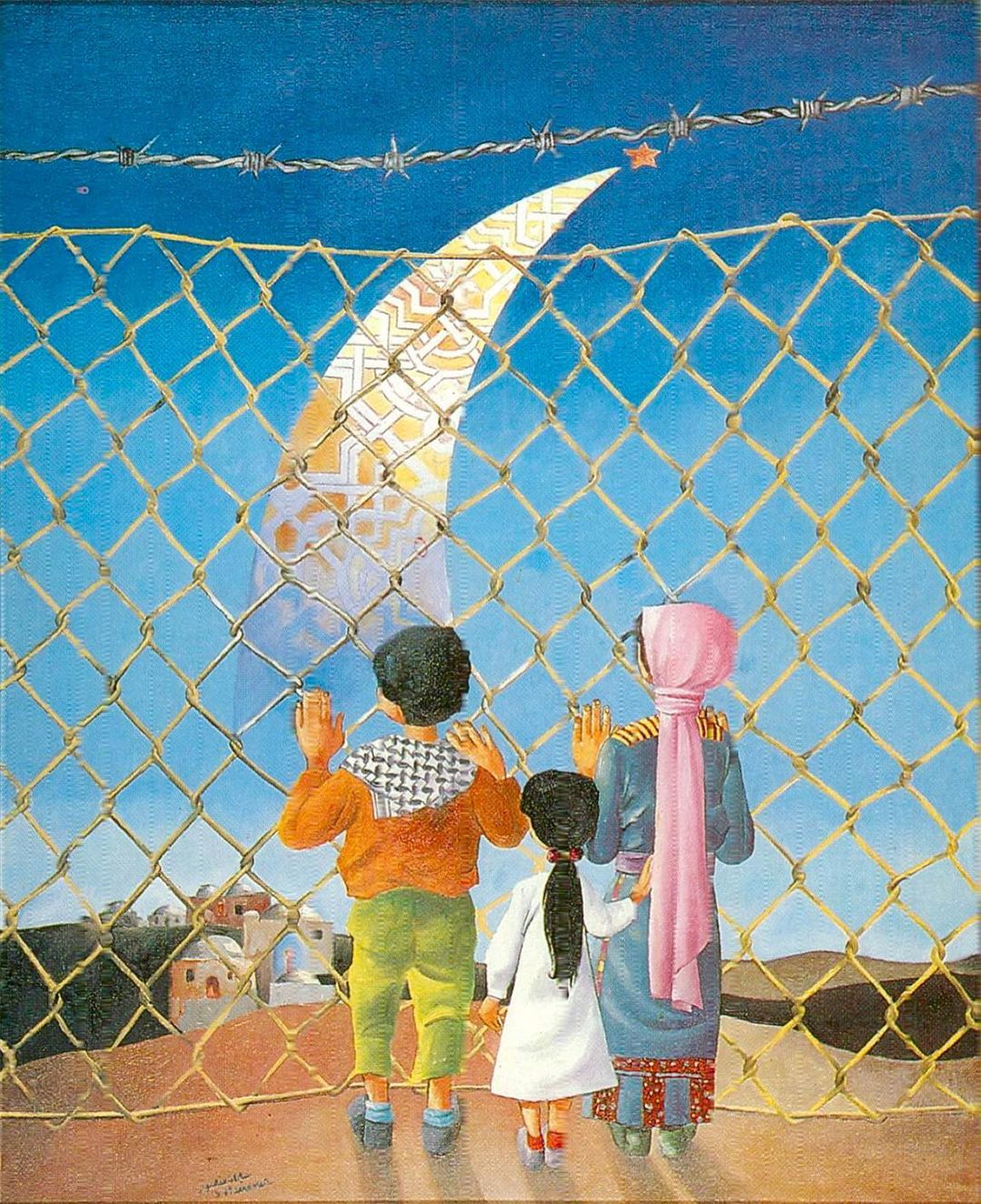
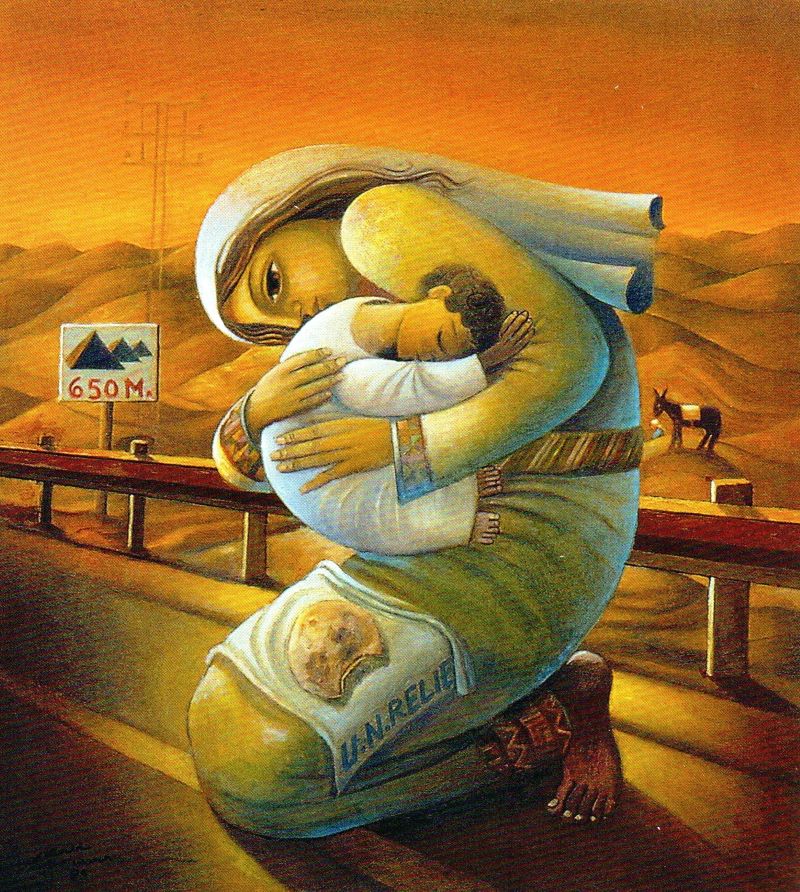
Sliman Mansour (Palestinian, 1947–), The Way to Bethlehem, 1990s. Acrylic on canvas.
LISTEN: “Bethlehem” by Jack Henderson | Performed by Over the Rhine, feat. Jack Henderson, on Blood Oranges in the Snow (2014)
Oh little town of Bethlehem Have you been forsaken? In your dark and dreamless sleep Your heart is breaking And in your wounded sky The silent stars go by
Oh little town of Bethlehem Be still tonight, be still
Mary, she was just a kid Jesus was a refugee A virgin and a vagabond Yearning to be free Now in the dark streets shining Is their last chance of a dream
Oh little town of Bethlehem Be still tonight, be still
Cradled by a crescent moon Born under a star Sometimes there’s no difference Between a birthmark and a scar
Oh little town of Bethlehem With your sky so black May God impart to human hearts The wisdom that we lack Should you chance to find A hope for all mankind
Oh little town of Bethlehem Be still tonight, be still
Over the Rhine is Karin Bergquist and Linford Detweiler, a married, music-making couple from Ohio. In preparation for their album Blood Oranges in the Snow, they put out a call to a few select colleagues for assistance with the songwriting. Glasgow-based singer-songwriter Jack Henderson responded with a demo of “Bethlehem,” which “reinvents the nativity story as a very modern tale set amid the ongoing Palestinian-Israeli conflict,” he writes. Over the Rhine arranged it, with Henderson singing lead and Bergquist providing backing vocals.
“How ironic that the very birthplace of Jesus should prove to be one of the most conflicted, unpeaceful regions of the world,” Bergquist says. Bethlehem is located in the West Bank, a Palestinian territory that has been under the military occupation of Israel since 1967. Numerous checkpoints have been set up in and around the Bethlehem district to restrict Palestinian movement.
The lyrics to Henderson’s “Bethlehem” pick up lines from the traditional Christmas carol “O Little Town of Bethlehem,” transposing them to the present day and giving them a dark twist. Phrases like “dreamless sleep” and “silent stars,” which in the original carol connote inexpectant slumber and a hushed nighttime idyll, in their new context allude to the nightmare of occupation (unjust arrests and imprisonments, shootings, house demolitions, impoverishment, impeded access to essential services like water and hospitals) and the seeming silence of God. The second verse highlights the Holy Family’s vulnerable status after Herod deployed troops to exterminate Jesus in an attempt to protect his own power.
The refrain, “Be still tonight, be still,” is a prayer for the cessation of violence in the land of Jesus’s birth.
>> “Peace on Earth” by U2: “Heaven on earth—we need it now. I’m sick of all this hanging around. Sick of the sorrow, sick of the pain . . .” U2’s “Peace on Earth” was inspired by the Omagh bombing in Northern Ireland on August 15, 1998. It first appeared on their 2000 album All That You Can’t Leave Behind, but I prefer the stripped-down acoustic version they recorded last year on Songs of Surrender.
The song wrestles with the tension between the angels’ proclamation of peace in Luke 2 and the course of history ever since, riddled, as before, with violence. “Hope and history won’t rhyme,” the lyrics lament—they’re just not matching up. “Peace on earth” feels naive; the words sometimes stick in our throats. The refrain addresses Christ: “Jesus, can you take the time / To throw a drowning man a line?” In its emotional honesty and its asks, it resembles a biblical psalm. (Bono has in fact spoken about how the Psalms have influenced his songwriting.)
When U2 performed “Peace on Earth” live at Sphere Las Vegas this February, Bono substituted the names of five Irish casualties of the Troubles listed in one of the verses with the names of four Palestinian and Israeli children who have been killed in the current Israel-Hamas War: Gal, Ayat, Hind, and Mila.
>> “There Will Be a Day (Isaiah 2)” by Caroline Cobb, arr. Joel Littlepage: I cued up my favorite song from last year’s Dawning Light service at Grace Mosaic church in Washington, DC (it’s at 32:50–37:29 of the video): “There Will Be a Day” by Caroline Cobb, based on Isaiah 2. The song is from Cobb’s album A Seed, a Sunrise: Advent to Christmas Songs (2020)—it’s my favorite of all her songs, and because of its emotional and summative power, I’ve set it as the concluding track of my Advent Playlist. Joel Littlepage, Grace Mosaic’s pastor of worship and formation and the director of the Daily Prayer Project, arranged it with gospel inflections for his church’s annual Advent carols service. He’s at the keyboard; his wife, Melissa Littlepage, is the vocal soloist (she’s also the choir director); and the saxophonist is Skip Pruitt.
ARTWORK: Home (land) Birth (place) by Beth Krensky:Beth Krensky is an artist, activist, and educator of Jewish heritage who describes herself as “a gatherer of things—objects, words, spirit—and a connector of fragments to make us whole.” Her website documents many compelling artistic projects she has undertaken over the past decade. One of them, Home (land) Birth (place), is a performance from 2016 with her academic colleague Amal Kawar, a professor of political science and the author of Daughters of Palestine: Leading Women of the Palestinian National Movement.
Beth Krensky (American, 1965–), Home (land) Birth (place), a performance with Amal Kawar, 2016, Great Salt Lake, Utah. Photo: Josh Blumental.
For this piece, Krensky sewed together a truce flag from baby clothes and other white linens and attached it to two olivewood poles onto which she burned quotes from Israeli and Palestinian mothers who have lost a child to Israeli-Palestinian violence. She and Kawar held the flag aloft in the desert outside their hometown of Salt Lake City as a call for peace. Read the artist’s statement at the link above, and view additional photos of the flag here.
+++
DEVOTIONAL POST: “Swords Will Be Turned into Plowshares,” Center for Christianity, Culture, and the Arts at Biola University: Every year Biola University’s CCCA publishes free daily Advent and Christmas devotions online that feature an artwork, a song, a poem, and a written reflection—the work of many contributors. You can access their 2024 Advent Project here.
Last year I was particularly taken with the peace-themed compilation offered on January 2, which includes a poem by Denise Levertov, a socially conscious, participatory art project led by Pedro Reyes (more on that in next roundup item), a Sweet Honey in the Rock rendition of an African American spiritual, and a wonderful reflection by Dr. Natasha Aleksiuk Duquette, a literature professor. Check it out.
+++
ARTICLE: “Mexican Artist Pedro Reyes Molds 1,527 Guns into Shovels Used to Plant Trees,”Colossal: Pedro Reyes is a Mexican artist, architect, and cultural agent who seeks to turn social problems into opportunities for tangible change through works that integrate elements of theater, psychology, and activism. (I learned about him through Biola’s Advent Project, above.) In 2008, in cooperation with city authorities, he led a campaign in Culiacán, Mexico, to collect firearms, giving donors vouchers for electronic appliances in exchange. The hundreds of guns he received were publicly crushed by a steamroller, melted, and remolded into shovels, which were then distributed to public schools and other institutions who committed to planting trees with them. This project was an effort to curb local gun violence and to cultivate the collective imagination toward life.
Pedro Reyes (Mexican, 1972–), Palas por Pistolas (Guns for Shovels), 2008Artist Pedro Reyes steamrolled 1,527 surrendered guns for his Palas por Pistolas project, transforming them into shovels for planting trees.
I’m interested in exploring more of Reyes’s work, as I love what he’s doing. In 2016, as a visiting lecturer in MIT’s Art, Culture, and Technology Program, he cotaught the course “The Reverse Engineering of Warfare: Challenging Techno-optimism and Reimagining the Defense Sector (an Opera for the End of Times).” A full-color illustrated survey of his projects, Pedro Reyes: Ad Usum / To Be Used, was published by Harvard University Press in 2017.
+++
INSTAGRAM SERIES: “Alternative Advent 2024” by Kezia M’Clelland: Through December 24, follow the Instagram account @alternative_advent for a progressively revealed photo essay of Advent promises told through journalistic images from 2024, sourced from various news organizations. I call attention to this project every year. The woman behind it, Kezia M’Clelland, has a master’s degree in violence, conflict, and development from SOAS University of London and helps equip churches and communities to support children and families in crisis situations.
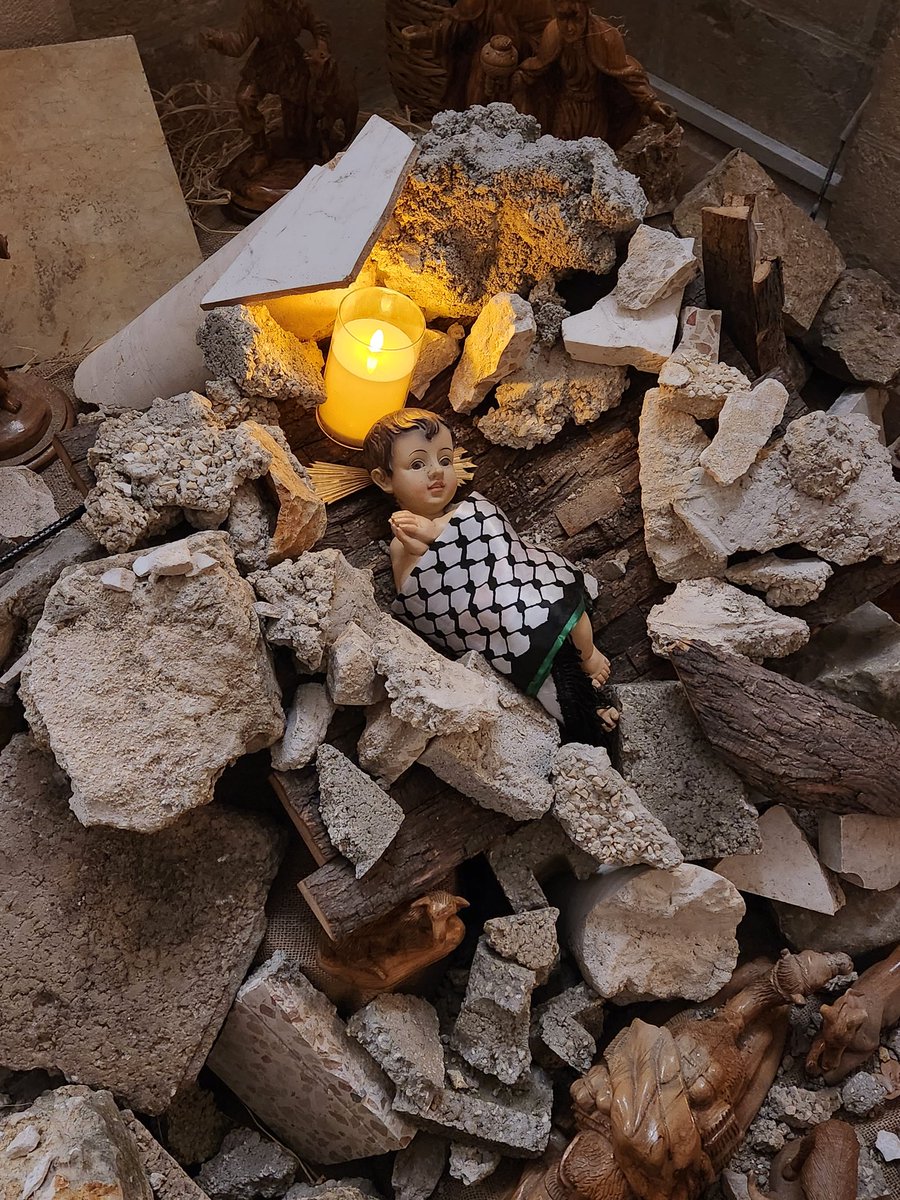
It shows the baby Jesus wrapped in a black-and-white checkered keffiyeh (Palestinian headdress) and lying in a pile of rubble while Mary, Joseph, the shepherds, the wise men, and the animals search for him. It is situated at the side of the altar in Bethlehem’s Evangelical Lutheran Christmas Church, which Rev. Dr. Munther Isaac, a prominent Palestinian Christian peacemaker, pastors. He said he wants the world to know that this is what Christmas looks like in Palestine this year, and for his own congregation to know the solidarity of Christ with the oppressed. Al Jazeera ran a news segment on the crèche on Tuesday, which features an interview with Isaac:
Since October 7, over 16,000 Palestinians have been killed by Israeli forces, and almost 1.9 million Palestinians (over 80 percent of the population) have been displaced. Morgues and hospital halls are overflowing in Gaza, and many people remain trapped under buildings felled by air strikes.
“In Gaza today, God is under the rubble. He is in the operating room,” Isaac wrote on Instagram. “If Christ were to be born today, he would be born under the rubble. We see his image in every child killed and pulled from under the rubble. In every child in incubators.” He expanded on these sentiments in a sermon preached October 22, titled “God Is Under the Rubble in Gaza,” reproduced in Sojourners. See also this video clip of Isaac explaining why his church chose to display such a scene in their sanctuary.
BLOG POST: “When a Dragon Tried to Eat Jesus: The Nativity Story We Don’t Talk About” by Chad Bird: “I’m still searching for a Christmas card with a red dragon in the nativity, lurking amidst the cows and lambs, waiting to devour the baby in the manger,” writes Bible scholar Chad Bird [previously]. “None of the Gospels mention this unwelcome visitor to Bethlehem, but the Apocalypse does. John paints a seven-headed, ten-horned red dragon onto the peaceful Christmas canvas. You can read all about it in Revelation 12. It’s the nativity story we don’t talk about. A dragon trying to eat our Lord . . .”
I’ve been wanting to write a long-form essay on this topic for some time—the dragon as a character in the Christmas story; a cosmic battle underlying our cozy little crèches. I would pull in iconography of the Woman of the Apocalypse and the treading of the beasts, as well as some Christmas songs and poems that reference the dragon. I won’t get around to it this season . . . but it’s coming sometime!
For now, I simply offer Chad Bird’s wonderful blog post to get you thinking about it. Since it was published in 2016, I’ve started seeing more people bringing it up. In 2019, Glen Scrivener, a minister in the Church of England, released the kids’ video “There’s a Dragon in My Nativity,” with illustrations by Alex Webb-Peploe and animation by Diego M. Celestino:
In 2020, Rev. Yohanna Katanacho, a Bible professor in Nazareth, wrote “The Christmas Dragon” for Radix, a retelling of the Nativity story through the lens of Revelation 12. And in a Christianity Today article published last December, Julie Canlis recommended adding a red dragon to your nativity set! Apparently some families have been doing this for years, such as the Gowins and the Palpants:
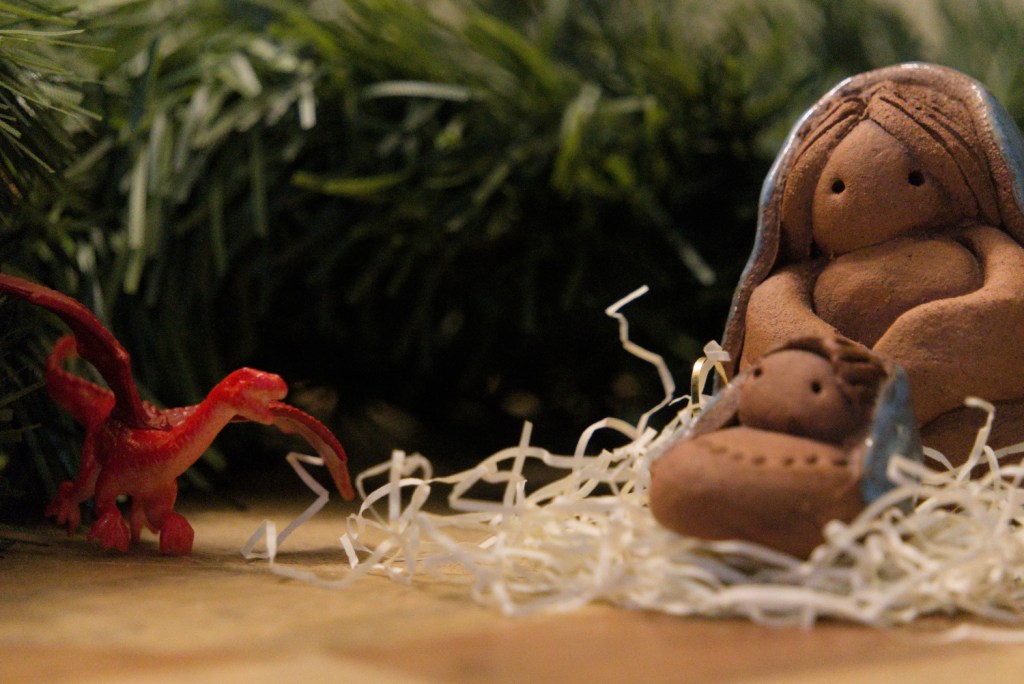
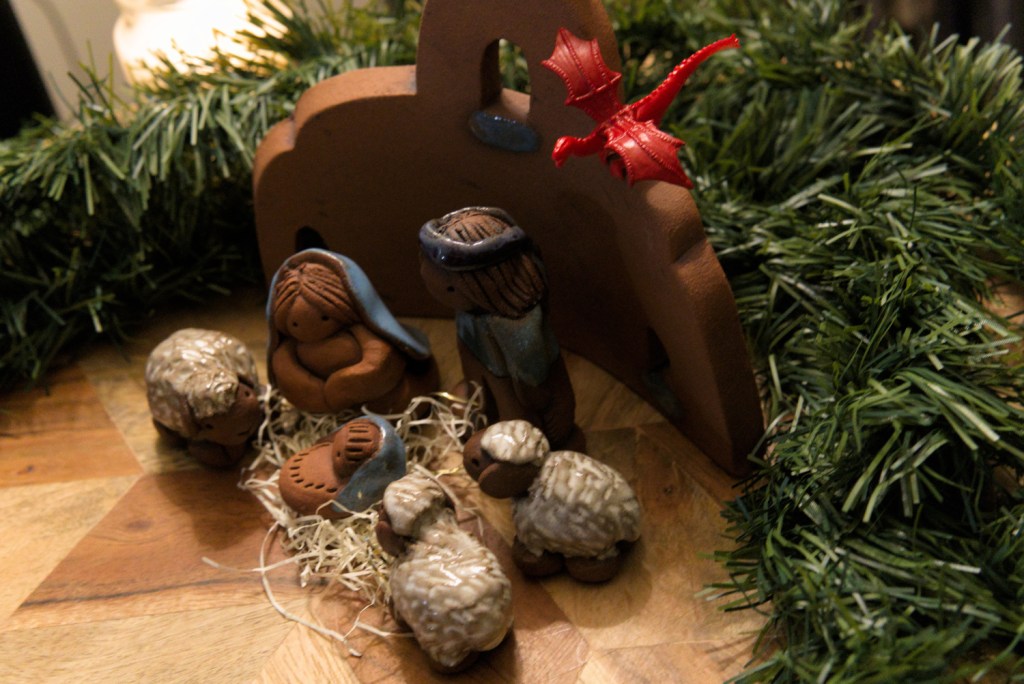
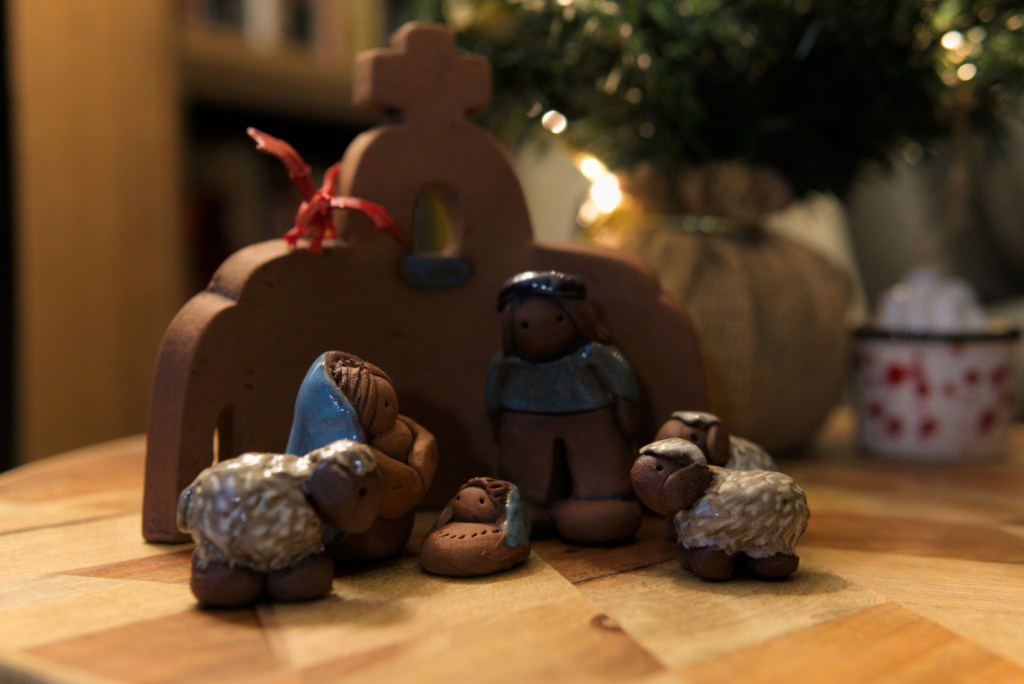
This year I bought a little plastic dragon myself to add to my household nativity! Below are some photos my husband and I took. The clay figurines and adobe-style backdrop were made by Barbara Boyd, an artisan from New Mexico. (I bought them in 2016 at a festival in Albuquerque.)
The dragon was part of a cheap multipack from Amazon, and there are twenty-three other dragons that I don’t know what to do with—so if you live in the US and you want one, shoot me an email at victoria.emily.jones@gmail.com and your physical mailing address and I’ll send you one! The first three respondents get a red one. None of them are seven-headed or horned per Revelation (a gap in the Christmas market, perhaps?!), but they still convey the gist.
+++
LECTURE: “What Is God’s Future for the World?: An Eschatological Vision for the Kingdom on Earth” by N. T. Wright: This talk on inaugurated eschatology, on heaven and earth coming together redemptively and new-creatively, was delivered at the Fuller Forum at Fuller Theological Seminary on May 3, 2014. Any time we talk, sing, or preach about the return of Christ and the end, Wright says, we’re really using signposts that point into a bright mist. But we need those signposts. Wright seeks to dispel the popular belief that humans’ ultimate destination is some disembodied existence “up there” and instead have us embrace the ancient vision of this world as the site of the Messiah’s eternal reign and these bodies as participants, a vision of creation made new from the old. To believe that God will eventually abandon the world to the forces of human wickedness or entropy and decay instead of claiming it as his own undermines the entire narrative of scripture. Wright makes his case by way of the books of Genesis, Isaiah, Ezekiel, Daniel, the Psalms, the Gospels, Romans, and Revelation—the whole gamut.
“The Jewish vision of God’s ultimate future was never that people would leave this world and end up somewhere else called heaven in the company of God. . . . When eschatology comes into full focus, . . . it is all about God’s kingdom being set up on earth as in heaven, and indeed on earth by means of heaven.” He continues, “Heaven is the place where God’s future purposes are stored. And the New Jerusalem comes down from heaven to earth so that the dwelling of God is with humans.”
There’s so much more I could say—but instead of reading my takeaways, listen to the talk itself! It ends at 1:04:45 and is followed by an hour of Q&A. Here is a list of the questions with time stamps:
1:05:33: What is your reading of 2 Peter 3:10–12, which says that the earth will be burned up?
1:08:18: What does Paul mean in 1 Thessalonians 4:17: “Then we who are alive, who are left, will be caught up in the clouds together with them to meet the Lord in the air, and so we will be with the Lord forever”?
1:13:05: Where do you land on premillennialism, amillennialism, postmillennialism?
1:15:42: If earth is already crowded, how will everyone fit in the renewed creation after the resurrection?
1:21:42: If this world is going to be renewed, why should we make economic and lifestyle sacrifices now to protect endangered species and such?
1:24:18: How do you interpret John 14:3: “I go and prepare a place for you; I will come again and take you to myself”?
1:27:48: How do you understand hell? What are your thoughts on the teaching of universal restoration, the idea that everyone will eventually be saved?
1:33:48: Since you take issue with Michelangelo’s Last Judgment, what would you have painted at the east end of the Sistine Chapel instead?
1:34:17: How does Paul’s “now and not yet” correlate with Jesus’s teaching that “this generation will not have passed away before all this has happened” (Matt. 24:34; Mark 13:30; Luke 21:32)?
1:36:59: What is the role of departed saints (the “cloud of witnesses”)? What are your thoughts on the intercession of the saints?
1:41:17: What are your words of advice for preaching on these subjects and for pastorally caring for congregants who come with certain stock images of and language about heaven?
1:44:30: Since we believe in Jesus’s bodily resurrection, where is Jesus now?
1:46:28: Please give us some guidance on Paul’s view on homosexuality and how to address this complex issue in the church.
1:52:16: Is there any sense in which the State of Israel founded in 1948 could be the fulfillment of biblical prophecy?
1:56:40: What impact do you hope your work has on Christian discipleship?
2:10:34: What’s the relationship between faith and action?
Oh, and at 1:18:58, Wright offers this rousing sidebar on Christian art:
We are starved imaginatively as Christians. Christian art easily collapses into sentimentalism, just as contemporary postmodern art easily collapses into brutalism. Both of those are ways of seeing something but not the whole picture. Sentimentalism is what you get when you’re determined to smile even if the whole world is falling apart; it becomes inane, this sort of silly grin, and sadly, there’s a lot of Christian art like that.
But actually, Christians ought to be at the forefront of the art and the music, because that creates the imaginative world within which it’s possible to think differently about things. I think the secular world has done a pretty good job, and we’ve colluded with that, of keeping our imaginative levels down to the level of eighteenth- and nineteenth-century Epicureanism or deism, so that heaven is just this odd place, etc., etc. We need the new art and the new music which will create a world in which it makes sense to think of these things.
+++
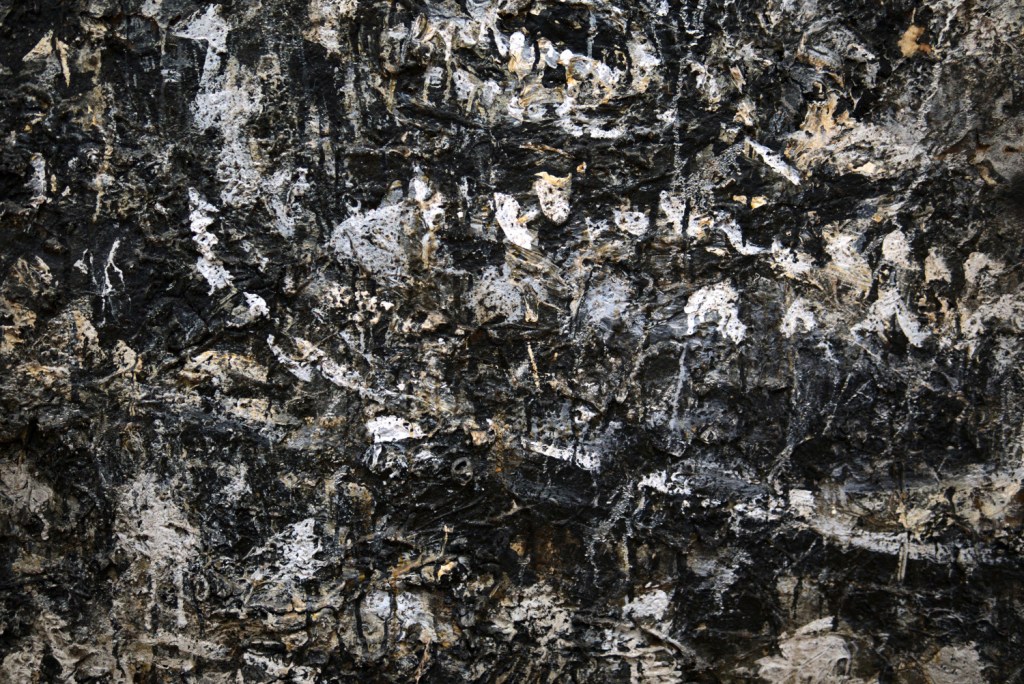
BLOG POST: “Advent Love and Anselm Kiefer’s Alchemist” by Alexandra Davison: I grew up, and my parents and sibling still live, in a suburb of Raleigh, North Carolina, so I’m a somewhat frequent visitor to the North Carolina Museum of Art. Their untitled triptych by Anselm Kiefer is one of my favorite pieces in their collection—it transfixes me every time—so I was delighted to see that Alexandra Davison [previously], a creative director of Artists in Christian Testimony International whom I bump into at arts conferences now and again, wrote about it a few years ago. She describes it as an image of “cosmic drama that waits for resolution,” conveying “an unflinching Advent longing.” I sense that too when I stand in front of it.
Anselm Kiefer (German, 1945–), Untitled, 1980–86. Oil, acrylic, emulsion, shellac, lead, charcoal, and straw on photograph, mounted on canvas, with stones, lead, and steel cable, overall 130 1/4 × 218 1/2 in. North Carolina Museum of Art, Raleigh. Photo: Victoria Emily Jones.
Kiefer is the subject of an acclaimed new documentary by Wim Wenders (which I’m eager to see when it comes to streaming!). He was born in Germany at the tail end of World War II, and his art, which often incorporates materials such as lead, ash, and straw, is inextricably connected to the ravaged landscapes and haunted history of his country.
VIRTUAL ARTIST RESIDENCY: 2023 Inbreak Residency: Led by Dea Jenkins, the organization Inbreak, which promotes social healing through the arts, is hosting its third annual (virtual) residency, open to US-based artists of any discipline interested in exploring the intersections of art, faith, and race in the United States. The residency provides a collaborative environment and opportunities for artistic development and creative leadership growth, with group workshops, group feedback sessions, studio visits, and a curriculum featuring a curated selection of viewings, readings, and dialogue prompts. It culminates in a live or virtual exhibition.
Applications are due by November 20, 2022; you are required to submit work samples, an artist statement and/or short bio, and a community-focused project proposal. Four applicants will be selected for the 2023 cohort, which runs from January to May, and each given a $500 stipend.
+++
SONG: “Lux Aeterna”: “Lux Aeterna” (Eternal Light) is the Communion antiphon for the Roman Catholic Requiem Mass. The traditional Latin text has been set to music by many composers. Recorded at All Hallows’ Gospel Oak in London in May 2021, this performance by the Gesualdo Six is of the setting by Spanish Renaissance composer Cristóbal de Morales. I share it in anticipation of All Saints’ Day on November 1.
The lyrics translate as follows:
May eternal light shine upon them, Lord, with your saints forever, for you are good.
Grant them eternal rest, Lord, and may light perpetual shine upon them, with your saints forever, for you are good.
The video came out of the Interfaith Sacred Art Forum and the Sacred Art in Collections pre-1900 Network, both launched last year as part of the National Gallery’s Art and Religion research strand. In their inaugural 2021–22 season, the theme was “Crossing Borders,” and they have used two paintings in the museum’s collection as a foundation for wide-ranging events and activities. The theme for 2022–23 is “The Art of Creation,” and the two paintings around which conversations and activities are based are Rachel Ruysch’s Flowers in a Vase (1685) and Claude Monet’s Flood Waters (1896).
+++
VIDEO: “Introducing Annie Dillard” by Tish Harrison Warren: In this video from the Trinity Forum, Anglican priest and writer Tish Harrison Warren introduces the forum’s fall reading, the Pulitzer Prize–winning classic Pilgrim at Tinker Creek (1975) by Annie Dillard. The book comprises Dillard’s evocative reflections on her time spent wandering about and observing the lively woods, creeks, and natural world of Virginia’s Roanoke Valley while she convalesced from illness.
“She [Dillard] has taught me, in the words of Eugene Peterson, to pray with my eyes open,” Warren says. “She has taught me to notice God at work in the world in ways that I wouldn’t.”
I hear Dillard quoted all the time, but I’m embarrassed to say that I have not yet read this quintessential book of hers! Though I do own it. I have now pulled it off the shelf and put it in my “to read imminently” stack. 😊
+++
VISUAL MEDITATION: “The Taste of Palestine” by Meryl Doney, on the art of Sliman Mansour: Sliman Mansour is a Palestinian Christian artist whose work centers on the Palestinian struggle against the Israeli occupation. This ArtWay article is a great, concise introduction to his work, spotlighting four of his paintings: Picking Olives; The Flight to Egypt; Hagar; and The Holy Family in an Olive Grove.
Sliman Mansour (Palestinian, 1947–), The Flight to Egypt, 1984. Oil on canvas.
Last month my friend Becky Hadeed, food photographer and creator and host of The Storied Recipe podcast, released an episode called “Honoring the Women of Palestine,” where she interviews Mai of Almond and Fig. Mai discusses growing up in Palestine and shares some of the ways she seeks to connect with her Middle Eastern heritage from her kitchen in Chicago.
Sarah, you massaged my sacrum
with a tennis ball when I was in labor.
Like a priestess of the body, you
wiped the newborn Ismail clean
of birthblood and whispered first
holy words into his ear. You are his mother
too. We are kin. No decrees
of man or God can make this truer
than it is, nor can it be cloven.

We did not begin with the husband we shared,
but in Egypt, with divine
intelligence arrowed from eye to eye
across a patio of pagan strangers,
when I was royalty and you were trembling
in the house. You knew exile and I
knew exile. You suffered and I suffered.

Like matter, kinship can be changed
but not destroyed. Cruelty tarnishes,
but cannot dissolve it. We are kin
from bread baked together,
salted, broken, eaten, sacred
as a challah braid at sunset on the Night of Power;
from the battering waters of the sea we crossed;
from the Tree of Life whose branches
we burned to stay alive. Kin
we are from knowledge of the Name;

you had the first letters, I had the last
and, putting them together, we
spelled out the Secret.
“Kin” by Mohja Kahf is from Hagar Poems (University of Arkansas Press, 2016). Reprinted by permission of The Permissions Company, Inc., acting on behalf of the publisher.
Mohja Kahf is a Syrian American poet, novelist, and scholar of Arabic literature, postcolonial studies, and Arab and Arab American feminism. Born in Damascus but moving to the midwestern US as a child, she was raised in a devout Muslim household. In her creative work and scholarship, she both respects and interrogates her own faith tradition.
Her second poetry collection, Hagar Poems, gives voice to several female characters from the Qur’an and Islamic history, many of whom are also present in the biblical narrative. Part 1 focuses on Hajar (or Hagar, as she’s called in the Bible) and, to a lesser extent, Sarah, the ancient matriarchs of Islam and Judaism, respectively. The remaining two parts spotlight Zuleikha (Potiphar’s wife); Asiya (Moses’s adoptive mother); Balqis (the queen of Sheba); Maryam (Mary); Khadija, Aisha, and Fatima (wives of Muhammad); Nusaiba (a disciple of Muhammad’s); and Hamamah (an Ethiopian princess-turned-slave known primarily as the mother of Bilal, a Muslim convert). The stories of these women are sometimes transposed into contemporary times. For example, Hajar goes to the moon, sees a therapist, participates in an AIDS march, and is visited by a caseworker responding to a report of domestic violence.
Like a few others in the volume, the poem I’ve selected here explores the relationship between Hagar and Sarah as a metonym for the relationships between modern-day adherents of the two religions they represent, on both personal and political scales (i.e., the Arab-Israeli conflict). But “Kin” is revisionist and aspirational, reimagining a more congenial, mutually supportive, compassionate sisterhood between the two matriarchs, and therefore also a brighter future for their descendants. It might be said that patriarchy made Hagar and Sarah rivals. Both suffered abuse within the system and at different points inflicted it as each gained privilege over the other and vulnerabilities and power dynamics shifted.
According to the biblical story (Gen. 12:10–20), a famine in Canaan drove Abraham and his wife Sarah to seek relief in Egypt. Fearful that his life would be endangered because of Sarah’s beauty (kings were, after all, known to go to extreme measures to get what they want), Abraham presents Sarah to the royal court as his sister, implying that she is sexually available. Pharaoh thus acquires her for his harem and, in gratitude for the giving over of his “sister,” lavishes Abraham with livestock and servants. But as judgment against Pharaoh’s act of (unwitting) adultery, God strikes him and his household with plagues, which is when Pharaoh realizes that he has been deceived. He orders Abraham and Sarah to leave Egypt.
It’s not until Genesis 16:1 that we meet Hagar, identified as “an Egyptian slave” (or, as some translations have it, a handmaid or servant) owned by Sarah. Presumably Sarah acquired—and yes, I use that disgusting term again, because women were treated as possessions in ancient Mesopotamia, including by other women—Hagar during her time in Egypt.
When Sarah cannot get pregnant, she forces Hagar to have sex with Abraham to bear him an heir. But when Hagar conceives Ishmael, Sarah becomes jealous, and the abuse worsens to the point that Hagar runs away. But God visits Hagar in the wilderness with words of comfort and reassurance. She returns to Abraham’s household and gives birth to Ishmael. Sometime later, Sarah herself miraculously conceives and gives birth to a son, Isaac, after which she casts out Hagar and Ishmael, no longer having need of them. God again comes to Hagar and to her son, both of them weak from thirst and on the verge of death. He reveals to them a well and promises to make of Ishmael a great nation, just as he promised of Isaac. “You are the God who sees me,” Hagar exults (Gen. 16:13).
According to Jewish midrash, before her enslavement to Sarah, Hagar was actually an Egyptian princess—that is, a daughter of Pharaoh’s. When Pharaoh witnessed the power of Sarah’s God, who came to Sarah’s defense by unleashing pestilence on Pharaoh’s house, he gave Hagar to her, saying, “Better that my daughter be a maidservant in this house than a mistress in another house” (Genesis Rabbah 45:1). In other retellings, Pharaoh gives her away reluctantly as penance, not wanting to incur any more of God’s wrath. And in yet another version, leaving Egypt with Sarah is Hagar’s idea, as she wishes to follow the one true God.
Islamic tradition also affirms Hagar’s royal birth, though according to the Qisas Al-Anbiya, she was the daughter of the king of Maghreb, whom Pharaoh killed, thus capturing her. Notably, neither Sarah nor Hagar are mentioned by name in the Qur’an; they are only briefly alluded to in Surah Ibrahim 14:37, where Abraham says in prayer, “I have settled some of my family in a barren valley near your Sacred House.” Hagar is, however, mentioned amply in the hadith.
In “Kin,” Kahf is interested in what binds Sarah and Hagar—and Jews and Muslims—together. Both women were subjected to gendered oppression, including sexual abuse, and had no recourse against it. Both were, at different times, strangers in a strange land—first Sarah in Egypt, then Hagar in Canaan and later the wilderness of Paran. Both experienced miraculous interventions by God and even heard his voice. Both were mothers. They shared, at least initially, a husband and a home—they baked and broke bread together. Their family lines would diverge, but the two, Kahf writes, were as intertwined as the braids of a challah loaf. “Kin / we are from knowledge of the Name”—both knew and embraced the same God, as would their spiritual descendants.
The poem is written to Sarah from Hagar’s perspective. Hagar looks back with empathy to their first meeting, when “I was royalty” (as rabbinic tradition has it) “and you were trembling / in the house.” Kahf idealistically envisions an intimacy between the two, and a cooperative spirit—for example, Sarah giving Hagar a sacral massage while she’s in labor, afterward welcoming Ishmael into the world with love and devotion.
This picture is not what we get in the sacred texts, where Sarah regards Hagar with bitterness and hostility and mistreats her, and, if Sarah’s complaints can be trusted, Hagar lords it over Sarah when Hagar becomes pregnant with Abraham’s first son.
But what if the women had been friends? What if Ishmael and Isaac had been raised together as brothers? How might those strong familial ties and goodwill have impacted subsequent generations and influenced Jewish-Muslim relations in the present day?
Like Kahf, Indian American Jewish artist Siona Benjamin also explores gender and religious identity through her work, focusing especially on the biblical matriarchs. Also like Kahf, she is interested in the midrashic process by which exegetes, be they scholars or artists, approach the stories of scripture with a spirit of seeking and inquiry, responding with creative interpretations that read between the lines and ponder implications.
Siona Benjamin (Indian American, 1960–), Beloved (Sarah and Hagar), 2004. Gouache on paper, 20 × 16 in. From the Finding Home series.
In her painting Beloved (Sarah and Hagar), Sarah wears a kippah on her head and tefillin (small boxes with passages from the Torah curled inside) on her arms, while Hagar wears a hijab and a misbaḥah (string of prayer beads). The two women are wound together in a tight embrace—“reflections of each other,” the artist says. They’re also wounded together, their bodies blown apart, blood dripping like tears from the rifts. To the side is a pair of amputee Israeli soldiers, whose surveillance camera has identified three Palestinian suicide bombers. Integrated into the foliate decoration around the border are guns and grenades.
Benjamin says this painting represents the eventual reuniting of Sarah and Hagar after Hagar’s banishment, an invented outcome but one that expresses hope for reconciliation between Jews and Muslims, and particularly between Israel and Palestine. When we recognize the shared humanity of the “other,” and how they are just as beloved of God, it becomes impossible to view them as the enemy, to be occupied or killed.
Did Sarah and Hagar ever share the kind of closeness Benjamin envisions in Beloved? Probably not. But does that mean the two nations they founded must forever be at war? Let us pray for peace and pursue it.
Instead of finger-pointing or offering political solutions, these two artistic works—one by a Muslim, one by a Jew—serve as prayers of lament and hope. They probe beneath the surface of Sarah and Hagar’s story and imagine future possibilities.
>> Rozhdestvo (The Nativity) (1996), written and directed by Mikhail Aldashin: I am blown away by this wordless animated short from Russia. Using a naive art style washed in sepia tones and set to a soundtrack of Bach and Beethoven, it tells the story of how angels, humans, and animals came together on the first Christmas to worship the newborn Christ. It opens with Gabriel peeking out from behind a tree at Mary hanging laundry, then chasing her down a footpath to tell her what God is up to. For every person and critter he encounters, Gabriel flashes open the book of God’s word, pointing them to the shalom it prophesies and inviting them to enter in. By the end, shepherds, fishermen, kings, rabbits, lambs, and lion are participating in a round dance outside the stable, while an angel orchestra (which includes violins and timpani!) plays from the rooftop.
An emphasis on the sweet humanity of the holy couple—scared, tired, joyful, loving—makes this film especially endearing, and the roles given to animals reminds us that under Christ, all creation will be redeemed. I’m adding this to my annual Christmas watchlist! [HT: ArtWay]
>> O Little Town of Bethlehem (2012), dir. Tim Parsons: Commissioned by St. Paul’s Arts and Media (SPAM) in Auckland, New Zealand, this film tells the story of Christ’s Nativity through the voices of those who currently live in and around his birthplace of Bethlehem. A Palestinian shepherd, taxi driver, street vendor, midwife, peace activist, and antiquities dealer are among those interviewed, each reflecting on the significance of Christ’s story and providing a window into Middle Eastern culture. Some are Christian, others are Muslim (the Koran has its own account of the virginal conception and birth of Jesus—or Isa, as he is known in that tradition).
Though filmed five years ago, the living conditions captured in this video still exist. The West Bank’s 440-mile wall, built by Israel on seized land, plows through front yards, farms, and university campuses and restricts the movement of Palestinians—to water, work, prayer, and hospitals. Since the establishment of the modern State of Israel in 1948, many Palestinians have been displaced from their homes and live in refugee camps. The director said he didn’t want to make the film political but that he couldn’t avoid filming these realities. The hopes and prayers expressed by the film’s subjects we should adopt as our own this Christmas as we reflect on the birth of Hope, Peace, Joy, and Love two thousand years ago in this little Palestinian town.
+++
SONGS:
>> “Glory in the Darkest Place” by Brittany Hope: Last December Brittany Hope Kauflin (whose professional name drops the “Kauflin”) wrote “a song for those in darkness this Christmas season,” video-recording it at home with her sister McKenzie and her dad Bob. The outpouring of appreciation she received made her recognize the demand for soft and somber Christmas songs that probe for the light—as for many people, the holidays are characterized more by sadness than by celebration. Now the song is available, along with seven others in the same vein, on the album Glory in the Darkest Place. To read an introduction to the song by Bob Kauflin and/or to download the chord chart, piano score, and lyrics, click here. [HT: Bruce Benedict]
>> “Hellige Natt” (O Holy Night),arr. Eirik Hegdal, feat. Kirsti Huke: This innovative Norwegian jazz arrangement of the Christmas classic “O Holy Night” is performed inside the medieval Nidaros Cathedral in Trondheim by the Norwegian University of Science and Technology (NTNU) Jazz Ensemble and the NTNU Chamber Orchestra. An impressive space whose grandeur is matched by this rich, expressive performance. [HT: Global Christian Worship]
+++
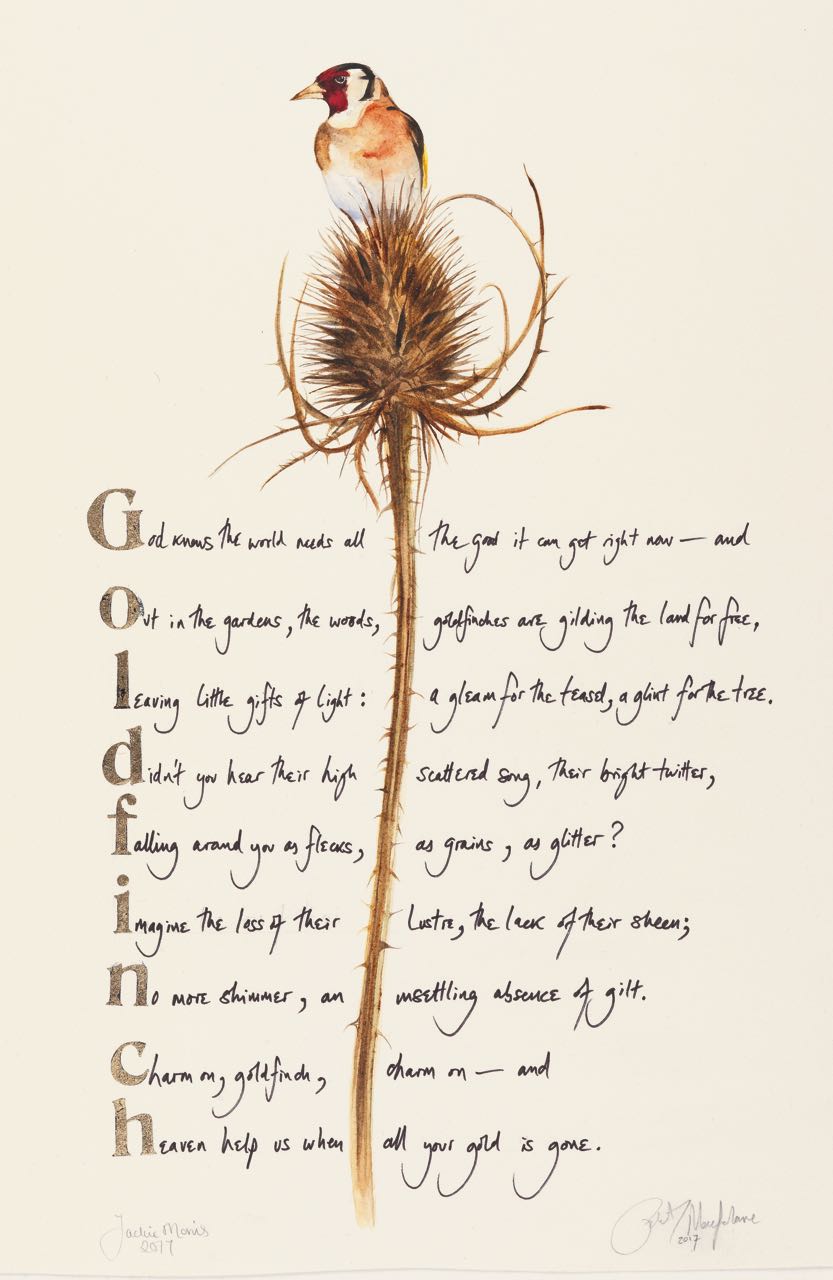
ILLUMINATED POEM: “Goldfinch” by Robert Macfarlane, illuminated by Jackie Morris: Nature writer Robert Macfarlane’s critically acclaimed book The Lost Words: A Spell Book, illustrated by Jackie Morris and published this October, is a joyful celebration of the nature words that were dropped from the 2008 edition of the Oxford Junior Dictionary. Aiming to “enchant nearby nature again” for both kids and adults, it comprises a series of acrostic poems whose main letters are gilded in gold leaf.
Poem by Robert Macfarlane. Art by Jackie Morris.
I’m pleased to see that Macfarlane’s collaboration with Morris has continued with his latest “Goldfinch”—a “‘charm’ about hope, harm, gift & darkness.” Handwritten over a painting by Morris, the poem begins
God knows the world needs all the good it can get right now—and
out in the gardens, the woods, goldfinches are gilding the land for free,
leaving little gifts of light . . .
The piece is reproduced in the latest issue of Elementum Journal, and the original has sold. Hear Morris read the poem in the SoundCloud player above.
Click here to read an interview with Macfarlane and Morris on the making of The Lost Words, and here to read Macfarlane’s response to a 2002 study that found that four- to eleven-year-old Brits are better at identifying Pokémon characters than native species of plants and animals, like oak tree and badger. Also, check out his other books, like Landscape, The Old Ways: A Journey on Foot, The WildPlaces, and Mountains of the Mind.
Many of the artworks and resources I share on these roundup posts I discover through the individuals, organizations, or publications I follow on social media or via RSS. If I’m not introduced to the content directly by its maker, I will try to indicate an “HT” credit, shorthand for “hat tip,” meaning thank you, X, for bringing this to my attention! All descriptions and commentary, however, are my own, unless set in quote marks.












 Art & Theology