Advent, Day 1: Wait

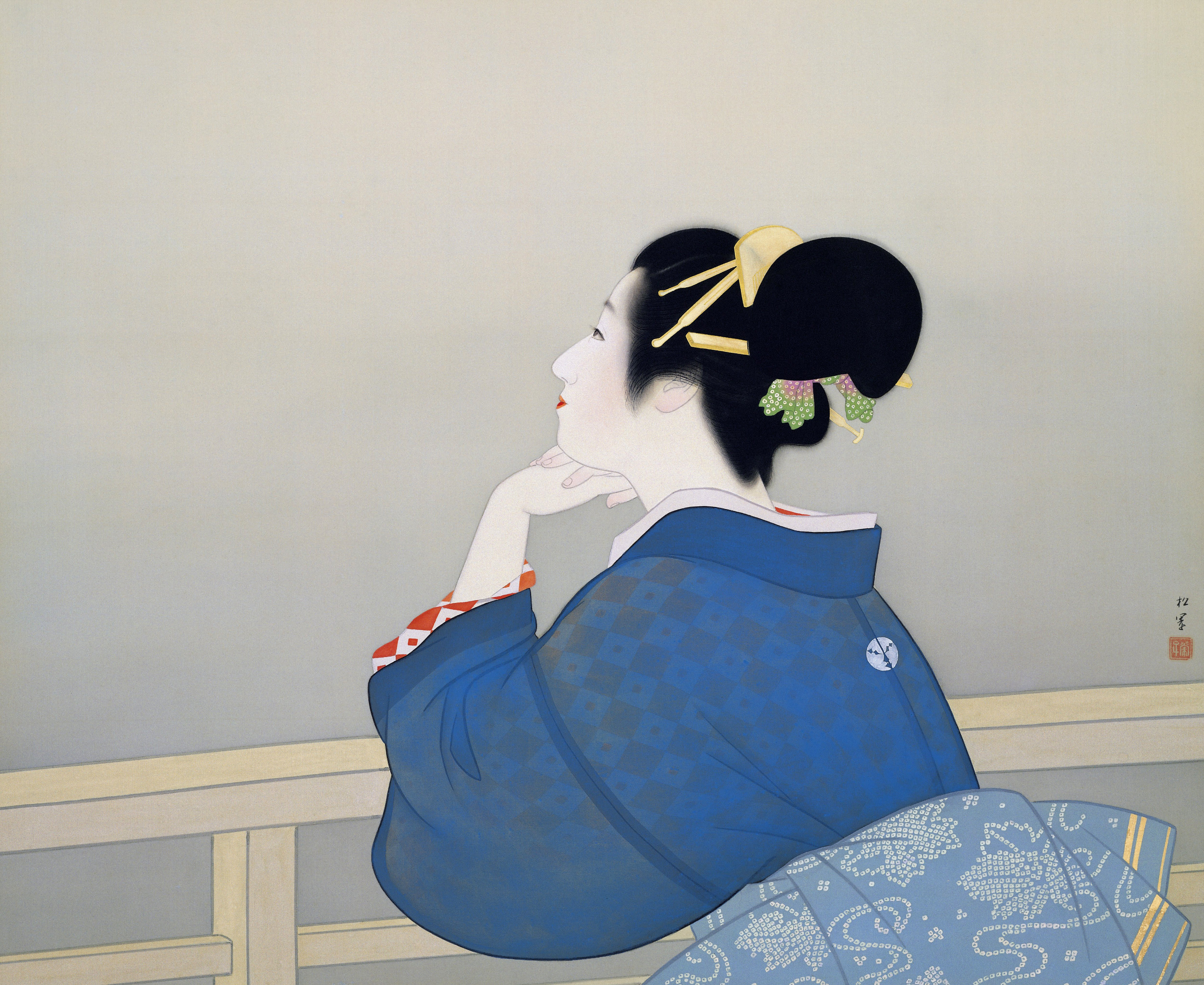
LOOK: Woman Waiting for the Moon to Rise by Uemura Shōen
Uemura Shoen_Woman Waiting for the Moon to Rise
Uemura Shōen (Japanese, 1875–1949), Woman Waiting for the Moon to Rise, 1944. Nihonga watercolor on silk, 73 × 86 cm. Adachi Museum of Art, Yasugi, Japan.

Uemura Shōen, the pseudonym of Uemura Tsune (1875–1949), was a Japanese artist active in the first half of the twentieth century, known primarily for her bijin-ga paintings of beautiful women in the nihonga style. A mold-breaking artist of exceptional skill, “she won international awards and accolades, defied social norms as a single mother of two, and dived into the world of professional painting at a time when women weren’t welcome.” In 1948 she became the first woman to be awarded Japan’s prestigious Order of Culture.

Uemura painted Woman Waiting for the Moon to Rise during World War II, showing a young woman leaning against a bridge railing on a foggy evening, her chin resting on her folded hands and her face looking ahead wistfully. Though the title tells us she’s waiting for the moon to rise, perhaps she’s also waiting for the war to end, for peace to be restored.

LISTEN: “Wait for the Lord” by Jacques Berthier of the Taizé Community, on Alleluia (1988)

Wait for the Lord, whose day is near.
Wait for the Lord: be strong, take heart!

The text of this simple chant comes mainly from Psalm 27:14: “Wait for the LORD; be strong, and let your heart take courage; wait for the LORD!” The chant was written as a responsorial refrain to the reading of another psalm, Psalm 37. As the hymnal Lift Up Your Hearts (2013) instructs congregations: sing the Taizé refrain; read Psalm 37:1–5, sing; read Psalm 37:6–9, sing; read Psalm 37:10–11, 39–40, sing. Like this:

Wait for the Lord, whose day is near.
Wait for the Lord: be strong, take heart!

Do not fret because of the wicked;
    do not be envious of wrongdoers,
for they will soon fade like the grass,
    and wither like the green herb.

Trust in the LORD, and do good;
    so you will live in the land, and enjoy security.
Take delight in the LORD,
    and he will give you the desires of your heart.

Commit your way to the LORD;
    trust in him, and he will act.

Wait for the Lord, whose day is near.
Wait for the Lord: be strong, take heart!

He will make your vindication shine like the light,
    and the justice of your cause like the noonday.

Be still before the LORD, and wait patiently for him;
    do not fret over those who prosper in their way,
    over those who carry out evil devices.

Refrain from anger, and forsake wrath.
    Do not fret—it leads only to evil.
For the wicked shall be cut off,
    but those who wait for the LORD shall inherit the land.

Wait for the Lord, whose day is near.
Wait for the Lord: be strong, take heart!

Yet a little while, and the wicked will be no more;
    though you look diligently for their place, they will not be there.
But the meek shall inherit the land,
    and delight themselves in abundant prosperity.

The salvation of the righteous is from the LORD;
    he is their refuge in the time of trouble.
The LORD helps them and rescues them;
    he rescues them from the wicked, and saves them,
    because they take refuge in him.

Wait for the Lord, whose day is near.
Wait for the Lord: be strong, take heart!

Psalm 37 encourages trust and patience in God, who will one day vindicate the righteous and put wickedness to bed.

Holy Week: Jesus Enters Jerusalem

When they were approaching Jerusalem . . . they brought the colt to Jesus and threw their cloaks on it, and he sat on it. Many people spread their cloaks on the road, and others spread leafy branches that they had cut in the fields. Then those who went ahead and those who followed were shouting,

Hosanna!
Blessed is the one who comes in the name of the Lord!
Blessed is the coming kingdom of our ancestor David!
Hosanna in the highest heaven!

Then he entered Jerusalem and went into the temple . . .

—Mark 11:1, 7–11

LOOK: Palm Sunday by Kai Althoff

Althoff, Kai_Palmsonntag
Kai Althoff (German, 1966–), Palmsonntag (Palm Sunday), 2002. Boat varnish, watercolor, and tinted paper on canvas, 70 × 90 cm. Private collection, Berlin.

In Kai Althoff’s painting of Jesus entering Jerusalem on a donkey, the background pulsates with color and people from all walks of life lay down their garments to carpet his path. There’s a nun and a monk in their habits; two bishops in dalmatics, one of whom casts his mozzetta at Christ’s feet; a choirboy; folks in a coat and tails and party dresses; and others in overalls, sweaters, and wool skirts. On the left, a backpacker passes by, looking behind him with curiosity at the hubbub, while at the bottom right a crowd of haloed people point and gaze—one man even yanks the collar of a friend, trying to pull him closer to the front for a better view.

Several of those present wave palm branches and shout, “Hosanna!,” meaning “Save us!” They quote Psalm 118:25–26: “Save us, we beseech you, O LORD! O LORD, we beseech you, give us success! Blessed is the one who comes in the name of the LORD.” The people recognize Jesus as their delivering Messiah and celebrate.

LISTEN: “Hosanna” by Jacques Berthier, 1978 | Performed by the Paul Leddington Wright Singers on Songs of Taizé, vol. 4 (2006)

Hosanna, hosanna!
Hosanna in excelsis!

This Palm Sunday canon (round) is from Taizé, a community of lay brothers in southern France who welcome pilgrims, especially young ones, from all over the world. The Latin in excelsis means “in the highest.”

Though the Hebrew expression that “Hosanna” transliterates was used by Jews as a supplication, a plea, today Christians often use “Hosanna” as a shout of jubilation, an acclamation of praise, in recognition of the salvation Jesus has wrought—so instead of the imperative “Save!,” it’s the exclamative “Salvation!” I think both meanings can hold simultaneously.


This is the first post in a daily series (running through Saturday) in which I’ll highlight a handful of events from Holy Week by choosing a visual artwork and a piece of music that engage with that event. The posts will all be short like this one—I imagine people spending ten minutes or so with each—and are an invitation to prayer and contemplation. For additional music, see the Art & Theology Holy Week Playlist on Spotify.

Maundy Thursday: Watch and Pray

Then Jesus went with his disciples to a place called Gethsemane, and he said to them, “Sit here while I go over there and pray.” He took Peter and the two sons of Zebedee along with him, and he began to be sorrowful and troubled. Then he said to them, “My soul is overwhelmed with sorrow to the point of death. Stay here and keep watch with me.

Going a little farther, he fell with his face to the ground and prayed, “My Father, if it is possible, may this cup be taken from me. Yet not as I will, but as you will.”

Then he returned to his disciples and found them sleeping. “Couldn’t you men keep watch with me for one hour?” he asked Peter. “Watch and pray so that you will not fall into temptation. The spirit is willing, but the flesh is weak.”

He went away a second time and prayed, “My Father, if it is not possible for this cup to be taken away unless I drink it, may your will be done.”

When he came back, he again found them sleeping, because their eyes were heavy. So he left them and went away once more and prayed the third time, saying the same thing.

Then he returned to the disciples and said to them, “Are you still sleeping and resting? Look, the hour has come, and the Son of Man is delivered into the hands of sinners. Rise! Let us go! Here comes my betrayer!”

—Matthew 26:36–46 NIV, emphasis added

LOOK: Agony in the Garden by Fra Angelico [HT: John Skillen]

Fra Angelico_Agony in the Garden
Fra Angelico (Italian, ca. 1387–1455), Agony in the Garden, ca. 1450. Fresco, 177 × 147 cm. Cell 34, Convent of San Marco, Florence.

This fresco is from one of the forty-four cells in the Dominican convent of San Marco in Florence whose walls Fra Angelico and his assistants painted with religious scenes in the mid-fifteenth century. The friars who lived at San Marco—of which the artist, whose nickname means “Angelic Brother,” was one—used these paintings for private meditation.

Here we see Jesus in the garden of Gethsemane pleading with God the Father to let the cup of suffering, held out by an angel, pass him by. As he prays in agony, his disciples James, John, and Peter nod off just a stone’s throw away. Jesus had asked them to stay awake and pray with him, but their tiredness gets the better of them. In their friend’s hour of deepest need, they fail him.

By contrast—and this is unique!—Mary and Martha, two sisters from Bethany who are also followers of Jesus, are awake and alert under an open loggia, diligently praying and studying God’s word. Perhaps Mary points, in the book in her lap, to the passage of the Suffering Servant in Isaiah 53, recognizing Christ in it, or to the book of Exodus, where the Israelites celebrate their first Passover by smearing the blood of a lamb over their doors. Perhaps Martha prays that the Father would grant Jesus discernment of his will and the strength to follow through with it—that he would sustain him all the way to the cross and beyond.

While the male disciples on the other side of the wall fall asleep, heads in hands, the women watch and wait through the night, exemplars of faithfulness. They trust the prophecies and keep vigil, supporting their Lord in his suffering.

LISTEN: “Stay with Me” by Jacques Berthier, 1984 | Performed by the Taizé Community Choir on Songs of Taizé: O Lord, Hear My Prayer & My Soul Is at Rest, 1999

Stay with me
Remain here with me
Watch and pray
Watch and pray

The words from this Taizé chant come from Jesus’s words in Matthew 26:38, 41 (cf. Mark 14:34, 38). He and his disciples have just finished the Passover Seder, and with full bellies, three of them follow Jesus up to an olive grove, which was perhaps a favorite prayer spot. But they neglect his instruction to stay awake and pray with him.

How can we remain with Christ this Maundy Thursday?

To “keep vigil” this night is to be fully present to Christ’s suffering and spiritually awake to his will and way.

This song is on the Art & Theology Holy Week Playlist.

Pentecost roundup

SONGS: The Holy Spirit Prayer is a traditional Catholic prayer that’s sung at Mass on the feast of Pentecost: “Come, Holy Spirit; fill the hearts of your faithful, and kindle in them the fire of your love. Send forth your Spirit and they shall be created, and you shall renew the face of the earth. O God, who by the light of the Holy Spirit did instruct the hearts of the faithful, grant that by the same Holy Spirit we may be truly wise and ever enjoy his consolations, through Christ our Lord. Amen.” The following two songs are settings of the first part of this prayer.

>> “Kindle in Us Your Love” by Deanna Witkowski: This funky refrain by jazz composer Deanna Witkowski “works well as a gospel acclamation, prayer response, or opening song,” especially for Pentecost. I’m planning to introduce it to my Presbyterian congregation this Sunday. (For church services, Witkowski charges a licensing fee of just $3 per use.) You can purchase the piano score here; it also appears in the Voices Together hymnal. Hear a high school choir perform the piece in the video below, with Witkowski accompanying on keys.

Come, Holy Spirit
Kindle in us the fire of your love
Come, Holy Spirit
Kindle in us your love

>> “Holy Spirit, Come to Us” by Jacques Berthier (Taizé chant): Taizé is an ecumenical Christian monastic community in France comprising more than one hundred Catholic and Protestant brothers from some thirty different countries. They welcome in around a hundred thousand young pilgrims a year, who come for prayer, Bible study, and communal work and worship. The songs of Taizé use simple musical phrases and few words that are repeated. Composed in 1998, “Holy Spirit, Come to Us” is one of 232 songs Jacques Berthier wrote for Taizé. It consists of solo verses sung by a leader over an ostinato refrain sung by the people.

Holy Spirit, come to us
Kindle in us the fire of your love
Holy Spirit, come to us

Jesus said, “It is by your love for one another
That everyone will recognize you as my disciples.”

Jesus said, “No one has greater love than this:
To lay down one’s life for those one loves.”

We know love by this,
That Christ laid down his life for us.

This is love: it is not we who have loved God
But God who loved us.

Taizé songs may be sung in public worship settings free of charge, provided their simplicity is preserved (i.e., no elaborate arrangements are permitted); for other uses, see here.

+++

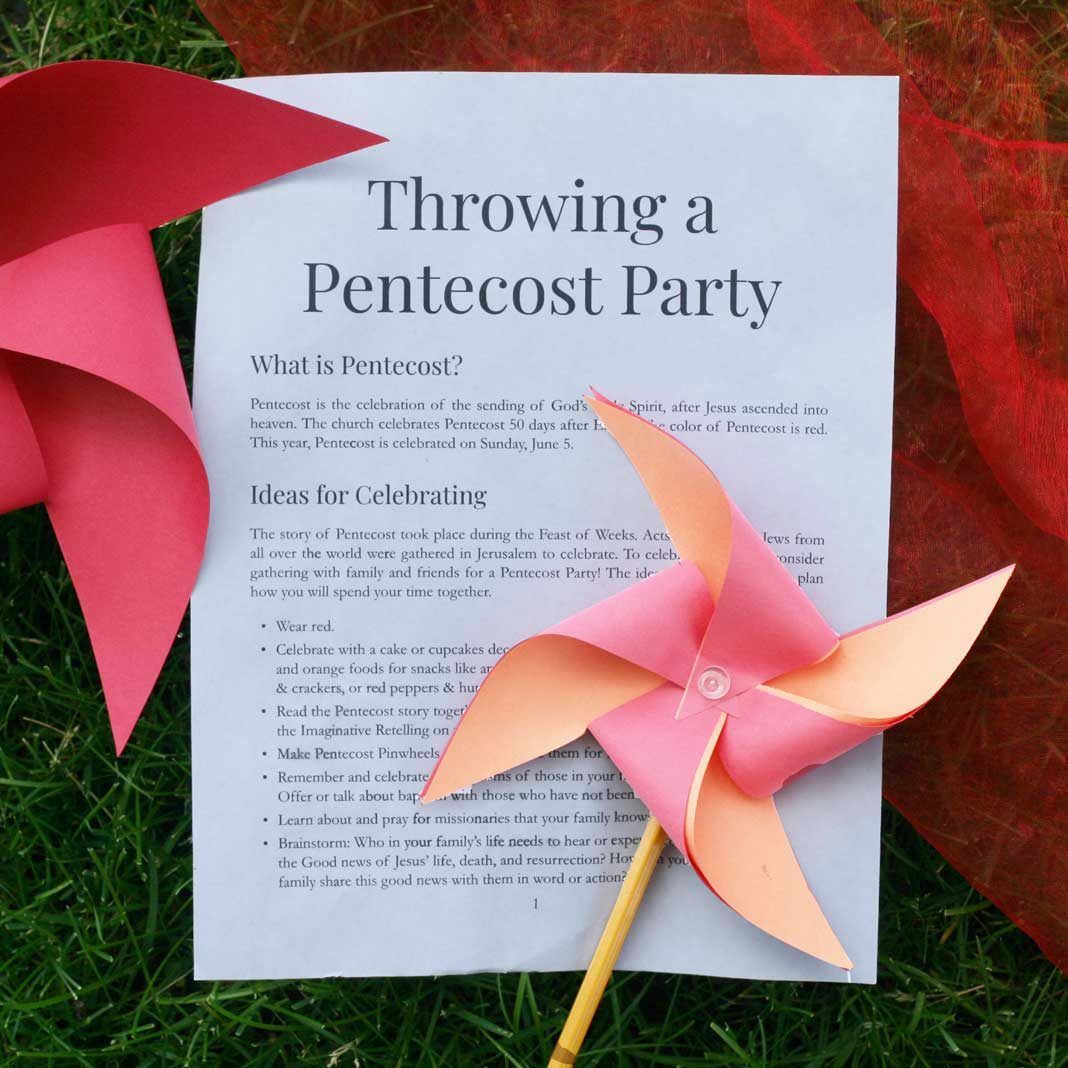
DIGITAL DOWNLOAD: Pentecost Party: Word & Wonder is offering a free twelve-page PDF of resources for celebrating Pentecost with children. Besides a list of party ideas, it includes an imaginative retelling of the Pentecost story from the perspective of a child, a prayer guide, prompts for talking about the Holy Spirit, coloring pages, and a pinwheel craft. On their website you will also find other family-friendly resources for the church year. [HT: Global Christian Worship]

+++

BLOG POST: “Whitsun Week” by Eleanor Parker: “The week following Pentecost is a lost holiday. From the Middle Ages until the early 20th century the period around Whitsun was the principal summer holiday of the year – especially Whit-Monday”—which is June 6 this year. “It was the time for fairs, Morris dancing, games, ale-drinking, school and church processions, weddings, wandering into the countryside, and generally having a good time.” Gooseberries and cheesecakes were broken out for the occasion, and communities engaged in fun activities like cricket, archery, sack races, and donkey derbies.

British medievalist Eleanor Parker compiles several sources that describe the Whitsuntide festivities of medieval western Europe and calls her readers to revive the week’s outdoor merrymaking!

+++

SHORT FILM: Stickmatch: Created in 2020 by London-born animator William Crook, this twenty-second stop-motion animation uses autumn leaves to simulate flames. [HT: Colossal]

+++

Here’s a new Spotify playlist I made for the month of June.

+++

Previous posts on the blog that are related, either directly or indirectly, to Pentecost include:

Advent, Day 2: Fire

LOOK: Jyoti Sahi (Indian, 1944–), Jesus Offering the Light (Arathi), 2004. Oil on canvas. Private collection, California, USA. For commentary by the artist, visit his blog.

Sahi, Jyoti_Jesus Offering the Light

LISTEN: “Within Our Darkest Night” by Jacques Berthier (Taizé community), 1991 [sheet music]

Within our darkest night
You kindle the fire that never dies away
That never dies away

Update, 1/12/21: I just came across the following quote in an Advent devotional (which arrived on order from my library after Advent!), and I instantly thought of this blog post.

Light comes pretty inexpensively and maybe even too conveniently to us. With batteries in flashlights and the cool-to-the-touch fluorescent glow of chemical lights, Christ might well say to us anew: “You are the fire of the world.” Fire is heat and combustion—fuel actively being consumed and transformed into energy. “Fire!” is a cry for attention, and a warning for anyone who is unprepared. That must be what Our Lord had in mind when he said, “You are the light of the world.” We have grown accustomed to Advent being a season of light, but let’s agree to make this Advent a season of fire. Be consumed by the energy that dwells and is growing within. Let it burn in you. Let God use fire to purify the cosmos through you and make ready the Way of the Lord.

—Thomas Hoffman, A Child in Winter: Advent, Christmas, and Epiphany with Caryll Houselander, p. 61


For each day of the first week of Advent I am publishing one art-and-song pairing as an invitation for seasonal reflection.