Christmas, Day 7: In the Beginning

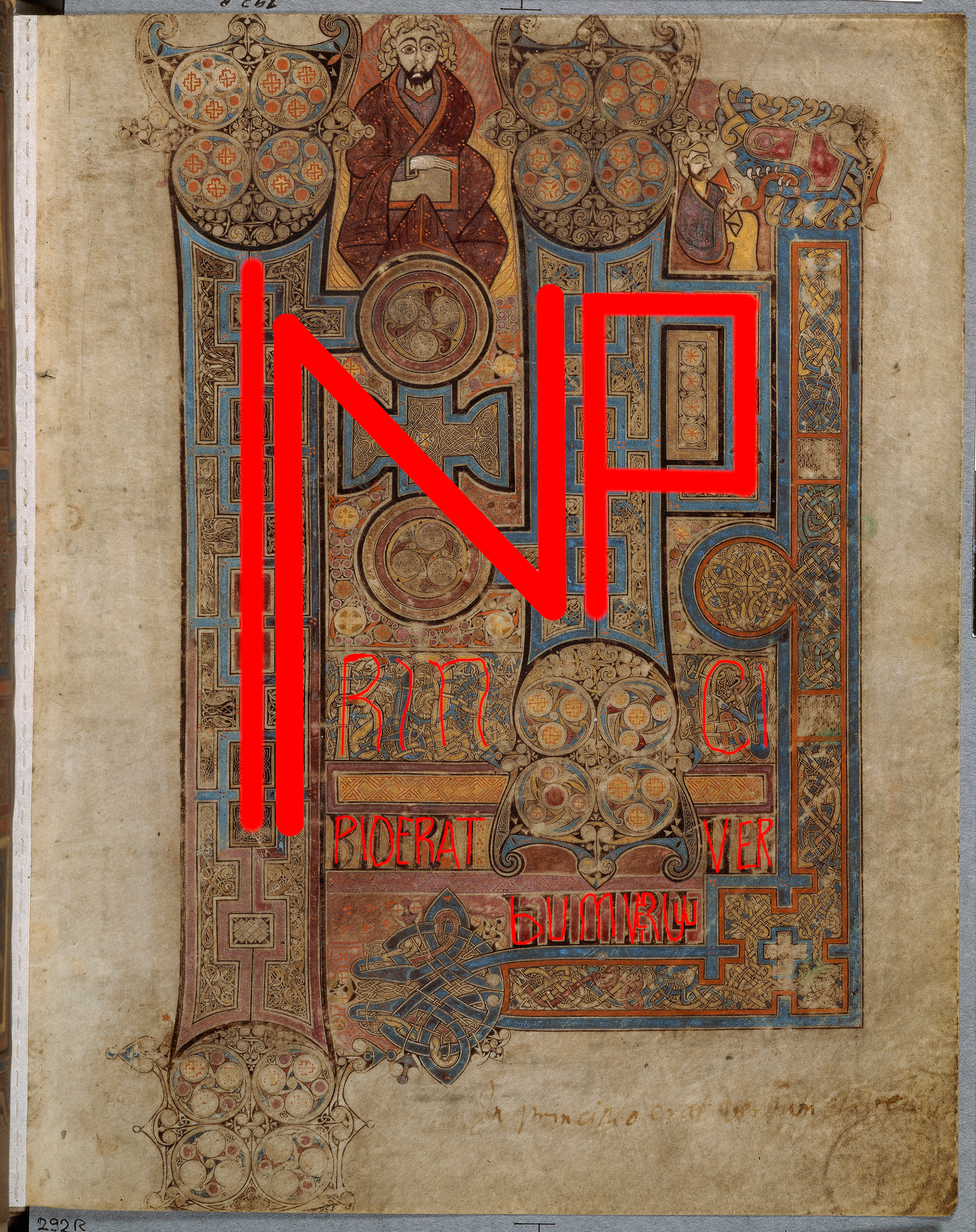
LOOK: Incipit to the Gospel of John from the Book of Kells

Incipit to the Gospel of John
Incipit to the Gospel of John, Book of Kells, ca. 800. Trinity College Dublin MS 58, fol. 292r.

Made by Celtic monks in a Columban monastery around the year 800, the Book of Kells—an illuminated Gospel book named after the monastery of Kells in County Meath, Ireland, where it spent eight centuries—is one of the most beautiful manuscripts ever created. Pictured here is the lavishly decorated opening page of the Gospel of John, which bears the words “In p/rinci/pio erat ver/bum [et] ver[b]um” (“In the beginning was the Word, and the Word . . .”). The passage continues on the following page.

Bernard Meehan, the former head of research collections and keeper of manuscripts at Trinity College Dublin, describes the lettering on folio 292r:

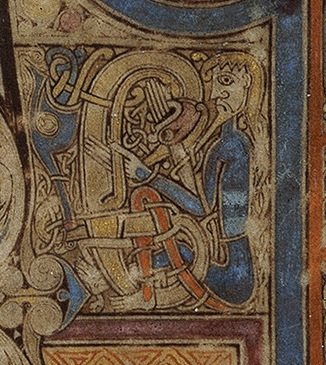
The letters IN P, filled with interlacing snakes, crosses and abstract ornament, dominate the composition. Snakes form the letters RIN and C, with C taking the form of a harp, played by the man who forms the letter I. The urge of the artist to decorate has taken precedence over legibility, to the extent that the letters ET and B are missing from the last line. [1]

Because some of the letters are difficult to discern, I’ve done my best to trace them in red in this graphic:

In the beginning (letters traced)

The text unfolds in four rows. The column on the left forms the I and doubles as the left stem of the N. The diagonal stroke of the N passes through the cross-shape, and its right stem is formed by another blue column, which also doubles as the stem of the P.

The following R, I, N, and C are beige and blue serpentine figures, tangled together, the latter shaped like a harp and being “played” by a seated man whose torso forms an I.

Book of Kells, fol. 292r (detail)

The remaining text is organized in two rows and is black. As Meehan mentioned, the artist-monk unintentionally omitted the ET and B in “et verbum.” And the final M is upside down, an artistic variation.

(Related post: “The Book of Kells,” a poem by Howard Nemerov)

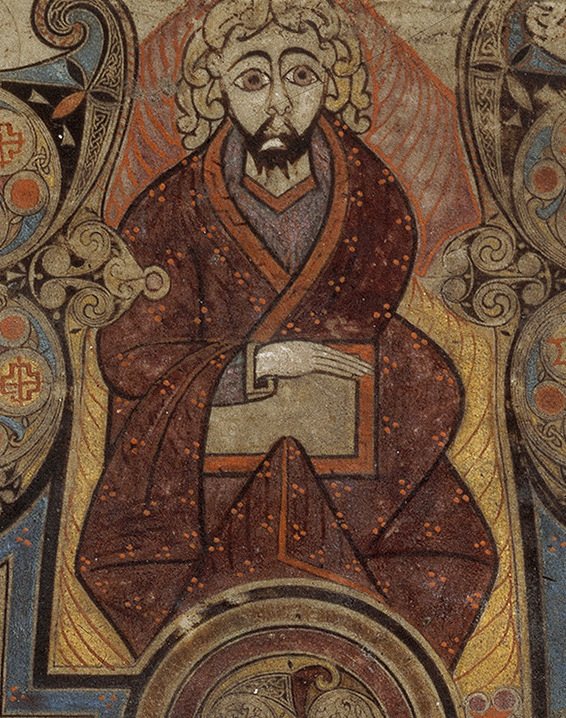
Book of Kells, fol. 292r (Christ)

Scholars disagree on who the curly-haired figure at the top is, holding a book: some suppose it’s John the Evangelist, the author of the fourth Gospel, while others think it’s Christ the Logos. I’m in the latter camp. Christ is often shown in art sitting on a throne holding a book, representing the gospel—as on folio 32v of this very manuscript. And a full-page portrait of John already appears on the opposite page, folio 291v; granted, the iconography is similar, but it would be an unusual choice to repeat a person in the same pose on a single page spread. Also, as art historian Heather Pulliam points out, the yellow and red striations that encompass the figure resemble flame—a “throne of light,” writes Françoise Henry—an attribute more befitting of the figure of Christ than of John. [2]

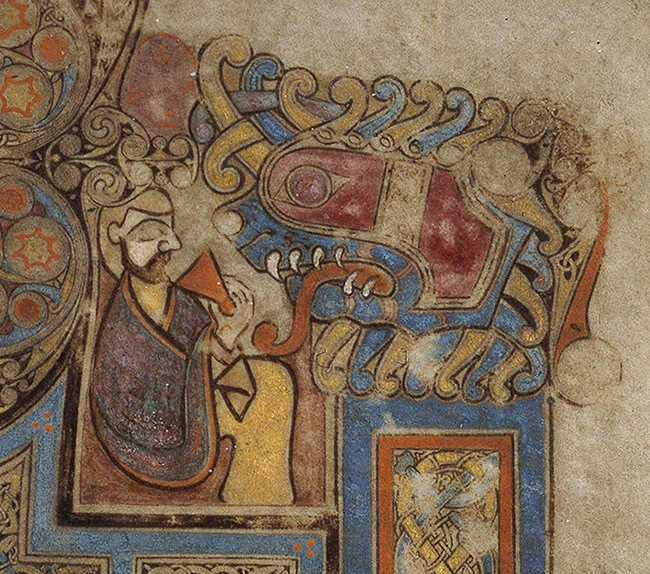
The identity of the smaller figure on the right who’s drinking from a red chalice is also debated. Again, it could be either John or Christ. According to an apocryphal legend that first appeared in the second-century Acts of John and that was popularized in the thirteenth-century Golden Legend, a pagan priest challenged John to drink a cup of poisoned wine to test whether his God was truly powerful enough to protect him. John blessed the cup, downed the wine, and suffered no harm. That’s why in art one of John’s attributes is a chalice with a serpent in it, representing the poison rising out and the triumph of Christian faith.

Book of Kells, fol. 292r (detail)

On the other hand, the drinking figure may be Christ drinking the cup of suffering (John 18:11). The monstrous head to the right supports either interpretation—it could be Satan tormenting Christ in Gethsemane, or in John’s case, the threat of death by poison, or the evil intent of the pagan priest who sought to discredit him.

Additional possibilities have also been posited. Małgorzata Krasnodębska-D’Aughton argues that the man is meant to be a generic Christian partaking of the Eucharist, [3] whereas Pulliam suggests that the cup represents not the blood of Christ but “the chalice of wisdom received from the breast of Christ.” [4] She cites Augustine’s first tractate on the Gospel of John:

Thence John, who said these things, received them, brothers, he who lay on the Lord’s breast, and from the breast of the Lord drank in what he might give us to drink. But he gave us words; you ought then to receive understanding from the source, from that which he drank who gave to you; so that you may lift up your eyes to the mountains from where shall come your aid, so that from there you may receive, as it were, the cup, that is, the word, given you to drink; and yet, since your help is from the Lord, who made heaven and earth, you may fill your breast, from the source. [5]

In Pulliam’s interpretation, the man imbibes the words of God—that is, scripture—providing a model for us to emulate.

Click here to digitally browse the Book of Kells in full.

Notes:

  1. Bernard Meehan, The Book of Kells: An Illustrated Introduction to the Manuscript in Trinity College Dublin (Thames & Hudson, 1994, 2008), 34.
  2. Heather Pulliam, Word and Image in the Book of Kells (Four Courts Press, 2006), 180–83; cf. Françoise Henry, The Book of Kells: Reproductions from the Manuscript in Trinity College, Dublin (Thames & Hudson, 1974).
  3. Małgorzata Krasnodębska-D’Aughton, “Decoration of the In principio initials in early Insular manuscripts: Christ as a visible image of the invisible God,” Word and Image: A Journal of Verbal/Visual Enquiry 18, no. 3 (Fall 2002): 117.
  4. Pulliam, Word and Image, 185.
  5. Augustine, In Joannis Evangelium 1.1, PL 35: 1382.

LISTEN: “The Word Was God” by Rosephanye Powell, 1996 | Performed by the University of Pretoria Camerata, dir. Michael Barrett, 2022

In the beginning was the Word, and the Word was with God, and the Word was God.

The same was in the beginning with God.

All things were made that have been made. Nothing was made he has not made.

While this choral anthem is not a Christmas song per se, it is a setting of John 1:1–3, the opening of the great prologue of the Incarnation. These first three verses are about Christ’s eternal being, his oneness with the Father, and his active role in creation. I can’t hear them without anticipating verse 14: “And the Word was made flesh, and dwelt among us . . .”

“The Word Was God” is by Dr. Rosephanye Powell (pronounced ro-SEH-fuh-nee) (born 1962), an African American composer, singer, professor, and researcher. One of her most popular and widely recorded works, it is full of rhythmic energy and drive. Read detailed notes by Powell here, where she explains her musical choices and their theological significance.

Roundup: Bolivian Christian art, Ukrainian folk carol, and more

ART SERIES: Pallay: Andean Weaving of Liturgy and Design by Daniela Améstegui: Daniela Améstegui is a graphic designer from Cochabamba, Bolivia, who holds a master’s degree in theological studies from Regent College in Vancouver, with a specialization in Christianity and the arts. Her work “revolves around exploring faith, social justice, and Christian contextualization through design” and “reflects her commitment to using design as a tool for expressing and exploring theological concepts,” she says. She currently lives in Langley, British Columbia, with her husband and two young children, working as a freelancer.

Améstegui’s final Integrative Project in the Arts and Theology for her master’s program was Pallay: Andean Weaving of Liturgy and Design, a series of seven digital illustrations, one for each of the major seasons/feasts of the liturgical year: Advent, Christmas, Epiphany, Lent, Easter, Pentecost, and Ordinary Time. The designs are inspired by Andean textile art and culture. You can view the full series at the link above from Regent College’s Dal Schindell Gallery, where the works were first exhibited in early 2022, but also listen to this wonderful online talk Améstegui gave about Pallay in 2020 for INFEMIT’s Stott-Bediako Forum, where she discusses not only her motivation and influences but also the content of each specific piece:

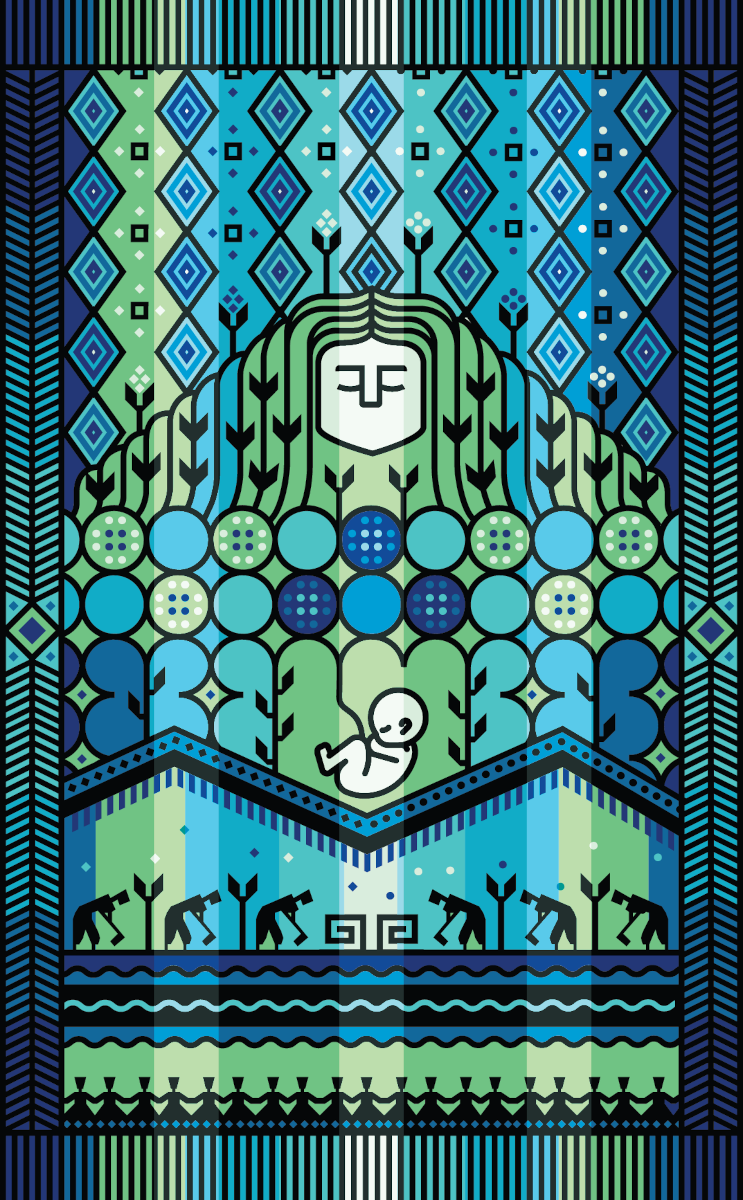
Whereas those of us in the northern hemisphere associate Advent with cold, darkness, and the onset of winter, in the southern hemisphere Advent falls in early summer, a time when the earth is most fertile and farmers plant their seeds. In her Advent design, Améstegui connects Mary carrying the seed of new life within her with Pachamama (Mother Earth).

Amestegui, Daniela_Advent
Daniela Améstegui (Bolivian, 1990–), Adviento (Advent), 2019–20, from the digital illustration series Pallay: Andean Weaving of Liturgy and Design. Used with permission.

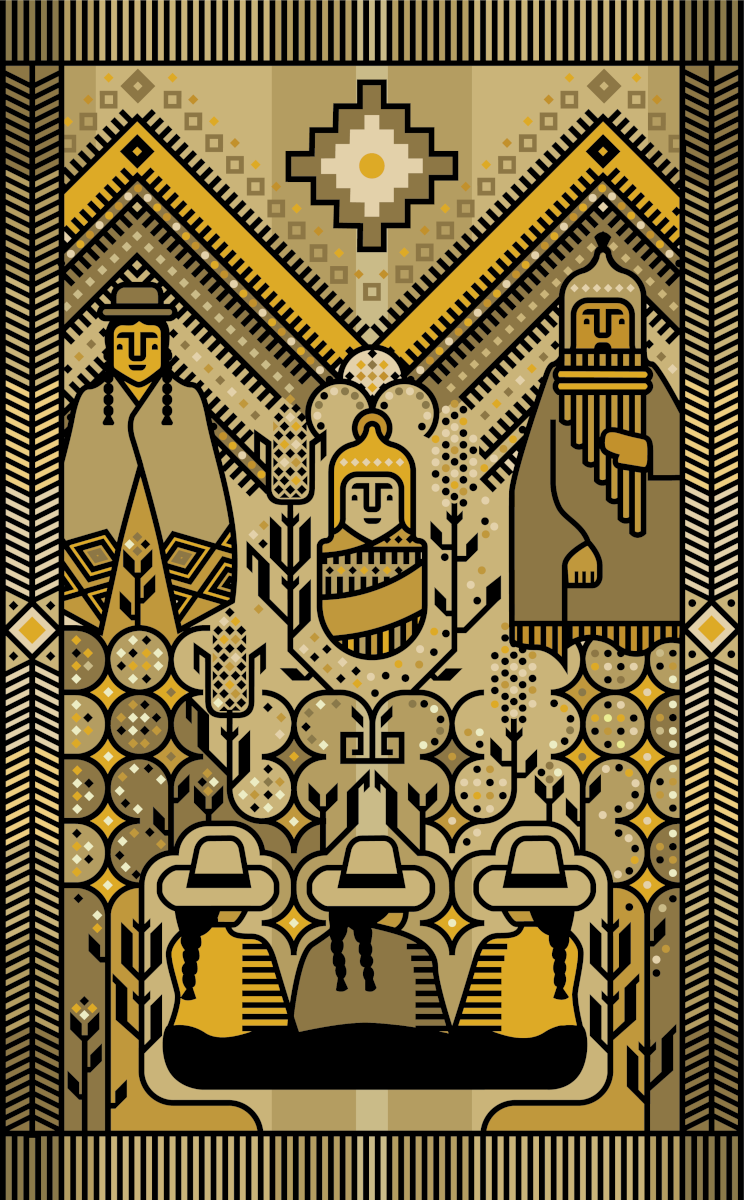
In Bolivia, Christmas takes place during a season of harvest, so in her Christmas design, Améstegui places Jesus in the center between crops of corn and quinoa, the two main agricultural foods cultivated in the country. Mary wears braids and a bowler hat and Joseph plays the zampoña (Andean panflute), and at the bottom three cholitas, Indigenous women from the Bolivian countryside, gather reverently to greet the Christ child.

Amestegui, Daniela_Christmas
Daniela Améstegui (Bolivian, 1990–), Navidad (Christmas), 2019–20, from the digital illustration series Pallay: Andean Weaving of Liturgy and Design. Used with permission.

Améstegui does not have a website just yet but tells me she plans to launch one in 2025. If you would like to purchase one or more of her Pallay pieces, you can contact her at daniela@amestegui.com.

Thank you to blog reader Nicole J. for alerting me to this striking series!

+++

VIDEO COLLECTION: Casa del Catequista (CADECA) chapel paintings: As chance would have it, the same week I learned about Daniela Améstegui’s work, a different blog reader, Mark M., emailed me a link to some videos his Langham Partnership colleague Paul Windsor took during a recent trip to Bolivia. They record the many paintings, most by the late Quechua artist Severino Blanco [previously], inside the chapel of CADECA in Cochabamba, a place where men and women are trained as Christian leaders who then go out to serve their rural communities. They portray scenes from the Old and New Testaments, the parables of Jesus, and Latin American church history, including a remarkable liberation theology–inspired Resurrection, in which Jesus breaks down the doors of death and hell, holding high a cacique’s staff and leading the people of Bolivia into their future. Here’s a 360-degree view captured by Windsor, but visit the boldface link to see additional videos that narrow in on particular portions.

Blanco, Severino_Nativity
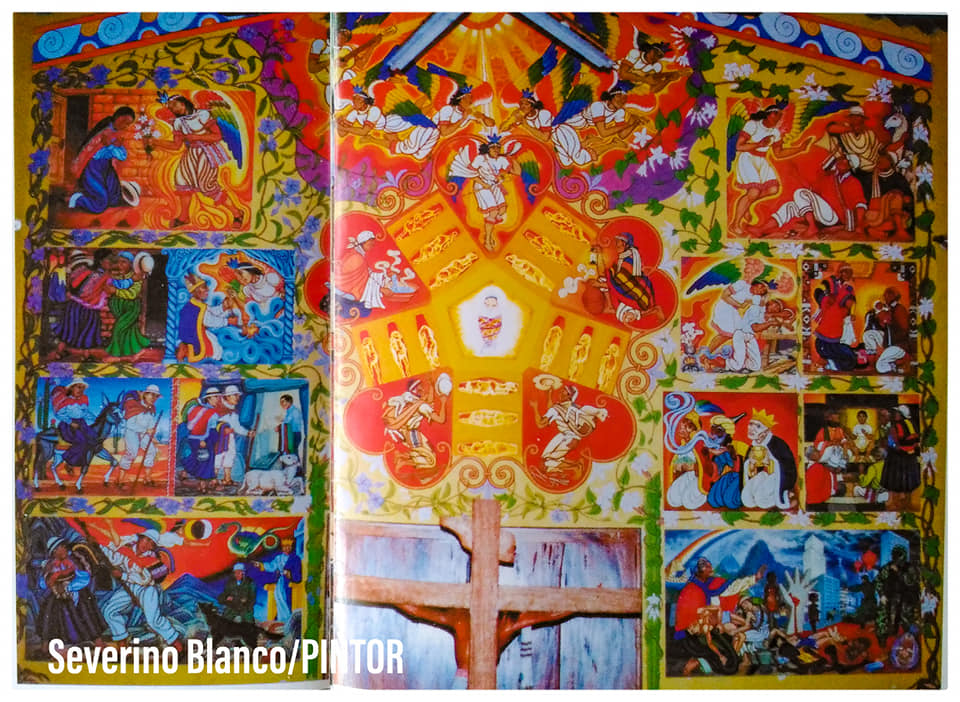
Severino Blanco (Quechua [Bolivian], 1951–2020), Infancy of Christ painting cycle, 1985. Chapel of the Casa del Catequista (CADECA), Cochabamba, Bolivia.

On the west end of the chapel (where people enter the space) is an Infancy of Christ cycle—reproduced here from a scan of a pamphlet, it appears. In the center is a Nativity, the Christ child painted over a pane of glass through which natural light comes gleaming in (see a closer view). The oblong shapes radiating out from the center are also glass, onto which the artist has (I think) etched lambs in various stages of prostration. On the sides, two villagers come with hot water and towels, and at the bottom two shepherds kneel before the Savior, removing their hats as a sign of respect. At the top, a host of angels with rainbow-colored wings and indigenous instruments sing Christ’s praises.

To the left of the Nativity are six scenes: (1) The Annunciation to Mary, (2) The Visitation, (3) The Annunciation to Zechariah, (4) The Journey to Bethlehem, (5) No Room at the Inn, and (6) The Flight to Egypt. To the right are (7) The Annunciation to the Shepherds, (8) The Annunciation to Joseph, (9) The Presentation in the Temple, (10) The Adoration of the Magi, (11) Jesus with the Scholars in the Temple, and (12) The Massacre of the Innocents.

+++

SONGS:

>> “Admirable Consejero” (Wonderful Counselor) by Santiago Benavides: Santiago Benavides is a Colombian singer-songwriter living in Toronto. On his Facebook page he describes his musical style as “trova-pop-bossa-carranga worship.” This song he wrote is a setting of Isaiah 9:2, 6–7 in Spanish. In the video, he’s the guitarist with the red-tinted glasses.

>> “The Word Became Flesh” by John Millea: John Millea is “a storyteller with a guitar,” singing in the tradition of Americana, folk, and gospel “about life and all of its joys, sorrows, and struggles.” He’s one of the artists I support through Patreon. This was the first song of his I encountered, and it’s one of my favorites, engaging with John 1:1–3, 14 in a wholly unique way!

In contrast to everyone and everything else in the universe, Millea explains, God had no beginning point, and all that is can in some way be traced back to him, the first link in a massive chain of cause and effect. So here Millea playfully traces his guitar all the way back to God—from the store he bought it at in Illinois, to the factory in Pennsylvania they ordered it from, to the mill in Washington that supplied the wood, to the Alaskan forests whence the tree was logged, and so on and so forth, imagining many thousands of years of fallen and dispersed tree seeds that traversed seas and continents, with an ultimate source in a tree planted in Eden by the Word of God.

When he hits on Eden, he starts moving forward again, through the story of creation, fall, and redemption in Christ, the divine beginningless One who graciously and mysteriously entered human history, born of a woman named Mary.

>> “Mary Had a Baby”: Arranged by Roland Carter, this African American spiritual is performed by the Nathaniel Dett Chorale, featuring the amazing mezzo-soprano Melissa Davis. It’s from their 2003 album An Indigo Christmas, the tracks taken from two live concerts given at the Church of St. George the Martyr in Toronto.

>> “Що то за предиво” (Shcho to za predyvo) (Behold a Miracle): This Ukrainian folk carol is performed by Trioda (Тріода), a musical group consisting of Andrii Gambal, Volodymyr Rybak, and Pavel Chervinskyi.

What is this awe-inspiring miracle?
There is great news on earth!
That the Virgin Mary gave birth to a son.
And upon birthing him, she declared,
“Jesus—my son!”

And the aging Joseph stands nearby in awe
Of Mary having given birth to a son.
And he prepares the swaddling for Jesus Christ.
And Mary swaddles him, and scoops him to her heart—
The pure Virgin Mary!

Trans. Joanna (Ivanka) Fuke [source]

Christmas, Day 3

No one has ever seen God. But the unique One, who is himself God, is near to the Father’s heart. He has revealed God to us.

—John 1:18 (NLT)

LOOK: The Word by Nicholas Mynheer

Mynheer, Nicholas_Incarnation
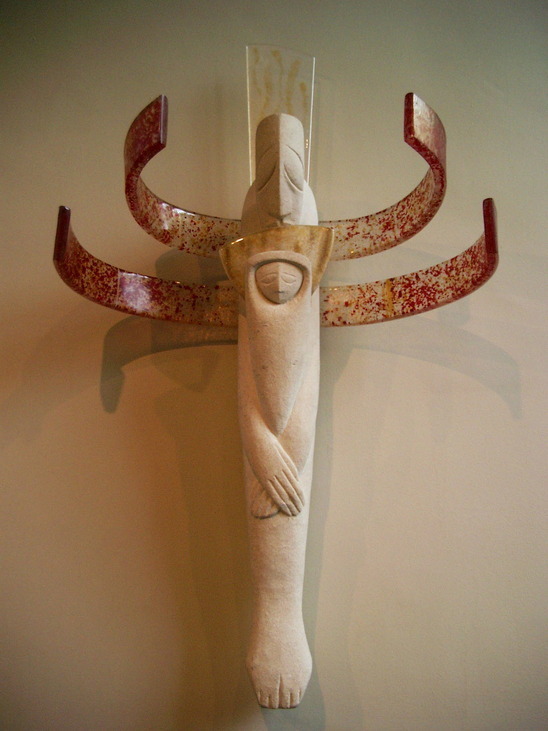
Nicholas Mynheer (British, 1958–), The Word, 2000. English limestone and cast glass, height 102 cm. South aisle, Birmingham Cathedral, UK.

This sculpture on the theme of the Incarnation of the Word was commissioned by the Cathedral Church of Saint Philip in Birmingham, England, for the new millennium. The sun shines on the work through the south window, casting light from the colored glass pieces over and across the stone and the surrounding wall.

“The changing light and shadows represent for me the ongoing Incarnation and not merely an historical event,” says artist Nicholas Mynheer. He notes the combination of heaven (glass) and earth (stone).

This is a Trinitarian image: the Father, anthropomorphized but nongendered, presents his glory, the Son, spoken, breathed, coming as infant, and both are embraced by the arcing sweep of the Holy Spirit.

To learn more about the artist, visit his website and check out this feature I wrote about him for Transpositions a few years ago.

LISTEN: “The Glory of the Father” | Words adapted from John 1 | Music by Egil Hovland, 1957; edited by Frank Pooler, 1974 | Performed by the National Lutheran Choir (US), dir. David Cherwien, 2018

The Word was made flesh, and dwelt among us.
We beheld the glory of the Father,
Full of grace and truth.

In the beginning was the Word, and the Word was with God.
In Him was life, and the life was the light of all.
He came to his own, and his own, received him not.

The Word was made flesh, and dwelt among us.
We beheld the glory of the Father,
Full of grace and truth.

Advent, Day 21

LOOK: gloria by Corita Kent

Kent, Corita_gloria
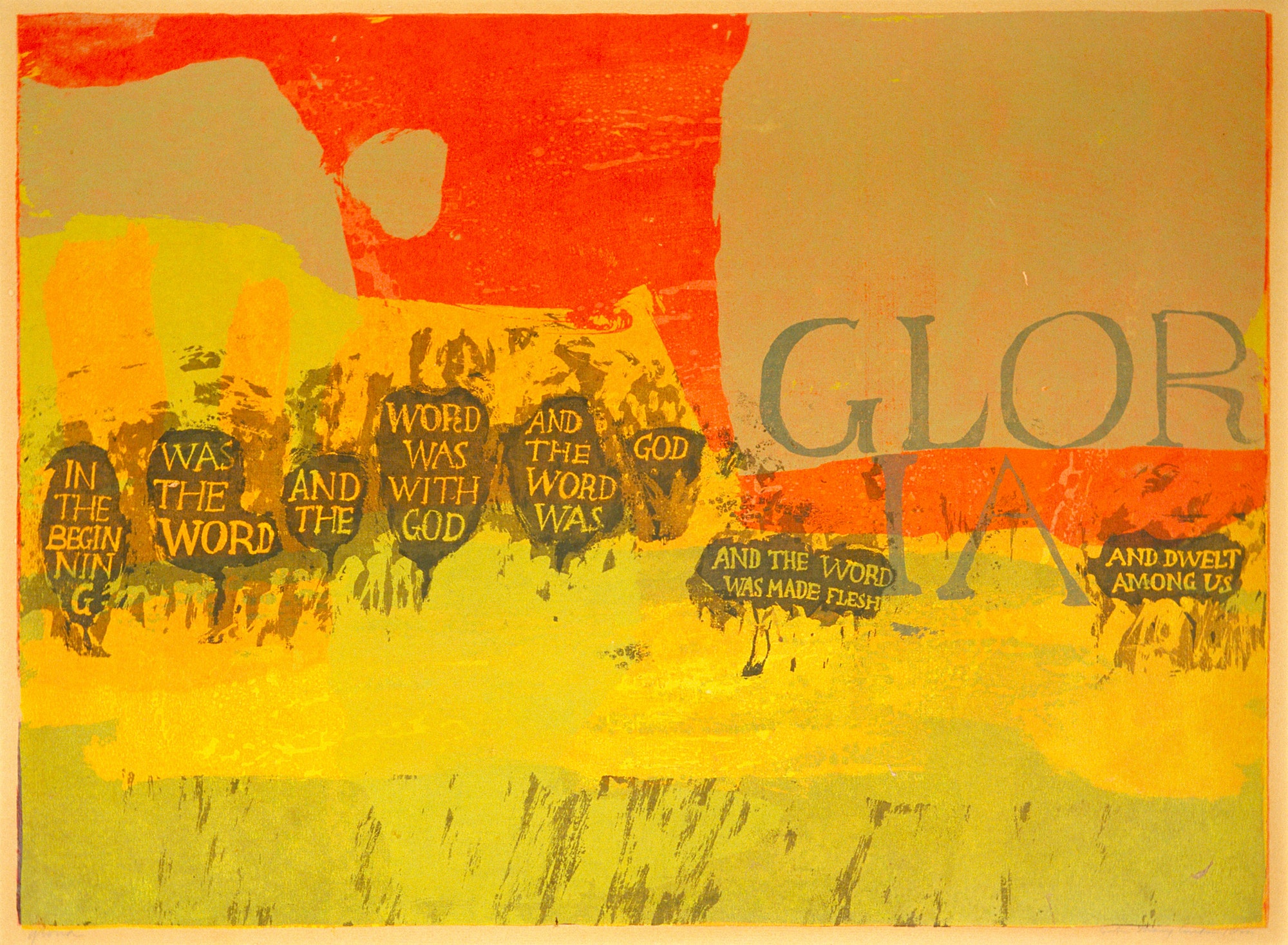
Corita Kent (American, 1918–1986), gloria, 1960. Serigraph.

From the Corita Art Center:

Corita Kent (1918–1986) was an artist, educator, and advocate for social justice. At age 18 she entered the religious order Immaculate Heart of Mary, eventually teaching in and then heading up the art department at Immaculate Heart College. Her work evolved from figurative and religious to incorporating advertising images and slogans, popular song lyrics, biblical verses, and literature. Throughout the ’60s, her work became increasingly political, urging viewers to consider poverty, racism, and injustice. In 1968 she left the order and moved to Boston. After 1970, her work evolved into a sparser, introspective style, influenced by living in a new environment, a secular life, and her battles with cancer. She remained active in social causes until her death in 1986. At the time of her death, she had created almost 800 serigraph editions, thousands of watercolors, and innumerable public and private commissions.

LISTEN: “God in Flesh, Our Hope Divine” by The Brilliance (David Gungor and John Arndt), on Advent, vol. 2 (2012; reissued 2021)

God of heaven, Lord of earth
We beseech thee
Born of Mary, virgin birth
Lord, we greet thee
God in flesh, our hope divine
Alleluia
Babe of heaven, God’s own son
Alleluia

Star of David, Son of Man
God be with us
Suff’ring servant, wounded lamb
Bring peace to us
Broken flesh, our hope divine
Alleluia
Lifted up for all mankind
Alleluia

Gloria, gloria, gloria in excelsis Deo! (×2)

Root of Jesse which shall stand
Lord, we need thee
Banner o’er the nations
We receive thee
Glorious resting place for all
Alleluia
Jew and Gentile, welcome home
Alleluia

Gloria, gloria, gloria in excelsis Deo! (×2)

“Come, Lord Jesus,” people sing
We are yearning
Give us back the garden
We are longing
On that day we’ll see thy face
Alleluia
This whole realm in your embrace
Alleluia

Gloria, gloria, gloria in excelsis Deo! (×6)