Easter, Day 8: We Walk His Way

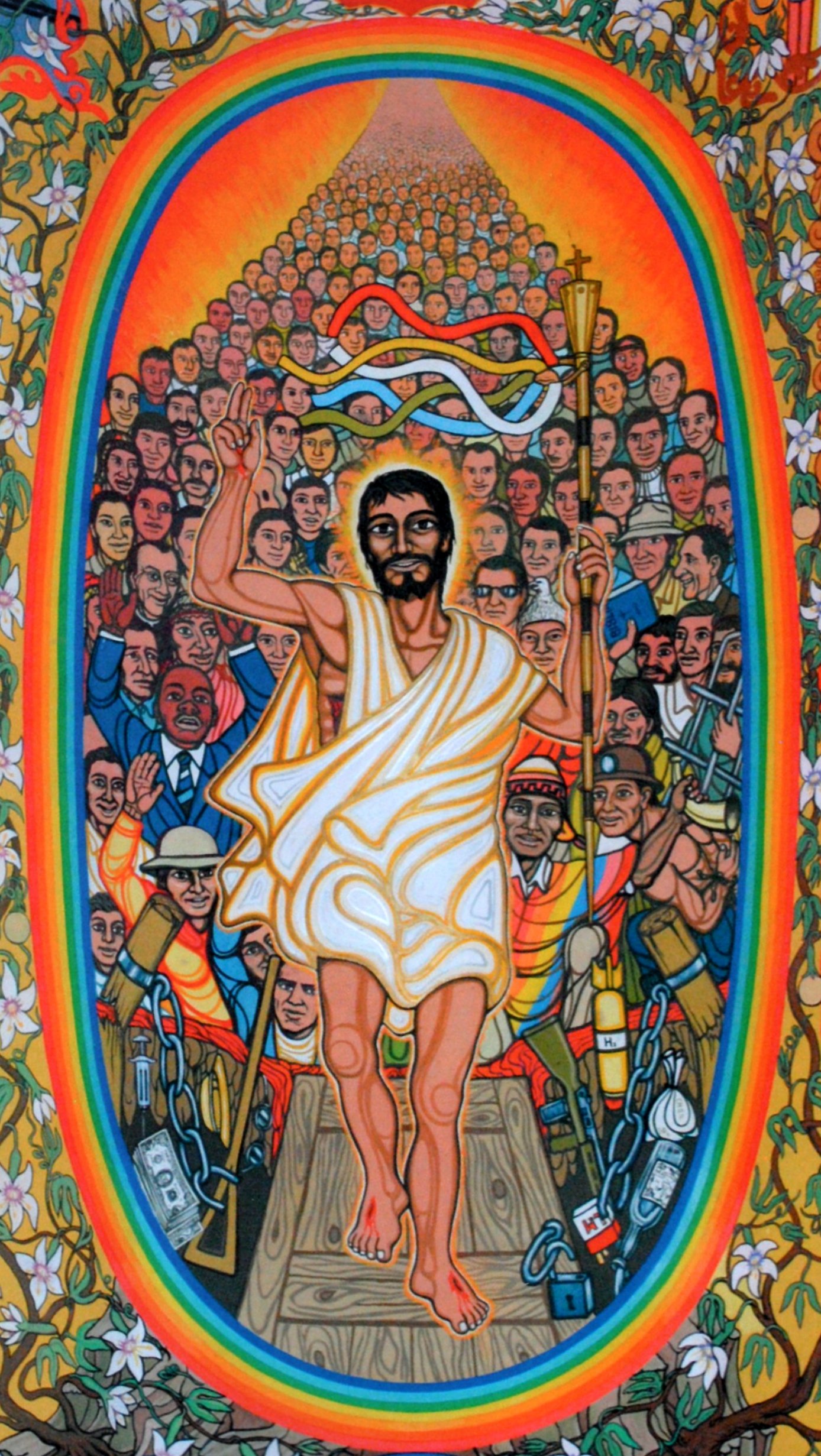
LOOK: The Resurrection by Severino Blanco
Blanco, Severino_Resurrection
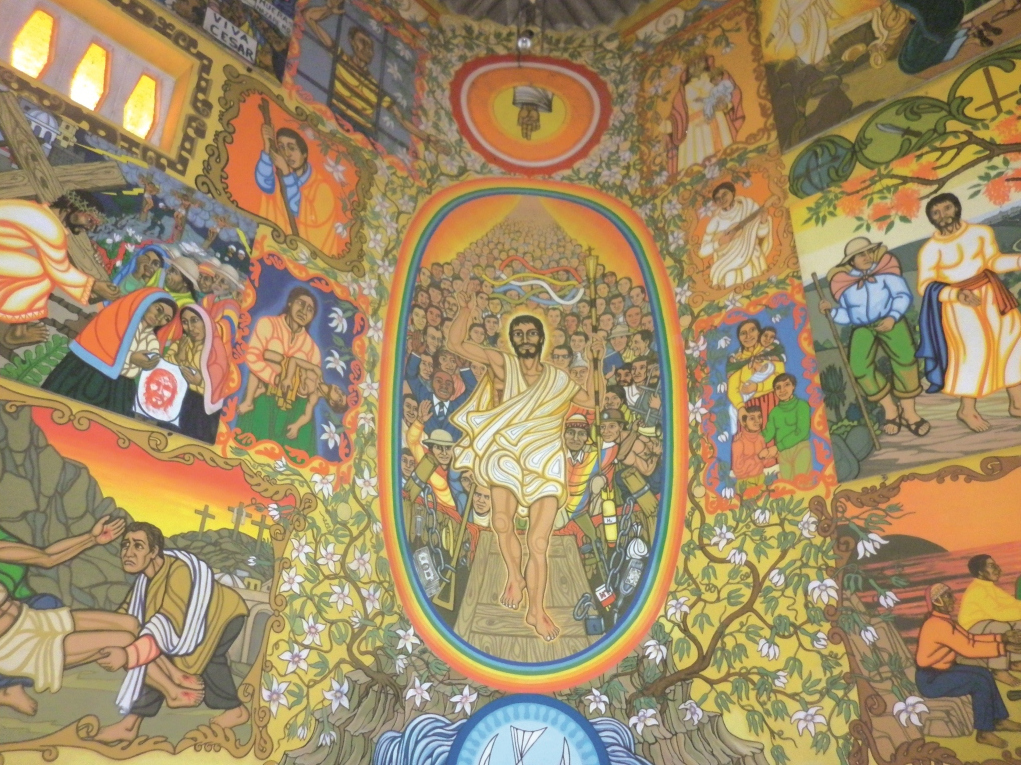
Severino Blanco (Quechua, 1951–2020), The Resurrection, ca. 1984. Mural, Casa del Catequista (CADECA) Chapel, Cochabamba, Bolivia.

Severino Blanco (1951–2020) [previously] was a Quechua Christian artist from Ayopaya, Bolivia. His magnum opus is an extensive cycle of biblical paintings inside the chapel of the Casa del Catechista (CADECA) in Cochabamba, a center for training catechists (lay Catholic missionaries) and pastoral leaders to serve the sixty villages in the city’s archdiocese.

The centerpiece of the mural is an image of the risen Christ breaking through the chains of hell, trampling down its gates and leading an exodus of departed saints into new life. I can spot Rev. Dr. Martin Luther King Jr. of the United States and Archbishop Óscar Romero of El Salvador, martyrs of the faith, and I’m sure there are many other Latin American Christian preachers and activists pictured—those who walk the way of liberation.
Blanco, Severino_Resurrection
Source: Von Befreiung und Erlösung: Bilder in CADECA Cochabamba/Bolivien (Missionskreis Ayopaya, 2012), p. 156

Barefoot and glowing, Jesus bears the puncture wounds from his crucifixion, but they are now glorified, and he holds high a cacique’s (Indigenous chief’s) staff, signifying his leadership. Beneath his feet are symbols of some of the hellish obsessions or addictions from which he frees us: a rifle and a hydrogen bomb (war and violence), money (greed, materialism), a needle and a liquor bottle (substance abuse). He walks through a rainbow-rimmed portal that frames him and his followers like an aureole and that is surrounded by flowering tree branches.

Above this vignette is the blessing hand of God the Father, and below is the Holy Spirit as dove, from whom issues forth streams of living water (see John 7:37–39). The presence of these two other persons of the Trinity emphasizes the Resurrection as a Trinitarian event.

This image is used on the cover of the German-language book Von Befreiung und Erlösung: Bilder in CADECA Cochabamba/Bolivien (Of Liberation and Redemption: Pictures in CADECA Cochabamba, Bolivia) by Alois Albrecht. The book features reproductions of the mural scenes alongside relevant Bible passages and texts by Latin American theologians and other members of the church.

One of the texts reproduced in the book is a letter from a Paraguayan base community to European Christians. (The date is not provided, nor is the original Spanish.) Here’s Google’s translation from the German:

Good people, our brothers and sisters in Europe!

Here as there, we celebrate Easter these days. How do you celebrate the feast of the resurrection of our suffering Lord, his passing from death to new life?

Here, the few rich people pass by the suffering of the poor. It is said of Jesus that he did not cling to his divinity as if it were a prize. But here, the few rich people plunder everything from the poor majority: bread, land, work, wages, health, housing, security.

How is passing over to a new life, like Easter, like resurrection, possible then? Are we not all brothers and sisters, you there and we here? Easter is an international affair.

Our situation has international roots and is caused by those who make decisions in the world, carry out plans, and in doing so forget us, the little brothers and sisters of the suffering and slain Jesus.

Easter is the feast of hopeful departure, of joyful new beginnings, of enthusiastic new life. But who among us feels anything of departure, joy, new beginnings, new life? Yes, hope—we have it! Easter is a feast of expectation; for whoever is always on the way also reaches their destination.

So, brothers and sisters! Despite everything, let us go our own way, you there and we here, in the light of Christ, the Lord raised to new life, to seek together equality and freedom for all.

We Paraguayans need you there, and not just your money, but above all your sure and loud voice against the ideology that enslaves and kills us all, us poor and you rich alike.

We all live in the same danger of death. But our risen Lord has also made us all his equal brothers and sisters. Please don’t forget that!

Arnoldo and friends and family

Another text is an excerpt from a document of the Third General Assembly of the Latin American Episcopate in Puebla, Mexico, in 1979. Again, Google Translate:

In fulfillment of the commission he received from his Father, Jesus voluntarily offered himself up to death on the cross, which was the goal of his life’s journey. As the bringer of the freedom and joy of the kingdom of God, he wanted to become the decisive sacrifice for injustice and evil in this world. On the cross, he takes upon himself the pain of creation and offers his life as a sacrifice for all.

In this way, he is the high priest who is able to share our weaknesses with us. He is the Easter sacrifice that redeems us from our sins. He is the obedient Son who, in the face of his Father’s redeeming justice, incarnates the cry for liberation and salvation of all people. . . .

Therefore, the Father raises his Son from the dead. He exalts him in glory to his right hand, pours out upon him the life-giving power of his Spirit, appoints him as head of his body, that is, the church, and confirms him as Lord of the world and of history.

Jesus’s resurrection is a sign and guarantee of the resurrection to which we are all called, as well as of the final transformation of the whole world. Through him and in him, the Father wished to re-create what he had already created.

Amen, and amen.

Addendum: At my church this morning, an invited guest preached a sermon on Colossians 1:18–20 titled “Leading the Resurrection Parade” after Eugene Peterson’s translation of the christological descriptor “the firstborn from the dead” in verse 18. I instantly thought of this image I had posted just hours earlier, in which Jesus’s staff is reminiscent of a drum major mace! The preacher spoke of Jesus steering a resurrection train of people, the new humanity, and cross-referenced 2 Corinthians 2:14: “Thanks be to God, who in Christ always leads us in triumphal procession and through us spreads in every place the fragrance that comes from knowing him.”

LISTEN: “We Walk His Way (Ewe Thina),” a South African freedom song from the apartheid era | Translated by Anders Nyberg, Jonas Johnson, and Sven-Bernhard Fast, 1984 | Arranged by John L. Bell and performed by the Wild Goose Collective on We Walk His Way: Shorter Songs for Worship, 2008

Refrain (Xhosa):
Ewe thina, ewe thina

Sizowa nyathela amadimoni
Ewe thina, ewa thina
Sizowa nyathela amadimoni
Ewe thina, ewa thina [Refrain]

Refrain (English):
We walk his way, we walk his way

Unarmed, he faces forces of demons and death
We walk his way, we walk his way
Unarmed, he faces forces of demons and death
We walk his way, we walk his way [Refrain]

He breaks the bonds of hell, dying on the cross
We walk his way, we walk his way
He breaks the bonds of hell, dying on the cross
We walk his way, we walk his way [Refrain]

The tree of freedom blooms by his empty grave
We walk his way, we walk his way
The tree of freedom blooms by his empty grave
We walk his way, we walk his way [Refrain]
Christmas, Day 1: He Came Down

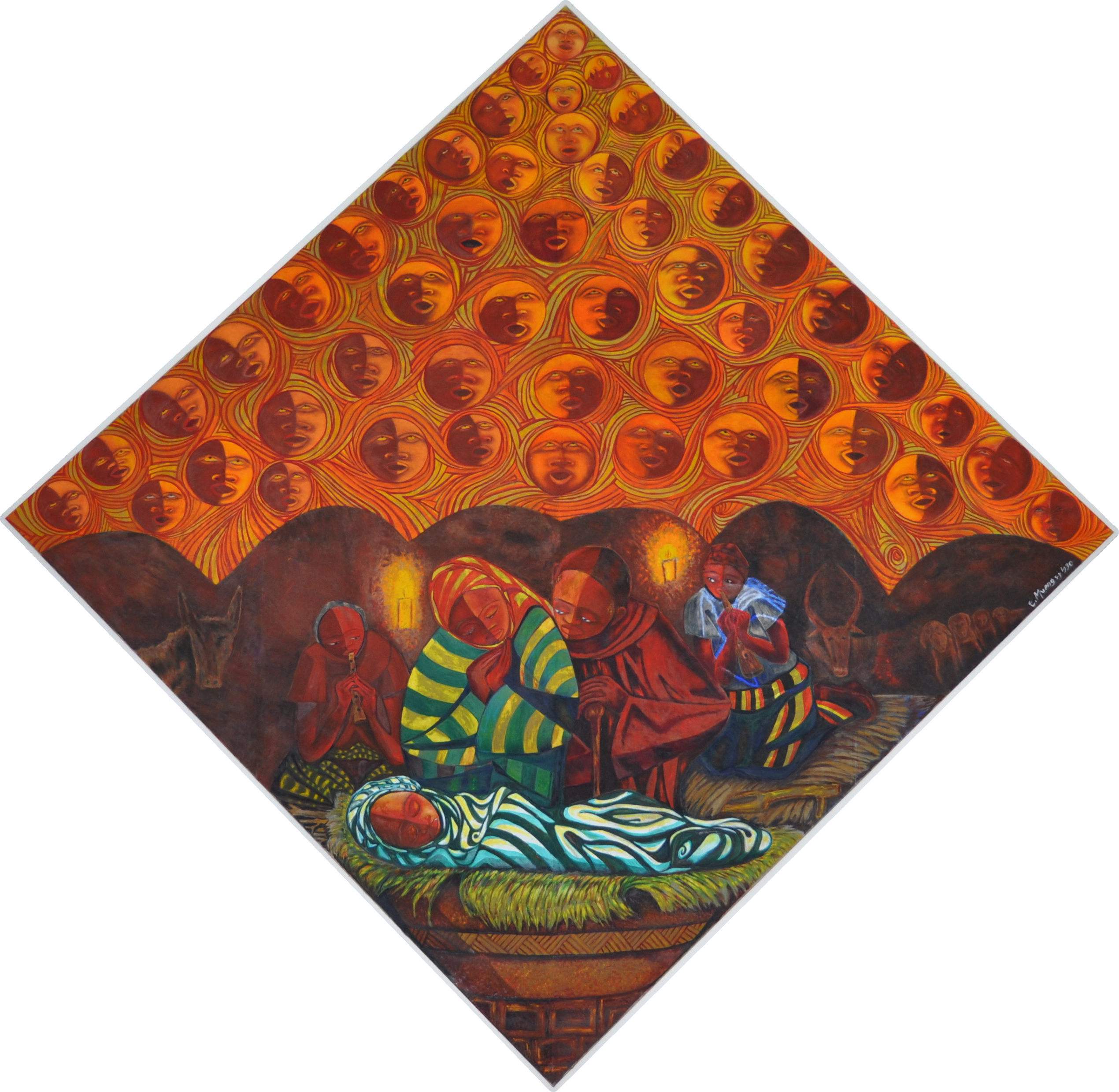
LOOK: The Birth of Jesus by Engelbert Mveng

Mveng, Engelbert_The Birth of Jesus
Fr. Engelbert Mveng, SJ (Cameroonian, 1930–1995), The Birth of Jesus, 1990. Central scene of mural at Our Lady of Africa Catholic Church, Chicago. All photos courtesy of the church.

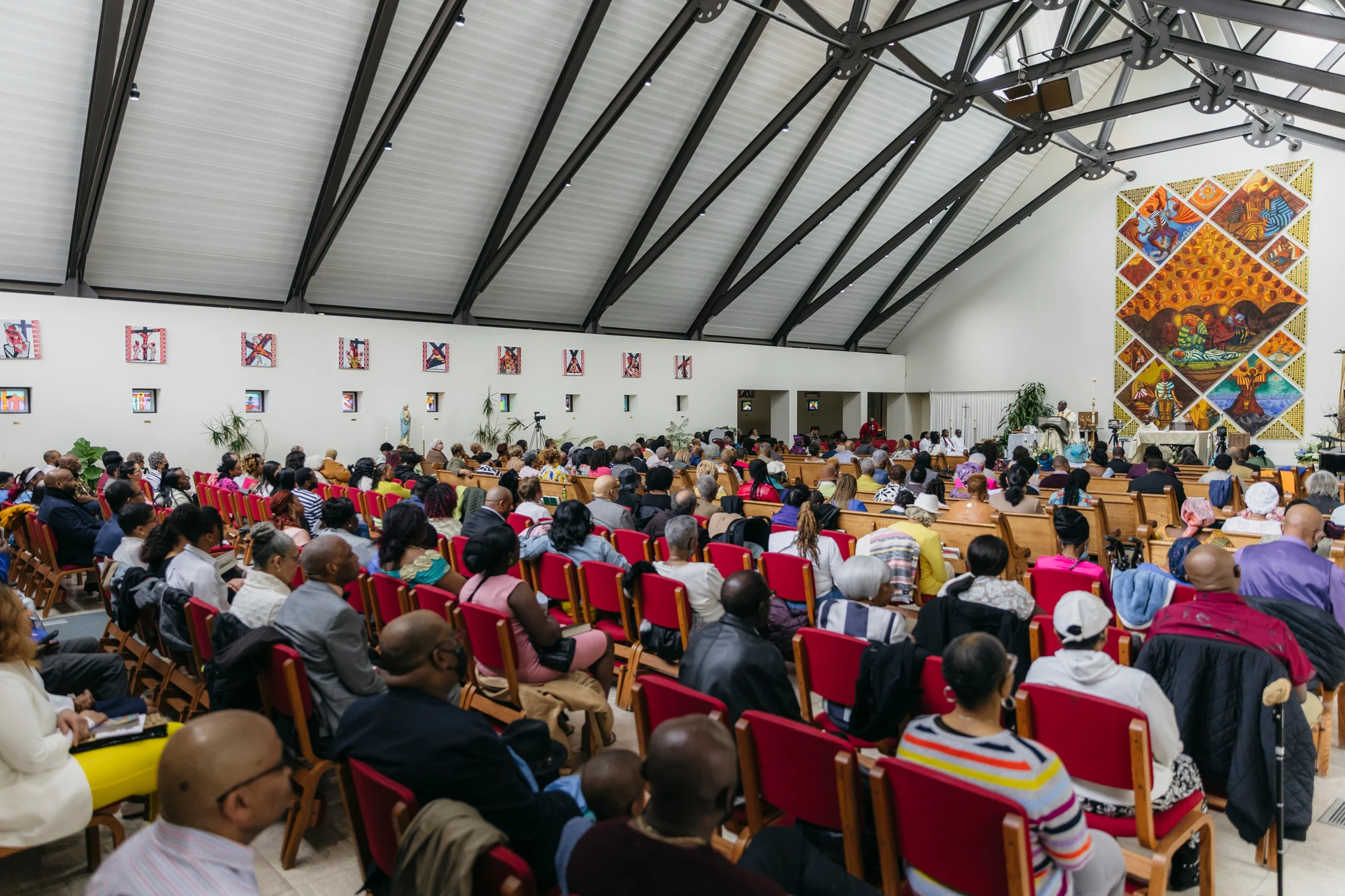
When Holy Angels Catholic Church on the south side of Chicago was rebuilt following a 1986 fire, the historic church commissioned the Cameroonian Jesuit priest, artist, and historian Engelbert Mveng (1930–1995) to paint a mural for behind the altar. He chose to represent moments of angelic intervention in biblical history. (See a close-up of the full mural here.)

The mural’s focal point is a Nativity scene, set in a hilly African landscape that’s pulsing with joy. The infant Jesus lies asleep on a grassy bed, adored by his parents and flanked by candles, pipers, and some curious animal onlookers. Caught up in the sky’s vibrant swirls are forty-nine disembodied angel heads, singing their Gloria.

In July 2021, Holy Angels merged with the faith communities of Corpus Christi, St. Ambrose, St. Anselm of Canterbury, and St. Elizabeth of Hungary in the Bronzeville/Kenwood area of Chicago to become Our Lady of Africa Parish, housed at the former Holy Angels church. The altar mural remains installed on the east end, a key visual feature of the worship space.

Mveng mural
Mveng mural

LISTEN: “He Came Down,” traditional Cameroonian carol | Transcribed and arranged by John L. Bell of the Iona Community, 1986 | Arranged and performed by Marty Haugen on Welcome the Child, 1992 [sheet music]

He came down that we may have life
Hallelujah, forevermore!

He came down that we may have peace . . .

He came down that we may have hope . . .

He came down that we may have joy . . .

Ten Songs of Joy for Gaudete Sunday

The third Sunday of Advent is known as Gaudete Sunday, gaudete (pronounced GOW-deh-tay) (Latin for “rejoice”) being the first word of the introit of the day’s Mass, taken from Philippians 4:4–6 and Psalm 85:1:

Gaudete in Domino semper íterum díco, gaudéte: modéstia véstra nóta sit ómnibus homínibus: Dóminus prope est. Nihil sollíciti sítis: sed in ómni oratióne petitiónes véstrae innotéscant apud Déum. Benedixísti, Dómine, térram túam: avertísti captivitátem Jácob.

Rejoice in the Lord always; again I say, rejoice. Let your forbearance be known to all men. The Lord is at hand. Do not be anxious over anything; but in all manner of prayer, let your requests be made known unto God. Lord, you have blessed your land; you have put an end to Jacob’s captivity.

It is customary for priests to swap out their purple vestments for pink today, and for those who use an Advent wreath to light not a purple candle but a pink one. Some churches favor a spare aesthetic in their sanctuaries for the first two weeks of Advent but break out the flowers for this the third. The approximate halfway point of the penitential Advent season, Gaudete Sunday is a special time to rejoice in the nearness of God’s coming as well as God’s presence with us here even now in the waiting, and to receive a foretaste of the bigger celebration to come on Christmas Day.

Here are ten songs for you to enjoy this Gaudete Sunday. If you’d rather listen to them as a YouTube playlist, click here.

Richardson, Jan_Visitation
The Hour of Lauds: Visitation by Jan Richardson [for sale]

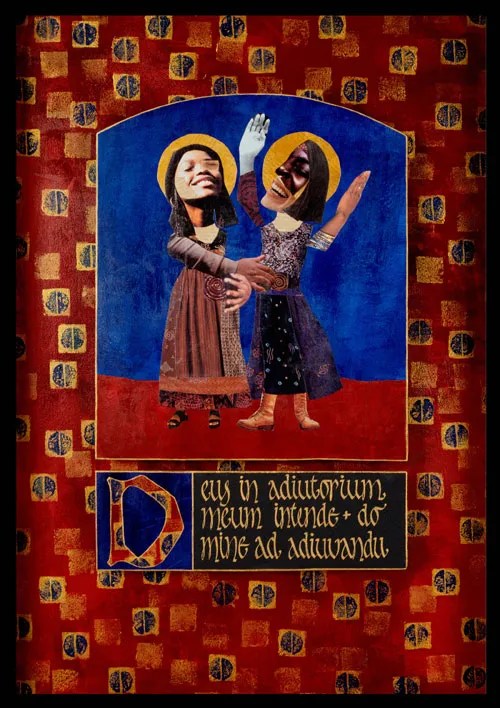
1. “Songs of Joy” by Garrison Doles, written late 1990s, on A Songmaker’s Christmas, 2012: “Songs of joy we hopefully sing, expanding our spirits, the season to know . . .” So opens this song by the late singer-songwriter Garrison Doles (d. 2013) [previously]. In 2009 his wife, the artist Jan Richardson, created a video combining the song with five of the seven collages from her Advent Hours cycle (which can be purchased as reproductions). Read the lyrics and songwriter’s statement here.

2. “My Soul Doth Magnify the Lord” by O’Landa Draper and the Associates, on Live…A Celebration of Praise, 1994: A trailblazing gospel choir director, O’Landa Draper was one of the top gospel artists of the nineties. This song of his is based on the Magnificat, the praise song Mary sings in the company of her cousin Elizabeth following the conception of Christ (see Luke 1).

3. “El burrito de Belén” (The Little Donkey of Bethlehem) by Hugo Cesar Blanco, 1972, performed by the band Matute, 2020: This is a Venezuelan carol about a person riding their donkey, with hurried excitement, from the sabanero (savanna) to Bethlehem to see the newborn Christ. Read the lyrics and translation here.

4. “Ecce mundi gaudium” (Behold the Joy of the World), England, 13th century, arranged and performed by the Mediæval Bæbes on Worldes Blysse, 1998: Written in Latin, this thirteenth-century carol is about the Virgin giving birth to the Son, our joy—announced to the shepherds by an angel and to the magi by a star. Despite the upbeat tempo throughout, the last two verses are about Herod’s raging and the Massacre of the Innocents. The soloist is Katharine Blake, the founder and musical director of Mediæval Bæbes. Read the original lyrics here, clicking on individual lines for the English translation.

5. “Kya Din Khushi Ka Aaya” (क्या दिन खुशी का आया) (What a Happy Day), performed by Akshay Mathews, 2021: A Hindi Christmas carol from India. Read the lyrics here.

6. “Repeat the Sounding Joy,” a fragment from “Joy to the World” arranged by Craig Courtney, performed by the Capital University Chapel Choir, 2019: A super-fun, one-minute choral work.

7. “Now Let Us Sing,” traditional, adapt. John L. Bell, 1995, performed by Katarina Ridderstedt, 2015: Katarina Ridderstedt (née Lundberg) is a rhythm teacher, musician, cantor, and choir director from Gotland, Sweden, who records music under the name Musikat. This video of hers introduced me to a charming little quatrain whose origins I don’t know (it’s credited as “Traditional”), but this version comes from Scotland’s Iona Community [previously]: “Now let us sing with joy and mirth, / praising the one who gave us birth. / Let every voice rise and attend / to God whose love shall never end.”

(Update, 1/6/25: “Now let us sing” is of Scottish origin, first appearing during the Protestant Reformation in the congregational song collection The Gude and Godlie Ballatis; the earliest extant edition of this book is from 1567, but it is thought to have been originally published in 1540. The tune was originally a drinking tune. For his rendition, published in Come All You People: Shorter Songs for Worship, John L. Bell essentially rewrote the first stanza, retaining only the first line of the original.)

8. “Brother” by Jorge Ben Jor, on A Tábua de Esmeralda, 1974: Known by the stage name Jorge Ben or (since the 1980s) Jorge Ben Jor, Jorge Duílio Lima Menezes (b. 1939) is a Brazilian singer-songwriter and musician whose characteristic style fuses elements of samba, funk, rock, and bossa nova. In this song he enjoins us to prepare a joyful path for the coming Christ—who is both Lord and friend—with love, flowers, and music.

9. “Alleluia, He Is Coming (I Looked Up)” by Martha E. Butler, 1979: This song is sometimes used in church services for Palm Sunday or Easter, but I think it makes a fitting Advent song as well—especially with the newer last verse that is sometimes used, as in the first video below. “Alleluia, he [Christ] is coming! Alleluia, he is here,” the refrain proclaims. Read about the inspiration behind the song, in the words of the songwriter, here. Allow me to sneak in two different performances. The first is by Donna Rutledge, Becky Buller, and Todd Green of First Baptist Church of Manchester, Tennessee, from 2020; theirs is a lovely rendition with strong vocals and a poignant violin part, but I do prefer a brisker pace (listening to the video at a playback speed of 1.25 is perfect, in my estimation):

The second is by the South African group Worship House, from their 2016 album Project 5 (Live in Johannesburg):

10. “Joy Will Come” by Paul Zach: The refrain of this song by Paul Zach of Virginia is based on Psalm 30:5b: “Weeping may linger for the night, but joy comes with the morning.” I also hear echoes of Psalms 18 and 121 throughout. The song is a reminder that through the dark nights we experience, we have hope; we have a Savior who will not abandon us.

Roundup: The Guild Conference, All Saints’ Day, and “Soul on Deck”

UPCOMING EVENT: The Guild Creative Arts Conference, November 4, 2023, Church on Morgan, Raleigh: Organized by singer-songwriter Jess Ray, spoken word poet Sharlene Provilus, and event curator Cary Brege, The Guild Conference endeavors “to care for the craft and character of creative people while encouraging creative community. We want to inspire your creative work, spiritual journey, and daily rhythms.” The special guests this year are singer-songwriters Dwan Hill, Andy Squyres, and Taylor Leonhardt; JourneyMates director Mary Vandel Young; and Makers & Mystics podcaster Stephen Roach. The day-long conference includes sessions, a panel discussion, an artist showcase, and a concert by The Choir Room. The regular ticket price is $75 (group rates and concert-only tickets also available).

+++

ARTICLE: “A Cloud of Witnesses: Why We Should Celebrate All Saints Day” by Leonard J. Vander Zee: In this June 2008 article from Reformed Worship, the Rev. Leonard J. Vander Zee writes to his fellows in the Reformed Protestant tradition, explaining what All Saints’ Day is and why it’s important to celebrate it, as Methodists, Lutherans, Anglicans, and Roman Catholics do every November 1. (Churches without midweek services typically celebrate the feast corporately on whatever Sunday precedes the first of November: this year, October 29.) Vander Zee also offers a sample order of worship, including specific hymn suggestions.

+++

SONGS:

>> “For All the Saints” by John L. Bell and Graham Maule, performed by Roger Sullins: A contemporary hymn from the Iona Community in Scotland, Bell and Maule’s “For All the Saints” is not to be confused with the 1864 William W. How hymn of the same title, which begins “For all the saints who from their labors rest.” Instead of How’s militant language that emphasizes the Christian life as struggle, this hymn focuses on the loving actions of the saints and uses the beautiful English folk tune O WALY WALY. It’s performed below by Roger Sullins, a worship leader at Palma Ceia Presbyterian Church in Tampa. Purchase the sheet music here. (© 1996 Wild Goose Resource Group / The Iona Community; admin. GIA Publications, Inc.) [HT: Global Christian Worship]

For all the saints who’ve shown your love
In how they live and where they move
For mindful women, caring men
Accept our gratitude again

For all the saints who loved your name
Whose faith increased the Savior’s fame
Who sang your songs and shared your word
Accept our gratitude, good Lord

For all the saints who named your will
And showed the kingdom coming still
Through selfless protest, prayer, and praise
Accept the gratitude we raise

Bless all whose will or name or love
Reflects the grace of heav’n above
Though unacclaimed by earthly pow’rs
Your life through theirs has hallowed ours

>> “Lux Aeterna (Nimrod)” by Edward Elgar, arr. John Cameron, performed by Voces8: The orchestral work “Nimrod” is movement 9 from the Enigma Variations by British composer Edward Elgar (1857–1934). In 2004 John Cameron wrote an SSAATTBB choral arrangement of the tune using the words of “Lux aeterna” from the Requiem Mass—which is what Voces8 performs in this video.

Lux aeterna luceat eis, Domine,
cum sanctis tuis in aeternum,
quia pius es.

Requiem aeternam dona eis, Domine,
et lux perpetua leceat eis.

English translation:

May light eternal shine upon them, O Lord,
with thy saints forever,
for thou art kind.

Eternal rest give to them, O Lord,
and let perpetual light shine upon them.

+++

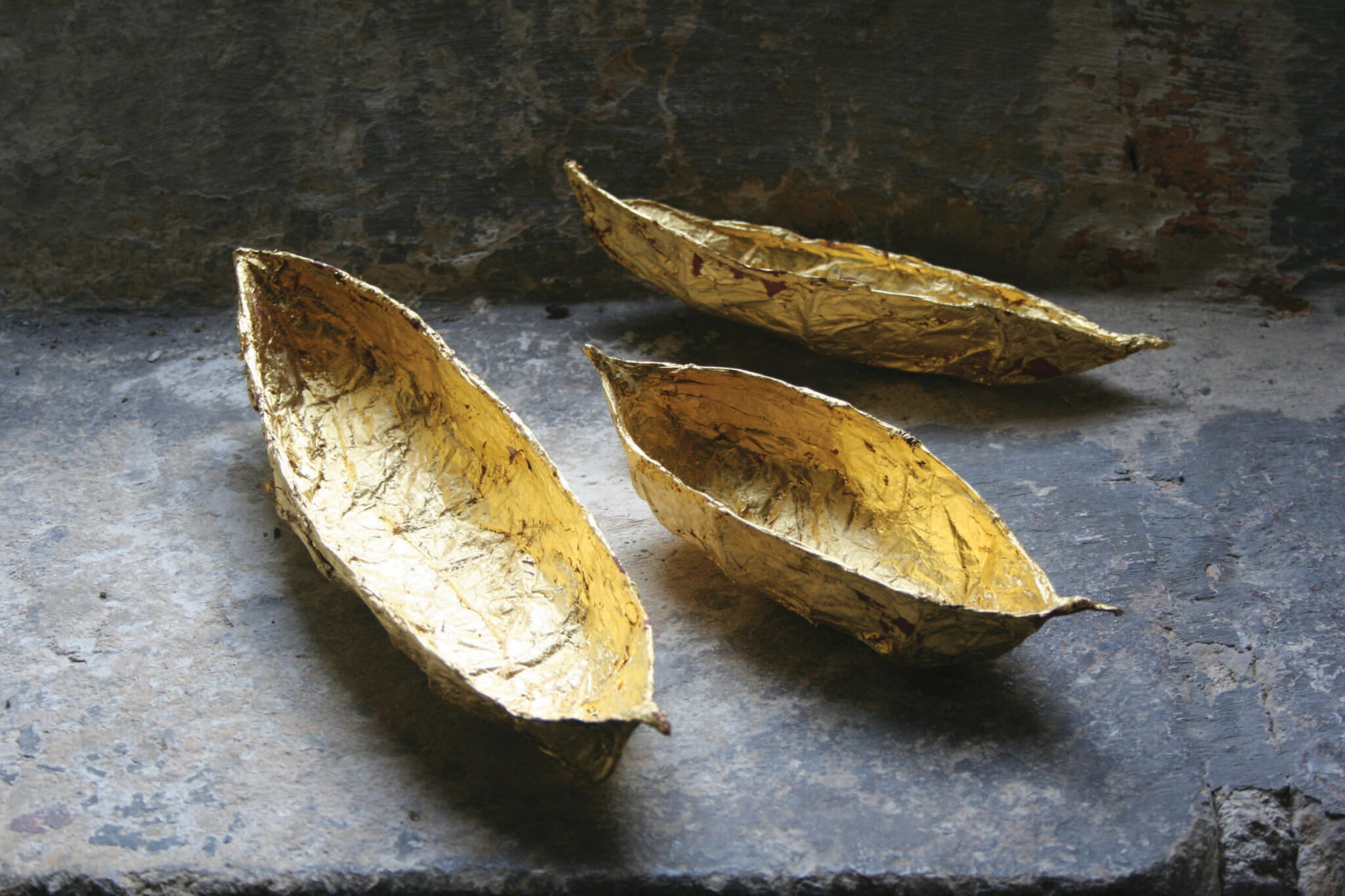
ARTICLE: “Soul on Deck” by Jake Lever: In Image no. 117 (Summer 2023), artist Jake Lever writes about a handful of his artworks having to do with the archetype of the boat as a vessel of passage: Ark, Bardsey Boats, Hailes Boats, Soul Boats, and Do the Little Things. He describes the fragile vessels he creates out of branches or wire, tissue paper, and gold leaf as “both cradle and coffin . . . something akin to a giant belly, cocoon, or womb . . . empty seed pods suggestive of cycles of birth, death, and resurrection.” Editions of some of these were given as gifts to family and friends during COVID, or to members of his collaborator-priest friend’s parish journeying through the final stages of a terminal illness.

Lever, Jake_Hailes Boats
Jake Lever (British, 1963–), Hailes Boats, 2013. Wire, tissue paper, and gold leaf, dimensions variable.

Jake Lever (British, 1963–), Soul Boats, installed at Birmingham Cathedral, 2015–16. Photo by the artist.

For Soul Boats, installed at Birmingham Cathedral for its tercentenary, Lever invited city residents to fill the two thousand boats that would hang from the ceiling of the nave with personal memories, prayers, and reflections. “Created in hospices, youth clubs, schools, sacred spaces, and scores of community settings across the city, boats were made in memory of loved ones who had died, as cries for help in finding employment, as prayers of thanksgiving and gratitude, for peace and justice.” Heading east toward the high altar in the sanctuary, these boats formed a “constellation of souls.”

+++

LITANY: “Litany for All Saints Day” by Fran Pratt: I always appreciate the litanies (responsive prayers for congregational use) that Fran Pratt writes. This one is from 2016.

+++

And for some lighthearted fun: a GIF by James Kerr (artist name: Scorpion Dagger), of Jesus and the twelve apostles riding a tandem bicycle! Kerr makes humorous animated digital collages mostly from Northern and Early Renaissance art.

Easter, Day 8: In Christ We Live

What then are we to say? Should we continue in sin in order that grace may increase? By no means! How can we who died to sin go on living in it? Do you not know that all of us who were baptized into Christ Jesus were baptized into his death? Therefore we were buried with him by baptism into death, so that, just as Christ was raised from the dead by the glory of the Father, so we also might walk in newness of life.

For if we have been united with him in a death like his, we will certainly be united with him in a resurrection like his. We know that our old self was crucified with him so that the body of sin might be destroyed, so we might no longer be enslaved to sin. For whoever has died is freed from sin. But if we died with Christ, we believe that we will also live with him. We know that Christ, being raised from the dead, will never die again; death no longer has dominion over him. The death he died, he died to sin once for all, but the life he lives, he lives to God. So you also must consider yourselves dead to sin and alive to God in Christ Jesus.

—Romans 6:1–11

LOOK: The Man and the Cross by Rufino Tamayo

Tamayo, Rufino_Man and the Cross
Rufino Tamayo (Mexican, 1899–1991), The Man and the Cross, 1975. Oil on canvas, 130 × 97 cm. Collection of Modern and Contemporary Art, Vatican Museums.

LISTEN: “In Christ We Live” by John L. Bell, 1996 | CCLI #5586758 [purchase sheet music]

>> Led by Nancy Boldt McLaren, 2008:

Part 1:

In Christ we live
And in Christ we die
And in Christ we rise up again
Let heaven rejoice
And let earth be glad
And sing, “Alleluia, amen!”
Part 2:

In Christ 
We live
In Christ we rise again
Let heaven
Rejoice
And sing, “Amen!”

>> Recorded by the Elnora Bible Institute Choir, 2020:

Part 1:

In Christ 
We live
And die and rise again
Let heaven
Be glad
And sing, “Amen, amen!”
Part 2:

In Christ we live
And in Christ we die
And in Christ we rise up again
Let heaven be glad
And let earth rejoice
And sing, “Alleluia, amen!”

This buoyant song in two-part polyphony was written by John Bell of the Iona Community, an international, ecumenical Christian movement working for justice and peace, the rebuilding of community, and the renewal of worship. The community was founded in Glasgow in 1938, and its music arm is regarded in the UK as one of the most vibrant sources of new congregational music.

Bell, a Church of Scotland minister, worked for the Iona Community for over forty years before retiring from his position as resource worker last November, though he continues to be involved as a member. He leads workshops on liturgy, music, spirituality, and social justice; has written and edited song collections, sermon collections, and a wide range of liturgical materials as part of the Wild Goose Resource Group he founded with the late Graham Maule; and contributes regularly to the annual Greenbelt festival in England. Much of his work has been in convincing people they can sing, regardless of their ability to read music, and encouraging more congregational participation in music making.

The video above shows a session from a Music That Makes Community gathering at St. Paul’s Chapel in New York City in April 2008, led by Connecticut pastor Nancy Boldt McLaren. I love the enthusiasm of the group who is learning this song for the first time! The Spotify link is to a recording by a choir from Elnora Bible Institute in Indiana, which sings the words as published (whereas McLaren makes a few small tweaks).

This concludes the Easter Octave—but keep celebrating! Easter is a fifty-day season that culminates with the feast of Pentecost on May 28. I’ll be releasing a brand-new Pentecost playlist on Spotify next month, but until then, check out the one for Eastertide, which includes today’s featured song.