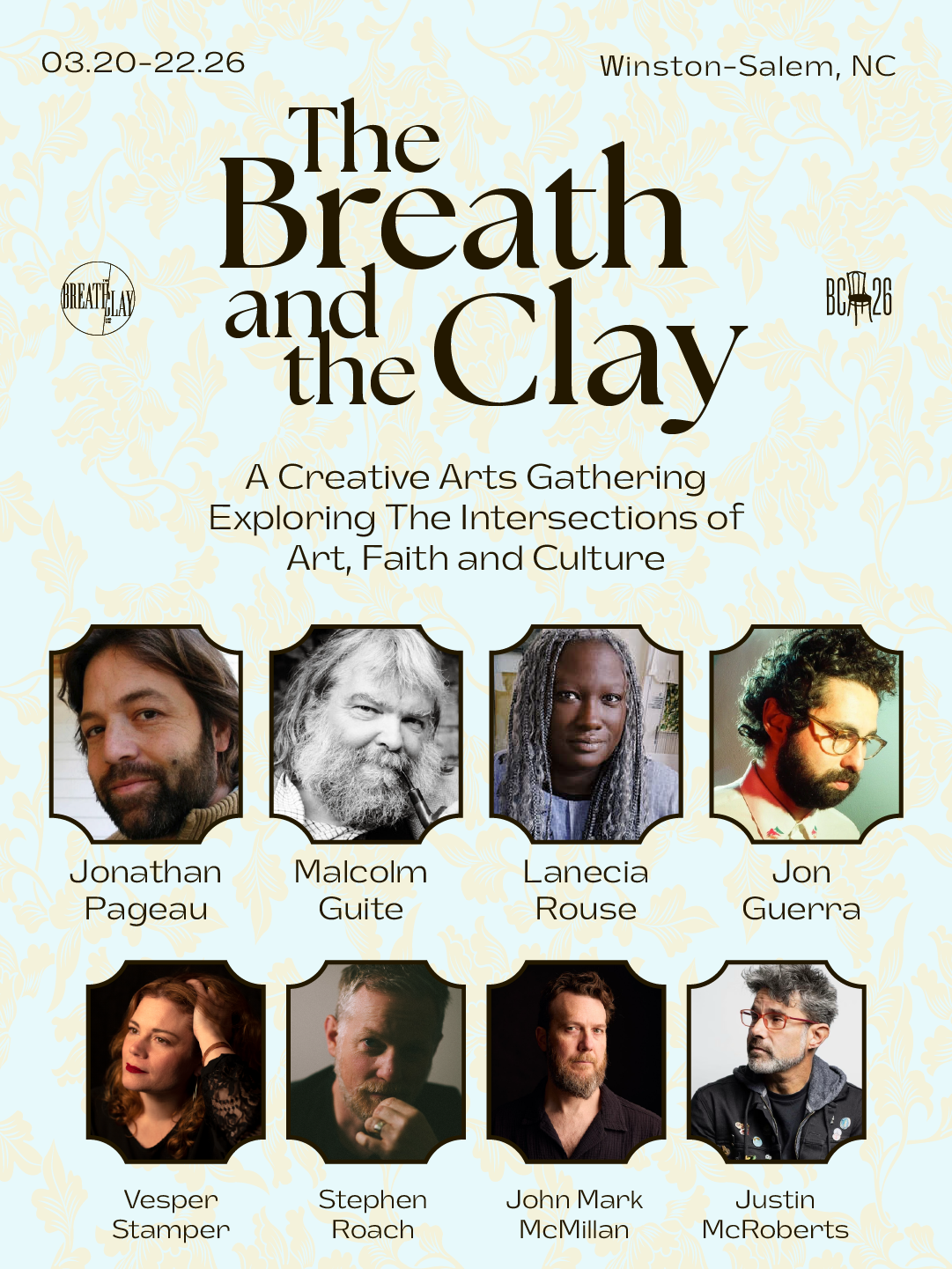
CONFERENCE: The Breath and the Clay: Exploring the Intersections of Art, Faith, and Culture, Winston-Salem, North Carolina, March 20–22, 2026: “Before the first word is spoken, before the brush touches the canvas or the note strikes the air, there is silence. Creation begins with a clearing, making space for new worlds to exist. An empty chair waits in welcome, an empty forest beckons us to come aside. Even absence itself becomes an opening for presence.
“At The Breath & The Clay 2026, we are exploring what it means to make space—for rest, for renewal, for art, for one another, and for the Presence that meets us in the emptiness. Together, we will practice making room: for the unfinished, and the unfurnished, for the overlooked, for voices not our own. In this space, we will make art—our response to the silence that precedes creation, our offering to the mystery and miracle that ever calls us onward.”
This annual gathering features presenters from across the disciplines of poetry, music, visual art, theater, film, dance, creativity coaching, and real estate development. General admission is $299.
>> “How Long (A Christian Lament)” by IAMSON: This week the Richmond, Virginia–based singer-songwriter IAMSON (the artist name of Orlando Palmer) wrote his pain into a song and shared it on social media. “I challenge all Christian artists to write about what’s really going on,” he says, likely referring to the two murders committed this month by US federal agents from Immigration and Customs Enforcement (ICE) and Customs and Border Protection (CBP) and, more broadly, the agencies’ hypermilitarized tactics, indiscriminate raids, illegal detainments, and terrorizing of communities in deference to President Trump’s mass deportation initiative.
>> “Psalm 10” by Poor Bishop Hooper: Poor Bishop Hooper (Leah and Jesse Roberts) have set all 150 psalms of the Bible to music. Psalm 10 is one I had not ever heard a musical interpretation of. Belonging to the genre of lament, it opens:
Why, O LORD, do you stand far off? Why do you hide yourself in times of trouble? In arrogance the wicked persecute the poor— let them be caught in the schemes they have devised.
>> “Micah 6:8” by Monroe Crossing:Monroe Crossing [previously] is a Minnesota bluegrass band whose members are Lisa Fuglie (fiddle), David Robinson (banjo), Derek Johnson (guitar), Matt Thompson (mandolin), and Mark Anderson (bass). This is a song Fuglie and Anderson wrote in 2011 inspired by Micah 6:8, one of this coming Sunday’s lectionary readings: “He has told you, O mortal, what is good, and what does the LORD require of you but to do justice and to love kindness and to walk humbly with your God?” Many Christians hold on to this as a “life verse,” a summation of God’s values that serves as a guiding principle.
FREE DIGITAL POETRY BOOKLET: Inkwell Poetry for the New Year (2026): Last week Inkwell (formerly Ekstasis), a publication of Christianity Today, released a collection of twenty poems curated by guest editor J. C. Scharl, and it’s excellent! “A storytelling community seeking transcendence,” Inkwell is in a period of refining their identity, and this offering is a sort of stopgap until they reintroduce poetry features into their editorial flow. (Right now they’re focusing on creative nonfiction.)
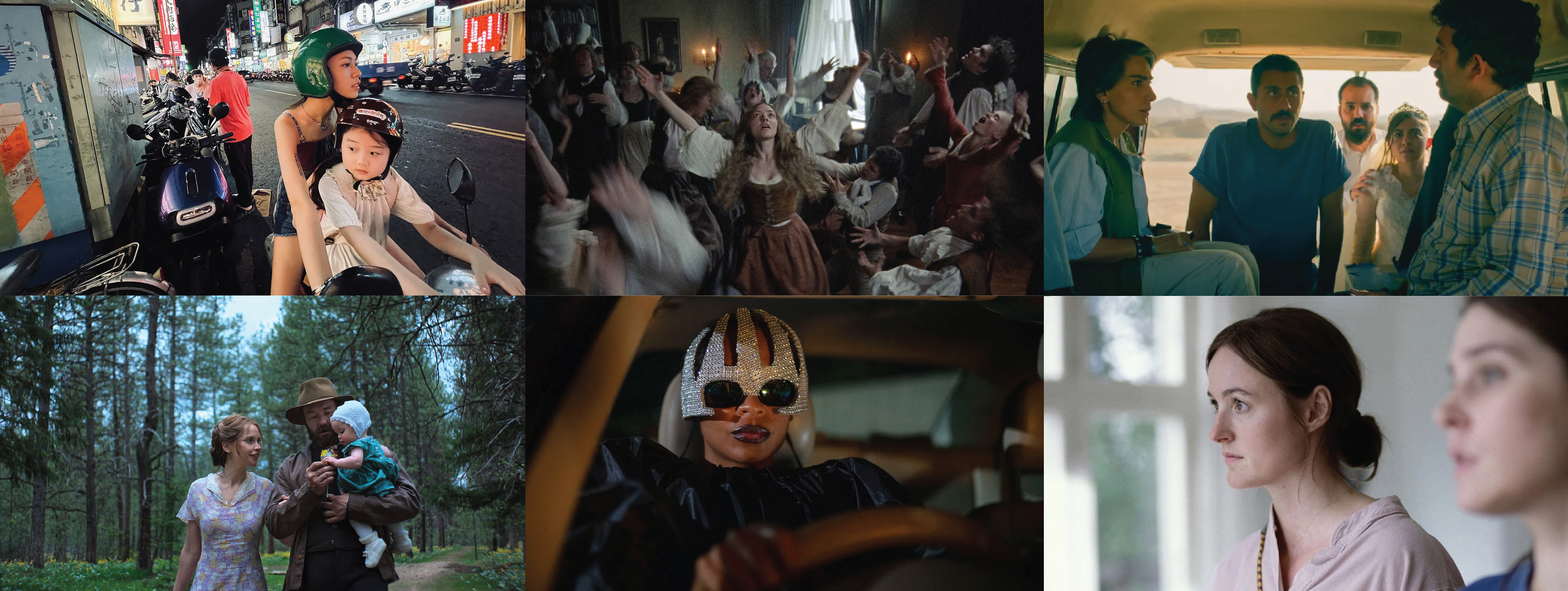
This is my sixth consecutive year of sharing my top twenty newly released films—see my favorites from 2024, 2023, 2022, 2021, and 2020. My criterion for qualifying as a 2025 release is the film had to have shown in commercial screenings in the US in that year; or if there was no theatrical release, it had to have become available through video on demand. I’ve seen over a hundred such films and will share with you the ones I like best, split across two posts.
The first Shaker settlement in colonial New York, the forests of early twentieth-century Idaho, a juke joint in Jim Crow Mississippi, the political prisons of 1970s Brazil, a crumbling ranch during the Rhodesian Bush War, a night market in Taipei, the beaches of a remote Welsh island—these are some of the places where the stories unfold. They explore parent-child relational fracture; the grief of losing a child or a spouse; the experience of spiritual ecstasy; the beauty of building a life and a family; the pressures of unemployment; the struggles of settling into a new city, country, or living arrangement; the horrors of adolescence; the consuming urge for revenge against an oppressor, and what to do when you’re confronted with their humanity; art making in (virtual) community; and the complicated process of healing from the trauma of sexual assault; among other themes.
Viewer discretion advised: Please beware that about half of these films have R ratings and may contain content that some find offensive. I do not flag such content because I don’t keep track of it and I evaluate movies based on their merit as a whole, recognizing that “mature” content is often necessary to tell a particular story; my descriptions should give you a good sense of whether that story is one you’d like to engage. But of course, if your conscience proscribes you from viewing certain content, please consult a content guide beforehand to determine if the film will be safe for you.
1. Sentimental Value, dir. Joachim Trier. Nora (Renate Reinsve), a stage actress, and her father Gustav (Stellan Skarsgård), a filmmaker, have a broken relationship. When she was a child her dad drank a lot, cheated on her mom, and left Norway for long periods of time to focus on his career. Now in his old age, Gustav wants to reconcile, and the only way he knows how to affirm the hurt his daughter feels and apologize for it is to write a role for her in a movie inspired by his own childhood, in which she would play a version of his mother. Nora has no interest in the project. She thinks it’s only a publicity stunt, not realizing it’s her dad’s way of saying, “I see you.”
Sentimental Value is about the emotional communication we lack, but also art as a way of translating pain into something we can share. (Film has the power to say things without saying them, fostering understanding.) It’s about the wounds family members inflict on each other, about love and rage and regret.
We come to learn that depression has afflicted three generations of this family: Nora, her mother, and her paternal grandmother. One of the most poignant scenes is where, when Nora is incapacitated again from her mental illness, her sister Agnes (Inga Ibsdotter Lilleaas) comes to clean her apartment while she lies awake on the couch—a simple act of care. The sisters’ bond is, I think, the sweetest aspect of the film.
2. The Testament of Ann Lee, dir. Mona Fastvold.The Testament of Ann Lee is a musical biopic of the primary founder of the Shakers, a Christian sect that emerged in mid-eighteenth-century England and that was known for its ecstatic worship (“shaking”); under the visionary Ann Lee’s leadership, it would also come to be distinguished by its practice of communal living, celibacy, gender and racial equality, pacifism, and meticulous craftsmanship. Fleeing religious persecution, Lee (played by Amanda Seyfried) emigrated to America in 1774 with a small group of followers, building a community in upstate New York—but their loud, night-long worship services (which sparked rumors of witchcraft), their refusal to fight in the Revolutionary War (due to their commitment to nonviolence), and many men’s disapproval of sexual abstinence (women, including wives, flocked to the new movement) led to attacks in their new home country too.
Visceral and rousing and built largely on the rhythm of breaths and body slaps, Daniel Blumberg’s soundtrack is phenomenal; much of it consists of new arrangements of old Shaker hymns, including “Hunger and Thirst,” “All Is Summer,” and “Pretty Mother’s Home,” but he also composed a few original songs as well. Using historical documentation of Shaker dancing as fodder for the imagination, choreographer Celia Rowlson-Hall designed the ways in which the characters commune with God together through movement, bringing all their emotions to bear in their bodies.
As someone deeply interested in Christian history (even unorthodox offshoots) and early American hymnody, I was already inclined to like this movie. But I did not expect to be as transported as I was. The story, the acting, the music and dancing, the costumes, the set design, the cinematography—all contribute to an electric, devotional film that illuminates the life and legacy of a radical woman preacher from centuries past. I did not know that Lee had had four children and lost them all in infancy; this repeated trauma likely prompted her teaching, which she claimed to have received in a revelation from God, about the sinfulness of sex. In many ways, the film is about moving through grief.
3. Hamnet, dir. Chloé Zhao. We don’t know much about William Shakespeare, and still less about his wife Anne (aka Agnes, pronounced AHN-yes). One thing we do know is that the couple had three children, and their only son Hamnet—a name interchangeable with “Hamlet” in the loose orthography of the time—died at age eleven, likely of the bubonic plague. Based on a novel by Maggie O’Farrell, Chloé Zhao’s Hamnet traces Will (Paul Mescal) and Agnes’s (Jessie Buckley) relationship from courtship to marriage to childbearing and -rearing and then, in the second half, through the waves of grief that hit them in different ways after the sudden death of Hamnet (Jacobi Jupe). The film focuses especially on Agnes’s perspective, opening with her nestled in the exposed roots of a giant tree (establishing her deep connection to nature), developing her as a feral yet tender character at first radiant with the joys of motherhood and then ripped apart by loss, and climaxing with a transcendent moment she experiences in community at the premiere performance of Hamlet at the Globe Theatre in London.
Several Shakespeare biographers have speculated that his writing Hamlet was a means by which he processed his grief over the loss of his son, reconfiguring that grief into a work of art. Even though it’s about the death of a father, the play contains ghosts, mourning, madness, guilt, and contemplations of suicide that may have been at least partially colored by Will’s own personal tragedy. O’Farrell and Zhao, who cowrote the Hamnet screenplay, have given this theory a compelling narrative framework, a story of marital love that’s strained by grief but that survives it.
4. No Other Choice, dir. Park Chan-wook. Man-su (Lee Byung-Hun) is a hardworking, upper middle-class South Korean family man with a wife (Son Ye-jin) and two kids. He takes pride in his work as a manager at a paper mill, producing beautiful products. Then suddenly, after twenty-five years at the same company, he’s laid off due to an American buyout. After more than a year of unemployment, he grows desperate and decides to eliminate the three highest-qualified men in competition with him for a job in the paper industry.
Often in dark comedy thrillers, murder is treated lightly. Not so here. We see the humanity of Man-su’s targets, the shocking and unjust nature of his determined course of action, and the soul-hollowing cost of moral compromise. Despite the film’s premise, there’s actually no graphic violence, other than when Man-su extracts from his mouth a rotting tooth, symbolic of his pained conscience, with pliers (plus a disturbing image having to do with bonsai wiring). A satire of capitalism and the male ego, the film explores the lengths to which a man is willing to go to maintain an affluent lifestyle for himself and his family. And oh, what wonderfully composed shots! (Props to cinematographer Woo-hyung Kim.)
5. I’m Still Here, dir. Walter Salles. This Brazilian biographical drama is about the real-life Eunice Paiva (played by Fernanda Torres), a mother of five who fought for the truth after her politically dissident husband, Rubens Paiva (Selton Mello), was forcibly disappeared by the country’s military dictatorship in 1971. Suddenly thrown into the role of sole head of family, Eunice must hold everyone together and reinvent herself. She moves her family to São Paulo, earns a law degree, and becomes an activist at the center of campaigns to open archives on the victims of the military regime. She is indefatigable in demanding answers and pursuing justice. Her endurance is a form of resistance.
The director of I’m Still Here, Walter Salles, spent time with the Paivas during his adolescence—he was friends with one of Eunice’s boys and frequented their teeming, music-filled oceanfront home in Rio de Janeiro before Rubens went missing. The first half hour of the film activates those memories, while the film as a whole is based on a book by Eunice’s son Marcelo Rubens Paiva.
Streaming on Netflix.
6. On Becoming a Guinea Fowl, dir. Rungano Nyoni. Made and set in Zambia, this comedy-drama is in Bemba and English. Its title is a metaphor referring to how guinea fowl use their voice—a screech—to warn the flock of predators or other impending dangers. The film opens with Shula (Susan Chardy) driving home from a party one night—wearing a glittering helmet and a puffy black jumpsuit inspired by Missy Elliott’s “The Rain” video—when she finds her uncle Fred lying dead in the road. She doesn’t seem upset, and later, when gathered with her relatives, they press her. Where are your tears? She observes her family’s performative grief for a man she knew to be immoral and their mistreatment of Fred’s widow, and she wants no part of it.
It’s hard to talk about this film without giving away a key reveal. But I can say that it’s about the silence families keep to maintain the myth of a happy and well-functioning unit, the behavior of elders that families pretend not to notice for the sake of cohesion. Consider who gets mourned and who/what does not. A critique of patriarchal culture in Zambia, the film confronts generational differences, especially as relates to traditionalist versus progressive notions of accountability, agency, respect, and respectability.
Streaming on HBO.
7. Train Dreams, dir. Clint Bentley. Adapted from Denis Johnson’s 2011 novella of the same name, Train Dreams spans the 1890s through 1960s in and around Bonners Ferry, Idaho. Both grand and quiet, transcendent and personal, it chronicles the small, simple frontier life of Robert Grainier (Joel Edgerton)—all the beauty and pain it holds. Orphaned at age six, Robert meets Gladys (Felicity Jones) sometime in his twenties, and the two marry. They build a cabin together near a river, and have a daughter. The family enjoys ordinary pleasures, like supper by candlelight, naps on the front porch, chasing chickens in the yard.
Robert works first as a railroad bridge builder, then as a logger—which takes him away from home for months at a time—then as a hauler. He suffers incredible loss, but he keeps moving on, into old age, as the wild country all around him modernizes and marvels like airplanes, television, and space travel are introduced. The film is about dreams realized and unrealized, about grief and change, about the fleetingness and yet (paradoxically) substantiality of human life.
Streaming on Netflix.
8. It Was Just an Accident, dir. Jafar Panahi. Working one day in an auto shop in Tehran, Vahid (Vahid Mobasseri) is traumatized by the voice and gait of a first-time customer, whom he swears is Eghbal (Ebrahim Azizi), an Iranian government security officer who, years earlier, had blindfolded and tortured him when he was imprisoned for speaking out for workers’ rights. In a thirst for vengeance, Vahid kidnaps the man and is in the process of burying him alive in the desert when he starts to have doubts as to whether he’s the right person. He tracks down a few of his fellow ex-prisoners, including a wedding photographer (Mariam Afshari) and a young bride-to-be (Hadis Pakbaten), to provide identity confirmation—but they, too, have mixed degrees of certainty.
Equal parts retribution drama, moral thriller, and screwball road comedy, this film explores what happens when four victimized men and women turn the tables on their victimizer. It wrestles with justice and mercy—what they look like, which is more virtuous or more prudent in this situation, and what would distinguish the civilians’ act of killing from the murders committed by the regime they resist.
Writer-director Jafar Panahi has spent time in Iranian prisons under the charge of “propaganda against the Islamic Republic of Iran” and has been banned from filmmaking in that country, so he had to shoot It Was Just an Accident furtively. I was surprised by how effective the comedic elements are against the backdrop of brutality. (My description makes the film sound only harrowing, but it’s also funny; there were quite a few laughs in the audience during the screening I attended.) It’s a difficult tonal balance to pull off, but Panahi does.
9.Left-Handed Girl, Shih-Ching Tsou. Single mom Shu-Fen (Janel Tsai) and her daughters, college-age I-Ann (Shih-Yuan Ma) and five-year-old I-Jing (Nina Ye), have just moved from rural Taiwan back to the city of Taipei. Shu-Fen opens a noodle stand at a night market, I-Ann takes a job as a “betel nut beauty” (dressing seductively to sell a fruit chewed for its stimulant and mild narcotic effects), and I-Jing attends school and takes care of her pet meerkat. This family drama is about these three female protagonists adapting to their new environment, each navigating their own challenges, whether that be paying the rent and dealing with old-fashioned parents; finding a new social scene and a place to belong; or overcoming the shameful “curse” (as I-Jing’s grandpa keeps reminding her) of being left-handed. There’s a clichéd plot device used to amp up the drama that irks me, but other than that, I enjoyed this story of acclimation and survival.
Director Shih-Ching Tsou wrote the screenplay with Sean Baker—whose Florida Project, which Tsou co-produced, is one of my favorite all-time films. She shot Left-Handed Girl entirely on an iPhone 13.
Streaming on Netflix.
10. Sorry, Baby, dir. Eva Victor. Writer-director and lead actor Eva Victor’s feature film debut is a tragicomedy about healing after sexual assault. Her character, Agnes, is a literature professor at a college in small-town New England—the same college where, three years earlier, her graduate thesis adviser raped her. She works through her trauma with the support of her friend Lydie (Naomi Ackie); her adopted cat Olga, her neighbor Gavin (Lucas Hedges), and a stranger with a sandwich shop (John Carroll Lynch) also offer her their presence. Wit and empathy combine in this nonlinear, life-affirming story of a woman in the process of recovering her sense of self and security that were wrenched from her by a trusted other.
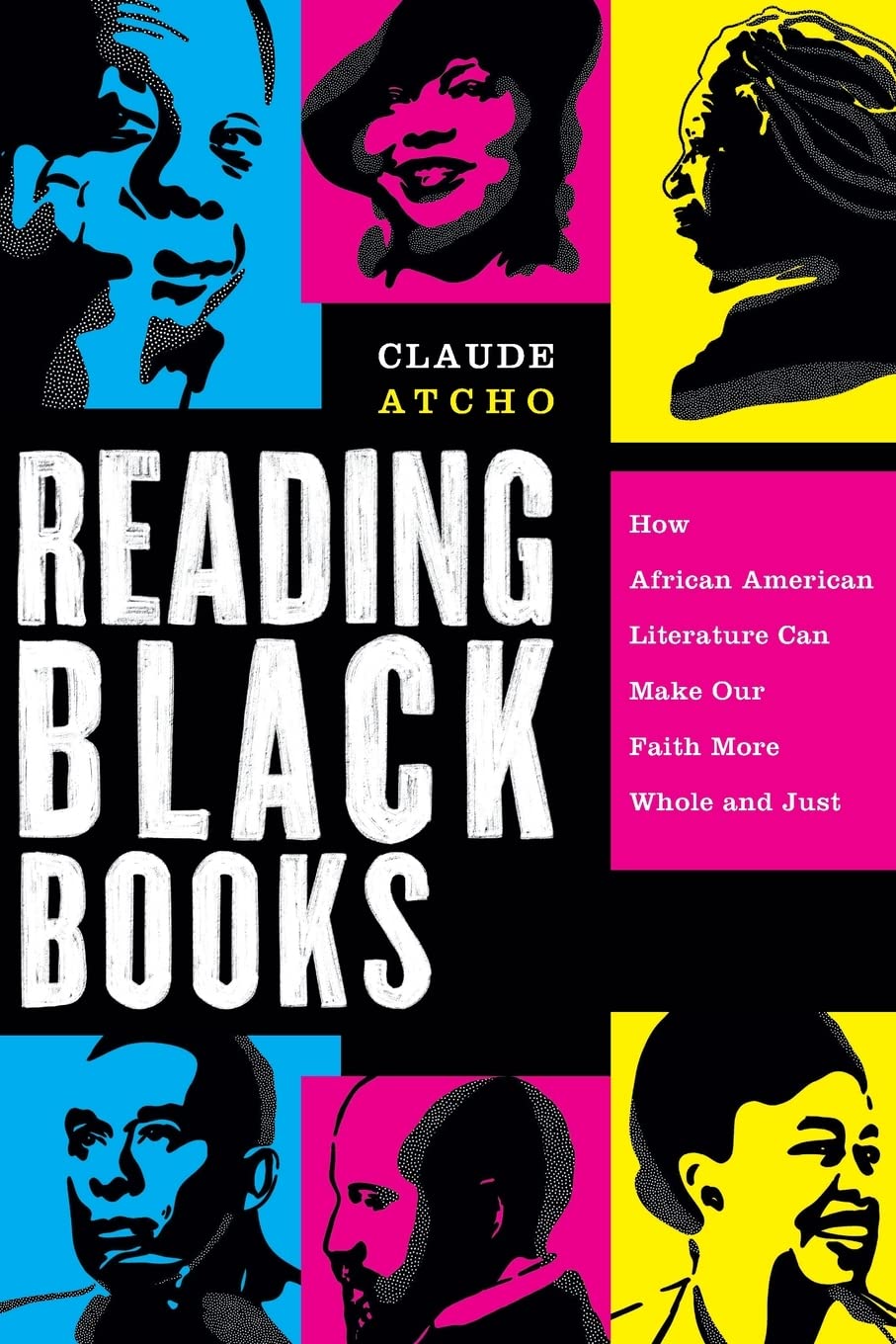
Published last month by Brazos Press, the book consists of ten chapters, each one built around a theologically charged word or concept (such as “sin,” “image of God,” or “lament”) and a twentieth-century novel or poem(s) by a Black author that is then engaged through that lens. A potential danger with this approach is that the interpretations in either direction could be forced to fit into a box, but this turned out not to be the case at all. Reading Black Books is a two-way, mutually enriching exchange between theology and literature, one that is expansive rather than limiting and that takes each discipline seriously on its own terms.
Combining literary analysis and theological reflection, Atcho shows how “God’s truth addresses Black experience and how Black experience, as shown in the literature of our great writers, can prod readers from all backgrounds toward sharper theological thinking and more faithful living” (1). We are invited to inhabit the experiences of various characters and poetic voices and to be transformed as a result. As a middle-class white woman living in a Maryland suburb, I acknowledge that I move about the world with a very different set of experiences than those of people of color. With pastoral sensitivity but also directness, Atcho helps me enter into America’s racial narrative—and the narrative of the gospel!—from a different vantage point. This book is for Christians of any race who desire to be enlarged by story and to live more fully into the liberative arc of scripture.
Atcho provides enough context for each book—introducing us to characters, rehearsing relevant plot points, and highlighting specific scenes, often including quoted excerpts—that you don’t have to have read the work previously to benefit from his commentary. The book does contain spoilers, as all serious literary criticism almost inevitably will. But literature is way more than plot, and readers are encouraged to then engage with the primary texts in full on their own, equipped with frames for thinking about them and open to surprises.
I have attempted to come to this book about books as a guide who integrates my affections: my love for these stories, my love for what they say about Black experience in both trials and triumphs, and my love for Jesus and his kingdom.
Claude Atcho, p. 7
Chapter 1 examines the question “What does it mean to live as an image bearer when other image bearers try to limit your existence?” The protagonist of Ralph Ellison’s Invisible Man (not to be confused with H. G. Wells’s sci-fi novel The Invisible Man) is not physically invisible; rather, he is rendered invisible by others’ refusal to see him. Atcho discusses the need for white sight—our warped “inner eyes”—to be redeemed.
Chapter 2 explores how systemic sin exacerbates personal sin through the controversial character of Bigger Thomas in Richard Wright’s Native Son, a Black man from 1930s Chicago who kills two people (the first one accidentally). Is Bigger a victim or a perpetrator? The question is too simplistic. Bigger is both trapped by Sin and an agent of Sin, Atcho says. Atcho’s explication of Sin with a capital S and sin, little s, is sophisticated and illuminates for me broader discussions going on in contemporary culture. Sin is not just personally experienced and personally enacted; it is also a dominating force that’s been set loose in our world and that has become embedded in systems.
The focus of chapter 3 is James Baldwin’s semiautobiographical debut novel Go Tell It on the Mountain, “a critical generational portrait of the toxic Christian practice that emerges from belief in a loveless God” (40). Baldwin gestures toward true religion through negation—by presenting the character of Gabriel, the protagonist’s minister stepfather, as a promiscuous and abusive binge drinker with a lust for power.
Chapter 4 visits “Christ Recrucified” and the nine-hundred-line “The Black Christ” (read the first stanza here) by Harlem Renaissance poet Countee Cullen, unpacking the picture they paint of a Jesus who suffers for, like, and with us. Published in the 1920s, both poems compare the crucified Christ to a lynched Black man.
In chapter 5 Zora Neale Hurston’s Moses, Man of the Mountain, a folkloric retelling of the book of Exodus, opens up a quest into the doctrine of salvation. Atcho discusses salvation from and to, which story and script forms us most (the old empire or the coming kingdom?), the significance of the promised land, and Christian social concern as a biblical imperative.
The deliverance of the exodus elides the false dichotomy of a truncated salvation. Hurston’s Moses points in the same direction—toward imagining a fully orbed salvation, as did our enslaved ancestors: revelation and liberation.
Is it our attention, then, to be fixed on the sin of slavery or our slavery to sin? Personal piety in the power of the Spirit or social change in Jesus’s name? Liberation or revelation? In the exodus, the Lord frees his people so that they might exist in freedom for him. It is liberation through revelation and atonement. God’s revelation (Exod. 9:4, 16, 29; 10:1–2; 11:7; 14:4), the necessity of atonement (13:13, 15), the urgency of liberation (2:23–25), and the subsequent call to holiness (31:13; Lev. 20:8) cannot be isolated. In the exodus, each motif exists in relation, forming the full melody of salvation. The song of salvation is not played in only one key. The contextual pressures of human experience can force us, understandably at times, to prize piety or liberation when truly salvation expands and contains both—and more. (84–85)
Nella Larsen’s Passing—which was adapted into an acclaimed film last year—is the subject of chapter 6, on racism. The novella delves into the psyches of two light-skinned Black women in 1920s Harlem, one of whom passes for white in all settings as a means of survival, and the other of whom does so only when convenient. Atcho talks about the need to combat colorism with affirmation (e.g., “Black is beautiful”), with denial, and through the flesh of Christ.
Chapter 7 spotlights Beloved, a gothic novel by Toni Morrison that combines the historical and the supernatural to tell the story of a devoted mother named Sethe who is seeking freedom from enslavement. At one point she escapes with her children, but when the authorities find them she kills her two-year-old daughter (who is unnamed in the novel and referred to as “Beloved,” the sole word on her tombstone) rather than relinquish her to a life of slavery. Sethe is ultimately able to get away to an Ohio farmhouse, which becomes haunted by Beloved’s ghost.
Atcho discusses the traumas of enslavement that continue to compound and haunt the body, mind, and soul even after one becomes “free”; the need for righteous rage; enfleshment and bodily liturgy; chattel slavery’s theft of the mother-child relationship; memory as a muscle that needs to be exercised transparently, communally, and redemptively; new creation and anticreation; and exorcism, rescue.
One of the most compelling characters in the novel is Sethe’s mother-in-law, Baby Suggs. A shepherdess of bodies and souls, she creates a new space in the woods near the farmhouse where she enacts weekly liturgies of healing. She directs her people, in Atcho’s words, “to move and be in the sacred humanity that they are and that has so viciously been attacked by those who enslaved and debased them” (117). A key passage in Beloved describes this communal gathering:
After situating herself on a huge flat-sided rock, Baby Suggs bowed her head and prayed silently. The company watched her from the trees. They knew she was ready when she put her stick down. Then she shouted, “Let the children come!” and they ran from the trees toward her.
“Let your mothers hear you laugh,” she told them, and the woods rang. The adults looked on and could not help smiling.
Then “Let the grown men come,” she shouted. They stepped out one by one from among the ringing trees.
“Let your wives and your children see you dance,” she told them, and groundlife shuddered under their feet.
Finally she called the women to her. “Cry,” she told them. “For the living and the dead. Just cry.” And without covering their eyes the women let loose.
It started that way: laughing children, dancing men, crying women and then it got mixed up. Women stopped crying and danced; men sat down and cried; children danced, women laughed, children cried until, exhausted and riven, all and each lay about the Clearing damp and gasping for breath. In the silence that followed, Baby Suggs, holy, offered up to them her great big heart. . . .
“Here,” she said, “in this here place, we flesh; flesh that weeps, laughs; flesh that dances on bare feet in grass. Love it. Love it hard. Yonder they do not love your flesh . . .”
Baby Suggs then goes on to list various parts of the body—eyes, skin, hands, mouth, neck, liver, heart—contrasting what “yonder” men do to those parts (gouge, flay, chop, beat, hang, expose and feed to hogs) with each part’s innate belovedness. Atcho’s comments on this passage—a passage that has stuck with me ever since I first read the novel some fifteen years ago—are among the best in the book.
Chapter 8 is on the theme of lament, and it considers that biblical practice in relation to the poem “A Litany of Atlanta” by W. E. B. Du Bois while also looking at the Psalms and the cross. “There is . . . power in lament that names injustice for what it is,” Atcho writes. “By naming it as such and placing it before God as counter to his moral will, lament teaches us to make no peace with injustice or oppression” (137). Bearing true witness against evil, the poem was written in response to the three-day reign of racial terror that white men unleashed on a Black community in Atlanta in September 1906, killing, maiming, and destroying homes and businesses. It opens, “O Silent God, Thou whose voice afar in mist and mystery hath left our ears an-hungered in these fearful days— / Hear us, good Lord!”
Chapter 9 takes a look at another novel by Richard Wright, The Man Who Lived Underground, published for the first time last year, sixty-one years after the author’s death. (Publishers rejected it during Wright’s lifetime.) It follows Fred Daniels, a Black man who, after being picked up by police and relentlessly tortured, confesses to a double murder that he did not commit, then flees into the city’s sewer system. “The underground” confers on him a new knowledge of the world’s foundations of falsehood and injustice. At the end, he meets his demise.
To imagine a more just world, one must reckon with the world that is.
Claude Atcho, p. 145
Even though the novel promotes a worldview that is bleak and fatalistic, reading it can still be constructive, Atcho says; as Christians, we carry our hope to bleak texts. What would it look like to see this senseless world reconfigured into wholeness and justice? Atcho calls us to action, away from discrimination, violence, and power abuse and toward the pursuit of justice for all people on earth as it is in heaven.
It’s fitting that the last chapter centers on hope, particularly as expressed through Margaret Walker’s poem “For My People.” Atcho describes the poem as “a living history, an ode, an exhortation, a lament, a prayer” that “embodies the fiery passion of a communal hope, a bond of persons and destiny” (160, 166). While the majority of the poem addresses Walker’s Black kin, at the end she expands “my people” to embrace all of humanity, “all the adams and eves.”
+++
Throughout Atcho’s book we see the legacies of racial oppression in America—how it manifests today. Though the most recent of the featured literary works is from 1989, they all speak into our current moment. I appreciate how Atcho defines terms that show up a lot in public discourse, such as liberation and justice, comparing cultural definitions with biblical ones. But he leads with story. While in the public square our tendency is often to arm ourselves with arguments to bolster our views and defend against attacks, story has a way of disarming us. Abstract concepts become incarnate in the lives of characters. Literature can teach us the discipline of listening and can develop our empathy and understanding. It may prompt us to assess our own prejudices or complicities and impel us to repentance and real change.
Reading Black Books demonstrates the power of great literature to form us spiritually, regardless of the faith commitments of its author. Atcho presumes no theological agenda on the part of the writers, but rather chooses to read these works theologically—which can unlock more nuanced interpretations or deepened meaning. Applying a theological framework, Atcho draws out themes from the works that cannot be addressed quite as well, I’d say, without theological language. He connects our collective human story to God’s story.
The back matter includes discussion questions for each chapter.
Though I had previously read and studied all four poems Atcho discusses, I’ve read only one of the seven novels—and this despite my having been an English major in college! This book makes me want to read more for sure. I’ve already stocked up my library accordingly. I’m grateful to Atcho for reactivating my interest in fiction and for extending it in the direction of these seminal African American novels.
Though I grew up in the church, for a long time I was ignorant of the vibrant threads of lament and justice that run throughout scripture. I imbibed the message that good Christians never complain or get angry or question God or call him to account, that “rejoicing always” means always putting on a happy face (dwelling in sadness was tantamount to distrust), and that social justice is a “liberal agenda” and a distraction from the gospel. As my faith has matured and my engagement with the scriptures has deepened, my eyes have been opened to the embeddedness of justice in the biblical narrative, and how any lack of justice is cause for lament.
Tim Keller’s book Generous Justice: How God’s Grace Makes Us Just (2012) was instrumental in helping me see how social justice is an expression of God’s own heart and an important part of the church’s mission, not tangential to the gospel but an extension of it. My earlier conception of the gospel, the good news of Jesus Christ, was so impoverished, as I had reduced it down to nothing more than a private transaction between me and God regarding the eternal destination of my soul. As I began to see, through reading scripture, that God cares about this world, and he cares about people’s souls and bodies, I came to realize how expansive the gospel really is, with real implications for the here and now. We may be in right relationship with God, or think we are, but are we in right relationship with our neighbors and, I would add, with the rest of God’s creation? That is, do we live justly, as God commands, which includes supporting policies that promote, as best as possible, the flourishing of all, not just ourselves or others like us?
Keller shows how the Christianese terms “sin” and “righteousness” have to do not only with personal morality but also with systems, and how “justice” is more multifaceted than merely “punishment.” Punishing wrongdoers and reestablishing rights is one type of justice, called rectifying (or retributive) justice, or mishpat in Hebrew. But primary justice (aka distributive justice) is making sure goods and opportunities are more equitably distributed in society. It’s proactive. “Primary justice, or tzadeqah, is behavior that, if it was prevalent in the world, would render rectifying justice unnecessary, because everyone would be living in right relationship to everyone else” (11). Keller says that when these two Hebrew words appear together in the Bible, the best translation of the compound is “social justice.” So, for example, when Psalm 33:5 says, “He loveth righteousness [tzadeqah] and judgment [mishpat],” perhaps a better modern translation would be “The LORD loves social justice.”
The truncated “ticket to heaven,” “me and Jesus” understanding of salvation shows up in countless Christian worship songs, which form, or malform, our imaginations. I’m not at all dismissing the need for personal salvation (that is a critical component of the gospel!), or suggesting that we ought not to be looking toward eternity. What I am saying is that our relationship with Jesus, including our transformative experience of his love and grace, should have a profound impact on how we relate to and advocate for our neighbors, and our conception of heaven should be as huge and as glorious as the Bible alludes to (the entire world renewed and in harmony under the headship of Christ)—and we should start living into that vision NOW, even as we await Christ’s return. I often wonder whether, if there had been more biblical justice–oriented songs circulating and in church use during my upbringing, my deep hurt over the brokenness of the world and thus my sense of social responsibility as a Christian would have developed sooner.
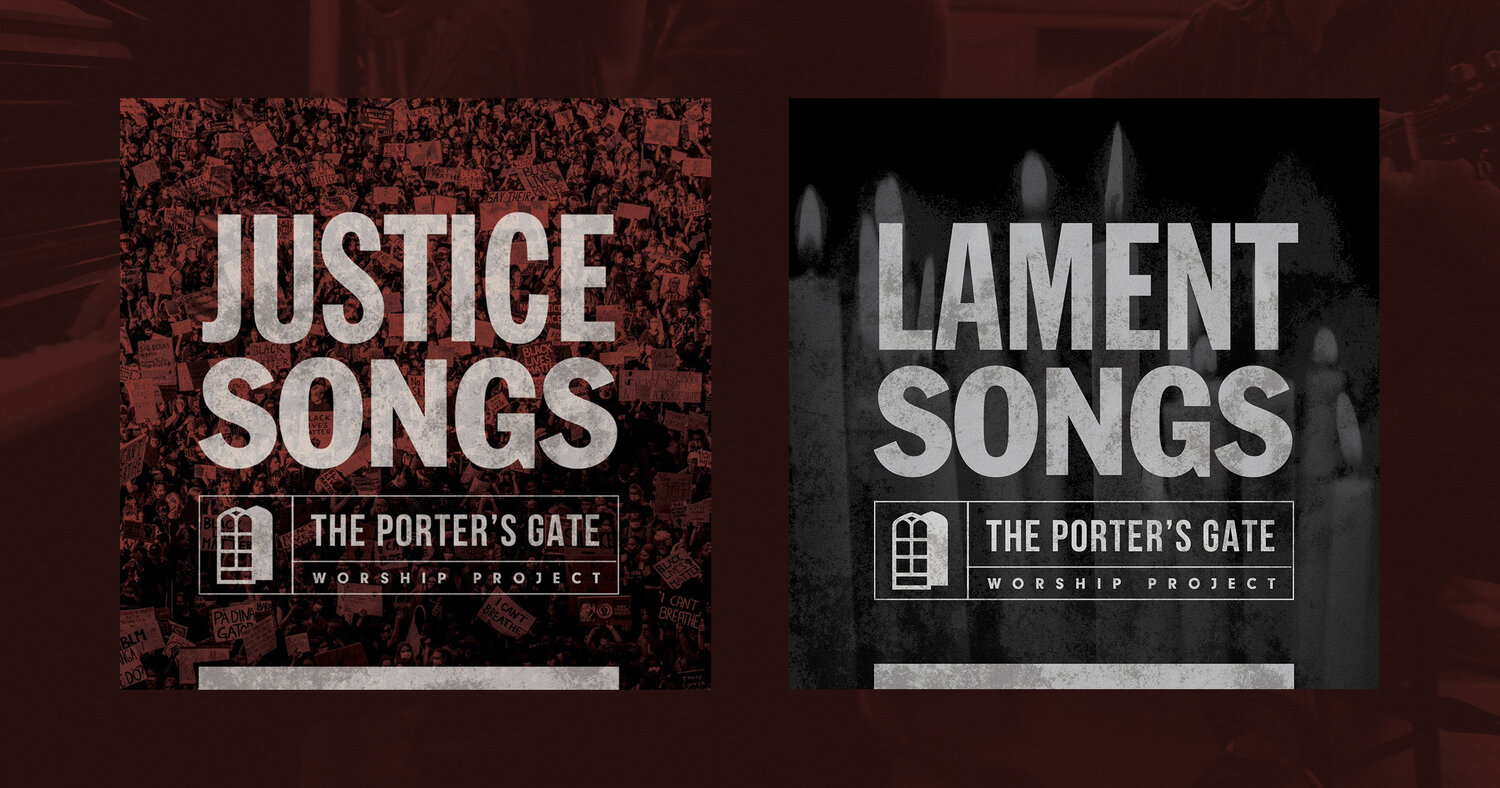
Founded in 2017 by Isaac and Megan Wardell, The Porter’s Gate is a music collective whose mission is to be a “porter” for the Christian church—one who looks beyond church doors for guests to welcome. Their first album, Work Songs (2017), explores the concept of vocation in both the public and private spheres. That was followed up by Neighbor Songs (2019), centered on the communal aspect of Christian living and of God’s future, and the embodied love at the heart of the gospel.
And now, released this month, are two companion albums: Lament Songs and Justice Songs. Recorded by a diverse group of musicians in July 2020 on a farm in Virginia, the albums interweave fragments from the Psalms with biblical prophecies and apocalypses, blessings, Gospel stories, and protest chants, crafting a robust kingdom theology that promotes constructive engagement with contemporary issues and a looking toward the reconciliation of all things in Christ. “We fight for the victories we know You will win” (a lyric from “Justicia”) is a good encapsulation.
Political corruption, police brutality, racism, mass incarceration, sexual violence, economic exploitation, and war are all referenced, either implicitly or explicitly, as forms of oppression that need to be toppled, as they are an affront to God, marring his image.
Full of heartbreak and hope, the songs are shepherding me out of my tendency toward cynicism and helping me recapture the beauty of God’s vision for the world. They’re saturated in biblical language. An antidote to the all-too-common escapism theology present in some Christian music, they catalyze the church to weep with those who are weeping (Rom. 12:15), to bear the burdens of others (Gal. 6:2), and to participate in God’s work of renewal in the world. God has not redeemed us to wait idly by while sin tightens its grip on society. No, he calls us to sow the seeds of his kingdom in anticipation of a bountiful harvest. To walk in the power of the Spirit, into dark corners, bringing light.
The Porter’s Gate seeks to provide songs for corporate worship, and all these would (potentially) be appropriate in that setting; for churches that aren’t used to the practice of lament or to engaging justice issues, some advance education and pastoral guidance will be in order. Some songs will naturally land better in some churches than in others. Some are challenging—and that’s a good thing, as challenge tends to grow us.
As one would expect, God is supplicated throughout the songs. Entreaties include
Come, Jesus, come
Be our light
Drive out the darkness
End all the violence
Do not be silent
Be near!
Illuminate the shadows
Take pity!
Keep the enemy back
Comfort
Be our refuge
Break oppression
Make me an instrument
Help me restore
And God is abundantly praised, and his promises laid claim to.
The songwriters on the two albums are Isaac Wardell, Latifah Alattas, Kate Bluett, Jessica Fox, Jon Guerra, Casey J, Wendell Kimbrough, Leslie Jordan, Dan Marotta, Orlando Palmer, John Swinton, Gregory Thompson, Liz Vice, Keith Watts, Tina Colón Williams, and Paul Zach.
As the writers would acknowledge, the general content and ethos of the songs are not “new” or alien to Christianity. If you cringe at the thought of bringing current events into worship or singing a confession of corporate sin or expressing sadness or outrage to God, just know that faithful Christians have been doing it since the beginning, and your discomfort may be because you haven’t been exposed to church traditions outside your own. Ecumenicism is an important aspect of The Porter’s Gate’s identity, says Isaac Wardell—an ecumenicism that says, “I come with gifts of the Spirit of my tradition, but I come also with the poverty of my tradition, looking for the charisms and the gifts of your tradition.” And I love that about the project.
Because I’m eager for others to see the biblical groundedness of the songs (which will be obvious to many upon first listening, but maybe not to those who are more selectivist in their Bible reading), and because I’m a musical worship leader who approaches worship music with great discernment of the theology it espouses, I’m going to point out just some of the scriptural connections in the songs.
Acknowledging that the world is not right, and mourning specific instances of that unrighteousness, is the first step in justice work. It’s called lament. Lament cries out, “Why, God?” and “How long?” Honest expressions of woe are not irreverent. The Bible is full of such language. The fact that lament is addressed to God means that faith has not been abandoned; on the contrary, lament leads to a renewed confidence in God.
The first song on Lament Songs, “Wake Up, Jesus” (feat. Liz Vice), takes as its conceit the story of Jesus’s calming the storm after being woken up by his scared disciples, but it is sung in medias res, from the vantage point of one who is caught in a storm that is still raging. “Jesus, when you gonna wake up? . . . Won’t you rise up?” Again, maybe you’ve always assumed this kind of forthrightness is forbidden in prayer, but it’s in perfect sync with the way the biblical psalmists, for example, relate to God; take Psalm 44: “Awake, Lord! Why do you sleep? / Rouse yourself! Do not reject us forever. / Why do you hide your face / and forget our misery and oppression?” (vv. 23–24). (See more biblical examples of this demand at https://artandtheology.org/2019/07/09/rise-up-artful-devotion/.)
When the instrumental intro to the second song begins, we recognize the famous passion chorale tune by Hassler, and we ready ourselves to sing “O Sacred Head . . .”—but instead we get “O Sacred Neck.” The word change is jarring. Why are we talking about Jesus’s neck? Then with the next phrase, “pressed down by blows and knees,” it becomes clear that the reference is to black victims of police violence, like George Floyd, who died in May after an officer, arresting him for trying to make a purchase with a counterfeit twenty-dollar bill, knelt on his neck for nearly eight minutes while he pled for his life and then died. (Two other officers assisted in restraining him, and another prevented onlookers from intervening.)
Laurent de La Hyre (French, 1606–1656), The Kiss of Peace and Justice, 1654. Oil on canvas, 21 5/8 × 30 in. (54.9 × 76.2 cm). Cleveland Museum of Art, Ohio, USA.
Lord, thou hast been favourable unto thy land: thou hast brought back the captivity of Jacob.
Thou hast forgiven the iniquity of thy people, thou hast covered all their sin. Selah.
Thou hast taken away all thy wrath: thou hast turned thyself from the fierceness of thine anger.
Turn us, O God of our salvation, and cause thine anger toward us to cease.
Wilt thou be angry with us for ever? wilt thou draw out thine anger to all generations?
Wilt thou not revive us again: that thy people may rejoice in thee?
Shew us thy mercy, O LORD, and grant us thy salvation.
I will hear what God the LORD will speak: for he will speak peace unto his people, and to his saints: but let them not turn again to folly.
Surely his salvation is nigh them that fear him; that glory may dwell in our land.
Mercy and truth are met together; righteousness and peace have kissed each other.
Truth shall spring out of the earth; and righteousness shall look down from heaven.
Yea, the LORD shall give that which is good; and our land shall yield her increase.
Righteousness shall go before him; and shall set us in the way of his steps.
—Psalm 85 KJV
This psalm is a community lament, probably written during the period of Israel’s return from the Babylonian exile—to a ruined city, a fallen temple, and a mourning land. The people seek forgiveness for their covenant unfaithfulness and restoration, appealing to the benevolence God has shown them in the past. The closing section expresses confidence that salvation will come.
Verse 10 personifies four of God’s virtues: mercy (lovingkindness; Heb. hesed, Lat. misericordia), truth (Heb. emeth, Lat. veritas), justice (righteousness; Heb. tsedeq; Lat. iustitia), and peace (Heb. shalom, Lat. pax). Mercy and Truth meet together, and Justice and Peace embrace with a kiss. In medieval Christian writings these virtues came to be allegorized as the “four daughters of God,” a motif developed most famously by Hugh of St. Victor and Bernard of Clairvaux.
Many churches sing Psalm 85 at Advent or Christmastime, the birth of Jesus being a time when God’s salvation came near and “glory . . . dwell[ed] in our land.” All the virtues of God kissed each other in Christ, bringing heaven to earth. Others read the psalm as prophesying Jesus’s atoning death.
I love how Eugene Peterson translates this psalm in The Message, which suggests that these virtues of God are ones that humanity should emulate, and indeed what the gospel calls us to:
Our country is home base for Glory!
Love and Truth meet in the street,
Right Living and Whole Living embrace and kiss!
Truth sprouts green from the ground,
Right Living pours down from the skies!
Oh yes! GOD gives Goodness and Beauty;
our land responds with Bounty and Blessing.
Right Living strides out before him,
and clears a path for his passage. (vv. 9b–13)
Jesus lived rightly and bound up the brokenness he encountered, bringing wholeness. His ministry announced, verbally and in tangible ways, a kingdom to come, and we are to pave the way for that kingdom by embodying its values.
+++
SONG: “O God, Will You Restore Us” by Isaac Wardell | Performed by Bifrost Arts, feat. Yolonda Coles Jones, on Lamentations, 2016
O God, will you restore us, And grant us your salvation? (×2)
I will hear what God proclaims.
The Lord our God proclaims peace.
Kindness and truth shall meet,
Justice and peace shall kiss.
O God, will you restore us, And grant us your salvation?
“Here is the fast that I choose:
To loosen the bonds of the oppressed and break their chains.
Let righteousness and justice go out before you,
Then you will call out and I will hear.”
O God, will you restore us, And grant us your salvation?
Near indeed is his salvation to those who call on him.
He will incline his ear and hear their prayers.
Truth shall spring out of the earth,
and justice will rain down from heaven.
O God, will you restore us, And grant us your salvation?
The Lord will guide you on a righteous path,
His vindication will shine down forth as the dawn.
Your people will be called repairers of broken walls,
Making straight the path to proclaim his reign!
O God, will you restore us, And grant us your salvation?
O God, will you restore us? Please grant us your salvation.
Isaac Wardell’s “O God, Will You Restore Us” cleverly integrates Psalm 85 with Isaiah 58, which both center on themes of restoration, blessing, and social responsibility, even using similar word pictures. The refrain is based on the plea of Psalm 85:6–7, the heart of the psalm.
Opening with that plea, Wardell’s first verse then moves into Psalm 85:8, 10: God proclaims shalom. Verse 2 articulates what that looks like: the bonds of wickedness loosed, the oppressed set free. This verse is derived from God’s words in Isaiah 58:6, 8–9, in which God expresses the work he wants his people to be about—namely, justice. Only when his people practice true piety—emancipating captives, feeding the hungry, sheltering the homeless—will he answer their prayers.
The third verse is drawn from Psalm 85:9, 11, an image of abundance and refreshment. And finally, verse 4 seems to be based on Isaiah 58:8, 12 and Psalm 85:13 (cf. Isa. 40:3).
Unmetered and in a minor key, the song has the feel of a Gregorian chant.
+++
“The Allegory of Justice and Peace,” or “Justice and Peace Kissing,” was a popular subject in the seventeenth and eighteenth centuries in the art of the Italian and Flemish Baroque and the French Neoclassical, including works by Giovanni Battista Tiepolo, Corrado Giaquinto, Pompeo Batoni, Artemesia Gentileschi, Theodoor van Thulden, Maerten de Vos, Jacob de Backer—and the artist featured above, Laurent de La Hyre. Although the image comes from the Hebrew Bible, where it is rooted in God’s dealings with his people, artists often used it for secular purposes, to express political peace. Some such paintings were gifted to rulers as a form of flattery.
The iconography that developed draws on classical symbolism and mythology, with both virtues being personified as women. Justice’s attributes include a crown, a sword, scales, and a fasces; Peace’s, an olive branch, an inverted torch (which burns weapons and armor), ears of wheat and/or a cornucopia (because peace leads to plenty), and a caduceus (one myth suggests that Mercury saw two serpents entwined in mortal combat and separated them with his wand, bringing about peace between them).
The Hebrew word for “kiss” in Psalm 85 refers seldom to an erotic kiss, says Sigrid Eder, but rather to a form of greeting or goodbye exchanged by near relatives or to the final phase of a peacemaking ritual. In medieval Europe, where the visual motif of Justice and Peace Kissing was first introduced, kissing was even more widespread than in the ancient Jewish world; it was common for people of equal rank, both male and female, to exchange lip-to-lip kisses. (See a compilation of medieval “kiss paintings,” showing a variety of contexts, here.) But the Baroque taste for undraped figures means that quite a few artistic renditions of Justice and Peace can be read as sexualized, as when one of the women has a bared breast, for example.
In Laurent de La Hyre’s The Kiss of Peace and Justice, the action is set within a larger landscape. An olive-wreathed Peace embraces a blue-beribboned Justice beside a fountain inscribed with Iusticia et Pax // osculatae sunt, from the Latin Vulgate. The women are surrounded by ruins—upturned roadstones, crumbled walls and detached columns, a cracked garden urn. But this is an image of hope. A lion-faced spigot emits fresh, flowing water, which sheep flock to for refreshment, and trees part to reveal a vista. After the upheaval, healing and repair are underway. Justice and Peace have harmonized.
The Cleveland Museum of Art, which owns the painting, notes that its date coincides with the end of the Fronde, a period of civil war in France during which the parlement (law courts) and the nobility sought—unsuccessfully—to limit the power of the monarchy. So it’s likely the painting is an allusion to the climate of general reconciliation between parties.
This post belongs to the weekly series Artful Devotion. If you can’t view the music player in your email or RSS reader, try opening the post in your browser.
To view all the Revised Common Lectionary scripture readings for Proper 14, cycle A, click here.


 Art & Theology