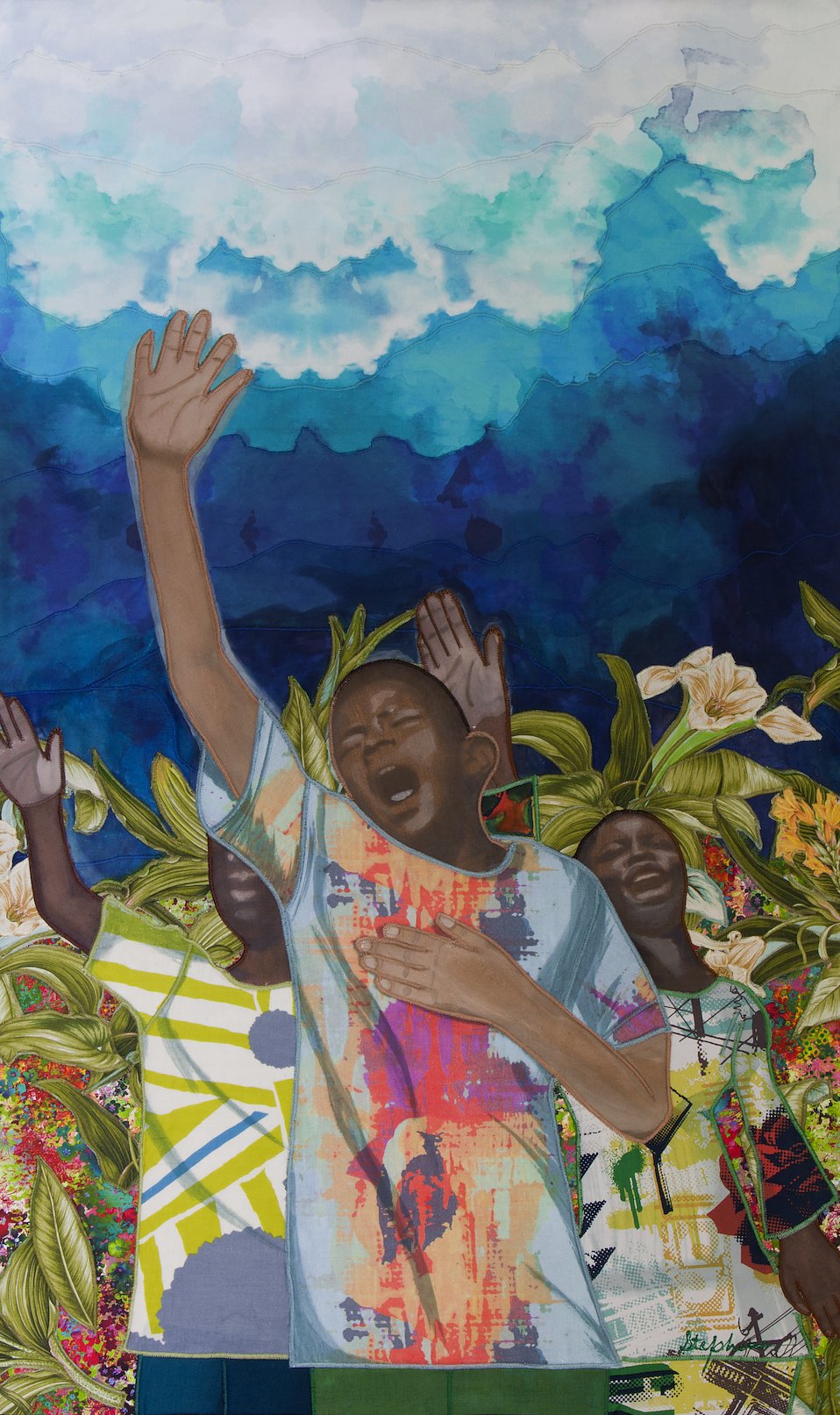
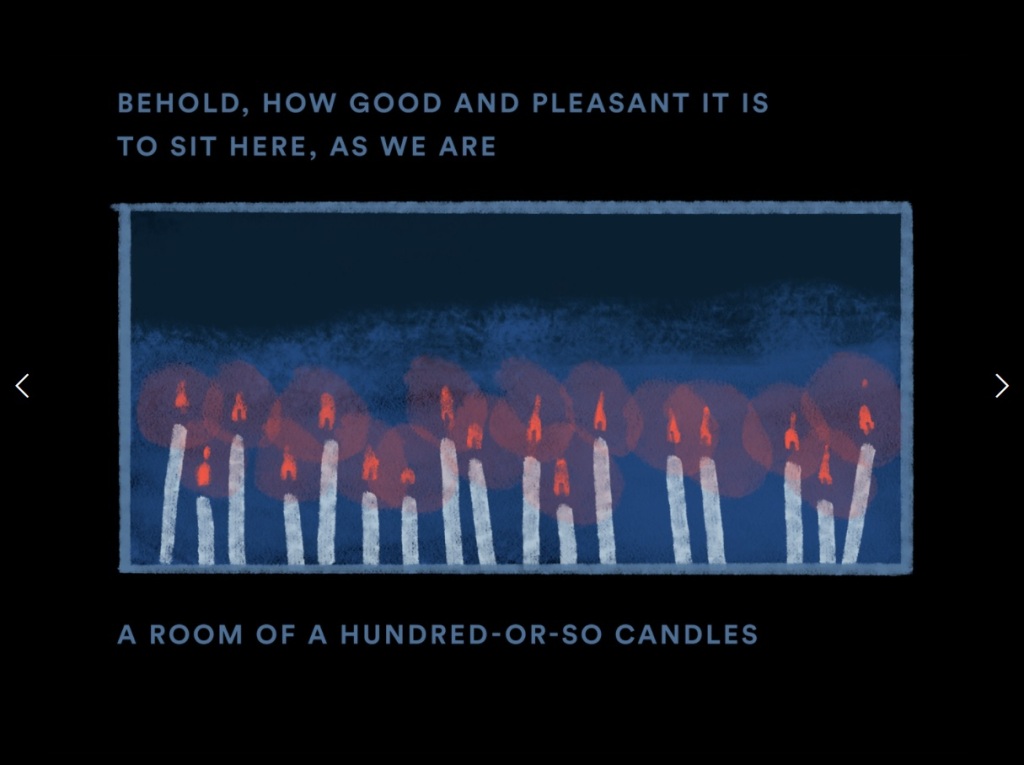
Juneteenth (June 19) is a holiday that celebrates the end of race-based chattel slavery in the United States. It rejoices in the expansion of freedom, but it also reckons with the shadow of freedoms still denied. It is thus both backward- and forward-looking. (For more on the holiday, see the article that historian Jemar Tisby published this morning: “Juneteenth Is the Counter-Narrative to America 250.”) Below are a few artistic pieces that speak to the themes of Juneteenth.
ARTWORKS: From my two most recent visits to New York City.
>> The Floating World: Lotus (125th) by Sanford Biggers: Lotus (125th) is part of the 2013 Floating World series by the multidisciplinary artist Sanford Biggers, employing paper collage, stencils, screenprint, and spray paint to construct layered compositions that blend Japanese aesthetics with African American history. “Floating world” translates the Japanese term ukiyo-e, referring to Edo-era woodblock prints, and “125th” likely refers to the main street in Harlem. The work features a mandala-like lotus flower whose petals are eighteenth-century diagrams showing enslaved humans tightly packed into the cargo hold of a ship. What looks pleasing from a distance is, on closer inspection, horrifying.
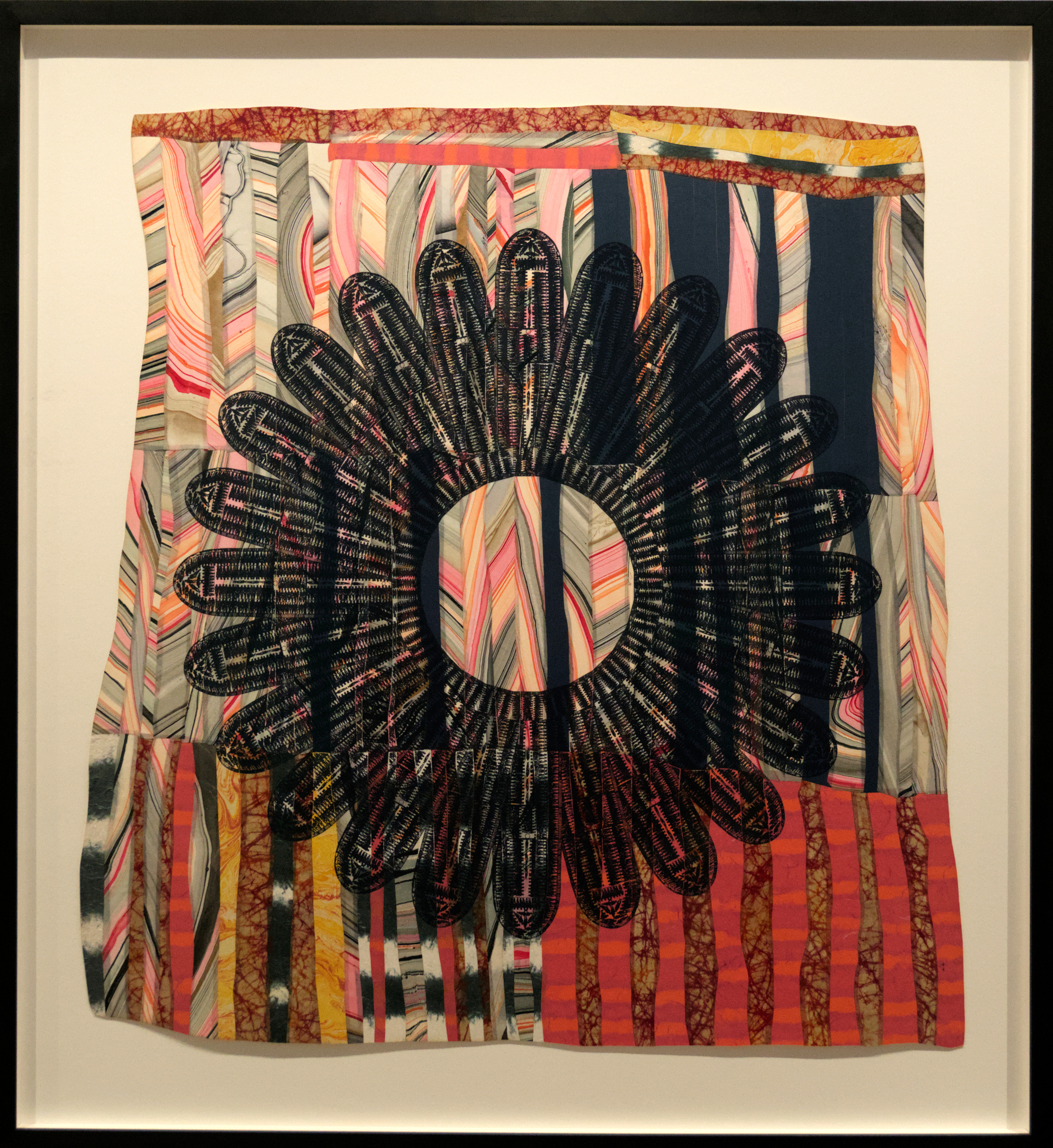
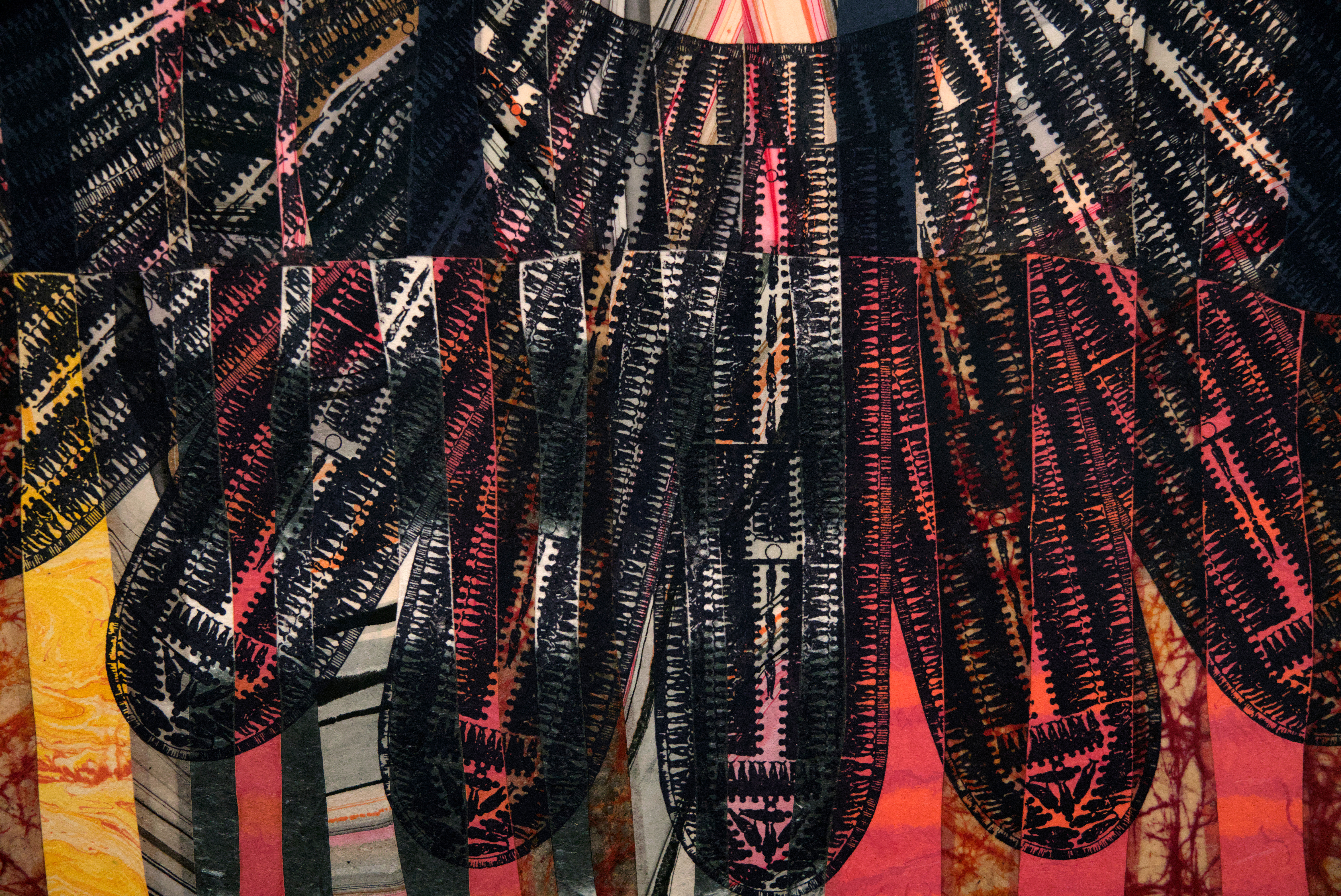
Biggers lived in Japan for three years in the 1990s, where he became greatly influenced by Zen Buddhism. In Buddhism, the lotus is associated with awakening, purity, transcendence. The slave-ship-lotus is a motif the artist has used in other works—see, e.g., here and here—and I’m not exactly sure what to make of it. Is it about how the pain, trauma, and destruction wrought by slavery can be transmuted into enlightenment, progress? Or is the disjunction between beautiful flower and ugly abuse meant to be ironic, perhaps a statement about how we tend to palliate the vile parts of American history?
(Related post: “Stained glass in West Side Chicago church reclaims an identity for Black youth”)
>> Contending with Contingency I by Kenturah Davis: Kenturah Davis is a multidisciplinary artist working between Los Angeles and Accra. Oscillating between facets of portraiture and design, her work explores the fundamental role language has in shaping how we understand ourselves and the world. Contending with Contingency I is the first work in a series engaging the Thirteenth Amendment to the US Constitution, which abolished slavery, with one exception: Those convicted of a crime can be subjected to forced labor. The amendment was a milestone, but the punishment clause creates a contingency under which slavery can remain legal. (Ava DuVernay’s illuminating documentary 13th, on Netflix, examines how this loophole has and continues to be exploited to disproportionately incarcerate Black people.)
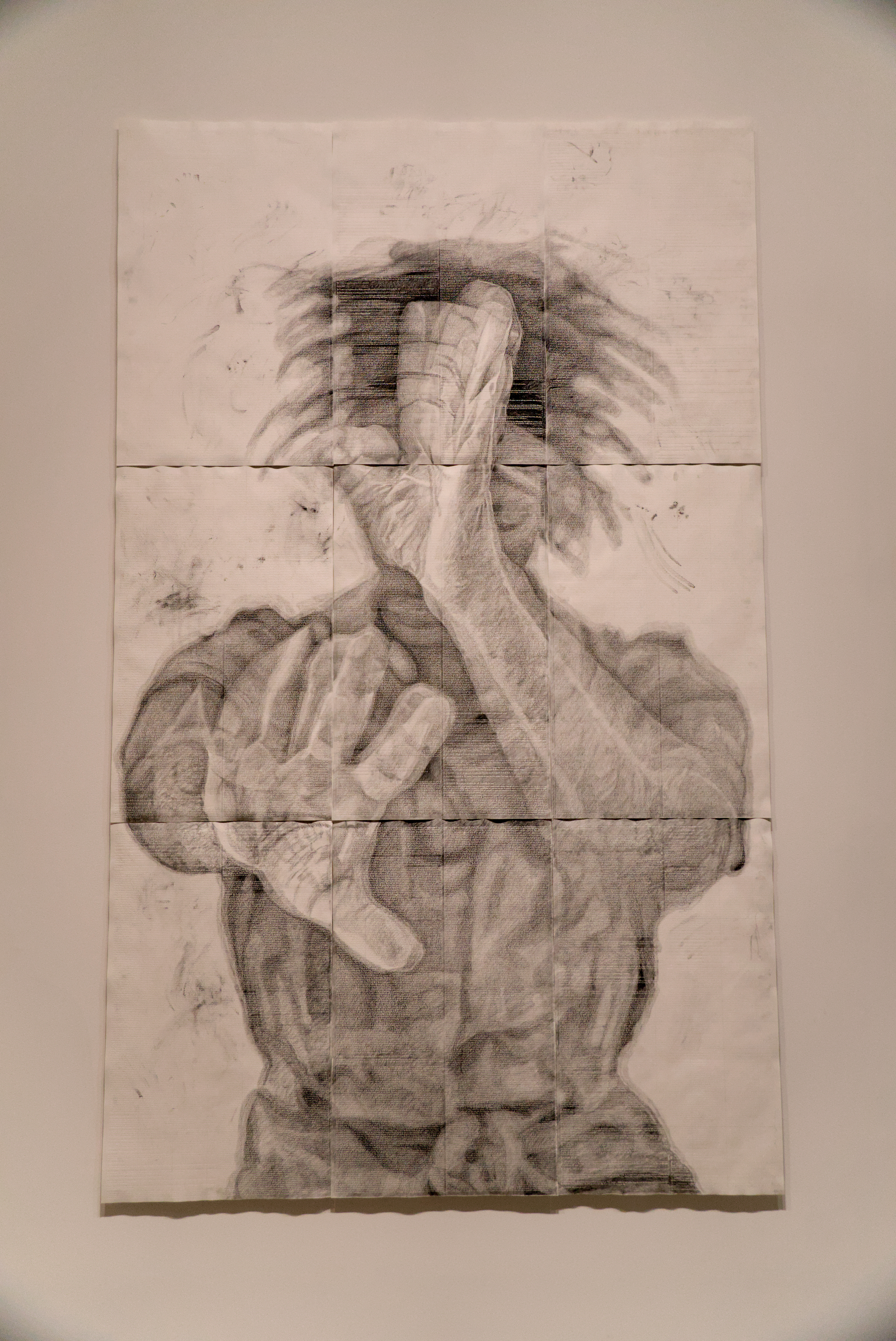
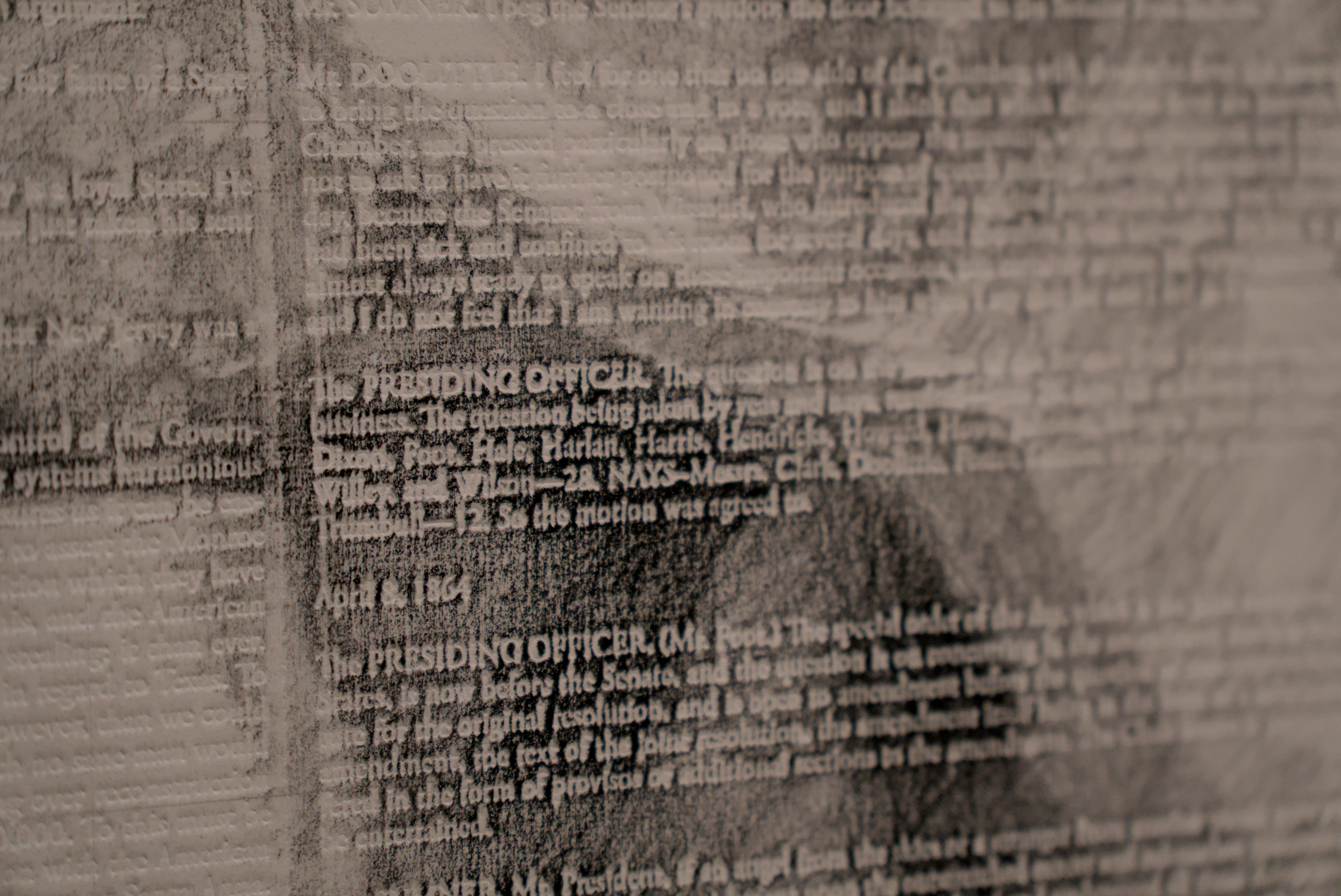
The eight pieces in Davis’s Contending with Contingency series depict a Black woman dancing over transcripts of the 1864–65 congressional debates regarding the language and provisions of the Thirteenth Amendment, and whether to pass it. Here’s an excerpt, for example, of the opinion given by Senator Lazarus Powell from Kentucky:
I do not believe it was ever designed by the founders of our Government that the Constitution of the United States should be so amended as to destroy property. I do not believe it is the province of the Federal Government to say what is or what is not property. . . . You seem to care for nothing but the negro. . . . You seem to be inspired by no other wish than to elevate the negro to equality and give him liberty. . . . I believe this government was made by white men and for white men; and if it is ever preserved it must be preserved by white men.
“The structures that shape our experience in the world extend from the ways we use language,” Davis says. “The implications of this language are activated through our bodies.” The legislators’ oppositional words, and the legacy they reflect and perpetuate, impede the free movement of the dancing figure—but she appears to be pushing past the obstacles, resisting dissent, claiming her right to liberty. I read the work, especially in light of the whole series, as ultimately emancipatory.
+++
SONGS:
Here are two songs I’ve added to my Juneteenth Playlist.
>> “Joy” by Raye, Mike Sabath, Tom Richards, Amma, and Absolutely: This song appears on the second studio album of the British pop sensation Raye (the stage name of Rachel Agatha Keen), This Music May Contain Hope, released in March. It’s based on Psalm 30:5: “Weeping may linger for the night, but joy comes with the morning.” Here’s Raye singing it on The Late Show with Stephen Colbert with her sisters Amma and Absolutely. (A worship song on late-night TV!) See also the recent cover by the Good Shepherd Collective.
>> “Someday We’ll All Be Free” by Donny Hathaway and Edward Howard, performed by the Good Shepherd Collective: In 1973, the American soul singer Donny Hathaway wrote the melody to this classic, and his friend Edward Howard wrote the lyrics. Howard said he intended it as an encouragement to Hathaway, who was struggling with paranoid schizophrenia; but it has since become an anthem of Black American civil rights. It’s sung here by Charles Jones for a Good Shepherd New York digital worship service.
+++
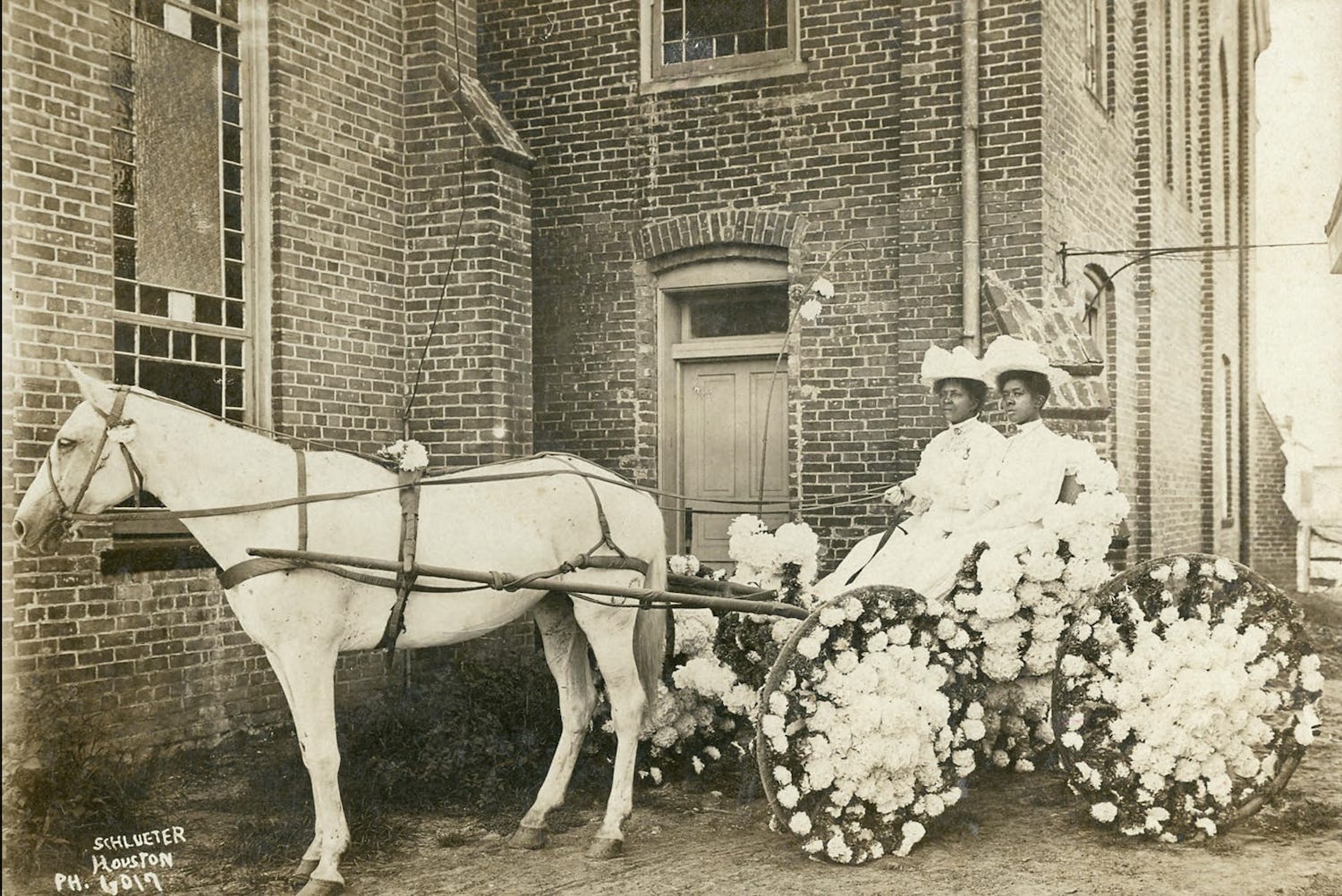
COMPILATION: “Early Photographs of Juneteenth Celebrations,” Public Domain Review: Many of the photographs that survive from turn-of-the-century Juneteenth celebrations in Texas depict elegantly dressed groups in horse-drawn carriages elaborately decorated with flowers down to the wheels.
+++
POEM: “Gospel” by Rita Dove: This poem is from Rita Dove’s Pulitzer Prize–winning collection Thomas and Beulah (Carnegie Mellon University Press, 1986), based on the lives of her maternal grandparents, who moved from Tennessee and Georgia to Akron, Ohio, during the Great Migration. Opening with the instantly recognizable phrase “Swing low” from the African American spiritual “Swing Low, Sweet Chariot,” it describes her grandparents’ Black church congregation as “a humming ship of voices / big with all / the wrongs done / done them,” but that “ride[s] joy.” Hymns, gospel songs, and spirituals have had a formative influence on Dove, a member of the African Methodist Episcopal (AME) Zion Church, as they did too for her predecessors, lifting them out of the miseries inflicted on them by Jim Crow America and into heaven, a place of wholeness, affirmation, and triumph, where racism and lynch mobs can’t touch.
+++
CHORAL-ORCHESTRAL WORK: Requiem for Colour: A Journey through Lament and Joy by Jeffrey L. Ames: Composed by Dr. Jeffery Ames, Requiem for Colour (2022) is a thirteen-movement work for SATB choir, soprano, tenor, orator, rapper, orchestra, and African percussion that adapts the form of the Requiem Mass, traditionally offered for the repose of the souls of the deceased, to tell a story of Black enslavement and liberation. Gentry Publications, who publishes the score, provides this description:
Requiem for Colour by Jeffery L. Ames is a powerful choral and orchestral work that honors the lives and legacies of enslaved Blacks from 1619 to 1865 and contemporary Black martyrs who sacrificed for equality and freedom. This masterwork skillfully blends idiomatic Black musical genres with Western European composition styles, creating a unique and profound musical journey. The requiem traces the Black experience from West Africa, through the Middle Passage, slavery, and sharecropping in the South, to the Civil Rights Movement and today’s ongoing fight against racism and injustice. The libretto incorporates narratives from enslaved people, sharecroppers, and contemporary activists, offering an aesthetic experience that both commemorates and challenges. This deeply moving work is a testament to the resilience and complexity of Black American history.
The finale, “Celebration Omega: Heaven,” is explosive! View the full score.
In this February 5, 2025, performance at the Fisher Center for the Performing Arts at Belmont University in Nashville, Ames conducts the Belmont University Oratorio Chorus and Orchestra, comprising over 450 students. The performance features soprano NaGuanda Nobles, tenor Rodrick Dixon, and orators Jasmine Simmons and Elliott Robinson, plus a lyrical rap by the composer’s daughter, Lydia Ames. The concert and its recording—which aired June 18, 2025, on WNPT, Nashville’s PBS station—were made possible by a grant from the Creative Arts Collective.