Roundup: “Peace on Earth” by U2, guns into shovels, and more

SONGS:

>> “Peace on Earth” by U2: “Heaven on earth—we need it now. I’m sick of all this hanging around. Sick of the sorrow, sick of the pain . . .” U2’s “Peace on Earth” was inspired by the Omagh bombing in Northern Ireland on August 15, 1998. It first appeared on their 2000 album All That You Can’t Leave Behind, but I prefer the stripped-down acoustic version they recorded last year on Songs of Surrender.

The song wrestles with the tension between the angels’ proclamation of peace in Luke 2 and the course of history ever since, riddled, as before, with violence. “Hope and history won’t rhyme,” the lyrics lament—they’re just not matching up. “Peace on earth” feels naive; the words sometimes stick in our throats. The refrain addresses Christ: “Jesus, can you take the time / To throw a drowning man a line?” In its emotional honesty and its asks, it resembles a biblical psalm. (Bono has in fact spoken about how the Psalms have influenced his songwriting.)

When U2 performed “Peace on Earth” live at Sphere Las Vegas this February, Bono substituted the names of five Irish casualties of the Troubles listed in one of the verses with the names of four Palestinian and Israeli children who have been killed in the current Israel-Hamas War: Gal, Ayat, Hind, and Mila.

>> “There Will Be a Day (Isaiah 2)” by Caroline Cobb, arr. Joel Littlepage: I cued up my favorite song from last year’s Dawning Light service at Grace Mosaic church in Washington, DC (it’s at 32:50–37:29 of the video): “There Will Be a Day” by Caroline Cobb, based on Isaiah 2. The song is from Cobb’s album A Seed, a Sunrise: Advent to Christmas Songs (2020)—it’s my favorite of all her songs, and because of its emotional and summative power, I’ve set it as the concluding track of my Advent Playlist. Joel Littlepage, Grace Mosaic’s pastor of worship and formation and the director of the Daily Prayer Project, arranged it with gospel inflections for his church’s annual Advent carols service. He’s at the keyboard; his wife, Melissa Littlepage, is the vocal soloist (she’s also the choir director); and the saxophonist is Skip Pruitt.

Cobb, the songwriter, has published a new book this year that may be of interest: Advent for Exiles: 25 Devotions to Awaken Gospel Hope in Every Longing Heart. She discusses it on a recent episode of The Habit Podcast that I commend to you.

+++

ARTWORK: Home (land) Birth (place) by Beth Krensky: Beth Krensky is an artist, activist, and educator of Jewish heritage who describes herself as “a gatherer of things—objects, words, spirit—and a connector of fragments to make us whole.” Her website documents many compelling artistic projects she has undertaken over the past decade. One of them, Home (land) Birth (place), is a performance from 2016 with her academic colleague Amal Kawar, a professor of political science and the author of Daughters of Palestine: Leading Women of the Palestinian National Movement.

Krensky, Beth_Home Land, Birth Place
Beth Krensky (American, 1965–), Home (land) Birth (place), a performance with Amal Kawar, 2016, Great Salt Lake, Utah. Photo: Josh Blumental.

For this piece, Krensky sewed together a truce flag from baby clothes and other white linens and attached it to two olivewood poles onto which she burned quotes from Israeli and Palestinian mothers who have lost a child to Israeli-Palestinian violence. She and Kawar held the flag aloft in the desert outside their hometown of Salt Lake City as a call for peace. Read the artist’s statement at the link above, and view additional photos of the flag here.

+++

DEVOTIONAL POST: “Swords Will Be Turned into Plowshares,” Center for Christianity, Culture, and the Arts at Biola University: Every year Biola University’s CCCA publishes free daily Advent and Christmas devotions online that feature an artwork, a song, a poem, and a written reflection—the work of many contributors. You can access their 2024 Advent Project here.

Last year I was particularly taken with the peace-themed compilation offered on January 2, which includes a poem by Denise Levertov, a socially conscious, participatory art project led by Pedro Reyes (more on that in next roundup item), a Sweet Honey in the Rock rendition of an African American spiritual, and a wonderful reflection by Dr. Natasha Aleksiuk Duquette, a literature professor. Check it out.

+++

ARTICLE: “Mexican Artist Pedro Reyes Molds 1,527 Guns into Shovels Used to Plant Trees,” Colossal: Pedro Reyes is a Mexican artist, architect, and cultural agent who seeks to turn social problems into opportunities for tangible change through works that integrate elements of theater, psychology, and activism. (I learned about him through Biola’s Advent Project, above.) In 2008, in cooperation with city authorities, he led a campaign in Culiacán, Mexico, to collect firearms, giving donors vouchers for electronic appliances in exchange. The hundreds of guns he received were publicly crushed by a steamroller, melted, and remolded into shovels, which were then distributed to public schools and other institutions who committed to planting trees with them. This project was an effort to curb local gun violence and to cultivate the collective imagination toward life.

Reyes, Pedro_Palas por Pistolas
Pedro Reyes (Mexican, 1972–), Palas por Pistolas (Guns for Shovels), 2008

Reyes, Pedro_Palas por Pistolas
Artist Pedro Reyes steamrolled 1,527 surrendered guns for his Palas por Pistolas project, transforming them into shovels for planting trees.

I’m interested in exploring more of Reyes’s work, as I love what he’s doing. In 2016, as a visiting lecturer in MIT’s Art, Culture, and Technology Program, he cotaught the course “The Reverse Engineering of Warfare: Challenging Techno-optimism and Reimagining the Defense Sector (an Opera for the End of Times).” A full-color illustrated survey of his projects, Pedro Reyes: Ad Usum / To Be Used, was published by Harvard University Press in 2017.

+++

INSTAGRAM SERIES: “Alternative Advent 2024” by Kezia M’Clelland: Through December 24, follow the Instagram account @alternative_advent for a progressively revealed photo essay of Advent promises told through journalistic images from 2024, sourced from various news organizations. I call attention to this project every year. The woman behind it, Kezia M’Clelland, has a master’s degree in violence, conflict, and development from SOAS University of London and helps equip churches and communities to support children and families in crisis situations.
Roundup: Baby Jesus in the rubble of Gaza, a dragon at the Nativity, and more

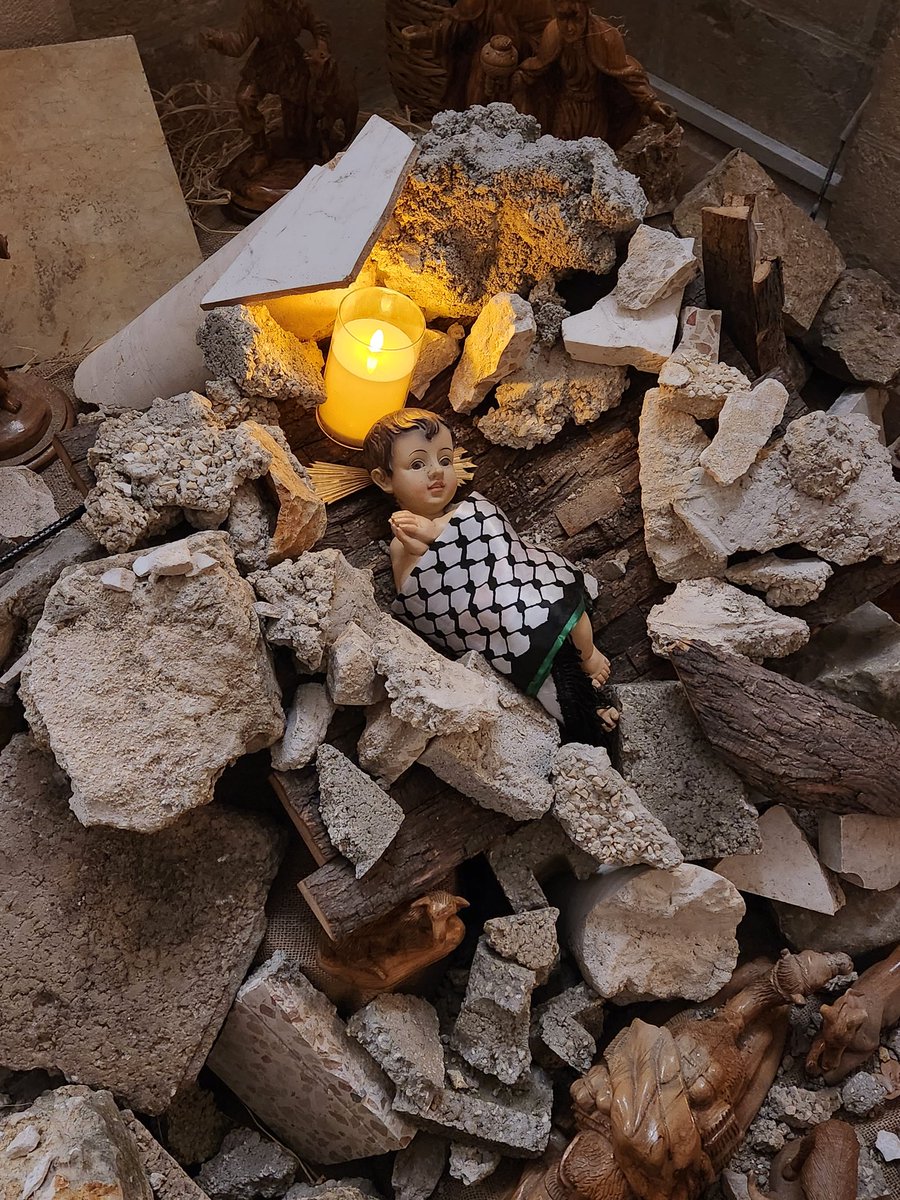
CHRISTMAS CRÈCHE: After my Advent Day 2 post, a reader shared with me a photo of this jarring crèche from Bethlehem:

Rubble Creche, Bethlehem
Crèche, December 2023, Evangelical Lutheran Christmas Church, Bethlehem. Photo: Munther Isaac.

It shows the baby Jesus wrapped in a black-and-white checkered keffiyeh (Palestinian headdress) and lying in a pile of rubble while Mary, Joseph, the shepherds, the wise men, and the animals search for him. It is situated at the side of the altar in Bethlehem’s Evangelical Lutheran Christmas Church, which Rev. Dr. Munther Isaac, a prominent Palestinian Christian peacemaker, pastors. He said he wants the world to know that this is what Christmas looks like in Palestine this year, and for his own congregation to know the solidarity of Christ with the oppressed. Al Jazeera ran a news segment on the crèche on Tuesday, which features an interview with Isaac:

Since October 7, over 16,000 Palestinians have been killed by Israeli forces, and almost 1.9 million Palestinians (over 80 percent of the population) have been displaced. Morgues and hospital halls are overflowing in Gaza, and many people remain trapped under buildings felled by air strikes.

“In Gaza today, God is under the rubble. He is in the operating room,” Isaac wrote on Instagram. “If Christ were to be born today, he would be born under the rubble. We see his image in every child killed and pulled from under the rubble. In every child in incubators.” He expanded on these sentiments in a sermon preached October 22, titled “God Is Under the Rubble in Gaza,” reproduced in Sojourners. See also this video clip of Isaac explaining why his church chose to display such a scene in their sanctuary.

Besides serving as a pastor, Isaac is also the academic dean at Bethlehem Bible College, director of the Christ at the Checkpoint conferences, and author of The Other Side of the Wall: A Palestinian Christian Narrative of Lament and Hope.

+++

“Alternative Advent 2023” by Kezia M’Clelland: I wrote about M’Clelland’s “Alternative Advent” last year and in previous years, an annual online project that thoughtfully brings together global photojournalism from the year with scripture. Following along with her daily Instagram posts @alternative_advent (which she will later compile at https://keziahereandthere.org/) has become an integral part of my Advent practice. Here’s day one:

+++

SONG: “How Long, How Long?” by Jordan Hurst: Worship musicians Jordan Hurst, Jaleesa McCreary, and Brian Douglas Phillips [previously] from Providence Church in Austin, Texas, perform an original lament song from Providence’s 2020 album Long-Awaited / You Arrived.

+++

BLOG POST: “When a Dragon Tried to Eat Jesus: The Nativity Story We Don’t Talk About” by Chad Bird: “I’m still searching for a Christmas card with a red dragon in the nativity, lurking amidst the cows and lambs, waiting to devour the baby in the manger,” writes Bible scholar Chad Bird [previously]. “None of the Gospels mention this unwelcome visitor to Bethlehem, but the Apocalypse does. John paints a seven-headed, ten-horned red dragon onto the peaceful Christmas canvas. You can read all about it in Revelation 12. It’s the nativity story we don’t talk about. A dragon trying to eat our Lord . . .”

I’ve been wanting to write a long-form essay on this topic for some time—the dragon as a character in the Christmas story; a cosmic battle underlying our cozy little crèches. I would pull in iconography of the Woman of the Apocalypse and the treading of the beasts, as well as some Christmas songs and poems that reference the dragon. I won’t get around to it this season . . . but it’s coming sometime!

For now, I simply offer Chad Bird’s wonderful blog post to get you thinking about it. Since it was published in 2016, I’ve started seeing more people bringing it up. In 2019, Glen Scrivener, a minister in the Church of England, released the kids’ video “There’s a Dragon in My Nativity,” with illustrations by Alex Webb-Peploe and animation by Diego M. Celestino:

In 2020, Rev. Yohanna Katanacho, a Bible professor in Nazareth, wrote “The Christmas Dragon” for Radix, a retelling of the Nativity story through the lens of Revelation 12. And in a Christianity Today article published last December, Julie Canlis recommended adding a red dragon to your nativity set! Apparently some families have been doing this for years, such as the Gowins and the Palpants:

Dragon at the Nativity
Left photo by Michael Gowin; right photo by Ben Palpant

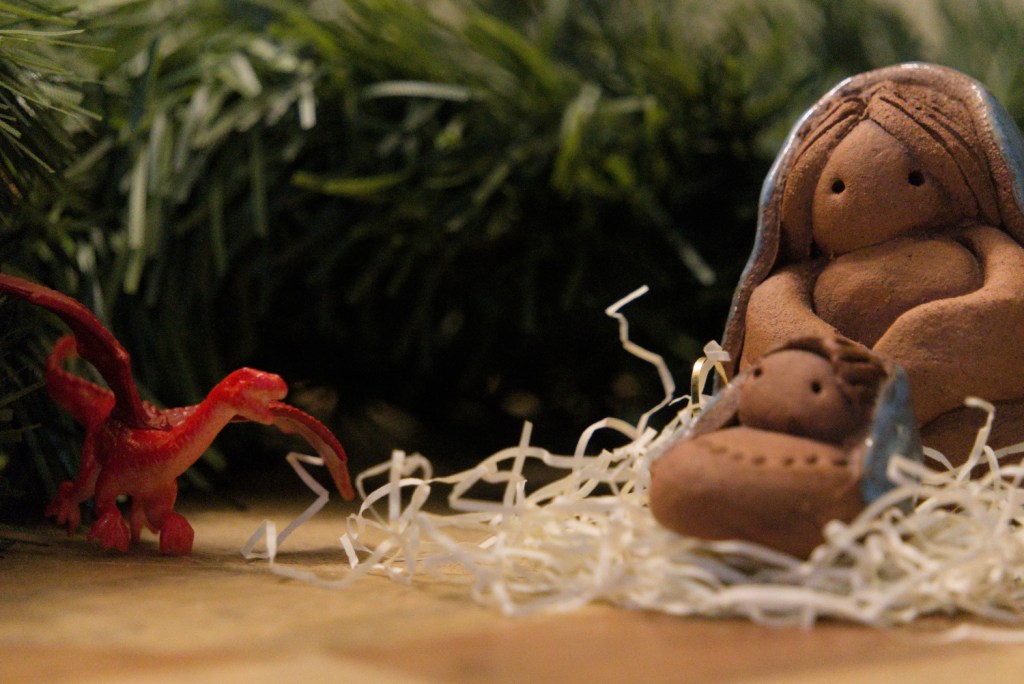
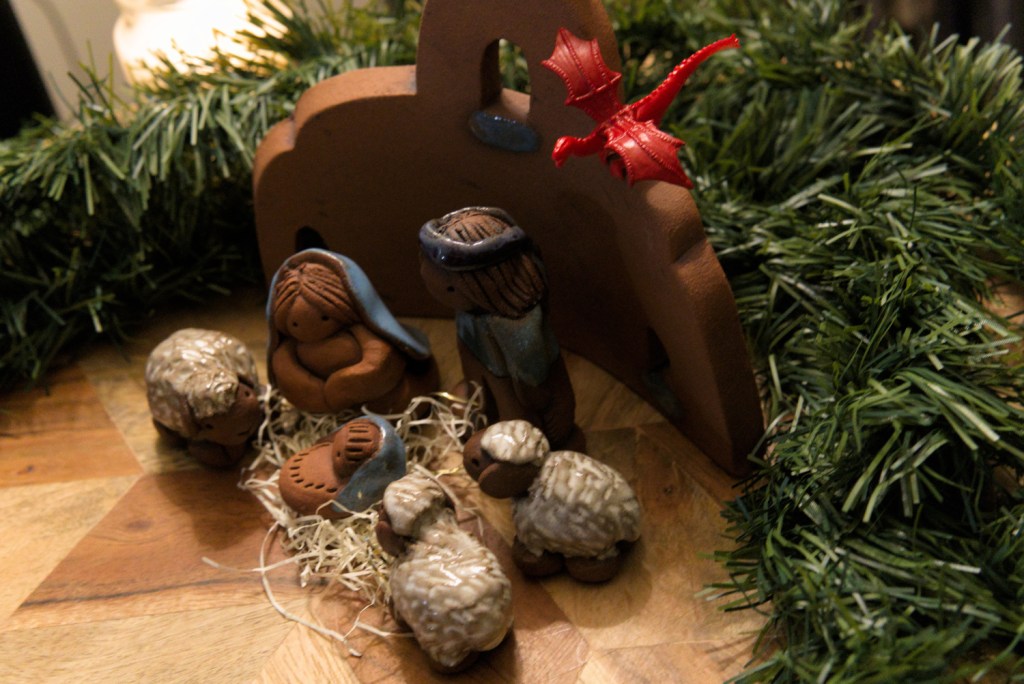
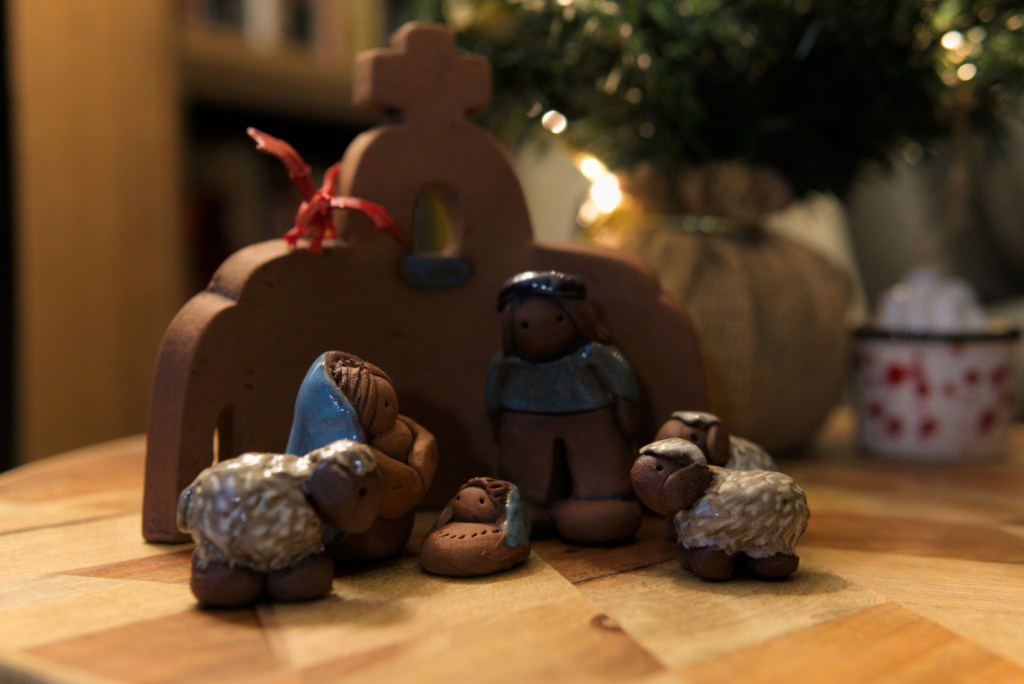
This year I bought a little plastic dragon myself to add to my household nativity! Below are some photos my husband and I took. The clay figurines and adobe-style backdrop were made by Barbara Boyd, an artisan from New Mexico. (I bought them in 2016 at a festival in Albuquerque.)

The dragon was part of a cheap multipack from Amazon, and there are twenty-three other dragons that I don’t know what to do with—so if you live in the US and you want one, shoot me an email at victoria.emily.jones@gmail.com and your physical mailing address and I’ll send you one! The first three respondents get a red one. None of them are seven-headed or horned per Revelation (a gap in the Christmas market, perhaps?!), but they still convey the gist.

+++

LECTURE: “What Is God’s Future for the World?: An Eschatological Vision for the Kingdom on Earth” by N. T. Wright: This talk on inaugurated eschatology, on heaven and earth coming together redemptively and new-creatively, was delivered at the Fuller Forum at Fuller Theological Seminary on May 3, 2014. Any time we talk, sing, or preach about the return of Christ and the end, Wright says, we’re really using signposts that point into a bright mist. But we need those signposts. Wright seeks to dispel the popular belief that humans’ ultimate destination is some disembodied existence “up there” and instead have us embrace the ancient vision of this world as the site of the Messiah’s eternal reign and these bodies as participants, a vision of creation made new from the old. To believe that God will eventually abandon the world to the forces of human wickedness or entropy and decay instead of claiming it as his own undermines the entire narrative of scripture. Wright makes his case by way of the books of Genesis, Isaiah, Ezekiel, Daniel, the Psalms, the Gospels, Romans, and Revelation—the whole gamut.

“The Jewish vision of God’s ultimate future was never that people would leave this world and end up somewhere else called heaven in the company of God. . . . When eschatology comes into full focus, . . . it is all about God’s kingdom being set up on earth as in heaven, and indeed on earth by means of heaven.” He continues, “Heaven is the place where God’s future purposes are stored. And the New Jerusalem comes down from heaven to earth so that the dwelling of God is with humans.”

There’s so much more I could say—but instead of reading my takeaways, listen to the talk itself! It ends at 1:04:45 and is followed by an hour of Q&A. Here is a list of the questions with time stamps:

  • 1:05:33: What is your reading of 2 Peter 3:10–12, which says that the earth will be burned up?
  • 1:08:18: What does Paul mean in 1 Thessalonians 4:17: “Then we who are alive, who are left, will be caught up in the clouds together with them to meet the Lord in the air, and so we will be with the Lord forever”?
  • 1:13:05: Where do you land on premillennialism, amillennialism, postmillennialism?
  • 1:15:42: If earth is already crowded, how will everyone fit in the renewed creation after the resurrection?
  • 1:21:42: If this world is going to be renewed, why should we make economic and lifestyle sacrifices now to protect endangered species and such?  
  • 1:24:18: How do you interpret John 14:3: “I go and prepare a place for you; I will come again and take you to myself”?
  • 1:27:48: How do you understand hell? What are your thoughts on the teaching of universal restoration, the idea that everyone will eventually be saved?
  • 1:33:48: Since you take issue with Michelangelo’s Last Judgment, what would you have painted at the east end of the Sistine Chapel instead?
  • 1:34:17: How does Paul’s “now and not yet” correlate with Jesus’s teaching that “this generation will not have passed away before all this has happened” (Matt. 24:34; Mark 13:30; Luke 21:32)?
  • 1:36:59: What is the role of departed saints (the “cloud of witnesses”)? What are your thoughts on the intercession of the saints?
  • 1:41:17: What are your words of advice for preaching on these subjects and for pastorally caring for congregants who come with certain stock images of and language about heaven?
  • 1:44:30: Since we believe in Jesus’s bodily resurrection, where is Jesus now?
  • 1:46:28: Please give us some guidance on Paul’s view on homosexuality and how to address this complex issue in the church.
  • 1:52:16: Is there any sense in which the State of Israel founded in 1948 could be the fulfillment of biblical prophecy?
  • 1:56:40: What impact do you hope your work has on Christian discipleship?
  • 2:10:34: What’s the relationship between faith and action?

Oh, and at 1:18:58, Wright offers this rousing sidebar on Christian art:

We are starved imaginatively as Christians. Christian art easily collapses into sentimentalism, just as contemporary postmodern art easily collapses into brutalism. Both of those are ways of seeing something but not the whole picture. Sentimentalism is what you get when you’re determined to smile even if the whole world is falling apart; it becomes inane, this sort of silly grin, and sadly, there’s a lot of Christian art like that.

But actually, Christians ought to be at the forefront of the art and the music, because that creates the imaginative world within which it’s possible to think differently about things. I think the secular world has done a pretty good job, and we’ve colluded with that, of keeping our imaginative levels down to the level of eighteenth- and nineteenth-century Epicureanism or deism, so that heaven is just this odd place, etc., etc. We need the new art and the new music which will create a world in which it makes sense to think of these things.

+++

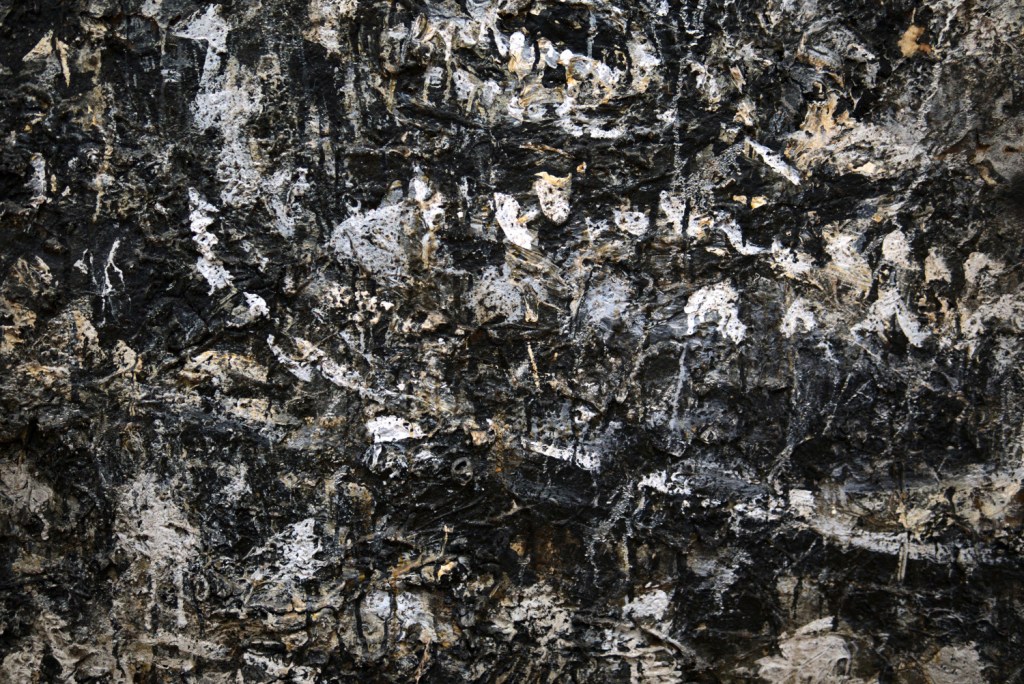
BLOG POST: “Advent Love and Anselm Kiefer’s Alchemist” by Alexandra Davison: I grew up, and my parents and sibling still live, in a suburb of Raleigh, North Carolina, so I’m a somewhat frequent visitor to the North Carolina Museum of Art. Their untitled triptych by Anselm Kiefer is one of my favorite pieces in their collection—it transfixes me every time—so I was delighted to see that Alexandra Davison [previously], a creative director of Artists in Christian Testimony International whom I bump into at arts conferences now and again, wrote about it a few years ago. She describes it as an image of “cosmic drama that waits for resolution,” conveying “an unflinching Advent longing.” I sense that too when I stand in front of it.

Kiefer, Anselm_Untitled (NCMA)
Anselm Kiefer (German, 1945–), Untitled, 1980–86. Oil, acrylic, emulsion, shellac, lead, charcoal, and straw on photograph, mounted on canvas, with stones, lead, and steel cable, overall 130 1/4 × 218 1/2 in. North Carolina Museum of Art, Raleigh. Photo: Victoria Emily Jones.

Kiefer is the subject of an acclaimed new documentary by Wim Wenders (which I’m eager to see when it comes to streaming!). He was born in Germany at the tail end of World War II, and his art, which often incorporates materials such as lead, ash, and straw, is inextricably connected to the ravaged landscapes and haunted history of his country.

Roundup: News photos with Advent promises, “Tent City Nativity,” and more

PHOTO COMPILATION: “Alternative Advent 2022” by Kezia M’Clelland: Kezia M’Clelland [previously] is the children in emergencies specialist and people care director for Viva and a child protection consultant for MERATH, the Lebanese Society for Educational and Social Development’s community development and relief arm. She is a British citizen, but her work brings her around the world, seeking to safeguard the rights and well-being of children globally.

Every December M’Clelland compiles photos from that year’s news, showing people affected by natural disasters, violence, and injustice, and overlays them with Advent promises. There’s sometimes a disjunction between image and text that’s grievous and challenging, a reminder that our long-looked-for deliverance is not yet fully here, even though we receive foretastes. The twenty-eight photos M’Clelland gathered from 2022 include throngs of people making their way to Aichi cemetery in Saqqez, Iran, to attend a memorial for twenty-two-year-old Mahsa Amini, allegedly beaten to death by the country’s religious morality police for not wearing her hijab properly; a police officer helping a child flee artillery on the outskirts of Kyiv, and a baby being born in a bomb shelter; women carrying pans of granite up the side of a mine in Ouagadougou, Burkina Faso, for meager wages; a woman comforting a neighbor who lost her home to flooding in Tejerias, Venezuela; children playing in a sandstorm at the Sahlah al-Banat camp for displaced people in the countryside of Raqa in northern Syria; children clearing trash from a river in Tonlé Sap, Cambodia; and more.

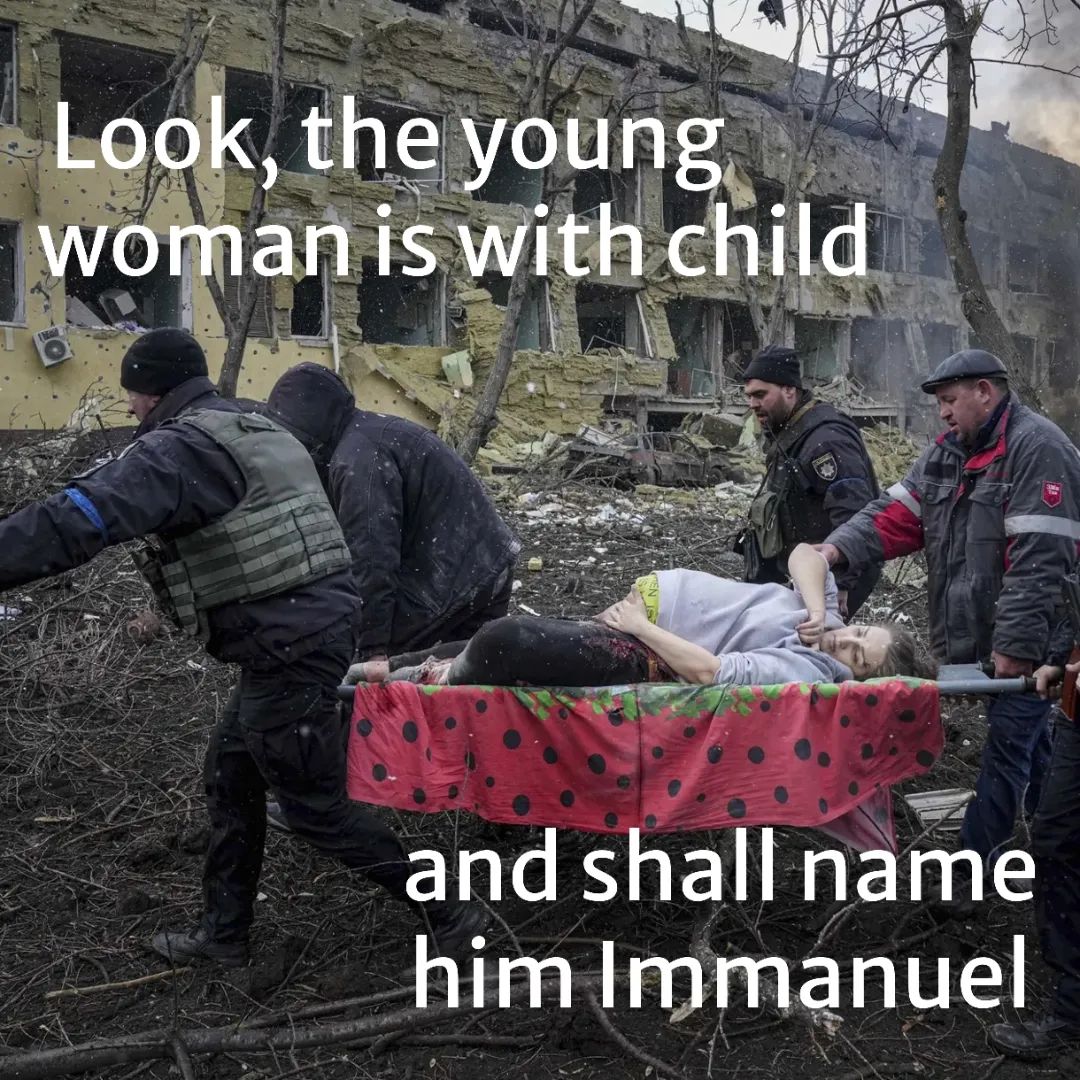
Alternative Advent 2022 (Immanuel)
March 9, 2022: An injured pregnant woman is rescued from a maternity hospital in Mariupol, Ukraine, that was bombed by Russian forces. The following week it was reported that she and her child, delivered in an emergency C-section, did not survive. Photo: Evgeniy Maloletka/AP. Scripture: Isaiah 7:14.

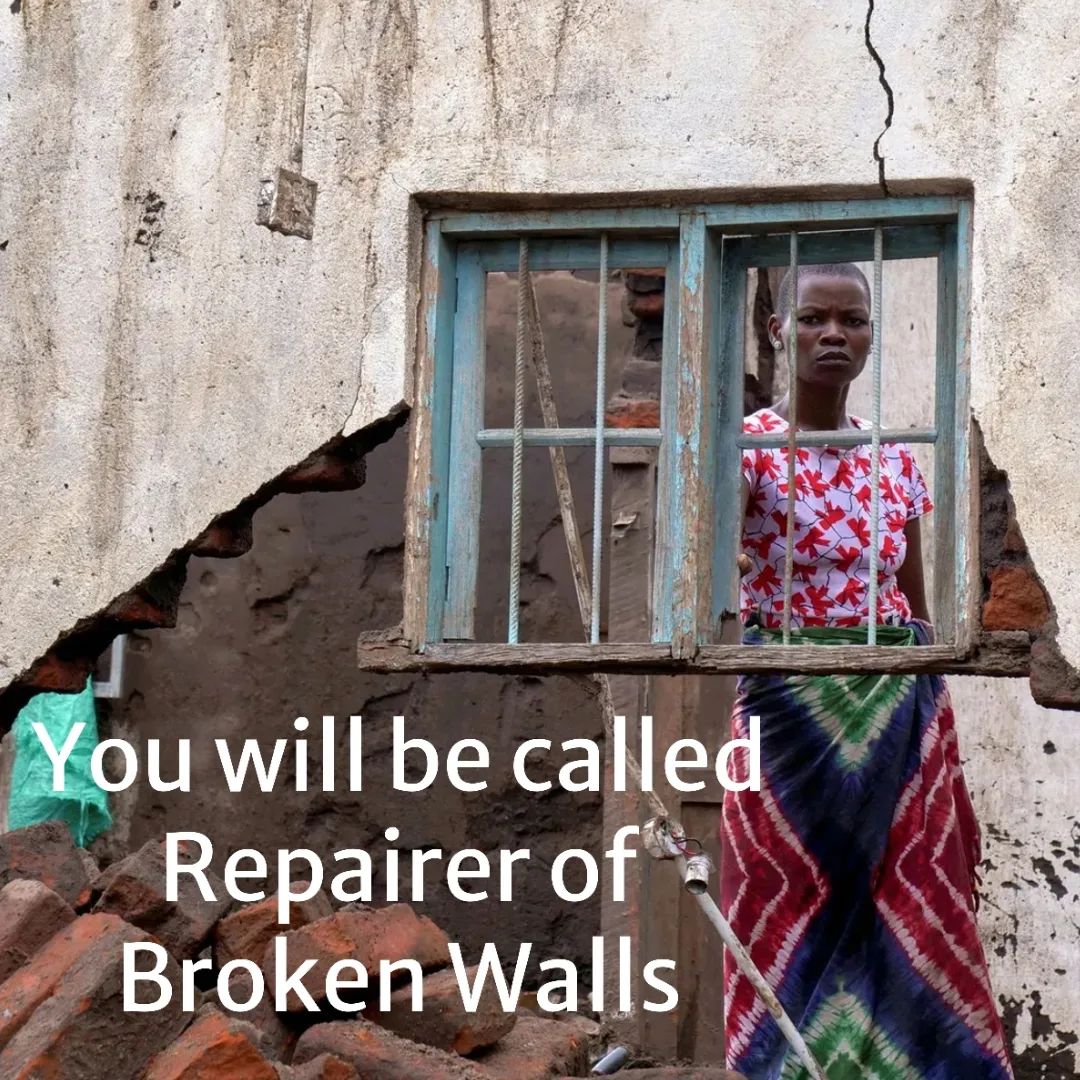
Alternative Advent 2022 (Repairer)
January 26, 2022: A young woman looks on from her house destroyed by tropical storm Ana in the village of Kanjedza in Malawi. Photo: Eldson Chagara/Reuters. Scripture: Isaiah 58:12.

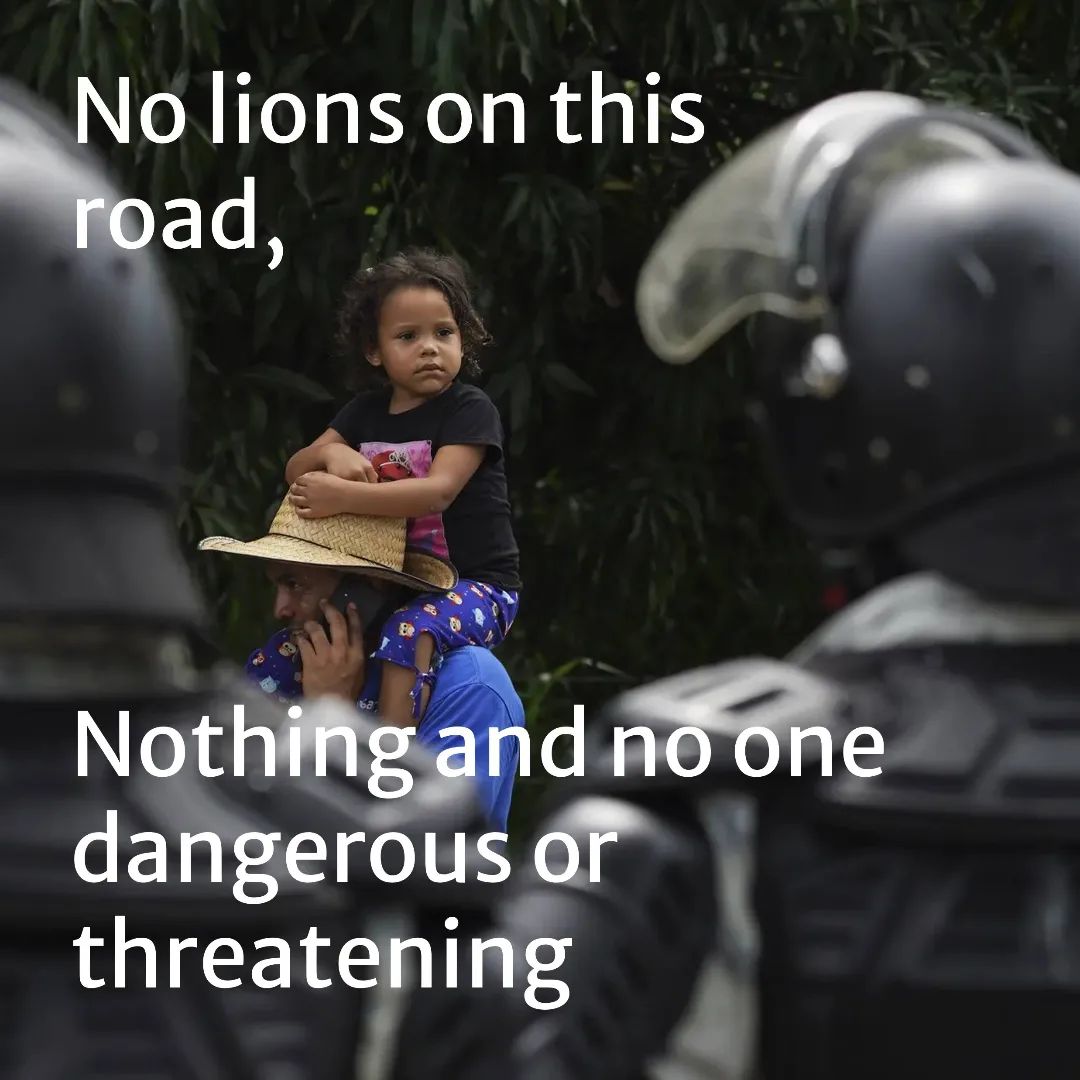
Alternative Advent 2022 (no lions)
June 7, 2022: A man and child, part of a migrant caravan consisting mostly of Central Americans, are blocked by members of the Mexican National Guard on a Huixtla road in Chiapas state, Mexico. They seek transit visas from the National Migration Institute so that they can continue their thousand-plus-mile journey north to the US. Photo: Marco Ugarte/AP. Scripture: Isaiah 35:9 MSG.

The sequence of images is a visual prayer of lament and intercession. I appreciate how M’Clelland—via the work of photojournalists, and her sensitive curation—raises awareness about these places of suffering, putting faces to the headlines, but also spotlights moments of empowerment and joy amid that suffering. We are encouraged to seek God’s coming into these situations of distress and to see the subtle ways he does come—for example, through the consoling embrace of a friend, the nurturance of an elder sibling, the protective aid of an officer, a jug of clean water, a child’s glee, or acts of protest.  

For photo credits and descriptions, see the Instagram page @alternative_advent. (Start here and scroll left if you’re on your computer, or up if you’re on your phone.) Follow the page to receive new posts in your feed starting next Advent.

+++

SONGS by Rev Simpkins, an Anglican priest and singer-songwriter from Essex previously featured here:

>> “Hallelu! (Love the Outcast)”: This song was originally released on The Antigen Christmas Album (2014) with the byline “Ordinand Simpkins & Brother De’Ath”; it was reissued in 2016 on Rev Simpkins’s album Love Unknown, “a cornucopia of non-LP tracks, studio experiments, ingenious live re-workings, radio sessions, off-the-wall demos, obscure b-sides, & pissings about.” The music video was recorded on an iPhone 4 in the Edward King Chapel at Ripon College Cuddesdon in Oxford. [Listen on Bandcamp]

>> “Poor Jesus” (Traditional): Here the Rev. Matt Simpkins performs the African American spiritual “Oh, Po’ Little Jesus” with a soft banjo accompaniment. Harmonizing vocals are supplied by his daughter, Martha Simpkins. It’s the opening track of his EP Poor Child for Thee: 4 Songs for Christmastide (all four songs are wonderful!), released December 11, 2020, to support St Leonard’s Church, Lexden, where he serves as priest-in-charge. [Listen on Bandcamp]

+++

NEW PAINTING: Tent City Nativity by Kelly Latimore: Kelly Latimore is an Episcopalian artist from St. Louis, Missouri, who “rewonders” traditional iconography, especially with an eye to social justice. This Christmas he painted an icon called Tent City Nativity, which shows the Christ child being born in a homeless encampment. A streetlight shines directly over the Holy Family’s tent, like the star of Bethlehem, and neighbors bring gifts for warmth and sustenance: coffees, a blanket, a cup of chili. View close-ups on Instagram, and read the artist’s statement on his website. Proceeds from print and digital sales of the icon will support organizations serving the unhoused in St. Louis.

Latimore, Kelly_Tent City Nativity
Kelly Latimore (American, 1986–), Tent City Nativity, 2022. Acrylic, Flashe, and golf leaf on birch board, 27 × 32 in.

[Purchase signed print] [Purchase digital download]

+++

SONG MEDLEY: YouTube user African Beats spliced together excerpts from three songs performed at a church in Germany at Christmastime by South African singer Siyabonga Cele and an unnamed woman, including “Akekho ofana no Jesu” (There’s No One like Jesus) and “He’s Got the Whole World in His Hands.” I couldn’t find the name of the last song, and attempts to contact the singer for information were unsuccessful, but it’s in Zulu, as is the first one. Lyrics to the first song, sourced from here, are below.

Akekho ofana no Jesu (There’s no one like Jesus)
Akekho ofana naye (There’s no one like him)
Akekho ofana no Jesu (There’s no one like Jesus)
Akekho ofana naye (There’s no one like him)

Sahamba, hamba, lutho, lutho (I’m walking, walking, nothing, nothing)
Safuna, funa, lutho, lutho (I’m searching, searching, nothing, nothing)
Sajika, jika, lutho, lutho (I’m turning, turning, nothing, nothing)
Akekho afana naye (There is no one like him)

Roundup: Alternative Advent, Fuller Studio videos, Desmond Tutu and Jeff Chu interviews, Psalm 121 in Arabic

“Lift Up Your Eyes” (Advent 2021): Kezia M’Clelland’s annual “Alternative Advent” video is here—a compilation of news photos from the year, from various photojournalists, matched with promises/declarations from scripture and a song. (I’ve described this project in years past; see here.) Migrant caravans, refugee camps, hospitals overwhelmed with COVID patients, a protest against a military coup, wildfires, volcanic aftermath . . . the global suffering we hear about in headlines and statistics is made personal in these intimate photographs of people who are experiencing it firsthand. M’Clelland bears tender witness to this suffering, but she also takes care to include signs of hope. Alongside images of devastation and misery are images of love, joy, and fortitude. The overall tone is one of somberness but not despair. As I do with each year’s “Alternative Advent,” I spent an afternoon interceding with God for each person in the photos and for others enduring the same harrowing journeys or disasters. I realize how my privilege as a white, middle-class US American insulates me from a lot of these realities, and I know that prayer must be accompanied by action.

Find out more context for the photos and their sources on Instagram @alternative_advent.

+++

VIDEO ROUNDUP FROM FULLER STUDIO: The Arts for the Life of the Church: In these six, five-minute videos shot by Fuller Studio, artists and creatives (most of them participants in the Brehm Residency) reflect on the diverse ways that the arts enliven, shape, and define their faith, their theology, and their work. Here’s one from the series, in which interdisciplinary artist Dea Jenkins discusses the ways the Spirit’s leading can be intertwined with the process of art-making, and how art has the capacity to be both prophetic and healing.

The other videos feature . . .

  • Young-Ly Hong Chandra on how she sees her creative work participating in God’s work of creation
  • Michelle Lang-Raymond on how theater and the arts can create opportunities for us to safely yet deeply engage with today’s polarizing issues
  • Rachel Morris on how incorporating the arts into worship services and pastoral care can contribute to the church’s healing work in the lives of its members
  • Jin Cho on the holistic, social, and communal dimensions of preaching and the liturgy
  • John Van Deusen on the significance of creating art in community and on the ways we are shaped by inviting both God and others into our creative processes

+++

ON BEING INTERVIEWS:

>> “Remembering Desmond Tutu”: The South African Anglican bishop, theologian, and human rights activist Desmond Tutu died December 26, 2021, and the On Being podcast re-released this 2010 interview Krista Tippett conducted with him. It’s a great introduction to his story, which includes especially his faith. He discusses the Bible as “dynamite,” our identity as “God-carriers,” the interfaith makeup of the anti-apartheid movement, God’s sense of humor, reconciliation as a process, his experience voting for the first time at age sixty-three (after decades of disenfranchisement), how entrenched racism had become in his own thinking, the beating heart of love at the center of existence, and more. And oh, his laughter is so sweet!

>> “A Life of Holy Curiosity: In Friendship with Rachel Held Evans” with Jeff Chu: Jeff Chu is a journalist, preacher, and co-leader of the Evolving Faith community. When his friend Rachel Held Evans, the famous Christian writer, died unexpectedly in 2019, he took it upon himself to bring to fruition the unfinished book she was working on, Wholehearted Faith (HarperOne, 2021). I enjoyed learning more about Evans through this conversation, and about Chu. He and Tippett read several excerpts from the book and discuss Chu’s Chinese Baptist upbringing, the recent phenomenon of “religious-but-in-exile,” the enormity of God’s love, the Incarnation, the Psalms, doubt, grief, and the lesson of the compost pile.

(As a side note: I recently came across Evans’s other posthumously published book, for children, titled What Is God Like?, in Target and bought it on a whim. It’s fabulous.)

+++

SONG: “I Lift My Eyes” by Christopher Tin: A setting of Psalm 121 in Arabic, performed by Abeer Nehme with Christopher Tin and the Angel City Chorale. Nehme is a Lebanese singer and musicologist, one of whose specializations is sacred music from the Syriac Maronite, Syriac Orthodox, and Byzantine traditions. [HT: Joy Clarkson]

Roundup: Advent photo essay, carol in a silo, multicultural Christmas, and more

PHOTO ESSAY: “Advent 2020: Comfort My People”: Community development and relief worker Kezia M’Clelland, a child protection in emergencies specialist, works in areas of disaster and conflict. Every December she compiles a set of news photographs published in The Guardian that year, pairing each with an Advent scripture. (I introduced her in a 2017 Advent roundup.) Text and image amplify each other and prompt deeper reflection on the themes of the season as well as an awakening to global crises and/or injustices. The photos in this year’s compilation include a schoolteacher bringing plastic-wrapped hugs to her quarantined students in Rio de Janeiro, flooded roadways in Honduras following Hurricane Eta, a Syrian family from Ariha breaking their Ramadan fast amid the rubble of their home, a Palestinian boy from the Khan Younis refugee camp standing on a pile of scrapped car parts, the aftermath of the Beirut port explosion in August (caused by improperly stored ammonium nitrate), a protester outside Dallas City Hall in the US insisting that all citizens’ presidential election votes be counted, and others.

Comfort, comfort my people
Photo: Pilar Olivares / Reuters [via], set to Isaiah 40:1 by Kezia M’Clelland

The rough ground shall become level
Photo: Aaref Watad / AFP [via], set to Isaiah 40:4 by Kezia M’Clelland

M’Clelland adds one new photo for each day of Advent and then releases them all in video slideshow form on December 24. Here are her photo compilations from 2019 (“Good News of Great Joy”) and 2018 (“Peace on Earth”):

She also made a photo compilation for Holy Week 2020.

+++

SONG: “He Who Made the Starry Skies”: For optimal acoustics, three Bruderhof women from the Fox Hill Community in Walden, New York, trek on over to a silo to sing a fifteenth-century processional carol written by the nuns of St. Mary’s, Chester, in England, a medieval nunnery of which nothing now survives. Both the words and music have been preserved in a ca. 1425 manuscript known as The Chester Mysteries. The original is in Latin (and is titled “Qui creavit coelum”), but singers Alina McPherson, Melinda Goodwin, and Coretta Marchant opt for an English translation. I am providing the sheet music here, courtesy of the Bruderhof Historical Archives. [HT: Tamara Hill Murphy]

He who made the starry skies (Lully, lully, lu)
Sleeping in a manger lies (Lully, lully, lu)
Ruler of all centuries (Lully, lully, lu)

Joseph brings the swaddling clothes (Lully, lully, lu)
Mary wraps the babe so mild (Lully, lully, lu)
In the manger puts the child (Lully, lully, lu)

Humbly clad, the King of kings (Lully, lully, lu)
Joy of heav’n to earth now brings (Lully, lully, lu)
Sweet above all earthly things (Lully, lully, lu)

Mary, ask thy little son (Lully, lully, lu)
That he give us of his joy (Lully, lully, lu)
Now and through eternity (Lully, lully, lu)

The Bruderhof is an Anabaptist Christian movement of more than three thousand people committed to peacemaking, common ownership, and proclamation of the gospel. They have twenty-eight settlements on four continents, made up of families and singles. Perhaps you know them through their publishing house, Plough. Their website reads, “Love your neighbor. Take care of each other. Share everything. Especially in these challenging times, we at the Bruderhof believe that another way of life is possible. We’re not perfect people, but we’re willing to venture everything to build a life where there are no rich or poor. Where everyone is cared for, everyone belongs, and everyone can contribute. We’re pooling all our income, talents, and energy to take care of one another and to reach out to others. We believe that God wants to transform our world, here and now. This takes a life of discipleship, sacrifice and commitment; but when you truly love your neighbor as yourself, peace and justice become a reality. Isn’t that what Jesus came to bring for everyone?”

+++

UPCOMING (ONLINE) CHRISTMAS CONCERTS:

“A Family Holiday Singalong with Dan and Claudia Zanes,” Tuesday, December 15, 6 p.m. EST: Presented by the Lebanon Opera House in New Hampshire, this multicultural concert will feature Christmas, Hanukkah, or New Year’s songs from France, Wales, Germany, America, Puerto Rico, Korea, Tunisia, and Haiti. You can download the set list, which includes lyrics and chords, at the registration link I’ve posted. Dan and Claudia Zanes are a musical couple from Baltimore (my neck of the woods!), and I’ve really enjoyed the daily song videos they’ve been releasing on YouTube since COVID started. Here they are in 2018 with Pauline Jean, singing “Ocho Kandelikas,” a Hanukkah song written by Flory Jagoda in the 1980s in the Judeo-Spanish language known as Ladino. (Update: Concert video available here.)

“Gospel Christmas: O Holy Night,” Friday, December 18, 6 p.m. EST: Presented by Washington National Cathedral, this program will feature gospel, jazz, and blues music interspersed with scripture readings. (Update: Concert video available here.)

“Lowana Wallace Christmas Concert,” Sunday, December 20, 9 p.m. EST: Canadian singer-songwriter Lowana Wallace [previously] incorporates subtle jazz styles into her arrangements of worship songs and her own compositions. Listen to a sampler from her wonderful Hymns & Carols album, and tune in this weekend! (Update: Concert video available here.)

+++

ARTICLE: “Making Space for a Multicultural Christmas” by Michelle Reyes: “How can each of us celebrate Christmas at the intersection of our faith and our culture, while welcoming differing cultural perspectives on Christ’s birth?” asks Dr. Michelle Reyes, VP of the Asian American Christian Collaborative and editorial director of Pax, in this Gospel Coalition article. She briefly discusses four different cultural traditions that highlight unique aspects of Jesus’s birth narrative: posadas in Central America, Kiahk in Egypt, parols (star-shaped lanterns) in the Philippines, and Día de los Reyes [previously] in Puerto Rico, Mexico, and other Hispanic countries.

(Related posts from my old blog: “Nativity Paintings from around the World”; “More Nativity Paintings from around the World”)

+++

PODCAST EPISODE: “God’s Global Family,” BibleProject: BibleProject, a nonprofit ed-tech organization and animation studio, produces one of my favorite podcasts, hosted by biblical scholar Tim Mackie and Jon Collins. (I found episodes 6–11 of their recently wrapped “Character of God” series, on the wrath of God, particularly illuminating.) “Family of God” is the name of the series they’re in now. In this first episode they discuss how Christianity is the most multiethnic religious movement in history, and how our humanity cannot be fully realized without understanding, appreciating, and being connected to the identity of every other culture. I link to it here because it dovetails nicely with the Reyes article and because I want to introduce you to the podcast, if you’re not already familiar with it, but also because Mackie spends time talking about the Basilica of the Annunciation in Nazareth, with its many culturally specific portrayals of Mary and Jesus from around the world.

Widayanto, Fransiskus_Mother Mary
Fransiskus Widayanto (Indonesian, 1953–), Bunda Maria (Mother Mary), 2006. Ceramic mosaic and relief sculpture. Basilica of the Annunciation, Nazareth, Israel. Photo © BibleWalks.com. Mary is depicted in a traditional Javanese kebaya.

Madonna and Child mosaic (Thailand)
Thai Madonna and Child, mosaic, Basilica of the Annunciation, Nazareth, Israel. Photo © BibleWalks.com.

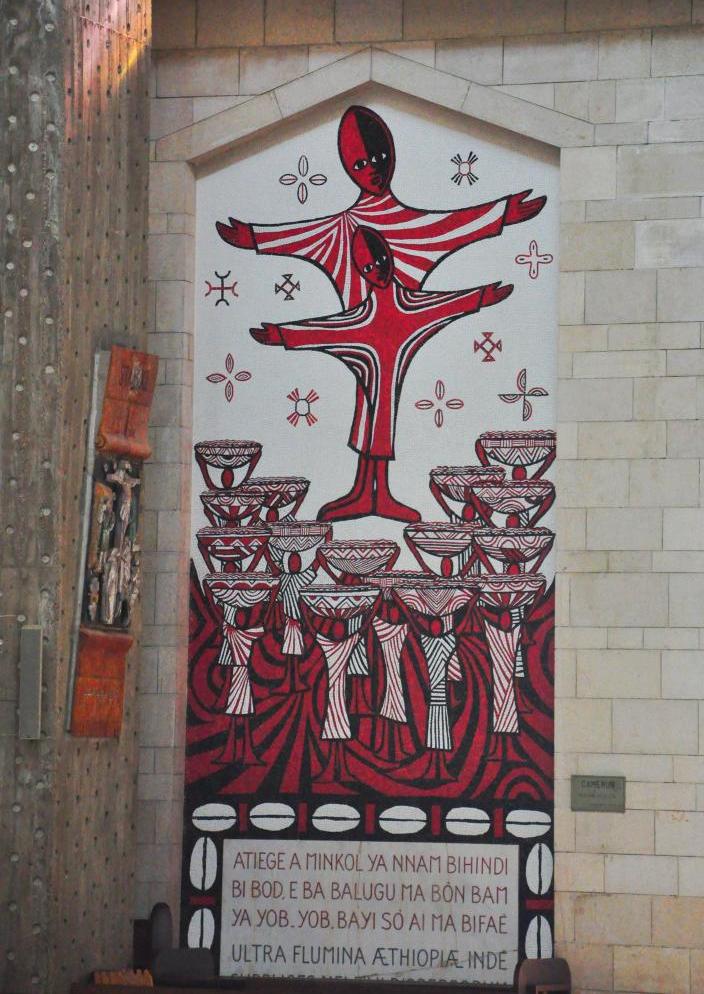
Mveng, Engelbert_Our Lady of Africa
Fr. Engelbert Mveng, SJ (Cameroonian, 1930–1995), Our Lady of Africa, mosaic, Basilica of the Annunciation, Nazareth, Israel. Photo © BibleWalks.com. The inscription is from Zephaniah 3:10: “From beyond the rivers of Cush / my worshipers, the daughter of my dispersed ones, / shall bring my offering.”

As you know, diversity in biblical imagery, especially images of Jesus, is important to me, so I was delighted to hear this popular podcast tip their hat to this pilgrimage site in Israel that features a range of visual interpretations of the incarnation. You can view a compilation of the church’s national mosaics at BibleWalks.com. Most of them are not of high artistic quality, but I appreciate the initiative of inviting the nations to contribute their own localized representations. Above, I posted three that I particularly like.

Roundup: “O Children, Come”; the Christmas story through news photos; Messiaen and the Incarnation; art from Bethlehem; nativity musical soundtrack

SONG: “O Children, Come” by Keith and Kristyn Getty: The Gettys are an Irish married couple who are major contributors to the modern Christian hymn-writing movement. I really enjoyed singing this song of theirs at church last week (CCLI 7036340); it was my first time hearing it. The acoustic performance below is from the Gettys’ 2015 Christmas concert. They’ve also recorded it with Ladysmith Black Mambazo.

+++

PHOTO ESSAY: “Alternative Nativity”: Kezia M’Clelland works with children affected by conflict in the Middle East and raises public awareness through her blog, Kezia Here and There. In 2015 she compiled news photos that document the refugee crisis and set them to excerpts from St. Matthew’s account of Christ’s birth and the prologue to St. John’s Gospel—a very powerful pairing that gives impetus to our Advent cry, “Come, Lord Jesus!” This is not a generic mashup; each photo was carefully selected to amplify a corresponding scripture text.

Alternative nativity1
“About that time Caesar Augustus ordered a census to be taken throughout the Empire. This was the first census when Quirinius was governor of Syria. Everyone had to travel to his own ancestral hometown to be accounted for.” (Photo via Reuters. Displaced Yazidis escape across the Syrian border by foot, fleeing violence from the Islamic State militants who have taken over their home town of Sinjar.)

Alternative nativity2
“So Joseph went to Bethlehem. He took with him Mary, his fiancée, who was obviously pregnant by this time.” (Photo via Al Jazeera. A refugee father with his pregnant wife and daughter asks for permission to enter into Hungary near Roszke as the border fence with Serbia is closed by Hungarian police.)

For each subsequent Advent, M’Clelland has released something in a similar vein: the video “Hope Is on the Way” in 2016, and this year, “Light in the Darkness,” with verses of scripture, mainly from the Old Testament prophets, emblazoned across photos from today’s Middle East. “This year again these Advent pictures and words will speak of a hope that is now and not yet,” she writes. “I am grateful that Advent gives us the freedom to weep and to hope, to rejoice and to grieve, to wait for and to recognise the Christ who is already here among us.”

Marrying the Christmas story with contemporary photojournalism can teach us to “pray with the Bible in one hand and a newspaper in the other,” as the popular adage goes. As we see the world’s brokenness, it should intensify our fervor for Christ’s shalom and impel us to action.

+++

UPCOMING MUSIC & ART EVENT: “Messiaen and the Incarnation,” December 20, 8 p.m., St. Mary’s Addington, London: Next Wednesday evening, Dr. Edward Forman will be performing three movements each from the French avant-garde composer Olivier Messiaen’s organ suite La Nativité du Seigneur (The Nativity of the Lord) and piano suite Vingt regards sur l’Enfant-Jésus (Twenty Contemplations on the Infant Jesus). Messiaen was a committed Christian who sought to express theological truths in a fresh, modern idiom. Like much of his output, these two works reject the Western conventions of forward motion, development, and diatonic harmonic resolution, so they can be difficult for first-time hearers. But this complexity, this sense of the unexpected, is appropriate for the mystical content they seek to convey.

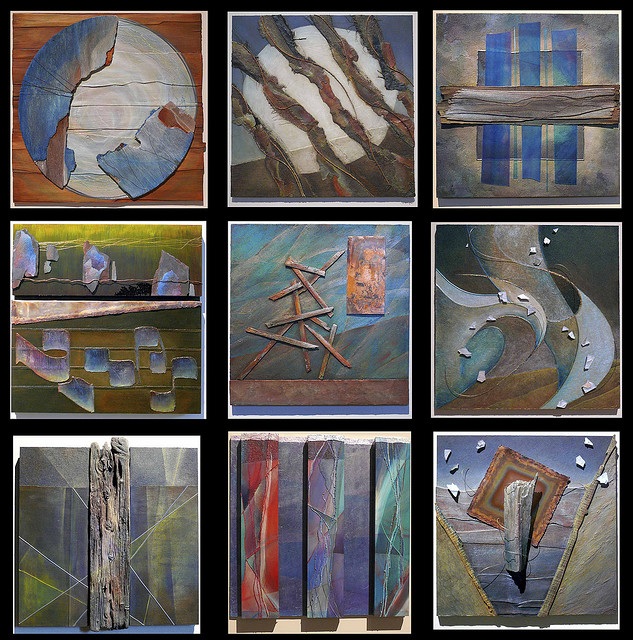
Inspired by the unique palette of sounds, textures, and rhythms of Nativité, British artist Sophie Hacker translated these into visual form. After deeply studying the music, in 2007 she created nine mixed-media panels in response—one for each movement—using slats of wood, nails, lead, wire, tree bark, and other found objects; you can see some of her process in the video below. These premiered at Winchester Cathedral in 2008. Then again in 2015 Hacker participated in another Messiaen-inspired artistic collaboration, under the direction of pianist Cordelia Williams, with poets Michael Symmons Roberts and Rowan Williams. This project is called “Between Heaven and the Clouds: Messiaen 2015.”

La Nativité du Seigneur by Sophie Hacker
Sophie Hacker (British), La Nativité du Seigneur (The Nativity of the Lord), 2007. Mixed media on nine canvases, 60 × 60 cm each. Photo: Mike J. Davis.

To guide us through the listening experience, St. Mary’s will be projecting Hacker’s artworks onto a screen during the playing, and interspersing it with poetic reflections on the theological themes—from the Bible, Messiaen, Roland Riem (Icons of the Incarnation), and other sources. “We think it is equally pointless to try to explain Messiaen’s music in words as to attempt a sensible account of what it means for God to become human,” writes Forman in the booklet that will be provided to attendees. “We hope that the visual effects, words and music will enhance each other in ways that are inspiring and provoking.”

Messiaen’s compositions are definitely more challenging than the standard Christmas music fare, so I am grateful that St. Mary’s has the boldness, vision, and talent to offer them to the public, and in the meaningful context (which you likely won’t get in the concert hall) of meditation on the mystery of the Incarnation.

+++

ARTIST PROFILE: Zaki Baboun: Zaki Baboun is a Palestinian Christian artist living in Beit Jala, a suburb of Bethlehem. He paints religious scenes in oils on olive wood, which you can browse and purchase here—either the originals or reproductions on Christmas cards.

The first video below contains a short, two-minute interview with Zaki and shows him painting The Journey of the Magi; the second shows him painting The Good Shepherd.

+++

ALBUM: The Unusual Tale of Mary and Joseph’s Baby by Waterdeep: I saw the world premiere of this nativity musical last summer in New York (read my review here), and it really helped shepherd my imagination into a deeper understanding of Mary and Joseph’s social and emotional realities. Now the album is out! The songs express the many ups and downs the Holy Couple likely underwent in their faith journeys to bring the Messiah into the world, with the theme of deliverance standing in highest relief. (Mary’s opening song, “I Want to Be Delivered,” is what spurs, much to her shock, the Annunciation, and the finale, “Walk Through the Sea on Dry Land,” draws everyone into a joyful reminiscence of God’s mighty hand in ages past, manifest in the present through the birth of the Christ child.) Comedy is provided through invented characters like Joseph’s friend Benjamin, the innkeeper and his wife, and a shepherd named Naphtali.

The Unusual Tale of Mary and Joseph's Baby album cover

The most poignant scene, for me—and hence probably my favorite song—is the “Magnificat.” The biblical account doesn’t tell us much about Mary’s state of mind at this point, so the writers imagine her coming to Elizabeth filled with fear, and Elizabeth building her up, preaching truth to her (and sharing her own story of shame), helping her move from doubt to confidence. Elizabeth’s song is what emboldens Mary to sing. Their “Magnificat” is later reprised by the full cast immediately following Christ’s birth, concluding part 1.

The new album is not an original cast recording; instead the songs were recorded by their writer, Don Chaffer, and his wife, Lori, and released under the Waterdeep moniker. Stream on Spotify; sample and purchase at Amazon or iTunes.