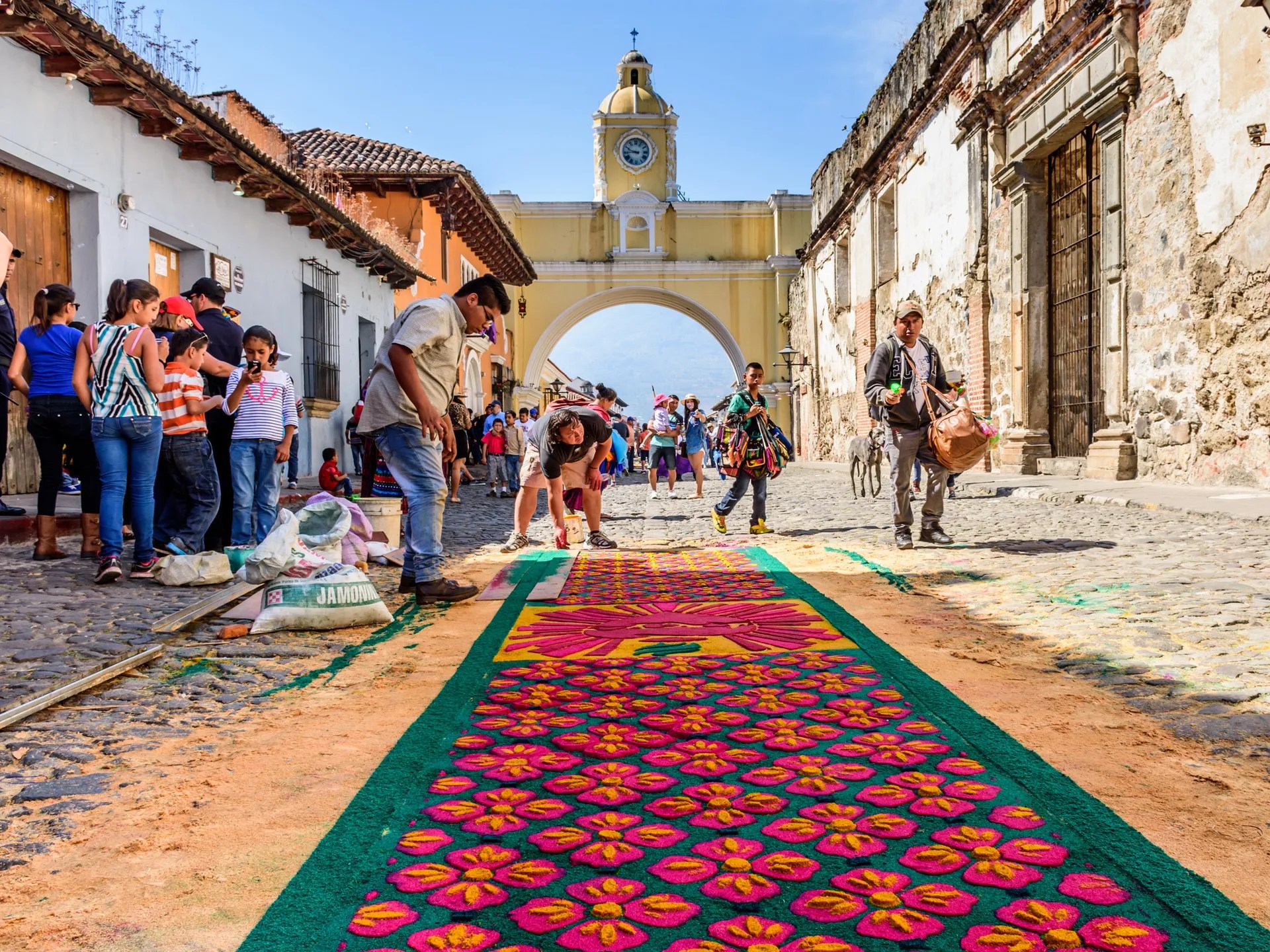
HOLY WEEK TRADITION: Antigua, Guatemala, is renowned for its annual Good Friday observance, which involves the laying out of alfombras (carpets) of multicolored sawdust through the city’s cobblestone streets, hundreds of feet long. On Maundy Thursday, the city closes so that families and businesses can spend the day constructing the carpets, applying the sawdust to planned designs using stencils and strainers and adding pine needles, flowers, fruits, and other natural materials as well.
People watch while locals make an alfombra (carpet) of dyed sawdust for Antigua’s Good Friday processions, the most famous in Latin America. Photo: Lucy Brown, 2016.
At 4 a.m. on Good Friday, the processions begin, with people carrying floats that bear statues of Christ carrying his cross, followed by marching bands playing solemn music. (This is a remembrance of Jesus’s walk to Calvary.) As their feet pass over the alfombras, the dust scatters. Locals and visitors gather along the streets dressed in black for mourning, and at 11 p.m. a figure of Jesus is laid to rest in the church.
Here are two resources for exploring this tradition further:
>> VIDEO: “Alfombras de Semana Santa en Guatemala,” dir.Federica Dominguez: This short film (in Spanish, with English subtitles) interviews Rolando Ortiz, an alfombrero who is also a shoemaker. He explains that the carpets hark back to Jesus’s triumphal entry into Jerusalem, when the crowds strewed his path with palm branches (giving him the red carpet treatment, so to speak). Even though the alfombras last only a brief time, locals spare no expense in bringing them to fruition each year—“for Jesus,” Ortiz says. “It is an act of gratitude above all.” An offering of beauty and praise.
+++
NEW ALBUM: As Foretold, Part 3 by Poor Bishop Hooper: Released today, this is the final album in a trilogy based on the prophetic fulfillment passages in the Gospel of Matthew. It centers on Jesus’s passion and concludes with a resurrection epilogue. As with all their music, the duo graciously offers it for free download from their website.
+++
SONGS performed by Emorja Roberson: Emorja Roberson [previously] is a singer, gospel choir conductor, and assistant professor of music and African American studies at Oxford College of Emory University in Georgia. I enjoy following his YouTube channel. Here are two songs that are especially fitting for Holy Week.
>> “I Know It Was the Blood”: Roberson sings three verses of this beloved African American spiritual: the title verse, “They whipped him all night long,” and “He never said a mumblin’ word.” The song is more typically sung in a major key, and its full lyrics span Christ’s passion, resurrection, ascension, and second coming. But Roberson slows down the tempo and sings in a minor key, homing in on the sorrow of Good Friday.
>> “He Decided to Die” by Margaret Pleasant Douroux: Roberson, on keys, sings a gospel classic with friends Marcus Morton and Cameron Scott, a song that emphasizes Christ’s resoluteness on the cross, his endurance for love.
+++
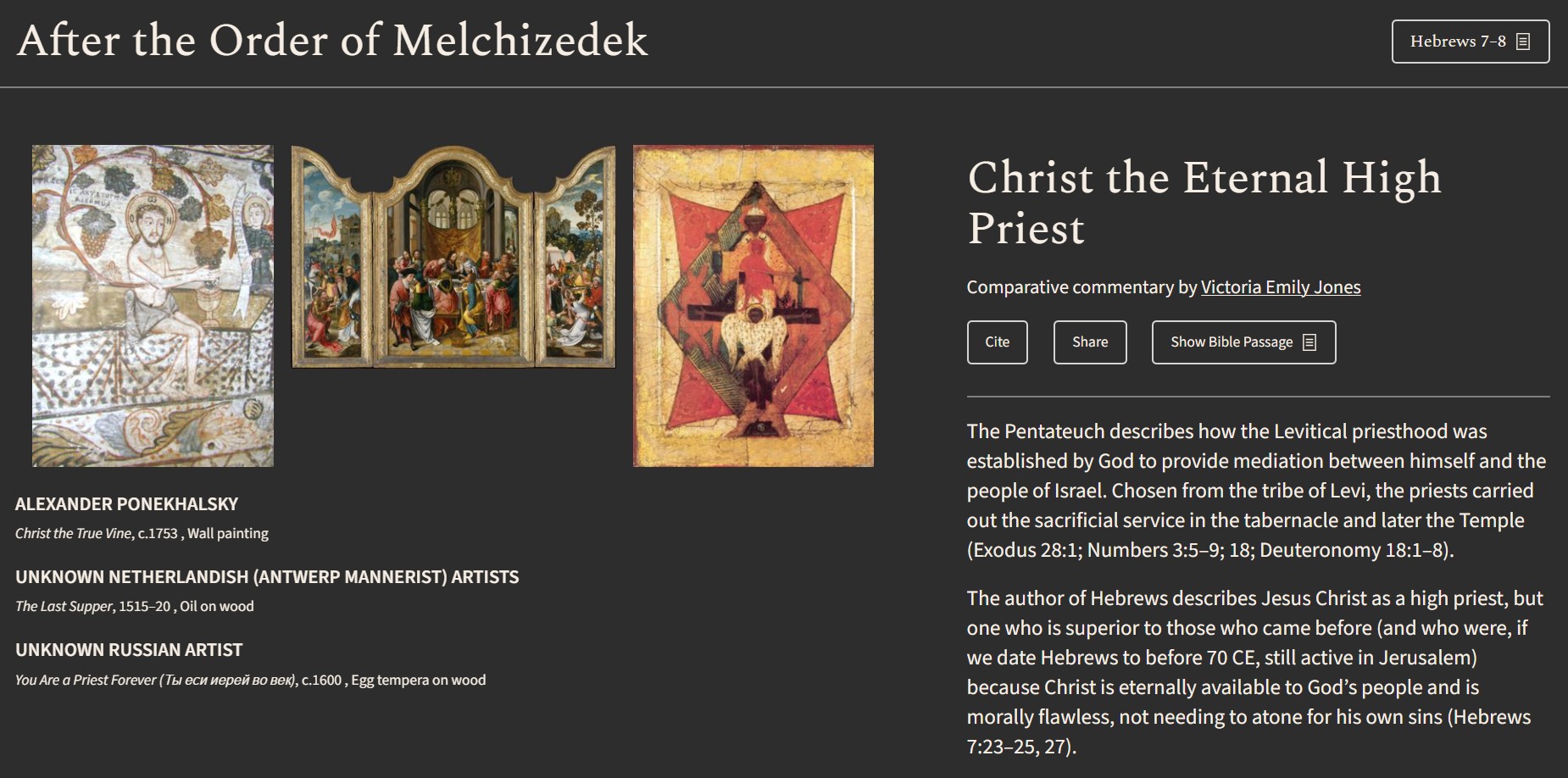
VISUAL COMMENTARIES: “After the Order of Melchizedek” by Victoria Emily Jones: My latest contribution to the Visual Commentary on Scripture, a project based out of King’s College London, was published earlier this month. Tasked with choosing and commenting on three artworks that dialogue with Hebrews 7–8, I landed on a “You Are a Priest Forever” icon from Russia (very strange!), an Antwerp Mannerist triptych that centers the Last Supper, and (my favorite) a wall painting of Christ the Grapevine from a Romanian church. I was interested to explore the idea of how Jesus, in giving his body and blood, is both the offerer and the offered, both priest and sacrifice.
+++
POEM: “The Death of Christ” by Emperor Kangxi: Emperor Kangxi (1654–1722) ruled in China for sixty-one years during the Qing Dynasty. In 1692 he issued the Edict of Toleration, which barred attacks on churches and legalized the practice of Christianity among Chinese people. Curious about and respectful of other faiths, he penned this short poem on the Crucifixion using the classical qi-yen-she form.
+++
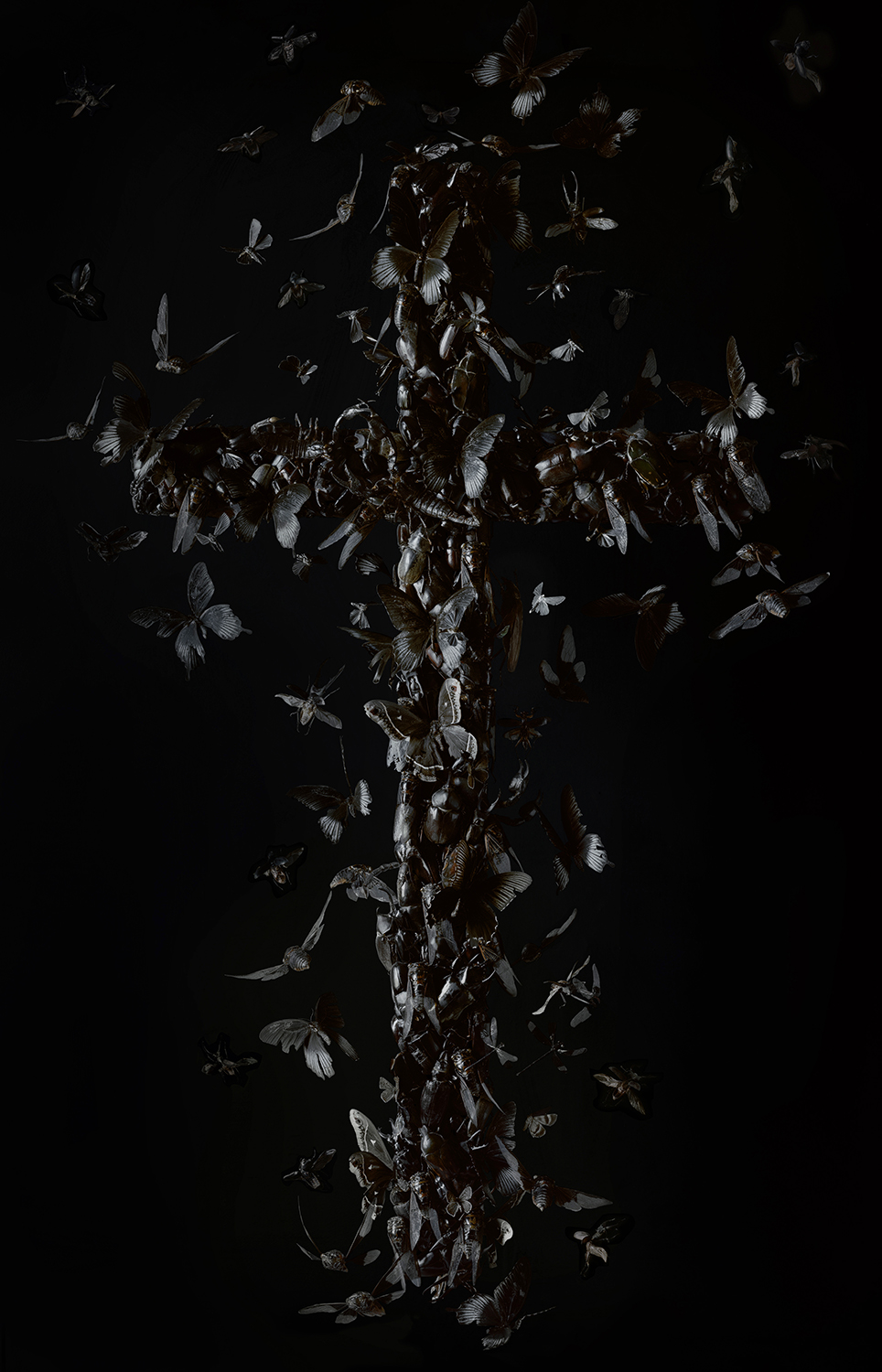
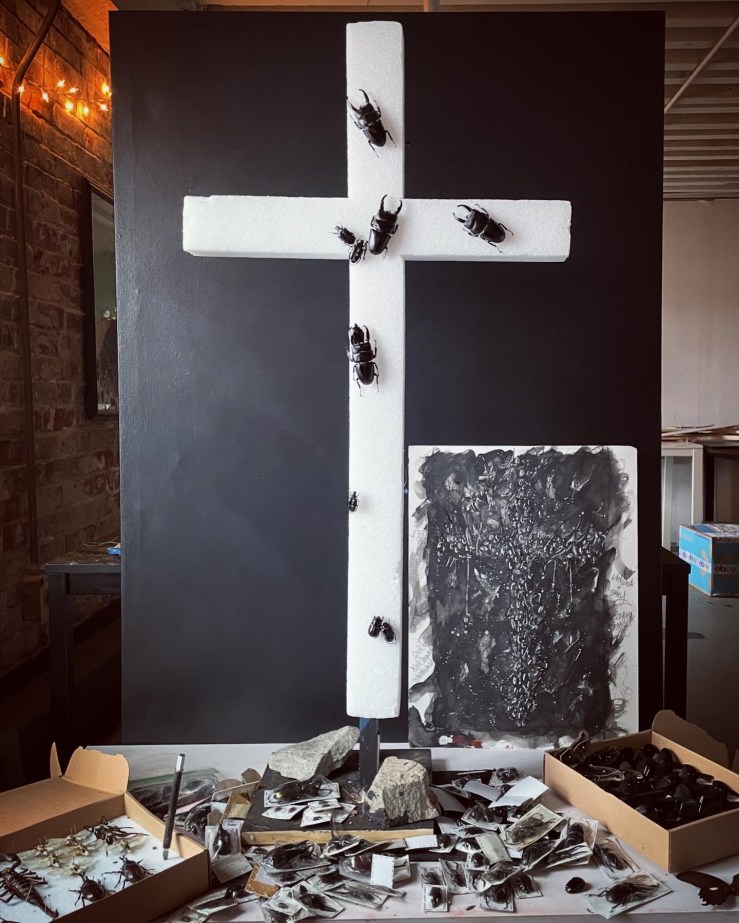
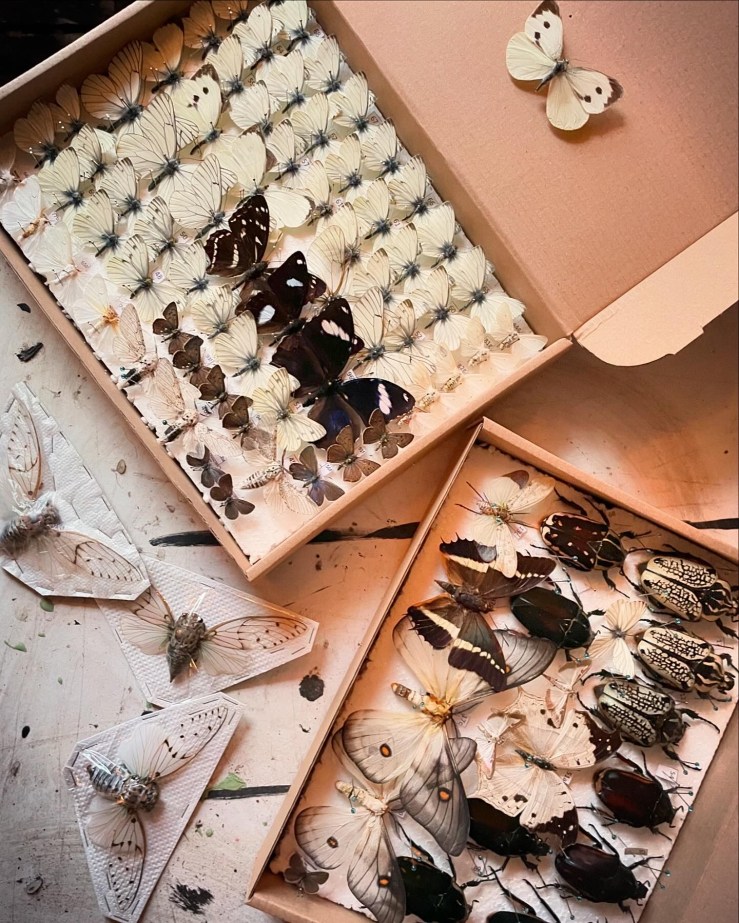
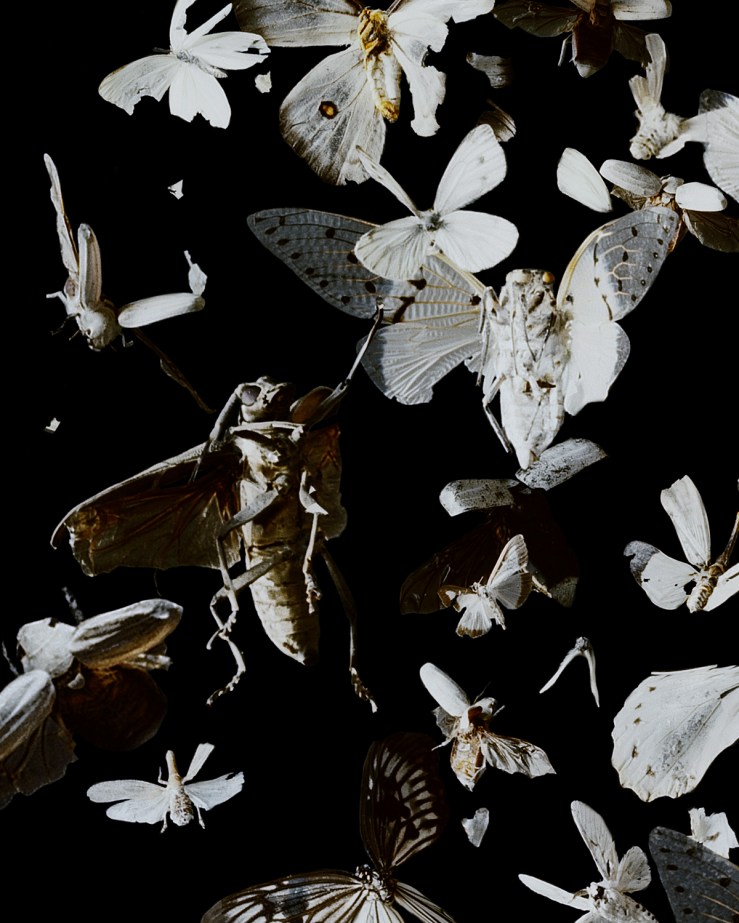
EXHIBITION: Tara Sellios: Ask Now the Beasts, Fitchburg Art Museum, January 18, 2025–January 18, 2026:Tara Sellios is a multidisciplinary artist from South Boston working mainly in large-format photography. Delighting in detail and complex symbolism, she often uses insects, dried fauna, bone, and other organic matter to create elaborate still lifes that she then photographs under dramatic lighting. She is inspired by art historical representations of the end of the world, especially the bizarre paintings of Hieronymus Bosch and Albrecht Dürer’s Apocalypse woodcuts, and by seventeenth-century Dutch vanitas paintings.
The photographs in her current solo show, Ask Now the Beasts at Fitchburg Art Museum in Massachusetts, are “contemporary allegories of suffering and transcendence.” The exhibition’s title comes from Job 12:7.
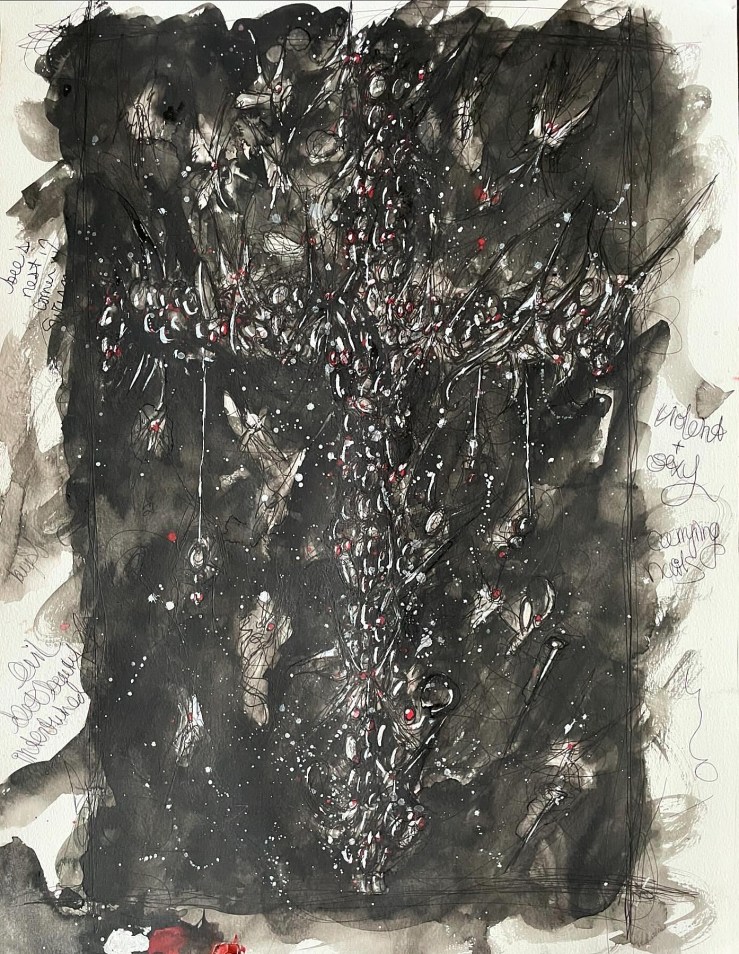
Two of the works on display are a pair of crosses: Umbra (Latin for “darkness” or “shadow”) and Dilucesco (“to begin to grow light, to dawn”), which together suggest a movement from death to resurrection. Constructed with a throng of black beetles and other black insects, the Umbra cross evokes the detail from the Synoptic Gospels’ Crucifixion accounts that at noon, “darkness came over the whole land until three in the afternoon, while the sun’s light failed” (Luke 23:44–45; cf. Matt. 27:45; Mark 15:33). Dilucesco, on the other hand, shows the cross seemingly exploding into light, as white moths and other winged insects break out of their cruciform shape. View these two photographic artworks, plus a few process photos and sketches the artist sent me, below. See, too, www.tarasellios.com.
Tara Sellios (American, 1987–), Umbra, 2024, from the series Ask Now the Beasts. Inkjet print from 8 × 10 negative, 55 × 35 in. Courtesy of the artist.Tara Sellios (American, 1987–), Dilucesco, 2024, from the series Ask Now the Beasts. Inkjet print from 8 × 10 negative, 55 × 35 in. Courtesy of the artist.
All photos in this post, except for the last one (of the processional icon), are my own.
(Note: WordPress seems to have disabled the feature that allows you to expand an image upon clicking, but if you’re reading on a computer, you can right-click an image and open it in a new tab to view it in full resolution; if you’re reading on a phone, you can pinch to zoom.)
Located in the Horn of Africa and with access to the Red Sea, Nile River, Mediterranean Sea, and Indian Ocean, Ethiopia stands at the nexus of historical travel, trade, and pilgrimage routes that brought it into contact with surrounding cultures and influenced its artistic development. Coptic Egypt, Nubia, South Arabia, Byzantium, Armenia, Italy, India, and the greater African continent were among those influencers. But Ethiopia not only absorbed influences; it transmitted them too.
A major art exhibition is centering Ethiopia’s artistic traditions in a global context. For Ethiopia at the Crossroads at the Walters Art Museum in Baltimore (running through March 3), curator Christine Sciacca has brought together more than 220 objects from the Walters’ own extraordinary Ethiopian art collection and private and institutional lenders both domestic and international. Icons, wall paintings, processional crosses and hand crosses, illuminated Gospel books and psalters, sensuls (chain manuscripts), healing scrolls, and more are on display throughout the galleries, whose walls have been painted bright green, yellow, and red—the colors of the Ethiopian flag. To round off the exhibition, guest curator Tsedaye Makonnen, an Ethiopian American multidisciplinary artist, was tasked with curating a few works from contemporary artists of the Ethiopian diaspora.
The majority of objects are Christian, made for liturgical or private devotional use. Ethiopia is one of the world’s oldest Christian nations: in the early fourth century, persuaded by a missionary from Syria, King Ezana of Aksum embraced Christianity, and it has been the dominant religion of Ethiopia ever since. But the exhibition does also include some Islamic and Jewish objects.
One of the first works you’ll encounter is a mural that would have originally been mounted on the outer wall of an Ethiopian Orthodox church sanctuary (mäqdäs), portraying the Nativity, the Presentation of Christ in the Temple, and the Adoration of the Magi.
Nativity, Presentation of Christ in the Temple, and Adoration of the Magi, Ethiopia, 18th century. Glue tempera on overlapping canvas pieces mounted to a new stretched canvas, 49 3/16 × 66 15/16 in. (124.9 × 170 cm). Walters Art Museum, Baltimore. [object record]
Remarkably, at the Nativity, there is a feast taking place, and Jesus is feeding his mother with what looks like a Communion wafer! As the theologian Lester Ruth has said, “The sound from most baby beds is a cry to be fed. But the cry from the manger is an offer to feed on his body born into this world.”
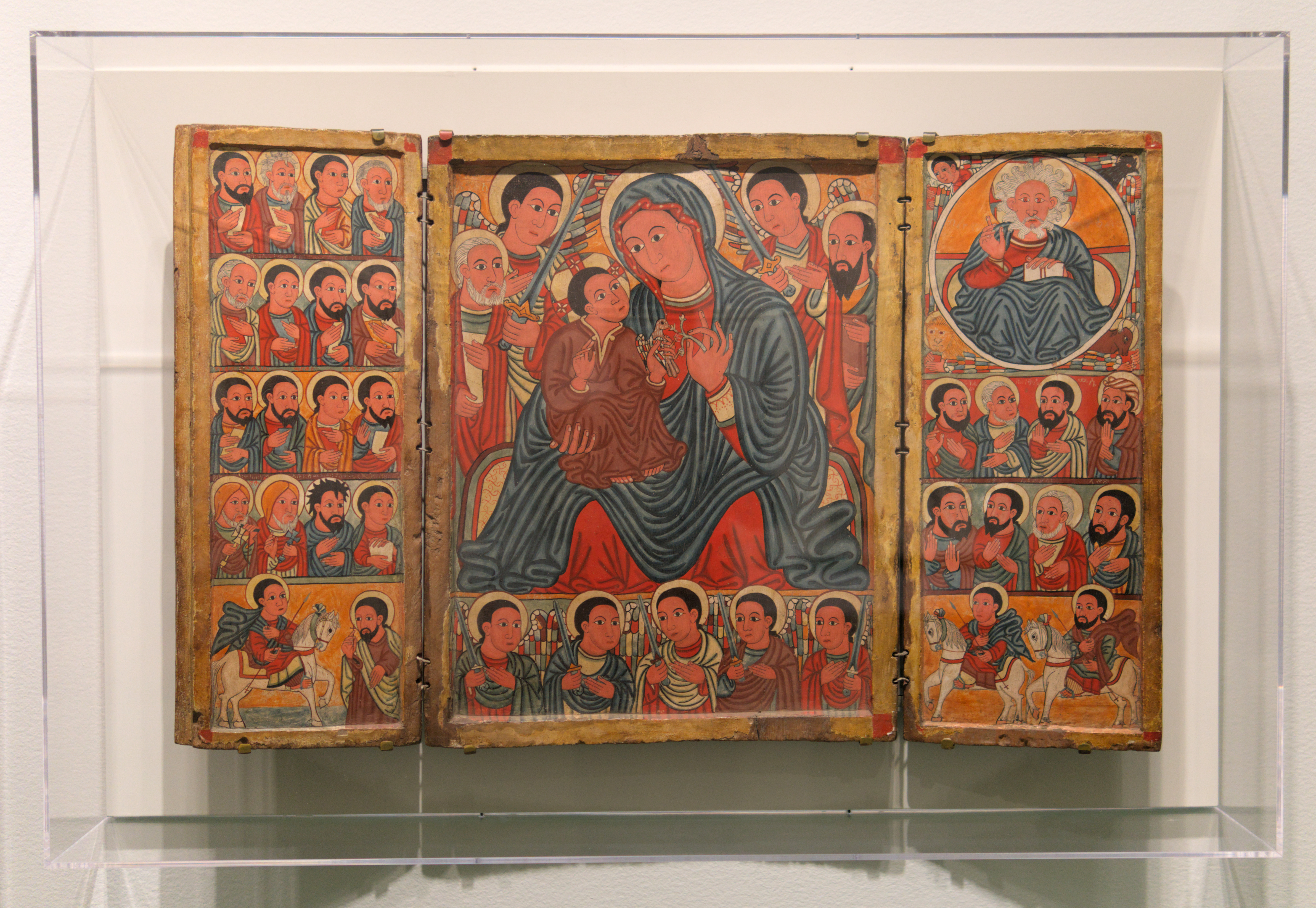
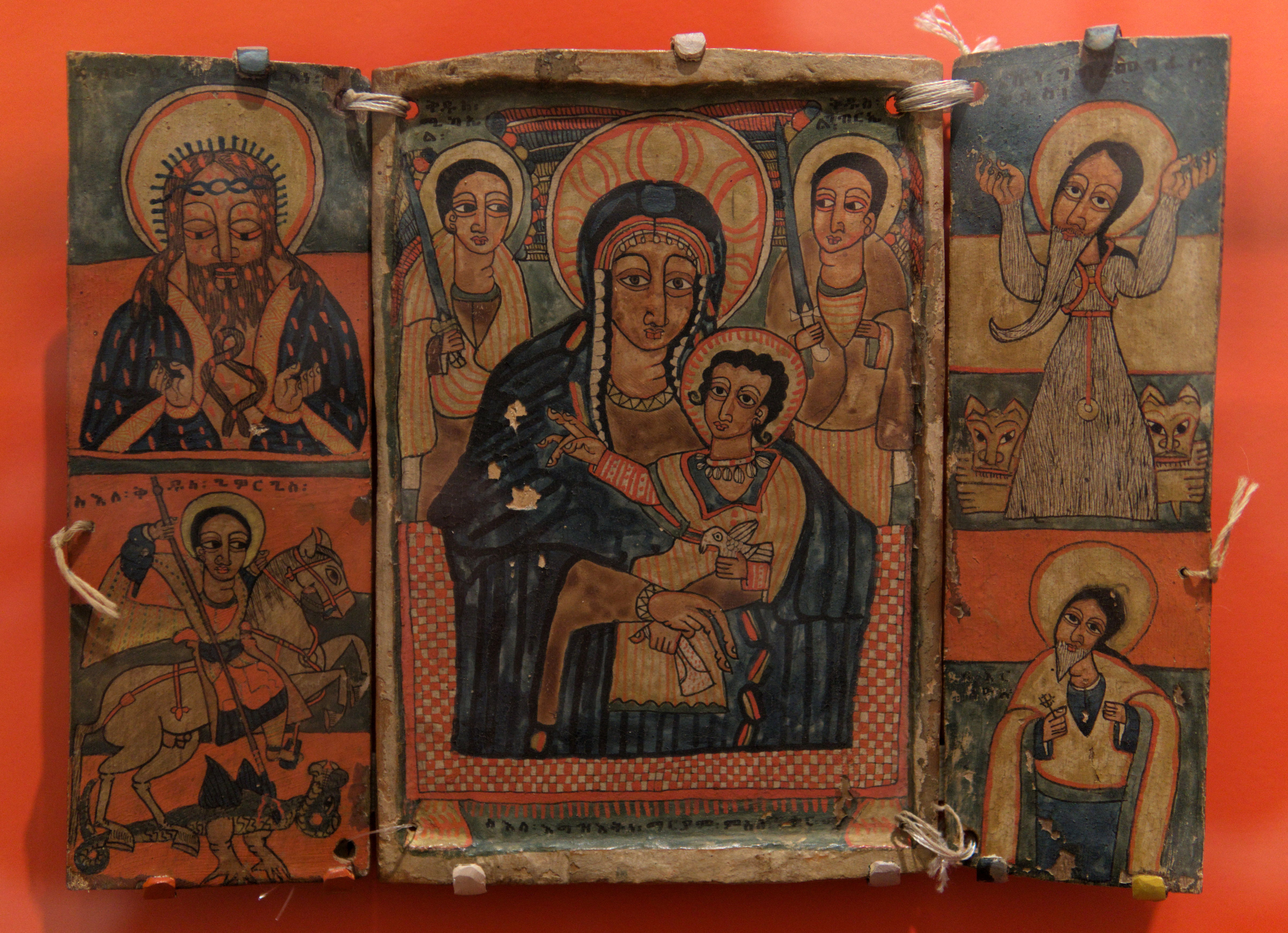
One of history’s most famous Ethiopian painters is Fre Seyon, who worked at the court of Emperor Zara Yaqob (r. 1434–1468) and was of the first generation of Ethiopian artists who painted icons on wood panels. He was also a monk. He likely introduced one of the characteristic features of Ethiopian icons of the Virgin and Child: the archangels Michael and Gabriel flanking them with drawn swords, acting as a kind of honor guard.
Fre Seyon (Ethiopian, active 1445–1480), Triptych Icon with the Virgin Mary and Christ Child Flanked by Archangels and Saints (center), Twelve Apostles and Saints (left), and Prophets and Saints (right), mid- to late 15th century. Tempera on gesso-primed wood. Institute of Ethiopian Studies, Addis Ababa University, acc. no. IESMus4186.
My two favorite details of this triptych by Fre Seyon are (on the right wing) the image of the Ancient of Days surrounded by the tetramorph, his wild gray locks being blown about, and in the center, the bird that Christ holds, its feet grasping at a three-branched twig. On a literal level, the bird is a plaything for the boy that charmingly emphasizes his humanity (in the late Middle Ages, at least in Europe—I’m not sure about in Ethiopia—it was common for young children to keep tame birds as pets). On another level, the bird may be symbolic. In traditional Western art, Jesus sometimes holds a goldfinch, a bird with distinctive red markings that’s fond of eating thistle seeds and gathering thistle down and thus came to be read as a prefiguration of Christ’s thorny, blood-spilt passion. I’m not sure whether Fre Seyon intended a symbolic significance for this bird.
Here’s another triptych from the exhibition, this one from a century and a half later:
Triptych Icon with the Virgin Mary and Christ Child Flanked by Archangels, Scenes from the Life of Christ, Saint George, and Saints Honorius, Täklä Haymanot, and Ewostatewos, Ethiopia (Tigray), early 17th century. Glue tempera on panel, 16 3/4 × 22 5/16 in. (42.5 × 56.7 cm). Walters Art Museum, Baltimore. [object record]
The composition of the Virgin and Child is based on prints of a painted icon from Santa Maria Maggiore in Rome brought to Ethiopia by Portuguese Jesuit missionaries—but it innovates. As the wall text notes, “Mary’s cloak stretch[es] out in either direction to embrace the scene of Christ Teaching the Apostles below. Umbrella-like, Mary appears as both the protector and personification of the church.”
On the right wing, angels hold up chalices to collect the blood that flows from Jesus’s wounds on the cross, while below that, Joseph of Arimathea and Nicodemus carry Jesus’s wrapped corpse to the tomb. On the left wing is one of my favorite traditional religious scenes: the Harrowing of Hell, or Christ’s Descent into Limbo, in which, on Holy Saturday, Jesus enters the realm of his dead to take back those whom Death has held captive, first of which are our foreparents Adam and Eve. Below that scene is an image of the dragon-slaying Saint George, a late third-century figure from the Levant or Cappadocia who is the patron saint of Ethiopia.
At the bottom center is a scene of Christ teaching the twelve apostles, plus two Ethiopian saints. They all hold hand crosses, like those carried by Ethiopian priests and monks.
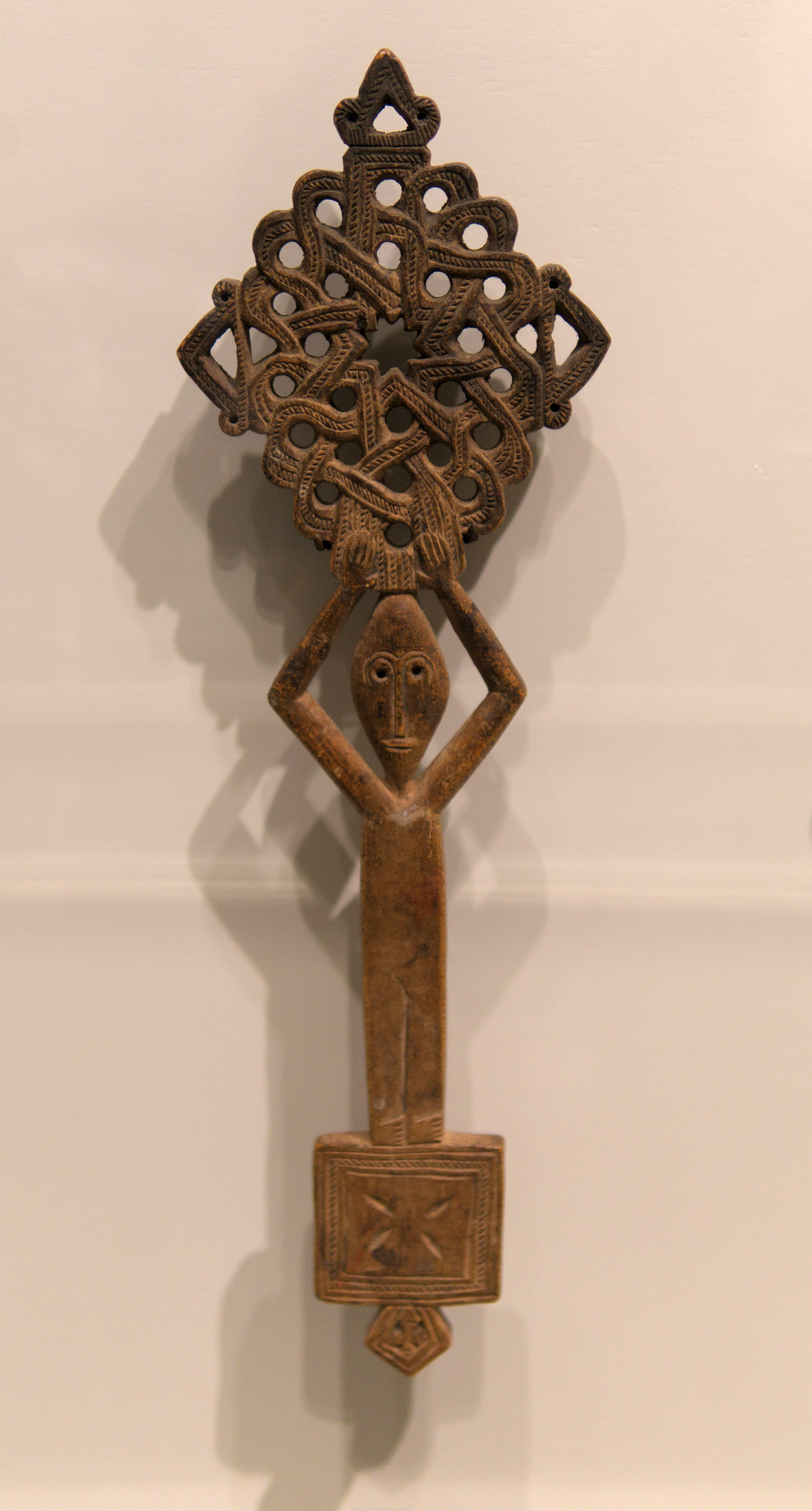
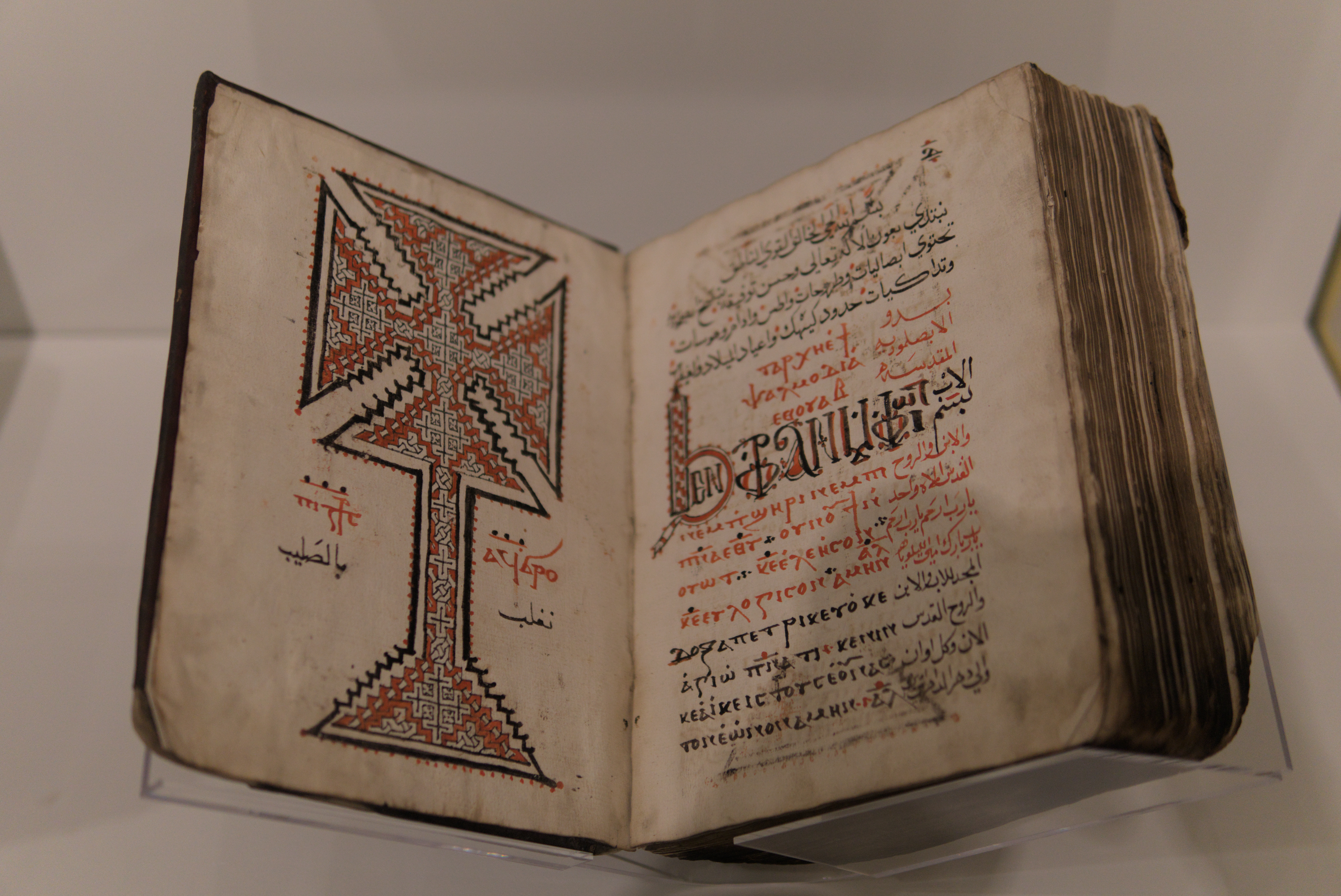
Hand Cross with Figure, Ethiopia, probably 18th–19th century. Wood, 13 3/8 × 4 3/16 × 9/16 in. (34 x 10.7 × 1.4 cm). Walters Art Museum, Baltimore. [object record]Coptic-Arabic Book of Prayer, Egypt, 18th century. Tempera and ink on parchment, 11 3/4 × 9 in. (29.8 × 22.8 cm). Melikian Collection. [object record]
One of the hallmarks of the exhibition is its multisensory nature: attendees are immersed not only in the sights of Ethiopia but also in the sounds and smells. Scratch-and-sniff cards invite people to take a whiff of frankincense, which would have filled the censer on display. Or to smell berbere, a hot spice blend that would have been stored in the woven baskets nearby.
This olfactory element was produced by the Institute for Digital Archaeology, which, as part of its efforts to record and preserve ephemeral culture, has launched an ambitious program to preserve the heritage of smells. “The aim is to provide the technical means for documenting the aromas of today for the benefit of future generations – and to find new methods and opportunities for experiencing the odors of the past.”
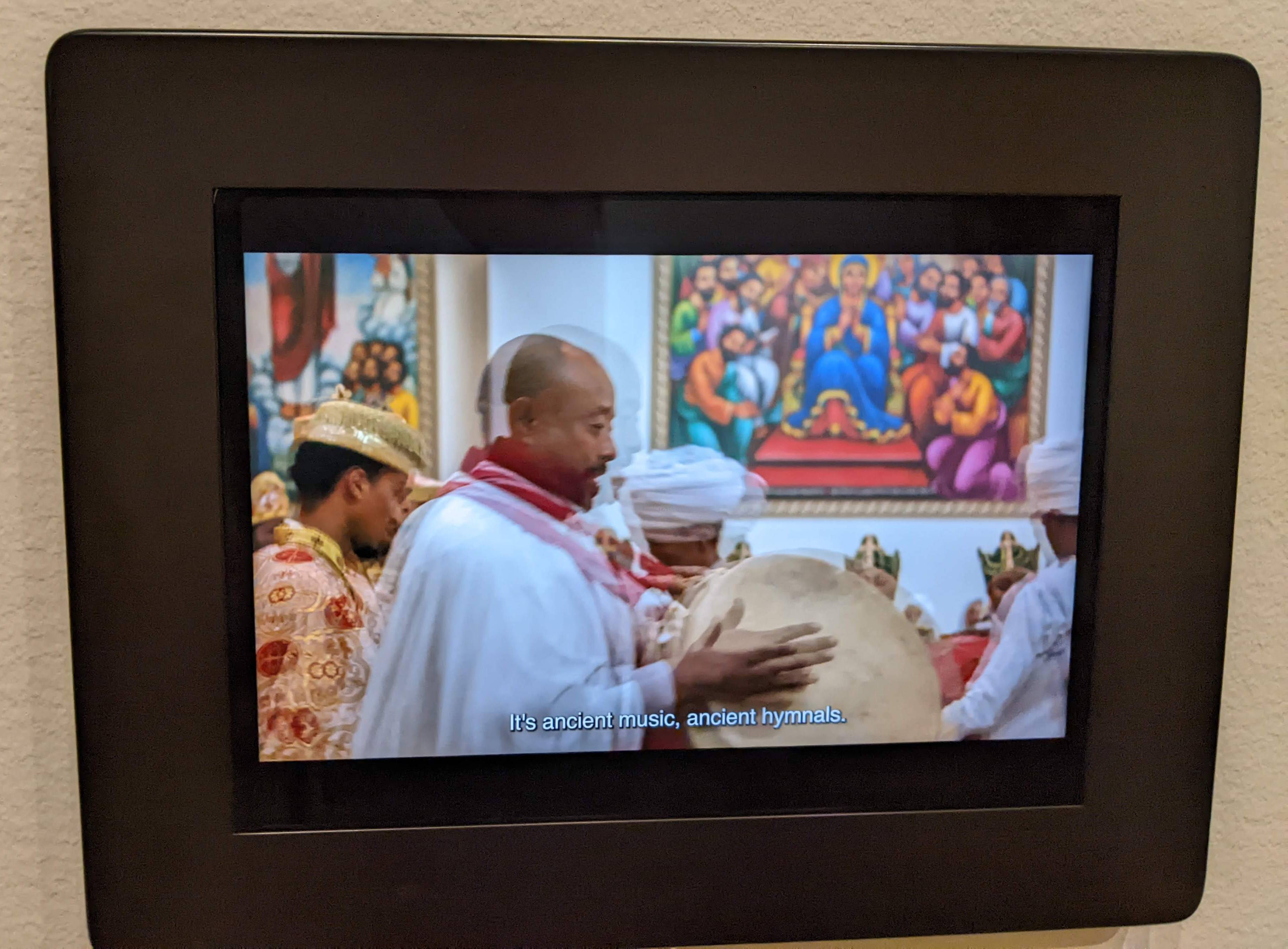
Also in the exhibition there are screens where you can watch videos of Ethiopian Orthodox worship, including music and liturgies, where you will see some of the objects in use. You can also listen to interviews with members of the local Ethiopian diaspora community. (The Washington metropolitan area has the largest Ethiopian population outside Ethiopia.)
Further contextualizing the objects and enhancing the sense of place, pasted onto the wall is a blow-up photograph of a Christian holy-day celebration wending through the streets. This serves as a backdrop to two physical artifacts present in the room: a qämis (dress) and a debab (umbrella).
The inscriptions on many of the Ethiopian icons and manuscript illuminations, which identify the figures and scenes, are in Ge‘ez (aka classical Ethiopic), an ancient South Semitic language that originated over two thousand years ago in what is now northern Ethiopia and Eritrea. It’s no longer spoken in daily life, but it is still used as the language of the Ethiopian Orthodox Church and taught to boys in Sunday school. I really wish I could read it, as it would be a great help in interpreting the Ethiopian images I come across in my studies!
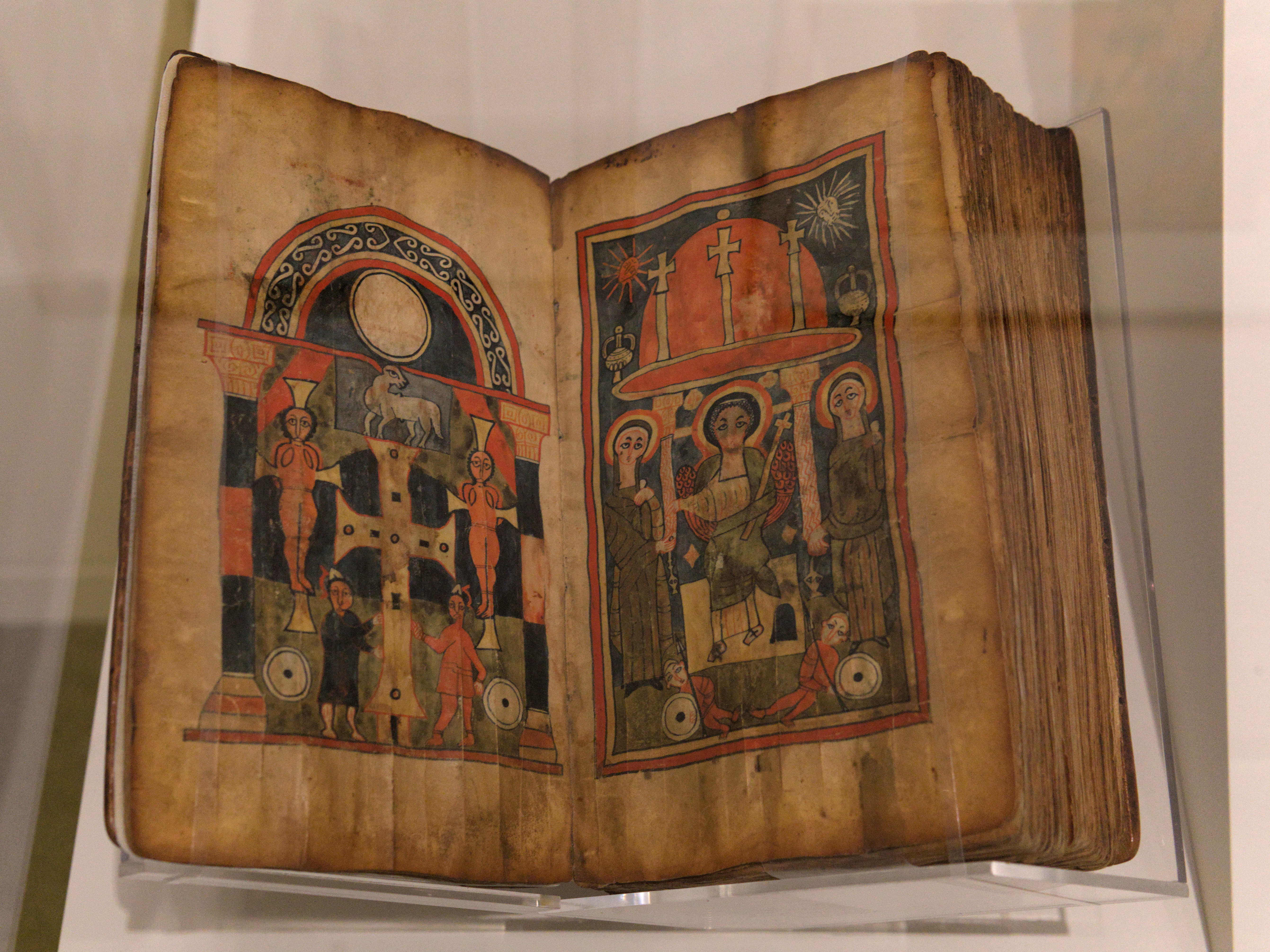
Contrary to what some may assume, Ethiopians in the medieval era were not an isolated people. They traveled—to Rome, to Jerusalem, and so forth. Evidence of Holy Land pilgrimage is suggested by an early fourteenth-century Gospel book that includes the domed Church of the Holy Sepulcher as the backdrop for Christ’s resurrection:
Gospel Book with the Crucifixion and Christ’s Resurrection, Ethiopia (Tigray), early 14th century. Ink and paint on parchment, 10 1/2 × 6 11/16 in. (26.7 × 17 cm). Walters Art Museum, Baltimore, W.8.36, fols. 6v–7r. [object record]
This is an extraordinary book, one of the oldest surviving Ethiopian manuscripts and the oldest in North America. Ethiopian artists weren’t yet depicting Jesus on the cross, so to represent the Crucifixion, this artist has painted a living lamb surmounting a bejeweled cross, with the two thieves crucified on either side.
Also from the fourteenth century, a manuscript opened to a page spread of Christ’s Entry into Jerusalem:
Christ’s Entry into Jerusalem, folios added from an earlier Gospel book to a Ta’ammera Maryam manuscript, Ethiopia, 14th century. Tempera and ink on parchment. Private collection.
I like how the scene extends across both pages, creating a sense of forward progression, and the two onlookers above the city gate.
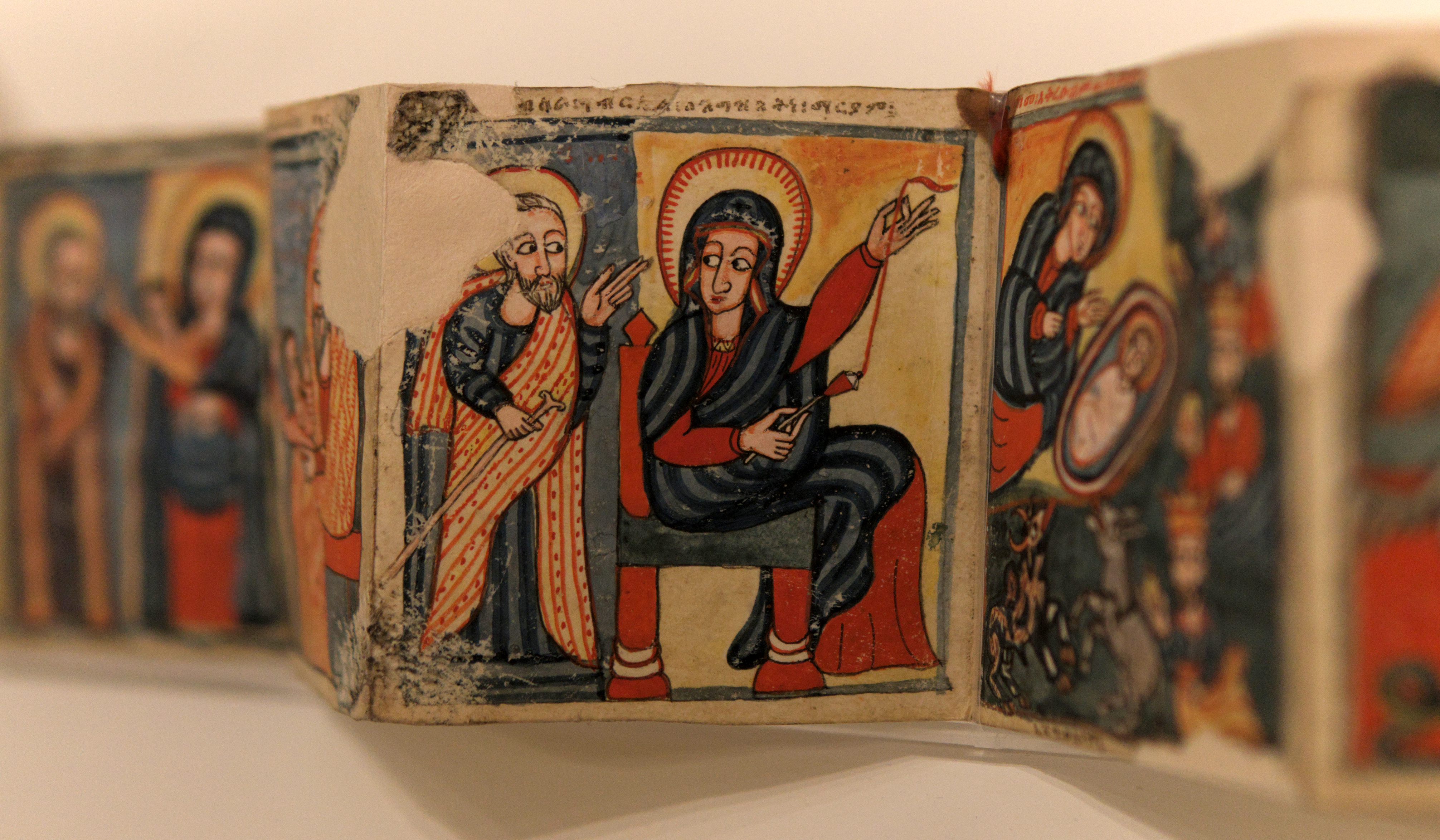
One of my favorite objects from the exhibition is a sensul from Gondar depicting ten scenes from the life of Mary. A sensul is an Ethiopian chain manuscript, in this case pocket-size, created out of a single folded strip of parchment attached to heavy hide boards at each end, which creates a small book when folded shut. Here’s a detail showing the Annunciation:
Annunciation, from a Gondarine sensul (chained manuscript), Ethiopia (Gondar), late 17th century. Ink and paint on parchment, each panel 3 5/8 × 3 1/8 in. (9.2 × 9 cm). Walters Art Museum, Baltimore. [object record] [GIF]
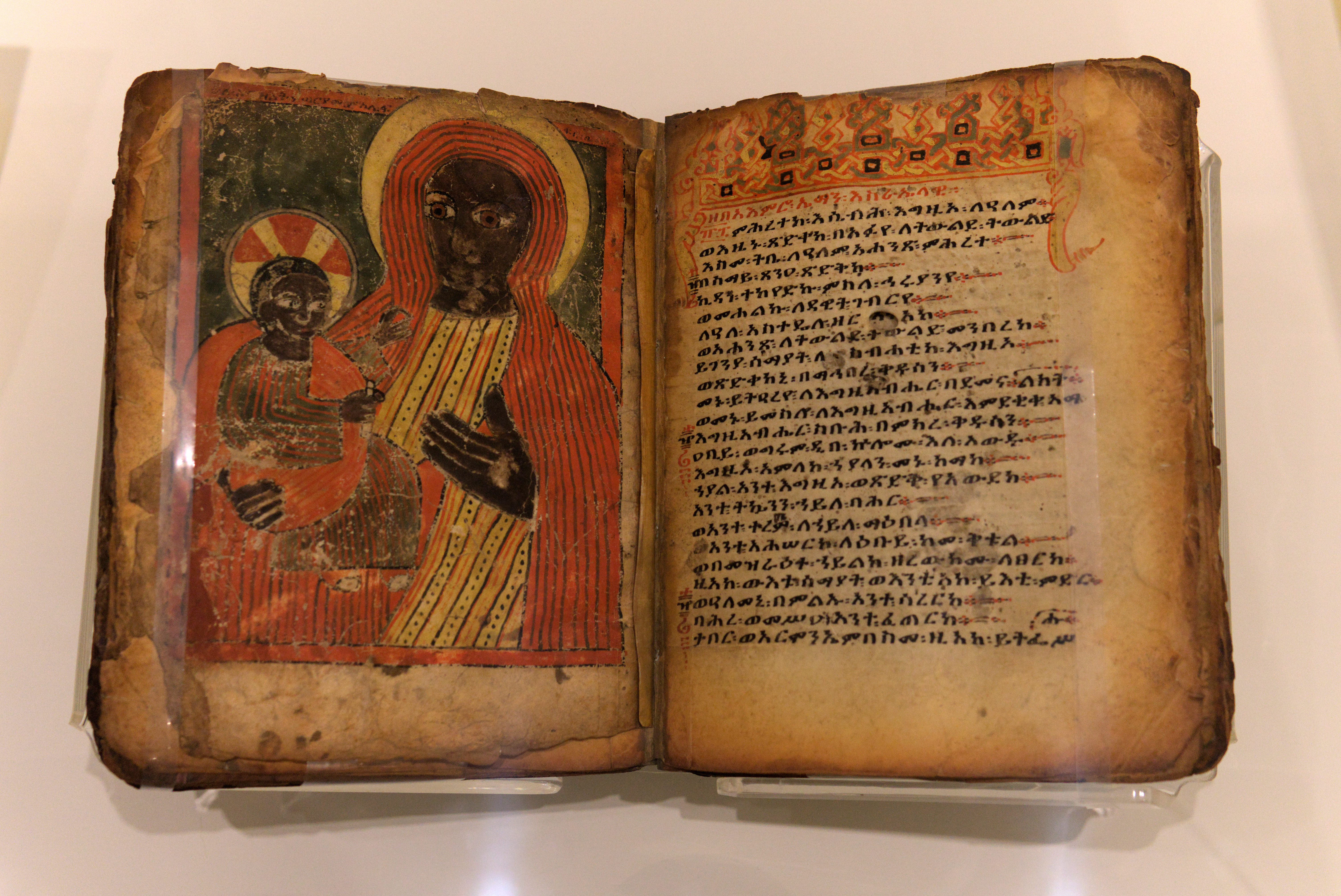
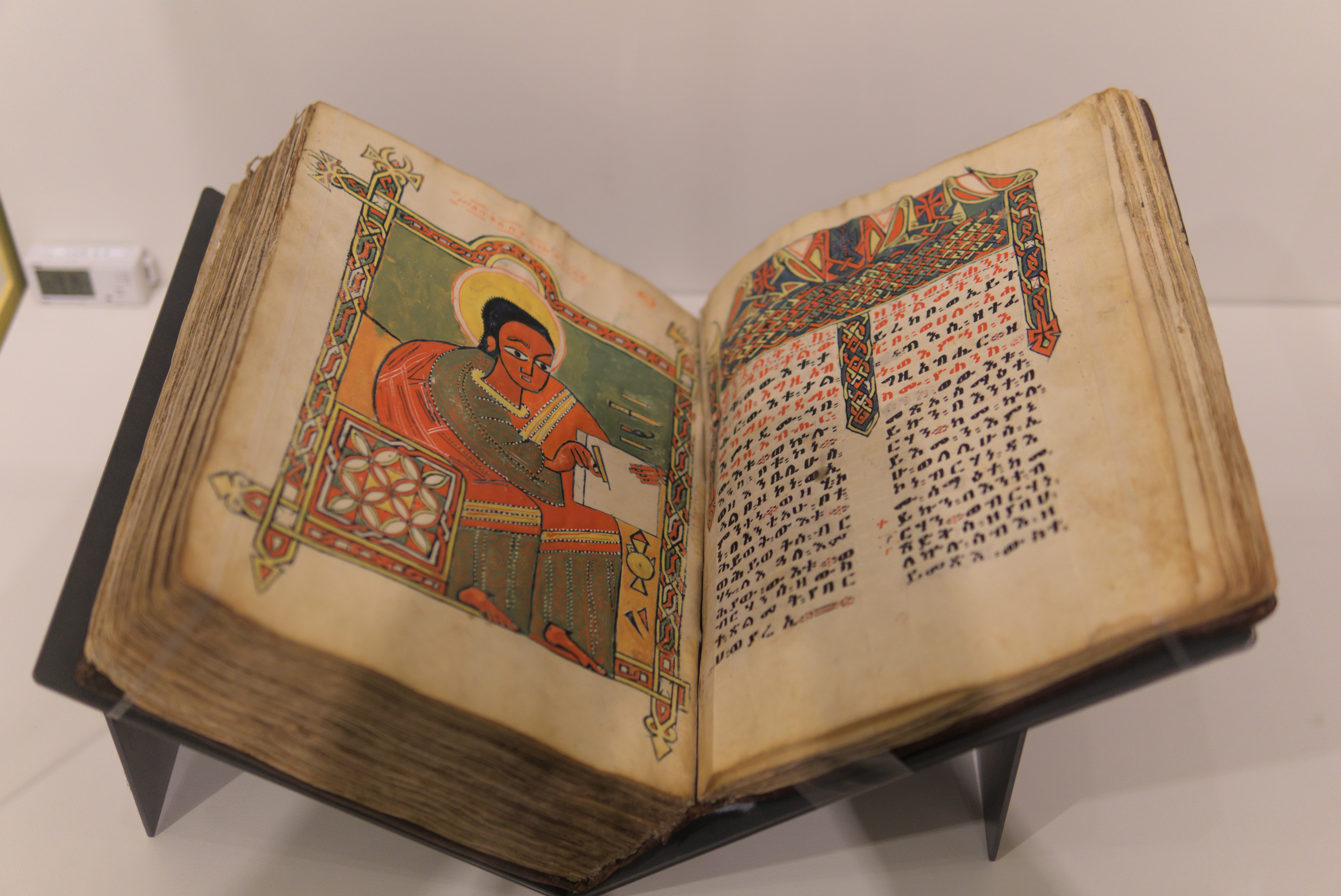
It’s a common misconception that Ethiopians have always depicted biblical figures as dark-skinned to reflect the local population. Such treatment didn’t become normative until the eighteenth century, although some earlier artists did choose black complexions for holy persons:
Virgin and Child, from a Psalter with the Wəddase Maryam (Praise of Mary) and Mähalǝyä Näbiyyat (Canticles of the Prophets), Ethiopia, 15th century. Ink and pigments on parchment with wooden boards, open: 8 7/8 × 6 11/16 × 3 15/16 in. (22.5 × 17 × 10 cm). Toledo Museum of Art, Ohio. [object record]The Opening of the Gospel of John, from a Gospel book, Ethiopia, ca. 1504–5. Tempera on parchment, 13 9/16 × 10 7/16 in. (34.5 × 26.5 cm). J. Paul Getty Museum, Los Angeles, Ms. 102, fols. 215v–216r. [object record]Triptych Icon with the Virgin Mary and Christ Child Flanked by Archangels (center), the Kwer‘atä re’esu (Man of Sorrows) and Saint George (left), and Saint Gäbrä Mänfäs Qeddus and Abba Arsanyos (right), Ethiopia (Gondar), late 17th–early 18th century. Tempera on gesso-primed wood. Institute of Ethiopian Studies, Addis Ababa University, acc. no. IESMus3492.
In the triptych shown above, not only is the infant Jesus depicted as Black, but he also wears a necklace made of cowrie shells, which are traditionally given to Ethiopian children for protection!
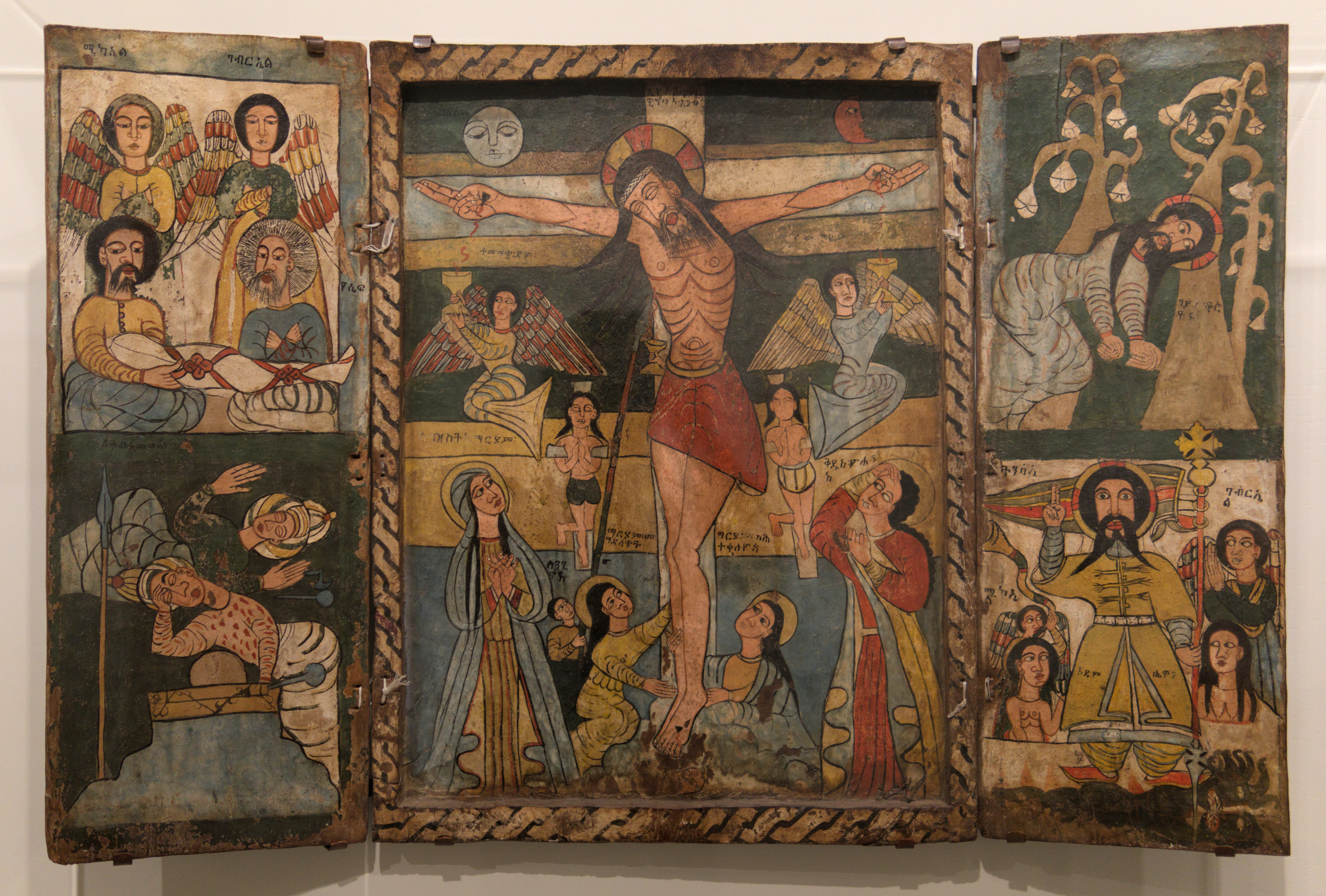
My favorite artwork from the exhibition is probably this triptych:
Triptych Icon with the Crucifixion (center), Entombment and Guards at the Tomb (left), and Temptation in the Wilderness and the Resurrection of Christ (right), Ethiopia, late 16th century. Tempera on gesso-primed wood. Institute of Ethiopian Studies, Addis Ababa University, acc. no. IESMus4126.
Its central panel depicts the Crucifixion, Christ’s head bowed in death and his fingers gesturing blessing, even as his palms are nailed. At the top, the sun and the moon mourn his passing. As we saw before, angels catch the blood that drips from his body (notice the cute little hand sticking out from behind his torso!). At the base, the two larger-scale figures are the Virgin Mary and St. John, while next to Mary on a smaller scale is Longinus, the centurion who pierces Christ’s side with a spear.
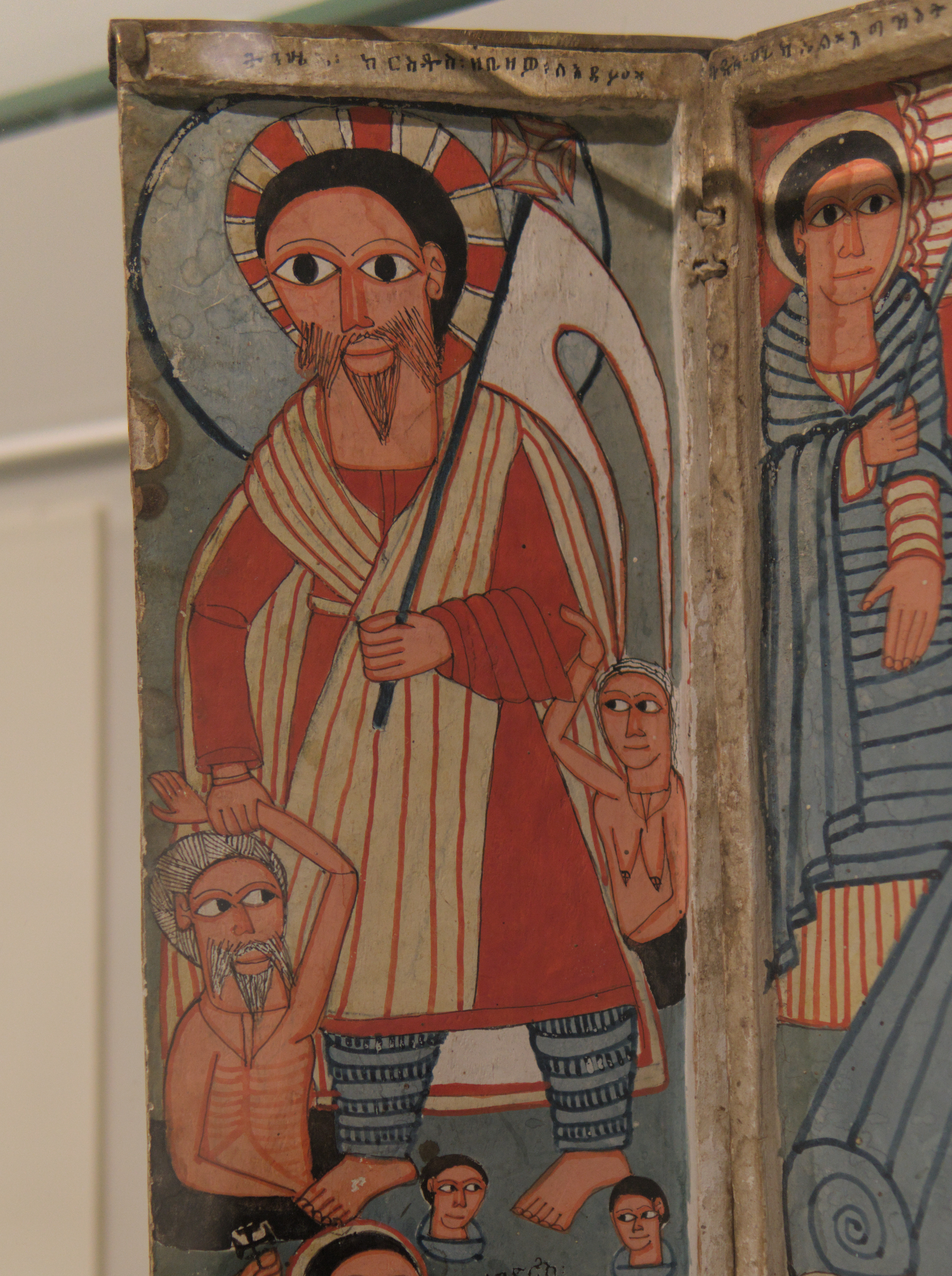
The left wing shows the Entombment of Christ, with two guards, wearing pointed turbans, sleeping at their post. The right wing shows a scene that the label identifies as “Temptation in the Wilderness” (presumably a translation of the inscription on the tree) but that looks to me more like an Agony in the Garden. Below that is the Resurrection, with Christ holding a victory banner, standing atop Hades. An angel blows a shofar and the dead rise up out of their graves, following Christ, the firstfruits of the resurrection (1 Cor. 15:20–22). Christ wears a short-sleeved, knee-length jacket with frog closures, and bunched sleeves and trousers, both of which reflect clothing from regions east of Africa.
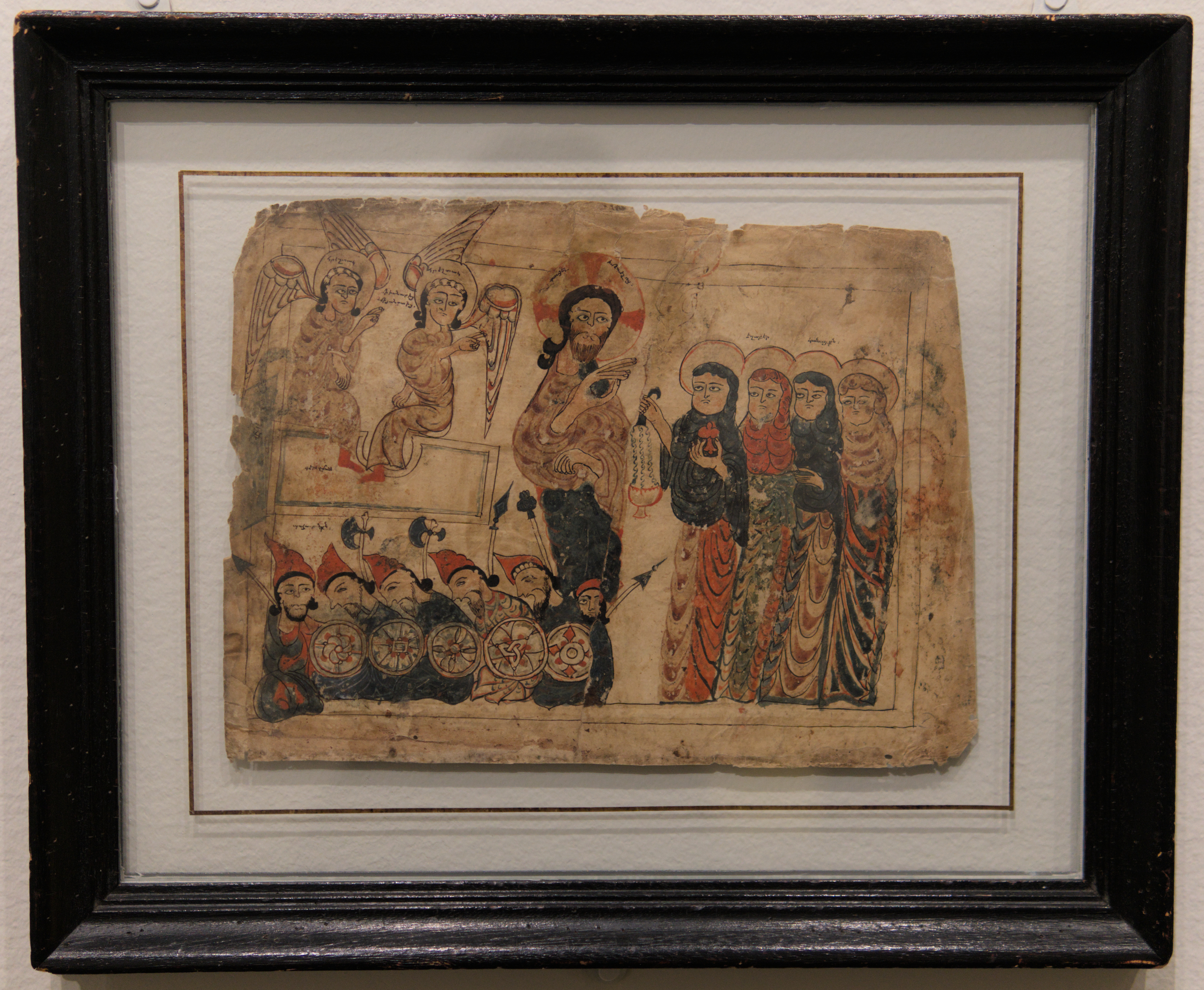
The wall text notes the fine, wavy lines used to render the figures’ draperies, perhaps influenced by Armenian artists from the Lake Van region.
Yovsian of Vaspurakan (Armenian), Leaf from a Gospel book with the Resurrection of Christ and Visit of the Women to the Tomb of Christ, ca. 1350. Tempera on cotton paper. Private collection.
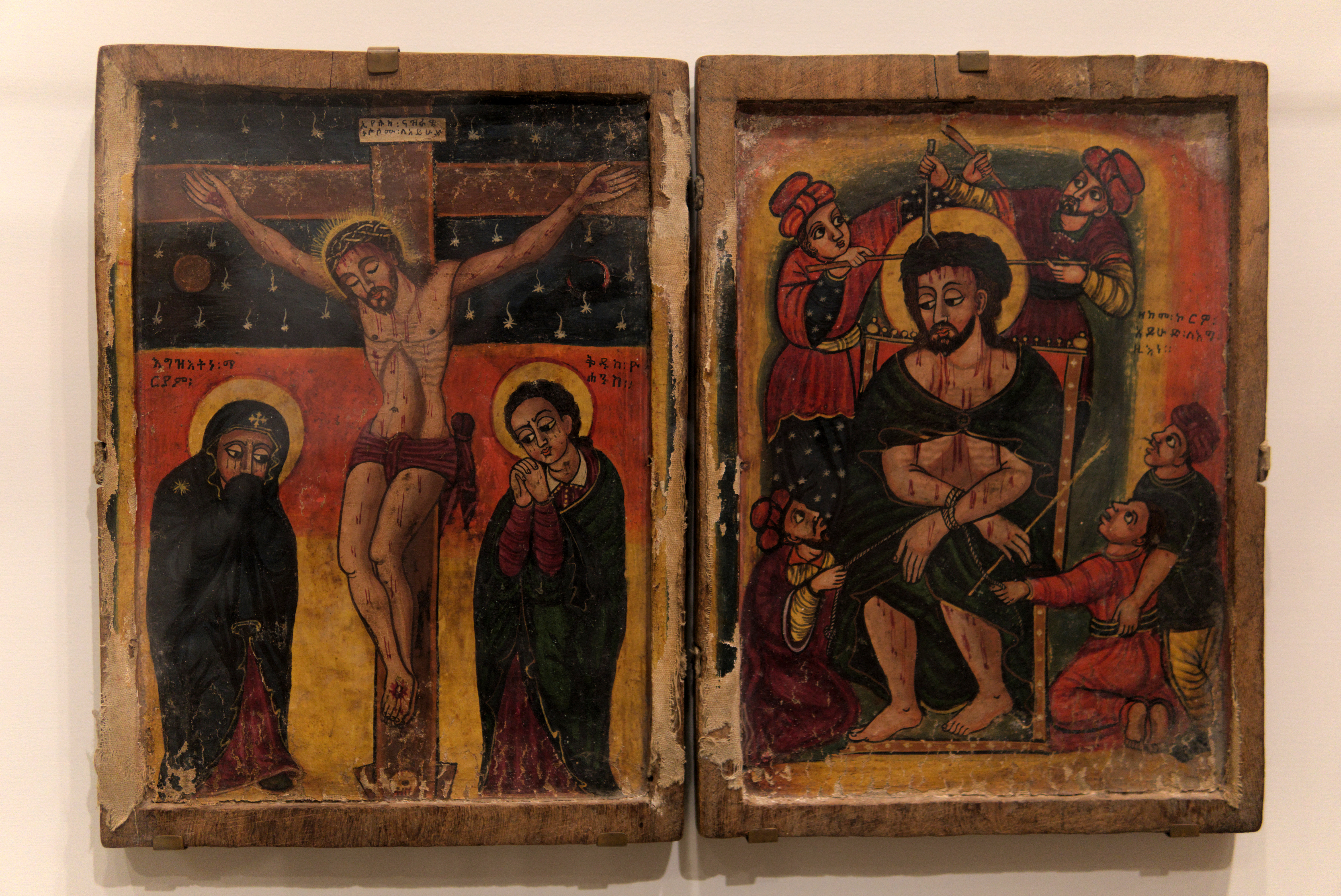
Here’s another Crucifixion, this one painted in what’s called the Second Gondarine style, characterized by smoothly modeled figures, often with darker skin tones, and wide horizontal bands of red, yellow, and green filling the background:
Diptych Icon with the Crucifixion (left) and the Mocking of Christ (right), Ethiopia, late 17th–early 18th century. Wood, polychrome, 13 1/2 × 9 7/8 in. (34.3 × 25.1 cm). Virginia Museum of Fine Arts, Richmond. [object record]
The squiggles behind Christ at the top left may simply be a decorative motif, but to me they look like falling stars, an apocalyptic sign, and as if the sky is weeping.
The right panel of the diptych shows Christ being cruelly fitted with a crown of thorns.
Two other passion images I want to share are a Last Supper wall painting and an Entombment from a disbound album.
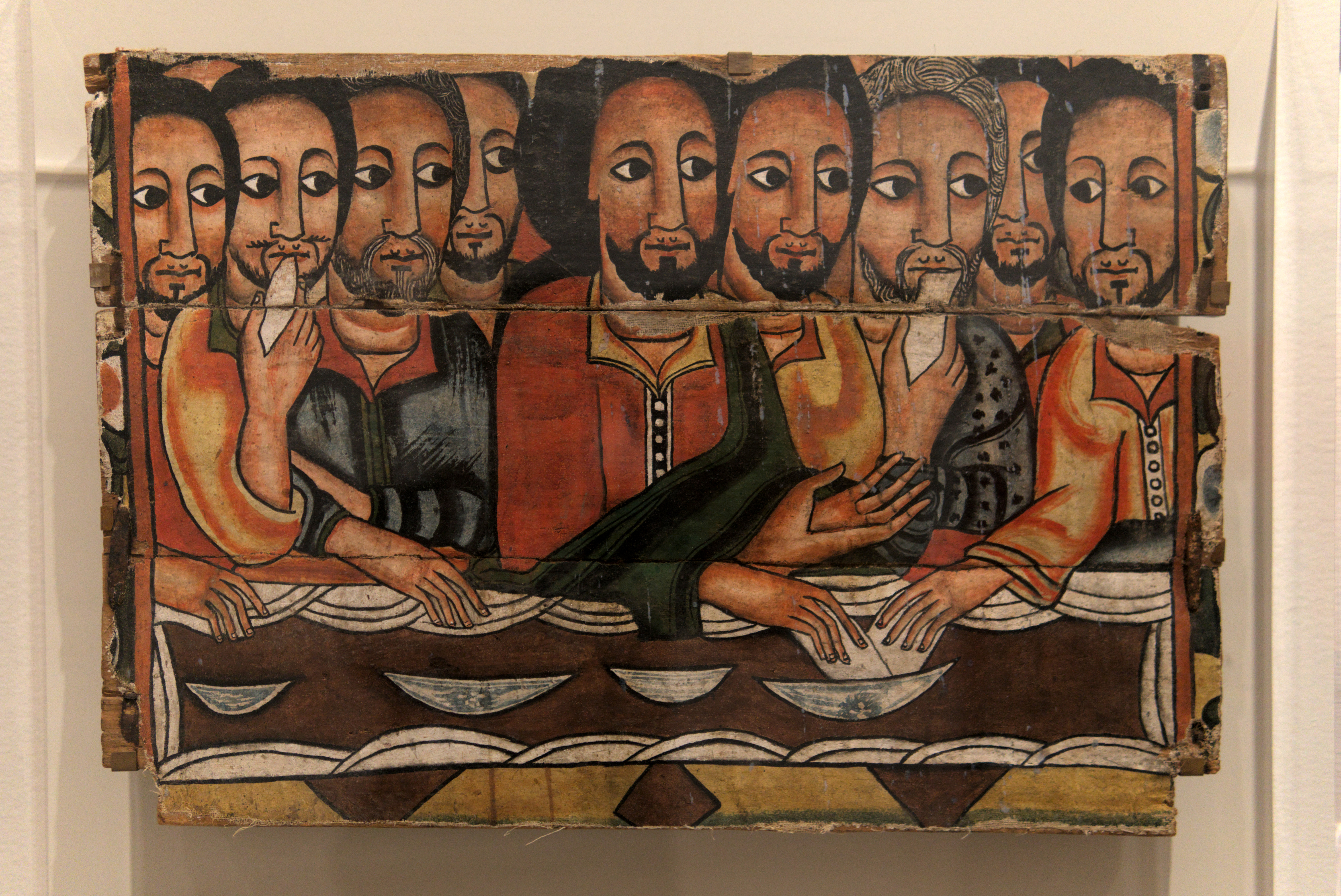
Last Supper, Ethiopia, 18th century. Tempera on linen, mounted on panel, 16 3/4 × 24 in. (42.6 × 61 cm). Virginia Museum of Fine Arts, Richmond. [object record]Album Leaf with the Entombment of Christ, Ethiopia (Sawa?), late 17th century. Pigments on vellum. Minneapolis Institute of Art, 2009.39.3y. [object record]
In the Last Supper, Jesus and Judas both dip their bread (injera!) into the same bowl and exchange a knowing glance.
In the Entombment, Jesus, wrapped in white linen, is lowered into the ground, mourned by several of his women followers. The portrayal of his mother Mary’s weeping, her hands covering her eyes and her face stained with tears, is particularly poignant. This leaf is from a set of forty-four, now matted separately but originally arranged in series and likely painted on several long sheets of parchment that were sewn together and folded accordion-style to form a sensul.
One of the most extraordinary objects on display is a rare folding processional icon that adopts the form of a fan, from the late fifteenth century:
Folding Processional Icon in the Shape of a Fan, Ethiopia, late 15th century (Stephanite). Ink and paint on parchment, thread, extended: 24 1/4 × 154 1/8 × 4 3/4 in. (61.6 × 391.4 × 12 cm). Walters Art Museum, Baltimore. Photo courtesy of the museum. [object record]
Thirty-eight identically sized figures span the surface of this elongated parchment: the early Christian martyrs Julitta (Juliet) and Cyricus, St. George, St. John the Baptist, the archangel Michael, the Virgin Mary, the archangel Raphael, St. Paul, the Ethiopian artist-priest Afnin, and unidentified Old Testament patriarchs and prophets. There would have been a wooden handle attached to either end that, when pulled together, created a double handle for a giant wheel to be displayed during liturgical processions and church services (see here). As the museum website notes, “The Virgin Mary, whose hands are raised in a gesture of prayer, is then at the top of the wheel. By depicting Mary in the company of saints and angels, the icon powerfully evokes the celestial community of the church.”
This is just a sampling of all the wonderful art objects that are a part of the Ethiopia at the Crossroadsexhibition. I’ll share more photos on Instagram (@art_and_theology) in the coming weeks.
I strongly encourage you to go see this! I think it would be enjoyable for children as well, especially Christian children, who will be able to identify many of the painted stories. For Christians, it’s an opportunity to connect with our artistic heritage and with African church history. If you can’t catch the exhibition at the Walters in Baltimore before it closes March 3, it will be traveling to the Peabody Essex Museum in Salem, Massachusetts (April 13–July 7, 2024), and the Toledo Museum of Art in Ohio (August 17–November 10, 2024).
Sister Kim Ok-soon (김옥순 수녀), The Bread of Life from Heaven (하늘에서 내려온 생명의 빵), 2014
Stars sing, light-years deep in silent space.
In a bottle’s neck God’s Ghost sings
as the wine is poured.
Out on the edge of eternity, the Father
sees the Lamb slain ere the world is formed.
A soft cough splits the silence of this room
light-years below the wheeling stars.
A hollow prayer; give it breath, O Ghost,
let roar a wind like that which shook
the bones in Vision Vale.
For vision, God spills bread crumbs on the board.
His stars sing, light-years deep in silent space.
Here, emblems speak a mystery of brokenness:
the shattering of him by whom all things consist.
Keith Patman is an occasional poet whose primary vocation is Bible translation. Since 1982 he has worked for Wycliffe Bible Translators, assisting with the translation of scripture into the languages of West and Central Africa. He lived in Cameroon from 1987 to 1995, working on a Nugunu New Testament, and now serves from the US as part of an international team providing tools and training to African translators. He currently lives in Waynesboro, Virginia, with his wife, Jaci, who is a Presbyterian minister. They have two grown children and six grandchildren.
While they were eating, Jesus took a loaf of bread, and after blessing it he broke it, gave it to the disciples, and said, “Take, eat; this is my body.” Then he took a cup, and after giving thanks he gave it to them, saying, “Drink from it, all of you; for this is my blood of the covenant, which is poured out for many for the forgiveness of sins.”
—Matthew 26:26–28 (cf. Mark 14:22–24; Luke 22:17–20)
The Lord Jesus on the night when he was betrayed took a loaf of bread, and when he had given thanks, he broke it and said, “This is my body that is foryou. Do this in remembrance of me.” In the same way he took the cup also, after supper, saying, “This cup is the new covenant in my blood. Do this, as often as you drink it, in remembrance of me.”For as often as you eat this bread and drink the cup, you proclaim the Lord’s death until he comes.
—1 Corinthians 11:23b–26
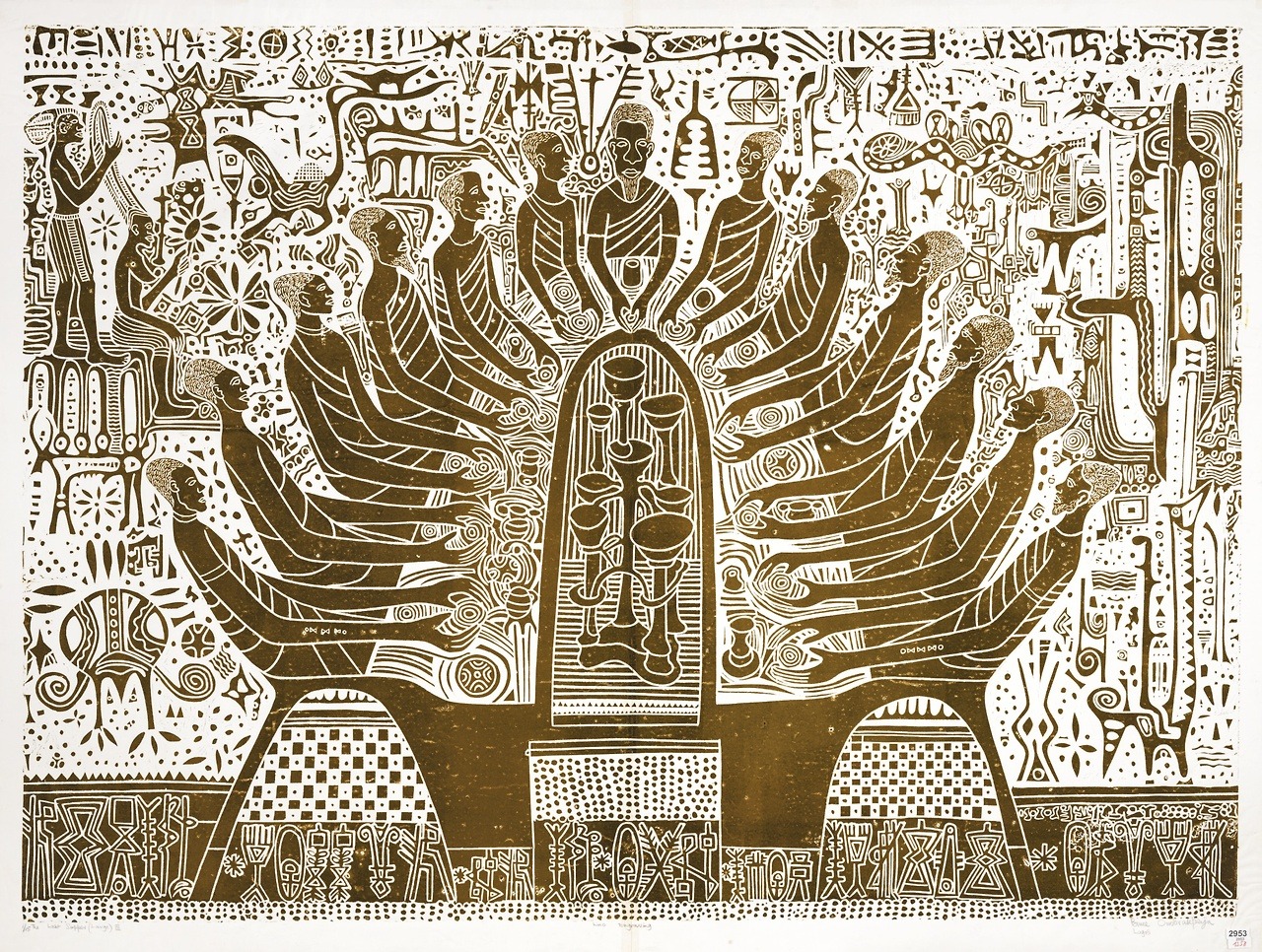
LOOK: TheLast Supper III by Bruce Onobrakpeya
Bruce Onobrakpeya (Nigerian, 1932–), The Last Supper III. Lino engraving on rice paper, 58 × 62 3/4 in. (147 × 195 cm). Edition 1/15.
A pioneer of modern African art, Bruce Onobrakpeya is an internationally renowned Nigerian printmaker, painter, and sculptor of Urhobo heritage. He was raised Christian and has fulfilled several commissions on Christian themes, especially from 1967 to 1981. (I wrote about his Stations of the Cross series of colored linocut prints on my old blog.) His work also explores Urhobo traditional religion, culture, and history and the modern world of Nigeria.
In Onobrakpeya’s Last Supper III, Jesus sits at the head of an oblong table with his twelve disciples, making eye contact with the viewer. The food and drink are highly stylized, but the men appear to be breaking bread. The background features the Ibiebe alphabet, a script of ideographic geometric and curvilinear glyphs that Onobrakpeya developed.
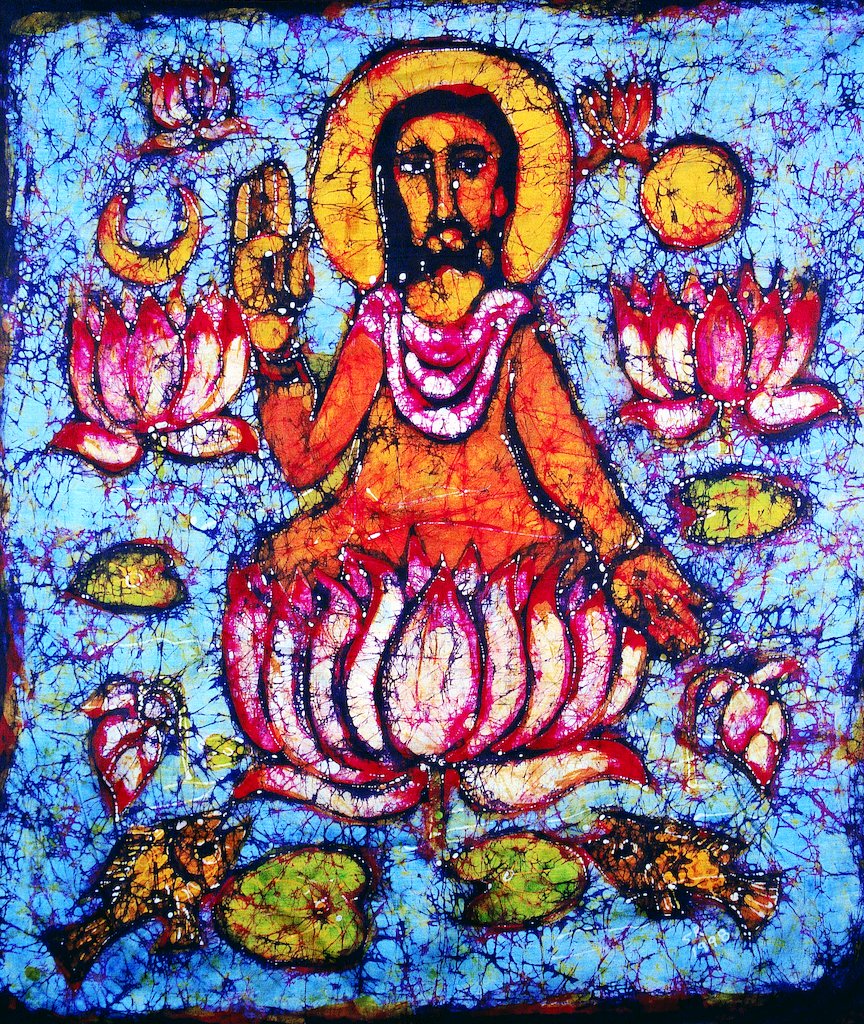
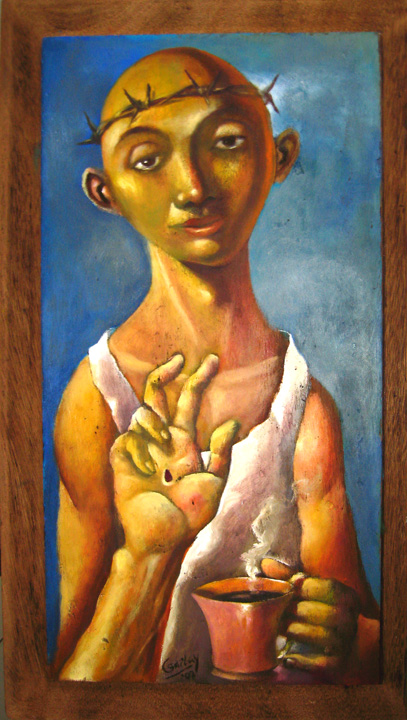
ARTICLE: “Searching for a Jesus Who Looks More Like Me” by Eric V. Copage: I was interviewed the other week for this New York Times piece on multiethnic images of Christ. I comment on paintings by Wisnu Sasongko (Indonesian), Greg Weatherby (Aboriginal Australian), Emmanuel Garibay (Filipino), and Solomon Raj (Indian), and helped select a few of the other images.
Solomon Raj (Indian, 1921–2019), Jesus on the Lotus Flower, 1998. Batik. Photo: Gudrun Löwner.
Emmanuel Garibay (Filipino, 1962–), Untitled, 2007. Oil on wood. Photo via the artist.
Of those Christians who even permit images of Jesus, some hold to a strict literalism and object to images that show him as anything other than a first-century Jew from Israel-Palestine—even though these same literalists would rightly insist that no image is literally Jesus. As I hope is clear from my website, I embrace a wide range of Christological imagery, which I feel reflects the universal presence and revelation of God. (“Christ is all, and in all,” as the apostle Paul wrote in Colossians 3:11; he continues to manifest spiritually, and through his ecclesial body, all over the world.) I’m not so proud to assume that my way of picturing Jesus is the most right or authoritative; I need others to help me see Jesus more fully, more truly. Like C. S. Lewis said, “My own eyes are not enough for me, I will see through those of others.” And historical realism is not the only, or even necessarily the best (depends on context), art style to show who Jesus is.
Even though the historical Jesus never wore a full-face moko (tattoo) like the Maori, as Sofia Minson paints him, nor did he sit on a lotus flower when he taught his disciples, nor did he appear to Peter, James, and John transfigured between two Yoruba deities, these images and others like them tell us something about Jesus. At a broad level, they proclaim the Incarnation—God in flesh, dwelling among us, as us, that is, fully human. The historical Jesus existed in a specific time and place, and had ethnic particularities, but his coming was not just for the Jews but for the Gentiles too, and not just for his day, for but all time. Through symbol and metaphor and materiality, artists make this truth real.
+++
UPDATED BLOG POSTS
Occasionally if I’ve covered an art topic in the past and then come across a new image that fits that topic perfectly, I will add it as an addendum to the original post. I’ve done that with two Eastertide posts.
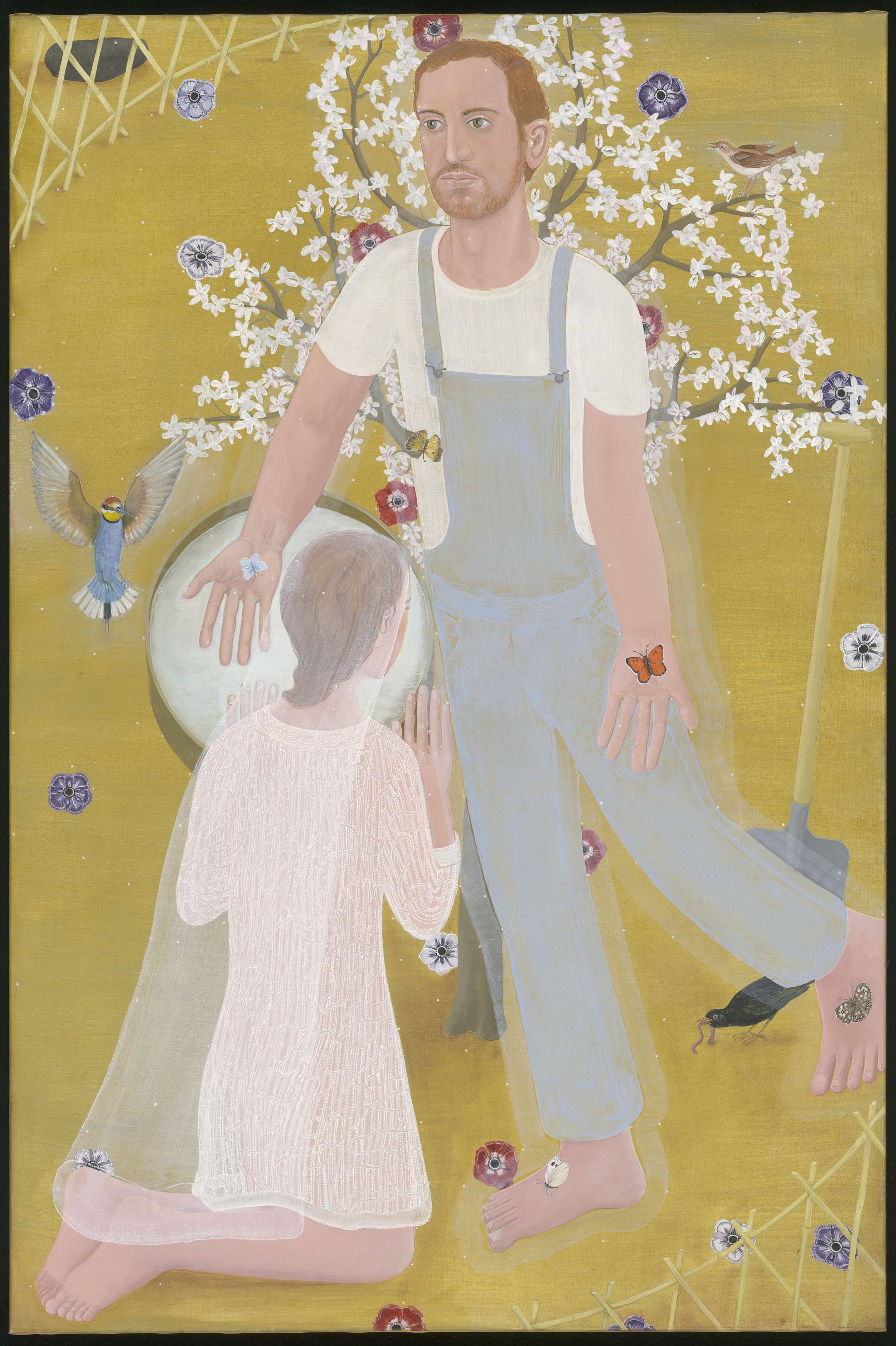
“‘She mistook him for the gardener’”: Humanity was born in a garden and reborn in a garden, as biblical scholars like N. T. Wright are keen to point out, with Easter morning marking the launch of new creation. In art history the resurrected Christ is sometimes amusingly shown carrying gardening tools when he encounters Mary Magdalene outside his tomb—to explain the case of mistaken identity that John records, perhaps, but more likely to establish a metaphor. Two of the paintings I’ve added to this post are by Janpeter Muilwijk, whose New Gardener from 2017 shows the freshly risen Christ in a white T-shirt and overalls, heading with open arms toward Mary, who is dressed like a bride to receive him. (Mary is modeled after the artist’s daughter Mattia, who died.) Butterflies alight on each of Jesus’s five wounds, marking them as sites of transformation, and the flowering branches of a tree crown him with spring glory.
Janpeter Muilwijk (Dutch, 1960–), New Gardener, 2017. Oil on canvas, 150 × 100 cm. Private collection, Netherlands.
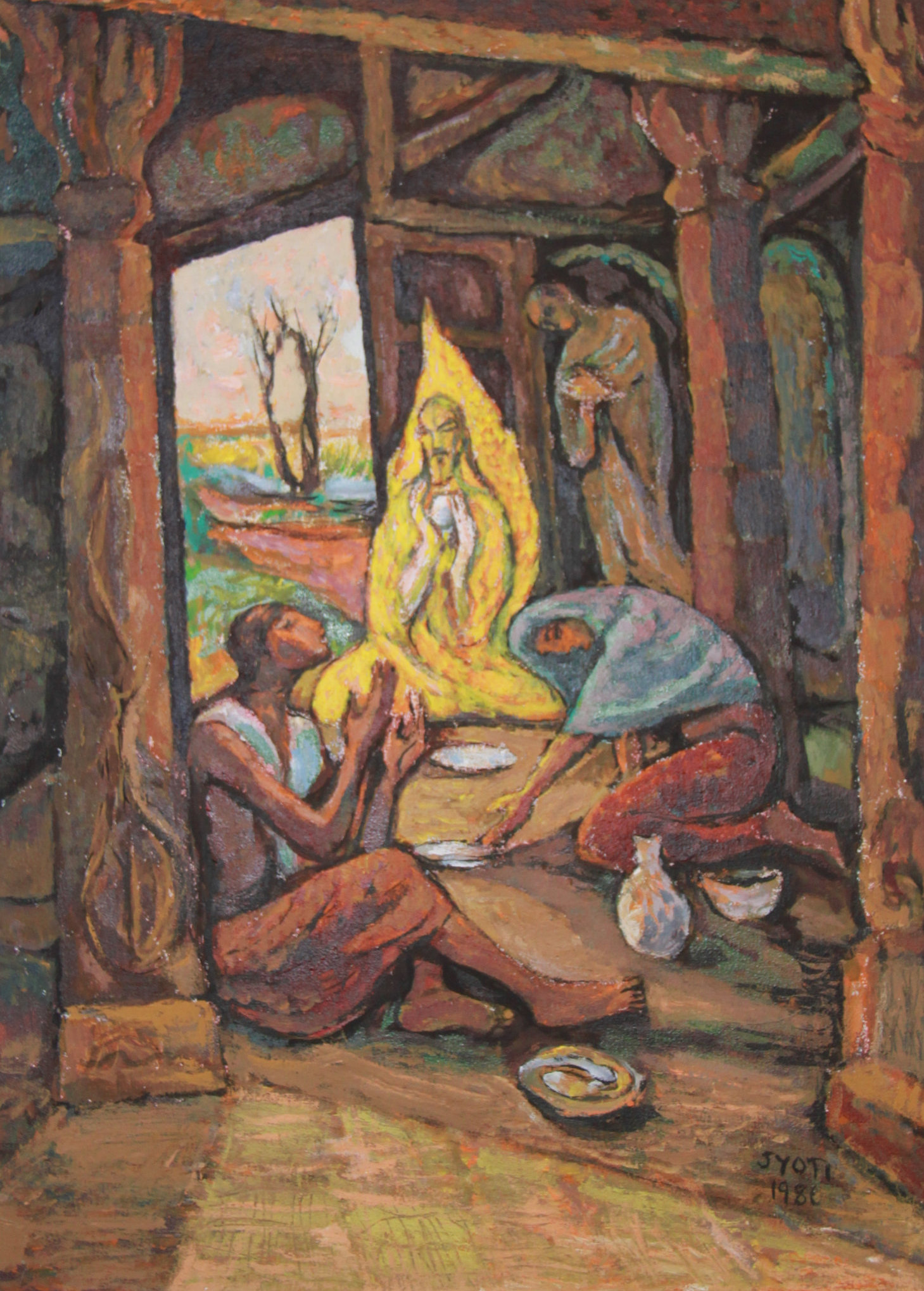
“The Unnamed Emmaus Disciple: Mary, wife of Cleopas?”: Written in 2017, this is one of Art & Theology’s most visited posts. In it I conjecture that the pilgrim who traveled with Cleopas from Jerusalem to Emmaus in the famous Easter story could have been a woman, perhaps Cleopas’s wife. Several artists have conjectured the same, and besides adding to this compilation three Emmaus paintings that the artist Maximino Cerezo Barredo sent me after the initial publication, I’ve also added one by Jyoti Sahi, which shows Jesus sitting with the two disciples—one male, one female—on the floor of a small roadside dwelling, breaking chapati (Indian flatbread) together. He is ablaze with glory, evoking his earlier revelations as I AM in the burning bush before Moses and to Peter, James, and John on Mount Tabor at the Transfiguration.
Jyoti Sahi (Indian, 1944–), The Supper at Emmaus, 1980. Mixed media on canvas. Photo courtesy of the artist.
+++
NEW SONGS
“A Bedtime Song for Anxious Children” by W. David O. Taylor and Paul Zach:David Taylor has written a new children’s song (set to music by Paul Zach), which he sings here with his daughter, Blythe. The lyrics are in the video description on YouTube.
“I’ve heard from so many parents recently that their children are struggling with anxiety, fear, frustration, sadness, anger, and restlessness,” Taylor writes, “and so I thought a little song reassuring them of God’s care at night, when they’re most vulnerable, might help their hearts. Our hope is that the melody might be simple enough for parents and children to be able to sing it when they go to bed.”
“See the Day” by Liz Vice: One of my favorite singers, Liz Vice, released a new single on April 10, called “See the Day.” Cowritten by her, Leslie Jordan, and Jonathan Day, it expresses hope for the coming day of the Lord, when justice will roll down like a mighty river, walls of division will crumble into dust, oppression will cease, and the whole world will be startled awake by love. “Precious Lord, come lead us on” to that reality.
+++
NEW ALBUM: Easter 1 by Mac Meador: Mac Meador, a singer-songwriter from Austin, Texas, released a new EP of six songs for Eastertide this April, a sort of flip side to the Lent 1 EP he released in February. I really enjoyed them both (and the same goes for his Summer of Psalms from 2018). The Easter album strikes just the right note for me right now—of a quiet hope and joy that’s not absent of pain. The songs celebrate Christ the risen king while also expressing longing for the age to come, when the kingdom will be established in full. Lean into that promise!
You can stream and purchase Meador’s music on Bandcamp. (Note: To help musicians affected by COVID-19, Bandcamp is waiving its cut of all sales made on its site on May 1.) You might also want to check out his YouTube channel, where he posts additional songs. For the past four weeks he has been releasing “Quarantine Hymn Sing” lyric videos for his church, Grace + Peace Austin, where he serves as minister of music. (He also sets Bible memory verses to music for kids!)
+++
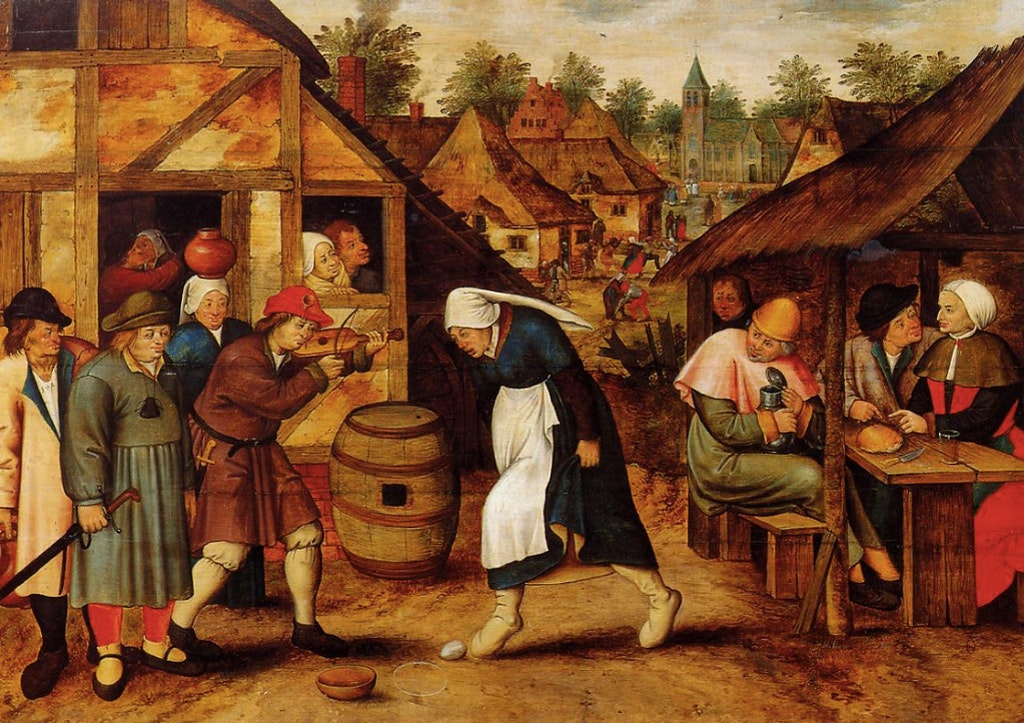
EGG DANCING: “The Egg Dance: From Peasant Village to Political Caricature”: The Public Domain Review has compiled an amusing gallery of historical paintings, drawings, and prints that show the egg dance, a traditional Easter game with several variations, most associated with western European peasantry of the sixteenth and seventeenth centuries.
Pieter Brueghel the Younger (Flemish, 1564/65–1637/38), The Egg Dance, ca. 1620. Oil on panel, 26 1/4 × 41 1/4 in. (66.7 × 104.8 cm).
+++
ART VIDEO:“500 Years of the Herrenberg Altarpiece”: I love seeing all the fun, creative resources being produced by art museums to help educate and engage the public in viewing art. Though I speak not a lick of German, this video from the Staatsgalerie Stuttgart about Jörg (Jerg) Ratgeb’s Herrenberg Altarpiece made me laugh and had me hooked for its full five minutes. (I came across it when I was prepping a Holy Week blog post that features a different painting attributed to the same artist.) Released last October for the five hundredth anniversary of the altarpiece, the video, directed by Valentin Hennig and Oleg Kauz, animates some of the birds from the painted panels and has them narrate as the camera zooms in on details (one of them quite jarring and unseemly!). They then fly through the museum hall and over the town some twenty miles southwest to the church where the piece originally stood.
To add autogenerated subtitles, click the “CC” (closed captioning) button on the bottom of the video player, then select your language using the gear icon.
Painted in 1519, this double-winged altarpiece was commissioned by the Brethren of the Common Life, a Catholic pietist community, for the high altar of the collegiate church of Herrenberg in Swabia. Closed, it shows the apostles about to set out on their mission to spread the word of God. The first open view (interior panels closed, exterior wings folded out) reveals scenes from the passion of Christ, each panel with a primary scene in the foreground and a secondary scene in the background: the Last Supper with the Agony in the Garden, the Flagellation and Crowning with Thorns with the Ecce Homo (presentation to the crowd), the Crucifixion with the Carrying of the Cross and the Entombment, and the Resurrection with the Noli me tangere (appearance to Mary Magdalene). Completely opened (its feast-day configuration), the altarpiece shows scenes from the infancy of Christ, with reference also to the life of the Virgin Mary. It used to have a central Marian statue and predella figures, but these were likely destroyed when the Protestant Reformation came to Württemberg in 1534.
The artist had already died by this time—he was executed (drawn and quartered) for treason in 1526 for his role as one of the leaders of the German Peasants’ Rebellion.
Attributed to Jörg Ratgeb (German, ca. 1480–1526), The Last Supper (detail), 1505–10. Oil on panel, 38 7/10 × 36 in. (98.5 × 91.5 cm). Boijmans van Beuningen Museum, Rotterdam, Netherlands.
Even my close friend in whom I trusted,
who ate my bread, has lifted his heel against me.
But you, O LORD, be gracious to me,
and raise me up . . .
—Psalm 41:9–10
“. . . the Scripture will be fulfilled, ‘He who ate my bread has lifted his heel against me.’ I am telling you this now, before it takes place, that when it does take place you may believe that I am he. . . .”
After saying these things, Jesus was troubled in his spirit, and testified, “Truly, truly, I say to you, one of you will betray me.” The disciples looked at one another, uncertain of whom he spoke.
One of his disciples, whom Jesus loved, was reclining at table at Jesus’ side, so Simon Peter motioned to him to ask Jesus of whom he was speaking. So that disciple, leaning back against Jesus, said to him, “Lord, who is it?”
Jesus answered, “It is he to whom I will give this morsel of bread when I have dipped it.” So when he had dipped the morsel, he gave it to Judas, the son of Simon Iscariot.
Then after he had taken the morsel, Satan entered into him. Jesus said to him, “What you are going to do, do quickly.” Now no one at the table knew why he said this to him. Some thought that, because Judas had the moneybag, Jesus was telling him, “Buy what we need for the feast,” or that he should give something to the poor.
So, after receiving the morsel of bread, he immediately went out. And it was night.
—John 13:18b–19, 21–30
+++
SONG: “Judas Song (Psalm 41:9–10)” by Matt Grimsley (words adapted from the Trinity Psalter) | Performed by the Green Carpet Players, on Morning to Evening(2014)
ORCHESTRAL REPRISE: “Judas Song, Pt. 2: The Betrayer” by Amy Porter, based on a melody by Matt Grimsley | Performed by the Green Carpet Players, on Morning to Evening(2014)
The Green Carpet Players is the recording alias of the musicians of Redeemer Church of Knoxville. Since they released this second album in 2014, chief musician Matt Grimsley, who wrote “Judas Song,” has become the founding pastor of Resurrection Presbyterian Church in Madison, Wisconsin, and Amy Porter is now worship director at Church of the Redeemer in Maryville, Tennessee.
+++
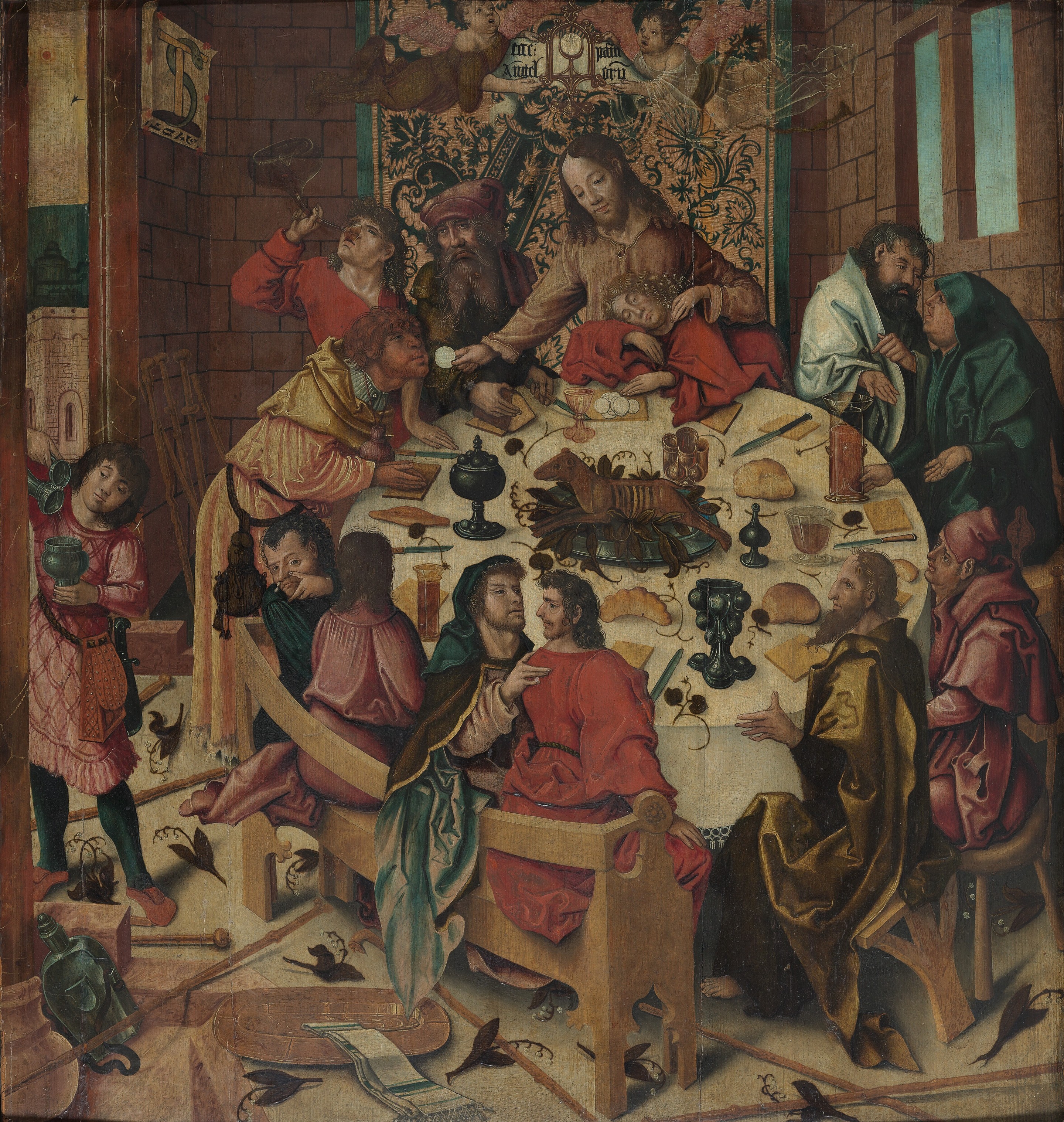
Attributed to Jörg Ratgeb (German, ca. 1480–1526), The Last Supper, 1505–10. Oil on panel, 38 7/10 × 36 in. (98.5 × 91.5 cm). Boijmans van Beuningen Museum, Rotterdam, Netherlands.
In Jörg Ratgeb’s Last Supper, the disciples have laid aside their pilgrim’s staffs and have sat down to a Passover meal of roast lamb, bread, and wine. Jesus, having just announced that one of them would betray him, looks across the table at Judas, the group’s treasurer—who wears not one but two purses! Jesus tenderly and regretfully feeds Judas an unleavened wafer, indicating that he’s the one. The others seem not to notice—groups of two discuss among themselves who the traitor might be; one disciple guzzles down more wine from a tubed bottle, while another pours more from a jug; John’s asleep to Christ’s left, and to his right Peter stares blankly into space, knife in hand (foreshadowing his cutting off the ear of one of Jesus’s arresters later that night); and one crass disciple turns his head to shoot snot out his nose.
Jesus has just washed all their feet, as indicated by the water basin and towel in the foreground—a stunning act of humility. (We will visit that episode in tomorrow’s Gospel reading.) His supremest act of humility is but a day away. It’s alluded to by the poster at the left of a snake lifted up on a staff (see John 3:14–15), as well as by the monstrance (a receptacle for the consecrated Eucharistic host) that two angels raise above Jesus’s head, proclaiming his impending sacrifice.
The sweet, generative nature of this sacrifice is underscored by the lily-of-the-valley that’s strewn all over the floor and table, as the flower is connected with the advent of spring and the promise of new life.
This post belongs to the weekly series Artful Devotion. If you can’t view the music player in your email or RSS reader, try opening the post in your browser.
To view all the Revised Common Lectionary scripture readings for Wednesday of Holy Week, cycle A, click here.
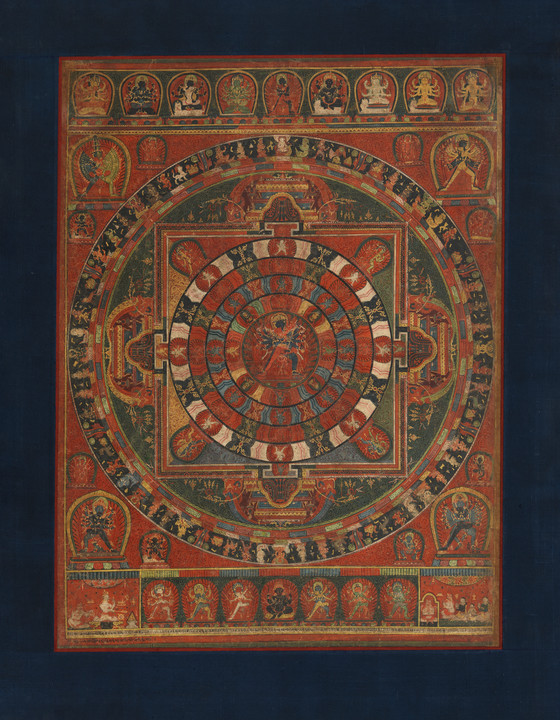
EXHIBITION REVIEW: “Overstating the religious?” by Christopher Knight, Los Angeles Times: Michael Wright brought to my attention an old review of the 2003 LACMA exhibition “The Circle of Bliss: Buddhist Meditational Art,” in which art critic Christopher Knight harshly faults the curators for using religion as the organizing principle . . . of an exhibition of religious art. He says it’s “bizarre” and “inappropriate” that
traditional artistic concerns of art museum exhibitions – style, historical context, connoisseurship, artist biography, etc. – play no part in [the objects’] presentation. Instead, LACMA’s galleries unfold as the articulation and embodiment of a religious philosophy. . . . You will leave this exhibition having not a clue who these artists were . . . and how (or if) their imagery evolved. Instead, the reason for the art’s inclusion is to instruct us in various aspects of the embodiment of perfect compassion – that is, to provide experience with critical theological nuances of “the Middle Way.”
Mandala of the Buddhist deity Chakrasamvara, Nepal, 1490. Mineral pigments on cotton cloth, 46 × 34 5/8 in. Los Angeles County Museum of Art, California.
The review itself struck me as bizarre—that Knight decries the exhibition’s focus on the religious meaning of these Tantric paintings, which he considers secondary to their aesthetic qualities and altogether outside the purview of an art institution to comment on. I was glad to see that several readers responded in letters, such as Andy Serrano, who wrote that “up until recent centuries, people did not make art for art’s sake. People who made religious art made it in order to enhance the religious experience in one way or another. Separating religious art without the context of religion is like trying to swim without getting wet.” Phil Cooke chimed in, “The fact that Knight sees no legitimate connection between art and the religious faith that inspired it is at once outrageous and yet sadly typical of current critical assumptions.” [HT: Still Life]
A decade and a half after this exhibition closed, I’ve observed that curators, critics, and art historians oftentimes still struggle to discern or articulate (or else they simply neglect) the theological content and/or devotional purposes of religious art, as they preoccupy themselves instead with the “traditional artistic concerns” Knight mentions. But I do feel that the situation is improving overall, with wider-spread recognition that evaluating certain works of art through the primary lens of religion—if that’s the context in and for which they were created—is not only permissible but essential.
+++
TED TALK: “The Danger of a Single Story” by Chimamanda Ngozi Adichie: The single story, says Nigerian novelist Chimamanda Ngozi Adichie, is when one story (about a person, place, or ethnicity) becomes the only story, creating stereotypes, or a flattened perspective. Adichie admits to having had a single story of her household servant growing up (“poverty”), and later on, of Mexicans (“the abject immigrant”). Many Americans have a single story of Africa. But the problem is, we are all formed by many stories, no single one more definitive than another—and we need to talk about them all. [HT: Sarah Quezada]
+++
ESSAY: “And God Said to Pastors: Use More Sermon Puns and Plan More Parties” by W. David O. Taylor, Christianity Today: Taylor gives three reasons to practice levity and humor in public worship, quoting Augustine, Chesterton, Lewis, Barth, Capon, Buechner, Ratzinger, and Eugene Peterson along the way. I especially like his first point about grace and hyper-abundance.
+++
ESSAY: “In Defense of Owning Too Many Books” by Daniel Melvill Jones, The Curator: I relate to this author’s tottering stacks of books throughout his house—having exhausted my shelf space, I also have them in closets, hutches, and chests. I’m a bibliophile, what can I say. Probably about a third of the books in my personal library I haven’t read yet, which, I affirm with Daniel M. Jones, is both humbling and tantalizing, a “promise of ideas to explore.”
Potential is not in the books you’ve read but in those that remain unread. Therefore, you ought to expand the rows of what you do not know as much as your resources allow, and expect them to keep growing as you get older and accumulate more knowledge.
The books you surround yourself with “will feed [your] life and output in unseen ways.” So stock up!
+++
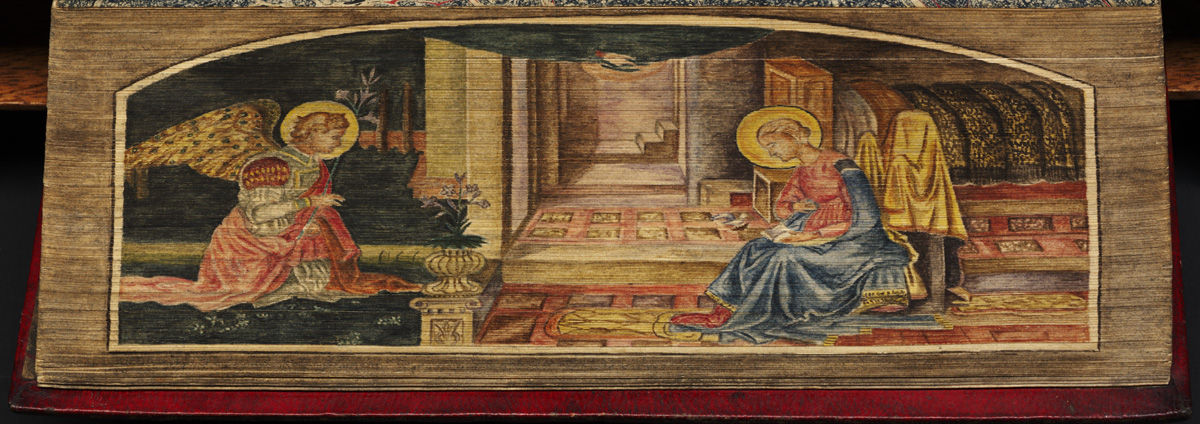
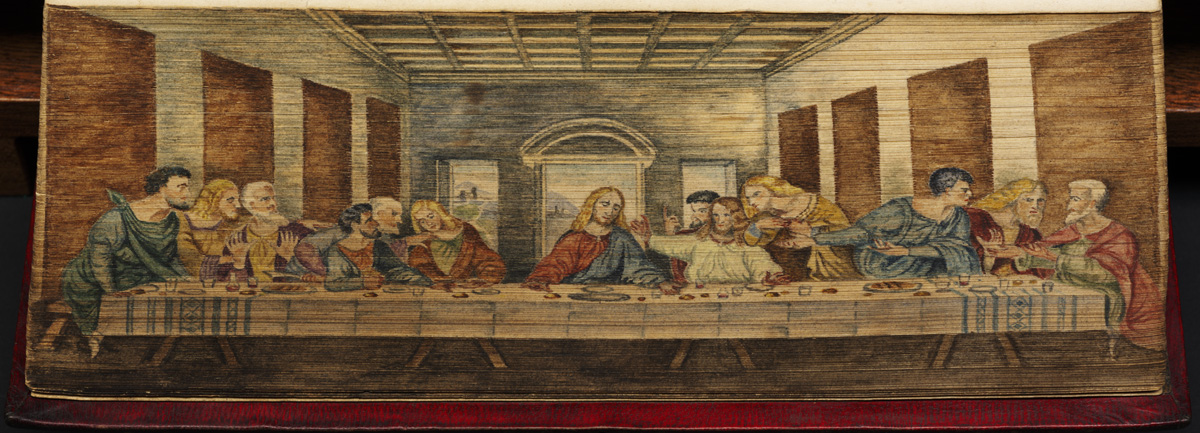
FORE-EDGE PAINTINGS: The Boston Public Library has one of the world’s finest collections of fore-edge paintings, an art form originating around the tenth century but popularized in the eighteenth, utilizing as a surface the edge of a book opposite its spine. Over time, the content of these paintings evolved from decorative or heraldic designs to landscapes and narrative scenes, like these two from volumes 1 and 2 of a Bible printed in Edinburgh in 1803. [HT: Public Domain Review]
The Annunciation after Fra Lippo Lippi, painted on the fore-edge of a Bible (vol. 1 of 2) printed in Edinburgh in 1803. Collection of Boston Public Library.
The Last Supper after Leonardo da Vinci, painted on the fore-edge of a Bible (vol. 2 of 2) printed in Edinburgh in 1803. Collection of Boston Public Library.
Great Big Story recently featured contemporary fore-edge painter Martin Frost, who specializes in the vanishing variety. Cool!
+++
MUSIC DOCUMENTARY: “Elizabeth I’s Battle for God’s Music,” presented by Lucy Worsley: Aired in October 2017 on BBC Four, this hourlong program presents a history of choral evensong, the Protestant church service of music and prayer born out of the English Reformation and still performed today. Worsley moves through the Tudor monarchs, discussing their relationship to sacred music—from Henry VIII, who broke away from the Catholic Church but didn’t want to abandon the Latin mass, and who thus hired Thomas Tallis to compose in a more austere style in which the words of the liturgy could be more easily understood; to his son Edward VI, who, in his dislike of elaborate music, ordered the disbanding of choirs and the destruction of organs, but also supported the creation of the first complete English prayer-book (Thomas Cranmer’s Book of Common Prayer) and John Marbeck’s musical guide to it; to Mary I, who returned England to Catholicism, with its high-church music, all in Latin; and finally Elizabeth I, a moderate Protestant whose compromising spirit led to the reinstatement of English evensong but with much leeway given as to how it is set, whether in monophony, homophony, or polyphony. Elizabeth’s patronage and legal protections of church music made possible the glorious compositions of, among others, William Byrd, and ensured the survival of choral evensong. [HT: Global Christian Worship]
Choral evensong is a continuing tradition, and Worsley concludes by highlighting its new possibilities, such as the Oxford Blues Service by Roderick Williams. Listen to an excerpt on the SoundCloud player below.
TGC ARTICLE:“18 Paintings Christians Should See”: The Gospel Coalition Arts & Culture editor Brett McCracken has rounded up fourteen arts professionals to each choose an artistically and theologically significant painting and write about it in 200 words or less—and I’m one of them! I chose Caravaggio’s The Incredulity of Saint Thomas, which shows that famous encounter between the “doubting” disciple and the risen Christ. Here Thomas literally puts his finger on the flesh-and-blood reality of the resurrection, and you can see the marvel in his face.
Caravaggio (Italian, 1571–1610), The Incredulity of Saint Thomas, 1601–2. Oil on canvas, 107 × 146 cm (42 × 57 in.). Sanssouci Picture Gallery, Potsdam, Germany.
Other selections in the article range from medieval manuscript illuminations and Dutch Golden Age portraits to pop art and abstract minimalism. You might recognize the names of some of the contributors whom I’ve featured before on Art & Theology, like Jonathan A. Anderson, Matthew J. Milliner, W. David O. Taylor, and Terry Glaspey—they have all been influential to me. I’m very encouraged to see this major evangelical website engaging with visual art.
+++
POEMS: “Featured Poet: Laurie Klein”: In this post from Abbey of the Arts, poet Laurie Klein introduces herself, discussing the sacred themes in her work and her approach to writing poetry, as well as sharing three of her poems: “How to Live Like a Backyard Psalmist,” “I Dream You Ask, But Where Do I Start,” and “Poem for Epiphany.” All three are wonderfully evocative, and I’m definitely going to check out her collection, Where the Sky Opens. The first poem references St. Kevin of Glendalough, a sixth-century Celtic monk whose hand outstretched in prayer once became a nesting place for a blackbird. The poem is about how to live a life of joy, wonder, and praise, and it begins,
Wear shoes with soles like meringue
and pale blue stitching so that
every day you feel ten years old.
Befriend what crawls.
Drink rain, hatless, laughing.
Sit on your heels before anything plush
or vaguely kinetic:
hazel-green kneelers of moss
waving their little parcels
of spores, on hair-trigger stems.
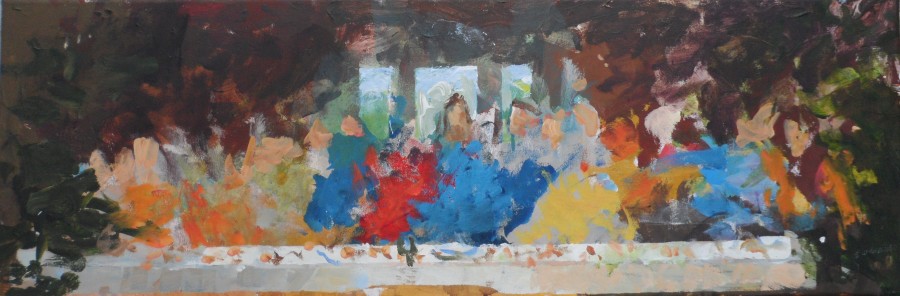
ARTISTS GROUP AT BIRCHWOOD: The Birchwood Painters, founded in 2009, is a group of painters with disabilities who live at Birchwood care home in Chesham, Buckinghamshire, in England, exhibiting locally and in an annual art show at Birchwood. One of the members is Mark Urwin, who has cerebral palsy and uses a wheelchair. Mark loves studying art history, especially the impressionists. Landscapes are his favorite genre to paint, but he also interprets religious works by the Old Masters—like Simone Martini and Lippo Memmi’s Annunciation, or Leonardo da Vinci’s Last Supper—in his own semiabstract style, using bright swaths of color. In 2016 Mark gave a lecture on his work at the Royal Academy of Arts in London.
Mark Urwin (British), Annunciation (after Martini and Memmi), 2013. Acrylic on canvas, 30 × 25 cm.
Mark Urwin (British), Last Supper (after Leonardo), 2013. Acrylic on canvas, 25 × 75 cm.
Mark uses an easel that was specially designed for him by DEMAND (Design and Manufacture for Disability) to enable greater freedom and control in his creations. Whereas before, an art class volunteer had to hold Mark’s canvas, making certain angles to paint more awkward, the DEMAND easel improves canvas access, as the canvas can be positioned in any orientation to Mark, with the bulk of his electric wheelchair no longer posing a problem. Furthermore, he can keep his talk board on his lap so that he doesn’t lose his voice while painting.
+++
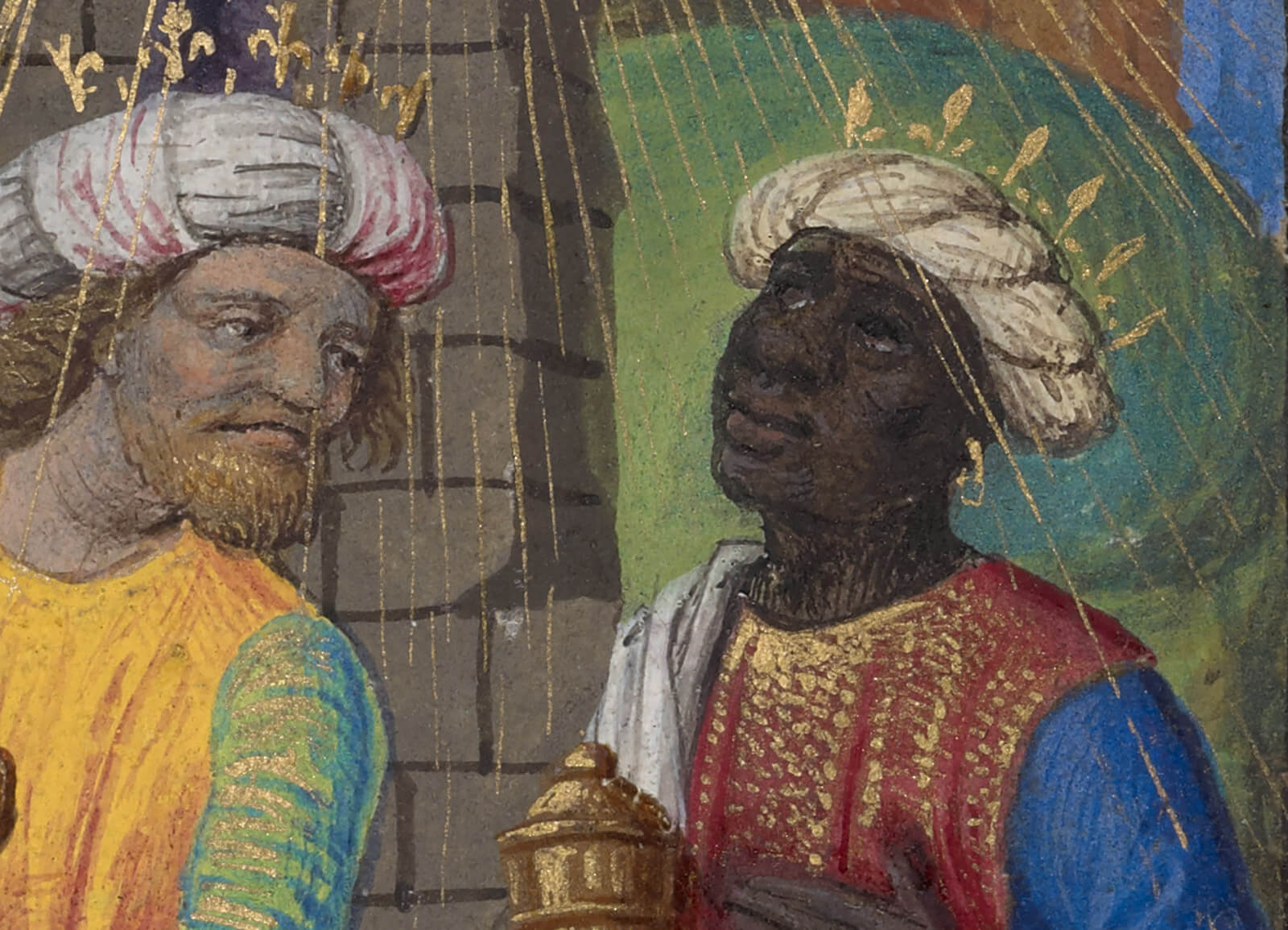
EXHIBITION-IN-PROGRESS: “Exhibition to Examine Balthazar, a Black African King in Medieval and Renaissance European Art”: “Early medieval written legends report that one of the three kings who paid homage to the Christ Child in Bethlehem was from Africa. But it would take nearly 1,000 years for European artists to begin representing Balthazar, the youngest of the three kings, as a black man. Why? . . .
“Delving into the Getty’s collections, we are at work on the exhibition Balthazar: A Black African King in Medieval and Renaissance Art (November 19, 2019–February 17, 2020). We are examining how Balthazar’s depiction coincided with and was furthered by the rise of the slave trade—and we invite your input to inform the exhibition. What questions or ideas do you have about this topic? What stories or themes would you like to see explored? We are eager to incorporate your views into our process.”
Detail of The Adoration of the Magi from a French Book of Hours (Ms. 48, fol. 59) showing the magus Balthazar (right), ca. 1480–90, by Georges Trubert. J. Paul Getty Museum, Los Angeles.
In this post from the Getty’s blog, The Iris, in addition to finding out how to relay feedback, learn about who the Magi were, what tradition says about them, and the development of Balthazar’s image over time.
I appreciate the Getty’s efforts to be more inclusive in the visual histories they highlight and to solicit input from the general public to assist them in this task. They did the same for their 2018 exhibition Outcasts: Prejudice and Persecution in the Medieval World.
+++
TED TALK / LIVE PAINTING: “Can Art Amend History?” by Titus Kaphar: American artist Titus Kaphar reconfigures historical artworks—through cutting, bending, overpainting, stitching, tarring, and tearing—to include African American subjects. In this thirteen-minute presentation before a live audience, Kaphar opens by sharing the words his young son spoke upon seeing the famous equestrian statue outside the Natural History Museum in Manhattan, which has Teddy Roosevelt up high on a horse, flanked by a Native American and an African lower down, on foot—which can easily be read as establishing a racial hierarchy.
Kaphar goes on to discuss some of his own encounters with Western art history and his mission to bring black figures out of the shadows of that tradition. He demonstrates this with a reproduction of Family Group in a Landscapeby the Dutch master Frans Hals, which shows a wealthy white family of four with their young black servant.* More has been written, Kaphar laments, about the lace the wife is wearing and the dog at the right of the picture than about the black youth who stares straight out at us. This claim did surprise me somewhat—and then I visited the museum website, only to find that their six-paragraph description of the painting doesn’t mention the boy at all! By strategically applying white paint across this canvas, Kaphar forces us to “shift our gaze” and to notice the one who has typically gone unnoticed.
James Earle Fraser (American, 1876–1953), Equestrian Statue of Theodore Roosevelt, 1939. Bronze, 300 × 218 × 450 cm (10 × 7 1/6 × 14 3/4 ft.). Museum of Natural History, New York.
Titus Kaphar (American, 1976–), Shifting the Gaze, 2017. Oil on canvas, 210.8 × 262.3 cm (83 × 103 1/4 in.). Brooklyn Museum, Brooklyn, New York.
+++
IN THEATERS: Currently showing in theaters are two historical drama films featuring main characters whose work (in art and in activism) was famously inspired by their Christian faith: Tolkien, about the author of Lord of the Rings, and The Best of Enemies, about civil rights leader Ann Atwater from Durham, North Carolina. Both movies have received lukewarm to not-so-great critical reviews but fairly high audience ratings, and I intend to see them. I found out about the latter one through Jonathan Wilson-Hartgrove, one of the mentees of “Grandma Ann,” who prepared a group study guide to accompany the film.
Also in theaters, with rave reviews all around, is Amazing Grace, a documentary about the creation of Aretha Franklin’s best-selling gospel album of the same title, recorded over two nights in 1972 at New Temple Missionary Baptist Church in Los Angeles. The footage was recently unearthed and reassembled after almost fifty years. The resultant film has been called “wonderfully intimate,” “a raw, sensory, reverent experience,” “a transcendent joy,” “the new gold standard of filmed music concerts,” and “one of the finest music documentaries ever.”
It’s been interesting to hear secular reviewers expressing how moved they were by the film, a film that is prayer (e.g., “Precious Lord, Take My Hand”), proclamation and praise (“God Will Take Care of You”), testimony (“Amazing Grace,” “How I Got Over”), and invitation (“Give Yourself to Jesus”).
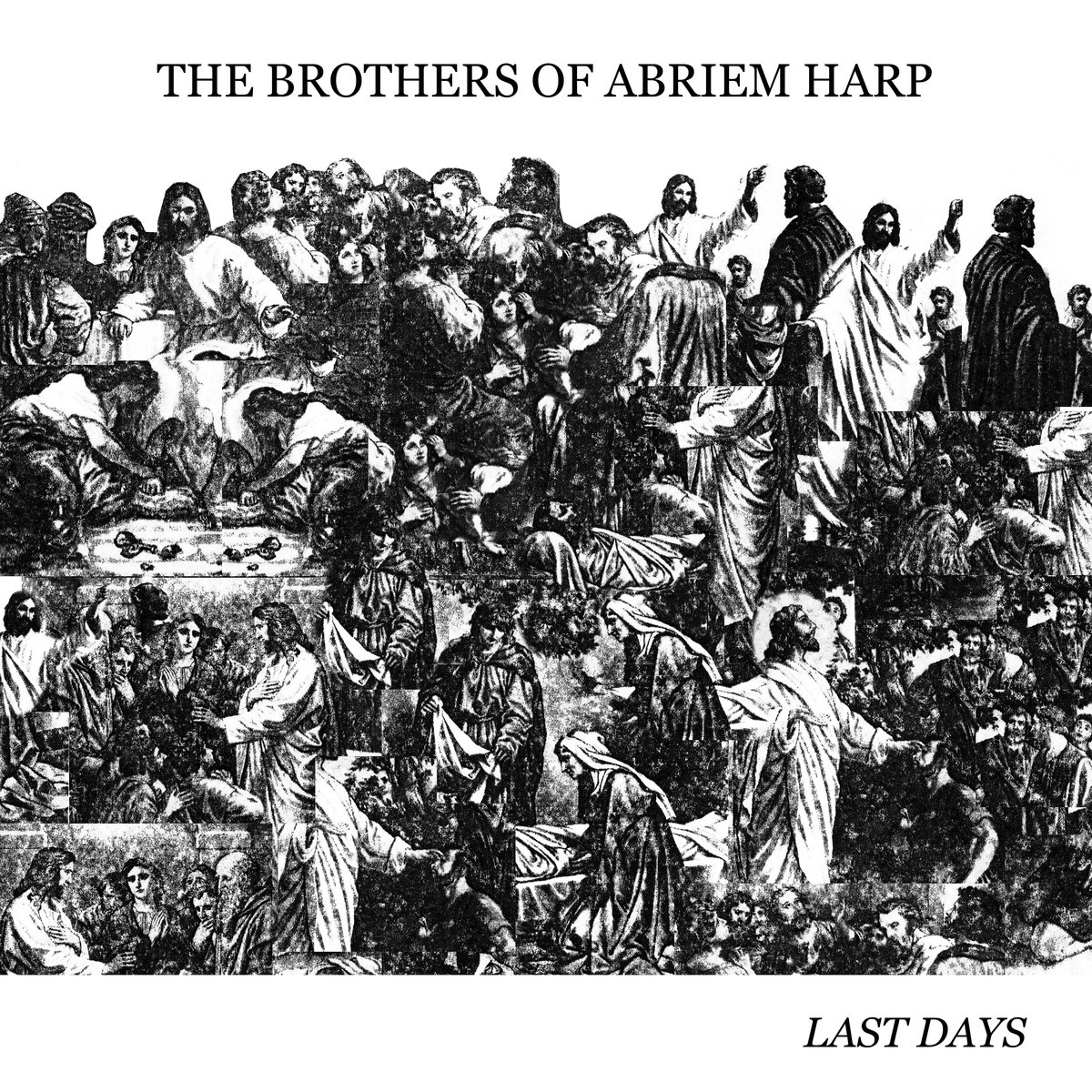
Released in 2015, the album Last Days by the Brothers of Abriem Harp features twelve original indie-folk songs for Holy Week that tell the story of Christ’s passion, from the thundering voice of the Father affirming the Son but also presaging judgment, to the glorification of Christ in the resurrection. One of its major draws is its quiet, understated conveyance of the week’s drama through several different voices: Jesus, of course, but also Mary, Peter, Judas, and other unnamed disciples who reflect on the events they witness, especially in light of their histories with Christ.
Approaching Jesus’s last days primarily through the lens of story—plot, character, mood, etc.—rather than the lens of doctrine makes the listening experience more immersive. That’s not to say theology is absent from the album; it’s very much there. But it is not heavy-handed or abstruse, and neither is it reduced to clichés.
The songs are written and sung by Joe Kurtz (pseudonym: Abriem Harp) and Josh Compton (Josh Harp), with Matt Kurtz (Matthew Harp) on percussion and John Finley (Hezekiah Harp) playing many of the other instruments. On the band’s Facebook page they describe themselves as “gospel-shoutin’ melody makers from the Rust Belt,” and among their musical influences are field recordings, the Sacred Harp tradition, and mountain music.
In the video below, the Brothers have set the entire album to altered footage from Vie et Passion du Christ (Life and Passion of the Christ), a forty-four-minute silent film released in France in 1903. The album is also available for streaming and purchase at https://harpfamilyrecordings.bandcamp.com/album/last-days.
Here’s a rundown of the songs.
1. “Glorify”
A voice arose, a voice arose
A voice arose, a voice
It sounded like thunder, pounded like thunder (×4)
It said, “I’ve glorified it, and again I’ll glorify it”
Yeah, “I’ve glorified it, and again I’ll glorify it” (×3)
This is an unconventional starting point for the passion narrative, which typically begins with Christ’s entry into Jerusalem. Instead, the Brothers have chosen a lesser-known episode from John’s Gospel, which occurs just after the triumphal entry—and what a beautiful passage to highlight. (I actually was not familiar with the references in the song and had to look them up—a great example of how the arts can stimulate renewed engagement with the Bible!)
“The hour has come for the Son of Man to be glorified. Truly, truly, I say to you, unless a grain of wheat falls into the earth and dies, it remains alone; but if it dies, it bears much fruit. . . .
“Now is my soul troubled. And what shall I say? ‘Father, save me from this hour’? But for this purpose I have come to this hour. Father, glorify your name.”
Then a voice came from heaven: “I have glorified it, and I will glorify it again.” The crowd that stood there and heard it said that it had thundered. Others said, “An angel has spoken to him.”
Jesus answered, “This voice has come for your sake, not mine. Now is the judgment of this world; now will the ruler of this world be cast out. And I, when I am lifted up from the earth, will draw all people to myself.” He said this to show by what kind of death he was going to die.
“It’s time.” That’s essentially what Jesus is saying. And then in the middle of this discourse with the disciples, Jesus gets real with the Father. “I’m scared! But what can I do? This is my destiny; I can’t avoid it.” And then, his words of acceptance, of surrender: “Father, glorify your name.” It’s unclear whether this prayer was audible to the disciples or was expressed merely internally. Whatever the case, the Father’s response was heard by all—though some attributed it to natural phenomena, or to an angel.
As this passage clarifies, the “it” in the song is the Father’s name: God says that he has glorified it in the past, and he will glorify it again, when Christ is lifted up for the salvation of the world.
John uses the words glory and glorified a lot in his Gospel, especially in relation to Christ’s passion. In John 13:31, after the Last Supper, where Jesus has just identified Judas as his future betrayer, Jesus says, “Now is the Son of man glorified, and God is glorified in him.” Later that night, in Gethsemane, Jesus prays, “Father, the hour has come; glorify your Son that the Son may glorify you. . . . I glorified you on earth, having accomplished the work that you gave me to do. And now, Father, glorify me in your own presence with the glory that I had with you before the world existed” (John 17:1, 4–5).
The opening song on Last Days, therefore, though just three allusive lines, repeated, is packed with meaning, much of it concentrated in that dense word glorify, a word that orients the whole album. Much like the opening sequence of a movie sets the movie’s tone and hints at what you’re in for, so do opening songs on albums, and this one is somewhat portentous, leaving us wondering, “How will God’s name be glorified?”; it also gives the Father a speaking role and thus situates him as a main character in the story. Continue reading “Album Review: Last Days by the Brothers of Abriem Harp”→
In 2010 Eugene Soh was enrolled in Nanyang Technological University’s School of Art, Design, and Media, on track to becoming a game programmer, when Campusmagazine, aware of his photography hobby, asked him if he’d like to contribute a centerfold to an upcoming issue. He said yes but, after combing through his photos, realized he had nothing great to offer—he’d have to shoot something new, something epic. He chose to restage Leonardo da Vinci’s Last Supper at Maxwell Road Hawker Centre (a “hawker center,” or kopitiam, is what Singaporeans call their open-air food courts), using vendors as models for Christ and his disciples.
Eugene Soh (Singaporean, 1987–), The Last Kopitiam, 2010. Photograph, 140 × 230 cm.
The photo was published but went without much notice until two years later in 2012, when it went viral online. Galleries started contacting him to do shows, not realizing that The Last Kopitiam was a one-off thing. Soh decided to finish out his concentration in interactive media, graduating in 2013, and then to pursue fine art photography as a career.
Encouraged by the interest in his Leonardo adaptation, Soh translated more Western art masterpieces into a contemporary Singaporean idiom, among them the Mona Lisa (renamed Moh Lee Sha), The School of Athens (Food for Thought), The Birth of Venus (Arrival of Venus), Saturn Devouring His Son (Saturn Devouring His Naan), A Sunday on La Grande Jatte (Sunday Afternoon on the Island of Singapore), Arrangement in Grey and Black No. 1 (Arrangement in Grey, Black and Yellow), and American Gothic (Singapore Gothic).
His Creation of Ah Dam, after Michelangelo’s famous Sistine Chapel ceiling fresco, shows a wet-market grocer transferring the spark of life to “Ah Dam” via carrot.
Eugene Soh (Singaporean, 1987–), Creation of Ah Dam, 2015. Photograph, 80 × 120 cm.
It is Soh’s process, as demonstrated in these photos, to shoot his human subjects separately and then stitch them together digitally to create a single composite image. The hawkers in The Last Kopitiam, for example, couldn’t all get away from their stalls at the same time, so this sort of cut-and-paste manipulation was born out of necessity. At first Soh was resistant to using Photoshop in this way, thinking of it as “cheating,” but he quickly became convinced of its legitimacy and artistic potential.
Earlier this year Soh developed a new series called The Second Coming, which reenvisions the life of Christ on Singaporean soil (much like David LaChapelle did, for America, in his 2003 series Jesus Is My Homeboy). Mounted as a solo show in February and March at Chan Hampe Galleries, The Second Coming draws on familiar devotional image types, like the Madonna and Child, the Crucifixion, and the Pietà, as well as invents some new ones, like Jesus answering his cell (Hold Up, Dad’s Calling) or helping one of his hosts prepare dinner (What’s Cooking, Jesus?).
In Happy Birthday & Merry Christmas, Jesus, Jesus blows out the candles on his cake. The mise-en-scène includes a foam crown, maracas, and an umbrella drink.
In contrast, the mood of The Last Christmas is gloom and doom. According to the artist, Jesus has just announced that he is going to destroy the world, putting a damper on the birthday festivities (though one attendee chooses to make light of the news). Staged like a Last Supper, this imagined scene takes place immediately preceding Armageddon. It’s everyone’s last Christmas. Continue reading “Jesus comes to Singapore: The New Testament imagery of Eugene Soh”→













#/media/File:Caravaggio_-_The_Incredulity_of_Saint_Thomas.jpg)






 Art & Theology