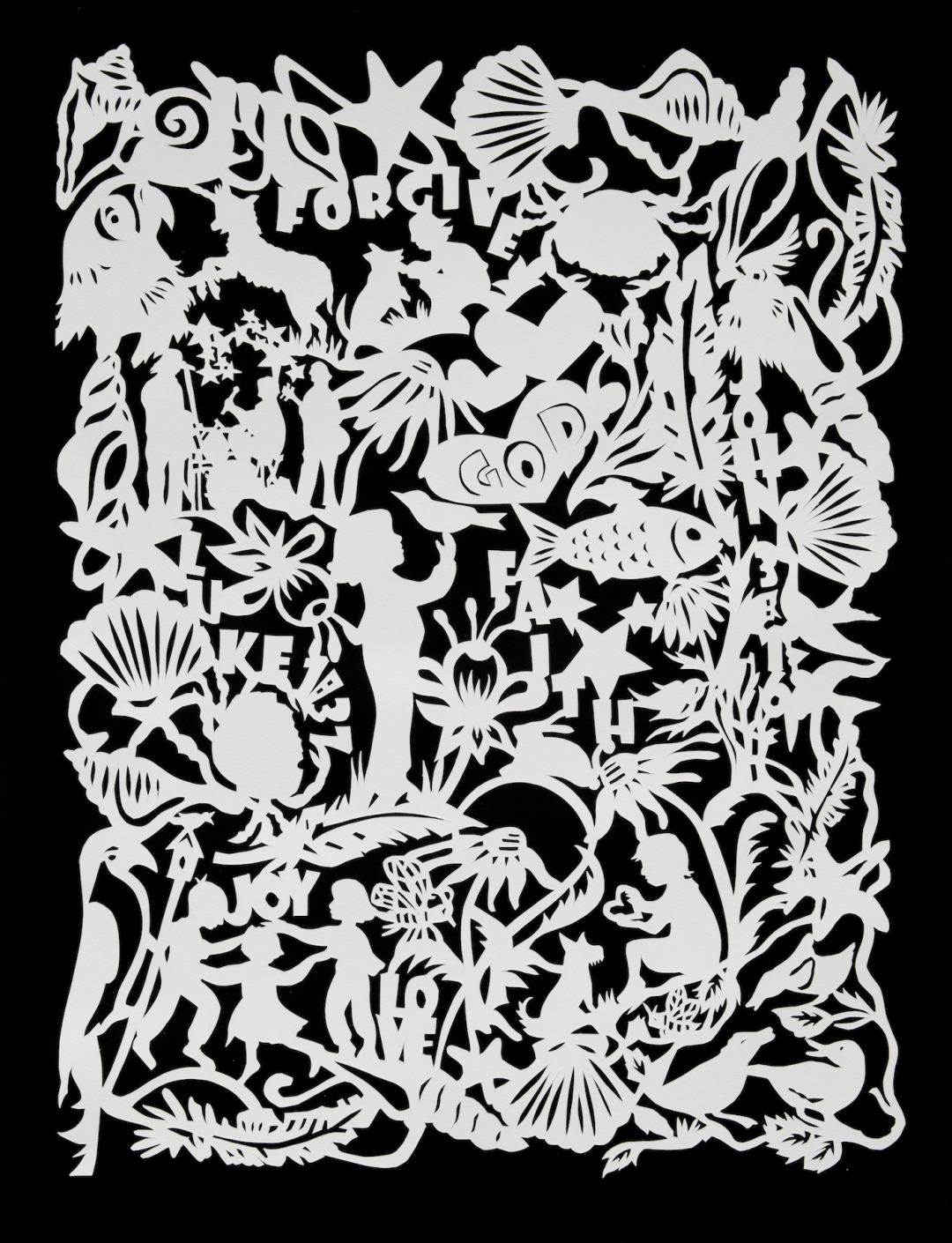
Nicholas Palumbo, Forgive, 2015‒16. Cut Bristol board on cardstock. Collection of Community Partners in Action, Hartford, Connecticut.
Nicholas Palumbo is one of thousands who have participated in Community Partners in Action’s Prison Arts Program over its forty-plus years of operation. Founded in 1977 and directed by Jeffrey Greene, the program “promotes self-examination and self-esteem in Connecticut inmates through participation in visual arts classes, exhibitions and publications, and brings the talent and creativity of the prison population to the community at large.”
This cut-out by Palumbo, titled Forgive, is one of the artworks the CPA purchased for its permanent art collection, which travels, along with new pieces, to public schools, universities, libraries, community centers, and galleries throughout the state. I came across it in a Hyperallergic review of the 2019 exhibition How Art Changed the Prison: The Work of CPA’s Prison Arts Program at the Aldrich Contemporary Art Museum in Ridgefield, Connecticut.
Full of whimsy, Palumbo’s piece brings together the words “God,” “joy,” “love,” “faith,” and “forgive” with scripture references (Luke 1:37, “For nothing will be impossible with God”; John 3:16, “For God so loved the world . . .”) and images of seashells, fish, birds, hearts, flowers, insects, a dog, a rock band under the stars, and children playing ring-around-the-rosy. I see it as an invitation into Christ’s joy-filled kingdom, which we must enter with faith like a child (Matt. 18:1-5; Mark 10:13-16; Luke 18:15-17)—in trust, curiosity, and wonder.
An alphabetical catechism, set to a buoyant, guitar-driven melody.
At all times give thanks, for this pleases God Be kind, loving, and forgiving to each other Christ died for our sins and rose again Don’t lie or cheat, but be truthful Even a child is known by what he does For God so loved the world that he gave his only Son God made the heavens and the earth Honor your father and mother It’s right to care for your animals Jesus said, “I am the Good Shepherd”
Alleluia, alleluia
Know that the Lord is God; he made us and we are his Love God with all your mind and strength Make the highest goal of your life love, for your Neighbors here and God above Obey your parents in the Lord Parents, gently correct, and teach your children in God’s ways Quench not the Holy Spirit Rejoice and be glad in the Lord
Alleluia, alleluia, alleluia
Serve the Lord happily and sing to him Temptations come to all, but God gives us strength to do right Unless you become like a child, you cannot enter heaven Victory over the world is our faith Worship the Lord and serve him only Except you be reborn, you will not see God’s truth You are the light of the world Zacchaeus, Jesus came to save those who are lost
Chunye He (Chinese, 1968–), Walking Together, 2018. Ink on rice paper, 67 × 43 cm.
This Chinese ink-wash painting is from Matter + Spirit: A Chinese/American Exhibition, the product of a 2018 gathering in Beijing of North American and Chinese art professors, sponsored by the Nagel Institute for the Study of World Christianity. According to curator Rachel Hostetter Smith, He’s piece, which shows two dragonflies flying in tandem, is “a poetic rendering of the way family, friends, and God ‘walk alongside’ us especially in times of trouble and loss.” It is stamped in red with the Chinese character for “earth,” which happens to be shaped like a cross.
This song was written by Leslie Jordan, Aaron Keyes, Orlando Palmer, Isaac Wardell, and Paul Zach of the Christian music collective The Porter’s Gate. The Spotify link is to their studio recording from 2019, whereas the YouTube video is a 2020 virtual performance by musicians from Whitworth Campus Ministries in Spokane, Washington.
Teach us Your ways, teach us Your ways As we learn from one another Learn to love each other Teach us Your ways
Teach us to give, teach us to give Give ourselves for one another Learn to love each other Teach us to give
Teach us to weep, teach us to weep Let us weep with one another Learn to love each other Teach us to weep
Hallelujah, hallelujah Let us learn from one another Learn to love each other Teach us Your ways
William H. Johnson (American, 1901–1970), Mount Calvary, ca. 1944. Oil on paperboard, 27 3/4 × 33 3/8 in. (70.5 × 84.9 cm). Smithsonian American Art Museum, Washington, DC.
LISTEN: “Draw Me Nearer” (I Am Thine, O Lord) | Words by Fanny Crosby, 1875 | Music by William H. Doane, 1875 | Performed by Nina Simone on Let It All Out, 1966
I am Thine, O Lord, I have heard Thy voice, And it told Thy love to me; But I long to rise in the arms of faith, And be closer drawn to Thee.
[Refrain] Draw me nearer, nearer, nearer, blessed Lord, To the cross where Thou hast died; Draw me nearer, nearer, nearer, blessed Lord, To Thy precious, bleeding side.
Consecrate me now to Thy service, Lord, By the pow’r of grace divine; Let my soul look up with a steadfast hope, And my will be lost in Thine.
Now there was a woman who had been suffering from hemorrhages for twelve years. She had endured much under many physicians, and had spent all that she had; and she was no better, but rather grew worse. She had heard about Jesus, and came up behind him in the crowd and touched his cloak, for she said, “If I but touch his clothes, I will be made well.” Immediately her hemorrhage stopped; and she felt in her body that she was healed of her disease. Immediately aware that power had gone forth from him, Jesus turned about in the crowd and said, “Who touched my clothes?” And his disciples said to him, “You see the crowd pressing in on you; how can you say, ‘Who touched me?’” He looked all around to see who had done it. But the woman, knowing what had happened to her, came in fear and trembling, fell down before him, and told him the whole truth. He said to her, “Daughter, your faith has made you well; go in peace, and be healed of your disease.”
—Mark 5:25–34
LOOK: Bleeding Woman by Kimberly Stephens
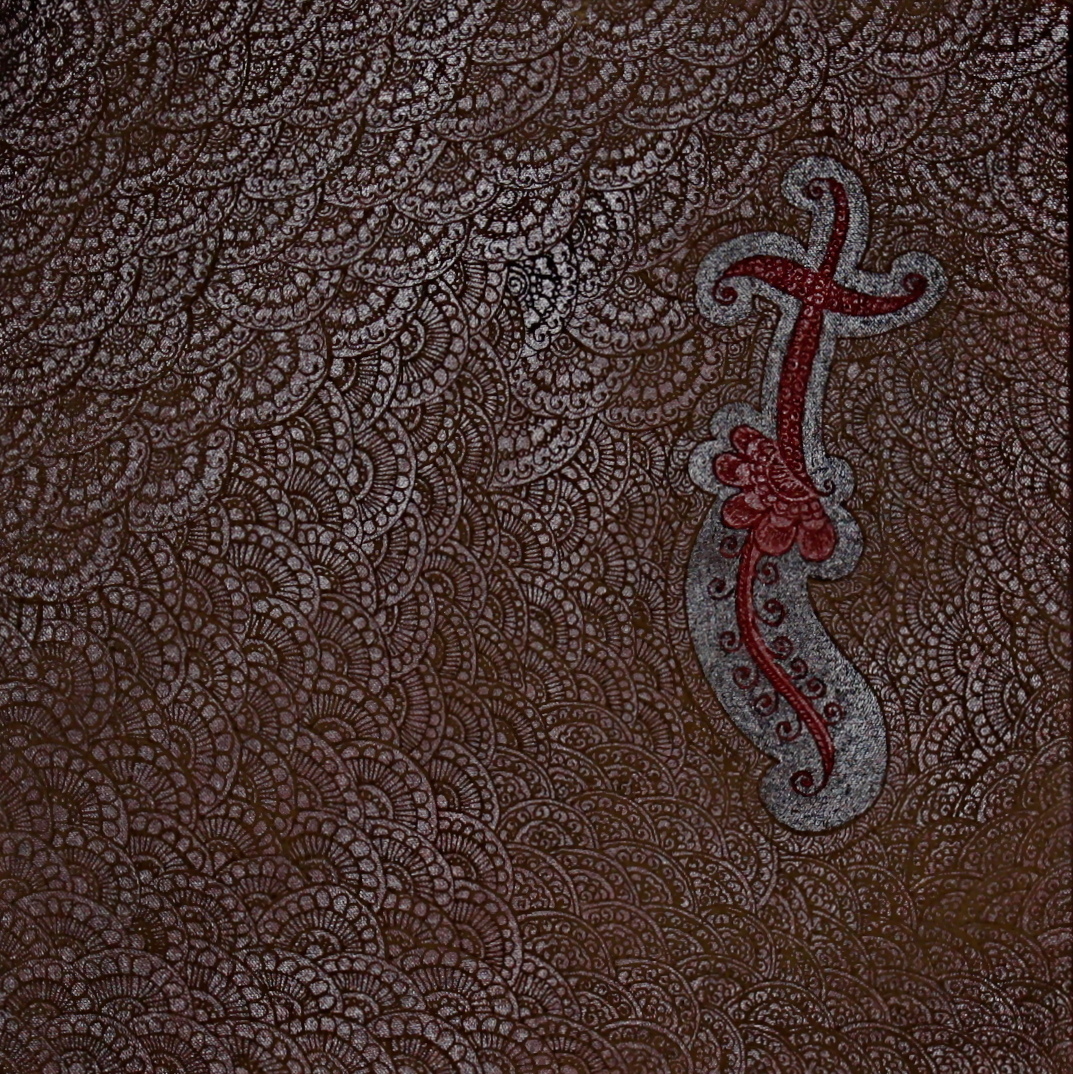
Kimberly Stephens, Bleeding Woman, 2010. Mehndi and acrylic on canvas.
Bleeding Woman is part of a series of eighteen biblical paintings originally exhibited in October 2010 at the L&P Hutheesing Visual Arts Centre in Ahmedabad, India, a country where Stephens lived for two years. Mehndi is a powder taken from the leaves of the henna plant and made into a paste. It’s traditionally applied to the skin as a form of temporary body art for weddings, religious festivals, and other celebrations, but Stephens has fixed it in more permanent form on canvas, and she uses it to tell the story of Jesus.
The episode depicted here is found in Mark 5:25–34 (cf. Matt. 9:20–22; Luke 8:43–47). A woman had been hemorrhaging for twelve years, which made her ceremonially unclean, and thus a social pariah, in the ancient Jewish culture in which she lived. Yet Stephens shows her confidently pressing her way through the crowd so that she can touch the hem of Jesus’s garment and be healed.
There is definitely a sense of claustrophobia in the painting, of tightness and crowding, achieved by the many overlapping waves. But something intimate, something private, is happening amid this very public throng: the woman reaches out to Jesus and immediately blossoms upon contact. Jesus restores her not only physically but also socially, emotionally, and spiritually—a holistic salvation.
Jesus and the woman are represented symbolically using the curled lines that are characteristic of mehndi designs, with Jesus’s form evoking the cross he will later die on. The thick, silvery outline around these two figures serves as an aura of sorts that sacramentalizes the encounter and draws the viewer’s attention to it but that also creates some breathing room and suggests the space of clarity and relief into which the woman has entered.
Reach out, reach out, the hem of his cloak One touch will heal the bleeding Press in, press in, the crowd draws near Your faith the pow’r is heeding
Written by Elizabeth Duffy and arranged by Kaitlyn Ferry of the group Sister Sinjin, “Talitha Koum” is a trilogy of short songs about three females from the New Testament: Jairus’s twelve-year-old daughter, whom Jesus raises from the dead (Matt. 9:18–26; Mark 5:21–43; Luke 8:40–56); the hemorrhaging woman discussed above; and the widow who puts her two small coins into the offering plate (Mark 12:41–44; Luke 21:1–4). The title is Aramaic, translating to “Little girl, arise!”—the words spoken by Jesus to Jairus’s daughter (Mark 5:41).
The song featured here is the second in the set. The woman with the issue of blood experienced a sort of resurrection herself, as Jesus raised her out of the pain, disruptiveness, and isolation of her condition, making possible a new life for her.
Imagine how freeing it must have felt to receive that jolt, I’ll call it, from the tzitzit (tassels) of Rabbi Jesus’s robe, and to know instantly that you have been healed! For over a decade the woman had suffered from continual bleeding, and no doctor was able to help. She lived on the margins of society. Until Jesus came along and she reached out in faith to claim the blessing of healing.
“Talitha Koum, Part 2” is sung in three-part harmony in G minor, but on the final syllable the key shifts up a half-step to G Major. This harmonic device (ending a minor song on a major chord) is known as a Picardy third [previously], and it’s used to lift what can be heard as sad, dark, or heavy into a lightness and brightness, into joy. I hear it as the woman’s sigh of relief. She had been holding her breath for so long, anxious for resolution, and now she can finally let it out.
Billie Bond (British, 1965–), Breathe (diptych), 2018. Black stoneware, resin, gold, 15.8 × 13 × 7.9 in. each. [available for sale]
This pair of ceramic busts by British sculptor Billie Bond is inspired by the Japanese art of kintsugi, or “golden seams,” by which a broken pottery vessel is repaired using gold lacquer. With this technique the cracks are purposefully accentuated rather than hidden, and the mended object is even more beautiful than the original.
Japanese American author, speaker, and artist Makoto Fujimura has spoken extensively about kintsugi as a metaphor for human brokenness and mending in Christ. We come to Christ in fragments; he lovingly puts us back together. The scars remain, but like his, they shine.
For Bond, the kintsugi heads represent human fragility and resilience—particularly healing after grief or psychological trauma, and enlightenment gained through experience. View more of Bond’s kintsugi sculptures here.
Smashed ceramic head by Billie Bond, before being reassembled and repaired with gold
LISTEN: “Come Healing” by Leonard Cohen and Patrick Leonard, 2012 | Performed by Elayna Boynton at Crosswalk Church, Redlands, California, 2012; and on The Farewell (Original Motion Picture Soundtrack), 2019
O gather up the brokenness And bring it to me now The fragrance of those promises You never dared to vow The splinters that you carry The cross you left behind Come healing of the body Come healing of the mind
And let the heavens hear it The penitential hymn Come healing of the spirit Come healing of the limb
Behold the gates of mercy In arbitrary space And none of us deserving The cruelty or the grace O solitude of longing Where love has been confined Come healing of the body Come healing of the mind
O see the darkness yielding That tore the light apart Come healing of the reason Come healing of the heart
O troubledness concealing An undivided love The Heart* beneath is teaching To the broken Heart above O let the heavens falter Let the earth proclaim: Come healing of the Altar Come healing of the Name
O longing of the branches To lift the little bud O longing of the arteries To purify the blood And let the heavens hear it The penitential hymn Come healing of the spirit Come healing of the limb
O let the heavens hear it The penitential hymn Come healing of the spirit Come healing of the limb
* The official website of Leonard Cohen, maintained by Sony Music Entertainment, capitalizes “Heart” in this stanza; same with “Altar” and “Name.”
Known as “the poet of brokenness,” Leonard Cohen (1934–2016) is widely considered one of the greatest songwriters of all time. Spiritual yearning characterizes quite a few of his songs, the most famous of which is “Hallelujah.” He was Jewish, with a respect for other spiritual traditions and a fondness for Jesus Christ as a universal figure.
“Come Healing” is from Cohen’s 2012 album Old Ideas. Elayna Boynton, perhaps discovered through this YouTube video from a worship service at her Southern California church, was asked to record the song for the 2019 film The Farewell (an excellent watch!). Cohen’s deep growl of a voice, though it has its admirers, is not attractive to me, so Boynton’s cover really helped me hear the tremendous beauty of this song.
Elliot R. Wolfson describes “Come Healing” as “a poem that is prayer in its purest distillation, a prayer clothed in quintessential nakedness, an anthem that celebrates and laments the wholehearted fragmentariness of the human condition.”
The speaker prays for healing of body and spirit, head and heart. We bring our failures and our lack, our guilt and regrets and all manner of pain to the altar, to the “gates of mercy.” We long to bloom, to be purified. In the mystical unity of love that ties our hearts to God, our hurt hurts him. His heart breaks over seeing us suffer, whether as a result of our own sin (which is what Cohen’s “penitential hymn” seems to focus on) or due to things outside our control.
When we bring our cracked or shattered selves to God, acknowledging our inability to fix the damage, he will restore us to wholeness.
While spiritual salvation is granted instantly (at least in the understanding of my tradition) to the one who turns to God, through Christ, in faith and repentance, what about other types of brokenness that we come to him with? Why won’t he heal us of that chronic physical condition? Or that debilitating mental illness? Or the effects of trauma? Why won’t he heal that broken relationship between us and our parent, despite our efforts at reconciliation?
I don’t have an answer for that—why, though none of us is free of pain and hardship in this life, some suffer much more than others; or why some receive healing and others do not. But eventual wholeness, shalom, is promised to those who are in Christ. In the new heavens and the new earth, salvation will be holistic, infusing spirits as well as bodies, minds, relationships, systems, and the whole created world.
And sometimes we do receive glimpses of that wholeness here and now! Sometimes the cancer goes away. Sometimes the depression is effectively treated, and fulfillment made possible again. Sometimes the sobriety sticks.
Often God is piecing us back together slowly, such that the progress may be imperceptible until years later, we look back and can see it.
The song suggests that although we don’t always deserve the slings and arrows that come our way, neither do we deserve the lavish graces God bestows. Sometimes we’re so focused on the one that we fail to see the other.
Even though complete wholeness is not possible in this life, God still invites us to reach out to him with the shards of our life, to seek his healing in specific areas—with faith that he can heal whatever it is that’s broken! He will tend to the shards with loving tenderness. And maybe put them back together in a way we didn’t expect.
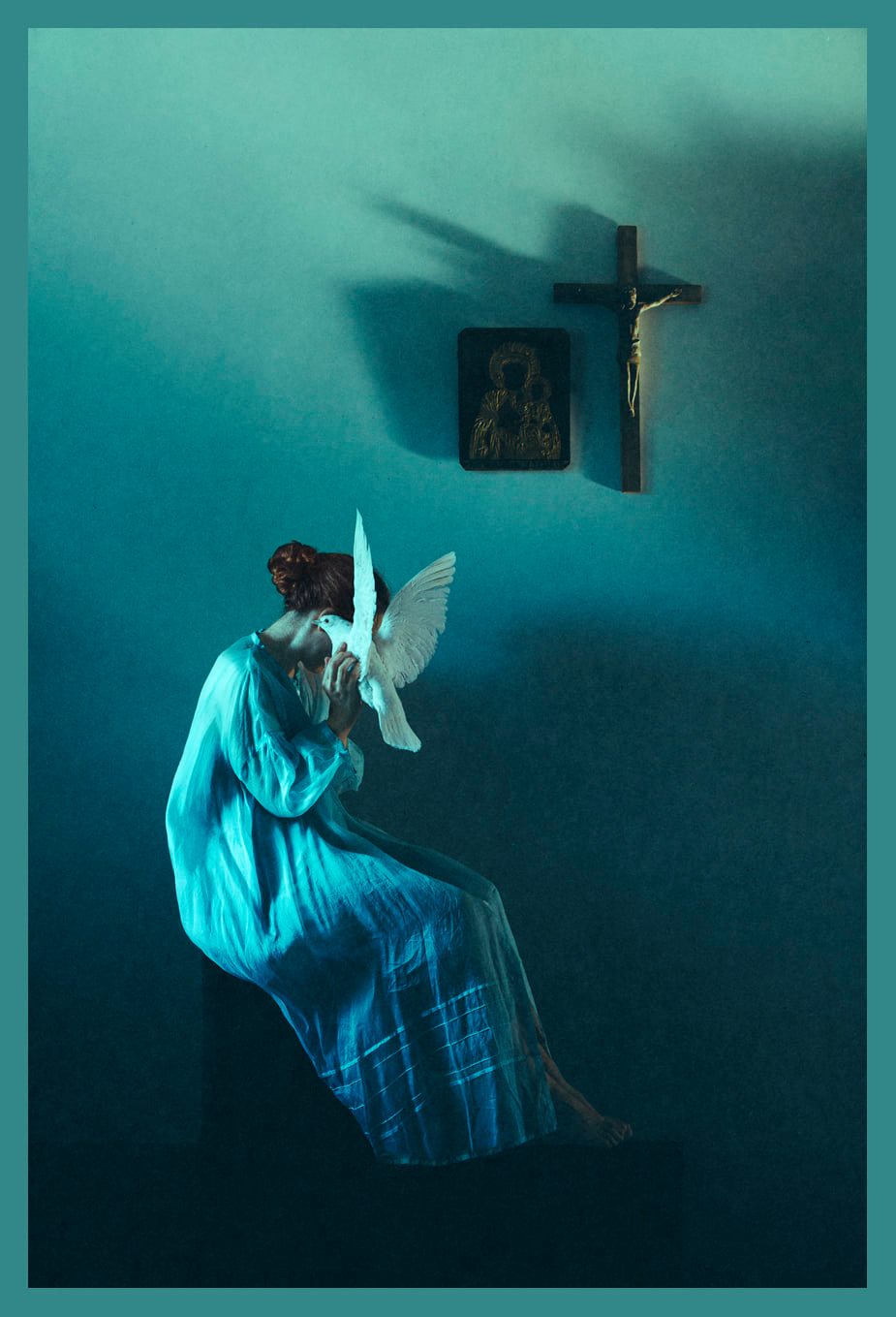
Laura Makabresku (Polish, 1987–), Lessons of Hearing, 2021, photograph
Laura Makabresku is the artist pseudonym of Kamila Kansy, whose photographs are inspired by dreams, fairy tales, and the Christian story. Surreal and spiritual, her body of work moves me immensely. It’s so poetic. Divine and human love and suffering are recurring themes, and animals—doves, crows, deer, lambs, foxes—often appear. Follow her on Instagram @lauramakabresku and on Facebook.
Lessons of Hearing shows a young woman alone in a shadowy domestic space, listening intently to the Spirit. A crucifix and an icon of the Virgin and Child hang above her on the wall. A limited edition of this photograph is available for sale—signed, numbered, printed on archival Hahnemühle Baryta paper, and framed. Contact the artist if interested.
LISTEN: “Bring Forth” | Words by John Ernest Bode, 1869, with adaptations and refrain by Ben Thomas, 2015 | Music by Ben Thomas, 2015 | Album: Bring Forth
O Jesus, I have promised To serve thee to the end; Open my eyes within To see your everlasting hand. I shall not fear the struggle If thou art by my side, Nor wander from the pathway If you will be my guide.
[Refrain] Bring forth the truth and beauty Embedded deep inside. Breathe life in every moment. You will not leave my side.
O let me hear thee speaking In accents clear and still, Above the storms of trials, The murmurs of self-will. O speak to reassure me, Strengthen and make me whole; O speak, and let me listen, Creator of my soul.
[Bridge] Bring forth the beauty (×8)
O Jesus, I have promised To serve thee to the end.
Edicam pulchritudine (×8)
This song is about coming home to who we were created to be—good and beautiful, reflections of our Maker. Sadly, sin often leads us away from home, and God’s image that we bear becomes marred. But Christ walks alongside us, calling forth our truest selves, reminding us that we are God’s beloved. We have been redeemed, made alive by God’s Spirit, and are being sanctified. God is bringing forth the beauty he embedded in us at creation.
The speaker of the song seeks Christ’s guidance, illumination, strength, and wholeness. He prays for the ability to discern God’s voice above all the voices of this world that try to tell us we are less than, or that only such and such will satisfy us. And he prays for the will to obey. His desire is that he be animated moment by moment by the Holy Spirit (see Romans 8).
The last line, which I take to be in God’s voice, is Latin for “I will bring forth the beauty.”
Abba Macarius was asked, ‘How should one pray?’ The old man said, ‘There is no need at all to make long discourses; it is enough to stretch out one’s hands and say, “Lord, as you will, and as you know, have mercy.” And if the conflict grows fiercer say, “Lord, help!” He knows very well what we need and he shews us his mercy.
English translation: Jesus, Jesus, Son of God, have mercy, have mercy on us.
I don’t know the name of this vocal ensemble, when the recording was made, or the origin of the melody they sing. (Can anyone help me out there?)
The text, though, is a famous one, used regularly in the Eastern Orthodox tradition and known as the Jesus Prayer, or the Prayer of the Heart. It originated with the early Christian monks of the Egyptian desert around the fifth century, and was first written down in Greek. Another variation is “Lord Jesus Christ, Son of God, have mercy on me, a sinner.”
An invocation of Christ’s name and presence, the Jesus Prayer is meant to be recited in repetition as a form of meditative prayer. Some Christians use it in conjunction with a breath prayer, breathing in as they say internally, “Jesus, Son of God,” and breathing out on “have mercy.”
It’s most often prayed in the first-person singular—“have mercy on me”—and used in private devotions, but in this corporate chant on the video, it’s prayed in the first-person plural, “us.” In light of Russia’s recent invasion of Ukraine and the war being fought there, I hear in these Ukrainian women’s voices a lament for their country.
Lord, have mercy. Spare the Ukrainian people. Stop the violence and destruction. Protect, provide. Heal the wounded and the traumatized, and comfort the grieving. Thwart the evildoers; turn their hearts to you in repentance. Grant wisdom to the leaders working for peace. In short: “Lord, help!”
The folk icon featured above is by contemporary Ukrainian artist, art historian, and curator Roman Zilinko, who works at the Andrey Sheptytsky National Museum in Lviv. “My artworks continue the tradition of the Ukrainian icon painting of the Carpathian region, which flourished in the 16th and 19th centuries,” Zilinko says. Its distinctive features are “naive and flat painting, but rich in colors and ornaments.” To view more of Zilinko’s icons, click here.
The above icon shows a religious procession, with two people carrying khorugvs (religious banners)—one of the Virgin Mary and Child, one of Christ Pantocrator. Foregrounded in the center is Christ, crucified on a tree that recalls the tree of life from Revelation 22, whose leaves are for the healing of nations. The suffering Christ goes before the people and is right in their midst. He is their companion, their deliverer, their wounded healer, their life.
Zilinko has named the icon The Parable of the Mustard Seed, after Jesus’s saying about how the kingdom of heaven starts out small but then grows into something enormous and lush (Matt. 13:31–32). Christ has indeed grown his church mightily in Ukraine; Christianity has been the primary religion there since the tenth century. Zilinko portrays the Christians of Ukraine as a sea of people who stand behind their Savior with hands clasped in prayer and faces radiant with hope.
Let us join them in intercession for a swift end to the war and lasting peace in the region, and for the ability of refugees to return home.
If you find yourself at a loss for words, I suggest praying the Jesus Prayer from the video.
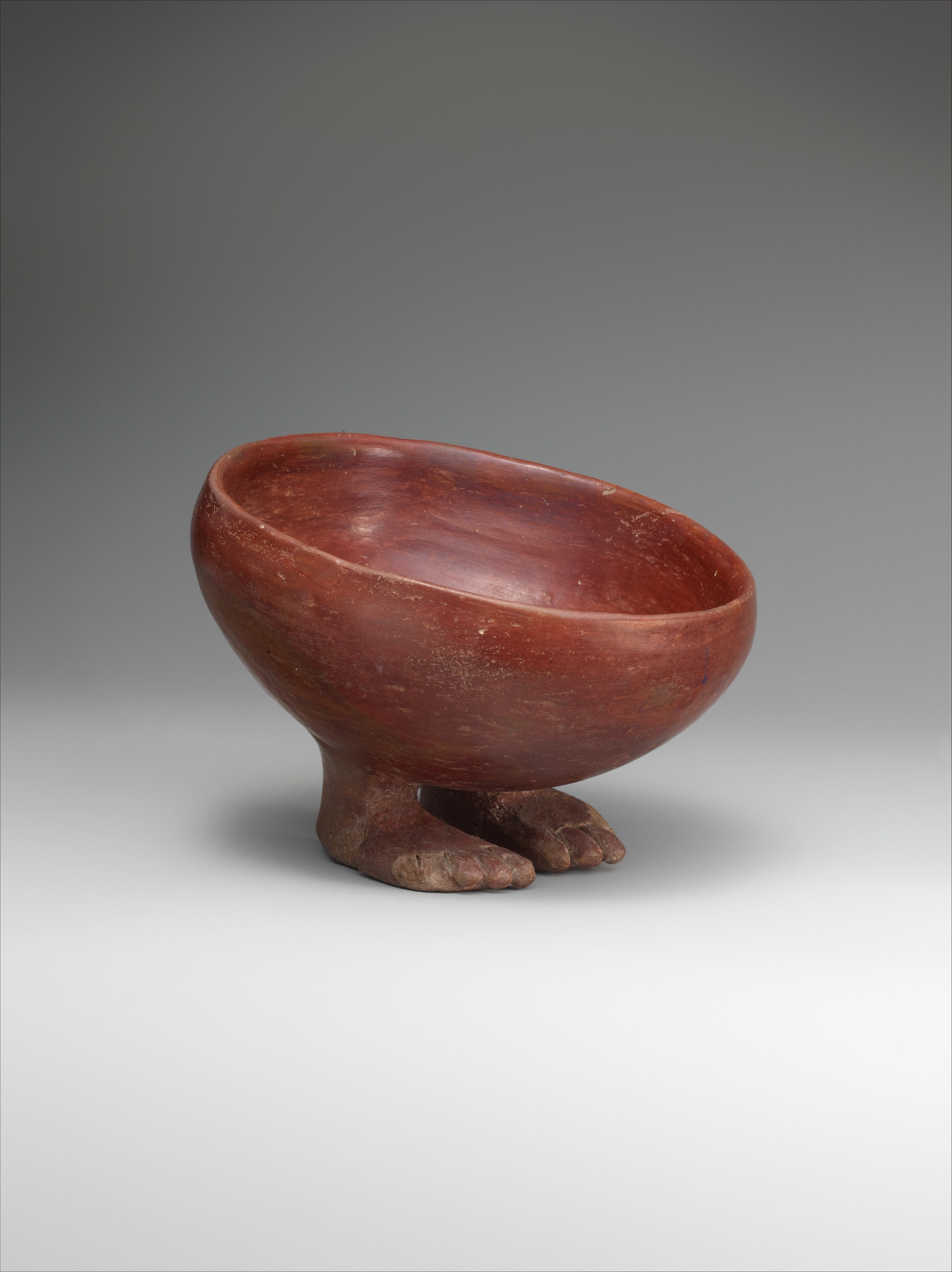
Bowl with Human Feet, Predynastic Egypt, Late Naqada l–Naqada II, ca. 3900–3650 BCE. Pottery (red polished ware), diam. 5 3/16 × W 5 3/8 × D 3 7/8 in. (13.2 × 13.7 × 9.8 cm). Metropolitan Museum of Art, New York.
Made from Nile clay over 5,600 years ago, with supports shaped like human feet, this small anthropomorphized bowl seems to be bending forward in humility. I see in it a reminder of how, on the one hand, we are to bring our selves as an offering to God, pouring out our praises and love; and on the other, how we bring our emptinesses, our lack, to God to fill.
LISTEN: “Ashish tujhse Chahte hain” (We Seek Your Blessings) | Composer and lyricist unknown | Performed by Anand Karma, 2021
This song is in Hindi. Below, a transliteration into the Roman alphabet is given beside the Devanagari script, followed by an English translation.
[1] कोई खूबी है ना लियाकत बक्शो हम को अपनी ताकत कोई खूबी है ना लियाकत बक्शो हम को अपनी ताकत खाली दिलों को लाते हैं खाली दिलों को लाते हैं हे स्वर्गीय पिता हम आते हैं
आशीष तुझसे चाहते हैं हे स्वर्गीय पिता हम आते हैं
[2] तुम हो शक्तिमान प्रभुजी दया भी है अपार तुम हो शक्तिमान प्रभुजी दया भी है अपार स्तुति हम गाते हैं स्तुति हम गाते हैं हे स्वर्गीय पिता हम आते हैं
आशीष तुझसे चाहते हैं, हे स्वर्गीय पिता हम आते हैं
[3] हमनें बहुत खताएं की हैं रहे निकम्मे ज़फ़ाएं की हैं हमनें बहुत खताएं की हैं रहे निकम्मे ज़फ़ाएं की हैं शर्म से सिर झुक जाते हैं शर्म से सिर झुक जाते हैं, हे स्वर्गीय पिता हम आते हैं
आशीष तुझसे चाहते हैं, हे स्वर्गीय पिता हम आते हैं
Koi khoobi hai na liyaqat Baksho humko apni taqat Koi khoobi hai na liyaqat Baksho humko apni taqat Khali dilon ko late hain Khali dilon ko late hain He swargya pita hum aate hain
Ashish tujhse chahte hain He swargya pita hum aate hain
Tum ho shaktimaan prabhu ji Daya bhi hai apaar yeshu ji Tum ho shaktimaan prabhu ji Daya bhi hai apaar yeshu ji Stuti hum sub gaate hain Stuti hum sub gaate hain He swargya pita hum aate hain
Ashish tujhse chahte hain He swargya pita hum aate hain
Humne bahut khatayen ki hain Rahe nikamme jafayen ki hain Humne bahut khatayen ki hain Rahe nikamme jafayen ki hain Sharm se sir jhuk jaate hain Sharm se sir jhuk jaate hain He swargya pita hum aate hain
Ashish tujhse chahte hain He swargya pita hum aate hain
There is no merit [that we bring] Bestow on us your power There is no merit Bestow on us your power Empty hearts we bring Empty hearts we bring O Heavenly Father, we come
Seeking your blessings O Heavenly Father, we come
You are all-powerful, O Lord And you are all-merciful, O Jesus You are all-powerful, O Lord And you are all-merciful, O Jesus Praises we all sing Praises we all sing O Heavenly Father, we come
Seeking your blessings O Heavenly Father, we come
We have made many mistakes And committed vile injustices We have made many mistakes And committed vile injustices Our heads are bowed in shame Our heads are bowed in shame O Heavenly Father, we come
Seeking your blessings O Heavenly Father, we come
Anand Karma is a Christian singer and worship leader from New Delhi. Last year he and his American wife moved temporarily to Minneapolis with their infant son, but they are planning to return to India later this year.
In 2017 Karma released a worship album, Gaye Mera Mann Yeshu Naam, which is available on all major digital platforms. On his YouTube channel he posts acoustic covers of Indian Christian worship songs, mostly in Hindi, like the one above, which asks God for the blessing of grace that forgives, strengthens, and makes glad.
Augustus Vincent Tack (American, 1870–1949), Canyon, ca. 1923–24. Oil on canvas mounted on plywood panel, 29 × 40 in. (73.7 × 101.6 cm). The Phillips Collection, Washington, DC.
Lord, high and holy, meek and lowly,
Thou hast brought me to the valley of vision,
      where I live in the depths but see thee in the heights;
      hemmed in by mountains of sin I behold thy glory.
Let me learn by paradox
      that the way down is the way up,
      that to be low is to be high,
      that the broken heart is the healed heart,
      that the contrite spirit is the rejoicing spirit,
      that the repenting soul is the victorious soul,
      that to have nothing is to possess all,
      that to bear the cross is to wear the crown,
      that to give is to receive,
      that the valley is the place of vision.
Lord, in the daytime stars can be seen from deepest wells,
      and the deeper the wells the brighter thy stars shine;
Let me find thy light in my darkness,
                     thy life in my death,
                     thy joy in my sorrow,
                     thy grace in my sin,
                     thy riches in my poverty,
                     thy glory in my valley.
The title of this prayer and its musical setting comes from the heading that is Isaiah 22:1: “The burden of the valley of vision.” The valley here refers to Jerusalem, a city located in the middle of a range of low mountains (it’s surrounded by seven peaks higher than itself) and a seat of divine revelation—where prophetic visions were given, and where God manifested himself in the temple. And in the context of the chapter, “burden” means a mournful oracle, as Isaiah warns of Jerusalem’s destruction.
Bennett extracts the phrase “valley of vision” from the Isaiah context, using it as a metaphor for the low, dark places where we can see God most clearly. “The way down is the way up,” he writes—one of the several paradoxes of the Christian faith. In God’s kingdom the lowly are uplifted; to admit defeat is to win the victory; and to die is to live.
Author Edna Hong refers to Lent as a “downward ascent” in which we go down into the depths of ourselves, acknowledging our fragility and examining and confessing our sins, in order that we might rise anew with Christ, with a refreshed understanding and experience of his love, power, and grace. May you find that refreshment this Lenten season. May your vision of God and self come into clearer, more glorious focus.
Lord, you have been our dwelling place in all generations. Before the mountains were brought forth, or ever you had formed the earth and the world, from everlasting to everlasting you are God.
You turn us back to dust, and say, “Turn back, you mortals.” For a thousand years in your sight are like yesterday when it is past, or like a watch in the night.
You sweep them away; they are like a dream, like grass that is renewed in the morning; in the morning it flourishes and is renewed; in the evening it fades and withers.
For we are consumed by your anger; by your wrath we are overwhelmed. You have set our iniquities before you, our secret sins in the light of your countenance.
For all our days pass away under your wrath; our years come to an end like a sigh. The days of our life are seventy years, or perhaps eighty, if we are strong; even then their span is only toil and trouble; they are soon gone, and we fly away.
Who considers the power of your anger? Your wrath is as great as the fear that is due you. So teach us to count our days that we may gain a wise heart.
Turn, O LORD! How long? Have compassion on your servants! Satisfy us in the morning with your steadfast love, so that we may rejoice and be glad all our days. Make us glad as many days as you have afflicted us, and as many years as we have seen evil. Let your work be manifest to your servants, and your glorious power to their children. Let the favor of the Lord our God be upon us, and prosper for us the work of our hands— O prosper the work of our hands!
—Psalm 90
God’s eternity and human frailty. These are the central themes of Psalm 90, commonly read on Ash Wednesday, the first day of Lent. Today many Christians will be receiving the sign of the cross in ash on their foreheads—a symbol of death and repentance. “Remember that you are dust, and to dust you shall return. Repent and believe the gospel,” the pastor pronounces as he or she smears the ash (made from burnt palm fronds from last year’s Palm Sunday) on young and old alike.
For a Protestant defense of Ash Wednesday, see “To Ash or Not to Ash” by Rev. Dr. Timothy R. LeCroy. He explores the biblical symbolism of the ritual, its history, and its importance for Christian formation.
LOOK: We Shake with Joy, We Shake with Grief by Meena Matocha
Meena Matocha (American, 1977–), We Shake with Joy, We Shake with Grief, 2019. Charcoal, ashes, soil, acrylic, and cold wax on panel, 12 × 12 in.
Austin-based artist Meena Matocha uses charcoal, ashes, soil, and wax to create figurative paintings that explore the tensions between joy and grief, life and death, and the eternal and temporal. The title of this featured painting of hers comes from the poem “We Shake with Joy” by Mary Oliver, reproduced here in full:
We shake with joy, we shake with grief. What a time they have, these two housed as they are in the same body. [source]
The exhibition Meena Matocha: Into the Bright Sadness opens this Friday, March 4, at Christ Church of Austin with a reception and gallery talk and will run through April 15. “Bright sadness” is how the Orthodox priest Alexander Schmemann, in his influential book Great Lent: Journey to Pascha (1969), translates the concept of charmolypê that John Climacus develops in his Ladder of Divine Ascent in relation to “holy compunction.” “Bright sadness . . . is the true message and gift of Lent,” Schmemann writes. “The sadness of my exile, of the waste I have made of my life; the brightness of God’s presence and forgiveness, the joy of the recovered desire for God, the peace of the recovered home.” Alternative translations of this compound noun that permeates the Lenten season are “bitter joy,” “joyful mourning,” “joy-making mourning,” or, as Archimandrite Lazarus Moore has it, “blessed joy-grief.”
In their mood and materiality, Matocha’s paintings capture well the themes of Ash Wednesday and the season it inaugurates. Follow her on Instagram @meenamatochaart and on Facebook.
LISTEN: “From the Dust” by Paul Zach and Kate Bluett, 2021 | Released as a single February 25, 2022
Singer-songwriter Paul Zach video-recorded a minimalist demo of this original song last year, and just last Friday he released a fuller version with backing vocals by The Sing Team and a forty-piece orchestral accompaniment. The string arrangement is by Brian Eichelberger. Zach gave me permission to publicly post this Dropbox link, where you can download an audio file of the song, a lead sheet, and the string parts: https://www.dropbox.com/sh/t56w2lyi3hsoerm/AADPnKbPDveZh825uUdBU4JEa?dl=0.
From the dust we came To the dust we shall return God everlasting, age unto age the same We are a moment, then like a breath we fade
From the dust we came To the dust we shall return God everlasting, we are cut down as grass Seeds in the morning, and by the night we pass
O Lord, have mercy O Lord, have mercy O Lord, have mercy
Based on Genesis 3:19 and Psalm 90:2–6, “From the Dust” is a sober acknowledgment of the mortality that unites us all, and a plea that God would be merciful to us, forgiving our foolish ways and setting us back on the path of wisdom.








 Art & Theology