Into Air, a meditation on impermanence

Dawn Ng is a Singaporean multidisciplinary artist whose practice deals with time, memory, and the ephemeral. For her recent body of work Into Air, Ng has crafted nearly 150 large sculptural blocks of frozen pigment and documented their dissolution in the form of photographs, film, and residue paintings. A poetic visual meditation on time and its passing, Into Air captures the metamorphosis of colored ice from solid to liquid to air, physicalizing transience. Presented by Sullivan+Strumpf, it premiered at a derelict ship factory in Singapore in January 2021 and from there traveled to Seoul, London, and Sydney. See the six-minute documentary below for more on the process and meaning behind the work.

Dawn Ng in her studio
Dawn Ng in her studio in Singapore, surrounded by studies and artworks from Into Air. Photo: Sean Lee. All photos courtesy of the artist.

Ng started working on Into Air in 2018, and it’s ongoing. The project encompasses three distinct series:

  1. Clocks
  2. Time Lost Falling in Love
  3. Ash

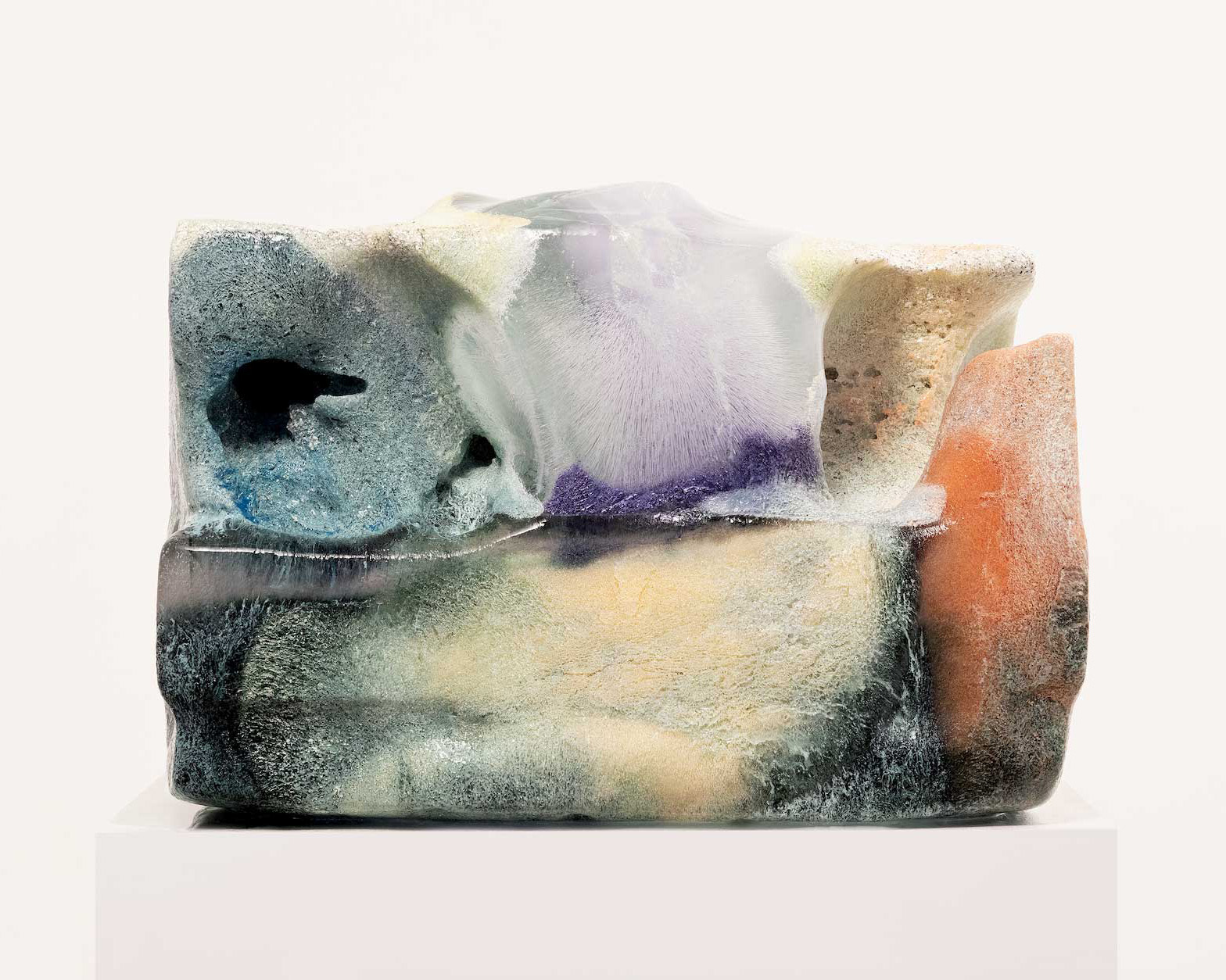
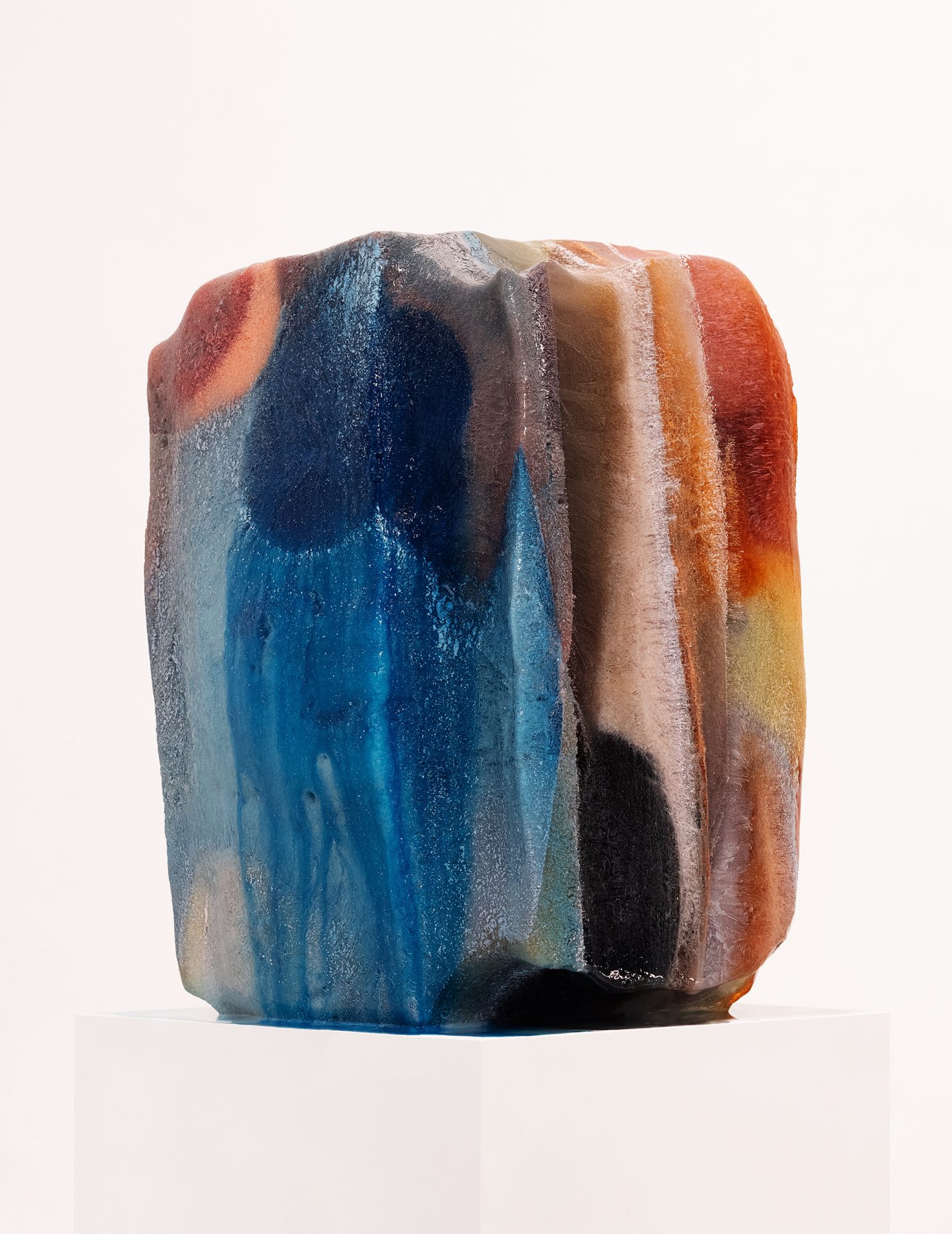
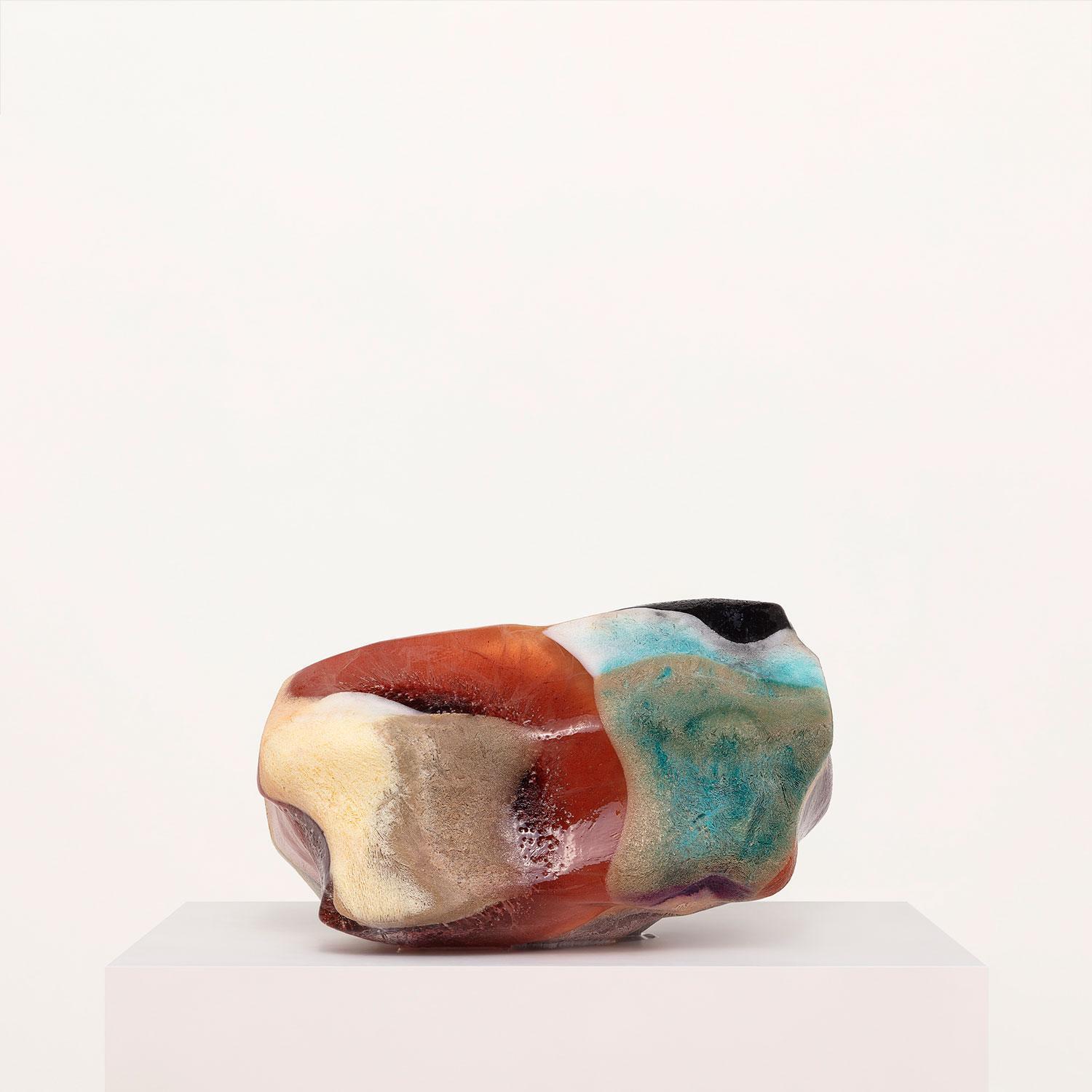
Clocks is the name Ng gives to the photo portraits of her colored glacier blocks at various stages of disintegration. Weighing about 132 pounds each, the blocks were constructed from acrylic paints, dyes, and inks that she froze together in her studio. After removing each block from the freezer, she and her team photographed it from ten different angles every four hours until it entirely eroded. “Like kaleidoscopic lodestones, the portraits visualize the shape, colour and texture that time inhabits in an ephemeral form,” Ng writes.

Ng, Dawn_If I could find (CLOCKS)
Dawn Ng (Singaporean, 1982–), If I could find a souvenir just to prove the world was here, from CLOCKS, 2021. Archival pigment print, 115 × 149 cm.

Ng, Dawn_Some will fall in love (CLOCKS)
Dawn Ng (Singaporean, 1982–), Some will fall in love with life and drink it from a fountain that is pouring like an avalanche coming down the mountain, from CLOCKS, 2021. Archival pigment print, 153 × 118 cm.

Ng, Dawn_Don't they know (CLOCKS)
Dawn Ng (Singaporean, 1982–), Don’t they know it’s the end of the world, from CLOCKS, 2022. Archival pigment print, 95 × 95 cm.

Time Lost Falling in Love is the collective title of the time-lapse videos Ng filmed of the thawing blocks. The collapse of each block into a puddle of liquid took fifteen to twenty hours, a process compressed into twenty to thirty minutes for each film. Ng says she wants to portray the fluidity of time—time as a “riot of colors” that swell and ebb, that form rivers and pools. By speeding up the frame rate of the film, Ng manipulates time, fast-tracking the dissolution of the blocks while simultaneously providing a calming evocation of a waterfall in slow motion. Time melting on. Here’s Avalanche II:

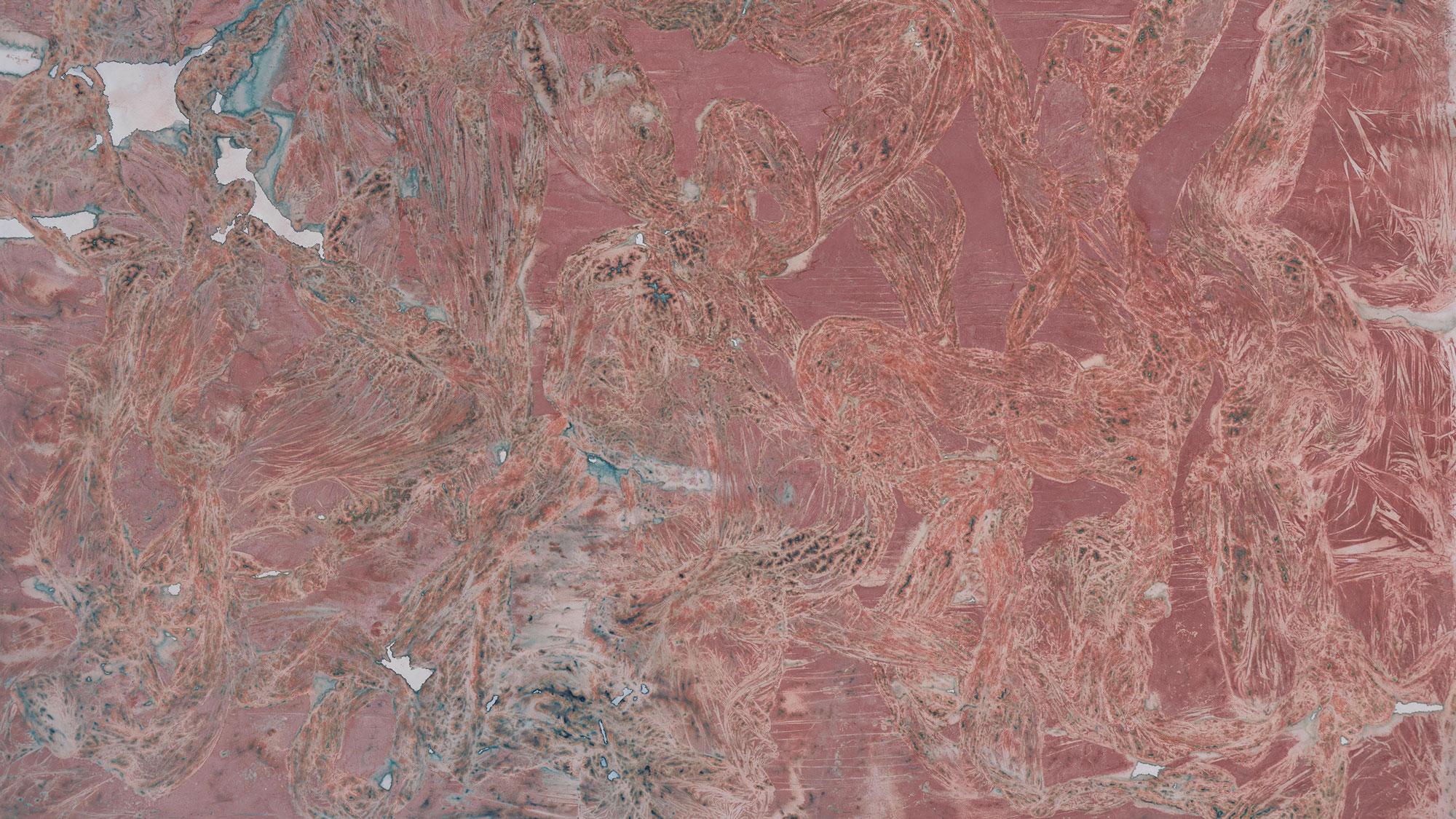
The third and final component of the Into Air project is Ash, a series of paintings created by blanketing the liquid remains of each melted pigment block with a large sheet of canvas-like paper. Ng leaves the paper there for weeks until all the liquid evaporates through it, creating marbled textures and thick buildups that she then peels away. Ng describes Ash as her attempt to “sieve time.”

Many of the photographs and residue paintings take their titles from song lyrics—by the Beatles, Genesis, the White Stripes, Death Cab for Cutie, Sufjan Stevens, and others.

Ng, Dawn_The Earth Laughs in Flowers I
Dawn Ng (Singaporean, 1982–), The Earth Laughs in Flowers I, 2020. Residue painting (acrylic, dye, ink) on paper, 165 × 142 cm.

Ng, Dawn_Ever see, ever be (detail)
Dawn Ng (Singaporean, 1982–), Ever see, ever be, ever know my heart (detail), from ASH, 2022. Residue painting (acrylic, dye, ink) on paper, 199.5 × 150.3 cm.

As much as Into Air is about time, it is also about death. In an interview with Nicholas Stephens for CoBo Social, Ng said,

There is an inescapable relationship between beauty and death. Death gives meaning to all of time. I don’t necessarily see death as something tragic, sad or final. It is that structure that gives true worth and true value to what comes before it. In Asia, especially as a Chinese Asian, we don’t like to talk about death. We feel it is bad luck. But in the paintings, I see death as something beautiful. Even in that last transition to nothingness, the pigments explode. They have a way of clinging on, they try to form tributaries, they flood a space. There is something very beautiful about that last gasp. It is not meek. It can be as strong as fireworks.

I would actually not use the word “nothingness” to describe the blocks’ final state. There’s definitely a “somethingness” still there after the melt! Behold the Ash paintings, which have a glory of their own. Although death is an end of sorts, it’s also a passing from this to that. Ng acknowledges as much. She even describes how “the melted pigments receive a form of resurrection through their incarnation as painterly formulae” in the Ash series. Resurrection!

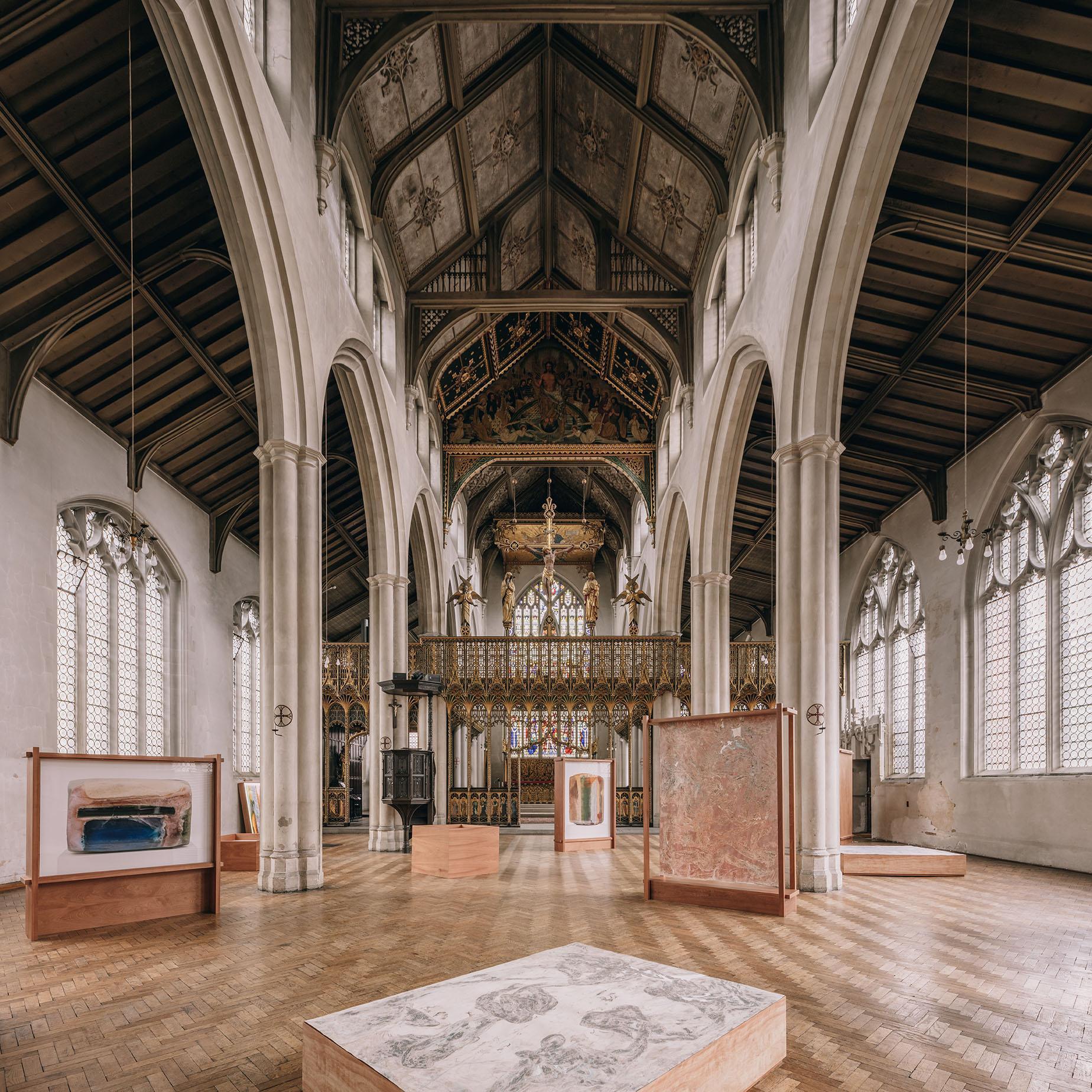
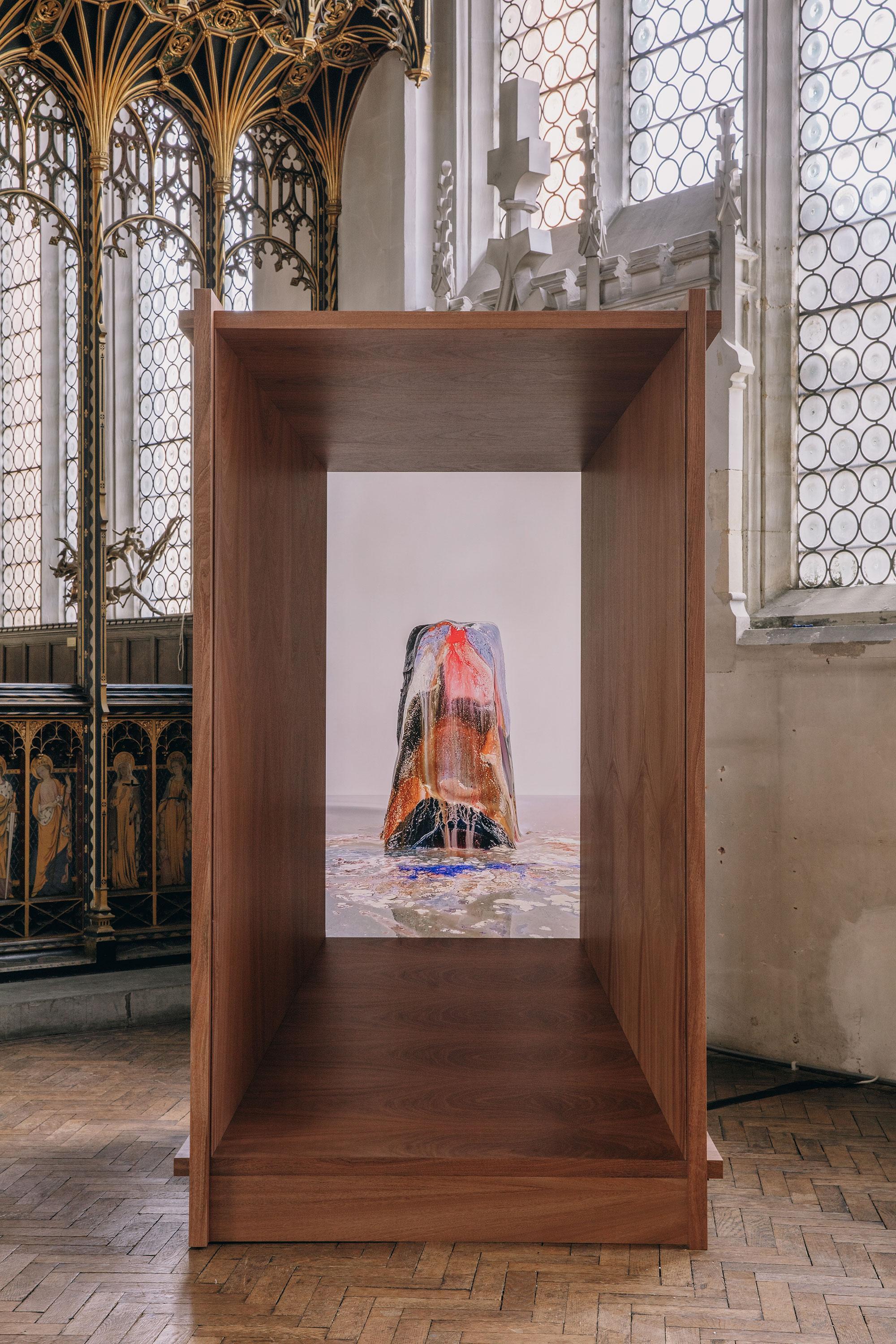
From July 7 to 23, 2022, Into Air was exhibited, under the curation of Jenn Ellis, at St Cyprian’s, Clarence Gate, a historic church in London’s Marylebone district. The midcentury pews, pulpit, and altar inside the Gothic revival interior inspired Ng to design, in collaboration with EBBA architects, new wooden box structures to house the works, some of which stand vertically, and others which lay parallel to the floor.

Ng, Dawn_Into Air installation
Exhibition view of Into Air by Dawn Ng, St Cyprian’s Church, London, July 7–23, 2022. Photo: James Retief.

Ng, Dawn_Waterfall VII (installation view)
Installation shot of Waterfall VII, 2022. Single-channel 4K video, 25 mins, 24 sec. Photo: James Retief. [watch video]

By displaying these works inside a sacred space, their spiritual implications become even more pronounced.

Impermanence is a theme that shows up in the sacred texts of all major religions, not least in the Bible, where we humans are reminded again and again of our mortality. Our days are like grass, which sprouts up and then withers (Isa. 40:6–7; Ps. 103:15–16; 1 Pet. 1:24). Our lives, but a sigh (Ps. 90:9–10), a shadow (Ps. 102:11), a mist (James 4:14), a breath (Ps. 39:5; Job 7:7; 7:16). We are made of dust and return to dust (Eccles. 3:20).

And not only are we finite; so is the present order of things. Even heaven and earth will pass away, Jesus says (Matt. 24:35; Mark 13:31; Luke 21:33; cf. Heb. 1:10–12). But, crucially, God and God’s word stand forever (Isa. 40:8; Matt. 7:24–27). True stability and unchangingness can be found only in God, Christians believe. God is a Rock that does not crumble, a strong foundation on which to stand, in life and in death.

The brevity of life may sound like a fearsome reality, but actually, it can serve to make our moments here on earth more precious and purposeful. Because our lives are but a short span, we must make the most of them while we can. Christians believe that everyone will one day have to give an account of what we did with the time God gifted to us. Did we share it freely with others, or keep it all for ourselves? Did we use it to cultivate virtue or to pursue vice?

The exhibition at St Cyprian’s also involved the premiere of a site-specific choral work by the London-based Welsh composer Alex Mills. A direct response to Ng’s art, his composition is also called Into Air and lasts about twenty-five minutes, the length of Ng’s Waterfall VII.

“In the piece,” Mills writes,

five singers undergo a musical meditation where each moves through the music to the rhythm of their own breaths, one bar of music for every exhale. Musical structures slowly build and disintegrate, evolve and transform, melt and evaporate. Textures, harmonies and colours – some delicate, others more pronounced – appear, disappear and re-emerge. Combing different singers’ breathing patterns gives the piece an indeterminate quality: the piece will never be the same twice and may even be radically different from one performance to the next. As such, the piece is not a fixed musical object that can be ‘performed’. Instead, it is a transient, ephemeral and elusive moment in time to be experienced.

The debut performance featured singers Jess Dandy, Rebecca Hardwick, Feargal Mostyn-Williams, James Robinson, and Ben Rowarth. It was recorded and turned into a gorgeous film by Bobby Williams, embedded above.*

The first singer stands at a kneeler. The second, at a pulpit. They establish the solemn mood. Two male singers sing from the organ loft, and another stands behind the rood screen with his arms crossed over his chest, as if in prayer. Haunting and mesmerizing, the five voices reflect off the stone architecture and meld together, sometimes harmoniously, sometimes in dissonance.

To everything there is a season. Starting at around 10:35, Mills incorporates keywords from Ecclesiastes 3:1–8, a biblical passage made especially famous by the Byrds: “gather,” “scatter,” “heal,” “kill,” “dance,” “mourn.” The author of Ecclesiastes is describing the tide of events that make up a life.

Periodically throughout the performance, a metal singing bowl resounds—a tool commonly used to deepen meditation. It is struck alternately by Ng and Mills, who are seated cross-legged at the front side of the church.  

Dawn Ng and Alex Mills at the premiere of Mills’s Into Air, St Cyprian’s Church, London, July 8, 2022. Photo: Damian Griffiths and Sarah Isabelle Tan.

Mills’s Into Air received a second performance just last week on February 8 at the launch of Music & Being, an initiative he founded with Jess Dandy. Music & Being is an open laboratory space in London exploring the intersection of art, music, psychology, spirituality, ecology, and movement.

As we near Ash Wednesday, the start of Lent, Ng’s and Mills’s works remind us of how time slips and slides and ultimately ceases, at least time as we know it. What will we do with our fleeting lives? As they dissipate, what will remain? When our breath stops, will a resonance linger?

* Additional video credits: Special thanks to Apsara Studio, Rose Lejeune, Performance Exchange, Ursula Sullivan, and Sullivan+Strumpf.

Lenten Art Videos from Loyola Press

Lent begins on Wednesday, February 22. I won’t be doing daily Lenten posts like I did last year, though I will be sharing seasonal content once or twice a week. If you want a set of new daily art-driven devotions that are freely accessible online, I’d encourage you to follow The Lent Project, run by the Center for Christianity, Culture, and the Arts at Biola University; each day features a scripture passage, a poem, a visual artwork, a piece of music, and a written reflection. I’d also direct you to my Lent Playlist (new additions at bottom) and Holy Week Playlist on Spotify.

Spitzweg, Carl_Ash Wednesday
Carl Spitzweg (German, 1808–1885), Ash Wednesday, 1860. Oil on canvas, 21 × 14 cm. Staatsgalerie Stuttgart, Stuttgart, Germany.

Another spiritual formation resource for Lent is the following series of Arts & Faith videos from Loyola Press, made in 2014–16. Each video features a three-minute commentary by Dr. Daniella Zsupan-Jerome on a historical artwork, chosen based on one of that day’s/week’s scripture readings from the Roman Catholic Mass Lectionary, which is currently in year A. Zsupan-Jerome is the director of ministry formation and field education at Saint John’s School of Theology and Seminary in Collegeville, Minnesota. Here she has crafted a “visual prayer experience” inspired by the Ignatian imagination. In his Spiritual Exercises, Saint Ignatius of Loyola, the founder of the Society of Jesus (the Jesuits), encourages Christians to apply the senses of sight, hearing, smell, touch, and taste to our reading of and meditation on the New Testament, imagining ourselves as present in the Gospel scenes.

Go to the “Arts & Faith: Lent” homepage, or see below, where the link on each artwork title will take you to a new tab where the corresponding video commentary is hosted on the Loyola website. I’ve included sample embeds of a few of the videos below.  

Arts & Faith: Lent, Cycle A

> ASH WEDNESDAY: Pieter Brueghel the Elder, The Fight Between Carnival and Lent, 1559

> WEEK 1: Ivan Kramskoi, Christ in the Desert, 1872

> WEEK 2: Raphael, Transfiguration, 1518–20

> WEEK 3: St. Photini (The Woman at the Well) (Orthodox icon)

> WEEK 4: El Greco, Christ Healing the Blind, ca. 1567

> WEEK 5: János Vaszary, Resuscitation of Lazarus, 1912

> PALM SUNDAY: Giotto di Bondone, Entry into Jerusalem, ca. 1305

> HOLY THURSDAY: Bernhard Strigel, Christ Washing the Disciples’ Feet, ca. 1520

> GOOD FRIDAY: Titian, Christ and the Good Thief, ca. 1566

> HOLY SATURDAY: Triumph of the Cross, 12th century, apse mosaic from the Basilica of San Clemente, Rome

> EASTER SUNDAY: Piero della Francesca, The Resurrection of Jesus Christ, 1463

Arts & Faith: Lent, Cycle B

> ASH WEDNESDAY: Carl Spitzweg, Ash Wednesday, 1860

> WEEK 1: The Temptation of Christ, 12th century, Basilica of St. Mark, Venice

> WEEK 2: Francesco Zuccarelli, Landscape with the Transfiguration of Christ, 1788

> WEEK 3: Quentin Matsys, Jesus Chasing the Merchants from the Temple, 16th century

> WEEK 4: James Tissot, Interview between Jesus and Nicodemus, 1886–94

> WEEK 5: Vincent van Gogh, The Sower, 1888

> PALM SUNDAY: Caravaggio, The Denial of Saint Peter, 1610

> HOLY THURSDAY: Tintoretto, Christ Washing the Disciples’ Feet, 1548–49

> GOOD FRIDAY: Master of the Karlsruhe Passion, The Capture of Christ, ca. 1450

> HOLY SATURDAY: Jacopo di Cione, The Three Marys at the Sepulchre, detail from the San Pier Maggiore Altarpiece, 1370–71

> EASTER SUNDAY: Eugène Burnand, The Disciples Peter and John Running to the Sepulchre on the Morning of the Resurrection, 1898

Arts & Faith: Lent, Cycle C

> ASH WEDNESDAY: John Berney Crome, Great Gale at Yarmouth on Ash Wednesday, 1836

> WEEK 1: Limbourg Brothers, The Temptation of Christ, 1411–16

> WEEK 2: Lorenzo Lotto, The Transfiguration of Christ, ca. 1511

> WEEK 3: Alexey Pismenny, Parable of the Fruitless Fig Tree, 2008

> WEEK 4: Rembrandt van Rijn, The Return of the Prodigal Son, ca. 1668

> WEEK 5: Palma il Vecchio, Christ and the Adulteress, ca. 1525–28

> PALM SUNDAY: Wilhelm Morgner, Entry of Christ into Jerusalem, 1912

> HOLY THURSDAY: Christ Washing the Feet of His Disciples, ca. 1210, Basilica of St. Mark, Venice

> GOOD FRIDAY: Andrea Mantegna, The Dead Christ (Lamentation of Christ), 1475–78

> HOLY SATURDAY: The Women at the Tomb; The Descent into Limbo, Armenia, 1386

> EASTER SUNDAY: Redemption Window (detail), Corona Chapel, Canterbury Cathedral, ca. 1200–1207

Lent, Day 40 (In the Grave)

I am counted with them that go down into the pit: I am as a man that hath no strength:

Free among the dead, like the slain that lie in the grave, whom thou rememberest no more: and they are cut off from thy hand.

Thou hast laid me in the lowest pit, in darkness, in the deeps.

Thy wrath lieth hard upon me, and thou hast afflicted me with all thy waves. Selah.

Thou hast put away mine acquaintance far from me; thou hast made me an abomination unto them: I am shut up, and I cannot come forth.

. . .

Wilt thou shew wonders to the dead? shall the dead arise and praise thee? Selah.

Shall thy lovingkindness be declared in the grave? or thy faithfulness in destruction?

Shall thy wonders be known in the dark? and thy righteousness in the land of forgetfulness?

—Psalm 88:4–8, 10–12 (KJV)

LOOK: Playa Studies by Craig Goodworth (HT)

Goodworth, Craig_Playa Studies
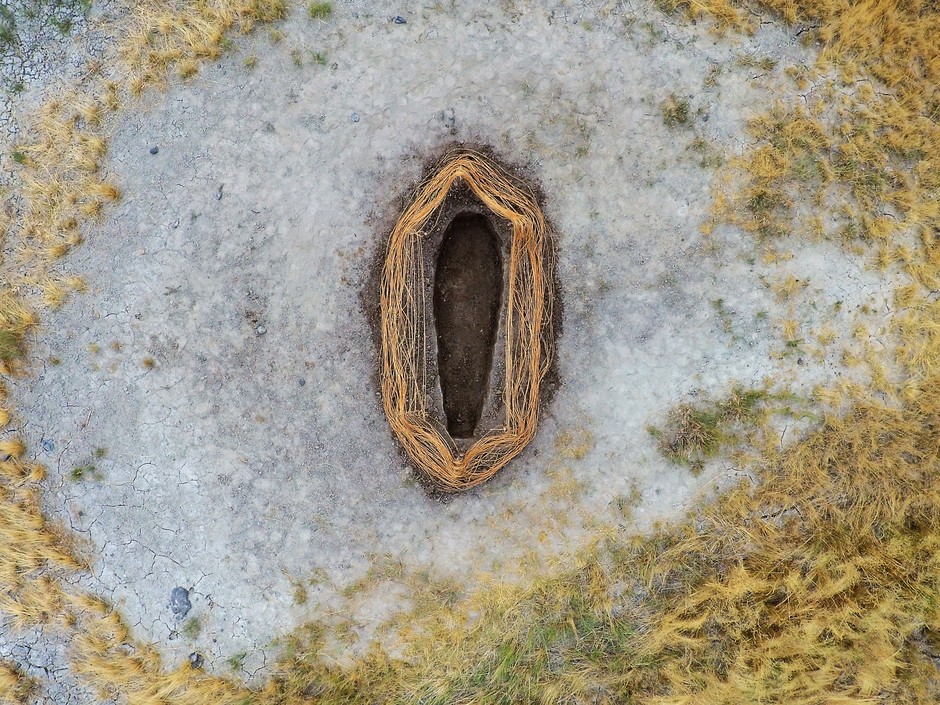
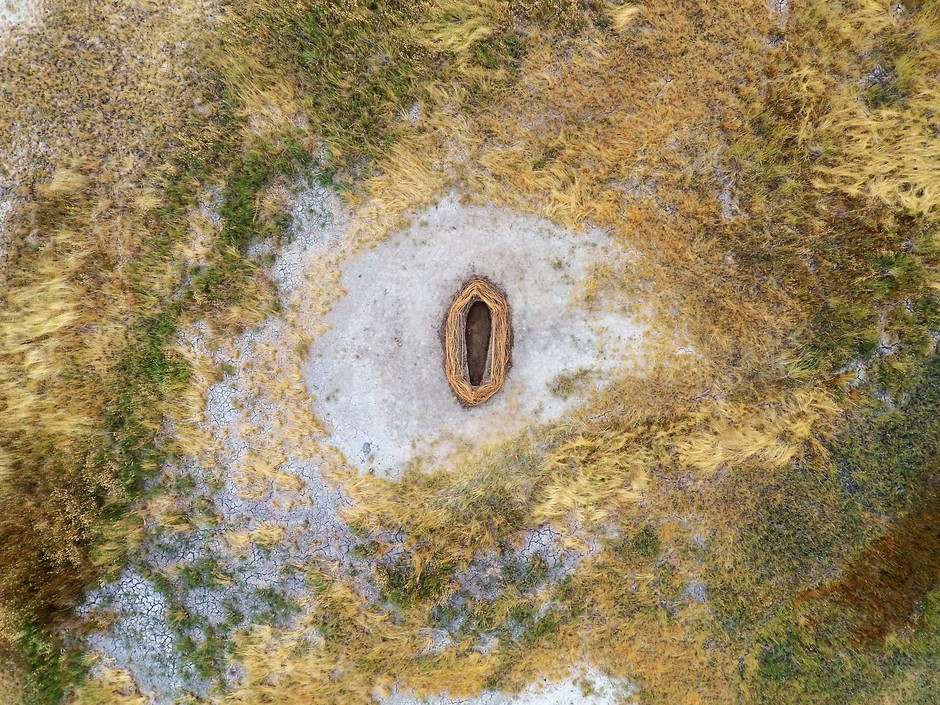
Craig Goodworth (American, 1977–), Playa Studies, 2017. Site-specific land-based artwork, Great Basin Desert, Oregon. Photograph by the artist.

Craig Goodworth’s practice encompasses installation, poetry, drawing, research, teaching, and farm labor. He holds master’s degrees in fine art, sustainable communities, and divinity, and his interests include land, place, religion, mysticism, and folk traditions.

During a four-week residency in the Great Basin Desert in Oregon, he made a series of land-based artworks called Playa Studies, which he documented through photographs. (A playa is an area of flat, dried-up land.) The shape of this one evokes a grave.

LISTEN: “Aestimatus sum” (I am counted . . .) by Tomás Luis de Victoria, 1585 | Performed by Ars Nova Copenhagen, dir. Paul Hillier, 2017

Aestimatus sum cum descendentibus in lacum,
factus sum sicut homo sine adjutorio, inter mortuos liber.
    Versus: Posuerunt me in lacu inferiori, in tenebrosis et in umbra mortis.
Factus sum sicut homo sine adjutorio, inter mortuos liber.

English translation:

I am counted with them that go down into the pit:
I am as a man that hath no strength: free among the dead.
    Verse: They have laid me in the lowest pit, in darkness, in the deeps.
I am as a man that hath no strength: free among the dead.

This is the eighth responsory for Holy Saturday. Tomás Luis de Victoria [previously] of Spain, one of the principal composers of the late Renaissance, set it to music in 1585. It’s the penultimate motet (a multivoiced musical composition sung without instrumental accompaniment) in a set of eighteen by Victoria, titled Tenebrae Responsories.

The text is taken from Psalm 87:5–7 of the Latin Vulgate (Psalm 88:4–6 in the King James Version and most modern translations). The most depressing psalm in the Psalter, Psalm 88 ends not on a note of hope but with the lament that “darkness has become my only companion.” (Hello darkness, my old friend.)

While the psalmist spoke in metaphors of death, Jesus went there literally. After suffering much affliction, he descended “into the pit” of the earth—his grave. He knew emotional and spiritual darkness, and now he was surrounded by the physical reality. The Light had gone out. The Word was made silent.

Imagine what Jesus’s followers must have felt the day after the Crucifixion. Grief, devastation, loneliness, bewilderment, hopelessness. They were left bereft of their Lord’s presence.

On Holy Saturday, we sit in the pocket of that grief, that loss.

N. T. Wright says, “We cannot be Easter people if we are not first Good Friday people and then Holy Saturday people. Don’t expect even a still, small voice. Stay still yourself, and let the quietness and darkness of the day be your only companions.”

Lent, Day 39 (“Simeron Kremate”)

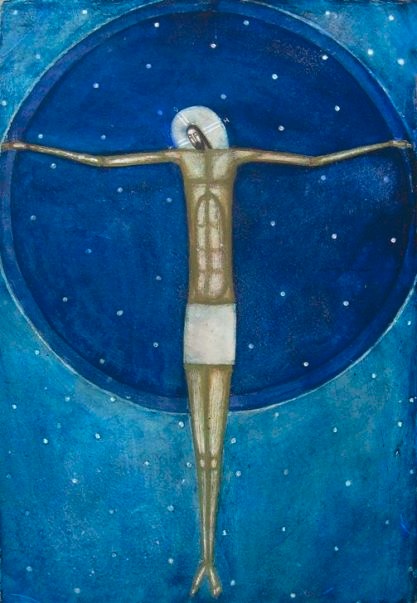
LOOK: Crucifixion by Natalya Rusetska

Rusetska, Natalya_Crucifixion
Natalya Rusetska (Ukrainian, 1984–), Crucifixion, 2013. Egg tempera on gessoed board, 20 × 13.5 cm.

LISTEN: “Σήμερον Κρεμάται” (Simeron Kremate), an antiphon for Great and Holy Friday, in plagal second mode, from the Greek Orthodox Church

>> Chanted in English by Vassilis Hadjinicolaou:

[Greek]
Σήμερον κρεμᾶται ἐπὶ ξύλου, ὁ ἐν ὕδασι τὴν γῆν κρεμάσας.
Στέφανον ἐξ ἀκανθῶν περιτίθεται, ὁ τῶν Ἀγγέλων Βασιλεύς.
Ψευδῆ πορφύραν περιβάλλεται, ὁ περιβάλλων τὸν οὐρανὸν ἐν νεφέλαις.
Ῥάπισμα κατεδέξατο, ὁ ἐν Ἰορδάνῃ ἐλευθερώσας τὸν Ἀδάμ.
Ἥλοις προσηλώθη, ὁ Νυμφίος τῆς Ἐκκλησίας.
Λόγχῃ ἐκεντήθη, ὁ Υἱὸς τῆς Παρθένου.
Προσκυνοῦμέν σου τὰ Πάθη Χριστέ.
Δεῖξον ἡμῖν, καὶ τὴν ἔνδοξόν σου Ἀνάστασιν.

[Transliterated Greek]
Símeron kremátai epí xýlou, o en ýdasi tín gín kremásas.
Stéfanon ex akanthón peritíthetai, o tón Angélon Vasiléfs.
Psevdí porfýran periválletai, o perivállon tón ouranón en nefélais.
Rápisma katedéxato, o en Iordáni eleftherósas tón Adám.
Ílois prosilóthi, o Nymfíos tís Ekklisías.
Lónchi ekentíthi, o Yiós tís Parthénou.
Proskynoúmén sou tá Páthi Christé.
Deíxon imín, kaí tín éndoxón sou Anástasin.

[English translation]
Today he who hung the earth upon the waters is hung on the tree.
The King of the angels is decked with a crown of thorns.
He who wraps the heavens in clouds is wrapped in the purple of mockery.
He who freed Adam in the Jordan is slapped on the face.
The Bridegroom of the church is affixed to the cross with nails.
The Son of the virgin is pierced by a spear.
We worship thy passion, O Christ.

We worship thy passion, O Christ.
Show us also thy glorious resurrection.

This is the fifteenth antiphon (short hymn) from the Matins service of Great and Holy Friday (as the day is called in the Orthodox tradition), celebrated on Thursday evening.

>> Arranged by Fr. Seraphim Dedes, chanted by Paul Barnes, 2019:

(An abbreviated version appears as “Byzantine Chant II: Simeron Kremate” on Barnes’s 2021 album Illumination; see my Holy Week Playlist.)

Paul Barnes is both a pianist and a Greek Orthodox chanter. Here he chants the “Simeron Kremate,” starting out in Greek and then using the following English translation:

Today he who suspended the earth on the waters is suspended on a cross. (×3)
The King of the angels wears a crown of thorns.
He who wraps the sky in clouds is wrapped in a fake purple robe.
He who freed Adam in the Jordan accepts to be slapped.
The Bridegroom of the church is fixed with nails to the cross.
The Son of the virgin is pierced with a spear.
We worship your passion, O Christ. (×3)
Show us also your glorious resurrection.

Seven of his piano majors from the Glenn Korff School of Music provide the ison (drone note).

>> Simeron Kremate, a solo keyboard work by Victoria Bond based on the Greek Orthodox chant, performed by Paul Barnes, 2019:

Paul Barnes and composer Victoria Bond are longtime collaborators. He introduced her to the “Simeron Kremate” chant, and she built a piano composition around its five-note melody. Struck by its similar melodic contour, she incorporated the Jewish Passover chant “Tal” (Dew), a prayer that life-sustaining dew would water the land. This prayer is traditionally chanted on the first morning of Passover (which is tomorrow; the festival begins this evening). Bond, who is Jewish, notes the thematic resonance between the two chants as well: (in my own words) the one a request for fruitfulness and refreshment, the other a lament for the death of the One whose death bears fruit and brings life. She describes the musical elements of the composition as follows:

The work opens with the traditional apichima of the plagal of the second mode which aurally establishes the musical atmosphere of the mode. Victoria follows this with a Jewish style cantillation (based on the cantillation of the great cantor Yosele Rosenblatt) which leads to the first statement of the “Simeron” chant. These opening notes are then developed in multiple ways before the intimate entry of the “Tal” melody. The work concludes with a ‘tranquillo’ passage of rare beauty ingeniously combining both themes. The work ends tentatively and unresolved as the opening notes of the chant dissipate into eternity.

Lent, Day 37 (Blood and Tears)

Anyone who cries at night, the stars and the constellations cry with him.

Babylonian Talmud, Sanhedrin 104b

LOOK: Blood and Tears by Hélène Mugot

Mugot, Hélène_Blood and Tears
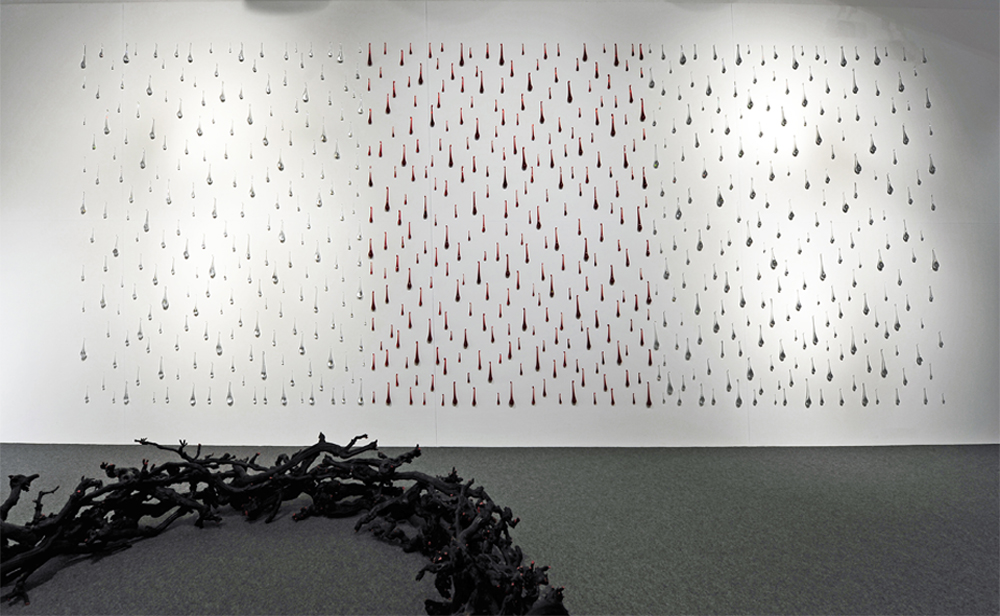
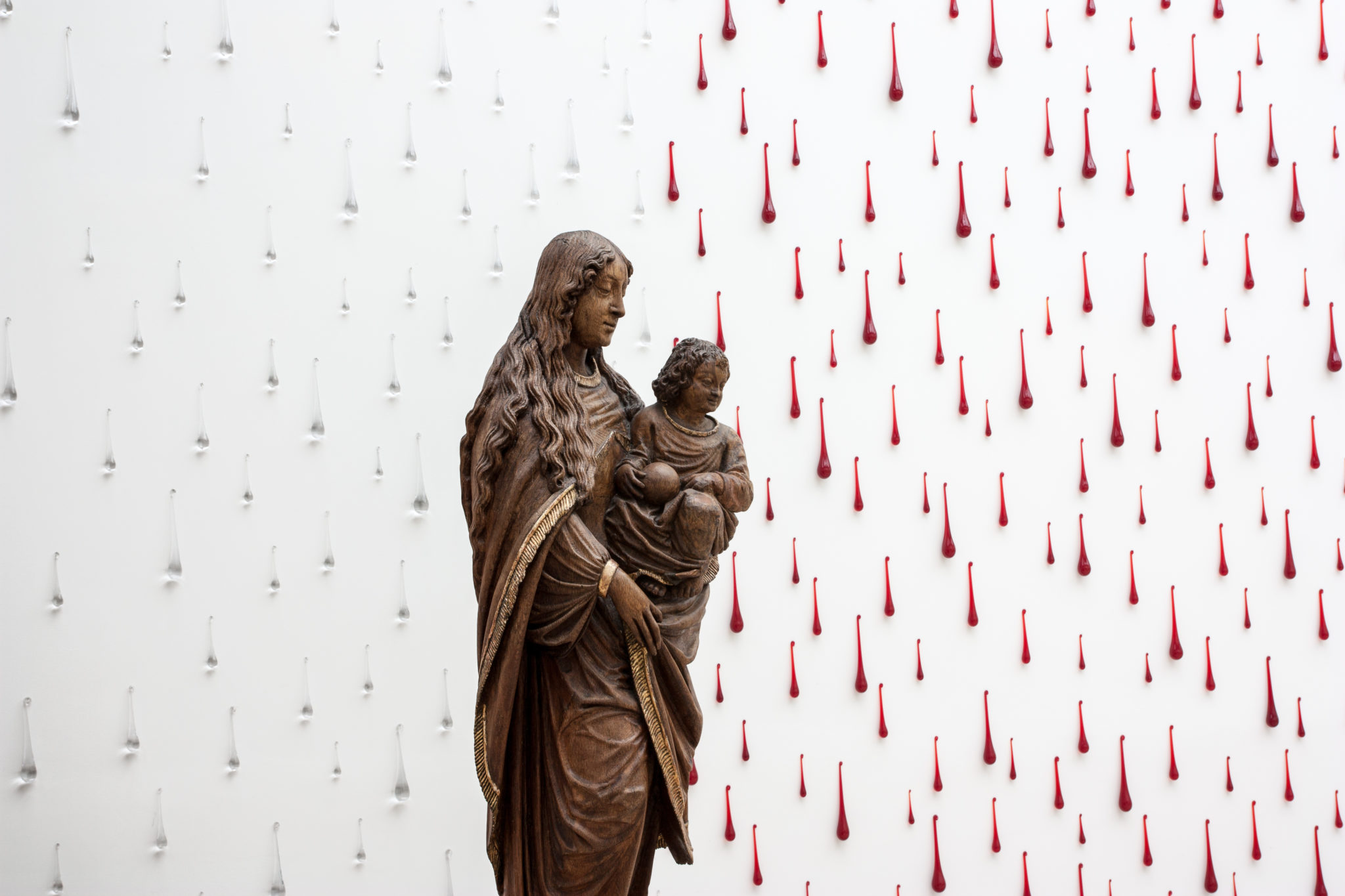
Hélène Mugot (French, 1953–), Du sang et des larmes (Blood and Tears), 2004. Triptych of 300 crystal drops and 200 red glass drops, 350 × 900 cm. Exhibition view from Icare encore at the Mandet Museum, Riom, France, October 22, 2011–January 22, 2012. (Foreground: Pour la gloire… [For the Glory…], 2011.)

Mugot, Hélène_Blood and Tears

When Jesus went out to the garden of Gethsemane to pray the night of his arrest, he pled with the Father to let the cup of suffering pass. Luke says he sweated drops of blood (22:44). He was in agony. He probably dreaded the physical torture he knew was coming, and maybe even more his disciples’ abandoning him. Perhaps he wept for the mother and friends he would leave behind in this next phase of ministry—or, with a mixture of grief and frustration, for the world’s failure to see who he truly was.

Hélène Mugot’s Du sang et des larmes, which translates to Blood and Tears, is an installation of glass pieces made to look like bodily fluids. They hang on the wall in the shape of a three-paneled altarpiece—blood in the center, tears on the wings. The globular forms catch the light from the room and shine.

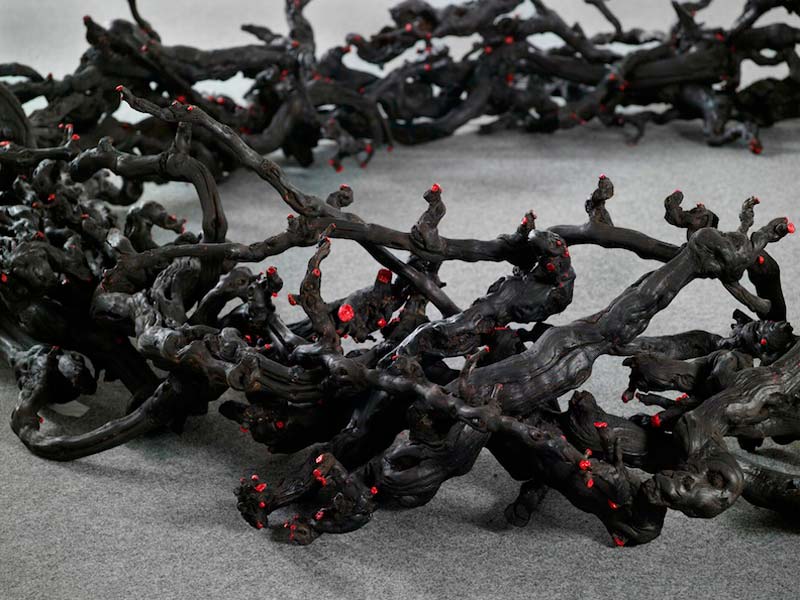
When Du sang et des larmes was exhibited at the Mandet Museum in 2011, it was part of a larger show of Mugot’s work. On the floor in front of it was her Pour la gloire… (For the Glory…), a menacingly large braided wreath of thick, knotted, blackened vines whose stumps are dotted with red wax of the type used to seal wine bottles—both bandage and wound here, Mugot says. The piece is meant to evoke Jesus’s crown of thorns.

Mugot, Helene_For the Glory
Hélène Mugot (French, 1953–), Pour la gloire… (For the Glory…), 2011. Old vines and red sealing wax, outside diameter 275 cm, height 50 cm. Exhibited at the Mandet Museum, Riom, France, 2011. Photo: Patrick André.

In 2013 Du sang et des larmes joined the collection of the Musée du Hiéron in Paray-le-Monial, France, a museum of Christian art from the Middle Ages to today. There it is staged as the backsplash to a seventeenth-century Virgin and Child statuette carved in wood, thus prompting us to read Christ’s infancy in light of his passion, and vice versa—the Incarnation as a total event, spanning birth to death. (Cue Simeon’s “A sword will pierce your soul . . .”)

Mugot, Hélène_Blood and Tears (with Virgin and Child)
Virgin and Child, 17th century; Du sang et des larmes by Hélène Mugot. Collection of the Musée du Hiéron, Paray-le-Monial, France. Photo: Jean-Pierre Gobillot.

To fit the space, the number of droplets and overall size changed slightly from the piece’s first few installations: at the Hiéron there are 311 crystal drops and 267 red glass drops, and the dimensions are 420 × 650 cm.

LISTEN: “Flow, My Tears” by Toivo Tulev, 2007 | Text based on a 1600 air by John Dowland and the Improperia (aka, the Reproaches), a series of antiphons and responses expressing the remonstrance of Jesus Christ with his people | Performed by the Latvian Radio Choir, dir. Kaspars Putniņš, on Tulev: Magnificat, 2018

Flow, my tears,
fall from your springs,
flow my tears, fall from your . . .
Flow my tears,
fall from your springs,
fall, fall, fall,
flow, flow, my tears, flow.

Down, vain lights,
shine no more,
no nights are dark enough,
no lights,
shine no more,
flow no more,
no more.
Flow down, vain lights,
shine no more,
shine you no more.

I led you in a pillar of cloud
but you led me to . . .
I gave you saving water,
but you gave me gall
and you gave vinegar.
My people, what have I done to you?
What have I done to you? Answer me.
How have I offended you, you, you?
I opened the sea before you,
I opened the sea,
but you opened my side with a spear.

Flow, flow, flow down.
Rain, drop down,
cover the ground,
drop down, my blood,
flow, flow down,
drop down,
drop down, drop,
flow, flow, flow,
shine, flow, flow, shine!
Flow, my blood, flow,
flow, drop, flow down.

My blood spills from your wounds,
drop, drop, drop,
your wounds,
flow, flow, flow down,
flow, shine, drop, flow.
Flow my tears, fall from your springs,
flow, my blood.
My blood, my blood spills from your wounds,
my wounds,
my blood,
flow, blood, flow, flow,
shine!
Spills from your wounds
my blood, shine!
My wounds, my wounds,
drop down, shine!
From your, from my wounds,
shine!
Flow, drop down,
shine!
Flow, shine!
My, your blood,
shine!

My blood,
flow, shine, flow,
shine! shine!
Fall, shine, fall, shine,
fall from your . . .
flow, fall . . .
Shine!
Shine! [source]

Toivo Tulev is an Estonian composer born in 1958. In this choral composition for twelve solo voices, he has combined words from a secular Renaissance lute song and the Christian Holy Week liturgy. It’s ponderous and grating, capturing well Jesus’s psychological affliction.

While in the first half the speaker, Jesus, wishes for light to “shine no more” so that he be left alone in darkness, that imperative eventually evolves into the affirmative: “Shine!” Blood: shine! Tears: shine! Tulev’s clever manipulation of his lyrical source material creates allusions to the glory, the illumination, that is to come. Paradoxically, when the sun is eclipsed from noon to three on the day of crucifixion, God’s love shines brighter than ever.

One line that stands out to me is “My blood spills from your wounds.” Who is the “your”? Earlier Jesus is talking to his people, but I interpret a shift here to God the Father as the addressee. Even though he sees through to the other side, he, too, is tremendously pained by what is unfolding—his only Son, killed. It’s as if Jesus’s wounds are his own (much like any parent would tell you, when their child is suffering). The unity of these two persons of the Godhead in the poetry of this song is really beautiful. Their heart is one.

Lent, Day 36 (Last Supper)

While they were eating, Jesus took a loaf of bread, and after blessing it he broke it, gave it to the disciples, and said, “Take, eat; this is my body.” Then he took a cup, and after giving thanks he gave it to them, saying, “Drink from it, all of you; for this is my blood of the covenant, which is poured out for many for the forgiveness of sins.”

—Matthew 26:26–28 (cf. Mark 14:22–24; Luke 22:17–20)

The Lord Jesus on the night when he was betrayed took a loaf of bread, and when he had given thanks, he broke it and said, “This is my body that is for you. Do this in remembrance of me.” In the same way he took the cup also, after supper, saying, “This cup is the new covenant in my blood. Do this, as often as you drink it, in remembrance of me.” For as often as you eat this bread and drink the cup, you proclaim the Lord’s death until he comes.

—1 Corinthians 11:23b–26

LOOK: The Last Supper III by Bruce Onobrakpeya

Onobrakpeya, Bruce_Last Supper III
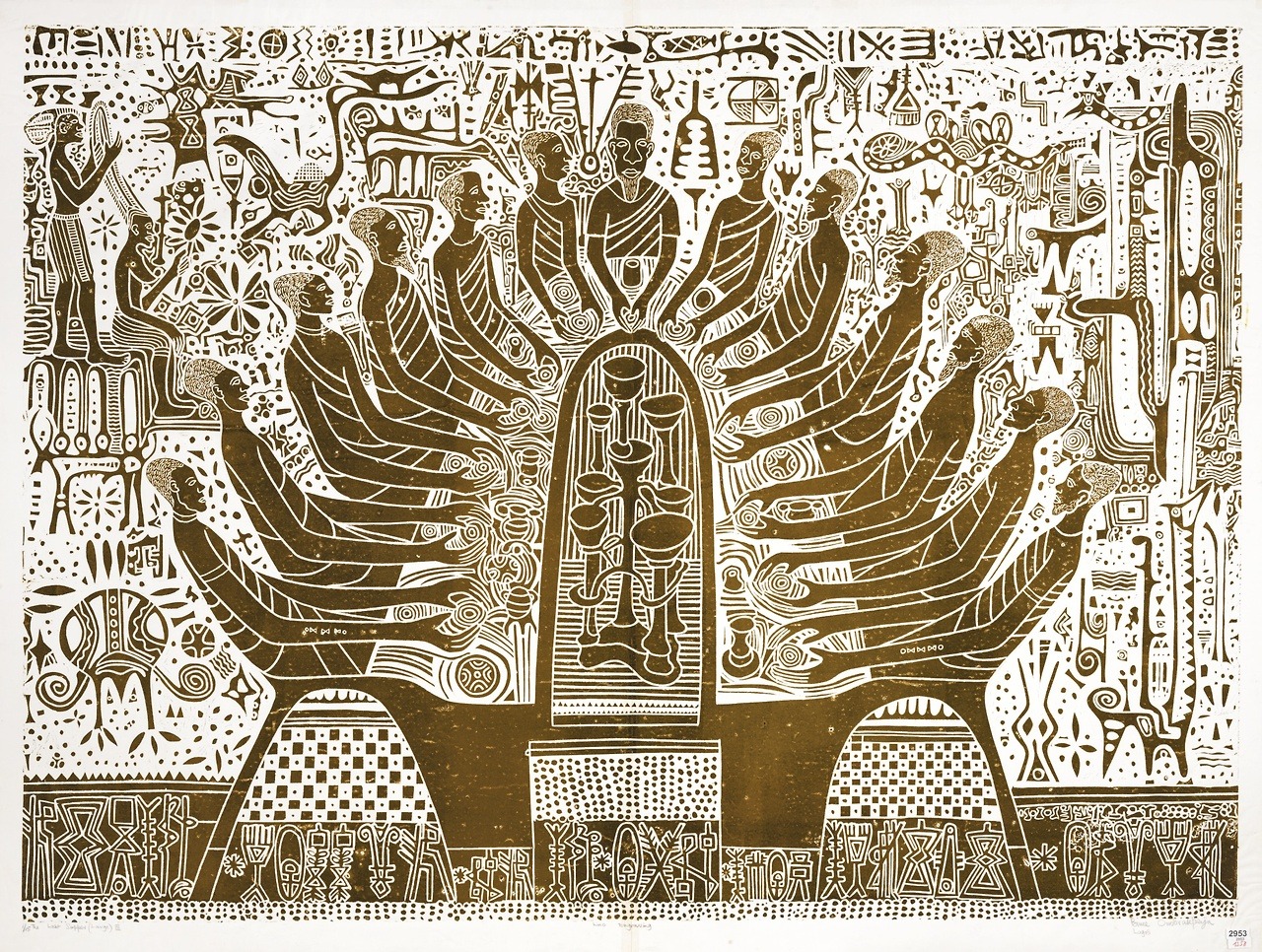
Bruce Onobrakpeya (Nigerian, 1932–), The Last Supper III. Lino engraving on rice paper, 58 × 62 3/4 in. (147 × 195 cm). Edition 1/15.

A pioneer of modern African art, Bruce Onobrakpeya is an internationally renowned Nigerian printmaker, painter, and sculptor of Urhobo heritage. He was raised Christian and has fulfilled several commissions on Christian themes, especially from 1967 to 1981. (I wrote about his Stations of the Cross series of colored linocut prints on my old blog.) His work also explores Urhobo traditional religion, culture, and history and the modern world of Nigeria.

In Onobrakpeya’s Last Supper III, Jesus sits at the head of an oblong table with his twelve disciples, making eye contact with the viewer. The food and drink are highly stylized, but the men appear to be breaking bread. The background features the Ibiebe alphabet, a script of ideographic geometric and curvilinear glyphs that Onobrakpeya developed.

LISTEN: “Take, Eat” by Josh Garrels, on Chrysaline (2019)

Take, eat
This is my body
Broken for your healing
This is my blood
Shed for remission
And forgiveness of your sin

Do this to remember what I’ve done for you
Do this to remember me

Lent, Day 35 (Anointing at Bethany)

LOOK: Mary Magdalen by Eric Gill

Gill, Eric_Mary Magdalen
Eric Gill (British, 1882–1940), Mary Magdalen, 1926. Wood engraving on paper, 6.3 × 6.3 cm. Tate Gallery, London.

(Related post: https://artandtheology.org/2020/04/05/holy-monday-artful-devotion/)

LISTEN: Adagio in G minor for violin, strings, and organ | Attributed to Tomaso Albioni, 18th century, but possibly entirely by Albioni biographer Remo Giazotto, 1958 | Performed by the Budapest Franz Liszt Chamber Orchestra

Today is the second day of Holy Week, the final week of Jesus’s life. One event that takes place during this period—on Wednesday, according to the chronologies of Matthew and Mark—is a woman’s anointing Jesus with oil. All four Gospel writers include the story, with variations (and Luke places it earlier in Jesus’s ministry). Love, hospitality, sacrifice, and honor are key themes. The woman is unnamed in the Synoptic Gospels, but John identifies her as Mary Magdalene. Praising her initiative, Jesus clarifies to those gathered that she anoints him in preparation for his burial (Matt. 26:12; Mark 14:8; John 12:7). It was a solemn act.

In addition, scholars have pointed out the deliberate allusions to the coronation ceremonies of Israel’s kings. Elisabeth Schüssler Fiorenza, in In Memory of Her: A Feminist Theological Reconstruction of Christian Origins, writes,

Since the prophet in the Old Testament anointed the head of the Jewish king, the anointing of Jesus’ head must have been understood immediately as the prophetic recognition of Jesus, the Anointed, the Messiah, the Christ. According to the tradition it was a woman who named Jesus by and through her prophetic sign-action. It was politically a dangerous story. (xiv)

Richard A. Horsley says that when the woman anointed Jesus, she was “literally ‘messiah-ing’ or ‘christ-ing’ him” (Hearing the Whole Story: The Politics of Plot in Mark’s Gospel, 207).

Sometimes it was a priest who anointed the new king, so the act could be read as not only prophetic but also sacramental. That is, Mary serving here as prophet and priest.

Someone, I forget who, once noted that Jesus would have gone to the cross with this aromatic fragrance still on him. The smell would have lingered with his sweat and blood and was perhaps a comfort to him in his hours of deepest distress, reminding him of the loving devotion of one of his disciples. It was also a proclamation to all the actors and bystanders, as he moved up Golgotha’s hill and was crucified, that he is indeed the Anointed One of God.

Palm Sunday

O give thanks to the LORD, for he is good;
    his steadfast love endures forever!

Let Israel say,
    “His steadfast love endures forever.”

. . .

Open to me the gates of righteousness,
    that I may enter through them
    and give thanks to the LORD.

This is the gate of the LORD;
    the righteous shall enter through it.

I thank you that you have answered me
    and have become my salvation.
The stone that the builders rejected
    has become the chief cornerstone.
This is the LORD’s doing;
    it is marvelous in our eyes.
This is the day that the LORD has made;
    let us rejoice and be glad in it.
Save us, we beseech you, O LORD!
    O LORD, we beseech you, give us success!

Blessed is the one who comes in the name of the LORD.
    We bless you from the house of the LORD.
The LORD is God,
    and he has given us light.
Bind the festal procession with branches,
    up to the horns of the altar.

You are my God, and I will give thanks to you;
    you are my God, I will extol you.

O give thanks to the LORD, for he is good,
    for his steadfast love endures forever.

—Psalm 118:1–2, 19–29

 The crowds that went ahead of [Jesus] and that followed were shouting,

“Hosanna to the Son of David!
    Blessed is the one who comes in the name of the Lord!
Hosanna in the highest heaven!”

—Matthew 21:9

LOOK: Palm Sunday, Home Depot Parking Lot by Gary Bergel

Bergel, Gary_Palm Sunday, Home Depot Parking Lot
Gary Bergel (American, 1943–), Palm Sunday, Home Depot Parking Lot. Digital photograph. Part of the traveling CIVA exhibition Again & Again.

LISTEN: “Blessed Is the One (Psalm 118)” by Tim Coons of Giants & Pilgrims | Performed by Tim Coons (guitar, vocals) and Craig Basarich (trumpet), 2020

Blessed is the one who comes in the name of the Lord (×4)

Hosanna (×4)

Blessed is the one who comes in the name of the Lord (×4)

Hosanna (×4)

Hosanna (×4)

Lent, Day 34

“Come unto me, all ye that labour and are heavy laden, and I will give you rest.”

—Matthew 11:28 (KJV)

LOOK: 62-33 (White Feathers on White Background) by Henk Peeters

Peeters, Henk_White Feathers
Henk Peeters (Dutch, 1925–2013), 62-33 (White Feathers on White Background), 1962. Feathers and velvet on hardboard, 153 × 133 cm. Stedelijk Museum Amsterdam, Netherlands. Photo: Victoria Emily Jones. [object record]

Peeters, Henk_White Feathers (detail)

Soft, light, pillowy, peaceful.

LISTEN: “Rest” by Sarah Juers, on In Moonlight (2017)

https://soundcloud.com/jesusloverrr/rest

“Come to me, all who are heavy with burden
And I’ll give you rest”

And be still and know
That he is God alone
And be still and know
He is good

“Come to me, come to me and rest”

(Related post: https://artandtheology.org/2021/12/19/advent-day-22/)

Lent, Day 33

But he was wounded for our transgressions,
    crushed for our iniquities;
upon him was the punishment that made us whole,
    and by his bruises we are healed.

—Isaiah 53:5

LOOK: Cuts by Johannes Phokela

Phokela, Johannes_Cuts
Johannes Phokela (South African, 1966–), Cuts, 1990. Acrylic and string on canvas, 83 1/16 × 83 1/16 in. (211 × 211 cm). Smithsonian National Museum of African Art, Washington, DC.

For this gruesome artwork, Johannes Phokela slashed a canvas in many spots with a razor, then stitched up the gashes with heavy string. He then painted over the gashes from the back with crimson paint until it bled through, forming a deep red along the seams and a flesh-pink further out, evocative of scar tissue. Then, as if to memorialize the wounds, he painted twenty gold frames over them in rows of five across and four down.

Phokela often uses painted frames or grids as a compositional device in his work. “The grid gives another dimension to the work; it is a device to challenge the viewer’s perception of the image and form beneath,” he said in a 2002 interview with Bruce Haines. “It is intended to have an effect like an ornamental frame surrounding a mirror, or a glass pane mounting a picture. . . . You have to regard it as part of the work, just like the traditional frame of a painting. . . . It gives the work a sort of focal point that can stimulate the viewer’s reaction.”

I was simultaneously drawn to and repulsed by this painting when I saw it exhibited as part of Conversations: African and African American Artworks in Dialogue at the Smithsonian in 2014. It is large—almost seven square feet. From a distance the image looks rather rose-like, a concentric arrangement of short red lines slightly curled like petals. It wasn’t until I got closer that I saw it portrays the vulnerability of human flesh, savagely torn.

When I’m at an art museum I like to look at each artwork before reading its label so that I can register my initial impressions and begin to form an interpretation before I receive the curator’s. (I hope you do the same when you encounter artworks on this website!) When I saw this one, I thought of how Christ was wounded for our transgressions, but those wounds became his glory—and ours. In art history Jesus is sometimes shown with light emanating from the holes in his hands, especially in images where he is exalted in heaven. For me, the gold in Cuts suggests a redemptive framework—like it’s asking us to view the horrors of the cross through the lens of glory. In addition, the gold frames within the picture plane seem to emphasize that these wounds are something worthy of being looked at, even meditated upon, as frames show us what’s important, directing our gaze.

Well, here’s what the label said:

On a trip home to South Africa in 1989, Phokela was distressed to see the state of violence that existed as a result of political rivalry and unrest. Disturbed by the bandaged and scarred faces and bodies of his fellow citizens and by the fact that everyone seemed to accept the situation as normal, the artist created a canvas of cuts overlaid with gold frames to distance himself from the violence.

So, Phokela, a Black South African who was born and raised in Soweto but had been living in London since 1987, painted this as a response to the violence of apartheid in his home country. Whoever wrote this text sees the frames as putting us at further remove from the cuts that are represented, as they form an intervening layer between us and them. A legitimate reading, though I haven’t found any statements from Phokela that express this intent. What I did find from him regarding his use of frames in general, I quoted above.

Having learned the particular context out of which this painting arose, I then considered what Jesus’s crucifixion has to say to human suffering today. What relevance has a Galilean man’s torture and execution two thousand years ago to present-day men and women who are beaten and abused?—in this case, because of their race.

Jesus’s death exposed and put to shame the powers of evil, those which assault God and God’s image-bearers. Surely there was much more going on with his death than just that (whole volumes, whole series of volumes, have been written to articulate a theology of the cross). But bringing to light the crimes of humanity—and at the same time, God’s supreme love—is one aspect. Opening up pathways of transformation, healing, reconciliation, and liberation is another.

LISTEN: “By His Wounds” by Bifrost Arts, feat. DM Stith, on He Will Not Cry Out, 2013 | Words by Isaac Wardell, 2011 | Music by Philip Hayes, 1786

By his wounds, his wounds, will we be healed
And for our transgressions, his passion has made us well
Let us come again and feed on him, our Lord Emmanuel

This melody was originally written in the eighteenth century by English composer, organist, singer, and conductor Philip Hayes (1738–1797), who published it in The Muses’ Delight: Catches, Glees, Canzonets, and Canons as a round setting of Psalm 137:1–2 (“By the waters of Babylon . . .”). The song became widely popular after Don McLean recorded it on his 1971 album American Pie and even more so in 2007, when it was used in a memorable montage in the TV series Mad Men.

Isaac Wardell, cofounder of the Bifrost Arts music collective and now director of The Porter’s Gate, put different words to Hayes’s melody in 2011, retaining the canon form. The first two lines reference the well-known Suffering Servant passage from Isaiah 53, and the last is an invitation to come to the Lord’s table—to take in unto ourselves the body and blood of Christ.