LISTEN: Adagio in G minor for violin, strings, and organ | Attributed to Tomaso Albioni, 18th century, but possibly entirely by Albioni biographer Remo Giazotto, 1958 | Performed by the Budapest Franz Liszt Chamber Orchestra
Today is the second day of Holy Week, the final week of Jesus’s life. One event that takes place during this period—on Wednesday, according to the chronologies of Matthew and Mark—is a woman’s anointing Jesus with oil. All four Gospel writers include the story, with variations (and Luke places it earlier in Jesus’s ministry). Love, hospitality, sacrifice, and honor are key themes. The woman is unnamed in the Synoptic Gospels, but John identifies her as Mary (of Bethany). Praising her initiative, Jesus clarifies to those gathered that she anoints him in preparation for his burial (Matt. 26:12; Mark 14:8; John 12:7). It was a solemn act.
Since the prophet in the Old Testament anointed the head of the Jewish king, the anointing of Jesus’ head must have been understood immediately as the prophetic recognition of Jesus, the Anointed, the Messiah, the Christ. According to the tradition it was a woman who named Jesus by and through her prophetic sign-action. It was politically a dangerous story. (xiv)
Sometimes it was a priest who anointed the new king, so the act could be read as not only prophetic but also sacramental. That is, Mary serving here as prophet and priest.
Someone, I forget who, once noted that Jesus would have gone to the cross with this aromatic fragrance still on him. The smell would have lingered with his sweat and blood and was perhaps a comfort to him in his hours of deepest distress, reminding him of the loving devotion of one of his disciples. It was also a proclamation to all the actors and bystanders, as he moved up Golgotha’s hill and was crucified, that he is indeed the Anointed One of God.
O give thanks to the LORD, for he is good; his steadfast love endures forever!
Let Israel say, “His steadfast love endures forever.”
. . .
Open to me the gates of righteousness, that I may enter through them and give thanks to the LORD.
This is the gate of the LORD; the righteous shall enter through it.
I thank you that you have answered me and have become my salvation. The stone that the builders rejected has become the chief cornerstone. This is the LORD’s doing; it is marvelous in our eyes. This is the day that the LORD has made; let us rejoice and be glad in it. Save us, we beseech you, O LORD! O LORD, we beseech you, give us success!
Blessed is the one who comes in the name of the LORD. We bless you from the house of the LORD. The LORD is God, and he has given us light. Bind the festal procession with branches, up to the horns of the altar.
You are my God, and I will give thanks to you; you are my God, I will extol you.
O give thanks to the LORD, for he is good, for his steadfast love endures forever.
—Psalm 118:1–2, 19–29
The crowds that went ahead of [Jesus] and that followed were shouting,
“Hosanna to the Son of David! Blessed is the one who comes in the name of the Lord! Hosanna in the highest heaven!”
—Matthew 21:9
LOOK: Palm Sunday, Home Depot Parking Lot by Gary Bergel
Gary Bergel (American, 1943–), Palm Sunday, Home Depot Parking Lot. Digital photograph. Part of the traveling CIVA exhibition Again & Again.
“Come unto me, all ye that labour and are heavy laden, and I will give you rest.”
—Matthew 11:28 (KJV)
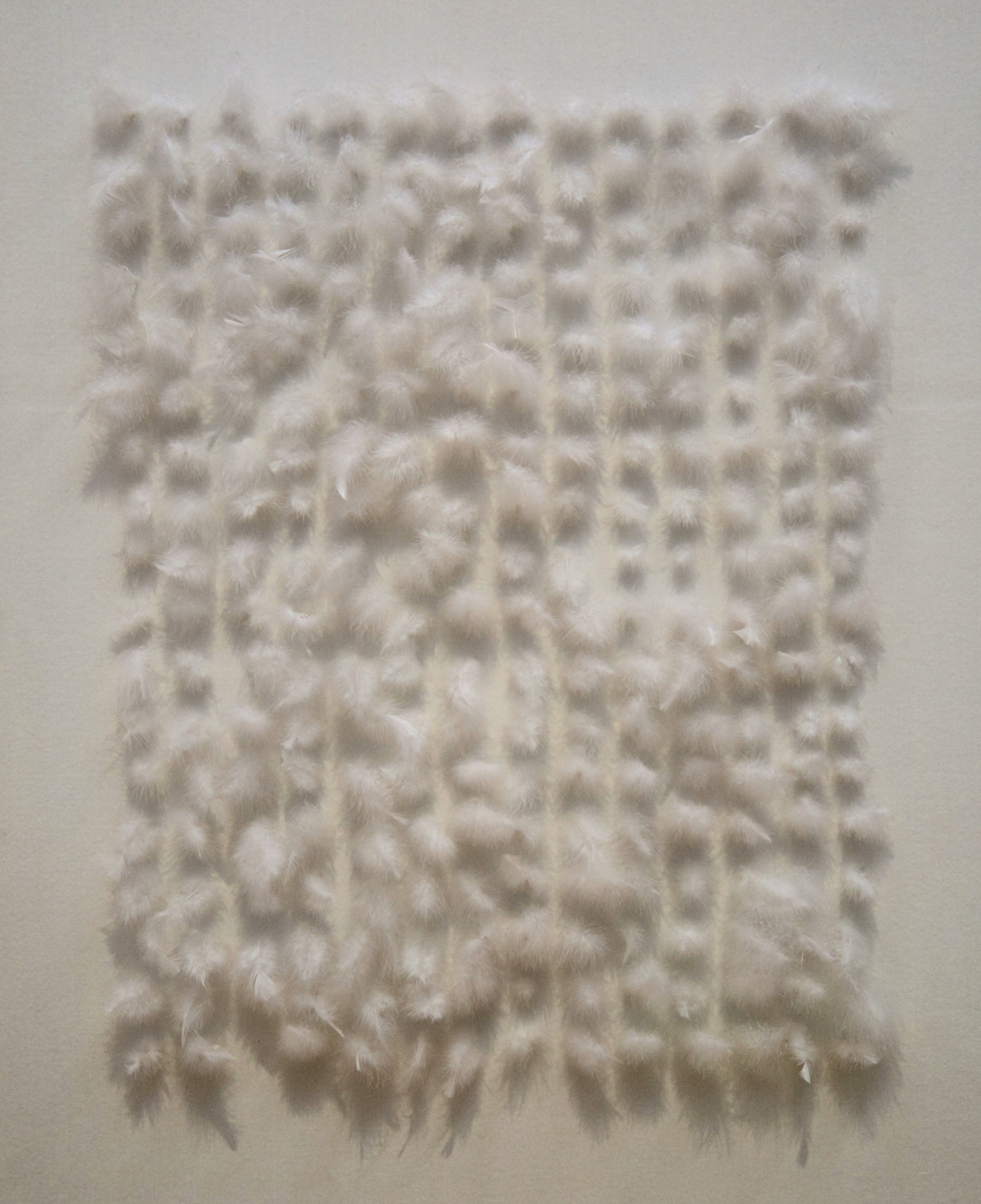
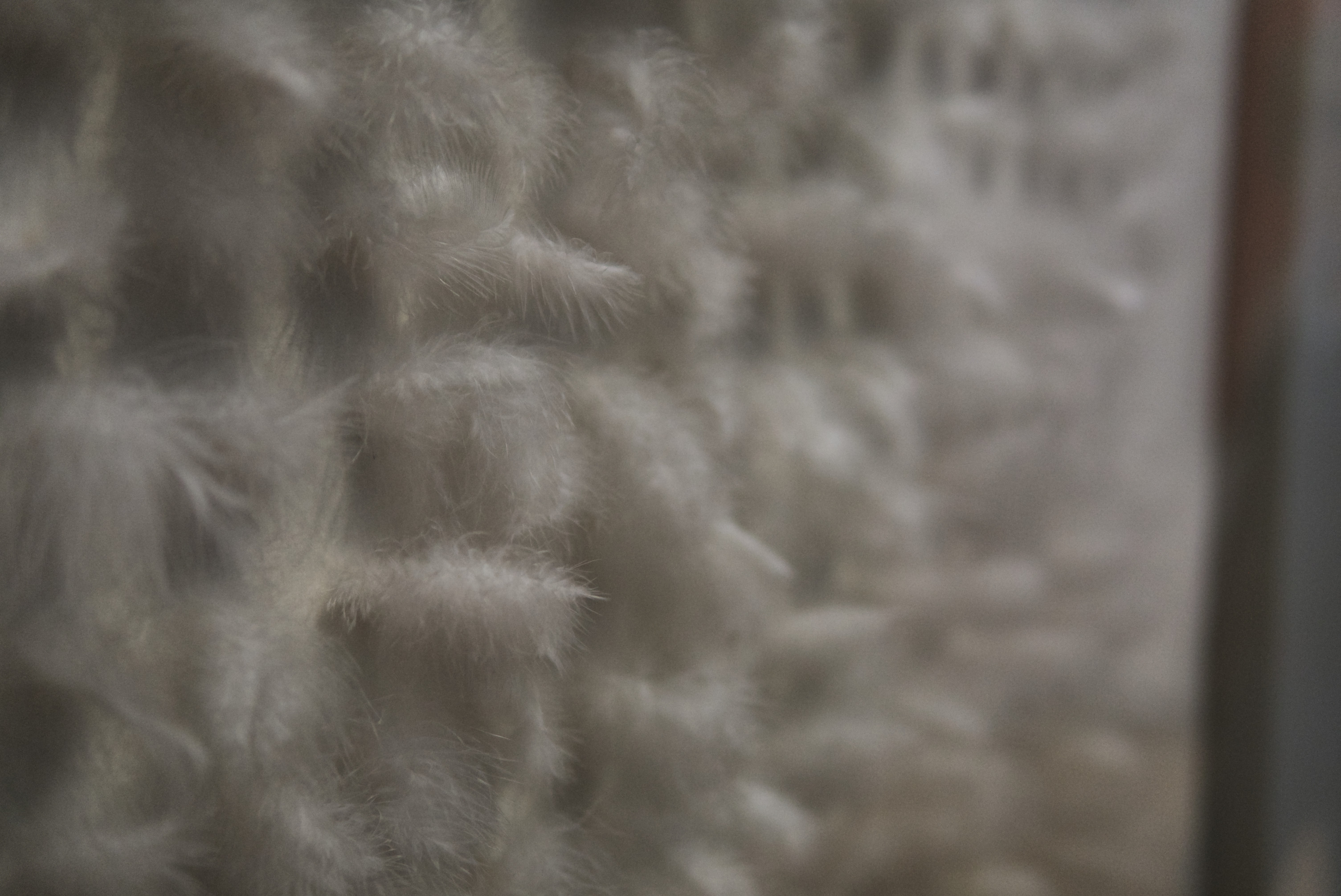
LOOK: 62-33 (White Feathers on White Background) by Henk Peeters
Henk Peeters (Dutch, 1925–2013), 62-33 (White Feathers on White Background), 1962. Feathers and velvet on hardboard, 153 × 133 cm. Stedelijk Museum Amsterdam, Netherlands. Photo: Victoria Emily Jones. [object record]
But he was wounded for our transgressions, crushed for our iniquities; upon him was the punishment that made us whole, and by his bruises we are healed.
—Isaiah 53:5
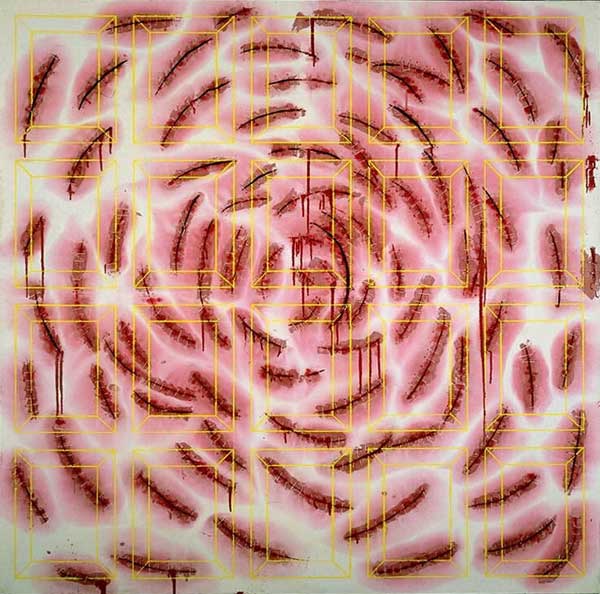
LOOK: Cuts by Johannes Phokela
Johannes Phokela (South African, 1966–), Cuts, 1990. Acrylic and string on canvas, 83 1/16 × 83 1/16 in. (211 × 211 cm). Smithsonian National Museum of African Art, Washington, DC.
For this gruesome artwork, Johannes Phokela slashed a canvas in many spots with a razor, then stitched up the gashes with heavy string. He then painted over the gashes from the back with crimson paint until it bled through, forming a deep red along the seams and a flesh-pink further out, evocative of scar tissue. Then, as if to memorialize the wounds, he painted twenty gold frames over them in rows of five across and four down.
Phokela often uses painted frames or grids as a compositional device in his work. “The grid gives another dimension to the work; it is a device to challenge the viewer’s perception of the image and form beneath,” he said in a 2002 interview with Bruce Haines. “It is intended to have an effect like an ornamental frame surrounding a mirror, or a glass pane mounting a picture. . . . You have to regard it as part of the work, just like the traditional frame of a painting. . . . It gives the work a sort of focal point that can stimulate the viewer’s reaction.”
I was simultaneously drawn to and repulsed by this painting when I saw it exhibited as part of Conversations: African and African American Artworks in Dialogue at the Smithsonian in 2014. It is large—almost seven square feet. From a distance the image looks rather rose-like, a concentric arrangement of short red lines slightly curled like petals. It wasn’t until I got closer that I saw it portrays the vulnerability of human flesh, savagely torn.
When I’m at an art museum I like to look at each artwork before reading its label so that I can register my initial impressions and begin to form an interpretation before I receive the curator’s. (I hope you do the same when you encounter artworks on this website!) When I saw this one, I thought of how Christ was wounded for our transgressions, but those wounds became his glory—and ours. In art history Jesus is sometimes shown with light emanating from the holes in his hands, especially in images where he is exalted in heaven. For me, the gold in Cuts suggests a redemptive framework—like it’s asking us to view the horrors of the cross through the lens of glory. In addition, the gold frames within the picture plane seem to emphasize that these wounds are something worthy of being looked at, even meditated upon, as frames show us what’s important, directing our gaze.
Well, here’s what the label said:
On a trip home to South Africa in 1989, Phokela was distressed to see the state of violence that existed as a result of political rivalry and unrest. Disturbed by the bandaged and scarred faces and bodies of his fellow citizens and by the fact that everyone seemed to accept the situation as normal, the artist created a canvas of cuts overlaid with gold frames to distance himself from the violence.
So, Phokela, a Black South African who was born and raised in Soweto but had been living in London since 1987, painted this as a response to the violence of apartheid in his home country. Whoever wrote this text sees the frames as putting us at further remove from the cuts that are represented, as they form an intervening layer between us and them. A legitimate reading, though I haven’t found any statements from Phokela that express this intent. What I did find from him regarding his use of frames in general, I quoted above.
Having learned the particular context out of which this painting arose, I then considered what Jesus’s crucifixion has to say to human suffering today. What relevance has a Galilean man’s torture and execution two thousand years ago to present-day men and women who are beaten and abused?—in this case, because of their race.
Jesus’s death exposed and put to shame the powers of evil, those which assault God and God’s image-bearers. Surely there was much more going on with his death than just that (whole volumes, whole series of volumes, have been written to articulate a theology of the cross). But bringing to light the crimes of humanity—and at the same time, God’s supreme love—is one aspect. Opening up pathways of transformation, healing, reconciliation, and liberation is another.
LISTEN: “By His Wounds” by Bifrost Arts, feat. DM Stith, on He Will Not Cry Out, 2013 | Words by Isaac Wardell, 2011 | Music by Philip Hayes, 1786
By his wounds, his wounds, will we be healed And for our transgressions, his passion has made us well Let us come again and feed on him, our Lord Emmanuel
This melody was originally written in the eighteenth century by English composer, organist, singer, and conductor Philip Hayes (1738–1797), who published it in The Muses’ Delight: Catches, Glees, Canzonets, and Canons as a round setting of Psalm 137:1–2 (“By the waters of Babylon . . .”). The song became widely popular after Don McLean recorded it on his 1971 album American Pie and even more so in 2007, when it was used in a memorable montage in the TV series Mad Men.
Isaac Wardell, cofounder of the Bifrost Arts music collective and now director of The Porter’s Gate, put different words to Hayes’s melody in 2011, retaining the canon form. The first two lines reference the well-known Suffering Servant passage from Isaiah 53, and the last is an invitation to come to the Lord’s table—to take in unto ourselves the body and blood of Christ.
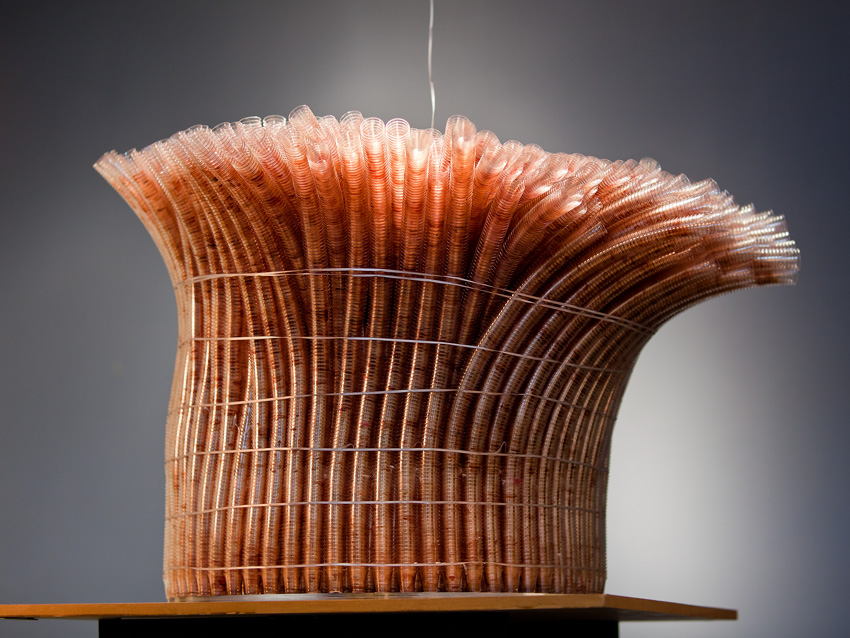
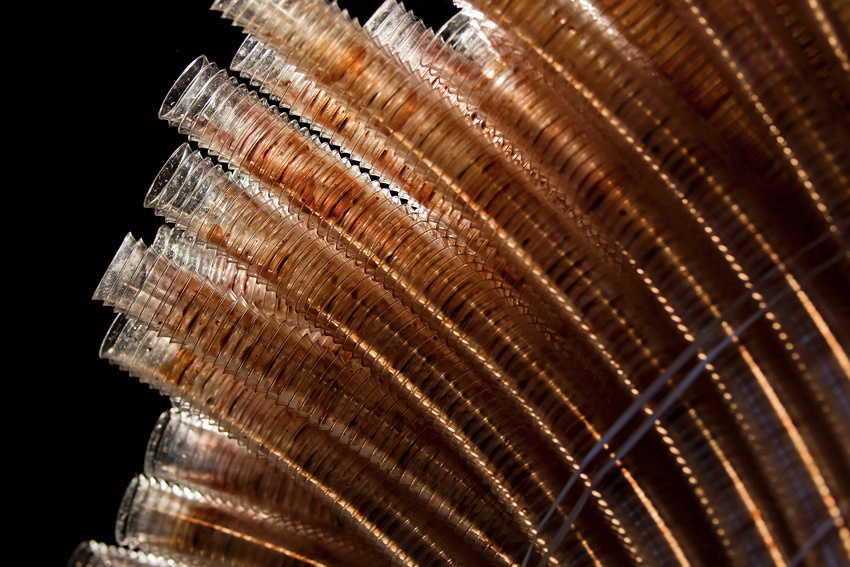
Denise Weyhrich (American, 1956–), Tabernacle, 2010. 70,000 used communion cups, 7 silver ribbons, plexiglass base, 42 × 42 in. Sasse Museum of Art, Upland, California. Photo: Jeff LeFever. [object record]
From Easter 2008 through Yom Kippur 2009, installation artist Denise Kufus Weyhrich collected unwashed cups from weekly communions at St. John’s Lutheran Church in Orange, California, and a few neighboring churches, leaving them out to dry in her studio. Over that year and a half when they accumulated, the room was filled with the fragrance of wine, she told me.
Once she had collected 70,000 cups into stacks—seven is the number of completion or perfection in Judaism and, by extension, Christianity—she arranged the stacks on a plexiglass disc and bound them together with six silver ribbons, like a sheaf of wheat. The seventh ribbon she threaded through all the cups and up to the ceiling, which could be read as the love of God coming down and through the people, uniting them, and/or the people’s thanksgiving going up to God through this ritual act of celebrating the Eucharist.
Each one of those wine-stained cups represents a person being fed by the body and blood of Christ. Their collective presentation is such a beautiful picture of the church and of God’s ongoing bestowal of grace and forgiveness. Weyhrich named the piece Tabernacle, the place where God dwells.
Weyhrich is the codirector, with Cindi Zech Rhodes, of Seeds Fine Art Exhibits, a nonprofit that supports artists of faith by transforming galleries into sacred spaces. “Our exhibits always have a central theme which invites contemplation of ‘that something other’ than the purely physical world,” she says. They just wrapped up California Redemption Value, a solo show by assemblage artist Leslie Caldera, and are now showing work by Teri Shagoury through May. Their gallery is located inside Full Circle in Orange, California.
Jesus said to them, “I am the bread of life. Whoever comes to me will never be hungry, and whoever believes in me will never be thirsty. . . . Your ancestors ate the manna in the wilderness, and they died. This is the bread that comes down from heaven, so that one may eat of it and not die. I am the living bread that came down from heaven. Whoever eats of this bread will live forever; and the bread that I will give for the life of the world is my flesh.”
—John 6:35, 49–51
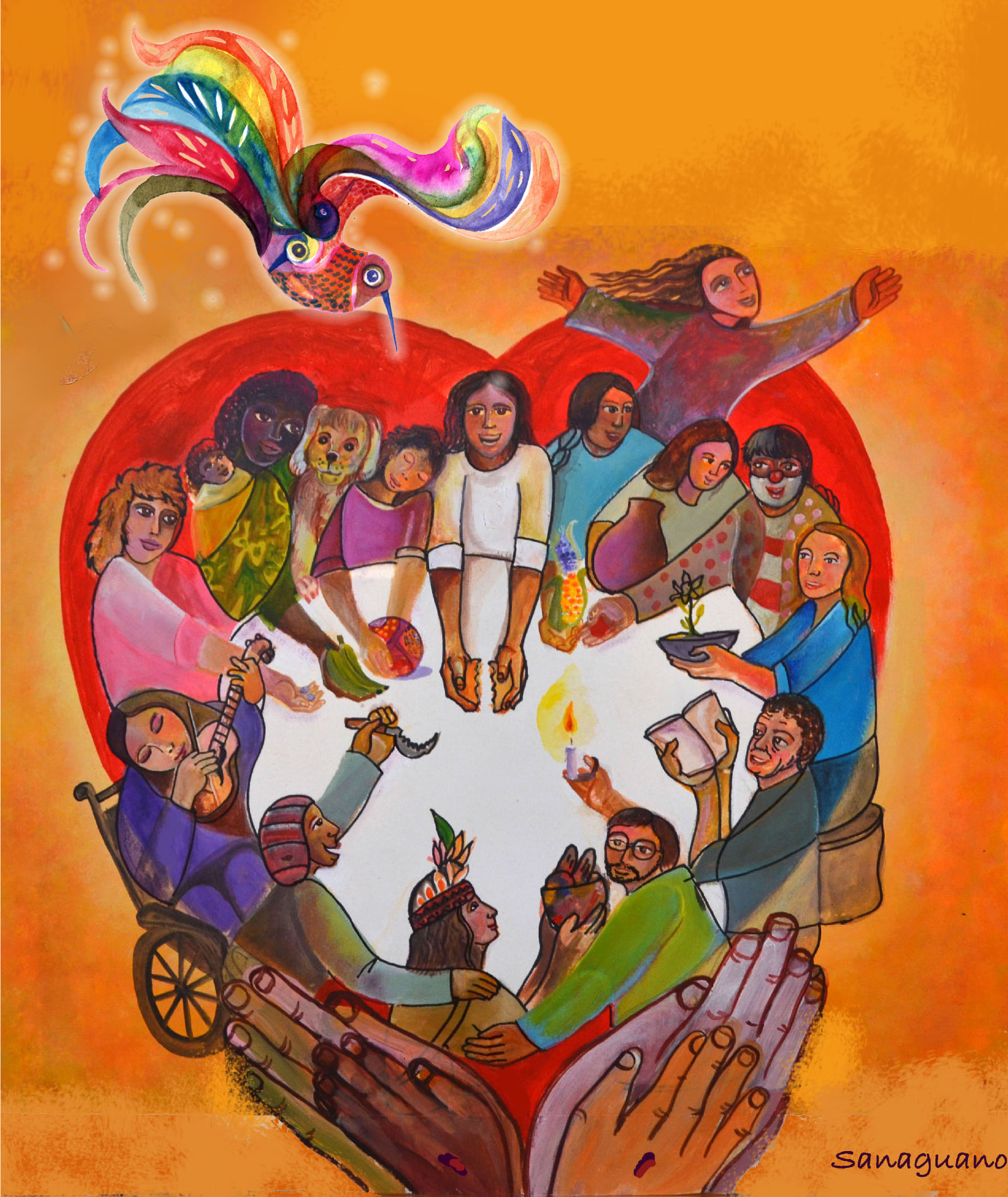
LOOK: Painting by Pablo Sanaguano
Painting by Pablo Sanaguano (Ecuadorian, 1964–), 2021
This song was written for the Porter’s Gate album Neighbor Songs, which released in 2019. Diana Gameros, a member of the collective, sings on the recording and plays guitar. Here she is a year later, singing the song with Minna Choi for a City Church San Francisco [previously] virtual worship service.
Jesus, bread of life Manna from heaven Broken for the world Offered up for every man
The feast of angels becomes food for the weary And hungry hearts are filled When you open up your hand When you open up your hand
O Lord, come fill us with your love This table laid for us There is more than enough Jesus, bread of life
Sister, take what you need Anything I own There is no famine here Jesus’ love will multiply
Brother, what’s mine is yours You are not alone There is no shortage here Jesus’ love satisfies Jesus’ love satisfies
O Lord, come fill us with your love This table laid for us There is more than enough Jesus, bread of life
“Alegbegbe Mawu Lɔ̃ Xexeame” (or “Alegbegbe” for short) is a choral setting of the scriptural passage John 3:16 composed by Dr. Ephraim Amu, one of the leading composers of Ghanaian art music. As do many of his works from the 1950s onward, this composition uses a technique called counterpoint—that is, the sounding of independent melodies simultaneously in different vocal lines, which are nevertheless integrated into a single harmonic texture. The words are in the Ewe language (pronounced ā-wā, with long a’s as in way), spoken in the Volta region of Ghana as well as in southwestern Togo and parts of Benin.
I’ve chosen a recent performance that was captured on video, but for an audio-only performance by the West Volta Presbytery Church Choir, conducted by Amu’s daughter, Misonu Amu, click here.
Dr. Paul Neeley of Global Christian Worshipwrites, “Dr. Ephraim Kɔku Amu (1899–1995) was a Ghanaian composer, musicologist, and teacher. He was a pioneer in contextualizing life and Christian faith in the African context, starting in the 1920s. He was not afraid to rock the boat of cultural and church norms of the time. He composed hundreds of songs, many of them choral songs in the major languages of Ewe and Twi, and some are still popular today.”
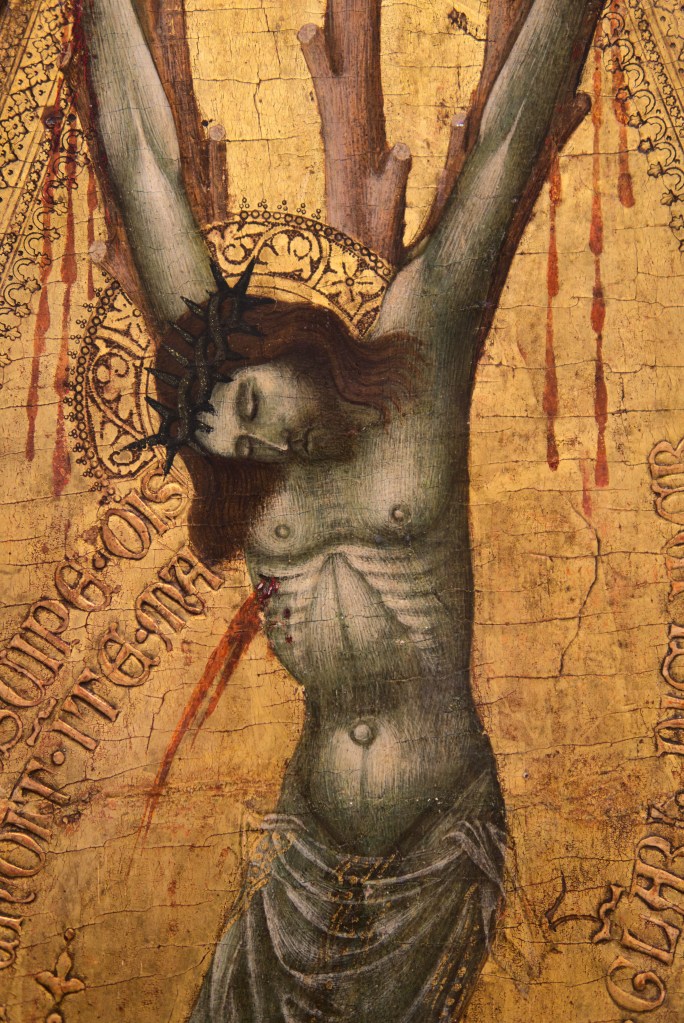
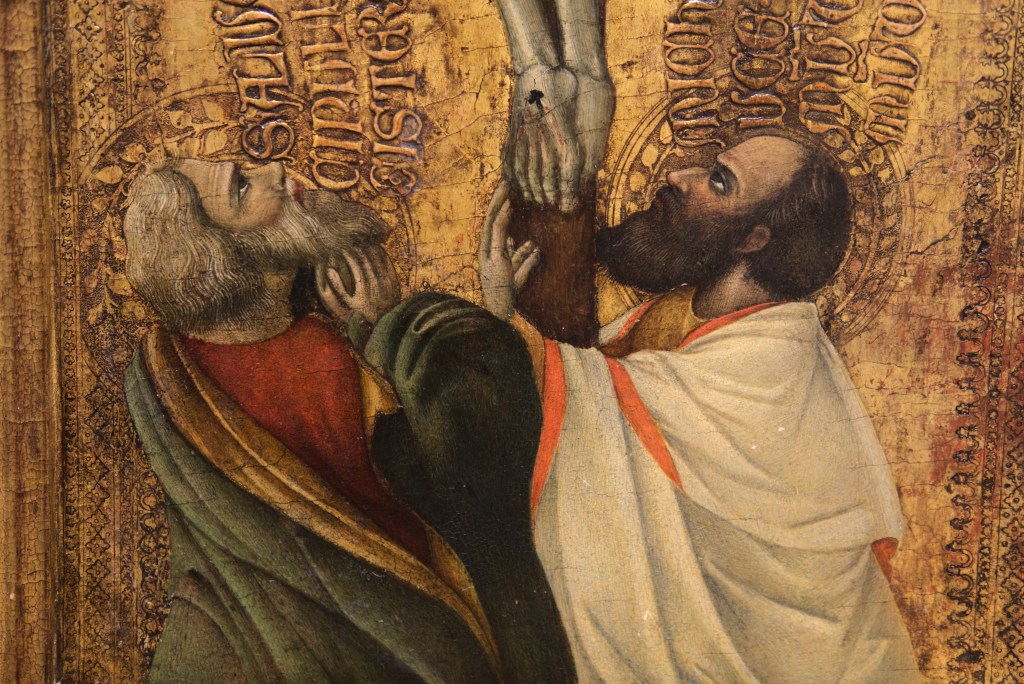
LOOK: Allegorical Representation of the Crucifixion with Saints Andrew and Paul by Francesco Traini
Francesco Traini (Italian, active 1321–1363), Allegorical Representation of the Crucifixion with Saints Andrew and Paul, ca. 1350–60. Tempera and gold leaf on panel, 41 1/4 × 16 5/8 in. (104.8 × 42.2 cm). Carnegie Museum of Art, Pittsburgh, Pennsylvania. Photo: Victoria Emily Jones. [object record]
In this panel painting from late medieval Italy, two of Christ’s apostles—Andrew and Paul—embrace the cross where Christ hangs crucified, his blood running down from his hands and side. The Latin inscriptions unfurl as speech from each. Paul, on the right, says, MICHI AUTEM ABSIT GLORIARI NISI IN CRUCE DOMINI NOSTRI JESU CHRISTU PER QUEM MICHI MUNDUS CRUCIXUS EST ET EGO MUNDO (“But God forbid that I should glory save in the cross of our Lord Jesus Christ, by whom the world is crucified unto me, and I unto the world” [Gal. 6:14]).
And Andrew exclaims, SALVE CRUS SPETIOSA SUSCIPE DISCIPLULUM EIUS QUI PENEDIT IN TE MAGISTER MEUS CHRISTUS (“Hail lovely cross, receive the disciple of him who hung on you, my master Jesus Christ”). This is one of the antiphons from the Feast of Saint Andrew, spoken by Andrew in response to being presented with the instrument of his martyrdom.
Francesco Traini is one of the few artists of the period to use raised gesso (plaster) and gold leaf texts on the surfaces of his paintings. He also often used punches, as here, to create elaborate borders.
I’m really compelled by the portrayal of the cross as a forked tree. (Note the similarity to Friday’s featured painting!) Granted, that artistic choice was probably dictated mainly by the narrow dimensions of the panel.
LISTEN: “येशूलाई क्रूसमाथि सब हेर” (Yeshulai Krusmaathi Sab Hera) (Down at the Cross) | Original English words by Elisha A. Hoffman, 1878 | Music by John H. Stockton, 1878 | Performed in Nepali by Psalms Unplugged, 2019 [HT: Global Christian Worship]
१. येशूलाई क्रूसमाथि सब हेर, हाम्रो दुःख उनैले बोकेर, डाक्दैछन् सबलाई प्रेम गरेर, येशूलाई हेर ।
Edgar G. Boevé (American, 1929–2019), Phoenix, Death, ca. 1980. Oil and acrylic on tea chest paper. Photo: Victoria Emily Jones, at the Center Art Gallery, Calvin University, Grand Rapids, Michigan, 2015.
Fat soil, full spring, sweet olive, grape of bliss, That yields, that streams, that pours, that doth distill; Untilled, undrawn, unstamped, untouched of press, Dear fruit, clear brooks, fair oil, sweet wine at will! Thus Christ prevents, unforced, in shedding blood, The whips, the thorns, the nails, the spear, and rood.
He pelican’s, he phoenix’, fate doth prove, Whom flames consume, whom streams enforce to die: How burneth blood, how bleedeth burning love? Can one in flame and stream both bathe and fry? How could he join a phoenix’ fiery pains, In fainting pelican’s still bleeding veins?
Elias once, to prove God’s sovereign power, By prayer procured a fire of wondrous force That blood and wood and water did devour, Yea stones and dust beyond all nature’s course: Such fire is love, that, fed with gory blood, Doth burn no less than in the driest wood.
O sacred fire! come, show thy force on me, That sacrifice to Christ I may return: If withered wood for fuel fittest be, If stones and dust, if flesh and blood will burn, I withered am, and stony to all good, A sack of dust, a mass of flesh and blood.
Note: I modernized the spellings of this poem for readability, but there is a beauty to the early modern English; see the original here.
Robert Southwell (ca. 1561–1595) was an English Catholic priest and poet living during the reign of Queen Elizabeth I. Educated at Jesuit colleges in France and Italy, he returned to his native England as a missionary in 1586. But he suffered persecution under the country’s Protestant regime, and had to conduct his ministry in concealment. In his early thirties he was caught celebrating the Mass and was subsequently imprisoned, tortured, and hanged for treason. None of his English poems was published in his lifetime, but many of them circulated as manuscripts. He probably wrote this one sometime during his three years in the Tower of London, awaiting execution.
“Christ’s Bloody Sweat” opens with a reflection on Christ’s agony in the garden of Gethsemane the night before the Crucifixion, when “in his anguish he prayed more earnestly, and his sweat became like great drops of blood falling down on the ground” (Luke 22:44). This bloody sweat may be a figure of speech Luke uses to convey the intensity of the moment, or it may be an actual condition called hematidrosis, in which capillary blood vessels that feed the sweat glands rupture, causing them to exude blood—something that can occur in rare cases when a person is under extreme physical or emotional stress.
In the first stanza of the poem, “Southwell introduces various fluids that represent the creative effusions of Christ’s love, with an extravagant reiteration of images that emphasises the extravagance of that love,” writes Rev. Patrick Comerford in his commentary on the poem.
Fat soil, full spring, sweet olive, grape of bliss, That yields, that streams, that pours, that doth distill; Untilled, undrawn, unstamped, untouched of press, Dear fruit, clear brooks, fair oil, sweet wine at will! Thus Christ prevents, unforced, in shedding blood, The whips, the thorns, the nails, the spear, and rood.
Southwell describes Christ as rich, fertile soil that yields sweet fruit; a spring of living water; an olive from which consecrated oil is distilled (for the anointing of the newly baptized and newly ordained); and a grape that yields fine wine. It may help you to read each phrase vertically down the first four lines: “Fat soil that yields, untilled, dear fruit”; “full spring that streams, undrawn, clear brooks”; “sweet olive that pours, unstamped, fair oil”; “grape of bliss that doth distill, untouched of press, sweet wine at will!”
“Prevent” in this context means to go before. In other words, even before Jesus is captured by the Roman soldiers, tortured, and led to Calvary to be crucified, he sheds his blood in Gethsemane. Without any physical forces acting upon him. “Rood” is an archaic word for the cross.
Stanza 2 references two birds of lore that were popular symbols of Christ: the pelican and the phoenix.
He pelican’s, he phoenix’, fate doth prove, Whom flames consume, whom streams enforce to die: How burneth blood, how bleedeth burning love? Can one in flame and stream both bathe and fry? How could he join a phoenix’ fiery pains, In fainting pelican’s still bleeding veins?
The pelican was said (by Epiphanius, Augustine, and other church fathers) to revive or feed her young with her own blood; she would peck at her breast until she died so that her little ones might have life. The phoenix is a fantastical bird from classical mythology that burns itself to ashes on a funeral pyre ignited by the sun but then rises up out of those ashes, renewed.
Southwell ponders how Christ can be both pelican and phoenix. Did he bleed to death (losing streams of blood), or did he die by burning? The image in line 10 is quite gruesome: Christ simultaneously is “bathe[d]” in blood and fries in flames. The fire is, of course, metaphoric. But it becomes here, along with the blood, an emblem of divine love. A love that bleeds and burns, and that is all-consuming.
The fire and blood imagery continues in stanza 3, where Southwell refers to the famous contest on Mount Carmel between Elijah (a prophet of Yahweh) and the prophets of Baal (see 1 Kings 18).
Elias once, to prove God’s sovereign power, By prayer procured a fire of wondrous force That blood and wood and water did devour, Yea stones and dust beyond all nature’s course: Such fire is love, that, fed with gory blood, Doth burn no less than in the driest wood.
To prove the supremacy of the God of Israel over Baal, Elijah issues a challenge. He and Baal’s prophets would each prepare a bull for sacrifice and lay it on a stone altar but light no fire. They would then pray each to their own god and see which god answers by sending fire from heaven to consume their sacrifice. The prophets of Baal accept the challenge, but no fire comes to light their altar, despite their most fervent entreaties. Elijah, to increase the stakes, even soaks his bull and the wood it lies on in water, three times over—and still fire comes from above, devouring, as Southwell writes, “blood and wood and water . . . [and] stones and dust beyond all nature’s course.”
God’s love is like that fire, Southwell says. The implication, I think, is that on the cross, the love of the Son (who gives himself as a sacrifice) and the love of the Father (who accepts the sacrifice) meet. (I know there are varying interpretations of the nature of the atonement and the role of the Father in the Crucifixion, but I’m simply trying to interpret Southwell here.)
In the poem’s final stanza, Southwell considers how he ought to respond to divine love as expressed in Christ’s passion.
O sacred fire! come, show thy force on me, That sacrifice to Christ I may return: If withered wood for fuel fittest be, If stones and dust, if flesh and blood will burn, I withered am, and stony to all good, A sack of dust, a mass of flesh and blood.
He calls on God to accept, in return, his sacrifice—of praise and thanksgiving and obedience (Heb. 13:15–16; Ps. 50:23) and of his very self (Rom. 12:1–2). He probably had his martyrdom in mind. He acknowledges that he is but a withered, soggy, stony-hearted “sack of dust” but prays that God would make him fit to receive and broadcast the fire of love from on high.
For waters shall break forth in the wilderness, and streams in the desert; the burning sand shall become a pool, and the thirsty ground springs of water . . .
—Isaiah 35:6b–7a
I will open rivers on the bare heights, and fountains in the midst of the valleys; I will make the wilderness a pool of water, and the dry land springs of water.
—Isaiah 41:18
I am about to do a new thing; now it springs forth, do you not perceive it? I will make a way in the wilderness and rivers in the desert.
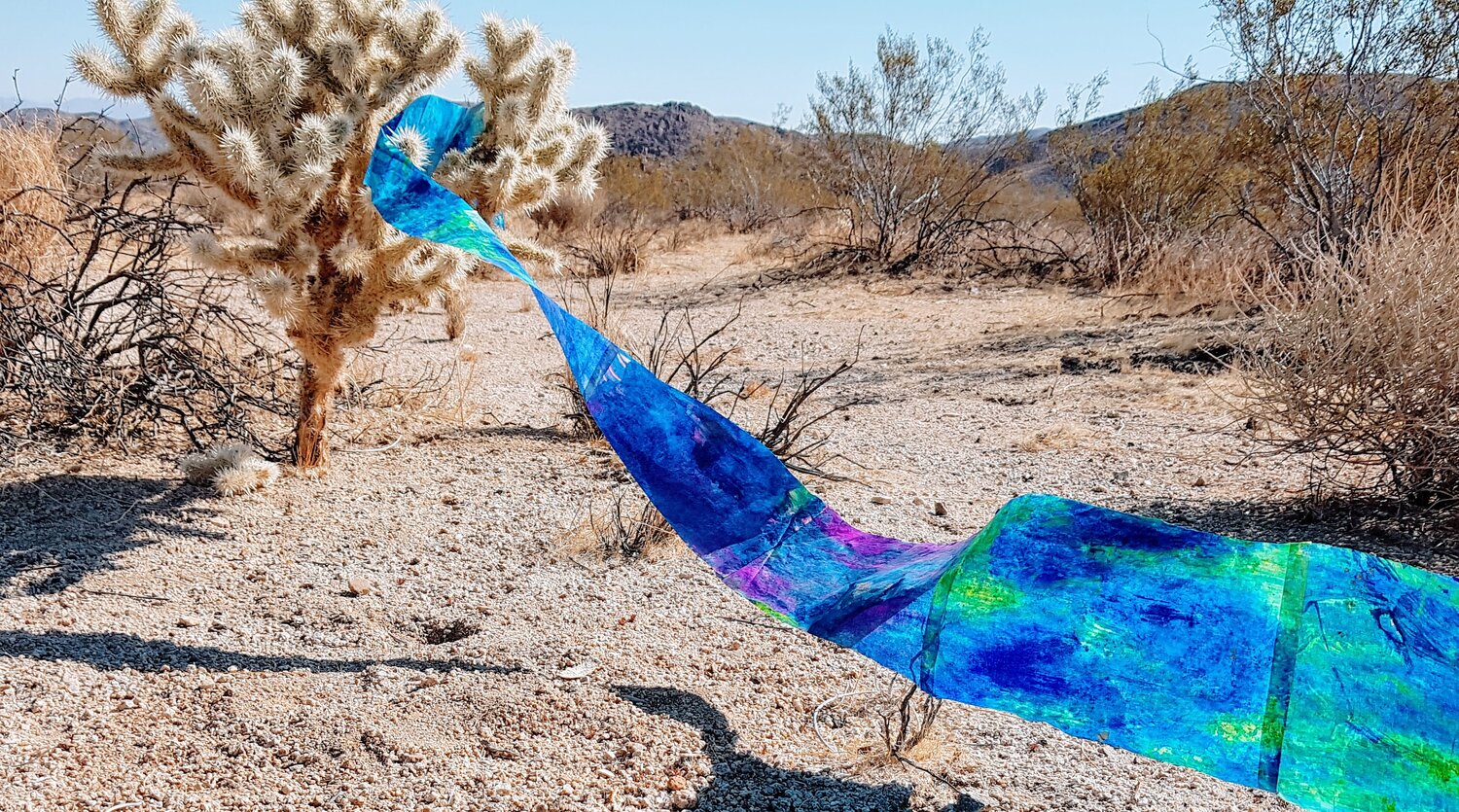
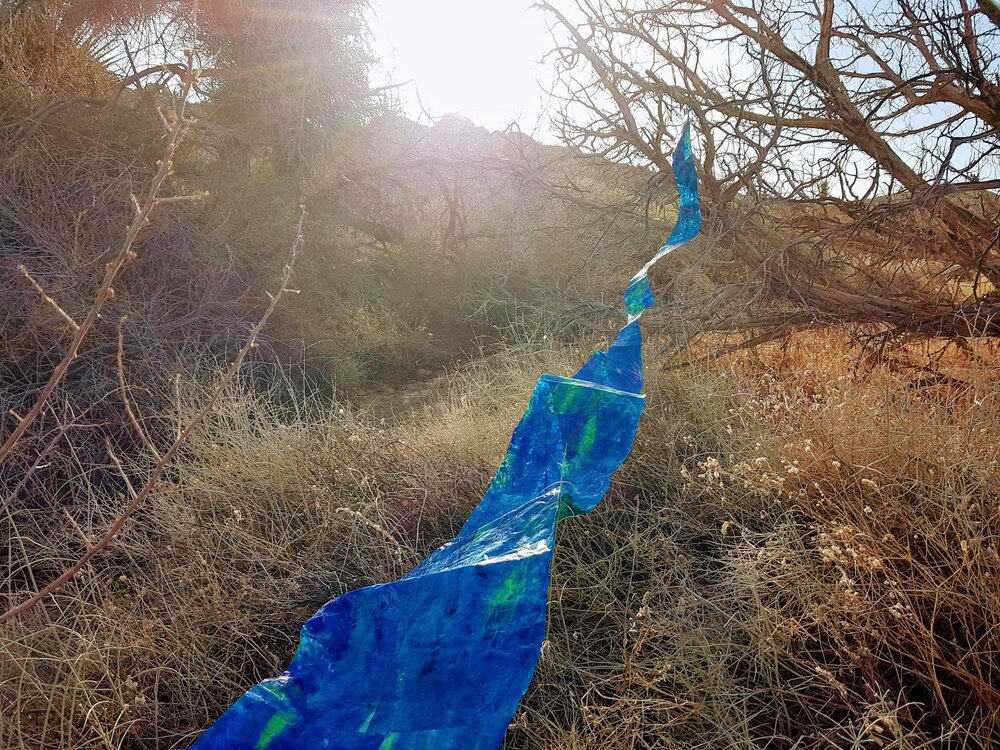
LOOK: Paper River Flow in the Desert by Young-Ly Hong Chandra
Young-Ly Hong Chandra (Korean, 1970–), Paper River Flow in the Desert, Joshua Tree National Park, Southern California, 2021. Traditional Korean mulberry paper with acrylic, watercolor, ink, and gel.
Born and raised in Seoul and currently living in Pasadena, Young-Ly Hong Chandra is an artist who works primarily with paper, fabric, and found objects and in a range of sizes, from small collages to large-scale installations. From October 2020 to June 2021 she was an artist in residence at the Brehm Center at Fuller Theological Seminary, and she is now a facilitator in the program. She is also an artist in residence with Inbreak.co.
One of the main materials Hong Chandra uses is hanji, traditional handmade paper from Korea made from the inner bark of the paper mulberry tree. She cuts the paper and paints it on both sides with acrylic, watercolor, and ink, then she applies a thin coat of transparent gel to make it more durable and waterproof. “Paper stained glass” is what she calls these creations.
For her Paper River Flow series, she attaches together numerous pieces of this paper stained glass to form long blue rolls that can be rolled up or folded and packed in a bag so that when she travels nationally or internationally, or when she moves about her home city, she can carry them with her and create installations as the mood strikes her. “I am a small river bearer,” she says, “who’s conveying the big vision of the river flow to give life to many and will reflect the glory of God clear as crystal.”
The river is a symbol of healing and renewal, she says. In our dryness, in our barrenness, God springs up, offering life and nourishment. The image of the river is used many times in the prophetic book of Isaiah—I’ve cited just a few examples above—and also appears in the final book of the New Testament, where it flows down from the throne of God, watering the new creation (Rev. 22:1–2). Hong Chandra says,
The image of river for me is from Revelation 22 . . . the river flowing in the holy city, reflecting the glory of the Lamb of God sitting on the throne. And what I’m doing is still far from reflecting that glory. But I want this piece to be an invitation to others to come and taste the living water that was given so freely.
KOREAN 하나님께서 당신을 통해 메마른 땅에 샘물나게 하시기를 가난한 영혼 목마른 영혼 당신을통해 주 사랑 알기 원하네
[Phonetic] Ha na neem geh suh Dang shin eul tong heh Meh malun ttang eh Sehm mul nag geh ha shi gee lul Ga nan han young hone Mohk mal luhn young hone Dang shin eul tong heh Joo sarang ahl gee wun ha neh
SPANISH Agua viva Fluye del Señor A través de ti A esta tierra seca Al que tiene sed Dale de beber Que el amor de Dios Sea mostrado en ti siempre
ENGLISH May the love of God Spring up in your soul Like a healing stream In the wilderness flowing And may the love of God Quench the thirsty soul Feed the hungry heart May the love of God flow through you




 Art & Theology