Christian comics: Encountering God in multipanel visual storytelling

I’ve been following the work of comics artist Madeleine Jubilee Saito for several years (you may recall me featuring her here and here), and I’m thrilled that her debut collection of comics, You Are a Sacred Place: Visual Poems for Living in Climate Crisis, has now hit shelves! It’s gorgeous, you all. To coincide with the book’s release date today, I asked if she’d be willing to write a guest post providing some background and insight on comics as an art form and how Christians, including herself, have used the form. Before sharing two of her own comics, she explores three earlier examples by others—an Italian Gothic devotional painting, a late nineteenth-century African American quilt, and (where my mind typically goes when I hear “Christian comics”) a popular series of evangelistic tracts—expanding my sense of what a comic can be.

—Victoria Jones


A guest post by Madeleine Jubilee Saito

Comics have always been an art form for ordinary people—the medium of children, the illiterate, and the learning-to-read. 

Since the 1960s, underground comix have been a scrappy, democratic, DIY art form: anyone with access to a black-and-white printer can make their own eight-page zine. And many Christians have found that humblest of publications, the self-published evangelistic tract, in that humblest of locations: the bathroom stall.

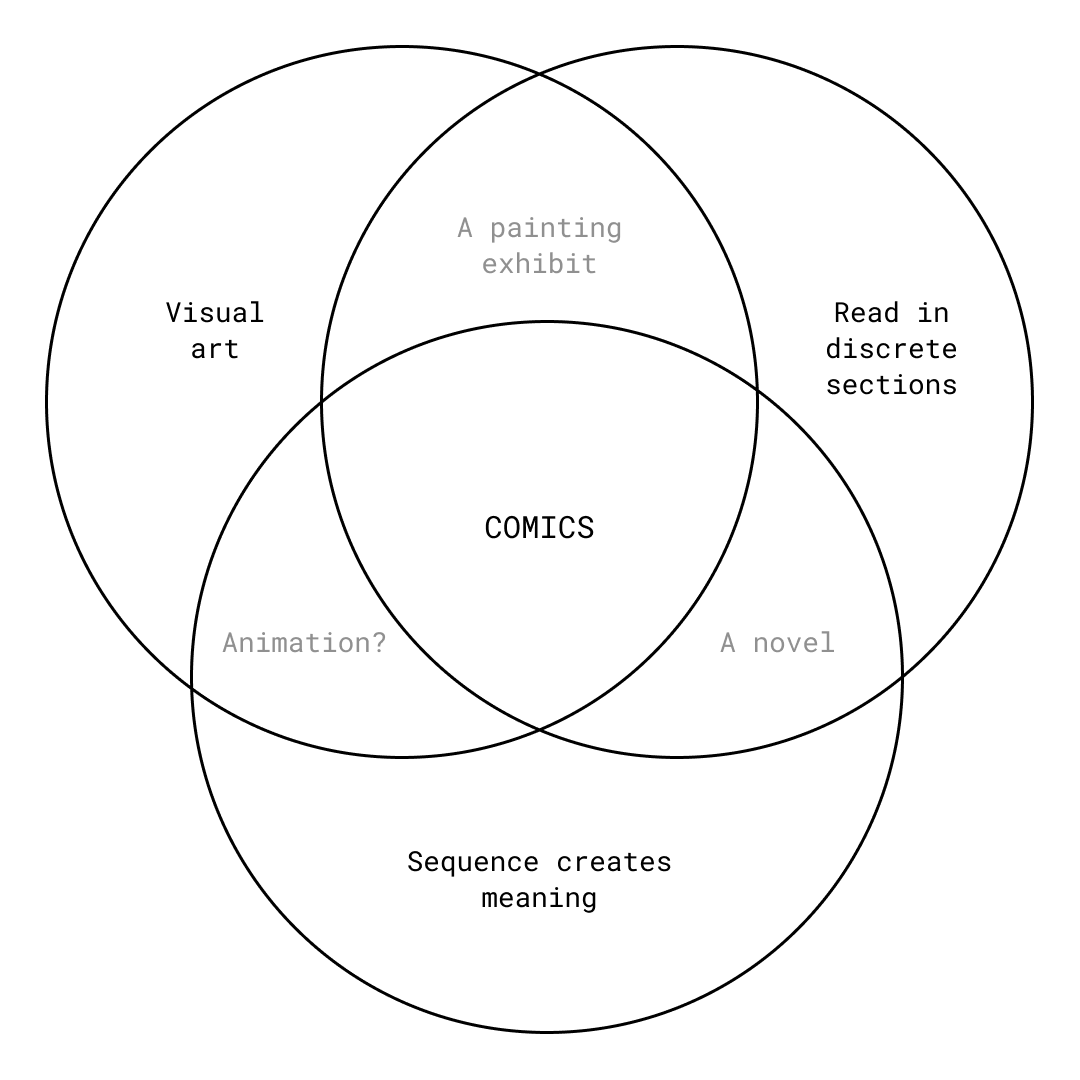
I am a Christian artist, and my medium is experimental comics. I define comics expansively as any visual artwork where meaning comes from the viewer reading discrete sections in sequence.
What is a comic?
Breaking down my definition of comics

To put it more simply, comics are pictures (and sometimes text) that you read across panels. 

Christian artists throughout time have been drawn to working in this medium. And because comics have always been a popular medium, often directed at those on the margins, reading Christian comics from the past can tell us something about how Christians of a particular time viewed ordinary people.

Three very different examples:

1. Pacino di Bonaguida, 14th century, Italy
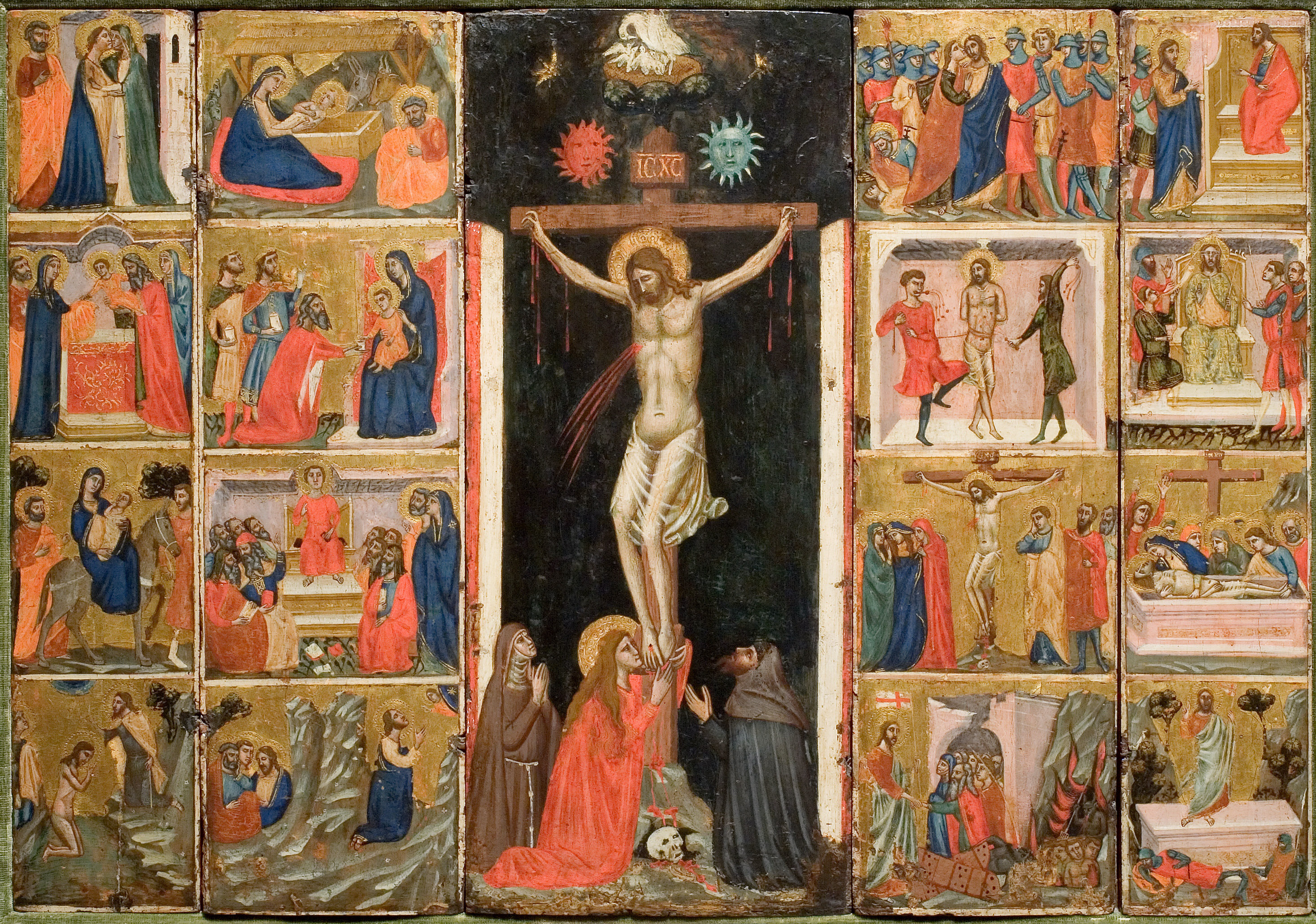
Pacino di Bonaguida_Tabernacle with Scenes from the Life of Christ
Pacino di Bonaguida (Italian, active 1302–ca. 1340), Tabernacle with Scenes from the Life of Christ, ca. 1325. Tempera and gold leaf on panel, 44.5 × 63.5 cm. University of Arizona Museum of Art, Tucson.

Pacino di Bonaguida is one example of an Italian artist making sacred comics alongside the rise of the Dominican and Franciscan mendicant orders in the thirteenth through fifteenth centuries. 

Panels showing sequential scenes from the life of Christ were a popular choice for altarpieces. (An example of artworks in this tradition is the Stations of the Cross—I made my own entry into that tradition a few years ago.)
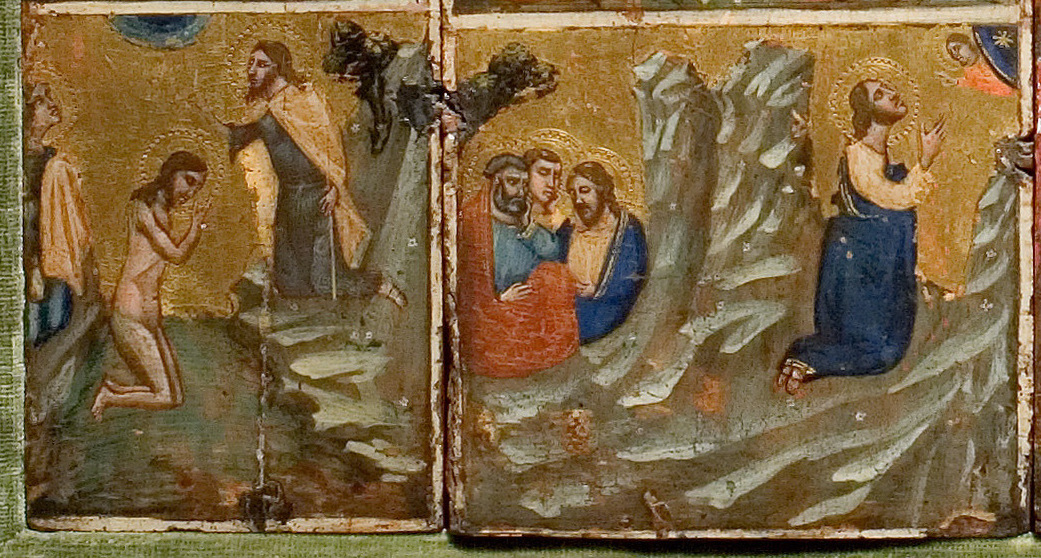
Pacino di Bonaguida, Tabernacle with Scenes from the Life of Christ, bottom left detail. Note the way that the rock forms echo between the two panels, creating rhythmic repetition between the Baptism of Christ and the Agony in the Garden.

In this period, Dominicans and Franciscans helped launch a movement in the church emphasizing preaching to and teaching common people and seeing oneself in the biblical story.

While we don’t have any writing from Pacino, we can look to the theological trends of the time to understand his comics. 

The Dominicans and Franciscans encouraged ordinary Christians, including the illiterate, to move sequentially, systematically, through the story of Christ. The anonymously authored manual The Garden of Prayer (1454) instructs:

Alone and solitary, excluding every external thought from your mind, start thinking of the beginning of the Passion, starting with how Jesus entered Jerusalem on the ass. Moving slowly from episode to episode, meditate on each one, dwelling on each single stage and step of the story. And if at any point you feel a sensation of piety, stop: do not pass on as long as that sweet and devout sentiment lasts.
Pacino di Bonaguida_Tabernacle with Scenes from the Life of Christ
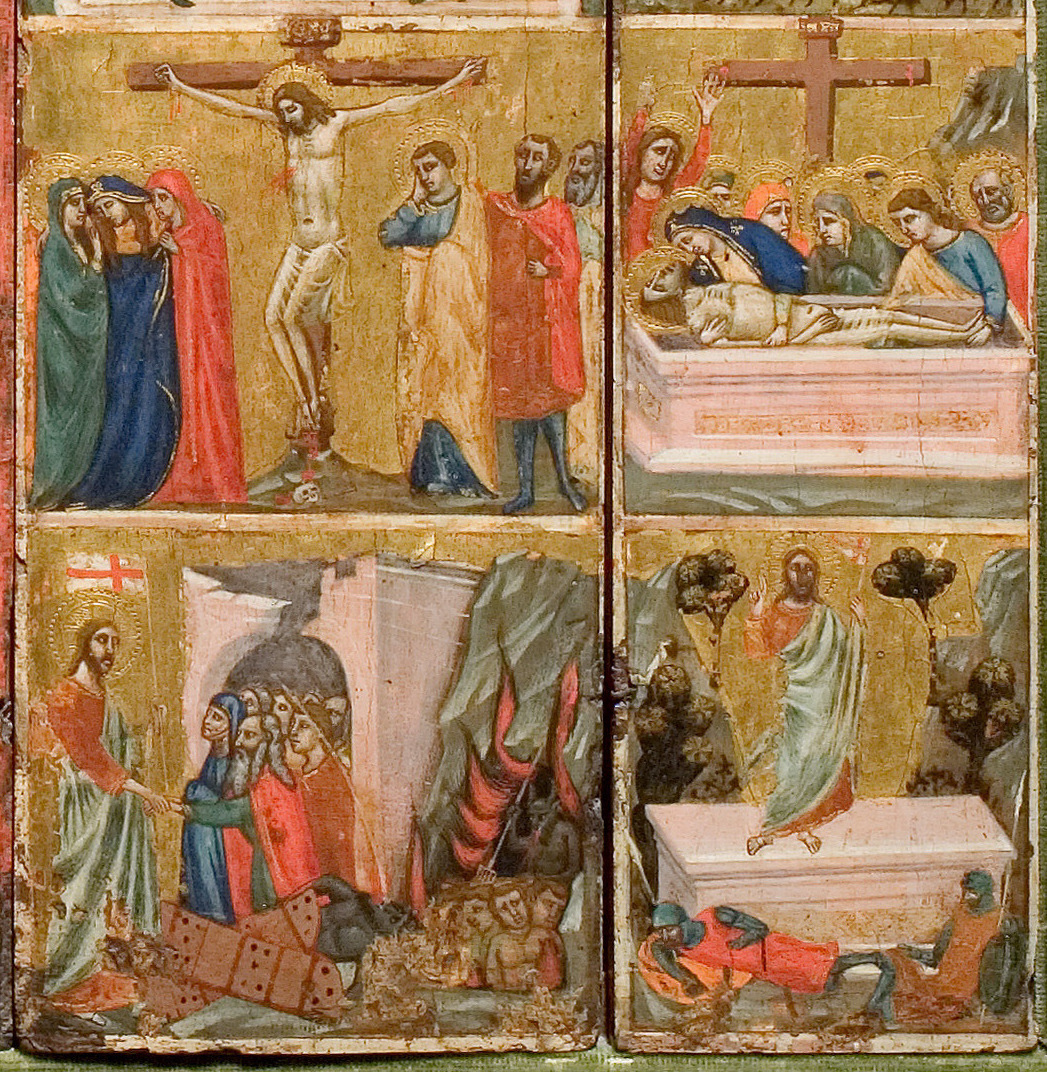
Pacino di Bonaguida, Tabernacle with Scenes from the Life of Christ, bottom right detail

We see this sequential movement reflected in the sacred comics of the time—sometimes in square panels, other times in more creative shapes.
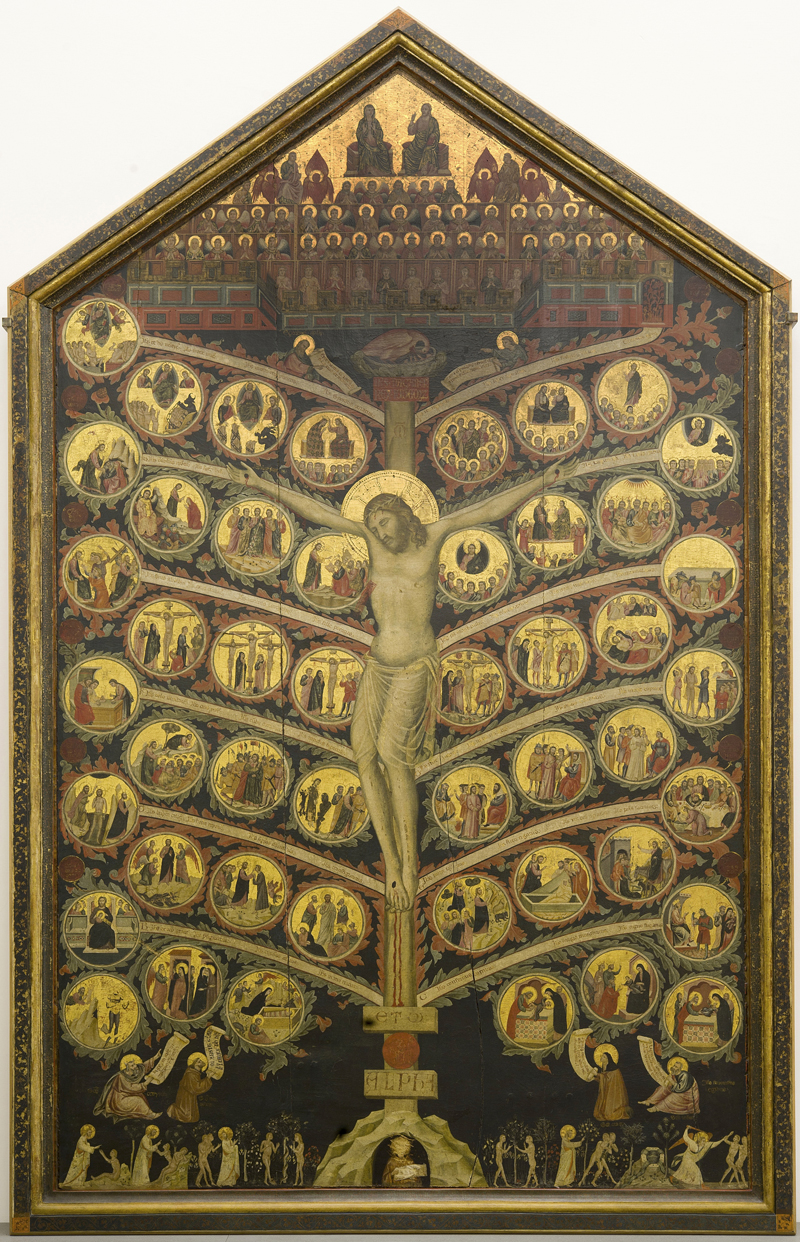
Pacino di Bonaguida_Tree of Life
Pacino di Bonaguida, The Tree of Life, 1320. Tempera and gold leaf on wood panel, 248 × 151 cm. Galleria dell’Accademia, Florence. Note the round panels extending from a central point.

Sermons from the time extolled the usefulness of images depicting scenes from the life of Christ as a way to expand access to the gospel narrative. In 1492, for example, the Dominican friar Michele da Carcano, citing a famous letter of Pope Gregory’s from around 600, preached that images were introduced in churches “first, on account of the ignorance of simple people, so that those who are not able to read the scriptures can yet learn by seeing the . . . faith in pictures.” 

These comics were intended to expand ordinary Christians’ access to the biblical story—making it more present and compelling, especially for those who couldn’t read. 

2. Harriet Powers, 19th century, American South
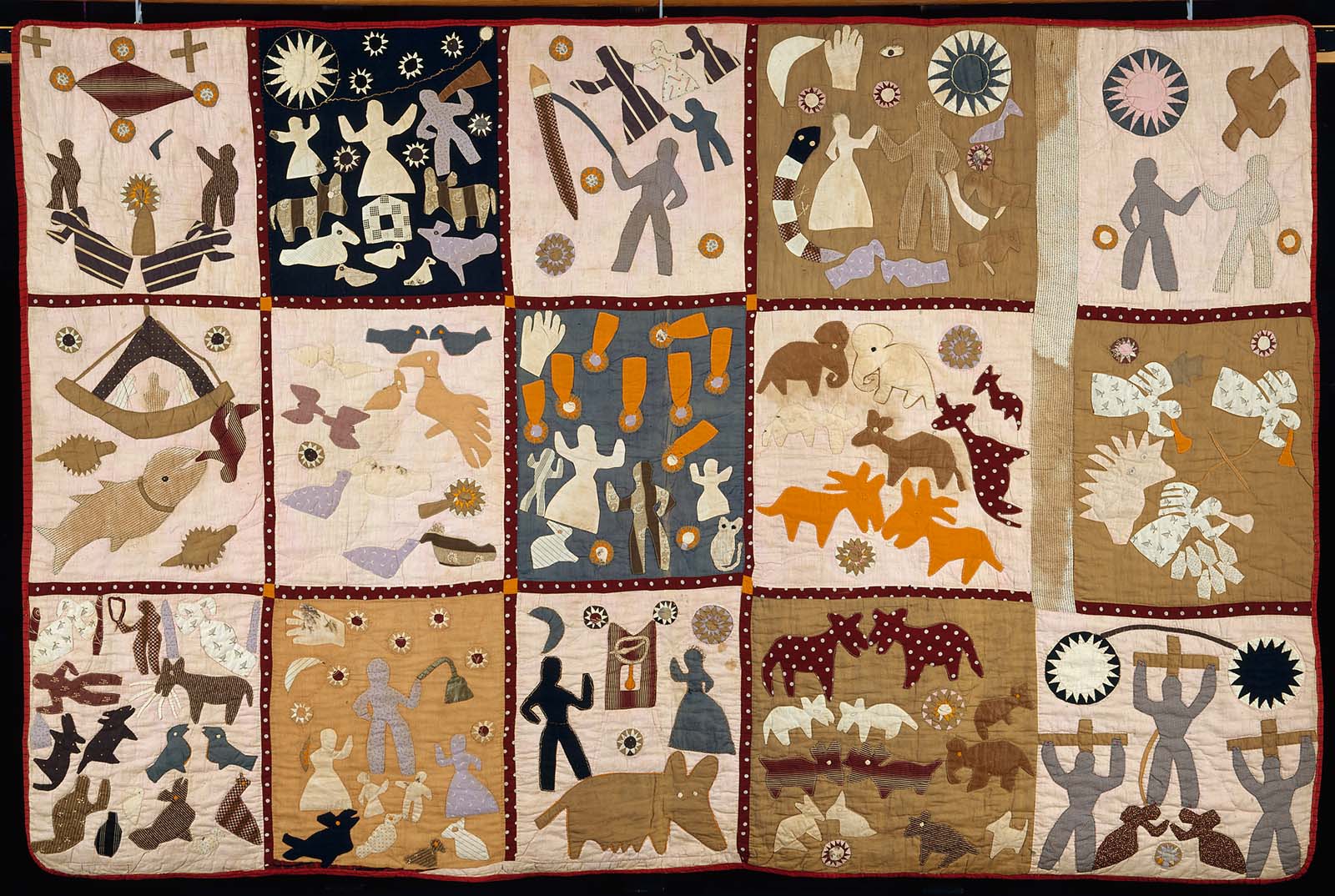
Powers, Harriet_Pictorial Quilt
Harriet Powers (American, 1837–1910), Pictorial Quilt, 1895–98. Cotton plain weave, pieced, appliqued, embroidered, and quilted, 175 × 266.7 cm. Museum of Fine Arts, Boston.

Harriet Powers was a Black American quilter and folk artist who was born into slavery in 1837 and lived near Athens, Georgia.

Like the Dominicans and Franciscans several centuries earlier, Powers saw her comics as a more-than-verbal way to preach the gospel. She described her work as “a sermon in patchwork,” saying she intended to “preach the gospel in patchwork, to show my Lord my humility” and to “show where sin originated, out of the beginning of things.”

Powers’s comics teach and exhort, just like a sermon. In her article “Quilting the Sermon: Homiletical Insights from Harriet Powers,” Dr. Donyelle McCray places Powers’s visual art in the tradition of African American preaching:

Rather than preaching a discursive message, [Powers] offers one that is “archaic,” or “predicated on the priority of something already there, something given.” Her symbols and textures facilitate a process of “crawling back” to a deeper level of consciousness or evoking knowledge that is already within but encumbered. . . .

Powers focuses on what her audience already knows by nurturing memory and offering faith-enlivening symbols that will embolden their Christian imagination.

Powers’s quilts weave historical scenes from the recent past with biblical scenes—visually and metaphorically linking the biblical story and her immediate reality.

In her Pictorial Quilt, five of the fifteen panels depict recent historical and climatological events. The remaining ten depict stories from scripture.
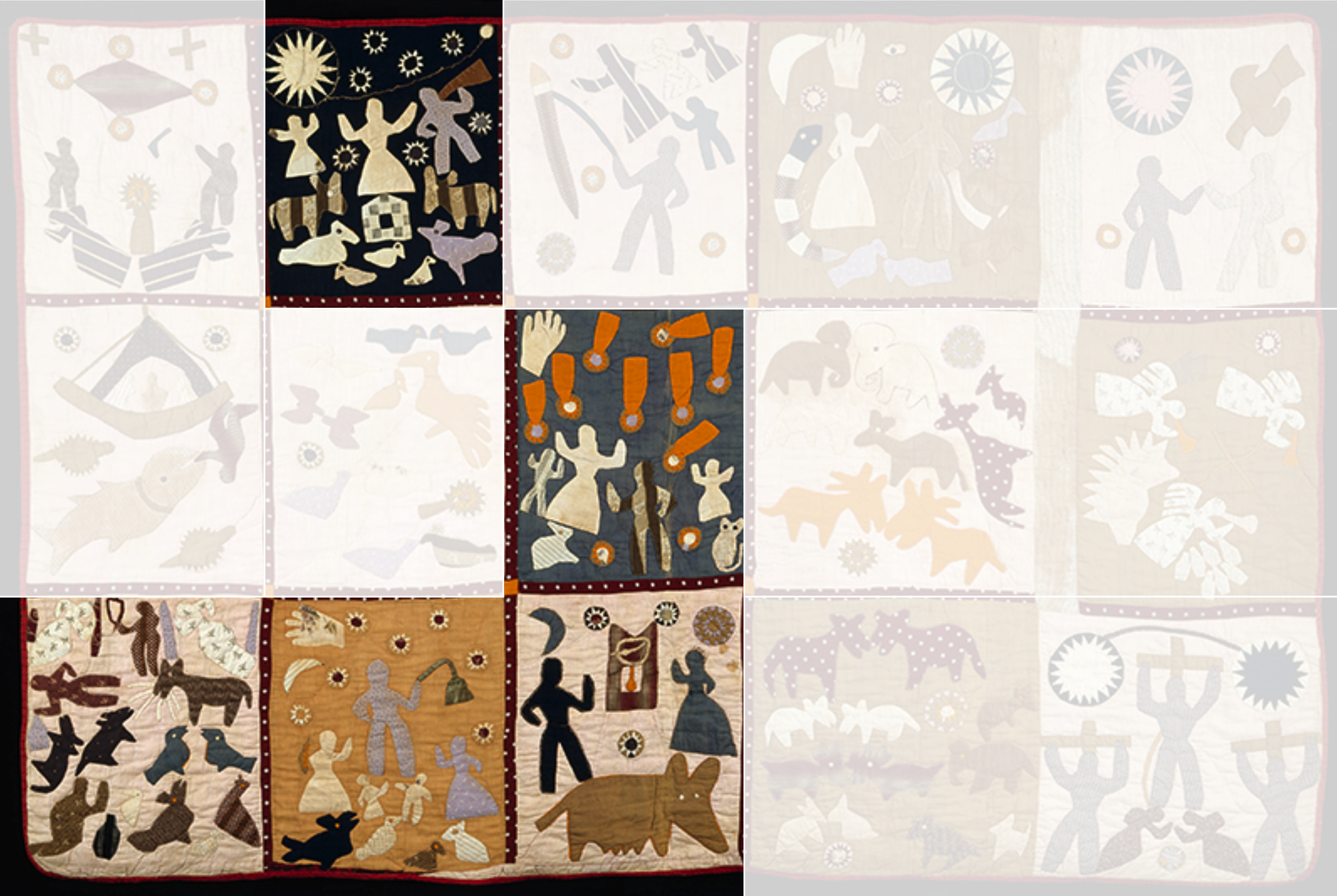
Harriet Powers, historical and climatological panels
Harriet Powers, Pictorial Quilt, edited by the author to highlight historical and climatological panels

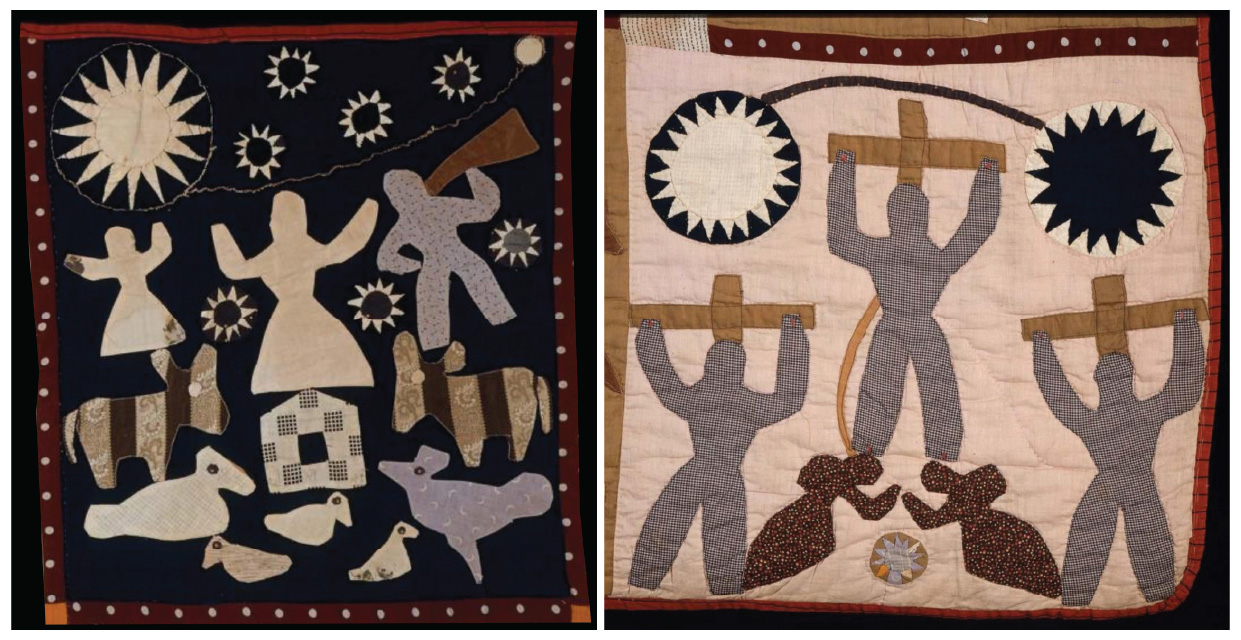
Panels from Pictorial Quilt by Harriet Powers

Left: “The dark day of May 19, 1780. The seven stars were seen 12 N. in the day. The cattle wall went to bed, chickens to roost and the trumpet was blown. The sun went off to a small spot and then to darkness.“

Right: “The crucifixion of Christ between the two thieves. The sun went into darkness. Mary and Martha weeping at his feet. The blood and water run from his right side.”

Note the way that the visual repetition of celestial bodies creates a link between the scene of recent history and Christ’s passion.

Powers’s comics, written from the margins (Powers was a formerly enslaved woman in Reconstruction-era Georgia) and for those on the margins, reflect a vision of a world where biblical stories and lived reality are not distant or separate, but already intertwined. 

God is already fully present on the margins. In “Quilting the Sermon,” McCray remarks:

A vibrant spirituality drives Powers’ preaching. She envisions God as a mighty sovereign who intervenes in earthly affairs and is known primarily through obedience to scripture and attentiveness to divine revelation. This revelation is not limited to scripture but continues to unfold in human history through climatological events, celestial occurrences, and everyday activities.

3. Jack Chick, 20th century, American West
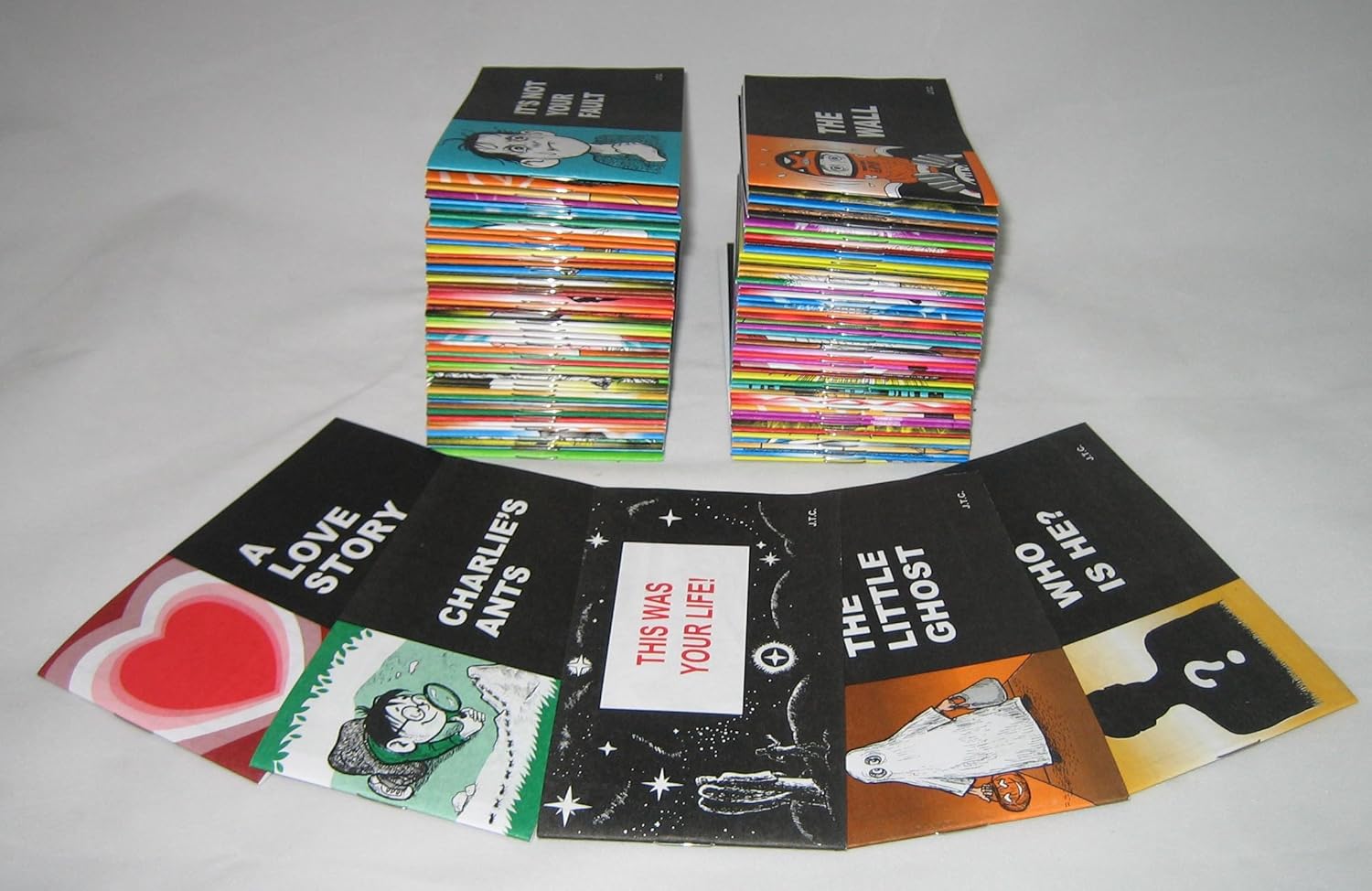
Chick tracts
Piles of Chick tracts from “Chick Tract Assortment” Amazon listing

Chick tracts are broadly viewed as hate literature because of their anti-Semitic and anti-Catholic content. And Jack Chick (and his collaborators) are likely among the best-selling cartoonists in human history, with one billion tracts sold (according to Chick.com’s numbers). 

While I don’t commend Chick’s work for distribution or personal meditation, I think that a critical reading of his comics reveals something interesting about a particular tradition of American Christianity—and how that tradition views the ordinary people who encounter Chick tracts in their mailboxes and workplaces and on public bathroom floors.
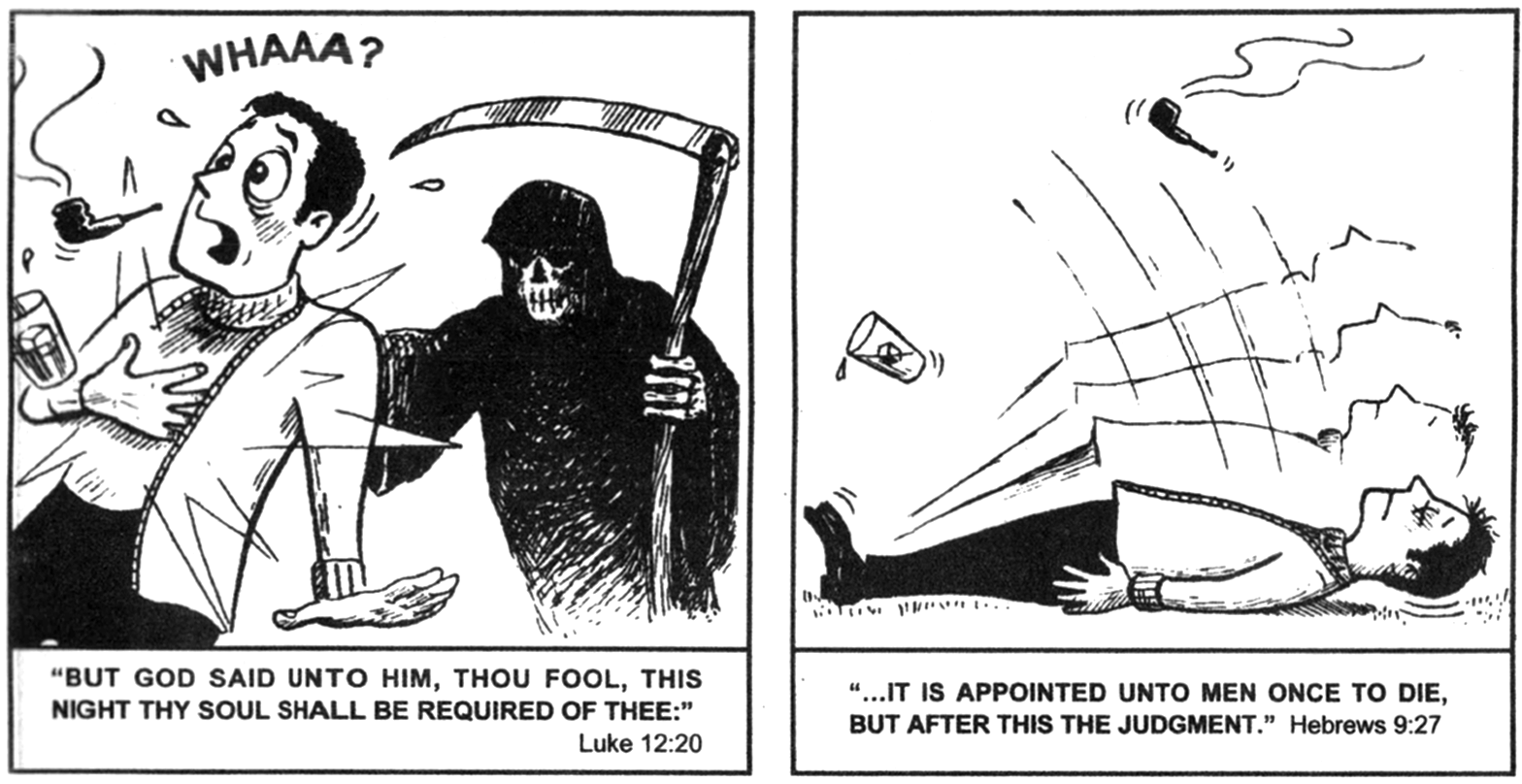
this was your life detail
Detail from This Was Your Life

Each tract is a little larger than a business card (3″ × 5″), and usually around twenty pages long. Most tracts have a consistent rhythm: a setup, a shocking encounter, and a dramatic conversion

If reading the Stations of the Cross feels like solemnly walking behind Christ as he makes his way through Jerusalem, Chick tracts feel like being pushed off a cliff.
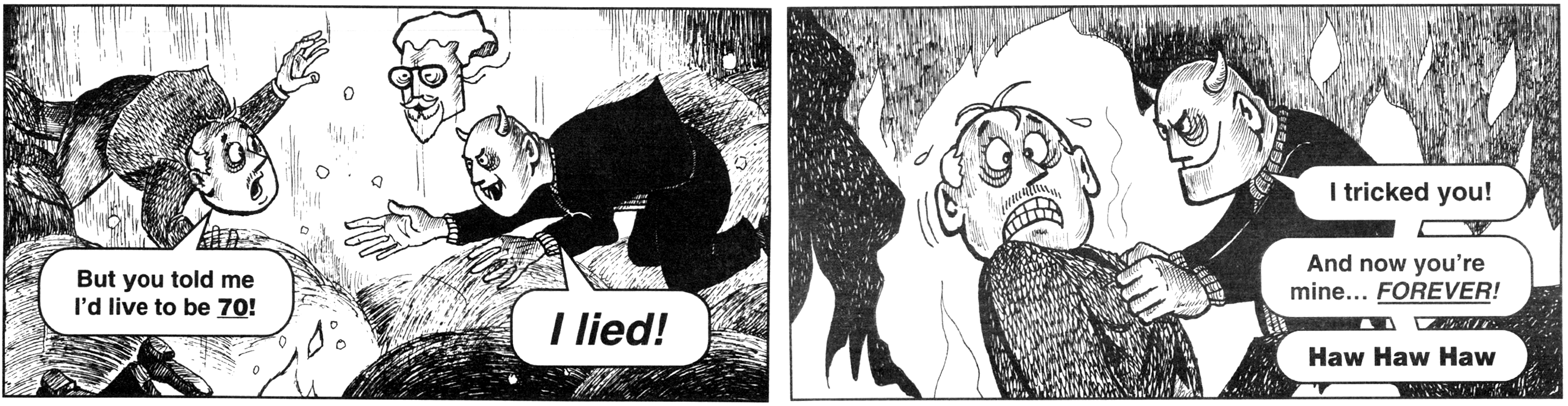
the-long-trip detail
Detail from The Long Trip

In Chick’s imagination, the reader’s encounter with Christ is flat, rote, and tightly choreographed: Chick gives his readers the words to say. The reader’s encounter with God is compressed and mass-produced—an industrial object, like the tracts themselves.
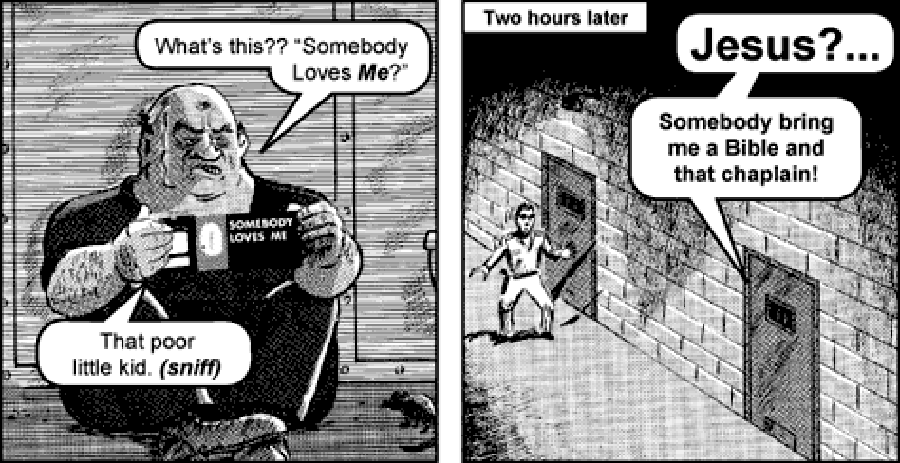
the-bull-detail
Detail from The Bull, in which the titular character has a conversion experience while reading a Chick tract


For all three artists—Pacino di Bonaguida, Harriet Powers, and Jack Chick—the form’s legibility, irresistibility, and overall accessibility made comics a compelling tool to facilitate their readers’ encounters with God. 


When I started making comics in high school, I was drawn to the medium for similar reasons: there is something irresistible and magical about the format. 

My first comics were influenced by the autobiographical cartoonists of the early 2000s, especially Kate Beaton and Marjane Satrapi. In recent years, I’ve begun working more experimentally, influenced by the tradition of Christian comics described above.
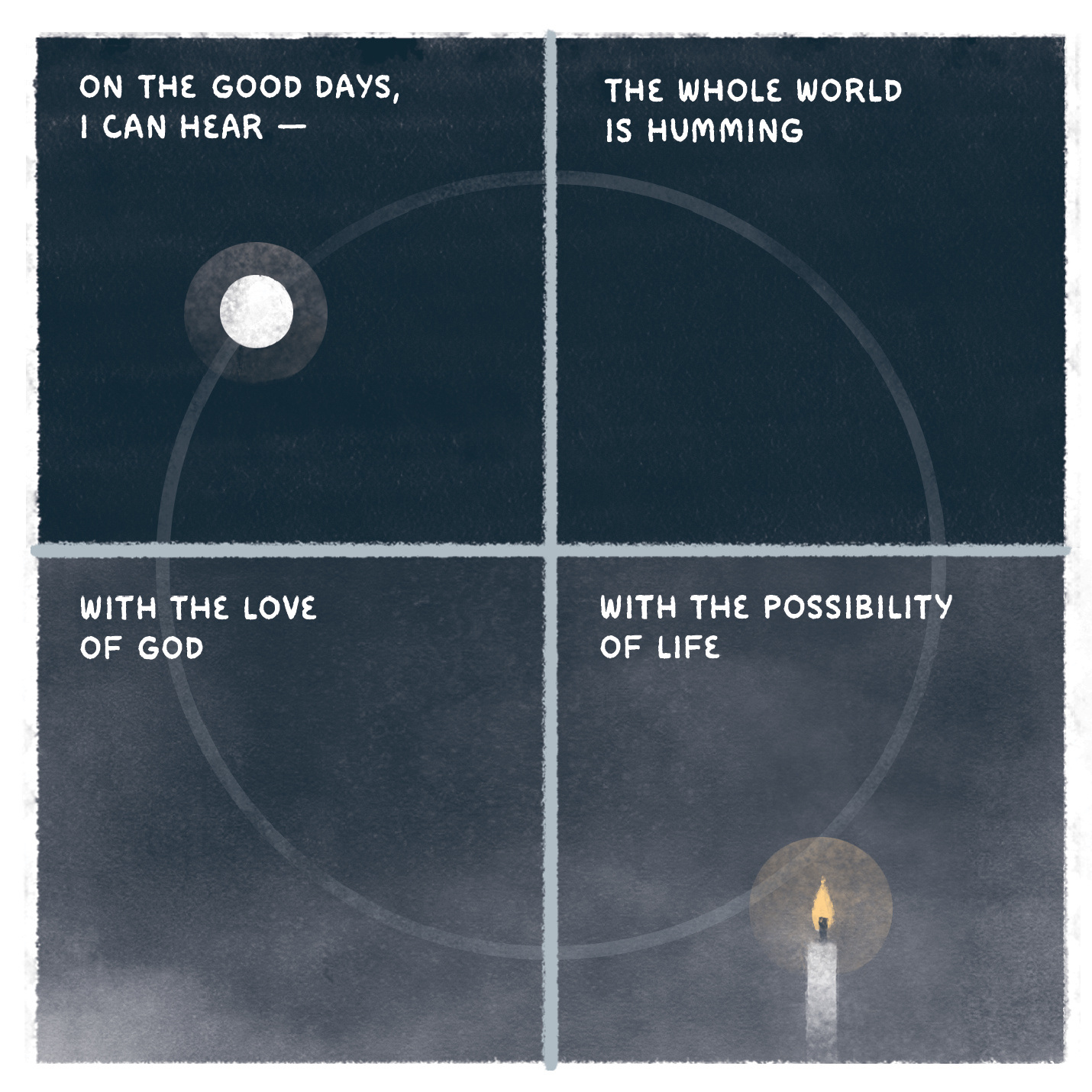
on-the-good-days
From You Are a Sacred Place © by Madeleine Jubilee Saito. Reprinted with permission of Andrews McMeel.

I’ve always loved the poetry and repetition of the Psalms and the Prophets. Comics, especially poetry comics, can have poetic resonances on multiple levels at once: in the text, in the imagery, and in the interplay between the text and imagery.
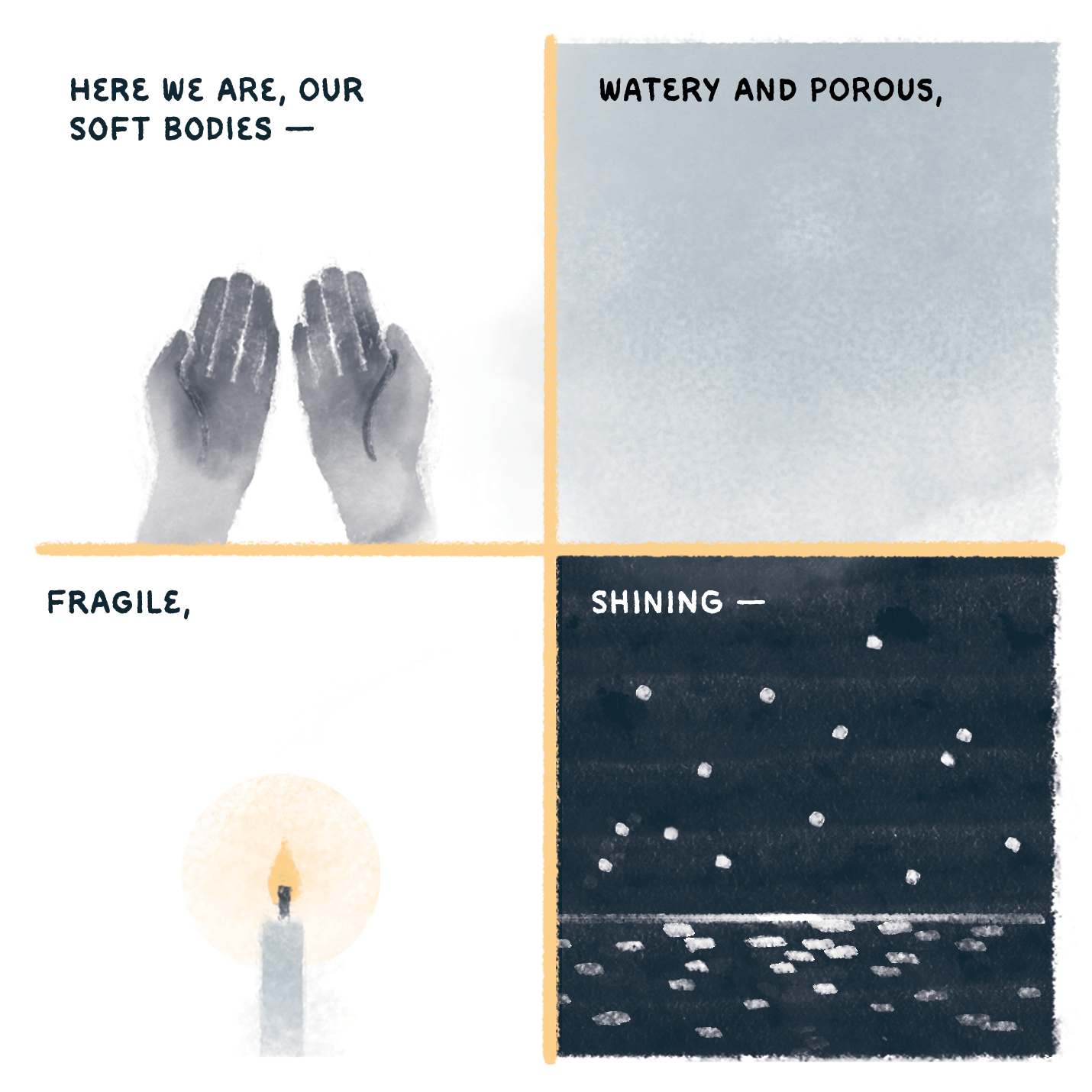
here-we-are
From You Are a Sacred Place © by Madeleine Jubilee Saito. Reprinted with permission of Andrews McMeel.

My first book, You Are a Sacred Place: Visual Poems for Living in Climate Crisis (out from Andrews McMeel March 25, 2025), is my attempt to bring the comics medium’s unique complexity into questions about the climate crisis, God’s justice, and how it feels to live in our moment in history. 


Madeleine Jubilee Saito (photo: Holly Stevens)

Madeleine Jubilee Saito is a cartoonist and artist from rural Illinois living in Seattle and the author of You Are a Sacred Place (Andrews McMeel, 2025). In 2022, she was an inaugural artist-in-residence at On Being. Her comics open each section of the best-selling anthology of women’s writing about climate, All We Can Save (One World, 2020), and her work was recognized in Best American Comics 2019. Follow her on Instagram @madeleine_jubilee_saito.
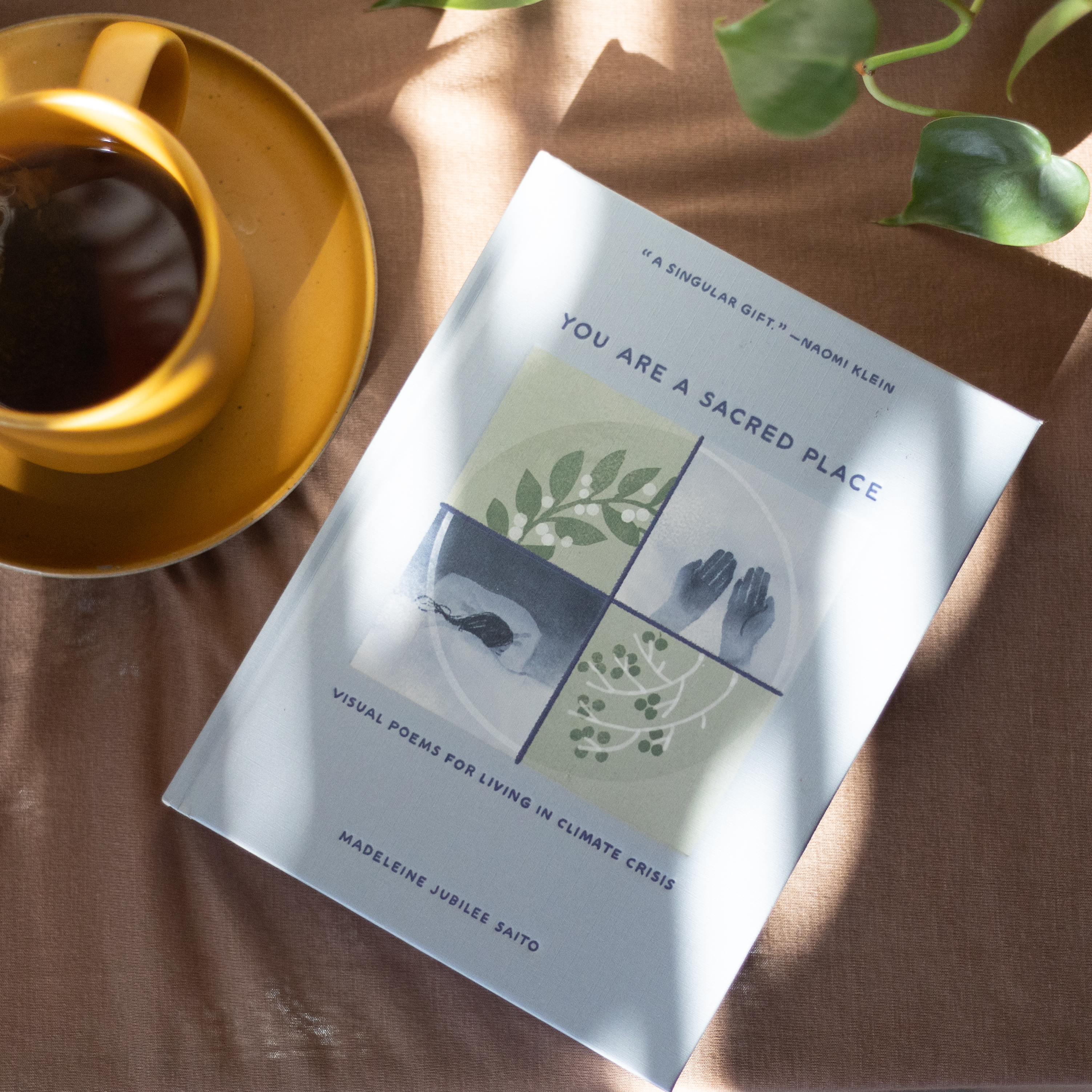
You Are a Sacred Place

[Purchase You Are a Sacred Place]

From the publisher: “In her debut collection of comics, artist and climate activist Madeleine Jubilee Saito offers a quietly radical message of hope. Framed as a letter in response to a loved one’s pain, this series of ethereal vignettes takes readers on a journey from seemingly inescapable isolation and despair, through grief and rage, toward the hope of community and connection. Drawing on the tradition of climate justice, Saito reminds readers that if we’re going to challenge fossil fuel capitalism, we must first imagine what lies beyond it: the beauty and joy of a healed world.”

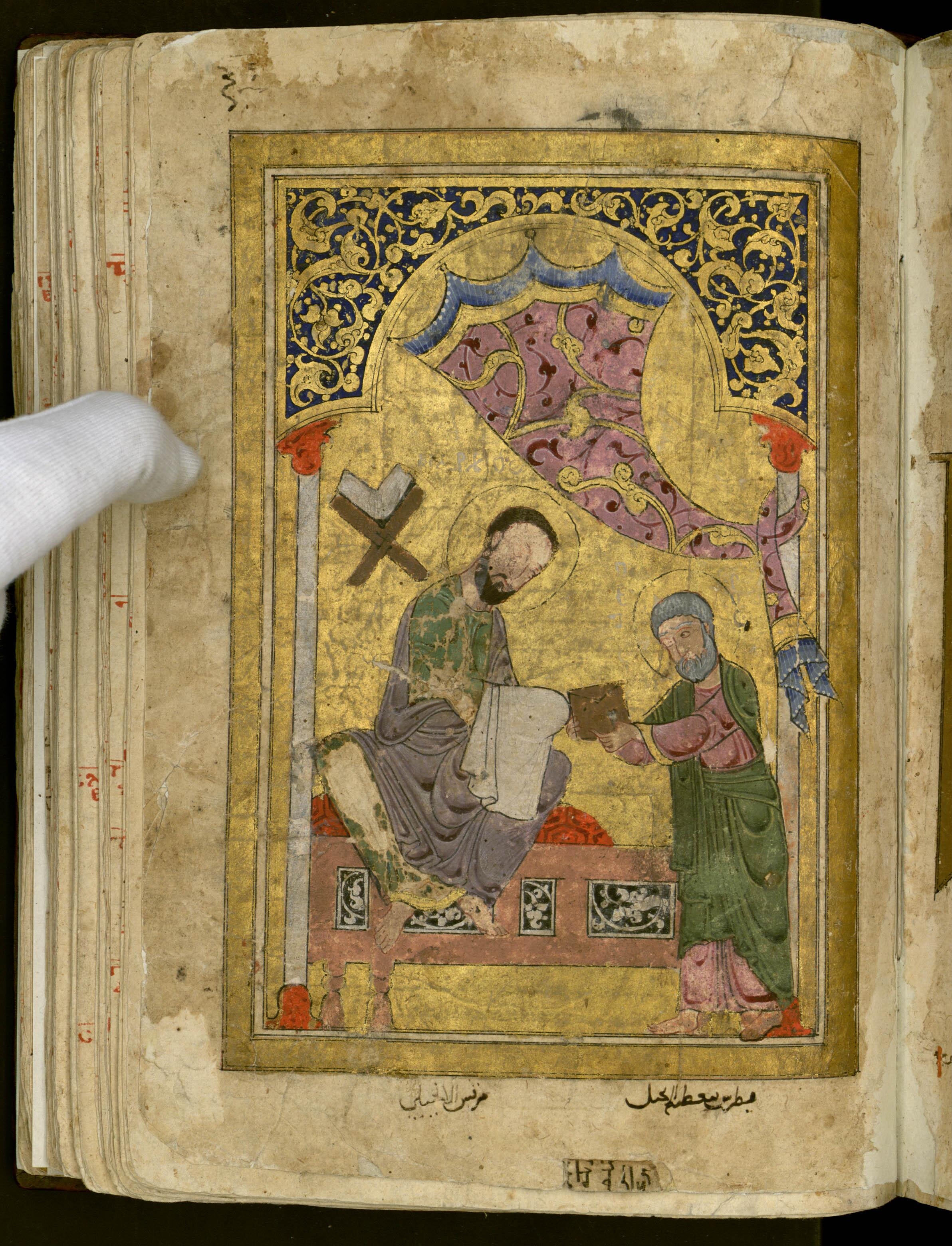
Miniatures from a Coptic-Arabic Gospel Book, 13th century

Christianity has had a long and deep presence in Egypt. The art historical record is one means of exploring that.

From mid-thirteenth-century Egypt there survives an illuminated New Testament written in Bohairic Coptic with glosses in Arabic. It was copied in Cairo in 1249–50 by Gabriel III (born al-Rashīd Farajallāh), who would serve as patriarch of Alexandria from 1268 to 1271, for the private use of a prosperous lay patron of the Coptic Church. The images are most likely the work of a single artist and his assistant.

This Coptic-Arabic New Testament is divided between two locations: the Four Holy Gospels in Paris (Institut Catholique, Ms. Copte-Arabe 1), and Acts of the Apostles and the Epistles in Cairo (Coptic Museum, Bibl. 94). In this post I will showcase the art from the Gospels portion.

Drawing on Byzantine and Islamic artistic influences, Copte-Arabe 1 “represents the culmination of painting in Egypt and the allied territory of Syria for the Ayyubid period [1171–1260] as a whole,” writes art historian Lucy-Anne Hunt. [1] The manuscript contains fourteen full-page miniatures and four Gospel headpieces. A later hand clumsily retouched in black ink some facial details that had become abraded over the years—so no, those marks most noticeable on folios 56v and 178v are not intended as mockery.

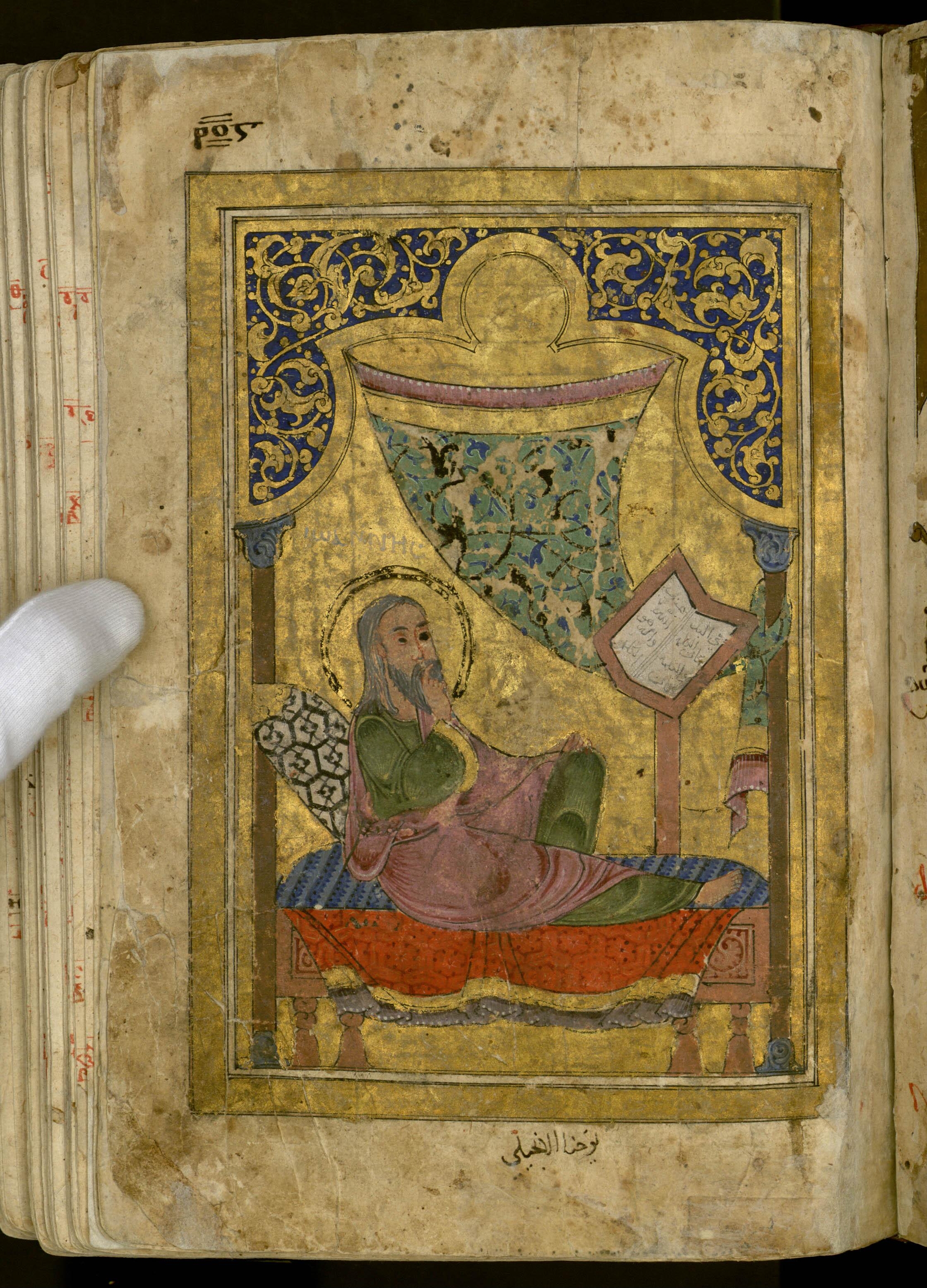
Of the fourteen full-page miniatures, four are portraits of the Evangelists (i.e., Gospel-writers): Matthew, Mark, Luke, and John. These are the most refined and celebrated paintings in the manuscript.

Coptic-Arabic Portrait of Matthew
fol. 1v: Portrait of Matthew the Evangelist

65v: Mark Receives the Gospel from Peter
fol. 65v: Mark the Evangelist Receiving the Gospel from Peter

Coptic-Arabic Portrait of Luke
fol. 105v: Portrait of Luke the Evangelist

Coptic-Arabic Portrait of John
fol. 174v: Portrait of John the Evangelist

Each Evangelist is shown under a cusped arch—Matthew copying his Gospel in Arabic, Luke seated in front of a pulled-back curtain with a lotus design pattern, and John uniquely reclining, a pose adapted from secular models.

But the most interesting of the four Evangelist portraits is Mark’s, because there’s another figure with him. The owning institution labels the page “Marc l’évangéliste; Pierre lui donnant l’Evangile” (Mark the Evangelist; Peter giving him the Gospel). I had to look into this!

Traditionally, a man named John Mark is credited as the author of the Gospel that begins, “The beginning of the good news of Jesus Christ.” (It came to be called the Gospel of Mark by the end of the second century.) John Mark was a disciple of Peter, whom he is believed to have used as his primary source in composing his Gospel. The two were close companions, and Peter even refers to him as a son (1 Pet. 5:13). John Mark’s mother, Mary, hosted a house church that Peter was connected with (Acts 12:12). John Mark was also a cousin of Barnabas of Cyprus (Col. 4:10) and accompanied Paul in some of his apostolic travels (Acts 12:25; 13:1–5; 15:36–39).

Papias of Hierapolis, Irenaeus, Justin Martyr, Clement of Alexandria, Eusebius, Tertullian, and Origen—church fathers of the first two centuries of Christianity—all mention in their writings that Mark wrote his Gospels based on Peter’s eyewitness testimony and teachings. [2]

So folio 65v of Copte-Arabe 1 shows Peter passing on his intimate knowledge of Christ to Mark. As a sign of respect, Mark’s hands are covered with a cloth, ready to receive Peter’s notes.

Examining artistic precedents of this pair of men, Hunt writes:

Middle Byzantine iconographic sources can . . . be suggested for the Copte-Arabe 1 portrait of Mark with Peter (fol. 65v), which relates to the broad category of Evangelist portraiture with a second, usually inspiring figure. Mark appears seated, with Peter, who stands before him bearing the Gospel. More frequent are portraits of Peter dictating to Mark, the earliest known being that in the mutilated Greek New Testament in Baltimore (Walters Art Gallery W. 524) in which both are seated. Greek manuscripts with such portraits would have been accessible through the Syrian and Armenian communities. Two such twelfth century Gospels today in Jerusalem are the Greek Taphou 56 and the Armenian Theodore Gospels (Armenian Patr. 1796), showing the standing Peter dictating to the seated Mark. It has often been pointed out that secondary figures, either inspiring or presenting, are particularly common in Coptic and other oriental Christian art. [3]

Now let’s take a look at the narrative images. I went through them all and attempted to identify each scene as best I could (I can’t read the Arabic inscriptions), which I label in the caption along with the scripture passage it illustrates. These descriptive titles are preceded by the folio number. Note that in manuscript studies, “fol.” or “f.” stands for “folio” (page), “v” stands for “verso” (a left-hand page), and “r” stands for “recto” (a right-hand page).

All the image files are sourced from La bibliothèque numérique de l’Institut Catholique de Paris (The Digital Library of the Catholic Institute of Paris), which hosts a full scan of the manuscript. If you wish to reproduce any of the images singly, I suggest the following caption: Page from a Coptic-Arabic Gospel Book, Cairo, Egypt, 1249–50. Illuminations on parchment, 25.5 × 17.5 cm. Bibliothèque de Fels (Fels Library), Institut Catholique de Paris, Ms. Copte-Arabe 1, fol. _.

The first narrative scene in the manuscript, a header to the Gospel of Matthew, is a Nativity, with Mary reclining in the hollow of a cave and the Christ child lying swaddled beside her, adored by an ox and ass. An angel with folded hands peers reverently over a rocky outcrop, while shepherds approach from the left and magi from the right. Joseph is seated near his wife, eyeing the coming visitors.

Coptic-Arabic Nativity
fol. 2r: The Nativity (Matt. 1:25; 2:9–11; cf. Luke 2:1–7)

Later there follow six pages illuminating various stories from the Gospel of Matthew—the largest image sequence in the manuscript. As in the Gospels of Luke and John (there are none for Mark), these scenes are arranged on a grid system of six small squares to a page.

Coptic-Arabic illumination
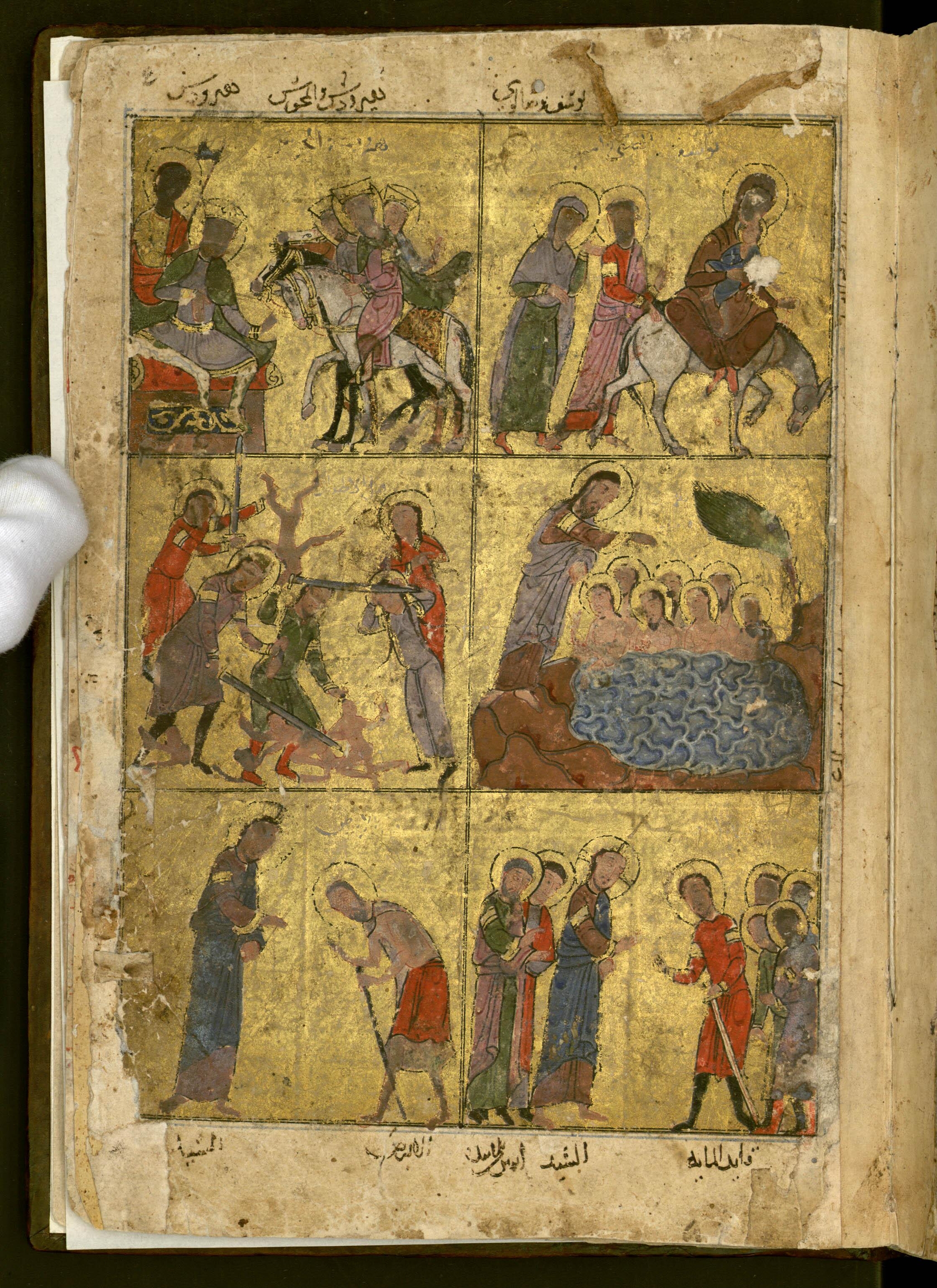
fol. 4v: The Magi before Herod (Matt. 2:7–8); The Flight to Egypt (Matt. 2:13–15); The Massacre of the Innocents (Matt. 2:16–18); John the Baptist Baptizes Converts (Matt. 3:1–12); Jesus Heals a Man with Leprosy (Matt. 8:1–4); A Centurion of Capernaum Seeks Healing for His Servant (Matt. 8:5–13)

Coptic-Arabic illumination
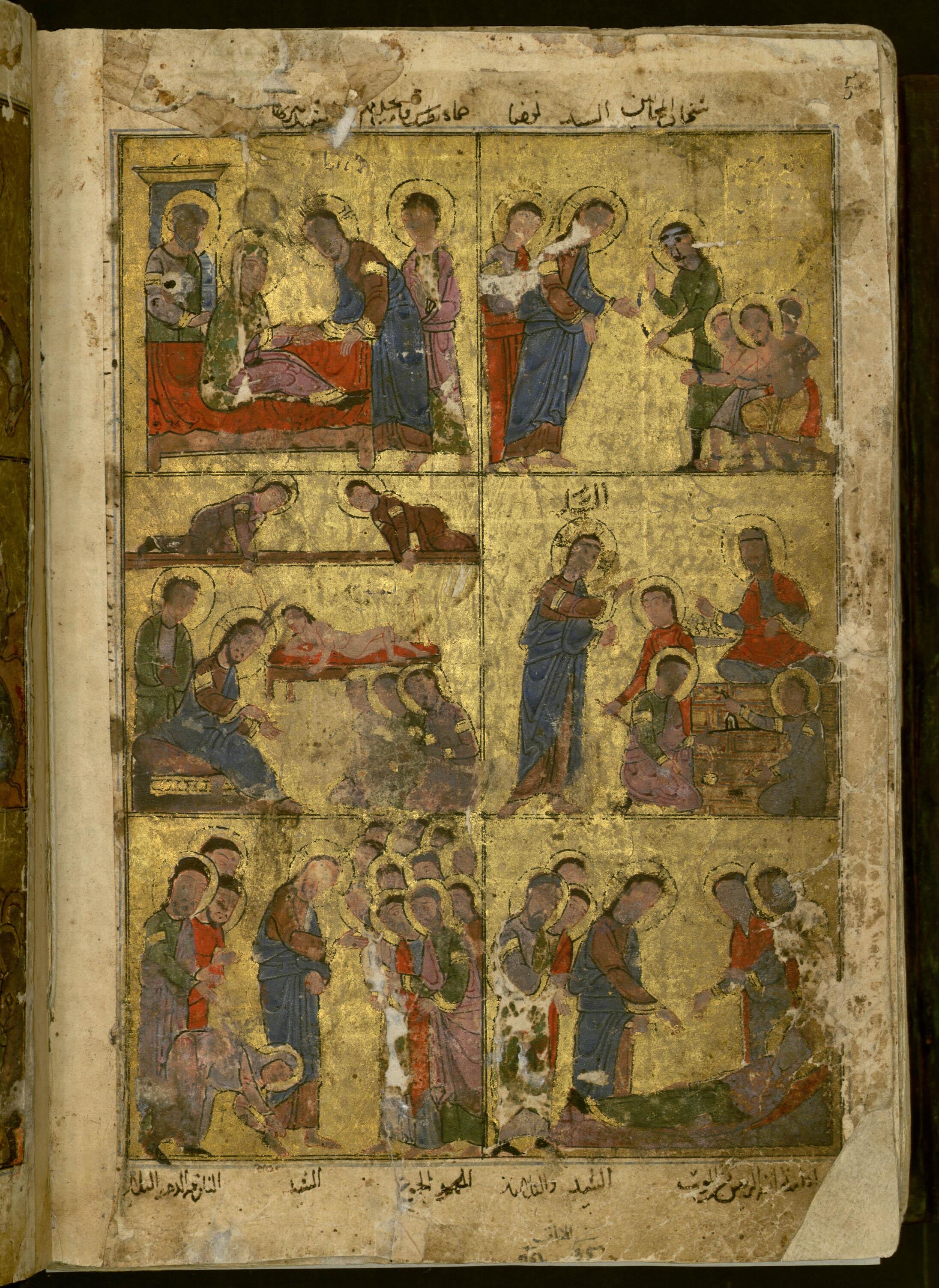
fol. 5r: The Healing of Peter’s Mother-in-Law (Matt. 8:14–15); Jesus Restores Two Demon-Possessed Men (Matt. 8:28–24); The Healing of the Paralytic (Matt. 9:1–8); The Calling of Matthew (Matt. 9:9–13); The Healing of the Woman with the Issue of Blood (Matt. 9:20–22); The Raising of Jairus’s Daughter (Matt. 9:18–19, 23–26)

Coptic-Arabic illumination
fol. 18v: Messengers from John the Baptist (Matt. 11:2–5); The Beheading of John the Baptist (Matt. 14:1–12); The Feeding of the Multitudes (Matt. 14:13–21); The Transfiguration (Matt. 17:1–13); Jesus Heals a Demon-Possessed Boy (Matt. 17:14–20); The Mother of James and John Requests a Favor (Matt. 20:20–28)

Coptic-Arabic illumination (Passion Week)
fol. 19r: Jesus’s Disciples Fetch a Donkey (Matt. 21:1–6); Christ’s Entry into Jerusalem (Matt. 21:7–11); The Parable of the Wise and Foolish Virgins (Matt. 25:1–13); The Anointing at Bethany (Matt. 26:6–13); Jesus Washes His Disciples’ Feet (John 13:1–17); The Last Supper (Matt. 26:20–29)

From having seen other similar compositions, I know that the man holding the scroll and gesturing toward the donkey on folio 19r/1 is the prophet Zechariah, and that his scroll contains a portion of Zechariah 9:9: “Rejoice greatly, O daughter Zion! Shout aloud, O daughter Jerusalem! See, your king comes to you; triumphant and victorious is he, humble and riding on a donkey, on a colt, the foal of a donkey.”

Coptic-Arabic illumination (Passion Week)
fol. 56v: The Agony in the Garden (Matt. 26:36–46); The Kiss of Judas (Matt. 26:47–49); The Arrest of Christ (Matt. 26:50–56); Christ before Caiaphas (Matt. 26:57–66); The Denial and Repentance of Peter (Matt. 26:69–75); Christ before Pilate (Matt. 27:11–23)

Coptic-Arabic illumination (Passion Week)
fol. 57r: Judas Returns the Blood Money and Hangs Himself (Matt. 27:1–10); Pilate Washes His Hands (Matt. 27:24–26); Christ Carries His Cross (Matt. 27:31); The Crucifixion (Matt. 27:33–56); The Deposition (Matt. 27:57–59); The Entombment (Matt. 27:59–61)

Strikingly, all the figures in this manuscript are given halos around their heads, not just holy figures—for example, King Herod, antagonistic Pharisees, Judas, the Roman soldiers who arrest and taunt Jesus, and the foolish virgins. I’m not sure the reason for this; it’s possible it marks the imago Dei in each and every human, even those who oppose Christ. I welcome the input of scholars better versed in Coptic art than I.

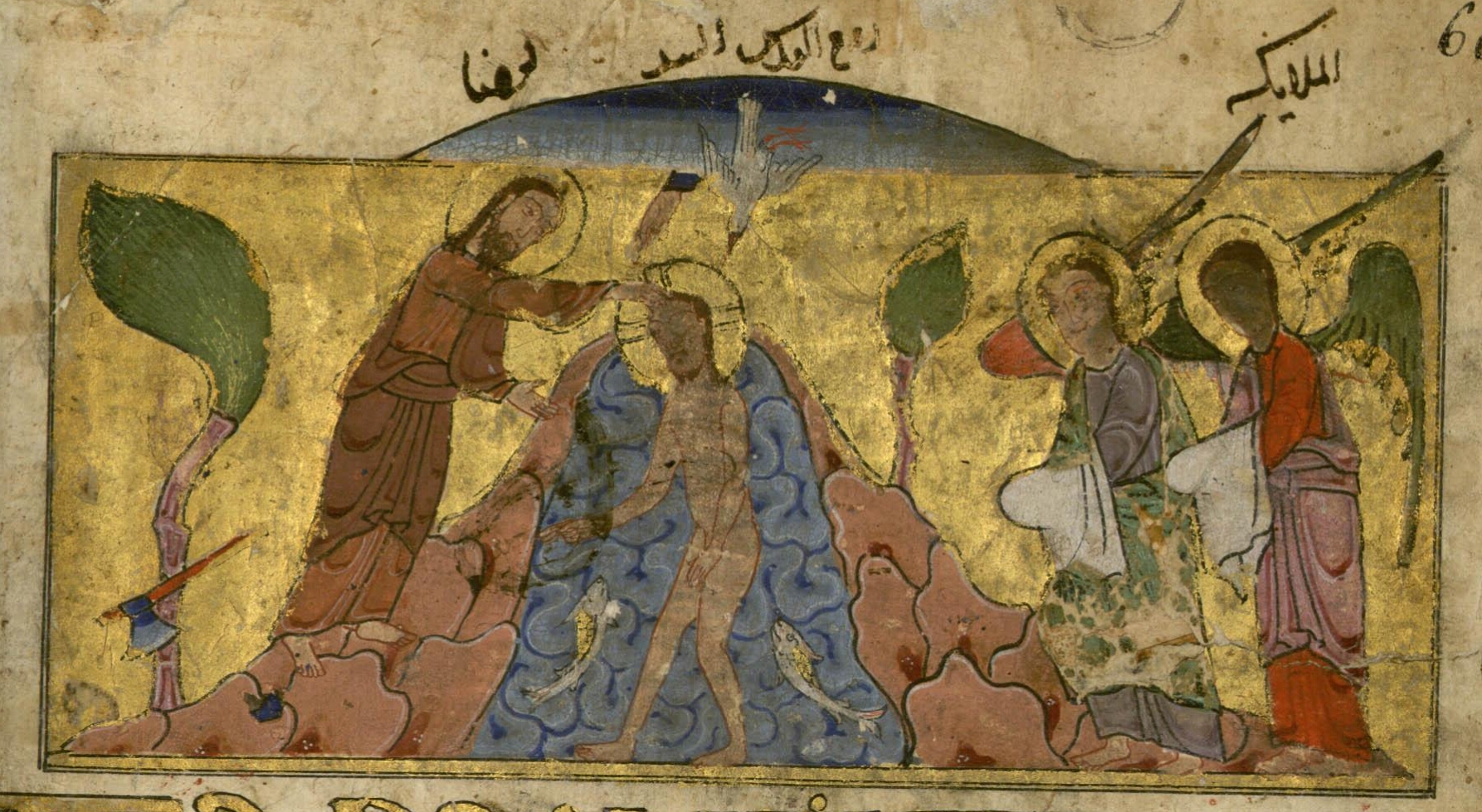
The headpiece to the Gospel of Mark portrays the Baptism of Christ. Fully nude, he is submerged in the Jordan River. John the Baptist stands on the bank and touches Christ’s head, while the hand of God the Father emerges from the heavens, pronouncing blessing over the Son, and the Holy Spirit as dove hovers above. Again, the manus velatae (veiled hands) motif appears, this time with the angels, signaling their reverence. On the left an ax cuts into the base of a tree, a reference to John the Baptist’s stark warning to the Sadducees and Pharisees who observe the baptisms: “Even now the ax is lying at the root of the trees; therefore every tree that does not bear good fruit will be cut down and thrown into the fire” (Matt. 3:10).

Coptic-Arabic Baptism of Christ
fol. 66r: The Baptism of Christ (Mark 1:9–11)

The next illumination is folio 106r, which opens the Gospel of Luke. It shows three scenes from Luke 1: the angel Gabriel announcing to the priest Zechariah that his wife, Elizabeth, will bear a son named John; Gabriel announcing to the virgin Mary that she will bear a son named Jesus; and Mary and Elizabeth rejoicing together in the unexpected news of their pregnancies and the divine deliverance they signal.

Coptic-Arabic Annunciation, Visitation
fol. 106r: The Annunciation to Zechariah (Luke 1:5–23); The Annunciation to Mary (Luke 1:26–38); The Visitation (Luke 1:39–56)

In the first full-page miniature from Luke (below), the third scene confuses me a bit. I’m fairly sure it’s supposed to be the twelve-year-old Jesus sitting among the doctors of the law in the temple at Jerusalem, as narrated in Luke 2:41–51; this episode is typically included in image cycles on the Life of Christ. But here he’s shown as a full-grown adult. The arch above the group is similar to the one shown in the previous frame where the infant Christ is presented in the temple forty days after his birth, suggesting that this is the temple, not a synagogue.

Coptic-Arabic illumination
fol. 109v: The Birth of John the Baptist (Luke 1:57–58); The Presentation in the Temple (Luke 2:22–38); Christ Disputing with the Doctors in the Temple (Luke 2:46–47); Jesus Teaching in the Synagogue at Nazareth (Luke 4:16–20); The Religious Leaders Attempt to Push Jesus Off a Cliff (Luke 4:28–30); Jesus Raises the Son of the Widow of Nain (Luke 7:11–17)

Regardless, the next episode, portrayed on folio 109v/4, is one of my favorites in Luke’s Gospel: Jesus interpreting the Isaiah scroll at his hometown synagogue, announcing himself as the long-awaited Messiah and thereby launching his ministry.

When he came to Nazareth, where he had been brought up, he went to the synagogue on the Sabbath day, as was his custom. He stood up to read, and the scroll of the prophet Isaiah was given to him. He unrolled the scroll and found the place where it was written:

The Spirit of the Lord is upon me,
    because he has anointed me
        to bring good news to the poor.
He has sent me to proclaim release to the captives
    and recovery of sight to the blind,
        to set free those who are oppressed,
to proclaim the year of the Lord’s favor.

And he rolled up the scroll, gave it back to the attendant, and sat down. The eyes of all in the synagogue were fixed on him. Then he began to say to them, “Today this scripture has been fulfilled in your hearing.” (Luke 4:16–20; cf. Isa. 61)

When asked to expound, Jesus emphasizes how God’s plan of salvation is for all people, recounting two stories from the Hebrew scriptures in which God showed favor to Gentiles—namely, the widow of Zarephath and the Syrian general Naaman. Well, this really raises the ire of his Jewish audience, who believed the Messiah should act exclusively on their behalf. The artist of Copte-Arabe 1 shows on folio 109v/5 the culmination of this contentious encounter between the up-and-coming Jewish teacher making his way through Galilee and the old guard: an attempted murder!

When they heard this, all in the synagogue were filled with rage. They got up, drove him out of the town, and led him to the brow of the hill on which their town was built, so that they might hurl him off the cliff. But he passed through the midst of them and went on his way. (Luke 4:28–30)

On the following page, in the fifth frame, the Rich Man and Lazarus is one of Jesus’s three parables depicted in the manuscript. (The other two are of the Ten Virgins and the Good Samaritan.) The artist depicts not the impoverished, sore-laden Lazarus begging outside the wealthy Dives’s door in this life, but the afterlife. Lazarus, now whole, sits comfortably in Abraham’s bosom, while Dives, who lacked mercy on earth, is denied it in hell; he languishes in flames.

Coptic-Arabic illumination
fol. 110r: Jesus Is Anointed by a Sinful Woman (Luke 7:36–50); The Parable of the Good Samaritan (Luke 10:25–37); The Healing of the Woman with a Bent Back (Luke 13:10–17); The Healing of the Man with Edema(?) (Luke 14:1–6); The Rich Man and Lazarus (Luke 16:19–31); The Healing of the Ten Lepers (Luke 17:11–19)

I’m not sure what the center right scene depicts, but given its placement in the sequence, its setting in a lavish interior, and Jesus’s clear presence at the left (as indicated by the cross in his halo; which I’d say precludes the figures being characters in a parable), my best guess is it represents the healing of the man with edema (dropsy), which takes place in the house of a prominent Pharisee.

Further into the manuscript, our anonymous artist commences the fourth and final Gospel, John, with a depiction of the descent of the Holy Spirit on the apostles at Pentecost—an event described not in John’s Gospel but in the book of Acts.

Coptic-Arabic Pentecost
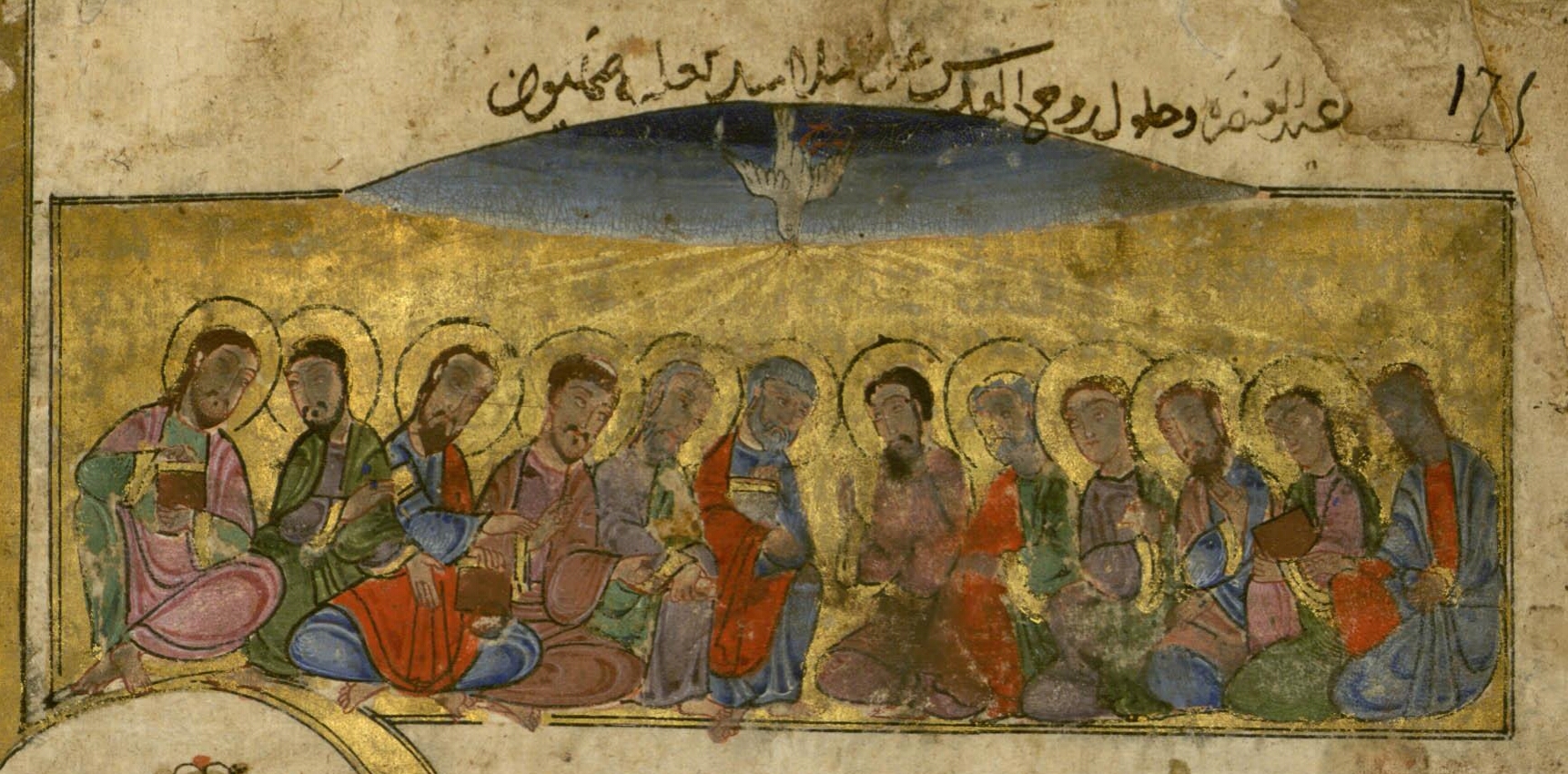
fol. 175r: The Descent of the Holy Spirit (Acts 2:1–13)

Coptic-Arabic illumination
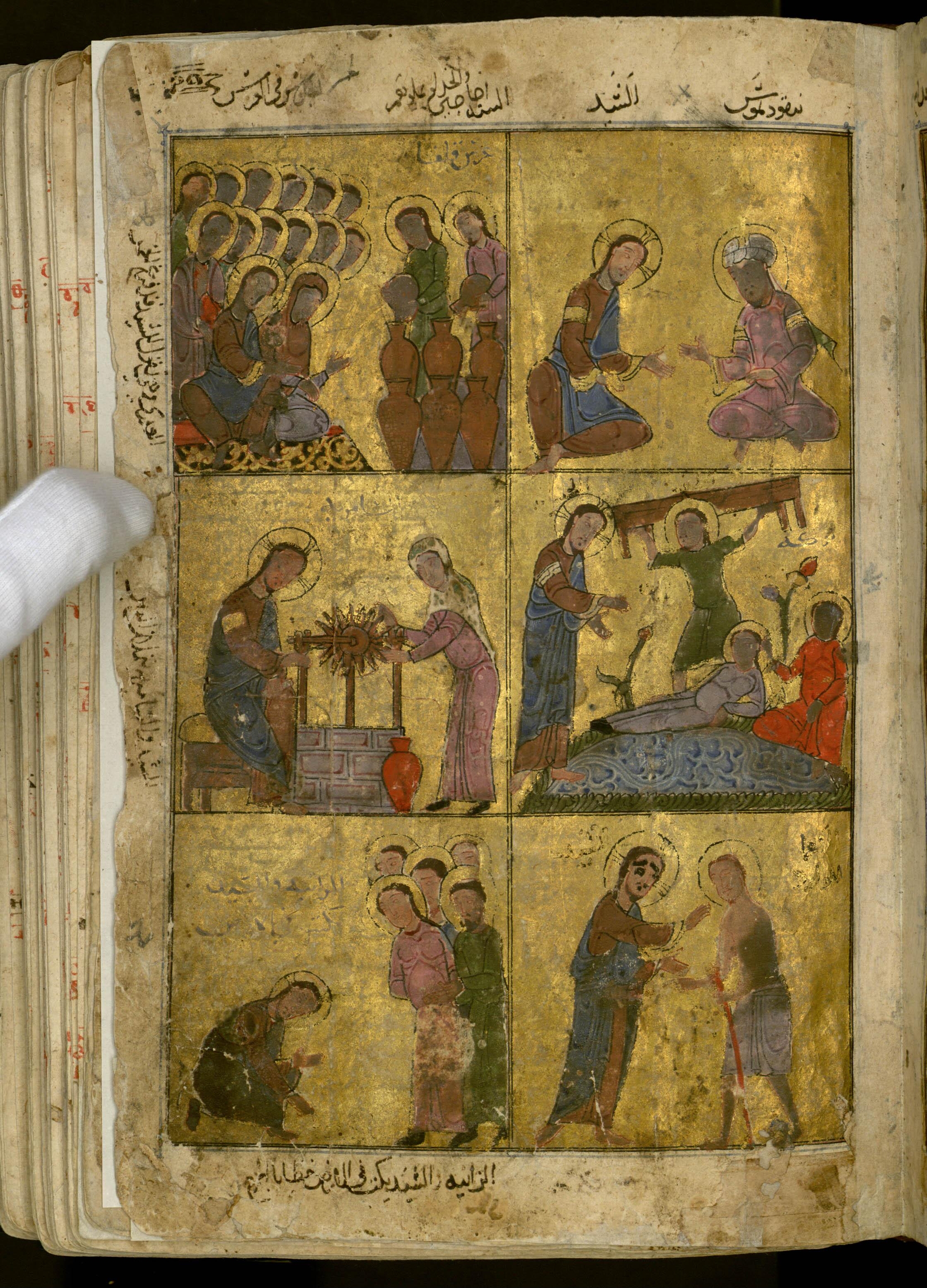
fol. 178v: The Wedding at Cana (John 2:1–12); Jesus Teaches Nicodemus (John 3:1–21); The Woman at the Well (John 4:1–26); The Healing at the Pool of Bethesda (John 5:1–15); The Woman Caught in Adultery (John 8:1–11); The Healing of the Man Born Blind (John 9:1–12)

Coptic-Arabic illumination (Resurrection)
fol. 179r: The Raising of Lazarus (John 11:1–44); The Holy Women at the Tomb (Mark 16:1–8); The Road to Emmaus (Luke 24:13–27; cf. Mark 16:12); The Incredulity of Thomas (John 20:24–29); The Miraculous Catch of Fish (John 21:1–14); The Ascension (Luke 24:50–53)

Folio 179r also contains scenes whose scriptural referents are from other Gospels: four women arriving at Christ’s empty tomb on Easter morning (John mentions only Mary Magdalene, Matthew mentions two women, Mark mentions three, and Luke speaks generally of “the women”); the risen Christ meeting two pilgrims on the road to Emmaus; and Christ’s ascent into heaven. I suppose it’s because this final full-page miniature is Resurrection-themed, so the artist harmonizes the four Gospels, pulling relevant highlights from each.


NOTES

1. Lucy-Anne Hunt, “Christian-Muslim Relations in Painting in Egypt of the Twelfth to Mid-Thirteenth Centuries: Sources of Wallpainting at Deir es-Suriani and the Illustration of the New Testament MS Paris, Copte-Arabe 1 / Cairo Bibl. 94,” Cahiers Archéologiques 33 (1985): 111–55, here 111. Reprinted in Lucy-Anne Hunt, Byzantium, Eastern Christendom and Islam: Art at the Crossroads of the Medieval Mediterranean, vol. 1 (London: Pindar, 1998): 205–81.

2. J. Warner Wallace, “Is Mark’s Gospel an Early Memoir of the Apostle Peter?,” Cold-Case Christianity, July 25, 2018.

3. Hunt, “Christian-Muslim Relations,” 129.

“Christ-hymn” by Sandra R. Duguid (poem)

Smither, Michael_Doubting Thomas
Michael Smither (New Zealand, 1939–), Doubting Thomas, early 1970s. Mural, St. Joseph’s Church, New Plymouth, New Zealand.

O You!
You tiny who
Of Simeons song
You shepherds shock
You singular star-bright

You student 
Shunning company
And travel
For scholars light.

Just apprentice
Of your mothers husband
True measurer
And leveler
And line

Authoritative voice
Enlisting aid
Selector
And selected
And Divine.

Creative host
Of weddings, picnics, graves
Most social
And uncelebrated
Friend

You thoughtful martyr
You thirsty man
You dying God—

I hoped!
But this concludes . . . 
                                       Amen. Amen. 

O
Heir of power
Crasher
Of closed meetings
The unsummoned
Inviting inspection—

You natural!
You Master
Of surprise.

This poem was originally published in the anthology A Widening Light: Poems on the Incarnation, edited by Luci Shaw, and is used here by permission of the poet.

Sandra R. Duguid (b. 1947) is an American poet living in West Caldwell, New Jersey. For twenty years she taught literature, composition, and creative writing at colleges in the New York/New Jersey metropolitan area and at East Stroudsburg University in Pennsylvania, retiring in 2010 to devote more time to writing. She is a recipient of a Fellowship in Poetry from the New Jersey State Council on the Arts and author of the poetry collection Pails Scrubbed Silver (North Star Press, 2013).

Lent, Day 15

LOOK: Life of Christ by Tony Nwachukwu

Nwachukwu, Tony_Untitled
Carved and painted wood by Tony Nwachukwu (Nigerian, 1959–)

I retrieved this image years ago from https://anthonynwachukwu.com/, but the domain has since expired. Nwachukwu didn’t give a title or a date there, and I couldn’t find his contact information to ask. The scene on the far left appears to me to be a Nativity—Christ in the manger, his mother and father standing behind. Then there’s what I’m guessing is Jesus’s anointing with the Spirit at his baptism; hands outspread, he receives his commission. The wineglass and flatbread refer, of course, to the Last Supper, and to Jesus’s declaration that he is the bread of life and that he is initiating a new covenant in his blood. The overturned cup may be a reference to the cup of wrath poured out on Christ at his passion. The open palm with nail wound and adjacent blood-stained cross are shorthand for the Crucifixion. Next to that is the dark cavern of Christ’s tomb. But in the final segment the mouth of the tomb is open and bright, and Christ bursts forth in resurrection.

Tony Nwachukwu studied art at the University of Nigeria in Nsukka. Since 1987 he has lived in Owerri in Imo State, where he runs an art gallery. In addition to painting and carving, he also makes batiks (dyed cloth artworks) [previously] and liturgical vestments. In 2009 the German Catholic organization Misereor commissioned him to design that year’s Hungertuch, a liturgical veil hung in churches during Lent [previously], which was reproduced throughout Europe; his theme was climate change.

LISTEN: “Life of Jesus” by David Childers and Bill Noonan, on Serpents of Reformation (2014)

I been washed in the blood of the Holy Lamb
Washed in the blood of Jesus

Well, I’m gonna tell you about the life of Jesus
I’m gonna tell you about the life of Jesus
He lived a long time ago
He still lives today
He came down from his Father in heaven
To show us a better way

And I been washed in the blood of the Holy Lamb
Washed in the blood of Jesus
Washed in the blood of the Holy Lamb
Washed in the blood of Jesus

He was born in a lowly place
Smack-dab in the middle of the human race
He grew up to spread the word of God
Living and loving and sweating as a man
Working and hurting and all that you can
Living and dying, he knew that too

Washed in the blood of the Holy Lamb
Washed in the blood of Jesus

He went through the land
Preaching the gospel and the truth to man
Healing the sick and saving the lost
Driving the demons back to hell
Then he came to Jerusalem
Where trials and tribulations waited for him
He wound up nailed on Calvary’s tree

And that’s where I was washed in the blood of the Holy Lamb
Washed in the blood of Jesus
Washed in the blood of the Holy Lamb
Washed in the blood of Jesus

He was laid in the tomb
He descended into hell
He arose on the third day
To angel horns and heavenly bells
And when his disciples came looking for him
He was not to be found
Angels had rolled the stone away
And Jesus was heaven-bound

Now I am washed in the blood of the Holy Lamb
Washed in the blood of Jesus
Washed in the blood of the Holy Lamb
Washed in the blood of Jesus

This song is from a gospel album by North Carolina singer-songwriter, roots musician, and bandleader David Childers (b. 1952). (Read an album review here.) I learned about him through Bob Crawford, bassist for the Avett Brothers and a close friend and sometime collaborator of Childers’s.

“Life of Jesus” originated in the 1990s with Bill Noonan, one of Childers’s bandmates in the Gospel Playboys at the time. Noonan was just playing around, but Childers “took it seriously and wound up writing out some words and finding a song structure,” Childers told me. His son Robert Childers and Neal Harper produced the version of the song on Serpents of Reformation, released in 2014 on Ramseur Records. “The song . . . has continued to evolve with each performance,” Childers said in an email. “It usually gets the room moving and grooving, which might freak out some Baptists; but it makes me happy. I also think Jesus liked to see people happy, and maybe did not frown on dancing or demonstrable rejoicing.”

There are a handful of live performances of the song on YouTube, including this one from a house concert in Charlotte shortly after the album release:

In addition to writing and recording music, Childers practiced law for thirty-five years, serving as an attorney for those on social security and/or disability. Those two careers ran parallel for a while, but in 2016 Childers decided to quit the legal profession to focus on his music. He is also a poet and a painter.

The Psalter of Blanche of Castile

A masterpiece of French Gothic art, the Latin Psalter of Blanche of Castile was produced in Paris in the first third of the thirteenth century by an anonymous master using tempera, ink, and gold leaf on parchment. The book was most likely commissioned by or for Blanche of Castile (1188–1252), the mother of Louis IX, whom it passed to after her death (which is why it is sometimes referred to jointly as the Psalter of Saint Louis and Blanche of Castile—not to be confused with the even more lavish Paris Psalter of Saint Louis that followed it). Whoever the original owner was, she is depicted praying before an altar on page 122v.

[What is a psalter?]

Discussing the transition from Romanesque to Gothic art and the new structures surrounding it, an online Encyclopedia of Art History states,

It is no accident that this new style of Christian art was born in France. The University of Paris was the intellectual centre of Europe throughout the thirteenth century, and from the time of St Louis (1226-70) the French court became increasingly important. Students and scholars from all over the continent flocked to Paris to learn and to discuss scholarly matters. Knights returning from the Crusades introduced Eastern theory and science. [This partially explains the unusual frontispiece depicting three geometers in the Psalter of Blanche of Castile, below.] With the ascendancy of the university, the importance of monasteries as centres of book illustration and illumination declined. Commercial guilds were founded and books were produced for private ownership. Large ceremonial books, lavishly illuminated and ornamented with jewellery, became less common and we must follow the stylistic developments principally in Psalters, which the highborn laity made their own.

An alternate name for the manuscript is the Sainte-Chapelle Psalter, due to the fact that it was preserved in the Sainte-Chapelle treasury from 1335 to the end of the eighteenth century, when it was moved to the Bibliothèque de l’Arsenal, now part of the Bibliothèque nationale de France. Louis IX built the Sainte-Chapelle (“Holy Chapel”) inside the royal palace complex between 1238 and 1248 to serve as a private devotional space and to house the thirty-plus relics of Christ he had bought, including what he believed to be the crown of thorns and a fragment of the cross.

Among the 192 pages of the Psalter of Blanche of Castile are twenty-seven full-page miniatures, twenty-two of which are divided into interlocking medallions containing distinct narrative episodes from the Old and New Testaments (mostly). All of them are reproduced below, sourced from https://gallica.bnf.fr/ark:/12148/btv1b7100723j (Bibliothèque de l’Arsenal MS 1186 réserve). Folio numbers and subjects are provided as captions.

This is one of thousands of Christian illuminated manuscripts that have been digitized by libraries and museums around the world, enabling people like you and me to be nourished by their beauty. People often ask me how I incorporate visual art into my devotional practice, and one way is by simply paging (digitally) through painting cycles from old books, letting the medieval imagination be my guide through God’s story of redemption. My eyes do the reading, my soul rests. There’s no rigid program I follow, and no particular goal, but I find I am often led to respond in prayer. Try it!

Astronomers (Sainte-Chapelle Psalter)
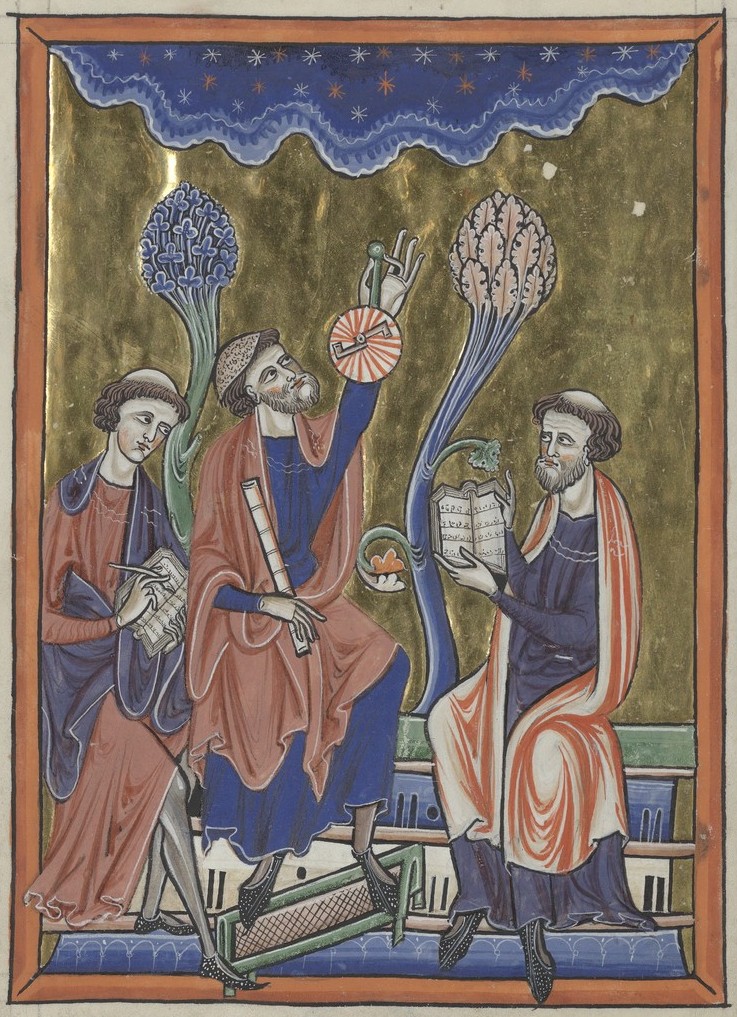
Fol. 1v: An astronomer with a looking tube takes the bearings of a star with the alidade of an astrolabe. One assistant holds open a book with Arabic ciphers (a star chart?) while the other records the results in Latin.

Fall of the Rebel Angels (Sainte-Chapelle Psalter)
Fol. 9v: The Fall of the Rebel Angels

Creation of Eve (Sainte-Chapelle Psalter)
Fol. 10r: The Creation of Eve

Continue reading “The Psalter of Blanche of Castile”