Every year, new Advent devotionals are released into the global book market. Let me introduce you to just two that came out in 2026.
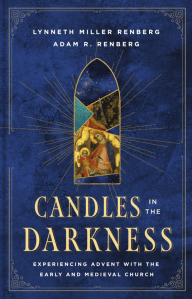
From IVP Academic, Candles in the Darkness: Experiencing Advent with the Early and Medieval Church was written by married couple Lynneth Renberg (a medieval historian) and Adam Renberg (a patristic historical theologian), both professors at Anderson University in South Carolina. They’ve compiled daily readings for Advent and the twelve days of Christmas, which each includes a scripture text, an excerpt from an author from the second through thirteenth centuries, a devotional reflection, and a prayer (some historical, some original).
The strength of this book is its variety of sources in terms of geographic origin and genre—and there are a fair number of writings by women as well! Among the selections are excerpts from Byzantine kontakia, an Old Saxon epic, the Mozarabic liturgy, the liturgy of the Ethiopian Church, a hymn from Tang dynasty China, an ode by an Armenian poet-monk, the letter of a Roman pilgrim to a friend, a spiritual manual a Frankish noblewoman wrote for her son, a sermon of a Cappadocian bishop, a prayer of an Irish missionary, the eucharistic vision of a Dutch Beguine, and more.
I congratulate the authors for intentionally featuring this diversity, a reminder that the practice of early and medieval Christianity extended well beyond western Europe and even the Latin-speaking Roman Empire. I appreciate how for each historical quotation, they cite the original language in which it was written, plus the century and country of its author, situating them in time and place.
Despite the admirable assortment of voices, the content itself doesn’t really have the same breadth, despite the strong five-part structure of “The Coming of Christ in Redemption,” “The Coming of Christ in Sanctification,” “The Coming of Christ in Glory,” “O Antiphons,” and “The Light Has Come.” The mystery of Creator God present in creation, Mary’s role in the Christmas story as an active participant in God’s plan for salvation, the paradoxes within the incarnation—these are some of the covered topics, but the writing starts to sound redundant. While there are a few real standouts, many of the quotations didn’t pop for me, didn’t uncover for me any new insights or sweep me up into marvel at old truths. And the authors’ commentary is a little bland.
But I enjoyed revisiting some old favorite passages, such as ones by Ephrem the Syrian, Romanos the Melodist, and Bernard of Clairvaux, and being introduced to new ones, such as the lyrical verse of Gregory of Narek, whom I certainly plan to explore more of. Here are a few snippets from the book:
Blessed is he whose will brought him
To the womb and to birth and to the bosom and to growth.—Ephrem the Syrian, “Hymn 3 on the Nativity,” fourth century, translated from Syriac by Kathleen McVey
Christ, Blessed Child of our own God, is born in the
Bastion of David,
He—our Master All Good. That is joy to mankind,
The weal of all folk.—The Heliand, ninth century, translated from Old Saxon by Mariana Scott
In the parental bosom he was called “the Dawn”;
With the rising of the sun he came with love,
Being born of the Virgin, the flower of her bosom.
[. . .]
He made known the love begotten of love,
Love blossoming with ardent desire
To unite love with love.—Gregory of Narek, “Ode for the Nativity,” tenth century, translated from Armenian by Abraham Terian
I recommend Candles in the Darkness if you’re eager to explore (not systemically, but in anthology form, with an emphasis on primary texts) the historic roots and development of theological ideas surrounding the comings of Christ. It’s fun getting to know saints from ages past, those who make up the great cloud of witnesses—the biographical sketches in the back are helpful for that. This book invites us to sit at the feet of our predecessors in the faith, hearing their passionate narrations of the greatest story, receiving their wisdom of interpretation, and joining in their wonderings and praises.
[Buy on Amazon] [Buy from publisher]
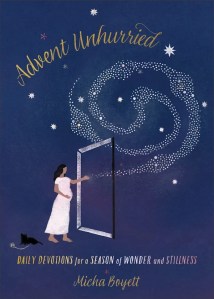
Unlike Candles in the Darkness, Micha Boyett’s book Advent Unhurried: Daily Devotions for a Season of Wonder and Stillness (Brazos Press) has a distinctively contemporary feel. It, too, is divided into short daily readings—twenty-eight total—but those vary in format between prose reflections, poems and imaginative retellings of biblical stories by the author, and spiritual practices. Following a mid-twentieth-century convention popular in US and UK churches, the overarching themes that provide the framework are “Hope,” “Peace,” “Joy,” and “Love.”
Boyett is a writer, a poet (MFA, Syracuse University), a mother of three, and the youth pastor at Good Shepherd New York. I’ve long enjoyed her Substack The Slow Way, “a weekly letter for frantic strivers, serial doers, and weary achievers focusing on the goodness of rest, the practice of prayer, and spiritual reflection.” She has a conversational literary style that’s warm and welcoming. Grounded in the everyday, she integrates personal narrative and practical theology as she writes about courage, beauty, pain, and grace.
Some of the guided practices in the book are for lectio divina (a method of slow, prayerful reading of scripture), pronouncing blessings, listing delights, breath prayer, and hygge (coziness, togetherness). I appreciate Boyett’s wholeness approach, taking into account mind, body, and soul. (In many devotionals, the body is mostly ignored.)
Advent Unhurried places a big emphasis on Mary—maybe not what you’d expect from a Protestant! But Mary, as scripture and tradition state, is where Jesus’s humanity comes from, so she’s a key player in the incarnation and a good entry point into the mysteries and invitation of the holiday season.
Curious and empathetic, Boyett ponders Mary’s consent to birth and mother the Son of God. “What did Mary know of what her consent would mean for her? What did she know of loss, of fear, of the glory of her choice?” (23). She views Mary as an exemplar of exercising “sacred imagination,” by which she means “our inner creativity that allows us to reconceive the world, dreaming of a reality more beautiful and true than we currently experience . . . the inner work of allowing the good gifts of life to awaken our perspectives, our longing for peace and joy and hope to guide us into a richer life” (7).
The poetry in Advent Unhurried, written from Mary’s perspective, is the book’s main highlight for me. (I featured an earlier version of Boyett’s poem “Bearing Peace” back in the 2023 installment of “25 Poems for Christmas”.) Another highlight is the section on shalom—what it is, how Jesus embodied it, its relationship to the Christian vocation, what keeps us from recognizing it when it lands in our lives, and how we sometimes make the same mistake as the careless leaders of Jeremiah 6. “The work of Advent,” Boyett writes, “becomes our annual chance to prepare for the entrance of shalom, to remember that we are invited to the work of peace, even if the world around us is still unready for the fullness of Jesus’s coming” (58).

