Malcolm Guite on the imagination and God-with-us

I love listening to Malcolm Guite talk about spirituality, poetry, and the imagination; he’s a phenomenal teacher. In a December 2 podcast episode titled “Keeping Advent: Hope for a Dark World,” host Sally Clarkson interviews Guite on these topics as they relate to Advent. Before he launches into the meat of the talk, he describes the importance of the imagination in getting at truth:

God has given us all kinds of capacities with which to come to the truth, just like he’s given us different sense organs. When a bird is singing, your ears are telling you one part of what’s happening, and your eyes are telling you another. You’ve got both to get that whole experience. If you just had a silent film of the bird, you would be seeing something real, but you’d be missing something as well.

So I sometimes think that reason, the reason that makes for great science—analytic, helps us to think things through logically—that’s a very, very important test for truth, that’s a very important faculty, but it doesn’t get to everything. . . .

Imagination is the thing that shapes and puts things together. Shakespeare put this very beautifully. He said that imagination “apprehend[s] / more than cool reason ever comprehends” [A Midsummer Night’s Dream, 5.1.5–6]. He said we need to apprehend some joy before we can comprehend the bringer of the joy.

Samuel Taylor Coleridge believed that the imagination was part of our capacity to pay attention, and that the imagination would help us to remove, for a minute, the dull film of familiarity that we put over everything, and see it with freshness again. He also used a very beautiful analogy. He uses the example of a little insect, the horned fly, and how, when it’s still in the squashy pupa phase and it’s going to metamorphose, it makes a cocoon—a kind of carapace. He says that when that little fly does that, it leaves room in its involucrum, he calls it—what a wonderful word—for antennae yet to come [Biographia Literaria, vol. 1, chap. 12]. He says that’s what the imagination does.

Sometimes the artistic imagination, the poetic imagination, comes to us with something marvelous. And what that marvelous thing is doing is it’s holding open a shape that the rest of our mind is going to grow into, so that the antennae, the real reasoning and figuring it all out, can come a bit later, but the story [or poem or image] gives us something.
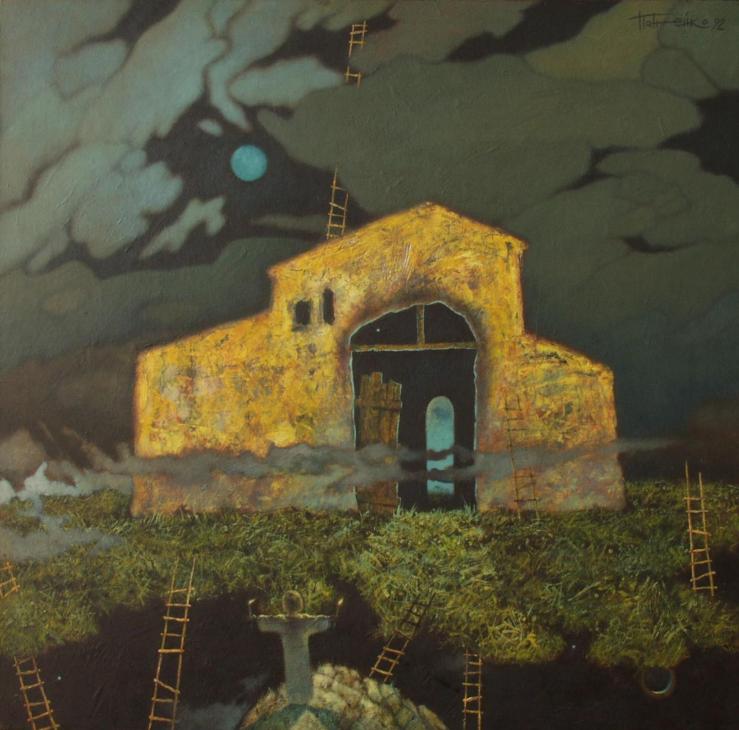
Paneyko, Igor_Gate II
Ihor Paneyko (Ukrainian, 1957–), Ворота ІІ (Gate II), 1992. Fiberboard, levkas, yolk emulsion, tempera.

In this interview Guite also reads one of his Advent sonnets, the last in a series of seven he wrote that were inspired by the traditional liturgical chants known as the O Antiphons. Titled “O Emmanuel,” the poem is a prayer for God to come among us again, in all his myriad attributes, and to rebirth not only the hearts of humanity but the whole earth.

“O Emmanuel” by Malcolm Guite

O come, O come, and be our God-with-us,
O long-sought With-ness for a world without,
O secret seed, O hidden spring of light.
Come to us Wisdom, come unspoken Name,
Come Root, and Key, and King, and holy Flame.
O quickened little wick so tightly curled,
Be folded with us into time and place,
Unfold for us the mystery of grace
And make a womb of all this wounded world.
O heart of heaven beating in the earth,
O tiny hope within our hopelessness,
Come to be born, to bear us to our birth,
To touch a dying world with new-made hands,
And make these rags of time our swaddling bands.

This and other poems, by Guite and others, can be found in the book Waiting on the Word: A Poem a Day for Advent, Christmas, and Epiphany. You can read more about “O Emmanuel” on Guite’s blog, which contains a wealth of writings. For additional books by Guite, see his Amazon page.
By the Mark (Artful Devotion)

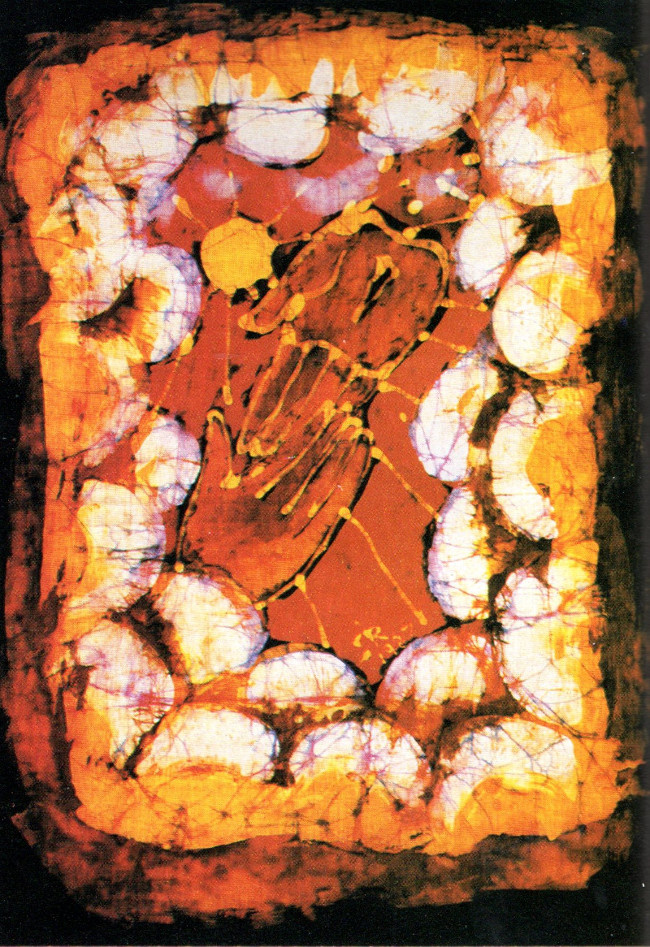
You and I by Solomon Raj
P. Solomon Raj (Indian, 1921–), You and I, before 1993. Batik. Source: Living Flame and Springing Fountain (Indian Society for Promoting Christian Knowledge, 1993)

Then [Jesus] said to Thomas, “Put your finger here, and see my hands; and put out your hand, and place it in my side. Do not disbelieve, but believe.”

Thomas answered him, “My Lord and my God!”

—John 20:27–28

+++

SONG: “By the Mark” by Gillian Welch and David Rawlings, on Revival (1996)

(Related post: “Thomas in the dark”)

+++

“St. Thomas the Apostle” by Malcolm Guite, from Sounding the Seasons: Seventy Sonnets for the Christian Year

“We do not know . . . how can we know the way?”
Courageous master of the awkward question,
You spoke the words the others dared not say
And cut through their evasion and abstraction.
O doubting Thomas, father of my faith,
You put your finger on the nub of things:
We cannot love some disembodied wraith,
But flesh and blood must be our king of kings.
Your teaching is to touch, embrace, anoint,
Feel after him and find him in the flesh.
Because he loved your awkward counter-point,
The Word has heard and granted you your wish.
O place my hands with yours, help me divine
The wounded God whose wounds are healing mine.

[Click here to listen to a short sermon Guite preached on St. Thomas back in 2012, which opens with his reading of this poem.]


This post belongs to the weekly series Artful Devotion. If you can’t view the music player in your email or RSS reader, try opening the post in your browser.

To view all the Revised Common Lectionary scripture readings for the Second Sunday of Easter, cycle B, click here.

Lent devotionals with arts component

Next Wednesday, February 14, is the first day of Lent—a season of focused prayer and simple living. During this time I will continue publishing weekly “Artful Devotion” posts based on scripture readings from the Revised Common Lectionary, plus I have a few other posts planned. I’m especially excited about what I’ll be publishing this Sunday—the fruits of many months of labor; I hope you’ll check back!

If you are looking for daily devotional content during Lent that incorporates the arts, check out some of these resources. See also last year’s list: https://artandtheology.org/2017/03/07/art-resources-for-lent/.

“The Lent Project V” by Biola University: From Ash Wednesday through the first week of Easter, Biola University’s Center for Christianity, Culture, and the Arts will be publishing daily “aesthetic meditations” on Christ’s life, death, and resurrection. The scripture texts, art images, music, and poetry are curated by a CCCA team, and staff are invited to contribute written reflections that respond to them. “The mood of Lent can be beautifully captured through the arts, which are often cathartic expressions of longing, suffering, loneliness, love, death and rebirth,” says university president Barry H. Corey. “Art is a great chronicler both of the drama of human history and the aches of the human heart.” Here are some artworks Biola has featured in previous years; click on each to experience the full devotion:

The Bread by Michael Borremans
Michaël Borremans (Belgian, 1963–), The Bread, 2012. Oil on canvas, 29 × 23 cm.

Lamb of God by Arcabas
Arcabas (French, 1926–), Lamb of God. Stained glass, Notre-Dame des Neiges Church, Alpe d’Huez, France.

Deposition and Christ Falling on the Way to Calvary (Palestinian Museum)
The Deposition & Christ Falling on the Way to Calvary, 2014. Collage, from “The Presence of the Holy See” project at the Palestinian Museum. Photographs by Alexandra Boulat (French, 1962–2007); paintings by Raphael.

Jesus on the Shore by Maja Lisa Engelhardt
Maja Lisa Engelhardt (Danish, 1956–), Jesus on the Shore. Altarpiece, Turup Church, Assens, Denmark.

Lenten Readings 2018 by Kevin Greene: For the seventh year in a row, Kevin Greene, a teaching elder at West End Presbyterian Church in Richmond, Virginia, is publishing short daily devotions, each one containing an art image and a piece of music. (Last year I learned of lots of new artists through him!) For the prayer component he has used various resources in the past—the Revised Common Lectionary, sermons on the cross of Christ across the centuries, Wesley’s Scripture Hymns, and excerpts from the early church fathers—but this year he will be using collects (pronounced COL-lects) from the Book of Common Prayer. Unfamiliar with the term? Click here to read how a collect works.   Continue reading “Lent devotionals with arts component”