
Roundup: Holocaust survival embroideries, transforming brokenness into beauty, and more

SPOTIFY PLAYLIST: August 2026 (Art & Theology)

+++

POEM: “Last Words (Death Row, Texas)” by Eileen Talone: This poem from Image journal’s Winter 2020 issue made me cry. “Formally, it is a villanelle composed of found language from the transcripts of executions in Texas,” writes James K. A. Smith. “It is a poem of last words that the poet has braided together as an elegy, a song of both lament and yearning.”

+++

PODCAST EPISODE: “Pádraig Ó Tuama: Poetry, and Making Peace, Bearing Witness and Being Human – Poetry Against the Dark,” No Small Endeavor with Lee C. Camp, November 3, 2025: “‘Legitimate target has sixteen letters—and one long abominable space between two dehumanizing words.’ In this episode, poet and peacebuilder Pádraig Ó Tuama offers a sobering yet luminous reflection on language, theology, and the long road of reconciliation. From exorcisms and conversion therapy to moments of silence, soup, and starlight, his stories remind us that even in a burning world, there is still room for awe, for courage, and for a better kind of human flourishing.”

+++

EXHIBITION (+ BOOK + VIDEO TOUR): Esther and the Dream of One Loving Human Family, American Visionary Art Museum, Baltimore, February 23, 2019–December 2030: I recently saw this affecting exhibition at AVAM (the same museum that’s currently showing Mary Proctor), spending a whole afternoon taking in the visual and textual testimony of Esther Nisenthal Krinitz (1927–2001) regarding her survival of the Holocaust. Krinitz was twelve when the Nazis occupied the Polish hamlet of Mniszek, where she lived on a farm with her family. She was able to flee three years later, in 1942, with one of her younger sisters, but she never saw her parents, brother, or other sister again. She emigrated to the United States in 1949, working as a seamstress in Brooklyn and then in Frederick, Maryland, where she spent the remainder of her life.
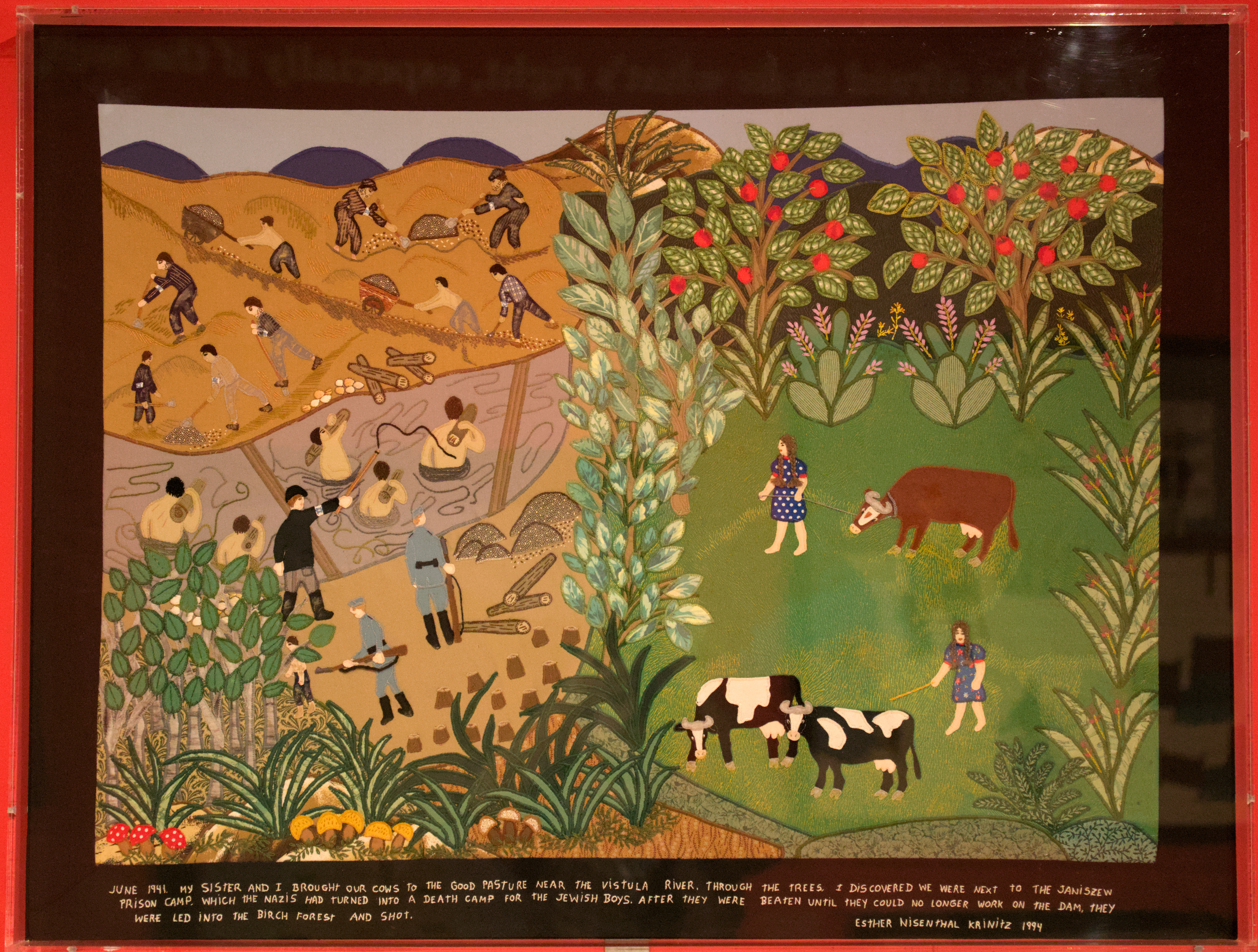
Krinitz, Esther Nisenthal_Janiszew Prison Camp
Esther Nisenthal Krinitz (Polish American, 1927–2001), Janiszew Prison Camp, 1994. Embroidery and fabric collage, 30 1/2 × 40 1/8 in. Photo: Victoria Emily Jones. © Bernice Steinhardt and Helene McQuade.

In 1977, at age fifty, Krinitz embroidered an approximately four-by-four-foot panel of her childhood home, her carrying pails of water up the footpath. She wanted to share her memories with her two daughters, Bernice Steinhardt and Helene McQuade. This became the first piece in a series of thirty-six, covering her bucolic childhood—tending geese, swimming in the river, walking through wheat fields on stilts, watching her mom make Passover matzos—and then its sudden disruption by German forces during the war. Her embroidered pictures show such cruelties as a soldier ripping off her father’s prayer shawl and cutting off her grandfather’s beard, and her whole family being pulled out of their beds at dawn and taunted with guns. They show children forced to dig trenches, a family friend’s betrayal, Krinitz hiding out in the woods, death marches, shootings, cabbages growing on human ashes at Maidanek concentration camp, and Nazi corpses hanging from trees after the liberation. Krinitz didn’t finish embroidering her whole life story, but the final image she completed shows her arriving, after living for several years in a refugee camp in Germany, in New York Harbor with her husband and newborn.

To view all the images, visit the Art and Remembrance website, which includes image files as well as a video tour narrated by Steinhardt. I also heartily recommend the beautifully produced book Memories of Survival, which reproduces the full series and provides an introduction, transcriptions of Krinitz’s hand-stitched descriptions, and commentary by Steinhardt.

Krinitz’s art is the primary component and anchor point of the current exhibition in Baltimore—but the exhibition also includes a dozen or so works by other artists that lament atrocities and advocate for an end to violence. “The show pays tribute to humanity’s unjust persecution of innocents and the dream of a world at peace.”

+++

TED TALK: “How Art Transforms Brokenness into Beauty” by Lily Yeh, April 19, 2024: Chinese American artist Lily Yeh travels the world, building community through the arts and bringing beauty to public spaces often seen as “broken.” In this TED Talk, she describes three of her collaborative projects: establishing an art park in North Philadelphia, which involved the making of murals, sculptures, and mosaics with neighborhood children and adults (a project that evolved into the nonprofit The Village of Arts and Humanities); working with survivors of the Rwandan genocide to create a memorial in Rugerero atop a mass grave (“Where there’s beauty, we see hope,” one survivor told her); and “turning dilapidation into color and abundance” at a middle school for migrant children in rural China.

Yeh is the subject of the 2014 documentary The Barefoot Artist: Healing Communities Through Art, streaming for free on Kanopy and available for rental through other platforms.

I learned about her through the Esther and the Dream of One Loving Human Family exhibition at AVAM (see previous roundup item), where three of her paintingsVillage Life in Rwanda Before the 1994 Genocide, Escaping into the Forest, and The 1994 Rwandan Genocide—are on display.
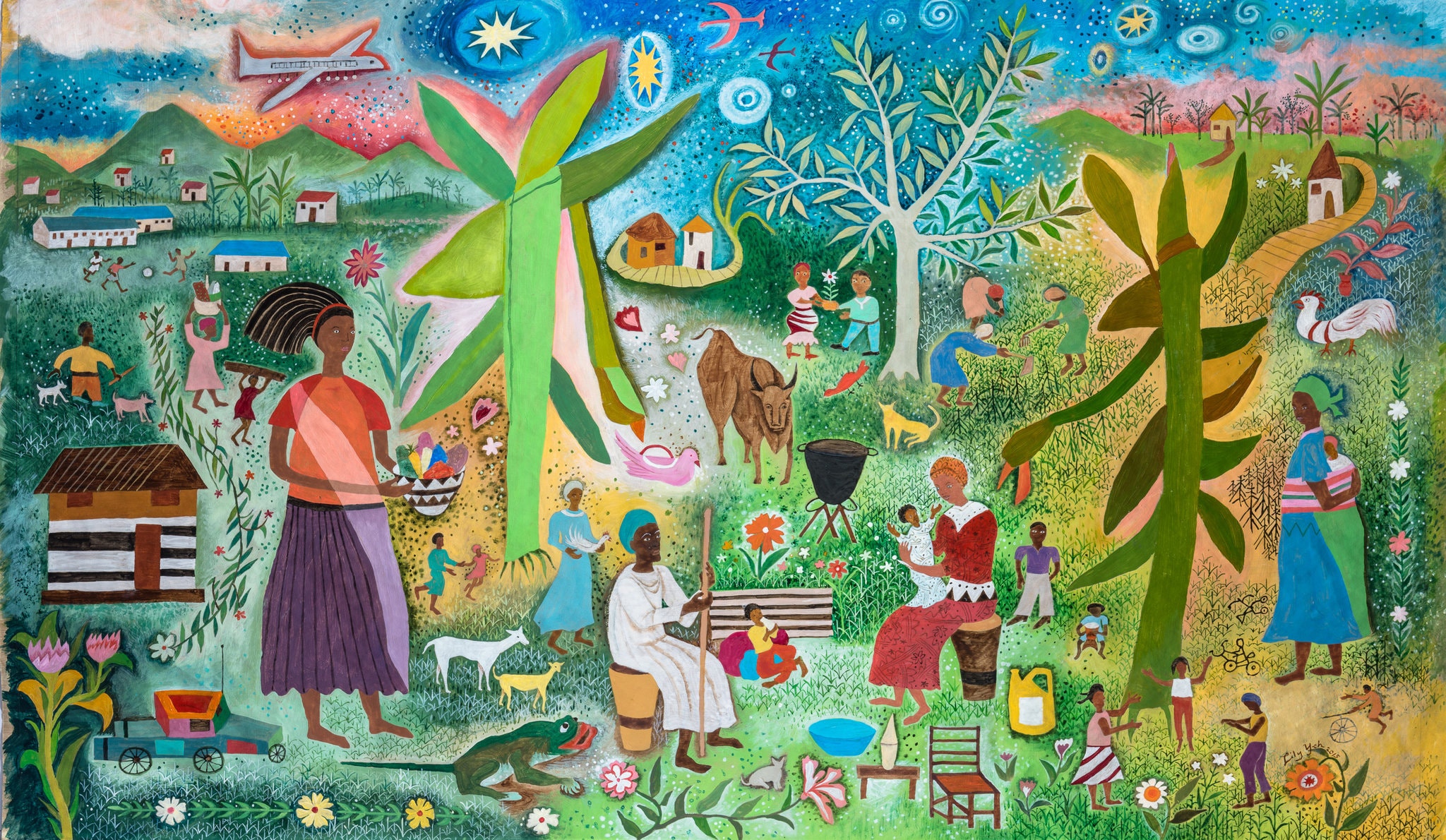
Yeh, Lily_Village Life in Rwanda Before the 1994 Genocide
Lily Yeh (Chinese American, 1941–), Village Life in Rwanda Before the 1994 Genocide, 2015. Acrylic on brown paper. Courtesy of the artist.

+++

SONGS:

>> “The Law of God Is Love” by Kester Limner: Kester Limner wrote this song in June 2020 for a virtual contemplative worship service at St. Andrew’s Episcopal Church in Seattle, influenced by the simple, slow, repetitive style of Taizé chant. She shares it under a Creative Commons Attribution (CC BY) license, which enables reusers to distribute, remix, adapt, and build on the material in any medium or format, even commercially, as long as attribution is given to the creator.

Love, love, the law of God is love
And to break every chain of oppression
So we work, and we pray, O God, Your kingdom come
May we see the dawn of Your justice

>> “Prayers for Freedom” by MaMuse: “Wholeheartedly fed by the folk and gospel traditions, MaMuse (Sarah Nutting and Karisha Longaker) create uplifting music to inspire the world into thriving.” “This video,” they write, “was inspired by our love and reverence for water, for friendship cherished and laughter forever praised.” I’ve previously featured the duo here and here.
Advent Prelude: Out of Darkness

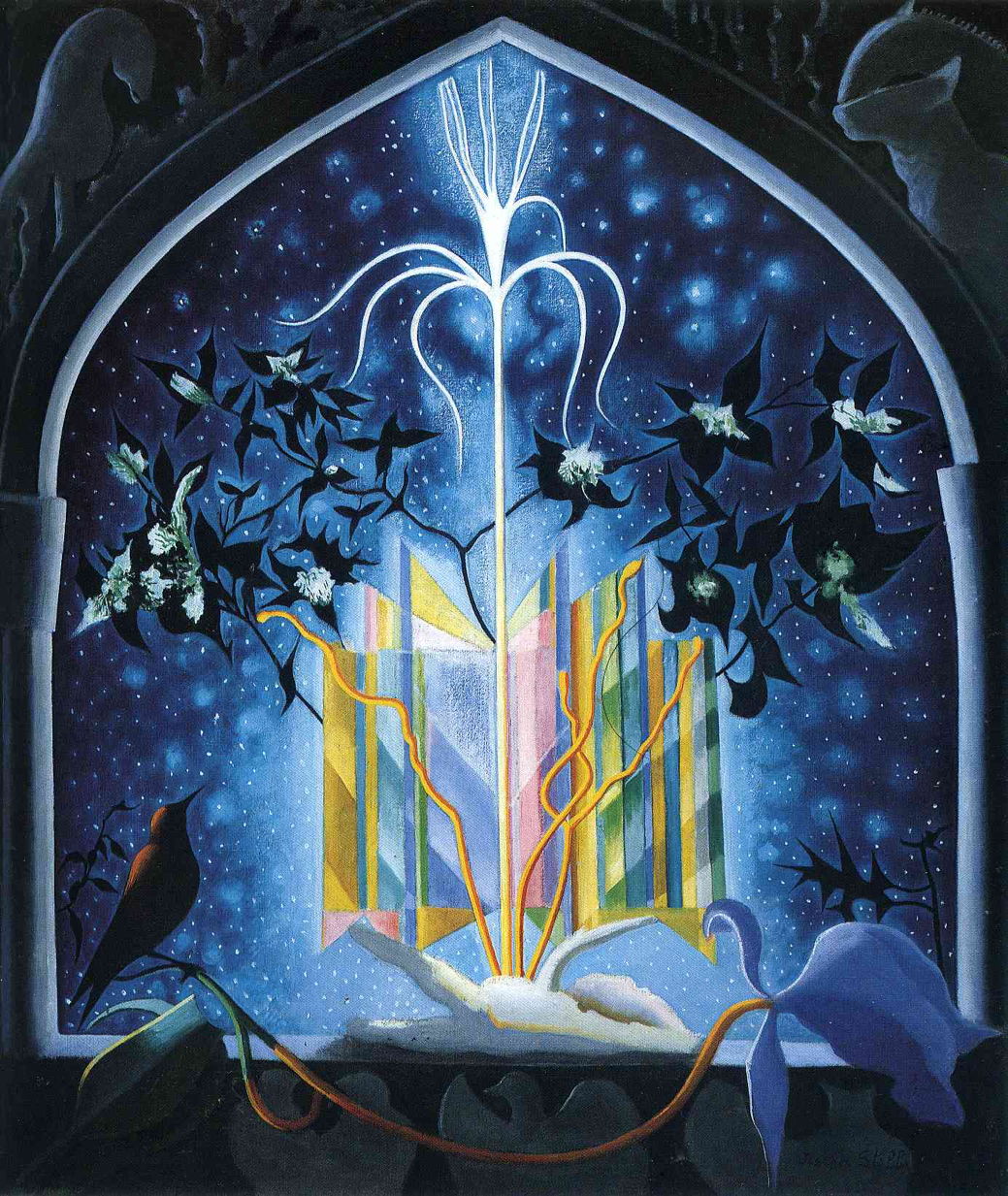
LOOK: Serenade: A Christmas Fantasy by Joseph Stella

Stella, Joseph_Serenade: A Christmas Fantasy
Joseph Stella (Italian American, 1877–1946), Serenade: A Christmas Fantasy (La Fontaine), 1937. Oil on canvas, 43 1/8 × 37 1/8 in. (109.5 × 94.3 cm). Hirshhorn Museum and Sculpture Garden, Washington, DC.

Joseph Stella (1877–1946) [previously] was an Italian American painter who became an important figure in modern art. His Serenade: A Christmas Fantasy is not overtly religious, but it does incorporate a few elements traditionally associated with Christmastime—a starry night sky, a holly branch, an ox and ass, a dove—and has a mystical quality. In the center, a flower emerges from what appears to be a conch shell, its pistil and stamen glowing. The flower’s stem shoots up past an abstract, mobile-like object that could be shards of colorful glass or pieces of cut paper. It’s a visionary composition that is open to multiple readings.

Art historian Judith Zilczer comments on the painting in the exhibition catalog Joseph Stella: The Hirshhorn Museum and Sculpture Garden Collection (Smithsonian Institution, 1983):

Serenade: A Christmas Fantasy typifies Stella’s mature symbolist style. Framed by an arch, a fantastic tree form bisects the composition and serves as the central image of the painting. The colors of the iridescent prism surrounding the central axis recall the abstract geometric style of Stella’s Futurist canvases.

The meaning of Stella’s complex imagery remains elusive. The ox and ass in the upper right spandrel traditionally appear together in paintings of the Nativity. The image of the dove in the center of the lower border is the symbol of the Holy Ghost. These Christian symbols are consistent with the painting’s subtitle, A Christmas Fantasy. The painting is also known as The Fountain (La Fontaine). The treelike form in the center may represent an abstraction of a jet of water. The image of the fountain often served as an attribute of the Virgin Mary, who was regarded as the “fountain of living waters.” It is possible that in this canvas Stella has fused the image of the tree of life with the fountain as the symbol of the Virgin. The nightingale perched on the tendril [of the purple iris] in the lower left is the source of the serenade. (54)

I see in Serenade the promise of Advent—light emerging out of darkness, wondrous new life growing out of dormancy. There’s a coming fullness here, a blossoming. The chromatic spectrum refracted by the center object evokes a rainbow, the sign of God’s covenant with all living creatures in Genesis 9.

LISTEN: “Wonder” by MaMuse (Sarah Nutting and Karisha Longaker), on Prayers for Freedom (2018)

Oooh, I wonder
Oooh, I wonder
Oooh, I wonder
What is to come out of this darkness

I’ve been moving, moving, moving, moving through the darkness
Moving, moving, moving, moving through the darkness
I wonder when the light is cracking open

Oooh, I wonder
Oooh, I am filled with wonder
Oooh, I wonder
What is to come out of this darkness

I thought this candle had long gone out
I thought that it had long gone out
But today, today, today, today I can see
There’s still a flickering, flickering

Oooh, I wonder
Oooh, I wonder
Oooh, I wonder
What is to come out of this darkness

Burn, burn, burn, burning on the inside
Burn, burn, burn, burning like a bright light
Burn, burn, burn, burning on the inside
This light’s still burning, burning bright

I thought this candle had long gone out
I thought that it was long gone out
I thought that this candle had long gone out
But today, today, today, today I can see
There’s more than a flickering

Oooh, I wonder
Oooh, I am filled with wonder
Oooh, I wonder
What is to come out of this darkness

This song was written by MaMuse [previously], an acoustic folk duo who I’d say are “spiritual but not religious,” several years ago on the winter solstice. Watch a live video recording from January 2019 at the Chico Women’s Club in Chico, California, the two’s hometown.

Advent is sometimes mischaracterized as glum, but actually, joyfulness is a key aspect of the season. There’s a somberness, for sure, but it’s married with excitement for what’s coming.

I hope to capture this dual tone of Advent in my selection of art and music over the next twenty-four days. This is the first post in a daily series that will run to the end of Advent on December 24, and then for the duration of Christmas, from December 25 to January 6. Many of the songs in the series can be listened to on the Art & Theology Advent Playlist, Christmastide Playlist, and Epiphany Playlist on Spotify.

In the liturgical calendar, Advent-Christmas-Epiphany is known as the cycle of light. Many churches and families light candles around an Advent wreath, progressively more until Christmas, symbolizing the Light of the World getting nearer, dispelling more of the darkness.

May you be blessed this Advent season as you wonder and explore what is to come out of December’s darkness. May you discern with delight those places where “the light is cracking open,” where God is shining through.

The soul-nourishing music of MaMuse

MaMuse is an acoustic folk duo from Chico, California, made up of Karisha Longaker and Sarah Nutting. Known for their soulful harmonies and light, bright lyrics, these women have said that they want their music to bring spiritual uplift and to connect people to the richness of life. Both Longaker and Nutting have backgrounds in music therapy and therefore view music as a healing art form. They also consider it an opportunity to bless others. Because of the intimacy it affords, they especially love performing house concerts.

Although they are not confessional Christians (they have a very all-embracing spirituality), they do cite gospel influences, which is evident in songs like “Hallelujah” and “On the Altar.” The former is the first track on their 2009 debut album All the Way and is one of the most beautiful songs I’ve heard in a while. Watch the music video below.

Lyrics | Purchase

The song invokes a whole cluster of water imagery from the Bible. Jesus, for example, declared his Spirit to be the living water that quenches one’s deepest thirst (John 4:1–45, 7:37–39). Those who believe in him will receive within them “a spring of water welling up to eternal life”; “from [their] innermost being will flow rivers of living water.” The third verse of the song alludes to this gift:

There is a river
In this heart of hearts
With a knowingness
Of my highest good

The Spirit not only nourishes and refreshes us but also prompts us to do what is right and good, coursing through our veins like a river of holy desire and spurting forth like a fountain for all to see.   Continue reading “The soul-nourishing music of MaMuse”