
Advent, Day 6: Maranatha

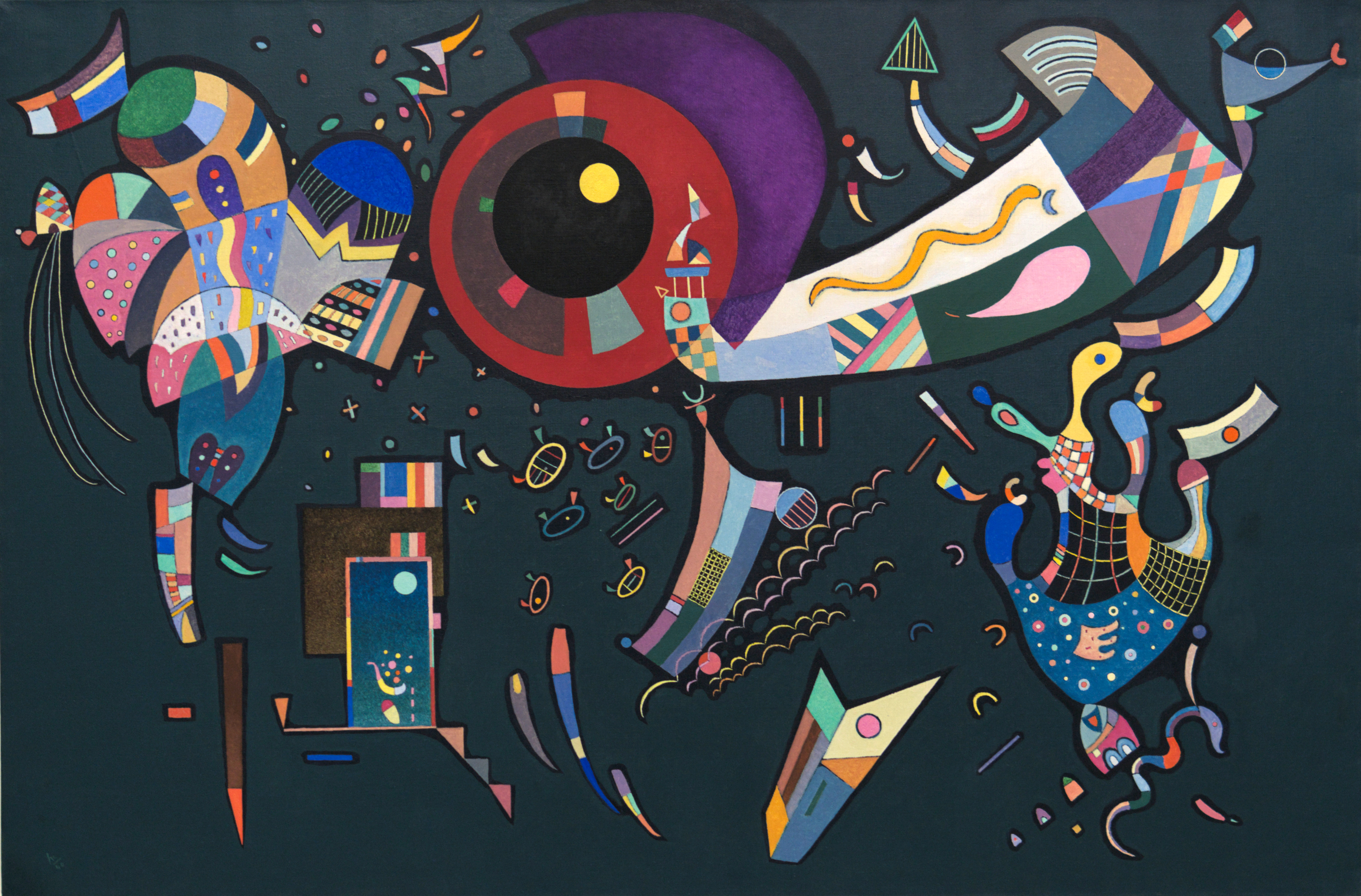
LOOK: Around the Circle by Wassily Kandinsky
Kandinsky, Wassily_Around the Circle
Wassily Kandinsky (Russian, 1866–1944), Around the Circle (Autour du cercle), 1940. Oil and enamel on canvas, 38 1/4 × 57 5/8 in. (97.2 × 146.4 cm). Solomon R. Guggenheim Museum, New York. Photo: Victoria Emily Jones. [object record]

I saw this vibrant abstract painting by the pioneering Russian French artist Wassily Kandinsky at the Guggenheim in 2022. The museum label stated:

Around the Circle, one of Kandinsky’s last major paintings, is a milestone in the artist’s circular journey. It reflects not only contemporary concerns but also his abiding interest in the belief systems and folklore of Russian and Siberian cultures. The dominant red circle at top center; the form cresting the undulating lines of “sacred waters” below; and a third, upside-down stylized humanoid form at bottom right have all been interpreted as potential allusions to shamans, or spiritual leaders and healers, in states of transformation. At bottom left, a lunar orb glows in the expanse beyond an open doorway, which is connected to a set of stairs with no physical support. This could be a portal to the cosmos, or some otherwise indeterminate space beyond the picture plane, in a probable nod to alternate dimensions or to the capacity for mystical ascendance.

What do I see? Color. Confetti, streamers, celebration. A rocket ship. Stars. Birds. Waves. A falling man. A doorway. An eye.

Advent is a dual-toned season that combines lament and penitence—an honest accounting of the brokenness of the planet, global and personal relationships, systems, and our own selves—with joyful expectation of Christ’s glorious intervention. In my annual Advent selections I seek to honor this characteristic balance between darkness and light.

Today’s art selection leans into the light—into the bubbling joy for what is just over the horizon, or just through the door. I think of the Magnificat of the Mother of God, a praise song in which, pregnant with Christ, she exults in the powerful being thrown down and the humble uplifted. She sings of the marvelous salvation wrought by God.

Let us rejoice with her in the righteousness to come.

LISTEN: “Maranatha” by David Benjamin Blower, on Hymns for Nomads, vol. 1 (2018)

Let the trees all clap their hands
And the stones all jump for joy
Let the earth shake off its bonds
Let the peoples all rejoice

Refrain:
Maranatha, our Maker
Who maketh all things right
Maranatha, our Healer
Come rise, O healing light

Let the peoples all delight
In the messianic light
Let the whole earth be glad
At the making all things right [Refrain]

Let the poor be lifted up
From the ashes and the dust
Let the proud climb down from their thrones
And we all shall be reconciled at once [Refrain]
Advent, Day 4: Maranatha (multilingual)

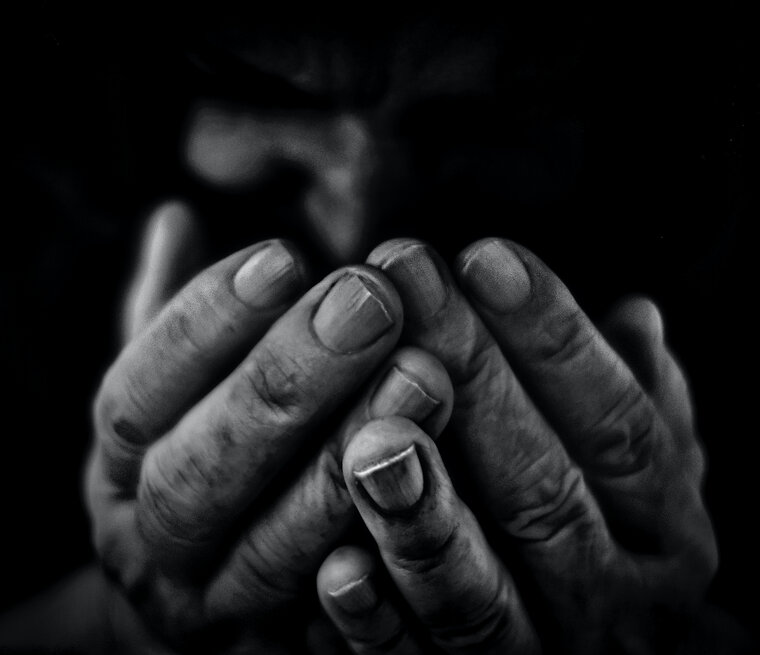
LOOK: God Heals by Anila Hussain

Hussain, Anila_God Heals
Anila Hussain, God Heals, metallic black and white print on Fujifilm paper with frame, 50 × 50 cm

A finalist for the 2021 Chaiya Art Awards, this black-and-white photograph shows a person at prayer, her hands cupped, anticipating in faith the receipt of what she’s asked for but open to whatever God gives. The woman pictured is photographer Anila Hussain’s eighty-something-year-old mother, who has suffered for years from chronic pain and prays multiple times a day for relief. Hussain is her primary caregiver.

With the woman’s face in the shadows and her rough, overlapping hands illuminated, closely cropped, and in the foreground, God Heals emphasizes a posture of humble and heartfelt entreaty.

LISTEN: “Ven, Señor Jesús, Maranathá” (Come, Lord Jesus, Come, O Lord), performed by Harpa Dei, 2020 [HT: Global Christian Worship]

Born in Germany and raised in Ecuador, siblings Nikolai, Lucía, Marie-Elisée, and Mirjana Gerstner form the sacred vocal quartet Harpa Dei. Here they sing a traditional chant invoking Christ’s return in ten languages, shifting voice parts and harmonies to beautiful effect. The lyrics are in the video and also below.

Māranā thā is Aramaic (the language of Jesus) for “Come, O Lord.” Christians have prayed this prayer since the apostolic era, looking toward the cosmic healing and restoration that Christ’s second coming will usher in.

SPANISH: ¡Ven, Señor Jesús, Maranathá!
ENGLISH: Come, Lord Jesus, Maranatha!
GERMAN: Komm, Herr Jesus, Maranatha!
FRENCH: Viens, Seigneur Jésus, Maranatha!
ITALIAN: Vieni, Signor Gesù, Maranatá!
CHINESE: 来吧,主耶稣 (Lai ba, zhu Ye su, Maranatha!)
HEBREW: !בּוֹא אָדוֹן יֵשׁוּעַ  מרנאתא (Bo Adon Jeshua, Maranatha!)
RUSSIAN: Гряди, Господи (Gryadi Gospodi, Maranatha!)
GREEK: ἔρχου, Κύριε (Erhu Kyrie, Maranatha!)
LATIN: Veni Domine, Maranatha!

Sheet music can be found here.

God Ascended (Artful Devotion)

Kulmbach, Hans von_Ascension of Christ
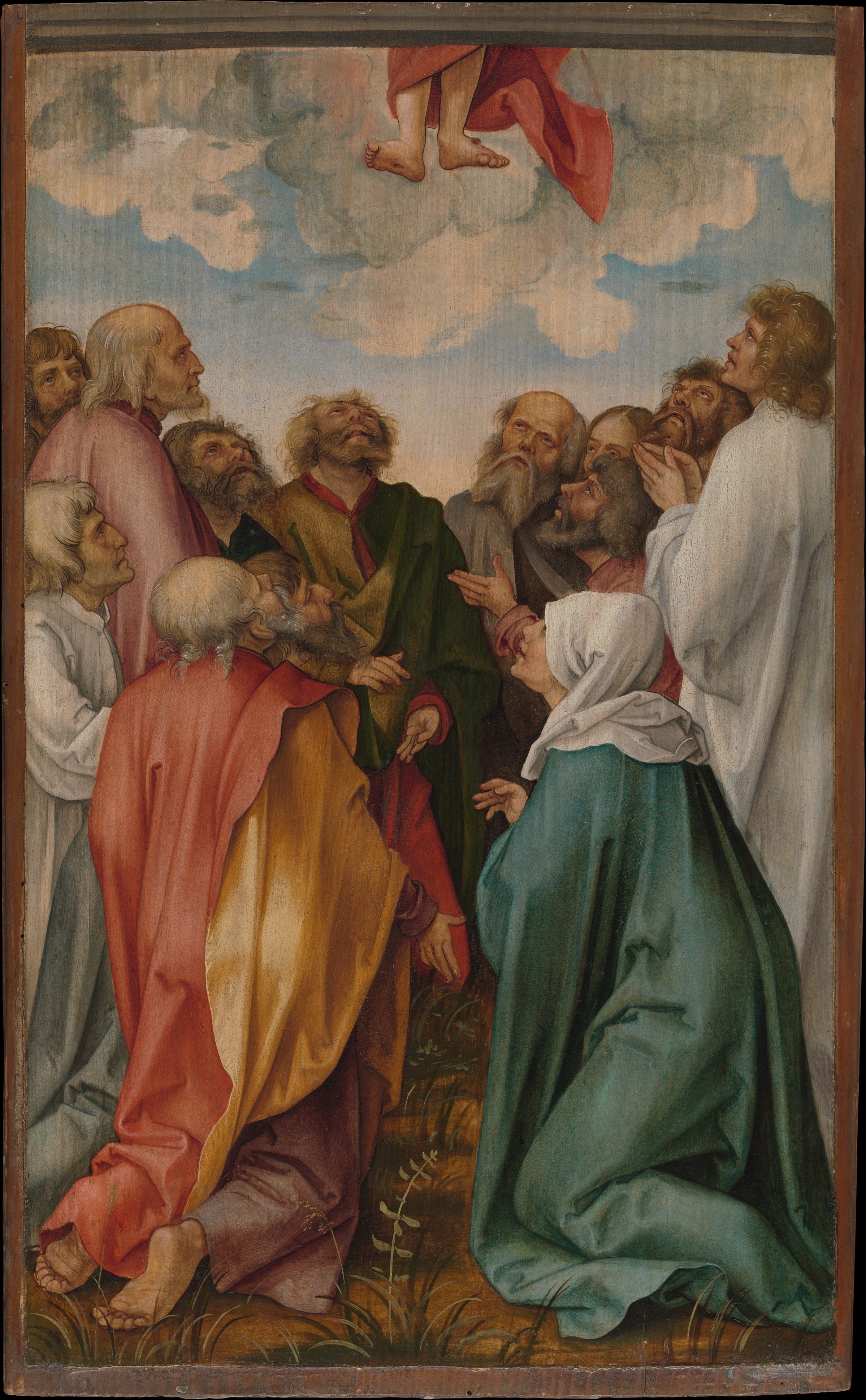
Hans Süss von Kulmbach (German, ca. 1480–1522), The Ascension of Christ, 1513. Oil on fir wood, 24 1/4 × 15 in. (61.5 × 38.1 cm). Metropolitan Museum of Art, New York.

Then he said to them, “These are my words that I spoke to you while I was still with you, that everything written about me in the Law of Moses and the Prophets and the Psalms must be fulfilled.” Then he opened their minds to understand the Scriptures, and said to them, “Thus it is written, that the Christ should suffer and on the third day rise from the dead, and that repentance for the forgiveness of sins should be proclaimed in his name to all nations, beginning from Jerusalem. You are witnesses of these things. And behold, I am sending the promise of my Father upon you. But stay in the city until you are clothed with power from on high.”

And he led them out as far as Bethany, and lifting up his hands he blessed them. While he blessed them, he parted from them and was carried up into heaven. And they worshiped him and returned to Jerusalem with great joy, and were continually in the temple blessing God.

—Luke 24:44–53

+++

SONG: “God Ascended” | Words by Joseph Hart, 1759, add. Bruce Benedict and Sarah Majorins | Music by Sarah Majorins, 2012 | Performed on Ascension Songs, a Cardiphonia compilation album

In this short SATB choral work, Sarah Majorins extracts the final verse from Joseph Hart’s “Come, Ye Sinners, Poor and Needy,” setting it to a new tune. On the one hand, Christ’s ascension is something to celebrate, tied up, as it is, in his exaltation at the right hand of God on high, where he intercedes for us; Luke even tells us that the disciples ultimately responded “with great joy.” But on the other hand, there must have been a solemnity to the occasion, as the disciples were saying goodbye to the physical presence of their friend and teacher. (We know from John’s Gospel that Mary Magdalene, for example, had to resist her desire to not part with Jesus.)

Majorins bends the tune of this song toward the latter mood and, with Bruce Benedict, has added a second verse that expresses a feeling of longing for and complete reliance on Christ’s return. Its refrain is the cry of the church that’s voiced in the penultimate verse of the Bible: “Come, Lord Jesus!” (or, in Aramaic, Maranatha!). Download the full piano score, courtesy of Liturgy Letter and by permission of the artist.

Lo! th’incarnate God, ascended,
Pleads the merit of his blood;
Venture on him, venture wholly,
Let no other trust intrude:
None but Jesus,
None but Jesus,
None but Jesus
Can do helpless sinners good.

Lo! th’incarnate God, ascended,
Enters now the heav’nly realms,
Angels singing alleluia
As they receive their Lord and King.
Maranatha,
Maranatha,
Maranatha,
Maranatha, we on earth still sing:
Come, O come, Lord Jesus, come.

See last year’s Artful Devotion for Ascension Day at https://artandtheology.org/2018/05/08/carried-up-artful-devotion/.


This post belongs to the weekly series Artful Devotion. If you can’t view the music player in your email or RSS reader, try opening the post in your browser.

To view all the Revised Common Lectionary scripture readings for Ascension Day, cycle C, click here.