Advent, Day 8: Vision

LOOK: Peace Window by Marc Chagall
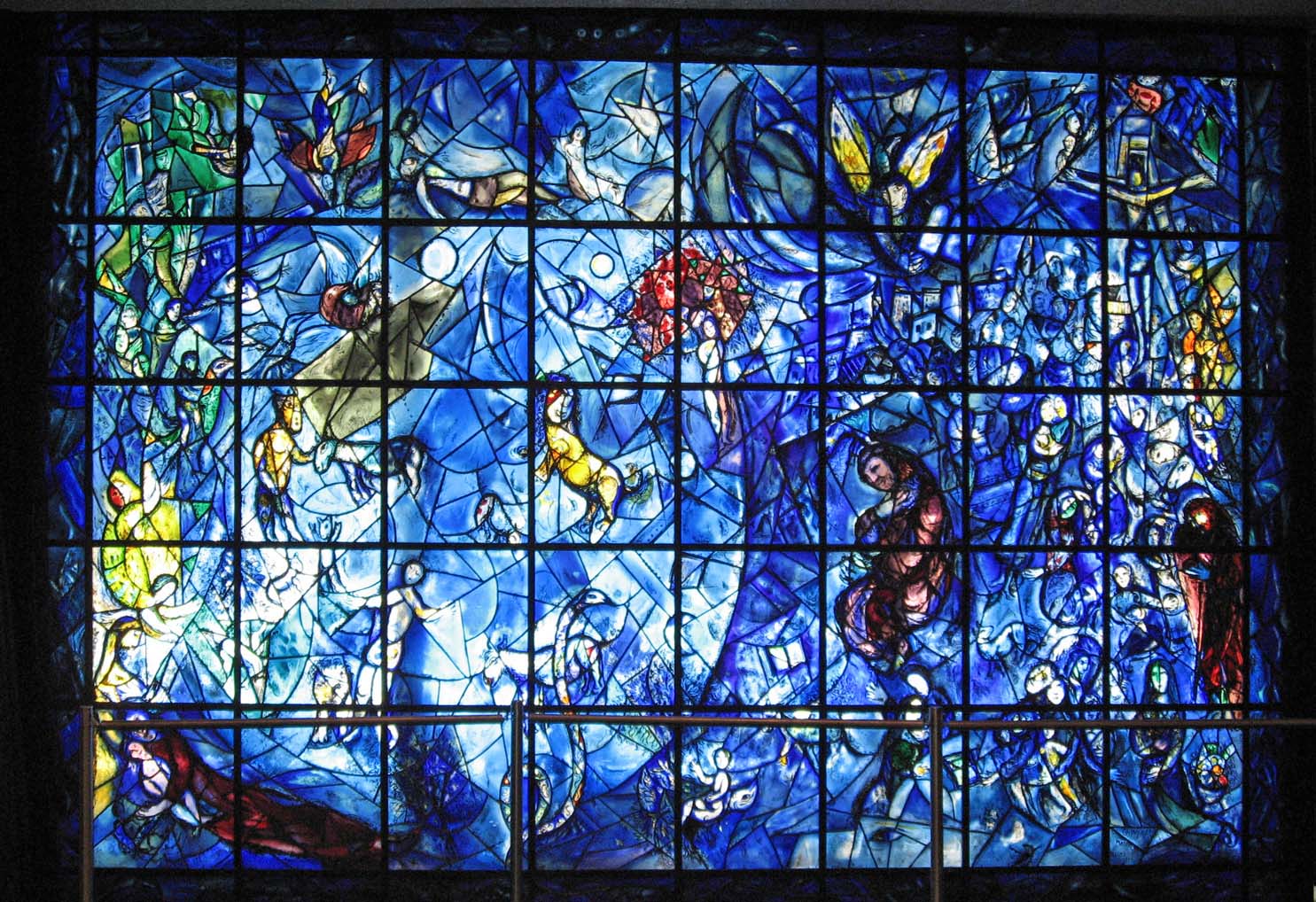
Chagall, Marc_Peace Window
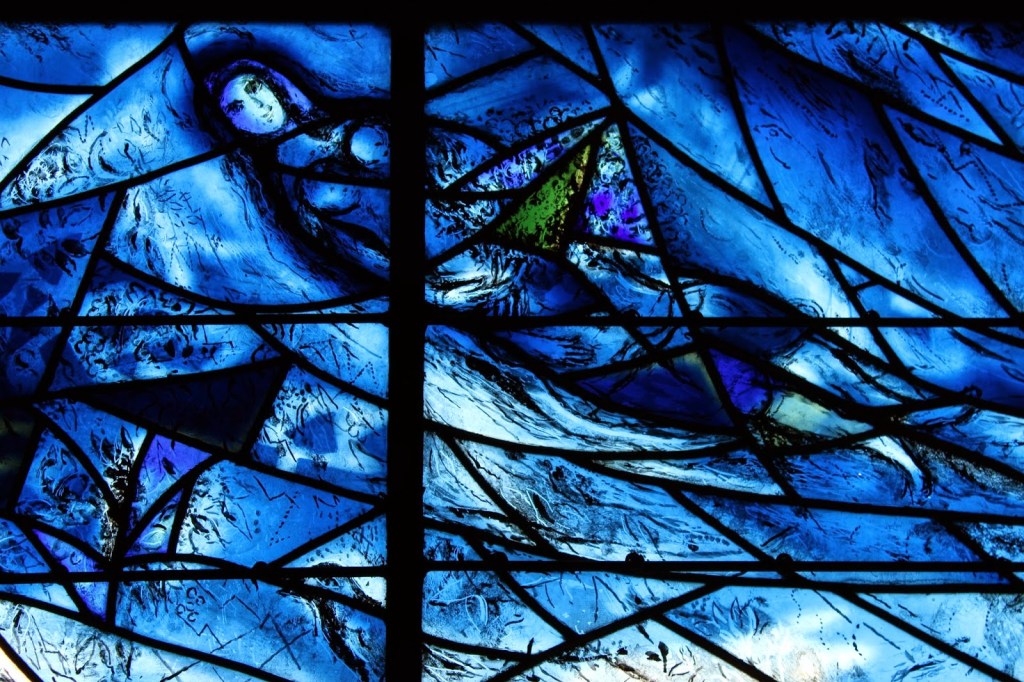
Marc Chagall (Russian/French, 1887–1985), Peace Window, 1964. Stained glass, 12 × 15 ft. Public lobby, General Assembly Building, United Nations Headquarters, New York. Manufactured by Brigitte Simon and Charles Marq.

This stained glass window by Marc Chagall was commissioned as a memorial for the Swedish diplomat Dag Hammarskjöld (1905–1961), who served as the second secretary-general of the United Nations, and for the fifteen other UN staff and peacekeepers who died with him when their plane crashed on the way to a peace negotiation for the Congo Crisis in Northern Rhodesia. The artist’s handwritten dedication reads, “A tous ceux qui ont servi les buts et principes de la Charte des Nations Unies et pour lesquels Dag Hammarskjöld a donné sa vie” (To all who served the purposes and principles of the United Nations Charter, for which Dag Hammarskjöld gave his life).

Chagall’s design was executed by master glassmakers Brigitte Simon and Charles Marq of Atelier Simon-Marq.

Chagall was born in 1887 into a Hasidic Jewish family in Vitebsk, Russia (now Belarus). He moved to Paris in 1910 to develop his art, becoming a French citizen in 1937. When Nazis took over the country, threatening Chagall’s safety, he was successfully extricated to the United States with the help of Alfred Barr, director of the Museum of Modern Art in New York. He returned to France for good in 1948. His impressive body of work, marked by a spiritual vivacity, includes—in addition to stained glass—paintings, drawings, book illustrations, stage sets, ceramics, and tapestries.

His 1964 Peace Window in New York City—not to be confused with his similar but much larger Peace Window of 1974 in the Chapel of the Cordeliers in Sarrebourg, France—is full of biblical allusions.

My eyes are drawn first to the red and purple bouquet in the center, under which stands an amorous couple. Who are they? What do they represent? I can think of several possibilities:
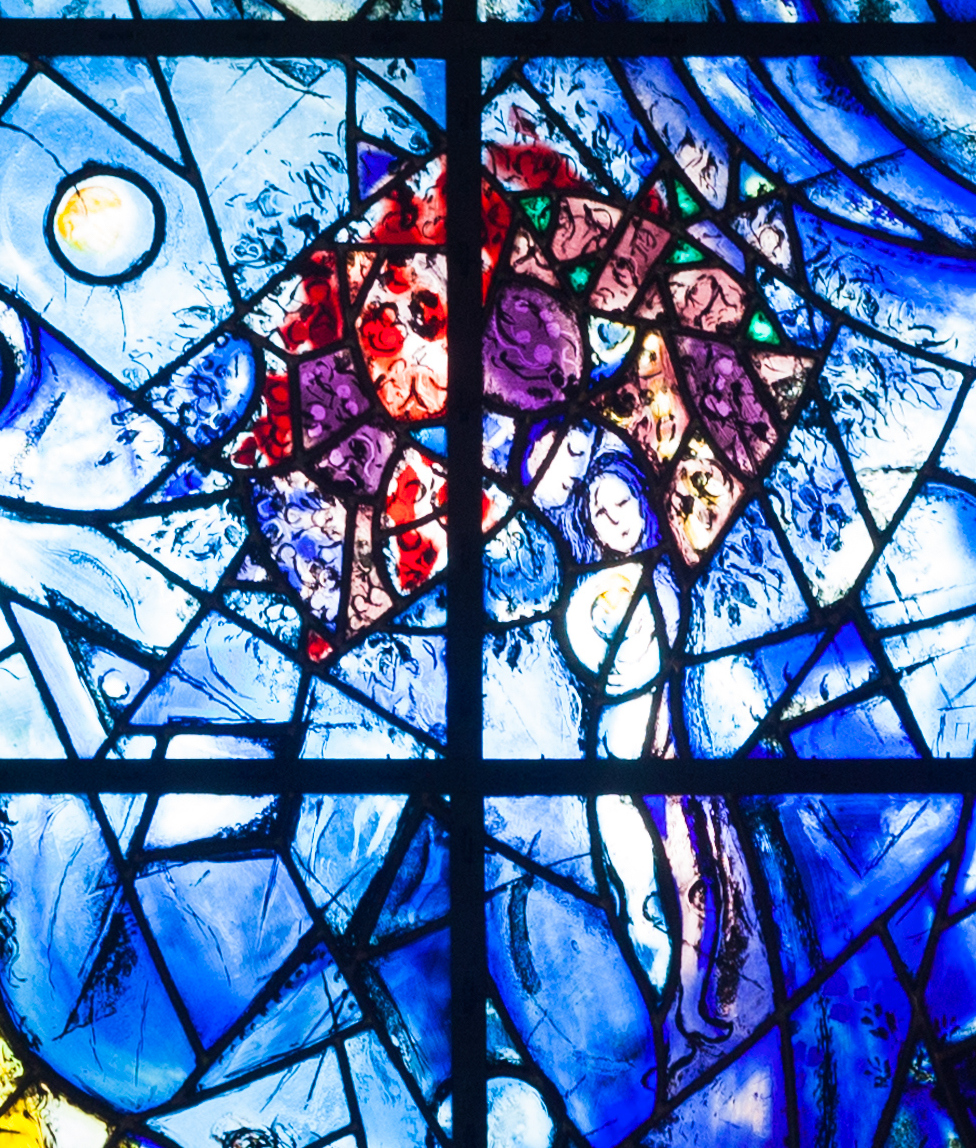
Lovers detail

1. Adam and Eve. In the sketch Chagall made for the window, the woman is very clearly naked, though she’s less obviously so in the final window. That Eve, pre-fall, is traditionally portrayed unclothed, and that Chagall’s later Peace Window unequivocally portrays Adam and Eve within a red tree, lends credence to the interpretation of these figures as our primordial foreparents, in which case the flowering mass would stand for the tree of life in the garden of Eden (Gen. 2:9).

2. The Annunciation—the angel Gabriel coming to Mary to announce that she had been chosen to birth and mother God’s Son. The male head is bodiless, emerging from the crimson bloom (suggesting, perhaps, a supernatural entity), and there’s a yellow glow at the woman’s breast, perhaps signifying the conception of Christ. What’s more, the woman appears to be cradling something—her pregnant belly?

3. God and the human soul, or Christ and his church. One traditional Jewish interpretation of the poetic book of scripture known as the Song of Solomon is that it celebrates the love between humanity and the Divine. Medieval Christians, similarly, spoke of the book as an allegory of the future marriage of Christ and the church, his bride, drawing too on the New Testament book of Revelation, which culminates in a mystical union, a picture of cosmic harmony, heaven and earth inseparably joined.

4. The kiss of Justice and Peace. Psalm 85:8–11, a common Advent text, speaks of the divine attributes that coalesce to accomplish salvation (in the Christian reading, in the Incarnation):

Let me hear what God the LORD will speak,
    for he will speak peace to his people,
    to his faithful, to those who turn to him in their hearts.
Surely his salvation is at hand for those who fear him,
    that his glory may dwell in our land.

Steadfast love and faithfulness will meet;
    righteousness and peace will kiss each other [emphasis mine].
Faithfulness will spring up from the ground,
    and righteousness will look down from the sky.

5. The kiss of Joy. Beethoven’s Ninth Symphony was a favorite of Dag Hammarskjöld’s, and its performance, at least the “Ode to Joy” chorus in its final movement, is a United Nations Day concert tradition. Hammarskjöld described the work as “a jubilant assertion of life,” championing universal peace and brotherhood. One of the lines from Friedrich Schiller’s text that Beethoven set exclaims that “Joy . . . kiss[es] . . . the whole world!”

I suspect some or all of these ideas were at play when Chagall designed the window. Or even just romantic love in general (with other types of love portrayed elsewhere in the composition), as he often painted himself and his wife Bella kissing or embracing.

After this tableau, my eyes go to the large male figure cloaked in purple just right of center. I take him to be the prophet Isaiah, beholding a vision of wild animals and children cavorting together in harmony (see Isaiah 11). A boy, for example, reaches his hand out toward a viper and is not harmed.
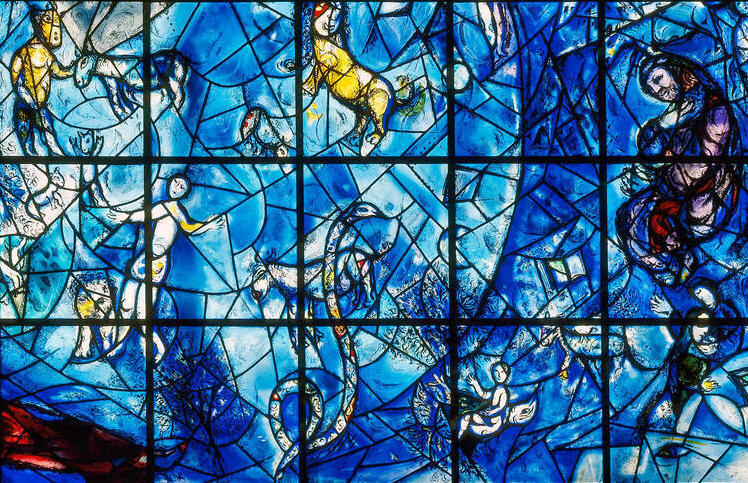
Peaceable Kingdom detail

But it’s also possible that’s meant to be Isaiah at the bottom left of the window, his face illumined by the beauty spread out before him, which an angel gestures to, guiding the prophet’s imagination:
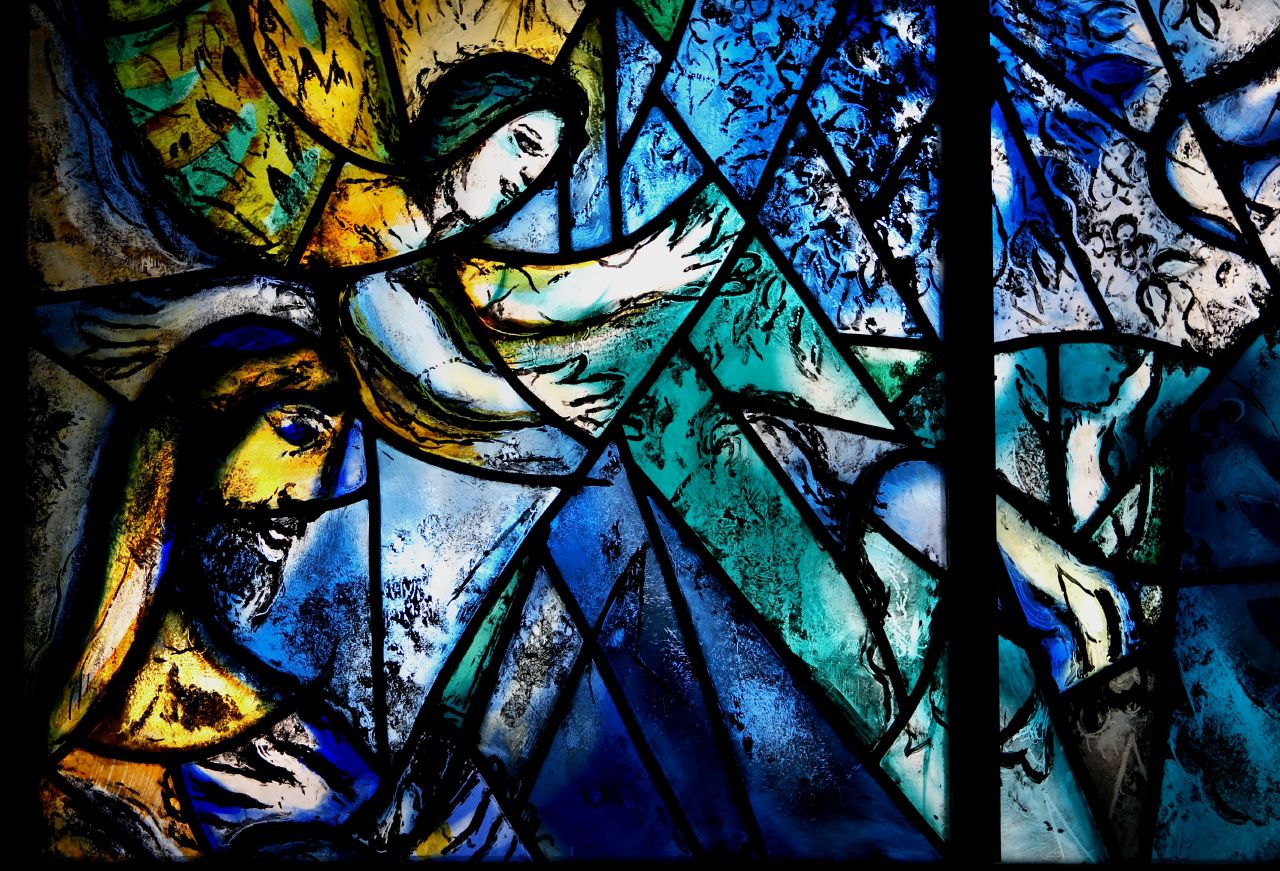
Detail (of Isaiah?)

On the top right, another angel delivers the Ten Commandments to the people of God.
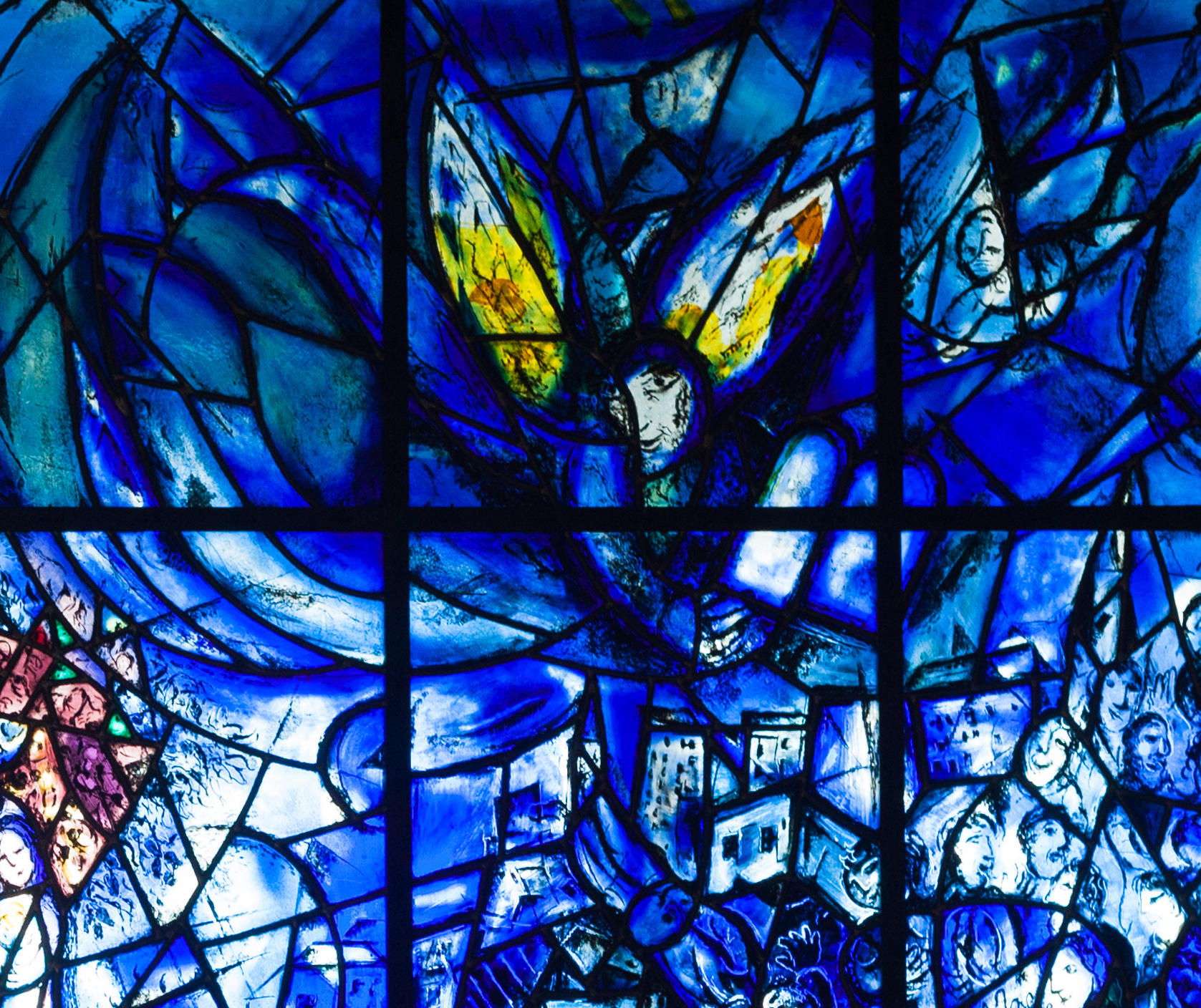
Ten Commandments detail

Next to this communication of God’s word is the death of God’s Word in the flesh, Jesus Christ, around whom the crowds have gathered. A man ascends a ladder propped against the cross, the ladder being a multivalent symbol harking back to Jacob’s dream at Bethel and evoking notions of descent and ascent.
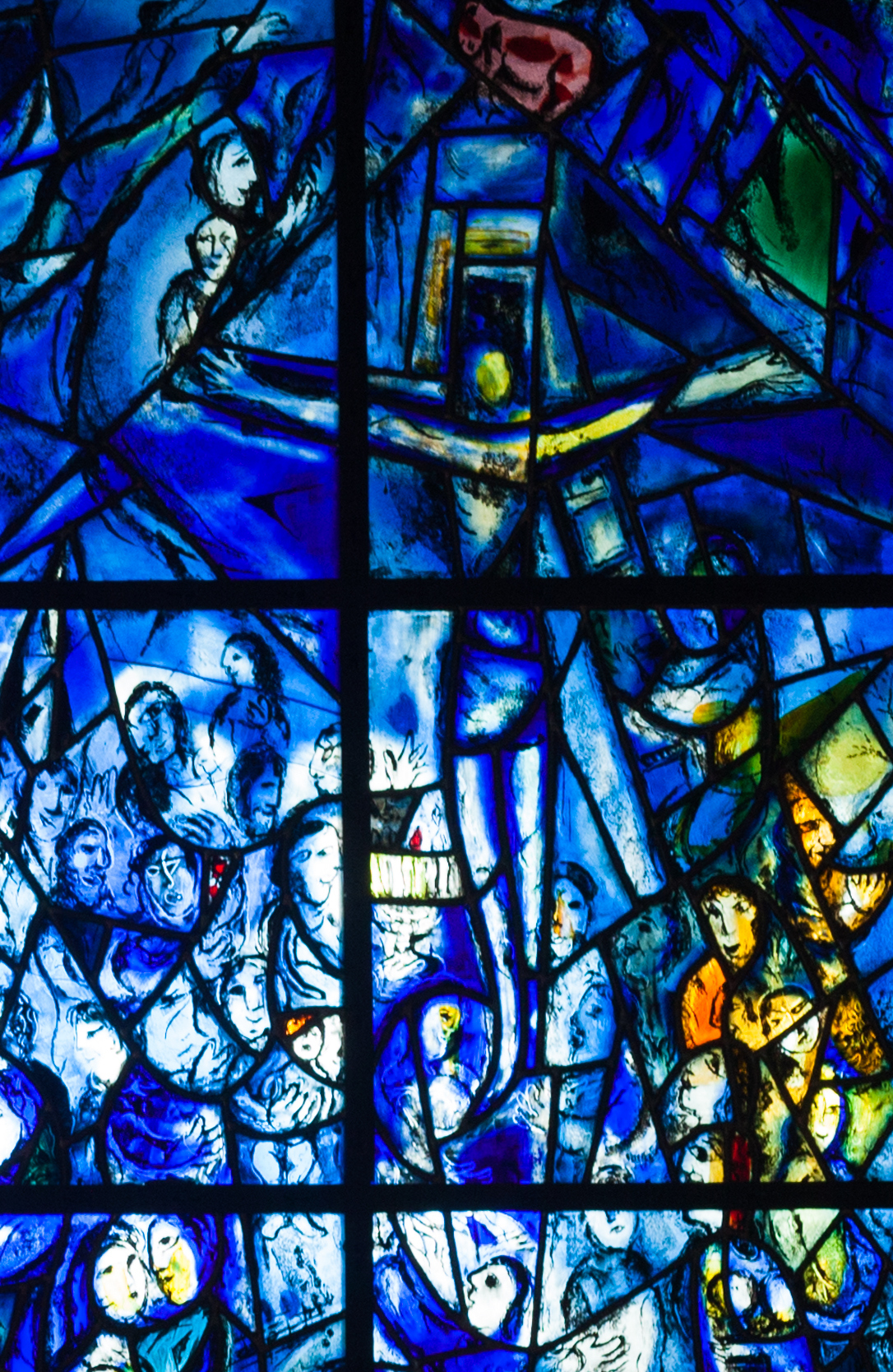
Crucifixion detail

Vignettes below include a couple embracing with an infant in hand, a woman being fed at a table (the Eucharist?), a family reading a book (probably the Bible), a woman making music, and another bearing flowers.

At the top left is a lamentation scene that evokes those of Christ deposed from the cross. A man in a loincloth lies dead or wounded on the ground, his head cradled by a loved one, while at his feet another mourner throws her arms up in grief. This is the cost of human violence.
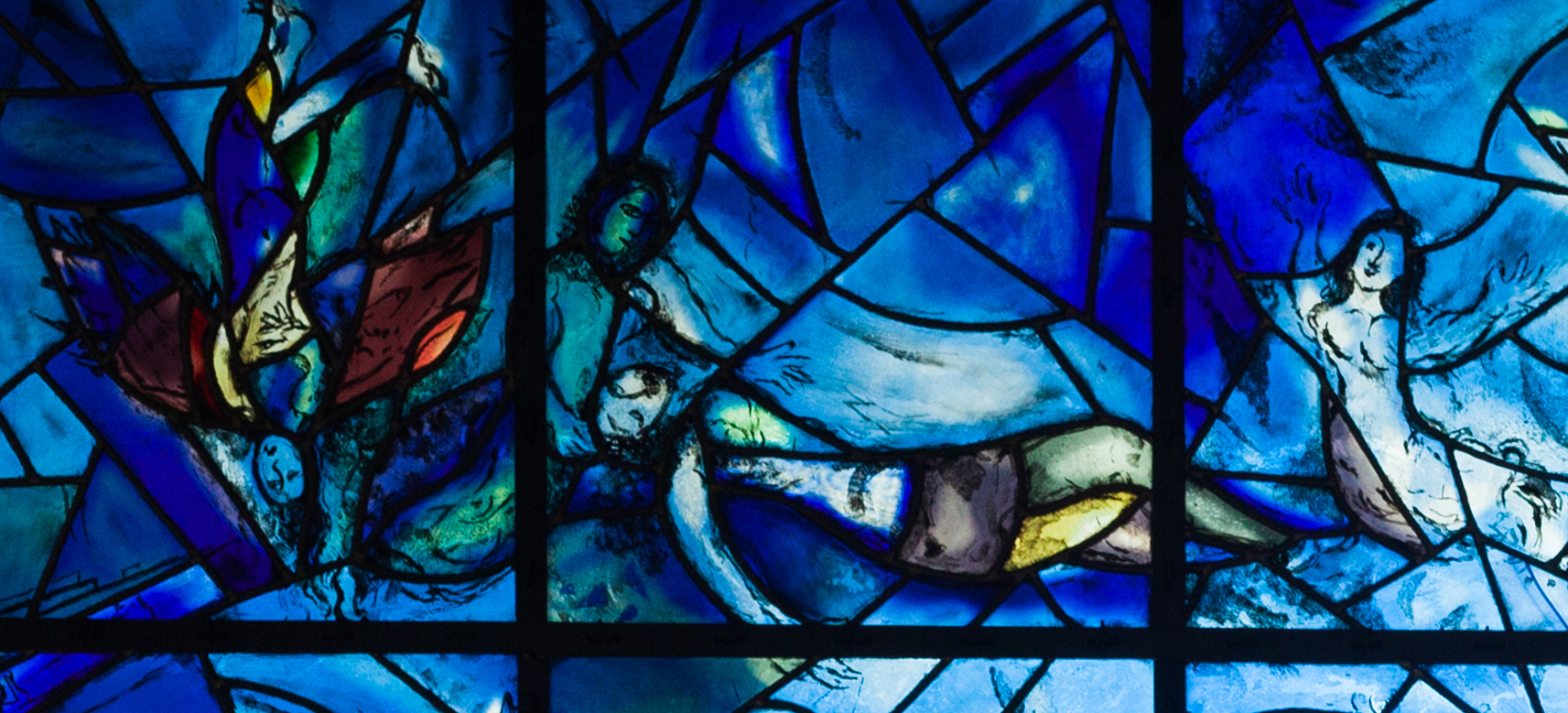
Lamentation detail

By contrast, in the bottom left corner, a mother cradles her child, evoking scenes of the nativity of Christ—of Mary with her newborn son.
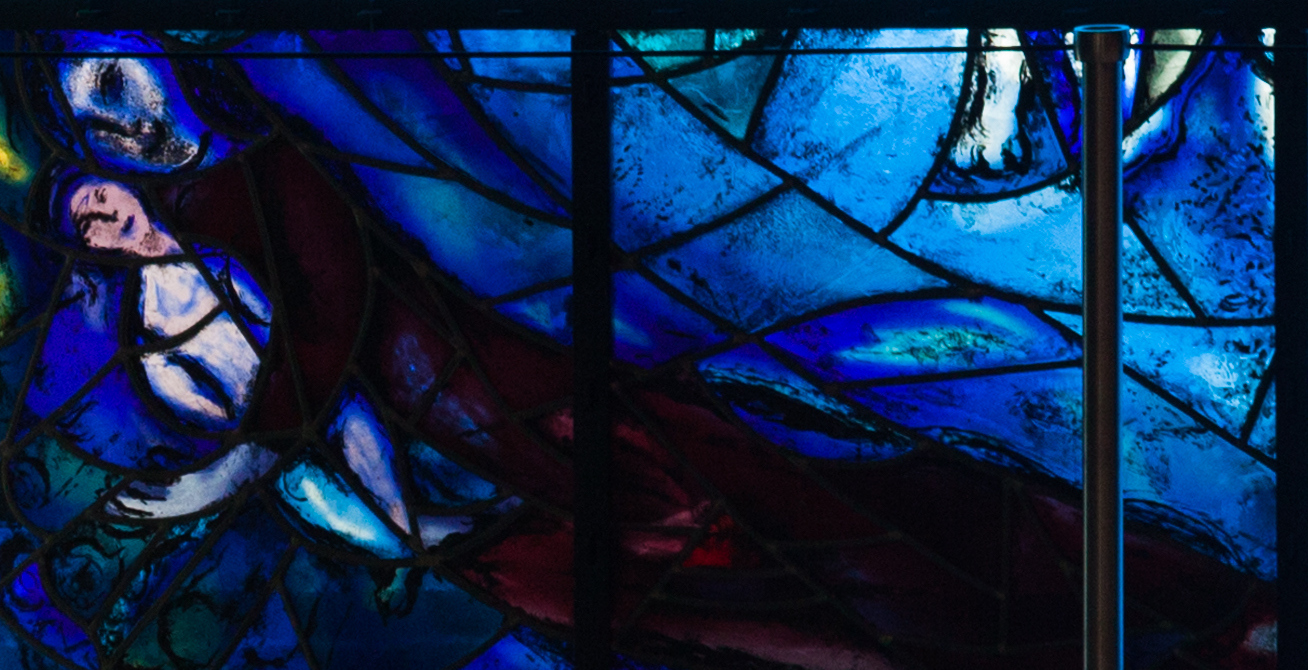
Mother and Child detail

All these characters—human, animal, and divine—are sprawled across a warm azure background, playing out love, suffering, death, peace, joy, and reconciliation.

When I visited the United Nations Headquarters last year, Chagall’s Peace Window was unlit and surrounded by construction, but a UN Facebook post from this September suggests that it is on view again. I’d love to see it in person and get some high-resolution photos of it. The majority of the detail shots I’ve posted here are cropped from a photo that Addison Godel (Flickr user Doctor Casino) took in 2016 when six of the forty panels were out for cleaning.

LISTEN: “Oracles” by Steve Bell, on Keening for the Dawn (2012)

O ancient seer, your vision told
Of desert highways streaming home
To the mountain of the Lord
Where nations sound a righteous song forevermore

And on that mountain men will forge
From cruel implements of war
The tools to till and garden soil
The rose will bloom and faces shine with gladdening oil

And it will surely come to pass
Justice will reign on earth at last
The wolf will lie down with the lamb
No beast destroy, no serpent strike the child’s hand

And God himself will choose the sign
A frightened woman in her time
Will bear a son and name him well
God with us! O come, O come, Emmanuel!
Roundup: Reading the Bible imaginatively, women of Genesis in poetry, and more

VIDEO INTERVIEW: “InStudio: An Image book launch celebrating Abram Van Engen’s Word Made Fresh, including a conversation with Shane McCrae”: The other week I mentioned the upcoming July 9 virtual event hosted by Image journal with Word Made Fresh author Abram Van Engen, who teaches poetry to university students, church groups, and (through his podcast Poetry for All, which he hosts with Joanne Diaz) an online public. The recording for the Image conversation is now available, in case you missed it!

Van Engen answers questions from poet Shane McCrae and from the audience, addressing how to read a volume of poetry, how poetry produces an experience, the role of understanding and not understanding when it comes to poems, why Christians in particular should read poetry, hymns as poetry, how Adam’s naming creation in Genesis 2 relates to the task of the poet, his favorite poets, and the qualities of a good poem.

Two especially great questions from attendees were:

  • How do you imagine poetry nourishing discipleship and/or corporate worship, if used by a church leader?
  • What, if anything, would you like to see more of from Christian poets writing today?

Regarding the first, he says,

I often think that ministers in particular—and especially the heavier the preaching tradition, the more true this is—need creative literature—poetry, novels, and other things—to enliven what it is they’re doing from the pulpit. Not just to understand human life in all of its flourishing and misery, but to connect to people in different kinds of ways than pure principle and message can do.

He mentions the recurring summer seminar for pastors co-led by Dr. Cornelius “Neal” Plantinga, “Imaginative Reading for Creative Preaching,” to help participants explore the possibilities and homiletical impact of engaging in an ongoing program of reading novels, poetry, short fiction, children’s lit, and nonfiction outside the category of Christianity—not just to mine for sermon illustrations but also to develop a “middle wisdom” (“insights into life that are more profound than commonplaces, but less so than great proverbs”) and to deepen their perception of people.

+++

PODCAST EPISODE: “Opening Your Bible? Turn on Your Imagination” with Russ Ramsey and Sandra McCracken, The Gospel Coalition Podcast, May 8, 2020: This is a recording of a breakout session—“Reading Scripture with an Engaged Imagination”—from the Gospel Coalition’s 2019 National Conference in Indianapolis. Pastor Russ Ramsey (author of Rembrandt Is in the Wind: Learning to Love Art through the Eyes of Faith) and singer-songwriter Sandra McCracken (“We Will Feast in the House of Zion,” “Thy Mercy, My God”) discuss the role the imagination plays in reading scripture and understanding and conveying its truth.

Scripture calls for reading with a fully engaged imagination, Ramsey says, because that’s how literature works and that’s how people work. “How are you supposed to understand Scripture if you’re not trying to empathize or get into a situation and walk around inside of it?” he asks. They discuss wonder, mystery, and paradox—the unresolved dissonance and complexity present in many Bible stories—and the need to take a Bible story on its own terms instead of always trying to extract a moral or “life application” from it.

Though they don’t use the term, they’re basically advocating for Ignatian contemplation, a.k.a. the Ignatian method of Bible reading and prayer, in which you put yourself into the story and try to experience it with all your senses. Ramsey demonstrates with the story of Mary and the nard. “In those hours as Jesus is being arrested and tried and flogged and crucified, he smells opulent. And I think we’re supposed to get that, you know. We’re supposed to . . . especially a first-century reader is going to say, ‘He left a lingering scent as he went down the Via Dolorosa, and it was the scent of royalty. And it was the scent of extravagance.’”

Some of the names that come up along the way are Robert Alter, Ellen Davis, Eugene Peterson, and Frederick Buechner.

+++

IMMERSIVE ART EXPERIENCE: Rembrandt’s Christ in the Storm on the Sea of Galilee at Frameless in London: I’ve been seeing these kinds of exhibitions advertised more and more—ones that use animation and projection-mapping technology and dozens of loudspeakers strategically placed around the room to create a wall-to-wall, multisensory experience built around one or more masterpiece paintings. Some people say it’s gimmicky or overstimulating, but though I’ve never been to one, I generally think they look like fun! They’re not meant to be a substitute for seeing the actual artwork in person.

In the case of Rembrandt van Rijn’s Christ in the Storm on the Sea of Galilee, though, that’s not possible, as the painting was stolen from the Isabella Stewart Gardner Museum in Boston in 1990 and has not been recovered. In collaboration with their long-term partner Cinesite, Frameless recently developed an immersive art experience based on the painting—the Dutch master’s only seascape—in which visitors can get a sense of the terror and exasperation Jesus’s disciples must have felt that night they were caught at sea in a torrential wind- and rainstorm while Jesus lay calmly asleep in the boat’s stern (see Matt. 8:23–27; Mark 4:36–41; Luke 8:22–25). Here’s a making-of featurette for that experience, which garnered a nomination for a prestigious Visual Effects Society award earlier this year:

Frameless is permanently housed in the Marble Arch Place in London’s West End cultural district. Christ in the Storm is one of forty-two works of art they riff on across four galleries.

+++

POEMS:

Here are two poems published this month that each explores a different episode from the story of Jacob’s family in the book of Genesis—one of his wife Rachel stealing her father’s household gods as they flee to Canaan, and one of Jacob’s sons avenging the rape of their sister, Dinah. Both are examples of how poems can stimulate renewed engagement with scripture, as these were stories I had forgotten some of the details of, and the poems did not make sense until I revisited the relevant Bible passages. Poems can help us walk around inside the biblical narratives, both familiar and unfamiliar ones, and see things from the perspectives of different characters, especially ones who are not given a voice in scripture, such as a Shechemite woman taken captive by Jacob’s sons.

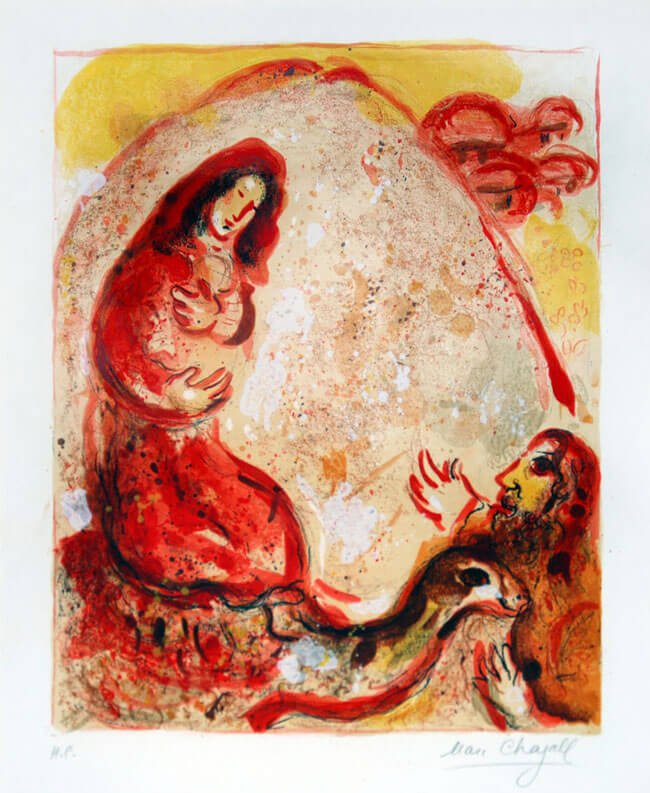
>> “Rachel, Cunning” by Patricia L. Hamilton, Reformed Journal: Read the poem first, then Genesis 29–31, then my commentary.

Voiced by Jacob’s second wife, Rachel, in this poem Rachel vents her jealousy over Jacob having first married her sister, Leah, who bore him six sons to her one at this point. This marriage was due to the trickery of her father, Laban, who also tried to cheat Jacob out of fair shepherding wages—so Rachel resents her father. As she prepares to secretly leave Paddan-aram for Canaan with Jacob, Leah, and their children, she steals her father’s teraphim (small images or cult objects used as domestic deities or oracles by ancient Semitic peoples).

In the biblical narrative, Rachel’s motive for stealing the idols is not given. Was she seeking to prevent Laban from consulting them to find out which way she and her family went? Was possession of the gods in some way connected to property inheritance, as some scholars have attested? Was she stealing a blessing from her ancestors? Did she take them for their monetary value? Or leaving her homeland, did she simply wish to take with her a little piece of home, for nostalgia’s sake?

I think the most likely reason is she still believed in these gods’ power—her allegiance to the God of Jacob had not yet been firmly established—and so she stole them for protection. That’s what Hamilton imagines in her poem: that Rachel sees them as “talismans against the spite of brothers,” averting the evil Jacob’s older twin brother, Esau, wished him for his having stolen their father’s blessing that belonged to him. (According to Genesis 27:41–45, before Jacob left for Paddan-aram, Esau had vowed to kill him.)

Chagall, Marc_Rachel Hides Her Father's Household Gods
Marc Chagall (Belarusian French, 1887–1985), Rachel dérobe les idoles de son père (Rachel Hides Her Father’s Household Gods), from The Bible series, 1960. Original color lithograph on Arches wove paper, image size 14 × 10 1/2 in. (35.6 × 26.7 cm).

Caught between two tricksters—her husband and her father—Rachel herself becomes a trickster. When Laban catches up with their traveling party and searches among their possessions for the stolen gods, Rachel, who’s sitting on them, lies and says she cannot get up because she’s menstruating (Gen. 31:34–35). She deceives her deceitful father to keep her deceitful husband and her son Joseph safe from Esau’s rage, as she believes the gods will act in the interests of whoever possesses them. The poem explores the ever-thickening web of deceptions woven in Jacob’s and Rachel’s families and also reminds us that Rachel, remembered now as a great Jewish matriarch, was not raised in the then-still-developing Israelite religion, nor was her turn to Yahweh necessarily immediate upon her marriage to Jacob. I hear in the poem a lament for fraternal and sororal rivalries, and a subtle sad awareness of the vulnerabilities and pressures of women in patriarchal cultures, who are bought and sold in marriage, valued primarily for their childbearing capacities, and typically forced to rely on men for survival, often suffering the consequences of men’s mistakes. (In the poem at least, Rachel’s feeling of insecurity comes from Esau’s threat of vengeance.)

Based on a lithograph by Marc Chagall, this ekphrastic poem is one of twenty-four from the unpublished chapbook Voiced by Patricia Hamilton, all inspired by biblical artworks by Chagall. Hamilton is currently looking for a publisher to take on the collection.

(Related post: “Bithiah’s defiance: Kelley Nikondeha and poet Eleanor Wilner imagine Pharaoh’s daughter”)

>> “For the Circumcision of a Small City” by Emma De Lisle, Image: The deception continues in Genesis 34; like father, like sons. This poem is based on the episode of the massacre of the men at Shechem by Jacob’s sons Simeon and Levi to avenge the rape of their sister, Dinah. Shechem, meaning “shoulder,” was the name of both the city in Canaan where the rape took place and the Hivite prince’s son who committed the rape. Jacob and his family were sojourning there, having even bought land. After sexually assaulting Dinah, Shechem wanted to make her his wife. Dinah’s brothers were disgusted by this request, but they pretended they would entertain bride-price discussions on the condition that all the males in the city be circumcised. Shechem’s father agreed, and his position as ruler meant the people obeyed. A few days after the mass circumcision, while the men were still sore, Simeon and Levi attacked with swords, killing all the males in the city. Their brothers then joined them in capturing the men’s wives and children and plundering their wealth.

Emma De Lisle’s poem is written from the perspective of a woman of Shechem, taken captive in the slaughter. The women of the city scorned the lengths Shechem was willing to go to for the homely Dinah, barely old enough to have her period. “Jacob’s silence for you” alludes to Genesis 34:5, which says that when he found out about his daughter’s rape, “Jacob held his peace” until his sons returned from the fields. If he felt grief or outrage, it’s not apparent in the scripture text. His initial response was to say and do nothing, and then to defer to his sons, who exact an outsize punishment for the crime that Jacob admits after the fact disappointed him because when word spreads, it will negatively impact the hospitality of other Canaanite cities toward them.

Stanzas 4 and 5 refer to two of Jacob’s previous deceptions: donning goatskins on his hands and neck to impersonate his hairy brother, Esau, before their blind father, so as to steal the blessing of the firstborn (Gen. 27), and altering the breeding pattern of Laban’s flocks to increase the number of spotted sheep and goats (how this is accomplished is vague and has posed difficulties for interpreters) and so enrich himself, as the spotted animals were his agreed-upon wage (Gen. 30:25–43). The implication of this mention is, I think, that men will take what they feel is owed to them, whether by guile or force.

Sometimes women participate in this violence. The poetic speaker wonders whether Dinah will force her or the other captive women to bear children for her (future husband’s) family line, just as her mother, Leah, had used her slave, Zilpah, when her own womb had closed.

“The city bled one way // or another, before your brothers took interest,” the speaker says. Sexual violence was not new to them. The last sentence suggests that Dinah was not the only female victim of the lustful Shechem’s assault—the women of the city paid a price too, seeing their husbands, fathers, brothers, and sons murdered in retaliation and themselves taken prisoner.

+++

ORATORIO: The Book of Romans by Emily Hiemstra (2019): Consisting of musical settings of select passages from the apostle Paul’s letter to the Romans, this piece for SATB soloists, choir, and string orchestra was commissioned by Grace Centre for the Arts, a ministry of Grace Toronto Church, where it premiered October 22, 2019. (Hooray for churches that commission new art!) Read a statement from the composer on the Deus Ex Musica blog. The performers are Meghan Jamieson (soprano), Rebecca Cuddy (alto), Asitha Tennekoon (tenor), Graham Robinson (baritone), Lyssa Pelton (violin), Amy Spurr (violin), Emily Hiemstra (viola), and Lydia Munchinsky (cello).

Here is the video time stamp for each of the eight movements:

(Related post: “Book of Romans album by Psallos”)

Roundup: “Kyrie / Oh Death” medley, preaching Chagall, Isaiah 35-inspired chamber work, and more

SONGS: The following two songs appear on the Art & Theology Lent Playlist on Spotify. (Note: I’ve also integrated some Lovkn, Sarah Juers, and a few others into the list since originally publishing it.)

>> “Kyrie / Oh Death,” performed by Susanne Rosenberg: March 11 marks one year since the coronavirus outbreak was officially declared a pandemic, and the tremendous number of lives lost is staggering. (A friend from Japan reminded me that it’s also the ten-year anniversary of the Great Tōhoku earthquake and tsunami that killed some 16,000 people; 3/11, he says, is as important in Japan as 9/11 is in the United States.) This lament by Susanne Rosenberg, one of Sweden’s foremost folk singers, seems appropriate. It combines a twelfth-century Kyrie chant with the Appalachian folk song “Oh Death,” the latter made famous by Ralph Stanley. Kyrie eleison, Christe eleison, Greek for “Lord, have mercy, Christ, have mercy,” is a short, repeated invocation used in many Christian liturgies, and Rosenberg seamlessly integrates it with these few lines: “Oh Death, oh Death, won’t you spare me over till another year?” The video recording is from a February 2010 concert in Dublin, and a similar version of the medley, in a different key, appears on Rosenberg’s album of the same year, ReBoot/OmStart.

>> “Washed in the Blood,” performed by Pokey LaFarge and Harry Melling: The Devil All the Time (2020) isn’t a great movie, but it has a great soundtrack. Harry Melling—known for his roles as Dudley Dursley in the Harry Potter series and, more recently, Harry Beltik in The Queen’s Gambit—plays a spider-handling preacher named Roy, and singer-songwriter Pokey LaFarge (whose style pulls from ragtime, jazz, country, and blues) plays his guitar-playing sidekick, Theodore. The two actors sing as their characters in the film, this classic hymn by Elisha Hoffman. Love it!

+++

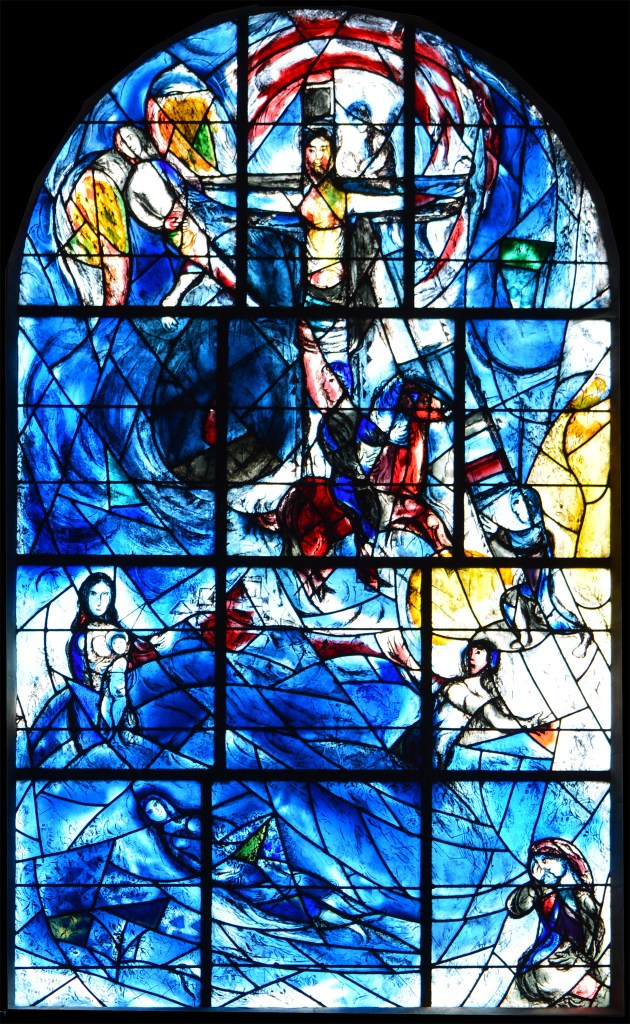
SERMON: “Chagall at Tudeley” by the Rev. James Crockford, University Church, Oxford, April 7, 2019: This sermon, preached on Passion (Palm) Sunday two years ago, is an excellent example of how pastors can draw on visual art as a theological and homiletical resource—not to merely illustrate a point already made or to add some pretty dressing to a sermon, but taking it on its own terms and allowing it to generate insight and guide the congregation someplace new. Crockford uses the East Window in All Saints’ Church in Tudeley, Kent, England, designed by the Russian Jewish artist Marc Chagall, to open up profound discussion on human loss, hope, renewal, and the cross. [HT: Jonathan Evens]

The window was commissioned by the parents of twenty-one-year-old Sarah d’Avigdor-Goldsmid, who in 1963 drowned off the coast of Sussex in a boating accident. “What I see in that East Window,” Crockford says, “is a remarkable exercise in the nature of suffering, and the interaction of human tragedy with the reality of Christ’s death and victory on the cross. It is a carefully composed centrepiece that asks us to face the depths of an abiding experience of grief, and to be faced with that grief each time we remember the grief of God, in broken bread and wine outpoured. But the window also shows a bigger picture – one that does not shut out the pains of our past, and the wounds in our hearts – and you’ll notice, when we come to it, that the scene of Sarah’s death still takes up over half of the window – but the bigger picture asks us to frame our grief and suffering on the centrality and promise of a God who, in Christ, is both suffering and victorious, broken and yet glorious, wounded but risen and standing among us to breathe Peace.” You can read the full transcript, or listen to an audio recording, at the link above.

East Window, Tudeley (Marc Chagall)
East Window, All Saints’ Church, Tudeley, Kent, designed by Marc Chagall and executed by Charles Marq. Installed 1967. Photo: George Rex.

Chagall, Marc_East Window, Tudeley (detail)
Detail photo by Jonathan Evens

+++

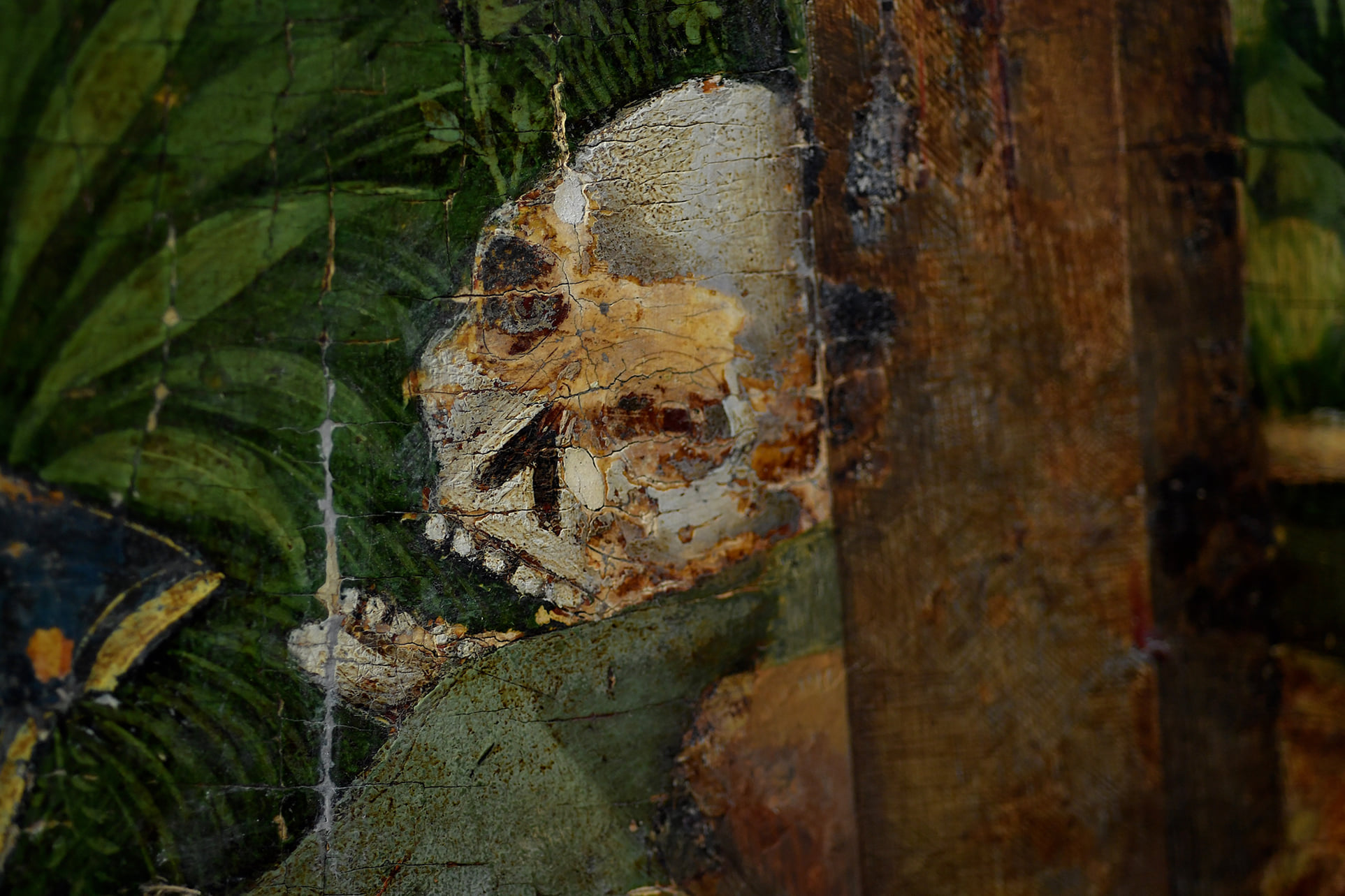
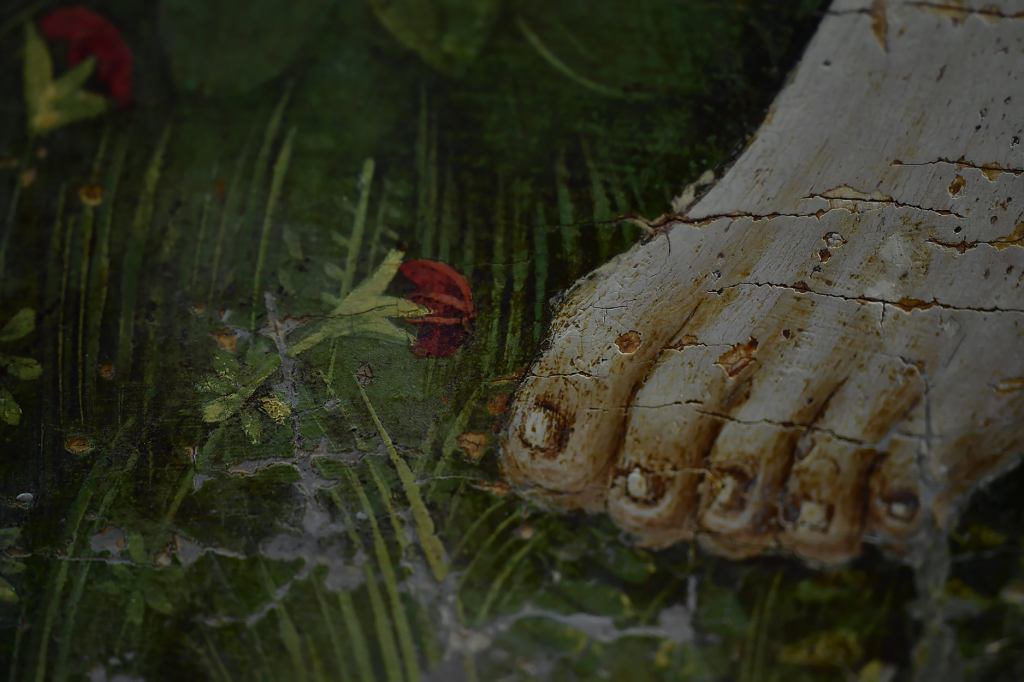
ART RESTORATION: “Hidden Gem: The Crucifixion by the Master of the Lindau Lamentation”: A Crucifixion painting from around 1425 by the Master of the Lindau Lamentation was recently restored by conservator Caroline van der Elst, and this short video documents part of that process. The Museum Catharijneconvent in Utrecht, the Netherlands, acquired the painting in 1875, but since then it had lain mostly forgotten in storage until being rediscovered by a staff member a few years ago, who recognized it as a masterpiece worthy of restoration efforts and public display. After the surface dust and discolored varnish were removed, in addition to other treatments, it was unveiled last year as the centerpiece of the Body Language exhibition (check out that link!), which ran from September 25, 2020, to January 17, 2021.

Curators Micha Leeflang and Annabel Dijkema discuss how the painting was made, how it was originally used, and its theological significance, and van der Elst explains some of the conundrums she faced while restoring the work—when it came to light, for example, that the azurite background was added in the sixteenth century. View the full painting here.

Lindau Crucifixion detail
Master of the Lamentation of Christ in Lindau, Crucifixion (detail), ca. 1425. Tempera on panel, 125 × 89 cm. Catharijneconvent Museum, Utrecht, the Netherlands. Photo: Marco Sweering.

Crucifixion detail (1425)

+++

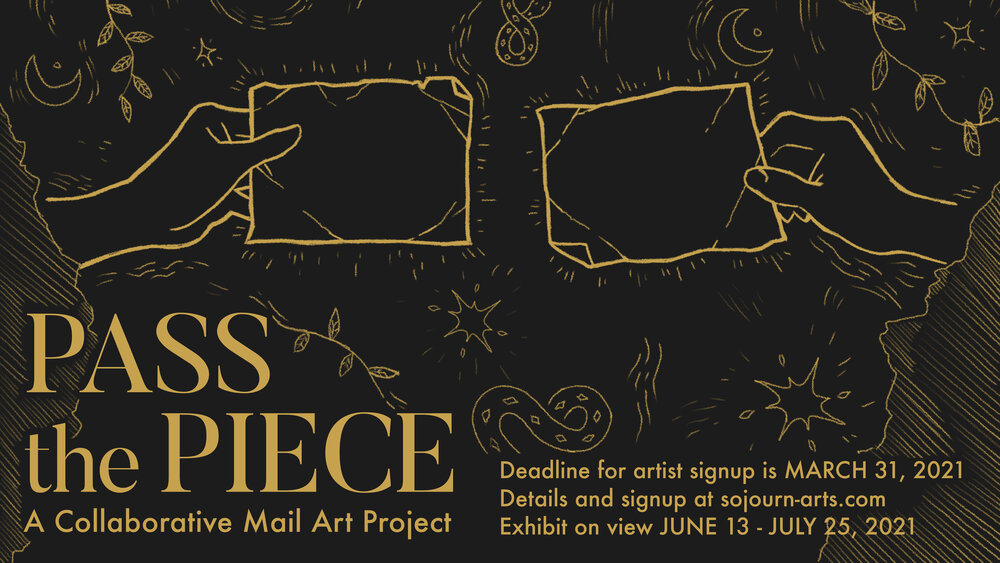
CALL FOR ARTISTS: Pass the Piece: A Collaborative Mail Art Project: A neat opportunity for artistic collaboration, organized by Sojourn Arts [previously] and open to US artists ages 13+. “Pass the Piece is a collaborative mail art project to be exhibited at Sojourn Arts in June 2021. Deadline for participating artists to sign up is March 31, 2021. Project is limited to 100 participants. We’re mailing out up to one hundred 8″ × 10″ panels, one to each participating artist. Each artist will start a panel that another artist will complete. Each artist will finish a panel that someone else started. Each artist will have their work exhibited and have a printed zine-style catalog of each piece from the exhibit. Artworks will be auctioned online with 50% going to the artists and 50% going towards Sojourn Arts interns’ travel expenses for the upcoming CIVA conference.”

Pass the Piece (Sojourn Arts)
Begun with an illustration by Stephen Crotts and finished with a painting by Kyra Hinton

+++

NEW ALBUM: for / waters by Joshua Stamper: Joshua Stamper [previously] composed this four-movement instrumental piece about marriage for pianist Bethany Danel Brooks and violinist David Danel, who are themselves married and perform on the recordings. Its title and that of each movement is taken from Isaiah 35, which was read at the couple’s wedding.

Stamper writes,

Marriage, ideally, is about two people in a state of mutual belonging. But marriage is more than a state of belonging: it includes an ongoing journey toward and into belonging. It encompasses the trajectories and momentum of individuals towards each other, even before an initial connection takes place. People are therefore in relationship with each other before they are “in relationship” with each other. From this perspective, marriage might be understood as another mystical manifestation of the inscrutable and unknowable fault line between free will and providence. Two lives are always in reference to one another before the initial “hello,” because though individual trajectories have not yet crossed, they will. This interweaving begins early: each life is conditioned, shaped, sensitized to see, hear, feel the other. Home is created in each for each.

Stamper goes on to describe how he reflects these ideas through the structure, melodic and rhythmic motifs, harmonies, and other musical elements of for / waters. Read more and stream/purchase at Bandcamp.

“Joshua Stamper has been a restless composer and collaborator for over twenty-five years. His work reflects a deep interest in the intersection points between seemingly disparate musics, and a profound love for the intimacy, charm, and potency of chamber music. Equally at home in the jazz, classical, avant-garde, and indie/alternative worlds, his work ranges from large-scale choral and instrumental works to art-pop song cycles to chamber jazz suites. Joshua has worked as an orchestral arranger and session musician for Columbia / Sony BMG and Concord Records, and for independent labels Domino, Dead Oceans, Important Records, Sounds Familyre, Smalltown Supersound, and Mason Jar Music, collaborating with such luminaries as Todd Rundgren, Robyn Hitchcock, Sufjan Stevens, Danielson, and Emil Nikolaisen.” [source]

“As the bridegroom rejoices over his bride . . .” (Artful Devotion)

Les maries de la tour Eiffel by Marc Chagall
Marc Chagall (Russian French, 1887–1985), Les mariés de la tour Eiffel (The Bride and Groom of the Eiffel Tower), 1938–39. Oil on canvas, 150 × 136.5 cm. Centre Pompidou, Paris. Photo: Jim Forest.

Regarding Zion, I can’t keep my mouth shut,
    regarding Jerusalem, I can’t hold my tongue,
Until her righteousness blazes down like the sun
    and her salvation flames up like a torch.
Foreign countries will see your righteousness,
    and world leaders your glory.
You’ll get a brand-new name
    straight from the mouth of GOD.
You’ll be a stunning crown in the palm of GOD’s hand,
    a jeweled gold cup held high in the hand of your GOD.
No more will anyone call you Rejected,
    and your country will no more be called Ruined.
You’ll be called Hephzibah (My Delight),
    and your land Beulah (Married),
Because GOD delights in you
    and your land will be like a wedding celebration.
For as a young man marries his virgin bride,
    so your builder marries you,
And as a bridegroom is happy in his bride,
    so your GOD is happy with you.

—Isaiah 62:1–5 (The Message)

+++

SONG: “Fairland” by The Hollands!, on ashes to beauty (2011)


The lyrics of “Fairland” are adapted from the poem “The Little Beach-Bird” by Richard Henry Dana (1787–1879), with the bridge referencing Jesus’s words to his disciples in John 14:1–3: “Let not your hearts be troubled. Believe in God; believe also in me. In my Father’s house are many rooms. If it were not so, would I have told you that I go to prepare a place for you? And if I go and prepare a place for you, I will come again and will take you to myself, that where I am you may be also.” These are the words of a bridegroom to his bride.

Thou little bird, thou dweller by the sea,
Why takest thou so melancholy,
And with that boding cry
Along the breaker fly?
O rather, bird, with me
Through the fair land rejoice!

Come and go with me
Back to my Father’s house
To my Father’s house
Come and go with me

+++

It is not difficult to see, . . . in his dreamlike images of adorned and beautiful Jewish brides, Chagall’s aspiration for the redeemed daughter of Zion.

—David Lyle Jeffrey, In the Beauty of Holiness, p. 347


This post belongs to the weekly series Artful Devotion. If you can’t view the music player in your email or RSS reader, try opening the post in your browser.

To view all the Revised Common Lectionary scripture readings for the Second Sunday after Epiphany, cycle C, click here.

Roundup: Advent as a season of pregnancy, an Oh Hellos Christmas, jumbo cathedral tapestry, new film column, music education ministry

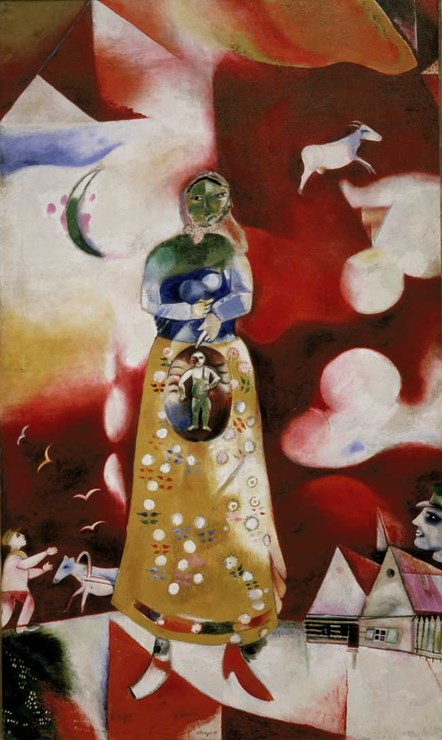
“ART OF ADVENT” SERMON: In his chapel address last December at Wheaton College, assistant professor of art history Matthew Milliner opened with a marriage analogy: If you love your spouse, you’ve got to love their parents. Do we love Mary and Joseph? Have we even met them? “Before the swaddled baby comes the swollen belly,” Milliner reminds us. He helps us dwell in those nine months before Christ’s birth, showing examples of the Virgin of the Sign icon (“ultrasound Jesus”) and Marc Chagall’s modern interpretation of it; these images are good for “target practice,” he says: for focusing our primary affections on Christ. He also shares how Mariko Mori’s video piece Miko No Inori (The Shaman-Girl’s Prayer) reminds him of a Visitation sculpture group by a fourteenth-century German artist, who inset Mary and Elizabeth’s bellies with a gem. Advent is a season of pregnancy, in which we are called to bear Christ within us. Not only that, it’s about “the pregnancy of a groaning planet,” waiting for deliverance from suffering. This address was given a few weeks after the death of Wheaton English professor Brett Foster, and Milliner notes how putting Brett’s body in the ground was an Advent act, in that we wait for it to rise.

The Pregnant Woman by Marc Chagall
Marc Chagall (Russian/French, 1887–1985), The Pregnant Woman, 1913. Oil on canvas. Stedelijk Museum Amsterdam.

+++

CHRISTMAS EXTRAVAGANZA TOUR + MUSIC DOWNLOAD: The Oh Hellos—folk rock sibling duo Maggie and Tyler Heath (and my husband Eric’s favorite band)—are hitting up eight US cities on their Christmas Extravaganza Tour this month, each show “an evening of Christmas music, carols, originals, bad jokes, sing-alongs, dancing, revelry, and all the holiday cheer you can squeeze into one room!” Sure to be featured are the four “movements” from their Family Christmas Album, which blend carol excerpts: “O Come, O Come, Emmanuel” with “The Coventry Carol”; “While Shepherds Watched Their Flocks by Night” with “O Come, All Ye Faithful”; “Silent Night”; and “Joy to the World” with “I Saw Three Ships.” I’ve embedded the first one in the player below. They’re offering this Christmas album for free download at NoiseTrade (tips appreciated), or if you want a physical disc, you can purchase it from Bandcamp.

+++

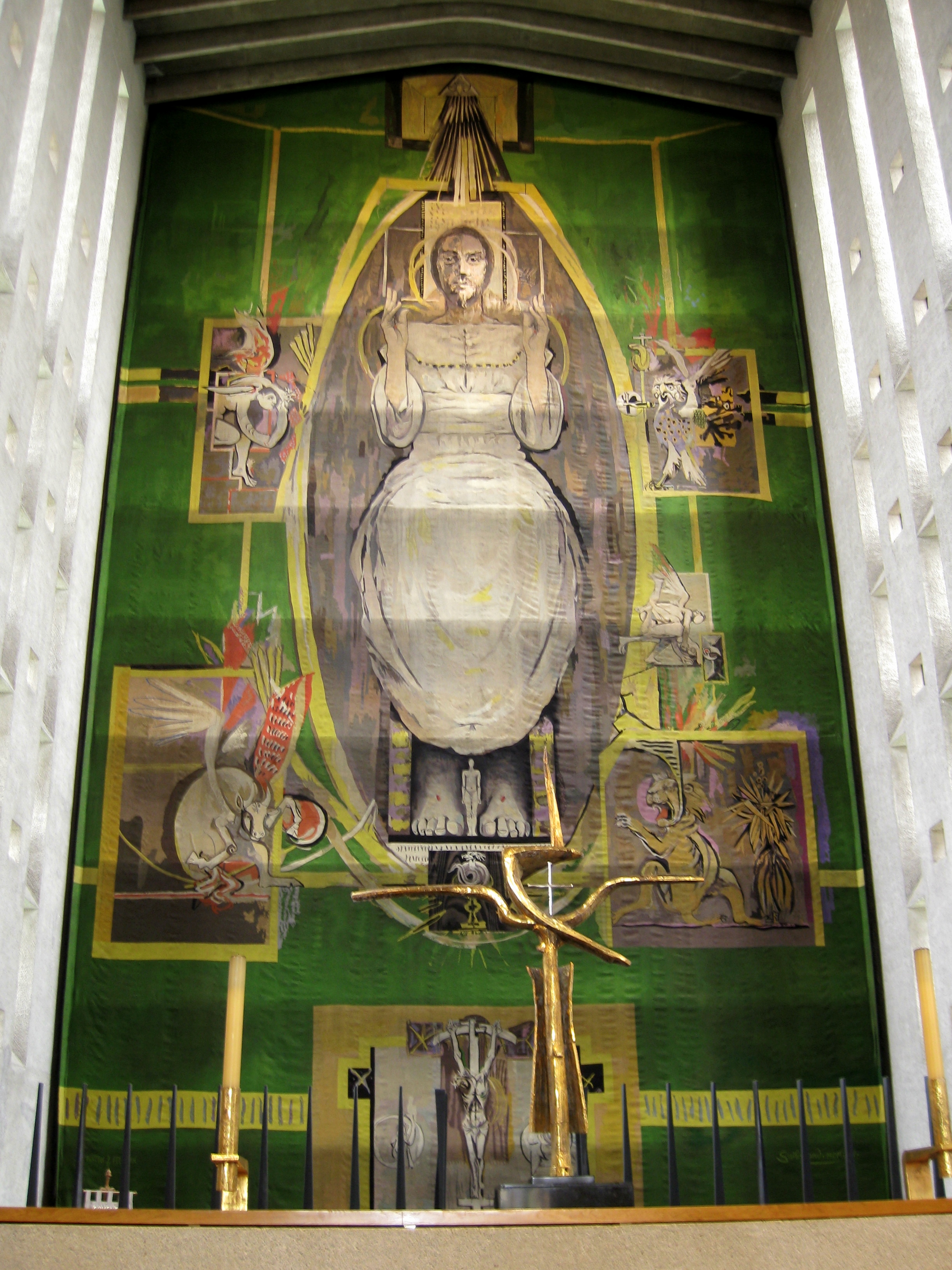
VISUAL MEDITATION: My latest visual meditation for ArtWay is on the gigantic Christ in Glory tapestry by Graham Sutherland that hangs behind the altar of Coventry Cathedral—one of many modern church art commissions in England necessitated by World War II bomb damage. Visiting the cathedral in 2013 was one of the most spiritually rich experiences I’ve ever had, and I plan to share it on this blog sometime in the future. Such a variety of artists were involved in the interior decoration program, and somehow it all comes together, collectively testifying to the power of resurrection. Sutherland wrote of his aspirations for the Christ figure: “The figure must look real—in the sense that it is not a rehash of the past. It must look vital; non sentimental, non-ecclesiastical; of the moment: yet for all time.” I’m taken by the final result, but an elderly gentleman who observed me staring at it for a while approached me and told me how much he hates it, how he thinks the eyes look unkind. (The man has lived in Coventry his whole life and remembers worshiping in the original cathedral before the war.) What do you think?

Christ in Glory by Graham Sutherland
Christ in Glory in the Tetramorph. Tapestry designed by Graham Sutherland (British, 1903–1980) and woven by Pinton Frères in France, 1962. Dimensions: 75 × 38 ft. Location: Coventry Cathedral, Coventry, UK.

+++

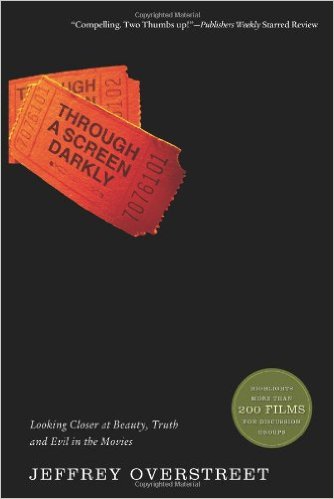
FILM COLUMN: This fall I’ve really been enjoying film critic Jeffrey Overstreet’s new Christianity Today column, “Viewer Discussion Advised,” designed to help Christians explore and discuss a broad range of films. His kickoff article on the foreign drama Timbuktu, which is about the city’s occupation by Muslim extremists, highlights how the film “bears artistic witness to the sufferings of our neighbors.” (Quoting Frederick Buechner: “If we are to love our neighbors, before doing anything else we must see our neighbors.”) “Christians can choose to dwell on—and invest in—movies that show us what we already like, tell us what we already know, assure us of our own salvation, and make us feel happily entertained. That isn’t wrong. But might we make better use of our time? Might we exercise courage and conscience, step outside of our comfort zones, attend to our neighbors, and learn from their experiences?”

Through a Screen Darkly

In addition to Timbuktu, Overstreet has covered the comedy The Station Agent; the US criminal justice system documentary 13th; the Hitchcock thriller Vertigo; the biographical drama A Man for All Seasons; the Marvel superhero flick Doctor Strange; the Coen brothers’ comedies; and the sci-fi feature Arrival, ending each article with group discussion questions. Overstreet has been writing about art, film, and faith for more than a decade at LookingCloser.org and is the author of Through a Screen Darkly: Looking Closer at Beauty, Truth, and Evil in the Movies. He is currently teaching an online film course for Houston Baptist University and creative writing at Seattle Pacific University. To receive weekly installments of “Viewer Discussion Advised” to your email inbox, sign up for the CT Entertainment Newsletter.

+++

MUSIC VIDEO: My friend Nabil Ince is a third-year music major at Covenant College who writes and produces music under the rap name Seaux Chill. After an internship this summer he became assistant program director for the New City Fellowship–based nonprofit East Lake Expression Engine in Chattanooga, Tennessee, whose mission is to provide children in the East Lake neighborhood with a free music education in a gospel-centered environment. Inspired by the El Sistema movement, the organization believes that music is an effective avenue for developing children’s creativity and problem-solving skills and for building up a strong community. They provide year-round classes on music history, theory, composition, and performance, including choir, bucket band, and orchestra. Below is the music video for “It Always Rains on Tuesdays,” a song Nabil wrote for the kids. The refrain is “Feed the plants / Clean all the cars / Fill the potholes / Tears from the stars.”

Religious art highlights from New Mexico

I spent last week in New Mexico with my husband, Eric, and my in-laws, visiting relatives in the south, then driving up north to spend some time in Albuquerque and Santa Fe. It was my first time to the Southwest, to the state where Eric was born; his grandparents came over from Mexico as teenagers and settled in Hobbs, a small oil town, and his mom grew up there, learning English in school. I enjoyed all the tastes: spicy green chiles in or on just about everything (eggs, tacos, burgers, soup, corn, French fries); piñons (pine nuts) galore sprinkled alongside dusty footpaths, ready to crack open and eat; and sopapillas (pillow-shaped fried dough drizzled with honey) after every meal.

On the five-hour upstate drive, the blue sky spread wide open across the desert and clouds hung low, casting shadows that, from the car, looked like bodies of water. The way was flat, flat, flat—until we reached Santa Fe, where mountains rose up and aspens flickered their glorious gold.

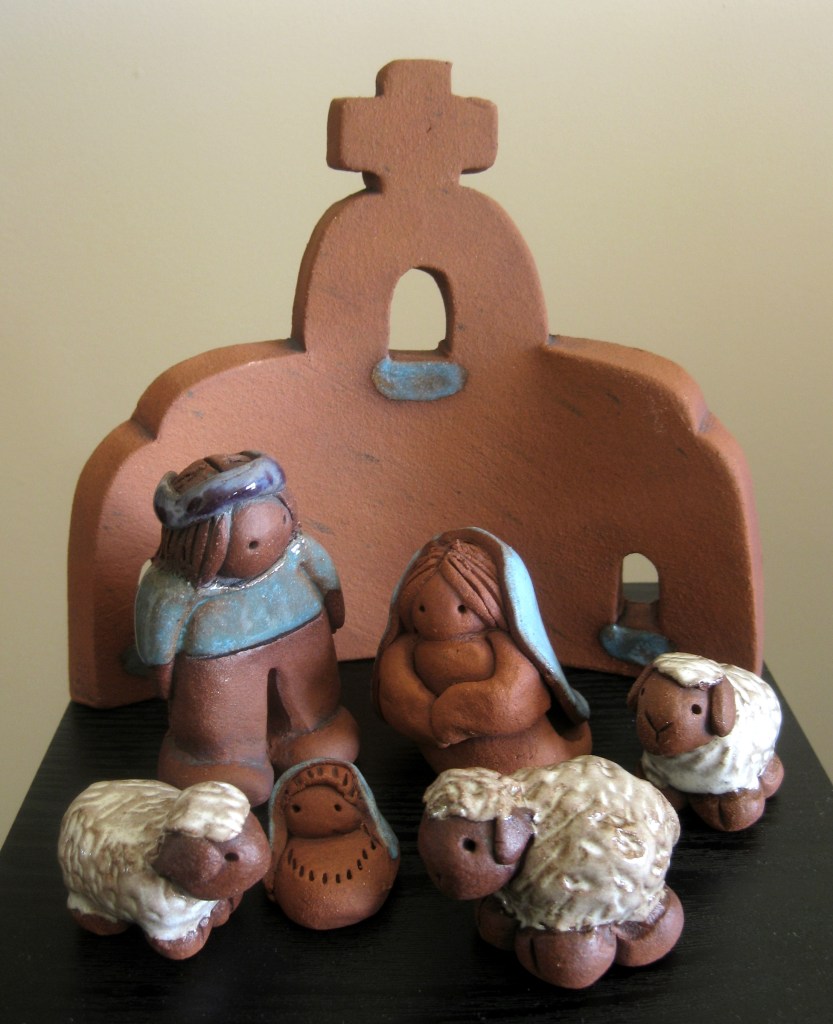
In Albuquerque we went to the International Balloon Fiesta, where hundreds of hot-air balloonists come out once a year to fly. Unfortunately, high winds prevented the “mass ascension” from happening the day we were there, but we saw static displays—inflated balloons in all shapes and colors. (My father-in-law was partial to the Darth Vader balloon; I liked the lovebirds.) And I got to visit to the artisan tent, where I bought my first nativity set! It’s seven pieces in clay by New Mexico native Barbara Boyd. I set it up in our living room when I got home, but Eric says I need to put it away until Advent . . .

Nativity by Barbara Boyd

We spent an afternoon in Old Town Albuquerque, strolling past historic adobe buildings and into galleries, while street musicians—Native American flautists and mariachi bands, mostly—provided a culturally immersive soundtrack. Our first stop happened to be one of my favorites: John Isaac Antiques and Folk Art. Isaac has a beautiful collection of santos (Hispano Catholic religious images)—a whole roomful—both contemporary and from the last few centuries. I was close to buying a Saint Francis bulto by Ben Ortega (Francis was his hallmark) but decided against it, and now I wish I hadn’t. Nonbuyer’s remorse—ugh.

Just before we left Old Town, my mother-in-law suggested one last gallery: Santisima, owned by Johnny Salas. I immediately recognized the work of Albuquerque native Brandon Maldonado, which is heavily influenced by the tradition of Día de los Muertos. I’m really attracted to Day of the Dead imagery, with all its macabre whimsy—the kind that makes most Protestants feel uncomfortable. I think the draw, for me, is that it embraces death instead of shrinking away from it; it says, “Death, we do not fear you.” As Maldonado says, Day of the Dead is not meant to be frightful but rather mocking, in a way:

The masses may prefer to think of the deceased as haloed angels floating on fluffy white clouds, but I like the idea of dancing skeletons in hats!

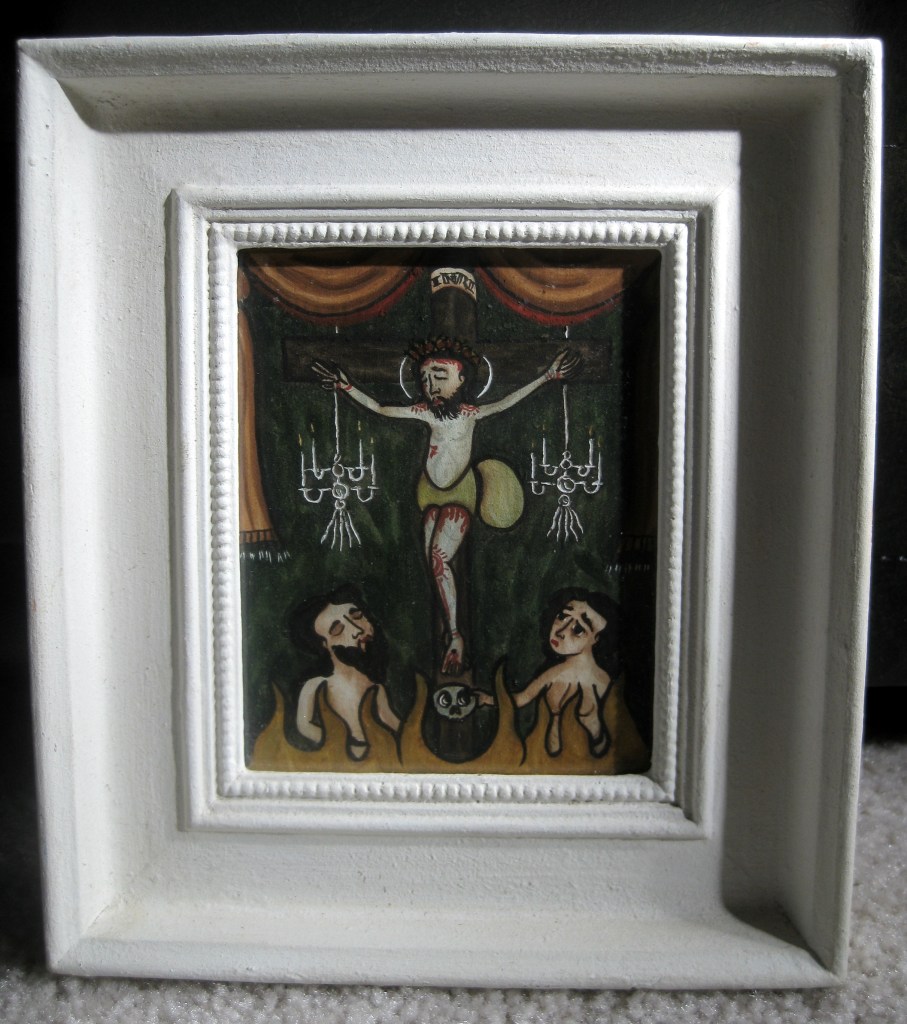
At Santisima I was introduced to the work of the young santero Vicente Telles, also a native of Albuquerque. I really liked his Adam and Eve and Saint Pelagia retablos but most especially his Crucifixion one, which I ended up buying.

Crucifixion by Vicente Telles
Vicente Telles (American, 1983–), Cristo crucificado (Christ Crucified), 2015. Natural and watercolor pigments on pinewood, 7.5 × 6.5 in. (framed).

It shows a curtain opening up, and two chandeliers dangling, to present Christ on the cross, given for us. As is traditional in New Mexican art, his shoulders and knees are bloodied; in Telles’s interpretation, the blood marks Christ in patterns, almost like tattoos. The animas solas (lonely souls) in the flames of purgatory is also a common motif in New Mexican art. I do not personally subscribe to the doctrine of purgatory, so I read the souls, rather, as Adam and Eve awaiting redemption. According to church tradition, Golgotha was the site not only of Christ’s execution but also of Adam’s burial, which is why, since the Middle Ages, a skull is often painted at the cross’s base, emphasizing Christ’s role as the Second Adam. Telles shows Eve reaching out to touch this death-symbol, lamenting her and Adam’s primordial rebellion and pleading in faith, with her eyes, for deliverance from its consequences. This is the precursor to the Anastasis (Resurrection) icon of Eastern Orthodoxy, which shows Jesus breaking down the doors of Sheol and pulling Adam and Eve up out of their graves to be with him in heaven. We are dead in our sins until Christ raises us. His spilled blood has “loosed the pains of death” once and for all.

To give the retablo a glistening appearance, Telles applied a micaceous clay slip to the pinewood before applying the paint.

If you’re not able to see Telles’s art in person at Santisima (he’s sold exclusively there), visit his Facebook page.   Continue reading “Religious art highlights from New Mexico”