Neumünster is a Catholic parish church in Würzburg, Germany. Dating back to the eleventh century, it was first built as a Romanesque basilica, but it underwent expansions, renovations, and remodels over the next seven centuries to match prevailing tastes of the times, the most major being the construction of its Baroque west facade and Baroque interior remodel, including its frescoed ceiling and new altar, in the eighteenth century. These features still stand today, restored from the heavy bomb damage the church suffered in World War II.
Neumünster was originally a collegiate church, where the Daily Office was maintained by a college of canons. But in 1803, during German secularization, the church’s associated religious chapter was dissolved, and the church passed into state ownership. From 1809 to 1811 and again in 1814, the military used it as a munitions depot. Worship services resumed in 1821, and at last in 1908, the church received its independent parish status. It is dedicated to St. John the Evangelist and St. John the Baptist.
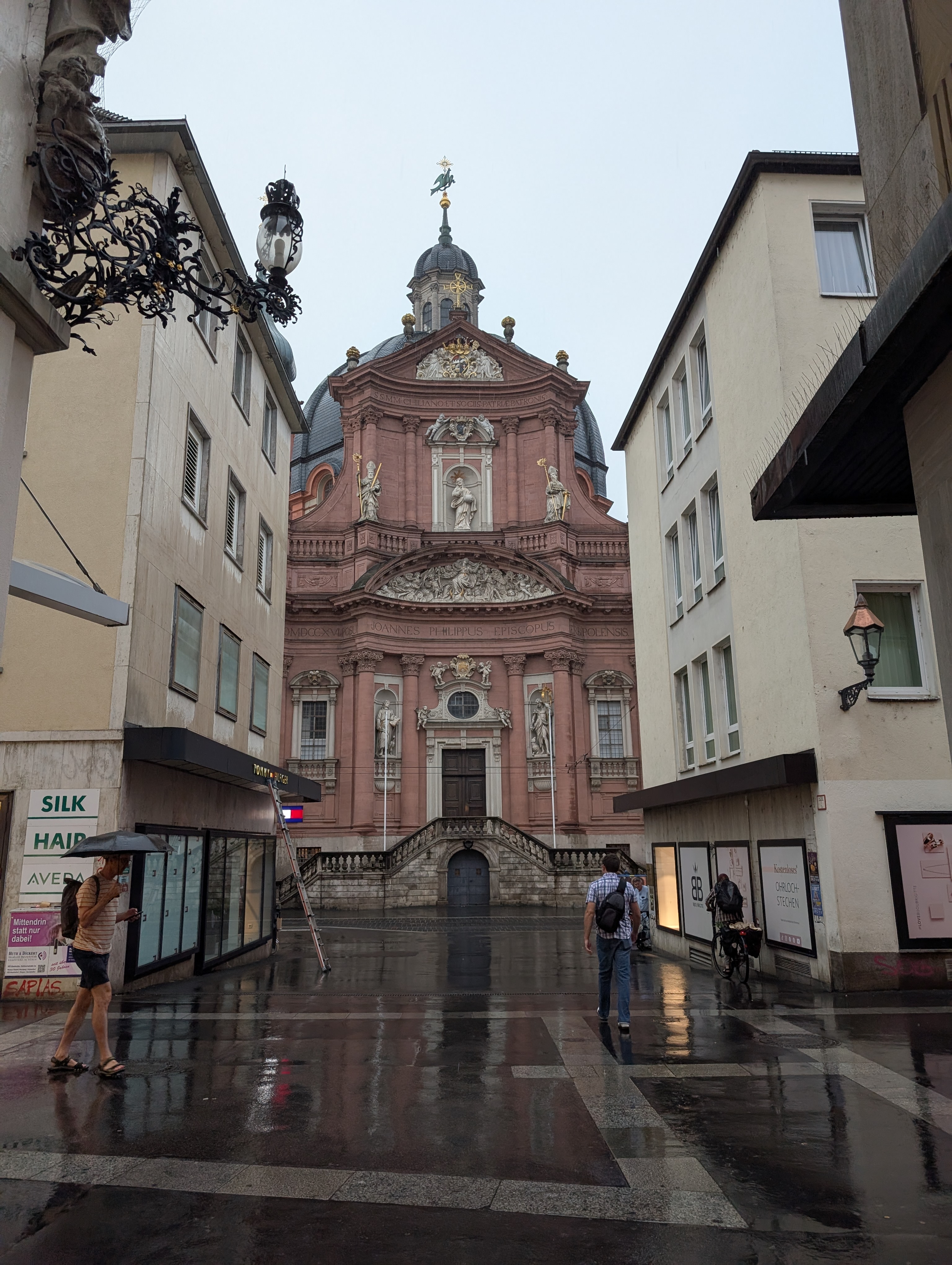
Located on Kürschnerhof street, a pedestrian thoroughfare, Neumünster is wedged between two retail apartment buildings. It was a gray, rainy day when I was there, so it was quite dark inside. (For a brighter photo of the interior, see here.)
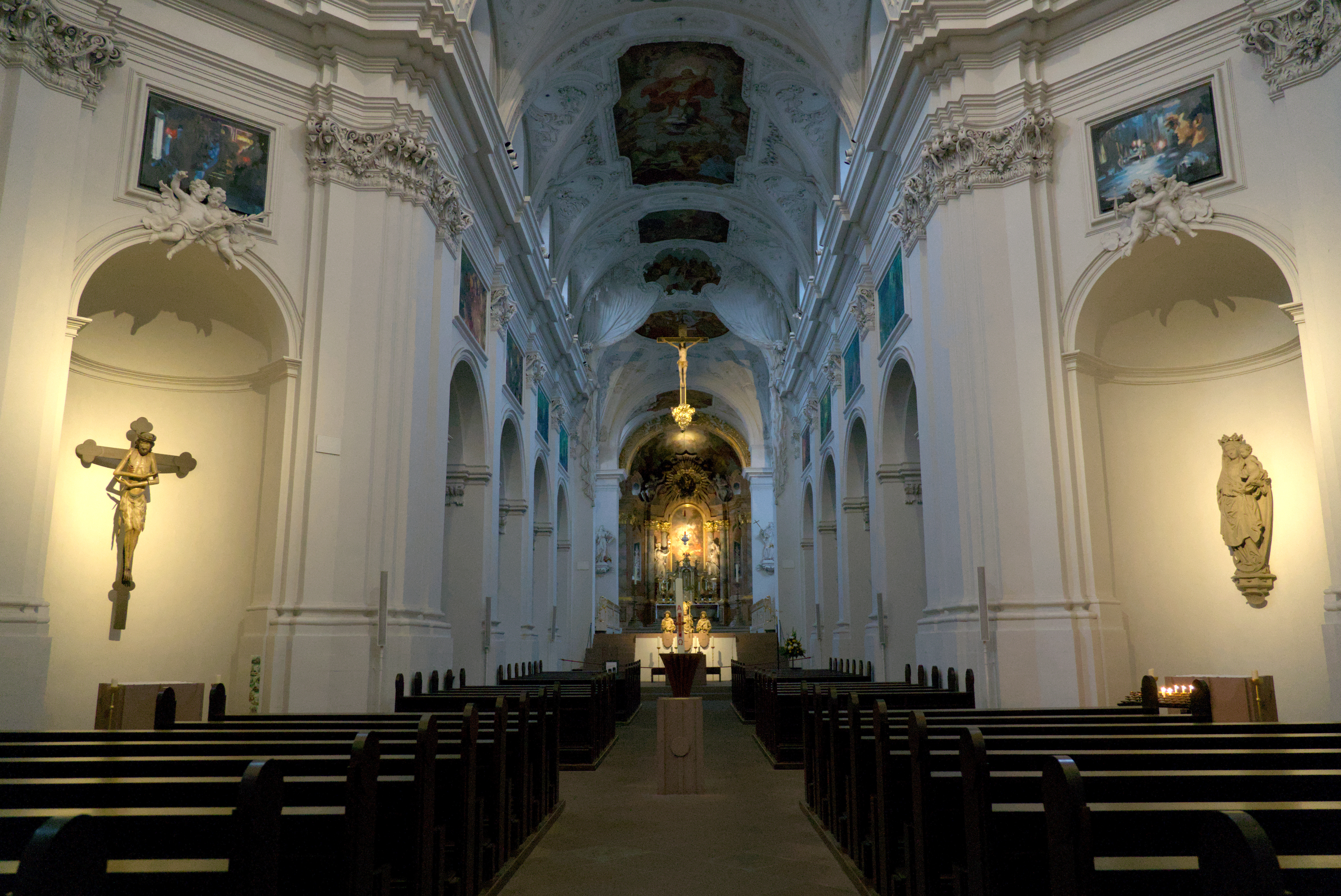
My main reason for visiting Neumünster was to see the Schmerzensmannkreuz (Man of Sorrows Cross) in its left altar niche, a polychrome wood crucifix made circa 1350 and extensively restored in 2007.
Just over seven feet tall, this Gothic sculpture is rare because of the unusual position of Christ’s arms: Instead of being pinned to the horizontal beam of the cross, they’re curved in front of his torso, as if he’s cradling an invisible someone or something—but two enormous nails still puncture his palms.
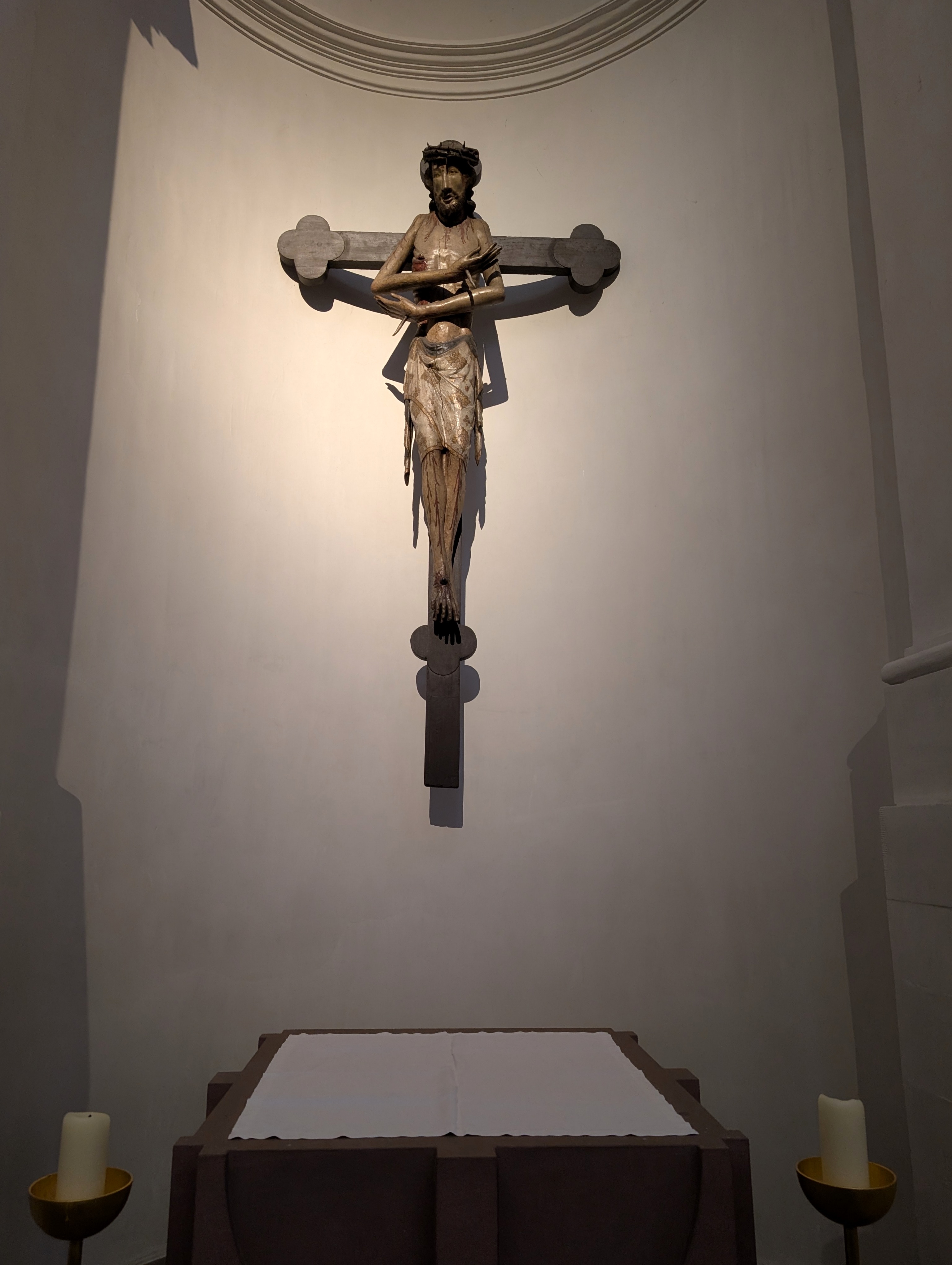
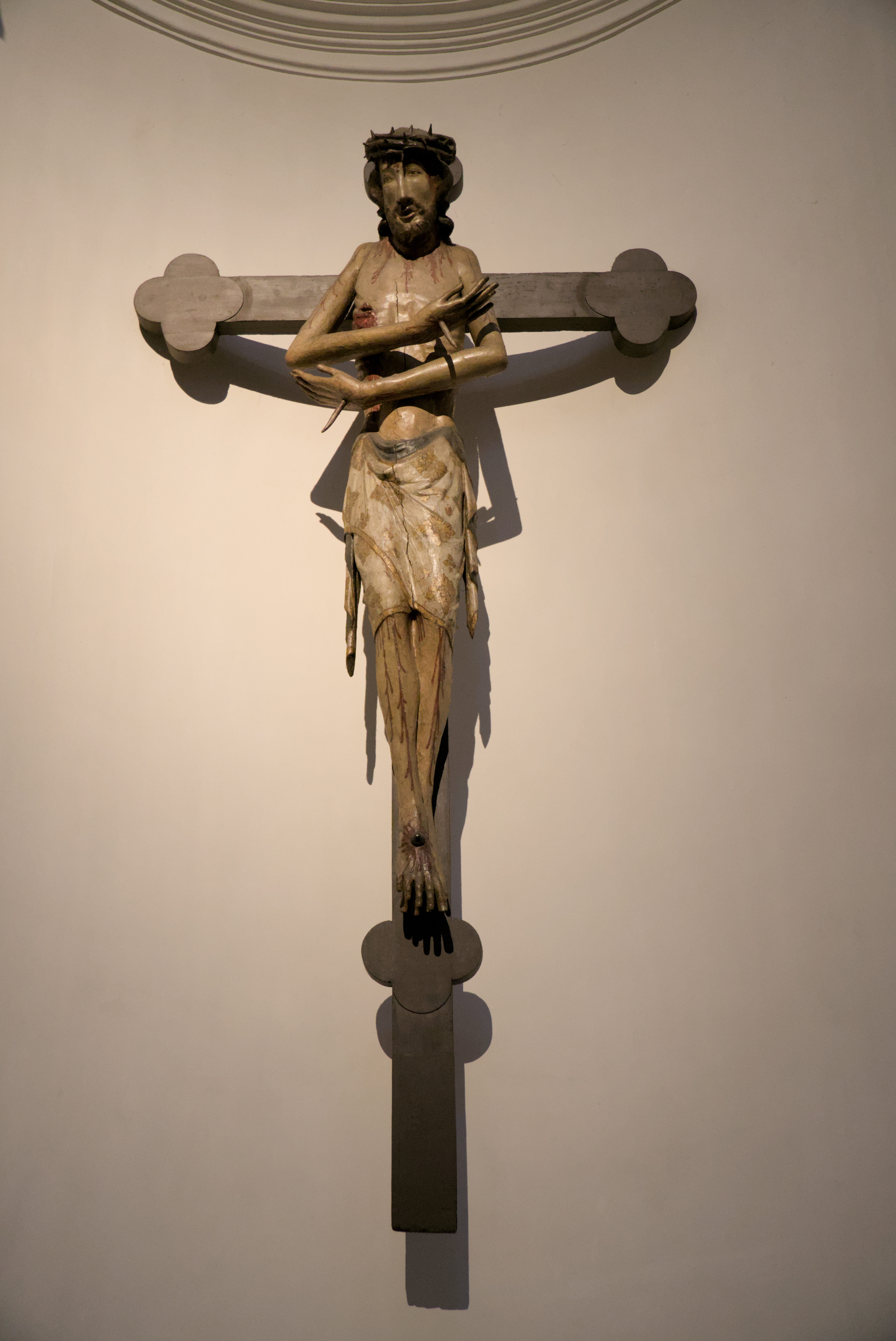
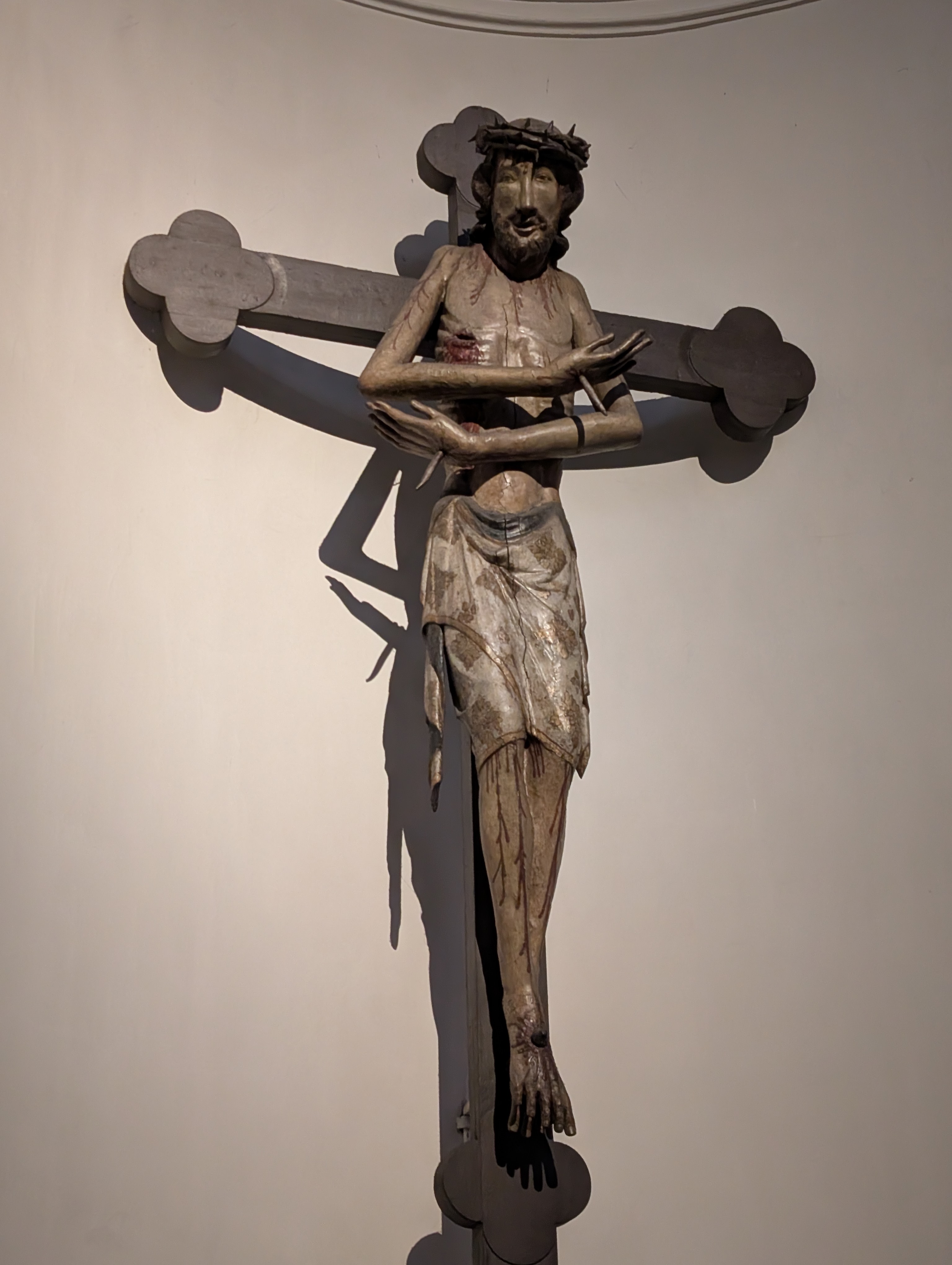
The iconography may be based on a mystical vision of the French abbot and theologian St. Bernard of Clairvaux (1090–1153). While praying before a crucifix one day, the Christ figure supposedly came to life and embraced him.
A Würzburg folk legend claims that the Schmerzensmannkreuz didn’t always look like this; that, sometime in its early history, it miraculously changed from its original form to demonstrate the love of God to an aggressor. The story goes that when a thief tried to steal the gold and silver jewelry that pilgrims had draped around the crucifix, the Christ figure unloosed his arms from the cross and wrapped them around the thief in a hug, which caused him to repent. The crucifix then remained fixed in that hugging posture.
The Neumünster congregation wants everyone to feel the embrace of God. Christ’s affectionate clasp is not just for Bernard, or for thieves, but for anyone who desires it. Be held in my love, says this Christ of Neumünster.
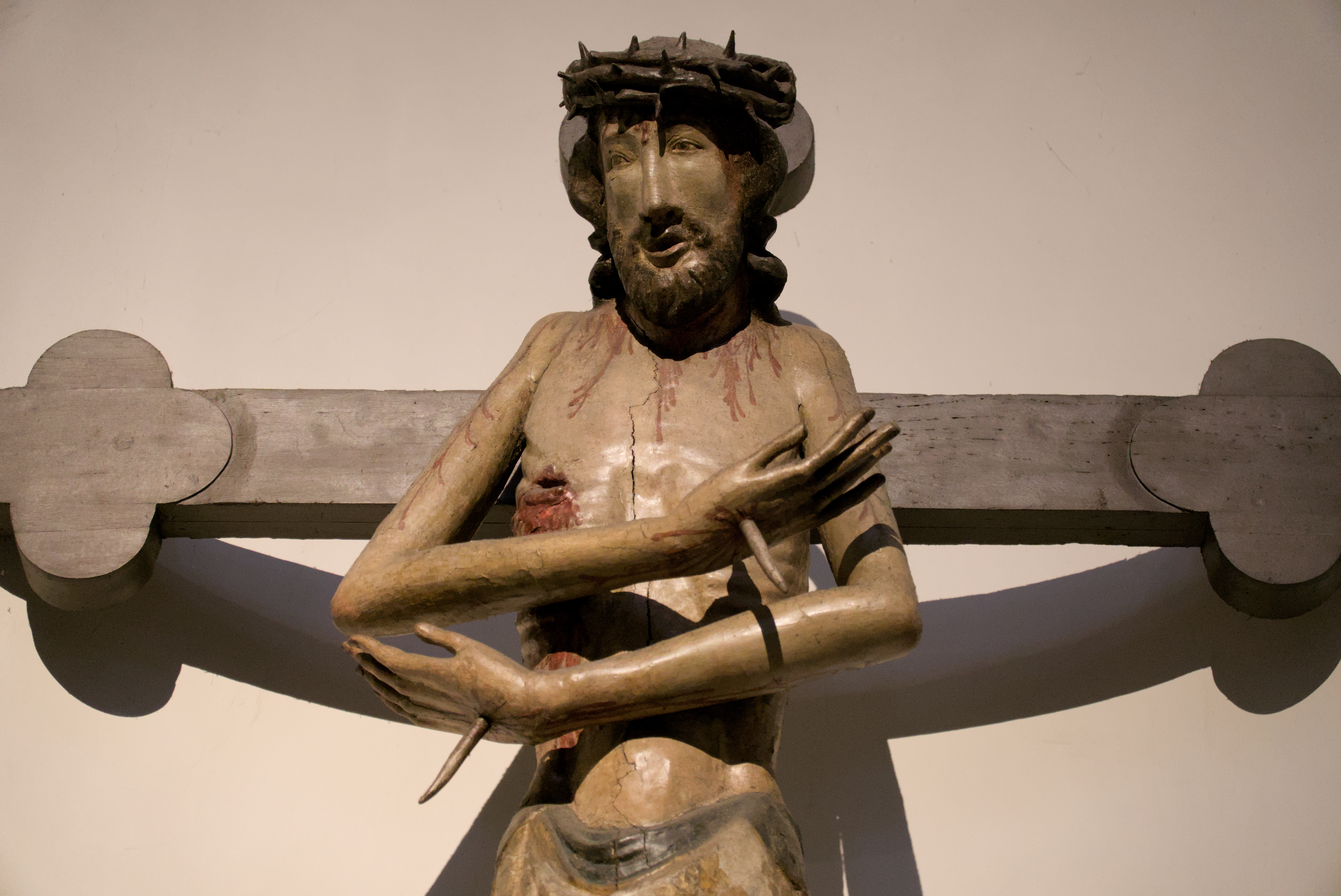
I’m reminded of the 2006 song “Circle Me” by Jeff Johnson, a setting of an ancient Celtic lorica (prayer of protection). “Circle me, O God, let your arms enfold me. Circle me, O God, let your love surround . . .”
But to me, this Jesus looks less like he’s placing his arms around an adult’s back and more like he’s holding a baby, perhaps even rocking one to sleep. His mouth is open—maybe he’s singing a lullaby! This imagery evokes Bible verses about the maternal love of God, such as Isaiah 49:15, where God compares his tender, devoted care and affection to that of a breastfeeding mother; Isaiah 66:13, where God assures, “As a mother comforts her child, so I will comfort you”; and Psalm 131:2, where the psalmist describes being “calmed and quieted” in the Lord, his soul “like a weaned child with its mother.”
The Christ figure’s protective embrace also evokes passages in which God is described metaphorically as a shepherd who gathers his lambs in his arm (e.g., Isa. 40:11).
Characteristic of the Gothic style, the Schmerzensmannkreuz emphasizes Jesus’s suffering, and in naturalistic terms. He’s gaunt, he’s battered, he’s dripping with blood that’s modeled in relief. And his gaze is filled with compassion.
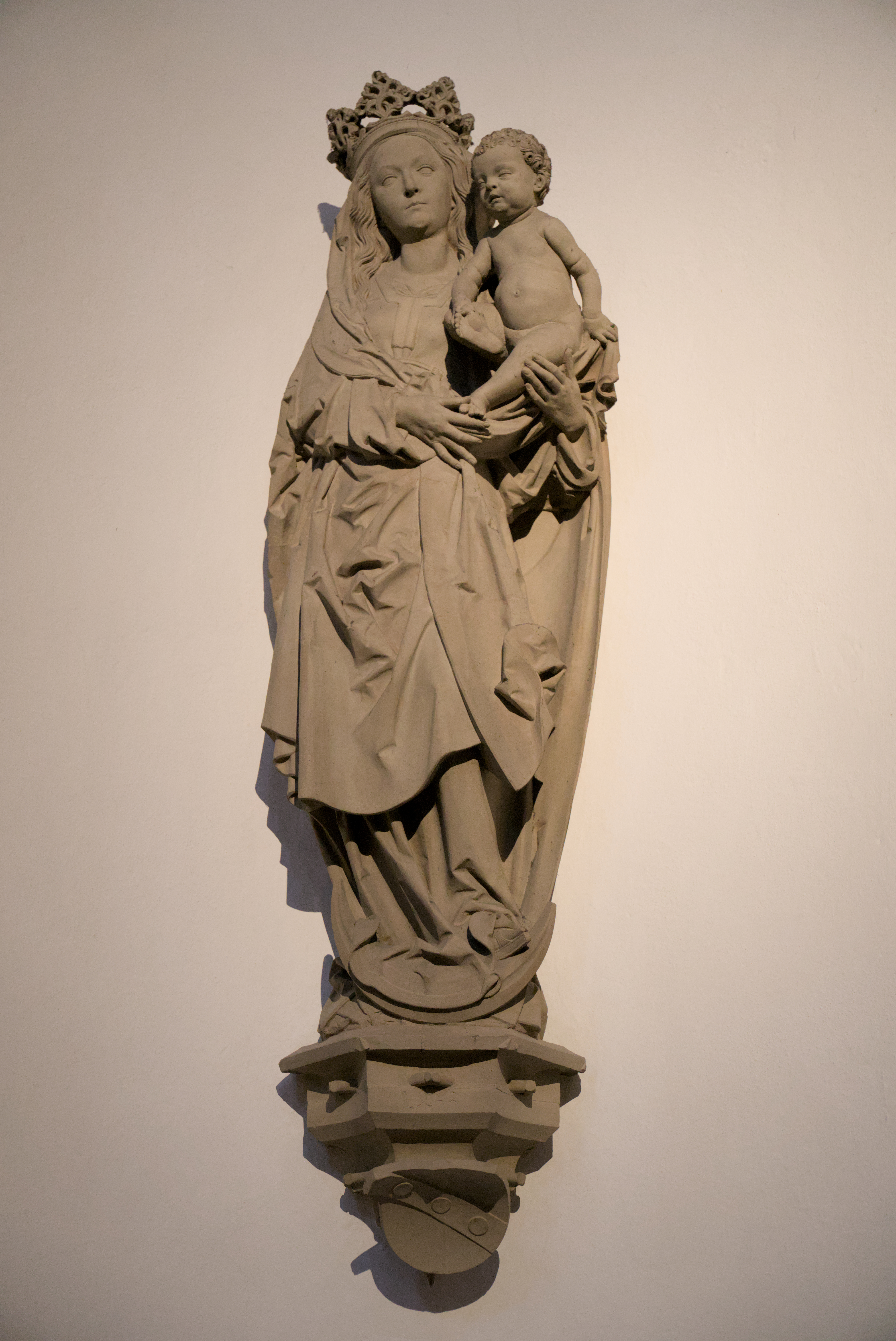
In the opposite altar niche on the right side of the church, we see Jesus as a baby being held by his mother—a stone sculpture by Tilman Riemenschneider, carved in 1493. The figures’ gazes are too detached for my liking, but it’s sweet how Mary touches Jesus’s foot, a not-uncommon detail found in other renditions of the subject.
In 2007–2011, Neumünster underwent another major renovation, fixing some post–World War II restoration flaws and incorporating contemporary German art.
To line the nave, they commissioned the neo-expressionist artist Thomas Lange (b. 1957), a key figure in the Neue Wilde movement in 1980s West Berlin, to make eight oil paintings of scenes from the life of Christ, all taken from the Gospel of John. He chose to depict Christ’s baptism in the Jordan, an evangelistic encounter, five of Christ’s miracles, and a passion scene. They progress roughly chronologically as you move down the nave, starting with the Wedding at Cana and the Baptism of Christ nearest the west end and concluding with the Washing of the Disciples’ Feet and the Raising of Lazarus near the east. I’ll share them here in the order they appear in John’s Gospel.
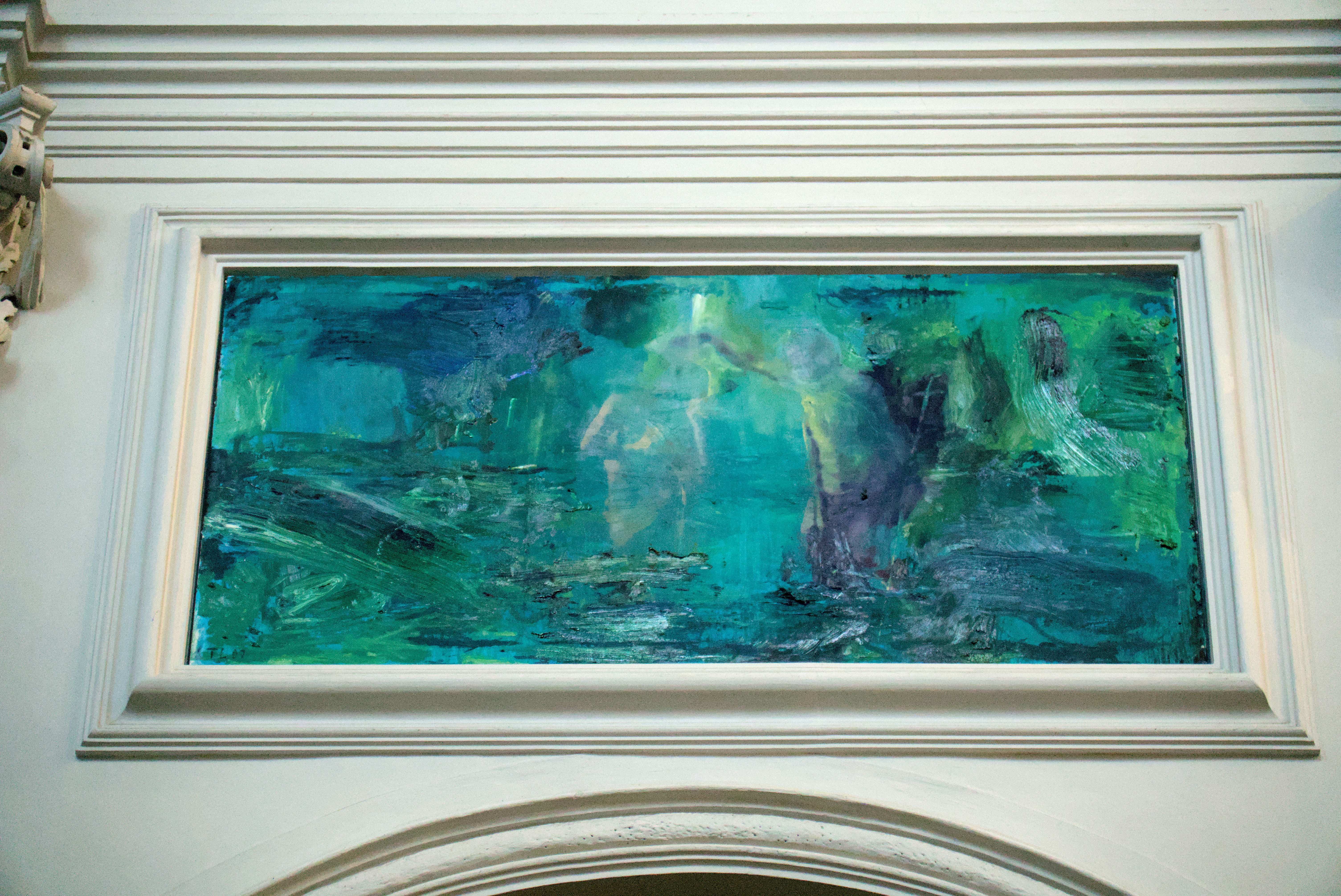
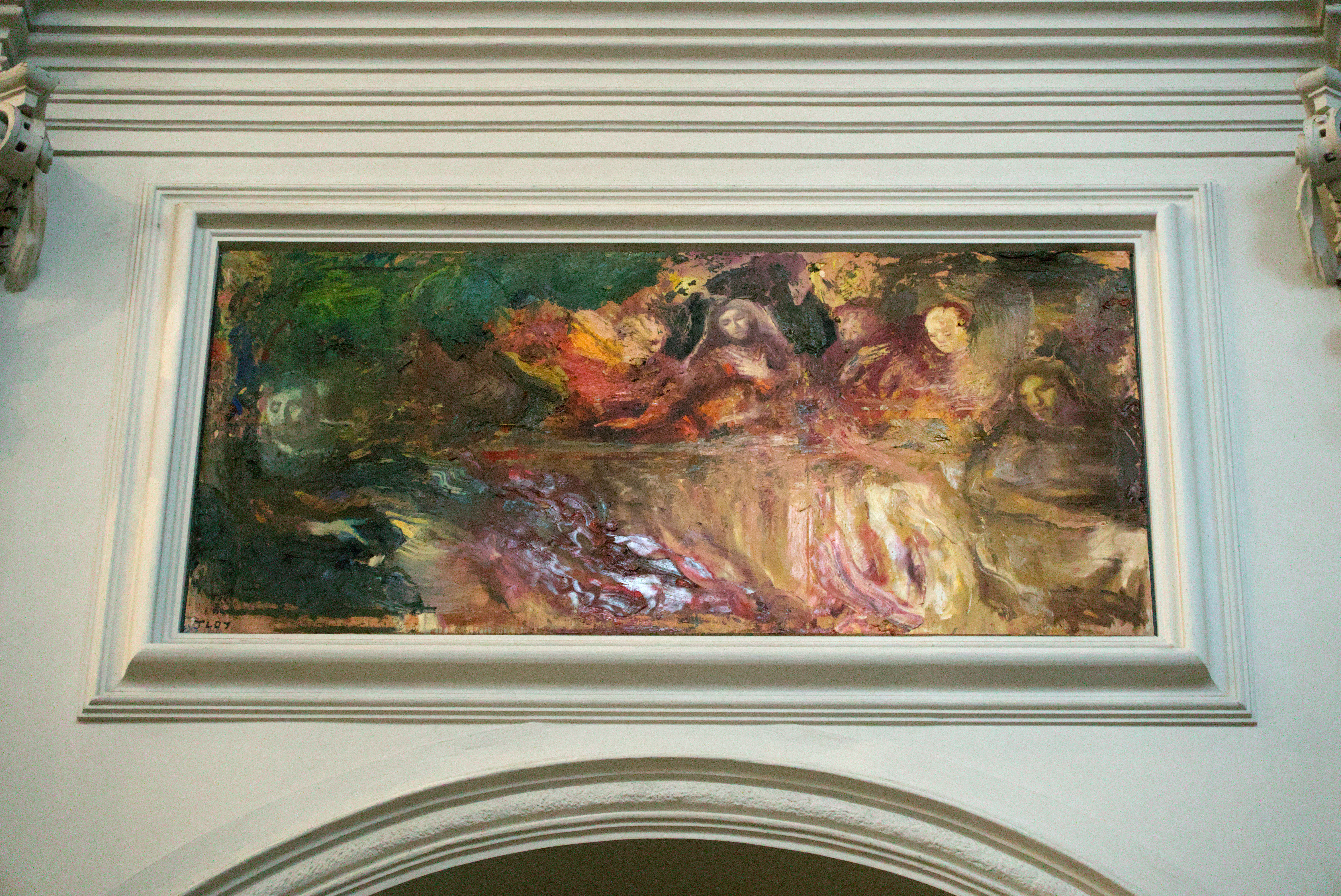
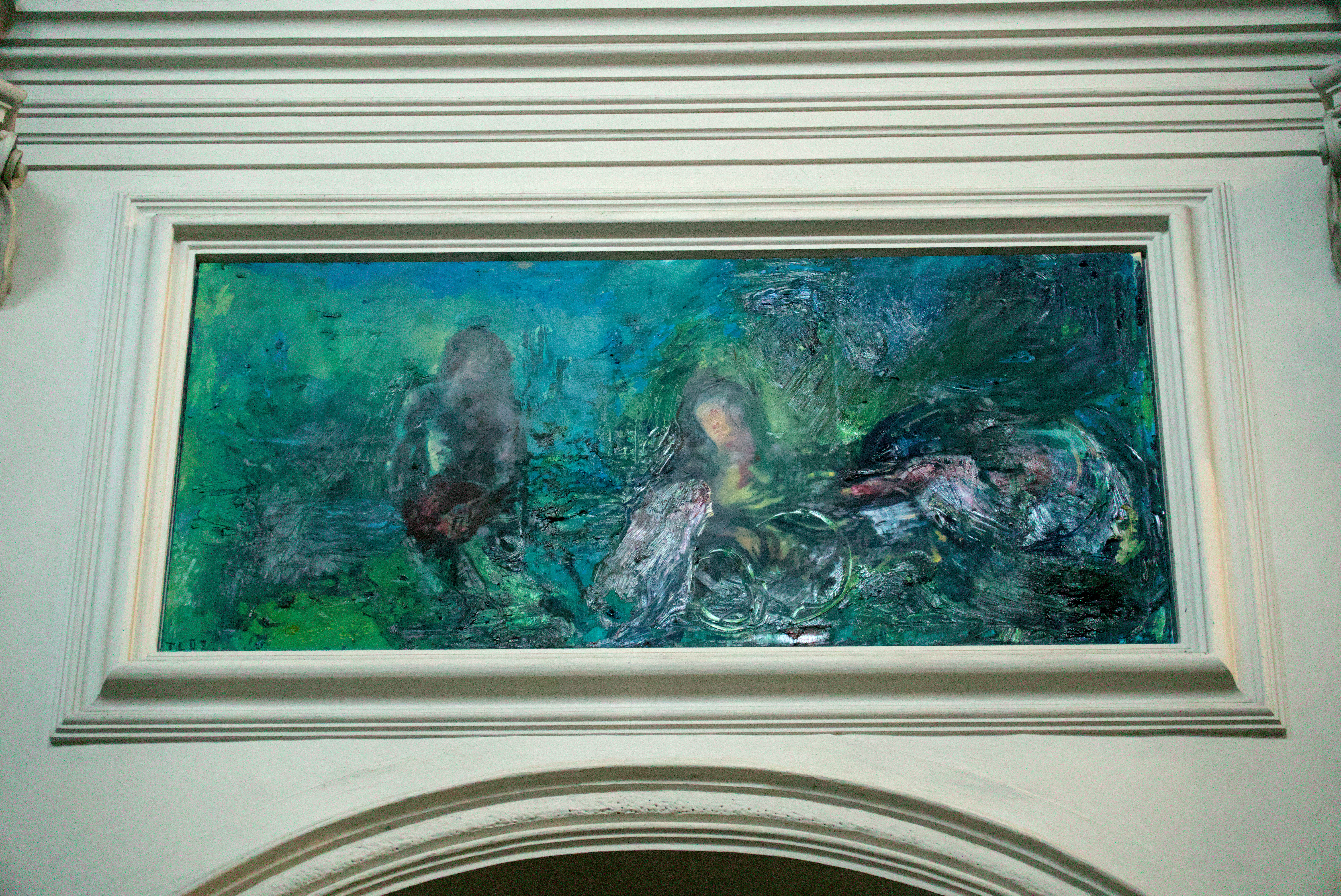
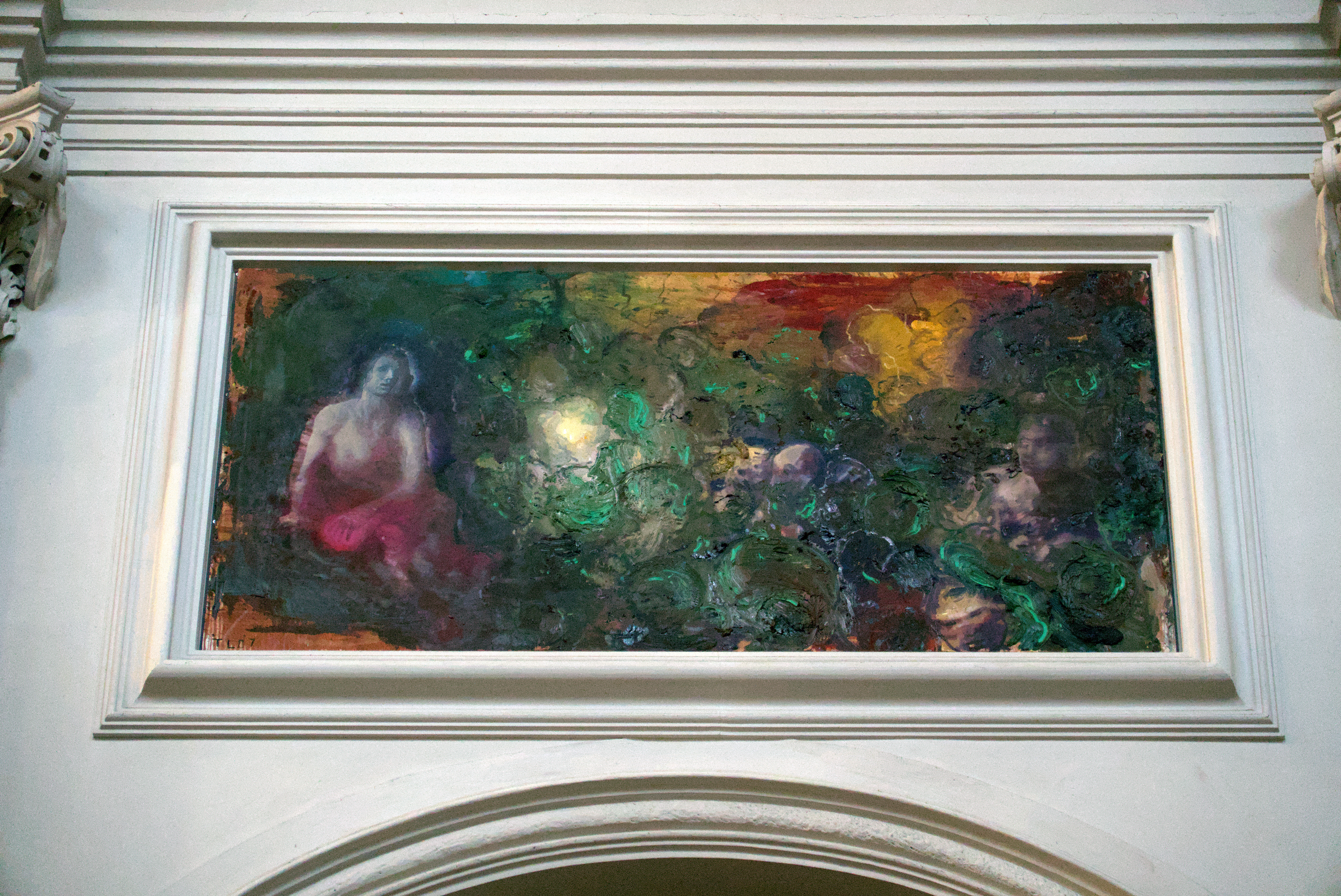
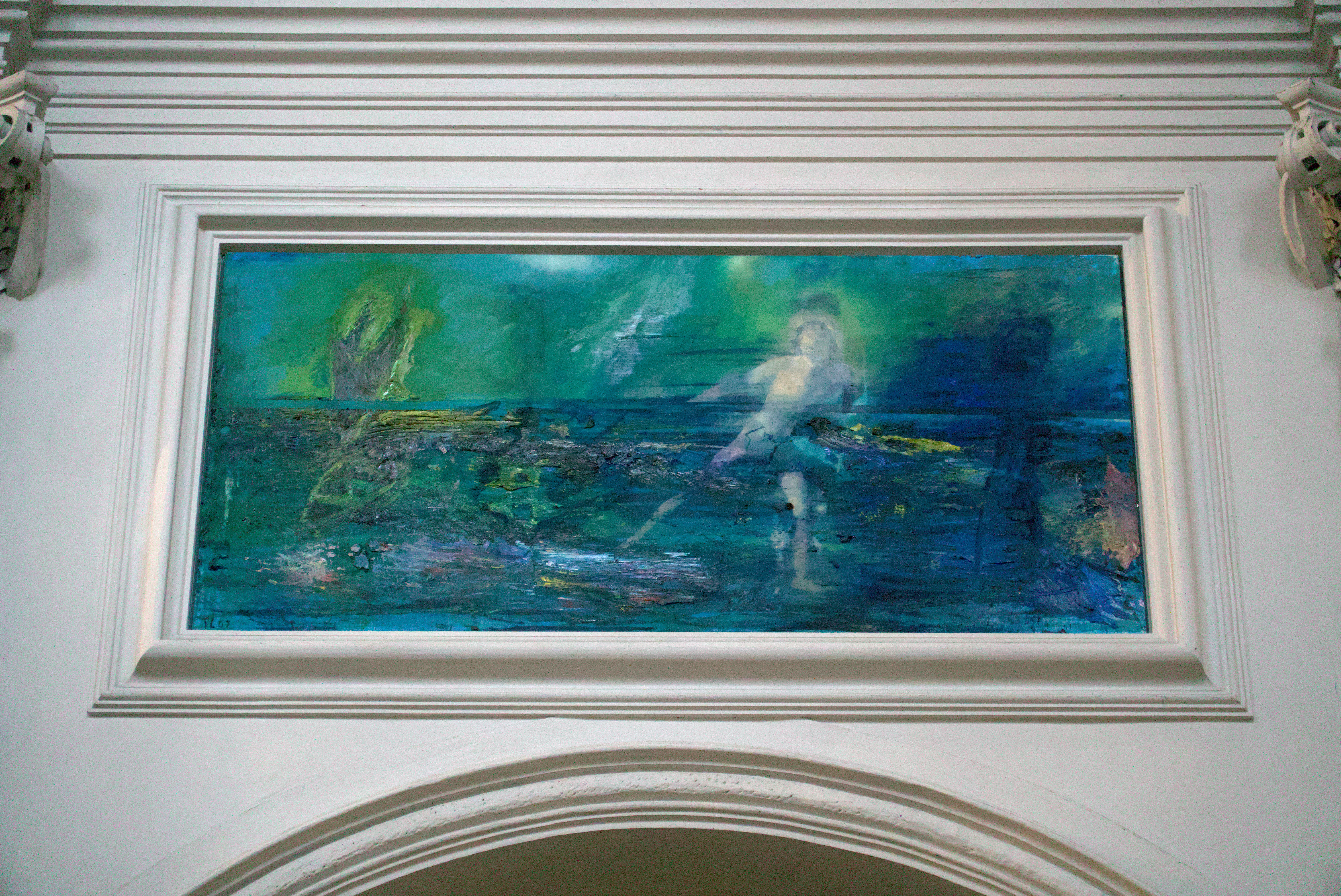
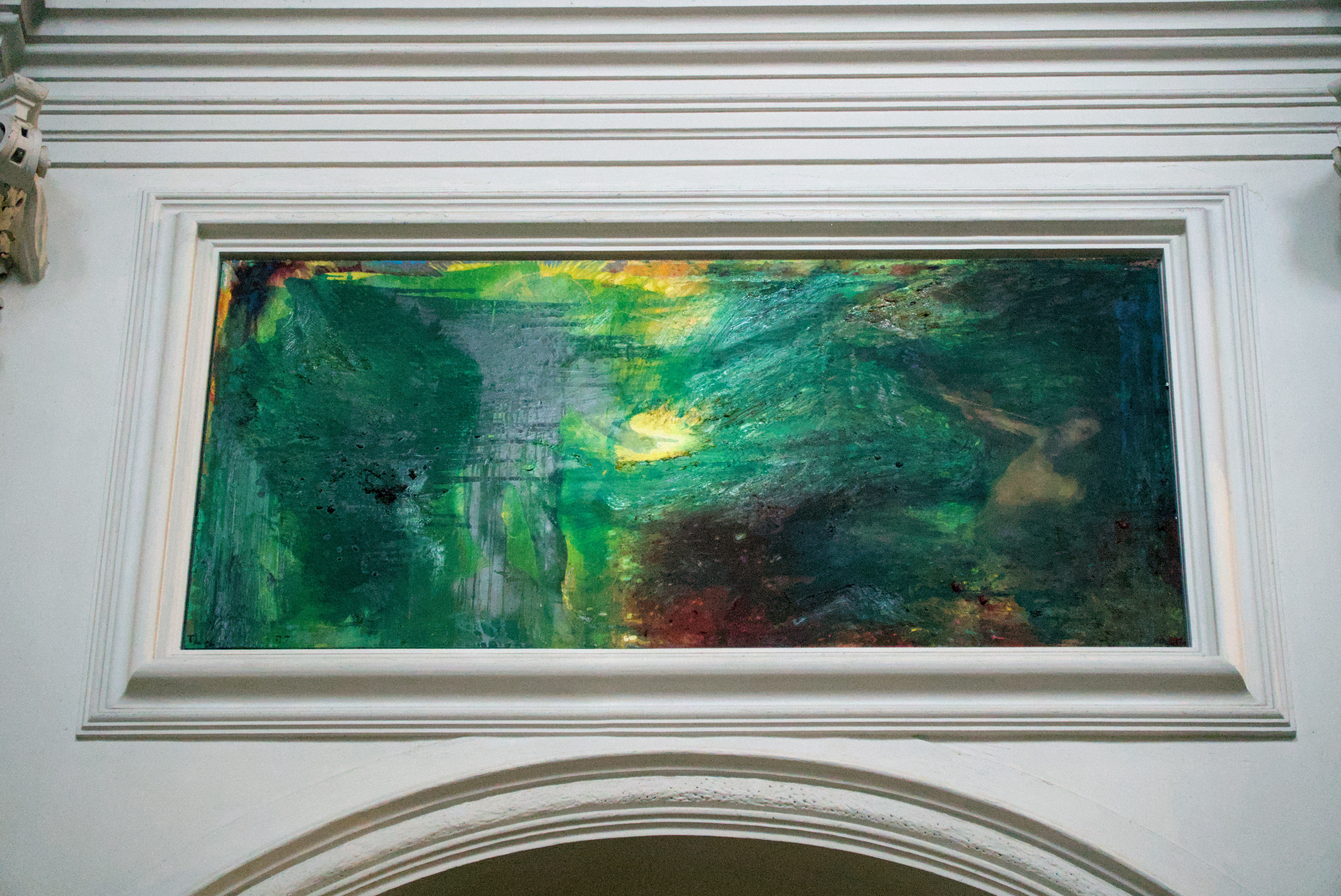
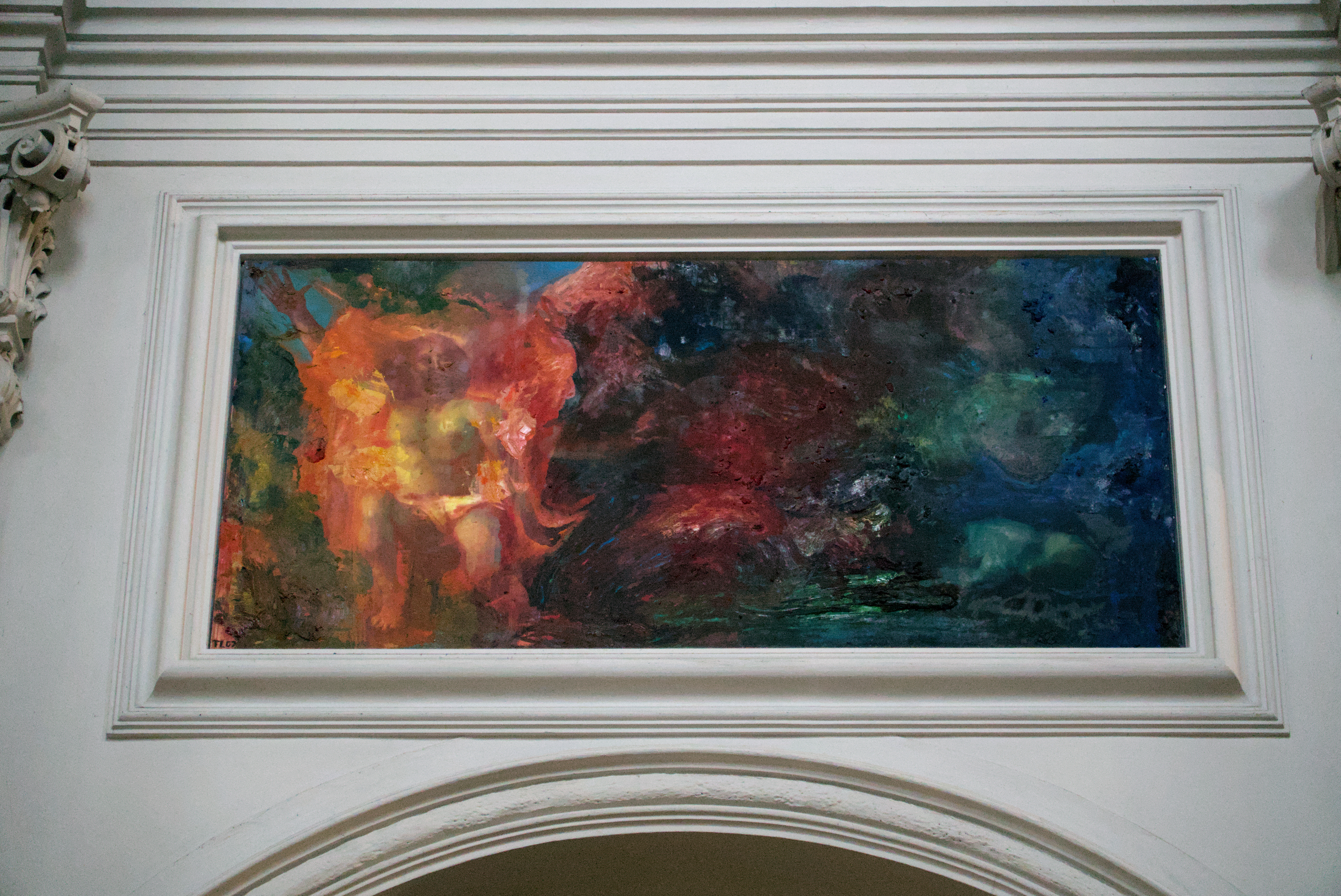
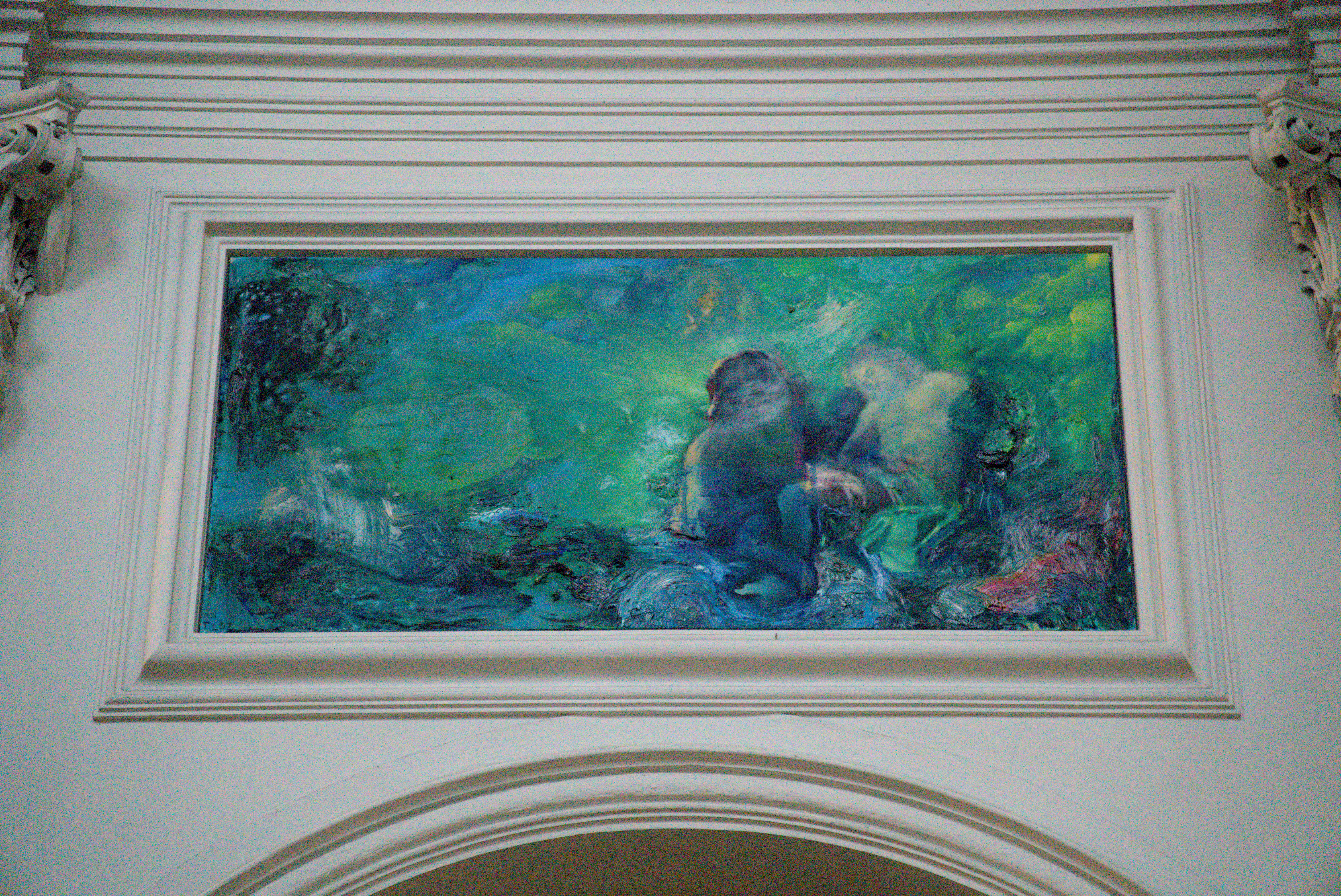
I’m compelled by Lange’s style, merging abstraction and figuration. However, I found some of the paintings difficult to interpret and, as there were no titles or other information available for them on signs or in brochures, had to email the Diocese of Würzburg to verify their subjects. My husband and I had exchanged guesses, most of which proved to be wrong—Joseph of Arimathea preparing Jesus’s body for burial? No, Jesus washing Peter’s feet. The Resurrection? Close, but no, that’s Lazarus. The risen Christ appearing to his mother? No, the woman at the well. (But why doesn’t he have a shirt on?) The conversion of Saul? Nope, that’s the man born blind, being made to see for the first time. (I like the implicit juxtaposition of sighting and blinding, but the distance between the two figures doesn’t fit the intimacy of the story in John 9, and the shooting light beam is a far cry from the earthy, dirt-and-saliva method Jesus uses to restore the man’s vision.)
The figures, I think, Lange extracts from traditional Baroque paintings, though I can’t pinpoint any exactly—but most come from different narrative contexts than the ones represented. Maybe the artist intended these to be merely faint impressions of Christ’s ministry, of his circle of friends and followers, with different episodes melding into one another?
I think the most successful painting in the set is the most straightforward one: The Baptism of Christ. John the Baptist holds a cross-staff in one hand and with the other pours water from a shell onto Jesus’s head, while a light from the heavens shines down, representing God’s blessing. The men are awash in blues and greens.
Jesus Walks on Water also works well, the wispiness of Jesus’s form lending credence to the disciples’ fear that he’s a ghost—even though Jesus seems to be heading away from the boat, not toward it.
I’m curious to hear what you all think.
Another contemporary artist the church commissioned is Markus Fräger (1959–2020), who was based in Cologne. He painted four oils for the entrance area, depicting, I later found out, the prophets Isaiah, Jeremiah, Daniel, and Ezekiel.
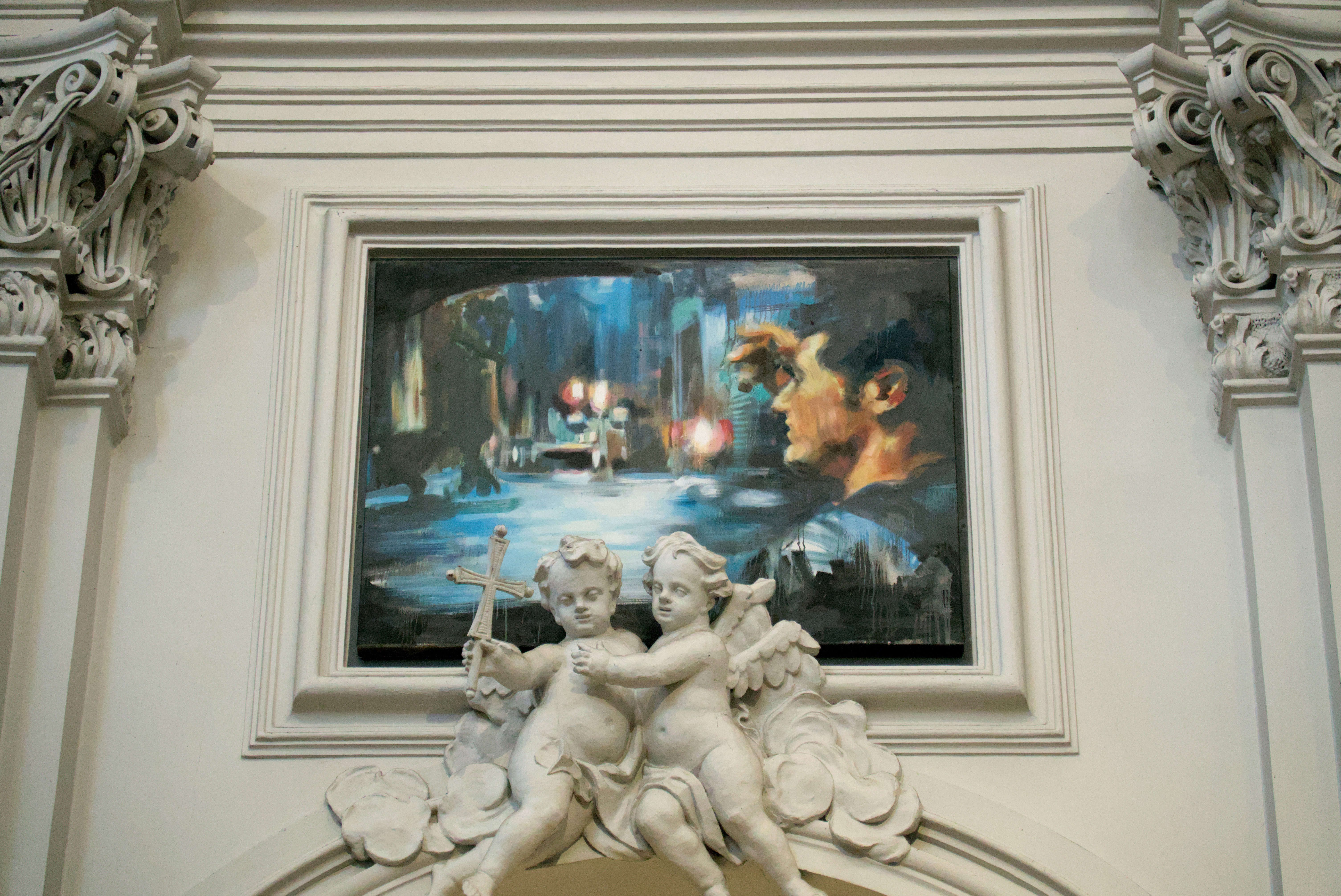
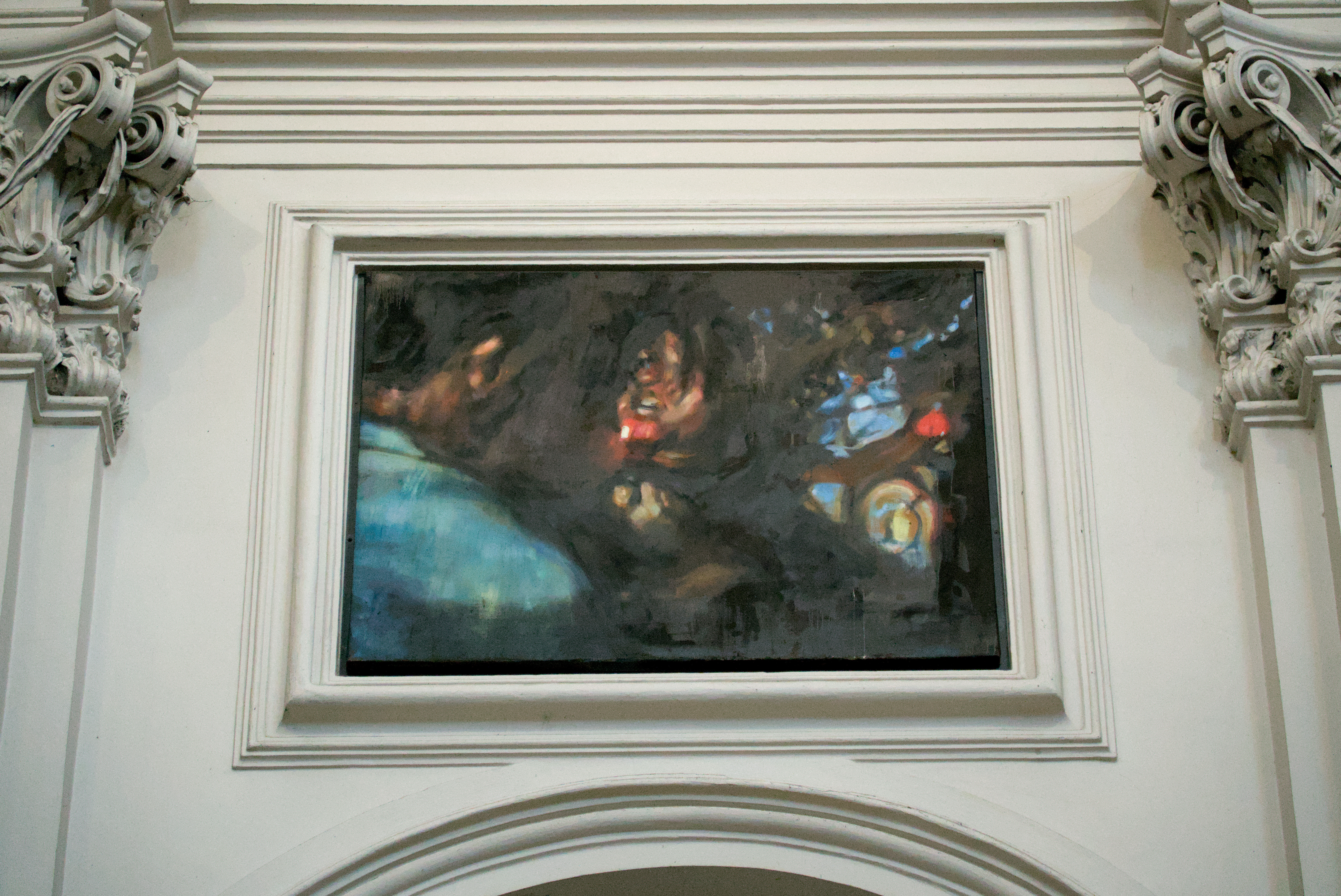
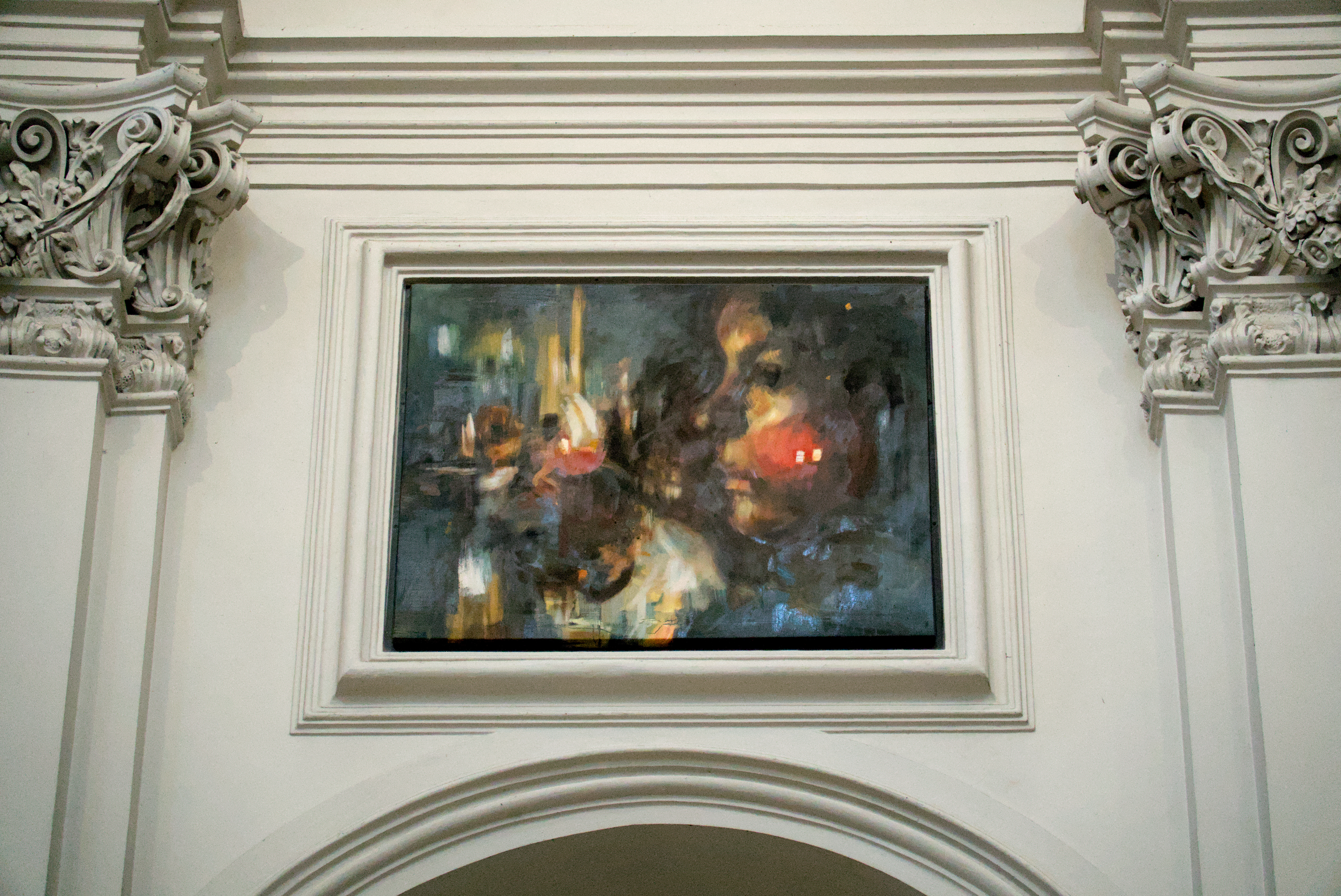
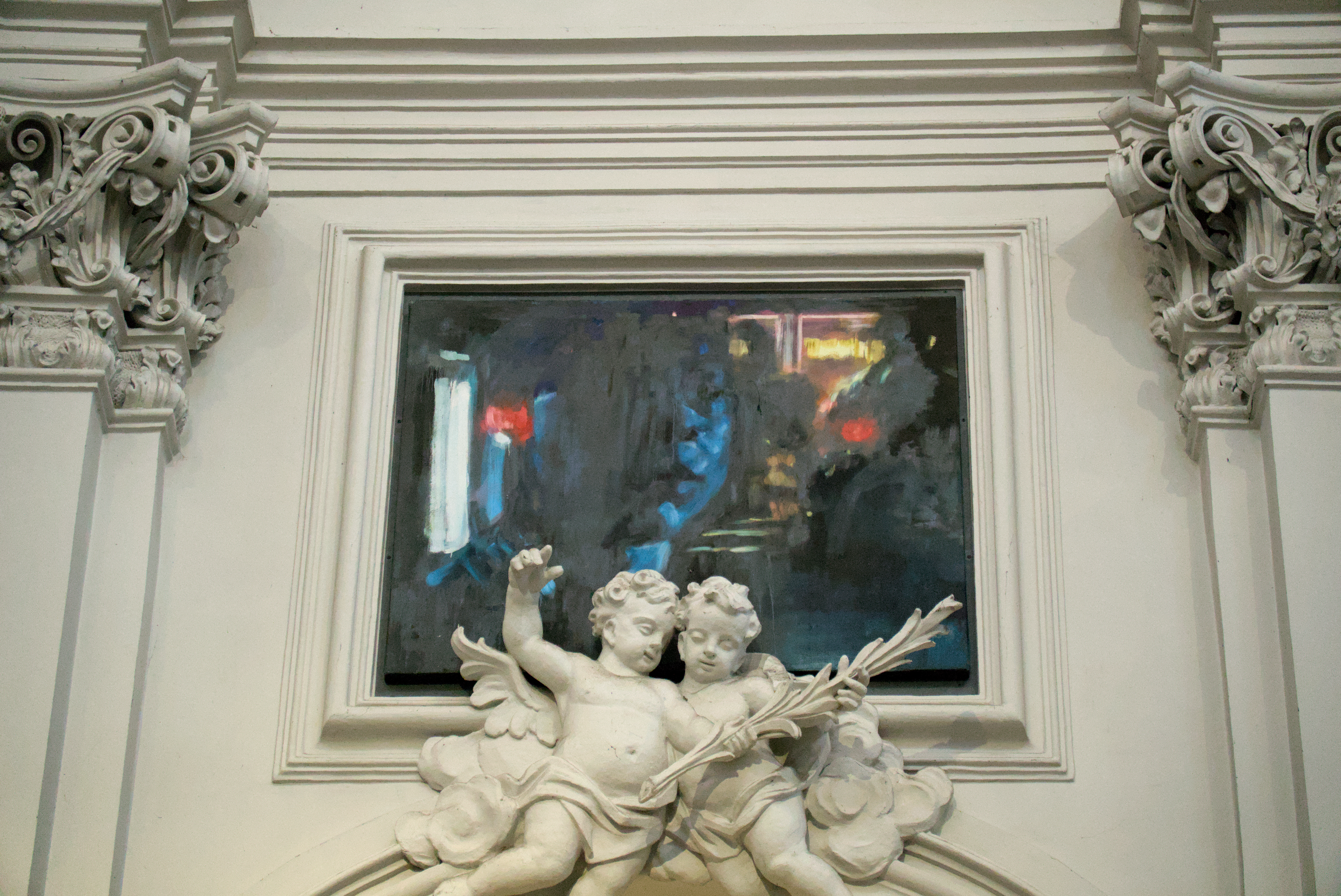
Again, I didn’t quite jibe with them. I see streaks of rain, the glow of city lights, people in shadow. (Referring to the artist’s larger oeuvre, Galerie Friedmann-Hahn wrote that “Markus Fräger staged his pictures like scenes from an American film noir.”) The paintings seem to portray the malaise of modernity, giving off a mood of alienation. The figures are looking out, altercating, contemplating, or making direct eye contact with us. Do you see a connection to the Hebrew prophets? What do the paintings make you feel? Are they fitting for a place of worship, and why or why not? What is the function of church art, anyway?
One of the newer art additions at Neumünster that works brilliantly (both literally and figuratively!) is a painting of the Crucifixion by Jacques Gassmann (b. 1963) that hangs above an early eighteenth-century bronze of Christ recumbent in the vestibule of the east crypt.
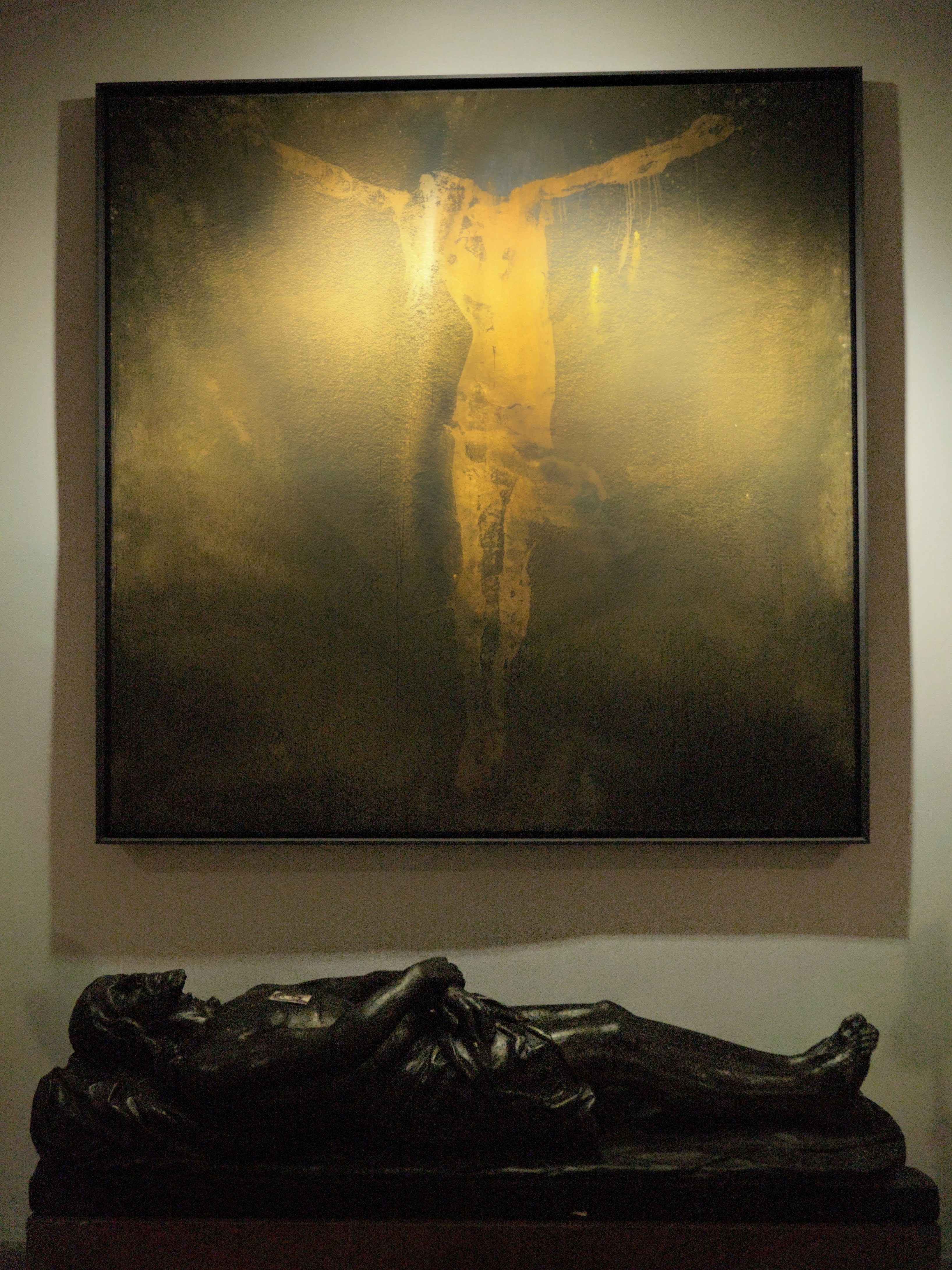
In Gassmann’s Passion, the crucified Christ is a gold, diaphanous silhouette composed of wafer-thin sweeps of ink. His head droops down in death but is streaked with light. Because there’s no cross, he appears suspended in space. The background is a warm brownish-yellow, reminiscent of tarnished metal.
Gassmann lives in Würzburg and Berlin, dividing his time between the two cities, with a studio in each. I encourage you to peruse his website, https://ogrody.org/, and to follow him on Instagram @jacques_gassmann_. He’s completed over thirty artworks for churches (including a set of three paintings in Würzburg Cathedral that I’ll share in part 3!), a monumental Apocalypse cycle, and various other projects.
Because there was a service going on inside the crypt while I was at Neumünster, I didn’t enter that space. It houses the graves and relics of St. Kilian and his companion martyrs and, among other pieces, a contemporary painting of Christ Triumphant by Michael Triegel (b. 1968).
All photos in this post are my own.