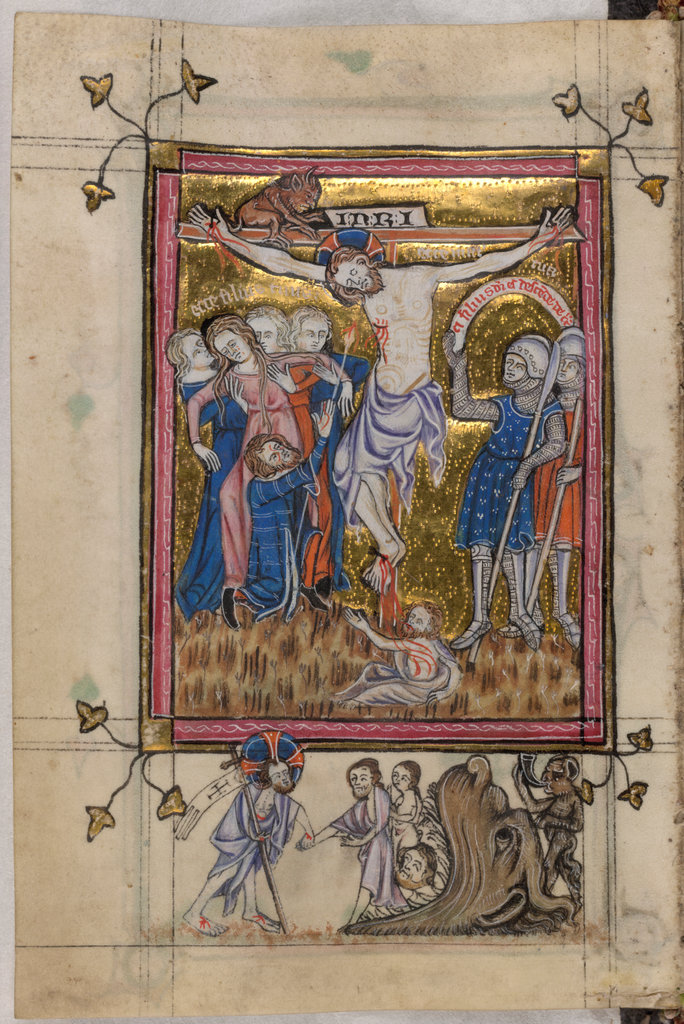
Crucifixion with bas-de-page scene of Christ leading figures from the mouth of Hell, from the Taymouth Hours, England, second quarter of 14th century. British Library, Yates Thompson 13, fol. 122v.
ORIGINAL MIDDLE ENGLISH:

Loue me brouthte,
& loue me wrouthte,
Man, to be þi fere.
Loue me fedde,
& loue me ledde,
& loue me lettet here.

Loue me slou,
& loue me drou,
& loue me leyde on bere.
Loue is my pes,
For loue i ches,
Man to byƷen dere.

Ne dred þe nouth,
I haue þe south,
Boþen day & nith,
To hauen þe,
Wel is me,
I haue þe wonnen in fith.
MODERN ENGLISH TRANSLATION:

Love me brought,
And love me wrought,
Man, to be thy fere. [companion]
Love me fed,
And love me led,
And love me fastens here.

Love me slew,
And love me drew,
And love me laid on bier.
Love’s my peace;
For love I chose
To buy back man so dear.

Now fear thee not;
I have thee sought
All the day and night.
To have thee
Is joy to me;
I won thee in the fight.

Trans. Victoria Emily Jones
This medieval passion lyric is from the Commonplace Book of John of Grimestone, compiled in Norfolk, England, in 1372 and owned by the National Library of Scotland in Edinburgh. It was transcribed by Carleton Brown in Religious Lyrics of the Fourteenth Century(Oxford: Clarendon Press, 1924), page 84.
Adv.MS.18.7.21, fol. 121r, with “Love Me Brought” poem highlighted. In this manuscript, the Franciscan friar John of Grimestone jotted down miscellaneous verses and quotes to use in his preaching.
In the poem, Christ addresses humankind from the cross, professing his great love for her. He was begotten in love by the Father, and it’s love that brought him to earth. Love nourished and guided him, and for love he stayed the difficult course, all the way to the end. Satan had stolen Christ’s beloved, and to win her back, Christ went into battle, to redeem her who was rightfully his. His decisive move: spreading out his arms across a wooden beam, so as to embrace the world, and submitting to being nailed there.
He died for love of his lady. Love is what drew him to and secured him to that cross, what kept him there when the physical and emotional agony begged he desist. And because of his persistence in seeking us, his courageous endurance as the enemy assailed, he attained ultimate victory. “Well is me!” (Blessed am I), he exclaims, “for you are mine and I am yours.” Let nothing stand between.
Katharine Blake, the founder and musical director of Mediæval Bæbes, wrote a setting of “Love Me Broughte,” in medieval style, for the group’s 1998 album Worldes Blysse. Sweet and vigorous, it features, besides voices, a zither, pipe, recorder, tambourine, and drums.
Did you enjoy this poem? For more like it, come on out on November 23 to “Christ Our Lover: Medieval Art and Poetry of Jesus the Bridegroom,” a lecture by Dr. Grace Hamman that I’ve organized for the Eliot Society in Annapolis. Learn some of the ways Christian preachers, poets, theologians, mystics, and artists in the late Middle Ages, both male and female, conceptualized Christ’s passionate love, drawing from the Song of Songs, courtly love poetry, and more—often in quite imaginative ways!
As an English major in college, I was required to take a course on medieval literature. I had not been looking forward to it—Romantic and Victorian lit were more my thing. I worried that working through Old English and Middle English texts would be a slog. But boy were my expectations upended! I was enthralled by all the imaginative theology I encountered in verse, drama, and sermons, from the Dream of the Rood on down. I went to a public university, but the saturation in Christian thought is unavoidable for students of the history of English literature. After overcoming some hang-ups I had acquired from my fundamentalist Baptist upbringing, I found my faith opened up, strengthened, and inspired by my study of medieval writers. The same has held true in my studies of medieval art.
If you missed the opportunity to study the creative outputs of the Middle Ages in school but want to wade into those waters, you must follow the work of Dr. Grace Hamman, a medieval scholar from Denver who writes and teaches on the great works of that era through her newsletter, podcast, and more recently her first book, Jesus through Medieval Eyes: Beholding Christ with the Artists, Mystics, and Theologians of the Middle Ages (Zondervan, 2023). The book explores seven identities of Jesus—Judge, Lover, Knight, Word, Mother, Good Medieval Christian, and Wounded God—engaging art and literature that develop these tropes, some more familiar to us as moderns than others. Mechthild of Magdeburg, Julian of Norwich, Margery Kempe, Gregory the Great, Fra Angelico, Petrus Christus, Thomas Aquinas, Anselm of Canterbury, and Richard Rolle are among the folks we meet.
The church’s writings and images from the past, Hamman says, are a gift to us in the present that can help us see beyond our time- and culture-bound limitations. “In reading these exploring, adoring, faithful witnesses from the past, we can come to know Jesus—and ourselves—better,” she writes. “What we find strange or beautiful in these medieval witnesses can reveal our concerns, hidden biases, and even new truths. They also teach us new and profound ways to love him” (6).
She continues,
I began reading medieval texts because, to my joyful surprise, I learned that medieval Christians loved Jesus. They wrote about Jesus incessantly, compulsively, athirst with love, devotion, and creativity. They possessed vast Christian imaginations, often more expansive and interesting than many of the Christians who preceded or followed them. I discovered that writers of this period were far more comfortable than we today in thinking about Jesus metaphorically, highlighting particular and peculiar attributes, and crafting new stories about him. Their narrative freedom, delight in allegory and metaphor as paths to truth, and cultural difference offer us the gift of strange new insights—the gift of surprise. (10)
To receive that gift of surprise, Hamman advises, we must approach the texts with a spirit of openness—a willingness to sit with them quietly, attentively, and humbly before making judgments, acknowledging that our own views are not necessarily superior. Then we can welcome in the discernment process, weighing the validity of the picture at hand, determining whether we want to graft it into our understanding of Christ and his work.
I appreciate how Hamman regards the medieval era with neither nostalgia nor negativity. She’s not suggesting we simply embrace medieval theology wholesale, as if it represents some kind of golden age we ought to return to. No, we can and should be critical of certain aspects—but we should first come to these works with a genuine readiness to receive and to learn, not instantly writing them off because they come from a time or tradition we’re not a part of.
Some of the pictures of Jesus that Hamman addresses are
a barefoot knight who jousts with the devil and storms the gates of hell, wearing human nature as his armor
a mother who gestates, gives birth, and breastfeeds
a lover who “forms us in blooming beauty through his tender desire” (53)
In chapter 3, “The Lover,” Hamman includes a woodcut illustration of one of the couplets from the late medieval verse dialogue Christus und die minnende Seele (Christ and the Loving Soul), showing the soul making herself naked before Christ her bridegroom so that they can join in spiritual union. Each gives themselves to the other in vulnerability.
“Christus beraubt die Seele ihrer Kleider, so daß sie nackt ist” (Christ strips the soul of its garments so that it is naked), Germany, ca. 1460. Woodcut illustration from a broadsheet of Christus und die minnende Seele (Christ and the Loving Soul). Albertina Museum, Vienna, Inv. DG1930/197/3.
She also walks us through the anonymous fifteenth-century poem “Quia Amore Langueo,” which brings together the language of romance with imagery of the crucifixion; its Latin refrain, taken from Song of Songs 2:5, translates to “Because I swoon with love.”
It’s important to pay attention to the places in these ancient texts and images that cause discomfort or confusion, as they are often places that helpfully challenge our assumptions today of who God is or what Christianity should look like.
—Grace Hamman, Jesus through Medieval Eyes, pp. 53–54
Jesus through Medieval Eyes introduces the reader to several important medieval texts, including the Old English poem Christ III, concerned with the second coming of Christ; Piers Plowman by William Langland, an allegorical poem in which the narrator, Will, is on a quest for the true Christian life; and the enormously influential Meditationes Vitae Christi (Meditations on the Life of Christ) and its derivative The Mirror of the Blessed Life of JesusChrist by Nicholas Love, who encourages us to exercise our “devout imagination” by envisioning the events of the Gospels. The latter includes charming, homey little narrative details, like Mary using her kerchief as a swaddle for the newborn Jesus, and after his forty-day fast in the desert, Jesus craving his mama’s home cooking.
I admire how Hamman takes art seriously as a theological medium, recognizing how historically, the church has expounded its theology not only through the written word but also through painting and other visual expressions. And so she integrates art images throughout the book, weaving them into her discussion. There are sixteen total, reproduced in black-and-white near the text that refers to them, for convenience, as well as in a color insert, where they can be enjoyed more fully. I wish more theologians and church historians would follow Hamman’s example of drawing on art as a resource for understanding the development of, and for inquiring into and articulating, religious ideas.
But what really sets Hamman apart from other medievalists, in my opinion, is the balance in tone she manages to achieve between academic, devotional, and personal. (It’s something I struggle to achieve as a writer.) She writes with authority but also with an intimacy that is inviting and refreshing. She lets us into her own background and experiences and feelings and is transparent about her enthusiasms and distastes. I feel like she’s a wise old friend conversing with me over a cup of tea. Whether it’s an audio commentary she’s published on her podcast, a Substack missive, or this book, I always come away from her content having learned something, been given something to reflect on or explore further, and been drawn closer to God. She’s a wonderful teacher!
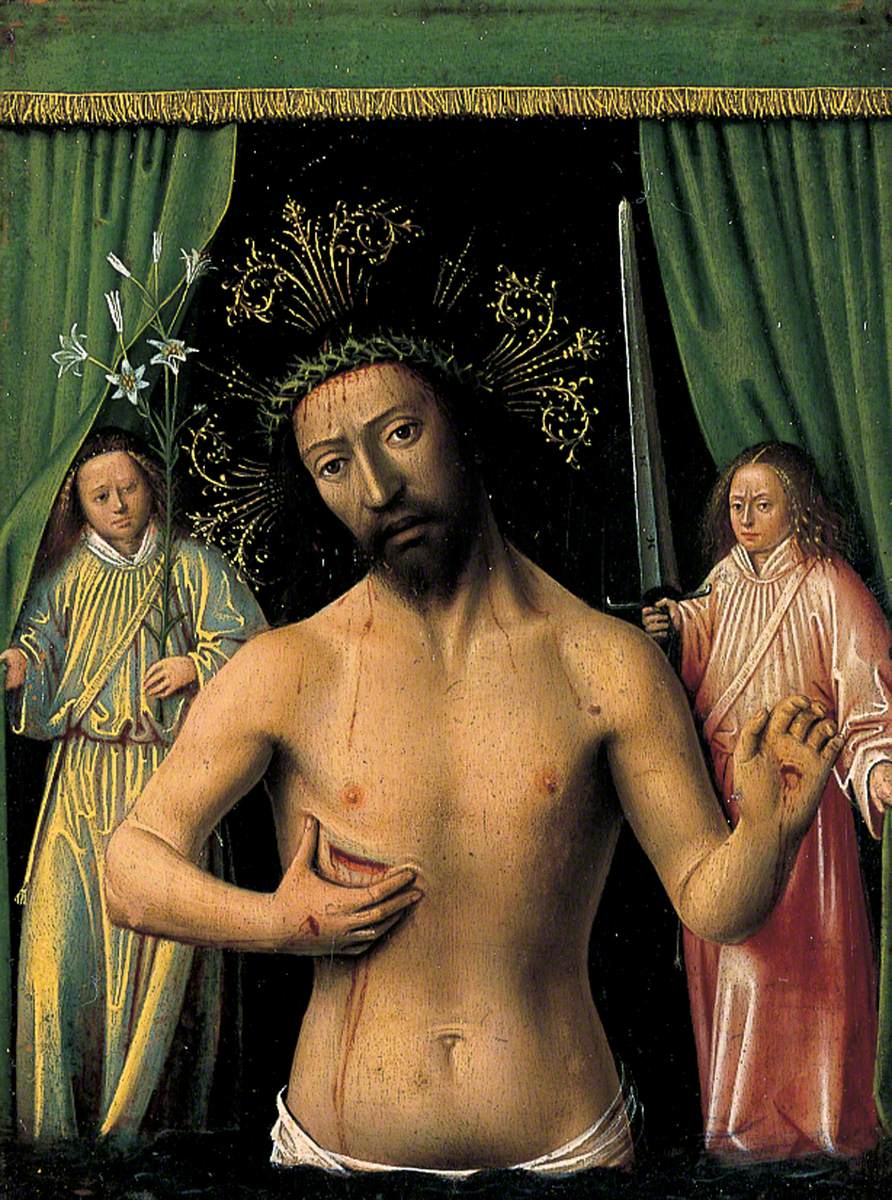
Petrus Christus (Netherlandish, ca. 1410–ca. 1475), Christ as the Man of Sorrows, ca. 1450. Oil on panel, 11.2 × 8.5 cm. Birmingham Museum and Art Gallery, Birmingham, England.
In Jesus through Medieval Eyes, each chapter ends with a scripture, reflection questions, one or two suggested exercises, and a prayer—some sourced from medieval authors, others original.
Each chapter opens with a whimsical line drawing based on medieval manuscript marginalia, which often feature humorous scenarios, like a knight fighting a snail or a rabbit hunting a human! (Role reversals were a favorite form of play for medieval artists.) This design element further immerses the reader in that world. The cover too, its art taken from a French book of hours illuminated by Jean Colombe, gives a sense of the shine of medieval manuscripts with its gilt lettering and halos of the saints.
Hamman has revitalized my interest in medieval literature, in all its wild beauty and strangeness. You may have noticed her influence on my blog over the past few years I’ve been following her. I encourage you to follow her on Twitter @GraceHammanPhD and Instagram @oldbookswithgrace, subscribe to her Medievalish newsletter, and BUY HER BOOK! It would be great material for a Christian book club, and would also make a great gift.
You may also want to check out the recent interview Hamman sat for on The Habit Podcast, part of the Rabbit Room Podcast Network. It’s a terrific introduction to her work:
This early sixteenth-century poem by William Dunbar of Scotland—who served as poet in the court of King James IV and was also an ordained Catholic priest—is an imaginative retelling of the extrabiblical episode known as the Harrowing of Hell, wherein Christ descends to the realm of the dead on the eve of his resurrection to free the souls being held captive there by Satan.
The original poem, in Middle Scots, is reproduced below, followed by my translation into modern English, with the assistance of the Dictionary of the Scots Language. I’ve provided hyperlinks to Scots words that don’t have an obvious English correlative. The Latin refrain translates to “The Lord is risen from the grave.”
Done is a battell on the dragon blak, Our campioun Chryst confountet hes his force; The yettis of hell ar brokin with a crak, The signe triumphall rasit is of the croce, The divillis trymmillis with hiddous voce, The saulis ar borrowit and to the blis can go, Chryst with his blud our ransonis dois indoce: Surrexit dominus de sepulchro.
Dungin is the deidly dragon Lucifer, The crewall serpent with the mortall stang, The auld kene tegir with his teith on char Quhilk in a wait hes lyne for us so lang, Thinking to grip us in his clowis strang: The mercifull lord wald nocht that it wer so, He maid him for to felye of that fang: Surrexit dominus de sepulchro.
He for our saik that sufferit to be slane And lyk a lamb in sacrifice wes dicht, Is lyk a lyone rissin up agane, And as a gyane raxit him on hicht: Sprungin is Aurora radius and bricht, On loft is gone the glorius Appollo, The blisfull day depairtit fro the nycht: Surrexit dominus de sepulchro.
The grit victour agane is rissin on hicht That for our querrell to the deth wes woundit; The sone that wox all paill now schynis bricht, And, dirknes clerit, our fayth is now refoundit: The knell of mercy fra the hevin is soundit, The Cristin ar deliverit of thair wo, The Jowis and thair errour ar confoundit: Surrexit dominus de sepulchro.
The fo is chasit, the battell is done ceis, The presone brokin, the jevellouris fleit and flemit, The weir is gon, confermit is the peis, The fetteris lowsit and the dungeoun temit, The ransoun maid, the presoneris redemit, The feild is win, ourcummin is the fo, Dispulit of the tresur that he yemit: Surrexit dominus de sepulchro.
ENGLISH TRANSLATION:
Done is a battle on the dragon black, Our champion Christ has confounded his force; The gates of hell are broken with a crack, The sign triumphal raisèd is the cross, The devils tremble with hideous voice, The souls are redeemed and to the bliss can go, Christ with his blood our ransom does endorse: Surrexit dominus de sepulchro.
Beaten is the deadly dragon Lucifer, The cruel serpent with the mortal sting, The old sharp tiger with his teeth bared, Who in wait has lain for us so long, Thinking to grip us in his claws strong: The merciful Lord would not that it were so, He made him for to fail of that prize: Surrexit dominus de sepulchro.
He who for our sake allowed himself to be slain, And like a lamb in sacrifice was offered, Is like a lion risen up again, And like a giant raised himself on high: Risen is Aurora radiant and bright, Aloft is gone the glorious Apollo, The blissful day departed from the night: Surrexit dominus de sepulchro.
The great victor again is risen on high Who on our behalf to the death was wounded; The Son that waxed all pale now shimmers bright, And, darkness cleared, our faith is now refounded. The knell of mercy from the heav’n is sounded, The Christians are delivered from their woe, The Jews and their error are confounded: Surrexit dominus de sepulchro.
The foe is chased, the battle is done, The prison broken, the jailers fled and banished, The war is gone, confirmèd is the peace, The fetters loosed and the dungeon emptied, The ransom made, the prisoners redeemed, The field is won, overcome is the foe, Despoiled of the treasure that he held: Surrexit dominus de sepulchro.
“Done Is a Battle” consists of five stanzas with a rhyme scheme of ababbcbc, dedeecec, and so on. (I wasn’t able to perfectly preserve this scheme in the translation.)
As was common in medieval European literature on the Resurrection, the poem portrays Christ as a heroic warrior who storms the gates of hell, freeing the souls imprisoned there by the Enemy—described here variously as a dragon, a serpent, and a tiger, who guards his stolen possession with ferocity. Carrying a cross as his battle standard and covered with his own blood, Jesus goes down into the beast’s lair to reclaim what is rightfully his.
The opening line is considered one of the finest of any poem: “Done is a battle on the dragon black.” Part of its power comes from the use of a literary device known as anastrophe—the inversion of the usual order of words in a sentence (usually subject-verb or adjective-noun). Dunbar uses it twice: “Done is a battle” instead of “A battle is done,” emphasizing finality rather than the conflict itself, and “dragon black” instead of “black dragon,” which gives more prominence to the creature than its color. “A battle is done on the black dragon” just doesn’t have the same ring. Anastrophe is used all throughout the poem (e.g., “sign triumphal,” “claws strong,” “confirmed is the peace”).
Cosmic and dramatic, the poem highlights the Christus Victor aspect of the atonement—that is, how Christ’s death and resurrection were a triumph over the powers of evil. Integrated into this model is the idea of ransom, redemption, emancipation.
While the Harrowing of Hell refers specifically to the salvation of those saints who died before Christ and were awaiting redemption in Sheol (aka Limbo, or Hades), it is representative of the act that Christ performs for all those who are in him—releasing us from Satan’s hold, bringing us out of the grave, letting us share eternally in the fruits of his victory in heaven. In the Eastern Orthodox Church, the central icon of Easter shows the risen Christ standing atop the broken-down doors of hell, pulling Adam and Eve and the other Old Testament faithful up from its pit. It’s called the Anastasis, Greek for “resurrection,” and we on this side of sacred history are meant to see Christ’s saving of our foreparents as a promise extended to us who live in our own kind of darkness.
Jesus conquered death by going through it. Stanza 3 describes the glory with which he rose from such a state. He died a sacrificial lamb, meek and lowly, but rose up like a lion—vigorous, strong. From the darkness of night, he rose like day—like Aurora, goddess of the dawn, or Apollo, god of the sun.
In the fourth stanza Dunbar uses a play on words that was particularly beloved in Middle English and Scots religious lyrics (and which still works in modern English): sun/Son. The sun/Son went dark at the Crucifixion (Luke 23:45) but reemerged brighter than ever on Easter morning, the dawn of a new day. Mercy sounds like bells from on high, and the world enters its liberation.
I don’t want to ignore the problematic nature of the penultimate line of this stanza: “The Jews and their error are confounded.” Their error was failing to see who Christ truly was and, because of that, calling for his execution. Attributing Jesus’s death to, broad brush, “the Jews” led to centuries of anti-Semitic persecution and violence in Europe. While the religious establishment of Jesus’s day certainly did play a driving role in his death, it’s important to remember that the Roman authorities were also key players; it was a collusion between synagogue and state. Both perceived Jesus as a threat, for different reasons. (And of course there’s a sense in which we all bear culpability, regardless of religious affiliation or time period, because it was for humanity’s sin that Christ went to the cross.) But casting blame is fruitless. Jesus died willingly. When I read old texts that charge all Jews across time and place with the crime of deicide, I can’t help but protest that it was also “the Jews” who stood by Jesus in the end—his mother Mary, Mary Magdalene, Nicodemus and Joseph of Arimathea (members of the Sanhedrin!), John the Evangelist, and others—and who were among his closest followers. Not to mention that most of those whom Jesus “harrowed” from hell were Jewish! Across generations they trusted the promise given to them.
I alert you to this line so that if you use the poem in a worship context, you might consider a revision there (or at least a clarification), as the shorthand can cause confusion and breed prejudice. Though it doesn’t exactly honor Dunbar’s intent, I might suggest the following: “The people are delivered from their woe, / Resisters all most truly are confounded.”
Despite the undesirable generalization in line 31, I still believe “Done Is a Battle” is a poem worthy of our attention and engagement. It’s an exciting and culturally contextualized celebration of Christ the Dragon-Slayer, who “descended into hell,” as the Apostles’ Creed puts it, to save his people.
Try reading the Scots aloud! That way you can get a better sense of the musicality. I was surprised by how much of the language I was able to comprehend. Curious of its history, I discovered that most people claim, controversially, that Scots is not actually a separate language, but rather a dialect of English.
Piers Plowman is a fourteenth-century allegorical poem in Middle English by William Langland, considered one of the greatest works of medieval literature. Unfolding as a series of dream-visions, it follows the narrator Will’s quest for the true Christian life.
Lines 491–95 of Passus V (as counted in the Norton Critical Edition, which uses the B-text) are among the poem’s most striking:
The sonne for sorwe therof les syghte for a tyme, Aboute midday whan moste lighte is and meletyme of seintes; Feddest with thi fresche blode owre forfadres in derknesse. Populus qui ambulabat in tenebris vidit lucem magnum. The lighte that lepe oute of the, Lucifer [it] blent, And blewe alle thi blissed into the blisse of Paradise.
MODERN ENGLISH TRANSLATION:
The sun for sorrow [at the Crucifixion] lost sight for a time, About midday, when most light is, and mealtime of saints; Thou feddest with Thy fresh blood our forefathers in darkness. Populus qui ambulabat in tenebris vidit lucem magnum. The light that leapt out of Thee, Lucifer it blinded, And blew all Thy blessed into the bliss of Paradise.
All three Synoptic Gospels tell us that from noon to three on Good Friday, “there was darkness over all the land” (Matt. 27:45; Mark 15:33; Luke 23:44–45). Medieval writers and artists sometimes imagined this in personified terms, as the sun veiling its face in mourning over the death of Christ. At what should be the brightest hour of day, the speaker remarks, the sky went black. And while people were eating their midday meal, Christ was preparing for his people a feast of his own flesh and blood.
This latter image is multifaceted, referring in context to the idea that Christ’s blood flowed into hell to rescue the patriarchs and prophets who died before his coming, but also to the legend of the pelican who wounded her breast to feed her children with her blood. The Eucharist is an obvious corollary.
Every line of Piers Plowman has three alliterative stresses, which in V.494–95 in particular create such a beautiful musicality: light, leapt, Lucifer, blinded, blew, blessed, bliss.
In the immense darkness of the Crucifixion, there shone, on a spiritual level, a glory so bright it blinded Lucifer and swept the Old Testament saints into God’s presence. Langland quotes, in Latin, the prophecy from Isaiah 9:2: “The people that walked in darkness have seen a great light.” With the atonement accomplished, our foremothers and fathers could finally inherit the promise they had clung to in faith for so long. The conflation of light and breath as a propulsive force or a vehicle of transport is so unique and vivid—how the saints, expelled from their prison, ride a strong wind or a ray of light into paradise. I see them joyfully tumbling to their new home!
This passage anticipates the triumph of Passus XVIII, which centers on the harrowing of hell. Reiterating the unusual verb choice of “blew,” the poet says it is Christ’s breath that breaks down the hellgate. Here is Christ (“the light”) on Holy Saturday, addressing the fiends of hell:
Again the light bade them unlock, and Lucifer answered, “Who is that? What lord are you?” said Lucifer. The light at once replied, “The King of Glory. The Lord of might and of main and all manner of powers: The Lord of Powers. Dukes of this dim place, at once undo these gates That Christ may come in, the Heaven-King’s son.” And with that breath hell broke along with Belial’s bars; For any warrior or watchman the gates wide opened. Patriarchs and prophets, populus in tenebris, Sang Saint John’s song, Ecce agnus Dei. Lucifer could not look, the light so blinded him. And those that our Lord loved his light caught away.
(XVIII.316–26, modern English translation by E. Talbot Donaldson)
+++
Greta Leśko (Polish, 1979–), Crucifixion with Transfiguration, 2019. Tempera on gessoed wood board.
This multitiered icon by Greta Leśko is not a direct response to the Piers Plowman passages, but boy does it resonate! I love how she has rendered the paradoxical nature of the cross as a site of simultaneous darkness and light by integrating a scene of the Transfiguration beneath.
Earlier in his ministry, Jesus went up to Mount Tabor with his disciples Peter, James, and John, where he revealed to them, in dazzling light, his true glory. Pierced by these rays, they are literally knocked off their feet! As is traditional, Leśko shows the transfigured Christ holding a scroll in his left hand (signifying that he is the Word of God) and making a blessing gesture with the other.
The Transfiguration was a prefiguration of the Resurrection, and indeed in Leśko’s minimalist conception, this tableau could be read secondarily as Christ risen from the grave. The dark orb that encircles him is like the mouth of his tomb, and the three splayed men evoke the Roman guards who were sent reeling as their dead charge emerged from it alive and in full health.
The top half of Leśko’s icon portrays the Crucifixion. Christ spreads wide his arms across the orange beam, which seems to have no end, but rather melds into the all-encompassing border of light. To his right is what appears to be an open window or a doorway—a displacement, perhaps, of his side wound, which we are invited to enter and take shelter in. At the base of the cross, in a darkened recess, sits a skull, representing the death of Adam.
Adam also appears, with Eve, in the roundel at the cross’s upper terminal. This is a scene of the Anastasis (Greek for “Resurrection”), which is the primary icon of Pascha (Easter). It shows Christ descending into Hades, breaking down its doors (which lie in a heap at his feet) and liberating all the Old Testament saints. Known in the West as the harrowing of hell, this event is referenced in the ancient Apostles’ Creed, which states that Jesus “suffered under Pontius Pilate, was crucified, died, and was buried, and he descended into hell . . .” Medievals loved this part of the story, with all its drama and redeemer-heroism. (It’s the climax of Piers Plowman!) In the Orthodox Church it is a central doctrine.
It’s notable that Leśko has chosen to place the underworld action at the top of the composition and the mountaintop action at the bottom. From the depths of the universe to its heights, God’s radiance is ablaze, yes, but is there a significance to their being transposed? The old world order being overturned, perhaps? Maybe it’s simply to give the Transfiguration more prominence, making it an equal counterweight to the Crucifixion—with the Anastasis, small as it is, merely hinted at. In any case, visually and narratively, it means we read the icon from bottom to top.
By sandwiching the cross between two unambiguous manifestations of Christ’s glory, Leśko helps us see the fuller picture of the Crucifixion, where human evil and God’s goodness met and salvation was born. Or, as William Langland puts it: where light leapt out and “blew all [God’s] blessed into the bliss of Paradise.”





 Art & Theology