All flesh is like grass and all its glory like the flower of grass. The grass withers, and the flower falls, but the word of the Lord endures forever.
—1 Peter 1:24–25
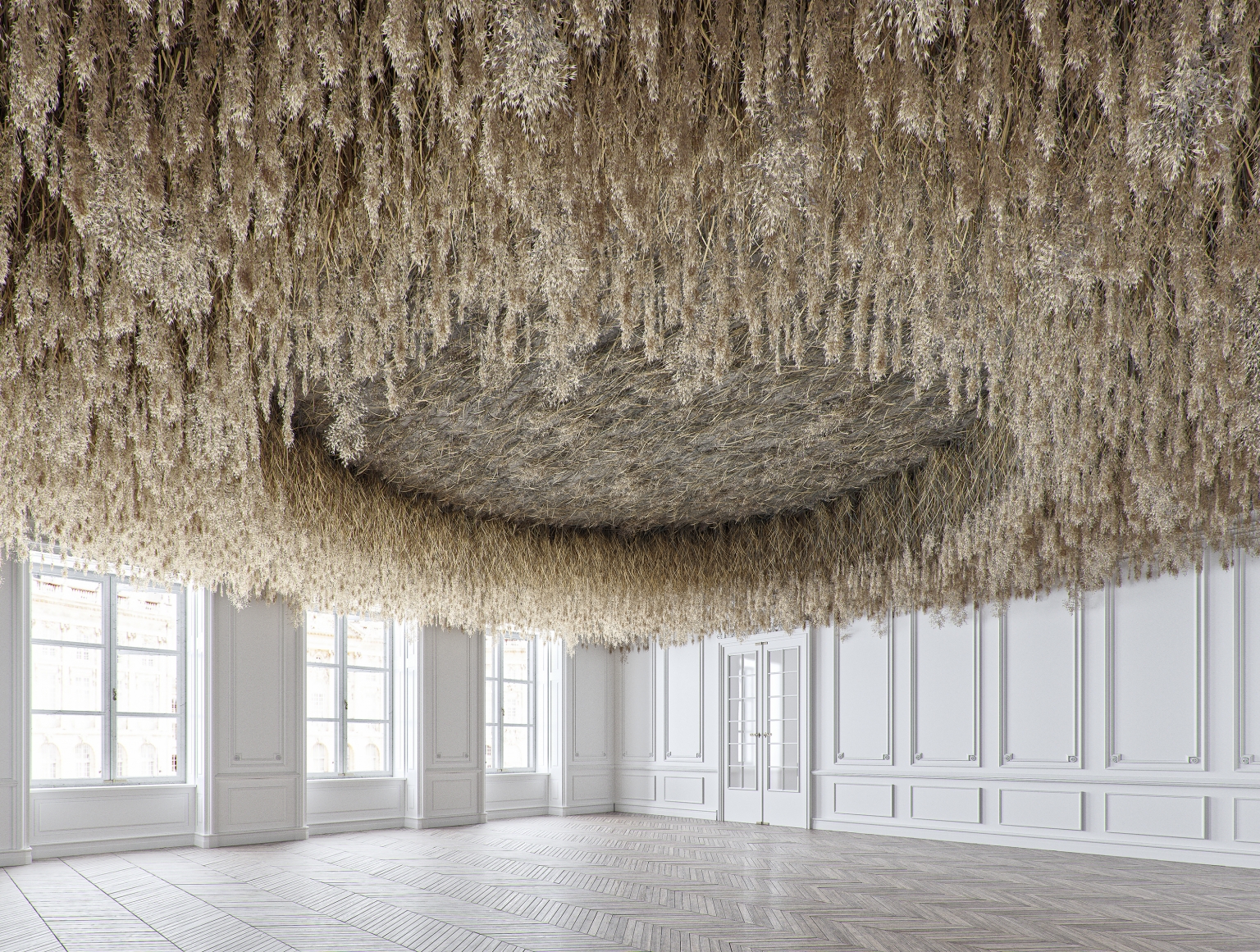
LOOK: French Exit by Tadao Cern
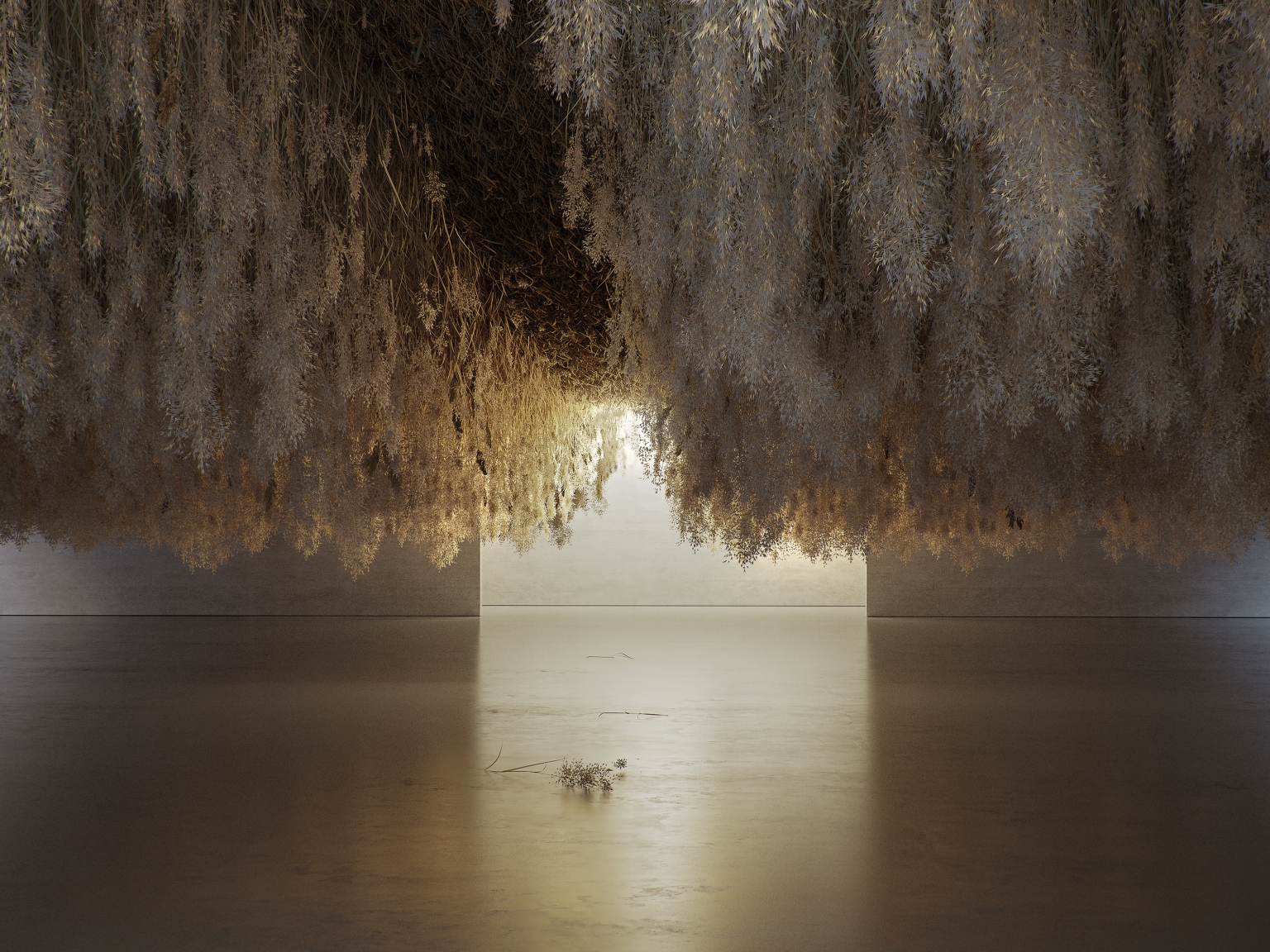
Tadao Cern (Lithuanian, 1983–), French Exit, 2020. Installation of dried grass.
In this installation by Tadao Cern, hundreds of thousands of dried grass stalks are suspended from the ceiling, creating a dense cloud under which viewers can walk. It’s an organic memento mori, a reminder of death. The title, French Exit, refers to the act of leaving a social gathering or a date without saying goodbye. The artist said he wanted viewers to consider their farewells.
Throughout the duration of the installation, some of the dead grass falls from the hovering field onto the floor, to be swept away.
Lent starts next Wednesday, February 18, so I want to remind you about my Lent Playlist on Spotify. There are plenty of songs for contemplative listening throughout the season. I periodically add new entries to the bottom. Recent additions include a song by Amanda Held Opelt about being in the belly of a whale; “Living Water” by Sr. Miriam Therese Winter of the Medical Mission Sisters; Paul Zach’s cover of Johnny Cash’s “The Beast in Me”; and a setting of Matthew 4:17 by Seth Thomas Crissman of The Soil and The Seed Project, whose parallel verse, Mark 1:15, is commonly recited with the imposition of ashes on Ash Wednesday.
+++
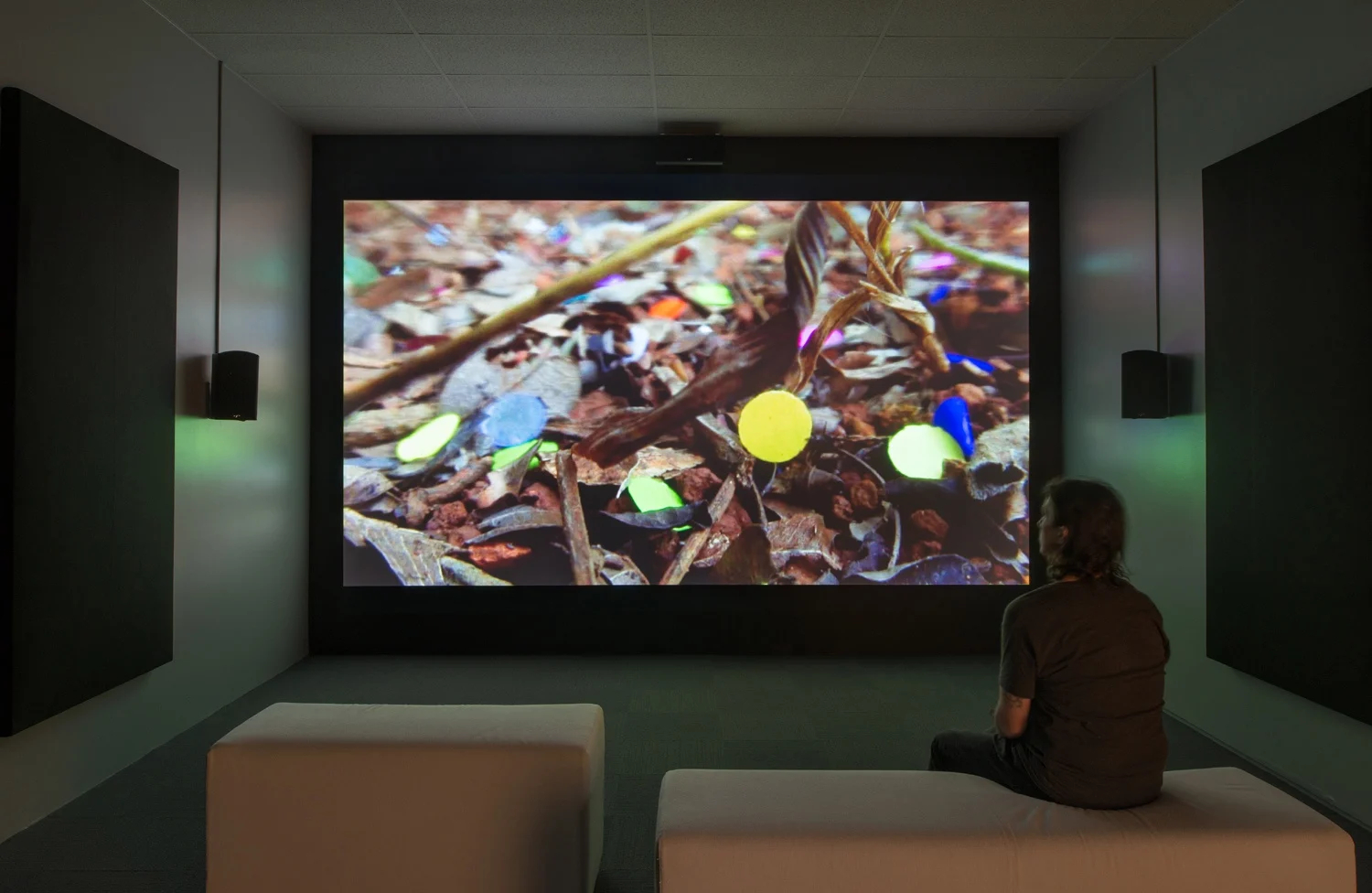
VIDEO ART: Quarta-Feira de Cinzas / Epilogue(Ash Wednesday / Epilogue) by Rivane Neuenschwander with Cao Guimarães: When visiting the Museum of Modern Art in New York last month, I encountered a video work from Brazil that I found mesmerizing. The Perez Art Museum Miami describes it this way:
In Rivane Neuenschwander’s video Quarta-Feira de Cinzas / Epilogue (Ash Wednesday / Epilogue), made in collaboration with artist Cao Guimarães, ants become the protagonists of a captivating journey. Shot on Ash Wednesday, after the end of Brazilian Carnival, the video follows a colony of leafcutter ants as they traverse the rough terrain of a forest floor, transporting pieces of colored confetti to their underground nest. The video is set to a digitally composed soundtrack that blends ambient natural sounds with the sound of matchsticks dropping onto the floor. At the video’s end, we watch the ants descend into the darkness of their nest, intent, perhaps, on furnishing a celebration of their own.
Rivane Neuenschwander (Brazilian, 1967–) with Cao Guimarães (Brazilian, 1965–), Quarta-Feira de Cinzas / Epilogue (Ash Wednesday / Epilogue), 2006. High-definition video (color, sound), 5:44 min. Photo courtesy of Tanya Bonakdar Gallery, New York.
Originating in the Middle Ages, Carnival—from the Latin carve vale, meaning “flesh, farewell!” (flesh = meat)—is a period of merrymaking before the solemn restraints of Lent. It’s primarily a secular folk custom, celebrated by many with hedonistic parties involving excessive drinking. But Carnival need not be debauched, and some Christians celebrate it with social gatherings, games, parades, and/or food traditions. A Polish Catholic coworker of mine would always bring pączki (jelly donuts) to the office on Fat Tuesday (Mardi Gras in French), the day before Ash Wednesday. Some churches host a pancake supper on that evening, using up eggs, milk, and sugar, ingredients that were historically forbidden during Lent, along with bacon and sausage. At The Liturgical Home, Ashley Tumlin Wallace describes Fat Tuesday as a transition day moving God’s people out of Epiphanytide.
Neuenschwander and Guimarães’s Ash Wednesday / Epilogue is, first and foremost, fun and playful. We don’t tend to think of insects having parties! I wonder what the ants are doing with those vibrant little metallized discs. But the video also, for me, captures something of the tone of the first day of Lent—a quiet sweeping up after the previous day’s festivities, the humans of this place having left their revelries to go to church, where they enter a time of penitence.
+++
BLOG POST: “Ash Wednesday” by Libby John: I really appreciated these four guided journal prompts that Libby John, founder of the Vivid Artistry creative collective, gave last Lent:
What is something in my life I am seeking for God to renew and restore?
What rhythms in my life need to be interrupted and reoriented to God’s heart for me?
What are some ways I can surrender my schedule to help attune my senses to more of God’s presence?
Am I bringing my whole self to God or do I divide and keep parts of my life from him?
+++
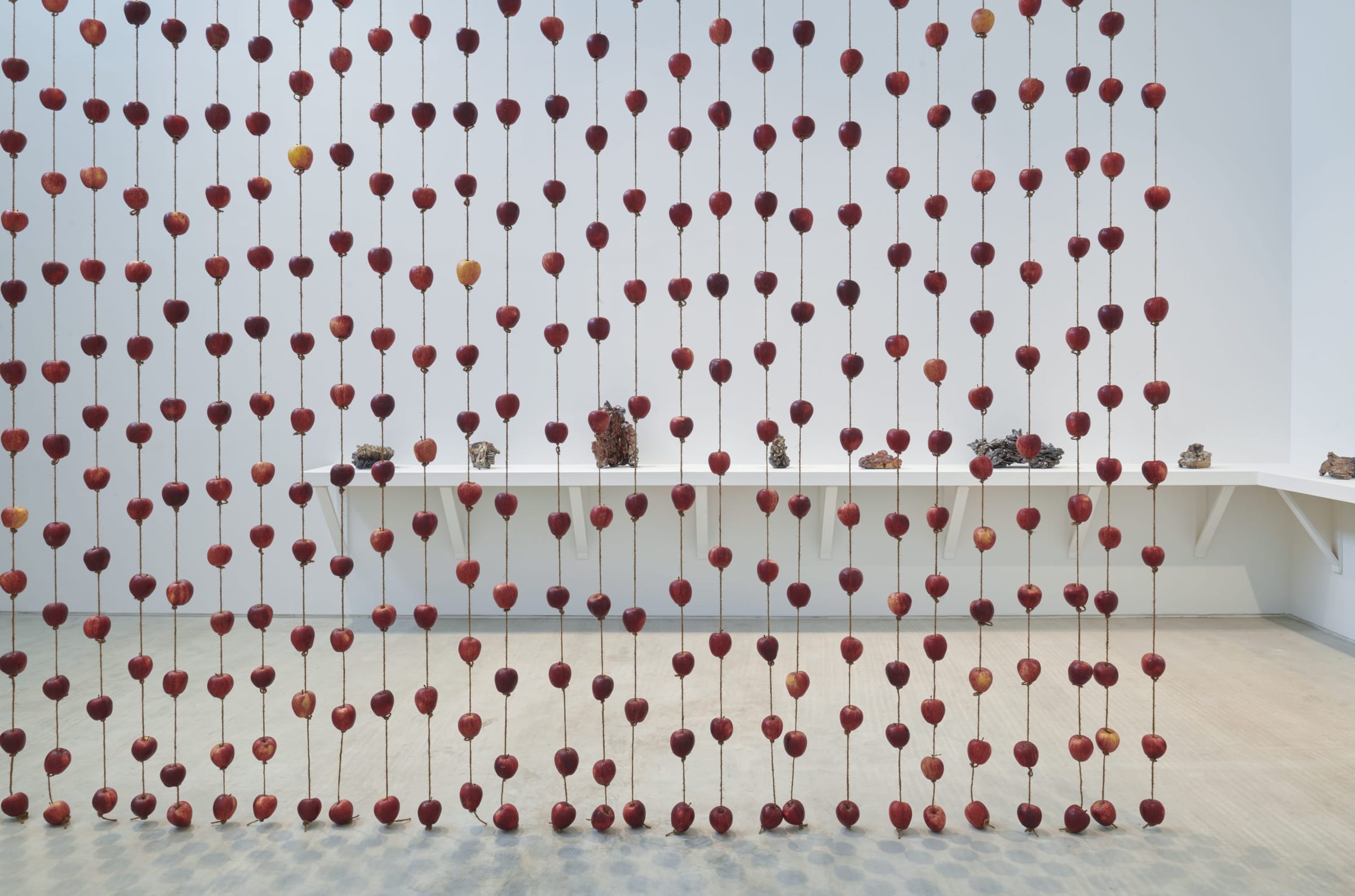
ARTICLE: “Anya Gallaccio’s Organic Mementos Mori” by Eliza Goodpasture, Hyperallergic: Rotting apples threaded with hanging twine, shriveling red daisies pressed between plexiglass, burning candles creating waxen landscapes on aluminum foil, a hundred-plus-year-old ash tree stricken with ash dieback disease—these were among the memento mori (reminders of death) installed at artist Anya Gallaccio’s exhibition preserve at Turner Contemporary in Margate, England, in fall 2024. “The potency of the transient works is so magnetic,” writes reviewer Eliza Goodpasture. “The Christian motif of dust to dust undergirds it all. . . . The artist reminds us that decay is full of energy—not just an ending, but part of an endless circle of life.”
Anya Gallaccio (Scottish, 1963–), Falling from grace, 2000. 2,700 Gala apples, hop twine. Installation view at Turner Contemporary, Margate, 2024. Photo: Jo Underhill, courtesy of the artist.
+++
SONGS:
>> “Turning” by Deanna Witkowski:Deanna Witkowski is a jazz composer and pianist living in Chicago. She wrote this choral piece for Lent, a season in which the liturgies call us to turn away from sin and toward God. That’s what repentance means: changing direction. The first verse is taken from Psalm 119:36–40. “Turn our hearts, O Lord, from selfish gain to your commandments . . .”
>> “Miraculous Salvation” by Tenielle Neda: This song by the Australian singer-songwriter Tenielle Neda praises God for the grace he lavishes on us and for his great love. Backing vocals are provided by Chris Cho.
+++
CAROL TEXT: “Revert, revert” by James Ryman, ca. 1492: Medievalist Eleanor Parker shares this Lenten carol text by the fifteenth-century Franciscan friar James Ryman, from Cambridge University Library MS Ee 1.12. The burden (repeated stanza) is “Revert, revert, revert, revert; / O sinful man, give me thine heart”—an echo of Isaiah 44:22, “Return to me, for I have redeemed you.” Written in Christ’s voice, it calls us to remember how he took on our flesh, was baptized, and was flogged and crucified for our sakes. I think the shield in stanza 3 refers to the cross; the Via Dolorosa was a battlefield on which Christ fought the devil, and paradoxically, the instrument of his execution was the means of victory.
PRAYER: “God, I Wake” by Rev. Maren Tirabassi: A morning prayer for Ordinary Time.
+++
SONG: “Sólo le pido a Dios” (I Only Ask of God), performed by the Alma Sufí Ensamble: This is a cover of a 1978 song written in Spanish by the Argentine folk rock singer-songwriter León Gieco—a personal prayer that he would not be unfeeling, not numb to injustice. In a November 2023 collaboration with the Alma Sufí Ensamble, Gieco joined the Argentine Jewish cantor Gastón Saied (also a guest artist) and the ensemble’s own Nuri Nardelli, a practicing Sufi (Muslim mystic), in singing the song in Spanish, Hebrew, and Arabic, respectively. “Three languages, one heart. And one prayer for peace in the Middle East,” they write. View the original Spanish lyrics and English translation here.
+++
VIDEOS:
The following videos are two of thirteen—the ones focusing on the continent’s Christian heritage—from the docuseries Africa’s Cultural Landmarks, produced by the Metropolitan Museum of Art in collaboration with the World Monuments Fund and directed by Sosena Solomon. The series was commissioned to coincide with the reopening of the museum’s Arts of Africa galleries this May, after being closed for four years as part of a major redesign and renovation of the Michael C. Rockefeller Wing.
>> “Rock-Hewn Churches of Lalibela, Ethiopia”: “Stepping into one of the rock-hewn churches of Lalibela is an experience unlike any other. Carved directly from volcanic rock, from the top to bottom, unlike traditional buildings built from the ground up, the eleven wondrous churches of Lalibela are monumental expressions of devotion and symbols of Ethiopia’s spiritual heartland. Visually captivating and rich with personal insights from priests entrusted with care of the churches, this documentary reveals how these sanctuaries—both magnificent and fragile—face the constant threat of erosion. Meet the dedicated guardians balancing conservation and sacred duty, to ensure Lalibela’s living pilgrimage tradition thrives for generations to come.”
Bete Giyorgis (Church of Saint George), Lalibela, Ethiopia, 13th century
>> “Rock-Hewn Churches of Tigray, Ethiopia”: “High in Ethiopia’s Northern Highlands, the rock-hewn churches of Tigray stand as breathtaking sanctuaries of faith carved into sandstone cliffs. For centuries, some 120 rock-hewn churches, and the paintings and artifacts preserved within their walls, were protected by their remote locations. However, during the 2020–2022 war in Tigray, some churches were targeted, and the use of heavy weapons resulted in vibrations that caused cracks in the stone. Through evocative imagery and intimate testimonies, this documentary explores the endurance of these remarkable sites of devotion, as local priests reflect on the spiritual and cultural legacies at risk.”
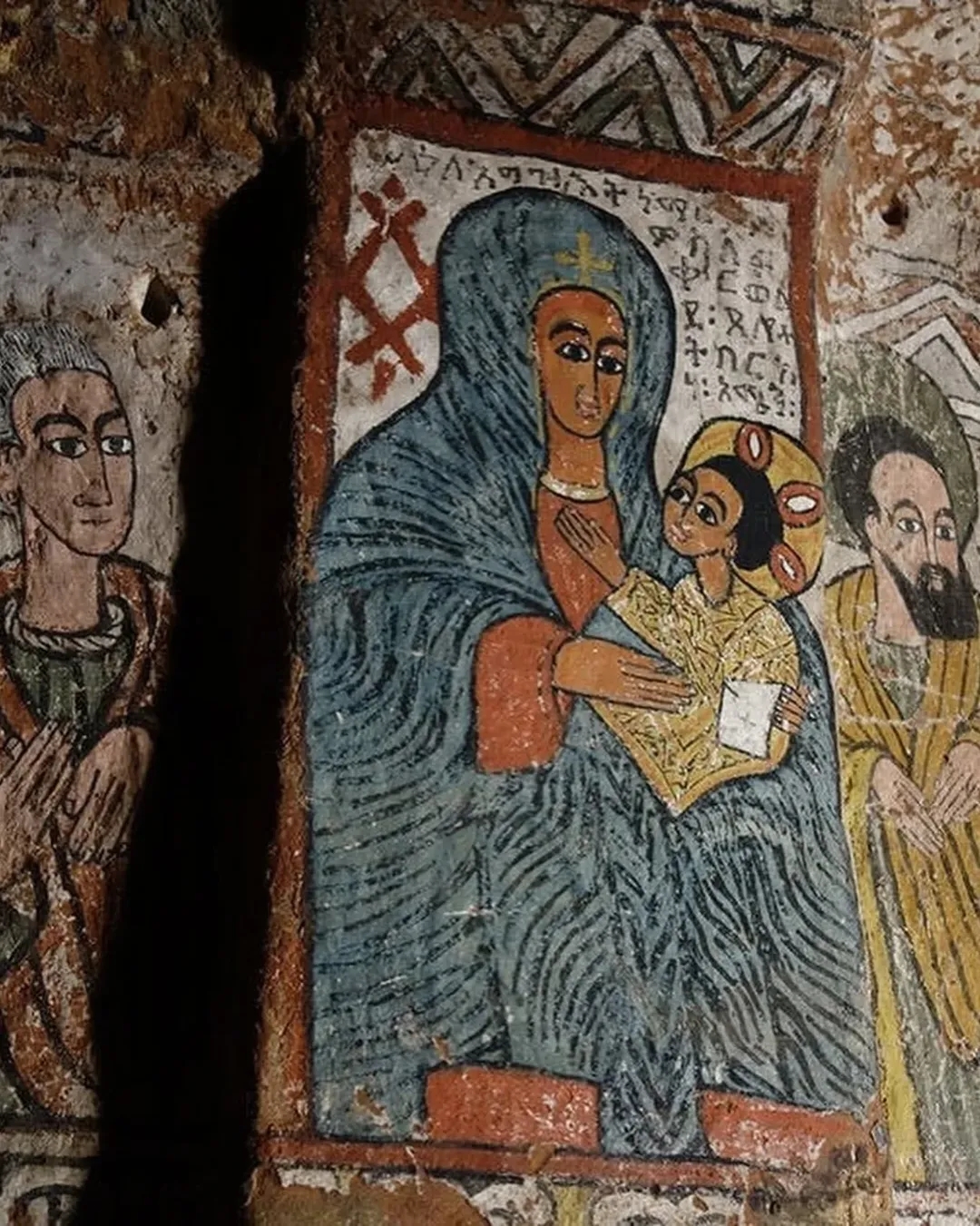
Virgin and Child wall painting, 15th century, inside Abuna Yemata Guh (The Chapel Near the Sky) in Tigray, Ethiopia, which contains the best-preserved medieval paintings in the region
+++
ESSAY: “Shaped for People: Sacred Harp Singing in the Age of AI” by Mary Margaret Alvarado: From Image journal’s summer 2025 issue: “What is that, I thought, when I first heard shape note singing. It was groaning, and some voices keened. It was loud. It was muscular, this music. There was glory, but it was not pretty. The voices did not blend, and the sound was not nice. All I knew was that I wanted to hear it again. Maybe it seemed to me like an aesthetic that does not lie? I feel surrounded, often, by aesthetics that do lie. . . . So there’s a contrarian appeal to a song that sounds sung by humans in their (young, old, crooked, fat, gorgeous, hairy, halt, jacked, sexy, bald, injured, hale) human bodies . . .”
Writer Mary Margaret Alvarado reflects on her experiences participating in shape-note hymn sings, a democratic form of communal music making using the “sacred harp” of the human voice. She provides an abridged history of such singing, which developed in late eighteenth- and early nineteenth-century New England but is now carried on throughout the US and in the UK and Germany. I’d love to take part in a shape-note hymn sing someday, as I’ve long been drawn to the sound and tradition, which I know only from recordings. Besides the small gatherings organized by local communities, there are also large conventions, and I’ve been intrigued to learn that, despite the hymns’ deep rootedness in Christianity, non-Christians are often among the attendees.
Below are a few of the hymns Alvarado mentions in her essay: “Youth like the Spring Will Soon Be Gone” (MORNING SUN), “David’s Lamentation” over the death of his son Absalom, and “I’m Not Ashamed of Jesus” (CORINTH). Traditionally, the singers start by singing through an entire verse using only the four syllables of the Sacred Harp notation system (fa, sol, la, mi) as their lyrics, to orient themselves to the tune.
To browse previous Art & Theology posts that have featured hymns from the Sacred Harp tradition—albeit not all performed in a traditional manner; several are arranged for soloists or otherwise stylistically adapted—see https://artandtheology.org/tag/sacred-harp/.
+++
NEW ALBUM: Radiant Dawn by the Gesualdo Six: Released August 1 by the British vocal ensemble the Gesualdo Six, this album features “an ethereal combination of trumpet and voices to explore different shades of light . . . from the soft, golden glow of a summer evening as shadows lengthen to the shimmering of moonlight on calm waters,” writes director Owain Park. “Some texts contrast the terror of darkness with the brilliance of dazzling sunlight; others explore the blurred boundaries between heaven and earth. Plainchant threads this programme together . . .” A range of composers are represented, from the Middle Ages to the present day.
Several of the songs are based on biblical episodes—Simeon’s response to having held the Christ child in the temple, the transfiguration of Christ on Mount Tabor, the arrival of the holy women at Jesus’s tomb on Easter morning, the walk to Emmaus—or passages such as Psalm 5:2 (“O hearken thou . . .”) and Revelation 21:23 (“And the city had no need of the sun . . .”). There are bedtime prayers, a meditation on the glory of the angels, an O Antiphon for the approach of Christmas, and settings of contemporary poems, like “Grandmother Moon” by the Mi’kmaq poet Mary Louise Martin and “Aura” by Emily Berry, about the death of her mother. View the track list at https://www.hyperion-records.co.uk/dc.asp?dc=D_CDA68465.
Below, from the album, is the Gesualdo Six’s performance of “Night Prayer” by Alec Roth, a setting of the Te lucis ante terminum, featuring Matilda Lloyd on trumpet. “The stark setting reminds me of the ravages of war,” one YouTube user remarks. “The singing, of a prayer sent out over the carnage, blessing those who have suffered. Sacred space indeed.”
For all flesh is as grass, and all the glory of man as the flower of grass. The grass withereth, and the flower thereof falleth away: but the word of the Lord endureth for ever. And this is the word which by the gospel is preached unto you.
—1 Peter 1:24–25 (KJV) (cf. Isaiah 40:7–8)
Man is like a breath; his days are like a passing shadow.
—Psalm 144:4 (ESV)
LOOK: Fraktur attributed to David Kriebel
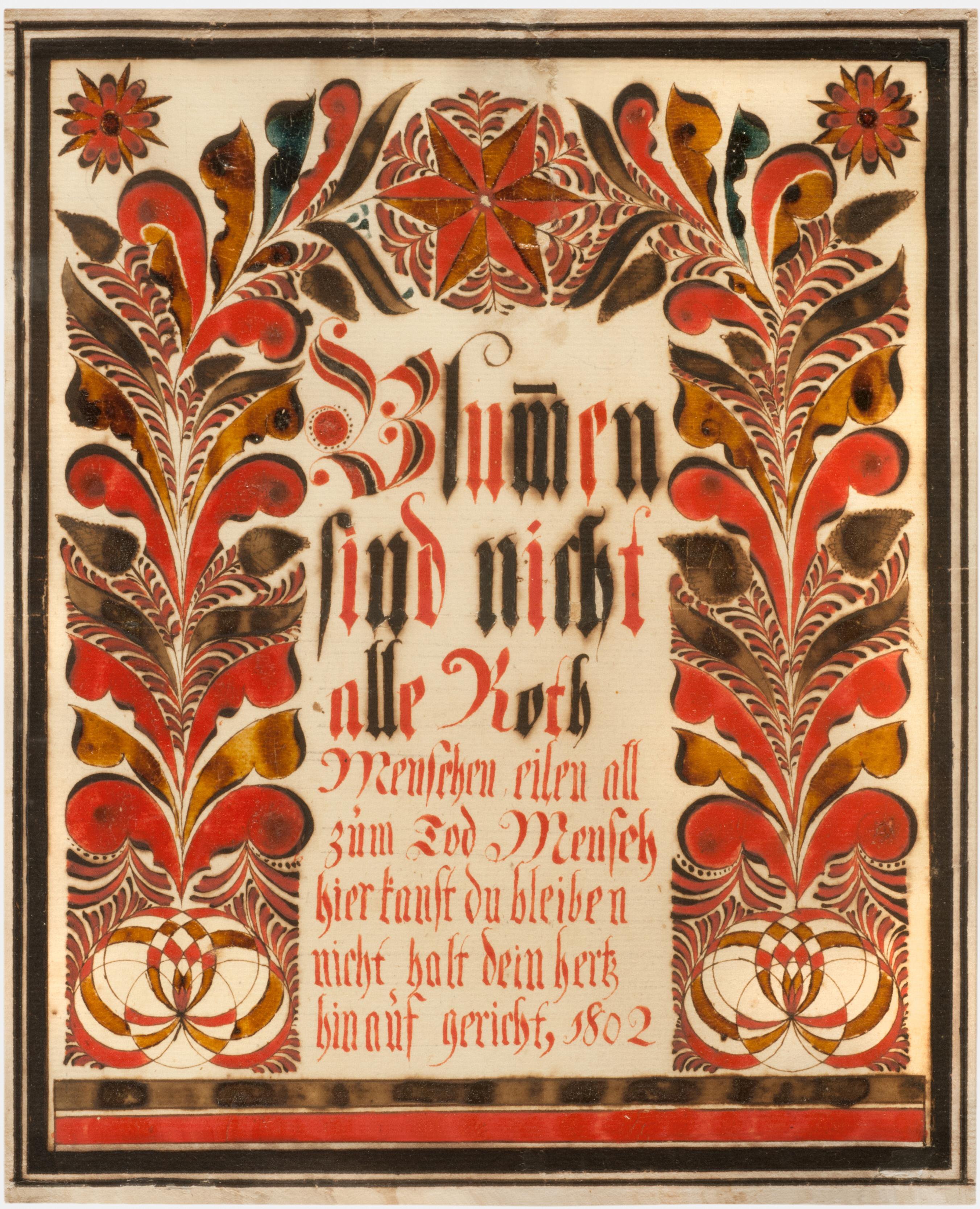
Fraktur attributed to David Kriebel (1787–1848), Gwynedd Township, Montgomery County, Pennsylvania, 1802. Watercolor and ink on laid paper, 9 1/2 × 7 1/2 in. (24.1 × 19.1 cm). Philadelphia Museum of Art.
Referring to exuberantly decorated pages made by Pennsylvania Germans, fraktur is a type of folk art that flourished in the eighteenth and nineteenth centuries. Traditionally handwritten in ink and hand-painted with letter embellishments and design motifs like birds, hearts, and tulips, these works on paper often contain religious texts and/or commemorate important life events like births, deaths, and baptisms. They were made primarily by pastors and schoolmasters, who gifted them to parishioners or students. The recipients did not frame or hang them, but rather kept them in Bibles, drawers, or chests.
The German text of this fraktur translates to “Flowers are not all red. All men hasten toward death. Man cannot remain here, so direct your heart upward.” The piece features a foliate border and a color palette of reds and browns that captures both the bloom of youth and life’s inevitable withering. It was made by David Kriebel, a farmer from Gwynedd Township in Montgomery County, Pennsylvania, who would later move to nearby Worcester Township and become a minister in the Schwenkfelder Church, a small Christian denomination rooted in the Protestant Reformation teachings of Caspar Schwenkfeld von Ossig (1489–1561), which emphasize inner spirituality over outward form.
LISTEN: “As the Life of a Flower” by Laura E. Newell (words) and George H. Ramsey (music), 1904 | Performed by the Chuck Wagon Gang, 1953 [HT]
As the life of a flow’r, as a breath or a sigh So the years that we live as a dream hasten by True, today we are here, but tomorrow may see Just a grave in the vale and a mem’ry of me
Refrain: As the life of a flow’r, as a breath or a sigh So the years glide away, and alas, we must die
As the life of a flow’r, be our lives pure and sweet May we brighten the way for the friends that we greet And sweet incense arise from our hearts as we live Close to him who doth teach us to love and forgive [Refrain]
While we tarry below, let us trust and adore Him who leads us each day toward the radiant shore Where the sun never sets and the flow’rs never fade Where no sorrow or death may its borders invade [Refrain]
This early twentieth-century gospel hymn is performed here by D. P. Carter (tenor) and three of his nine children: Rose Carter Karnes (soprano), Anna Carter Gordon (alto), and Ernest (Jim) Carter (bass, guitar). The quartet formed in 1935 and started appearing on WBAP radio in the family’s hometown of Fort Worth, Texas, the following year, billing themselves as the Chuck Wagon Gang.
“As the Life of a Flower” draws on biblical passages that compare human life to a flower for its ephemerality (e.g., Job 14:2; Psalm 103:15–16; Isa. 40:6–8; 1 Pet. 1:24–25). But flowers are also fragrant, and the song makes that comparison too, echoing verses like 2 Corinthians 2:14–15, where Paul writes, “Thanks be to God, who . . . through us spreads in every place the fragrance that comes from knowing him. For we are the aroma of Christ to God among those who are being saved and among those who are perishing.”
Though we are fading, we are glorious creations of God with joyous and sweet-smelling potential. While we live on this earth, may we exude the beauty and aroma of Christ in all we say and do.
LENT SERIES: “Let go of unlove this Lent: Let’s practice love together—a new and improved Lenten reflection series starting March 5th” by Tamara Hill Murphy: I’ve been nurtured for years by Murphy’s gentle spiritual writing and curated beauty and wisdom, and I especially appreciate her annual Advent and Lent Daybook series. This Lent, she’ll be exploring four postures of cruciform love given to us in 1 Corinthians 13, providing daily scripture readings, prayers, and art, along with weekly practices. You can gain access for just $16. (She uses the Substack platform.)
Forgive Thy Other by Scott Erickson
I like how Murphy frames the season: “Lent is a significant time for us to seek a deeper understanding of God’s heart and recognize the gaps in our experiences of His love. Through its beautiful stories, prayers, and practices, Lent also invites us to reflect on our own expressions of love and unlove. The Book of Common Prayer encourages us to let go of our unloving ways so we can love what (and who) God loves. Let’s joyfully embrace this transformative season together, reflecting God’s love with compassion and understanding.”
+++
NEW PLAYLIST: God’s Love (Art & Theology): Related to Tamara Hill Murphy’s 2025 Lent Daybook theme: here’s a new playlist I put together of songs about the abounding, ever-present love of God the Father, Son, and Holy Spirit, a love that seeks, heals, and transforms.
The cover photo is of an early twentieth-century relief sculpture from the exterior of Holy Trinity Church in the town of St Andrews, Scotland, taken by Joy Marie Clarkson; it shows a pelican pecking her breast to feed her young with her own blood, a medieval symbol of Christ’s self-giving love.
There’s some overlap between this playlist and my dedicated Lent Playlist. I hope it uplifts you in the knowledge of the depths and riches of God’s love for you.
+++
SONGS:
>> “And Am I Born to Die?”: Lent opens with a call to “remember you are dust, and to dust you shall return.” A reflection on human mortality, this somber hymn was written by the great English Methodist hymnist Charles Wesley (1707–1788) and set to music—a shape-note tune—by Ananias Davisson (1780–1857), a Presbyterian elder from Virginia. In this video from January 2023, it’s performed by the Appalachian folk musician Nora Brown, with Stephanie Coleman on fiddle and James Shipp on harmonium.
And am I born to die? To lay this body down? And must my trembling spirit fly Into a world unknown?
Awaked by trumpet sounds, I from my grave shall rise, And see the Judge, with glory crowned, And see the flaming skies.
Soon as from earth I go, What will become of me? Eternal happiness or woe Must then my portion be.
>> “Nunc tempus acceptabile” (Now Is the Accepted Time): Second Corinthians 5:20b–6:10 is traditionally read on Ash Wednesday, a passage that includes the adjuration, “Behold, now is the acceptable time; behold, now is the day of salvation!” (2 Cor. 6:2). There’s a beautiful tenth-century Latin hymn for Lent, from the Liber Hymnarius, that opens with this line. In 2013, the Chicago-based composer and conductor Paul M. French set it to music for SSA a cappella choir, its unison opening unfolding into an increasingly expressive three-part harmony. It’s performed here by the Notre Dame Magnificat Choir under the direction of Daniel Bayless.
Nunc tempus acceptabile
Fulget datum divinitus,
Ut sanet orbem languidum
Medela parsimoniae.

Christi decoro lumine
Dies salutis emicat,
Dum corda culpis saucia
Reformat abstinentia.

Hanc mente nos et corpore,
Deus, tenere perfice,
Ut appetamus prospero
Perenne pascha transitu.

Te rerum universitas,
Clemens, adoret, Trinitas,
Et nos novi per veniam
Novum canamus canticum.

Amen.
Today is the accepted time. Christ’s healing light, the gift divine, shines forth to save the penitent, to wake the world by means of Lent.
The light of Christ will show the way that leads to God’s salvation day. The rigor of this fasting mends the hearts that hateful sinning rends.
Keep all our minds and bodies true in sacrifice, O God, to you, that we may join, when Lents have ceased, the everlasting Paschal feast.
Let all creation join to raise, most gracious Trinity, your praise. And when your love has made us new, may we sing new songs, Lord, to you.
LECTURE: “Embracing the Ephemeral: How Art Honors Creaturehood” by James K. A. Smith, Duke Divinity School, February 17, 2022: Mortality means something more than being a creature who will someday die, says philosopher James K. A. Smith; it is a way of being, not defined solely by its terminus. “To be created is to be ephemeral, fugitive, contingent. To be a creature is to be a mortal, subject to the vicissitudes of time.” Part of the Duke Initiatives in Theology and the Arts Distinguished Lecture Series, this talk about developing a Christian temporal awareness is based on chapter 4 of Smith’s then-forthcoming, award-winning book How to Inhabit Time (Brazos, 2022), titled “Embrace the Ephemeral: How to Love What You’ll Lose.”
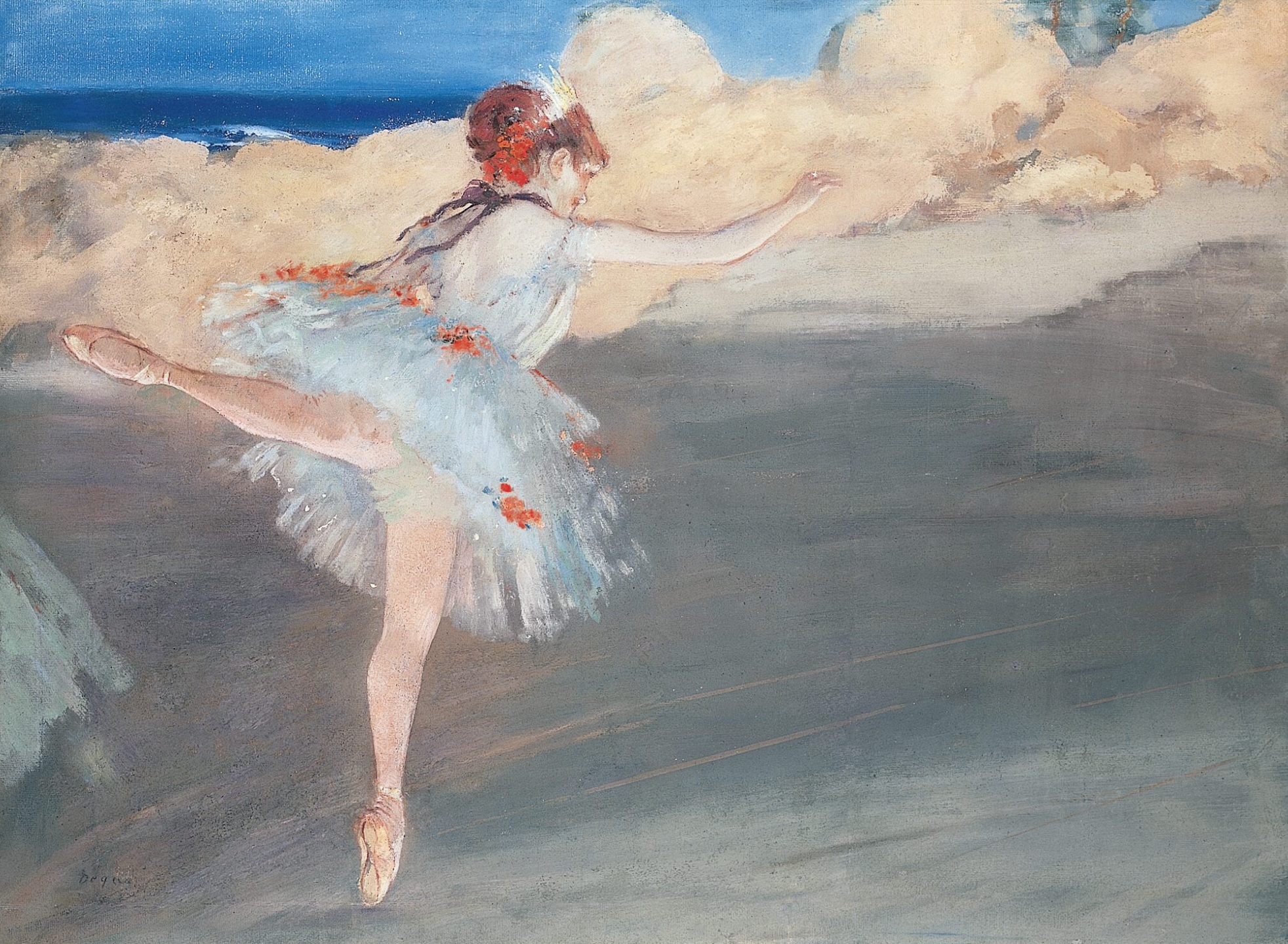
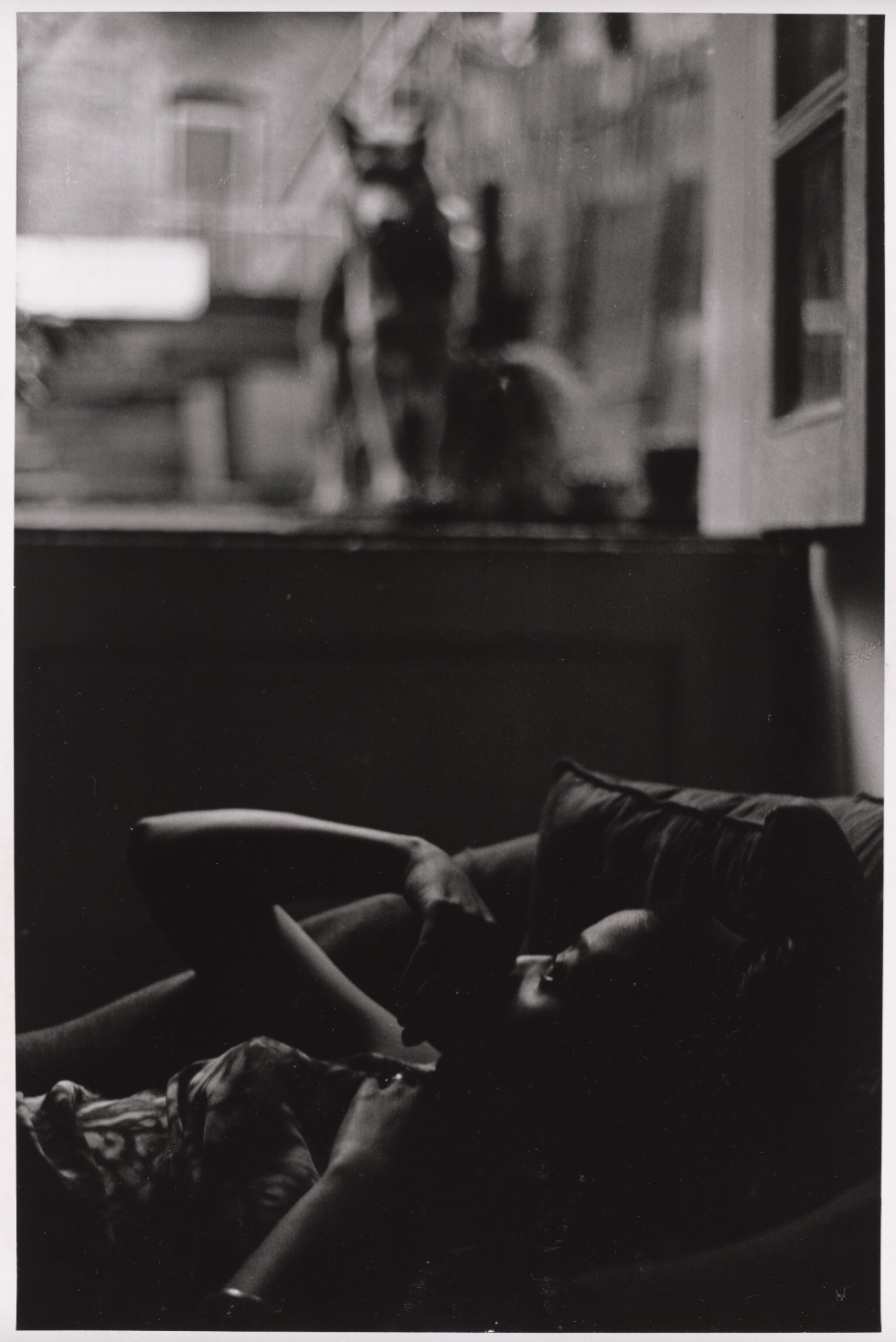
Edgar Degas (French, 1834–1917), The Star: Dancer on Pointe, ca. 1878–80. Gouache and pastel on paper, mounted on board, 22 1/4 × 29 3/4 in. (56.5 × 75.6 cm). Norton Simon Museum, Pasadena, California.Herbert Randall (American, 1936–), Untitled (Lower East Side, New York), 1960s. Gelatin silver print, 13 7/16 × 8 7/8 in. (34.2 × 22.5 cm). J. Paul Getty Museum, Los Angeles.
Some notes I took:
“We need not only memento mori, but also memento tempore—reminders of our temporality, not just our mortality.”
“Imagine embracing the ephemeral as a discipline of not only conceding our mortality as a condition but also receiving our mortality as a gift.”
“Our finitude is not a fruit of the fall, even if it is affected by the fall. Contingency is not a curse. . . . Aging is not a curse. Autumn is not a punishment. Not all that is fleeting should be counted as loss. The coming to be and passing away that characterize our mortal life are simply the rhythms of creaturehood.”
Resting in our mortality instead of resenting it
Theologian Peter Leithart says hebel means not “emptiness,” “vanity,” or “meaninglessness” but, literally, “mist” or “vapor.” The Teacher in Ecclesiastes uses that word repeatedly to describe human life: it’s vaporous, elusive, escapes our efforts to hold on to it, to manage it.
How to sift tragedy from good creaturely rhythms in which good things fade?
“To dwell faithfully mortally is to achieve a way of being in the world for which not all change is loss and not all loss is tragic, while at the same time naming and lamenting those losses that ought not to be. . . . To be faithfully mortal is a feat of receiving and letting go, celebrating and lamenting. Being mortal is the art of living with loss, knowing when to say thank you and knowing when to curse the darkness.”
“One Art” by Elizabeth Bishop: “The art of losing isn’t hard to master . . .”
A Q&A takes place from 39:00 onward. The first question, asked by theologian Jeremy Begbie, is the one I had, and it recurs with different phrasing at 58:17.
Mortality is one of the main themes in Silver’s poetry, including the physicalities of being human, as reflected in “Ash Wednesday,” in which she, the speaker, muses on the shared Christian ritual of the imposition of ashes at the beginning of Lent. Silver, who died of breast cancer eight years after writing this poem, was used to practicing memento mori (“remember you must die”): her mastectomy scar and silicone breast prosthesis are constant reminders of the fact, she writes. She wants to touch the body of God, wants to wrap her fingers around some tangible promise of healing, but both remain elusive. Instead she resolves to embrace the finiteness of her present form, taking the burnt remains of those Hosanna palms from last year and wearing them with repentance and praise, knowing that what is sown in perishability will be raised in imperishability (1 Cor. 15:42).
I’m compelled by how Silver both laments her fragility and owns it. There’s a defiant quality to the tone, the ash-and-oil mixture that’s thumbed into her forehead in the shape of a cross evoking a football player applying eye black in front of a locker room mirror before the big game. Wearing the mark of Christ, she’s ready for the face-off between herself and death.
Dawn Ng is a Singaporean multidisciplinary artist whose practice deals with time, memory, and the ephemeral. For her recent body of work Into Air, Ng has crafted nearly 150 large sculptural blocks of frozen pigment and documented their dissolution in the form of photographs, film, and residue paintings. A poetic visual meditation on time and its passing, Into Air captures the metamorphosis of colored ice from solid to liquid to air, physicalizing transience. Presented by Sullivan+Strumpf, it premiered at a derelict ship factory in Singapore in January 2021 and from there traveled to Seoul, London, and Sydney. See the six-minute documentary below for more on the process and meaning behind the work.
Dawn Ng in her studio in Singapore, surrounded by studies and artworks from Into Air. Photo: Sean Lee. All photos courtesy of the artist.
Ng started working on Into Air in 2018, and it’s ongoing. The project encompasses three distinct series:
Clocks
Time Lost Falling in Love
Ash
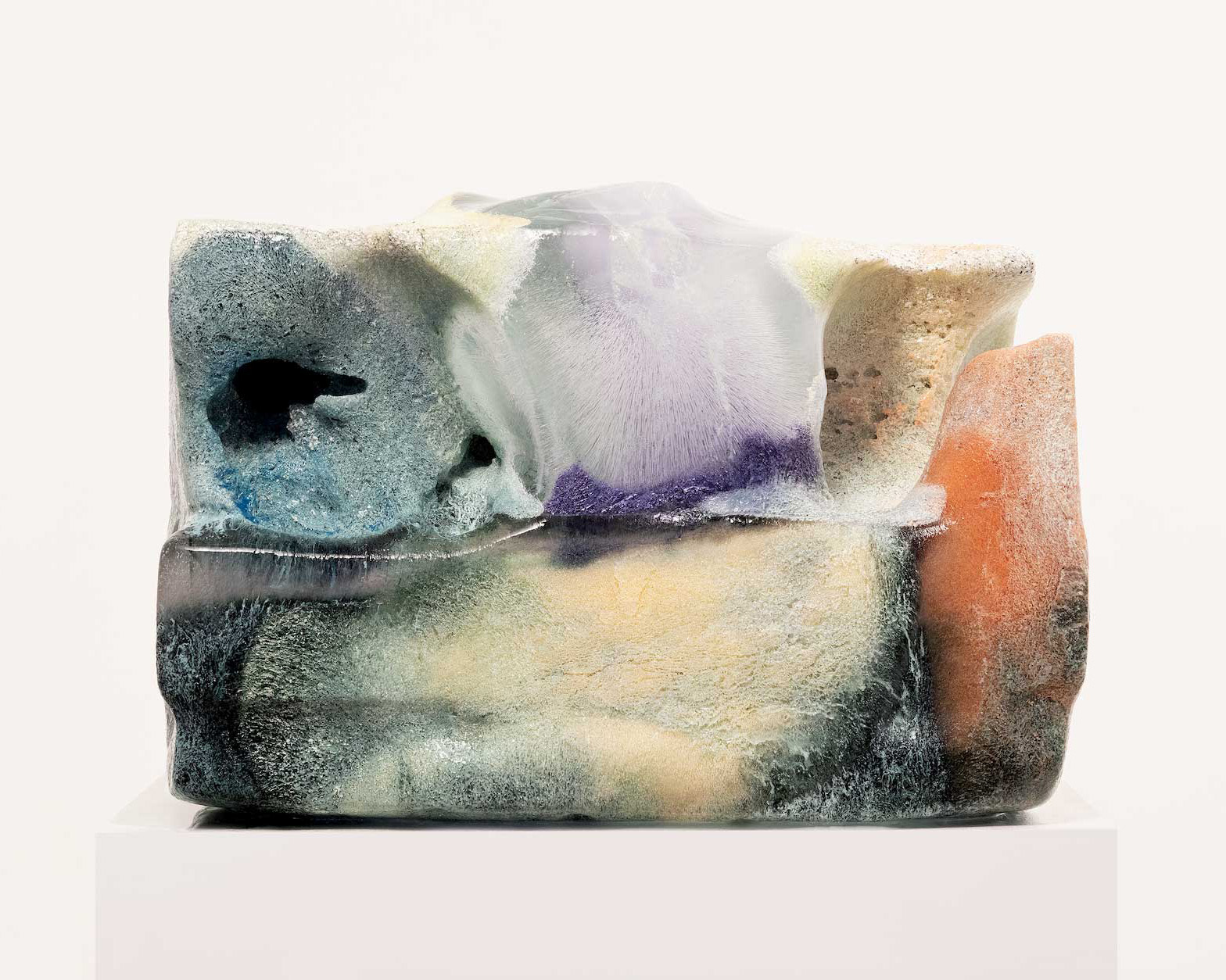
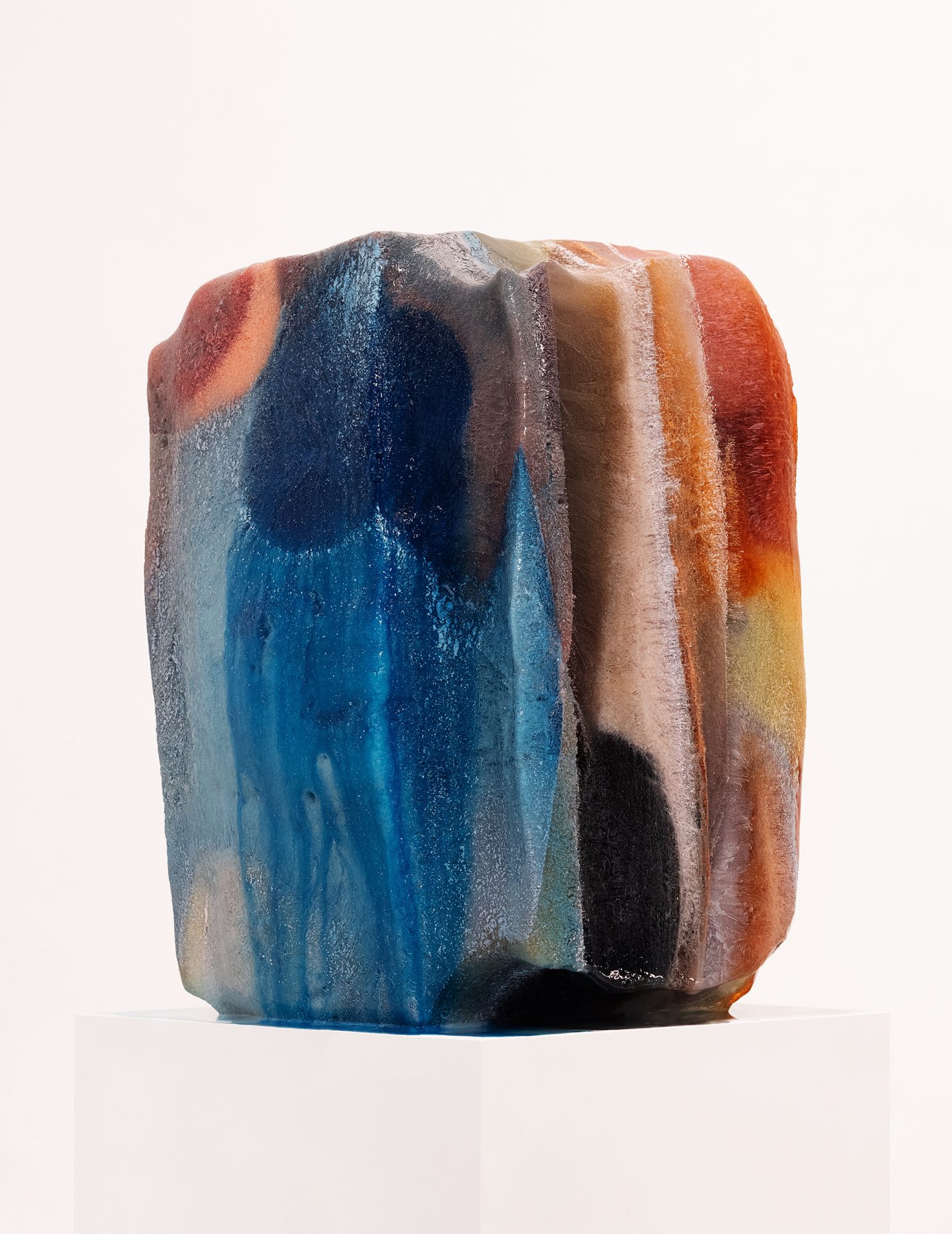
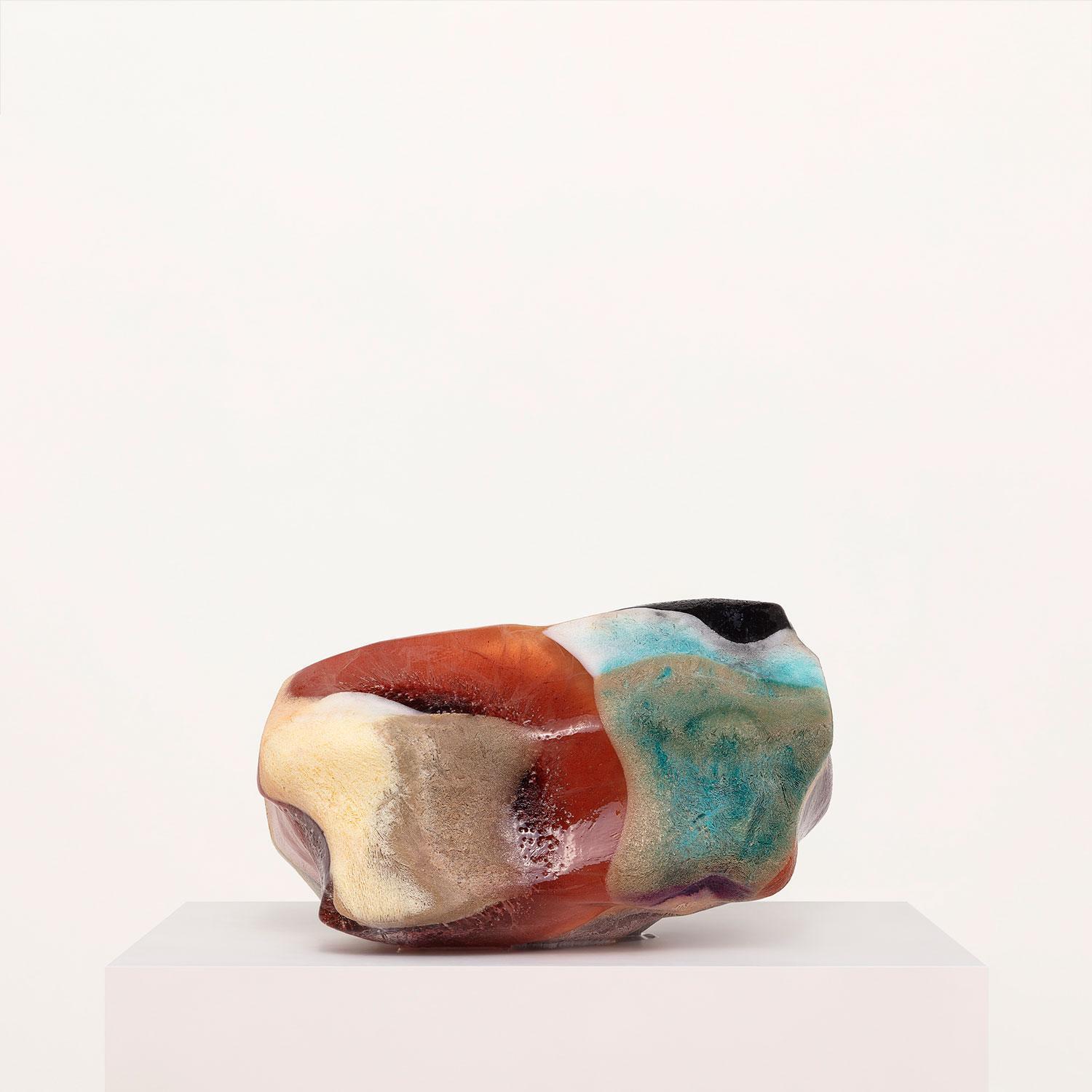
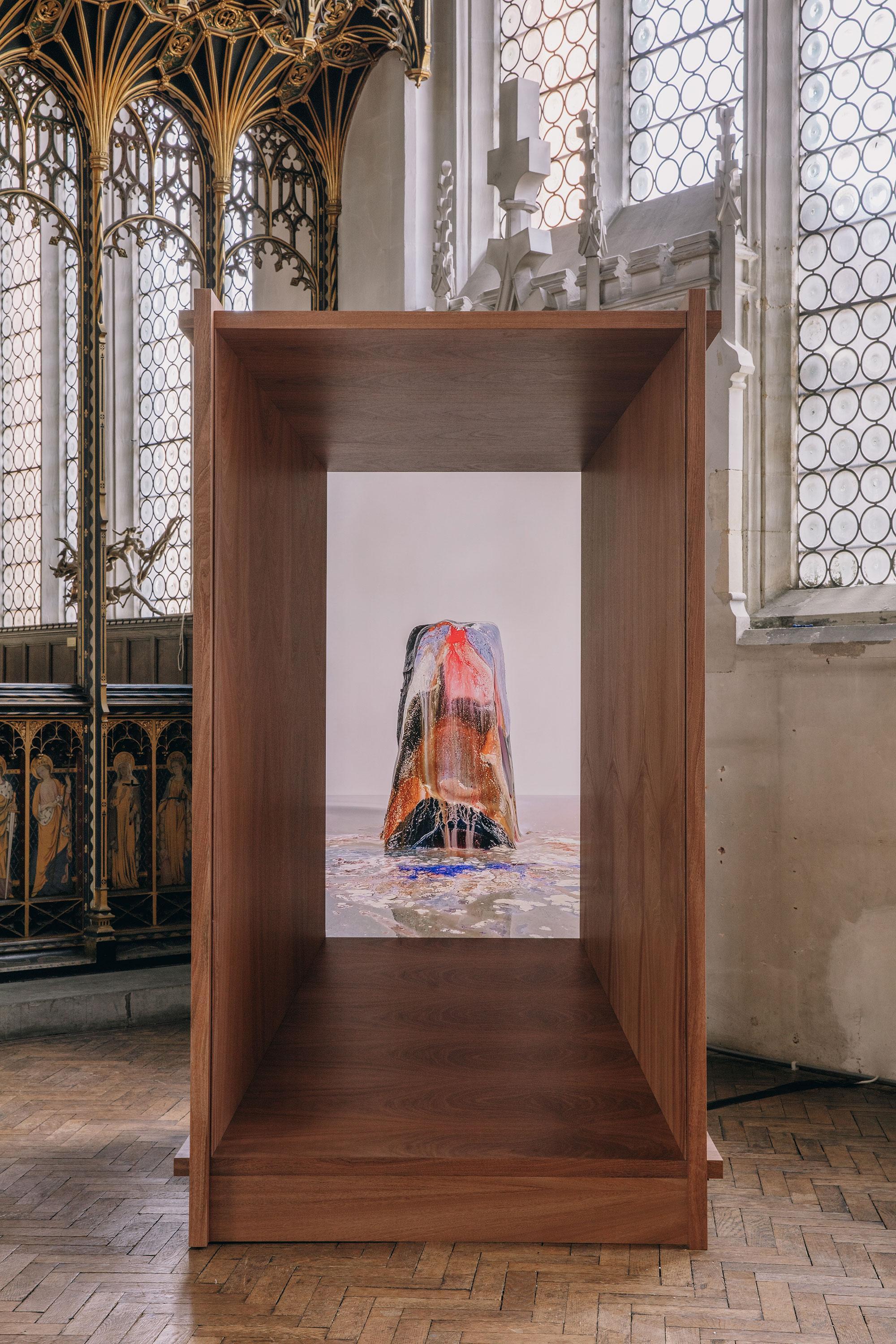
Clocks is the name Ng gives to the photo portraits of her colored glacier blocks at various stages of disintegration. Weighing about 132 pounds each, the blocks were constructed from acrylic paints, dyes, and inks that she froze together in her studio. After removing each block from the freezer, she and her team photographed it from ten different angles every four hours until it entirely eroded. “Like kaleidoscopic lodestones, the portraits visualize the shape, colour and texture that time inhabits in an ephemeral form,” Ng writes.
Dawn Ng (Singaporean, 1982–), If I could find a souvenir just to prove the world was here, from CLOCKS, 2021. Archival pigment print, 115 × 149 cm.Dawn Ng (Singaporean, 1982–), Some will fall in love with life and drink it from a fountain that is pouring like an avalanche coming down the mountain, from CLOCKS, 2021. Archival pigment print, 153 × 118 cm.Dawn Ng (Singaporean, 1982–), Don’t they know it’s the end of the world, from CLOCKS, 2022. Archival pigment print, 95 × 95 cm.
Time Lost Falling in Love is the collective title of the time-lapse videos Ng filmed of the thawing blocks. The collapse of each block into a puddle of liquid took fifteen to twenty hours, a process compressed into twenty to thirty minutes for each film. Ng says she wants to portray the fluidity of time—time as a “riot of colors” that swell and ebb, that form rivers and pools. By speeding up the frame rate of the film, Ng manipulates time, fast-tracking the dissolution of the blocks while simultaneously providing a calming evocation of a waterfall in slow motion. Time melting on. Here’s Avalanche II:
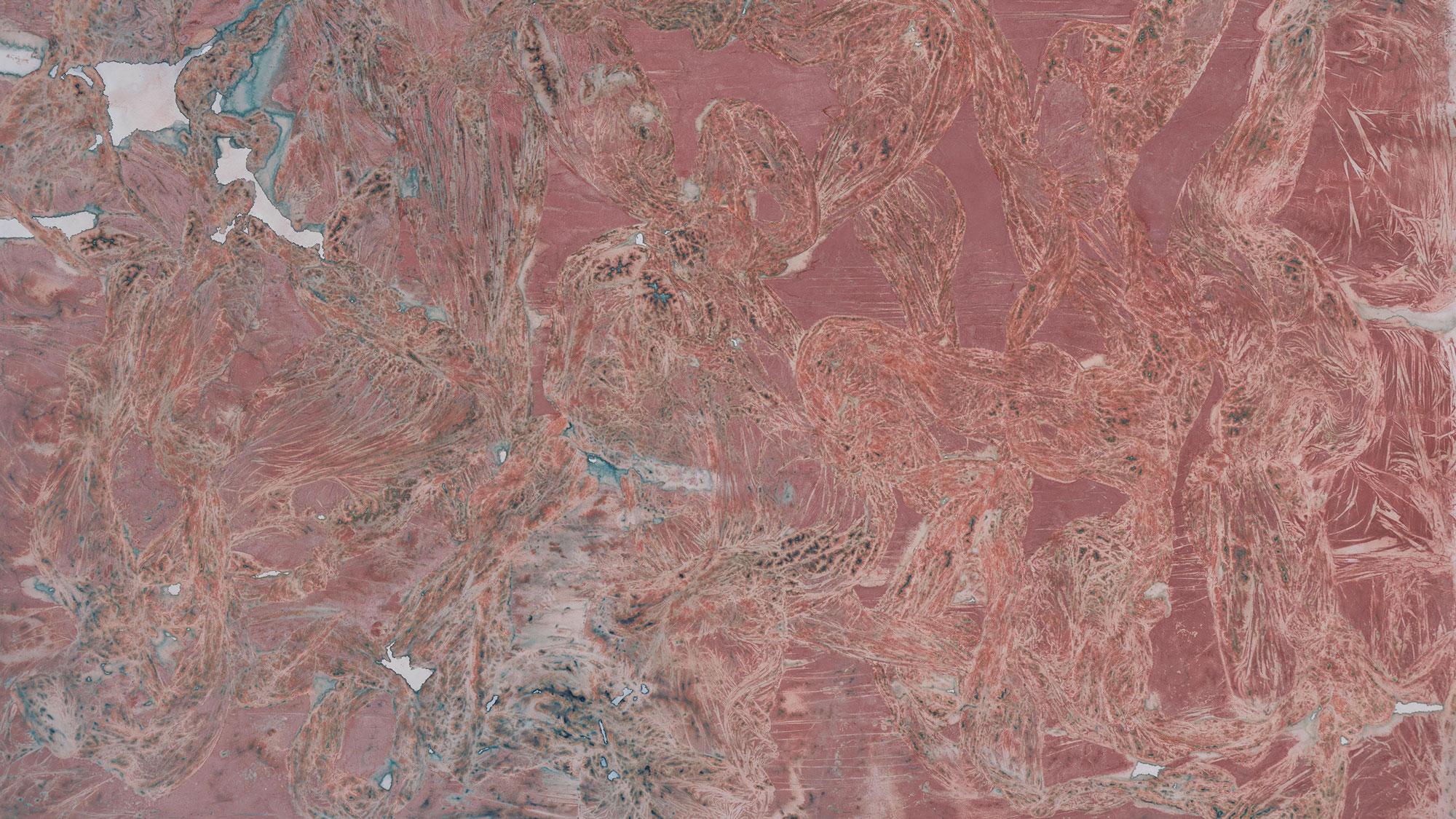
The third and final component of the Into Air project is Ash, a series of paintings created by blanketing the liquid remains of each melted pigment block with a large sheet of canvas-like paper. Ng leaves the paper there for weeks until all the liquid evaporates through it, creating marbled textures and thick buildups that she then peels away. Ng describes Ash as her attempt to “sieve time.”
Many of the photographs and residue paintings take their titles from song lyrics—by the Beatles, Genesis, the White Stripes, Death Cab for Cutie, Sufjan Stevens, and others.
Dawn Ng (Singaporean, 1982–), The Earth Laughs in Flowers I, 2020. Residue painting (acrylic, dye, ink) on paper, 165 × 142 cm.Dawn Ng (Singaporean, 1982–), Ever see, ever be, ever know my heart (detail), from ASH, 2022. Residue painting (acrylic, dye, ink) on paper, 199.5 × 150.3 cm.
There is an inescapable relationship between beauty and death. Death gives meaning to all of time. I don’t necessarily see death as something tragic, sad or final. It is that structure that gives true worth and true value to what comes before it. In Asia, especially as a Chinese Asian, we don’t like to talk about death. We feel it is bad luck. But in the paintings, I see death as something beautiful. Even in that last transition to nothingness, the pigments explode. They have a way of clinging on, they try to form tributaries, they flood a space. There is something very beautiful about that last gasp. It is not meek. It can be as strong as fireworks.
I would actually not use the word “nothingness” to describe the blocks’ final state. There’s definitely a “somethingness” still there after the melt! Behold the Ash paintings, which have a glory of their own. Although death is an end of sorts, it’s also a passing from this to that. Ng acknowledges as much. She even describes how “the melted pigments receive a form of resurrection through their incarnation as painterly formulae” in the Ash series. Resurrection!
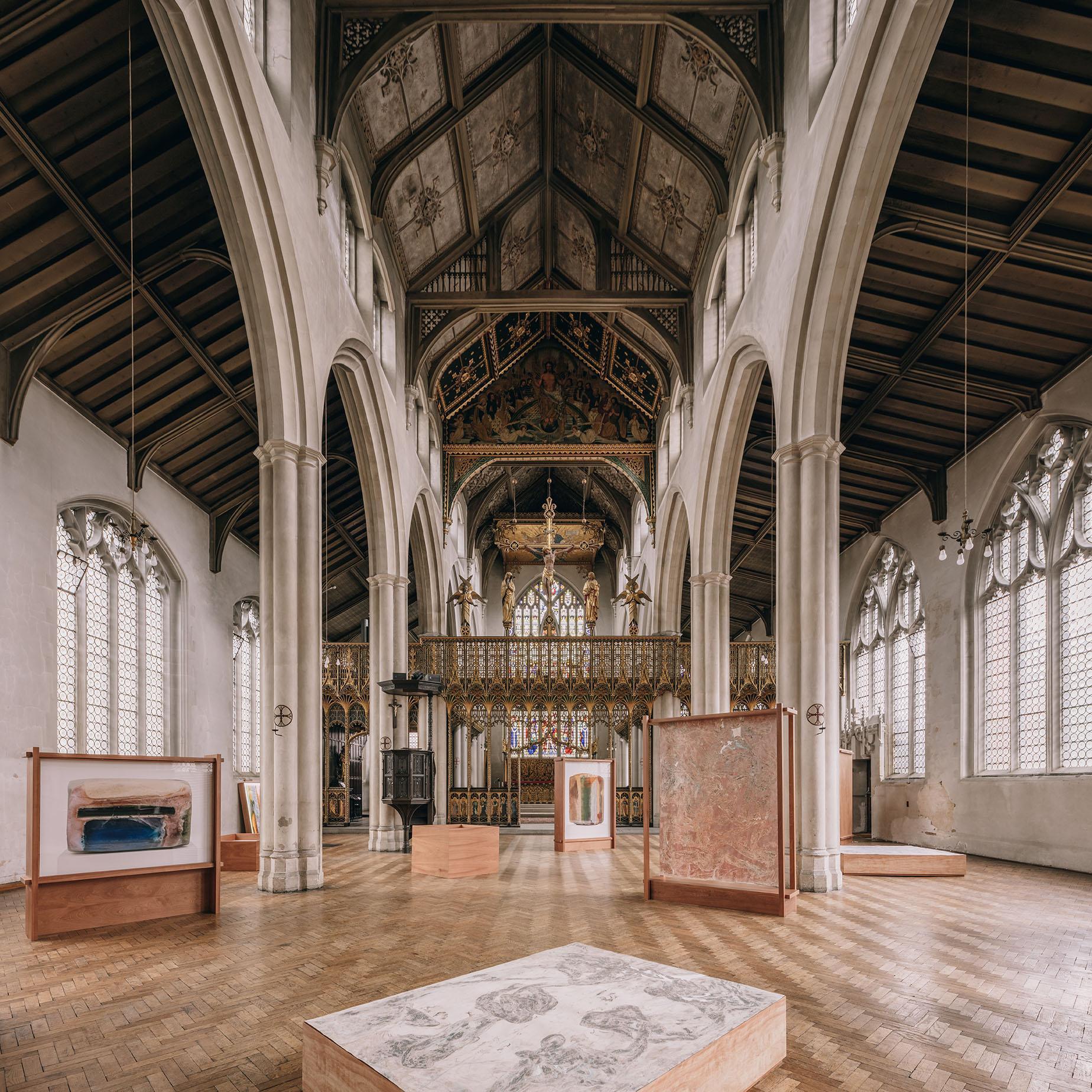
From July 7 to 23, 2022, Into Air was exhibited, under the curation of Jenn Ellis, at St Cyprian’s, Clarence Gate, a historic church in London’s Marylebone district. The midcentury pews, pulpit, and altar inside the Gothic revival interior inspired Ng to design, in collaboration with EBBA architects, new wooden box structures to house the works, some of which stand vertically, and others which lay parallel to the floor.
Exhibition view of Into Air by Dawn Ng, St Cyprian’s Church, London, July 7–23, 2022. Photo: James Retief.Installation shot of Waterfall VII, 2022. Single-channel 4K video, 25 mins, 24 sec. Photo: James Retief. [watch video]
By displaying these works inside a sacred space, their spiritual implications become even more pronounced.
Impermanence is a theme that shows up in the sacred texts of all major religions, not least in the Bible, where we humans are reminded again and again of our mortality. Our days are like grass, which sprouts up and then withers (Isa. 40:6–7; Ps. 103:15–16; 1 Pet. 1:24). Our lives, but a sigh (Ps. 90:9–10), a shadow (Ps. 102:11), a mist (James 4:14), a breath (Ps. 39:5; Job 7:7; 7:16). We are made of dust and return to dust (Eccles. 3:20).
And not only are we finite; so is the present order of things. Even heaven and earth will pass away, Jesus says (Matt. 24:35; Mark 13:31; Luke 21:33; cf. Heb. 1:10–12). But, crucially, God and God’s word stand forever (Isa. 40:8; Matt. 7:24–27). True stability and unchangingness can be found only in God, Christians believe. God is a Rock that does not crumble, a strong foundation on which to stand, in life and in death.
The brevity of life may sound like a fearsome reality, but actually, it can serve to make our moments here on earth more precious and purposeful. Because our lives are but a short span, we must make the most of them while we can. Christians believe that everyone will one day have to give an account of what we did with the time God gifted to us. Did we share it freely with others, or keep it all for ourselves? Did we use it to cultivate virtue or to pursue vice?
The exhibition at St Cyprian’s also involved the premiere of a site-specific choral work by the London-based Welsh composer Alex Mills. A direct response to Ng’s art, his composition is also called Into Air and lasts about twenty-five minutes, the length of Ng’s Waterfall VII.
“In the piece,” Mills writes,
five singers undergo a musical meditation where each moves through the music to the rhythm of their own breaths, one bar of music for every exhale. Musical structures slowly build and disintegrate, evolve and transform, melt and evaporate. Textures, harmonies and colours – some delicate, others more pronounced – appear, disappear and re-emerge. Combing different singers’ breathing patterns gives the piece an indeterminate quality: the piece will never be the same twice and may even be radically different from one performance to the next. As such, the piece is not a fixed musical object that can be ‘performed’. Instead, it is a transient, ephemeral and elusive moment in time to be experienced.
The first singer stands at a kneeler. The second, at a pulpit. They establish the solemn mood. Two male singers sing from the organ loft, and another stands behind the rood screen with his arms crossed over his chest, as if in prayer. Haunting and mesmerizing, the five voices reflect off the stone architecture and meld together, sometimes harmoniously, sometimes in dissonance.
To everything there is a season. Starting at around 10:35, Mills incorporates keywords from Ecclesiastes 3:1–8, a biblical passage made especially famous by the Byrds: “gather,” “scatter,” “heal,” “kill,” “dance,” “mourn.” The author of Ecclesiastes is describing the tide of events that make up a life.
Periodically throughout the performance, a metal singing bowl resounds—a tool commonly used to deepen meditation. It is struck alternately by Ng and Mills, who are seated cross-legged at the front side of the church.
Dawn Ng and Alex Mills at the premiere of Mills’s Into Air, St Cyprian’s Church, London, July 8, 2022. Photo: Damian Griffiths and Sarah Isabelle Tan.
Mills’s Into Air received a second performance just last week on February 8 at the launch of Music & Being, an initiative he founded with Jess Dandy. Music & Being is an open laboratory space in London exploring the intersection of art, music, psychology, spirituality, ecology, and movement.
As we near Ash Wednesday, the start of Lent, Ng’s and Mills’s works remind us of how time slips and slides and ultimately ceases, at least time as we know it. What will we do with our fleeting lives? As they dissipate, what will remain? When our breath stops, will a resonance linger?
Since 2020, I have been publishing an annual list of my top twenty films of the year, with trailers and microreviews. (See my lists for 2020 and 2021.) I love the collaborative nature of filmmaking, the coming together of so many talents—writing, acting, directing, shooting, editing, set design, costume design, etc.—to tell a story through moving images. Movies are actually my favorite mode of storytelling. It’s a shame that in some circles they’re denigrated as inferior to novels, less worthy of our time. That’s absolutely not true!
Moviegoing can be transformative. Like other art forms, movies reflect back to us the many aspects of the human (and in the case of my #5, animal!) experience, and can demand something of us.
Here are the first ten of my twenty recommendations for films to see that were released in the United States (though several were made internationally) in 2022, ranked in order of preference. Please be aware that many of these have R ratings and that you can consult content advisories if that concerns you.
1. Everything Everywhere All at Once, dir. Daniel Kwan and Daniel Scheinert. Bighearted and bizarre, this comedy sci-fi action adventure is about a first-generation Chinese American woman, Evelyn (Michelle Yeoh), who’s trying to hold it all together as her laundromat business is failing and her relationships are fraying, especially with her twenty-something daughter, Joy (Stephanie Hsu), whom she just doesn’t “get.” Then one day, out of nowhere, Evelyn is enlisted by a version of her husband, Waymond (Ke Huy Quan), to stop the evil Jobu Tupaki, a version of Joy, from destroying the multiverse. As Evelyn travels to alternate universes, she’s able to access skills and emotions her alt-selves possess and bring them back with her to help her fight.
Absurdity ensues. In one universe, Evelyn has hotdogs for fingers, and so becomes adept at using her feet; in one she’s a rock overlooking a canyon; in another, a teppanyaki chef whose colleague is controlled by a raccoon under his hat; in yet another, she’s a martial arts–trained movie star who never left China. She “verse jumps” from one to the other seeking to save her daughter from the vortex of despair into which she’s trying to suck everyone and everything, and all the while Joy is trying to find a version of her mother whom she can connect with, who can understand the emptiness in her.
The directors said the film is about a family trying to find each other through the chaos. At its core, it’s a family drama—one that explodes across the multiverse. It’s also about choosing kindness and joy (symbolized by a googly eye) and moving toward one another in empathy. It’s much louder and more outrageous than all my other picks, and I could have done without the scatological humor, but I found myself enthralled by the wild, disorienting ride that lands at a really tender place. Michelle Yeoh proves her versatility as an actor, and Jamie Lee Curtis, who plays IRS inspector Deirdre Beaubeirdra, is hilarious.
Streaming on Showtime.
2. The Banshees of Inisherin, dir. Martin McDonagh. Set in 1923 during the Irish Civil War on a fictional island off Ireland’s west coast, this dark comedy begins when Colm (Brendan Gleeson) tells his lifelong bestie, Pádraic (Colin Farrell), that he no longer wants to be friends. Colm is a fiddler and composer who wants to establish a legacy, a musical output that will live on—a goal that Pádraic is impeding by distracting him with daily hours of dull conversation, he says—whereas Pádraic says he merely wants to be known for “being nice.” Baffled by his friend’s abrupt severing of their relationship, Pádraic repeatedly pursues understanding and restoration, escalating the tension toward acts of violence. Male friendship and loneliness, melancholy, and mortality are key themes in this artful buddy-breakup movie that had me laughing out loud as well as tearing up.
Streaming on HBO Max.
3. Guillermo del Toro’s Pinocchio, dir. Guillermo del Toro and Mark Gustafson. Light overcomes the darkness in this stop-motion animated musical adaptation of the classic Italian children’s novel from 1883. It was written and codirected by Guillermo del Toro, a master of magical realism, and has been in development since 2008. When his young son dies, the carpenter Geppetto (David Bradley) carves a boy puppet, Pinocchio (Gregory Mann), to fill the hole left by this profound loss. In an act of compassion, the Wood Sprite (Tilda Swinton) brings Pinocchio to life and commissions Sebastian J. Cricket (Ewan MacGregor), an itinerant writer, to look out for him. Curious and unruly, Pinocchio ends up trapped in a circus by an abusive showman. He and his father spend much of the film trying to reunite, to be family to each other.
These story points will sound familiar to most, but del Toro cleverly adapts them and adds new ones, setting the story in a Tuscan village during the rise of Mussolini in the 1930s, with one of the main villains being a Fascist podestà who’s trying to recruit Pinocchio into the army. It turns out it is the villagers who blindly subscribe to Il Duce’s propaganda who are the puppets, whereas Pinocchio, with his irrepressibility, is decidedly unpuppetlike. Thus the film explores contexts in which disobedience can be a virtue. Del Toro also places more emphasis on Geppetto’s growth than Pinocchio’s, making the story about Geppetto becoming a real father—learning to accept Pinocchio with all his quirks and difference, not making his love contingent on Pinocchio fulfilling his image of the perfect son—rather than Pinocchio becoming a real boy.
The artistry of this film is dazzling! I was blown away by the production design by Guy Davis and Curt Enderle (they designed the locations and characters and established the whole visual style), especially the evocation of interwar Italian life and culture, with the centrality of the church. I’m also dazzled by the puppets—shout-out to Georgina Haynes, the director of character fabrication—because remember, with stop-motion animation, all the characters are handmade, physical creations existing in three-dimensional space, not computer-made or drawn on a page; all but the “wooden” Pinocchio (made from 3D-printed hard plastic) consist of a manipulable silicone skin sitting over a mechanized system.
Streaming on Netflix.
4. Aftersun, dir. Charlotte Wells. Eleven-year-old Sophie (Frankie Corio) is on vacation with her single dad, Calum (Paul Mescal), in Turkey. He doesn’t have a lot of money, but he’s trying to create a memorable holiday for her. And despite its mundanity, it is memorable—the frame story is adult Sophie replaying its moments on tape and in her mind. Aftersun is a very personal project for first-time writer-director Charlotte Wells, who draws on her own history and relationship with her father; she says she wants people to be able to feel the warmth of these memories, even though they’re tinged with sadness. Though it’s never spelled out, it appears that Calum suffers from depression, and we gradually see more and more of his pain. The lack of exposition enables us to make our own inferences about it and about the ending. The “Under Pressure” dance sequence, which intercuts a frantic, stroboscopic nightclub scene where adult Sophie searches the floor for Calum with one of young Sophie and Calum dancing lovingly outside the hotel, safe in each other’s arms, is a contender for scene of the year—a metaphoric conveyance of mental health decline, of holding on and letting go.
5. EO, dir. Jerzy Skolimowski. Who would have thought a donkey’s inner life could be so captivating to watch onscreen? His memories, his imagination, his hopes, his fears, the affection he feels and longs for, his joys and sorrows. EO follows the life journey of the titular donkey as he passes from owner to owner, some of them kind, others cruel. He starts out at a circus in Poland, where he’s tenderly cared for by the young performer Magda (Sandra Drzymalska). But he’s seized by animal rights activists and ends up at a horse sanctuary, and from there he moves to a petting farm for children with disabilities. He escapes, looking for Magda, and spends a harrowing night alone in the forest. Chancing upon a soccer game the next day, he becomes a mascot for a time, a figure of great adulation but also vitriol by the opposing team. His next job is as a beast of burden at a fur farm, where he’s made to carry fox pelts, and then he’s acquired by an Italian priest.
There’s very little dialogue in the film, and there are no voiceovers to convey EO’s thoughts or emotions, which we infer by context. The cinematography, from close-up shots of EO’s dark, expressive eyes to wide shots of varied landscapes, is gorgeous—visual poetry. EO is an indictment of human violence and a call to empathy for animals. Dare I say I liked it better than the Bresson classic (Au hasard Balthazar) that inspired it? Unlike its predecessor, it stays entirely focused on the donkey’s perspective, with humans relegated to the periphery.
6. Hit the Road, dir. Panah Panahi. A road-trip dramedy from Iran, this debut feature by Panah Panahi follows a family of four as they drive across the Iranian countryside under the pretext of a wedding. Dad (Mohammad Hassan Madjooni), who wears a leg cast, sits in the back with the young ball-of-fire son (Rayan Sarlak) and sick dog, while Mom (Pantea Panahiha) and the quiet older son (Amin Simiar) take turns at the wheel, sometimes evincing their worry. There’s something clandestine about this journey, and over the course of the film we learn more but not much. But even with the imminent separation hanging like a cloud, there’s a lightness and a sweetness that’s so endearing as we watch the characters bicker and goof around and connect with one another. Films that can hold together the weighty and the comical, like this one, tend to be the ones I enjoy most.
Streaming on Showtime.
7. TÁR, dir. Todd Field. Set in the classical music world, this drama explores the corrupting nature of power through the (fictional) character of Lydia Tár (Cate Blanchett), an award-winning conductor, composer, educator, and author. It’s an intense and brilliant performance of a complex character who is amazing at her craft but who also uses her status to manipulate others, including the young female cellist who has just joined her orchestra, the prestigious Berlin Philharmonic. The tension rachets up as they prepare to perform Mahler’s Fifth Symphony and rumors about Lydia’s connection to the death of one of her former protégés threaten to undo her.
8. Broker, dir. Kore-eda Hirokazu. Found families is a key theme in the oeuvre of the Japanese director Kore-eda Hirokazu, whose Shoplifters (2019) is one of my all-time favorite films. His latest, Broker, is set in South Korea. Seeking to place her newborn son, Woo-sung, in the care of a family better equipped to raise him, the young single mom So-young (Ji-eun Lee) leaves him outside a church, where he is intercepted by Sang-hyeon (Song Kang-ho) and Dong-soo (Dong-won Gang), who attempt to sell him on the adoption black market. The next day she returns with doubts and demands to be included in the process of finding a home for Woo-sung. So she follows the two brokers in responding to the calls of prospective buyers, and along the way they pick up a stowaway from an orphanage, the ebullient Hae-jin (Seung-soo Im), the character that really brought it all together for me.
As they drive from city to city, the five travelers bond with one another, each of them carrying their own forms of rejection trauma and seeking love and belonging. The last night they spend together . . . wow! Kore-eda is a deft handler of sentiment, never maudlin but rather inserting understated emotional moments in all the right places (another example: the flower on the wet car window scene). He tackles heavy subject matter and complex social issues with heart, always keeping his characters at the center and allowing for reprieves of warmth and brightness. He avoids simplistic endings but also unnecessarily bleak ones, taking a vantage point of hope.
9. The Fabelmans, dir. Steven Spielberg. This coming-of-age drama is a fictionalized telling of Steven Spielberg’s upbringing in a midcentury Jewish American household and, since seeing his first movie in a theater at age six, his developing passion for cinema. Spielberg’s stand-in is Sammy Fabelman (Gabriel LaBelle). In many ways The Fabelmans is Spielberg’s love letter to his artistic and free-spirited mother, named Mitzi in the movie and played by Michelle Williams, who from the get-go fully supports Sammy’s dream to become a filmmaker, unlike his much more practical father, Burt (Paul Dano), a computer engineer, who doesn’t initially see filmmaking as a worthy pursuit.
I wondered if The Fabelmans was going to be a self-indulgent homage to Spielberg’s successful career, full of Easter eggs to his other films, but it wasn’t that at all. The story stands on its own apart from its basis in the particularities of Spielberg’s life. It’s about vocation and family and the power of films to help us see the truth. That it’s also a semiautobiographical portrait of a director whose films I grew up on (E.T., Jaws, Jurassic Park) and continue to admire is an added bonus!
10. Nanny, dir. Nikyatu Jusu. Marked by menace and mystery, this psychological horror-drama centers on Aisha (Anna Diop), a Senegalese immigrant to New York City hired by an affluent couple to care for their daughter. Aisha is haunted by the absence of her six-year-old son, whom she left under the care of a cousin in Senegal so that she could earn money to bring him to the US. But that goal becomes difficult when her employers start withholding her wages. As she navigates the oppressive situation she finds herself in, she is visited by figures from West African folklore: Mami Wata (a mermaid-like water spirit) and Anansi (a trickster spider). They seem like malevolent forces, but her boyfriend’s grandmother encourages her to reframe her thinking and to ask what the spirits want not from her but for her. Could they be haunting her to help guide her toward a new and better life?
The film deals with class, race, exploitation, resistance, survival, motherhood, and guilt—all parts of Aisha’s immigrant experience. Despite the too-quick resolution that follows, the scene at the end of Aisha being reborn out of chaos is visually and emotionally compelling. I appreciate how writer-director Nikyatu Jusu, born in the US to Sierra Leonean parents, uses supernatural horror tropes in unique and subversive ways.
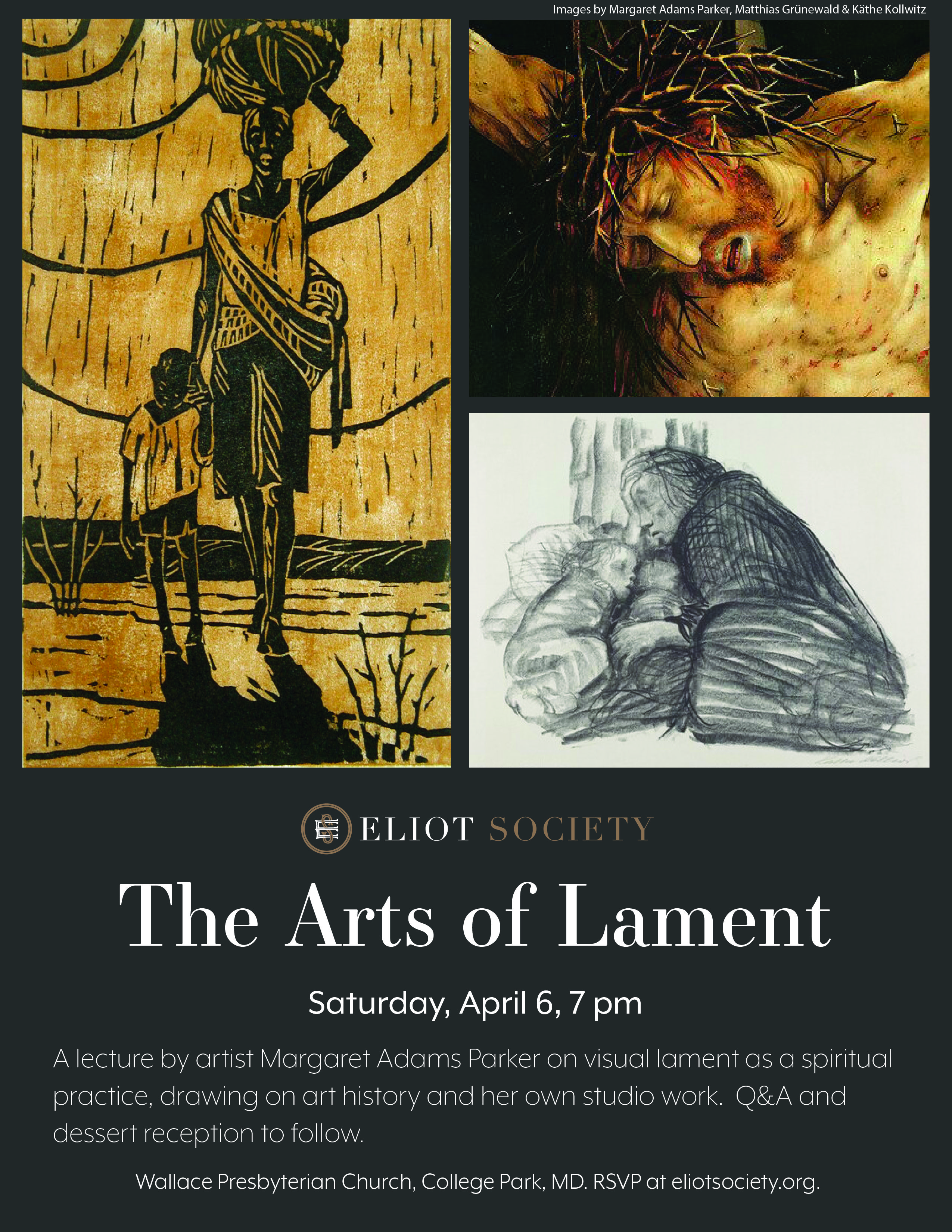
UPCOMING LECTURE: “The Arts of Lament” by Margaret Adams Parker: I’m one of the artistic directors of the Eliot Society, a DC-based nonprofit that promotes spiritual formation through the arts. Our next event is a lecture on April 6, 2019, by printmaker and sculptor Margaret (Peggy) Adams Parker (previously), which I’m really looking forward to.
Most especially during Lent, we recall the prominence of lament in Scripture: the psalms of lament; David’s lament for Jonathan; the Lamentations of Jeremiah; Christ’s lament over Jerusalem. These laments bear witness to outrage, sorrow, suffering, fear, desolation. And through these passionate cries, the biblical authors allow us to experience and express—in God’s holy presence—our own stories of brokenness and loss.
The visual arts make these laments visible. In this program Parker will present images by Grünewald, Rembrandt, Goya, Käthe Kollwitz, Jacob Lawrence, and others, as well as some of her own work. We will ask, How might these depictions of the horrors of war, displacement, oppression, sickness, and death enlarge our appreciation of the scriptural laments and in turn illuminate our understanding of suffering? Further, we will explore the spiritual significance of the practice: how lament might ultimately serve to console and strengthen, helping to lead us out of dark places into the light.
+++
SHALOM CHANT: At the 2019 Brehm Conference, “Worship, Theology, and the Arts in a Divided World,” liturgist Julie Tai led attendees in a group chant of the word shalom, an exercise she picked up from the author, speaker, psychotherapist, songwriter, and Episcopal priest Ian Morgan Cron. I streamed in from afar, and even from this distance, I found it really moving. “Really think about the places and spaces that need shalom—shalom meaning not our flat language of just ‘peace,’” Tai said by way of preface. “It’s an embodied word, a disruptive word. And we don’t get to see the completeness of shalom until all of us are at the table.” She instructs that after chanting shalom in unison three times, everyone is to find a note, any note, and sing it. Dissonance is welcome. The thick texture and distinctive timbre that result are possible only because each and every person is contributing their unique selves. The exercise is about listening to your neighbor, seeing your neighbor, and praying for and committing to pursuing shalom, wholeness, in this world. It expresses, in community, a shared hope and intention.
Chanting is a practice found in almost all spiritual traditions. Through rhythmical repetition, a word or short phrase washes over you and settles into the mind. When done in a group, everyone’s biorhythms become synchronized; individual breaths and sound vibrations unite, a physical manifestation of a spiritual communion.
“Julie Tai is the director of chapel at Fuller Theological Seminary. She received a BA in Asian American Studies and studied vocal jazz at UCLA before earning an MA in Intercultural Studies from Fuller. She is a songwriter, worship leader, and liturgist who loves to explore creative and integrative ways to engage diverse people in worship. A proud second-generation Korean American, Julie has led worship experiences at Urbana, the Calvin Worship Symposium, and SIM’s Global Assembly. She passionately trains worship leaders, seminarians, and pastors to see liturgy as a unifying and artistic act of justice . . . the reordering of glory, honor, and praise to the One seated on the throne.” [source]
+++
NEW SONG: “Jesus, See the Traveler” by Sara Groves: “I wanted a way for Ruby [my daughter] and me to remember the number of people who are on the road, displaced and wandering on any given night,” said Sara Groves about this new song she wrote. “Due to war and violence, there are more displaced people right now than any other time in history, and I want to be in the number who are responding in love—both in person in my community, and in my music.” The official music video is below; purchase the single on iTunes or stream on Spotify. [HT: Tamara Hill Murphy, A Sacramental Life]
+++
ARTICLE: “Art Interrupted” by Sophie Haigney: Unfinished artworks, like La Sagrada Familia (whose architect was hit by a tram when the cathedral was only a quarter of the way done) or Elizabeth Shoumatoff’s famous FDR portrait (the president slumped over mid-portrait-sitting and died of a brain hemorrhage), are reminders of our mortality. [HT: Michael Wright, Still Life]
Cranes hover over the spires of La Sagrada Familia in Barcelona, whose construction began in 1882 under architect Antoni Gaudí and is still going on.
+++
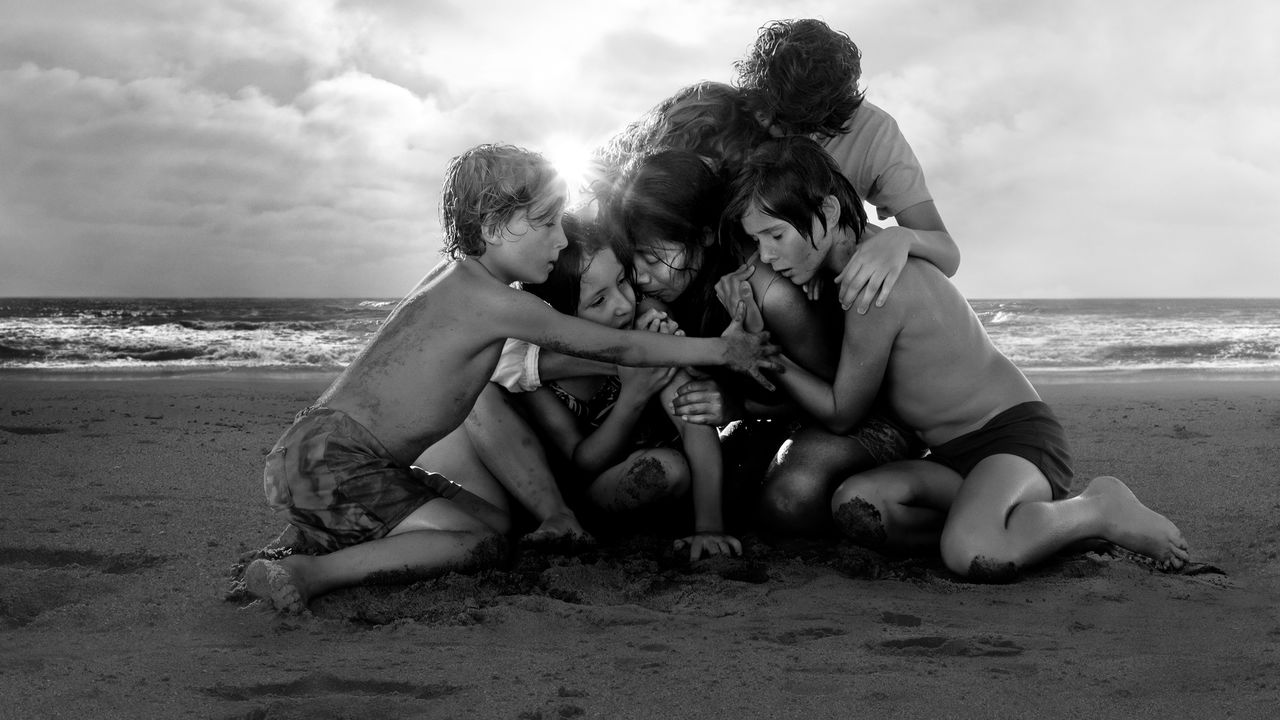
PODCAST EPISODE:“Roma,”Sunday Morning Matinee, January 22, 2019: To help me think more deeply and articulately about movies, I appreciate the work of, among others, Sunday Morning Matinee (formerly Technicolor Jesus), hosted by Matt Gaventa and Adam Hearlson. Back in January they discussed a movie that was one of my favorites of 2018, which is Roma, written, directed, and shot by Alfonso Cuarón. Set in the Colonia Roma neighborhood of Mexico City in the early ’70s, it focuses on Cleo (played by newcomer Yalitza Aparicio), a Mixtec domestic servant for a middle-class family. It was a very personal project for Cuarón, who based the character of Cleo on the real-life nanny who helped raise him, Liboria “Libo” Rodríguez.
This still frame from Roma captures a climactic moment of shared intimacy as Cleo (center), grieving a recent trauma, receives love and support from the family she works for.
“As artists, our job is to look where others don’t,” Cuarón said in his acceptance speech last month for the Academy Award for Best Director. (The movie also won Best Foreign Language Film and Best Achievement in Cinematography.) As an adult, Cuarón looked back and realized that Libo had another life, both internal and external, that he had not been aware of as a child, and this is his way of honoring Libo’s beautiful complexity. This podcast episode discusses the opening and closing shots of the movie, water symbolism, the contrast of the terrestrial and the heavenly, the role of memory, Cleo’s interiority and who gets access to it, the possibilities and limits of employer-employee relationships, and more.







 Art & Theology