
Roundup: New albums, historic Boston church to get new mural, new opera sets words of Mexican nun, and more

NEW ALBUMS:

>> The Divine Dark, vol. 1: This three-song EP was released December 15, 2024, on Re-Echo Records, a new label for music created by artists from Resurrection Philadelphia church. “The Divine Dark is an ongoing series of original arrangements and compositions for devotion, contemplation, and edification. The series takes its name from a phrase that emerged in the fifth century among Christian mystics to describe the ineffable unknowableness of God . . . in all his kindness, grace, and mystery.”

The first volume features new arrangements by Joshua Stamper [previously] of two seventeenth-century German hymns (both translated into English by Catherine Winkworth, and sung here by Sarah Long), plus one new hymn that Stamper wrote with his wife, Kory Stamper, whose refrain is taken from Psalm 127:4. The songs quietly explore the mysteries of salvation, the Eucharist, and God’s sovereignty as well as some of the paradoxes of God’s character, such as his being both storm and shelter (wild and thundering, but also safe and enfolding).

Volume 2 of The Divine Dark is likely to release later this year.

>> It Is Good to Be Here with You by Nick Chambers: Out today, the first full-length album by singer-songwriter Nick Chambers. These songs of spiritual seeking touch on sobriety, divine nearness, ambiguity and wonder, the pursuit of understanding or insight, the longing to be held and loved, and more. Chambers deftly weaves voices from scripture—the blind beggar Bartimaeus, who cried out to Christ for mercy; the sons of Korah, who thirsted for God like a deer thirsts for water; the apostle Paul, who experienced a frustrating tension between desire and action—with his own poetic voice, finding companionship with those ancient seekers who were transformed by their encounters God. There’s reference to the wrestling patriarch Jacob, the blazing bush-vision of Moses, Elijah in a wilderness cave, the mount of Transfiguration, the eighth day of creation. Besides biblical texts, the songs bear influences from writers Rainer Maria Rilke, Madeleine L’Engle, Gregory of Nyssa, and Esther de Waal.

The album features some co-writing contributions by Jon Guerra (“Hold Me”), Paul Zach (“A Sweeter Word,” “Always Already”), and Tyson Matthews (“It Is Good to Be Here with You”).

My favorite tracks: “To an Unknown God,” “Hear,” “Thanks Be to God.”

+++

NEW ART COMMISSION: Memorial to Enslaved Persons by Harmonia Rosales, King’s Chapel, Boston: Harmonia Rosales, an Afro-Cuban artist born and raised in Chicago and living in Los Angeles, is at work on a three-part commission for the historic King’s Chapel at 58 Tremont Street in Boston, a church originally built in wood in 1686 and then rebuilt in stone in the 1750s. One of the oldest churches in the United States, it (and its adjacent burying ground) is one of the stops along the Freedom Trail, and it still has an active congregation.
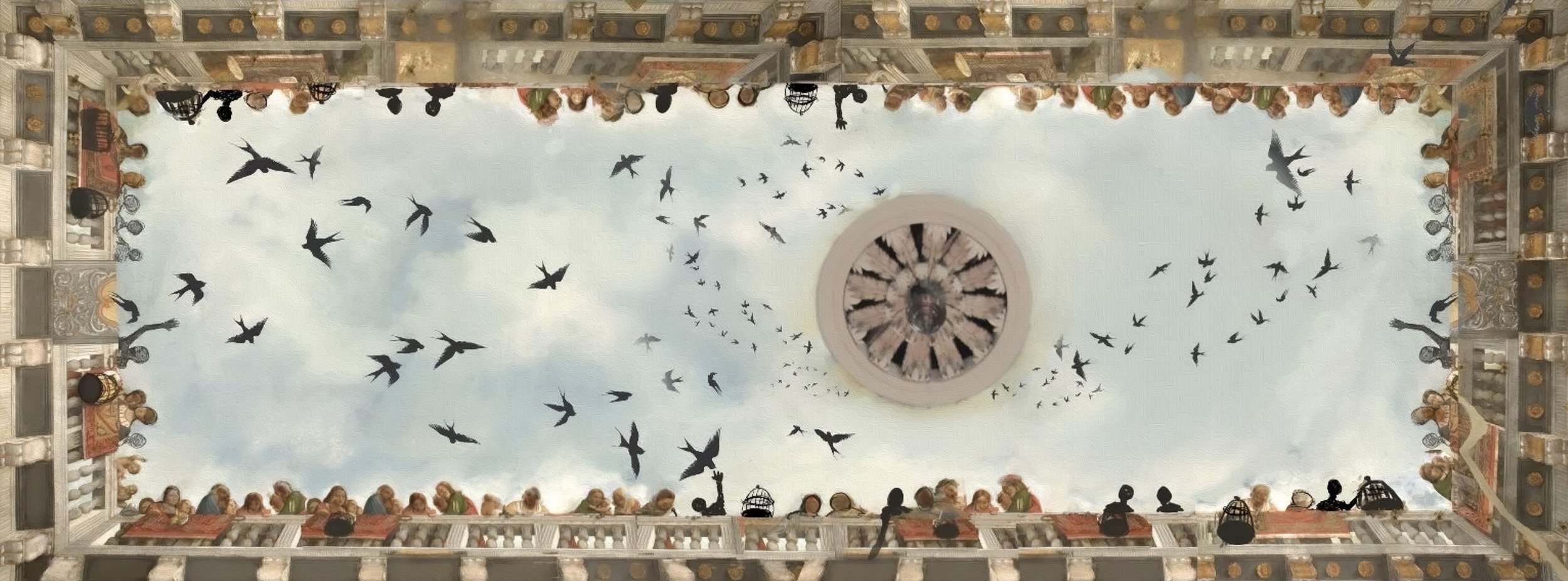
Rosales, Harmonia_King's Chapel ceiling mural
Conceptual image of the mural by Harmonia Rosales that’s being installed this year on the ceiling of King’s Chapel in Boston, Massachusetts

Despite being in the North, King’s Chapel has links to the slave trade. Historical documents reveal that at least 219 persons, most of them of African descent but at least two of them Native American, were enslaved by ministers and members of the church throughout its history, and that even after slavery was abolished in Massachusetts in 1783, donations to the church continued to flow in from people whose wealth depended on Southern slave labor, such as textile magnates. You can read more details in Slavery and King’s Chapel, the thirty-two-page report published by King’s Chapel’s Ad Hoc Committee on Slavery in 2018.

Until at least the mid-nineteenth century, people of color, both enslaved and free, who attended King’s Chapel were relegated to the balcony seats. We know the names of 182 enslaved attendees from the church’s baptismal, marriage, and burial registers. “As a community of faith,” the church writes on its website, “we are working to recover, honor, and remember these long-overlooked members of our community. We hope to make their lives and their presence in early Boston visible in new and powerful ways as we tell a more complete version of our history for our congregation, our city, and the 4 million people who walk the Freedom Trail each year.”

In addition to setting up a “living fund” to “provide monetary support for programs and engagement centered around reparative justice and reconciliation in the community,” the church has hired artist Harmonia Rosales, in partnership with the MASS Design Group, to create a physical commemoration of this history, which has three components: a figurative sculpture in the church’s courtyard, a collection of bronze birds perched throughout the church’s exterior and grounds, and a trompe l’oeil ceiling mural in the sanctuary. The memorial will be unveiled later this year. Here are two videos about it:

>> “How a Freedom Trail landmark is reckoning with its ties to slavery,” GBH News, July 19, 2023: This news segment features interview clips of Cassandra Dumay and Jessie Sage O’Leary, Boston University journalism students who are inquiring further into King’s Chapel’s links to the colonial slave trade; Rev. Joy Fallon, senior minister at King’s Chapel; Marissa Cheifetz, director of the King’s Chapel History Program; and memorial committee member David Waters.

>> “VCS Creative Conversations: Ben Quash with Harmonia Rosales,” Visual Commentary on Scripture, February 27, 2025: Theologian and VCS director Ben Quash sits down with artist Harmonia Rosales inside King’s Chapel to discuss her latest commission for that space, plus her paintings Birth of Oshun, The Creation of God, Strangler Fig, and more. Raised in the Santería religious tradition, in her art Rosales draws Yoruba deities (the orishas) into play with Christian ones and centers Black women. Speaking of the VCS’s commitment to showcasing biblical engagement from diverse vantage points, Quash tells Rosales, “We’ve always said that these conversations should not just be about the Bible’s importance to Christians or Jews, but the Bible’s importance to those of other traditions, as something to bounce off, to use, sometimes to object to. And you are a wonderful example of how to do that in a way that’s constantly creative and generous.”

+++

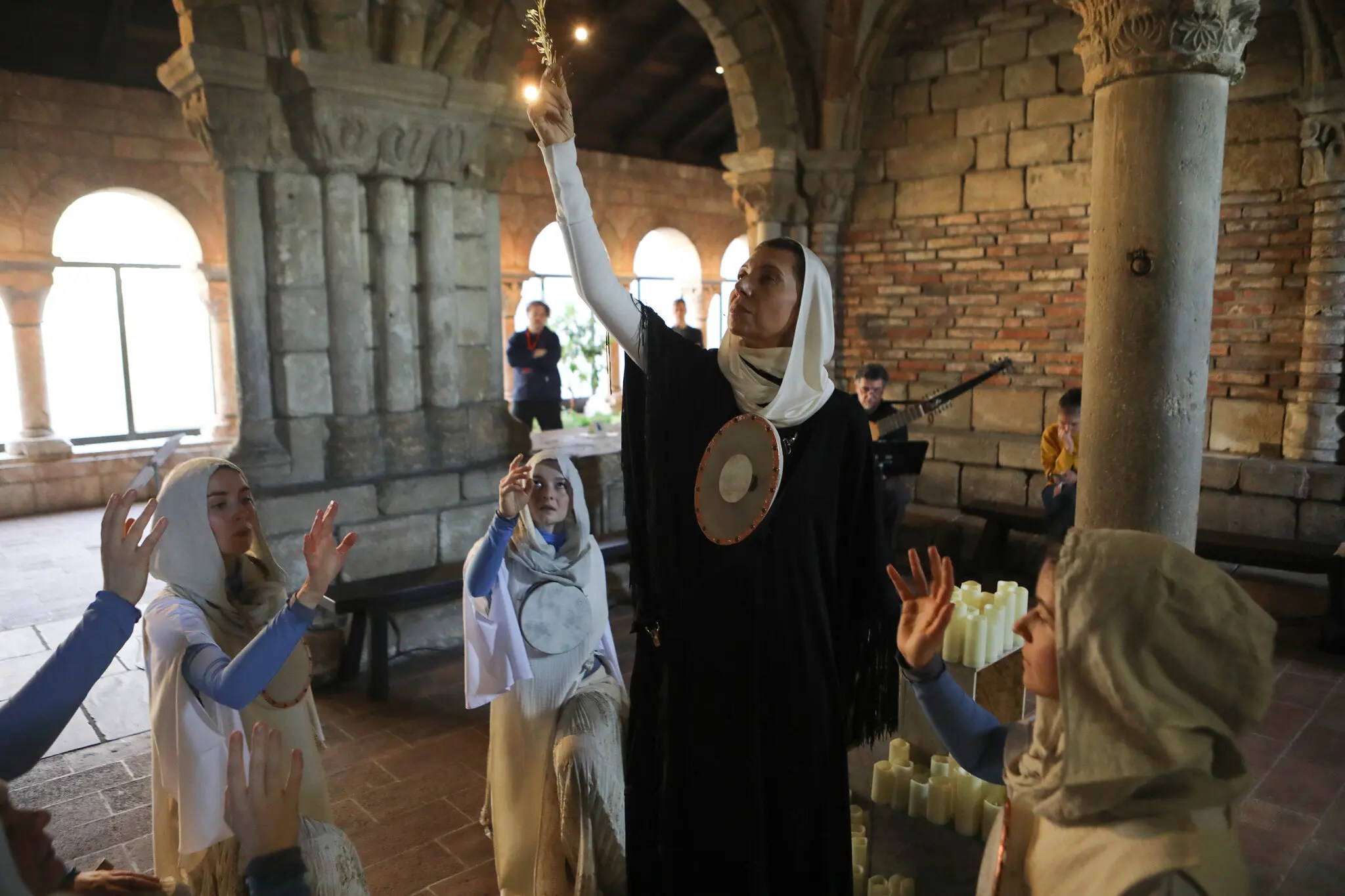
ARTICLE: “At the Cloisters, Sor Juana’s Words Ring Out in Song” by Elisabeth Vincentelli, The New York Times: Primero Sueño (First Dream) is a new opera by Magos Herrera and Paola Prestini that adapts to music the seventeenth-century mystical poem of the same title by the Mexican Catholic nun Sor Juana Inés de la Cruz, one of the greatest literary works of the Hispanic Baroque. Commissioned by the Metropolitan Museum of Art’s Department of Live Arts (MetLiveArts) and VisionIntoArt, it was conceived as a processional opera that meanders throughout the Met Cloisters, audience in tow—an appropriate choice, as the poem is about the soul’s journey. It premiered January 23, with Herrera playing Sor Juana, the nun in black, “sing[ing] in an earthy mezzo that complements the heavenly harmonies of the six nuns in white, performed by the German vocal ensemble Sjaella.” Accompaniment was provided by harps, hand percussion, theorbo, and Spanish guitar. Here’s a trailer (not filmed on location):
Primero Sueno performance
Magos Herrera, center, as Sor Juana in a rehearsal of the opera Primero Sueño at the Met Cloisters. Photo: Earl Wilson / The New York Times.

The Cloisters—a building designed to evoke a medieval European monastery and housing a sizeable portion of the Met’s medieval art collection—is one of my favorite spaces in all of New York. What a delight that Herrara, Prestini, and team utilized its halls and rooms as staging ground for this dramatic, musical reimagining of a historic sacred poem by a pioneering female Christian writer.

+++

INTERFAITH ART EXHIBITION: Cloud of Witnesses: Images of Faith and Divinity Today, St John’s Waterloo, London, March 4–April 27, 2025: A juried exhibition featuring the work of twenty-six artists from the UK, funded and supported by Art + Christianity; The God Who Speaks; St John’s Church, Waterloo; the Catholic Bishops’ Conference of England and Wales; Culham St Gabriel Trust; and Bible Society. Click here to view the exhibition catalog.

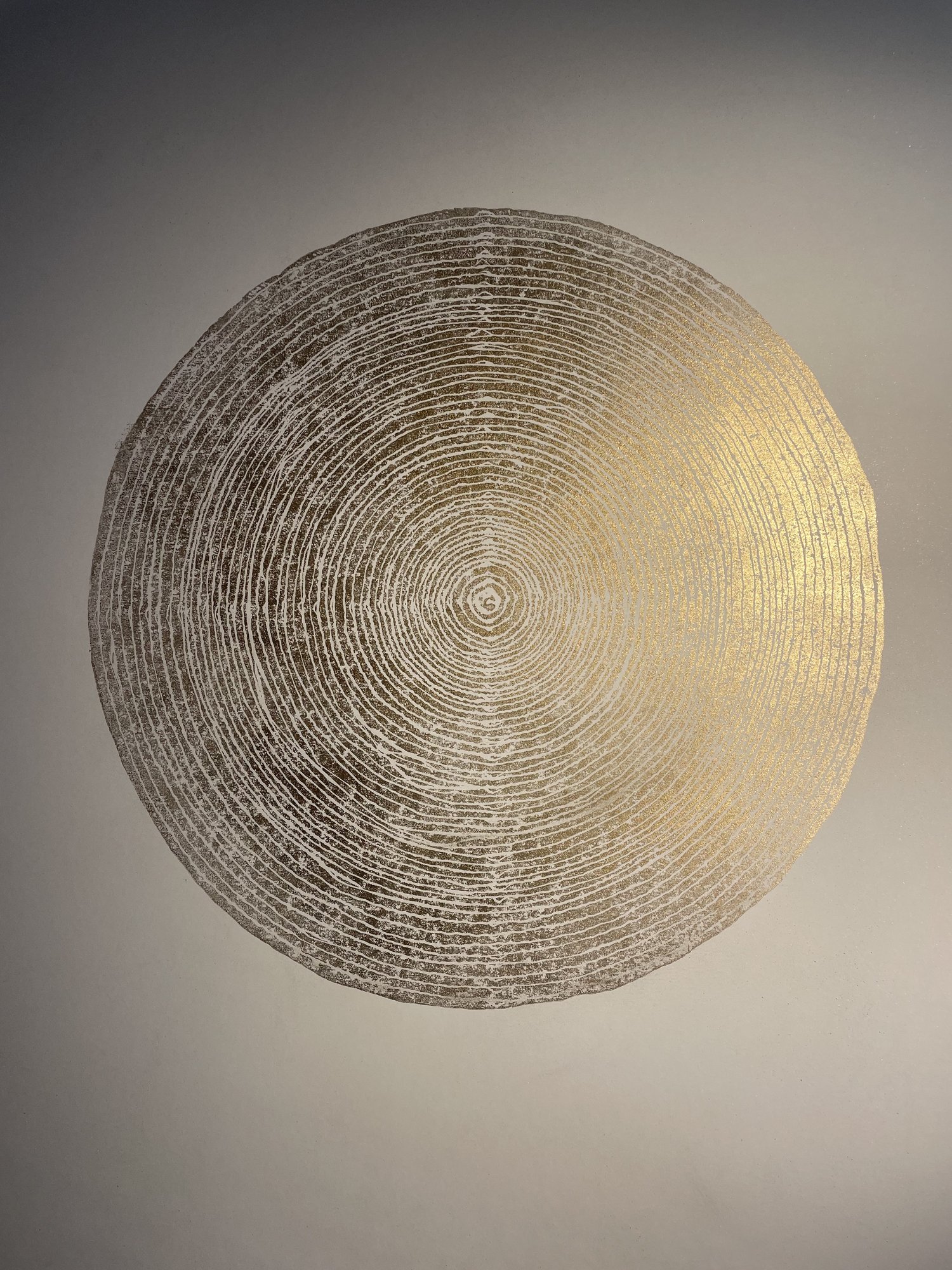
The image used for the cover of the exhibition catalog is Life 1, a linocut by Svetlana Atlavina consisting of fifty golden concentric circles that she said represent the vibrations of the heart—the sounds constantly being emitted from our cardiac valves, which mean we’re alive.
Atlavina, Svetlana_Life 1
Svetlana Atlavina, Life 1, 2024. Handmade linocut with gold ink on 300g white Somerset paper, 70 x 50 cm.

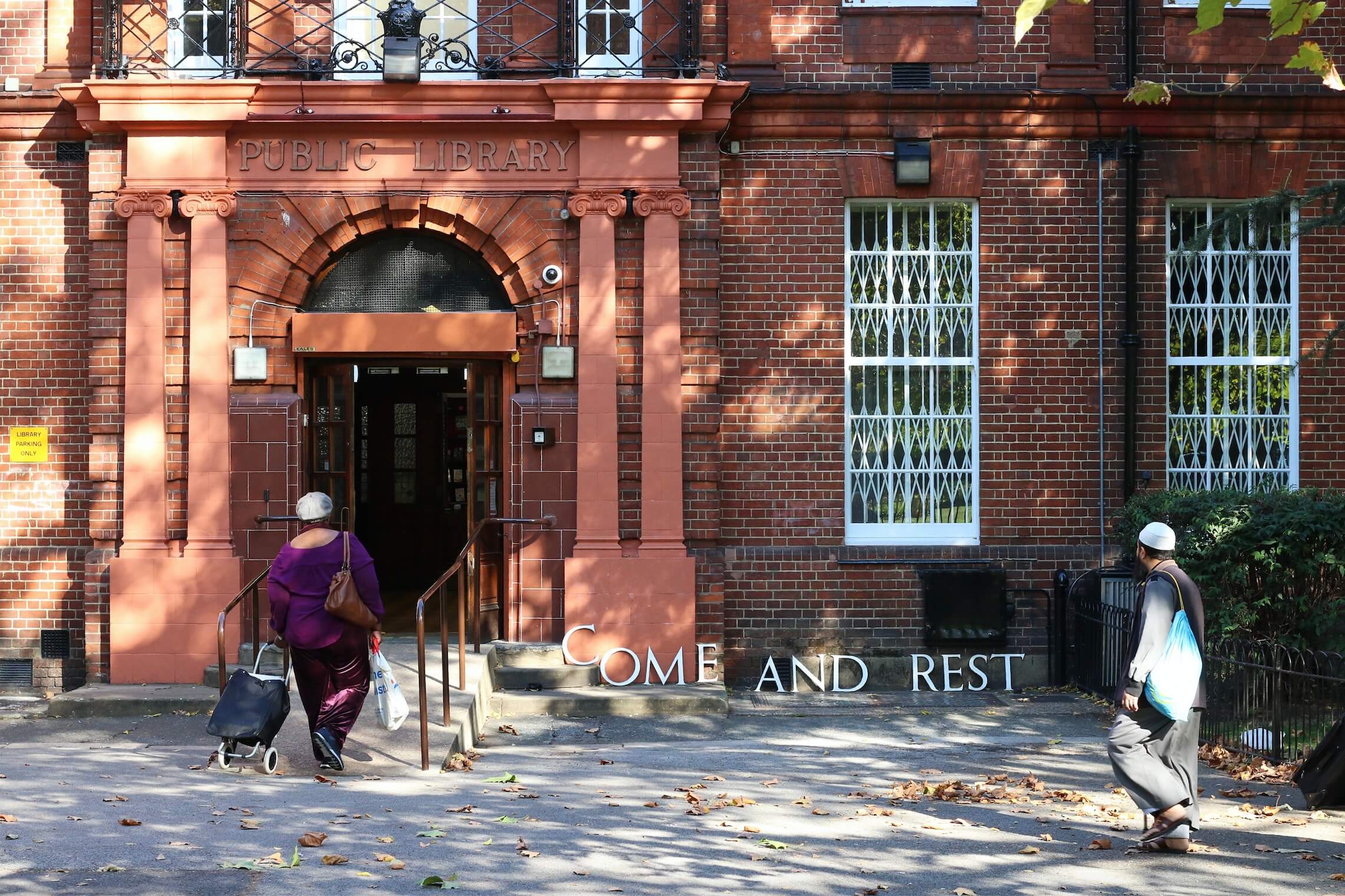
The work that I find most compelling is the eight-piece series of COME AND REST photographs by Kirsty Kerr.
Come and Rest: Bethnal Green Library
Kirsty Kerr, COME AND REST: Bethnal Green Library, 2018. Photograph of a public intervention, from a series, 30.5 × 44 cm. Documentation by Will Alcock.

COME AND REST documents a series of public interventions informed by the demolition and rebuilding of Bethnal Green Mission Church. Taking letters from a scripture text that had hung on the old building (Jesus’ words: ‘Come to me and I will give you rest’), Kirsty spelt the phrase in Bethnal Green locations, recording the process with local filmmaker Will Alcock. The words were a gentle yet radical proclamation: of welcome, refuge, and quiet protest against loneliness and exhaustion often synonymous with city life. The act of spelling them out became a performed prayer, symbolic of the church’s continued presence and God’s enduring invitation.

Against the backdrop of this racially and religiously diverse neighbourhood, the words were both witnessed to and overlooked by passers-by of all faiths and none.

Kerr displayed Christ’s invitation in fields and basketball courts, on street corners and scaffolding and bandstand steps, outside subway stops and housing estates and libraries. View the full series here, using the right scroll arrow. I also enjoyed exploring the artist’s other projects on her website.

+++

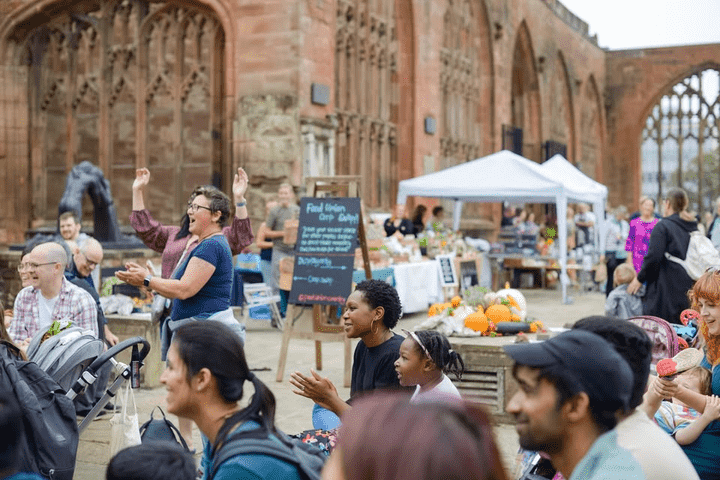
EVENT: Taste of Heaven Intercultural Worship Festival, Coventry Cathedral, May 24, 2025: Organized by Intercultural Churches UK. “The Taste of Heaven Festival will be an exciting opportunity to celebrate the rich cultural diversity and creativity of the UK church through live performances, workshops, food and worship. The festival will take place in the iconic venue of Coventry Cathedral and its beautiful surrounding ruins. The day will trace our history of increasing diversity, by highlighting different cultural worship expressions from Celtic to Choral, South Asian and Caribbean, to more recent immigrant communities including Middle Eastern, African, and Hong Kong. It will culminate in a celebration of Intercultural Worship, demonstrating how churches can draw from different cultural streams in their corporate worship.” Tickets range from £10 to £25. Register here. [HT: Global Christian Worship]
Intercultural Worship Festival

+++

SPOTIFY PLAYLIST: April 2025 (Art & Theology): The song selections on my short monthly playlists are somewhat random—a smorgasbord of what I’ve been listening to, a mix of brand-new releases and older faves—but for thematic playlists keyed to where we are in the liturgical calendar during April, see my Lent Playlist, Holy Week Playlist (I’m especially proud of this one!), and Eastertide Playlist.

Roundup: US-Zimbabwe sacred music collaboration, tour of Welsh folk hymns, peace song from Palestine, and more

CONCERT RECORDING: “Found in Translation: Cross-Cultural Musical Explorations of the Bible” with John Pfumojena and Delvyn Case: “In this unique concert, acclaimed Zimbabwean musician John Pfumojena and award-winning American pianist Delvyn Case reinterpret traditional sacred music by drawing upon traditions from Africa, Western Europe, and the Americas. Featuring one-of-a-kind arrangements for voice, mbira, and piano of gospel songs, African American spirituals, and hymns, the concert celebrates the unique power of sacred music to foster Christian unity—while simultaneously challenging us to consider the ways the church has fallen short of its ideals. Presented in June 2024 in historic Exeter College chapel at the University of Oxford.”

The program includes, among other selections, a medley of the nineteenth-century hymn “Abide with Me” from the UK and the nineties Zimbabwean song “Iwe Nesu” (Lord God, Be with Your Children) by Chiwoniso Maraire and Chirikure Chirikure; a powerful performative reading of Psalm 22 in English and Ndebele; and perhaps my favorite, the closer, the gospel song “Precious Lord, Take My Hand” with a verse in Shona.

To inquire about bringing this concert to your church, school, or organization in the UK, contact Deus Ex Musica.

+++

CONCERT TOUR: Tafod Arian (Silver Tongue), a.k.a. the Lost Welsh Folk Hymns, a project by Lleuwen Steffan: This year the progressive Welsh folk artist Lleuwen Steffan has been traveling to chapels and other venues across the UK to present a trove of little-known Welsh folk hymns that she uncovered from the sound archive of St Fagans National Museum of History. (The field recordings were made by folklore and oral history expert Robin Gwyndaf in 1964.) Mostly dating from the eighteenth century, these hymns were passed down orally and never made it into church hymnals.

“They’re conversational and the lyrics feel so current,” Steffan says. “There were committees who would choose what hymns would go into the hymn books. These were the unchosen ones, the ‘canceled’ ones, if you like. Many of them are about addiction, mental illness, the dark side of the psyche. You have one that talks of drunkenness and alcoholism that is transformed into drinking the wine from God’s cellar.”

In addition to showcasing her own contemporary arrangements of the hymns, Steffan is also performing electronic renditions of nineteenth-century “hwyl” (spirit) sermons. Here’s an April 17, 2024, performance of hers at Drygate Brewing in Glasgow, part of the Celtic Connections festival:

What a strange and interesting soundscape! I’m eager to hear more of these hymns, and I’d love to see at least some of them translated into English.

+++

DOCUMENTARY: “The Canaan Hymns,” part 4 of The Cross: Jesus in China, dir. Yuan Zhiming (2003): Lu Xiaomin (吕小敏) (b. 1970) is China’s most prolific and beloved Christian hymn-writer, having written over 1,800 hymns since 1990, published in Canaan Hymns (迦南诗选). She didn’t finish junior high school, and she’s had no musical education (at least not at the time the documentary was filmed two decades ago, a full decade into her hymn-writing endeavors), but despite her inability to read music or notate it, she has had a tremendous impact on the development of indigenized Christian worship in her home country. To set down the hymns she composes, she’ll sing them, either in person or into a recorder, and someone else transcribes them.

This documentary tells Lu’s story and features many of her beautiful hymns. It’s the final (fifty-minute) segment of the four-part documentary The Cross: Jesus in China (2003), made by the China Soul for Christ Foundation, and it’s been translated into fifteen languages: English, Arabic, Tamil, French, German, Polish, Dutch, Finnish, Norwegian, Swedish, Russian, Japanese, Korean, and Spanish. See https://www.chinasoul.org/en_US/the-cross.

+++

HYMNS:

I’m always finding new-to-me hymns from YouTube’s recommendations algorithm. Here are two that popped up in that sidebar recently that I particularly enjoyed.

>> “The Rock That Is Higher Than I,” performed by Hannah Fridenmaker: Written in 1871 by Erastus Johnson (words) and William Fischer (music), this hymn is based on Psalm 61:2b–3a: “Lead me to the rock that is higher than I, for you have been my refuge . . .” The video is from the Folks and Hymns YouTube channel of Hannah Fridenmaker, whose tagline is “Creating simple, singable versions of hymns and folk songs for family worship and connection, and for the joy of singing together.”

Follow Folks and Hymns on Instagram, Facebook, and Patreon.

>> “I’m Not Ashamed to Own My Lord,” performed by Nathan Clark George and family: This 1707 hymn by the great Isaac Watts is set to the early American melody PISGAH from Kentucky Harmony (1817). (I love a good shape-note tune!) The phrase “to own God” in the opening line sounds odd to modern ears, as we typically equate that word with possession or mastery over, but here it’s used in the sense of to profess, to claim, to acknowledge to be true or valid. The hymn is an elaboration of Romans 1:16 (“For I am not ashamed of the gospel; it is the power of God for salvation to everyone who has faith, to the Jew first and also to the Greek”) and Matthew 10:32 (“Everyone, therefore, who acknowledges me before others, I also will acknowledge before my Father in heaven”).

Check out the other songs on George’s YouTube channel, and on Spotify!

+++

ALBUM: Cross Culture: Songs of Faith from Near and Far (2003): Consisting of Mary Preus, Donna Peña, ValLimar Jansen, Tom Witt, and José Antonio Machado, Cross Culture was an ecumenical group originally formed to lead music and worship for Lutheran Global Mission events around the US. “While at these events and listening to the many stories and testimonies that were coming from the various countries that this music was born in,” they write in the liner notes, “we could not help but bond with the song, the stories, the spirit, and the heart of those who live in these realities, be they joyous or be they of struggle. We found ourselves forming a deep love and commitment to carry on their truths to you, the musicians and the listeners, so you too may develop a love and understanding that goes way beyond our parish doors.”

This album of theirs brings together nineteen songs from South Africa, Mozambique, Cameroon, Tanzania, Pakistan, Palestine, Taiwan, Sweden, Argentina, Nicaragua, Arapaho Nation, Cherokee Nation, and the US. You can listen to full album on YouTube or Spotify, or buy a digital download from GIA Music; or, like me, you can buy a used physical copy from Amazon. I wanted to have the liner notes. Unfortunately they don’t include most of the original lyrics, but they do provide English translations or paraphrases as well as info about the source and performance of each song.

Let me share just three. The medley “Nzamuranza / African Processional” opens with a traditional Xitswa song from Mozambique, arranged by Patrick Matsikenyiri, who roughly translates it to “Be joyful! We are made in the image of God,” or alternatively, “I worship Jesus. There is no one like him!” (Those meanings are quite different, so it’s possible those are two different verses; it’s not clear from the liner notes which words are sung.) At 2:16, “African Processional” enters; this song was adapted from “Praise, Praise, Praise the Lord,” written by a group of women from Cameroon and collected by Elaine Hanson. Mary Preus is the caller:

The CD also includes a beautiful arrangement of “Amazing Grace” with bombo and Native American flute and rain stick, sung in Cherokee by Donna Peña, who is of Mexican and Cherokee descent:

One of the two featured songs from Palestine is “Yarabba Ssalami,” a traditional chant in Arabic that’s well known by Christians there and in Lebanon, and that’s led on the album by Jim Rolland. The liner notes provide the translation “God of peace, rain peace upon us. Fill our hearts with peace. God of peace, rain peace upon us. Give our land peace.” But let me instead share this “virtual choir” rendition of the song made earlier this year for the World Day of Prayer, amid Israel’s still-ongoing war on Gaza, which in addition to an English translation of the Arabic also features sung Spanish, French, German, Taiwanese, and Mandarin translations:

Yarabba ssalami amter alayna ssalam,
Yarabba ssalami im la’ qulubana ssalam.

Lord of peace, come among us, rain down your peace on the world.
Make a path for your goodness, fill every heart with your peace.

“Holy Spirit Fiyah” (song from Hawaii)

This call-and-response song is from the December 31, 2015, morning session of the Urbana student missions conference in St. Louis, Missouri. It’s performed by the University of Hawaii’s Hui Poly student group, a ministry of InterVarsity Hawai‘i geared toward Pasifika Christians, along with some new conference friends. The song (and ministry) leader is Moanike’ala Nanod-Sitch, who establishes the rhythm on the djembe and issues the calls. She is the pastor of Ka ‘Ohana o ke Aloha church in Kaneohe and is of Native Hawaiian, Chinese, Japanese, and Ukrainian descent.

The first half of the song is in English (lyrics below), but starting at 3:51, the singers launch into seven different Polynesian or Native American languages: Yup’ik, ‘Ōlelo Hawai‘i (Hawaiian), Fijian, Tongan, Samoan, Hawaiian Pidgin, and Lakota. Subtitles are included in the video. There’s also dancing!

Holy Spirit, come (Holy Spirit, come)
Won’t you rain down (Rain down)
Rain down (Rain down)

Come like fiyah, come like flames
Come like thundah, come like rain
Won’t you rain down (Rain down)
Rain down (Rain down)

Fill us up, fill our cup
Won’t you rain down (Rain down)
Rain down (Rain down)

We want more, we want more
Won’t you rain down (Rain down)
Rain down (Rain down)

Till we overflow
Till we overflow
Won’t you rain down (Rain down)
Rain down (Rain down)

The Son of righteousness will rise
With healing in his wings
We will be free
And dance before our king
Let your kingdom come
And let your will be done
Here on earth as it is
In heaven (In heaven)

We will walk in your love
As we advance your kingdom
Bringing your word
To every nation
Let your kingdom come
And let your will be done
Here on earth as it is
In heaven (In heaven)

To view other video content from Urbana 15, including songs and sermons, see https://2100.intervarsity.org/resource-keyword/urbana-15. Urbana has been held triennially since 1946, and its worship always demonstrates a commitment to global multiculturalism.

Also, hear more from Moanike’ala Nanod-Sitch:

Roundup: Works of mercy, #GettyMuseumChallenge, new gospel songs, and poems

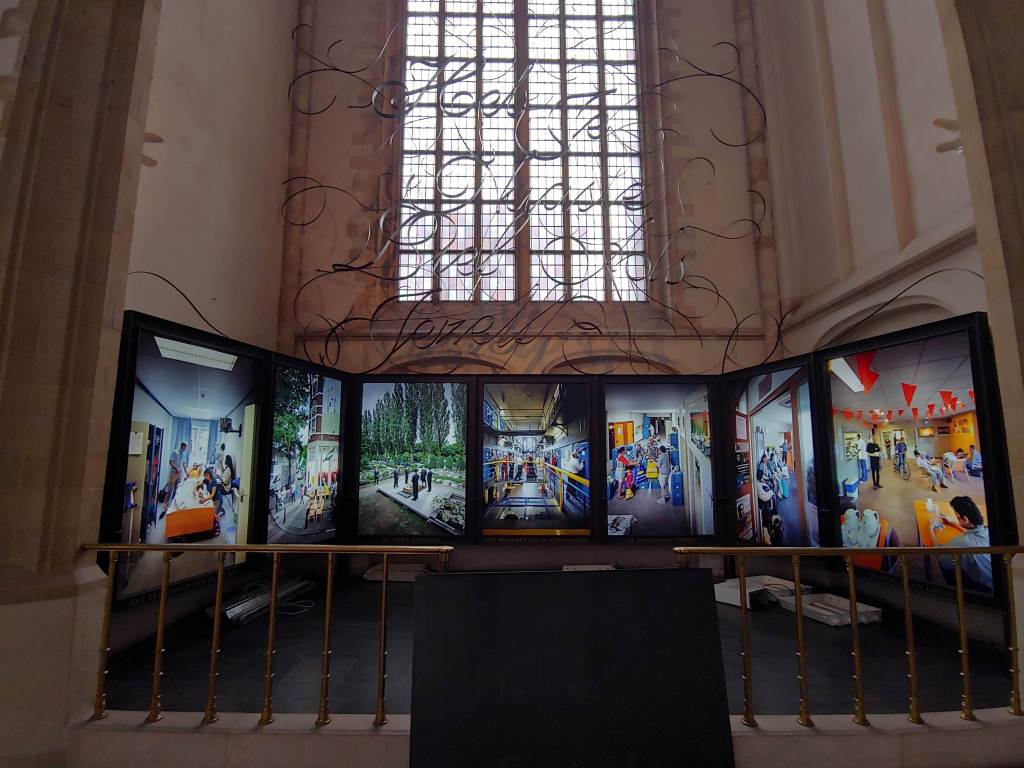
RADIX ARTICLE: “The Seven Works of Mercy: How two Dutch artworks—one Renaissance, one contemporary—can help us recover an ethic of neighborly care” by Victoria Emily Jones: When I was in the Netherlands last year, I saw lots of artistic representations of what are called the seven works of mercy, derived from Matthew 25. (Even after the Protestant Reformation, the subject remained popular among Dutch artists, who delighted in representations of everyday life.) In this article, published last week, I share just two. One is a multipaneled painting, now at the Rijksmuseum, commissioned in 1504 by the Holy Ghost Confraternity in Alkmaar, which ran an almshouse that provided medical care for the sick and housing for the poor (social welfare programs were carried out by the church in those days); notably, in each contemporary townscape, Jesus stands among the afflicted—a theologically loaded artistic choice. The other artwork is a set of photographs by Thijs Wolzak on display inside Rotterdam Cathedral, which feature community service organizations in action, caring for drug users, undocumented immigrants, and others. (Note: The chapel was in a bit of disarray when I was there, with light fixtures disassembled all over the floor and a ramp blocking my entrance, hence the messy staging of my photo! See a professional photograph in the article link, including photos of individual panels.)

Feeding the Hungry by the Alkmaar Master
Master of Alkmaar, Feeding the Hungry, leftmost panel from the Seven Works of Mercy polyptych, 1504. Oil on panel, 103.5 × 55 cm. Rijksmuseum, Amsterdam. The inscription on the original frame underneath (not pictured) is a rhyming Dutch couplet: “Deelt mildelick den armen / God zal u weder ontfarmen” (Share generously [with] the poor, [and] God shall have mercy on you).
Wolzak, Thijs_Works of Mercy
Thijs Wolzak (Dutch, 1965–), in collaboration with Kathelijne Eisses, Werken van Barmhartigheid (Works of Mercy), 2010. Duratrans prints in light boxes. Chapel of Works of Mercy, Sint-Laurenskerk (Church of St. Lawrence), Rotterdam, Netherlands. Photo: Victoria Emily Jones.

It’s interesting to consider the overlap of Christian and civic duty the images present and the way in which they function(ed) in their disparate spaces. The more explicitly theological Alkmaar polyptych was originally owned by a lay brotherhood and sited in a church beside the collection box, and its primary purpose was “to stir up . . . to love and good works” (Heb. 10:24), and to financial giving—but it is now in a large, government-run art museum, where it’s viewed mainly as an art historical object. The Wolzak piece, on the other hand, was commissioned as a permanent installation inside an active church that is also a heritage museum and something like a community center, with the purpose of highlighting the charitable work being done in the city. I like how Wolzak helps us to see where some of the needs lie in contemporary society and examples of tangible ways they might be met, through such services as safe-injection sites (for those suffering from heroin addiction) or the Lonely Funeral Foundation (for the anonymous dead).

The summer 2020 issue of Radix magazine also includes an interview with Mark Labberton, president of Fuller Theological Seminary, on his book The Dangerous Act of Loving Your Neighbor: Seeing Others Through the Eyes of Jesus; an interview with D. L. Mayfield on her book The Myth of the American Dream: Reflections on Affluence, Autonomy, Safety, and Power; Martin Buber on genuine dialogue; Simone Weil and the “kinship of affliction”; a review of the film Just Mercy; and more.

+++

NEW BOOK: Off the Walls: Inspired Re-Creations of Iconic Artworks: This March on social media, the Getty Museum issued the #GettyMuseumChallenge, inviting art lovers to channel the stir-crazy energy of COVID-19 quarantine into crafting themselves, their families, and their pets into masterpieces of world art and posting the photos online. By May there were at least 100,000 re-creations uploaded to the Internet—246 of which are featured in the new book Off the Walls, released this month by Getty Publications. All profits from the book will go to the charity Artist Relief to support artists facing financial emergencies to the coronavirus pandemic. This is such a fun way to get people to engage with art!

+++

NEW SONG RELEASES

“Hallelujah (Come Bless the Lord)” by September Penn: September Penn is a singer, songwriter, performance artist, worship leader, and cofounder of The Power of Song Inc., an organization that educates about social justice issues through song, theater, and art. She wrote “Hallelujah” while directing the Kaleo Choir at Fuller Theological Seminary, where she earned an MDiv this year with a focus on Worship, Theology, and the Arts. The song was released September 3 as a single on all music-streaming platforms.

“Nara Ekele Mo” by Tim Godfrey, performed by Resonance: Last month the Global Resonance Multicultural Worship Collective, under the organization Arts Release, posted on YouTube a multicontinent, multilingual cover of the Nigerian Igbo song “Nara Ekelo Mo” by Tim Godfrey. It features thirty-seven singers from Brazil, England, France, Indonesia, Singapore, and Spain, with lyrics in Igbo, Yoruba, Tamil, Bahasa Indonesia, French, Mandarin, Portuguese, Spanish, and English. (See the original version of the song here.) [HT: Global Christian Worship]

+++

POEMS

“Field Guide” by Tony Hoagland: A few weeks ago SALT Project reprinted this poem that celebrates the ordinary in nature—along with brief commentary and a stunning macrophoto of a dragonfly. An excerpt from the opening chapter of Ralph Waldo Emerson’s essay “Nature” is referenced: “If the stars should appear one night in a thousand years, how would men believe and adore; and preserve for many generations the remembrance of the city of God which had been shown! But every night come out these envoys of beauty, and light the universe with their admonishing smile.” (The poem is from Hoagland’s 2010 collection Unincorporated Persons in the Late Honda Dynasty, published by Graywolf Press.)

from the current issue of Image: Image journal is the one piece of mail I most look forward to receiving every quarter—full of poetry, visual art, literary essays, and short stories with a spiritual sensibility. In its current issue, no. 105, some of the poems I particularly enjoyed were “Trench Coat” by Cameron Alexander Lawrence, on the accumulation of things; “Pastoral with Wheat” by John Hart, on fatherhood as beatitude, and as a continual lesson in dying to self; “Duet” by Chelsea Wagenaar [previously], about the “music” of the ordinary moments of motherhood, like tending to your child’s bee sting; and “The Eighth Sacrament” by Peter Cooley, on grief, written after the death of his wife, Jacqueline.