Advent, Day 1: Rend the Heavens!

O that you would tear open the heavens and come down!

—Isaiah 64:1a

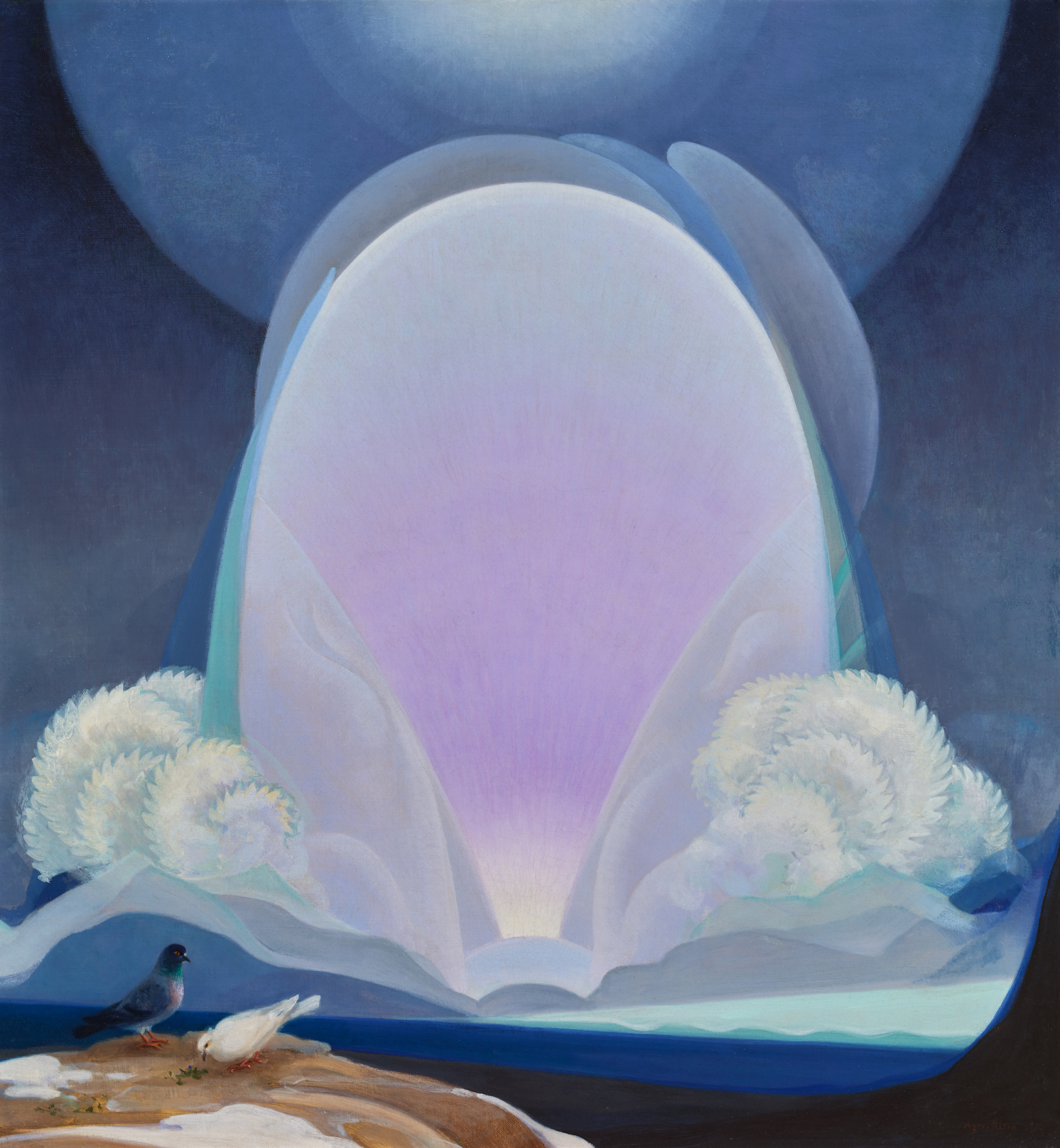
LOOK: Winter by Agnes Pelton
Pelton, Agnes_Winter
Agnes Pelton (American, 1881–1961), Winter, 1933. Oil on canvas, 30 × 28 in. Crocker Art Museum, Sacramento, California.

Agnes Pelton was part of the Transcendental Painting Group, an artists’ collective founded in the American Southwest in 1938 on the principles of creating a pure abstract painting style imbued with spiritual intent. Clayton Schuster, writing for Hyperallergic, describes one of Pelton’s metaphysical landscapes:

Pelton’s Winter (1933) depicts a pigeon and dove on a cliff in the foreground, with a great blooming cloud in the distance. The arched lavender cloud against the dark sky seems to suggest the narrow path toward a new beginning, as a pale glow at the top of the painting symbolizes hidden truths. Within the cloud are delicate lines hinting at two hills. The cloud seems to glow where the hills nearly meet and delineate the valley. It is as if Pelton has excavated a road from the cloud and revealed the path to paradise.

Pelton shows us a new way opening. The sky has been rent, and light breaks in. To either side of the central bulbous form are tooth-edged wheels in motion. At the bottom left, the snow is melting at the emerging warmth, revealing tiny green shoots on the ground. The two doves perhaps signify a coming peace.

Full of mystical yearning, this painting shouts “Advent!” to me. It evokes in my mind not only the Isaianic exclamation cited above—the basis for today’s featured song (below)—but several other Advent scriptures as well, such as Isaiah 40:3–5 (pave a straight path for God through the desert; every hill, every valley . . .), Psalm 98:8–9 (“let the hills sing together for joy at the presence of the Lord, for he is coming . . .”), and Revelation 1:7 (“Look! He is coming with the clouds”; cf. Matthew 24:30: “they will see ‘the Son of Man coming on the clouds of heaven’ with power and great glory”).

Pelton was not a Christian—she rejected organized religion—but her artworks are so wonderfully expansive in the associations and interpretations they invite.

For more on the artist, see the wonderful book Agnes Pelton: Desert Transcendentalist, a catalog of a recent major retrospective of her work organized by the Phoenix Art Museum.

LISTEN: “O Savior, Rend the Heavens Wide” (original title: “O Heiland, reiß die Himmel auf”) | Original German words by Friedrich Spee, 1622; translated into English by Martin L. Seltz, 1965, ©1969 Concordia Publishing House | Tune: O HEILAND, REISS DIE HIMMEL AUF, from Gesangbuch, Augsburg, 1666 | Performed by Koiné on Anno Domini, 2009 [sheet music]

O Savior, rend the heavens wide;
Come down, come down with mighty stride;
Unlock the gates, the doors break down;
Unbar the way to heaven’s crown.

O Morning Star, O radiant Dawn,
When will we sing your morning song?
Come, Son of God! Without your light
We grope in dread and gloom of night.

Sin’s dreadful doom upon us lies;
Grim death looms fierce before our eyes.
O come, lead us with mighty hand
From exile to our promised land.

There shall we all our praises bring
And sing to you, our Savior King;
There shall we laud you and adore
Forever and forevermore.

The German hymn text “O Heiland, reiß die Himmel auf” (O Savior, Rend the Heavens Wide) is by Friedrich Spee (1591–1635), a German Jesuit priest, professor, and poet best known for opposing the European witch trials and the use of torture. Written during the Thirty Years’ War, it was first published in Würzburg in 1622 in the collection Das Allerschönste Kind in der Welt (The Most Beautiful Child in the World).

Four-plus decades later, in 1666, a Dorian-mode melody was published anonymously with the text in the Rheinfelsisches Deutsches Katholisches Gesangbuch (German Catholic Hymnal). Then in 1863, Johannes Brahms arranged that melody as a motet for unaccompanied mixed choir (op. 74, no. 2):

The hymn entered English-speaking churches in the twentieth century when Martin L. Seltz (1909–1967) translated it.

The original chorale tune is still in use, but I’ve also heard some churches using the 2003 retune by Nathan Partain. Here’s a live recording of that version from Trinity Church Seattle, sung by Partain, back when he was the church’s music director (it was called Green Lake Presbyterian Church at the time):

The hymn also appears, with updated arrangement, on Partain’s 2019 album The Beauty to Come. The chord charts, lead sheets, and string scores for this album and two others can be downloaded for free from Partain’s website.


This post is part of a daily Advent series from December 2 to 24, 2023 (with Christmas to follow through January 6, 2024). View all the posts here, and the accompanying Spotify playlist here.
Roundup: Advent art, songs, poems

So much to share today! Be sure not to miss “Psalm 126” by Drew Miller (a new favorite Advent song) and Matthew Milliner’s excellent presentation on the Virgin Mary in art, which opened an exhibition that’s running in Southern California—both below. (If you only have time to take in a few items from this post, those are the ones I’d recommend.)

PODCAST EPISODE: “A Time for Wanting and Waiting: An Advent Conversation with W. David O. Taylor”: In this recent episode of The Road to Now, hosts Bob Crawford and Chris Breslin interview liturgical theologian David Taylor [previously] about the season of Advent: what it is, its history and how it fits into the wider church year (see especially 43:29ff.), the canon of Advent and Christmas songs, and the gift the Psalms offers us during this season. Referencing his 2015 Washington Post article, Taylor says our picture of Christ’s coming, especially as expressed through our hymnody, tends to be unidimensional and far too sanitized:

We should permit the Nativity stories to remain as strange and bizarre and fantastical and difficult as they in fact are, rather than taming and distilling them down to this one nugget or theme of effusive joy. There is effusive joy in that—it’s simply that that’s not the only thing that characterizes these stories. Unfortunately, most of our canon of Christmas carols or hymns tends to focus on what I would argue is only 50 percent of the Nativity stories. Everything that begins with Elizabeth and Zechariah and goes all the way to, say, Anna and Simeon and the visit of the Magi and the flight to Egypt . . . it really is one whole story that is being told with these subplots.

I would love to see us create . . . new music that either retells portions that we are already telling but not the whole of it, or we need to tell parts that have not yet been told. . . . Let’s ask ourselves how God is at work in all the minor-key or difficult or dissonant parts of the Nativity stories, not absent from—those are not extraneous to God incarnating himself in Jesus Christ. Those are essential parts of it. And so how can our hymns become ways of praying ourselves into these stories so they can sink deeply into the fibers of our hearts and minds and bodies, and for us to say, “Oh, all the weird and difficult and dissonant parts of our lives are part and parcel of God’s good work,” not, again, on the margins of it, or things we should eschew.

To help deepen and expand the church’s repertoire of Christmas music, Taylor founded, along with a few others, the Christmas Songwriters Project. The Psalms are an inspiration in this task, as they express a joy that is at times quiet and at others raucous, as in the Nativity narratives, and that exists as part of a dynamic constellation of emotions and postures that praise can encompass. Most of us don’t recognize the pure, undistilled happiness that is marketed to us throughout December, Taylor says, and we shouldn’t force ourselves to try to feel it but rather should take a cue from the Psalms and also see the same emotional complexity at work at the beginning of the Gospels:

The Psalms, and I think Christian faith at its heart, can make space for joy and sorrow to exist alongside each other in a way that happiness, as we commonly understand it, cannot, or only with great difficulty. . . . What the psalms of praise do . . . is that in one movement, there’s this effusive joy or a shouting joy or a convivial joy, and then it segues to a quieter joy or a contemplative joy or a yearning, painful kind of joy. . . .

So in the season of Advent, when we look at the characters in scripture—you know, Mary and Joseph and Zechariah and Elizabeth and the shepherds and Anna and Simeon—every one of them has this moment, perhaps, of which we could say, “That sounds like joy.” . . . But immediately before or immediately after, it transitions to something else. So does that mean that joy is negated? Is joy squashed? Is joy extinguished? Or is joy able to continue to exist side by side, to subsist, with a continued experience of longing or a sudden moment of sadness?

+++

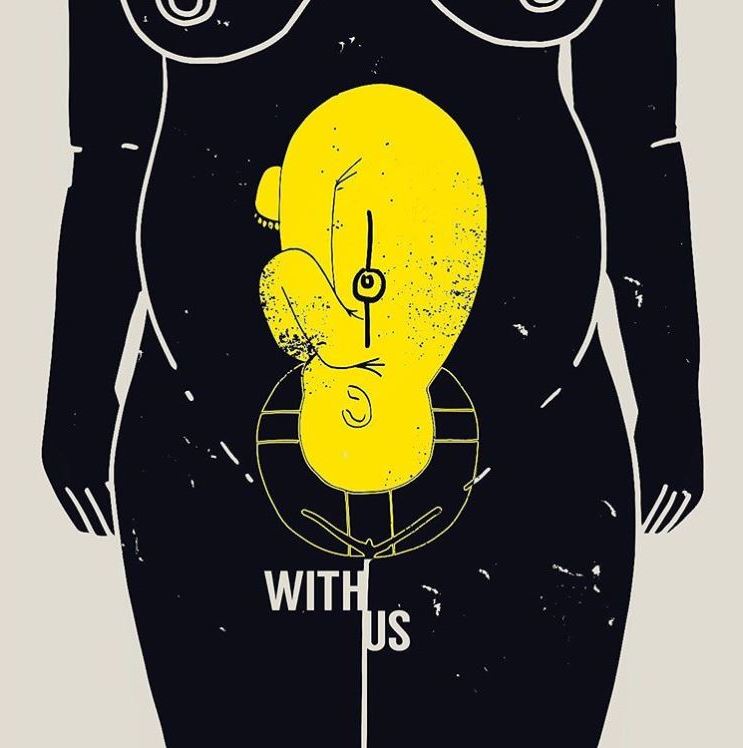
ART BY SCOTT ERICKSON: This month Portland-based artist Scott Erickson has been posting on Instagram Advent-themed images he has made, along with thoughtful meditations. Some emphasize the bodiliness of the Incarnation, which often gets overlooked, presumably out of a sense of propriety. But “grace comes to us floating in embryonic fluid . . . embedded in the uterine wall of a Middle Eastern teenage woman,” Erickson writes about With Us – With Child, to which one Instagrammer responded, “This is trajectory changing. Thank you for this. Nipples, vaginas, and Jesus CAN coexist!” Another mentioned how she had never seen Mary with a belly button and a linea nigra before. The image reminds us that Jesus was indeed “born of woman” (Gal. 4:4).

Erickson, Scott_With Us, With Child
Scott Erickson (American, 1977–), With Us – With Child, 2016 [purchase as poster]
Another imaginative image suggests that Christ came to set the world on fire, so to speak. God, who is of old, gives himself to earth as a Jewish babe (“Love has always been FOR GIVENESS,” Erickson writes), sparking a revolution.

Erickson, Scott_Advent
Art by Scott Erickson

View more art by Scott Erickson @scottthepainter.

+++

LECTIONARY POEMS FOR ADVENT: This year Englewood Review of Books launched a new feature on their website: a weekly post of four to six poems that resonate with the Revised Common Lectionary readings for that week. “We will offer here a broad selection of classic and contemporary poems from diverse poets that stir our imaginations with thoughts of how the biblical text speaks to us in the twenty-first century. We hope that these poems will be fruitful not only for preachers who will be preaching these texts on the coming Sunday, but also for church members in the pews, as a way to prime our minds for encountering the biblical texts.” I’m really enjoying these stellar selections, several of which are new to me.

Continue reading “Roundup: Advent art, songs, poems”

A eulogy for Pop-Pop

The light he was returns
Unto the Light that is.
—Wendell Berry

My grandpa, Richard Joseph Hartz, passed away on May 22 at age ninety-two. A cradle-to-tomb resident of Mercer County, New Jersey, he was a simple man who loved his Lord, his family and friends, and his work. He was faithful, caring, contented, ingenuous, and conservative in every sense of the word. Clocks, cars, and Phillies baseball were among his hobbies. He got thrills from things like cereal box prizes (his favorite was a plastic spoon that lights up—he said, facetiously, that it helps him find his mouth), Dollar Tree purchases (“Can you believe this only cost a dollar?”), and fish sandwiches from Burger King (I don’t think I ever saw him so excited as when he unwrapped a BK gift card for his ninetieth birthday).

Rick Hartz

Pop-Pop’s Bible never gathered dust; he read it every morning, along with Our Daily Bread. His constancy in this regard is something my dad inherited. It is because of Pop-Pop’s (and Mom-Mom’s) religious faith, which they lived and breathed and passed on to their kids, that I am a Christian. It is the greatest treasure I have ever received.

The highlight of Pop-Pop’s week was always Saturday-morning breakfast with the ROMEOs (“Retired Old Men Eating Out”)—a moniker bestowed affectionately by his sister Theresa to describe him and his group of cronies. In flat cap and cardigan, he’d be dressed to go. Scrambled eggs and coffee was his custom, and a plate of sausage split with his brother-in-law Don.

Pop-Pop’s most distinctive, and most beloved, trait was his joke telling. His jokes were mainly of the Reader’s Digest variety—that is, clean and corny. After making sure he had our attention, he’d start in, wide eyed and serious, all the way up to the punchline, when he’d break down chuckling. His repertoire wasn’t too large, so during any one visit, we’d hear the same joke at least twice, and then again the next time we saw him. But we’d always laugh as if it were brand-new to our ears.

Some staples:

If a bear was chasing you and up ahead there was a tree on one side and a church on the other, would you run up the tree or into the church?

Response: I don’t know—into the church?

With a bear (bare) behind?

[When we’re eating corn] We’re having a chicken dinner!

I went to the doctor’s, and he gave me a prescription for smart pills. When I saw the bill, I couldn’t believe it. “$100!” I said. “These aren’t worth that much!”

The doctor replied, “See, you’re smarter already.”

If we were to shrink your head to the size of your brain, you could wear a peanut shell for a Panama hat.

One time he floored us all with a real grade A insult at my younger brother’s expense. We were posing for a photo, and Rob, clowning around, bent over and stuck his head between his legs. Pop-Pop, camera in hand, retorted, “You’ll have to smile, Robbie, so that I know which end’s your face.” Ooo, burn!   Continue reading “A eulogy for Pop-Pop”