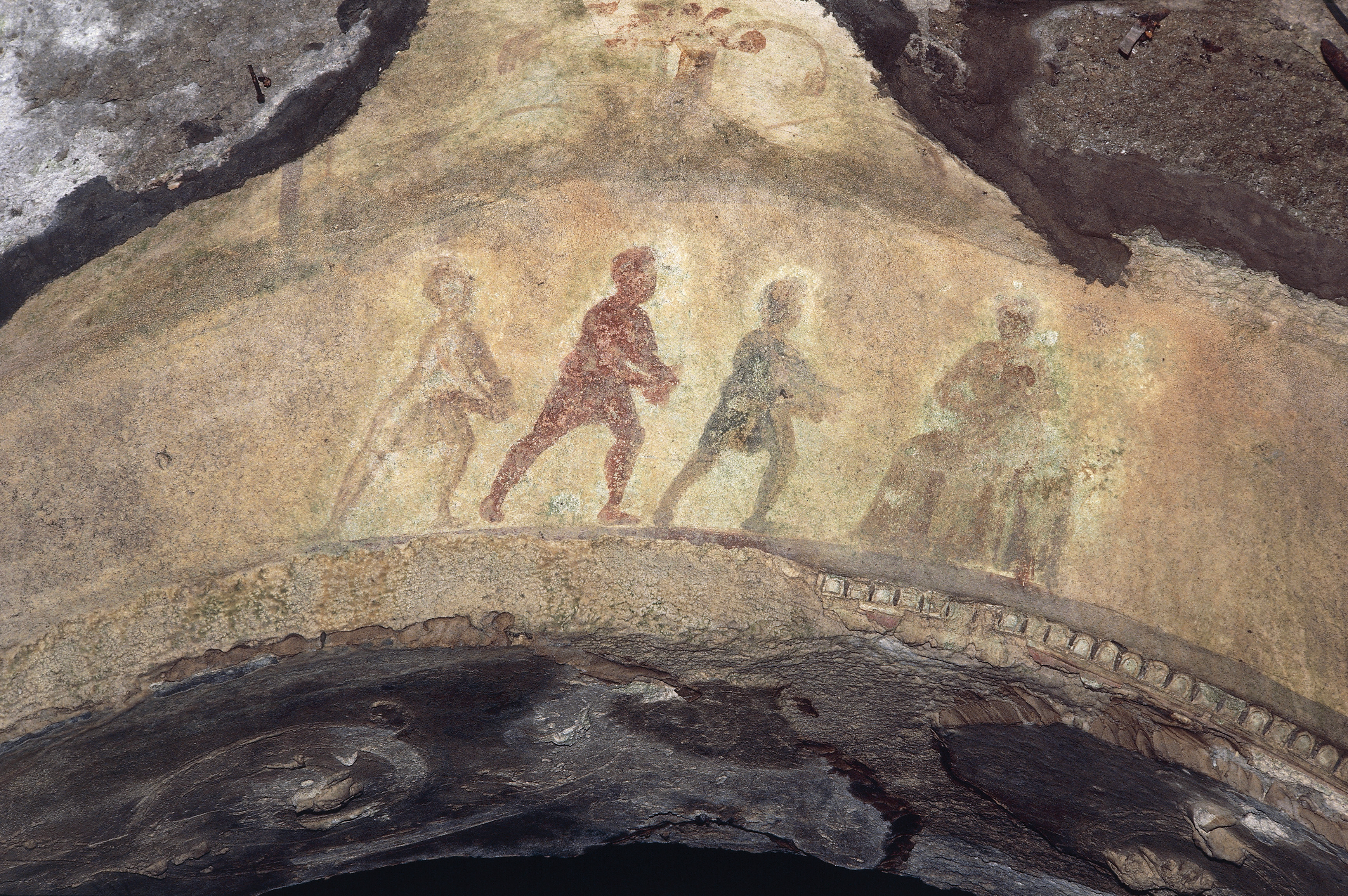
ARTICLE: “Witnessing the Divine: The Magi in Art and Literature” by Robin Jensen, Bible Review: In this 2001 article, art historian Robin Jensen traces the development of the tradition of the magi through early Christian art (catacomb frescoes, sarcophagi and funerary plaques, church mosaics) and literature.
The Adoration of the Magi, 3rd century. Fresco, Capella Graeca, Catacomb of Priscilla, Rome. Photo: Vincenzo Pirozzi.
+++
SONGS:
>> Slaviiq (“Starring”) carols in St. Paul, Alaska: In the mid-eighteenth century, Russian Orthodoxy was the first Christian denomination to take root in Alaska; Siberian trappers arrived as part of the “fur rush,” and many ended up marrying local Native women, bringing their religion into their new and growing families. Now Orthodoxy is widely practiced in Unangan (Aleut), Alutiiq (Kodiak), Yup’ik, and Tlingit communities.
Adapted from a custom originating in the Carpathian Mountains, Slaviiq (also spelled Slaviq, Slaaviq Selaviq, or Slavii), meaning “Starring,” is a multiday Native Alaskan Orthodox Christmas celebration beginning on the Feast of the Nativity of Christ on January 7. It involves processions into homes with a large decorated pinwheel star, caroling in English, Slavonic, and Native languages, traditional foods, prayers, and blessings.
The following video is a five-minute clip from a Slaviiq celebration in 2022 on Saint Paul Island, one of the homes of the Unangan people. Community members Aquilina Lestenkof and George Pletnikoff Jr. sing a few songs while a youth spins the Christmas star.
>> “Bright Star,” arranged for string quartet by Ellie Consta and performed by Her Ensemble: Published in 1968, the Christmas song “Bright Star” was a collaboration between poet Janice Lovoos and composer Margaret Bonds [previously]. Her Ensemble, a UK-based women’s orchestra founded by violinist Ellie Consta to perform and promote music by female composers, encountered the song in 2021 through Lara Downes’s solo piano arrangement and decided to arrange it for strings. “We wanted to keep it as close to the original as possible because it’s just so beautiful as it is,” they write, “but we did add a couple of very subtle harmonics in the background to add a little extra Christmas charm!”
It’s an instrumental performance, but here are Lovoos’s lyrics:
Bright star, glist’ning star, shining on that holy night, guiding shepherds in their flight to Bethlehem;
Bright star, guiding star, leading to a blessed abode, three wise men on camels rode to Bethlehem;
Bright star, glimm’ring star, floating in your cobalt sea, won’t you light the way for me as you did them in Bethlehem;
Sweet star, holy star, won’t you shine as bright today, bright as when the Christ child lay in his manger in the hay in Bethlehem, in Bethlehem.
>> “Songs of Thankfulness and Praise,” performed by Josh Bales: The Episcopal priest and singer-songwriter Josh Bales introduces an Epiphany hymn from 1862 by Christopher Wordsworth, nephew of the Romantic poet William Wordsworth. Observed annually on January 6, Epiphany (meaning “manifestation”) celebrates three events in which Jesus’s identity was made manifest: the visit of the magi, Jesus’s baptism in the Jordan, and Jesus’s first miracle at the wedding at Cana. The Western Church focuses on the magi, the Eastern Church on the baptism. Read the lyrics at Hymnary.org. The tune, SALZBURG, was composed by Jakob Hintze in 1678.
+++
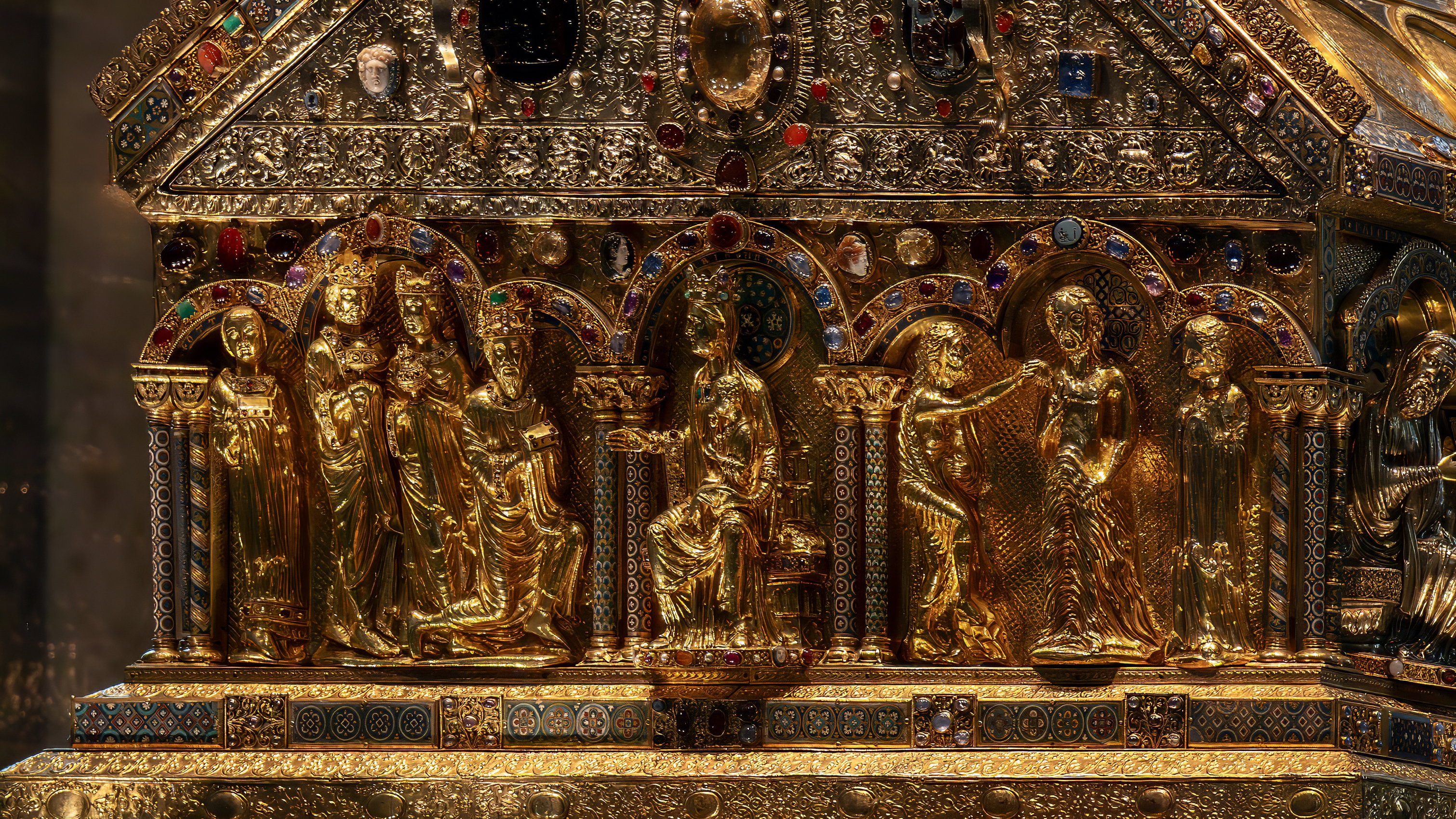
VIDEO:“Nicholas of Verdun, Shrine of the Three Kings, Cologne Cathedral,” Smarthistory: I visited Cologne for the first time in fall 2025. I loved it. My only disappointment was that access to its cathedral’s most beautiful art object, the Shrine of the Three Kings, was obstructed, with the entire sanctuary and choir areas roped off, even though there was no Mass in session. I, a Protestant, was indifferent to the relics inside—the purported skulls of the magi—that have made Cologne an important pilgrimage destination since the Middle Ages. I merely wanted to see this extraordinary twelfth-century metalwork I had read about in art history books, the high point of Mosan art, from the renowned workshop of Nicholas of Verdun. If time had allowed, I could have paid for a tour that would have brought me a little closer but still at a distance. Instead, I had to resort to awkward viewing angles through metal bars.
However, a month after I returned home, Smarthistory uploaded a video that gives a closer look at the shrine, with lovely detail photographs by director Steven Zucker.
Nicholas of Verdun and workshop, Shrine of the Three Kings (front view), ca. 1181–1220. Oak, gold, silver gilt, copper, enamel, jewels, 155 × 112 × 224 cm. Cologne Cathedral, Germany. Photo: Steven Zucker.
The short end that faces out toward worshippers portrays, in pure gold, the Adoration of the Kings, with the three traditional sovereigns accompanied by a fourth, the Holy Roman emperor Otto IV. (He had paid for the shrine’s production—following the magi’s example, he donated a materially precious gift in homage to Christ.) To the right of this scene is the Baptism of Christ.
The figures on the sides represent prophets, apostles, and evangelists.
Among this month’s thirty spiritual songs of note are three by Indigenous artists of Turtle Island (North America):
>> “Ambe Anishinaabeg” from Cree composer Andrew Balfour’s Nagamo project, which explores the intersections of Indigenous song and Anglican choral music. The Ojibway text of “Ambe Anishinaabeg” was gifted to Balfour by Cory Campbell: “Ambe Anishinaabeg / Biindigeg Anishinaabeg / Mino-bimaadiziwin omaa” (Come in, two-legged beings / Come in, all people / There is good life here). On the album (and the playlist), the text is set to the “Gloria in excelsis Deo” by the late English Renaissance composer Thomas Weelkes; but in another iteration, captured in the following video, Balfour pairs the text with the music of William Byrd’s “Sing Joyfully” (itself a setting of Psalm 81:1–4). (Balfour has also written original music for Campbell’s text.) See the third roundup item for more about Nagamo.
>> “Jesus I Always Want to Be Near to You,” a solo by Doc Tate Nevaquaya (1932–1996) on Native American flute. Nevaquaya, who was Comanche, played an important role in the revival of the Native American flute in the 1970s, expanding the repertoire and playing techniques. This instrumental is one of twelve from the album Comanche Flute Music, originally released in 1979 by Folkway Records, which also includes Nevaquaya’s adaptations of non-Comanche flute melodies, his own compositions, and one piece by his son Edmund. As he states in his introduction to this track, “Jesus I Always Want to Be Near You” is an original Christian hymn written by the Comanche people. I couldn’t find the lyrics, but to listen to some more Comanche hymns, with words, see this video by Comanche Nation tribal members Anthony Nauni and Chad Tahchawwickah, and this recorded gathering at Lawton Indian Baptist Church in Oklahoma.
>> “naká·yè·ʔr sihskę̀·nęʔ (may it be that you have peace)” by Tuscarora singer Jennifer Kreisburg, a song of blessing from the new Yo-Yo Ma EP Our Common Nature. According to Sony Classical, the song expresses “hope for a future where humanity and nature coexist in harmony.” I just started listening to the album’s wonderful companion podcast, for which four of the seven episodes have been released.
+++
Also for November: See my Thanksgiving Playlist [introduction], comprising a hundred-plus songs of gratitude, with a few recent additions at the bottom; and my Christ the King Playlist [introduction], which I made for the final feast of the church year, celebrated Sunday, November 23, this year.
+++
ALBUM: Nagamo by Andrew Balfour: In May and June 2022, the Vancouver-based vocal ensemble musica intima teamed up with composer Andrew Balfour to create Nagamo (Cree for “sings”), a concert and CD recording that reimagines the Anglican choral tradition through an Indigenous lens. A child of the Sixties Scoop, Balfour was born in 1967 in the Fisher River Cree Nation near Winnipeg but at six weeks old was forcibly removed from his birth family by child welfare authorities of Manitoba and adopted by white parents. He says his childhood was happy, and that he was fortunate to have been put in a men and boy’s choir from a young age, where he received a musical education and international travel opportunities; but of course, the sudden rupture from his culture of origin left wounds.
With Nagamo, Balfour seeks to bring together his identities as Cree and as the son of Anglicans of Scottish descent, who raised him in the church (his father was a minister); his love of Renaissance choral music, much of which voices polyphonic praises to the God of Abraham, Isaac, and Jacob, and an Indigenous spiritual sensibility. The album comprises two original compositions (including one in Scots Gaelic), five Renaissance songs retexted (not translated) in Cree or Ojibway, and five unaltered works by William Byrd and Alfonso Ferrabosco. “The concept mines the fantastical question of what might have happened musically should Indigenous and European musics and cultural expressions come together in a manner collaborative and respectful, rather than divisive,” writes music journalist Andrew Scott for The WholeNote.
Examples of the adaptations include “Four Directions,” a recitation in Ojibway of the four cardinal directions—Ningaabiianong (West), Giiwedinong (North), Wabanong (East), Zhaawanong (South)—set to Thomas Tallis’s “Te lucis ante terminum” [previously], a prayer for protection through the night. And “Ispiciwin” (Journey), whose musical basis is Orlando Gibbons’s “Drop, drop, slow tears,” a Christian hymn of contrition, but whose Cree lyrics make reference instead to a smudging ceremony, a sacred cleansing ritual practiced by many Indigenous peoples. Here’s a mini-documentary about the Nagamo project:
Balfour “re-imagines how settler and Indigenous spiritualities can interact with one another. In essence, Balfour imagines a new system of power relations where both spiritualities can co-exist and engage in dialogue without the power imbalances of colonization,” Lukas Sawatsky writes in his master’s thesis Converging Paths: Settler Colonialism and the Canadian Choral Tradition, the final chapter of which explores Nagamo as a case study of “the reclaiming of settler-originated aesthetic models and genres by Indigenous people for their own storytelling purposes.” Sawatsky continues, “Through the lens of the Anglican choral tradition, Balfour synthesises his Indigenous cultural identity into music that proudly celebrates both parts, without resolving their differences. Through this, Balfour looks towards a world where the settlers and Indigenous people can exist without settler colonialism.”
+++
EVENT RECORDING:“A Timbered Choir: The Witness of Creation,”Wheaton College, Illinois, October 28, 2025: Last week the Marion E. Wade Center and the Conservatory of Music at Wheaton College presented “A Timbered Choir: The Witness of Creation,” an evening of music and poetry inspired by J. R. R. Tolkien’s and Wendell Berry’s love of creation and visions of stewardship. Readings and reflections by Wheaton professors from across the disciplines of biology, literature, and art culminated in the world premiere of a new Wade Center commission, a fifteen-minute choral cycle by Josh Rodriguez called A Timbered Choir, which sets to music three poems by Berry. “It was my aim to create a work which captures a sense of awe: at the trees which play such an important role in our fragile ecosystem, at the beauty and life-giving pleasure they provide for us, and at our urgent responsibility to care for them,” Rodriguez explains. “In this three-part tale on the life of trees, the audience is invited to witness an opening lullaby about the birth of the forest, followed by a desperate lament on the destruction of nature’s life-giving biodiversity, and a concluding celebration of nature’s resilience.”
The Wade Center is dedicated to promoting the study of seven British Christian writers: Owen Barfield, G. K. Chesterton, C. S. Lewis, George MacDonald, Dorothy L. Sayers, J. R. R. Tolkien, and Charles Williams. Wendell Berry—an American poet, novelist, and farmer especially known for his “Sabbath poems,” an expansive series he wrote over decades during his Sunday walks in the woods—is not part of their archive. But Wade Center Director Jim Beitler says they built this recent event around Berry because they want to encourage learners not just to look at the seven authors but to look with them, at the things they cared about. The center identified particular resonance between Berry and Tolkien.
Here are the time stamps from the video recording. The songs are performed by the Wheaton College Concert Choir under the direction of John William Trotter:
Opening remarks by Jim Beitler, director of the Wade Center
Also, the Armerding Center for Music and the Arts, where the event was held, is hosting tree-related art in the lobby: Cross of the Feast by Sung Hwan Kim (a crucifix in wood and mixed media made for a past KOSTA [Korean Students All Nations] Conference at Wheaton), permanently installed; and a set of graphite drawings by David Hooker, on display through Christmas break.
ARTICLE: “Regarding the Face of God: On the Paintings, Drawings, and Notebooks of Paul Thek” by Wallace Ludel, Triangle House Review:Last month I wrote about a chalk drawing by Paul Thek that the Archdiocese of Cologne curated for its latest exhibition at Kolumba museum. In preparation for writing, I did some basic research about the artist, who’s best known for his “Meat Pieces,” and was led to this fascinating article that focuses instead on his paintings, drawings, and notebooks, especially the religiosity and contradictions they are charged with.
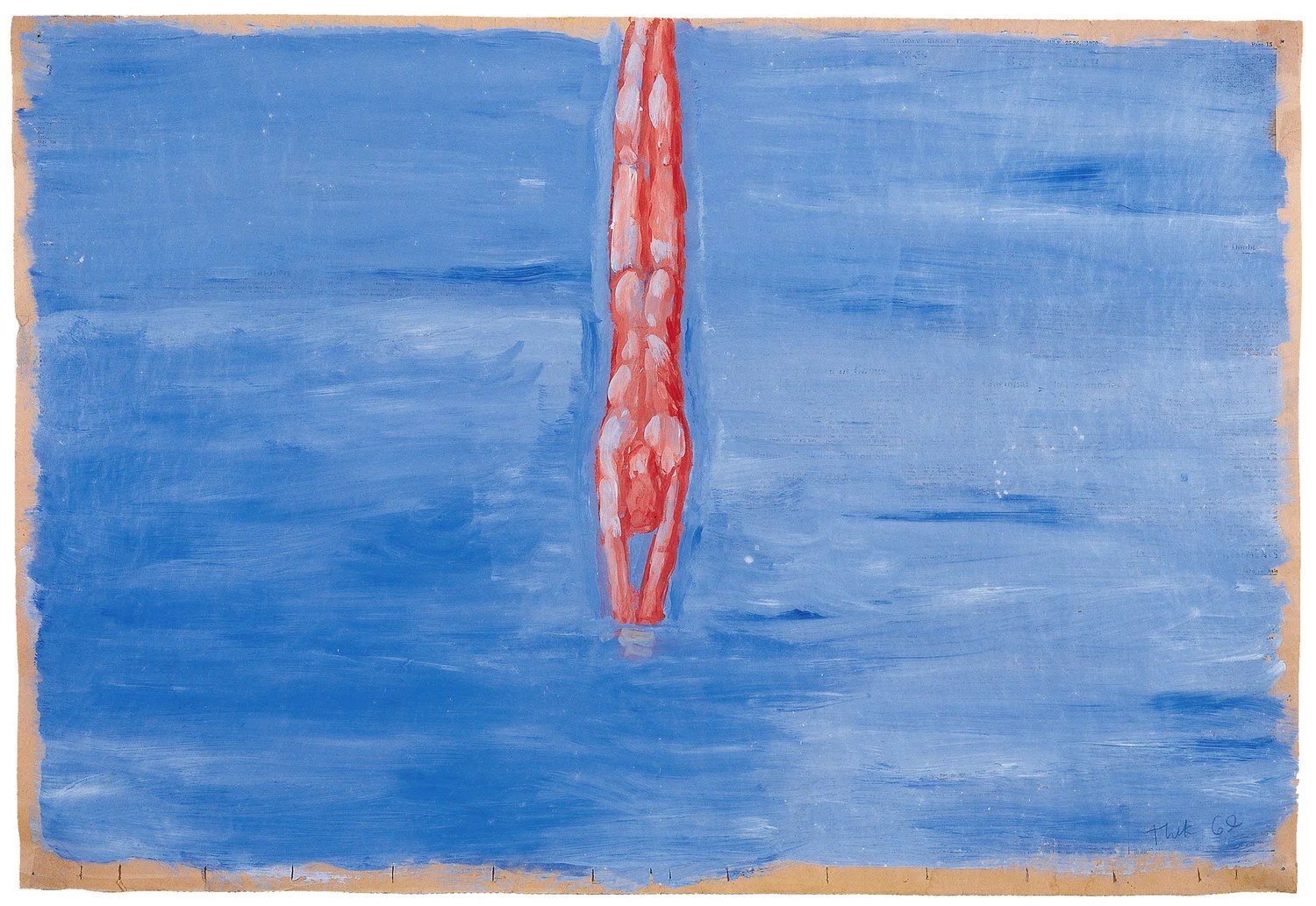
Writer Wallace Ludel describes Thek’s “Diver” paintings of 1969–70, speculated to have been inspired by an ancient fresco inside the Tomb of the Diver in Paestum, Italy, as “at once ebullient and lonesome, womb-like and deathly.”
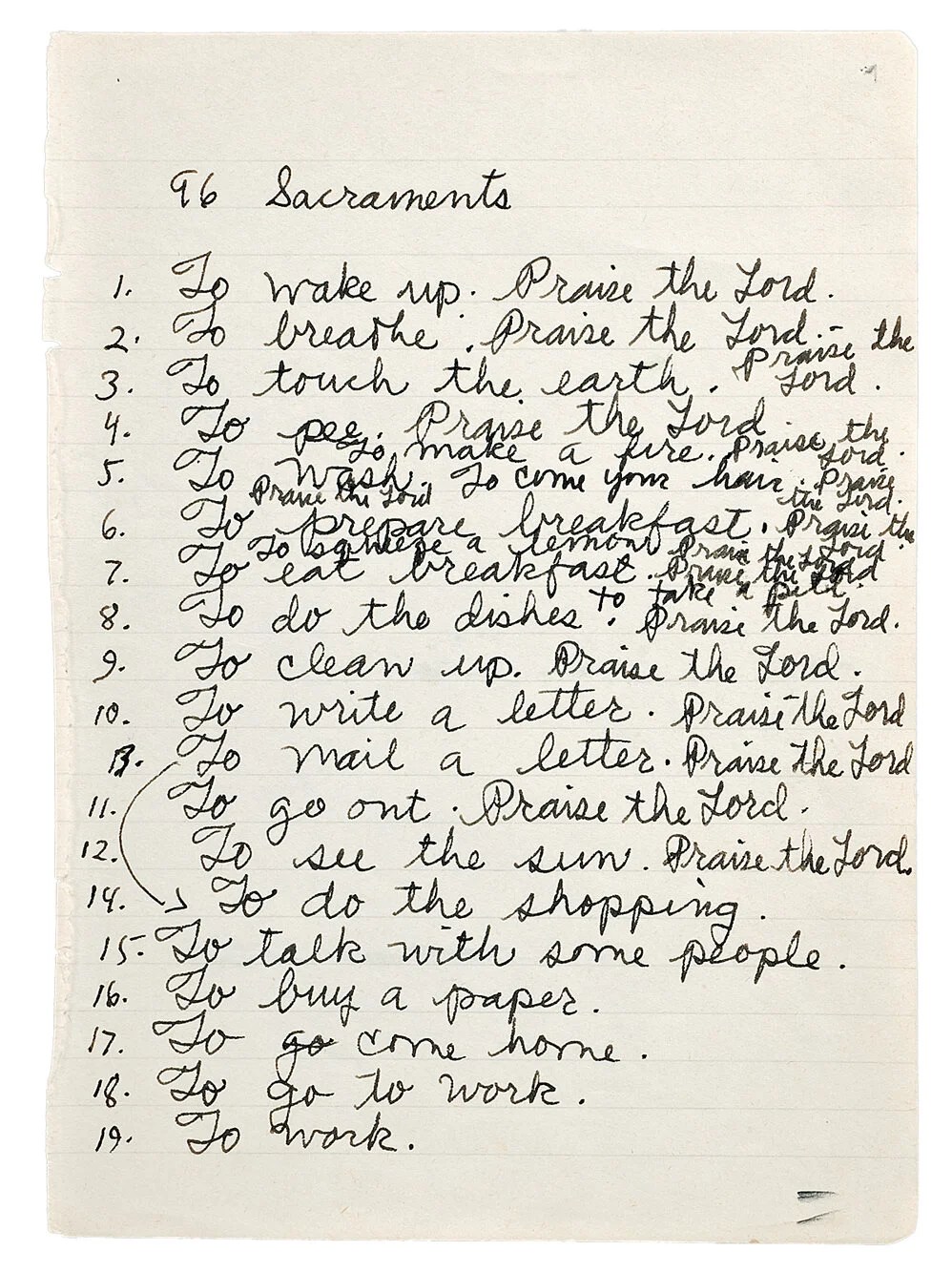
Thek identified as a “predominately gay” Catholic man and was even accepted as a novice by a Carthusian monastery in Vermont shortly before he died of AIDS in 1988. From 1970 onward, he kept notebooks where he copied long passages from spiritual texts and wrote his own devotional musings, as well as made drawings and watercolors and recorded various diaristic thoughts and mantras. One set of the pages, for example, titled “96 Sacraments,” enumerates ninety-six activities—“to breathe . . . to pee . . . to do the dishes . . . to forget bad things . . .”—each followed by the refrain “Praise the Lord.” This list evinces the spiritual influence of Brother Lawrence, who talked about “practicing the presence of God” in all things, which Thek remarked on in a 1984 letter to the Carthusians.
Thek is an artist I had never heard of prior to seeing his work exhibited at Kolumba. Visiting art museums, taking note of the works that intrigue you, and following up afterward with online searches to see and learn more is a great way to develop knowledge of the art that’s out there and to start to identify some of your own personal favorites—which is one of the primary questions I get asked. (“Where do you find all this art?”)
The RFP is open to interested individual artists, artist collaboratives, church leaders, scholars/theologians, arts-affiliated organizations, faith-based nonprofit organizations, or institutions who reside or operate in the United States. Eligible applicants may submit proposals with requests ranging from $50,000 to $250,000 that may be used over one year. Chosen applications will then be requested to submit a full grant proposal for the competitive 2025 Spring Grant Program.
The 2025 grant-seeking theme is “Performing Shalom.” Applicants are invited to reflect the theme in their project or program, but it is not a requirement when applying for a grant. Please click here for more information.
+++
SUBSTACK POST: “On Artists, Kings, and Mending the Multiverse” by Houston Coley: A wise and rousing reflection after the US presidential election. Houston Coley is an Atlanta-based documentary filmmaker, video essayist (YouTube @houston-coley), podcaster, and writer on TV and film, who “cultivat[es] spiritual imagination around art and pop culture,” as one person put it.
+++
POEM: “What to Do After Voting” by James A. Pearson: The poet James Pearson shared this poem from his collection The Wilderness That Bears Your Name (Goat Tail Press, 2024) on Instagram on Election Day last Tuesday. He writes, “What’s driving [all our voting] are two things: Our common needs for love, safety, and belonging. And our often conflicting attempts to meet them. Rumi wrote: ‘Out beyond ideas of wrongdoing and rightdoing, there is a field. I’ll meet you there.’ History is offering us a fork in the road. Let’s turn towards what we can do—vote. Then let’s find each other in that field and do the long, slow work of building a world where everyone has access to the love, safety, and belonging they need.” [HT: Amy Peterson]
He writes further on his website, “This poem doesn’t pretend to be a full prescription for what our country needs. It’s just my way of acknowledging that all electoral choices are imperfect. Because even more important is what happens between elections—the long, slow work of building a culture of love and justice for our politicians to live up to. And the better we do that work, the better our options will be next time elections come around.”
+++
SONG: “Apsáalooke Praise Song,” sung by Sarah Redwolf (née Bullchief):Sarah Redwolf is a member of Crow Nation in Montana and a follower of the Jesus Way whose Apsáalooke name is Baawaalatbaaxpesh (Holy Word). Here she sings a praise song by her grandmother Xáxxeáakinnee (Rides the Painted Horse). The Apsáalooke lyrics are below; I couldn’t find an English translation, and the artist has not yet returned a message I sent ten days ago, but I believe the song was written with Christian intent, as Christianity has been in Sarah’s family for generations. Her father, Duane Bull Chief, is a traveling Pentecostal preacher and the leader, with his wife, Anita, of Bull Chief Ministries, and Sarah has often led worship for church services and other Christian gatherings. What a beautiful voice!
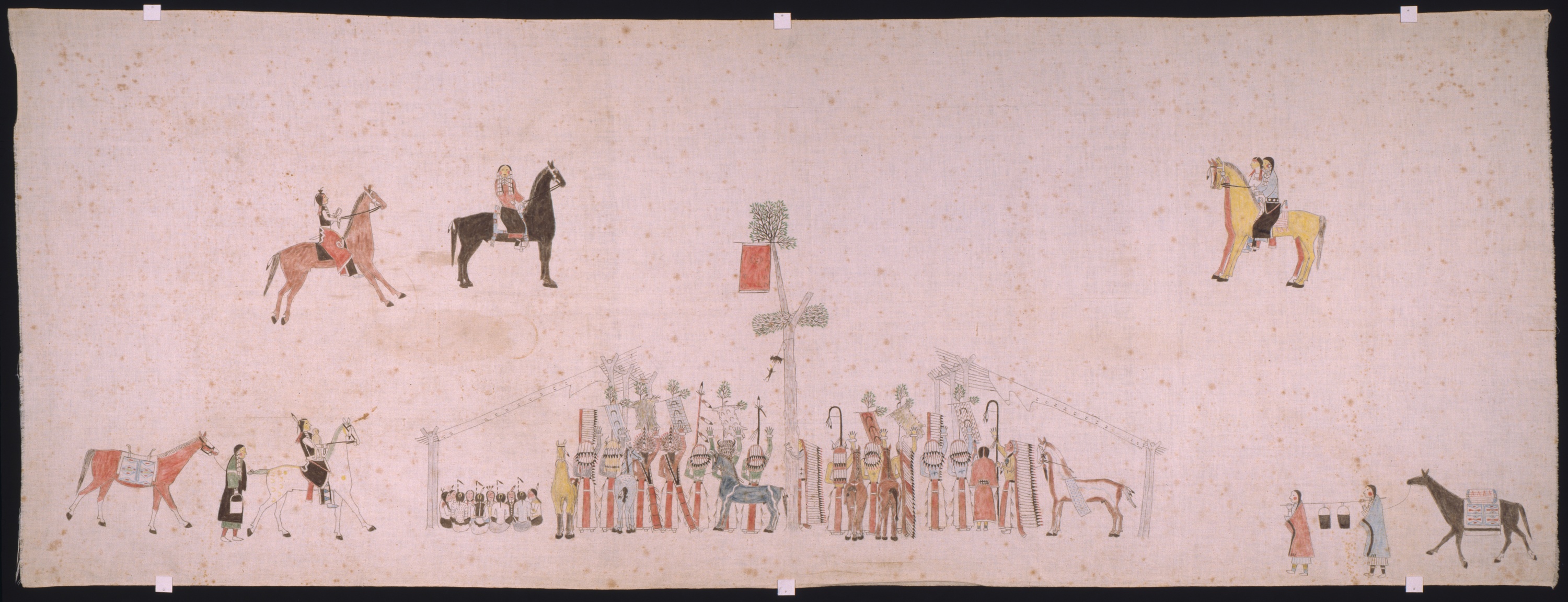
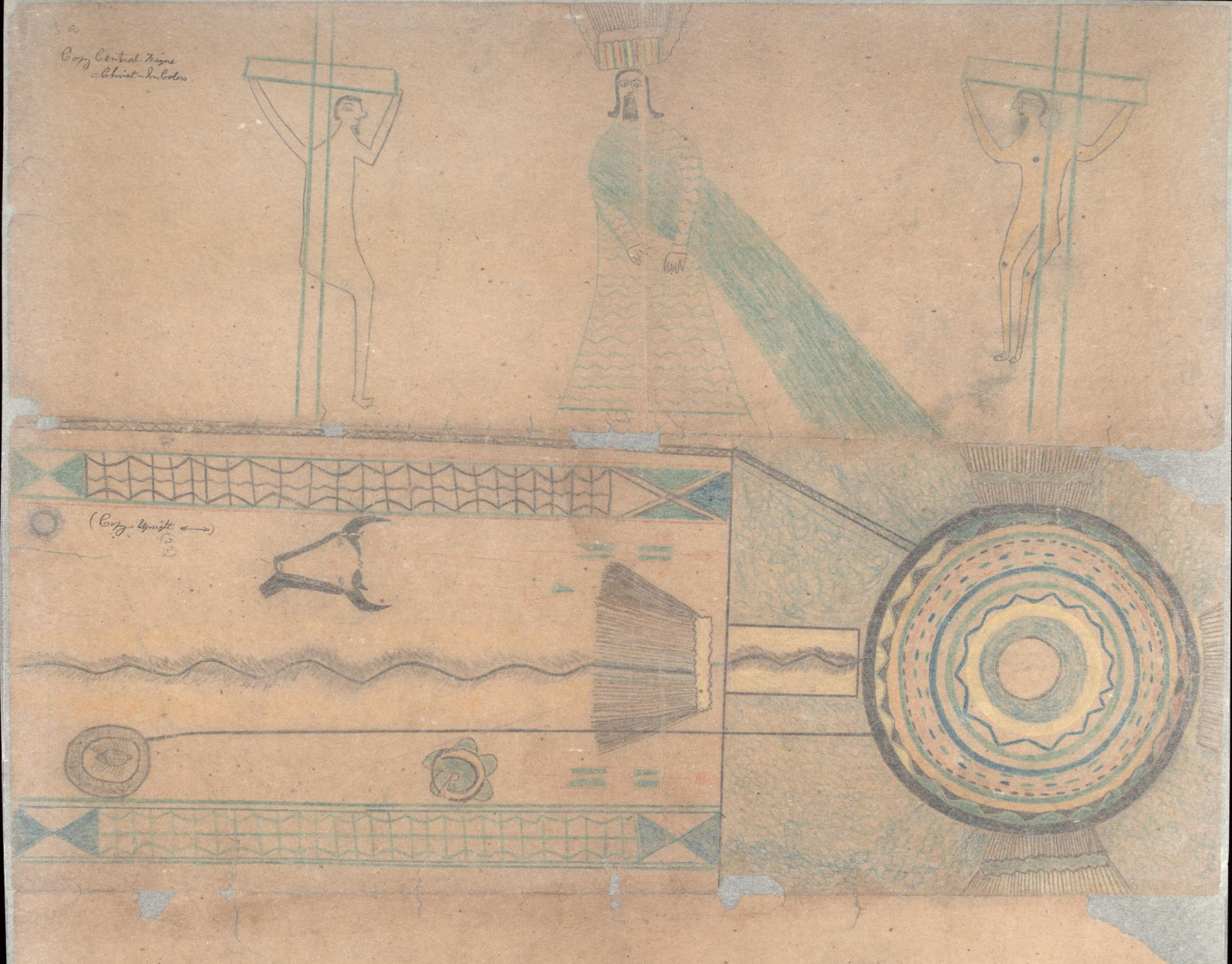
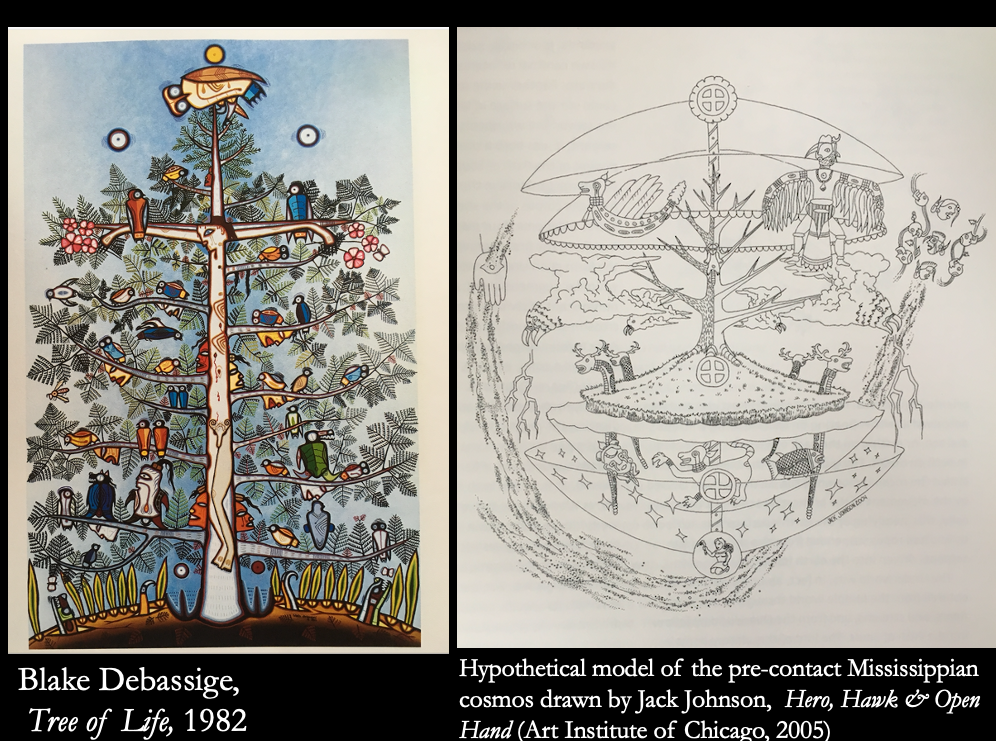
In conversation with Chesterton’s The Everlasting Man, Milliner explores contact points between Christianity and Indigenous North American art, symbol, ritual, and history. The discussion touches on pre-contact petroglyphs carved into Teaching Rocks near Peterborough, Ontario (one of them, a sun figure, quite possibly representing Gitchie Manitou, the Great Spirit—Christ incarnate?), the Sun Dance (which many Native Christians interpret as a prophecy of the Crucifixion), the Ghost Dance (about resurrection and renewal), the Mishipeshu (an underwater panther often representing death, which some Native Americans used to characterize white settlers), the Thunderbird, Black Elk’s vision of a mysterious figure with holes in the palms of his hands, and the cross as an axial tree conjoining the above and below worlds. Just as ancient Hebrew culture contained pointers to Christ, so too, Milliner argues, do the Indigenous cultures of North America. Artists, preachers, and visionaries from among the Ojibwe, Kiowa, Lakota, and other peoples are “our North American Virgils,” he says—Virgil being a Latin poet whose Fourth Eclogue, written around 40 BCE, prophesied the birth of a divine savior who would usher in a golden age.
Sun Dance Scene, Teton Lakota, Central Plains or Northern Plains, Wyoming, ca. 1885. Muslin cloth with watercolor paint, 36 × 91 1/2 in. (91.5 × 232.5 cm). Art Institute of Chicago. See 32:55 of Milliner’s lecture.Vision of a Kiowa man named Fiqi (Eater), received during the revived Ghost Dance, of Christ blessing the ceremony, collected by ethnologist James Mooney, ca. 1890. Pencil and crayon drawing from MS 2538, National Anthropological Archives, Smithsonian Institution, Washington, DC. See 38:49 of Milliner’s lecture and pages 11–12, 130, 142–44 of his book The Everlasting People.See 59:24 of Milliner’s lecture and page 8 of his book The Everlasting People
There’s much more I could say, as there’s certainly more nuance and complexity to this, but instead let me simply refer you to Milliner’s lecture and finely footnoted book. There’s also a great audio interview with Milliner about The Everlasting People from November 2021, conducted by Jason Micheli for the Crackers and Grape Juice podcast.
+++
VIDEO: Chapel service led by Terry Wildman, November 6, 2023, Azusa Pacific University, California: Earlier this year I got to have dinner with Terry Wildman [previously] and his wife, Darlene, who form the Nammy Award–winning musical duo RainSong. It was exciting to hear all about their work with Native InterVarsity and other projects. They live in Maricopa, Arizona, on the traditional lands of the Pima and Tohono O’odham peoples. Wildman, who has both Ojibwe and Yaqui ancestry, was the lead translator, general editor, and project manager of the First Nations Version: An Indigenous Bible Translation of the New Testament. (The nativity narrative from the FNV translation of the Gospel of Luke, you may be interested to know, was adapted into an illustrated book titled Birth of the Chosen One: A First Nations Retelling of the Christmas Story, which just released this fall.)
Last November Wildman led a worship service for Azusa Pacific University students. Here are the key elements:
The opening three minutes are an animated video of the gospel story, narrated by Terry Wildman to a flute accompaniment by Darlene Wildman
8:12: Blessing of the Gabrielino-Tongva people
9:38: The Lord’s Prayer (FNV)
10:57: Sermon: “Worship in Spirit and in Truth” (John 4:1–42)
21:17: Reading of Psalm 8 (FNV)
23:48: Song: “Lift Up Your Heads” by Terry and Darlene Wildman, based on Psalm 24
28:40: Song: “Hoop of Life” by Terry Wildman – Native American powwows often feature hoop dancers, who dance a prayer that Creator will bring harmony and goodwill to all the gathered people. Wildman says, “I look at Jesus and I call him the Great Hooper Dancer. Because he’s the one who ever lives to pray for us, to make intercession for us, and when he dances his prayer, he is bringing harmony and balance to the whole world, to the whole universe. And if we follow him, if we give our hearts to him, he will produce that harmony and balance in us and with each other.”
35:56: Song: “Nia:wen” (Mohawk for “Thank You”) by Jonathan Maracle of Broken Walls
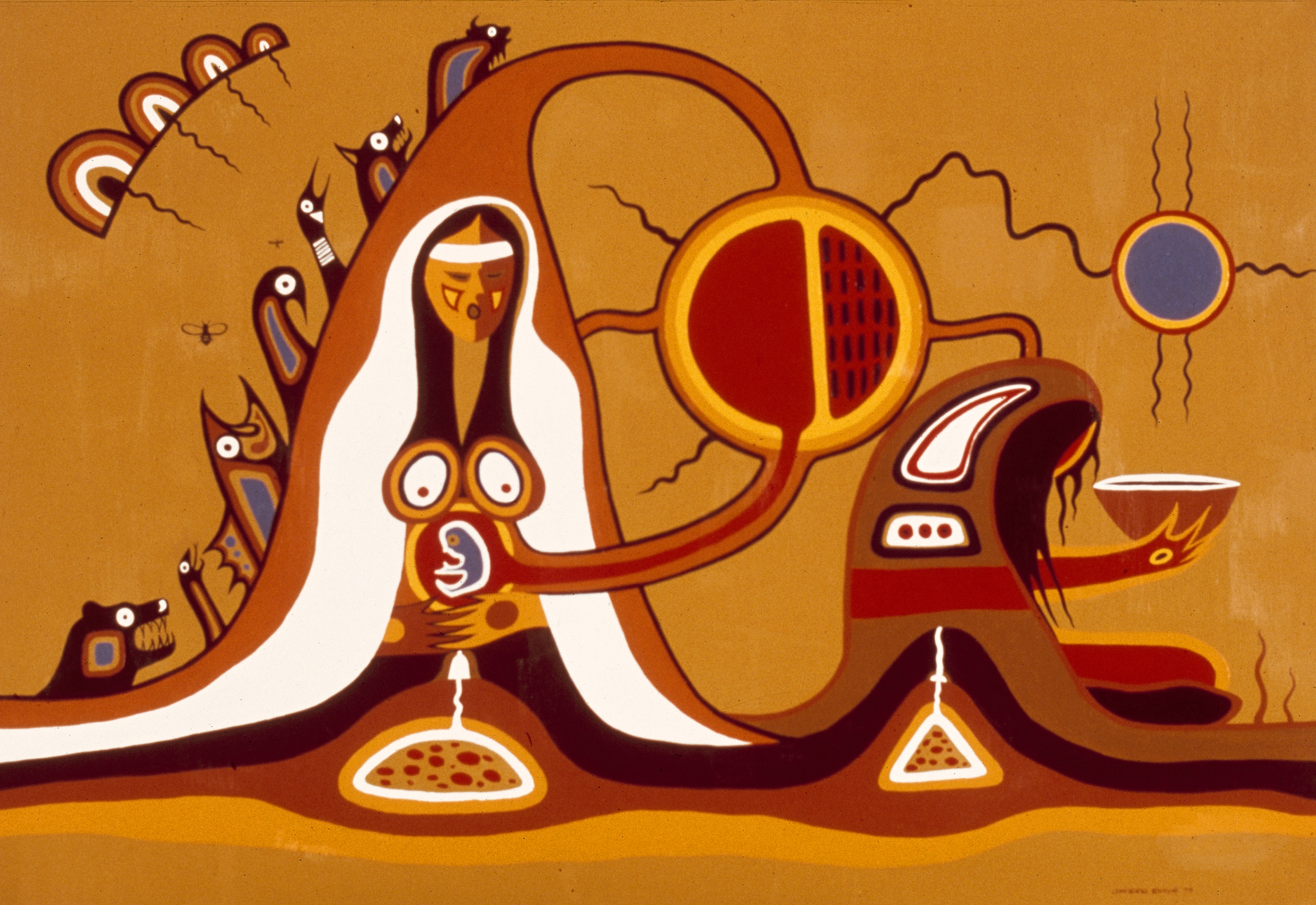
Jackson Beardy (1944–1984) was an Anishinaabe artist born on the Garden Hill Reserve in Manitoba. He belonged to the Woodland school of art [previously], adopting its distinctive style of Indigenous expression characterized by thick black outlines and vivid, compartmentalized color. His paintings draw on Ojibwe and Cree oral traditions and often express cosmological and spiritual concepts.
Beardy is one of twenty Canadian artists commissioned by the Canadian Conference of Catholic Bishops in 1975 to convey the Christian message using whatever idiom they wished. Beardy chose to portray the Virgin Mary pregnant with the Word, the sun’s fire pouring into her and yet she is not consumed. He provided the following artist’s statement:
It is my personal belief that a messenger from the Great Spirit came to earth in the form of His image after Him through a virgin birth in unrecorded history. Through this man, knowledge was passed on to man from the Great Spirit. Many of the teachings of this man have been kept by word of mouth through the ages by the elders of all tribes.
We see the virgin mother-to-be holding on to an embryo connected to the sun symbol (the Great Spirit) [center] who has deemed it necessary to send his messenger to his people. The mother is also connected to Mother Earth, who is nursing her [see the breast shape below]. She too is connected by a lifeline to the sun symbol. Around her are all the orders of creatures who come to see the messenger. He is born to explain their existence, [to restore] harmony between humanity and the elements, physically, mentally, and spiritually.
On the other side of the sun symbol we see an elder in prayer, ritually offering a bowl filled with sacred things. You can see the sun symbol is resting on his hunched frame, bearing him down with doubts, fear, depression, and all the ills of his time, his back to the very miracle he is praying for. It will take time for all to fully comprehend this phenomenon which has come to pass.
The four semicircles represent the elements of the air: snow, rain, tornadoes, heat. The moon [the blue circle] is painted above the elder. We regard the moon as our Grandmother who keeps vigil over all creatures during the night.
Though titled The Nativity, the painting is actually a prebirth scene, as Jesus is still in utero. Beardy shows the Christ child taking root in Mary’s womb (having been conceived by the power of the Great Spirit) and growing to full term as people and animals alike long for his arrival. They groan, they watch, they wrestle and seek. Creator Sets Free—as the First Nations Version of the New Testament translates the name Jesus—is almost here.
(Note: There’s a flipped version of this image floating around online. I confirmed with the CCCB that the file posted here, which I licensed directly from them, represents the correct orientation.)
Leaning into that Advent yearning, here is a performance of “O Come, O Come, Emmanuel” in Ojibwe—“Ondaas, Ondaas, Emaanooyen”—performed by E Halverson:
Now, I have a crowdsourcing request: I am searching for Advent or Christmas songs originally written in Indigenous Canadian or Native American languages, preferably by an Indigenous person. If you know of any, please let me know in the comments below, or in an email. Thanks!
Tomorrow begins Allhallowtide, a three-day Christian festival in which the saints in heaven are remembered. Several friends of mine have lost loved ones this year—siblings, parents, uncles—and just this month my church said goodbye to one of its dear members who passed on. All Hallows’ Day, the central observance of the triduum, recognizes that a spiritual bond still exists between the departed saints and those on earth, whom Christ binds together in one communion. So let us honor this week the memory of those who have gone before us in faith, praising our great and gracious God who sanctifies his people—and who is preparing a family reunion like no other!
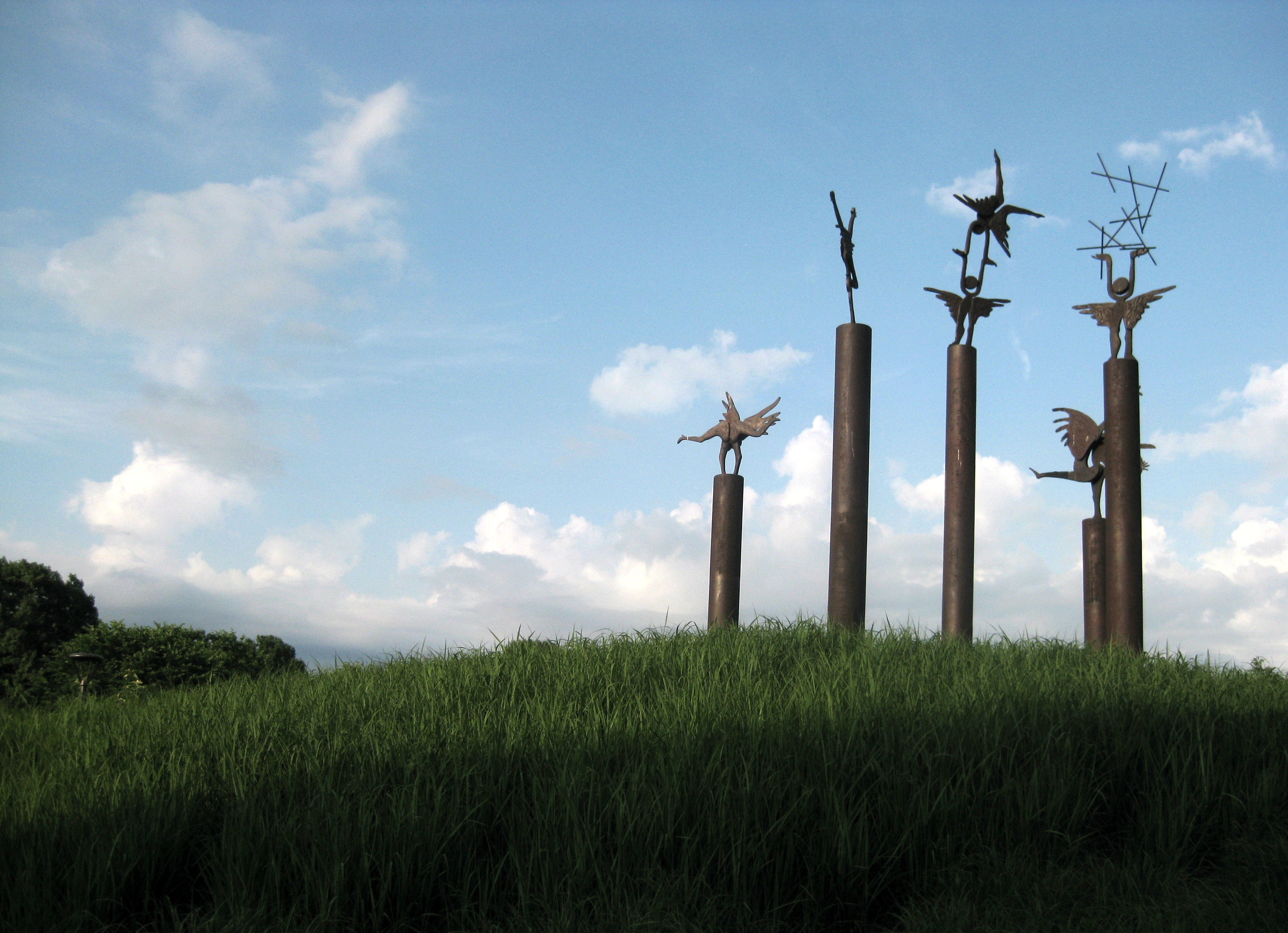
Joseph Kinnebrew (American, 1942–), Visitations: Gifts; A Slight Lapse of Purpose; Hand Stands; Yea; Majorette, 1994–97. Cast iron, 54 to 69 inches tall. Frederik Meijer Gardens and Sculpture Park, Grand Rapids, Michigan. Photo: Victoria Emily Jones.
. . . they seemed to have died, and their departure was thought to be an affliction, and their going from us to be their destruction; but they are at peace. . . . Their hope is full of immortality.
—Wisdom of Solomon 3:2–4
(Note: The Wisdom of Solomon, or the Book of Wisdom, is a deuterocanonical book, meaning it is part of the Septuagint but not the Hebrew canon and therefore is not recognized as canonical by Protestants. However, it still contains spiritual wisdom and, as Martin Luther believed, is “useful and good to read” alongside the inspired scriptures.)
+++
SONG: “Sky World” | Words and music by Theresa Bear Fox, 2015 | Performed by Teio Swathe (vocals) and Supaman (dance), 2017
“Sky World” was written in Mohawk and English by Theresa Bear Fox of the Akwesasne Mohawk Nation as a song of remembrance for those who have passed on. An abridged version was recently recorded by Teio Swathe and released as a music video with Apsáalooke hip-hop artist Supaman fancy-dancing (that’s actually the name of the style!) in White Sands, New Mexico. On October 12 the video won a Nammy Award.
Ha io ho we iaa
Ha na io ho we ia he
Io ha io ha io ho we ia
Ha na io ho we ia he
Ha io ha io ho we ia
Ha na io haioho we ia
Iooho we ia
We ha na io ho we ia he
Let’s put our minds together as one
And remember those who have passed on to the sky world
Their life duties are complete, they are living peacefully
In the sky world, in the sky world
Supaman lives on the Crow Nation reservation in south-central Montana. His own music fuses rapping with traditional Native American sounds and aims to inspire hope; he is best known for his “Prayer Loop Song,” which has over 2.3 million views on YouTube. In 2011 Supaman was interviewed on NPR’s All Things Considered, where he shared the story of his conversion to Christianity as an adult and the influence it has had on his life and work.
+++
This world is not conclusion;
A sequel stands beyond,
Invisible, as music,
But positive, as sound.
—Emily Dickinson
This post belongs to the weekly series Artful Devotion. If you can’t view the music player in your email or RSS reader, try opening the post in your browser.
To view all the Revised Common Lectionary scripture readings for All Saints’ Day, cycle B, click here.

 Art & Theology