“For the Nativity” by John Heath-Stubbs + choral setting

Shepherds, I sing you this winter’s night
Our Hope new-planted, the womb’d, the buried Seed:
For a strange Star has fallen, to blossom from a tomb,
And infinite Godhead circumscribed hangs helpless at the breast.

Now the cold airs are musical, and all the ways of the sky
Vivid with moving fires, above the hills where tread
The feet—how beautiful!—of them that publish peace.

The sacrifice, which is not made for them,
The angels comprehend, and bend to earth
Their worshipping way. Material kind Earth
Gives Him a Mother’s breast, and needful food.

A Love, shepherds, most poor,
And yet most royal, kings,
Begins this winter’s night;
But oh, cast forth, and with no proper place,
Out in the cold He lies!

This poem is published in Collected Poems 1943–1987 by John Heath-Stubbs (Carcanet Press, 1988) and is reprinted here by permission of David Higham Associates.

+++

John Heath-Stubbs (1918–2006) was an English poet, translator, critic, and anthologist whose lifelong fascination with world history and literature was borne out in his career. He translated poetry from Greek (Sappho, Anyte, Anacreon), Latin (Horace, Catullus), Persian (Hafiz, Omar Khayyam), Italian (Dante, Giacomo Leopardi), and French (Paul Verlaine) and wrote many verses of his own influenced by classical myths, including an Arthurian epic, Artorius.

Described by friends as a “devout” and “committed” Christian, Heath-Stubbs sometimes turned to the lives of Christ and the saints as subjects for his poetry, as in “‘Through the Dear Might of Him That Walk’d the Waves,’” “Dionysius the Areopagite” (on a pagan’s response to the eclipse during the Crucifixion), “Canticle of the Sun” (on the Resurrection), “Alexandria,” “Maria Aegyptiaca,” and “Virgin Martyrs,” to name a few. In his introduction to his Collected Poems, he wrote that he was interested in “the reaffirmation of orthodox religious themes in the poetry of TS Eliot and Charles Williams and others.”

Among other distinctions, Heath-Stubbs was awarded the Queen’s Gold Medal for Poetry in 1973 and in 1989 was appointed OBE (Officer of the Most Excellent Order of the British Empire). At his death, publications celebrated his style and influence:

  • “His distinctive achievement was to forge a modern pastoral out of unlikely sources, a style which can encompass Yeatsian symbolism and dry irony.”—Poetry Archive
  • His diction was conservative, but his lyricism was always modern.—The Telegraph
  • “His finest work is to be found in his huge output of shorter poems. In their technical mastery, wry wisdom and gloriously deceptive lightness, these place him in the company of W.H. Auden and Robert Graves, a major English poet of the 20th century.”—The Independent

Heath-Stubbs was nearly blind from age three, his eyesight progressively worsening until he lost it completely at age fifty-nine. But rather than regard his blindness as a disability, he regarded it as a gift. “As a poet, I have found that blindness actually tends to stimulate the imagination,” he said.

+++

First published in 1965, “For the Nativity” by John Heath-Stubbs is an ode to the infant Jesus—to him who is Hope, Seed, Star, and Love.

The first stanza is a loose paraphrase of the Annunciation to the Shepherds in Luke 2:10–13, in which an angel tells a group of Jewish night workers that Emmanuel, God-with-us, has been born. Heath-Stubbs uses horticultural imagery: Jesus was planted in Mary’s womb, and now he breaks through into air, blooming for all the world to see. Foreshadowing future events, the “tomb” refers not only to the cave he was born in but also to the cave he’d be buried in. He’d be seeded once again (in death), and again (in resurrection) he’d flower forth with new life. The fourth line embraces the paradox of the Incarnation: that infinite God became a finite human being; the omnipotent Creator, an impotent babe reliant on his mother’s milk.   Continue reading ““For the Nativity” by John Heath-Stubbs + choral setting” →
New folk musical: The Unusual Tale of Mary and Joseph’s Baby

This December hundreds of churches around the world will no doubt bring to life onstage the unusual tale of Mary and Joseph’s baby. Most of the characters will be played by little kids dressed up in robes and star-tinsel garlands, and “Hark! The Herald Angels Sing” is sure to make the song list. A beloved tradition—but one that has perhaps made Jesus’s birth too familiar to us, rendered it not unusual or shocking at all.

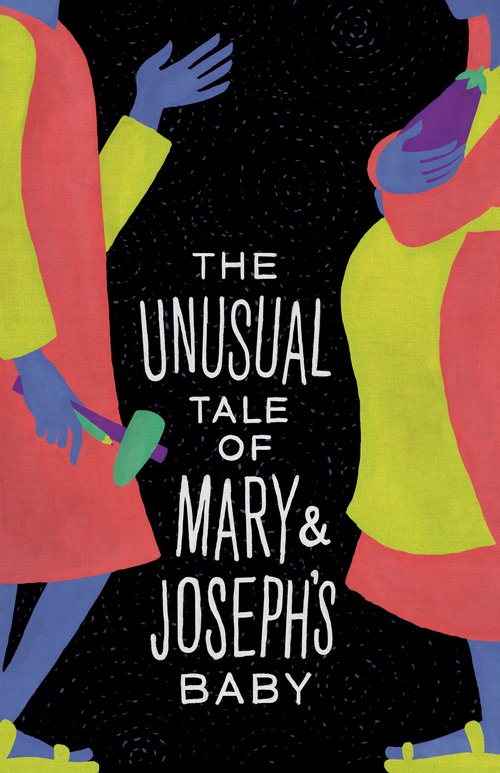
The Unusual Tale of Mary and Joseph's Baby poster

Into this milieu comes Don Chaffer and Chris Cragin-Day’s new musical, The Unusual Tale of Mary and Joseph’s Baby, to shake things up. Running December 8–18 at River and Rail Theatre in Knoxville, Tennessee, the play retells Matthew and Luke’s nativity accounts with a modern imagination, focusing on the hopes and fears of the young couple chosen to bear God into the world. My husband and I attended its world premiere this August at the New York International Fringe Festival, produced by Firebone Theatre, and loved it. (We’re still singing “Hel-looo! Hel-looo!” to each other—the catchy angelic greeting.) Far from the tired, pious storytelling of many a Christian-penned pageant, The Unusual Tale bursts with energy and even surprises, inviting believers and nonbelievers alike to consider anew the meaning of the Incarnation.

The show has a cast of four: Mary, Joseph, and two multirole characters (one male, one female). Mary and Joseph are humanized and given dimension. They are at times angry, scared, hurt, frustrated, confused, happy, tired, skeptical, or insistent. Their personalities sometimes clash—Mary is plucky and passionate and refuses to accept the way things are, whereas Joseph is mostly content and prefers to play it safe. When they are confronted with the outrageous news that Mary is to give birth to the son of God, they are forced to exercise a degree of trust in God and in each other that they had not been required to previously, and it doesn’t come easy. But they grow together into God’s plan in their own different ways as they learn more and more how to do the work they’ve been called to.

One of the most enthralling possibilities that the play opens up is that the Incarnation was triggered not just by God’s feeling that “now’s the time” or by some generic devoutness on the part of Mary but by a spoken vow of hers. Fed up with how the Roman authorities have been roughing up her fiancé at work, Chaffer and Cragin-Day’s Mary starts sermonizing about how God raised up stuttering Moses to deliver their people from slavery in Egypt, and little ole David to conquer a Philistine giant, and why couldn’t he do the same today?

“You know what I think? I think God is just waiting for someone to step up and say, ‘I’ll do it. Choose me.’ Like David did. So you know what I’m gonna do?” Mary says, stepping onto a crate, despite Joseph’s objections.

“I’ll do it, God. I’ll slay Goliath. I am available and willing.”

“One of these days, God’s gonna call your bluff,” Joseph says.

“I’m not bluffing.”   Continue reading “New folk musical: The Unusual Tale of Mary and Joseph’s Baby“ →

Religious art highlights from New Mexico

I spent last week in New Mexico with my husband, Eric, and my in-laws, visiting relatives in the south, then driving up north to spend some time in Albuquerque and Santa Fe. It was my first time to the Southwest, to the state where Eric was born; his grandparents came over from Mexico as teenagers and settled in Hobbs, a small oil town, and his mom grew up there, learning English in school. I enjoyed all the tastes: spicy green chiles in or on just about everything (eggs, tacos, burgers, soup, corn, French fries); piñons (pine nuts) galore sprinkled alongside dusty footpaths, ready to crack open and eat; and sopapillas (pillow-shaped fried dough drizzled with honey) after every meal.

On the five-hour upstate drive, the blue sky spread wide open across the desert and clouds hung low, casting shadows that, from the car, looked like bodies of water. The way was flat, flat, flat—until we reached Santa Fe, where mountains rose up and aspens flickered their glorious gold.

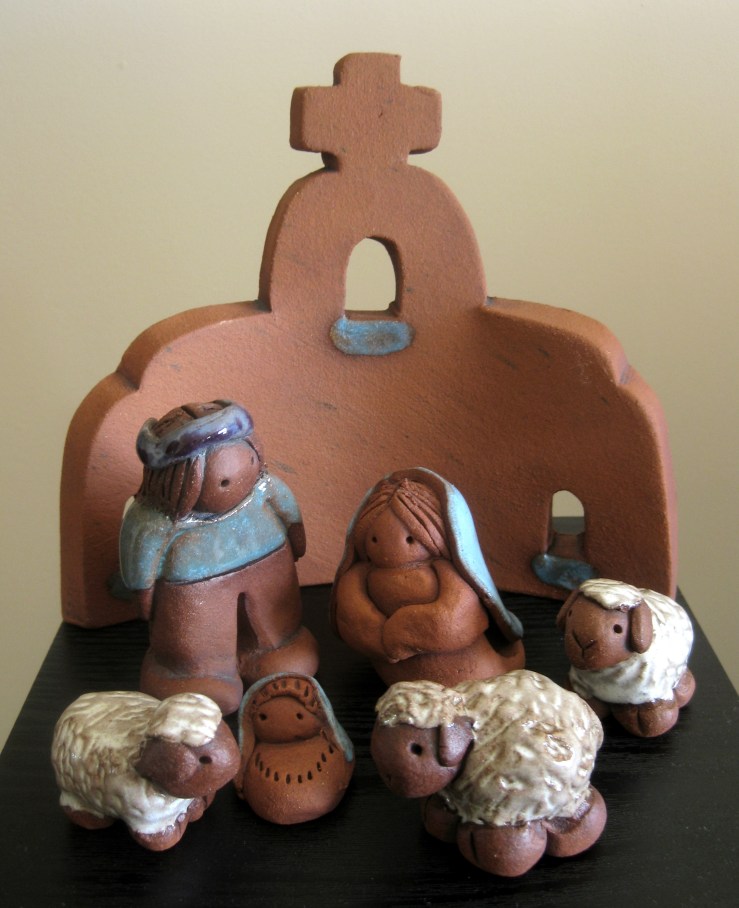
In Albuquerque we went to the International Balloon Fiesta, where hundreds of hot-air balloonists come out once a year to fly. Unfortunately, high winds prevented the “mass ascension” from happening the day we were there, but we saw static displays—inflated balloons in all shapes and colors. (My father-in-law was partial to the Darth Vader balloon; I liked the lovebirds.) And I got to visit to the artisan tent, where I bought my first nativity set! It’s seven pieces in clay by New Mexico native Barbara Boyd. I set it up in our living room when I got home, but Eric says I need to put it away until Advent . . .

Nativity by Barbara Boyd

We spent an afternoon in Old Town Albuquerque, strolling past historic adobe buildings and into galleries, while street musicians—Native American flautists and mariachi bands, mostly—provided a culturally immersive soundtrack. Our first stop happened to be one of my favorites: John Isaac Antiques and Folk Art. Isaac has a beautiful collection of santos (Hispano Catholic religious images)—a whole roomful—both contemporary and from the last few centuries. I was close to buying a Saint Francis bulto by Ben Ortega (Francis was his hallmark) but decided against it, and now I wish I hadn’t. Nonbuyer’s remorse—ugh.

Just before we left Old Town, my mother-in-law suggested one last gallery: Santisima, owned by Johnny Salas. I immediately recognized the work of Albuquerque native Brandon Maldonado, which is heavily influenced by the tradition of Día de los Muertos. I’m really attracted to Day of the Dead imagery, with all its macabre whimsy—the kind that makes most Protestants feel uncomfortable. I think the draw, for me, is that it embraces death instead of shrinking away from it; it says, “Death, we do not fear you.” As Maldonado says, Day of the Dead is not meant to be frightful but rather mocking, in a way:

The masses may prefer to think of the deceased as haloed angels floating on fluffy white clouds, but I like the idea of dancing skeletons in hats!

At Santisima I was introduced to the work of the young santero Vicente Telles, also a native of Albuquerque. I really liked his Adam and Eve and Saint Pelagia retablos but most especially his Crucifixion one, which I ended up buying.

Crucifixion by Vicente Telles
Vicente Telles (American, 1983–), Cristo crucificado (Christ Crucified), 2015. Natural and watercolor pigments on pinewood, 7.5 × 6.5 in. (framed).

It shows a curtain opening up, and two chandeliers dangling, to present Christ on the cross, given for us. As is traditional in New Mexican art, his shoulders and knees are bloodied; in Telles’s interpretation, the blood marks Christ in patterns, almost like tattoos. The animas solas (lonely souls) in the flames of purgatory is also a common motif in New Mexican art. I do not personally subscribe to the doctrine of purgatory, so I read the souls, rather, as Adam and Eve awaiting redemption. According to church tradition, Golgotha was the site not only of Christ’s execution but also of Adam’s burial, which is why, since the Middle Ages, a skull is often painted at the cross’s base, emphasizing Christ’s role as the Second Adam. Telles shows Eve reaching out to touch this death-symbol, lamenting her and Adam’s primordial rebellion and pleading in faith, with her eyes, for deliverance from its consequences. This is the precursor to the Anastasis (Resurrection) icon of Eastern Orthodoxy, which shows Jesus breaking down the doors of Sheol and pulling Adam and Eve up out of their graves to be with him in heaven. We are dead in our sins until Christ raises us. His spilled blood has “loosed the pains of death” once and for all.

To give the retablo a glistening appearance, Telles applied a micaceous clay slip to the pinewood before applying the paint.

If you’re not able to see Telles’s art in person at Santisima (he’s sold exclusively there), visit his Facebook page.   Continue reading “Religious art highlights from New Mexico” →