Roundup: Films for Advent, new Advent books, and more

BLOG SERIES: Three excellent, brief musings on the season of Advent by W. David O. Taylor, published last year on his blog:

  1. “Advent is for singing not-Christmas songs”: “This is, of course, easier said than done. Hymnals fail to supply a decent list of options and congregants often clamor for the ‘traditional’ carols, the songs of triumphant appearance and glorious coming. Yet this insistence fights against the dominant concern of the Gospels. Luke especially spends the bulk of his story anticipating Christ’s birth rather than narrating his arrival. The dramatic tension lies in what’s to come—not in what’s happened already . . .”
  2. “Advent is about being neither fish nor fowl”: “In being neither here nor there, Advent reminds us of our truest identity. We are amphibious creatures . . .”
  3. “Advent is about the goodness of divine interruptions”: “The entire story of Advent is a story of interruptions. . . . May we, like the actors in God’s divine nativity drama, have eyes to see and hearts to welcome his interrupting work in our lives. May we trust that he wills our deepest good in these interruptions. May we be blessed in our trust in him.”

+++

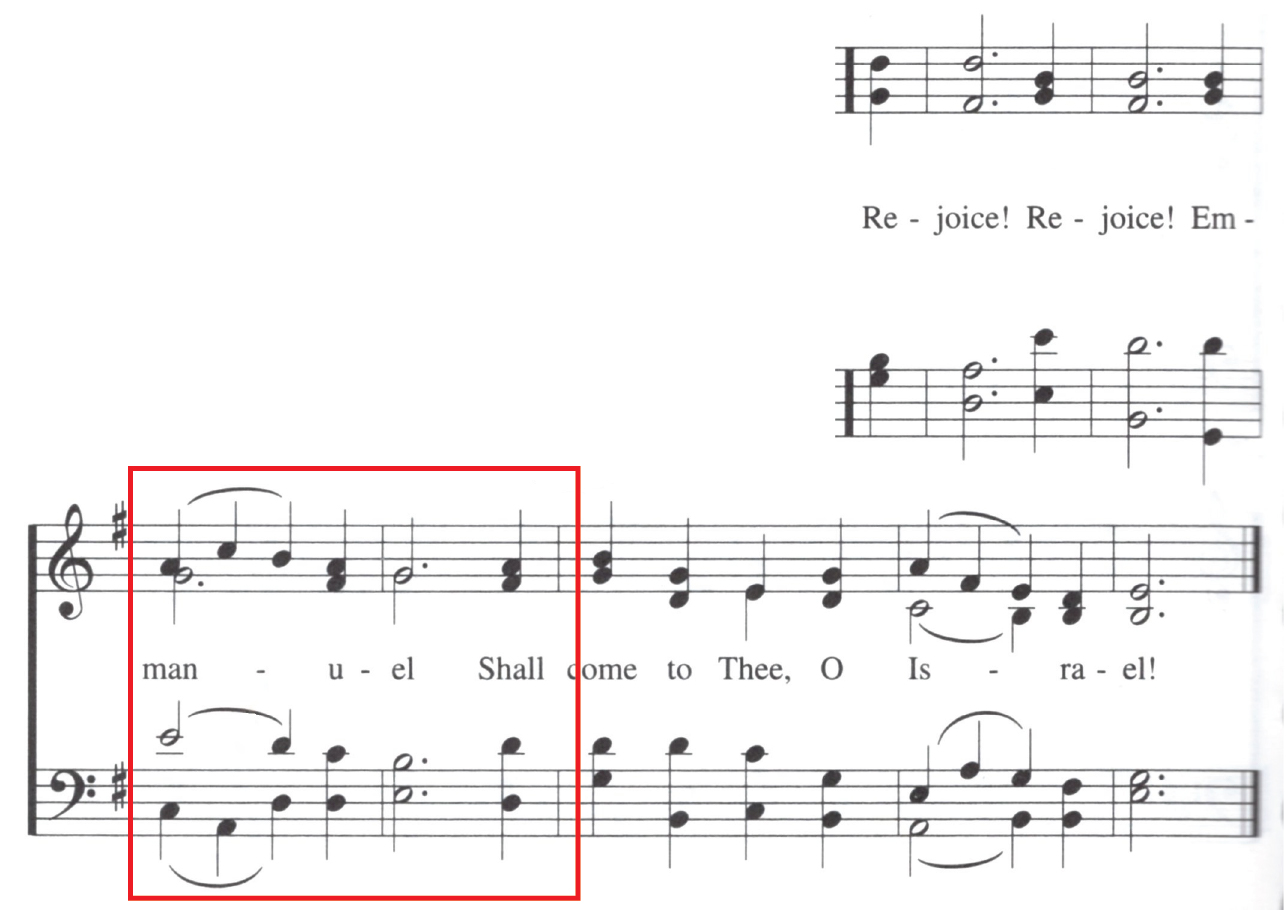
ESSAY: “O Come, O Come, Emmanuel: Dark Good News” by Linda Gregerson, Image: Poet Linda Gregerson reflects, in prose, on the quintessential Advent hymn, which dates back to the Middle Ages. She grew up singing it in her Methodist church every December. “It’s ironic, really—it quite betrays me—to realize that I must have loved this hymn for its whiff of the monastery: chalice and incense smuggled in by way of the minor chord. There’s a moment, a breathtaking moment, when the meter defies expectation. Everything has been steady-as-you-go, four-four time, all quarter notes and dotted halves. But during that remarkable refrain, just when you expect to dwell on the last syllable of the holy name for a count of three, as every verse before this has prepared you to do, the hymn leaps forward and anticipates itself by half a measure. No breath, no stately pause: Emmanuel / Shall come to thee, as though rushing to arrival. Those missed beats never fail to stop my heart.”

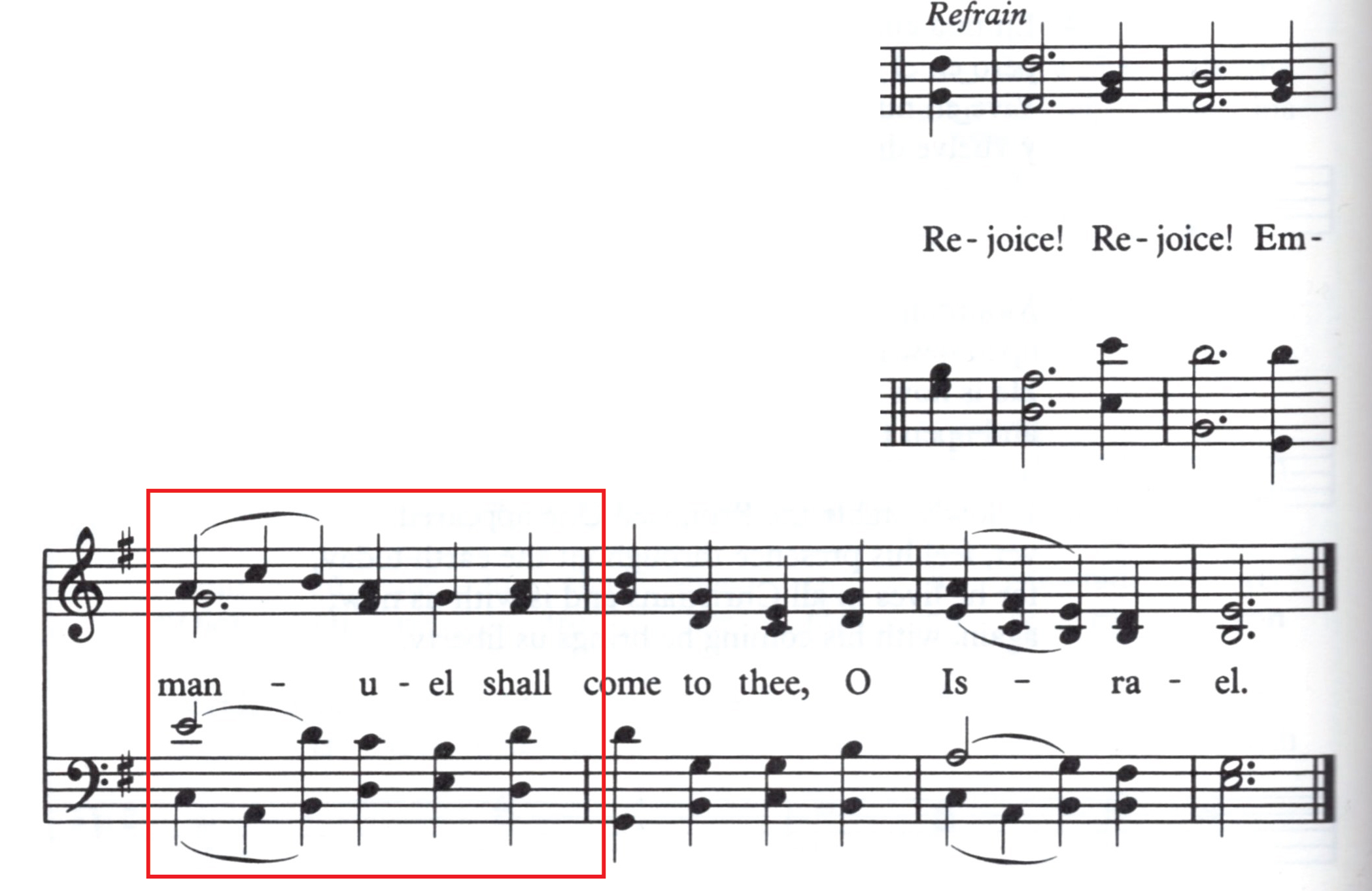
I didn’t know what Gregerson was talking about until I looked up the notation in The United Methodist Hymnal no. 211, and sure enough, in measure 15 there are two extra beats. In all the other hymnals I have (and all the recordings of the song I’ve heard), that measure is divided into two and the regular meter sustained, with “el” held out for three beats. Interesting! It does feel unnatural to me to sing it the way she suggests, but she offers a compelling theological reason for why the arranger made that decision.

O Come_v1
This is the standard way (as far as I’m concerned) of singing “O Come, O Come, Emmanuel.” Sheet music excerpt from Majesty Hymns, the hymnal of my youth.

O Come_v2
Sheet music excerpt from The United Methodist Hymnal, showing the unusual (but significant, Gregerson claims) shift from 4/4 meter to 6/4 in one of the measures of the refrain

Here’s an example of a congregation (First United Methodist Houston) singing the refrain the way Gregerson so fondly remembers:

+++

NEW BOOKS:

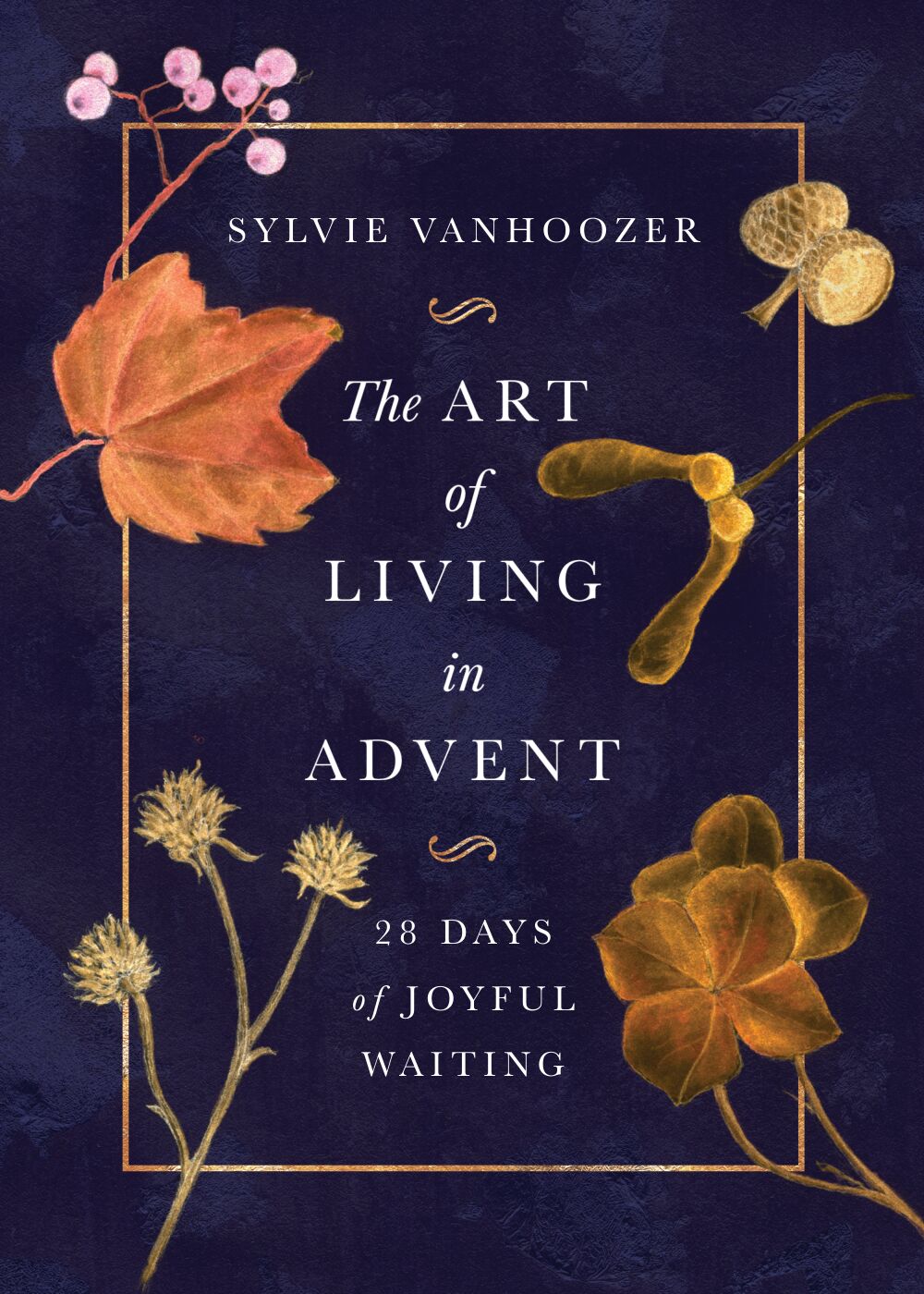
>> The Art of Living in Advent: 28 Days of Joyful Waiting by Sylvie Vanhoozer: A retired French teacher and a botanical artist, Sylvie Vanhoozer was born and grew up in Provence and now lives in Illinois with her husband, the theologian Kevin Vanhoozer. In this little illustrated book, she introduces readers to the tradition of Provençal crèches, localized nativity scenes populated by santons (“little saints”). Made from the land’s clay, the santons resemble nineteenth-century villagers, who offer up gifts from their vocations—olives, bread, wine, wood, sheep, hurdy-gurdy music, herbal remedies. (Reminds me of the presepe from southern Italy that I encountered some years ago!) The crèches are also traditionally decorated with native vegetation, such as thyme, juniper, lavender, and rosemary, freshly harvested on the first weekend of Advent. This is one of the ways in which Provençals embrace Christ’s presence in their own time and place.

The Art of Living in Advent

“I am not inviting readers to leave their place and go to some distant land in a distant past,” Vanhoozer writes. “The invitation is rather to transpose this Provençal scene into one’s own place, to live the same story in a different context. . . . The question is not ‘Did Jesus really come to Provence?’ but rather ‘Could Jesus really come here, to me?’ Could my home, my neighborhood, my church, become a crèche scene, with Christ right here beside me, in me?”

I think this book would have worked better as a literary essay, as it feels padded out to make its ninety-page count, with redundancies and somewhat arbitrary divisions. But I love how Vanhoozer draws us into this cherished and still-living tradition from her childhood and calls us to see and participate in the story of God’s coming where we live, in all its particularities.

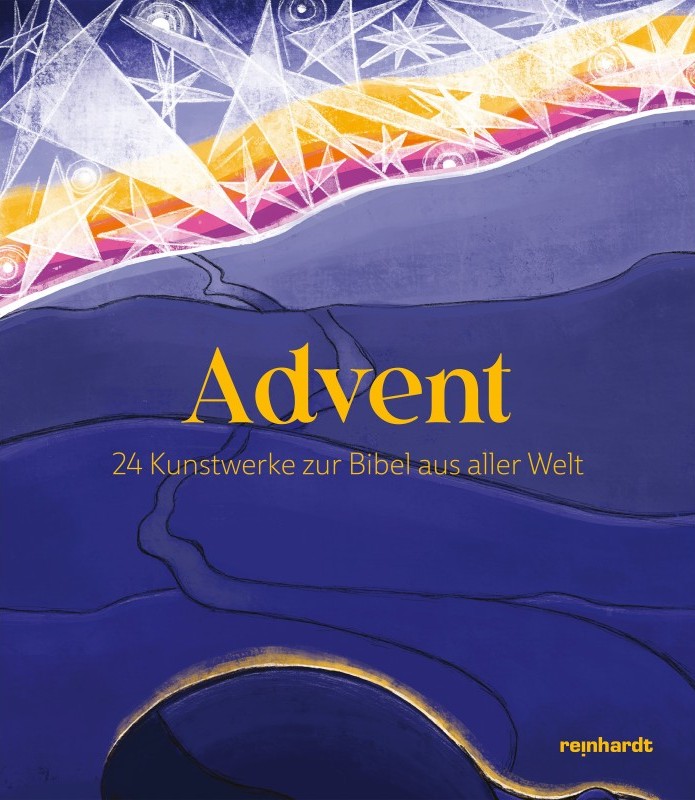
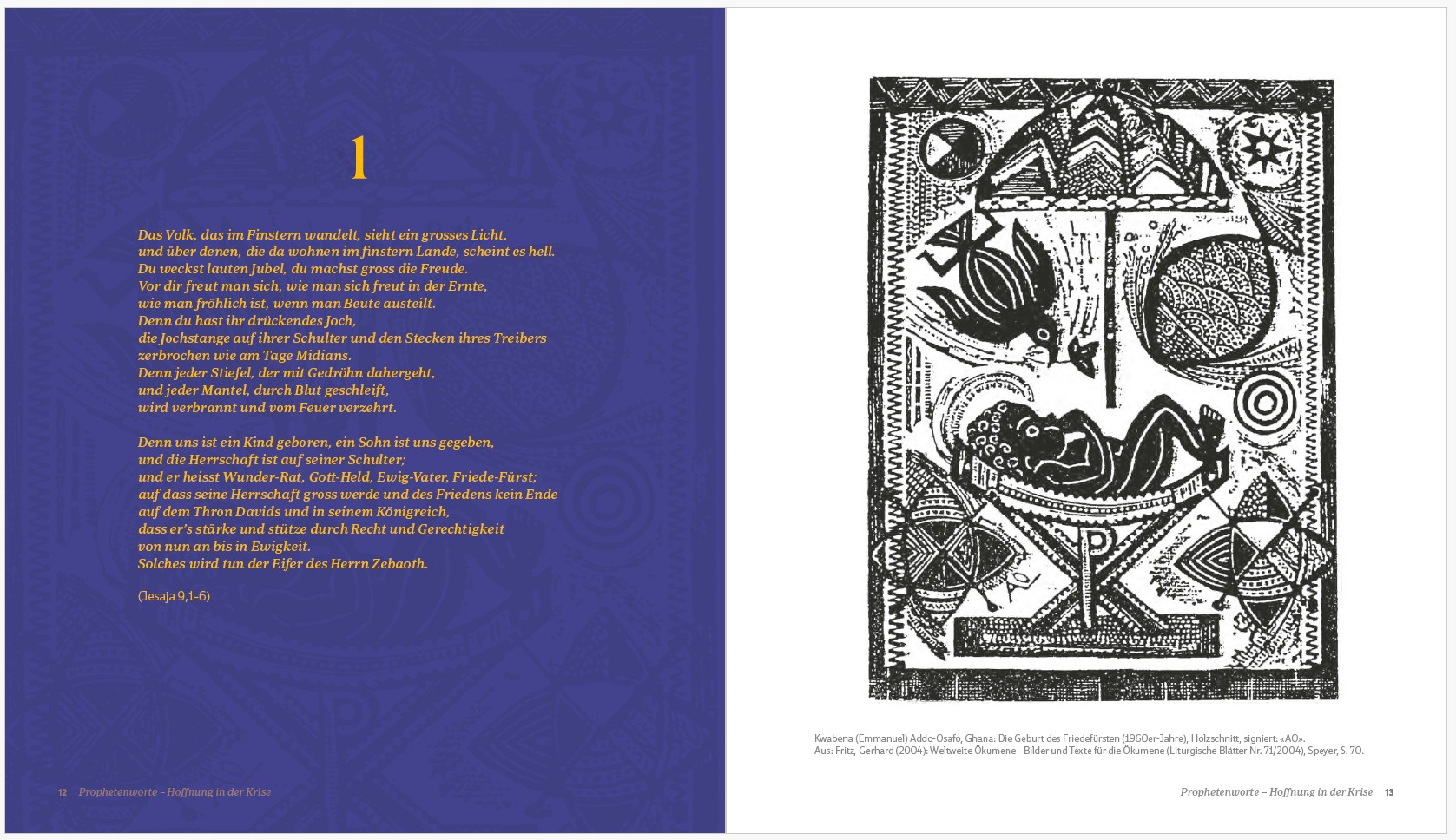
>> Advent: 24 Kunstwerke zur Bibel aus aller Welt by Christian Weber: Rev. Dr. Christian Weber [previously] is the director of studies for Mission 21, an international mission agency of the Protestant Reformed Churches in Switzerland. His work brings him into contact with religious art from diverse parts of the globe. I’m delighted by this new (German-language) book of his, whose title translates to Advent: 24 Bible-Inspired Artworks from Around the World. Organized into four parts (“Words of Prophecy,” “Parables of Jesus,” “John the Baptist,” and “Mary”) and printed in full color, the book features twenty-four primary artworks (plus some supplementary) from twenty-two countries, providing background on and interpretations of each, as well as information about the artists and a bibliography.

Advent (Mission 21 book cover)
Advent (Mission 21 page spread)
Sample page spread from Advent: 24 Kunstwerke zur Bibel aus aller Welt, showing a woodcut by the Ghanaian artist Kwabena (Emmanuel) Addo-Osafo

A church mural from Zimbabwe, a kalamkari from South India, a gourd carving from Peru, a manuscript illumination from Armenia—these are among the artworks Weber highlights. Some of the works are of higher quality than others, but the emphasis is on how the scripture texts of the Advent season have prompted artistic responses in a variety of places outside Europe, which is the continent that has most shaped the popular imagination when it comes to the biblical story. Weber’s Advent encourages us to widen those imaginations. Despite my fifteen or so years spent researching global Christian art, Weber is always bringing new artists to my attention! You can view sample pages from the book on the publisher’s website.

The cover image is a detail of For Those in Darkness by the American artist Lauren Wright Pittman.

Weber is looking for a North American publisher to release an English-language edition of the book.

+++

ARTICLE/VIDEO: “Five Films to Help You Observe Advent” by Abby Olcese, Think Christian: Abby Olcese, author of Films for All Seasons: Experiencing the Church Year at the Movies, provides five movie suggestions for Advent, corresponding to the themes of Hope, Faith, Joy, Peace, and Christ. (Other churches and families, like mine, substitute “Faith” with “Love” on their Advent wreaths; Olcese’s fifth pick, for Christmas Eve, would fit the “Love” theme perfectly, but see also my suggestion below.) You can read the content as an article or watch it in video format, which includes a few film clips:

ALSO: Allow me to add one of my own suggestions: American Symphony, a 2023 documentary about musical artist Jon Batiste, whose meteoric rise to fame coincided with the return of his partner Suleika Jaouad’s leukemia. Directed by Matthew Heineman, the film follows a year in the life of the married couple, as Batiste prepared for the premiere of his boundary-breaking American Symphony composition at Carnegie Hall in September 2022 while Jaouad endured chemotherapy. It has a very Advent-y feel, by which I mean its calling on God in the darkness (Batiste is a devout Christian) and its orientation around faith, hope, and love. It’s a beautiful, intimate portrait of a marriage, of creativity, courage, and care.

+++

ART: Advent Wreath by Beach4Art: Beach4Art is a family of four who create beach art inspired by beautiful nature in Devon, UK. (Follow them on Facebook, Instagram, or TikTok, and see their Etsy shop.) Below are some photos of the Advent wreath they made out of twigs, stones, and shells on Sandymere beach for the first Sunday of Advent in 2023.

Epiphany: Nothing but a Child

LOOK: The Nativity of Christ by Irakli Parjiani

Parjiani, Irakli_The Nativity of Christ
Irakli Parjiani (Georgian, 1950–1991), The Nativity of Christ, 1990. Oil on canvas, 100 × 132 cm.

LISTEN: “Nothing but a Child” by Steve Earle, on Copperhead Road (1988)

From the compilation album To: Kate—A Benefit for Kate’s Sake, sung with Allison Moorer, 2005:

Once upon a time in a far-off land
Wise men saw a sign and set out across the sand
Songs of praise to sing, they traveled day and night
And precious gifts to bring, guided by the light

They chased a brand-new star, ever towards the west
Across the mountains far, but when they came to rest
They scarce believed their eyes, they’d come so many miles
And this miracle they prized was nothing but a child

Refrain:
And nothing but a child could wash those tears away
Or guide a weary world into the light of day
And nothing but a child could help erase those miles
So once again we all can be children for a while

Now all around the world, in every little town
Every day is heard a precious little sound
And every mother kind and every father proud
Looks down in awe to find another chance allowed [Refrain]

Outro:
Nothing but a little baby
Nothing but a child


This is the final post in my 2024/25 Advent–Christmas series. Thanks for journeying with me! If you feel so led, please consider donating; I’ve been having trouble with the embedded Stripe form often rejecting credit cards and then WordPress disabling it (do any of you know of a secure but reliable credit card processor that does not require donors to make an account and that integrates well with WordPress?), but PayPal and Amazon are still options.

I wish you all a very happy Epiphanytide!

Christmas, Day 11: Maligayang Pasko! (Merry Christmas)

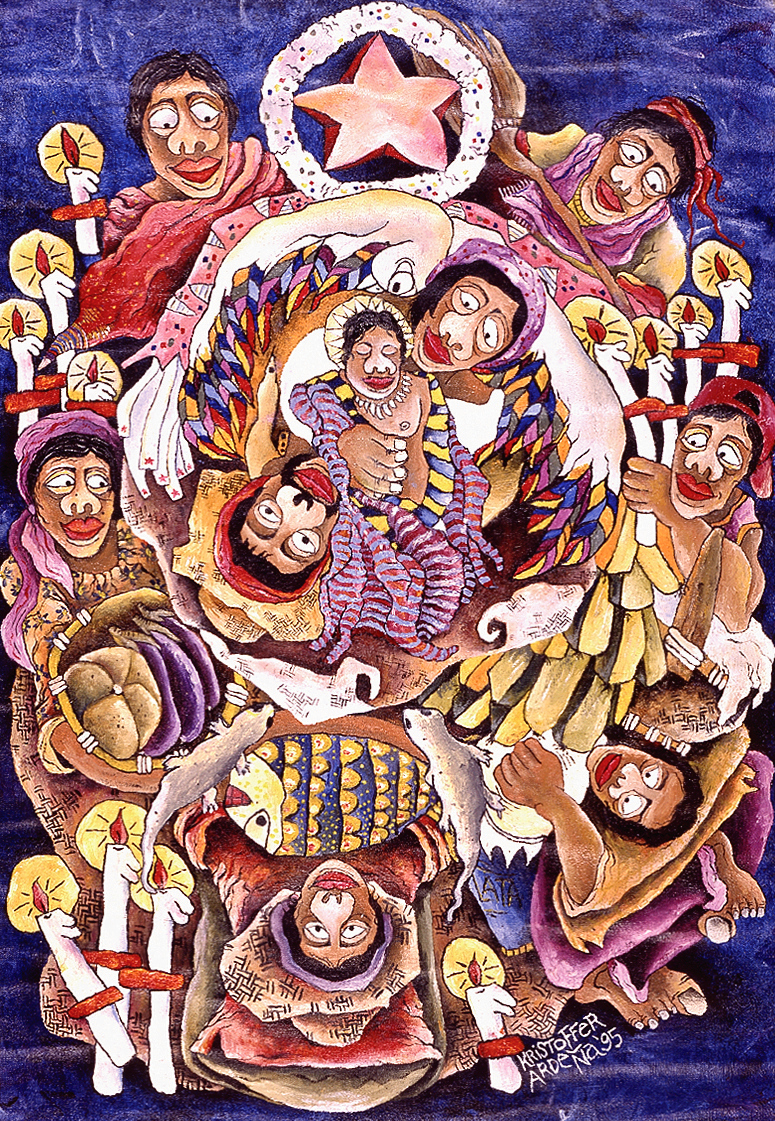
LOOK: Ang Kahulugan ng Pasko by Kristoffer Ardeña

Ardeña, Kristoffer_The Meaning of Christmas
Kristoffer Ardeña (Filipino, 1976–), Ang Kahulugan ng Pasko (The Meaning of Christmas), 1995. Acrylic on chipboard, 59 × 45 cm. © missio Aachen.

About 88 percent of the population of the Philippines is Christian—it’s the only Asian country where Christianity predominates—and Christmas is the most festive holiday of the year.

Filipino artist Kristoffer Ardeña celebrates the Christmas story and its ongoing impact in his painting Ang Kahulugan ng Pasko, which translates to “The Meaning of Christmas.” He wrote the following extended statement about it for the December 1996 issue of Image: Christ and Art in Asia, a publication of the Asian Christian Art Association. From what I can tell, this organization is no longer active.

Christmas—what does it really mean to us? Parties, extravagant decorations, frivolous gifts and all those materialistic things—do they manifest the true meaning of Christmas?

Sometimes we get so used to celebrating Christmas that we forget the truth behind it. In my painting Ang Kahulugan ng Pasko I want to express what Christmas means to me and to the ordinary people whom we hardly notice.

The Christmas lantern

The most popular Philippines Christmas symbol is the star lantern, or parol (see top of artwork). All that is needed to make a star lantern are ten long and five short bamboo sticks, string, starch and paper.

Although rice paper was traditionally used to cover the lantern, nowadays Japanese paper, foils or plastics are used and bulb lights have replaced the traditional candle inside the lantern.

The star lantern is a Filipino innovation of the Mexican piñata which was introduced to our country during the Spanish colonial period.

The five-pointed star lantern represents the star of Bethlehem. Stars produce the elements that make life possible, and in death they sow the seeds of new stars and planets across the heavens. The earth is built in part from the ashes of dead stars, and I think human beings are literally star children. We and all other life forms are collections of atoms forged in stellar furnaces.

It was through this star that the shepherds and the magi were guided, and it may well be the same star that calls us to remember and beckons us to search for the child in the manger—for he is the truth behind Christmas.

By living and dying, a star generates new worlds; the life and death of the infant that the star of Bethlehem symbolises created a new spiritual world.

The banig, or native handwoven mat

The banig is made from abacca, buri or other dried plant fibres woven together. Motifs and designs differ regionally. The banig is where gatherings happen. It is placed on the ground so that rituals, dialogues, recreation or mere eating sessions may occur. It calls us together, it draws us to gather.

The candles

The use of votive candles most probably came from the Roman practice of burning candles as a mark of respect to a person, and in this painting the candles symbolise respect for Christ. But there is more to a candle. It is believed that candles are also a form of prayer.

During fiestas and other holy occasions we offer candles, and we light candles during birthdays or when we visit our dear departed loved ones.

The bananas

During Christmas our front doors are adorned with three bunches of bananas still attached to their stalks. They are placed there during the Advent season and are not taken down before Epiphany. These bananas represent the Holy Family.

Whenever the visitors come to our home we offer them some of these bananas because we believe that these bananas have been blessed by God and that we should share His blessings with others.

I included these bananas as well as the star lantern in this painting because, just like my ancestors, I believe they add meaning to Christmas.

The people surrounding the Holy Family

(1) The northern tribesman of Luzon and the Metro Aide worker (the one who sweeps and keeps our streets clean). These two represent the people both near (the Metro Aide worker) and far (the tribesman) who have been guided by the star to bear witness to the birth of Jesus, just as the shepherds were led to the manger to pay homage to the king.

I chose the Metro Aide worker because I feel that we get used to his presence when he cleans our streets and we hardly take notice of him or thank him for what he does; yet here he is with his broom, giving praise and thanks.

(2) The fisherman, the vegetable vendor and the balut (duck egg) vendor. The Magi brought gold, incense and myrrh, and here are the fisherman with his best catch, the vegetable vendor with her freshest and best vegetables and the balut vendor with the best duck eggs to offer Jesus.

I placed these people in the painting rather than the rich and extravagantly dressed because I believe that Christmas is universal and for everybody. It is not only for the rich but for the modest poor people as well.

The offering we give to Jesus is not merely an act of human generosity; it is a religious act. It is an act which is sacramental and sacrificial. We have worked on these gifts, and we bring them to Jesus and offer them and offer ourselves.

(3) The comanchero. He is the “marine” of Christmas, the first to welcome and the last to go. He is the caroller. He sings and plays his instruments to the tune of Christmas songs to announce Christmas.

He uses ethnic as well as indigenous instruments—tambourines made of beer bottle caps, drums made of cans and cloth, maracas made of coconut shell with mango seeds inside. Just as the vendors offer their goods, he offers his songs to Jesus.

The dove and house lizards

Just as there were cows, horses and many farm animals, the dove and house lizards in this painting represent more than that. They are there to bear witness to this glorious event. The dove, which is the universal symbol of peace, unveils yet embraces the Holy Family.

With regard to the house lizards, I adhere to the superstition that every day at six in the evening they come down from the ceiling to kiss the floor in reverence to God. This belief tells me that we human beings, stewards of God’s creation, must do more than that.

La Sagrada Familia (The Holy Family)

In this painting I represented Joseph as a farmer and Mary as his wife. Jesus is wrapped in striped layette cloth distinctive to the Igorot tribe of Luzon, and as a sign of kingship he wears a necklace made of animal bones, which is characteristic of an Igorot chieftain.

This is one of nine artworks featured in an article I wrote last Christmas for Christianity Today, “How Asian Artists Picture Jesus’ Birth from 1240 to Today.” 

LISTEN: “Ang Pasko Ay Sumapit” (Christmas Has Arrived) | Tagalog words by Levi Celerio, 1950, based loosely on a 1933 Cebuano carol text, “Kasadya Ning Takna-a,” by Mariano Vestil | Music by Vicente Rubi, 1933 | Performed by the Bayanihan Philippine Dance Company on A Philippine Christmas, 1964, reissued 1991

Ang Pasko ay sumapit
Tayo ay mangagsiawit
Ng magagandáng himig
Dahil sa ang Diyos ay pag-ibig

Nang si Kristo’y isilang
May tatlóng haring nagsidalaw
At ang bawat isá ay nagsipaghandóg
Ng tanging alay

Koro:
Bagong Taón ay magbagong-buhay
Nang lumigayà ang ating Bayan
Tayo'y magsikap upang makamtán
Natin ang kasaganaan!

Tayo’y mangagsiawit
Habang ang mundó'y tahimik
Ang araw ay sumapit
Ng Sanggól na dulot ng langit

Tayo ay magmahalan
Ating sundín ang Gintóng Aral
At magbuhát ngayon
Kahit hindî Paskô ay magbigayan!
Christmas has come
Come, let us go forth singing
Beautiful hymns
For God is love

When Christ was born
There were three kings who did visit
And each one did present
A unique offering

Refrain:
’Tis New Year, so we must reform our lives
That our nation might be joyful
Let us strive that we might achieve
Prosperity

Come, let us go forth singing
While the world is silent
The day has arrived
Of the Infant sent from heaven

Let us love one another
May we follow the Golden Rule
And from now on
Though it not be Christmas, let us keep giving [source]

I really like the recording above, which has rollicking instrumentation to back the voices, but here’s an a cappella performance that’s also good, from 2006, by the Philippine Madrigal Singers:

Roundup: Nativity story told by Kenyan children, Annie Moses Band Christmas Special, industrious Joseph, and more

Some of you may wonder why I’m still posting Christmas content. It’s because it’s still Christmastime! Christmas is a twelve-day feast extending from December 25 to January 5. So keep the celebration going with parties, carols, decoration, storytelling, worship, and meditation on the amazing historic event of the Incarnation.

VIDEO: “The Nativity Story (as Imagined by Children in Kenya)”: Released in 2021, this video produced in Kenya by the faith-based child sponsorship organization Compassion International tells the story of Jesus’s birth with localized details, narrated and enacted by children. I was struck by how Mary is pounding yams when the angel Gabriel comes to her, like in one of Nigerian artist George Bandele’s wood carvings of the Annunciation, and how the shepherds literally run to see Jesus, so excited are they to meet him! [HT: Global Christian Worship]

As far as I can tell, this is the first installment in a series of children’s retellings of the Nativity story from around the world that Compassion International releases annually. Subsequent videos—all of them worth watching!—are from Indonesia (2022), Bolivia (2023), and the Philippines (2024).

+++

CONCERT RECORDING: O Holy Night: An Annie Moses Band Christmas Special: Named after their great-grandmother, the Annie Moses Band is an Americana string band of six siblings, raised by award-winning Nashville songwriters Bill and Robin Wolaver, who are committed to godly excellence in the arts. This Christmas concert of theirs, featuring outstanding arrangements of a range of classic carols and one original, was released on DVD in 2018 and just made available by the band for free on YouTube!

Here’s the set list. Links are to standalone videos, excerpted from the performance above. My favorites are probably the opener, “On This Day,” and “We Three Kings”:

+++

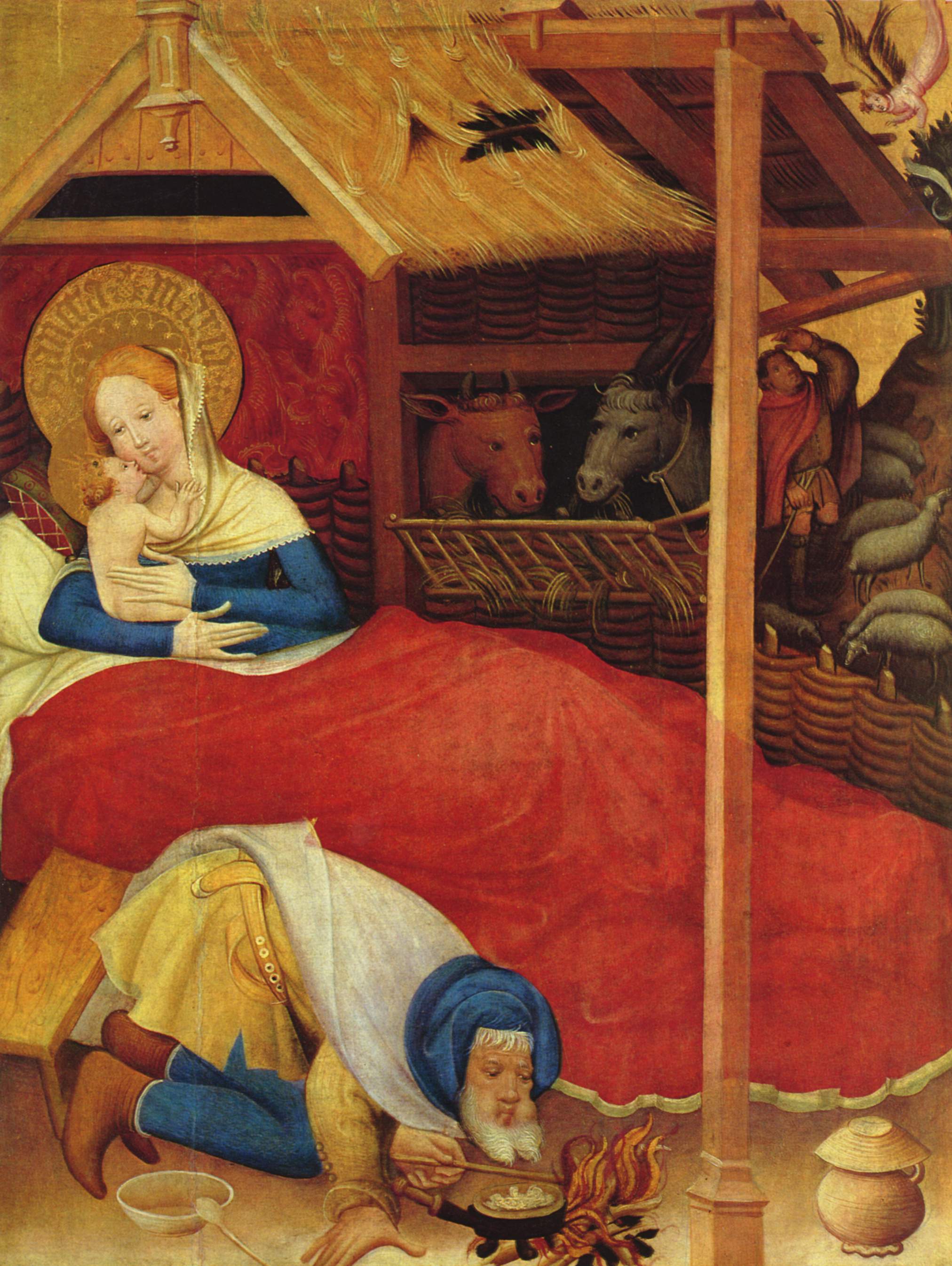
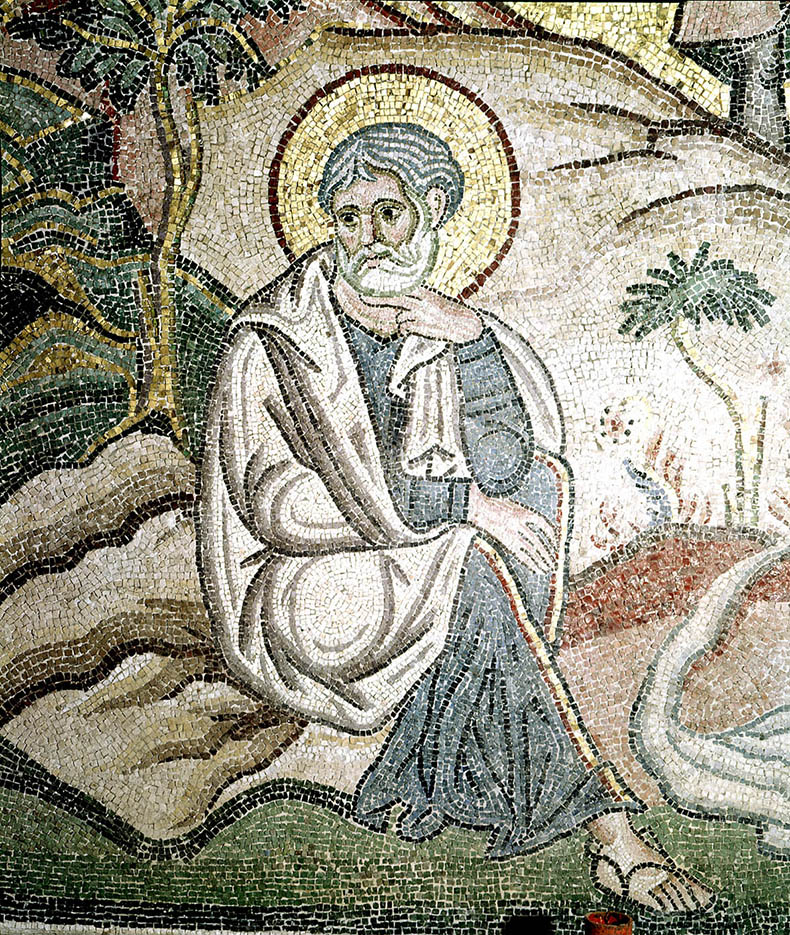
ARTICLE: “Saint Joseph as Baby Daddy: An Illustrated Medieval Guide” by Ela Bobek, DailyArt Magazine: In 2021 on Instagram I shared a small compilation of images that show Joseph as helpful and industrious at the Nativity, as opposed to the more classic depiction of him sitting off to the side with his head in his hands. I’ve since collected over a dozen more and have been wanting to develop a reflection on this motif into a full-fledged article (and probably still will someday), but Ela Bobek has beaten me to it! Check out the images she has compiled that show Joseph cooking, doing laundry, sewing clothes, preparing a bath, and swaddling or holding the baby—allowing Mary some much-needed rest. What a loving, caring, actively involved father and husband!

Konrad von Soest_Nativity
Conrad von Soest (German, ca. 1370–ca. 1422), Nativity, panel in the left wing of the Niederwildungen Altarpiece, 1403. Tempera on wood, 73 × 56 cm. Stadtkirche St. Nikolaus, Bad Wildungen, Germany. [view full altarpiece]

+++

SONGS:

>> “Christmas Ko Ramjham Ma” by Milan Bhujel and Surya Rasaili: This Nepali Christmas song was written by Milan Bhujel (words) and Surya Rasaili (music) in 2022 and is performed here (with dancing!) by Bhujel and friends. I couldn’t find a translation of the Nepali lyrics, but the gist of it is “Let’s dance and rejoice, let’s celebrate the birth of Jesus, who has come to save us. Jesus is a light dispelling all darkness.” [HT: Global Christian Worship]

>> “Christ Is Born (This Day)” by Todd Family Hymnal: This song by Jason B. Todd and Sara K. Todd, a married couple who make music together, is the second track of their Christmas EP from 2020. Jason (who goes by “JB”) is the pastor of administration and music at Westport Baptist Church in Denver, North Carolina.

>> “Funky Little Drummer Boy” by the Good Shepherd Collective: A cover of the funk arrangement of “The Little Drummer Boy” by Sharon Jones & the Dap-Kings, this performance video premiered last week at Good Shepherd New York’s Christmas Eve digital service. The soloist is Stephany Mora. Watch the standalone video on Instagram, or listen on YouTube at this cued-up link.

[Related post: “The Little Drummer Boy: Four Versions (Nigeria, India, Cuba, Norway)]

Christmas, Day 6: A Little Baby

LOOK: Nativity by Ivan Večenaj

Vecenaj, Ivan_Nativity
Ivan Večenaj (Croatian, 1920–2013), Nativity, 1970. Oil on glass. Galerija Ivan Večenaj, Gola, Croatia.

Ivan Večenaj (1920–2013) was a self-taught artist from Croatia, a representative of the Hlebine school of naive painting. He loved nature and folk culture—many of his paintings depict local village life or biblical scenes set in Croatia’s rural countryside. His works are in the collections of the Croatian Museum of Naïve Art in Zagreb and the Vatican Museums, among others. There is also a museum dedicated to his work: the Galerija Ivan Večenaj (Ivan Večenaj Gallery) in his home village of Gola in the Prekodravlje region.

Večenaj’s 1970 Nativity sets Jesus’s birth in Gola. Mary bounces the boy Jesus on her knee under a makeshift shelter roofed with a purple blanket that resembles a mountain. Emerging from the snowy ground behind them is a red cross, a crown of thorns hanging from the center and blood dripping from a wedged nail on both terminals onto a barren tree and Mary’s cloak. But this sign of death is counterbalanced with signs of life—flowers, wheat, and a grapevine sprouting up around the two, references to the Eucharist and to the blossoming of salvation.

The scene emphasizes Jesus’s humble birth into a peasant family—the artist, too, had a peasant background—and foreshadows his atoning death.

LISTEN: “Ar gyfer heddiw’r bore” (For the sake of this very morning), aka “Faban Bach” (A Little Baby) | Words by David Hughes, early nineteenth century | Tune: MENTRA GWEN, traditional Welsh | Performed by Parti Fronheulog, 1967

Ar gyfer heddiw’r bore’n faban bach, faban bach,
y ganwyd gwreiddyn Iesse’n faban bach;
y Cadarn ddaeth o Bosra,
y Deddfwr gynt ar Seina,
yr Iawn gaed ar Galfaria’n faban bach, faban bach,
yn sugno bron Maria’n faban bach.

Caed bywiol ddŵfr Eseciel ar lin Mair, ar lin Mair,
a gwir Feseia Daniel ar lin Mair;
Caed bachgen doeth Eseia,
’r addewid roed i Adda,
yr Alffa a’r Omega ar lin Mair, ar lin Mair;
mewn côr ym Meth’lem Jiwda, ar lin Mair.

Diosgodd Crist o’i goron, o’i wirfodd, o’i wirfodd,
er mwyn coroni Seion, o’i wirfodd;
i blygu’i ben dihalog
o dan y goron ddreiniog
i ddioddef dirmyg llidiog, o’i wirfodd, o’i wirfodd,
er codi pen yr euog, o’i wirfodd.

Am hyn, bechadur, brysia, fel yr wyt, fel yr wyt,
i ’mofyn am dy Noddfa, fel yr wyt
i ti’r agorwyd ffynnon
a ylch dy glwyfau duon
fel eira gwyn yn Salmon, fel yr wyt, fel yr wyt,
gan hynny, tyrd yn brydlon, fel yr wyt.

English translation by Richard B. Gillion, 2008:

For the sake of this very morning, as a little baby, a little baby
Was born the root of Jesse, as a little baby;
The Strong one who came from Bosra,
The Lawmaker of old on Sinai,
The Redemption to be had on Calvary, as a little baby, a little baby,
Suckling the breast of Mary, as a little baby.

The life-giving water of Ezekiel is found on Mary’s knee, on Mary’s knee,
And the true Messiah of Daniel on Mary’s knee;
Here is the wise boy-child of Isaiah,
The promise made to Adam,
The Alpha and Omega on Mary’s knee, on Mary’s knee;
In the stall in Bethlehem of Judah, on Mary’s knee.

Christ took off his crown, of his freewill, of his freewill,
In order to crown Zion, of his freewill;
To bow his undefiled head
Under the thorny crown,
To suffer enraged derision, of his freewill, of his freewill,
To raise the head of the guilty, of his freewill.

Therefore, sinner, hurry, as thou art, as thou art,
To ask for his sanctuary, as thou art;
For thee the well was opened
Which washes thy wounds
Like the snow on Salmon, as thou art, as thou art.
For that, come promptly, as thou art.

With roots dating back to the pre-Reformation era, the plygain service is a Welsh Christmas tradition in which Christians gather at church from 3 a.m. to 6 a.m. on Christmas morning for community-led carol singing. One of the popular carols that’s sung is “Ar gyfer heddiw’r bore,” its text by the Welsh poet David Hughes (ca. 1794–1862), known by his bardic name of Eos Iâl. It’s twelve stanzas in all, which start with the Nativity and then move through various stages of Christ’s passion, from Gethsemane to Pilate’s hall to Golgotha to the garden of the tomb, commemorating the incarnation, the atonement, and Christ’s ascension and intercession for sinners.

The recording here is by Parti Fronheulog, a folk trio of brothers from southeast Denbighshire, Wales—Tom Williams (lead), Osmond Williams (tenor), and Ted Williams (bass)—who were active in the 1960s. They sing stanzas 1, 2, 5 and 12.

Christmas, Day 5: His Hair Alight

LOOK: Maryam and Isa, Mughal India

Mughal Nativity
Maryam and Isa (Mary and Jesus), miniature from a Falnama, Mughal India, 1550–1600. Opaque paint, gold, and silver on paper, 49 × 35 cm. Wereldmuseum, Rotterdam, Netherlands, Inv. 07180329.

This delicate painting is from an Islamic manuscript made in India during the Mughal era. It shows Mary sitting outside with her son, Jesus, on her lap, whose flaming halo identifies him as a prophet. Enclosed by a gate, they are seated on a mat, and Jesus hands his mother a fruit that looks to me like a pomegranate—though a date would cohere better with the Qur’an’s Nativity account (19:25–26). Verdant pink hills rise up behind them, as does a palm tree, under which sits a pitcher of water. From the left, an anthropomorphized sun gazes down on the sacred pair. The inscriptions are in Persian.

Like Christians, Muslims revere Jesus—his birth is recounted in the Qur’an 19:16–34 and 3:45–53, and in that book he is also described as the Messiah, the Word of God, and the Spirit of God—but unlike Christians, Muslims do not regard Jesus as divine.

LISTEN: “A Christmas Carol” | Words by G. K. Chesterton, 1900 | Music by Deanna Witkowski, 2017 | Performed by the ChoralArt Camerata, dir. Robert Russell, 2018

The Christ-child lay on Mary’s lap,
His hair was like a light.
(O weary, weary were the world,
But here is all aright.)

The Christ-child lay on Mary’s breast
His hair was like a star.
(O stern and cunning are the kings,
But here the true hearts are.)

The Christ-child lay on Mary’s heart,
His hair was like a fire.
(O weary, weary is the world,
But here the world’s desire.)

The Christ-child stood on Mary’s knee,
His hair was like a crown,
And all the flowers looked up at Him,
And all the stars looked down.

“The Vigil of Joseph” by Elsa Barker (poem)

Saint Joseph at the Nativity
Saint Joseph at the Nativity, ca. 1100, mosaic detail from Daphni Monastery, Haidari (outside Athens), Greece [ view full scene ]

After the Wise Men went, and the strange star
Had faded out, Joseph the father sat
Watching the sleeping Mother and the Babe,
And thinking stern, sweet thoughts the long night through.

“Ah, what am I, that God has chosen me
To bear this blessed burden, to endure
Daily the presence of this loveliness,
To guide this Glory that shall guide the world?

“Brawny these arms to win Him bread, and broad
This bosom to sustain Her. But my heart
Quivers in lonely pain before that Beauty
It loves—and serves—and cannot understand!”

from The Frozen Grail and Other Poems by Elsa Barker (Duffield & Company, 1910)

Elsa Barker (1869–1954) was a novelist, short story writer, and poet from New England. She lived for extended periods in London and Paris and was a member of the Theosophical Society.

Christmas, Day 3: A Cradle in Bethlehem

LOOK: Nativity relief sculpture from Chartres Cathedral

Nativity (Chartres)
The Nativity, ca. 1230–40. Limestone fragment from the now destroyed rood screen of Chartres Cathedral, France, 93 × 133 cm.

LISTEN: “A Cradle in Bethlehem” by Alfred Bryan (words) and Larry Stock (music), 1952 | Performed by Gregory Porter and the Jazz at Lincoln Center Orchestra with Wynton Marsalis, on Big Band Holidays, 2015

Watch the live performance on the Blue Engine Records Facebook page.

Sing sweet and low a lullaby till angels say, “Amen”
A mother tonight is rocking a cradle in Bethlehem
While wise men follow through the dark a star that beckons them
A mother tonight is rocking a cradle in Bethlehem

A little child will lead them, the prophets said of old
In storm and tempest heed him until the bell is tolled
Sing sweet and low your lullaby till angels say, “Amen”
A mother tonight is rocking a cradle in Bethlehem

A mother tonight is rocking a cradle in Bethlehem
A mother tonight is rocking her baby in Bethlehem

This song was popularized by Nat King Cole on his 1960 album, The Magic of Christmas. In addition to the live recording above featuring singer-songwriter Gregory Porter and legendary jazz trumpeter Wynton Marsalis, here are two other recordings I like:

>> By the Lower Lights, feat. Debra Fotheringham, on Sing Noel (2013):

>> By Son of Cloud (Jonathan Seale), on Glad Tidings, vol. 1, by Mason Jar Music (2019):

Christmas, Day 2: A Child Is Born

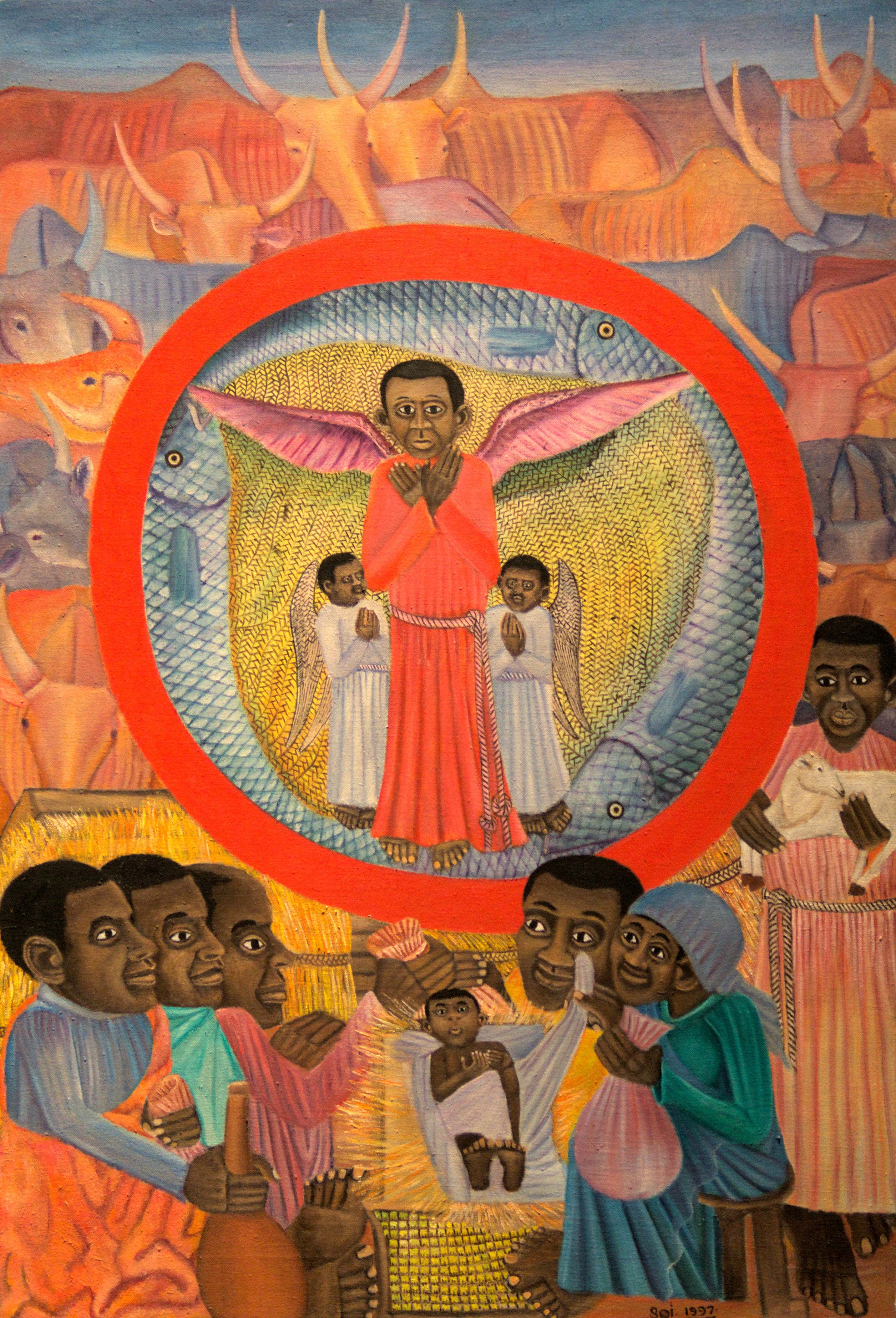
LOOK: Birth of Jesus with Magi and Celestial Observers by Ancent Soi

Soi, Ancent_Birth of Jesus
Ancent Soi (Kenyan, 1939–2022), Birth of Jesus with Magi and Celestial Observers, 1997. Oil on canvas, 34 × 23 in. (86.4 × 58.4 cm). North Carolina Museum of Art, Raleigh. Photo: Victoria Emily Jones. [object record]

LISTEN: “Nyathi Onyuol” (A Child Is Born) | Traditional Luo spiritual, arr. Enrico Oweggi, 1990 | Performed by the Nairobi Chamber Chorus, 2021

Isaya ne okoro k’owacho niya
“Kuomwa nyathi onyuol.”
Nyathi ma wuoyi, no luonge Hono,
Jabura, Nyasaye ma Jateko, Wuonwa, Emmanuel.

Chieng’o nogo piny neolil piny neo kuwe,
Sulwe ne rieny, Nyathi n’o nyuol.
Kanyna n’oting’o Maria, yawa, kodhiyoe piny mar
Daudi kwargi kanyna n’oting’o
Maria yawa Maria ne pek Yesu Jawar
Kar nindo n’otamo Maria yudo
Bethlehem ne opon’g ting ma pek
Josef chwore n’o manyo ot tone ot otamo
Kuom hawi Josef n’onyis kund dhok
Gotieno nogo muoch neoyako Maria.

Isaya ne okoro . . .

ENGLISH TRANSLATION:

Isaiah prophesied and said:
“Unto us a child is born!”
He shall be called Wonderful Counselor,
the Mighty God, our Father, Emmanuel!

On that day
it was dark and silent.
There was no place
in Bethlehem for
Mary and Joseph.
By chance
they were shown
a shed, and that night
Mary gave birth
to the child.

Isaiah prophesied . . .

This song of unknown authorship is written in the Luo language of the Luo people, who traditionally live on the shores of Lake Victoria in western Kenya and northern Tanzania. It was popularized by Muungano National Choir, who recorded it on their 1990 album Missa Luba: An African Mass—10 Kenyan Folk Melodies, as arranged by one of their members, Enrico Oweggi (sometimes rendered “Owegi”).

The Luo lyrics and loose English translation above are sourced from the liner notes of Christmas a Cappella: Songs from Around the World by Chicago a Capella (2008).

Other performance videos available on YouTube include those by Christ the King Church Choir in Kampala and the Choir of ACK St. Stephen’s Bamburi in Mombasa.

Roundup: Bolivian Christian art, Ukrainian folk carol, and more

ART SERIES: Pallay: Andean Weaving of Liturgy and Design by Daniela Améstegui: Daniela Améstegui is a graphic designer from Cochabamba, Bolivia, who holds a master’s degree in theological studies from Regent College in Vancouver, with a specialization in Christianity and the arts. Her work “revolves around exploring faith, social justice, and Christian contextualization through design” and “reflects her commitment to using design as a tool for expressing and exploring theological concepts,” she says. She currently lives in Langley, British Columbia, with her husband and two young children, working as a freelancer.

Améstegui’s final Integrative Project in the Arts and Theology for her master’s program was Pallay: Andean Weaving of Liturgy and Design, a series of seven digital illustrations, one for each of the major seasons/feasts of the liturgical year: Advent, Christmas, Epiphany, Lent, Easter, Pentecost, and Ordinary Time. The designs are inspired by Andean textile art and culture. You can view the full series at the link above from Regent College’s Dal Schindell Gallery, where the works were first exhibited in early 2022, but also listen to this wonderful online talk Améstegui gave about Pallay in 2020 for INFEMIT’s Stott-Bediako Forum, where she discusses not only her motivation and influences but also the content of each specific piece:

Whereas those of us in the northern hemisphere associate Advent with cold, darkness, and the onset of winter, in the southern hemisphere Advent falls in early summer, a time when the earth is most fertile and farmers plant their seeds. In her Advent design, Améstegui connects Mary carrying the seed of new life within her with Pachamama (Mother Earth).

Amestegui, Daniela_Advent
Daniela Améstegui (Bolivian, 1990–), Adviento (Advent), 2019–20, from the digital illustration series Pallay: Andean Weaving of Liturgy and Design. Used with permission.

In Bolivia, Christmas takes place during a season of harvest, so in her Christmas design, Améstegui places Jesus in the center between crops of corn and quinoa, the two main agricultural foods cultivated in the country. Mary wears braids and a bowler hat and Joseph plays the zampoña (Andean panflute), and at the bottom three cholitas, Indigenous women from the Bolivian countryside, gather reverently to greet the Christ child.

Amestegui, Daniela_Christmas
Daniela Améstegui (Bolivian, 1990–), Navidad (Christmas), 2019–20, from the digital illustration series Pallay: Andean Weaving of Liturgy and Design. Used with permission.

Améstegui does not have a website just yet but tells me she plans to launch one in 2025. If you would like to purchase one or more of her Pallay pieces, you can contact her at daniela@amestegui.com.

Thank you to blog reader Nicole J. for alerting me to this striking series!

+++

VIDEO COLLECTION: Casa del Catequista (CADECA) chapel paintings: As chance would have it, the same week I learned about Daniela Améstegui’s work, a different blog reader, Mark M., emailed me a link to some videos his Langham Partnership colleague Paul Windsor took during a recent trip to Bolivia. They record the many paintings, most by the late Quechua artist Severino Blanco [previously], inside the chapel of CADECA in Cochabamba, a place where men and women are trained as Christian leaders who then go out to serve their rural communities. They portray scenes from the Old and New Testaments, the parables of Jesus, and Latin American church history, including a remarkable liberation theology–inspired Resurrection, in which Jesus breaks down the doors of death and hell, holding high a cacique’s staff and leading the people of Bolivia into their future. Here’s a 360-degree view captured by Windsor, but visit the boldface link to see additional videos that narrow in on particular portions.

Blanco, Severino_Nativity
Severino Blanco (Quechua [Bolivian], 1951–2020), Infancy of Christ painting cycle, 1985. Chapel of the Casa del Catequista (CADECA), Cochabamba, Bolivia.

On the west end of the chapel (where people enter the space) is an Infancy of Christ cycle—reproduced here from a scan of a pamphlet, it appears. In the center is a Nativity, the Christ child painted over a pane of glass through which natural light comes gleaming in (see a closer view). The oblong shapes radiating out from the center are also glass, onto which the artist has (I think) etched lambs in various stages of prostration. On the sides, two villagers come with hot water and towels, and at the bottom two shepherds kneel before the Savior, removing their hats as a sign of respect. At the top, a host of angels with rainbow-colored wings and indigenous instruments sing Christ’s praises.

To the left of the Nativity are six scenes: (1) The Annunciation to Mary, (2) The Visitation, (3) The Annunciation to Zechariah, (4) The Journey to Bethlehem, (5) No Room at the Inn, and (6) The Flight to Egypt. To the right are (7) The Annunciation to the Shepherds, (8) The Annunciation to Joseph, (9) The Presentation in the Temple, (10) The Adoration of the Magi, (11) Jesus with the Scholars in the Temple, and (12) The Massacre of the Innocents.

+++

SONGS:

>> “Admirable Consejero” (Wonderful Counselor) by Santiago Benavides: Santiago Benavides is a Colombian singer-songwriter living in Toronto. On his Facebook page he describes his musical style as “trova-pop-bossa-carranga worship.” This song he wrote is a setting of Isaiah 9:2, 6–7 in Spanish. In the video, he’s the guitarist with the red-tinted glasses.

>> “The Word Became Flesh” by John Millea: John Millea is “a storyteller with a guitar,” singing in the tradition of Americana, folk, and gospel “about life and all of its joys, sorrows, and struggles.” He’s one of the artists I support through Patreon. This was the first song of his I encountered, and it’s one of my favorites, engaging with John 1:1–3, 14 in a wholly unique way!

In contrast to everyone and everything else in the universe, Millea explains, God had no beginning point, and all that is can in some way be traced back to him, the first link in a massive chain of cause and effect. So here Millea playfully traces his guitar all the way back to God—from the store he bought it at in Illinois, to the factory in Pennsylvania they ordered it from, to the mill in Washington that supplied the wood, to the Alaskan forests whence the tree was logged, and so on and so forth, imagining many thousands of years of fallen and dispersed tree seeds that traversed seas and continents, with an ultimate source in a tree planted in Eden by the Word of God.

When he hits on Eden, he starts moving forward again, through the story of creation, fall, and redemption in Christ, the divine beginningless One who graciously and mysteriously entered human history, born of a woman named Mary.

>> “Mary Had a Baby”: Arranged by Roland Carter, this African American spiritual is performed by the Nathaniel Dett Chorale, featuring the amazing mezzo-soprano Melissa Davis. It’s from their 2003 album An Indigo Christmas, the tracks taken from two live concerts given at the Church of St. George the Martyr in Toronto.

>> “Що то за предиво” (Shcho to za predyvo) (Behold a Miracle): This Ukrainian folk carol is performed by Trioda (Тріода), a musical group consisting of Andrii Gambal, Volodymyr Rybak, and Pavel Chervinskyi.

What is this awe-inspiring miracle?
There is great news on earth!
That the Virgin Mary gave birth to a son.
And upon birthing him, she declared,
“Jesus—my son!”

And the aging Joseph stands nearby in awe
Of Mary having given birth to a son.
And he prepares the swaddling for Jesus Christ.
And Mary swaddles him, and scoops him to her heart—
The pure Virgin Mary!

Trans. Joanna (Ivanka) Fuke [source]