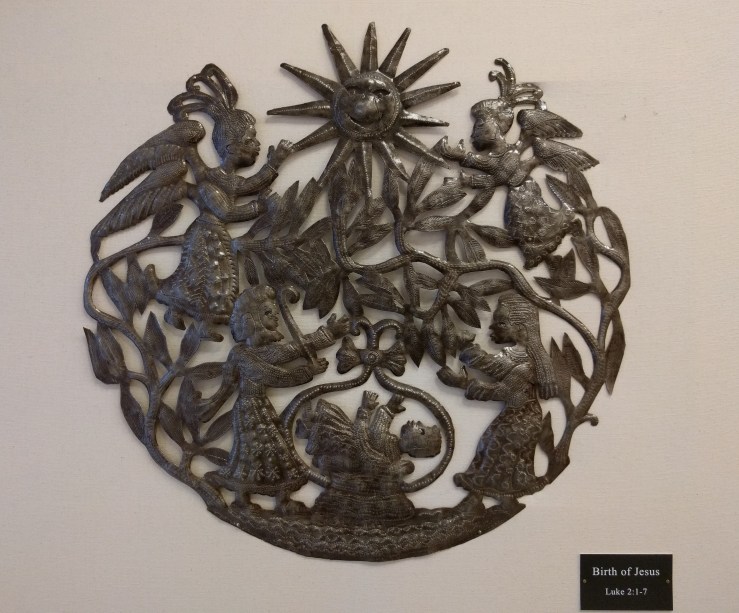
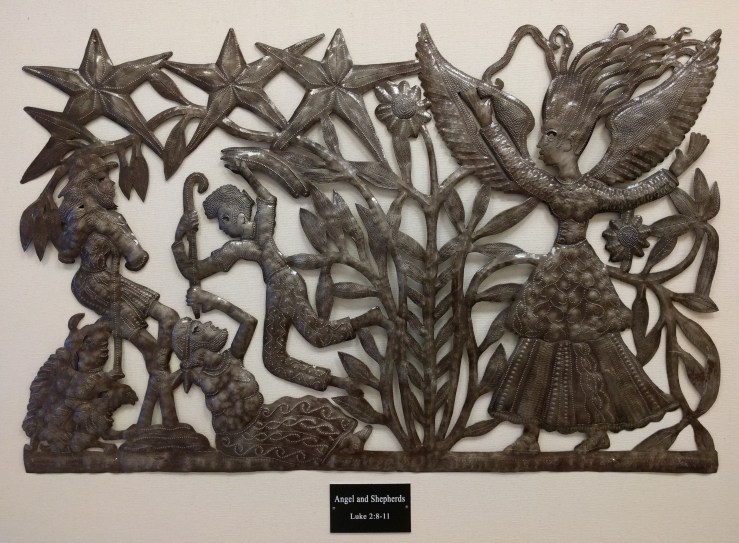
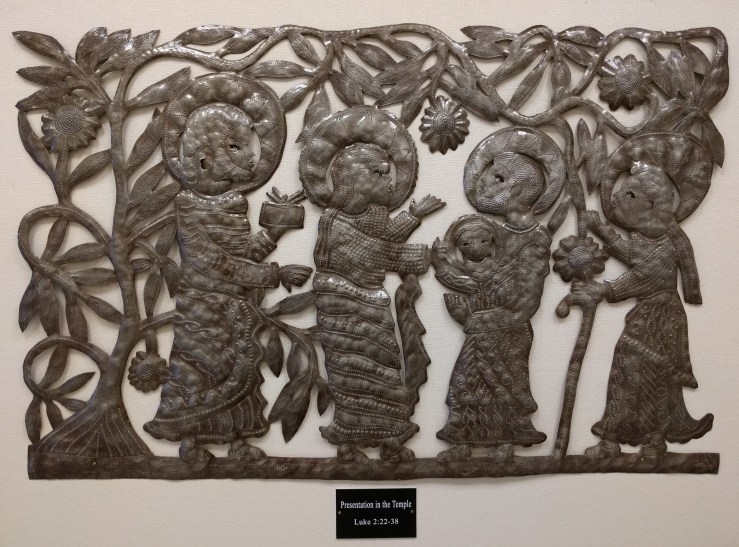
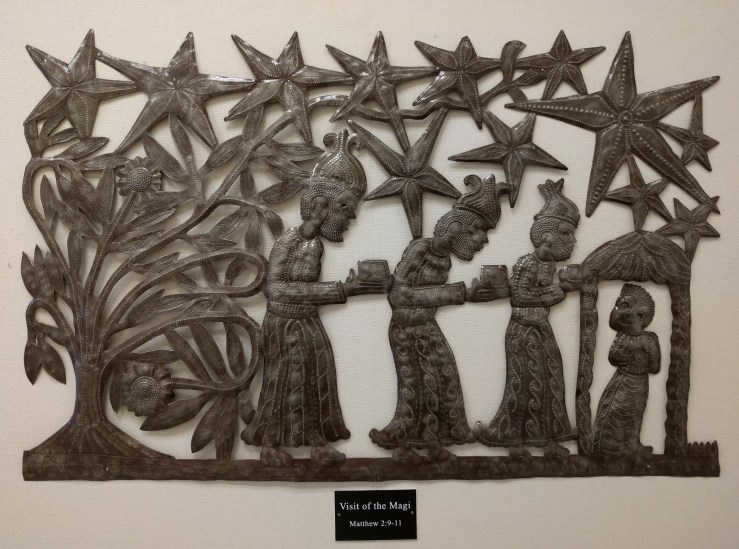
When wandering around the Duke Divinity School campus this summer, waiting for a conference talk to start, I inadvertently encountered a stunning seven-work cycle of metal panels depicting scenes from the biblical narratives of Christ’s birth. They were designed and hand-carved from discarded steel oil drums by Haitian artist Jean Sylvestre, who lives in the village of Croix-des-Bouquets, ten miles outside Port-au-Prince.
Steel drum sculpting is an art form unique to Haiti, and Croix-des-Bouquets is the center of production, home to dozens of workshops. Once acquiring a drum, the artist first removes the round ends and places them inside the cylinder along with dried banana or sugar cane leaves, then sets the leaves on fire to burn off any paint or residue. When the drum cools, the artist makes a cut from top to bottom, then climbs inside and pushes with his legs and arms to open up the metal, which he then pounds into a flat sheet. Next he draws a design onto the metal using chalk, then uses a hammer, chisel, and ice picks to actualize it. To see photos of this process and learn more about it, visit www.haitimetalart.com.
In Sylvestre’s nativity cycle at Duke—a gift from Drs. Richard and Judith Hays—the characters are depicted as native Haitians. Each scene unfolds against a backdrop of curvilinear greenery that is typical of Haitian metalwork.
My favorite of the seven has got to be the Annunciation to the Shepherds; I love the angel’s wild hair and the one shepherd who jumps backward in fear and surprise. I’m also tickled by the smiling sun in the Nativity panel!
Jean Sylvestre (Haitian, 1957–), Annunciation, 2013. Recycled steel. No. 1 from a cycle of seven in the Westbrook Building, Duke Divinity School, Durham, North Carolina. Photo: Victoria Emily Jones.Jean Sylvestre (Haitian, 1957–), Visitation, 2013. Recycled steel. No. 2 from a cycle of seven in the Westbrook Building, Duke Divinity School, Durham, North Carolina. Photo: Victoria Emily Jones.Jean Sylvestre (Haitian, 1957–), Birth of Jesus, 2013. Recycled steel. No. 3 from a cycle of seven in the Westbrook Building, Duke Divinity School, Durham, North Carolina. Photo: Victoria Emily Jones.Jean Sylvestre (Haitian, 1957–), Angel and Shepherds, 2013. Recycled steel. No. 4 from a cycle of seven in the Westbrook Building, Duke Divinity School, Durham, North Carolina. Photo: Victoria Emily Jones.Jean Sylvestre (Haitian, 1957–), Presentation in the Temple, 2013. Recycled steel. No. 5 from a cycle of seven in the Westbrook Building, Duke Divinity School, Durham, North Carolina. Photo: Victoria Emily Jones.Jean Sylvestre (Haitian, 1957–), Visit of the Magi, 2013. Recycled steel. No. 6 from a cycle of seven in the Westbrook Building, Duke Divinity School, Durham, North Carolina. Photo: Victoria Emily Jones.Jean Sylvestre (Haitian, 1957–), Flight into Egypt, 2013. Recycled steel. No. 7 from a cycle of seven in the Westbrook Building, Duke Divinity School, Durham, North Carolina. Photo: Victoria Emily Jones.
Duke Divinity School also owns a fourteen-piece Stations of the Cross cycle by Jean Sylvestre, which is often displayed in the nave of Duke University Chapel during Lent.
>> Rozhdestvo (The Nativity) (1996), written and directed by Mikhail Aldashin: I am blown away by this wordless animated short from Russia. Using a naive art style washed in sepia tones and set to a soundtrack of Bach and Beethoven, it tells the story of how angels, humans, and animals came together on the first Christmas to worship the newborn Christ. It opens with Gabriel peeking out from behind a tree at Mary hanging laundry, then chasing her down a footpath to tell her what God is up to. For every person and critter he encounters, Gabriel flashes open the book of God’s word, pointing them to the shalom it prophesies and inviting them to enter in. By the end, shepherds, fishermen, kings, rabbits, lambs, and lion are participating in a round dance outside the stable, while an angel orchestra (which includes violins and timpani!) plays from the rooftop.
An emphasis on the sweet humanity of the holy couple—scared, tired, joyful, loving—makes this film especially endearing, and the roles given to animals reminds us that under Christ, all creation will be redeemed. I’m adding this to my annual Christmas watchlist! [HT: ArtWay]
>> O Little Town of Bethlehem (2012), dir. Tim Parsons: Commissioned by St. Paul’s Arts and Media (SPAM) in Auckland, New Zealand, this film tells the story of Christ’s Nativity through the voices of those who currently live in and around his birthplace of Bethlehem. A Palestinian shepherd, taxi driver, street vendor, midwife, peace activist, and antiquities dealer are among those interviewed, each reflecting on the significance of Christ’s story and providing a window into Middle Eastern culture. Some are Christian, others are Muslim (the Koran has its own account of the virginal conception and birth of Jesus—or Isa, as he is known in that tradition).
Though filmed five years ago, the living conditions captured in this video still exist. The West Bank’s 440-mile wall, built by Israel on seized land, plows through front yards, farms, and university campuses and restricts the movement of Palestinians—to water, work, prayer, and hospitals. Since the establishment of the modern State of Israel in 1948, many Palestinians have been displaced from their homes and live in refugee camps. The director said he didn’t want to make the film political but that he couldn’t avoid filming these realities. The hopes and prayers expressed by the film’s subjects we should adopt as our own this Christmas as we reflect on the birth of Hope, Peace, Joy, and Love two thousand years ago in this little Palestinian town.
+++
SONGS:
>> “Glory in the Darkest Place” by Brittany Hope: Last December Brittany Hope Kauflin (whose professional name drops the “Kauflin”) wrote “a song for those in darkness this Christmas season,” video-recording it at home with her sister McKenzie and her dad Bob. The outpouring of appreciation she received made her recognize the demand for soft and somber Christmas songs that probe for the light—as for many people, the holidays are characterized more by sadness than by celebration. Now the song is available, along with seven others in the same vein, on the album Glory in the Darkest Place. To read an introduction to the song by Bob Kauflin and/or to download the chord chart, piano score, and lyrics, click here. [HT: Bruce Benedict]
>> “Hellige Natt” (O Holy Night),arr. Eirik Hegdal, feat. Kirsti Huke: This innovative Norwegian jazz arrangement of the Christmas classic “O Holy Night” is performed inside the medieval Nidaros Cathedral in Trondheim by the Norwegian University of Science and Technology (NTNU) Jazz Ensemble and the NTNU Chamber Orchestra. An impressive space whose grandeur is matched by this rich, expressive performance. [HT: Global Christian Worship]
+++
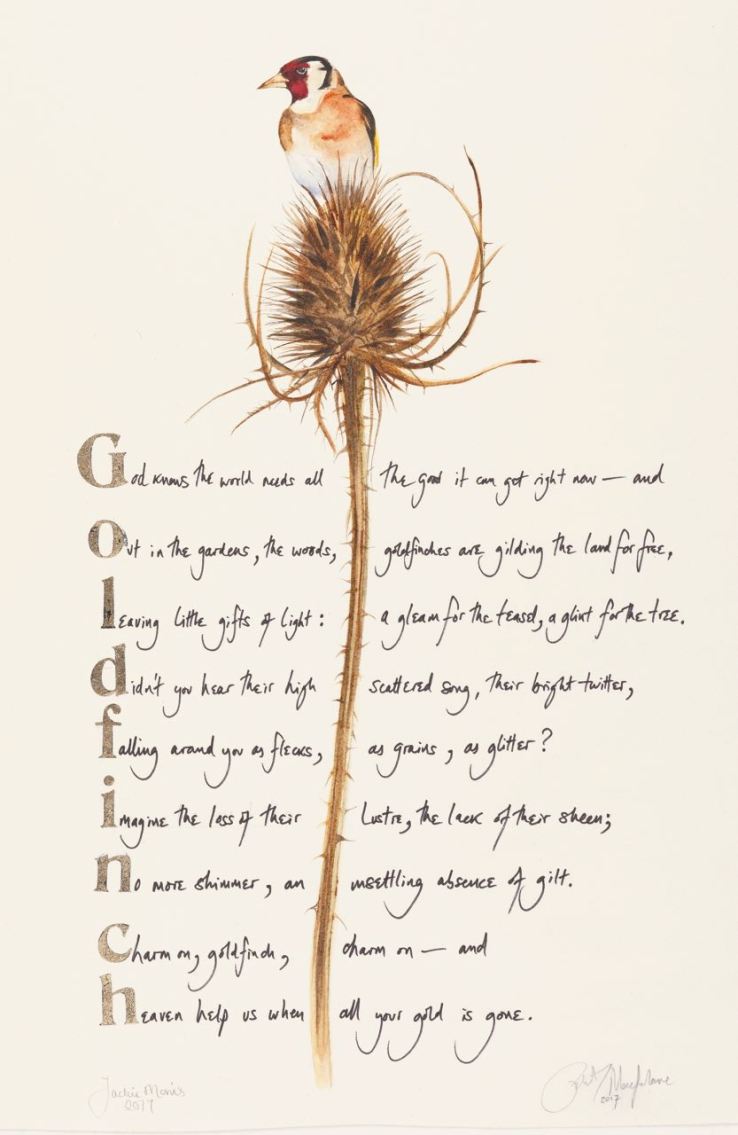
ILLUMINATED POEM: “Goldfinch” by Robert Macfarlane, illuminated by Jackie Morris: Nature writer Robert Macfarlane’s critically acclaimed book The Lost Words: A Spell Book, illustrated by Jackie Morris and published this October, is a joyful celebration of the nature words that were dropped from the 2008 edition of the Oxford Junior Dictionary. Aiming to “enchant nearby nature again” for both kids and adults, it comprises a series of acrostic poems whose main letters are gilded in gold leaf.
Poem by Robert Macfarlane. Art by Jackie Morris.
I’m pleased to see that Macfarlane’s collaboration with Morris has continued with his latest “Goldfinch”—a “‘charm’ about hope, harm, gift & darkness.” Handwritten over a painting by Morris, the poem begins
God knows the world needs all the good it can get right now—and
out in the gardens, the woods, goldfinches are gilding the land for free,
leaving little gifts of light . . .
The piece is reproduced in the latest issue of Elementum Journal, and the original has sold. Hear Morris read the poem in the SoundCloud player above.
Click here to read an interview with Macfarlane and Morris on the making of The Lost Words, and here to read Macfarlane’s response to a 2002 study that found that four- to eleven-year-old Brits are better at identifying Pokémon characters than native species of plants and animals, like oak tree and badger. Also, check out his other books, like Landscape, The Old Ways: A Journey on Foot, The WildPlaces, and Mountains of the Mind.
Many of the artworks and resources I share on these roundup posts I discover through the individuals, organizations, or publications I follow on social media or via RSS. If I’m not introduced to the content directly by its maker, I will try to indicate an “HT” credit, shorthand for “hat tip,” meaning thank you, X, for bringing this to my attention! All descriptions and commentary, however, are my own, unless set in quote marks.
SONG: “O Children, Come”by Keith and Kristyn Getty: The Gettys are an Irish married couple who are major contributors to the modern Christian hymn-writing movement. I really enjoyed singing this song of theirs at church last week (CCLI 7036340); it was my first time hearing it. The acoustic performance below is from the Gettys’ 2015 Christmas concert. They’ve also recorded it with Ladysmith Black Mambazo.
+++
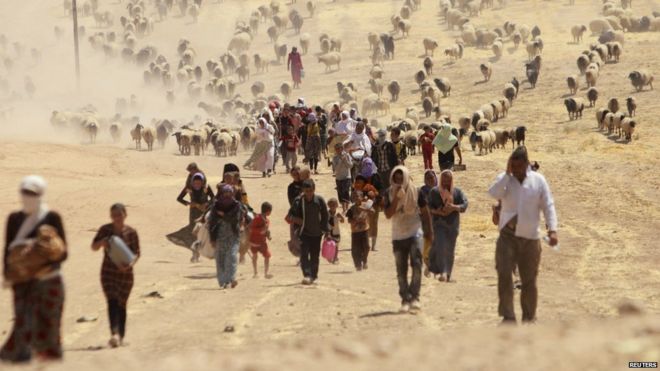
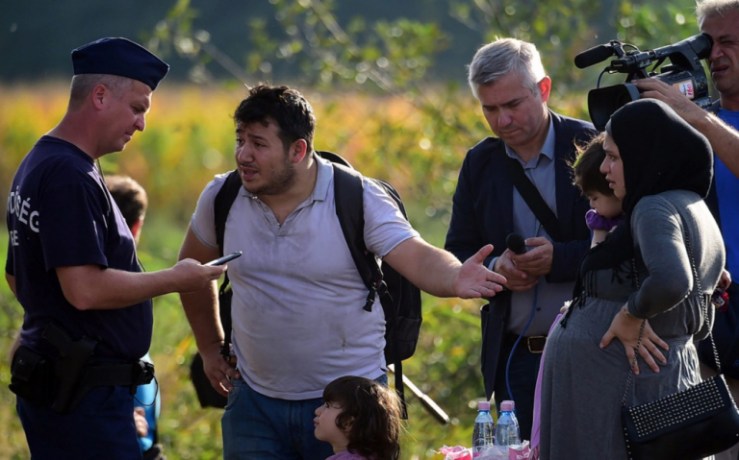
PHOTO ESSAY: “Alternative Nativity”: Kezia M’Clelland works with children affected by conflict in the Middle East and raises public awareness through her blog, Kezia Here and There. In 2015 she compiled news photos that document the refugee crisis and set them to excerpts from St. Matthew’s account of Christ’s birth and the prologue to St. John’s Gospel—a very powerful pairing that gives impetus to our Advent cry, “Come, Lord Jesus!” This is not a generic mashup; each photo was carefully selected to amplify a corresponding scripture text.
“About that time Caesar Augustus ordered a census to be taken throughout the Empire. This was the first census when Quirinius was governor of Syria. Everyone had to travel to his own ancestral hometown to be accounted for.” (Photo via Reuters. Displaced Yazidis escape across the Syrian border by foot, fleeing violence from the Islamic State militants who have taken over their home town of Sinjar.)“So Joseph went to Bethlehem. He took with him Mary, his fiancée, who was obviously pregnant by this time.” (Photo via Al Jazeera. A refugee father with his pregnant wife and daughter asks for permission to enter into Hungary near Roszke as the border fence with Serbia is closed by Hungarian police.)
For each subsequent Advent, M’Clelland has released something in a similar vein: the video “Hope Is on the Way” in 2016, and this year, “Light in the Darkness,” with verses of scripture, mainly from the Old Testament prophets, emblazoned across photos from today’s Middle East. “This year again these Advent pictures and words will speak of a hope that is now and not yet,” she writes. “I am grateful that Advent gives us the freedom to weep and to hope, to rejoice and to grieve, to wait for and to recognise the Christ who is already here among us.”
Marrying the Christmas story with contemporary photojournalism can teach us to “pray with the Bible in one hand and a newspaper in the other,” as the popular adage goes. As we see the world’s brokenness, it should intensify our fervor for Christ’s shalom and impel us to action.
+++
UPCOMING MUSIC & ART EVENT: “Messiaen and the Incarnation,”December 20, 8 p.m., St. Mary’s Addington, London: Next Wednesday evening, Dr. Edward Forman will be performing three movements each from the French avant-garde composer Olivier Messiaen’s organ suite La Nativité du Seigneur (The Nativity of the Lord) and piano suite Vingt regards sur l’Enfant-Jésus (Twenty Contemplations on the Infant Jesus). Messiaen was a committed Christian who sought to express theological truths in a fresh, modern idiom. Like much of his output, these two works reject the Western conventions of forward motion, development, and diatonic harmonic resolution, so they can be difficult for first-time hearers. But this complexity, this sense of the unexpected, is appropriate for the mystical content they seek to convey.
Inspired by the unique palette of sounds, textures, and rhythms of Nativité, British artist Sophie Hacker translated these into visual form. After deeply studying the music, in 2007 she created nine mixed-media panels in response—one for each movement—using slats of wood, nails, lead, wire, tree bark, and other found objects; you can see some of her process in the video below. These premiered at Winchester Cathedral in 2008. Then again in 2015 Hacker participated in another Messiaen-inspired artistic collaboration, under the direction of pianist Cordelia Williams, with poets Michael Symmons Roberts and Rowan Williams. This project is called “Between Heaven and the Clouds: Messiaen 2015.”
Sophie Hacker (British), La Nativité du Seigneur (The Nativity of the Lord), 2007. Mixed media on nine canvases, 60 × 60 cm each. Photo: Mike J. Davis.
To guide us through the listening experience, St. Mary’s will be projecting Hacker’s artworks onto a screen during the playing, and interspersing it with poetic reflections on the theological themes—from the Bible, Messiaen, Roland Riem (Icons of the Incarnation), and other sources. “We think it is equally pointless to try to explain Messiaen’s music in words as to attempt a sensible account of what it means for God to become human,” writes Forman in the booklet that will be provided to attendees. “We hope that the visual effects, words and music will enhance each other in ways that are inspiring and provoking.”
Messiaen’s compositions are definitely more challenging than the standard Christmas music fare, so I am grateful that St. Mary’s has the boldness, vision, and talent to offer them to the public, and in the meaningful context (which you likely won’t get in the concert hall) of meditation on the mystery of the Incarnation.
+++
ARTIST PROFILE: Zaki Baboun: Zaki Baboun is a Palestinian Christian artist living in Beit Jala, a suburb of Bethlehem. He paints religious scenes in oils on olive wood, which you can browse and purchase here—either the originals or reproductions on Christmas cards.
The first video below contains a short, two-minute interview with Zaki and shows him painting TheJourney of the Magi; the second shows him painting The Good Shepherd.
+++
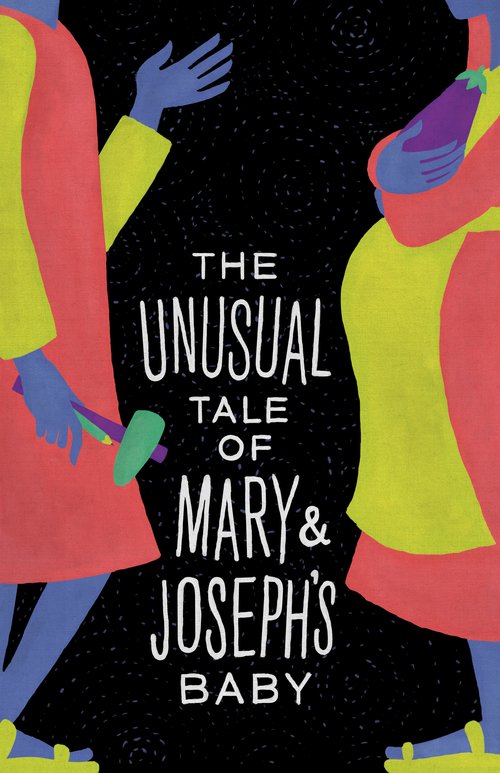
ALBUM: The Unusual Tale of Mary and Joseph’s Baby by Waterdeep: I saw the world premiere of this nativity musical last summer in New York (read my review here), and it really helped shepherd my imagination into a deeper understanding of Mary and Joseph’s social and emotional realities. Now the album is out! The songs express the many ups and downs the Holy Couple likely underwent in their faith journeys to bring the Messiah into the world, with the theme of deliverance standing in highest relief. (Mary’s opening song, “I Want to Be Delivered,” is what spurs, much to her shock, the Annunciation, and the finale, “Walk Through the Sea on Dry Land,” draws everyone into a joyful reminiscence of God’s mighty hand in ages past, manifest in the present through the birth of the Christ child.) Comedy is provided through invented characters like Joseph’s friend Benjamin, the innkeeper and his wife, and a shepherd named Naphtali.
The most poignant scene, for me—and hence probably my favorite song—is the “Magnificat.” The biblical account doesn’t tell us much about Mary’s state of mind at this point, so the writers imagine her coming to Elizabeth filled with fear, and Elizabeth building her up, preaching truth to her (and sharing her own story of shame), helping her move from doubt to confidence. Elizabeth’s song is what emboldens Mary to sing. Their “Magnificat” is later reprised by the full cast immediately following Christ’s birth, concluding part 1.
The new album is not an original cast recording; instead the songs were recorded by their writer, Don Chaffer, and his wife, Lori, and released under the Waterdeep moniker. Stream on Spotify; sample and purchase at Amazon or iTunes.
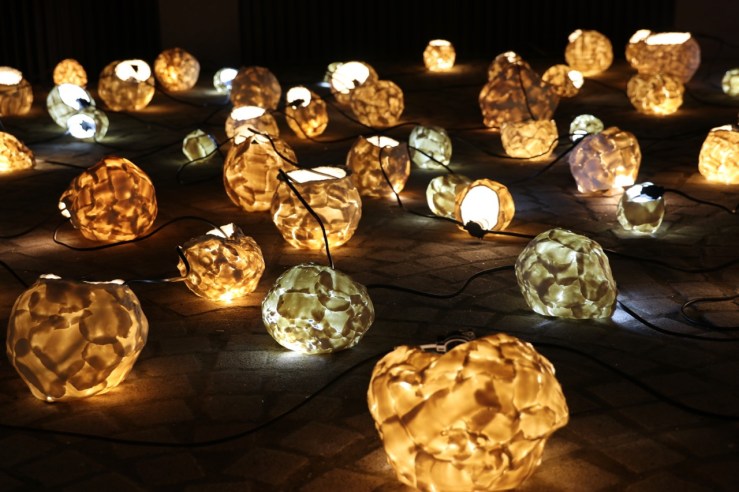
COMMUNITY ART PROJECT + INSTALLATION: Light the Well by Anna Sikorska: Last month artist Anna Sikorska led the congregation of St. Martin-in-the-Fields in creating a constellation of cracked, translucent porcelain globes, lit from within like lanterns and linked together—a visualization of Paul’s words in 2 Corinthians 4:6–12, about our hearts being clay jars whose fragility and brokenness enable the light of Christ to shine through all the more. Light the Well was installed at St. Martin’s on November 11, and since November 19 the individual lanterns have been selling for £10 a piece to benefit New Art Studio and Art Refuge UK, charities working with art therapy in the context of migration and displacement. Associate vicar Jonathan Evens delivered a beautiful reflection on this artwork and the scripture that inspired it, as well as a prayer and benediction, which you can read in full here.
I love it when churches use art not merely to decorate or prettify the building but to further the congregation’s engagement with scripture and to foster shared doing and seeing.
+++
SONGS:
“City of David” by the Gray Havens: The Gray Havens, a “narrative pop folk duo” from Nashville made up of married couple David and Licia Radford, released a new Christmas single on November 17—recorded on an iPhone! Listen to the song and watch some of their “making of” process in the video below. God the Father often gets overlooked during this season, so I like that the refrain reminds us that “the Father sent him [the Son] down.” [Purchase here]
“Human for Me” by Katy Kinard: Released last year on the album God of Fireflies, this song praises God for assuming full humanity—for not circumventing any frustrating or painful aspect of it. [Purchase here]
+++
GALLERY TALKS:
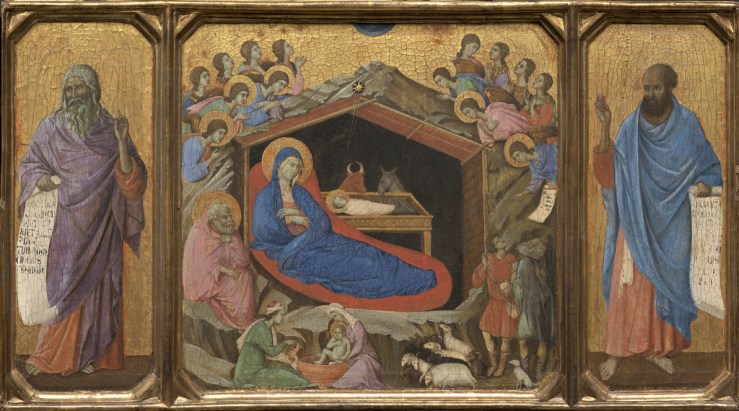
“The Christmas Story in Art” at the National Gallery, Washington, DC: Gallery lecturer David Gariff will lead a 75-minute discussion about paintings in the collection that depict the birth of Jesus, including one of my favorites, Duccio’s Nativity with the Prophets Isaiah and Ezekiel. (Click on the link to see a full list of works.) The event is free and geared to an adult audience. To participate, meet in the West Building Rotunda at 1 p.m. on December 9 or 10, or 2 p.m. on December 14, 18, 20, 21, or 22.
Duccio (Italian, ca. 1255–60–ca. 1318/19), The Nativity with the Prophets Isaiah and Ezekiel, 1308/1311. Tempera on single poplar panel, 48 × 86.8 × 7.9 cm (18 7/8 × 34 3/16 × 3 1/8 in.). National Gallery of Art, Washington, DC.
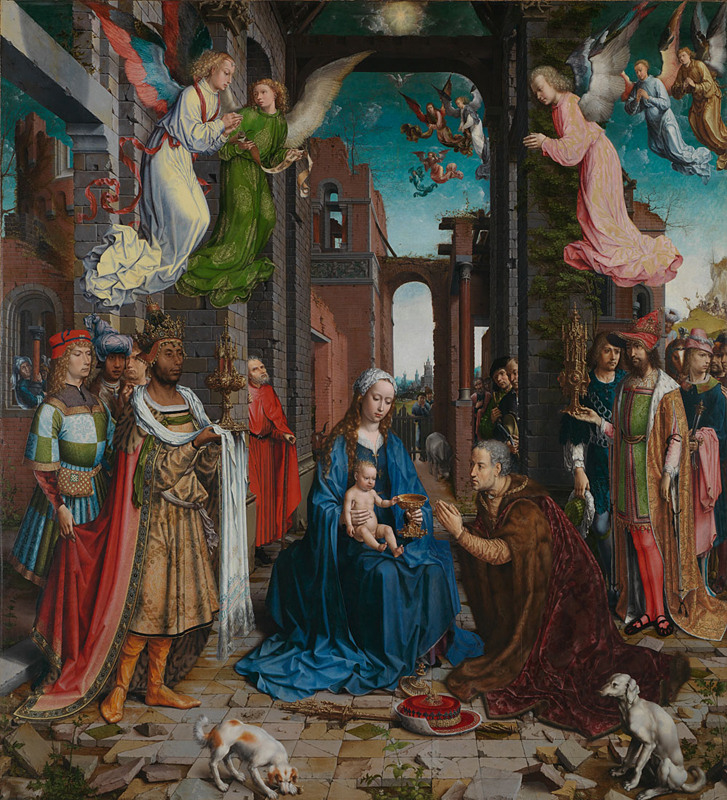
“Adoration of the Kings” Facebook Live tour at the National Gallery, London: Friday, December 15 at 9 a.m. GMT, director Gabriele Finaldi will be exploring Jan Gossaert and Pieter Bruegel the Elder’s paintings of the Adoration of the Magi. This “tour,” offered exclusively online, will be broadcast live on the Gallery’s Facebook page, and a replay version will be available on the channel afterward.
Jan Gossaert (Flemish, d. 1532), The Adoration of the Kings, 1510–15. Oil on oak, 179.8 × 163.2 cm. National Gallery, London.Pieter Bruegel the Elder (Flemish, d. 1569), The Adoration of the Kings, 1564. Oil on oak, 112.1 × 83.9 cm. National Gallery, London.
+++
POEM: “Scale” by Chelsea Wagenaar: Chelsea and I went to the same small North Carolina church as kids, back when she was a Henderson and I a Hartz, so we share a heritage of learning Bible lessons from Butch the Dragon and competing annually in the Bean Bag Relay at the AWANA Olympics. Now she is an award-winning poet, a Lilly Fellow, a lecturer in Valparaiso University’s English department, and a mom!
Inspired by her pregnancy, the poem “Scale” is full of metaphors that revel in the wonders of prenatal life—the womb is a “winterplum sky,” the cluster of baby cells “untufted cotton,” the belly a “Lenten moon.” The central theme, which Chelsea cleverly plays around, is Psalm 139:16, a praise verse by King David: “Your eyes saw my unformed substance; in your book were written, every one of them, the days that were formed for me, when as yet there was none of them.”
Chelsea’s poem is especially appropriate for Advent, a season of pregnancy in which we position ourselves retrospectively with Mary, letting our hearts expand as we wait expectantly for that marvelous deliverance, the coming of the Christ child.
A popular song in choir repertoires, “Betelehemu” is a Yoruba Christmas carol by the Grammy-nominated drummer Babatunde Olatunji, arranged for men’s choir by Wendell P. Whalum. It came into being while Olatunji was a student on scholarship at Morehouse College in the 1950s: he shared it with Whalum, director of the school’s glee club, and that spawned a collaboration.
There have been numerous recordings of “Betelehemu” over the years, and each one has its own distinct flavor, especially in the percussion sections. I really like the one by The Young People’s Choir of New York City from the 2003 album It Is Possible. But here’s a version from Brazil, arranged for SATB by Jonathan Crutchfield:
Here are the Yoruba lyrics and English translation to follow along with, provided courtesy of my friends Ezekiel Olagoke and Temidayo Akinsanya. For a pronunciation guide, click here.
Betelehemu Awa yio ri Baba gbojule Awa yio ri Baba fehinti Nibo labi Jesu Nibo labe bi i Betelehemu, ilu ara Nibe labi Baba o daju Iyin, iyin, iyin nifun o Adupe fun o, adupe fun o, adupe fun ojo oni Baba oloreo Iyin, iyin, iyin fun o Baba anu Baba toda wasi Betelehemu
Bethlehem
We shall see that we have a Father to trust
We shall see that we have a Father to rely on
Where was Jesus born?
Where was he born?
Bethlehem, the city of wonder
That is where the Father was born for sure
Praise, praise, praise be to Him
We thank You, we thank You, we thank You for this day
Blessed Father
Praise, praise, praise be to You, merciful Father
Father who delivered us
Bethlehem
The lyrics are simple, rejoicing in the Father’s glory and grace in giving his Son over to be born in Bethlehem. I asked my Yoruba friends about the line “That is where the Father was born for sure,” which seems problematic from a Trinitarian perspective, because it was the Son, Jesus—not the Father—who was born in Bethlehem. The Yoruba word Baba has more nuance than the English “Father”; it is used to signify a biological relationship but also as an honorific for wise men or elders. But still I wondered whether it is theologically appropriate.
Ezekiel told me that Yoruba Christians understand the distinctions between the three persons of the Trinity and that Baba is not commonly used to refer to Jesus, but in defense of it, he pointed me to scripture passages like Daniel 7:9–14 (cf. the book of Revelation), which describes Jesus as “the Ancient of Days”; John 8:58, in which Jesus tells his disciples, “Before Abraham was, I am,” ascribing to himself a status greater than that of the greatest Jewish patriarch; and Colossians 1:15–17: “He [Jesus] is the image of the invisible God, the firstborn of all creation. For by him all things were created, in heaven and on earth, visible and invisible, whether thrones or dominions or rulers or authorities—all things were created through him and for him. And he is before all things, and in him all things hold together.” In Yoruba culture and other African cultures as well, says Ezekiel, Jesus is sometimes called “Chief” or “Ancestor,” a similar notion that emphasizes his being before all things, the eternal Source in whom all things consist.
Temi said that to avoid confusion, he would probably recommend a revision from Nibe labi Baba o daju to Nibe labi Jesu o daju (or else he’d drop the name so that the indefinite pronoun “he” is implied instead).
Both friends felt that the phrase Awa yio ri (“We shall see”) in the second and third lines is awkward in this context. All the other lyric translations I’ve found translate the phrase as “We are glad,” but that would be Awa ni, Ezekiel said—and that doesn’t quite fit the musical meter. It’s possible that the song is merging Advent with Christmas: it starts with looking forward to the birth, then it acknowledges the birth as having happened, eliciting appellations of praise.
Wooden door detail by George Bandele, 1962, showing the Adoration of the Magi. Collection of the SMA Fathers, Cadier en Keer, Netherlands. Source: Christliche Kunst in Afrika, p. 144
It seems that “Betelehemu” is more popular outside Nigeria than in. Ezekiel and Temi and one other Yoruba friend (from different generations) said that despite growing up in Christian homes in Nigeria, they’ve never heard it before, but they’ve heard ones similar to it. So while some sources credit “Betelehemu” as a “Yoruba folk text” and “Yoruba folk tune,” leaving Olatunji out entirely, I think it’s more likely that Olatunji drew on the song traditions of his people to create a new composition. At the very least, Olatunji introduced the song to the United States—and our Christmas concerts are all the richer for it! Continue reading “Yoruba Christmas carol and art (Nigeria)”→
Shepherds, I sing you this winter’s night
Our Hope new-planted, the womb’d, the buried Seed:
For a strange Star has fallen, to blossom from a tomb,
And infinite Godhead circumscribed hangs helpless at the breast.
Now the cold airs are musical, and all the ways of the sky
Vivid with moving fires, above the hills where tread
The feet—how beautiful!—of them that publish peace.
The sacrifice, which is not made for them,
The angels comprehend, and bend to earth
Their worshipping way. Material kind Earth
Gives Him a Mother’s breast, and needful food.
A Love, shepherds, most poor,
And yet most royal, kings,
Begins this winter’s night;
But oh, cast forth, and with no proper place,
Out in the cold He lies!
This poem is published in Collected Poems 1943–1987 by John Heath-Stubbs (Carcanet Press, 1988) and is reprinted here by permission of David Higham Associates.
+++
John Heath-Stubbs (1918–2006) was an English poet, translator, critic, and anthologist whose lifelong fascination with world history and literature was borne out in his career. He translated poetry from Greek (Sappho, Anyte, Anacreon), Latin (Horace, Catullus), Persian (Hafiz, Omar Khayyam), Italian (Dante, Giacomo Leopardi), and French (Paul Verlaine) and wrote many verses of his own influenced by classical myths, including an Arthurian epic, Artorius.
Described by friends as a “devout” and “committed” Christian, Heath-Stubbs sometimes turned to the lives of Christ and the saints as subjects for his poetry, as in “‘Through the Dear Might of Him That Walk’d the Waves,’” “Dionysius the Areopagite” (on a pagan’s response to the eclipse during the Crucifixion), “Canticle of the Sun” (on the Resurrection), “Alexandria,” “Maria Aegyptiaca,” and “Virgin Martyrs,” to name a few. In his introduction to his Collected Poems, he wrote that he was interested in “the reaffirmation of orthodox religious themes in the poetry of TS Eliot and Charles Williams and others.”
Among other distinctions, Heath-Stubbs was awarded the Queen’s Gold Medal for Poetry in 1973 and in 1989 was appointed OBE (Officer of the Most Excellent Order of the British Empire). At his death, publications celebrated his style and influence:
“His distinctive achievement was to forge a modern pastoral out of unlikely sources, a style which can encompass Yeatsian symbolism and dry irony.”—Poetry Archive
His diction was conservative, but his lyricism was always modern.—The Telegraph
“His finest work is to be found in his huge output of shorter poems. In their technical mastery, wry wisdom and gloriously deceptive lightness, these place him in the company of W.H. Auden and Robert Graves, a major English poet of the 20th century.”—The Independent
Heath-Stubbs was nearly blind from age three, his eyesight progressively worsening until he lost it completely at age fifty-nine. But rather than regard his blindness as a disability, he regarded it as a gift. “As a poet, I have found that blindness actually tends to stimulate the imagination,” he said.
+++
First published in 1965, “For the Nativity” by John Heath-Stubbs is an ode to the infant Jesus—to him who is Hope, Seed, Star, and Love.
The first stanza is a loose paraphrase of the Annunciation to the Shepherds in Luke 2:10–13, in which an angel tells a group of Jewish night workers that Emmanuel, God-with-us, has been born. Heath-Stubbs uses horticultural imagery: Jesus was planted in Mary’s womb, and now he breaks through into air, blooming for all the world to see. Foreshadowing future events, the “tomb” refers not only to the cave he was born in but also to the cave he’d be buried in. He’d be seeded once again (in death), and again (in resurrection) he’d flower forth with new life. The fourth line embraces the paradox of the Incarnation: that infinite God became a finite human being; the omnipotent Creator, an impotent babe reliant on his mother’s milk. Continue reading ““For the Nativity” by John Heath-Stubbs + choral setting”→
This December hundreds of churches around the world will no doubt bring to life onstage the unusual tale of Mary and Joseph’s baby. Most of the characters will be played by little kids dressed up in robes and star-tinsel garlands, and “Hark! The Herald Angels Sing” is sure to make the song list. A beloved tradition—but one that has perhaps made Jesus’s birth too familiar to us, rendered it not unusual or shocking at all.
Into this milieu comes Don Chaffer and Chris Cragin-Day’s new musical, The Unusual Tale of Mary and Joseph’s Baby, to shake things up. Running December 8–18 at River and Rail Theatre in Knoxville, Tennessee, the play retells Matthew and Luke’s nativity accounts with a modern imagination, focusing on the hopes and fears of the young couple chosen to bear God into the world. My husband and I attended its world premiere this August at the New York International Fringe Festival, produced by Firebone Theatre, and loved it. (We’re still singing “Hel-looo! Hel-looo!” to each other—the catchy angelic greeting.) Far from the tired, pious storytelling of many a Christian-penned pageant, The Unusual Tale bursts with energy and even surprises, inviting believers and nonbelievers alike to consider anew the meaning of the Incarnation.
The show has a cast of four: Mary, Joseph, and two multirole characters (one male, one female). Mary and Joseph are humanized and given dimension. They are at times angry, scared, hurt, frustrated, confused, happy, tired, skeptical, or insistent. Their personalities sometimes clash—Mary is plucky and passionate and refuses to accept the way things are, whereas Joseph is mostly content and prefers to play it safe. When they are confronted with the outrageous news that Mary is to give birth to the son of God, they are forced to exercise a degree of trust in God and in each other that they had not been required to previously, and it doesn’t come easy. But they grow together into God’s plan in their own different ways as they learn more and more how to do the work they’ve been called to.
One of the most enthralling possibilities that the play opens up is that the Incarnation was triggered not just by God’s feeling that “now’s the time” or by some generic devoutness on the part of Mary but by a spoken vow of hers. Fed up with how the Roman authorities have been roughing up her fiancé at work, Chaffer and Cragin-Day’s Mary starts sermonizing about how God raised up stuttering Moses to deliver their people from slavery in Egypt, and little ole David to conquer a Philistine giant, and why couldn’t he do the same today?
“You know what I think? I think God is just waiting for someone to step up and say, ‘I’ll do it. Choose me.’ Like David did. So you know what I’m gonna do?” Mary says, stepping onto a crate, despite Joseph’s objections.
“I’ll do it, God. I’ll slay Goliath. I am available and willing.”
“One of these days, God’s gonna call your bluff,” Joseph says.
I spent last week in New Mexico with my husband, Eric, and my in-laws, visiting relatives in the south, then driving up north to spend some time in Albuquerque and Santa Fe. It was my first time to the Southwest, to the state where Eric was born; his grandparents came over from Mexico as teenagers and settled in Hobbs, a small oil town, and his mom grew up there, learning English in school. I enjoyed all the tastes: spicy green chiles in or on just about everything (eggs, tacos, burgers, soup, corn, French fries); piñons (pine nuts) galore sprinkled alongside dusty footpaths, ready to crack open and eat; and sopapillas (pillow-shaped fried dough drizzled with honey) after every meal.
On the five-hour upstate drive, the blue sky spread wide open across the desert and clouds hung low, casting shadows that, from the car, looked like bodies of water. The way was flat, flat, flat—until we reached Santa Fe, where mountains rose up and aspens flickered their glorious gold.
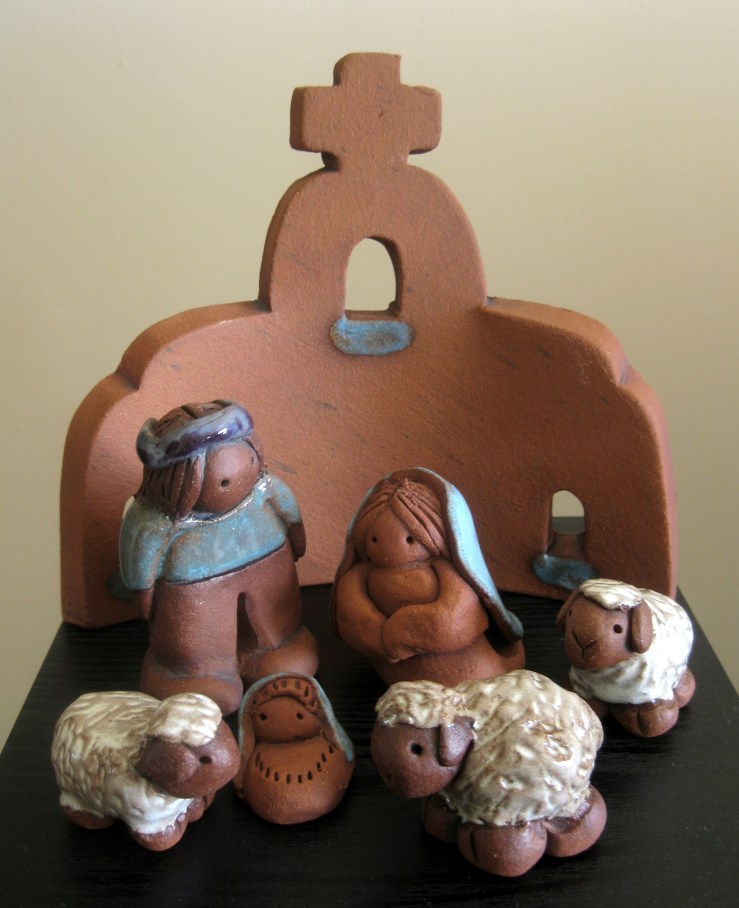
In Albuquerque we went to the International Balloon Fiesta, where hundreds of hot-air balloonists come out once a year to fly. Unfortunately, high winds prevented the “mass ascension” from happening the day we were there, but we saw static displays—inflated balloons in all shapes and colors. (My father-in-law was partial to the Darth Vader balloon; I liked the lovebirds.) And I got to visit to the artisan tent, where I bought my first nativity set! It’s seven pieces in clay by New Mexico native Barbara Boyd. I set it up in our living room when I got home, but Eric says I need to put it away until Advent . . .
We spent an afternoon in Old Town Albuquerque, strolling past historic adobe buildings and into galleries, while street musicians—Native American flautists and mariachi bands, mostly—provided a culturally immersive soundtrack. Our first stop happened to be one of my favorites: John Isaac Antiques and Folk Art. Isaac has a beautiful collection of santos (Hispano Catholic religious images)—a whole roomful—both contemporary and from the last few centuries. I was close to buying a Saint Francis bulto by Ben Ortega (Francis was his hallmark) but decided against it, and now I wish I hadn’t. Nonbuyer’s remorse—ugh.
Just before we left Old Town, my mother-in-law suggested one last gallery: Santisima, owned by Johnny Salas. I immediately recognized the work of Albuquerque native Brandon Maldonado, which is heavily influenced by the tradition of Día de los Muertos. I’m really attracted to Day of the Dead imagery, with all its macabre whimsy—the kind that makes most Protestants feel uncomfortable. I think the draw, for me, is that it embraces death instead of shrinking away from it; it says, “Death, we do not fear you.” As Maldonado says, Day of the Dead is not meant to be frightful but rather mocking, in a way:
The masses may prefer to think of the deceased as haloed angels floating on fluffy white clouds, but I like the idea of dancing skeletons in hats!
At Santisima I was introduced to the work of the young santero Vicente Telles, also a native of Albuquerque. I really liked his Adam and Eve and Saint Pelagia retablos but most especially his Crucifixion one, which I ended up buying.
Vicente Telles (American, 1983–), Cristo crucificado (Christ Crucified), 2015. Natural and watercolor pigments on pinewood, 7.5 × 6.5 in. (framed).
It shows a curtain opening up, and two chandeliers dangling, to present Christ on the cross, given for us. As is traditional in New Mexican art, his shoulders and knees are bloodied; in Telles’s interpretation, the blood marks Christ in patterns, almost like tattoos. The animas solas (lonely souls) in the flames of purgatory is also a common motif in New Mexican art. I do not personally subscribe to the doctrine of purgatory, so I read the souls, rather, as Adam and Eve awaiting redemption. According to church tradition, Golgotha was the site not only of Christ’s execution but also of Adam’s burial, which is why, since the Middle Ages, a skull is often painted at the cross’s base, emphasizing Christ’s role as the Second Adam. Telles shows Eve reaching out to touch this death-symbol, lamenting her and Adam’s primordial rebellion and pleading in faith, with her eyes, for deliverance from its consequences. This is the precursor to the Anastasis (Resurrection) icon of Eastern Orthodoxy, which shows Jesus breaking down the doors of Sheol and pulling Adam and Eve up out of their graves to be with him in heaven. We are dead in our sins until Christ raises us. His spilled blood has “loosed the pains of death” once and for all.
To give the retablo a glistening appearance, Telles applied a micaceous clay slip to the pinewood before applying the paint.









 Art & Theology