Some of you may wonder why I’m still posting Christmas content. It’s because it’s still Christmastime! Christmas is a twelve-day feast extending from December 25 to January 5. So keep the celebration going with parties, carols, decoration, storytelling, worship, and meditation on the amazing historic event of the Incarnation.
As far as I can tell, this is the first installment in a series of children’s retellings of the Nativity story from around the world that Compassion International releases annually. Subsequent videos—all of them worth watching!—are from Indonesia (2022), Bolivia (2023), and the Philippines (2024).
+++
CONCERT RECORDING: O Holy Night: An Annie Moses Band Christmas Special: Named after their great-grandmother, the Annie Moses Band is an Americana string band of six siblings, raised by award-winning Nashville songwriters Bill and Robin Wolaver, who are committed to godly excellence in the arts. This Christmas concert of theirs, featuring outstanding arrangements of a range of classic carols and one original, was released on DVD in 2018 and just made available by the band for free on YouTube!
Here’s the set list. Links are to standalone videos, excerpted from the performance above. My favorites are probably the opener, “On This Day,” and “We Three Kings”:
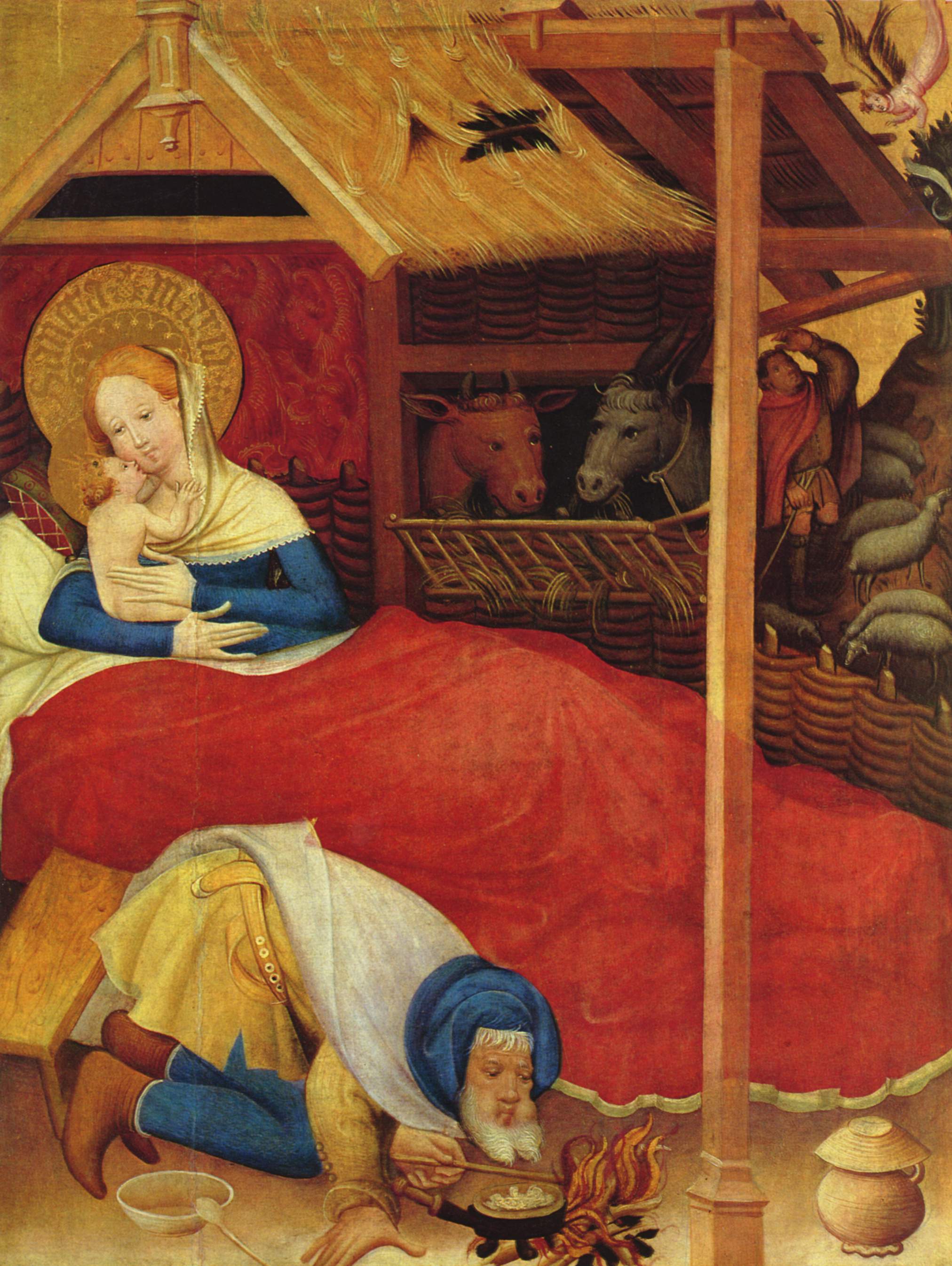
ARTICLE: “Saint Joseph as Baby Daddy: An Illustrated Medieval Guide” by Ela Bobek, DailyArt Magazine:In 2021 on Instagram I shared a small compilation of images that show Joseph as helpful and industrious at the Nativity, as opposed to the more classic depiction of him sitting off to the side with his head in his hands. I’ve since collected over a dozen more and have been wanting to develop a reflection on this motif into a full-fledged article (and probably still will someday), but Ela Bobek has beaten me to it! Check out the images she has compiled that show Joseph cooking, doing laundry, sewing clothes, preparing a bath, and swaddling or holding the baby—allowing Mary some much-needed rest. What a loving, caring, actively involved father and husband!
Conrad von Soest (German, ca. 1370–ca. 1422), Nativity, panel in the left wing of the Niederwildungen Altarpiece, 1403. Tempera on wood, 73 × 56 cm. Stadtkirche St. Nikolaus, Bad Wildungen, Germany. [view full altarpiece]
+++
SONGS:
>> “Christmas Ko Ramjham Ma” by Milan Bhujel and Surya Rasaili: This Nepali Christmas song was written by Milan Bhujel (words) and Surya Rasaili (music) in 2022 and is performed here (with dancing!) by Bhujel and friends. I couldn’t find a translation of the Nepali lyrics, but the gist of it is “Let’s dance and rejoice, let’s celebrate the birth of Jesus, who has come to save us. Jesus is a light dispelling all darkness.” [HT: Global Christian Worship]
SERMONS by Rev. Nadia Bolz-Weber: Nadia Bolz-Weber [previously] is an ordained Lutheran pastor who founded the House for All Sinners and Saints in Denver and now guest-preaches around the city. Here are two of her sermons from the past year or so that I’ve come across and appreciate, just twelve minutes each.
>> “Sinking,” Montview Boulevard Presbyterian Church, Denver, August 13, 2023: Preaching on Matthew 14:22–33, Bolz-Weber critiques the idea that our ability to do great things relies on the quality of our faith instead of on the power of God: “I’ve often heard this walking-on-water story from Matthew preached as like The Little Disciple Who Almost Could. Like Peter could have kept walking on water if he just thought ‘I think I can, I think I can’ enough. The message being that with enough faith, you too can walk on water all the way to Jesus. Which, on the surface, sounds inspiring. But taken to its logical conclusion, it also means that if you are not God-like in your ability to overcome all your fears and failings as a human, if you are not God-like in your ability to defy the forces of nature, then the problem isn’t the limits of human potential, the problem is the limits of your faith, and you should probably muster up some more . . .” [Read the transcript]
>> “The Lord Is My Shepherd, (but) I Shall Not Want (a Shepherd, Thank You Very Much),” Saint John’s Cathedral, Denver, May 8, 2022: No matter how much we fancy ourselves “anti-shepherdarian,” wanting to make our own choices and go our own way, we are all shepherded by someone or something, says Bolz-Weber in this sermon on Psalm 23. Perhaps it’s by the “wellness” industry, or by the angriest voices on Twitter. And the thing is, “not one single shepherd-shaped wolf that I have followed has ever actually fulfilled my wants and desires,” she confesses; “they have only ever increased them. They have only ever led me to waters with a high salt content, only ever led me to waters that create thirst and never ever quench it. They leave me feeling insecure and insufficient.” She contrasts the shepherds of this world to the one true Good Shepherd. The preaching starts at 23:20. [Read the transcript]
+++
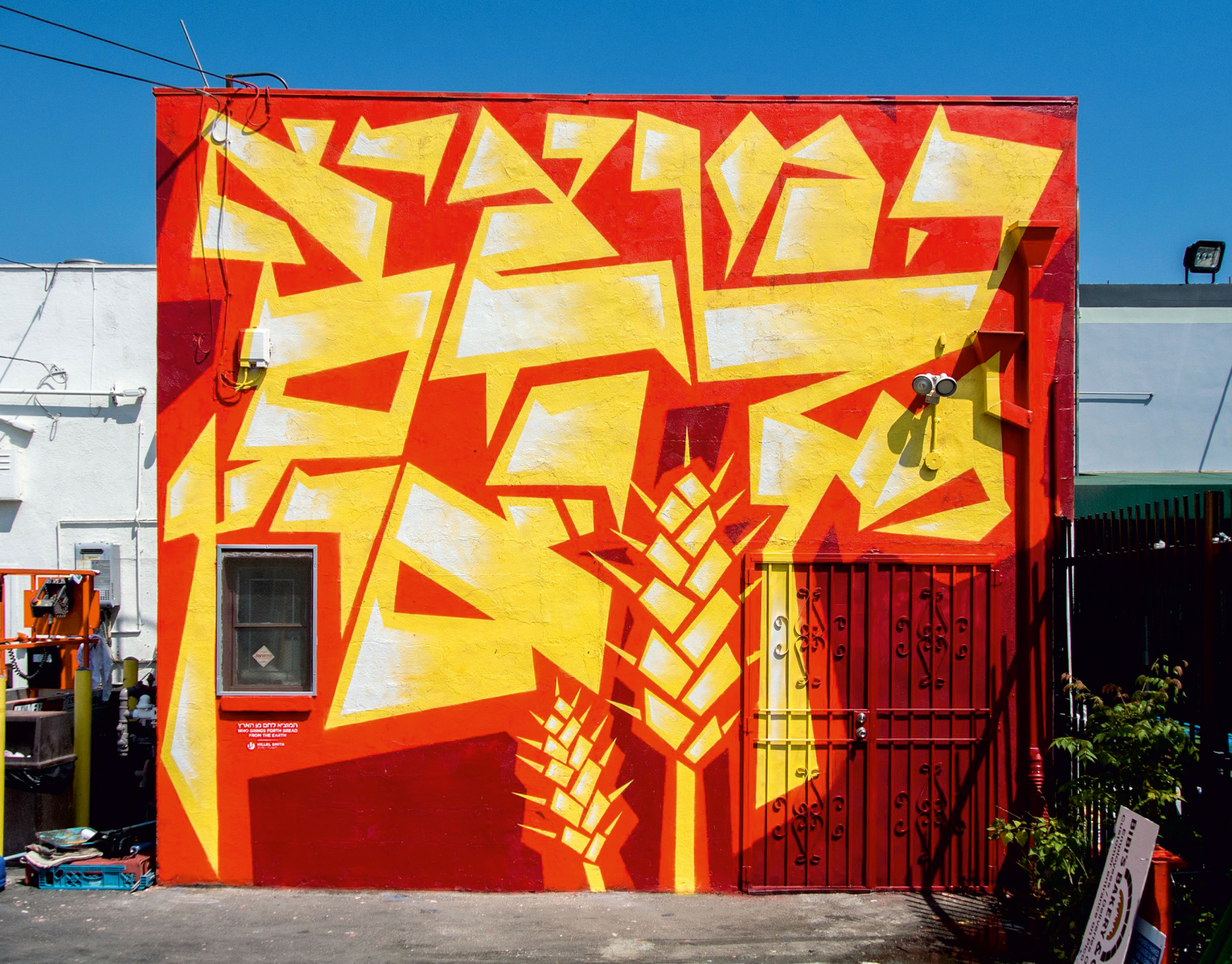
BOOK REVIEW: The Beauty of the Hebrew Letter: From Sacred Scrolls to Graffiti by Izzy Pludwinski, reviewed by Sarah Rose Sharp: In this new book from Brandeis University Press, certified Jewish scribe and calligrapher Izzy Pludwinski looks at the evolution of Hebrew calligraphy from sacred scrolls through modern art and graffiti. “Font enthusiasts, lovers of Judaica, and those passionate about the minutiae and range of the written form” will find much to appreciate here, writes Sarah Rose Sharp, whose review includes a handful of images from the book. For example, below is a mural painted by Hillel Smith on the alley-side exterior of a kosher bakery in the Pico-Robertson neighborhood of Los Angeles, which reads in bright yellow letters, “בָּרוּך אַתָּה אַדָנָי אֱלהֵינוּ מֶלֶך הָעוֹלָם הָמוֹציא לֶחם מן הַארץ” (Hamotzi lechem min ha-aretz) (Who brings forth bread from the earth), part of the traditional Hebrew blessing over bread before a meal: “Blessed are You, Lord our God, King of the Universe, Who brings forth bread from the earth.” [purchase on Amazon]
Hillel Smith (American, 1984–), Hamotzi Mural, Bibi’s Bakery and Café, Los Angeles, 2016. Photo courtesy of the artist.
+++
SONGS:
>> “Be Alright” by God’s Children: Having amassed over four million collective views, this video was posted August 1 by Shirika “ReRe” Flowers across multiple social media platforms, showing four of her six kids singing a gospel song she wrote for them, “Be Alright,” at her home in Memphis. It’s led by Demeriauna “Sugar Mama” Harper, with the other three parts sung by Thedrick “Preacher” Webb (in orange Crocs), Dedric “Chunky” Trice (seated at left), and Cornbread.
The family performs and records together under the name God’s Children, and this song can be heard on their 2018 album It’s So Amazing.
>> “Aakhaima Rakhchhu Mero Yeshu” (आँखैमा राख्छु मेरो येशू) (Keep My Eyes on Jesus): In this 2016 video, a group of teens from New Life Church in Nepal sing a popular Nepali Christian worship song. I haven’t been able to find who the songwriter is, but from a search on YouTube, I can see that it’s a very popular song to dance to in Nepal! There are dozens of videos, mainly of children or youth, dancing to it with hand motions and a bounce, often in church.
From what I can tell through Google Translate, the lyrics translate roughly to “I keep my eyes on Jesus. I keep him in my heart. He shadows me with his love.”
+++
POEMS:
>> “Mattina” (Morning) by Giuseppe Ungaretti: This week reading the book Poetry and Revelation: For a Phenomenology of Religious Poetryby Kevin Hart, I came across this beautiful four-word poem in Italian from 1917 that stopped me in my tracks: “M’illumino / d’immenso.” (Those euphonic m’s!) Hart didn’t translate it, and though I could recognize the two keywords (they’re English cognates), I wasn’t sure of the words connecting them or the verb tense. In googling the poem, I was sent to the blog Parallel Texts: Words Reflected, run by Canadian literary translator Matilda Colarossi, who lives in Florence. It’s fascinating to hear her describe the complicated process of translating these two spare lines. Click on the link to read her translation and to learn what considerations informed her.
Part of the poem’s brilliance is its openness to various readings. For me, it’s about being known warmly and intimately by an immensity I call God.
>> “What He Did in Solitary”by Amit Majmudar: A second book I read this week was the poetry collection What He Did in Solitary by Amit Majmudar, Ohio’s first poet laureate. The titular poem, the first in a suite of three that conclude the book, made me cry. You can read all three on the website of Shenandoah journal, where they were originally published in 2019.
Other favorites: “Altarpiece,” “Ode to a Jellyfish,” “Elegy with van Gogh’s Ear.”
CALL FOR ART: Light in the Dark, Sojourn Arts: Sojourn Arts, a ministry of Sojourn Midtown church in Louisville, Kentucky, is accepting entries for wall-hung visual artworks on the theme “Light in the Dark” for its juried art show this Advent and Christmas. It is free to enter (see email submission instructions at link), but selected artists will be responsible for shipping costs to the venue. Three cash prizes will be awarded. Deadline: October 8, 2023. Open to continental US artists only.
>> “O My Hope (A Prayer of Saint Isaac the Syrian)” by Symon Hajjar:Symon Hajjar is a singer-songwriter from Tulsa, Oklahoma. I love, love, love his setting of this passage (lightly adapted from an English translation by Sebastian Brock) from the writings of Isaac the Syrian, a seventh-century theologian from Mesopotamia. Because the song would work well for Epiphany, Hajjar released it as the final track on his album Finally Christmas (2015), although it’s not available on Bandcamp as all the other tracks are.
O my Hope, pour into my heart the inebriation that consists in the hope of you. O Jesus Christ, the resurrection and light of all worlds, place upon my soul’s head the crown of the knowledge of you, and open before me suddenly the door of mercies; cause the rays of your grace to shine out in my heart. . . . I give praise to your holy nature, Lord, for you have made my nature a sanctuary for your hiddenness, a tabernacle for your mystery, a place where you can dwell, a holy temple for yourself.
Currently, Hajjar writes and performs kids’ songs under the name Hot Toast Music.
>> “Mahima Mariyeko Thumalaai” (महिमा मारिएको थुमालाई) (Glory to the Lamb Who Was Slain), arranged and performed by Psalms Unplugged: This song is #505 from Nepali Khristiya Bhajan, the definitive Nepali-language hymnal; the words are by Rev. Solon Karthak, and the music is by the late Kiran Kumar Pradhan, the most influential writer of Nepali hymns, who was particularly active in the 1990s. Inspired by Revelation 5:12, its refrain translates to “Glory to the Lamb who was slain / Praise to the Lord of lords / Shouts to the King of kings.” Read the original Nepali lyrics here.
The musicians who form the Nepali worship collective Psalms Unplugged are extraordinary. In this video are Subheksha Rai Koirala (vocals), John Rashin Singh (flute), Ayub Bhandari (keys), Sagar Pakhrin (guitar), and Enosh Thapa Magar (drums). The group’s mission is to see the transformation of lives through the preservation, cultivation, and spread of Nepali Christian music.
+++
LECTURE: “Janet McKenzie’s Women: Mothers, Midwives, and Missionaries” by Sister Barbara E. Reid, OP, September 27, 2015, Catholic Theological Union, Chicago: In this lecture, New Testament scholar Barbara Reid, OP, discusses three painted artworks by Janet McKenzie featuring women of the Bible, all in the collection of Catholic Theological Union: The Succession of Mary Magdalene, a triptych that shows Mary Magdalene deaconing with Susanna and Joanna (Luke 8:1–3), seated with Jesus Christ, her commissioning teacher (John 20:17), and preaching the Resurrection to Peter and John (John 20:2–9, 18); Mary with the Midwives, showing the Mother of God in the early stages of labor; and one of McKenzie’s most reproduced images, Epiphany, which replaces the traditional three wise men with wise women!
Janet McKenzie, The Succession of Mary Magdalene (triptych), 2008. Left to right: Companion; The One Sent; Apostle of the Apostles. Collection of Catholic Theological Union, Chicago.
Professor Reid’s talk starts at 13:55. Before that, there is an introduction by Barbara Marian from Harvard, Illinois, who commissioned the paintings and donated them to CTU (“The giftedness of women and our call to minister in the church must be made visible, no longer hidden or ignored and devalued,” she says), and by CTU President Mark Francis, CSV. Because the feast day of Mary Magdalene is coming up on July 22, it’s a particularly apt time of the liturgical year to share this!
+++
VIDEO: “12 Ways to Be a Christian” by SALT Project: The nonprofit production company SALT Project creates beautiful short films for churches and other clients. In sixty seconds, this one lists (and visualizes) twelve practical ways of living Christianly. The video is fully customizable to include your church’s name, logo, worship times, and website; click here for prices.
Psalm 91 (Psalm 90 in the Vulgate) is a psalm of protection, commonly invoked in times of hardship or before embarking on a journey. It conveys the sheltering presence of God, using the metaphor, tender and intimate, of a mother bird who cares for her fledglings, shading them under her wings and lifting them up out of danger. This image recurs throughout the Psalter and the Bible at large (see Pss. 17:8; 36:7; 57:1; 63:7; Exod. 19:4; Deut. 32:11).
Agnes Pelton (American, 1881–1961), The Primal Wing, 1933. Oil on canvas, 25 × 24 in. San Diego Museum of Art, California. Source: Agnes Pelton: Desert Transcendentalist, p. 113.
Let me quote the psalm in full, using the King James Version, whose poetic quality cannot be beat:
1 He that dwelleth in the secret place of the most High shall abide under the shadow of the Almighty.
2 I will say of the Lord, He is my refuge and my fortress: my God; in him will I trust.
3 Surely he shall deliver thee from the snare of the fowler, and from the noisome pestilence.
4 He shall cover thee with his feathers, and under his wings shalt thou trust: his truth shall be thy shield and buckler.
5 Thou shalt not be afraid for the terror by night; nor for the arrow that flieth by day;
6 Nor for the pestilence that walketh in darkness; nor for the destruction that wasteth at noonday.
7 A thousand shall fall at thy side, and ten thousand at thy right hand; but it shall not come nigh thee.
8 Only with thine eyes shalt thou behold and see the reward of the wicked.
9 Because thou hast made the Lord, which is my refuge, even the most High, thy habitation;
10 There shall no evil befall thee, neither shall any plague come nigh thy dwelling.
11 For he shall give his angels charge over thee, to keep thee in all thy ways.
12 They shall bear thee up in their hands, lest thou dash thy foot against a stone.
13 Thou shalt tread upon the lion and adder: the young lion and the dragon shalt thou trample under feet.
14 Because he hath set his love upon me, therefore will I deliver him: I will set him on high, because he hath known my name.
15 He shall call upon me, and I will answer him: I will be with him in trouble; I will deliver him, and honour him.
16 With long life will I satisfy him, and shew him my salvation.
The righteous will be protected, sings the psalmist, from sickness and attack, whether by arrow or by wild animal. Because of the psalm’s specific mention of plagues, or “deadly disease,” it became especially popular during the COVID-19 pandemic.
Now, we know from experience that some of these statements cannot be taken at face value. Physical harm does befall those who love God. Believers were among the “ten thousand” (and more) felled by the most recent raging pestilence. It’s wrong to conclude that this was a result of their lack of faith.
Biblical scholar J. Alec Motyer clarifies that “the promise [in Psalm 91] is not security from but security in.” That God looks after us is an absolute principle, but the Bible makes clear that no one is immune from suffering. Still, we can trust in God’s grace and strength and ultimate deliverance, and entreat him for specific protections. Bodily salvation won’t come in full until the new heavens and the new earth are ushered in, but we are kept spiritually in the shelter of our loving God.
That doesn’t mean Psalm 91 is a lie; it is poetry, and poetic language is often not meant to be literal. The assurances are still worth praying. God does often intervene on our behalf.
The ancient Jewish community at Qumran near the Dead Sea, through whom the oldest manuscript fragments of the Hebrew Bible come to us, referred to Psalm 91 as a “psalm against demons,” and it is thought to have been used by that community in exorcisms. Jewish midrash interprets many of the listed threats as veiled language for demons, and there is Christian precedent for that interpretation as well. In Luke 10:17, Jesus’s followers marvel that “Lord, in your name even the demons submit to us!,” to which Jesus affirms that yes, “I have given you authority to tread on snakes and scorpions and over all the power of the enemy, and nothing will hurt you”—language very similar to that in Psalm 91.
In the Late Antique era, both Jews and Christians wore the words of Psalm 91 on amulets, to attain or simply feel God’s guarding power. In the church it is traditionally sung or recited during Compline services and on the first Sunday of Lent (in Matthew 4:6 the devil manipulatively quotes verse 11 in his temptation of Christ in the desert).
This psalm has also influenced popular culture, as from it comes the concept of guardian angels (vv. 11–12).
Below I have selected fifteen musical settings or adaptations of Psalm 91 from diverse sources, including homophonic and polyphonic choral works, songs in indie folk and soul styles, a Puerto Rican hymn, a Nepali bhajan, and more.
For each I have embedded either a YouTube video or Bandcamp track, and if a Spotify link exists, I’ve included it at the end of the description. If you cannot see these music players in your email client or RSS feed reader, open the post in your browser.
This is a curation, not a collation, meaning that I’ve intentionally picked these songs from among hundreds of options, for both excellence and variety. I tried to limit the list to ten and just couldn’t, but I thought twenty would be too overwhelming, so I compromised by choosing fifteen with five honorable mentions. I’ve added almost all twenty to a YouTube playlist (the Sister Sinjin song isn’t available on that platform), if you prefer to listen that way.
1. Gregorian chant performed by Harpa Dei: Born in Germany and raised in Ecuador, siblings Nikolai, Lucía, Marie-Elisée, and Mirjana Gerstner form the sacred vocal quartet Harpa Dei. Here they sing Psalm 91 in Latin in the medieval plainchant tradition. Subtitles are provided in Spanish and English.
For a plainchant in English, albeit of verses 4–5 only, see here.
2. “Psalm 91” by Victory Boyd: This is probably my favorite of all the selections. Victory Boyd is one of seven musical siblings, and before she started her solo career, she was a member of the vocal-harmony sibling act Infinity Song. Her voice is gorgeous, as is this simple musical setting she wrote, conveying both the vulnerability and confidence present in the psalm.
3. “Psalm 91” by Poor Bishop Hooper: Every Wednesday since January 1, 2020, married couple Jesse and Leah Roberts, who record music under the alias Poor Bishop Hooper, have been releasing a new psalm-based song for free download as part of their EveryPsalm project. Handling them consecutively, they have just eight left to go! They made a live video for “Psalm 91,” which shows them playing their own piano four hands accompaniment. [Spotify]
4. “Qui habitat in adjutorio altissimi” (He who dwells in the shelter of the Most High)by Josquin des Prez, adapted by Laurel MacDonald: Josquin des Prez (pronounced “joss-can day pray”) was a highly influential Franco-Flemish composer of the High Renaissance. In 1542 he wrote a setting of Psalm 91[90]:1–8 in Latin for twenty-four voices (SATB ×6)—that is, six distinct soprano parts, six distinct alto parts, etc.
Inspired by this choral motet, in 2007 composer and video artist Laurel MacDonald worked with longtime associate John Oswald to create qui, a sound installation of twenty-nine voices singing an adaptation of des Prez’s “Qui habitat” in twenty-nine languages over twenty-nine speakers, for the Royal Ontario Museum in Toronto. MacDonald revisited the project in 2010, creating the short video “XXIX” (below) with twenty-one of the original qui singers, each singing in the language of his or her personal heritage. They weave a complex tapestry with interlocking threads of Krio, Spanish, Korean, Hungarian, Hindi, Greek, Finnish, English, French, Italian, Latin, Zulu, Xhosa, Sesotho, Georgian, Russian, English, Tamil, Hebrew, Swahili, Japanese, and Arabic—a multilingual declaration of God’s protective power.
To hear Josquin des Prez’s motet as originally conceived, click here.
5. “Your Wings” by Lauren Daigle: Lauren Daigle is one of the most popular CCM (contemporary Christian music) artists of the past decade. Two-time-Grammy-winning and with two platinum records, she is often compared to Adele in terms of her vocal style—soulful, rich, in a husky register. In April 2020 she released on YouTube a stripped-down, “social distancing” version of her Psalm 91–based song (written with Jason Ingram and Paul Mabury) from Look Up Child, with just her and a piano. You can get a sense of her strong stage presence from the video; here she hits the melody with both her voice and her body—bouncy on the verses, smooth on the refrain! [Spotify (studio version)]
6. “Whomsoever Dwells” by Sinéad O’Connor: “Whomsoever Dwells,” written with Ron Tomlinson, is one of nine Hebrew Bible–based songs that appears on Sinéad O’Connor’s stellar 2007 double album, Theology. (Thanks to Art & Theology reader Koen Desmecht for introducing me to this!) The acoustic performance below—from November 8, 2006, at The Sugar Club in Dublin—was released on disc one, subtitled “The Dublin Sessions,” and features guitars, fiddle, harp, and low whistle; the same song, arranged for a pop-rock band and recorded in a London studio, is on disc two. (I much prefer the acoustic version.)
“Theology is an attempt to create a place of peace in a time of war and to provoke thought,” O’Connor said. It is very “personal” and “emotional.”
7. “El que habita al abrigo de Dios” (Those Who Dwell in the Shelter of God) by Luz Ester Ríos de Cunaand Rafael Cuna: This 1943 hymn from Puerto Rico is a versification of Psalm 91 in Spanish by Luz Ester Ríos de Cuna, with music by her husband, Rafael Cuna (1907–1995). I learned of it from the bilingual hymnal Santo Santo Santo: Cantos para el pueblo de Dios (Holy, Holy, Holy: Songs for the People of God). Here it’s performed by musicians from Iglesia Central del Movimiento Misionero Mundial en el Perú (Central Church of the World Missionary Movement in Peru) in Lima. Their names are not given.
8. “Denn er hat seinen Engeln befohlen” (For he shall give his angels charge),MWV B 53by Felix Mendelssohn: Early Romantic composer Felix Mendelssohn, a Reformed Christian with Jewish ancestry, wrote this setting of Psalm 91:11–12 in German in 1844 for Berlin Cathedral, where he was serving as Generalmusikdirektor (royal composer of church music). It is for an unaccompanied eight-part choir, but he later reused it with orchestral accompaniment as movement 7 of his oratorio Elijah.
9. “No Harm Befall You (Psalm 91)” by Sister Sinjin: Released on the 2022 compilation album Joy to the World (Psalms 90–106) from Cardiphonia Music, “No Harm Befall You” was written by Elizabeth Duffy and is sung by her and Kaitlyn Ferry, who make up the Indianapolis folk duo Sister Sinjin. Their harmonies are a hallmark of their music.
10. “Psalm 91” by Sharyn:Sharyn (pronounced “sha-REEN”) is a Ugandan-born, London-based gospel/R&B singer-songwriter “whose mission is to spread the gospel through adventurous, original, and engaging music,” she says. She wrote “Psalm 91” during the height of the coronavirus, as that scripture passage is one she would read again and again as a source of comfort amid the uncertainty. “This song is an affirmation and a reminder of who God is, what He can do, will do and has done,” she says. “Never forget that God is faithful and his promises are the greatest form of protection we can ever have. His promises are your armor and shield.” The recording features Calibleubird on backing vocals. [Spotify]
11. “Shelter Me” by Buddy Miller: In a 2010 episode of PBS’s Soundstage, country-rock artist Buddy Miller performed a set with other Americana greats Emmylou Harris, Shawn Colvin, and Patty Griffin, including this original song (written with Julie Miller) from his 2004 album Universal United House of Prayer. “Shelter Me” is about not being scared in the face of disaster or war, for God is our hiding place. The song could apply to Psalm 57 just as well, which addresses the same themes as Psalm 91 and even uses the same language of sheltering under the wings of the Almighty. [Spotify (studio version)]
12. “Underneath the Shadow” by Tom Wuest: This is one of twelve quiet, sparsely instrumented songs that Tom Wuest recorded with his wife, Karen, which were written as their two young sons fell asleep. They all “draw their lyrics from the psalms and from our family’s joy in and meditation upon the good creation of God,” he says. Fitting indeed for meditation, “Underneath the Shadow” comprises just three simple lines: “Underneath the shadow of Your wings / We dwell underneath the shadow of Your wings / Hidden close to Thee, we find rest.” [Spotify]
13. “Mero Saransthaan (My Shelter)” by Suraj Khadka: A Nepali adaptation of Psalm 91, this bhajan (devotional song) from 2021 features traditional instruments from the Indian subcontinent: sarangi (vertical fiddle), bansuri (bamboo flute), and dholak, madal, and tabla (drums). Thanks to Dr. Paul Neeley at Global Christian Worship for alerting me to this one.
14. “Lang en gelukkig (Psalm 91)” (Long and Happy) by Psalmen voor Nu: Founded in 2002, Psalmen voor Nu (Psalms for Now) was a project in the Netherlands to set all 149 psalms (they combined Psalms 42 and 43) in Dutch to music, a task they completed in 2014 with the release of their eleventh album. Seeking “to introduce as many people as possible to the beauty and power of the psalms,” the team comprised some twenty theologians, poets, and composers, plus a band. They wanted the texts to be understandable and the melodies modern and singable. This particular song from the project was written by Liesbeth Goedbloed (words) and Roeland Smith (music) and released in 2013. It has a smoky nightclub vibe. I’ve copied the lyrics below. [Spotify]
[1] Als je bij de Allerhoogste woont, mag je in zijn schaduw slapen. Als je zegt: ‘De Hoogste is mijn huis. mijn God, ik kan op u vertrouwen’, dan mag je in zijn schaduw slapen.
[2] Het is God die jou bevrijdt van de dood, de zwarte dood. Hij dekt je met zijn vleugels toe. Ga maar slapen. Je bent moe. Zijn trouw zal jou beschermen. Dan kun je slapen, dan kun je slapen. God waakt over jou. Dan kun je slapen.
[3] Voor de angst die elke avond komt, hoef je niet meer bang te wezen, ook al spookt de zwarte dood weer rond, al sloopt een ziekte alle mensen, jij hoeft niet meer bang te wezen.
[4] Ook al komt de dood dichtbij, vallen duizend mensen om, toch zul jij altijd veilig zijn wat de rest ook overkomt en slechte mensen krijgen, durf je te kijken, durf je te kijken? hun verdiende loon. Durf je te kijken?
[5] Jij zei ooit: ‘Mijn God, u bent mijn huis. Geen ziekte komt de drempel over.’ Die ellende gaat je deur voorbij, sinds je dicht bij God ging wonen. Geen ziekte komt je drempel over.
[6] Zijn engelen staan klaar. Ze dragen je op handen. God stuurt ze met je mee. Je stoot je nergens aan. De leeuw, de draak, de adder jij loopt over ze heen.
[7] Want je houdt van mij, zegt God, en die liefde maakt je vrij. Ik dek je met mijn vleugels toe, omdat jij weet wie ik ben. Je kent mijn naam en roept me. Ik kom je redden, ik kom je redden. En ik antwoord jou: ik kom je redden.
[8] In de zwartste nacht blijft ik bij jou. Ik red je en ik geef je leven. Deze keer is alle eer voor jou. Ik zeg: Ik ben voor jou een zegen! Voor jou een lang gelukkig leven!
[Outro] Lang en gelukkig, lang zul je leven, lang zul je leven, lang en gelukkig, lang zul je le ven! [source]
15. “In Him I Will Trust” by Sherri Youngward: Covering Psalm 91:1–5, this is one of sixteen psalm-passage settings by Bay Area singer-songwriter Sherri Youngward. For more, see her two Scripture Songs albums.
If you appreciated this post and would like to see more like it in the future, please consider donating to my work. If you do, leave a note telling me which psalm you’d like me to do next!
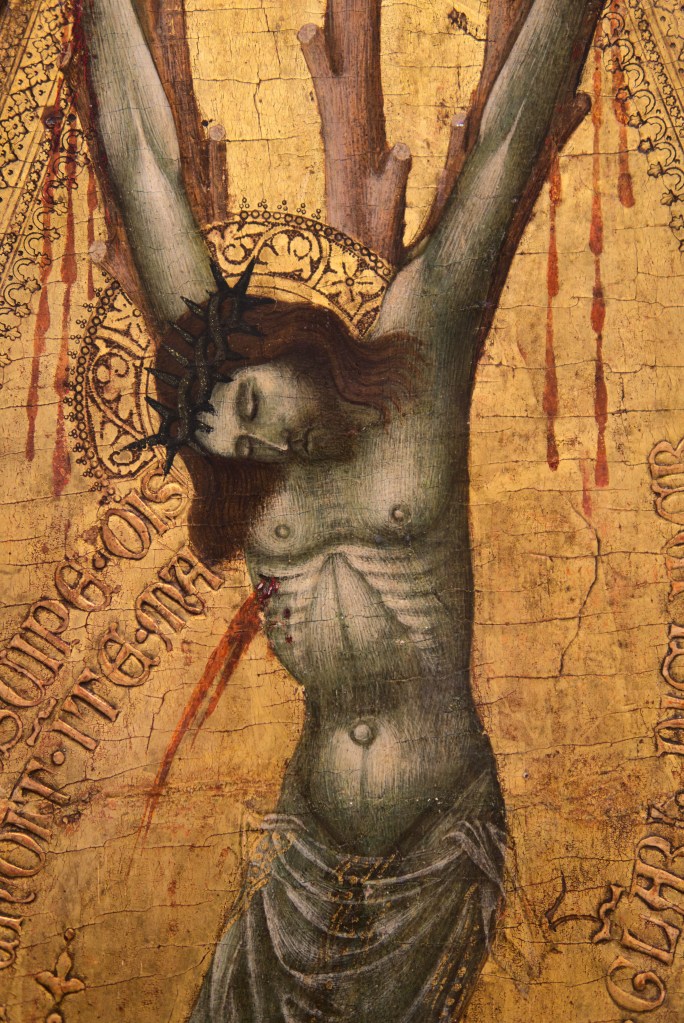
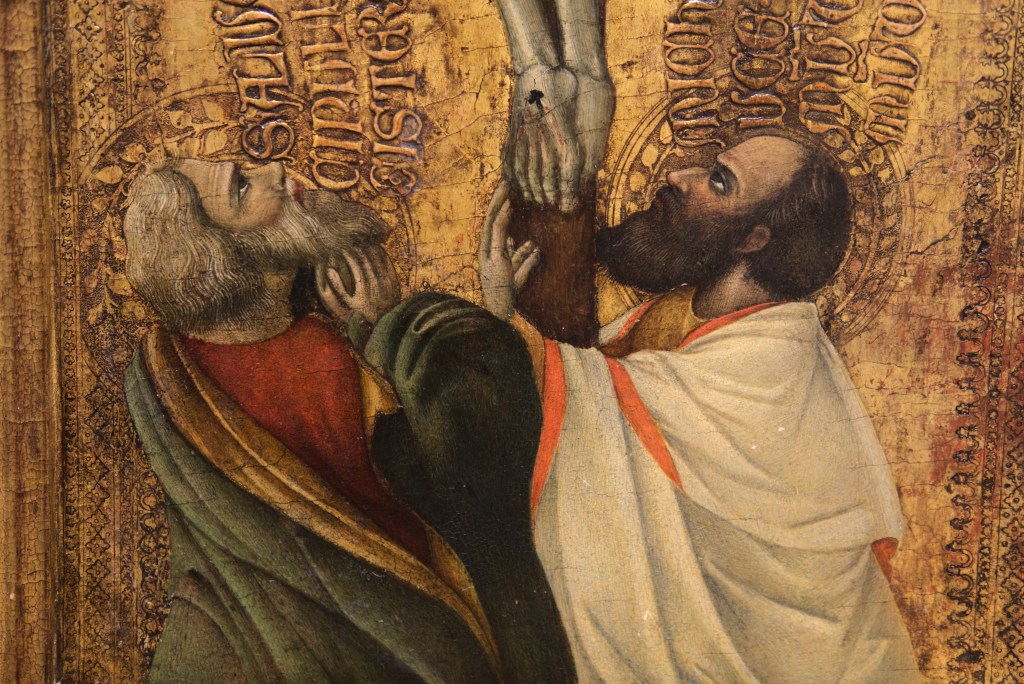
LOOK: Allegorical Representation of the Crucifixion with Saints Andrew and Paul by Francesco Traini
Francesco Traini (Italian, active 1321–1363), Allegorical Representation of the Crucifixion with Saints Andrew and Paul, ca. 1350–60. Tempera and gold leaf on panel, 41 1/4 × 16 5/8 in. (104.8 × 42.2 cm). Carnegie Museum of Art, Pittsburgh, Pennsylvania. Photo: Victoria Emily Jones. [object record]
In this panel painting from late medieval Italy, two of Christ’s apostles—Andrew and Paul—embrace the cross where Christ hangs crucified, his blood running down from his hands and side. The Latin inscriptions unfurl as speech from each. Paul, on the right, says, MICHI AUTEM ABSIT GLORIARI NISI IN CRUCE DOMINI NOSTRI JESU CHRISTU PER QUEM MICHI MUNDUS CRUCIXUS EST ET EGO MUNDO (“But God forbid that I should glory save in the cross of our Lord Jesus Christ, by whom the world is crucified unto me, and I unto the world” [Gal. 6:14]).
And Andrew exclaims, SALVE CRUS SPETIOSA SUSCIPE DISCIPLULUM EIUS QUI PENEDIT IN TE MAGISTER MEUS CHRISTUS (“Hail lovely cross, receive the disciple of him who hung on you, my master Jesus Christ”). This is one of the antiphons from the Feast of Saint Andrew, spoken by Andrew in response to being presented with the instrument of his martyrdom.
Francesco Traini is one of the few artists of the period to use raised gesso (plaster) and gold leaf texts on the surfaces of his paintings. He also often used punches, as here, to create elaborate borders.
I’m really compelled by the portrayal of the cross as a forked tree. (Note the similarity to Friday’s featured painting!) Granted, that artistic choice was probably dictated mainly by the narrow dimensions of the panel.
LISTEN: “येशूलाई क्रूसमाथि सब हेर” (Yeshulai Krusmaathi Sab Hera) (Down at the Cross) | Original English words by Elisha A. Hoffman, 1878 | Music by John H. Stockton, 1878 | Performed in Nepali by Psalms Unplugged, 2019 [HT: Global Christian Worship]
१. येशूलाई क्रूसमाथि सब हेर, हाम्रो दुःख उनैले बोकेर, डाक्दैछन् सबलाई प्रेम गरेर, येशूलाई हेर ।



 Art & Theology