
LOOK: The Resurrection by Severino Blanco
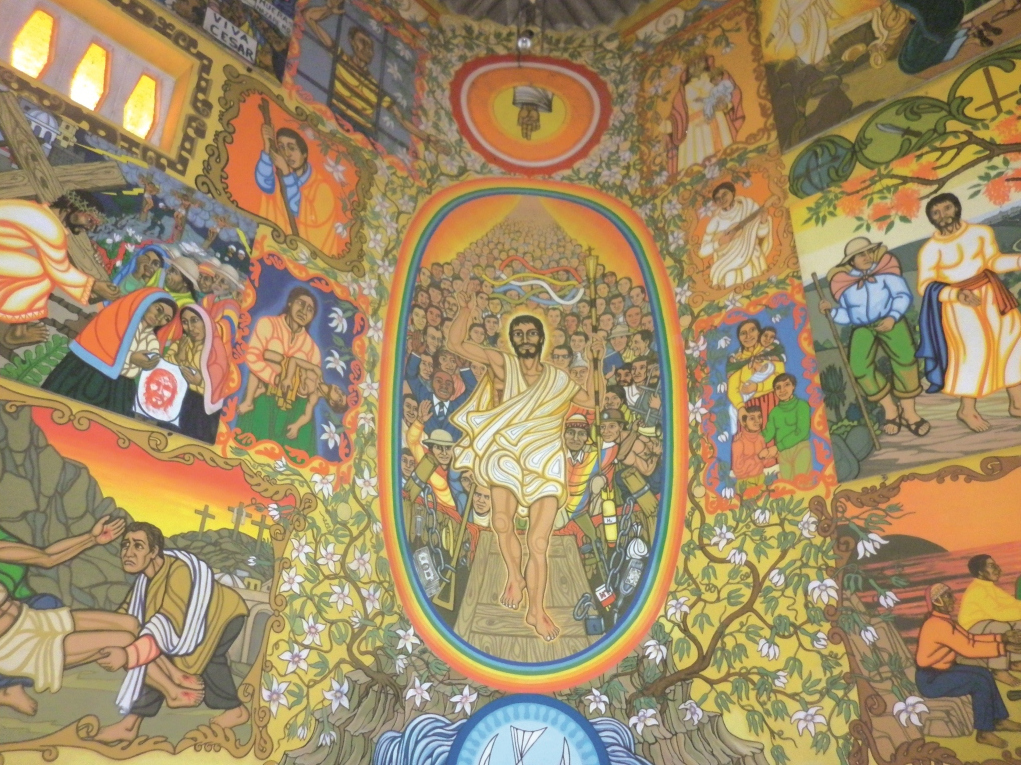
Severino Blanco (1951–2020) [previously] was a Quechua Christian artist from Ayopaya, Bolivia. His magnum opus is an extensive cycle of biblical paintings inside the chapel of the Casa del Catechista (CADECA) in Cochabamba, a center for training catechists (lay Catholic missionaries) and pastoral leaders to serve the sixty villages in the city’s archdiocese.
The centerpiece of the mural is an image of the risen Christ breaking through the chains of hell, trampling down its gates and leading an exodus of departed saints into new life. I can spot Rev. Dr. Martin Luther King Jr. of the United States and Archbishop Óscar Romero of El Salvador, martyrs of the faith, and I’m sure there are many other Latin American Christian preachers and activists pictured—those who walk the way of liberation.
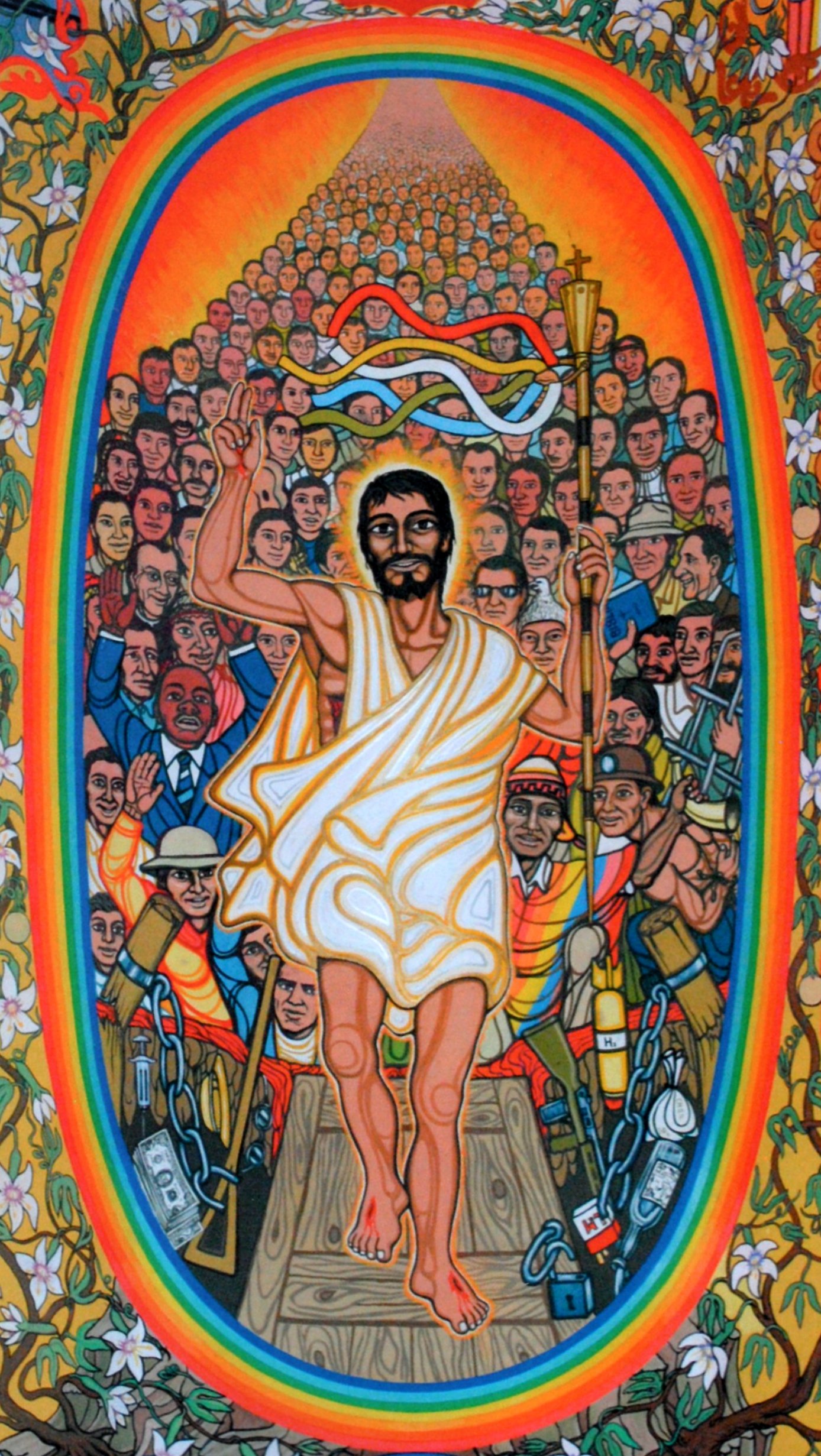
Barefoot and glowing, Jesus bears the puncture wounds from his crucifixion, but they are now glorified, and he holds high a cacique’s (Indigenous chief’s) staff, signifying his leadership. Beneath his feet are symbols of some of the hellish obsessions or addictions from which he frees us: a rifle and a hydrogen bomb (war and violence), money (greed, materialism), a needle and a liquor bottle (substance abuse). He walks through a rainbow-rimmed portal that frames him and his followers like an aureole and that is surrounded by flowering tree branches.
Above this vignette is the blessing hand of God the Father, and below is the Holy Spirit as dove, from whom issues forth streams of living water (see John 7:37–39). The presence of these two other persons of the Trinity emphasizes the Resurrection as a Trinitarian event.
This image is used on the cover of the German-language book Von Befreiung und Erlösung: Bilder in CADECA Cochabamba/Bolivien (Of Liberation and Redemption: Pictures in CADECA Cochabamba, Bolivia) by Alois Albrecht. The book features reproductions of the mural scenes alongside relevant Bible passages and texts by Latin American theologians and other members of the church.
One of the texts reproduced in the book is a letter from a Paraguayan base community to European Christians. (The date is not provided, nor is the original Spanish.) Here’s Google’s translation from the German:
Good people, our brothers and sisters in Europe!
Here as there, we celebrate Easter these days. How do you celebrate the feast of the resurrection of our suffering Lord, his passing from death to new life?
Here, the few rich people pass by the suffering of the poor. It is said of Jesus that he did not cling to his divinity as if it were a prize. But here, the few rich people plunder everything from the poor majority: bread, land, work, wages, health, housing, security.
How is passing over to a new life, like Easter, like resurrection, possible then? Are we not all brothers and sisters, you there and we here? Easter is an international affair.
Our situation has international roots and is caused by those who make decisions in the world, carry out plans, and in doing so forget us, the little brothers and sisters of the suffering and slain Jesus.
Easter is the feast of hopeful departure, of joyful new beginnings, of enthusiastic new life. But who among us feels anything of departure, joy, new beginnings, new life? Yes, hope—we have it! Easter is a feast of expectation; for whoever is always on the way also reaches their destination.
So, brothers and sisters! Despite everything, let us go our own way, you there and we here, in the light of Christ, the Lord raised to new life, to seek together equality and freedom for all.
We Paraguayans need you there, and not just your money, but above all your sure and loud voice against the ideology that enslaves and kills us all, us poor and you rich alike.
We all live in the same danger of death. But our risen Lord has also made us all his equal brothers and sisters. Please don’t forget that!
Arnoldo and friends and family
Another text is an excerpt from a document of the Third General Assembly of the Latin American Episcopate in Puebla, Mexico, in 1979. Again, Google Translate:
In fulfillment of the commission he received from his Father, Jesus voluntarily offered himself up to death on the cross, which was the goal of his life’s journey. As the bringer of the freedom and joy of the kingdom of God, he wanted to become the decisive sacrifice for injustice and evil in this world. On the cross, he takes upon himself the pain of creation and offers his life as a sacrifice for all.
In this way, he is the high priest who is able to share our weaknesses with us. He is the Easter sacrifice that redeems us from our sins. He is the obedient Son who, in the face of his Father’s redeeming justice, incarnates the cry for liberation and salvation of all people. . . .
Therefore, the Father raises his Son from the dead. He exalts him in glory to his right hand, pours out upon him the life-giving power of his Spirit, appoints him as head of his body, that is, the church, and confirms him as Lord of the world and of history.
Jesus’s resurrection is a sign and guarantee of the resurrection to which we are all called, as well as of the final transformation of the whole world. Through him and in him, the Father wished to re-create what he had already created.
Amen, and amen.
Addendum: At my church this morning, an invited guest preached a sermon on Colossians 1:18–20 titled “Leading the Resurrection Parade” after Eugene Peterson’s translation of the christological descriptor “the firstborn from the dead” in verse 18. I instantly thought of this image I had posted just hours earlier, in which Jesus’s staff is reminiscent of a drum major mace! The preacher spoke of Jesus steering a resurrection train of people, the new humanity, and cross-referenced 2 Corinthians 2:14: “Thanks be to God, who in Christ always leads us in triumphal procession and through us spreads in every place the fragrance that comes from knowing him.”
LISTEN: “We Walk His Way (Ewe Thina),” a South African freedom song from the apartheid era | Translated by Anders Nyberg, Jonas Johnson, and Sven-Bernhard Fast, 1984 | Arranged by John L. Bell and performed by the Wild Goose Collective on We Walk His Way: Shorter Songs for Worship, 2008
Refrain (Xhosa):
Ewe thina, ewe thina
Ewe thina, ewe thina
Ewe thina, ewe thina
Ewe thina, ewe thinaSizowa nyathela amadimoni
Ewe thina, ewa thina
Sizowa nyathela amadimoni
Ewe thina, ewa thina [Refrain]Refrain (English):
We walk his way, we walk his way
We walk his way, we walk his way
We walk his way, we walk his way
We walk his way, we walk his wayUnarmed, he faces forces of demons and death
We walk his way, we walk his way
Unarmed, he faces forces of demons and death
We walk his way, we walk his way [Refrain]He breaks the bonds of hell, dying on the cross
We walk his way, we walk his way
He breaks the bonds of hell, dying on the cross
We walk his way, we walk his way [Refrain]The tree of freedom blooms by his empty grave
We walk his way, we walk his way
The tree of freedom blooms by his empty grave
We walk his way, we walk his way [Refrain]


