
Isaiah’s Vision of God: Two songs, two paintings

The Old Testament reading in the Revised Common Lectionary for this coming Sunday, Trinity Sunday, is Isaiah 6:1–8:

In the year that King Uzziah died, I saw the Lord sitting on a throne, high and lofty, and the hem of his robe filled the temple. Seraphs were in attendance above him; each had six wings: with two they covered their faces, and with two they covered their feet, and with two they flew. And one called to another and said,

Holy, holy, holy is the LORD of hosts;
the whole earth is full of his glory.

The pivots on the thresholds shook at the voices of those who called, and the house filled with smoke. And I said, “Woe is me! I am lost, for I am a man of unclean lips, and I live among a people of unclean lips, yet my eyes have seen the King, the LORD of hosts!”

Then one of the seraphs flew to me, holding a live coal that had been taken from the altar with a pair of tongs. The seraph touched my mouth with it and said, “Now that this has touched your lips, your guilt has departed and your sin is blotted out.” Then I heard the voice of the Lord saying, “Whom shall I send, and who will go for us?” And I said, “Here am I; send me!”

Wow. What a truly awesome passage!

I’d like to share two songs inspired by it as well as two visual artworks. The first song is a choral work by the English composer and organist Sir John Stainer (1840–1901), titled “I Saw the Lord.” It was performed by The Sixteen under the direction of Harry Christophers and appears on the ensemble’s 2009 album A New Heaven.

The first stanza is the King James Version of Isaiah 6:1–4, and the second stanza is the third verse of “Ave, colenda Trinitas,” an anonymous Latin hymn of the eleventh century, translated by John David Chambers (1803–1893).

I saw the Lord sitting upon a throne, high and lifted up,
and his train filled the temple.
Above it stood the seraphims: each one had six wings;
with twain he covered his face,
and with twain he covered his feet,
and with twain he did fly.
And one cried unto another,
Holy, holy, holy is the LORD of hosts:
the whole earth is full of his glory.
And the posts of the door moved at the voice of him that cried,
and the house was filled with smoke.

O Trinity! O Unity!
Be present as we worship thee,
And with the songs that angels sing
Unite the hymns of praise we bring.
Amen.

Christian biblical commentators have discerned in Isaiah 6 two Trinitarian references: the three “holys” pronounced by the angels (v. 3), and the use of both a singular and plural pronoun in God’s question in verse 8: “Whom shall I send, and who will go for us?” (emphasis mine; cf. Gen. 1:26). Unity in plurality. Further, the New Testament relates this passage to both Jesus (John 12:41) and the Holy Spirit (Acts 28:25). That’s why it’s commonly read on Trinity Sunday, and why Stainer has appended to it a Trinitarian hymn text.

Of Stainer’s musical setting, William McVicker writes,

It is often said that I saw the Lord was written with the acoustics of St Paul’s [Cathedral in London] in mind. It is scored for double choir with an independent organ part. The music’s drama is achieved by the simple, largely homophonic texture, and the interplay of the two chorus parts with that of the organ. Stainer breaks into an imitative texture at the words ‘and the house was filled with smoke’ and again in the final verse section, which is reminiscent of a Victorian part-song.

The music is grandiose, majestic, as one would expect for the encounter it frames, which involves robes, thrones, angelic attendants, shaking doorposts, smoke, and an all-pervasive divine glory.

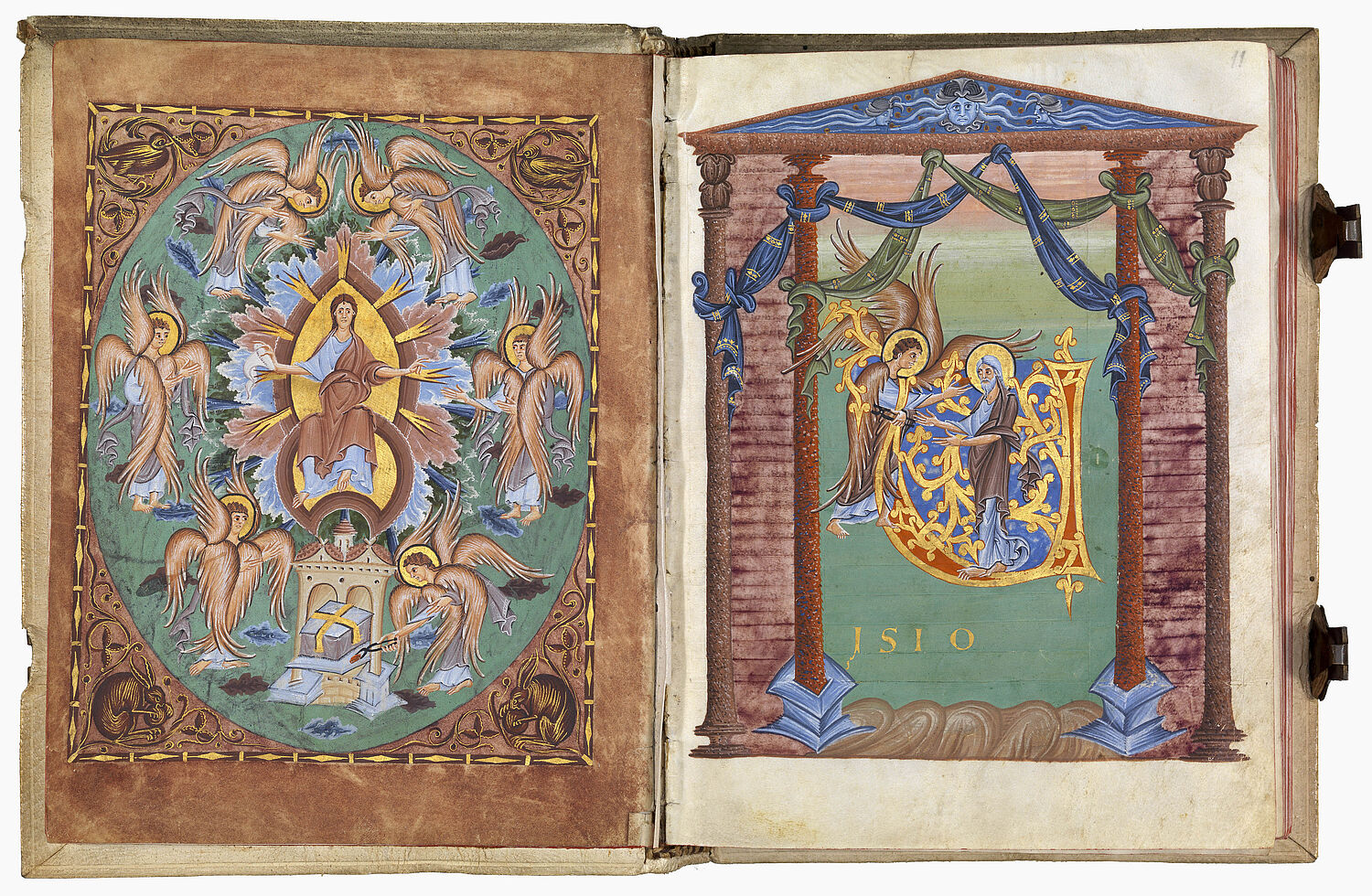
I suggest listening to Stainer’s choral piece as you look on the following page spread from a high medieval German manuscript produced in Reichenau. The manuscript is a copy of Jerome’s (Latin) commentary on Isaiah, with glosses added in the Alemannic dialect of Old High German, and these are the only two images inside.
Isaiah's Vision (Reichenau)
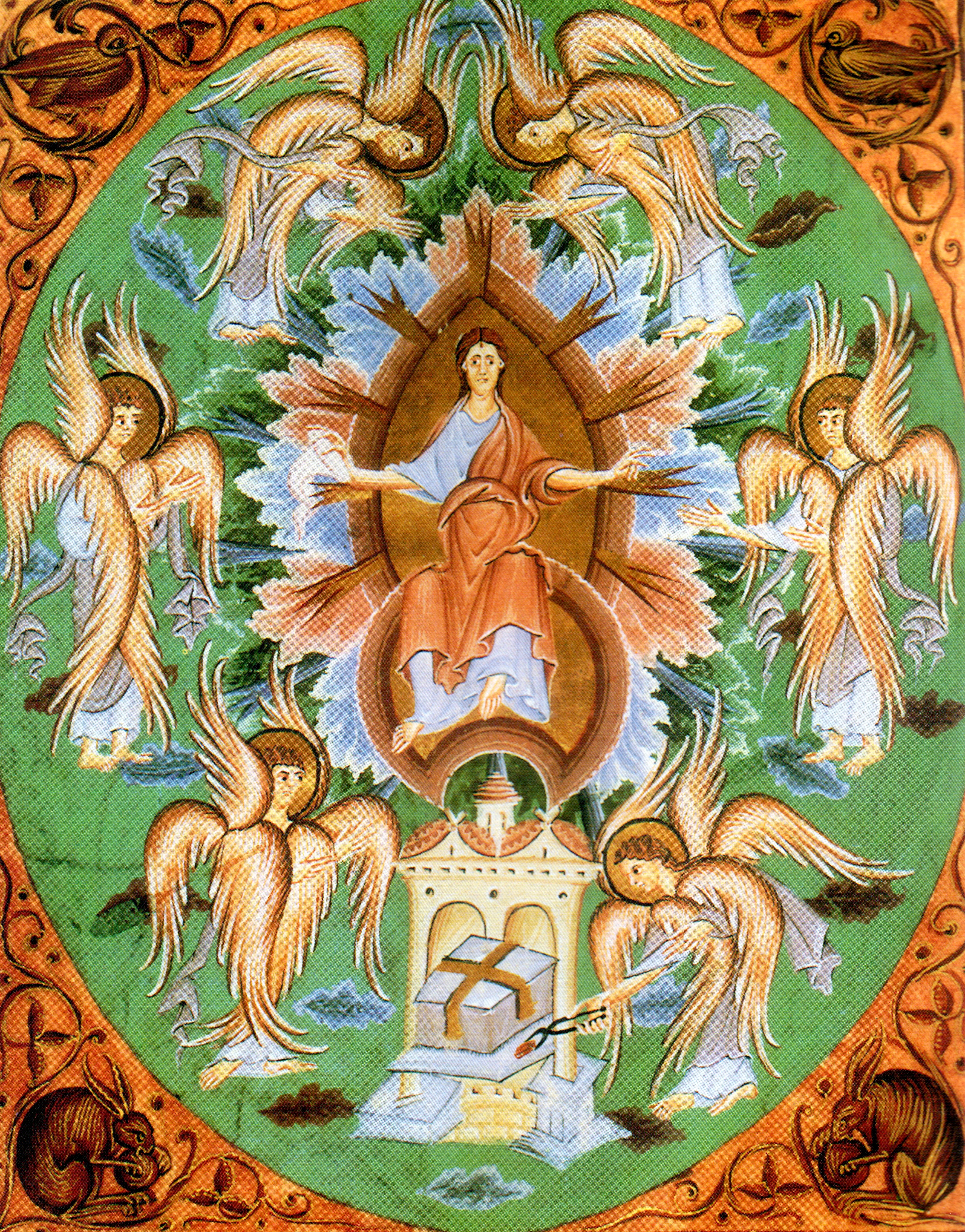
Miniature depicting the prophet Isaiah’s vision of God and decorative initial page showing the cleansing of the prophet, from an Isaias glossatus made in Reichenau, Germany, ca. 1000. Staatsbibliothek Bamberg, Msc.Bibl.76, fols. 10v–11r. [browse full manuscript]

The island monastery of Reichenau on Lake Constance in southern Germany was an important center of illuminated manuscript production in the Ottonian period (919–1024) of the Holy Roman Empire. The miniatures painted there are among the finest of the Middle Ages. (For another example, see the one I shared back in 2020.)

On folio 10v of the Isaias glossatus that’s kept at the Bamberg State Library, God in the form of Christ sits in a mandorla from which trifold bursts of light shine forth, backed by mauve and powder-blue billows of smoke. In his right hand he holds a scroll that represents the word he speaks to Isaiah in 6:9–13, and the words he will continue to supply him with throughout his ministry. Hovering above a smaller-scale temple, God is attended by six seraphim (lit. “burning ones”), one of whom removes a hot coal from the altar with tongs. All this takes place within a green oval, which is surrounded by a brown and gold decorative border of vine tendrils housing two birds and two hares.
Isaiah's Vision (Reichenau)

On the opposite page, folio 11r, the tong-bearing seraph touches the coal to Isaiah’s lips, purging his speech and thus fitting him for the office of prophet. This cleansing act is in response to Isaiah’s humble confession of sin, having beheld God’s holiness: “Woe is me! I am lost, for I am a man of unclean lips . . .” (v. 5). The artist shows Isaiah’s hands open and arms outstretched, welcoming God’s cleansing and accepting the call to service: “Here am I; send me!” (v. 8). Notice that this exchange takes place within the letter V, from the opening of Isaiah, “Visio Esaiae” (The vision of Isaiah . . .). The miniature is a historiated initial—that is, an enlarged letter at the beginning of a paragraph that contains a picture.

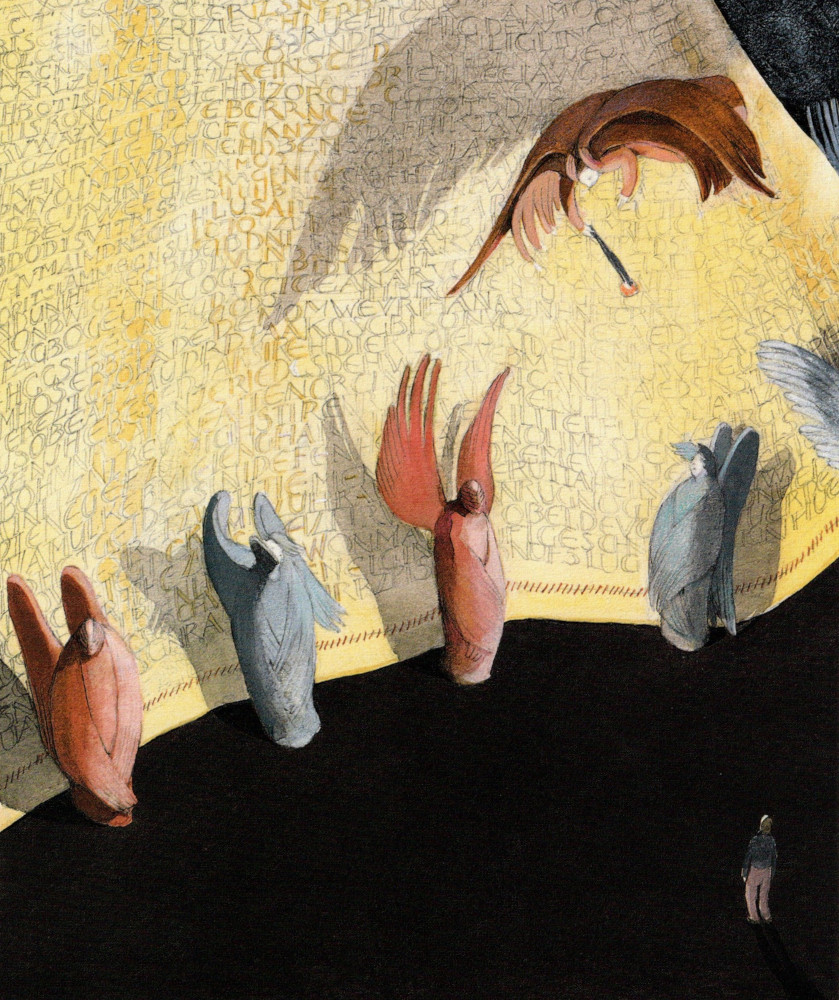
Now let’s shift gears to two Isaiah 6–based works that were made in a folksier idiom. Take in this pen, ink, and watercolor image by the award-winning Austrian illustrator Lisbeth Zwerger, from her book Stories from the Bible (North-South Books, 2002), originally published in German as Die Bibel in 2000:
Zwerger, Lisbeth_Isaiah's Calling
Lisbeth Zwerger (Austrian, 1954–), Isaiah’s Calling, 2000, an illustration from Stories from the Bible (North-South Books, 2002)

This book contains some of the most imaginative biblical artworks of the past century (I shared a sampling on Instagram), and I recommend it for all Christian bookshelves!

In contrast to the frontal wide shot given by the anonymous Reichenau artist, in Isaiah’s Calling Zwerger zooms in on just one detail of the scene, structured along a diagonal. Isaiah stands at the bottom right in the dark, dwarfed by the immense train of God’s robe, which is pure light. It contains letters that I can’t make out into words; can you? I would have assumed they spell out the passage from Isaiah 6 (in German?), but it’s possible they’re not meant to be intelligible—just a further indicator of God’s mysteriousness. The artist has also deliberately chosen not to show God’s face.

Five blue- and red-plumed seraphim—one mostly out of frame, save for one of his wings—stand at the hem of the royal garment, while a sixth flies down toward Isaiah with that burning coal.

At the hem of Christ’s robe is where the woman from Capernaum with the issue of blood finds healing (Luke 8:43–48), and it’s also here at God’s hem that Isaiah is made well, restored.

For a musical complement to Zwerger’s painting, I recommend the song “Lofty and Exalted” by Lenny Smith. It’s from 1993, but Smith didn’t release a recording until 2020, on the album Splendor and Majesty.

Lofty and exalted, reigning from your throne
The train of your robe fills the temple
Seraphim above you, calling out your name
Proclaiming how good and how lovely

Refrain:
Holy, holy, Lord
The earth is full of your glory
Holy, holy, Lord
The earth is full of your praise

“God’s real exalted status and prestige is that He loves being with the lowest of the low,” Smith writes on the song’s Bandcamp page. And in the YouTube description for the song, he reminisces, “Oh for the days when a bunch of us just got together in my basement and just played and sang for hours . . . to our hearts’ content. We had no ulterior motives at all. It was just fun and exhilarating. No audience or pastors or video cameras or aspirations to become worship leaders or famous artists. Oh for those simple, lovely days!”

Smith was involved in the Jesus Movement of the 1960s and ’70s. He has written some two hundred church songs, the most famous of which is “Our God Reigns.” I know him best for “But for You,” through the cover by the Welcome Wagon on their debut album.

Stylistically, this musical adaptation of Isaiah 6 is much different from John Stainer’s. The composition is simple, just a few chords and easily singable (it would work great congregationally), and the instrumentation consists of guitar and piano. It’s also exuberant in tone. Perhaps Stainer’s piece better holds the gravitas of Isaiah’s vision, but Smith’s captures its joy.

In his Prophecy of Isaiah: An Introduction and Commentary, J. Alec Motyer writes, paradoxically, that God’s “transcendent holiness is the mode of God’s immanence, for the whole earth is full of his glory” (77), reminding us that however otherworldly this mystic moment might have felt to Isaiah, the glory of God is profoundly thisworldly too, suffusing the everyday. “God’s glory isn’t ‘up there’ away from us,” writes SALT Project in their lectionary commentary for this Sunday, “but rather fills the whole earth and is intimately, actively involved in our lives, calling and sending us in service to God’s mission in the world.”

Smith gives permission for the use of “Lofty and Exalted” in church contexts; it’s #3248380 on CCLI, and the lead sheet can be found here.

Every artistic interpretation—visual, musical, or what have you—of a scripture text has the potential to open us up to the text in new ways. No single interpretation should become totalizing; we need all kinds! I’m so appreciative of those who take the time to sit with a Bible passage and then respond to it in paint or in song, whether that be medieval monks laboring away in the scriptorium with their gold leaf and color pigments or contemporary storybook illustrators with their watercolors, a Victorian organist knighted by the queen and serving a cathedral or folk musicians jamming with friends in informal, at-home worship.

From “On Pentecost” by Romanos the Melodist (poem)

Pentecost (Ottonian)
The Descent of the Holy Spirit, from a benedictional made in Regensburg, Germany, ca. 1030–40. Tempera colors, gold leaf, and ink on parchment, 9 1/8 × 6 5/16 in. (23.2 × 16 cm). J. Paul Getty Museum, Los Angeles, Ms. Ludwig VII 1 (83.MI.90), fol. 47v. As is traditional in artistic depictions of this subject, the apostle Paul (with brown beard) is seated in a prominent position opposite Peter, receiving the Spirit like the other eleven apostles. Paul was not present at the event, but he was later mystically joined to it.

. . .

Peter, speaking like this to the apostles, roused them to prayer,
And standing in their midst, he spoke as follows:
“On bended knee let us beg and pray
That we shall make this chamber a church, for so it is and has become.
Let us be eager to cry unto God,
‘Send us thy good spirit
So that it may lead all of us to correct knowledge
Which thou hast prepared for those who worship and praise
The All-Holy Spirit.’”

When they heard this, those who had been called with him gathered together
As lambs in the presence of the shepherd, charmed by his speech;
And silently they specified what they desired,
And they held up to the Pantokrator the prayers which pressed for these things:
“To the Lord of angels and the King,
To the Ruler of humankind and the Maker of the world,
To the One who holds sway with his nod over those in heaven and earth,
Thy friends and servants cry to thee: ‘Quickly send us
The All-Holy Spirit.’”

Immediately after completing their prayers, they wrote their names under them,
And sealing them in faith, they sent them on high—
Prayers which the Master recognized and he said:
“Comforter, descend as thou dost wish, of thy own initiative, and without being summoned;
The disciples expect thee; they are the ones
Whom I gather together for thee and the Father,
The ones whom I educated when I said: ‘Teach the nations,
Extolling the Father, and worshiping the Son, and praising
The All-Holy Spirit.’”

God heard their wants, and his Comforter
Descended on those who were praying.
The Ineffable One was not removed from one place to the other,
Nor was there alteration, nor accommodation, nor did he endure diminution,
For he was above, and below, and everywhere;
For the divine nature is ineffable and not to be touched;
It is not seen by the eyes, but it is apprehended through faith;
It is not grasped in the hands; but it is felt in hearts of faith—
The All-Holy Spirit.

When the divine Pentecost was complete, the eleven chosen ones set up a din.
As they persevered in their prayers,
And as the passage read from Acts says,
When the sound of the powerful wind of the spirit suddenly came resounding from heaven,
The whole chamber was filled with fire.
Indeed, it amazed the beloved disciples rather too much.
When they saw the dwelling tossed like a boat, they cried:
“O Master, check the storm and send
The All-Holy Spirit.”

When the disciples recognized that the whole upper room was shaken as by an earthquake from the wind,
They all lowered their eyes in fear;
And lo! Another trembling still more to be shuddered at,
And one upon another marvel brought a second trembling in addition to the first fear,
For fiery tongues touched them anew
And began to appear on the heads of the chosen group.
Indeed, the fiery tongues did not burn their hair but lighted up their hearts
And sent them forth cleansed and purified—
The All-Holy Spirit.

Peter, seeing all the things which were happening, cried out: “Brothers,
Let us hold in reverence what we see, and let us not examine it.
Does anyone say what it is that has been done?
For what has been accomplished transcends belief and defies thought.
Spirit and fire are united—a true miracle;
Air and flame are joined together—awesome sight!
Along with winds, torches; along with dew, sparks of fire.
Who has seen, who has heard of this? Who is able to speak of what is produced by
The All-Holy Spirit?

“Do you, then, dearly beloved, stand and simply observe the fire
Which the One who is in heaven has sent from on high;
Do not fear, for the coals do not burn;
Do not be amazed that the fire does not burn, but as prudent men remember
How long ago the fire received kindly the three children,
How their bodies were not burned, nor their hair,
How the furnace revealed the three as four,
For it gave back those whom it received with interest, since it feared
The All-Holy Spirit.

“Then, brothers, let the One descended upon us cast out fear from our minds,
And make a show of love to the Ascended One.
Since he loved those whom he called,
Since all the things which he prophesied, he has fulfilled, and since he has done as he said,
Why, then, should we be afraid of a flame which does not burn?
Let us consider the fire as roses, which indeed it is.
It has been placed upon our heads like flowers,
And on our heads it has formed a crown, an ornament, and illumined us,
This All-Holy Spirit.”

. . .

This passage constitutes strophes 4–12 of a sixth-century Pentecost kontakion (poetic homily) by Romanos the Melodist, translated by Marjorie Carpenter in Kontakia of Romanos, Byzantine Melodist; I: The Person of Christ (Columbia: University of Missouri Press, 1970). For the original Greek, see #33 in the critical edition edited by Paul Maas and Constantine Athanasius Trypanis, Sancti Romani Melodi Cantica Genuina (Oxford: Clarendon Press, 1963).

Three details stand out to me: the prayers of the apostles for the Spirit being sent up like signed, sealed letters to the heavens, eliciting God’s affirmative response; the paradoxical mingling of dew and fire (two seemingly incompatible elements) in the Spirit’s descent, both refreshing and enflaming; and the image of the Pentecostal flames as roses that crown the apostles’ heads!

Romanos is known for his kontakia, a form of hymn in the Byzantine liturgical tradition that Romanos is believed to have introduced. The kontakion is basically a poetic sermon that was sung, containing highly dramatic features, including dialogue, but it was not staged. At its inception in the early sixth century and through the seventh, a kontakion consisted of a prologue (the prooimoion or koukoulion) followed by eighteen to thirty metrically identical strophes (oikoi or ikoi, i.e., stanzas; sing. oikos or ikos) linked by a refrain. (In the example above, the refrain is “The All-Holy Spirit.”) The first letter of each of the strophes often forms an acrostic.

Kontakia were written to be sung at the Daily Office, not Mass, on feast days. Unfortunately, none of the music Romanos wrote for his survives.

By the eighth century, the kontakion had become shortened, and it lost its homiletic character and its dialogue.


Romanos the Melodist (fl. 536–556 CE) was a preeminent Byzantine hymnographer and composer who is said to have written, in Greek, nearly a thousand kontakia, of which fifty-nine (text only) survive, his best known being on the Nativity of Christ. He was born in the late fifth century to a Jewish family in Emesa (modern-day Homs), Syria, but was baptized into Christianity as a young boy. He later moved to Berytus (Beirut) and was ordained a deacon of the Church of the Resurrection there. During the reign of Emperor Anastasius I (r. 491–518) Romanos moved to Constantinople and served as sacristan at Hagia Sophia, residing in that capital city until his death. He was sainted by the Greek Orthodox Church, which celebrates his feast on October 1. The famous Akathist Hymn to the Theotokos is attributed to him.

Whole World in His Hands (Artful Devotion)

Christ in Glory (Gospel-book of Bamberg Cathedral)
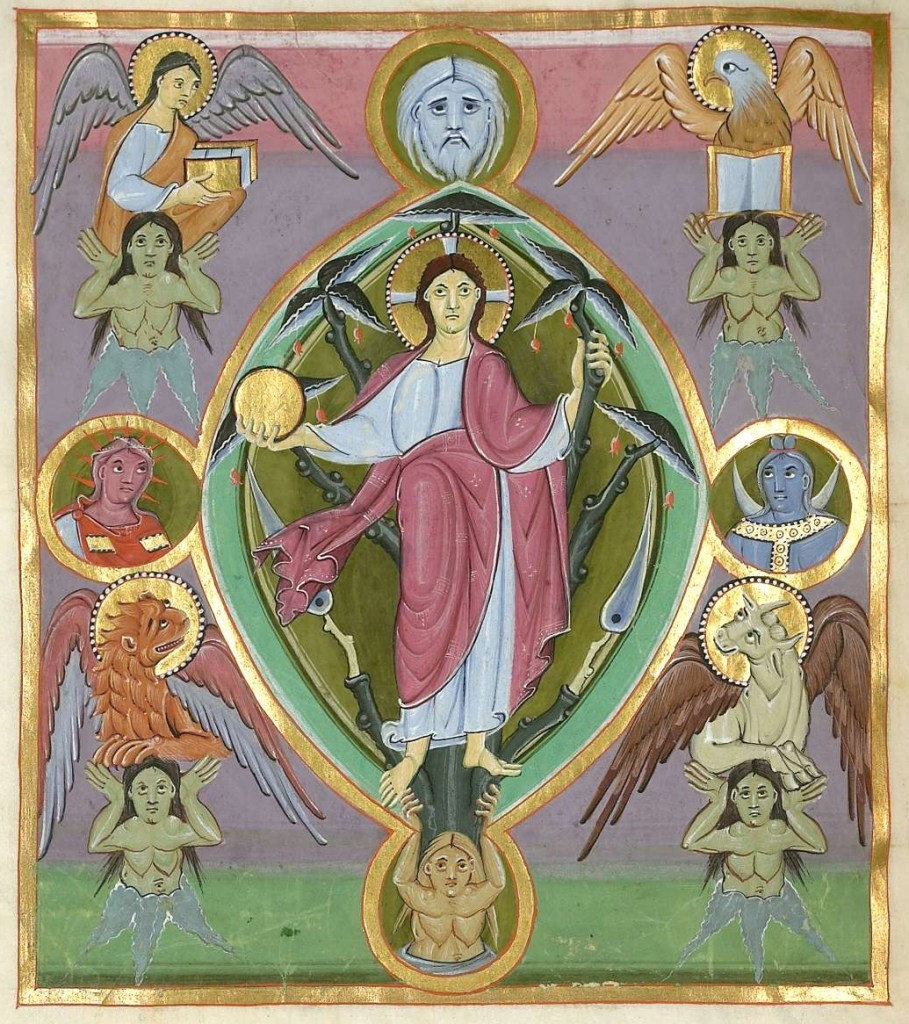
“Christ in Mandorla with evangelists,” Reichenau, Germany, early 11th century. BSB Clm 4454, fol. 20v, Bayerische Staatsbibliothek, Munich.

Oh come, let us sing to the LORD;
    let us make a joyful noise to the rock of our salvation!
Let us come into his presence with thanksgiving;
    let us make a joyful noise to him with songs of praise!
For the LORD is a great God,
    and a great King above all gods.
In his hand are the depths of the earth;
    the heights of the mountains are his also.
The sea is his, for he made it,
    and his hands formed the dry land.
Oh come, let us worship and bow down;
    let us kneel before the LORD, our Maker!
For he is our God,
    and we are the people of his pasture,
    and the sheep of his hand.

—Psalm 95:1–7

This is the Psalm reading for the last Sunday of the liturgical year, Christ the King Sunday. I’ve paired it with an Ottonian miniature from around 1015, which shows Christ, framed by a mandorla (an almond-shaped aureole), standing in a branched tree of life. The gold-leaf outline of this glory cloud encompasses heaven (Caelus, the top figure) and earth (Terra, aka Terrus, at bottom), two realms connected by Christ himself. (Earth is his footstool! That is, part of his throne.) He holds a globe in his right hand and is surrounded by symbols of the four evangelists (the tetramorph)—each supported by a water nymph representing one of the four rivers of paradise—and Sol (sun) and Luna (moon). I love how this image emphasizes the life-giving nature of Christ’s rule, and how it extends over all of creation.

From our limited human perspective, it can be hard to see the divine reality that this artist is pointing to. It sometimes doesn’t feel like Jesus is on the throne, holding together everyone and everything in love. But I look at that little orb, and I think of all the sin and suffering and love and grace and stress and beauty swirling around in that one small part of the cosmos, and I see that it’s rendered in precious gold, and is gripped firmly by the hand of God, who—zoom out—is “a great King above all,” who made the heights and the depths and who gives us his word and indeed his very self, a tree of life for the healing of the nations. As we head into Advent, may we not lose this vision of the Christ who reigns.

More about the art: In the tenth and eleventh centuries, the Benedictine abbey on the island of Reichenau in Lake Constance in southern Germany was the site of one of Europe’s largest and most influential schools of manuscript illumination, known as the Reichenau school. The painting above is from a Gospel-book produced there, commissioned by Holy Roman Emperor Henry II (r. 1002–24) for the cathedral he founded in Bamberg. The book is now housed at the Bayerische Staatsbibliothek (Bavarian State Library) in Munich, along with two other similar illuminated manuscripts from Bamberg Cathedral: the Gospel-book of Otto III (Clm 4453) and the evangeliary of Henry II (Clm 4452). Find out more about this particular manuscript at the World Digital Library. You can also browse the images here by selecting the links in the “Content” sidebar at the left.

For other artworks from Art & Theology that show, in a literal manner, “the whole world in [God’s] hands,” see this medieval Pisan fresco with signs of the zodiac; How God loves his People all over the World by John Muafangejo; Creation of the World by Lyuba Yatskiv; Salvator Mundi by Leonardo da Vinci, a common image type; and a Florentine panel painting of God the Father.

Do you know of any good nonliteral images that say to you, “The world is in God’s hands”? That is, a visual artwork that helps you sense God’s sovereignty? I often fall back on traditional visual conceptualizations of theological teachings like this, but I’d like to expand my repertoire!

+++

SONG: “He’s Got the Whole World in His Hands,” African American spiritual

There are hundreds of professional recordings and live performance videos of this traditional song. It was first published in the paperbound hymnal Spirituals Triumphant, Old and New in 1927 and became an international pop hit in 1957 when it was recorded by thirteen-year-old English singer Laurie London.

First off, I want to feature a fairly recent two-part video compilation released by TrueExclusives. Back in March, as the first wave of the coronavirus hit the US, Tyler Perry posted a video of himself singing one verse of “He’s Got the Whole World in His Hands” to provide a word of assurance in the face of rising death tolls and social isolation. He called on his fellow musicians and other friends to likewise video-record a verse or two, in whatever key or style they wished—just a simple, unpolished phone recording—tagging it #tylerperrychallenge. These were then collected into two videos, a string of contributions from people like Mariah Carey, Usher, Patti Labelle, Jennifer Hudson, Shirley Caesar, LeAnn Rimes, Aubrey Logan, Israel Houghton, and many more. For a list of all the singers with time stamps, see the comment by YouTube user benzmusiczone for the first video and the comment by The Cherie Amour Show for the second.

(Update, January 2023: The original two YouTube videos from the TrueExclusives channel have been removed—not sure why—but you can view the originals on Tyler Perry’s Facebook page: part 1 and part 2.)

Some participants sing in other languages—for example, Nicole Bus in Dutch, Jencarlos Canela in Spanish. Others adapt the lyrics to more specifically address the context of our global pandemic. Kelly Rowland, for example, sings, “He’s got the doctors and the nurses in his hands.” Stevie Mackey names specific countries and virus hot spots. And not only does God have the itty bitty babies in his hands, Ptosha Storey reminds us; he also has the elderly. BeBe Winans spans the cosmic to the small in his verse, emphasizing that God’s sovereign care is both expansive and intimate: “He’s got the moon and the stars in his hands / He’s got Pluto and Mars in his hands / And as I’m sitting in this car, I’m in his hands / He’s got the whole world in his hands.”

I love me some harmonies, so I particularly enjoyed hearing sisters Chloe and Halle Bailey (2:32) and The Walls Group (16:54).

What follows are a handful of other renditions I want to highlight.

Jeanne Lee [previously], 1961:

Ruth Brown, 1962 (classic gospel):

A live 2006 performance in Johannesburg—with hand motions!—by the African Children’s Choir:

A lush choral and orchestral arrangement by Mack Wilberg, featuring Alex Boyé [previously] and the Mormon Tabernacle Choir, from 2010:

Similarly lush, a duet performed by operatic sopranos Jessye Norman and Kathleen Battle, backed by the Metropolitan Opera Chorus, the New York Philharmonic, and the Metropolitan Opera Orchestra. The performance was conducted by James Levine at Carnegie Hall in 1990 and is included on the album Spirituals in Concert (1991). The arrangement is by Robert de Cormier:


This post belongs to the weekly series Artful Devotion. If you can’t view the music player in your email or RSS reader, try opening the post in your browser.

To view all the Revised Common Lectionary scripture readings for Proper 29 (Reign of Christ), cycle A, click here.

Dives and Lazarus (Artful Devotion)

Lazarus and the Rich Man (11th cent.)
“Lazarus and Dives,” fol. 78r from the Codex Aureus of Echternach, ca. 1035–40. German National Museum, Nuremberg, Germany.

There was a rich man who was clothed in purple and fine linen and who feasted sumptuously every day. And at his gate was laid a poor man named Lazarus, covered with sores, who desired to be fed with what fell from the rich man’s table. Moreover, even the dogs came and licked his sores. The poor man died and was carried by the angels to Abraham’s side. The rich man also died and was buried, and in Hades, being in torment, he lifted up his eyes and saw Abraham far off and Lazarus at his side. And he called out, “Father Abraham, have mercy on me, and send Lazarus to dip the end of his finger in water and cool my tongue, for I am in anguish in this flame.” But Abraham said, “Child, remember that you in your lifetime received your good things, and Lazarus in like manner bad things; but now he is comforted here, and you are in anguish. And besides all this, between us and you a great chasm has been fixed, in order that those who would pass from here to you may not be able, and none may cross from there to us.” And he said, “Then I beg you, father, to send him to my father’s house—for I have five brothers—so that he may warn them, lest they also come into this place of torment.” But Abraham said, “They have Moses and the Prophets; let them hear them.” And he said, “No, father Abraham, but if someone goes to them from the dead, they will repent.” He said to him, “If they do not hear Moses and the Prophets, neither will they be convinced if someone should rise from the dead.”

—Luke 16:19–31

+++

SONG: “Dives and Lazarus” | Traditional English ballad | Performed by Cooper, Nelson & Early, on Love & War (2004)

+++

The illuminated manuscript page above tells visually, in three sequential strips, the parable of the rich man (“Dives”) and Lazarus. (The personal name Dives is not given in the scripture text but is traditionally used as shorthand for the rich man, as dives is Latin for “rich.”) The top register shows Lazarus, a sick homeless man, dying at Dives’s door; the middle, Lazarus’s soul being carried off to paradise by two angels and seated in Abraham’s bosom; and the bottom, Dives’s soul being carried off to hell by two devils and tortured.

This is one of four full-page miniatures that preface the Gospel of Luke in the Codex Aureus (“Golden Book”) of Echternach, a Vulgate edition of the four Gospels produced at the Benedictine Abbey of Echternach in Luxembourg in the eleventh century shortly after the Ottonian dynasty came to an end. It is a preeminent example of the Ottonian style.


This post belongs to the weekly series Artful Devotion. If you can’t view the music player in your email or RSS reader, try opening the post in your browser.

To view all the Revised Common Lectionary scripture readings for Proper 21, cycle C, click here.