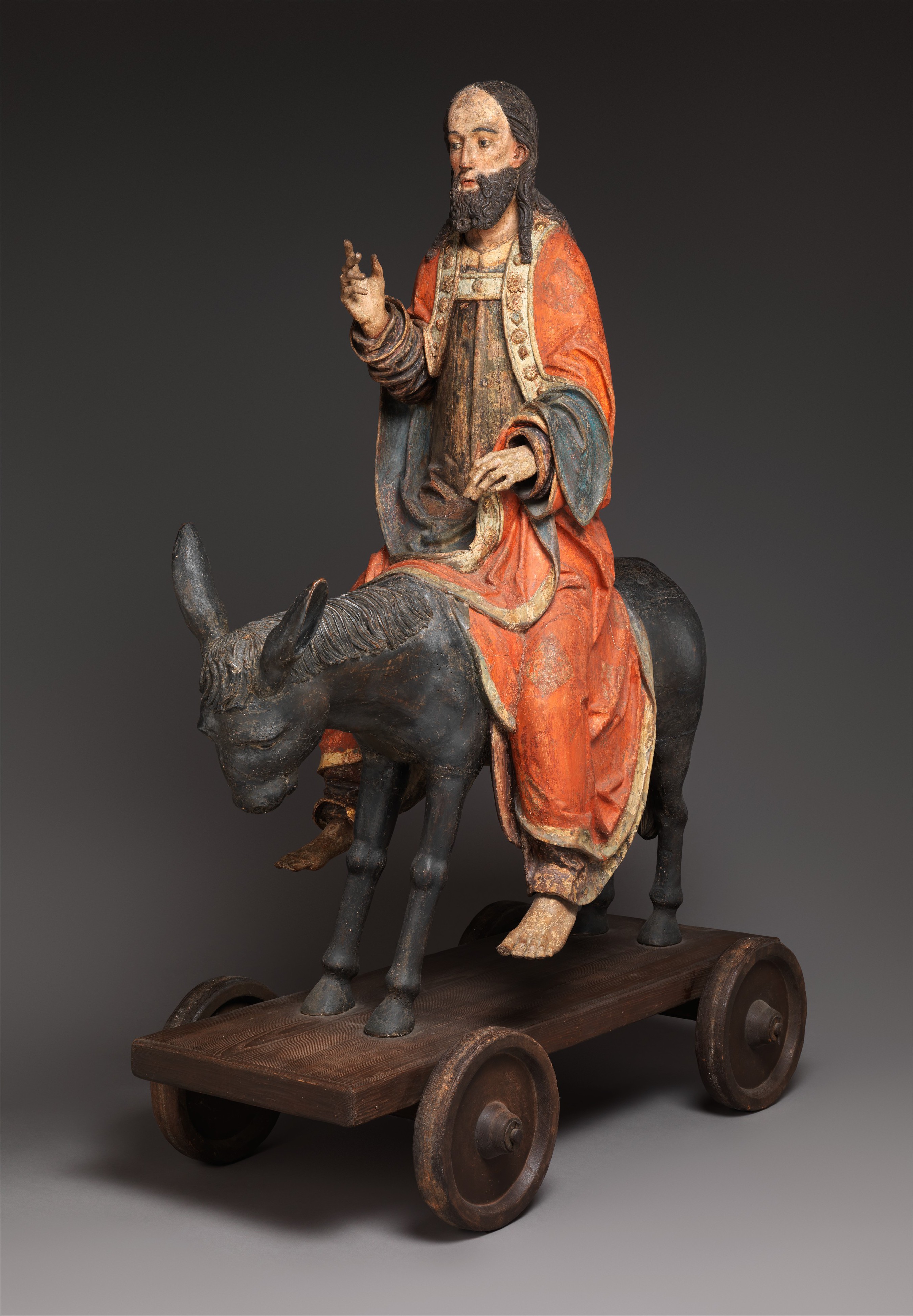
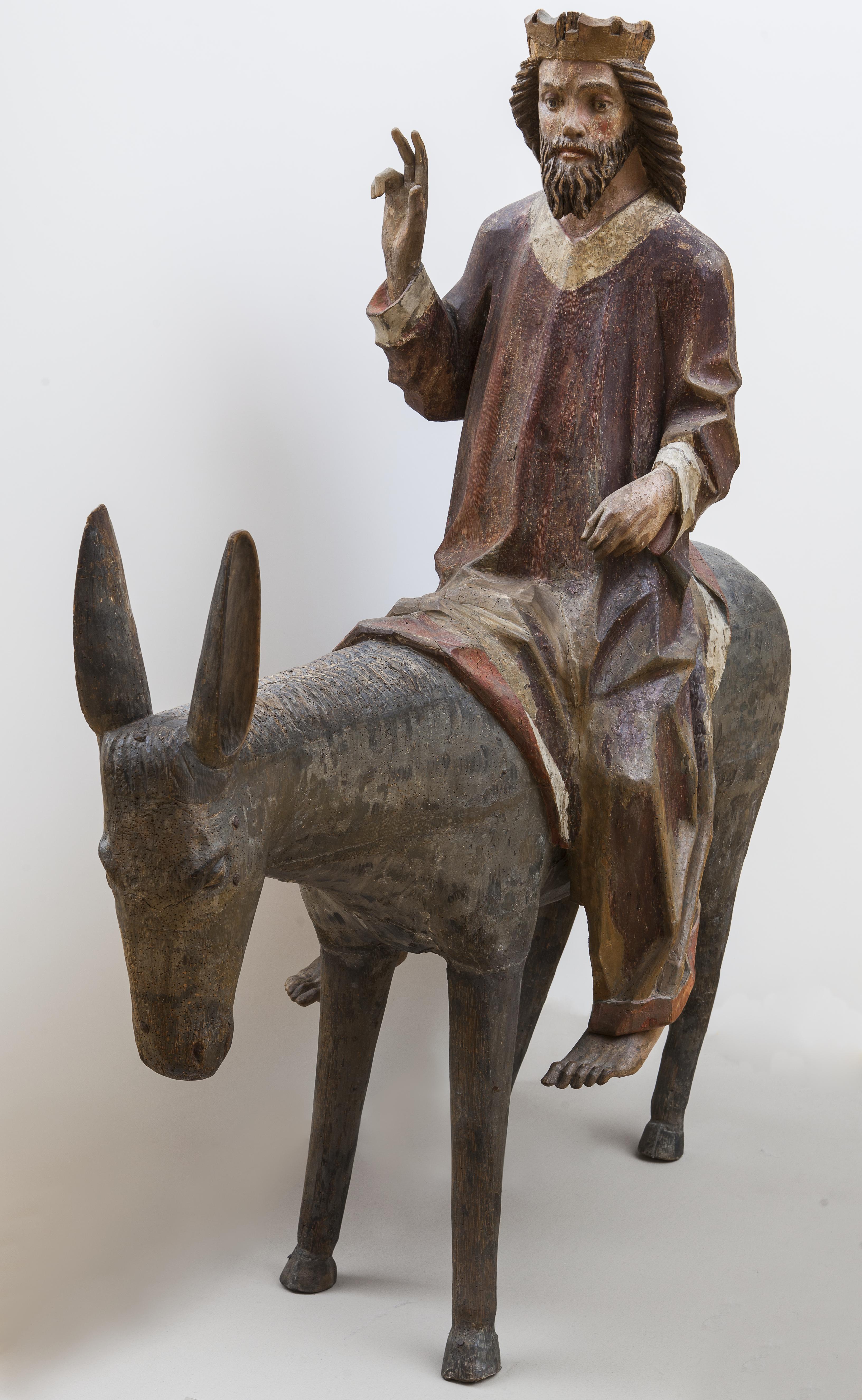
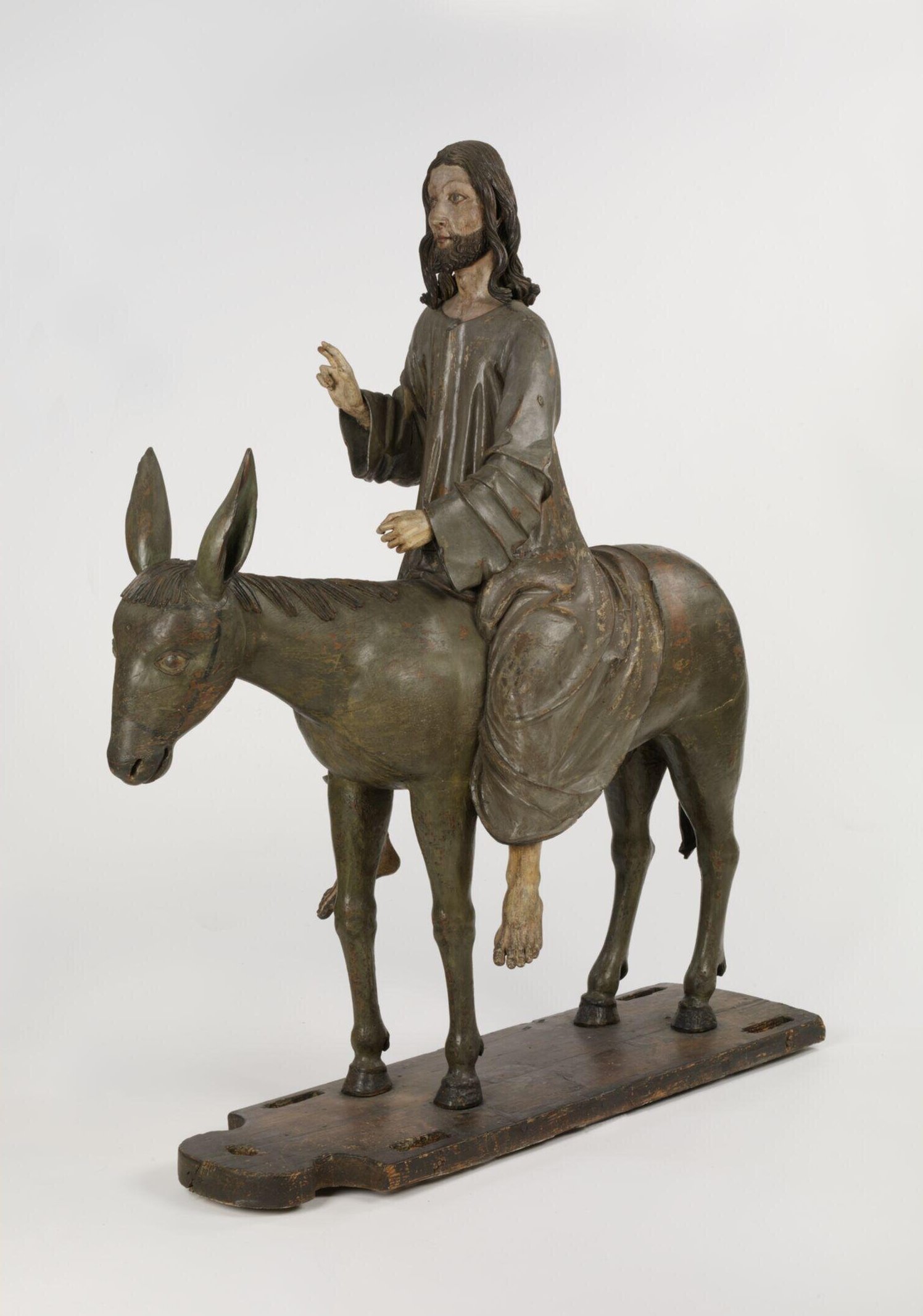
Holy Week: Entering Jerusalem

When the days drew near for him to be taken up, he set his face to go to Jerusalem.

—Luke 9:51

The next day the great crowd that had come to the festival [of Passover] heard that Jesus was coming to Jerusalem. So they took branches of palm trees and went out to meet him, shouting,

Hosanna!
Blessed is the one who comes in the name of the Lord—
the King of Israel! [Ps. 118:25–26]

Jesus found a young donkey and sat on it, as it is written:

Do not be afraid, daughter of Zion.
Look, your king is coming,
sitting on a donkey’s colt! [Zech. 9:9]

His disciples did not understand these things at first, but when Jesus was glorified, then they remembered that these things had been written of him and had been done to him.

So the crowd that had been with him when he called Lazarus out of the tomb and raised him from the dead continued to testify. It was also because they heard that he had performed this sign that the crowd went to meet him.

—John 12:12–18

LOOK: Christ’s Entry into Jerusalem from Daphni Monastery

Triumphal Entry mosaic (Daphni)
Christ’s Entry into Jerusalem, late 11th century. Mosaic, Daphni Monastery, Greece.

LISTEN: “Ride On to Die” by Michael Card, on Known by the Scars (1984)

Sense the sorrow untold as you look down the road
At the clamoring crowd drawing near
Feel the heat of the day as you look down the way
Hear the shouts of “Hosanna the King!”

Refrain:
Oh daughter of Zion, your time’s drawing near
Don’t forsake him, oh don’t pass it by
On the foal of a donkey, as the prophets had said
Passing by you, he rides on to die

Come now, little foal, though you’re not very old
Come and bear your first burden bravely
Walk so softly upon all the coats and the palms
Bare the One on your back oh so gently

’Midst the shouting so loud and the joy of the crowd
There is One who is riding in silence
For He knows the ones here will be fleeing in fear
When their shepherd is taken away [Refrain]

Soon the thorn-cursed ground will bring forth a crown
And this Jesus will seem to be beaten
But he’ll conquer alone both the shroud and the stone
And the prophecies will be completed [Refrain]

Roundup: Alfombras from Antigua, Christ the Grapevine, “Ask Now the Beasts,” and more

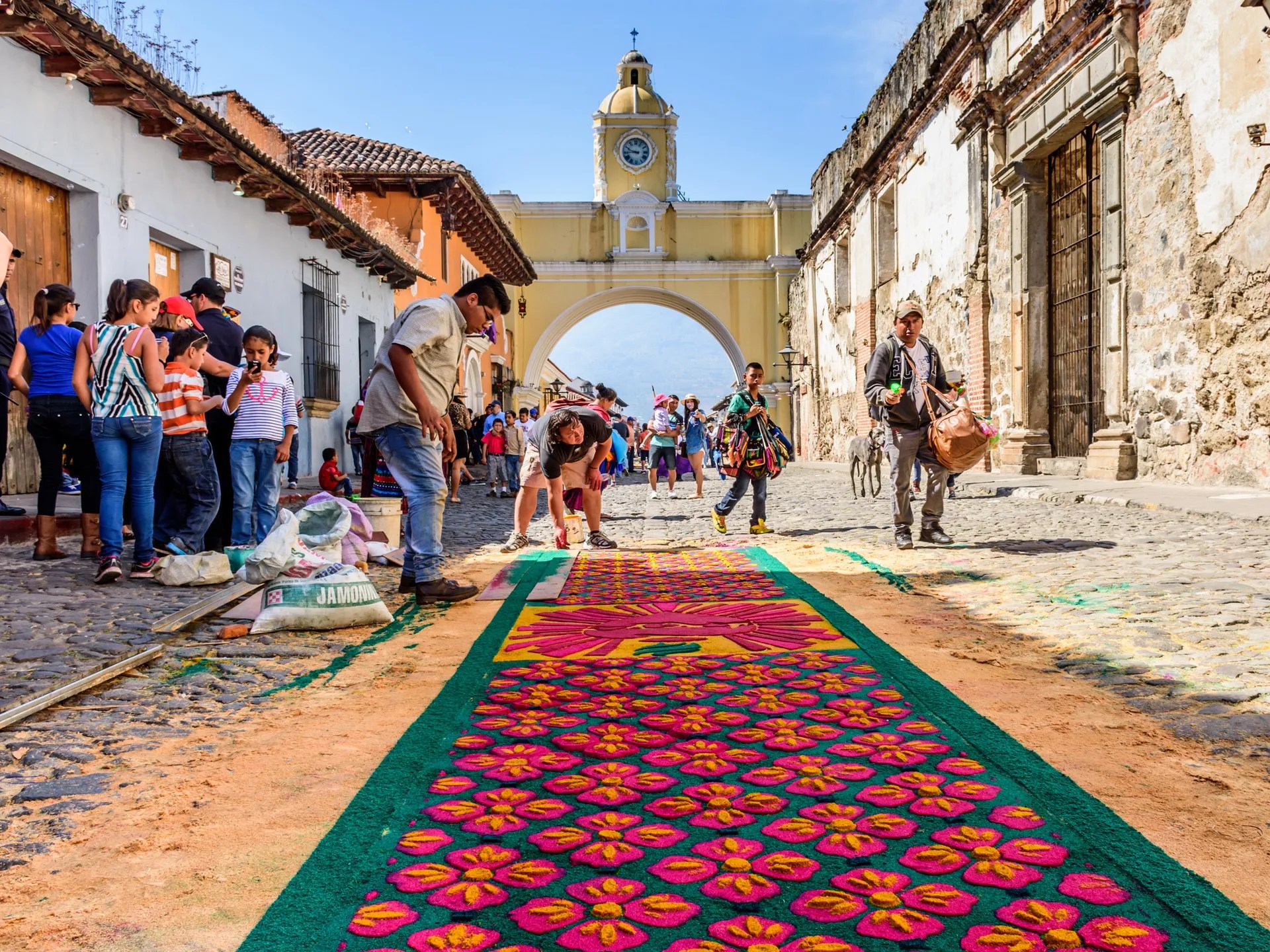
HOLY WEEK TRADITION: Antigua, Guatemala, is renowned for its annual Good Friday observance, which involves the laying out of alfombras (carpets) of multicolored sawdust through the city’s cobblestone streets, hundreds of feet long. On Maundy Thursday, the city closes so that families and businesses can spend the day constructing the carpets, applying the sawdust to planned designs using stencils and strainers and adding pine needles, flowers, fruits, and other natural materials as well.

Alfombra
People watch while locals make an alfombra (carpet) of dyed sawdust for Antigua’s Good Friday processions, the most famous in Latin America. Photo: Lucy Brown, 2016.

At 4 a.m. on Good Friday, the processions begin, with people carrying floats that bear statues of Christ carrying his cross, followed by marching bands playing solemn music. (This is a remembrance of Jesus’s walk to Calvary.) As their feet pass over the alfombras, the dust scatters. Locals and visitors gather along the streets dressed in black for mourning, and at 11 p.m. a figure of Jesus is laid to rest in the church.

Here are two resources for exploring this tradition further:

>> ARTICLE: “Exploring Guatemala’s Vibrant Easter Tradition” by Meredith Carey

>> VIDEO: “Alfombras de Semana Santa en Guatemala,” dir. Federica Dominguez: This short film (in Spanish, with English subtitles) interviews Rolando Ortiz, an alfombrero who is also a shoemaker. He explains that the carpets hark back to Jesus’s triumphal entry into Jerusalem, when the crowds strewed his path with palm branches (giving him the red carpet treatment, so to speak). Even though the alfombras last only a brief time, locals spare no expense in bringing them to fruition each year—“for Jesus,” Ortiz says. “It is an act of gratitude above all.” An offering of beauty and praise.

+++

NEW ALBUM: As Foretold, Part 3 by Poor Bishop Hooper: Released today, this is the final album in a trilogy based on the prophetic fulfillment passages in the Gospel of Matthew. It centers on Jesus’s passion and concludes with a resurrection epilogue. As with all their music, the duo graciously offers it for free download from their website.

+++

SONGS performed by Emorja Roberson: Emorja Roberson [previously] is a singer, gospel choir conductor, and assistant professor of music and African American studies at Oxford College of Emory University in Georgia. I enjoy following his YouTube channel. Here are two songs that are especially fitting for Holy Week.

>> “I Know It Was the Blood”: Roberson sings three verses of this beloved African American spiritual: the title verse, “They whipped him all night long,” and “He never said a mumblin’ word.” The song is more typically sung in a major key, and its full lyrics span Christ’s passion, resurrection, ascension, and second coming. But Roberson slows down the tempo and sings in a minor key, homing in on the sorrow of Good Friday.

>> “He Decided to Die” by Margaret Pleasant Douroux: Roberson, on keys, sings a gospel classic with friends Marcus Morton and Cameron Scott, a song that emphasizes Christ’s resoluteness on the cross, his endurance for love.

+++

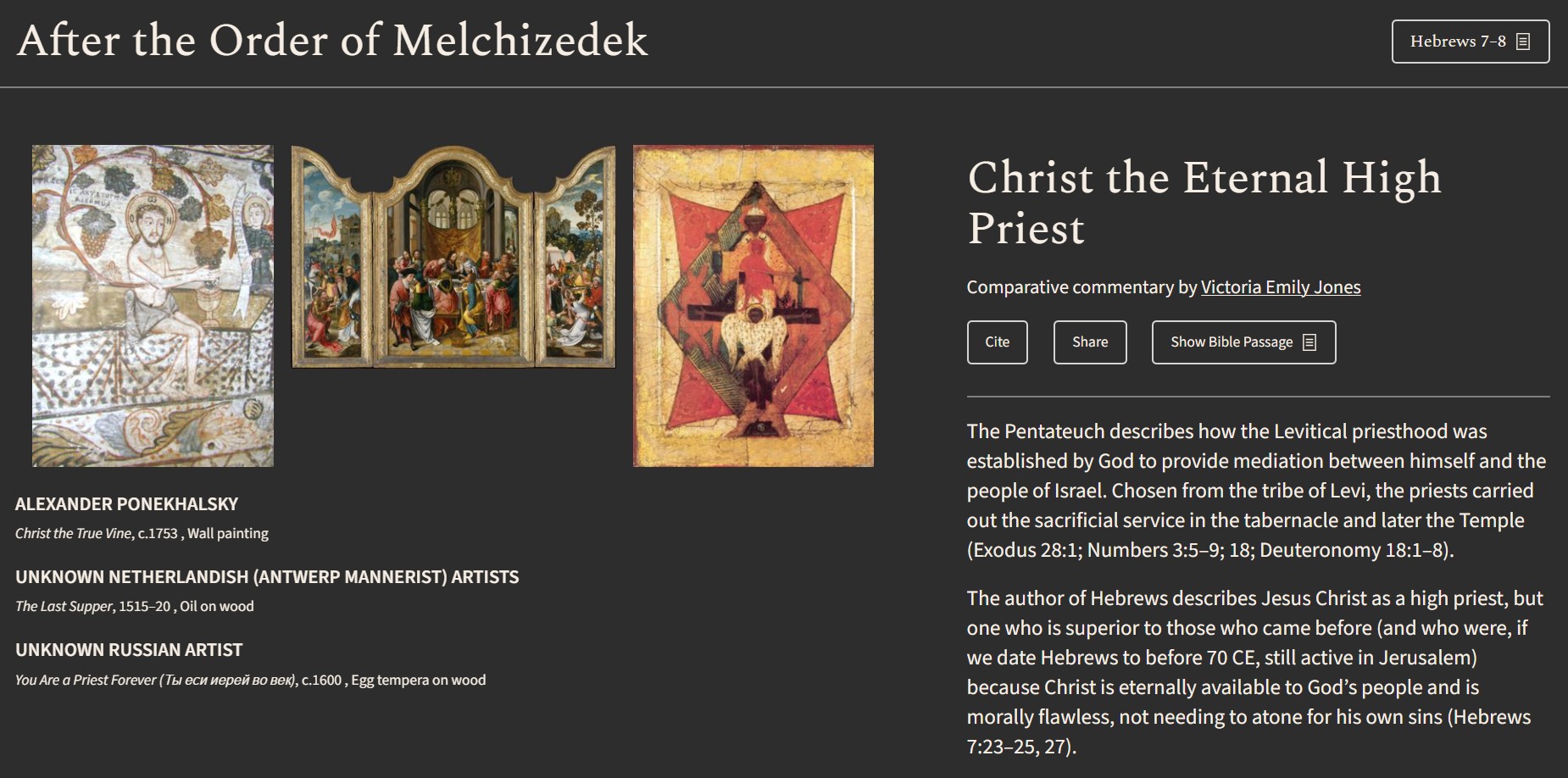
VISUAL COMMENTARIES: “After the Order of Melchizedek” by Victoria Emily Jones: My latest contribution to the Visual Commentary on Scripture, a project based out of King’s College London, was published earlier this month. Tasked with choosing and commenting on three artworks that dialogue with Hebrews 7–8, I landed on a “You Are a Priest Forever” icon from Russia (very strange!), an Antwerp Mannerist triptych that centers the Last Supper, and (my favorite) a wall painting of Christ the Grapevine from a Romanian church. I was interested to explore the idea of how Jesus, in giving his body and blood, is both the offerer and the offered, both priest and sacrifice.

Melchizedek exhibition

+++

POEM: “The Death of Christ” by Emperor Kangxi: Emperor Kangxi (1654–1722) ruled in China for sixty-one years during the Qing Dynasty. In 1692 he issued the Edict of Toleration, which barred attacks on churches and legalized the practice of Christianity among Chinese people. Curious about and respectful of other faiths, he penned this short poem on the Crucifixion using the classical qi-yen-she form.

+++

EXHIBITION: Tara Sellios: Ask Now the Beasts, Fitchburg Art Museum, January 18, 2025–January 18, 2026: Tara Sellios is a multidisciplinary artist from South Boston working mainly in large-format photography. Delighting in detail and complex symbolism, she often uses insects, dried fauna, bone, and other organic matter to create elaborate still lifes that she then photographs under dramatic lighting. She is inspired by art historical representations of the end of the world, especially the bizarre paintings of Hieronymus Bosch and Albrecht Dürer’s Apocalypse woodcuts, and by seventeenth-century Dutch vanitas paintings.

The photographs in her current solo show, Ask Now the Beasts at Fitchburg Art Museum in Massachusetts, are “contemporary allegories of suffering and transcendence.” The exhibition’s title comes from Job 12:7.

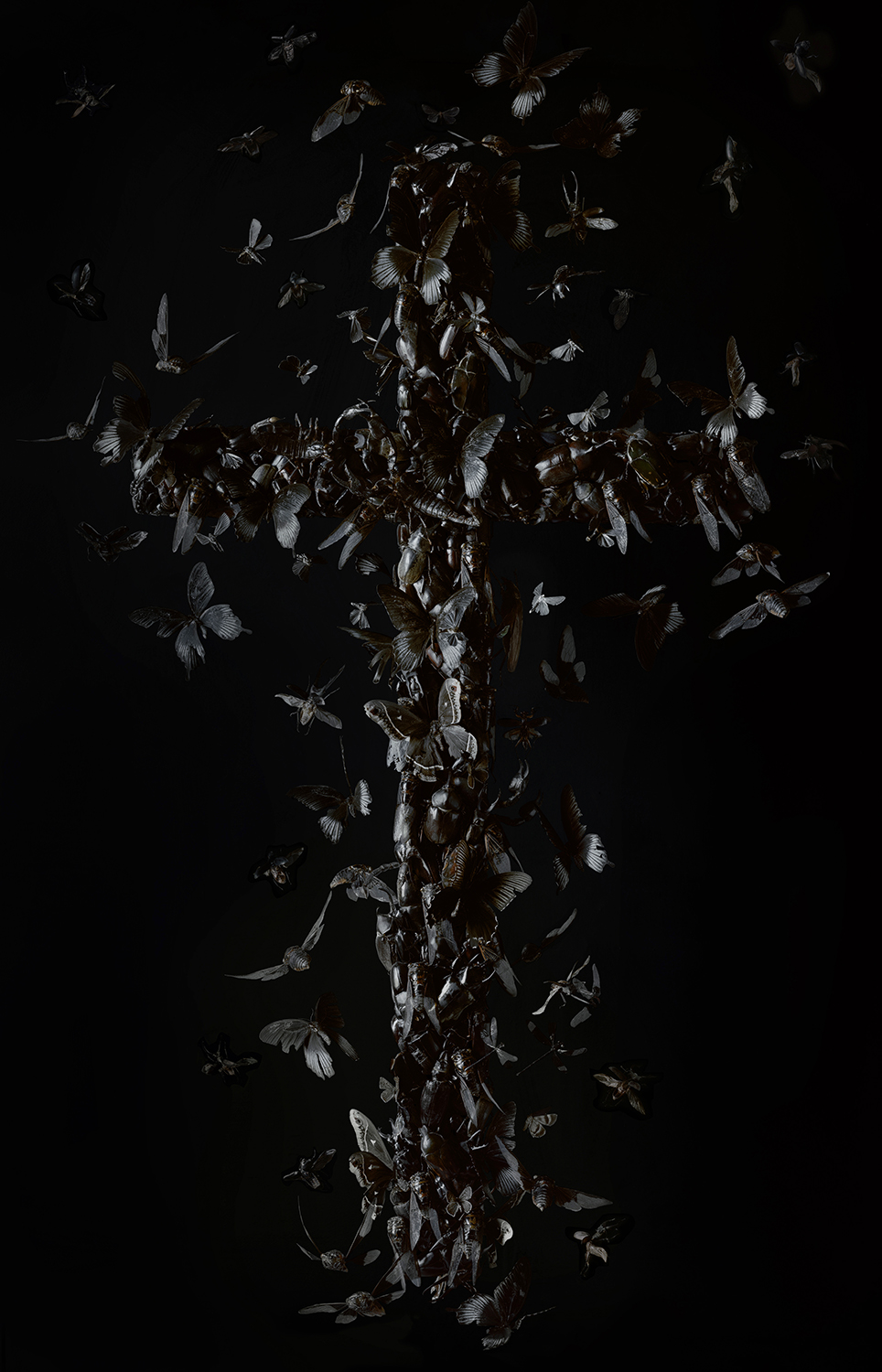
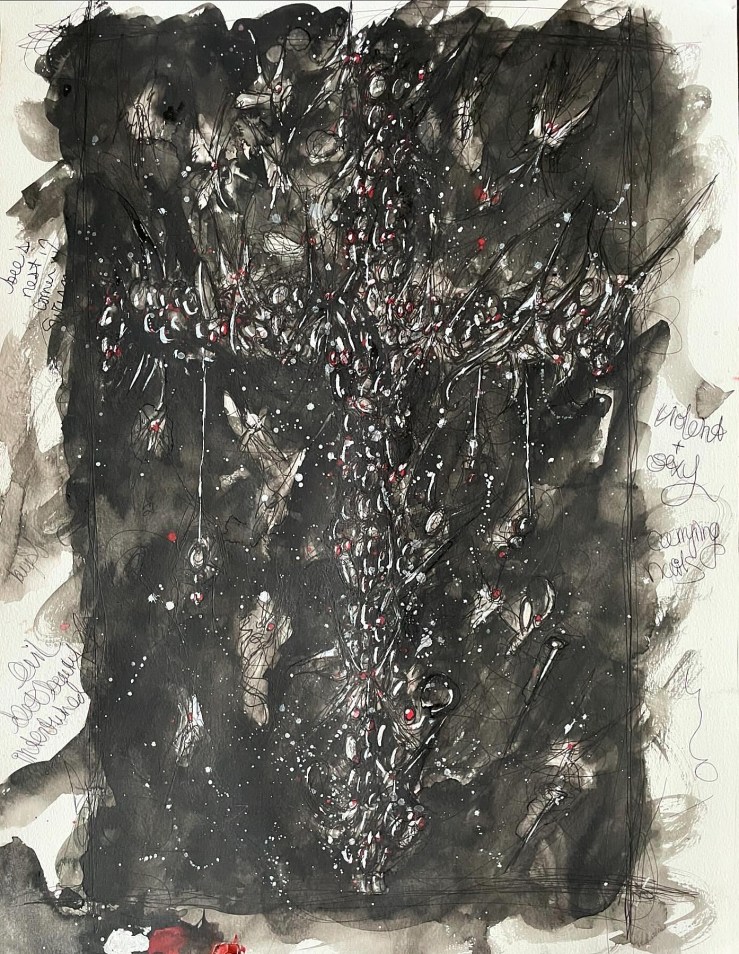
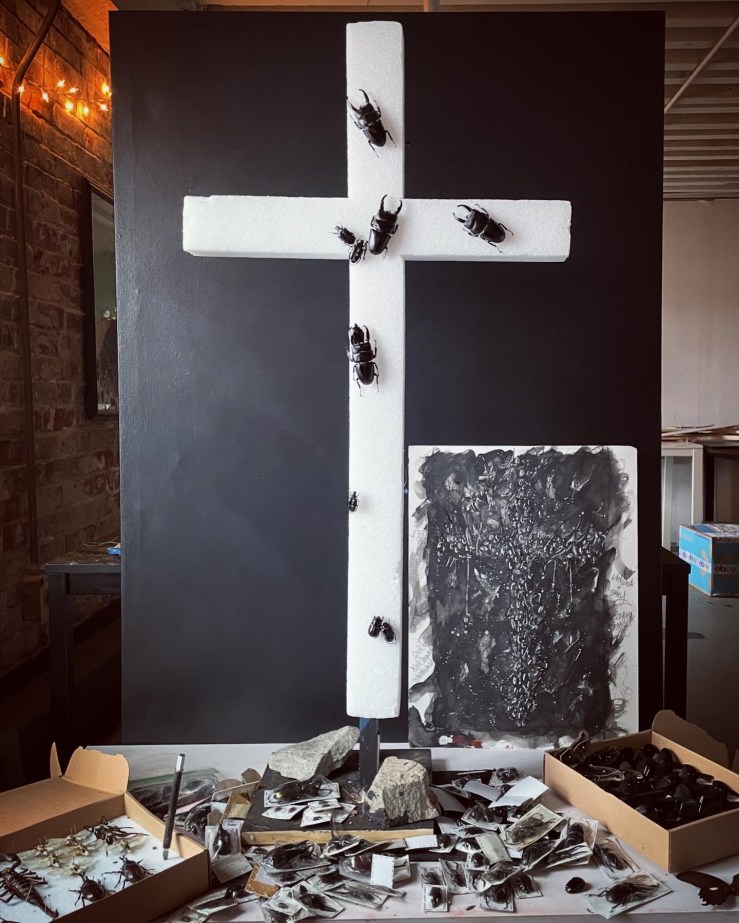
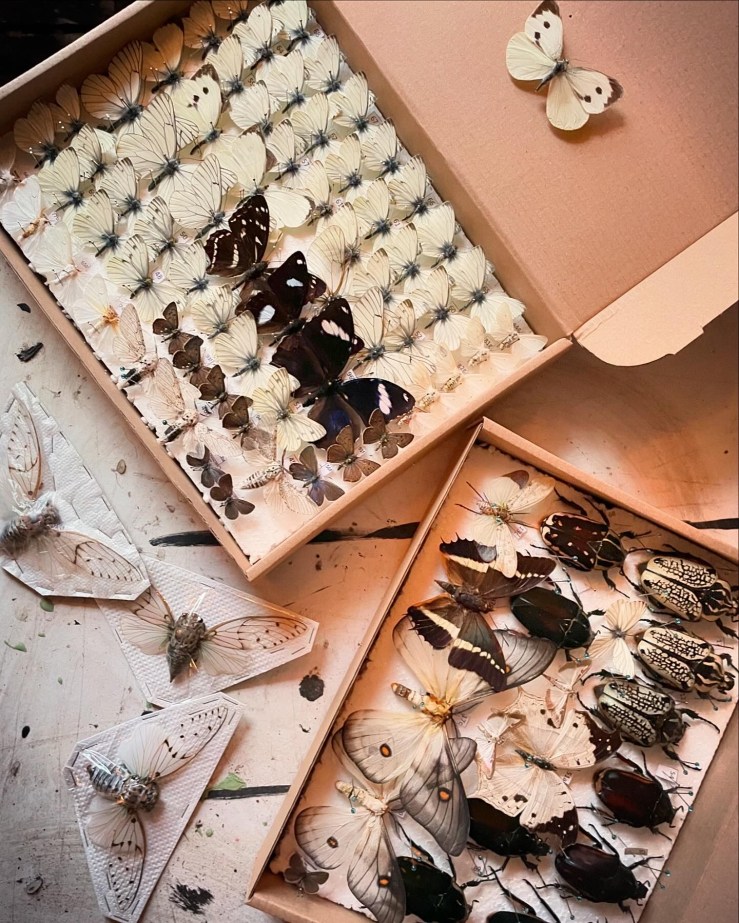
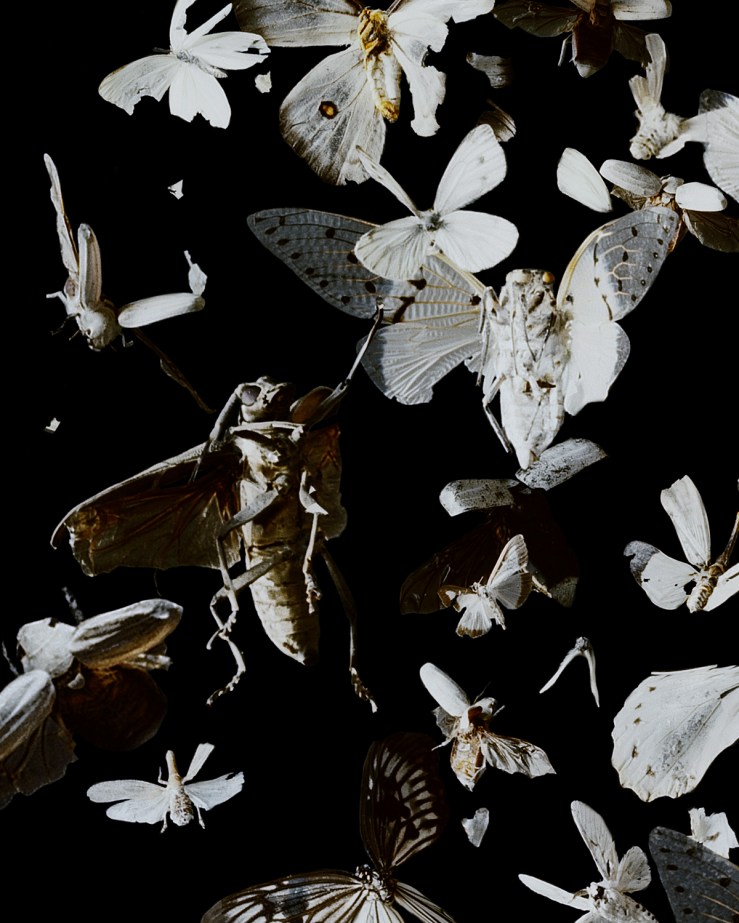
Two of the works on display are a pair of crosses: Umbra (Latin for “darkness” or “shadow”) and Dilucesco (“to begin to grow light, to dawn”), which together suggest a movement from death to resurrection. Constructed with a throng of black beetles and other black insects, the Umbra cross evokes the detail from the Synoptic Gospels’ Crucifixion accounts that at noon, “darkness came over the whole land until three in the afternoon, while the sun’s light failed” (Luke 23:44–45; cf. Matt. 27:45; Mark 15:33). Dilucesco, on the other hand, shows the cross seemingly exploding into light, as white moths and other winged insects break out of their cruciform shape. View these two photographic artworks, plus a few process photos and sketches the artist sent me, below. See, too, www.tarasellios.com.

UMBRA
Tara Sellios (American, 1987–), Umbra, 2024, from the series Ask Now the Beasts. Inkjet print from 8 × 10 negative, 55 × 35 in. Courtesy of the artist.

DILUCESCO
Tara Sellios (American, 1987–), Dilucesco, 2024, from the series Ask Now the Beasts. Inkjet print from 8 × 10 negative, 55 × 35 in. Courtesy of the artist.

  • SKETCH_UMBRA
  • Umbra_process
  • Dilucesco-Umbra_process
  • SKETCH_DILUCESCO
  • Dilucesco (detail)

Holy Week: Jesus Enters Jerusalem

When they were approaching Jerusalem . . . they brought the colt to Jesus and threw their cloaks on it, and he sat on it. Many people spread their cloaks on the road, and others spread leafy branches that they had cut in the fields. Then those who went ahead and those who followed were shouting,

Hosanna!
Blessed is the one who comes in the name of the Lord!
Blessed is the coming kingdom of our ancestor David!
Hosanna in the highest heaven!

Then he entered Jerusalem and went into the temple . . .

—Mark 11:1, 7–11

LOOK: Palm Sunday by Kai Althoff

Althoff, Kai_Palmsonntag
Kai Althoff (German, 1966–), Palmsonntag (Palm Sunday), 2002. Boat varnish, watercolor, and tinted paper on canvas, 70 × 90 cm. Private collection, Berlin.

In Kai Althoff’s painting of Jesus entering Jerusalem on a donkey, the background pulsates with color and people from all walks of life lay down their garments to carpet his path. There’s a nun and a monk in their habits; two bishops in dalmatics, one of whom casts his mozzetta at Christ’s feet; a choirboy; folks in a coat and tails and party dresses; and others in overalls, sweaters, and wool skirts. On the left, a backpacker passes by, looking behind him with curiosity at the hubbub, while at the bottom right a crowd of haloed people point and gaze—one man even yanks the collar of a friend, trying to pull him closer to the front for a better view.

Several of those present wave palm branches and shout, “Hosanna!,” meaning “Save us!” They quote Psalm 118:25–26: “Save us, we beseech you, O LORD! O LORD, we beseech you, give us success! Blessed is the one who comes in the name of the LORD.” The people recognize Jesus as their delivering Messiah and celebrate.

LISTEN: “Hosanna” by Jacques Berthier, 1978 | Performed by the Paul Leddington Wright Singers on Songs of Taizé, vol. 4 (2006)

Hosanna, hosanna!
Hosanna in excelsis!

This Palm Sunday canon (round) is from Taizé, a community of lay brothers in southern France who welcome pilgrims, especially young ones, from all over the world. The Latin in excelsis means “in the highest.”

Though the Hebrew expression that “Hosanna” transliterates was used by Jews as a supplication, a plea, today Christians often use “Hosanna” as a shout of jubilation, an acclamation of praise, in recognition of the salvation Jesus has wrought—so instead of the imperative “Save!,” it’s the exclamative “Salvation!” I think both meanings can hold simultaneously.


This is the first post in a daily series (running through Saturday) in which I’ll highlight a handful of events from Holy Week by choosing a visual artwork and a piece of music that engage with that event. The posts will all be short like this one—I imagine people spending ten minutes or so with each—and are an invitation to prayer and contemplation. For additional music, see the Art & Theology Holy Week Playlist on Spotify.

Roundup: Jesus’s surprising path to kingship, Isenheim Altarpiece video, “Varsha,” and more

Heads up: For each day of Holy Week (March 24–30) and the Easter Octave (March 31–April 7), I will be publishing a short post that pairs a visual artwork with a piece of music as a way of inviting you into the narrative. Here are examples from previous years:

Holy Week Series 2023 | Easter Series 2023
Holy Week Series 2022 | Easter Series 2022
Holy Week Series 2021 | Easter Sunday 2021
Holy Week Series 2020 | Easter Sunday 2020

+++

VIDEO: “How Jesus Became the King of the World (That He Always Was)” by BibleProject: Written and directed by Jon Collins and Tim Mackie with art direction by Robert Perez, this six-minute animated video explores how Jesus brought God’s kingdom to earth and how we can live under God’s reign today.

+++

SONGS:

>> “Lead On, O King Eternal” (second verse), retuned by John Hatfield: This Palm Sunday hymn was originally written by Ernest W. Shurtleff in 1887 and paired with an older tune by Henry T. Smart. It has largely fallen out of favor due to its cringey first verse, with its militant language of battle and conquest. However, John Hatfield, a singer-songwriter from Houston, calls our attention to the second verse, which reframes what comes before, turning the martial imagery on its head. Our battle, Shurtleff writes in verse 2, is waged not with weapons but with holiness, peace, and deeds of love and mercy. “Let’s be about that, my friends,” Hatfield urges. In this Instagram video he sings “the better verse” of “Lead On, O King Eternal” to a new tune he wrote for it, self-accompanied on ukulele:

>> “Anointed One of God” by Tom Fisher: Written around 2004, Tom Fisher revisited this hymn of his in 2022, updating some of the lyrics. Where he hums, he originally had the word “Hallelujah,” but he wanted to experiment with something more subdued and to honor the tradition, observed in Roman Catholicism, Episcopalianism, and other denominations, of removing the “Alleluias” from worship services during Lent in recognition of the solemnity of the season. The song exalts Jesus as the Christ, literally “Anointed One” (messiah in Hebrew), who, contrary to expectations, fulfilled this identity by being crucified. According to Matthew’s and Mark’s Gospel accounts, an unnamed woman recognized Jesus’s messiahship at a house in Bethany two days before his death, pouring oil on his head—a prophetic act that named him king. The scent probably lingered in his hair and on his body as he went to the cross. [HT: Liturgy Fellowship]

>> “傷跡 (Scars)” by Takafumi Nagasawa, performed by Ruah Worship: A sibling group from Japan covers this contemporary worship song about Jesus taking up his cross and with it the weight of humanity’s sin. “The scars on your hands are the sign of your love for me,” goes the refrain. Turn on Closed Captioning for English subtitles.

+++

VIDEO: “The mystical brilliance of Grünewald’s Isenheim Altarpiece” by Smarthistory: This is one of my all-time favorite artworks—I’ve given talks on it, with a focus on its matchless Crucifixion panel—though I admit I’ve only seen it in books and on screens; it’s on my list of things to see before I die (it’s at the Unterlinden Museum in Colmar, France). Drs. Beth Harris and Steven Zucker have created this excellent video introduction to it, featuring wonderful photography and commentary and an animation that shows the altarpiece’s multiple configurations.

Isenheim Altarpiece (detail)
Matthias Grünewald (German, ca. 1470–1528), Crucifixion (detail) from the Isenheim Altarpiece, 1515

+++

INSTRUMENTAL INTERLUDE: “Varsha” by Reena Esmail, for cello or viola, from The Seven Last Words Project: Commissioned by Juilliard Historical Performance to compose an interlude between the “I Thirst” and “It Is Finished” movements of Haydn’s Seven Last Words of Christ, Reena Esmail wrote “Varsha” for cello, drawing on Hindustani raags that evoke rain. (She is one of seven composers who worked on the project, each contributing their own interlude.) In this video it’s performed by Madeleine Bouissou, who premiered it April 16, 2019, at the Cathedral of Saint John the Divine in New York City as part of The Seven Last Words Project.

Describing her artistic vision, Esmail writes, “Christ thirsts. Rain comes from the distance (Megh Malhaar). There is a downpour around him (Miyan ki Malhaar), but he grows slowly weaker. His next words make clear that even the rain is not enough: his thirst is of another sort, which cannot be quenched by water. And so, it is finished.”

Esmail is an Indian American composer living in Los Angeles, known for combining the worlds of Indian and Western classical music in her work.

Palm Sunday: Jerusalem, Jerusalem

LOOK: Palm Sunday by Justin O’Brien

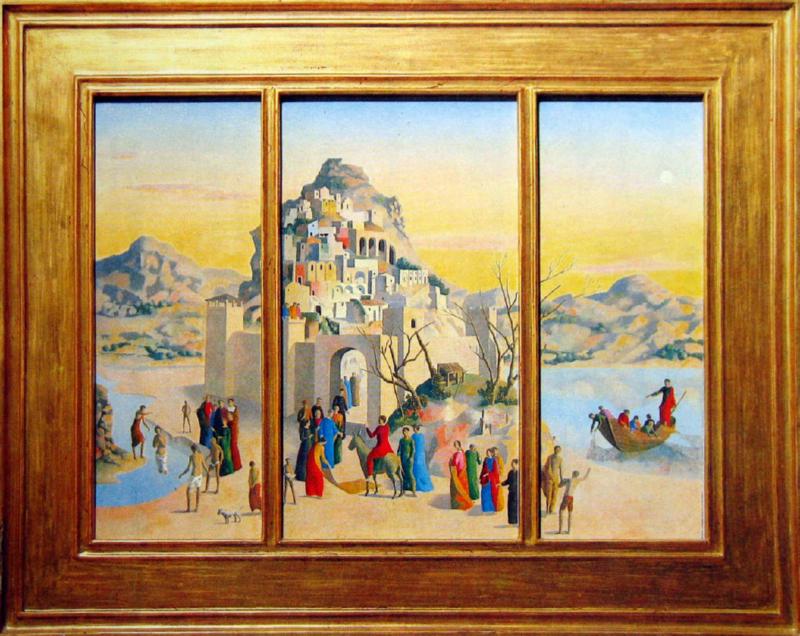
O'Brien, Justin_Palm Sunday triptych
Justin O’Brien (Australian, 1917–1996), Palm Sunday, 1962. Oil on canvas, 45.5 × 62 cm.

This triptych (three-paneled artwork) by Australian artist Justin O’Brien portrays three scenes from the life of Christ. On the left wing is the Baptism of Christ, where he’s anointed by God’s Spirit for his messianic role, and on the right is the Miraculous Draught of Fishes, a story of miraculous abundance. The center panel shows Jesus about to enter the gates of a hilltop city representing Jerusalem. He rides a donkey and is dressed in red, the color of martyrdom. One man lays down his cloak before Jesus’s dusty path as a sign of reverence. Now the people welcome him in, but in just a few short days many will turn on him.

O’Brien grew up in a Catholic household in Sydney. In 1948–49 he visited Italy and fell in love with the work of the Proto- and Early Renaissance painters from Tuscany, like Duccio and Piero della Francesca. Most of O’Brien’s paintings are on religious subjects, despite his renunciation of Catholicism in 1954. Though he self-identified as agnostic for the second half of his life, he continued to be artistically inspired by the stories of the New Testament. He moved to Rome in 1967 and spent the remainder of his days there, returning to his home country of Australia every few years for exhibitions.  

LISTEN: “Jerusalem Interlude,” excerpted from “The Holy City” | Words by Frederick E. Weatherly, 1892 | Music by Stephen Adams (pseudonym of Michael Maybrick), 1892; arr. Noble Caine, 1946 | Performed by the Aeolians of Oakwood University on Aeolianology Acappella, vol. 2, 2015

Jerusalem, Jerusalem
Lift up your gates and sing
Hosanna in the highest
Hosanna to your king

This is the refrain of the Victorian choral ballad “The Holy City” by the English lawyer, author, lyricist, and broadcaster Frederick E. Weatherly (best known for writing “Danny Boy”) and his regular collaborator, the English composer Michael Maybrick, who published under the pen name Stephen Adams. The song became hugely popular in the UK and the US at the beginning of the twentieth century, and is even mentioned in James Joyce’s Ulysses (1920). It is sung by early Hollywood musical superstar Jeanette MacDonald in the 1936 film San Francisco.

Lyrics to the complete song are below, as is a video performance by the Aeolians from 2020:

Last night I lay a-sleeping
There came a dream so fair
I stood in old Jerusalem
Beside the temple there
I heard the children singing
And ever as they sang
Methought the voice of angels
From heav’n in answer rang

“Jerusalem, Jerusalem!
Lift up your gates and sing
Hosanna in the highest
Hosanna to your king!”

And then methought my dream was chang’d
The streets no longer rang
Hush’d were the glad Hosannas
The little children sang
The sun grew dark with mystery
The morn was cold and chill
As the shadow of a cross arose
Upon a lonely hill

“Jerusalem, Jerusalem!
Hark! how the angels sing
Hosanna in the highest
Hosanna to your king!”

And once again the scene was chang’d
New earth there seem’d to be
I saw the Holy City
Beside the tideless sea
The light of God was on its streets
The gates were open wide
And all who would might enter
And no one was denied
No need of moon or stars by night
Or sun to shine by day
It was the new Jerusalem
That would not pass away

“Jerusalem, Jerusalem!
Sing, for the night is o’er!
Hosanna in the highest!
Hosanna for evermore!”

The song’s speaker has a dream about Christ’s celebrated entry into Jerusalem, with crowds surrounding him and shouting his praises. But then the mood turns dark and hushed as a cross is erected on Golgotha and the newly hailed king is crucified. However, the mood revolves back to one of celebration in the final verse as the New Jerusalem comes down, permanently displacing all sorrow, its gates thrown open wide in universal welcome and the wounded but victorious Jesus seated on the throne.

The Aeolians’ isolation of the first refrain for their “Jerusalem Interlude,” which echoes Psalm 24:7–10 [previously], makes a perfect antiphon for Palm Sunday. Though the words are exultant, the music has an aching quality that foreshadows the suffering that is soon to come and that matches the tone of Jesus’s lament over Jerusalem on this day: “As he came near and saw the city, he wept over it, saying, ‘If you, even you, had only recognized on this day the things that make for peace! But now they are hidden from your eyes’” (Luke 19:41–42; cf. Matt. 23:37–39).

The American jazz composer Duke Ellington used the refrain’s melody as the basis of the opening of his “Black and Tan Fantasy” (1927), in which a cornet and trombone play dolefully in parallel harmony. Can you hear the clopping donkey?

Addendum, 4/23/25: Here’s another arrangement of the song I like, by African Vocals, an a cappella group from Namibia. The following video shows one of the performances from their 2019 Germany tour. Soloist Reinhard Kungairi Kahambuee (who doesn’t come into frame until fifty seconds in) is wonderful! Note that at 1:40, the tempo becomes bright, lively, and more rhythmic, with the addition of hand claps.

Palm Sunday

O give thanks to the LORD, for he is good;
    his steadfast love endures forever!

Let Israel say,
    “His steadfast love endures forever.”

. . .

Open to me the gates of righteousness,
    that I may enter through them
    and give thanks to the LORD.

This is the gate of the LORD;
    the righteous shall enter through it.

I thank you that you have answered me
    and have become my salvation.
The stone that the builders rejected
    has become the chief cornerstone.
This is the LORD’s doing;
    it is marvelous in our eyes.
This is the day that the LORD has made;
    let us rejoice and be glad in it.
Save us, we beseech you, O LORD!
    O LORD, we beseech you, give us success!

Blessed is the one who comes in the name of the LORD.
    We bless you from the house of the LORD.
The LORD is God,
    and he has given us light.
Bind the festal procession with branches,
    up to the horns of the altar.

You are my God, and I will give thanks to you;
    you are my God, I will extol you.

O give thanks to the LORD, for he is good,
    for his steadfast love endures forever.

—Psalm 118:1–2, 19–29

 The crowds that went ahead of [Jesus] and that followed were shouting,

“Hosanna to the Son of David!
    Blessed is the one who comes in the name of the Lord!
Hosanna in the highest heaven!”

—Matthew 21:9

LOOK: Palm Sunday, Home Depot Parking Lot by Gary Bergel

Bergel, Gary_Palm Sunday, Home Depot Parking Lot
Gary Bergel (American, 1943–), Palm Sunday, Home Depot Parking Lot. Digital photograph. Part of the traveling CIVA exhibition Again & Again.

LISTEN: “Blessed Is the One (Psalm 118)” by Tim Coons of Giants & Pilgrims | Performed by Tim Coons (guitar, vocals) and Craig Basarich (trumpet), 2020

Blessed is the one who comes in the name of the Lord (×4)

Hosanna (×4)

Blessed is the one who comes in the name of the Lord (×4)

Hosanna (×4)

Hosanna (×4)

Palm Sunday: Sannanina (Hosanna)

Now when they drew near to Jerusalem, to Bethphage and Bethany, at the Mount of Olives, Jesus sent two of his disciples and said to them, “Go into the village in front of you, and immediately as you enter it you will find a colt tied, on which no one has ever sat. Untie it and bring it. If anyone says to you, ‘Why are you doing this?’ say, ‘The Lord has need of it and will send it back here immediately.’” And they went away and found a colt tied at a door outside in the street, and they untied it. And some of those standing there said to them, “What are you doing, untying the colt?” And they told them what Jesus had said, and they let them go. And they brought the colt to Jesus and threw their cloaks on it, and he sat on it. And many spread their cloaks on the road, and others spread leafy branches that they had cut from the fields. And those who went before and those who followed were shouting, “Hosanna! Blessed is he who comes in the name of the Lord! Blessed is the coming kingdom of our father David! Hosanna in the highest!”

—Mark 11:1–10

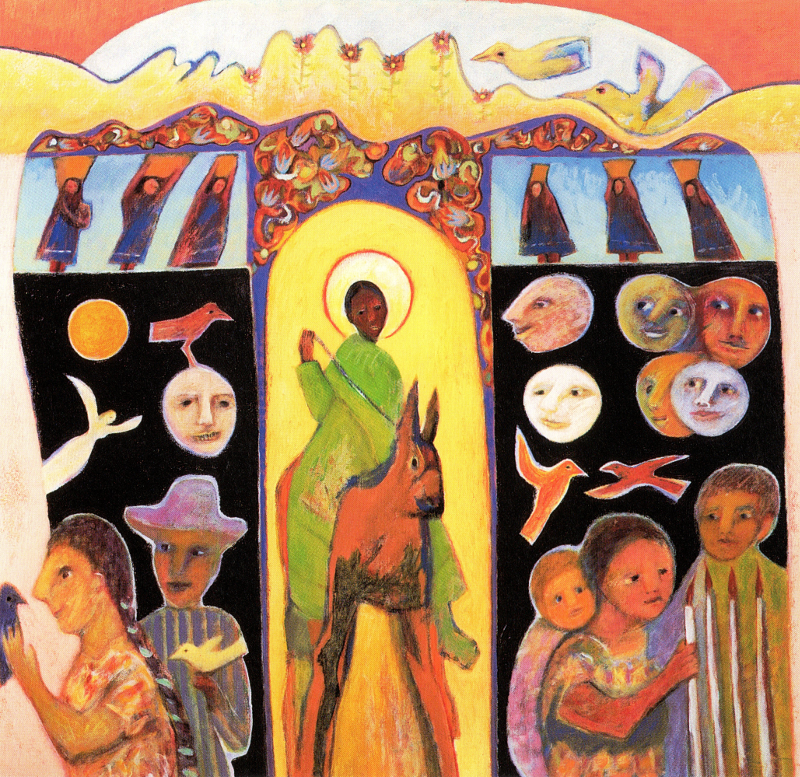
LOOK: Betty LaDuke (American, 1933–), Guatemala: Procession, 1978. Acrylic on canvas, 72 × 68 in.

LaDuke, Betty_Guatemala-Procession

In Imaging the Word, vol. 3, the artist describes the inspiration behind this painting:

Before Christmas, at the Mayan village of Chichicastenango in Guatemala, statues of Christ, the Virgin Mary, and the saints are . . . carried aloft in an annual procession. In my painting Guatemala: Procession, Christ appears on a donkey surrounded by the masks worn by the Mayans who dance to honor and celebrate their indigenous roots. They also dance a re-enactment of the brutal Spanish invasion, with satirical masks representing conquistadores. Inside the church many candles are lit and prayers are offered. (181)

So it seems LaDuke has imagined Christ entering this Maya community of Christian celebrants who remember biblical history alongside their history as a people. This isn’t a Palm Sunday image per se, since it visualizes a procession that occurs toward the beginning of the liturgical year, but Jesus’s presence in the center on donkeyback, in a gateway backlit with glorious yellow, flanked by crowds and with angels overhead, evokes his triumphal entry into Jerusalem five days before his death.

LISTEN: “Sanna, Sannanina,” traditional South African

“Sannanina” is a Xhosa derivate of the Greek word “Hosanna,” which is itself a transliteration of a Hebrew phrase that means “Save us, please!” (For more on the word “hosanna” and how its meaning shifted from a cry for help to a shout of exultation—“Salvation!”—read here.) In the first video below, the song is performed by the Africa University Choir. The second video is a demo produced by MennoMedia in preparation for the publication of the Mennonite hymnal Voices Together in 2020.

For more songs for Holy Week, see the Art & Theology Holy Week Playlist.

Ride On, Ride On (Artful Devotion)

Sahi, Jyoti_Entry into Jerusalem
Jyoti Sahi (Indian, 1944–), Entry into Jerusalem, 2012. Oil and acrylic on canvas. Photo courtesy of the artist.

. . . Most of the crowd spread their cloaks on the road, and others cut branches from the trees and spread them on the road. And the crowds that went before him and that followed him were shouting, “Hosanna to the Son of David! Blessed is he who comes in the name of the Lord! Hosanna in the highest!” And when he entered Jerusalem, the whole city was stirred up, saying, “Who is this?” And the crowds said, “This is the prophet Jesus, from Nazareth of Galilee.”

—Matthew 21:8–11

+++

SONG: “Ride On, Ride On in Majesty!” | Words by Henry H. Milman, 1827 | Music by John Hatfield, 2017

Can’t view the embedded podcast player? Access the episode at https://hymnistry.simplecast.com/episodes/ride-on-ride-on-in-majesty-fae373c8. There you can also find a chord chart.

Ride on, ride on in majesty!
Hark! all the tribes hosanna cry;
O Savior meek, pursue thy road
with palms and scattered garments strowed.

Ride on, ride on in majesty!
In lowly pomp ride on to die:
O Christ, thy triumphs now begin
o’er captive death and conquered sin.

Ride on, ride on in majesty!
The angel armies of the sky
look down with sad and wond’ring eyes
to see th’approaching sacrifice.

Ride on, ride on in majesty!
Thy last and fiercest strife is nigh;
the Father on his sapphire throne
expects his own anointed Son.

Ride on, ride on in majesty!
In lowly pomp ride on to die;
bow thy meek head to mortal pain,
then take, O Christ, thy pow’r and reign.

This year’s Palm Sunday music selection comes from Hymnistry, an excellent podcast that ran from 2015 to 2018. I’ve always liked Henry H. Milman’s hymn text “Ride On, Ride On in Majesty!,” but not the traditional tunes it’s typically paired with. So I was thrilled to hear this contemporary setting by John Hatfield. Hatfield’s introduction to the hymn starts at 5:51. He discusses the cognitive dissonance of Palm Sunday, a celebratory occasion with somber undertones, because we’re really cheering Jesus on to his death. He’s hailed as king, Hatfield says, and “his first act in office is to give himself up for us.” Milman’s text captures this paradox of victory through a cross, and Hatfield seeks to do so as well in his retuning, maintaining a happy energy throughout but sneaking in a minor chord. The actual hymn starts at 10:32.

In the first half of the episode, the Rev. Jacob Paul Breeze, pastor of Holy Family in downtown Houston, gives some illuminating historical background. He says that when Jesus entered Jerusalem during Passover, the Israelites took out the Hanukkah decorations (palm branches) instead! Why were they getting their holidays mixed up? Well, they weren’t. Waving palm branches, which were a symbol of prosperity and triumph in Judaism, is how they celebrated their ancestor Judah Maccabee’s cleansing of the temple in the second century BCE. (He recaptured Jerusalem from the Syrian Greeks and restored Jewish temple worship, which gave way to the first Hanukkah, really a belated celebration of the fall festival of Sukkot; see 2 Maccabees 10:1–8, cf. 1 Maccabees 4:54–60.) The Israelites’ waving of date palms as Jesus processed into their most holy city was their way of affirming him as their chosen one, Breeze says, to lead a revolt against the Romans and secure their freedom.

+++

I love the colorful flurry of excitement in Jyoti Sahi’s painting Entry into Jerusalem, where crowds gather in effusive praise of their new liberator. Birds and angels wing overhead, while green palm branches spill forth from the bottom right to carpet Jesus’s path.

Jyoti told me he started this painting after visiting Jerusalem for an interfaith meeting—his first trip to the Holy Land—where he presented a paper on art and meditation. He was fascinated by the surrounding landscape. The theme of Christ entering Jerusalem is related to the idea of Christ entering the human heart, he says.

The painting was acquired in 2018 by a visiting Italian monk for a Christian chapel in Sicily.

+++

Palm Sunday–related posts from the Art & Theology archives:

+++

This is the first in a series of eight Artful Devotions I’ve planned—one for each day of Holy Week and the Paschal Triduum. I’m posting this one several days ahead because it’s more substantial than the others; the rest I will endeavor to post in the early morning of the given day, from next Monday through Sunday (Easter!). Most of the world will be spending Holy Week at home this year due to the COVID-19 pandemic. Paul Neeley of Global Christian Worship has compiled a great list of resources to help individuals and families honor these days while in quarantine: https://globalworship.tumblr.com/post/613778966717841408/holy-week-at-home. I’m sure there are many more ideas and materials out there as well.

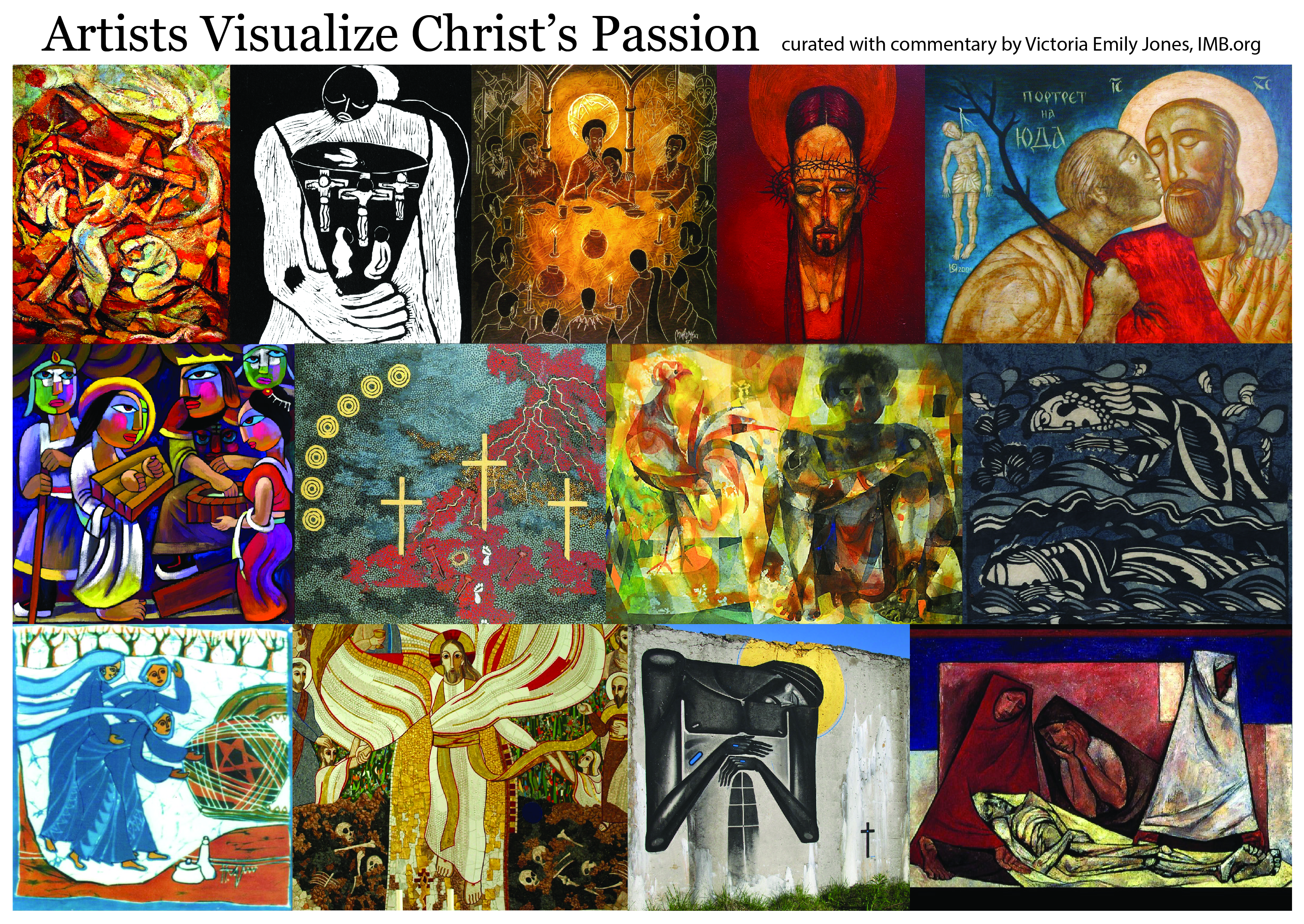
Also for Holy Week, I’d like to remind you of a digital gallery of contemporary global art I curated and commented on for the International Mission Board in 2017, with selections spanning six continents: https://www.imb.org/2017/04/07/journey-cross-artists-visualize-christs-passion-part-1/; https://www.imb.org/2017/04/12/journey-cross-artists-visualize-christs-passion-part-2/.

Holy Week art at IMB.org


This post belongs to the weekly series Artful Devotion. If you can’t view the music player in your email or RSS reader, try opening the post in your browser.

To view all the Revised Common Lectionary scripture readings for Palm Sunday, cycle A, click here.

He Went On Ahead (Artful Devotion)

Jesus Entering Jerusalem by Nathan Simpson
Nathan Simpson (Australian, 1973–), Jesus Entering Jerusalem, 1999. Oil on canvas.

And when he had said these things, he went on ahead, going up to Jerusalem . . .

—Luke 19:28

+++

SONG: “My Lord” by Hiram Ring, on Home (2013)


This Sunday marks the start of Passion Week, with Jesus riding into Jerusalem on a donkey, where he is greeted by palm branches and Hosannas. By Thursday, though, these shouts of praise will devolve into “Is it I?,” “I do not know him,” and “Crucify him!”

In a series of simple verses, Hiram Ring’s blues-inflected song “My Lord” moves from Jesus’s triumphal entry to his agony in the garden (where he drinks heavily the bitter draft of suffering) to his crucifixion. The final two verses shift then to his resurrection and his exaltation in heaven.

+++

Agony in the Garden by Nathan Simpson
Nathan Simpson (Australian, 1973–), Agony in the Garden, 1999. Oil on canvas.

Resurrection by Nathan Simpson
Nathan Simpson (Australian, 1973–), Large Resurrection, 1999. Oil on canvas.

I’m compelled by the Gospel narrative paintings of contemporary Australian artist Nathan Simpson. These are a few I saved from his website a while ago before it went under construction. In Simpson’s Agony in the Garden, Christ’s anguish is palpable. The image combines the Gethsemane narrative with all the suffering that lies ahead, culminating in death. A row of olive trees forms the horizontal beam of a cross, while a rooster (alluding to Peter’s betrayal) forms the vertical; Christ’s head, with swollen eyes and gaping mouth (“My God, my God . . .”), is the point of intersection.

Simpson’s Resurrection painting, by contrast, shows a Christ who’s victorious over death, his face serene. The artist plays with the popular “tree of life” motif, fusing Christ’s body into this flowering, bird-filled plant. An arborescent Christ! See how the nail wound in his left foot is also the tree’s hollow.

+++

In their latest blog post, SALT Project suggests a simple at-home Holy Week ritual for families that I really like: a Tenebrae Wreath (tenebrae means “shadows”).

Imagine . . . a sort of Advent Wreath in reverse: four candles in a circle with a Paschal candle in the middle, extinguished one by one. Sunday night: beginning with only the Paschal candle lit, read Luke’s story of Palm Sunday, and then light all four candles in joy, hope, and thanksgiving. Thursday night: read Luke’s story of the Last Supper, and extinguish one candle; then read Luke’s story of Gethsemane, and extinguish a second. Friday night: read Luke’s story of Peter’s denials and desertion, and extinguish a third candle; then read Luke’s story of Jesus’ suffering, and extinguish the fourth; and then finally, read Luke’s story of Jesus’ death, and extinguish the Paschal candle. Saturday, the wreath remains unlit and bare, perhaps shrouded with cloth. And Sunday morning, the shroud is gone and all candles are lit, with a few more candles added—along with some flowers and Easter sweets! Read Luke’s story of the empty tomb, and sing your favorite Easter hymn (or two).


This post belongs to the weekly series Artful Devotion. If you can’t view the music player in your email or RSS reader, try opening the post in your browser.

To view all the Revised Common Lectionary scripture readings for Palm Sunday and the Liturgy of the Passion, cycle C, click here and here.

Hail to the King (Artful Devotion)

Entry into Jerusalem by Julia Stankova
Julia Stankova (Bulgarian, 1954–), The Entry into Jerusalem, before 2002. Tempera, gouache, watercolors, and lacquer technique on wood, 40 × 22 cm.

The next day the large crowd that had come to the feast heard that Jesus was coming to Jerusalem. So they took branches of palm trees and went out to meet him, crying out, “Hosanna! Blessed is he who comes in the name of the Lord, even the King of Israel!” And Jesus found a young donkey and sat on it, just as it is written, “Fear not, daughter of Zion; behold, your king is coming, sitting on a donkey’s colt!”

—John 12:12–15

+++

SONG: “King of Kings and Lord of Lords” | Music: Traditional Hebrew folk tune | Words: Sophie Conty and Naomi Batya (stage name: Nomi Yah), 1974 | Performed by Glenn Tompkins, 2011 | CCLI #23952

This Hebrew folk melody, with its gradually increasing tempo, is in the tradition of the Israeli hora, or round dance. In 1974 two Christian gal pals, Sophie Conty and Naomi Batya, put their own words to it when they were only thirteen. Since then the song has been published in at least sixteen hymnals. I learned about it two Palm Sundays ago when we sang it at my church. Tying it to that particular liturgical occasion was, I think, a really insightful choice on the part of the music leader. The beats are evocative of a clopping donkey, and the quickening pace builds tension, as when Christ approached the swell of praises in Jerusalem that preceded his doom.

It was hard to search for recordings of “King of Kings” because the title is such a common one. I’ve found that it is often performed by children’s choirs (replete with side steps and hand motions!), and the rock band Petra covered it in the late eighties. I chose to feature this solo accordion arrangement because it best captures the flavor of the song. Even without a vocalist, it’s easy to follow along:

King of Kings and Lord of Lords
Glory, hallelujah
King of Kings and Lord of Lords
Glory, hallelujah

Jesus, Prince of Peace
Glory, hallelujah
Jesus, Prince of Peace
Glory, hallelujah


This post belongs to the weekly series Artful Devotion. If you can’t view the music player in your email or RSS reader, try opening the post in your browser.

To view all the Revised Common Lectionary scripture readings for Palm Sunday, cycle B, click here.