Playlist: The Lord Is My Shepherd (Psalm 23, etc.)

Tomorrow’s readings in the Revised Common Lectionary, for the fourth Sunday of Easter, include what’s probably the most famous passage in the Bible, Psalm 23:

The LORD is my shepherd; I shall not want.

He maketh me to lie down in green pastures: he leadeth me beside the still waters.

He restoreth my soul: he leadeth me in the paths of righteousness for his name’s sake.

Yea, though I walk through the valley of the shadow of death, I will fear no evil: for thou art with me; thy rod and thy staff, they comfort me.

Thou preparest a table before me in the presence of mine enemies: thou anointest my head with oil; my cup runneth over.

Surely goodness and mercy shall follow me all the days of my life: and I will dwell in the house of the Lord for ever.

In characterizing God as a shepherd, the psalmist expresses how God leads, protects, rescues, feeds, and cares for his own. The author of Psalm 95 uses the same metaphor when he writes, “For he is our God, and we are the people of his pasture, and the sheep of his hand” (v. 7)—as do Isaiah and Ezekiel. During his teaching ministry, Jesus described himself as “the good shepherd [who] lays down his life for the sheep,” and whose flock knows his voice and follows him (John 10:1–18).

There are hundreds of metrical paraphrases and musical settings of Psalm 23. I’ve compiled some three dozen of the best into a Spotify playlist, along with a handful of other songs that reference or adapt other biblical passages that speak of God as a shepherd. There are settings by Philippe Rogier, Franz Schubert, Antonin Dvořak, Noel Paul Stookey (of Peter, Paul and Mary), John Michael Talbot, Val Parker, David Gungor, Luke Morton, and others. Besides English, languages include Hebrew, Latin, Spanish, French, German, Czech, Arabic, Mandarin, Urdu, Swahili, and Sotho.

Rae, Ronald_Shepherd
Ronald Rae (Scottish, 1946–), Shepherd, 1988. Granite, 4 × 5 × 4 ft. Private collection, Peak District, Scotland.

The Psalm 23 settings that are most widely reproduced in modern English-language hymnals are:

  • “The Lord’s My Shepherd,” written by Francis Rous but extensively revised by committee and published by the General Assembly of the Church of Scotland in the Scottish Psalter (1650). This text is most commonly matched with the 1872 tune CRIMOND by Ms. Jessie Seymour Irvine of Scotland, but I really like it with the early American folk tune PISGAH, as recorded, for example, by the William Appling Singers. However, both melodies, I feel, are difficult to sing congregationally.
  • “My Shepherd Will Supply My Need” by Isaac Watts, from The Psalms of David Imitated in the Language of the New Testament (1719). This text is traditionally paired with the tune RESIGNATION, first published in the fifth edition of the shape-note hymnal The Beauties of Harmony (Pittsburgh, 1828), compiled by Freeman Lewis, but first appearing with the Watts text in The Valley Harmonist in 1836. My playlist features a performance by the female a cappella quartet Anonymous 4 (the music arranged by Johanna Maria Rose; see video embed below), as well as by folk singer Claire Holley, who recorded the hymn at the request of a friend who told her it was the song that helped her get sober for good. I also like the minor-key setting by Stephen Gordon.
  • “The Lord Is My Shepherd (No Want Shall I Know)” by James Montgomery (1822), with music by Thomas Koschat (1862). Here’s the Lower Lights:
  • “The King of Love My Shepherd Is” [previously] by Henry Williams Baker (1868). This hymn is most often sung to a traditional Irish tune known as ST. COLUMBA (my playlist features both a choral performance by the Choir of Kings School, Canterbury, and a folksy solo by Luke Spehar) and occasionally to MCKEE, also from Ireland, as recorded by Redeemer Knoxville.

At my church we use Wendell Kimbrough’s musical adaptation of the psalm, “His Love Is My Resting Place.” Do you sing Psalm 23 at your church, and if so, what version?

Probably my favorite choral setting is by Bobby McFerrin, “The 23rd Psalm,” performed below by his VOCAbuLarieS, featuring SLIXS & Friends, live in Gdansk, Poland, at the Solidarity of Arts Festival on August 17, 2013:

Some people are thrown off by McFerrin’s use of feminine pronouns for the Divine in this song. God has no literal sex because God does not possess a body, so our gendered binaries are inadequate—but scripture and church tradition refer to God using masculine pronouns. I’m not bothered by the “She” throughout, or even “Mother,” but the substitution of “Daughter” for “Son” in the Trinitarian doxology at the end is theologically confusing, since Jesus was a man. But I get what McFerrin is doing.

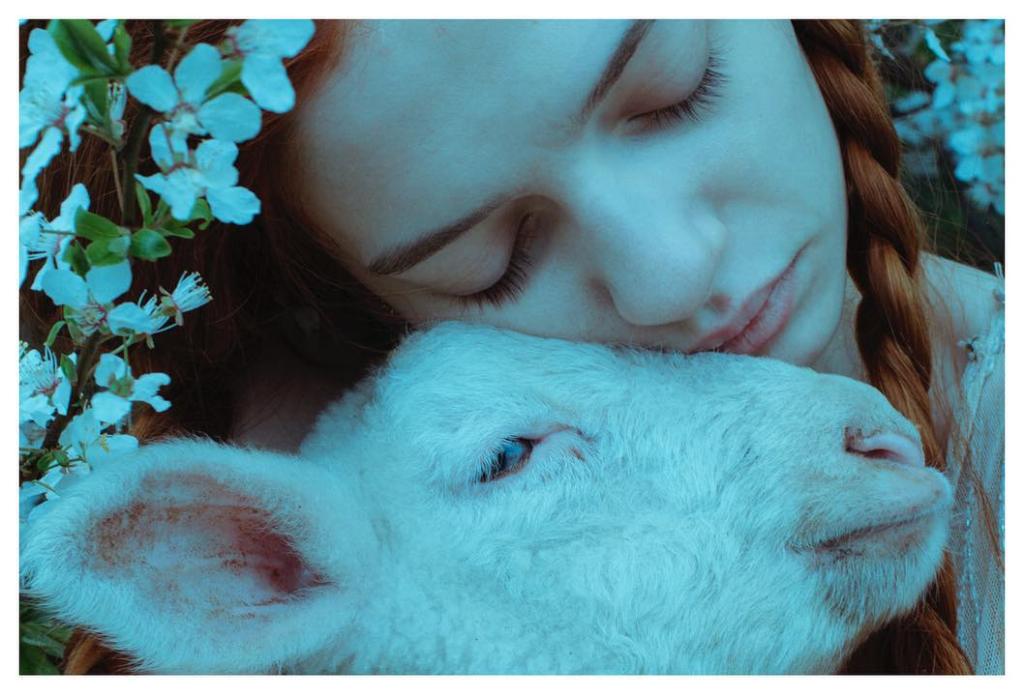
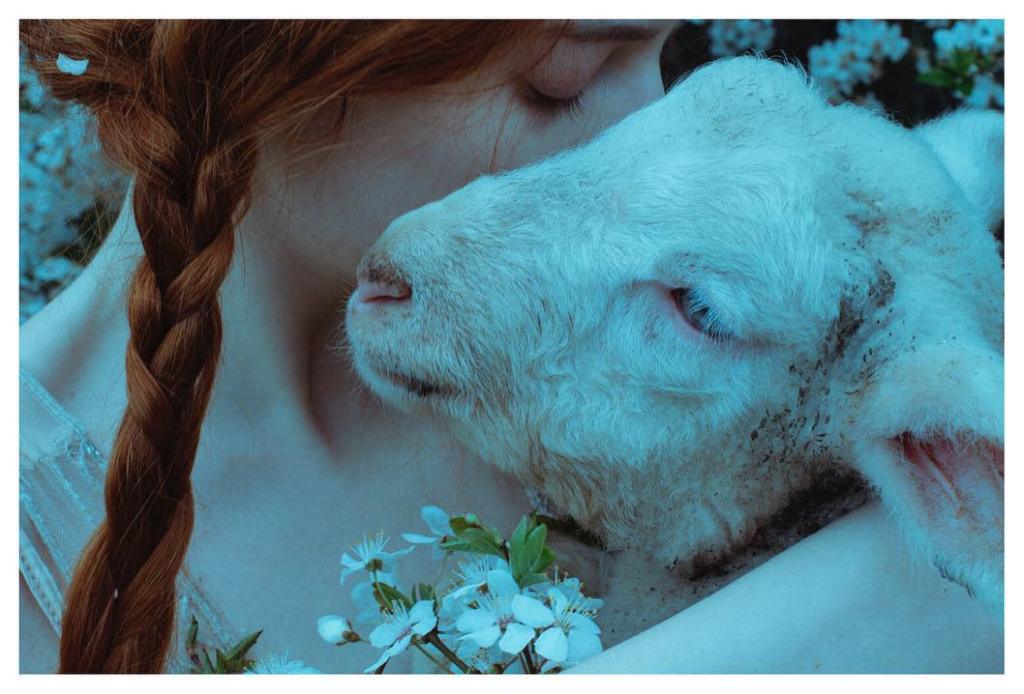
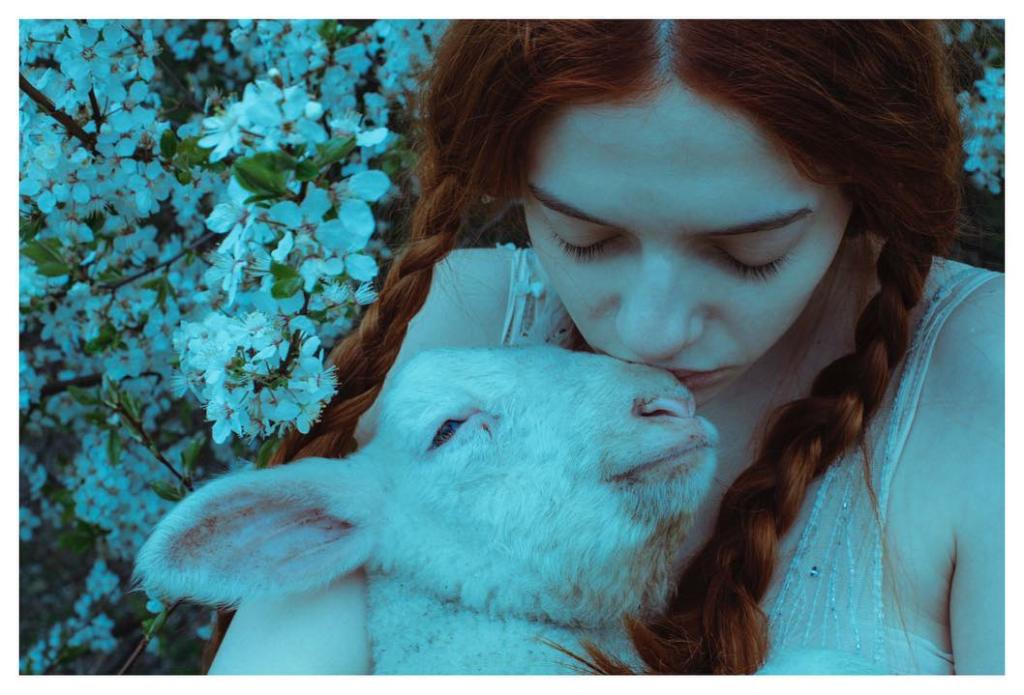
How does the change in gender impact your reception of the psalm text? We’re used to seeing religious imagery of a man with a sheep slung over his shoulders to embody the metaphor of God as shepherd—but what happens when you picture a shepherdess in the role? Note that it was not unusual in the ancient Near East for girls and women to tend their family herds (think of Rachel and Zipporah in the Old Testament, for example), and still today across the globe there are many female shepherds.

McFerrin dedicated his “23rd Psalm” to his mother.
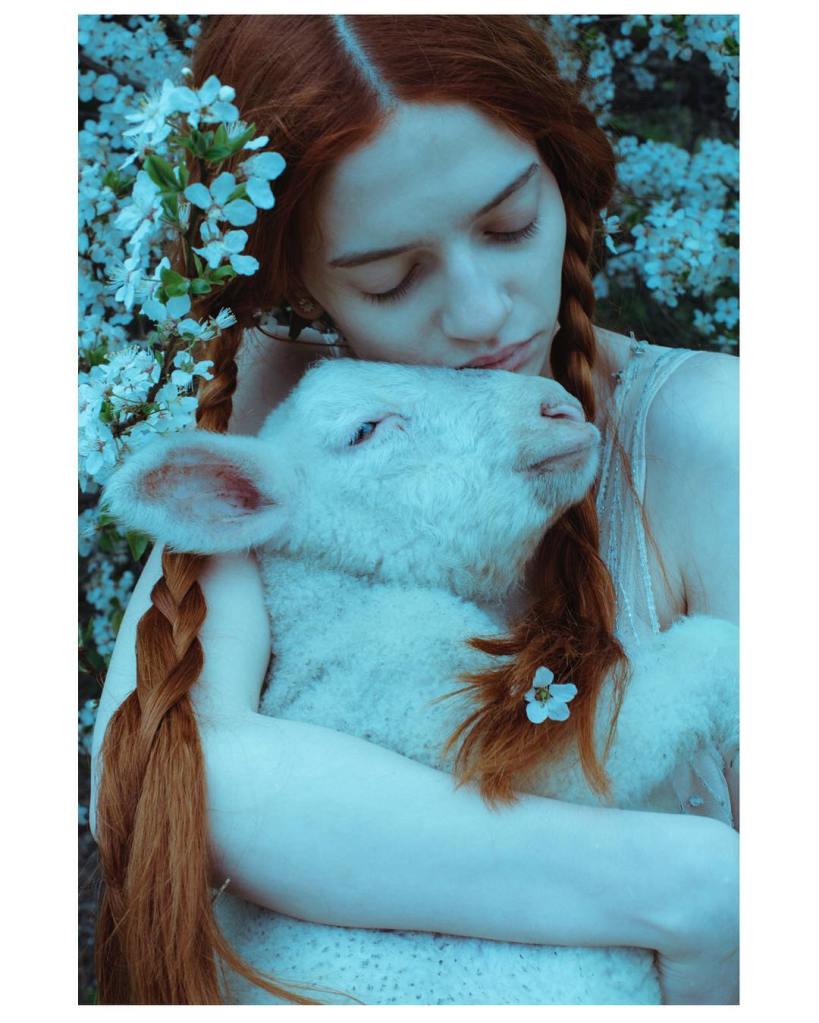
(The above artworks, sourced from Instagram, are from the 2019 series The Shepherd by Laura Makabresku, a fine-art photographer from Poland whose work is influenced by her Catholic faith and by fairy tales.)

Here is a selection of other songs from the playlist:

>> “Adonai Ro’i” is a setting of the original Hebrew of Psalm 23 by Jamie Hilsden of Misqedem, a band from Tel Aviv, Israel, that is heavily influenced by Middle Eastern and North African music styles, often utilizing microtonal scales, irregular time signatures, and regional instruments. The song is sung by Shai Sol. (Available on Bandcamp.)

>> “The Lord Is My Shepherd” by Paul Zach of the United States:

>> “El Señor es mi Pastor” by Omar Salas of the Dominican Republic, a salsa song:

>> “Ke Na Le Modisa” by the Soweto Gospel Choir, sung live at the Nelson Mandela Theatre in Johannesburg in 2008. The song is in Sotho, an official language in South Africa and Lesotho.

>> “The Shadow Can’t Have Me” by Arthur Alligood:

>> “Done Found My Lost Sheep,” an African American spiritual sung by Lucy Simpson [previously] for Smithsonian Folkways, based on Jesus’s parable of the lost sheep (Luke 15:1–7):
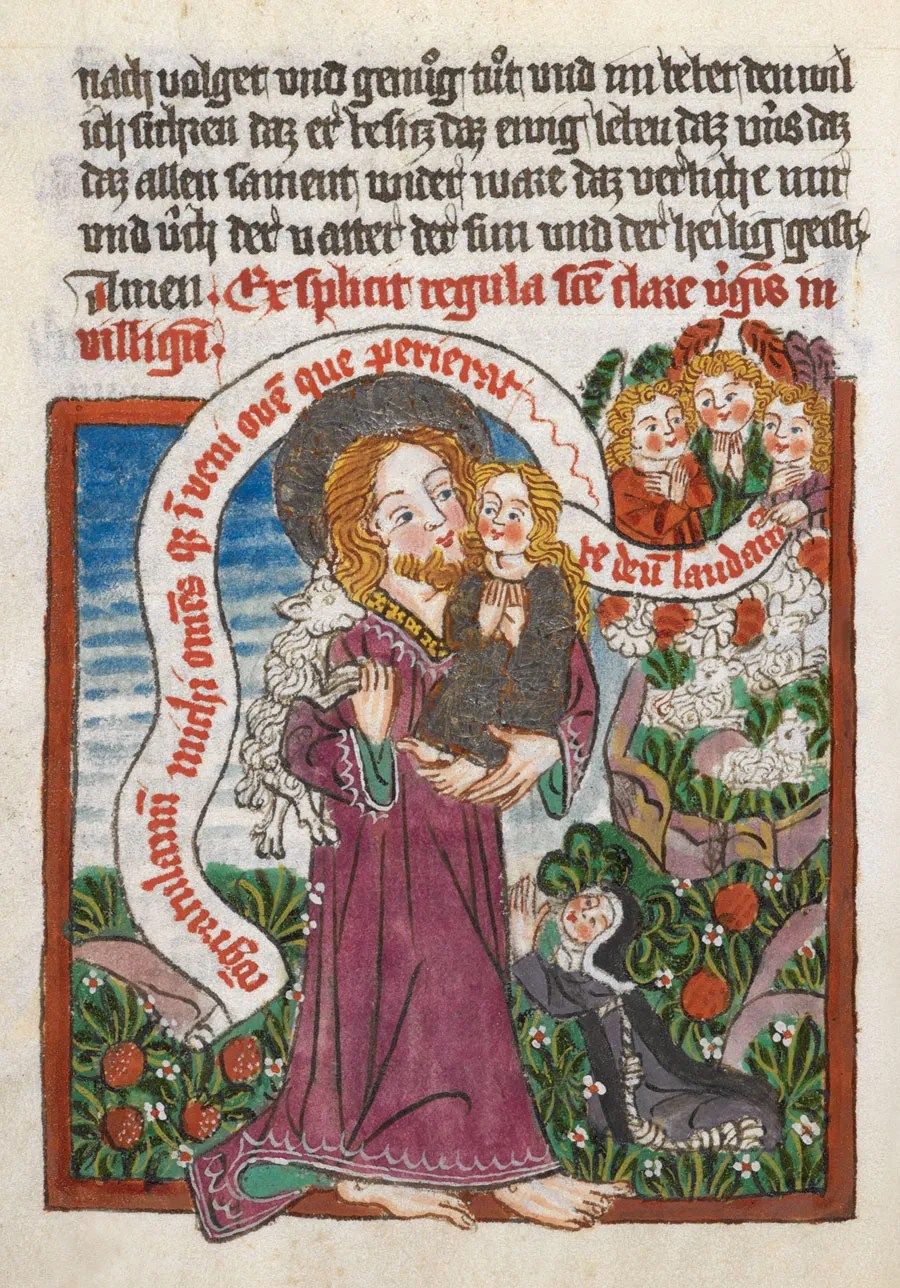
Lost sheep found (British Library)
Illustration by the nun Sibylla von Bondorf (German, ca. 1440–1525), from a copy of the Clarrissan Rule, Freiburg, ca. 1480. Opaque pigments on parchment, 15 × 10 cm. London, British Library, Add. MS 15686, fol. 30v. The banderole reads, “Rejoice with me, for I have found my sheep that was lost” (Luke 15:6). [HT]

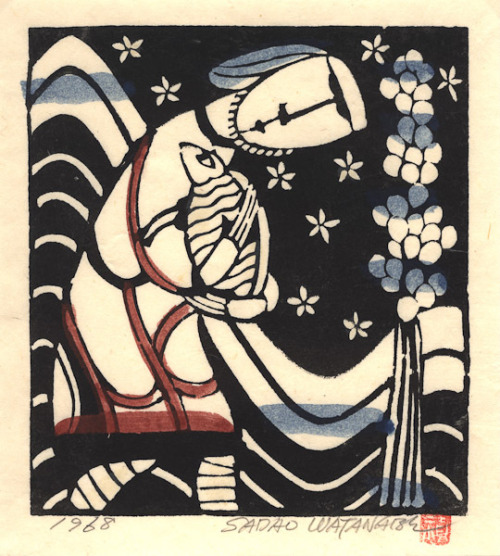
Watanabe, Sadao_Good Shepherd
Sadao Watanabe (Japanese, 1913–1996), Good Shepherd, 1968. Katazome stencil print.

>> “Our Psalm 23” by Gabriella Velez, Kevin Dailey, Justin Gray, and JonCarlos Velez of Common Hymnal, featuring Sharon Irving:
Roundup: Pippy the Piano, “The Cobblestone Gospel,” and more

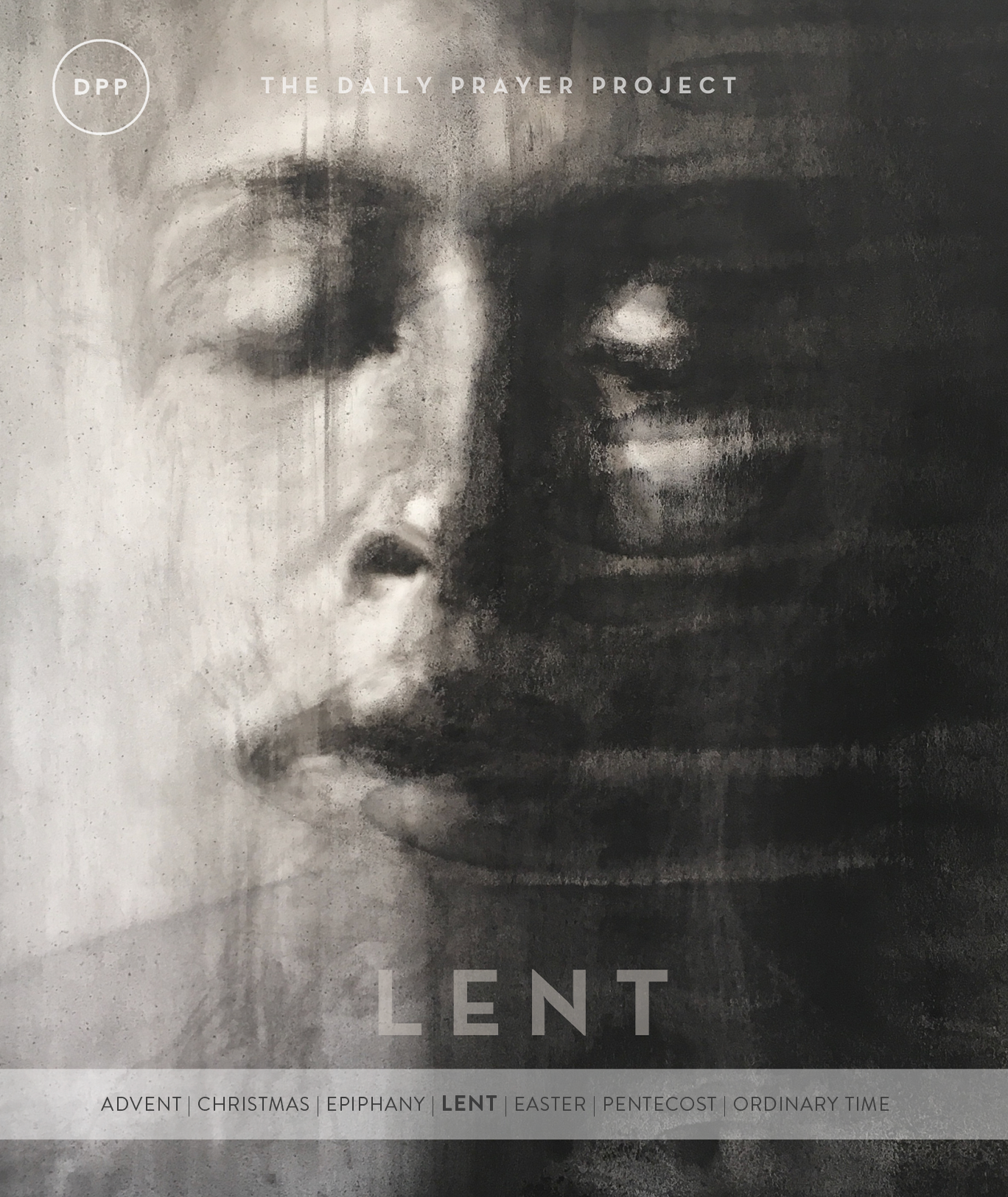
The Lent 2021 edition of the Daily Prayer Project prayerbook is now available, covering February 17–April 3. (I serve as curator.) The stunning cover image is Prayers of the People I by Meena Matocha, who works in charcoal, ashes, acrylic, and wax. You can purchase the booklet in either digital or physical format.

In the opening letter, Project Director Joel Littlepage writes, “Lent is a season that disturbs many people. Maybe that includes you. Among Protestant Christian communities that I have been a part of over the years, Lent can either be seen as a ‘graceless,’ ‘harsh,’ ‘legalistic’ part of the Christian year or, on the other hand, trivialized into a time to ‘pick something to give up,’ like a seasonal spiritual diet plan. Both these characterizations miss the mark.” He goes on to describe the bidirectionality of the Lenten journey: downward, as we are crucified with Christ, and upward, toward the victory of resurrection and new life. “It is a season to sense again the path of the Christian life.”

+++

NEW CHILDREN’S BOOK: Pippy the Piano and the Very Big Wave by Roger W. Lowther, illustrated by Sarah Dusek: My friend Roger Lowther [previously], director of Community Arts Tokyo and host of the Art Life Faith podcast, has written his first children’s book, which released in December. It’s inspired by the story of a church in Kamaishi, who after the 2011 tsunami found their beloved piano upside down and covered in mud and debris but, rather than discard it, decided to spend enormous amounts of time and money to restore it—a picture of God’s love for his precious creation, and the lengths he went to to demonstrate that love. Hollywood and Broadway actor Sean Davis reads the book in the video below. [Available on Amazon]

+++

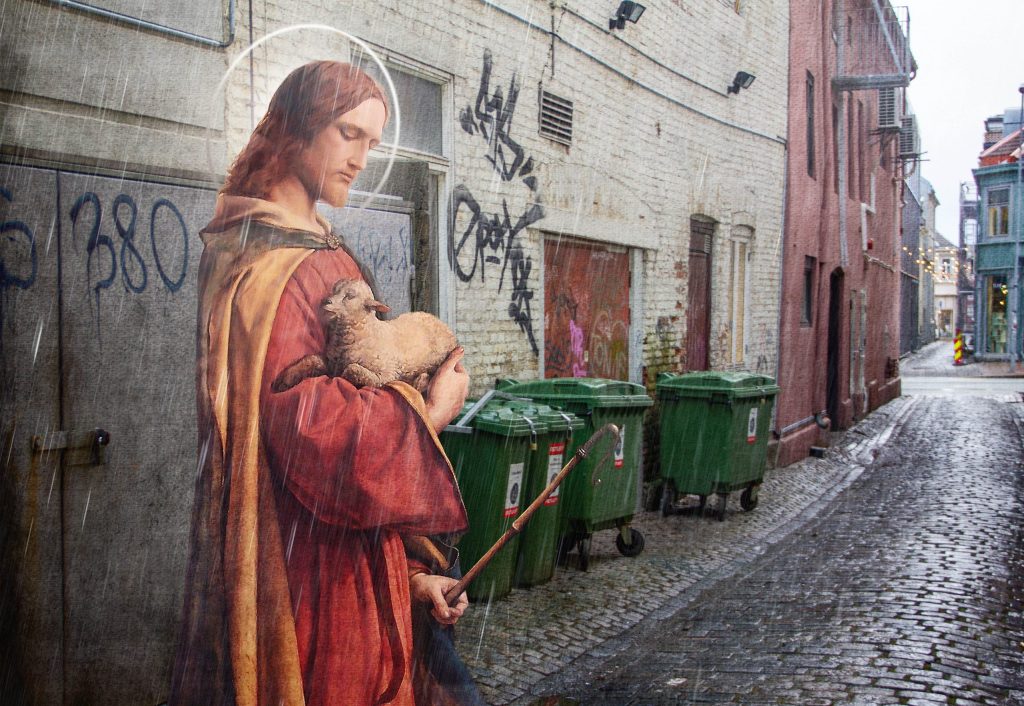
EXHIBITION: The Cobblestone Gospel by Trygve Skogrand, Vår Frue Kirke (Our Lady Church), Trondheim, Norway, July 2020–April 2021: “An exhibition of collages of historic low-church art merged with photographs of our own contemporary surroundings. The essence of the works is the meeting. Between painting and photography, the mystical and the mundane, and how the meeting makes both worlds renewed and re-visibled.” The original advertising says the exhibition is open Mondays through Saturdays from 12 to 3 p.m., but I’m not sure whether COVID has changed that; you can contact the church here.

Skogrand, Trygve_Found
Trygve Skogrand (Norwegian, 1967–), Found, 2020. Collage / pigment print on paper.

Skogrand, Trygve_The Beloved
Trygve Skogrand (Norwegian, 1967–), The Beloved, 2020. Collage / pigment print on paper.

In October Skogrand described the impetus behind his work to Edge of Faith magazine:

When I was a child, I went to a Christmas party at our local church. At the end of the party, every child got a small bag of gifts to take home. In the bag: a pack of raisins, a small orange, some sweets – and a prayer card showing Jesus in paradise. Oh, how beautiful I thought the small prayer card was! Jesus and butterflies and a sunset and flowers AND a golden glittery border. A wonder of loveliness and holiness!

Move on twenty years. I was 30, had started working as an artist, and found the bible card again. I had changed, and the card too. Instead of seeing loveliness, I found the card rather sad. It looked to me as if Jesus was imprisoned in a dusty and suffocating make-believe paradise.

Then it struck me: What if I remove the paradise?

I have now been working with the merging of high and low historical Christian art with our contemporary surroundings for twenty years. For me, this process not only binds together what nowadays normally is shown as sundered but also re-actualizes the classical art and infuses the everyday, modern surroundings with holiness.

+++

MUSIC VIDEO: “Fear Thou Not” by Josh Garrels: This beautiful new setting of Isaiah 41:10 by Josh Garrels appears on Garrels’s 2020 album Peace to All Who Enter Here [previously]. “Fear thou not; for I am with thee: be not dismayed; for I am thy God: I will strengthen thee; yea, I will help thee; [and] I will uphold [you] with the right hand of my righteousness” (KJV).

+++

SHORT FILM: A Colorized Snowball Fight from 1896 Shows Not Much Has Changed in the Art of Winter Warfare: This is pure joy! “A short clip, originally captured by Louis Lumière in 1896, documents a rowdy snowball fight [bataille de boules de neige] on the streets of Lyon, France. Thanks to Saint-Petersburg, Russia-based Dmitriy Badin, who used a combination of the open-source software DeOldify and his own specially designed algorithms to upscale and colorize the historic footage, the video of the winter pastime is incredibly clear, revealing facial features and details on garments.”

The Lost Lamb (Artful Devotion)

Good Shepherd (Chinese)
Chinese scroll painting of the Good Shepherd, 1966. Collection of the Church of the Good Shepherd, Ann Arbor, Michigan.

“What man of you, having a hundred sheep, if he has lost one of them, does not leave the ninety-nine in the open country, and go after the one that is lost, until he finds it? And when he has found it, he lays it on his shoulders, rejoicing. And when he comes home, he calls together his friends and his neighbors, saying to them, ‘Rejoice with me, for I have found my sheep that was lost.’”

—Luke 15:4–6

+++

SONG: “The Lost Lamb” by Abigail Washburn and Jingli Jurca | Performed by Abigail Washburn, on Song of the Traveling Daughter (2005)

Zai na yaoyuan de guxiang
Wo shiluo liao yi ge gulao de meng
Yi ge youshang de meng
Zai na yangyu wo de defang

Wo fenbian buliao muse he chenguang
Wo yanjuanliao chenmo he sixiang
Feng nanchui you zhuanxiang beifang
Jianghe ben hai, hai que bu zhang

Wo xin manliao choucheng
Yu lai you shi qing bu jiuchang
Fuzu tianbuman linghun de kewang
Zhihui dangbukai yongsheng de shuangjiang

Wo
Wo shi
Yi zhi
Mitu de gaoyang

Shei neng ying wo zouchu mimang
Nar you wo chongsheng de xiwang
Oh, muyangren ah
Ni zai hefang?

In that far distant land I call home
I lost the ancient dream
A sorrowful dream
In that place that raised me

I cannot discern the growing shadows of dusk
And the first faint rays of the morning sun
I’ve wearied in the silence and searching
Wind blows south and turns again north
River flows to the sea, yet the sea does not rise

My heart is filled with melancholy
The rains come, clear skies will follow soon
Even fortune and good blessings
Cannot quench the soul’s thirst
Wisdom cannot relieve us our eternal lot

I am a lost lamb

Who will lead me from this haze?
What will bring me hope again?
Oh shepherd
Where are you? [source]

+++

Before Abigail Washburn (previously featured here) became one of America’s most acclaimed folk musicians, she was a college student majoring in East Asian studies and Mandarin, traveling intermittently to China and ready to pursue a degree in international law at Beijing University. But before her planned departure, she heard at a party one night a recording of Doc Watson singing “Shady Grove,” and she instantly fell in love with American bluegrass music. She bought herself a banjo and traveled Appalachia, learning the instrument and developing a repertoire. Her skill and enthusiasm soon landed her at a recording studio in Nashville, the city where she now lives with her husband, Béla Fleck.

Although Washburn decided not to pursue a law career in Beijing, her love of Chinese language and culture has continued. In 2011 she embarked on a Silk Road Tour, where she collaborated with Chinese musicians at each stop along the way. That year also marks the founding of The Wu-Force, a self-described “kung fu-Appalachian avant-garde folk-rock” trio consisting of Washburn, guzheng (Chinese zither) virtuoso Wu Fei, and multi-instrumentalist Kai Welch. As her website says, “her efforts to share US music in China and Chinese music in the US exist within a hope that cultural understanding and the communal experience of beauty and sound rooted in tradition will lead the way to a richer existence.” Learn more by watching her 2012 TED talk, “Building US-China Relations . . . by Banjo,” or by listening to her (and Fleck’s) 2015 interview with Krista Tippett, “Truth, Beauty, Banjo.”

“The Lost Lamb” is one of several songs that Washburn co-wrote with her friend Jingli Jurca, a poet from Beijing. Washburn says it was inspired by one of the Chinese students she was teaching English to in Vermont in the early 2000s. He had come to the States to earn money to send back home, but four years later he received a letter from his wife saying that she and their daughter were going to start a new life without him. This mournful ballad gives expression to his feeling of exile, of rootlessness, of being far from home and unable to return to what was once a place of joy and connection.

The first time I heard this song, I was incredibly moved. Having no knowledge of Mandarin or the context of the song’s composition, I looked up a translation, finding that the lyrics have a beautiful resonance, whether intentional or not, with Jesus’s parable of the lost sheep, where he likens himself to a good shepherd who seeks out and restores those of his flock who have wandered off. I hear it as very psalmic, a grasping after God through pain. It’s hard to tell dusk from dawn, the speaker says. My soul thirsts. It ends, “Oh Shepherd, where are you?” Shepherd, who promises to lead us through dark valleys and bring us to still waters. The speaker is readily confessing that he’s lost; “come find me” is essentially what he pleads.

In the spirit of the biblical psalmists, the speaker appears to take God to task, questioning whether he will show up as he said he would. “Who will lead me from this haze? / What will bring me hope again?” It’s an earnest reaching, through tears and uncertainty, for something stable that he or she once knew.

Whether you want to interpret the song as lamenting a felt distance from one’s home country or culture or family or faith, it rings so true, so beautiful.

I’ve paired it with a visual artwork and scripture reading that fulfill its longing, showing a being found.


This post belongs to the weekly series Artful Devotion. If you can’t view the music player in your email or RSS reader, try opening the post in your browser.

To view all the Revised Common Lectionary scripture readings for Proper 19, cycle C, click here.