Advent, Day 15: Promise

LOOK: the rain bows and the rainbows by Katy Mixon
Mixon, Katy_The rain bows and the rainbows
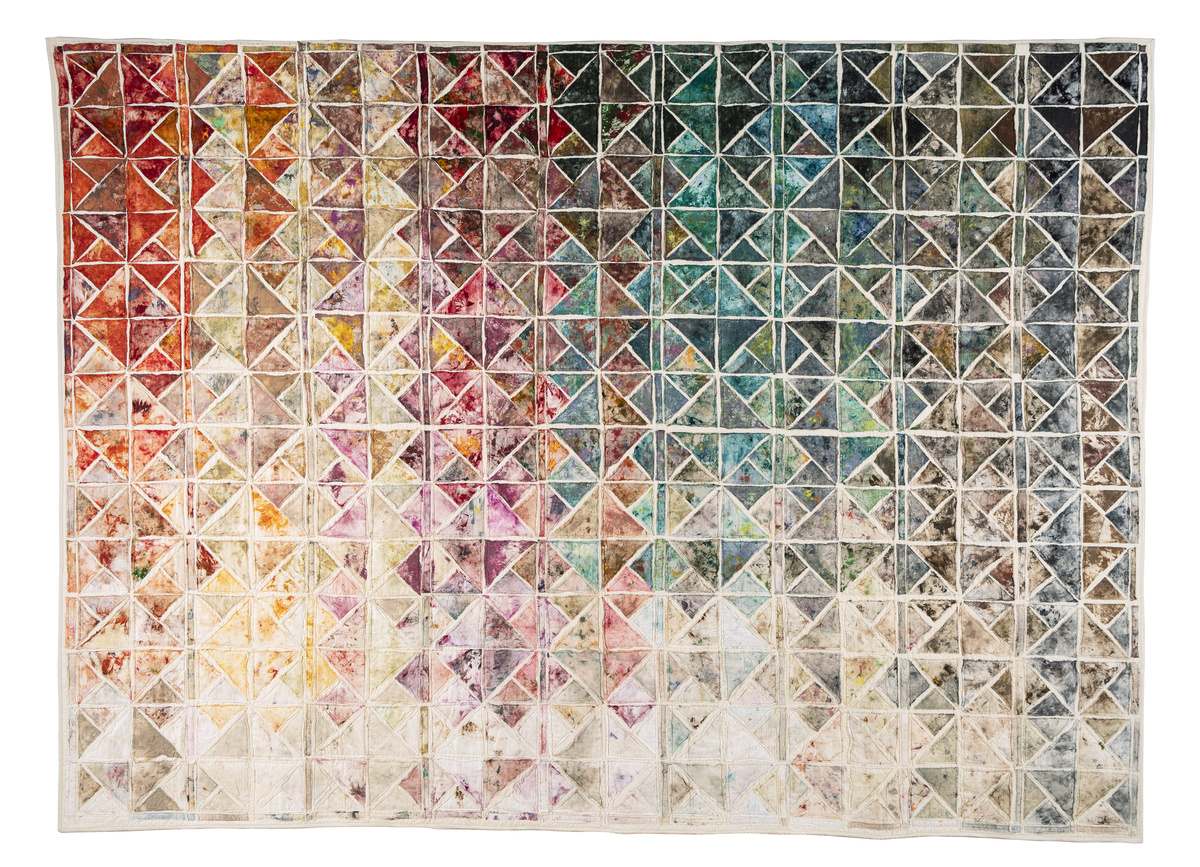
Katy Mixon (American, 1984–), The rain bows and the rainbows (one day we will switch sides), 2018. Oil paint and used hand rags on muslin, 100 × 138 in.

I saw this quilt by Katy Mixon in December 2021 at the exhibition Break the Mold: New Takes on Traditional Art Making at the North Carolina Museum of Art. I was struck first by its prismatic color, and then by its title—which, the artist told me, comes from a dream she had after her close friend died. To bow, long o, is to bend into a curve; as a noun, a bow is a weapon used to propel an arrow, or a knotted ribbon typically worn by young girls. To bow, short o (as in “ow”), is to incline in respect or submission. The multiple meanings of this homograph open the title to different readings.

But the overall meaning points to the multihued arc that appears in the sky after a rainfall, as sunlight refracts through water vapor.

In the Judeo-Christian tradition, the rainbow is a sign of God’s covenant with Noah and has come to symbolize divine promise more generally, or hope—after the bleakness, beauty.

Mixon’s making process involves upcycling rags, which is itself a kind of redemptive act, saving used scraps and piecing them together into a new whole.

“Katy Mixon’s ‘quilts’ began as an outgrowth of her painting process,” the NCMA exhibition text read. “She routinely wipes her hands, palette knives, and other tools with baby wipes, which she then tosses into her studio’s garbage can. ‘One day [I] looked at the trash and realized it was full of all this hastily discarded color,’ she notes. She began saving the vibrant detritus with no specific purpose in mind, but after remembering her grandmother’s homemade quilts and discovering the famed African American quiltmakers of Gee’s Bend, Alabama, Mixon had a plan for her colorful scraps. ‘For me, the quilted works are alternate endings in the painting’s life cycle,’ Mixon says. ‘Painting as a practice, with the used rags as kaleidoscopic evidence.’”

Describing her technique, Mixon told me: “I compose the pieced tops and work with local longarm quilters to add the batting and backing. I finish each piece with hand stitching, often using crewel embroidery to define brush marks and tonal variations.”

LISTEN: “Joyful” | Words by Kate Bluett | Music by Paul Zach | Performed by Paul Zach with Taylor Leonhardt and Nick Dahlquist, on Christmas Hymns (2022)

The MP3 file of the song is embedded here with Paul Zach’s permission.

Come, O Lord, and make us joyful
as you came to Mary’s womb;
buried deep beneath our sorrows,
where our hopes take root and bloom.
Be the promise that sustains us
through the seasons of the years,
’til at last we see your radiance
when you shine beyond our tears.

Come, O Lord, and show your mercy
as you came in Bethlehem;
let us see the sunlight bursting
through the shadows once again.
Let us hear the song of glory
where the silence held us fast.
We will come to you rejoicing
from the shackles of the past.

Come, O Lord, as living water;
make our deserts green again,
where the wellspring of our laughter
will refresh us like the rain.
After all the years of waiting
for the promise long foretold,
come at last, and let the day break
in the morning of your joy!

Advent, Day 21: Reign of Mercy

LOOK: Beulah by Jyoti Sahi

Sahi, Jyoti_Beulah
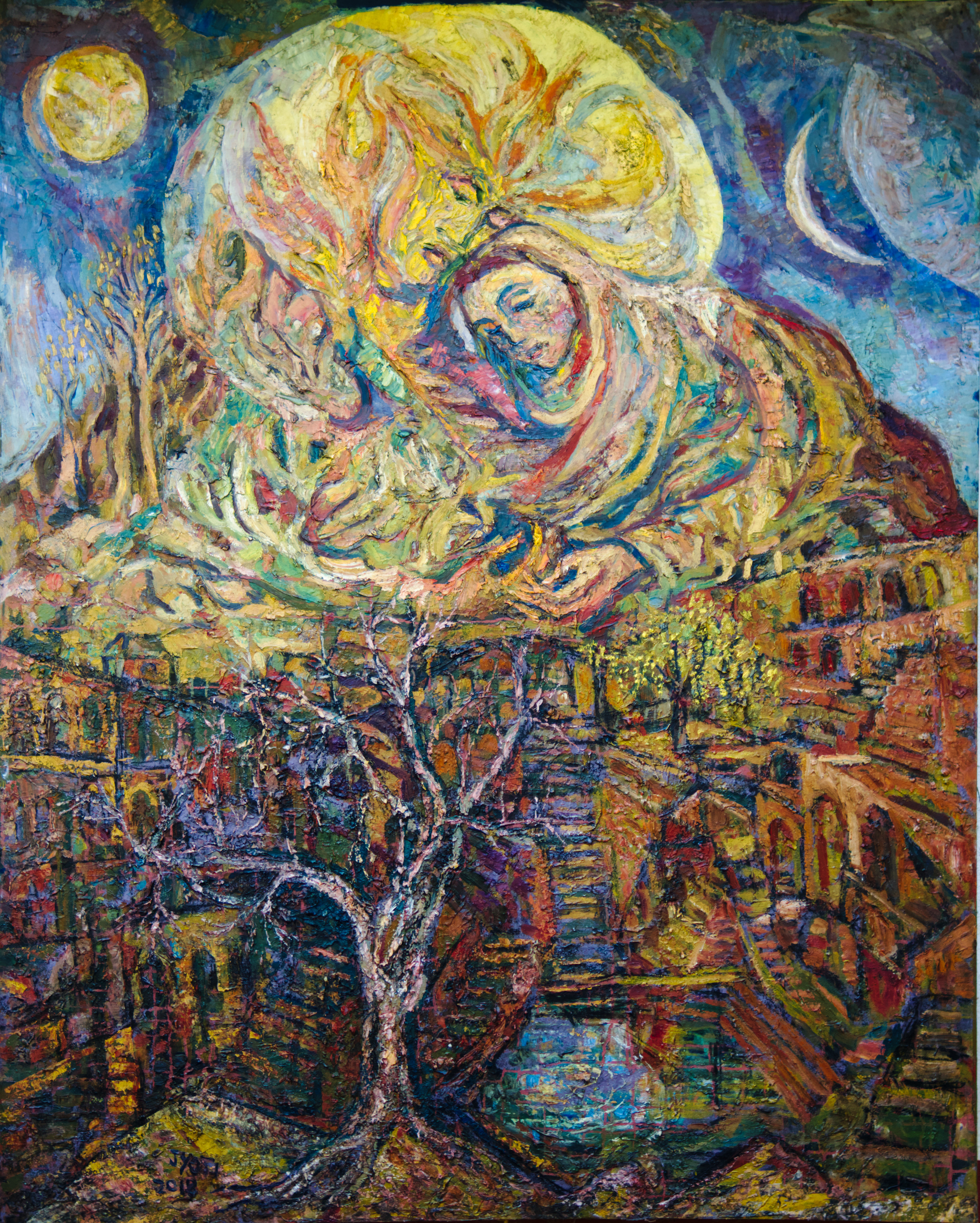
Jyoti Sahi (Indian, 1944–), Beulah, 2018. Oil and acrylic on canvas, 5 × 4 ft. Photo: Victoria Emily Jones.

In Isaiah 62:2–5, God talks to Zion about her future. He says that on the day of the Lord,

The nations shall see your vindication
    and all the kings your glory,
and you shall be called by a new name
    that the mouth of the LORD will give.
You shall be a beautiful crown in the hand of the LORD
    and a royal diadem in the hand of your God.
You shall no more be termed Forsaken,
    and your land shall no more be termed Desolate,
but you shall be called My Delight Is in Her
    and your land Married,
for the Lord delights in you,
    and your land shall be married.
For as a young man marries a young woman,
    so shall your builder marry you,
and as the bridegroom rejoices over the bride,
    so shall your God rejoice over you.

The painting Beulah by the Indian Christian artist Jyoti Sahi (pictured below) takes its title from the Hebrew word for “married” that’s used in Isaiah 62:4. He told me the image pictures the coming together of heaven and earth, the sun marrying the land, which can also be read as Christ uniting with his bride. Christ comes as dawn, his head like flame, like the great I AM revealed to Moses in the burning bush. His glory, the yellow halo around his head, encompasses the female figure. He leans in, tenderly resting his head on hers, and their hands touch.

Beulah shows the reunion not only of humanity and the Divine at the end of time, but also of the land and the Divine. As the Isaiah passage states, the earth, too, will be redeemed and made to flourish once again.

The two figures here form a sacred mountain. A river of life flows down between them, watering the new city, which is a wilderness no longer. This is Isaiah’s vision wrapped up into John the Revelator’s.

Jyoti Sahi
Jyoti Sahi touches up a detail of his painting Beulah. Photo: Victoria Emily Jones.

LISTEN: “The Reign of Mercy” by Kate Bluett and Paul Zach, 2021 | Performed by Paul Zach and Lauren Plank Goans on Advent Songs by the Porter’s Gate, 2021

Oh may our world at last be just
And hilltops echo with your peace
A harvest come from barren dust
The reign of mercy never cease
He comes as rain upon the grass
High heaven’s sun to earth descends
Not as the seasons that will pass
But with a light that never ends

Oh come to him and find your rest
Who saw the poor and came as one
Who hears the cries of the oppressed
And rules till all oppression’s done
Someday he’ll come to reign as king
And we will see his justice done
Our souls will magnify and sing
The Christ whose kingdom now is come

And all the mighty and the strong
Will bow before him on that day
The silenced fill the world with song
The poor and lowly he will raise
And all our bitterness and tears
Our violence and our endless wars
Will end at last when he draws near
Come soon, come soon, oh Christ our Lord

Gaudete! Ten Songs for Advent Rejoicing

(This article is an all-new edition of last year’s “Ten Songs of Joy for Gaudete Sunday.”)

The third Sunday of Advent is traditionally known as Gaudete (Joy) Sunday, a day of celebrating the joyful reality that God is near. Advent is characterized by our waiting and yearning for Christ, which can feel heavy, especially as we look around and within and see so much brokenness. But on this day we are reminded to embrace a spirit of joy as we wait and as we yearn—much like a child waits with eager anticipation to unwrap a gift, or lovers to be reunited after a time of separation.

The following ten songs help us to inhabit the gladsome aspects of the Advent season, paving the way to Christmas.

Geyser
Øystein Sture Aspelund (Norwegian, 1984–), GVariations #08, Pamir Mountains, Tajikistan [HT]

1. “First Song of Isaiah” by Jack Noble White (1976) | Arranged and performed by Advent Birmingham, feat. Annie Lee, on Canticles (2020): Here’s an upbeat rendition, with xylophone and ukelele, of Jack Noble White’s choral setting of Isaiah 12:2–6. “You shall draw water with rejoicing from the springs of salvation. . . . Cry aloud, inhabitants of Zion, ring out your joy!” In the Book of Common Prayer this text appears in the section “Morning Prayer, Rite 2,” where it is labeled Canticle 9, “The First Song of Isaiah: Ecce, Deus.”

2. “Rejoice Greatly, O Daughter of Zion” from Messiah by George Frideric Handel (1741) | Performed by Regula Mühlemann (2019): A setting of Zechariah 9:9–10, this aria from Handel’s most famous oratorio features coloratura in the vocals—that is, elaborate, fast-paced ornamentation, trills, runs, and wide leaps—that accentuates the prophecy’s joyful message of a coming king. It’s sung by the Swiss soprano Regula Mühlemann, accompanied by the Sächsische Staatskapelle Dresden under the direction of Alondra de la Parra. For a Broadway-style arrangement of this piece, see here.

3. “Joy (Elizabeth)” by Poor Bishop Hooper, on Firstborn (2018): This song by Jesse and Leah Roberts voices Elizabeth’s awe upon visiting with her younger relative Mary, who is newly pregnant with the Son of God. Elizabeth radiates such joy in the Messiah that her preborn son, John, catches it too, leaping in her womb.

4. “Joy” by Kirk Franklin and Donald Malloy | Performed by the Georgia Mass Choir, feat. Dorothy Anderson and Kirk Franklin, on I Sing Because I’m Happy (1992): Sweet, beautiful, soul-saving joy! That’s what Jesus gives. The Georgia Mass Choir testifies with vigor, led by the Grammy-winning artist Kirk Franklin. In 1996 this song was adapted for Whitney Houston for the film The Preacher’s Wife, with Christmas-specific lyrics, but I really dig Dorothy Anderson’s solo work in this original recording.

5. “Rejoice” by Victory Boyd, on Glory Hour (2023): This anthem by singer-songwriter Victory Boyd is based on Nehemiah 8:10: “Do not be grieved, for the joy of the LORD is your strength.” Victory often incorporates scripture recitations into her songs, and here she speaks Psalm 27:1–6 as a bridge, which has thematic crossovers with the Nehemiah verse. In this live performance from the February 4, 2024, episode of the Hour of Power television program, she is accompanied by the Hour of Power Orchestra, conducted by Marc Riley.

6. “Joy” by Shakti, on Shakti with John McLaughlin (1976): Shakti is an acoustic fusion band that combines Indian music with elements of jazz; they were active in the 1970s and re-formed in 2020. Recorded at the Montreux Jazz Festival in 1976, this instrumental improvisation features John McLaughlin on guitar, L. Shankar on violin, Zakir Hussain on tabla (hand drums), and T. H. “Vikku” Vinayakram on ghatam (clay pot).

7. “There Will Be Joy” by Paul Zach and Kate Bluett (2022): “Sorrow has an ending / Something new is coming / Oh, there will be joy!”

8. “Come That Day” by Ken Wettig, on Behold and Become (2019): Ken Wettig served for eight years as pastor of Early Church, a Mennonite congregation in Harrisonburg, Virginia, before becoming a community minister at Coracle. This song he wrote is one that Early Church sings in its worship services. It celebrates the coming day of the Lord, when death will be no more and Christ will bring about total restoration. On that day, all chaos will be stilled, swords will be beaten into plowshares, the poor will be filled, and loved ones taken too soon will embrace one another once again. The song is an invocation: it beseeches Christ to come, to bring the promised consummation of his kingdom.

Wettig has given me permission to post the lead sheet for “Come That Day,” which he freely offers for noncommercial use. Click the link to download a PDF.

9. “Peace and Joy,” Shaker hymn (1893) | Performed by the Rose Ensemble, feat. Kim Sueoka, on And Glory Shone Around (2014): One of the less recognized roots of bluegrass and old-time music is the Shaker tradition. This hymn, performed here by the Rose Ensemble, hails from the late nineteenth-century Shaker community in Mount Lebanon, Columbia County, New York. It beckons us “Awake!” and hear the angels whispering forth the blessings of Christ. “Happy are they who gather these gifts” of peace and joy ushered in by the Incarnation. The fabulous soprano soloist is Kim Sueoka.

10. “Carol of the Bells” – Music by Mykola Leontovych (1914), based on a traditional Ukrainian folk chant | Words by Peter Wilhousky (1936) | Arranged by Isaac Cates and performed by Ordained on Carol of the Bells (2014): The composer, conductor, and pianist Isaac Cates plays piano accompaniment for his choir, Ordained, in this original arrangement of a Christmas classic. Dramatic and haunting, energizing too, “Carol of the Bells” is one of my favorite choral songs of the season—I never tire of hearing it! I love the build in volume and the interplay of voices in imitation of church bells.

Playlist: Christ the King

The final Sunday of the liturgical year—which this year is November 24—marks the Feast of Christ the King. This festival celebrates the reign of Jesus Christ over all of creation and every aspect of our lives.

“The belief in Christ as King finds its roots in the Christian understanding of Jesus as the Messiah, whose reign exists as both a present reality and a future hope,” writes Ashley Tumlin Wallace on her blog The Liturgical Home. “In the here and now, his reign manifests in the lives of believers who seek to live under his lordship. But the Feast of Christ the King also carries a sense of eschatological anticipation, signaling the ultimate culmination of time when the reign of Christ is fully realized.”

Unlike some who sit on earthly thrones, Christ is no tyrant; he’s a benevolent ruler who leads with love and perfect wisdom. He is high and lifted up, and yet he stoops down to us and attends to our cries. He’s so committed to our flourishing that he became one of us and sacrificed himself to save us from the Evil One and reconcile us to God. We owe him our praise, our deference, our all.

For Christ the King Sunday, I put together a Spotify playlist of songs that extol Christ as king of the cosmos and of our own hearts.

It includes traditional hymns like “All Hail the Power of Jesus’ Name” (below, sung by Paul Zach), “Come, Christians, Join to Sing,” “All Creatures of Our God and King,” “All People That on Earth Do Dwell,” “Praise to the Lord, the Almighty,” “O Worship the King,” “Crown Him with Many Crowns” . . .

In looking up hymns, I was delighted to find a new-to-me one from the nineteenth century by Josiah Conder called “The Lord Is King,” which Navy Jones set to a buoyant new tune:

There’s one song on the list whose text dates all the way back to the fifth century. Written in Latin by the Christian poet Sedulius, “Regnavit Dominus” (The Lord Is King) combines praises to the One who conquered death and feeds us with himself with the humble plea, “Kyrie eleison” (Lord, have mercy). Owen and Moley Ó Súilleabháin sing it to a twelfth-century melody:

The playlist also features several psalm settings, including two of Psalm 93, which opens,

The LORD is king; he is robed in majesty;
    the LORD is robed; he is girded with strength.
He has established the world; it shall never be moved;
    your throne is established from of old;
    you are from everlasting.

One is by Jacob Mwosuko, a member of the Abayudaya (People of Judah) Jewish community near Mbale in eastern Uganda. The text is in Luganda. Though Jews would read “LORD” as referring to God the Father, ever since the early church Christians have confessed Jesus not only as Lord (Master) but also as LORD (YHWH), consubstantial and co-eternal with the Father, sharing with him all rule, authority, power, and dominion.

Also from Africa, there’s the Resurrection-rooted salsa song “Jesus Reigns” by Joe Mettle of Ghana, which I learned while attending worship at a Nigerian friend’s church plant for African Christians in Maryland:

On a softer note, there’s the piano ballad “Wondrous Things” by Sandra McCracken, Patsy Clairmont, and JJ Heller of FAITHFUL, a collective of female Christian authors and artists formed in 2019. It lauds Jesus as king to the poor, the oppressed, and the brokenhearted. Heller and McCracken perform it with Sarah Macintosh in the following video:

This next one is more of a nostalgic pick for me: “Make My Heart Your Throne”:

Over two decades ago, when I was a young high schooler, I attended a Christian retreat. The worship leader for the weekend was a man named Carl Cartee, and I remember being struck by this original song of his that we all sang one night. Its words and melody imprinted on me, and all these years later I still find myself sometimes singing them in private as a prayer that Christ would be foremost in my affections and that I would cede control to him.

One of the keenest depictions of Christ’s kingship in scripture is in the book of Revelation, where his glory and triumph are on full display and he’s surrounded by worshipping throngs. Chapter 19, where the exiled John describes “the loud voice of a great multitude in heaven,” is the source text of the song “He Is Wonderful,” sung by Lowana Wallace with Lana Winterhalt and Josh Richert:

These three overlaid, harmonized vocal lines are so enthralling!

Wallace’s song is a simplified arrangement of “Revelation 19:1” by A. Jeffrey LaValley, who wrote it in 1984 for the gospel choir of New Jerusalem Baptist Church in Flint, Michigan, where he served as music director. You can listen to a more recent performance of “Revelation 19:1” on the album Jesus Is King (2019) by the Sunday Service Choir under the direction of Jason White, or in this Mav City Gospel Choir video from 2021, which features soloist Naomi Raine. The choir is directed by Jason McGee:

The build to such fullness of sound . . . wow! It really is evocative of the ample rejoicing in heaven around God’s throne that John the Revelator narrates—“like the sound of many waters and like the sound of mighty thunderpeals” (Rev. 19:6).

For a multilingual (English-Korean-Spanish) arrangement performed by students and staff at Fuller Theological Seminary in California, see here.

This is just a sampling of the eighty-plus songs on Art & Theology’s “Christ the King” playlist, exalting the One who lives and reigns supreme in the heavens and who will one day bring his kingdom to full fruition on earth.

Christ the King playlist cover

Cover art: John Piper (British, 1903–1992), Christ in Majesty, 1984, East Window, Chapel of St John Baptist without the Barrs, St John’s Hospital, Lichfield, Staffordshire, England

Roundup: Biber’s Mystery Sonatas, icons by Maxim Sheshukov, “Mercy at the Movies,” and more

SPOTIFY PLAYLIST: March 2024 (Art & Theology): My new monthly playlist of thirty songs is up a day early and, as usual, includes both recent releases and older favorites. Let me also point you to the longer, thematically distinct playlists I made for Lent, Holy Week, and Eastertide.

+++

CONCERT: Phantasia performs Biber’s Mystery Sonatas, St Hubert’s Church, Corfe Mullen, England, February 17, March 23, and April 13, 2024: The Mysteries of the Rosary are a set of fifteen meditations on episodes in the lives of Jesus and his mother, Mary. They are divided into three groups: the Joyful Mysteries (the Annunciation, the Visitation, the Nativity, the Presentation of the Infant Jesus in the Temple, the Twelve-Year-Old Jesus), the Sorrowful Mysteries (Christ on the Mount of Olives, the Scourging at the Pillar, the Crown of Thorns, Jesus Carries the Cross, and the Crucifixion), and the Glorious Mysteries (the Resurrection, the Ascension, Pentecost, the Assumption of the Virgin, and the Beatification of the Virgin).

Around 1676, the Bohemian Austrian composer Heinrich Ignaz Franz von Biber (1644–1704) wrote fifteen short sonatas for violin and continuo based on these mysteries. In a free three-part event sponsored by Deus Ex Musica, the newly formed period-instrument ensemble Phantasia will be performing Biber’s Mystery Sonatas at St Hubert’s Church, Corfe Mullen, on the south coast of England, accompanied by commentary by musician and educator Dr. Delvyn Case, who will provide thoughts about the ways each sonata reflects its “mystery,” linking specific elements of the musical structure to themes or ideas in the biblical scene. The performance of the first cycle of the work has already passed, but the remaining two are still upcoming: the Sorrowful Mysteries on March 23 (the Saturday just before the start of Holy Week), and the Glorious Mysteries on April 13.

Case tells me that Deus Ex Musica hopes to eventually provide video excerpts from the performances on their YouTube channel. In the meantime, here’s a little teaser, a snippet from the “Presentation in the Temple” movement, performed by Phantasia musicians Emma-Marie Kabanova on Baroque violin and Chris Hirst on German theorbo (long-necked lute).

+++

ARTICLES:

>> “Mercy at the Movies: Ten Films That Flip the Script” by Meaghan Ritchey, Mockingbird: “Spanning almost a century of cinema, this list of films maps a world—real and imagined—devoid of the mercy for which we all have need, as well as a world animated by unexpected and unearned mercies, flipping the script and leaving the plot forever changed.” What a great list! Number 7 is one of my all-time favorite films.

>> “As If Through a Child’s Inner Eye: The Contemporary Icons of Maxim Sheshukov” by Fr. Silouan Justiniano, Orthodox Arts Journal: In this article from 2016, Fr. Silouan Justiniano, a monk at the Monastery of Saint Dionysios the Areopagite on Long Island, explores the work of contemporary iconographer Maxim Sheshukov (Максим Шешуков) of Pskov, Russia, finding it “exemplary of the diversity and flexibility possible within our ever-renewing and living Tradition.”

Sheshukov, Maxim_Zacchaeus
Maxim Sheshukov, Zacchaeus, 2015. Egg tempera on gessoed wood.

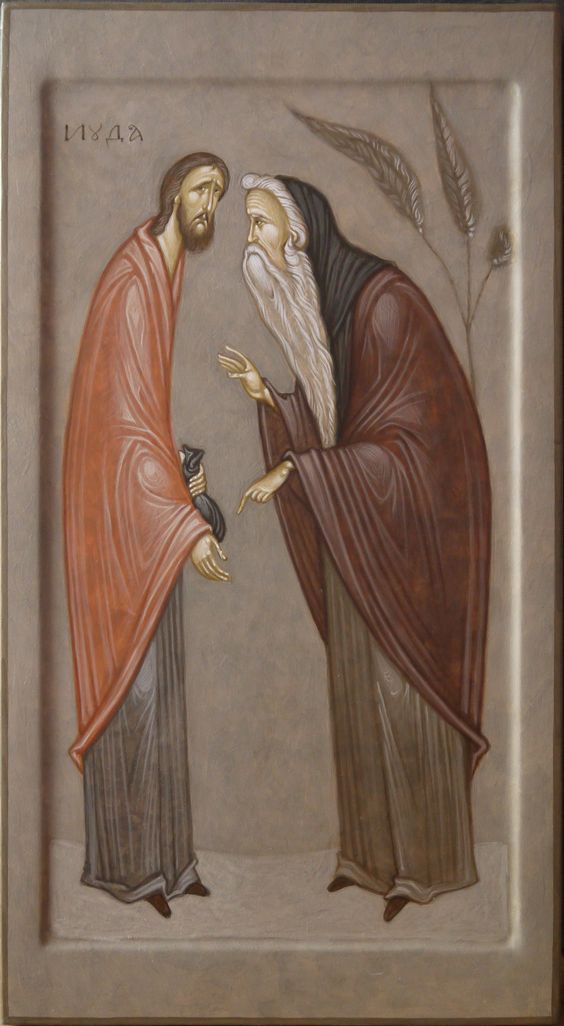
Sheshukov, Maxim_Judas
Maxim Sheshukov, Judas, 2020. Egg tempera on gessoed wood.

+++

NEW ALBUMS:

>> Volume 9 (Lent-Easter-Pentecost) of The Soil and The Seed Project: This is the latest release in an ongoing series of music for the church year by musicians of faith from the Shenandoah Valley. Some of my favorite tracks are “I Will Sing to the LORD” (a setting of Psalm 104:33) and “Hosanna, Loud Hosanna” (a newly retuned but old-timey-sounding hymn for Palm Sunday). I also really like “Gentle Shepherd,” a lullaby written for the children of Salford Mennonite Church to sing in worship in 2018 and performed in this music video by the sister folk duo Spectator Bird:

>> Life and Death and Life: Songs for Lent, Holy Week, and Easter by Steve Thorngate: Chicago-based church musician and songwriter Steve Thorngate has followed up his excellent album After the Longest Night: Songs for Advent, Christmas, and Epiphany with an album for the next two seasons of the church year, including the Day of Pentecost! In addition to twelve original songs, it includes two African American spirituals, a Charles Tindley hymn, and, perhaps my favorite, a cover of (new-to-me) Brett Larson’s poetic country song “Rolling Away,” about barriers to sight and wholeness being removed and a fresh new clarity, a freedom, a path opening up:

>> JOY JOY JOY JOY JOY by Paul Zach: The ever prolific Paul Zach of Virginia’s latest release is an effusively joyous ten-track album celebrating God’s love, salvation, and sustenance. He collaborated with other musicians on the project, including Jon Guerra, Tristen Stuart-Davenport, and IAMSON. Here’s a snippet of the opening song, “Nothing,” based on Romans 8 (listen to the full track here):

Roundup: Upcoming conferences, “Rupture as Invitation,” and more

UPCOMING CONFERENCES:

>> Calvin Symposium on Worship, February 7–9, 2024, Calvin University, Grand Rapids, MI: I’ve promoted this event in years past—see, e.g., here and here—and am excited to be attending again this year! I’ll be coleading a breakout session with Joel Littlepage and Ashley Williams about our work at the Daily Prayer Project, curating textual, visual, and musical resources from across time and place to encourage a life of prayer that reflects the church’s beautiful diversity. There are plenty of other sessions being offered as well; a few that stand out to me are “Blues: The Art of Lament” with Ruth Naomi Floyd (she’s also leading a Jazz Vespers service), “Music, Architecture, and the Arts: Early Christian Worship Practices” with Vince Bantu [previously], and “The First Nations Version New Testament and Its Impact on Worship” with Terry Wildman. This is in addition to what is probably my favorite part: the multiple worship services, led by liturgists, preachers, and musicians from different denominations and cultural backgrounds. I love my local church community, but I also love worshipping with folks from outside it—a reminder that the church is far broader than what I’m used to on a weekly basis.

>> “Poetry and Theology: 1800–Present,” February 22–24, 2024, Duke University, Durham, NC: Supported in part by Duke Initiatives in Theology and the Arts, next month Duke is hosting a poetry symposium that’s free and open to the public! The speakers are Lisa Russ Spaar, Judith Wolfe, Toby Martinez de las Rivas, Thomas Pfau, Kevin Hart, Anne M. Carpenter, Ian Cooper, Anthony Domestico, Luke Fischer, Dante Micheaux, Łukasz Tischner, and Bernadette Waterman Ward. Papers are on the poetry of Hopkins, Eliot, Rilke, Miłosz, and more.

>> “Return to Narnia: Creativity, Collaboration, and Community” (Square Halo Books), March 8–9, 2024, Lancaster, PA: Organized by book publisher, author, illustrator, printmaker, and gallerist Ned Bustard, this year’s Square Halo conference will feature author Matthew Dickerson as its keynote speaker and Sarah Sparks as its musical guest, along with various breakout session leaders, such as Brian Brown of the Anselm Society and Stephen Roach of the Makers & Mystics podcast. Tickets are $210 if purchased in advance or $220 at the door.

>> The Breath and the Clay, March 22–24, 2024, Awake Church, Winston-Salem, NC: Organized by Stephen Roach and friends, this annual creative arts gathering aims to foster community and connection around the pursuit of truth, beauty, and goodness, providing opportunities for immersive encounters and kindling for the imagination. There will be main-room sessions, workshops, a juried art exhibition (entry deadline: February 16), a poetry slam and songwriters’ round, a panel discussion on reconciling artists and the church, concerts, a dance performance, a short film screening, and more. Musical artists include Victory Boyd, John Mark McMillan, Young Oceans, and Lowland Hum, and among the keynote speakers are Rachel Marie Kang, Mary McCampbell, Junius Johnson, Vesper Stamper, and Justin McRoberts. I appreciate the bringing together of various artistic disciplines and the emphasis on practice. For tickets, there are both virtual ($99) and in-person ($299) options.

+++

NEW SONG: “MLK Blessing” by the Porter’s Gate: Written by Paul Zach and IAMSON (Orlando Palmer) and just released for Martin Luther King Jr. Day, this song is based on a benediction that MLK prayed, a variant of the ancient Jewish benediction known as the Birkat Kohahim or Aaronic blessing (Num. 6:24–26). It’s sung by Liz Vice and Paul Zach.

+++

PAST LECTURE: “Rupture as Invitation: Generosity and Contemporary Art” by Elissa Yukiko Weichbrodt: I’ve mentioned Elissa several times on the blog—I find her work so illuminating—and was grateful to have her in town last fall to deliver a lecture for the Eliot Society. “Contemporary art can often be unexpected or downright unsettling in its form and subject matter. But what if we reframed our discomfort as an invitation to enter rather than an unbridgeable divide? In this lecture from November 11, 2023, Dr. Elissa Yukiko Weichbrodt demonstrates how approaching contemporary art with humility, love, and courage can be a powerful means of growing in love for our neighbors.”

+++

UPCOMING EVENT: “Why Should Christians Care About Abstract Art?” with Elissa Yukiko Weichbrodt and Jonathan Anderson, February 22, 2024, Gordon-Conwell Theological Seminary–Charlotte, NC: Hosted by the Leighton Ford Initiative for Art, Theology, and Gospel Witness, this evening will consist of an opening of the exhibition Alfred Manessier: Composer in Colors (on display through April 30) and dessert reception, lectures by Elissa Yukiko Weichbrodt and Jonathan Anderson, and a Q&A. “For some people of faith, abstract art is difficult to engage because the meaning remains unclear, and the form can appear chaotic or uncompelling. For others, abstract art is an invitation to engage the whole person, contemplate spiritual realities, and encounter God in transformative ways. If abstract art can facilitate the latter, then Christians have a unique opportunity to learn and care about abstract art for theological, practical, missional, and relational reasons. This event is a unique opportunity to experience abstract art, learn about abstract art, and have formative interaction with one another on this topic.” The cost is just $10, and there is an online option.

Manessier, Alfred_Mount Calvary
Alfred Manessier (French, 1911–1993), La montée au Calvaire (Mount Calvary), from the Suite de Pâques (Easter Series), 1978. Chromolithograph on Arches paper, 22 × 29 9/10 in. (56 × 76 cm). Edition of 99.

+++

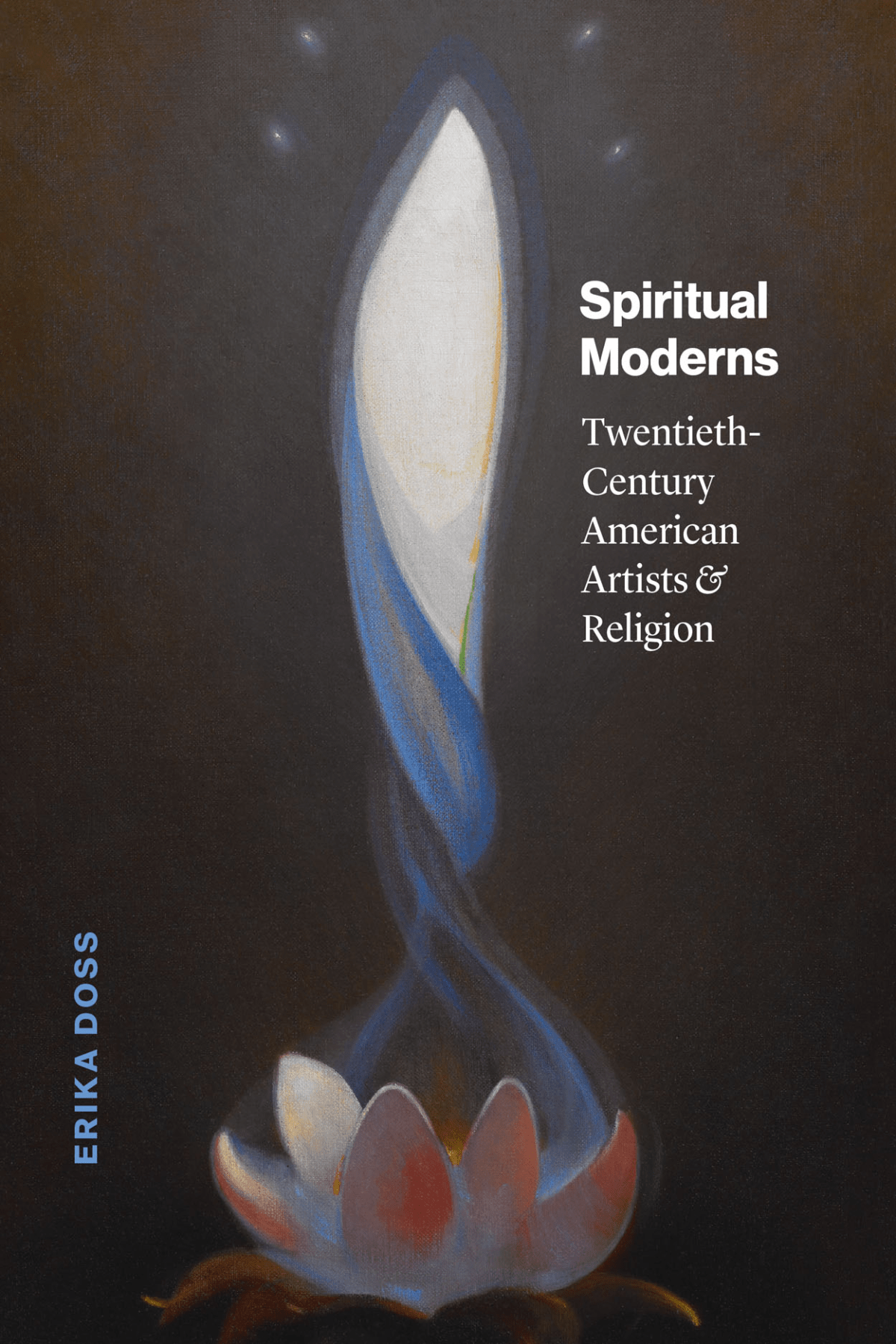
BOOK REVIEW: “Religion’s Understated Influence on Modern Art” by Daniel Larkin, on Spiritual Moderns: Twentieth-Century American Artists and Religion by Erika Doss: Challenging the presumed secularity of modern art, the new book Spiritual Moderns centers on four iconic American artists who were both modern and religious: Andy Warhol, Mark Tobey, Agnes Pelton, and Joseph Cornell.

+ ROUNDTABLE DISCUSSION: Also responding to this publication: the Association of Scholars of Christianity in the History of Art (ASCHA) will be presenting a session at the College Art Association Annual Conference in Chicago on February 16 at 2:30 p.m. that will put four prominent scholars—Stephen S. Bush, Matthew J. Milliner, Robert Weinberg, and Gilbert Vicario—in dialogue with Doss to “explore the assumptions, motivations, and insights of [her] analysis, and consider a more open, inclusive, and diverse reading of American Modernism.”

Ten Songs of Joy for Gaudete Sunday

The third Sunday of Advent is known as Gaudete Sunday, gaudete (pronounced GOW-deh-tay) (Latin for “rejoice”) being the first word of the introit of the day’s Mass, taken from Philippians 4:4–6 and Psalm 85:1:

Gaudete in Domino semper íterum díco, gaudéte: modéstia véstra nóta sit ómnibus homínibus: Dóminus prope est. Nihil sollíciti sítis: sed in ómni oratióne petitiónes véstrae innotéscant apud Déum. Benedixísti, Dómine, térram túam: avertísti captivitátem Jácob.

Rejoice in the Lord always; again I say, rejoice. Let your forbearance be known to all men. The Lord is at hand. Do not be anxious over anything; but in all manner of prayer, let your requests be made known unto God. Lord, you have blessed your land; you have put an end to Jacob’s captivity.

It is customary for priests to swap out their purple vestments for pink today, and for those who use an Advent wreath to light not a purple candle but a pink one. Some churches favor a spare aesthetic in their sanctuaries for the first two weeks of Advent but break out the flowers for this the third. The approximate halfway point of the penitential Advent season, Gaudete Sunday is a special time to rejoice in the nearness of God’s coming as well as God’s presence with us here even now in the waiting, and to receive a foretaste of the bigger celebration to come on Christmas Day.

Here are ten songs for you to enjoy this Gaudete Sunday. If you’d rather listen to them as a YouTube playlist, click here.

Richardson, Jan_Visitation
The Hour of Lauds: Visitation by Jan Richardson [for sale]

1. “Songs of Joy” by Garrison Doles, written late 1990s, on A Songmaker’s Christmas, 2012: “Songs of joy we hopefully sing, expanding our spirits, the season to know . . .” So opens this song by the late singer-songwriter Garrison Doles (d. 2013) [previously]. In 2009 his wife, the artist Jan Richardson, created a video combining the song with five of the seven collages from her Advent Hours cycle (which can be purchased as reproductions). Read the lyrics and songwriter’s statement here.

2. “My Soul Doth Magnify the Lord” by O’Landa Draper and the Associates, on Live…A Celebration of Praise, 1994: A trailblazing gospel choir director, O’Landa Draper was one of the top gospel artists of the nineties. This song of his is based on the Magnificat, the praise song Mary sings in the company of her cousin Elizabeth following the conception of Christ (see Luke 1).

3. “El burrito de Belén” (The Little Donkey of Bethlehem) by Hugo Cesar Blanco, 1972, performed by the band Matute, 2020: This is a Venezuelan carol about a person riding their donkey, with hurried excitement, from the sabanero (savanna) to Bethlehem to see the newborn Christ. Read the lyrics and translation here.

4. “Ecce mundi gaudium” (Behold the Joy of the World), England, 13th century, arranged and performed by the Mediæval Bæbes on Worldes Blysse, 1998: Written in Latin, this thirteenth-century carol is about the Virgin giving birth to the Son, our joy—announced to the shepherds by an angel and to the magi by a star. Despite the upbeat tempo throughout, the last two verses are about Herod’s raging and the Massacre of the Innocents. The soloist is Katharine Blake, the founder and musical director of Mediæval Bæbes. Read the original lyrics here, clicking on individual lines for the English translation.

5. “Kya Din Khushi Ka Aaya” (क्या दिन खुशी का आया) (What a Happy Day), performed by Akshay Mathews, 2021: A Hindi Christmas carol from India. Read the lyrics here.

6. “Repeat the Sounding Joy,” a fragment from “Joy to the World” arranged by Craig Courtney, performed by the Capital University Chapel Choir, 2019: A super-fun, one-minute choral work.

7. “Now Let Us Sing,” traditional, adapt. John L. Bell, 1995, performed by Katarina Ridderstedt, 2015: Katarina Ridderstedt (née Lundberg) is a rhythm teacher, musician, cantor, and choir director from Gotland, Sweden, who records music under the name Musikat. This video of hers introduced me to a charming little quatrain whose origins I don’t know (it’s credited as “Traditional”), but this version comes from Scotland’s Iona Community [previously]: “Now let us sing with joy and mirth, / praising the one who gave us birth. / Let every voice rise and attend / to God whose love shall never end.”

(Update, 1/6/25: “Now let us sing” is of Scottish origin, first appearing during the Protestant Reformation in the congregational song collection The Gude and Godlie Ballatis; the earliest extant edition of this book is from 1567, but it is thought to have been originally published in 1540. The tune was originally a drinking tune. For his rendition, published in Come All You People: Shorter Songs for Worship, John L. Bell essentially rewrote the first stanza, retaining only the first line of the original.)

8. “Brother” by Jorge Ben Jor, on A Tábua de Esmeralda, 1974: Known by the stage name Jorge Ben or (since the 1980s) Jorge Ben Jor, Jorge Duílio Lima Menezes (b. 1939) is a Brazilian singer-songwriter and musician whose characteristic style fuses elements of samba, funk, rock, and bossa nova. In this song he enjoins us to prepare a joyful path for the coming Christ—who is both Lord and friend—with love, flowers, and music.

9. “Alleluia, He Is Coming (I Looked Up)” by Martha E. Butler, 1979: This song is sometimes used in church services for Palm Sunday or Easter, but I think it makes a fitting Advent song as well—especially with the newer last verse that is sometimes used, as in the first video below. “Alleluia, he [Christ] is coming! Alleluia, he is here,” the refrain proclaims. Read about the inspiration behind the song, in the words of the songwriter, here. Allow me to sneak in two different performances. The first is by Donna Rutledge, Becky Buller, and Todd Green of First Baptist Church of Manchester, Tennessee, from 2020; theirs is a lovely rendition with strong vocals and a poignant violin part, but I do prefer a brisker pace (listening to the video at a playback speed of 1.25 is perfect, in my estimation):

The second is by the South African group Worship House, from their 2016 album Project 5 (Live in Johannesburg):

10. “Joy Will Come” by Paul Zach: The refrain of this song by Paul Zach of Virginia is based on Psalm 30:5b: “Weeping may linger for the night, but joy comes with the morning.” I also hear echoes of Psalms 18 and 121 throughout. The song is a reminder that through the dark nights we experience, we have hope; we have a Savior who will not abandon us.

Trinity Sunday Roundup

Today, June 4, is Trinity Sunday! Here’s a handful of art and music items on the topic.

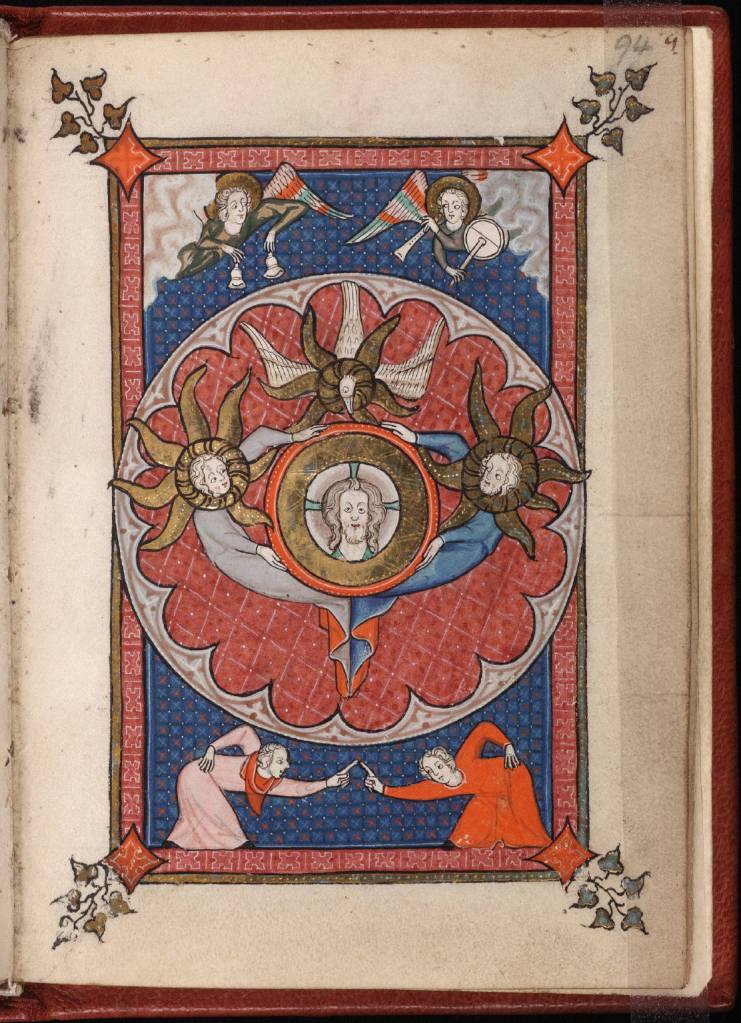
VISUAL MEDITATION: “The Wheeling Playfulness of the Trinity” by Victoria Emily Jones: The Rothschild Canticles [previously] from ca. 1300 Flanders contains some of the most inventive and delightful artistic renderings of the Trinity that I’ve ever seen. I key in on four of them in today’s visual meditation for ArtWay

Beinecke MS 404, fol. 94r

+++

MUSICAL COMMENTARY: “Theology in Sound and Motion: Perichoresis, for Brass Quintet” by Delvyn Case: Delvyn Case provides musical and theological commentary on his brass quintet composition “Perichoresis” (2006), inspired by the divine dance of the Trinity. “Its overall mood is joyous, an ecstatic whirling-about in which all three members become lost in the ecstasy of divine fellowship,” he writes. “At the exact moment of the dance when one member moves, the other fills in the spot left vacant.” “Perichoresis” premiered by Boston’s Triton Brass and appears on Case’s 2018 album Strange Energy. About this piece, Bible scholar and theologian Walter Brueggemann said, “I . . . have pondered ‘perichoresis’ for a long time. This is the finest exposition of that thick idea that I have encountered.”

+++

SONGS:

>> “Trinity Song” by Paul Zach: Performed in 2021 by Solomon Dorsey with Liz Vice and Madison Cunningham, this song by Paul Zach evolved into “God of Grace and Mystery” for The Porter’s Gate’s 2022 album Climate Vigil Songs. This earlier iteration has a Trinitarian focus that’s just lovely. “God of all eternity / Father, Spirit, and the Son / Ever-loving Three-in-One / O divine community / . . . / Calling us to join your dance . . .”

>> “One-Two-Three” by the Chosen Gospel Singers: This song was recorded in Los Angeles for Specialty Records and released as a single in 1952, with singers J. B. Randall (bass), E. J. Brumfield (tenor), George Butler (tenor), Fred Sims (tenor), and Oscar Cook (baritone). It opens with a repetition of the lines “One, two, three / One-in-Three and the Trinity.” The refrain is:

One for the Father
Two for the Son
Three for the Holy Ghost
All made of one

The song is largely eschatological. The first verse is about John the Revelator’s vision of the New Jerusalem descending, among other wonders; it ascribes a vision of the Trinity to John, even though that is not explicit as such in either John’s Gospel or the Apocalypse (but see “The Trinity in the Book of Revelation” by Edwin Reynolds). The second verse anticipates our singing and praising the Triune God in heaven, dressed in our brand-new robes. It also mentions David and Goliath, and I’m honestly not sure how that relates. But with gospel songs, floating lyrics are common, taken from one song and spliced into another, some more coherent than others in their new context.

+++

ESSAY: “The Hospitality of Abraham in the Work of Julia Stankova, Painter of Bulgarian Icons” by François Bœspflug: The first half of this peer-reviewed article introduces readers to the Bulgarian artist Julia Stankova, rehearsing her biography and examining her relationship to the icons tradition. The second half explores twelve of her paintings on the subject of the three angelic visitors to Abraham and Sarah in Genesis 18, whom the narrator suggests are a manifestation of God (“The LORD appeared to Abraham at the oaks of Mamre . . .”); because of the number of visitors, many Christians interpret this passage as revealing something of God’s triune nature, and for this reason traditional icons of the story are often titled The Trinity.

Stankova, Julia_The Hospitality of Abraham
Julia Stankova (Bulgarian, 1954–), The Hospitality of Abraham, 2004. Tempera on primed wooden panel and lacquer technique, 46 × 41 cm.

Since the publication of this article in 2019, Stankova has made at least three more paintings on the subject, all of which foreground Sarah and are titled Sarah’s Smile. She has just heard the angels announce that she will conceive a son in her old age.

+++

POEM: “After Rublev’s Trinity by Carrie Purcell Kahler: Published in Image no. 99 (Winter 2018), p. 21, this ekphrastic poem by Carrie Purcell Kahler interprets the famous fifteenth-century Trinity icon by Andrei Rublev. Sometimes referred to as “the hospitality of Abraham,” this biblical episode, as the iconographers interpret it, is really about the hospitality of God, who extends a hand to humanity, ever inviting us to sit at his table.

Rublev, Andrei_Trinity
Andrei Rublev (Russian, 1360–ca. 1430), The Trinity, ca. 1411. Tempera on wood, 141.5 × 114 cm. Tretyakov Gallery, Moscow.

A new choral setting of this poem by Garrett John Law is premiering today at Holy Trinity Episcopal Church in Covina, California, where Law serves as music director and organist. I believe it can be heard on the 10:30 a.m. PT worship service livestream on the church’s YouTube channel, but I’m not sure whether the performance will be archived online for later viewing. (Update, 6/12/23: Here it is! Sung by Holy Trinity’s seven-person choir.)

The Reproaches: A divine lament for Good Friday

O my people, what have I done to you?
In what have I wearied you? Answer me!

—Micah 6:3

The Reproaches (Latin: Improperia), also known by the first phrase of their refrain, “Popule meus” (O My People), are a series of antiphons and responses used in Good Friday liturgies across all three branches of Christianity. The text contrasts Old Testament stories of God’s goodness with humanity’s enactment of evil against God’s Son. Whereas God graciously delivered his people from death time and again throughout history, they delivered his Son to death—death on a cross. Thus God reproaches us, his beloved ones, for our fatal rejection of Christ, his greatest gift, lamenting that we have spurned his love.

The lyrics are reproduced below (the side-by-side formatting with English translation on the right is best viewed on a computer screen), followed by four musical settings, chosen from among dozens. In the present Roman Rite, the roman-style text is sung by a cantor and the italicized text by a choir, and the lines of the Trisagion (“Thrice Holy”), the ancient hymn that follows the first improperium, are sung by two halves of a choir in alternation—the first singing in Greek, the second in Latin. Composers working outside that context, however, may assign the sections differently.

(Related post: “Blood and Tears”)

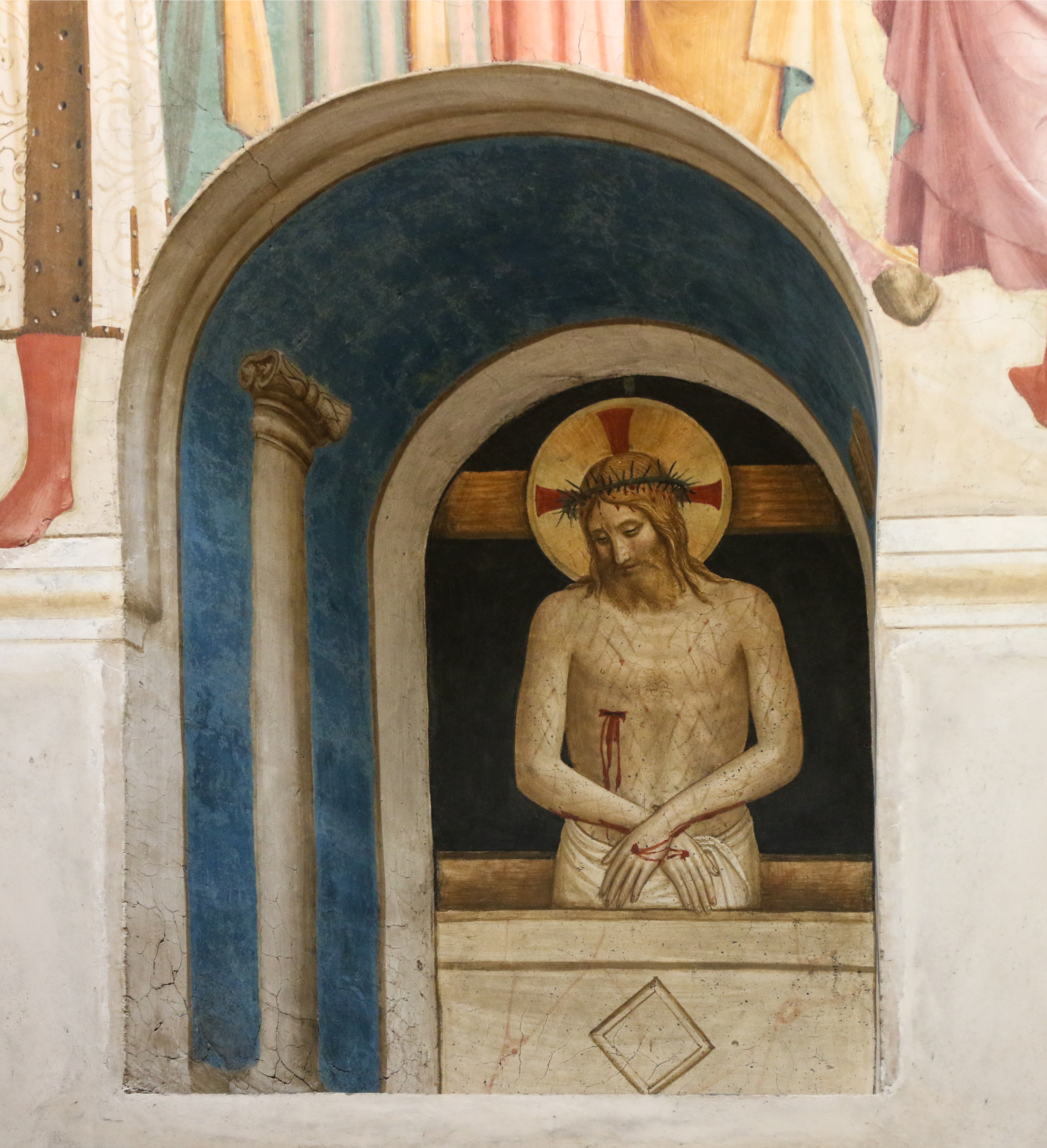
Fra Angelico_Man of Sorrows
Fra Angelico (Italian, ca. 1395–1455), Man of Sorrows, ca. 1440. Fresco, Cell 39, Convent of San Marco, Florence. Photo: Fr. Lawrence Lew, OP.

Popule meus, quid feci tibi?
Aut in quo contristavi te?
Responde mihi.

Quia eduxi te de terra Aegypti:
parasti Crucem Salvatori tuo.

   Hagios o Theos.
      Sanctus Deus.
   Hagios Ischyros.
      Sanctus fortis.
   Hagios Athanatos, eleison himas.
      Sanctus immortalis, miserere nobis.

Quia eduxi te per desertum quadraginta annis:
et manna cibavi te, et introduxi te in terram satis bonam:
parasti Crucem Salvatori tuo.
Hagios . . .

Quid ultra debui facere tibi, et non feci?
Ego quidem plantavi te vineam meam speciosissimam:
et tu facta es mihi nimis amara:
aceto namque sitim meam potasti:
et lancea perforasti latus Salvatori tuo.
Hagios . . .

Ego propter te flagellavi Aegyptum cum primogenitis suis:
et tu me flagellatum tradidisti.
Popule meus . . .

Ego te eduxi de Aegypto, demerso Pharone in mare Rubrum:
et tu me tradidisti principibus sacerdotum.
Popule meus . . .

Ego ante te aperui mare:
et tu aperuisti lancea latus meum.
Popule meus . . .

Ego ante te praeivi in columna nubis:
et tu me duxisti ad praetorium Pilati.
Popule meus . . .

Ego te pavi manna in desertum:
et tu me cedisti alapis et flagellis.
Popule meus . . .

Ego te potavi aqua salutis de petra:
et tu me potasti felle et aceto.
Popule meus . . .

Ego propter te Chananeorum reges percussi:
et tu percussisti arundine caput meum.
Popule meus . . .

Ego dedi tibi sceptrum regale:
et tu dedisti capiti meo spineam coronam.
Popule meus . . .

Ego te exaltavi magna virtute:
et tu me suspendisti in patibulo crucis.
Popule meus . . .
O my people, what have I done to thee?
Or how have I offended thee?
Answer me.

Because I led thee out of the land of Egypt:
thou hast prepared a cross for thy Savior.

O holy God!
O holy God!
O holy strong One!
O holy strong One!
O holy and immortal, have mercy upon us.

Because I led thee through the desert for forty years:
and fed thee with manna, and brought thee into a land exceeding good:
thou hast prepared a cross for thy Savior.
O holy God! . . .

What more ought I to have done for thee, that I have not done?
I planted thee, indeed, my most beautiful vineyard:
and thou hast become exceeding bitter to me:
for in my thirst thou gavest me vinegar to drink:
and with a spear thou hast pierced the side of thy Savior.
O holy God! . . .

For thy sake I scourged the firstborn of Egypt:
Thou hast given me up to be scourged.
O my people . . .

I led thee out of Egypt, having drowned Pharaoh in the Red Sea:
and thou hast delivered me to the chief priests.
O my people . . .

I opened the sea before thee:
and thou hast opened my side with a spear.
O my people . . .

I went before thee in a pillar of cloud:
and thou hast led me to the judgment hall of Pilate.
O my people . . .

I fed thee with manna in the desert:
and thou hast assaulted me with blows and scourges.
O my people . . .

I gave thee the water of salvation from the rock:
and thou hast given me gall and vinegar to drink.
O my people . . .

For thy sake I struck the kings of the Canaanites:
and thou hast struck my head with a reed.
O my people . . .

I gave thee a royal scepter:
and thou hast given a crown of thorns for my head.
O my people . . .

I exalted thee with great strength:
and thou hast hanged me on the gibbet of the cross.
O my people . . .

1. “Popule meus” by Tomás Luis de Victoria (1585)

First up, a traditional setting of the Latin by the Spanish Renaissance composer Tomás Luis de Victoria (ca. 1548–1611) [previously], performed by Ensemble Invocatio under the direction of Daniel Knaggs in 2022 at Seminary Church in Warsaw, Poland. The soloist is Łukasz Dziuba. This four-part motet is the most widely performed setting of the Reproaches.

2. “The Reproaches” by John Sanders (1984)

This setting in English by the British composer John Sanders (1933–2003) has become standard repertoire for many English cathedral and church choirs. Sanders first wrote it in 1984 for a Good Friday service at Gloucester Cathedral, where he served as organist, but it wasn’t published until 1993. It’s performed here by the Ely Cathedral Choir, conducted by Sarah MacDonald, from 2018. Whereas Victoria scored his setting for four voices (SATB), Sanders scored his for eight (SSAATTBB), creating more complex harmonies, including dissonance.

3. “Popule meus” by Filipe Faria and Sérgio Peixoto (2015)

In 1999 Portuguese composers Filipe Faria (b. 1976) and Sérgio Peixoto (b. 1974) founded Sete Lágrimas ECMC (Early and Contemporary Music Consort) to create dialogues between medieval, Renaissance, and early Baroque music on the one hand and contemporary music on the other. Their “Popule meus,” which includes just the opening refrain, is from their Missa Mínima, a minimalistic setting for two voices and recorder of the five parts of the Catholic Mass, along with other important liturgical texts. They began composing it in 1999, put it on the back burner for a while, and returned to it later, completing it in 2015. In this 2016 recording, the singers are Faria and Peixoto. The melodic embellishment on the syllable -sta in contristavi (literally “saddened” but more often translated in this song as “offended” or “distressed”) creates a tense quivering effect, a climax before the languid return to the title phrase and a petering off with “Responde mihi.”

4. “The Reproaches” by Paul Zach (2021)

American singer-songwriter Paul Zach wrote this condensed version of the Reproaches with frequent collaborator Kate Bluett [previously], which puts the words in the voice of the people, who assume and repent of their responsibility for Jesus’s death—for no matter our temporal or geographical proximity to the event, it was our sin that led him to and held him on the cross. Transferring the speaker from God to the Christian for the whole duration helps make the song more suitable for congregational singing, as it can then function as a corporate confession.

You delivered us from Pharaoh;
We delivered you to death.
You gave manna in the desert;
We gave a crown of thorns for your head.

You brought us out of slavery
Into the promised land;
We brought you up to Calvary
And pierced your feet and hands.

Holy God, Holy Mighty One,
Holy Immortal One,
Have mercy, mercy,
Have mercy on us.

You opened up the Red Sea;
We opened up your side.
“Come down, come down,” we mocked you;
“My God, my God,” you cried.

Holy God, Holy Mighty One,
Holy Immortal One,
Have mercy, mercy,
Have mercy on us.

Zach told me he’s not fully satisfied with the song and is working on a rewrite that he may release in 2024. Nonetheless, I really like what he and Bluett have created here! And I appreciate how it brings the Reproaches into an indie-folk idiom, making that long-standing sung portion of the global church’s Good Friday liturgy accessible to those who find it difficult to connect with choral music or chant.

Addendum, 3/21/23: Rev. Bill Combs from Greensboro, Georgia, has just reminded me of a contemporary adaptation of the text of the Reproaches by Janet Morley, a liturgist from the UK. It’s from her wonderful collection All Desires Known, a resource for public worship and private devotion, and can be read here. Combs’s church, Episcopal Church of the Redeemer, chants this text as part of their annual Good Friday service using Tone II.1.

Roundup: New Lent album, Porter’s Gate Kickstarter, “Bare and Bones,” and more

NEW ALBUM: Lent Hymns by Paul Zach: Released this month, Lent Hymns by Paul Zach comprises twelve songs, a mix of originals and classics, with contributions by IAMSON, Jessica Fox, Sara Groves, Jon Guerra, and Kate Bluett. The LP is available wherever music is streamed or sold. Here’s an Instagram video that excerpts “Draw Me In”:

+++

KICKSTARTER: New Porter’s Gate album: This summer The Porter’s Gate, an interdenominational Christian music collective, is gathering songwriters to write and record musical settings of passages from The Message, a translation of the Bible by the late Eugene Peterson [previously] that uses contemporary idioms and phrases. The project is in partnership with the Eugene Peterson Center for Christian Imagination at Western Theological Seminary in Holland, Michigan. I’m so looking forward to this!

+++

SONGS:

>> “Вечірня молитва” (Vechirnya molytva) (Evening Prayer): A choral setting of a text from the Divine Service of the Eastern Orthodox Church, by contemporary Ukrainian composer Iryna Aleksiychuk. Performed in 2012 by the Female Choir of Kiev Glier Institute of Music, conducted by G. Gorbatenko. [HT: Global Christian Worship]

English translation:

Heavenly King, Comforter, Spirit of Truth,
Who art everywhere present and fillest all things,
Treasury of good things, and Giver of life:
Come and abide in us, and cleanse us from every sin,
And save our souls, O Good One!
Holy God, holy Mighty, holy Immortal,
Have mercy on us.

>> “Bare and Bones” by Candace Coker: Trinidad-born, Vancouver-based singer-songwriter Candace Coker sings the title track from her new album, Bare and Bones, with her boyfriend, Josiah Charleau. The video is shot at Bamboo Cathedral, a thousand-foot stretch of roadway in Tucker Valley in Chaguaramas, Trinidad and Tobago, where bamboo stalks bend toward each other across the road, creating a canopy.

>> “HigherHoly” by IAMSON: IAMSON is the artist name of singer-songwriter and music producer Orlando Palmer, based in Richmond, Virginia. He released this song as a single in 2020. The rap is performed by guest artist Marv (Marvin Hudgins II) of Chattanooga, Tennessee, and the animation in the video is by Kenya Foster.

>> “I Could Sing of Your Love Forever” (cover) by Mary Yang and Ger Vang: Mary Yang and Ger Vang are Hmong Christian musicians living in Milwaukee, Wisconsin. (The Hmong are an Indigenous people group from East and Southeast Asia.) Here they perform their bossa nova arrangement of this modern worship classic by Martin Smith of the English band Delirious?. Yang and Vang are part of the Fishermen’s Project, a band that releases mainly classic hymns translated into the Hmong language. [HT: Global Christian Worship]