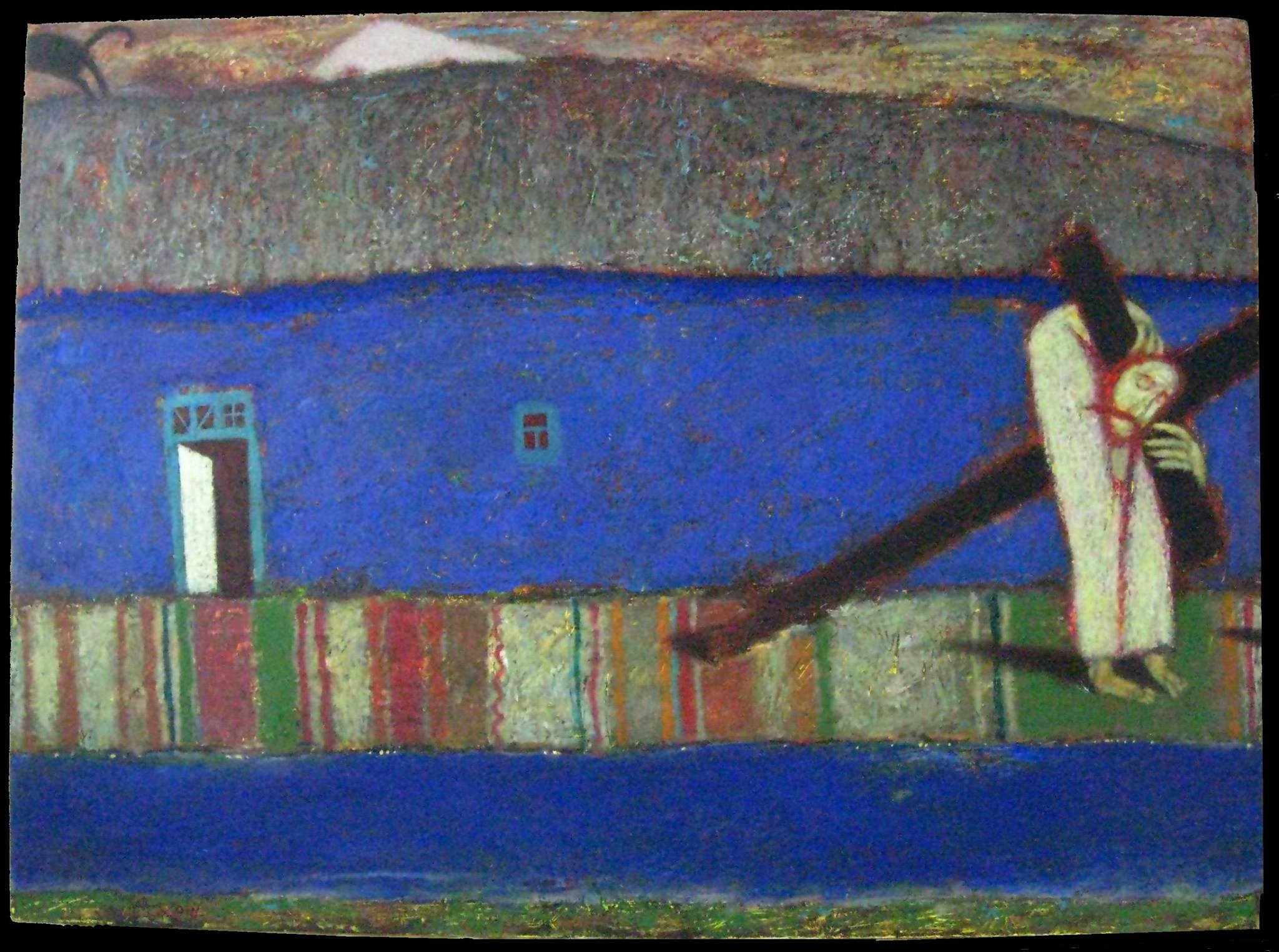
It is the day of Resurrection and an auspicious beginning. Let us be made brilliant by the feast and embrace each other. . . .
Yesterday the lamb was slaughtered, and the doorposts were anointed, and the Egyptians lamented the firstborn, and the destroyer passed over us, and the seal was awesome and venerable, and we were walled in by the precious blood. Today we have totally escaped Egypt and Pharaoh the harsh despot and the burdensome overseers, and we have been freed from the clay and the brick-making. And nobody hinders us from celebrating a feast of exodus for the Lord our God. . . .
Yesterday I was crucified with Christ, today I am glorified with him; yesterday I died with him, today I am made alive with him; yesterday I was buried with him, today I rise with him.
—Gregory of Nazianzus, “On Pascha and on His Slowness,” an Easter sermon from ca. 362, trans. Nonna Verna Harrison in Festal Orations by Saint Gregory of Nazianzus (St. Vladimir’s Seminary Press, 2008)
LOOK: Miniature from the Tomić Psalter

This miniature comes from a fourteenth-century illuminated psalter from Bulgaria, a masterpiece of the Tarnovo art school. It’s linked to Psalm 105, which exults in the memory of God bringing Israel up out of Egypt, providing for them in the desert, and establishing them in the promised land. “So he brought his people out with joy, his chosen ones with singing,” the psalmist writes (Ps. 105:43).
More directly, the image is an illustration of Exodus 15:20–21, an episode of female-led worship that occurs just after the crossing of the Red Sea:
And Miriam the prophetess, the sister of Aaron, took a timbrel in her hand; and all the women went out after her with timbrels and with dances.
And Miriam answered them, Sing ye to the LORD, for he hath triumphed gloriously; the horse and his rider hath he thrown into the sea.
The only percussion instrument mentioned in the Hebrew Bible, the timbrel (Heb. toph), or hand drum, consists of a hoop of wood or metal over which the skin of an animal is stretched. Some have jingles around the rim, like the modern tambourine, and some do not. The instrument is associated with women and celebration.
In the visual imagination of the anonymous Tomić Psalter artist, Miriam beats a drum with a stick while two of her companions clash cymbals and other women interlock arms and dance. The artist probably took inspiration from the folk music and dancing of women in his own culture.
LISTEN: “Da Mariae tympanum” (Give Mary a Tambourine) | Words by Peter Abelard, 1130s | Music by Georg Forster, 16th century | Performed by the Augsburg Early Music Ensemble on Medieval Pilgrimage to Santiago, 2003
Da Mariae tympanum
resurrexit Dominus,
Hebraes ad canticum
cantans provocet,
Holocausta carminum
Iacob immolet.

Subvertens Aegyptios,
resurrexit Dominus,
Rubri Maris alveos
replens hostibus,
quos involvit obrutos
undis pelagus.

Dicat tympanistria,
Resurrexit Dominus,
illa quidem altera
re, non nomine,
resurgentem merita
prima cernere.

Cantet carmen dulcius,
resurrexit Dominus,
reliquis fidelibus
mixta feminis,
cum ipsa narrantibus
hoc discipulis.

Deo patri gloria,
resurrexit Dominus,
salus et victoria
Christo Domini;
par honor per saecula
sit Spiritui.
Give Mary a tambourine,
for the Lord has risen;
as she sings, let her incite
Hebrew women to song;
let too Jacob sacrifice
holocausts of songs.
Egyptians he did overwhelm,
for the Lord has risen,
filled the Red Sea’s submerged caves
with his enemies,
whom the sea caught and buried
in the waves below.
Let the timbrel player sing,
For the Lord has risen,
a second Mary, different in
her person, not in name,
she deserved to be the first
to see him risen up.
Let her sing a sweeter song,
for the Lord has risen,
as she mingles with the rest
of the faithful women,
who with her proclaim the news
to the Lord’s disciples.
Glory be to God the Father,
for the Lord has risen,
health restored and victory
to the Lord’s anointed;
equal honor through the years
to the Holy Spirit.
Trans. Peter G. Walsh with Christopher Husch in One Hundred Latin Hymns: Ambrose to Aquinas (Harvard University Press, 2012)
This hymn is from the second book of the Hymnarius Paraclitensis (Hymnary of the Paraclete), a collection of over 130 Latin hymns written by the French philosopher and theologian Peter Abelard (1079–1142) [previously] for the convent of the Paraclete near Troyes, headed by Héloïse. It imagines Mary Magdalene as the New Miriam (Mary is the anglicized form of the Hebrew Miriam), leading women in song and dance in celebration of God’s victory over the forces of sin and death through the resurrection of God’s Son, Jesus Christ.
(Related posts: “‘Oh Mary, Don’t You Weep’: Death, Resurrection, and the New Exodus”; “Tambourines” by Langston Hughes)
In Christianity, the exodus is interpreted not just as a literal saving act in Israel’s history but also as a prefigurement of the Resurrection. In many churches, Exodus 14, recounting the Israelites’ crossing of the Red Sea, is part of the Easter liturgy. The Orthodox word for Easter, Pascha—a Greek word from the Hebrew Pesach—itself means “Passover,” further reinforcing the connection between the Israelites’ liberation from Egyptian slavery and the liberation of God’s New Testament people from spiritual bondage, both made possible by the blood of a lamb and requiring passage through the waters—sea versus baptismal.
Mary Magdalene was one of Jesus’s closest disciples, and it’s she, according to the Gospel of John, to whom he first appeared following his resurrection. He then commissioned her to go tell the other disciples—to beat the drum, as it were, announcing the good news that he is alive. The Gospels of Matthew and Luke have her joined in this task by other faithful women: “the other Mary” and “Joanna, Mary the mother of James, and the other women,” respectively.
I like the image Abelard gives us of Mary Magdalene rousing her female companions with a tambourine, leading them in the song and dance of resurrection. In the new exodus, Christ guides humanity into freedom, from death to life, as Mary praisefully proclaims, across the path he has paved by his own rising. “Resurrexit Dominus!” The men at first disbelieve her testimony . . . but once they see what she’s seen, they, too, rejoice.
The musical setting of Abelard’s text featured above is by the German Renaissance composer and physician Georg Forster (ca. 1510–1568).