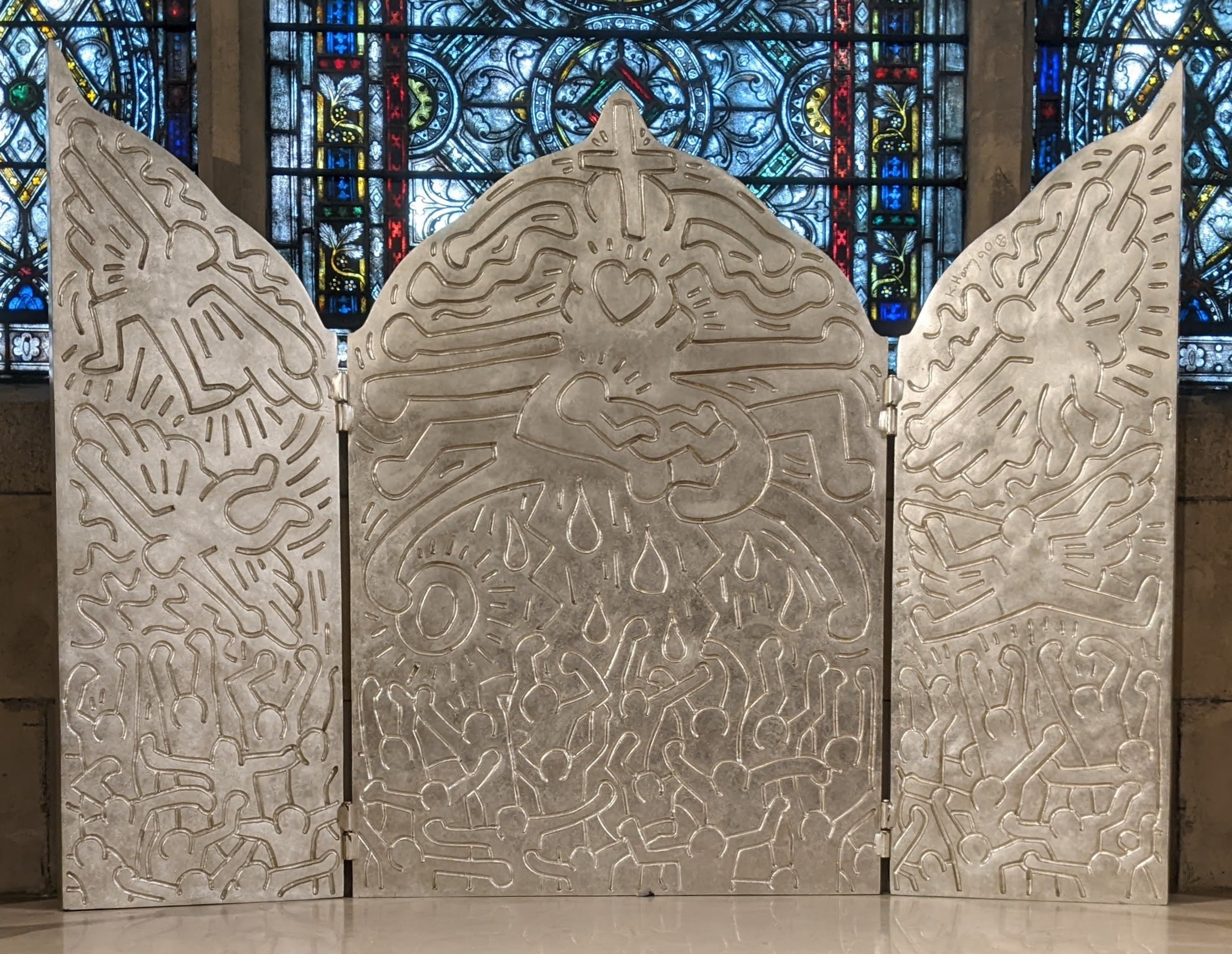
Keith Haring (American, 1958–1990), The Life of Christ, 1990. Bronze altarpiece with white gold leaf patina, 81 × 60 × 2 in. Edition of 9. Chapel of St. Columba, Cathedral of St. John the Divine, New York. All photos by Victoria Emily Jones.
Keith Haring [previously] was a popular artist and activist on the New York scene during the 1980s. Inspired by graffiti art, he started his career by filling empty poster spaces with chalk drawings in the city’s subway stations. He wanted to make art accessible to everyone and believed that it “should be something that liberates the soul, provokes the imagination, and encourages people to go further.”
His style is characterized by bold black outlines, vibrant colors, a sense of rhythm, and simple iconic figures like the Barking Dog and Radiant Baby, which recur again and again in his oeuvre.
Sadly, Haring’s career was cut short by AIDS, which he died of on February 16, 1990, at age thirty-one. The last work he completed, just weeks before his death, was a Life of Christ altarpiece, a work that conveys eternal love and loss, divine suffering and hope. Without any preliminary sketches, he cut the design into clay using a loop knife. It was posthumously cast in bronze and covered in a white gold patina, an edition of nine.
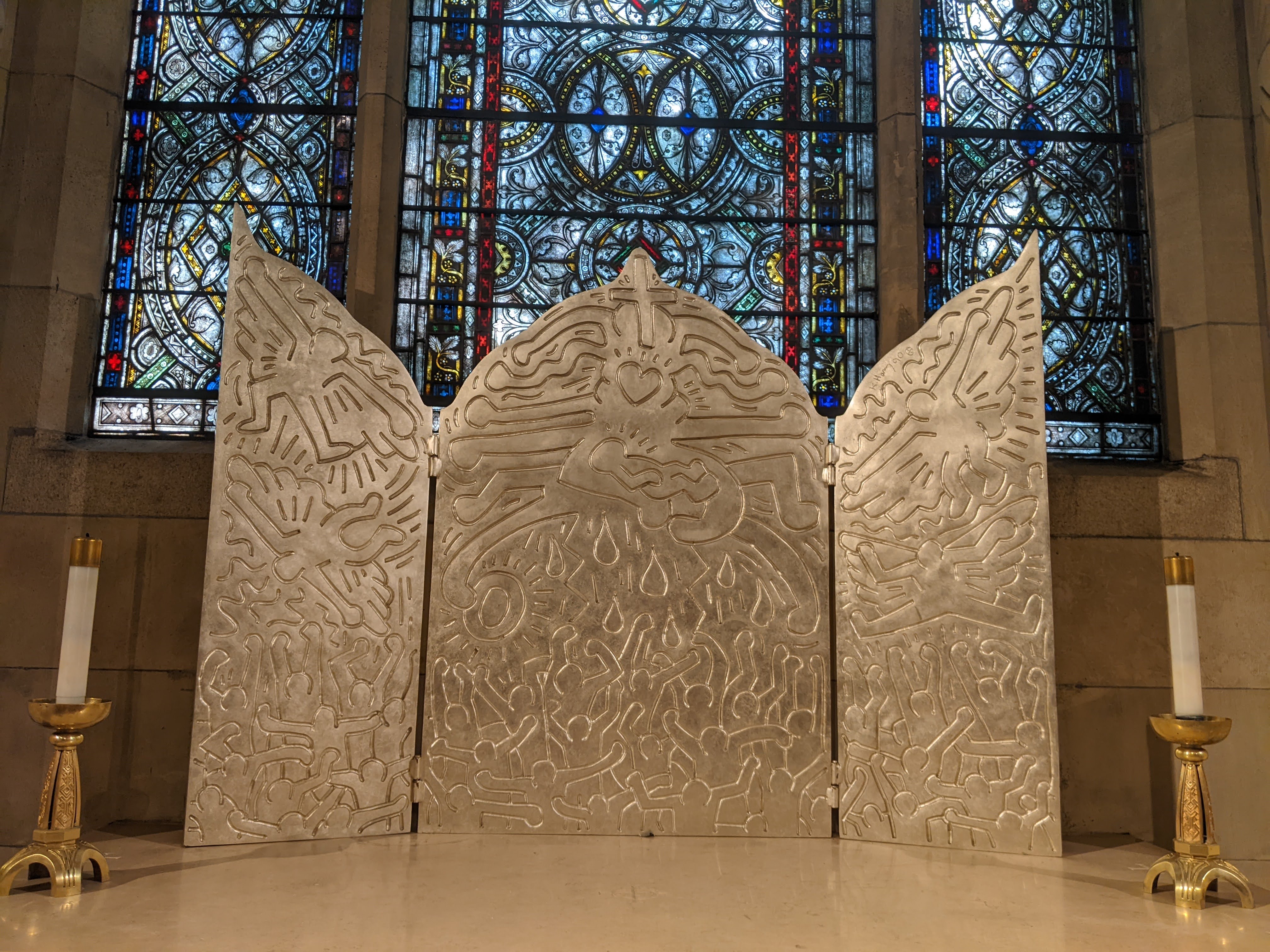
The first edition is housed in the Cathedral of St. John the Divine in New York, the world’s fourth-largest church by area, where Haring’s memorial service was held.
Chapel of St. Columba, Cathedral of St. John the Divine, New York, designed by the architectural firm Heins & LaFarge, dedicated 1911. The stained glass windows are by Wilbur Burnham of Boston and Clayton & Bell of London, and the altarpiece, a later addition, is by Keith Haring.
Pulsating, cosmic, and somehow both mournful and joyous, the altarpiece is a triptych, meaning it has three panels. The central panel shows, at the top, a cross, below which is a multiarmed figure holding a baby. The top figure I interpret as God the Father, his arms all-embracing. Below him, at torso level, I discern a second figure (though the head is not clearly defined), who must be Mary, a shining heart over her face. Nestled in her arms is, irrefutably, her infant son Jesus.
Another possible reading is that this is the Trinity—Father, Spirit, and Son—united in an act of self-giving.
The surplus of arms (I count thirteen, plus the baby’s two) reminds me of the Thousand-Armed Avalokiteśvara in Buddhism; a bodhisattva associated with limitless compassion, his arms represent his extending aid, his reaching out to touch, heal, and uplift. One of the arms here stretches down to bestow a halo on humankind, which in Christianity symbolizes the grace/light of God.
Below this primary grouping is a crowd of people who appear to me to be dancing and celebrating, lifting their arms to receive the blessings that flow forth from the holy child. (Or are they clamoring, turning away, resisting? Without facial features and fingers, it’s hard to tell!) Drops of Jesus’s blood fall over all, bringing redemption.
On the two side panels, angels careen down from the heavens, surfing, leaping, tumbling, one screeching to a halt.
Haring’s Life of Christ combines, as have many artworks before it, Jesus’s birth and death, collapsing his time on earth, his ministry of salvation, into a single image of incarnation and atonement. Mary holds him as a newborn, but she also holds him as a lifeless adult after his crucifixion—a traditional representation known as the Pietà. Many artists have given Mary a sad twinge in her eye at the nativity, suggesting a premonition of loss.
Haring’s figures are faceless, so we can’t look there for emotional clues, but Mary’s body language suggests both a desire to keep and protect her son, and a willingness to give him up for the greater good.
I wonder whether, when Haring incised the sacred blood drops, he was not only thinking of the “power in the blood” that Christians sing about in reference to Jesus’s redemptive sacrifice—and all the weight that bodily fluid as Christian symbol carries—but also lamenting the HIV infecting his own bloodstream, ravaging his body and stigmatizing him, and that had already killed many of his friends and his partner.
Haring’s friend Sam Havadtoy, who was present at the altar’s creation, reports that when Haring finished the piece, he stepped back and, gazing at it, said, “Man, this is really heavy.”
I think the prominence of blood must have been at least partly influenced by the destructiveness of the AIDS epidemic and the artist’s meditation on his mortality, perhaps even hope for transcendence through death. And if so, then the Radiant Baby, who, the artist’s title would lead us to assume, is Jesus, could also double as the soul of an AIDS victim being taken back up to God.
While I hesitate to ascribe prayers or intentions to others that they have not clearly voiced, I can’t help but think that this last artwork of Haring’s, executed in the final throes of his illness, its subject returning him to the Christianity of his youth, to a story that once captivated him, was in one sense a plea for (physical and spiritual?) cleansing, for deliverance.
LISTEN: “We Sing Glory” by Fred Hammond, on Fred Hammond Christmas . . . : Just Remember (2001)
Little baby boy, sent as God among us For your plan to free all humanity We sing glory to your name Sing glory to your name
Tiny fragile heart Pumped your blood to save us For you’ve come to be a sin offering Singing glory to the Lamb Sing glory to the Lamb
Singing glory to the one Who saved the whole world Born to die but you live again And take all our sins away
Little hands and feet Made for nail and hammer For the pain and grief you suffered for me I sing glory to the Lamb Oh, glory to the Lamb
Tiny arms and legs Broad, strong, and sturdy You carry the key to our victory We sing glory to your name We sing glory to your name
We sing glory to the Child Who will save the whole world Born to die and then live again To take all our sins away
Glory, glory to the one Who was born to save the whole world You died but you’ll rise again So Jesus, we praise your name
Hark the herald angels sing Glory to the newborn King Peace on earth and mercy mild God and sinner reconciled Thank you, Jesus
Hark the herald angels sing Glory to the newborn King Peace on earth and mercy mild God has come to save us Yes, he has
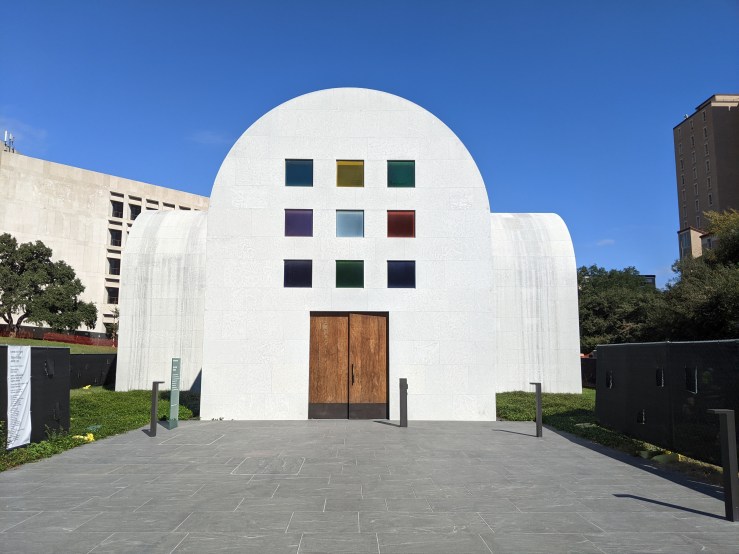
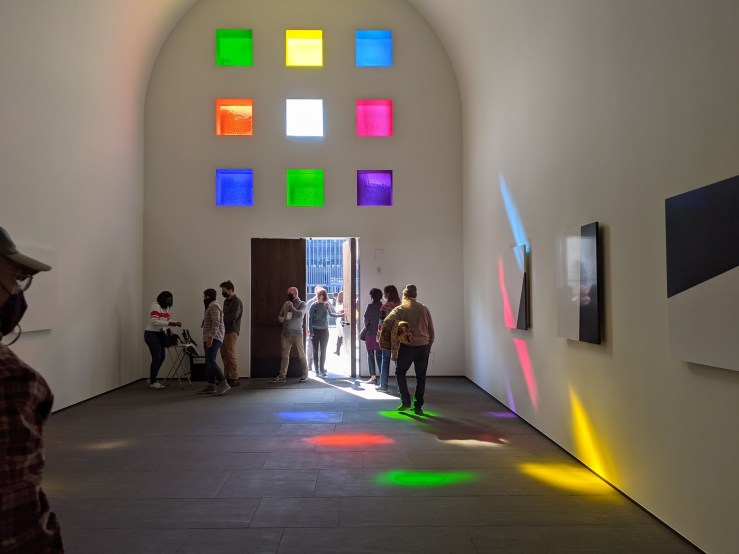
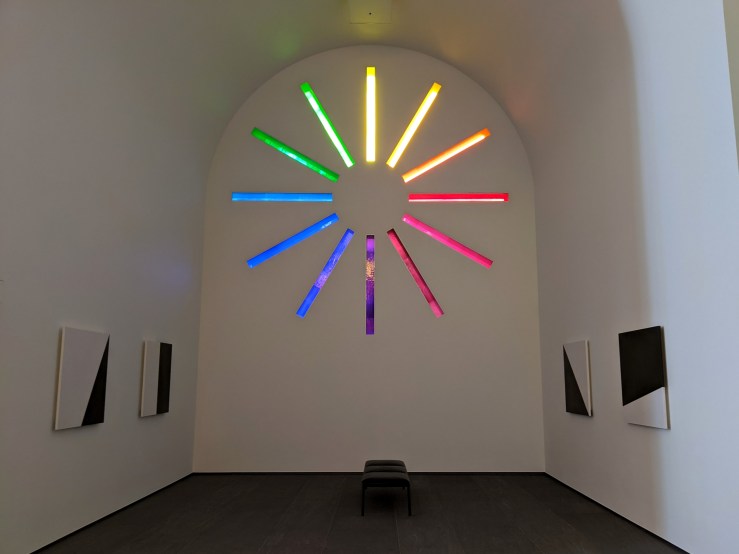
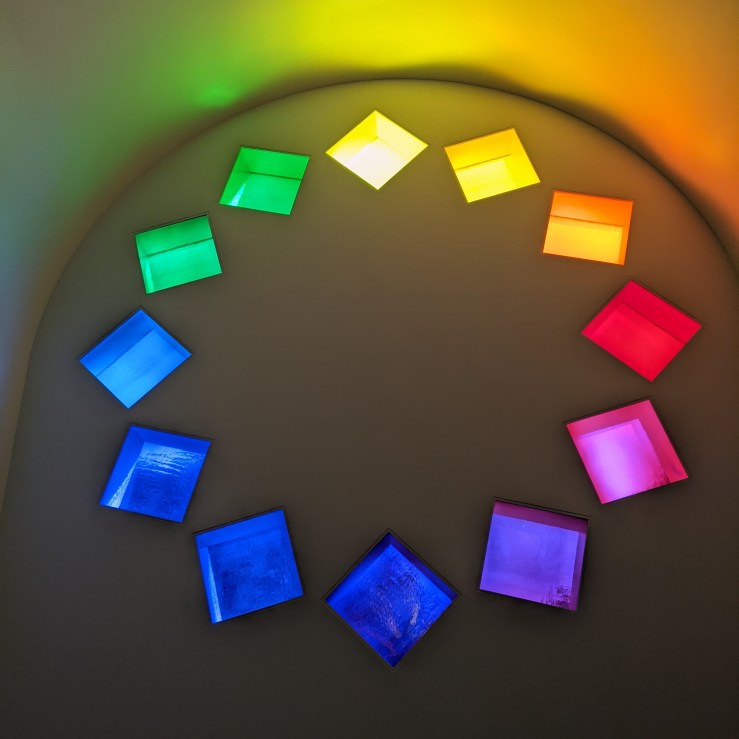
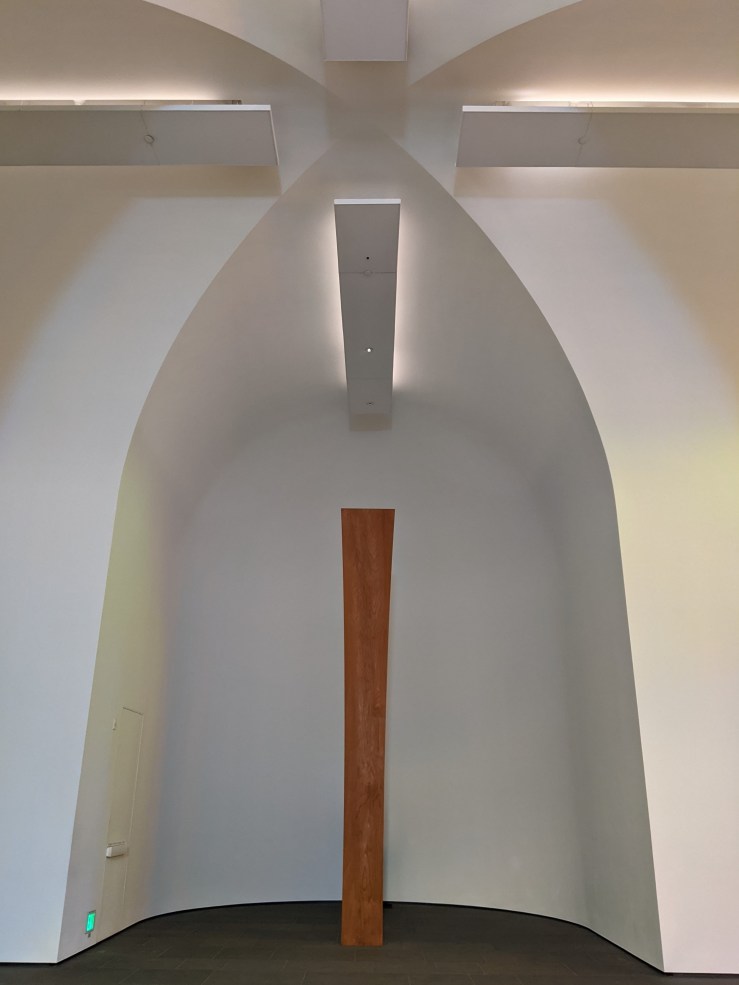
>> “What Remains: The Making of Ellsworth Kelly’s Last Work,”Image interview with Rick Archer: I got to experience Ellsworth Kelly’s Austin—a modernist “chapel” containing three stained glass windows, fourteen black-and-white marble panels (Stations of the Cross), and a redwood totem—while in Texas for a CIVA conference in 2021; see some of my photos below. Kelly was an atheist inspired by Romanesque church architecture, and the architect he chose to collaborate with on Austin, Rick Archer, is a Christian. In this wonderful new interview by Bruce Buescher, Archer discusses his working relationship with Kelly, Kelly’s desire for randomization and form over meaning, the technical and architectural challenges of bringing Kelly’s vision to life, religious references, and the artist’s objective for the space. “I hope when people go in here, they will experience joy,” Archer remembers Kelly saying.
Ellsworth Kelly (American, 1923–2015), Austin, 1986/2015. Artist-designed building with colored glass windows, black-and-white marble panels, and redwood totem, 63 × 76 × 28 ft. Blanton Museum of Art, University of Texas at Austin. Photo: Victoria Emily Jones.
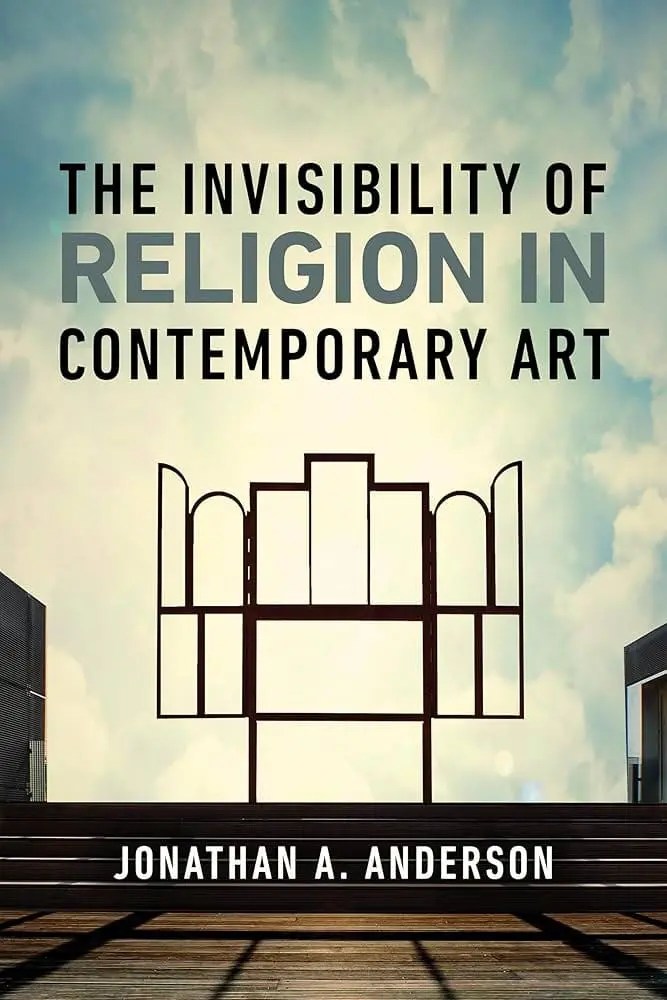
In this recent interview for Comment magazine, Anderson explains his purpose in writing the book:
I have become increasingly convinced that so many pivotal artists and artworks over the past century are deeply shaped by religious traditions and seriously engaged in theological questioning, but this remains severely under-interpreted or misinterpreted in the scholarship about these artists. One might see these threads running through an artist’s artworks and personal writings and even discuss these topics with the artist in their studio, but when one moves to the scholarly writing and teaching about that same artist, that language consistently disappears or is transposed into another register—usually politics, occasionally a highly esoteric spirituality. I wanted to understand, at a non-superficial level, why this was the case, and I wanted to see how other ways of speaking and writing about this topic might be possible.
Don’t miss, at the end of the article, his three hopes for the field of “art and theology,” which I very much share!
+++
LECTURE: “The Problems and Possibilities of Visual Theology: The Ascension as a Case Study” by Jonathan A. Anderson: With Ascension Day coming up on May 29, it’s timely to share this talk given by Jonathan Anderson (see previous roundup item) a few years ago at Duke Divinity School, where he worked as a postdoctoral associate of theology and the visual arts from 2020 to 2023. Anderson explores a handful of images depicting the Ascension of Christ, a particularly challenging subject because of the spatial ambiguity. The scriptural accounts of the event (Luke 24:50–53 and Acts 1:6–11) beg the question, “What does ‘lifted up’ mean? Where is Jesus?” Attempting to work out these spatial difficulties visually can be theologically and exegetically productive, Anderson claims—even if it sometimes leads to unsatisfying results, as, Anderson says, it often does in Western art from the Renaissance onward. By contrast, when artists foster intertextual readings across the biblical canon and focus not so much on what the Ascension looks like as a historical event but rather on what it means, they are generally more successful.
Here are some time stamps, with links to the artworks discussed:
38:33: The Ascension by Andrei Rublev: “Fundamental to all [the Ascension icons of the East],” Anderson says, “is the notion that the Ascension doesn’t have much to do with a higher part of the atmosphere (which Western images are continually struggling with) but with an entirely different kind of space. The relevant coordinates here are not down and up, or even higher and lower, but earth and heaven, old creation and new creation.” Anderson’s quotation of Douglas B. Farrow’s Ascension Theology is illuminating!
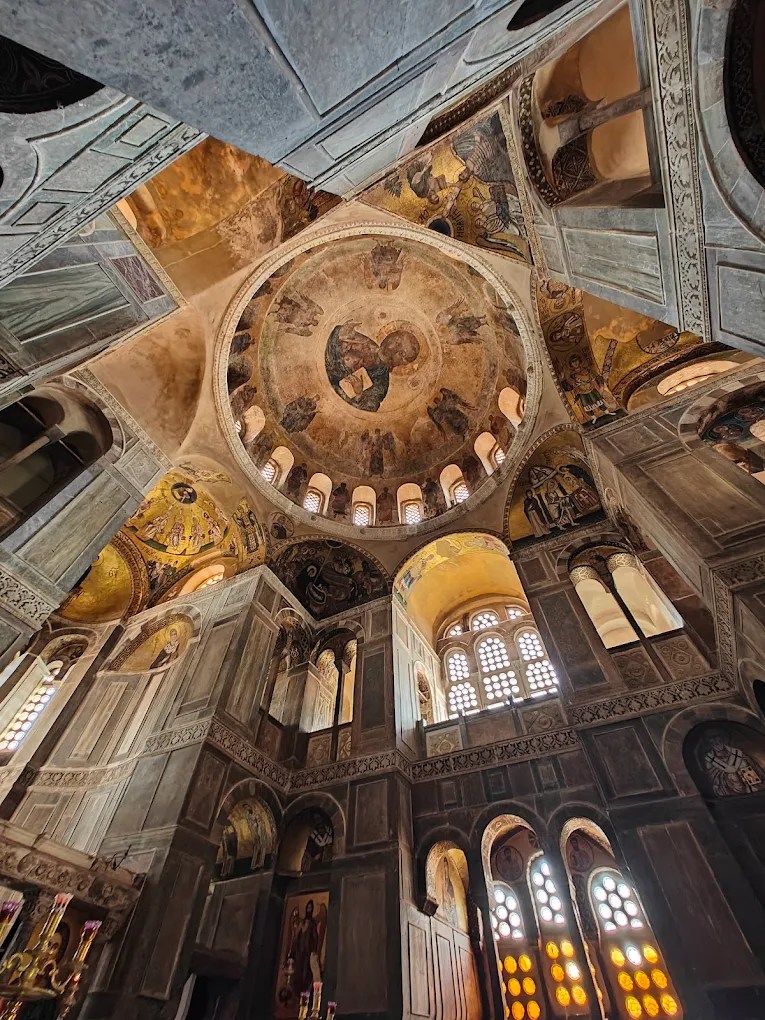
44:30: Interior of the katholikon (principal church) of Hosios Loukas
53:40: Q&A
Katholikon of Hosios Loukas monastery, Boeotia, Greece, 1011–12
+++
INSTRUMENTAL JAZZ: “Prayer” by Cory Wong: This video shows a live performance of Cory Wong’s “Prayer” on July 4, 2023, at Gesù music hall in Montreal. Wong, on guitar at far left, is joined by Ariel Posen on guitar, Victor Wooten on bass, and Nate Smith on drums. I learned about Wong through his collaborative album with Jon Batiste, Meditations (2020), which includes a version of this piece featuring Batiste’s piano playing.
+++
EXHIBITION: OMG! Reli Popart, Museum Krona, Uden, Netherlands, April 5–September 7, 2025: This exhibition at Museum Krona (housed in the complex of the still-active Birgittine Abbey of Maria Refugie in Uden, Netherlands) explores the connection between the pop art movement and Christianity through works by artists such as Andy Warhol, Corita Kent, Niki de Saint Phalle, and especially Dutch artists, including Woody van Amen and Wim Delvoye. Pop art is characterized by the use of imagery from popular culture, sourced from television, magazines, comic books, ads—and sometimes from the trash bin.
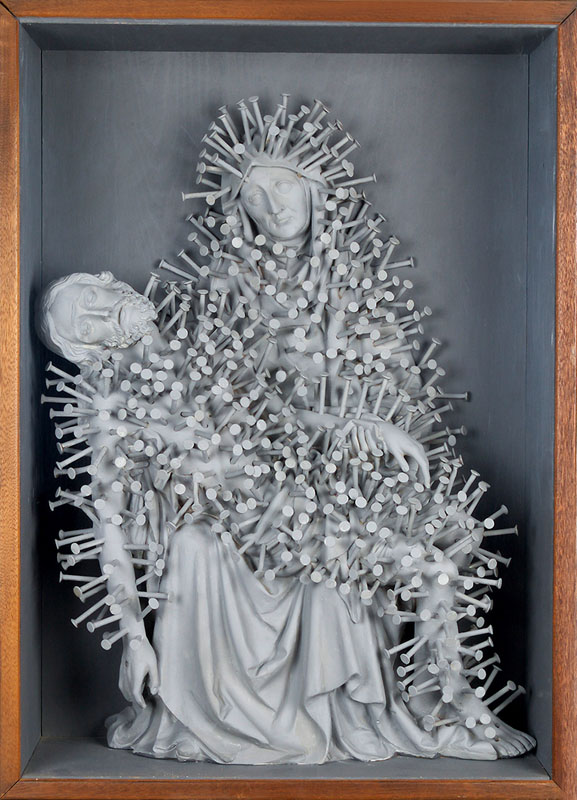
Jacques Frenken [previously], for example, built a body of work by salvaging discarded plaster sculptures of Christ and the saints—mass-produced for Catholic devotional use—and reconstructing them into assemblages. For his Spijkerpiëta, he “brought the Pietà back into our midst and accentuated the pain it radiates with nails,” the artist said.
Jacques Frenken (Dutch, 1929–2022), Spijkerpiëta (Nail Pietà), 1967. Plaster, paint, iron, wood. Museum Krona, Uden, Netherlands.
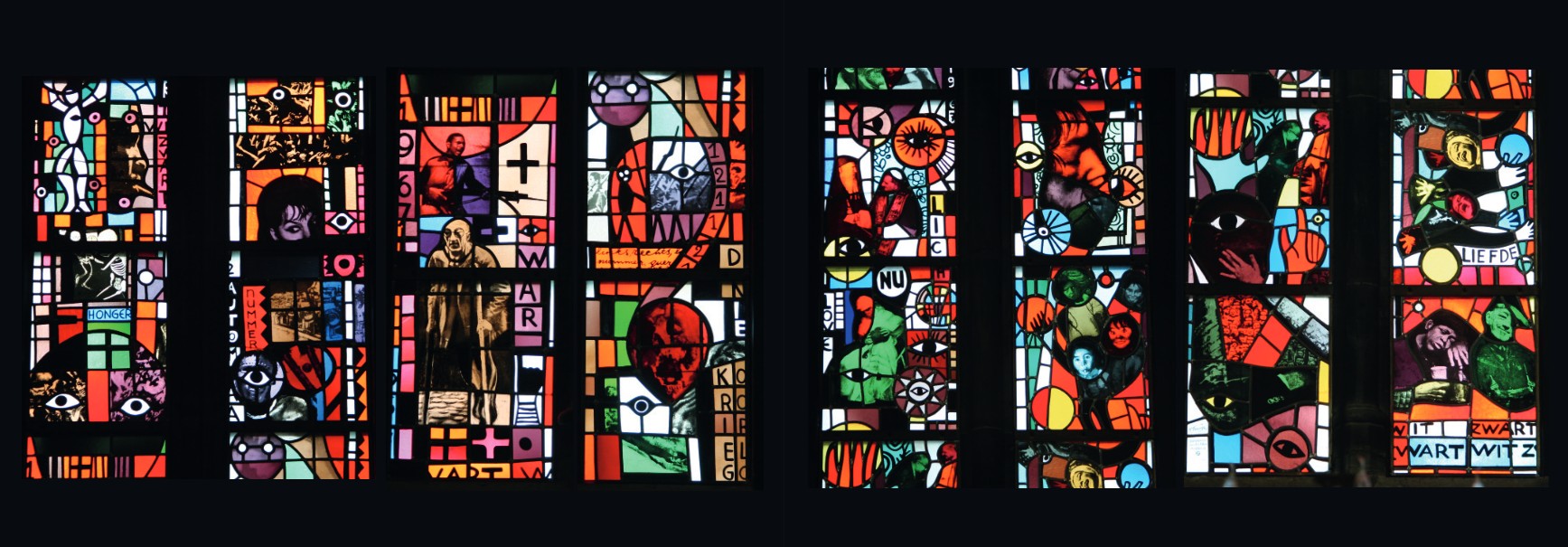
Another artist represented in the exhibition is Hans Truijen, who was commissioned in the 1960s by St. Martin’s Church in Maastricht to design eight stained glass windows for their worship space. The four along the left aisle of the nave depict human and divine suffering, whereas those on the right express hope, love, freedom, and happiness. He chose photographic images from various periodicals, including ones of the Vietnam War, and transferred them to glass using a special screen-printing process.
Hans Truijen (Dutch, 1928–2005), Studies for the eight stained glass windows commissioned by St. Martinuskerk, Wyck-Maastricht, Netherlands, 1966–68. Courtesy of the artist’s son, Marc Truijen.
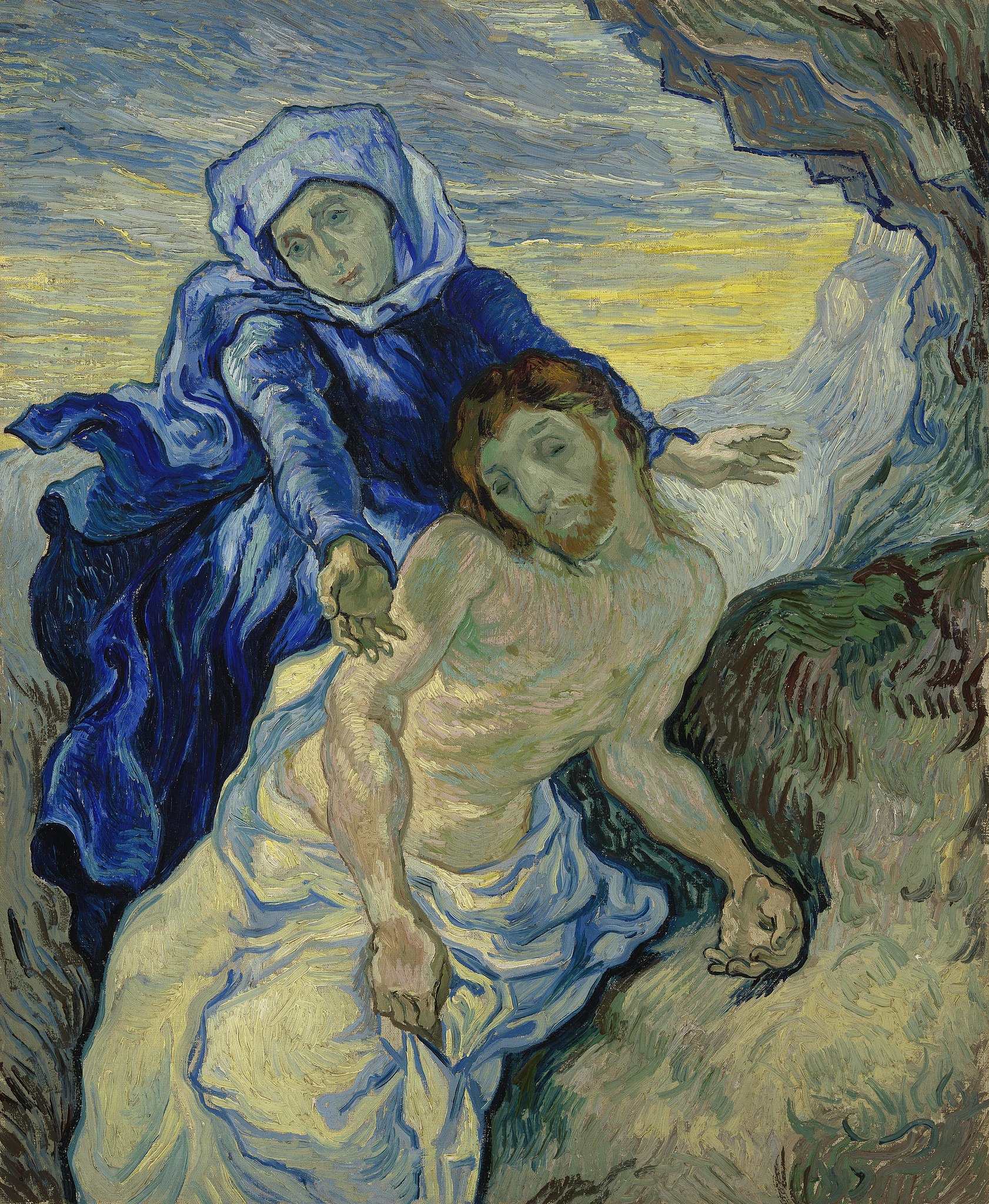
Vincent van Gogh (Dutch, 1853–1890), Pietà (after Delacroix), 1889. Oil on canvas, 73 × 60.5 cm. Van Gogh Museum, Amsterdam.
“Poor fighter, poor sufferer,”
my brother’s words for me.
                                                 Self-pity—
I have to beat it down. But how, exactly?
Never know when the next attack will come.
How to suppress religion?
Down the cloisters of the sick it beckoned—
I abused my God . . . that lithograph of Delacroix’s,
irredeemable sheets I flung in the paint and oil,
his Pietà in ruins.
                               Reconstruct it from memory.
Good technical exercise. Start with the hands,
there were four hands, four arms in the foreground—
mother and son, and the torsions of their bodies
almost impossible, draw them out—
painfully . . . no measurements—
into a great mutual gesture of despair.

Delacroix and I, we both discovered painting
when we no longer had breath or teeth.
Work into his work, strain for health,
the brain clearing, fingers firmer,
brush in the fingers going like a bow,
big bravura work—pure joy! I copy—
no, perform his masterwork of pain.

Genius of iridescent agony, Delacroix,
help me restore your lithograph with color.
I mortify before your model—
how to imitate my Christ? The bronze
of my forelock shadows his, the greatest artist:
stronger than all the others, spurning marble,
clay and paint, he worked in living flesh.

Living and yet immortal, Lord, revive me—
let me inhale the blue of Mary’s cape
billowing hurricanes of hope, clothe me
in your cerements gold with morning—
mother and son, from all your sorrow
all renewal springs, the earth you touch
turns emerald as your hand that burgeons green.
Robert Fagles (1933–2008) (PhD, Yale) was an award-winning American translator, poet, and academic. He is best known for his many translations of ancient Greek and Roman classics, especially the epic poems of Homer. He taught English and comparative literature at Princeton University from 1960 until his retirement in 2002, chairing the department from 1975 onward.
Vincent van Gogh (1853–1890) was raised in the Dutch Reformed Church, the son of a small-town minister—and even worked himself as a lay preacher in the Borinage mining region of southwestern Belgium for two years in his mid-twenties. While there, he gave away all his possessions and lived in poverty like those he served, eating a spare diet, wearing rough garments, and sleeping on the floor. Ironically, his sponsoring evangelical committee deemed such behavior unbecoming of a minister of the gospel, and, due also to his lack of eloquence and theological refinement, they withdrew their support.
This rejection soured Vincent on institutional Christianity. But it didn’t squash his faith. After moving back in with his parents in Nuenen, the Netherlands, he wrote to his brother and close confidante, Theo:
Life [. . .] always turns towards one an infinitely meaningless, discouraging, dispiriting blank side on which there is nothing, any more than on a blank canvas.
But however meaningless and vain, however dead life appears, the man of faith, of energy, of warmth, and who knows something, doesn’t let himself be fobbed off like that. He steps in and does something, and hangs on to that, in short, breaks, ‘violates’ – they say.
Let them talk, those cold theologians. [Letter 464]
Although Vincent left the church and developed conflicted feelings about the Bible, he maintained a reverence for Christ to the end of his days. His time in the Borinage was not for nothing, as it’s there that he discovered, through sketching his parishioners and the surrounding landscapes, his calling to be an artist.
This new vocation was one he ascribed metaphorically to Christ. In a letter to his friend and fellow artist Émile Bernard dated June 26, 1888, Vincent wrote that Jesus’s masterworks are human beings made fully and eternally alive:
Christ – alone – among all the philosophers, magicians, &c. declared eternal life – the endlessness of time, the non-existence of death – to be the principal certainty. The necessity and the raison d’être of serenity and devotion. Lived serenely as an artist greater than all artists–disdaining marble and clay and paint – working in LIVING FLESH. I.e. – this extraordinary artist, hardly conceivable with the obtuse instrument of our nervous and stupefied modern brains, made neither statues nor paintings nor even books . . . he states it loud and clear . . . he made . . . LIVING men, immortals. [Letter 632]
In the same letter, he contended that “the figure of Christ has been painted – as I feel it – only by Delacroix and by Rembrandt…….. And then Millet has painted…. Christ’s doctrine.”
These are the three artists Vincent admired most. He mentions them many times throughout his ample correspondence with family and friends, and he made paintings after all three.
The only painting Vincent ever made of Christ was his Pietà, which he painted in two versions in September 1889, both after the French artist Eugène Delacroix (1798–1863). These are among the many works Vincent painted at a psychiatric hospital in Saint-Rémy-de-Provence in southern France, to which he had voluntarily committed himself after suffering an acute mental breakdown that resulted in his infamous severing of his left ear on December 23, 1888. Theo had rushed to Arles, where Vincent was living in “the Yellow House” at the time, and on December 28 reported on Vincent’s condition in a letter to his wife, Jo van Gogh-Bonger:
I found Vincent in the hospital in Arles. The people around him realized from his agitation that for the past few days he had been showing symptoms of that most dreadful illness, of madness, and an attack of fièvre chaude, when he injured himself with a razor, was the reason he was taken to hospital. Will he remain insane? The doctors think it possible, but daren’t yet say for certain. It should be apparent in a few days’ time when he is rested; then we will see whether he is lucid again. He seemed to be all right for a few minutes when I was with him, but lapsed shortly afterwards into his brooding about philosophy and theology. It was terribly sad being there, because from time to time all his grief would well up inside and he would try to weep, but couldn’t. Poor fighter and poor, poor sufferer. Nothing can be done to relieve his anguish now, but it is deep and hard for him to bear. [Letter 728]
Vincent returned to the Yellow House in January 1889 but over the next few months experienced recurring bouts of mania and depression and was in and out of the hospital. Some of the people of Arles grew increasingly frightened by his erratic behavior, and they essentially ran him out of town. That’s when he made his way twenty miles northeast to the town of Saint-Rémy to check in to Saint-Paul-de-Mausole, a former monastery that then, as now, served as a hospital for the mentally ill.
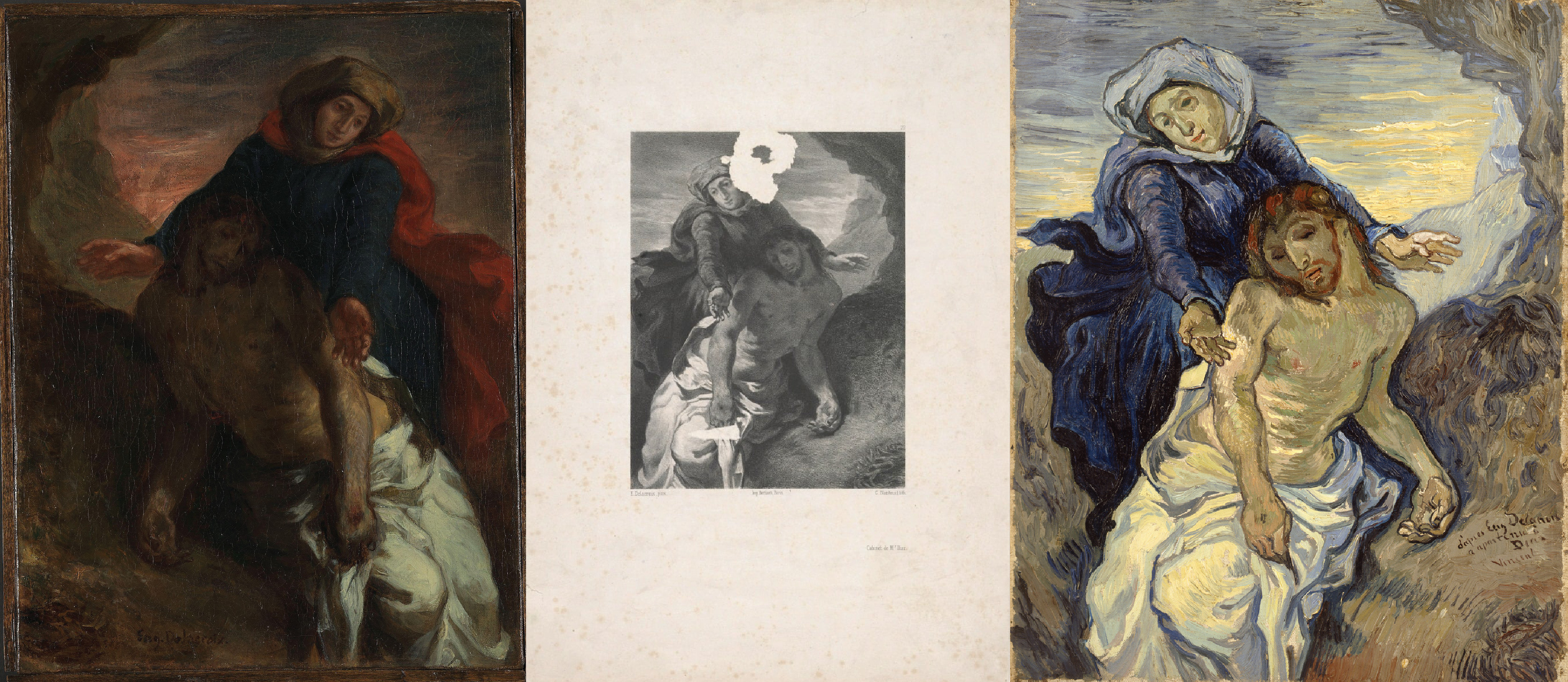
Vincent had two rooms there, one of which he used as a studio, setting up the various print copies he owned of acclaimed paintings. One was a lithograph by Célestin François Nanteuil-Leboeuf after Delacroix’s Pietà, from the portfolio Les artistes anciens et modernes. (Theo had bought and sent him this litho at his request.) Vincent lamented to his brother that he accidentally damaged it with spilled paint—but that impelled him to paint his own copy of Delacroix. On September 10, 1889, he wrote:
Work is going very well, I’m finding things that I’ve sought in vain for years, and feeling that I always think of those words of Delacroix that you know, that he found painting when he had neither breath nor teeth left. Ah well, I myself with the mental illness I have, I think of so many other artists suffering mentally, and I tell myself that this doesn’t prevent one from practising the role of painter as if nothing had gone wrong.
[. . .] In the very suffering, religious thoughts sometimes console me a great deal. Thus this time during my illness a misfortune happened to me – that lithograph of Delacroix, the Pietà, with other sheets had fallen into some oil and paint and got spoiled.
I was sad about it – then in the meantime I occupied myself painting it, and you’ll see it one day, on a no. 5 or 6 canvas I’ve made a copy of it which I think has feeling. [. . .] My fingers [are] so sure that I drew that Delacroix Pietà without taking a single measurement, though there are those four outstretched hands and arms – gestures and bodily postures that aren’t exactly easy or simple. [Letter 801]
LEFT: Eugène Delacroix, Pietà, ca. 1850, oil on canvas, 35.6 × 27 cm, National Museum of Art, Architecture and Design, Oslo. CENTER: Célestin François Nanteuil-Leboeuf, Pietà (after Delacroix), 1853, lithograph, Van Gogh Museum, Amsterdam. RIGHT: Vincent van Gogh, Pietà (after Delacroix), 1889, oil on canvas, 42 × 34 cm, Vatican Museums.
The painted copy he refers to here is the smaller of the two, which he gifted to his sister Willemien and is now in the collection of the Vatican Museums in Vatican City. In another letter, from September 19, he tells Wil “this little copy of course has no value from any point of view,” but “you’ll be able to see in it that Delacroix doesn’t draw the features of a Mater Dolorosa [sorrowing Mother of God] in the manner of Roman statues – and that the pallid aspect, the lost, vague gaze of a person tired of being in anguish and in tears and keeping vigil is present in it.”
The other Pietàthat Vincent painted—which is similar to the first but larger and brighter—he kept for himself, hanging it in his bedroom at Saint-Rémy. He describes the painting to Wil:
The Delacroix is a Pietà, i.e. a dead Christ with the Mater Dolorosa. The exhausted corpse lies bent forward on its left side at the entrance to a cave, its hands outstretched, and the woman stands behind. It’s an evening after the storm, and this desolate, blue-clad figure stands out – its flowing clothes blown about by the wind – against a sky in which violet clouds fringed with gold are floating. In a great gesture of despair she too is stretching out her empty arms, and one can see her hands, a working woman’s good, solid hands. With its flowing clothes this figure is almost as wide in extent as it’s tall. And as the dead man’s face is in shadow, the woman’s pale head stands out brightly against a cloud – an opposition which makes these two heads appear to be a dark flower with a pale flower, arranged expressly to bring them out better. [Letter 804]
Vincent van Gogh (Dutch, 1853–1890), Pietà (after Delacroix), 1889. Oil on canvas, 73 × 60.5 cm. Van Gogh Museum, Amsterdam.
Although Vincent may have at one time seen Delacroix’s Pietàpainting in person, at Saint-Rémy he had only a grayscale image, the lithograph by Nanteuil-Leboeuf, to reference. For his version, he invented his own color scheme—bold blues and yellows.
On September 20, Vincent described to Theo his process of “copying,” or interpreting, the masters:
What I’m seeking in it, and why it seems good to me to copy them, I’m going to try to tell you. We painters are always asked to compose ourselves and to be nothing but composers.
Very well – but in music it isn’t so – and if such a person plays some Beethoven he’ll add his personal interpretation to it – in music, and then above all for singing – a composer’s interpretation is something, and it isn’t a hard and fast rule that only the composer plays his own compositions.
Good – since I’m above all ill at present, I’m trying to do something to console myself, for my own pleasure.
I place the black-and-white by Delacroix or Millet or after them in front of me as a subject. And then I improvise colour on it but, being me, not completely of course, but seeking memories of their paintings – but the memory, the vague consonance of colours that are in the same sentiment, if not right – that’s my own interpretation.
Heaps of people don’t copy. Heaps of others do copy – for me, I set myself to it by chance, and I find that it teaches and above all sometimes consoles.
So then my brush goes between my fingers as if it were a bow on the violin and absolutely for my pleasure. [Letter 805]
Some art historians believe the Christ figure in the painting is a self-portrait—Vincent identifying himself with the suffering Christ, or recognizing Christ’s presence with him in his suffering, and expressing his longing to be cradled in loving arms and for resurrection from the grave of psychosis. In Vincent van Gogh: The Complete Paintings, Ingo F. Walther and Rainer Metzger write,
Nothing could convey more clearly his need to record his own crisis in the features of another than these two copies [of Delacroix’s Pietà]. The face of the crucified Christ in the lap of a grieving Mary quite unambiguously has van Gogh’s own features. In other words, a ginger-haired Christ with a close-trimmed beard was now the perfect symbol of suffering, the (rather crude) encoding of van Gogh’s own Passion. The painter was to attempt this daring stroke once more, in his interpretation of Rembrandt’s The Raising of Lazarus. Here, van Gogh gave his own features to a Biblical figure who, like Christ, passed through Death into new Life. It was as if, in his work as a copyist, van Gogh was pursuing the kind of oblique allegory he disapproved of in Bernard and Gauguin [see Letter 823]. Five weeks of mental darkness demanded artistic expression – and even that incorrigible realist Vincent van Gogh could not be satisfied with landscape immediacy alone. (542)
On May 16, 1890, Vincent left the hospital at Saint-Rémy, bringing his Pietà painting with him. He moved to Auvers-sur-Oise, a suburb of Paris, placing himself under the care of the homeopathic doctor Paul Gachet, who became a friend. Dr. Gachet admired the painting very much and requested his own copy. (As far as we know, Vincent never got around to making one.)
Vincent was incredibly prolific in Auvers, but his mental health continued to decline, and he died a little over two months after relocating there, on July 29, 1890, from a gunshot wound to the lower chest that was likely self-inflicted.
In his poem “Pietà” from an ekphrastic collection based entirely on Vincent’s paintings, Robert Fagles draws on Vincent’s biography and letters in addition to the titular painting to voice the spiritual and emotional yearnings of Vincent’s final year. The last stanza is a prayer that the poetic speaker Vincent addresses to God—for hope, renewal, light:
Living and yet immortal, Lord, revive me— let me inhale the blue of Mary’s cape billowing hurricanes of hope, clothe me in your cerements gold with morning— mother and son, from all your sorrow all renewal springs, the earth you touch turns emerald as your hand that burgeons green.
In Vincent’s Pietà, the dead Christ’s limp hand rests on a grassy boulder or knoll, which Fagles reads as signifying life awakening from death. You can even see the green reflected in Christ’s face and chest, not to mention the golden sun (“after the storm,” as the historical Vincent wrote) glinting on his right arm, abdomen, and shroud, a faint promise of resurrection.
Solomia Kazanivska (Соломія Казанівська) (Ukrainian, 1996–), Mother of God, 2019. Acrylic and soil on wood, 60 × 40 cm.
I.
Here mothers move more than others
into Mary’s mourning, each chorus
a soul full of crosses, weighted
with her child dying
continuously in the contemplation
of our contrition.

II.
That once-upon-a-time angel’s voice
stretching anew her middle-aged womb,
she who once sang Magnify, O Magnify,
when all she screams for now
is mercy in her urgent rebirth
of sorrow.

III.
When he stumbles,
she cannot fix his fall,
cannot cradle the boyhood
scrapes and bruises bleeding
into crowd-sanctioned murder.
No cock crows; she hears his groans
as if the world’s bones
are splintering within her.

IV.
Besides the tree, he carries
the tears of the one who carried him
beneath her Eve ribs, lifted him
into a world he breathed as good,
gone now into this God-crucified-
as-her-son catastrophe
for salvation’s sake.

V.
Simon of Cyrene stands close.
Understanding too well the two sorrows—
mother and son helpless to comfort the other—
he heaves up and shoulders
the burdens of both,
his back the black tablet
of Moses’ commandments fulfilled
to the jot and tittle.

VI.
Veronica—eyes swollen
for the Madonna and Child
wrenched from their rightful honor—
lifts her veil to cool the Savior’s pain,
alleviate, however slightly, a mother’s anguish.

VII.
Thorns gouge the brow she stroked.
The sweat-caked man that came out of her
stumbles again. Already,
the sharp nails gnaw her own palms.

VIII.
Oh, daughters of Jerusalem,
your tears sweep the streets,
wet the weary soles of Mary.
Weep for your own children
forever dashing away from Yahweh.

IX.
Wretched stones that tip her sinless child,
dirt that drives down the innocent son.
His own earth hurts him more each tumble.
Three times he trips,
crashes to the dust we are,
mortal muscles turning their backs
on Man and his Mother.

X.
Threads twisted by her own fingers,
tugged carefully through cloth:
this is the tunic they rip from him,
fabric tattooed with red;
she remembers his baby body
blood-splattered and matted.

XI.
Her soul stabbed by the tree
that slays her son. Her heart nailed.
She swears his life spurts
from her barely breathing body.

XII.
Death is indigo and indelible,
the Roman sky collapsed and re-scribbled
on the shreds of her memories.
She cannot bear to look upon his face
when breath forgets its maker.

XIII.
Ten thousand stillborns better
than this: his torso in her arms,
icon of the inconsolable,
the flesh Pietà with its nails of pain,
pounding, pounding.

XIV.
The hewn tomb seals her grief.
She remembers his first words,
his final prayer. All else rots
within her. They swaddle him,
implant him quickly behind stone.
This poem is from Weeknights at the Cathedral (Cincinnati: WordTech Communications, 2006) and is anthologized in slightly revised form, as here, in Poems of Devotion: An Anthology of Recent Poets, ed. Luke Hankins (Eugene, OR: Wipf & Stock, 2012).Used by permission of the author.
Note: The Stations of the Cross are a form of Catholic devotion organized around the events of Christ’s passion, from his condemnation by Pilate to his crucifixion and burial.
Marjorie Maddox (born 1959) is the author of fourteen poetry collections, including Begin with a Question (Paraclete, 2022); Transplant, Transport, Transubstantiation from the Poiema Poetry Series (Wipf & Stock, 2018); and True, False, None of the Above (Wipf & Stock, 2016). She has also published a short story collection, four children’s and YA books, and 650-plus stories, essays, and poems in journals and anthologies. Living in Central Pennsylvania, she is a professor of English and creative writing at Lock Haven University and is the assistant editor of Presence: A Journal of Catholic Poetry.
LOOK: The Passion of Mary by Katherine Kenny Bayly
Katherine Kenny Bayly (American, 1945–), The Passion of Mary, before 2006. Collage on paper, 8 × 12 in.
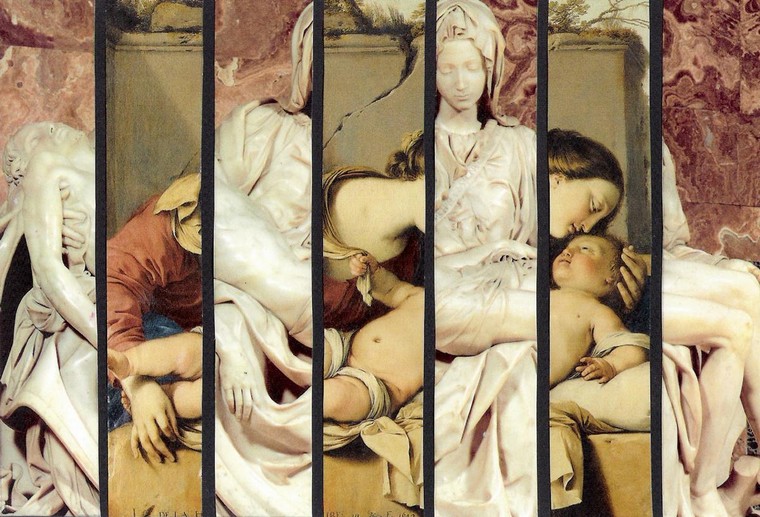
This collage by Katherine Bayly is from the 2006 CIVA traveling exhibition Highly Favored: Contemporary Images of the Virgin Mary. In seven alternating vertical bands, it combines Michelangelo’s Pietà from St. Peter’s Basilica with a Virgin and Child painting by Laurent de La Hyre, showing Christ’s birth and death as two sides of the Incarnation coin. One can hear echoes of Simeon’s prophecy to Mary, that “a sword will pierce your own soul too” (Luke 2:35)—a veiled reference to the Crucifixion.
Since the Middle Ages artists have often embedded symbolic or other visual references to Christ’s passion in Nativity paintings—a goldfinch, a coral rosary, a bunch of grapes, a cave that recalls the tomb, swaddling bands that look like burial wrappings, a manger that looks like a sarcophagus or altar, or, more explicitly, angels holding the arma Christi (instruments of the passion). Sometimes artists would use a diptych format to juxtapose images of Mary holding Jesus as a vibrant young infant with her holding him as a pale adult corpse deposed from the cross, a pairing that strikes an emotional tenor, as there’s perhaps no deeper grief than a mother’s loss of a child. Bayly draws on this tradition in The Passion of Mary, foreshadowing a future sorrow and reminding us that Christ came to earth not only to live but also to die.
LISTEN: “Baby Boy” by Rhiannon Giddens, on Freedom Highway (2017)
Baby boy, baby boy, don’t you weep Baby boy, baby boy, don’t you weep You will be our savior But until then, go to sleep
Young man, young man, I’ll watch over you Young man, young man, I’ll watch over you While you lead our people to the promised land I will shelter you
Baby boy (Young man) Baby boy (Young man) Don’t you weep (I will watch over you) Baby boy (Young man) Baby boy (Young man) Don’t you weep (I will watch over you) You will be (You will be) Our savior But until then, go to sleep
Beloved, beloved, I will stand by you Beloved, beloved, I will stand by you When you leave this place to do what you must I will always love you
Baby boy (Young man) (Beloved) Baby boy (Young man) (Beloved) Don’t you weep (I will watch over you) (I will stand by you) Baby boy (Young man) (Beloved) Baby boy (Young man) (Beloved) Don’t you weep (I will watch over you) (I will stand by you) You will be (You will be) Our savior But until then, go to sleep
Poignantly performed by Rhiannon Giddens [previously], Lalenja Harrington, and Leyla McCalla, “Baby Boy” is a lullaby written in the voice of a mother to her son, her salvation, whom she sings to sleep. She pledges to always watch over, shelter, and support him to the best of her ability.
The subject of the song could be Moses and the speaker his birth mother, Jochebed, as there’s mention of him leading his people to the promised land. This boy will grow up to shepherd a nation into its rest.
Or it could be Jesus, the New Moses, who liberated humanity at large, breaking their bondage to the powers of evil. Remembering the angel’s promise, Mary whispers her grand hopes to this cuddly little bundle she holds who will be their fulfillment, even as she shushes his cries.
Note, though, how there are three voices singing—a trio of women, a sisterhood united in their love of this child and their eager expectation of deliverance. Think of the women who, against all odds, ensured Moses’s protection as a young one and those who later walked alongside him in his difficult calling. Think, too, of all the women who supported Christ throughout his ministry, materially and spiritually, standing by him until the end, mourning his death, and spreading the news of his resurrection. One might imagine this song being sung by the three Marys, for example. They have a faint sense of the danger ahead and know the hero Jesus will become, but for now, they simply wish him sound slumber and sweet dreams. “Until then . . .”
Warning: This post contains distressing photographs, including one of an emaciated child and one of a wounded (but bandaged) infant.
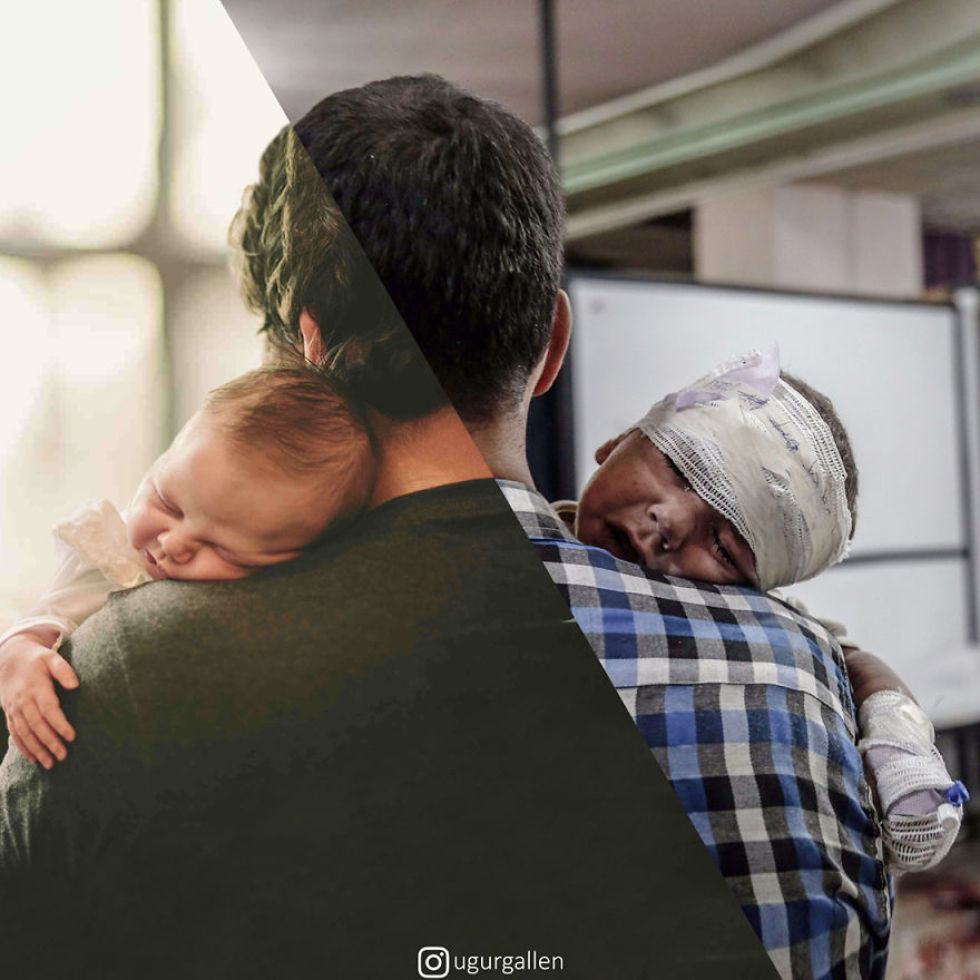
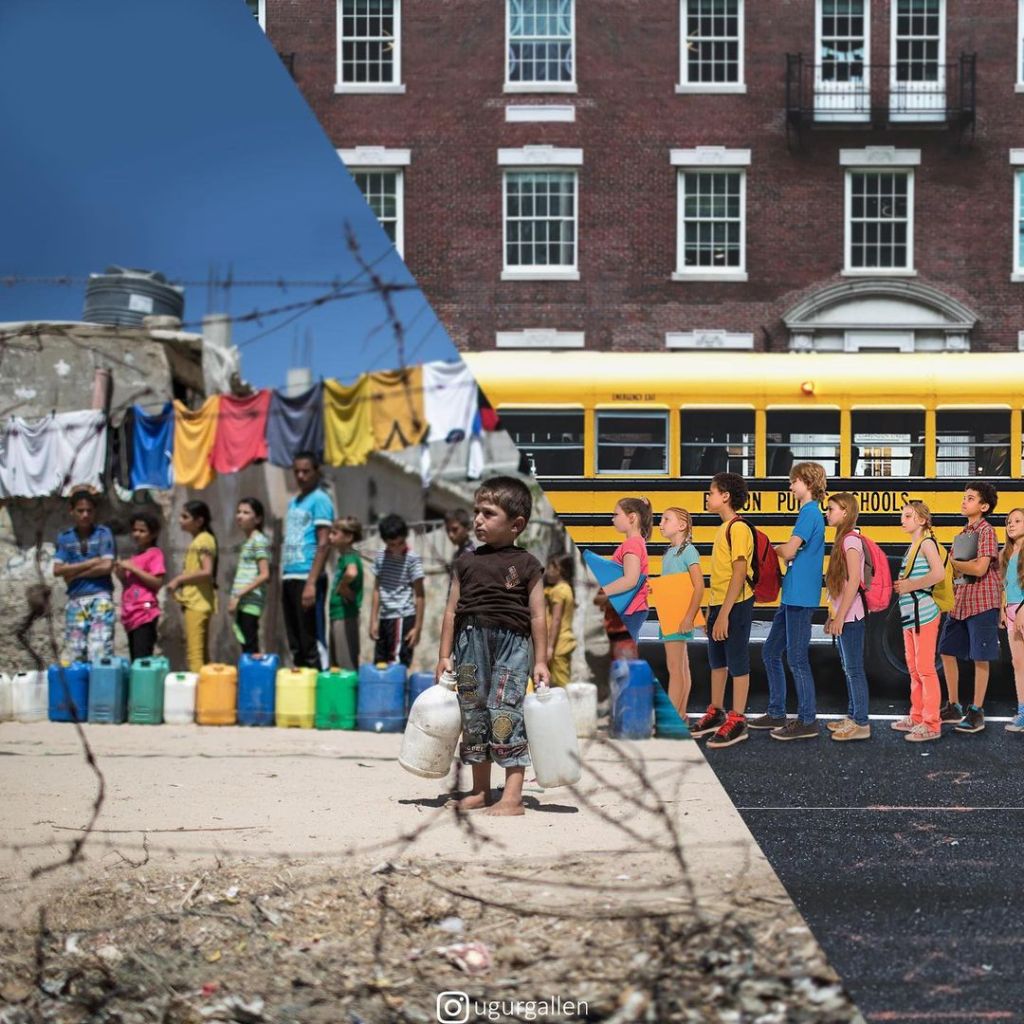
Uğur Gallenkuş (Turkish, 1990–) is an Istanbul-based artist whose digital photomontages address the widening global divide between the privileged and the oppressed. By combining photojournalistic images and stock photos with similar compositional elements, he juxtaposes the relative safety, stability, comfort, and flourishing experienced by middle- and upper-class Westerners with the violence, terror, trauma, and hardship experienced by victims of poverty, war, and displacement. Because Gallenkuş lives in the Middle East, he focuses on that geographic region.
Releasing November 20 in honor of World Children’s Day, Parallel Universes of Children brings together fifty of Gallenkuş’s sobering mash-ups, integrating facts of children’s lived realities around the world. It is $60 plus shipping, available only through the artist’s website. (For US buyers, there’s stock warehoused in New Jersey, so you won’t be paying to ship it from Turkey.)
“I aim to create awareness and inspire action to remember and to ask ourselves every day what we have done to safeguard children’s rights, both near home and across the globe,” Gallenkuş says. He wants not only to alert the well-off to the suffering they often shield themselves from, shaking them out of their complacency, but also to remind those in underdeveloped countries that they deserve better government and education, the right to thrive.
I’ve linked each image to its source on Instagram, where you can find out more information about it—when and where the photograph was taken and by whom (Gallenkuş does not take the photos himself), context, stats, etc. Some of the links will take you to a revised (updated) form of the image; in those instances, the originals I found at Juxtapoze.
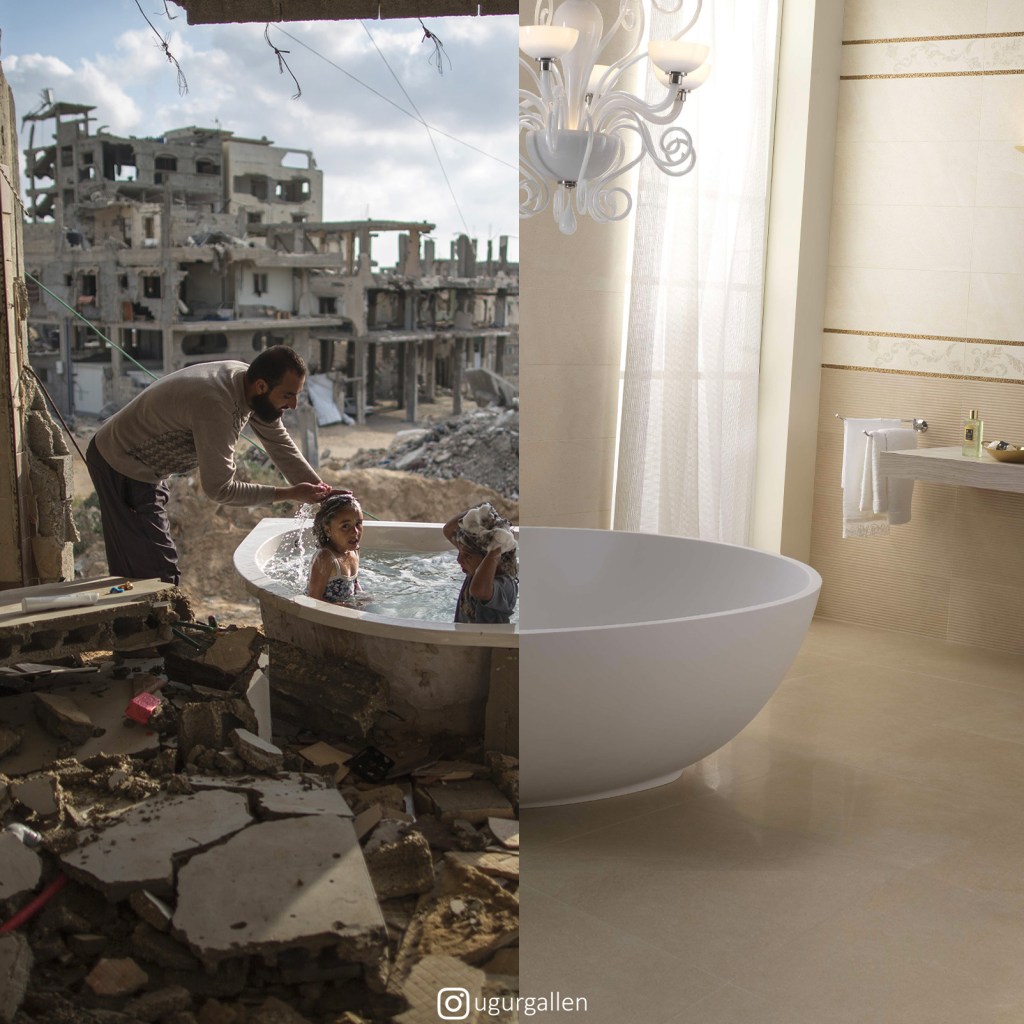
The stark contrast between the two component photos of each montage is jolting, intentionally so. Reflecting socioeconomic and political disparities, they tell drastically different stories about childhood. My existence must look like a fairy tale to those who have grown up in war zones or refugee camps.
One of Gallenkuş’s montages shows a lavish bathroom with a chandelier, pristine tiles, and freshly pressed towels next to the remnants of a bathroom whose walls were blown out by an Israeli airstrike, where a father bathes his daughter and niece.
Another one shows a line of American schoolchildren waiting to board a bus, which transforms into a line of Palestinian children waiting to fill jerrycans and bottles with drinking water from public taps at the Deir al-Balah refugee camp in central Gaza Strip. (Many fall sick from the water, whose source is polluted with human waste.)
Consider, too, the differences in play. A child at an IDP camp plays with a toy grenade launcher, while his counterpart plays doctor. A Syrian boy has fun balancing on the barrel of a tank in a pile of wreckage, while opposite him, in a green park, a boy rides a harmless seesaw. The imaginations of children are shaped by what surrounds them, whether that be violence or possibility.
I returned this week from a wonderful arts conference/retreat in the Colorado mountains, a much-needed time to unplug from work and engage with nature, to meet and worship with other Christians from around the country, and to reaffirm my sense of calling to online arts ministry. Eric came with me, so we took a few extra days there for scenic walks and drives, which included the Peak-to-Peak Scenic Byway, the Flatirons, the Rocky Mountain Arsenal National Wildlife Refuge, Pikes Peak, and Garden of the Gods. So much beauty! Here’s a charming little stone church we spotted outside Estes Park, built in 1939.
Chapel on the Rock (Saint Catherine of Siena Roman Catholic Chapel), Saint Malo Retreat Center, Allenspark, Colorado. Photo: Victoria Emily Jones.
We also visited the Cadet Chapel at the United States Air Force Academy, which I will share about in a separate post.
And as is my practice whenever I visit a new city, I spent time at a local art museum: the Colorado Springs Fine Arts Center at Colorado College. The size and quality of its collection exceeded my expectations, with many fine works of Native American (Pueblo, Plains, Plateau, and Great Basin), Hispanic and Spanish colonial, and twentieth-century American art. I particularly loved the santos galleries, which feature religious folk art of the Southwest, including two monumental altarpieces. Below is a retablo (panel painting) and a bulto (sculpture) from the santos tradition.
José Rafael Aragón (New Mexican, ca. 1796–1867), Cristo (Crucifixion), ca. 1820–35. Tempera on gessoed pine, 19 × 11 in. Colorado Springs Fine Arts Center at Colorado College. Photo: Victoria Emily Jones. Patrociño Barela (New Mexican, 1902–1964), Anuncio de la Nacimiento de Jesus (Announcement of the Birth of Jesus), 1942. Cedar wood. Colorado Springs Fine Arts Center at Colorado College. Photo: Victoria Emily Jones.
José Rafael Aragón is the most highly regarded classic santero from early New Mexico, so I was already familiar with his work (note the visual influences on contemporary santero Vicente Telles, one of whose Crucifixion retablos I own). The chandeliers in Aragón’s painting are like those found in the chancels of New Mexico churches, and the vertical branches that fill the spaces between the figures are also standard elements of church decoration.
Patrociño Barela I was not previously familiar with, and I found myself so captivated by his work. (If you are too, be sure to check out this online solo show of his.) I’m not sure whether to interpret his Anuncio de la Nacimiento de Jesus as an Annunciation image, with Gabriel announcing Christ’s conception to Mary, or a Nativity image, seeing as the babe appears to be ex utero—in which case the top figure could be either an angel or God the Father. I can’t identify the object Mary is holding. (A piece of fruit?)
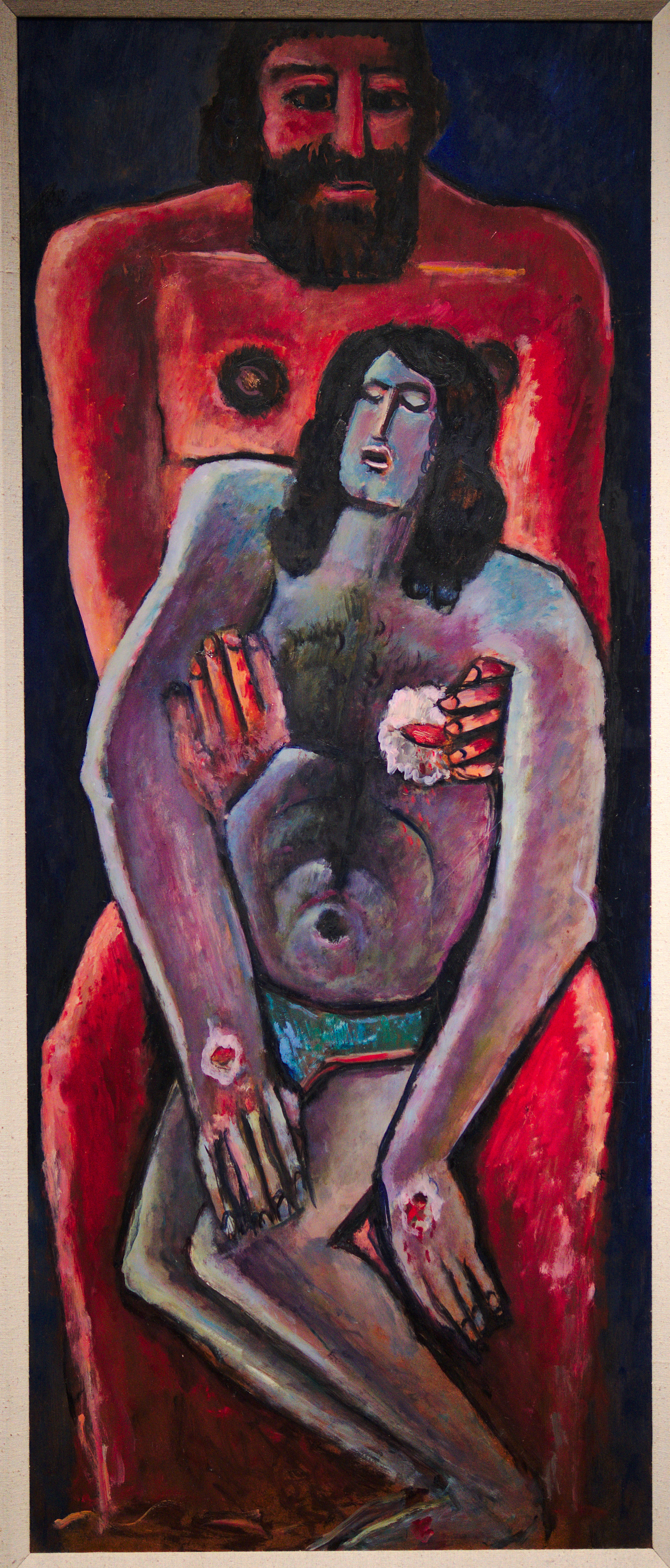
Lastly, here’s a unique Pietà image by the modernist painter Marsden Hartley. Could that be God the Father supporting Christ deposed from the cross? Maybe it’s Nicodemus or Joseph of Arimathea, but I rather like the thought that the Father held his Son in love during this time of his immense suffering and death.
Marsden Hartley (American, 1877–1943), Christ Evicted, 1941–43. Oil on board, 47 × 20 in. Colorado Springs Fine Arts Center at Colorado College. Photo: Victoria Emily Jones.
+++
EVENING DISCUSSION: “Idols and Taboos: Modern and Contemporary Art and Theology Today”: This free public event, consisting of two lectures and a panel discussion, will take place May 23, 2019, at 6 p.m. at the School of the Art Institute of Chicago. The presenters are James Elkins, who will be discussing the distance between avowedly religious art and the disciplines of art history, art criticism, art theory, and studio pedagogy, and Thomas Crow, who will be discussing “the generally inverse relationship between grandiosity in a work of art and its intrinsic theological import,” as well as art’s susceptibility to idolatry. A panel discussion will follow, moderated by Professor Ben Quash, and all are invited to gather afterward in the Lobby Bar of the historic Palmer House (across the street) for further socializing and conversation.
+++
SONG:“O Death”: This Easter, CCLI released a video of Kaden Slay, Melanie Tierce-Slay, and Ryan Kennedy of People & Songs performing Stephen Marti’s “O Death,” written in 2017. Those three-part a cappella harmonies are so sweet.
+++
SONG: “How Great Thou Art / Whakaaria Mai”: On March 23, the Grammy Award–winning singer-songwriter John Mayer began an extensive world tour at Spark Arena in Auckland, New Zealand. He opened the show quite unexpectedly with “How Great Thou Art,” a tribute to those killed and injured during a terrorist attack on two mosques in Christchurch, New Zealand, on March 15. [HT: Global Christian Worship]
This is the final part of my commentary on Art Stations of the Cross: Troubled Waters, a multisite exhibition in Amsterdam running from March 6 to April 22. (Read parts one and two.) Unless otherwise noted, all photos are by Eric James Jones/ArtandTheology.org.
+++
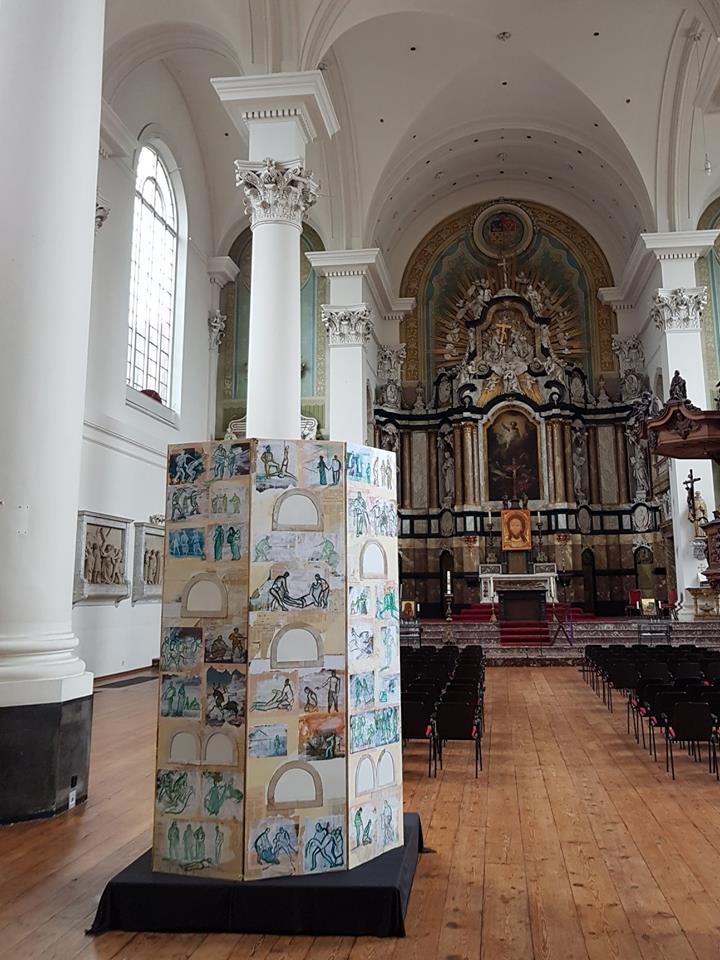
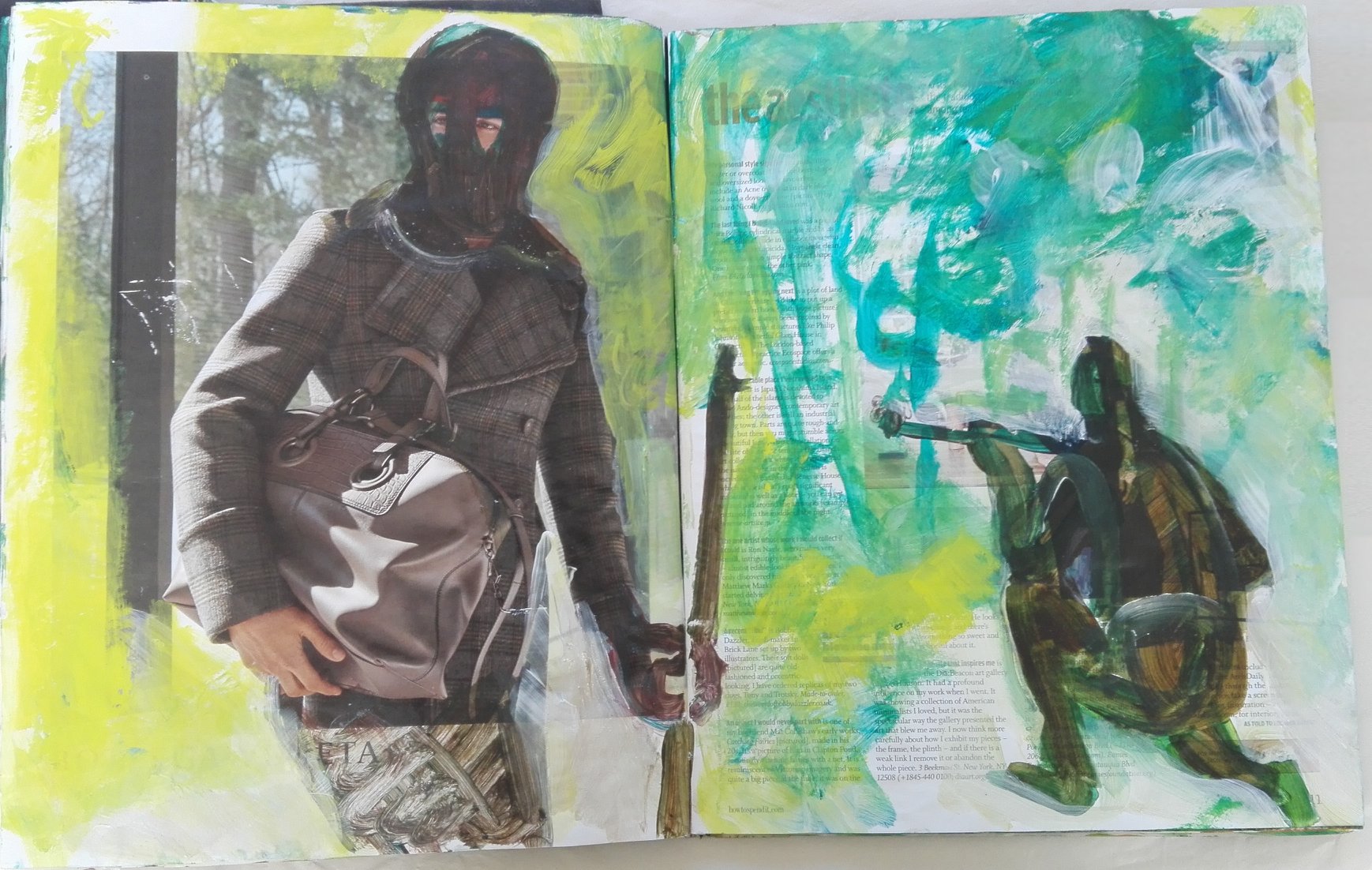
STATION 10. This is the one station I did not get a chance to see, due to its more limited opening hours. Anywhere, Anytimeby Masha Trebukova is a temporary installation in the Mozes en Aäronkerk (Church of Moses and Aaron) in Amsterdam’s Waterlooplein neighborhood. It consists of a nine-foot-tall octagonal structure (a “columbarium”) covered with paintings on newspaper, as well as six large-format “books” of paintings on glossy magazine pages.
Masha Trebukova (Russian, 1962–), Anywhere, Anytime, 2019. Temporary installation at the Moses and Aaron Church, Amsterdam, consisting of an eight-paneled “columbarium” with paintings on newsprint, each panel 60 × 290 cm, and “How to spend it,” six painted-over magazines. Photo courtesy of Sant’Egidio Nederland.
A columbarium is a room, building, or freestanding structure with niches for the public storage of funerary urns (which hold the ashes of the deceased). Ancient Romans decorated theirs with frescoes, often of peaceful scenes of the hereafter. Trebukova, on the other hand, has painted this columbarium with images of war and violence, exposing the savagery that causes death. This is not a celebration of paradise gained; it’s a lament for paradise lost.
Hear the artist briefly introduce the piece:
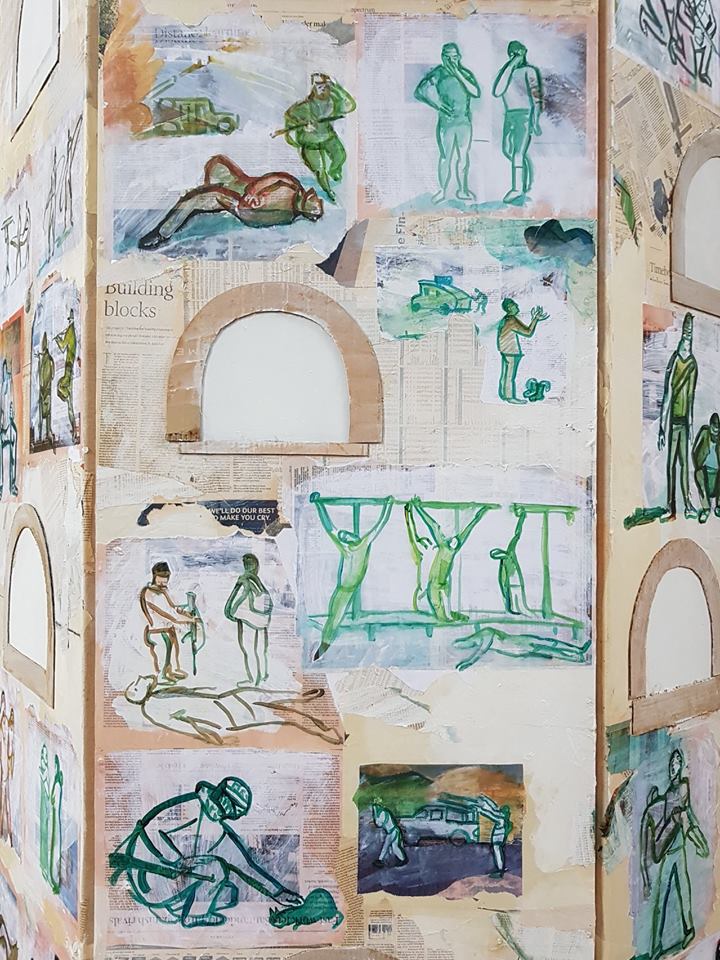
Masha Trebukova, Anywhere, Anytime (detail). Photo courtesy of Sant’Egidio Nederland.
Trebukova used as her painting surface pages from newspapers and magazines, the headlines often creating consonance with the images while the ads create dissonance. The sleek photos selling vacations and luxury goods, enticing you to treat yourself, contrast starkly with Trebukova’s slashes and smears of color that depict masked gunmen terrorizing families, mass executions, refugees on the run, and individuals huddled over the corpses of loved ones. This contrast urges viewers to consider how our own self-absorption might be restricting our view of what’s going on in the larger world. What incinerations are being carried out as we casually engage in our leisure reading and other entertainments? The vaults in Anywhere, Anytime are fictive, but they prompt us to imagine the many bodies and places being turned to ash as armed conflict and acts of terrorism persist globally. [Images below sourced from the artist’s website]
The books are too fragile to be handled by visitors, so they are displayed open in glass cases, laid flat on a black-clothed table, and a video screen nearby loops through all the images in succession. Here is an excerpt from the video, a showcase of book five:
The book appears to have originally been a dance magazine, but Trebukova subverts the elegance associated with controlled bodily movement by recontextualizing these found images of dancers. A woman walking down a rustic road in pointe shoes is given a heavy burden on her back—a child—and a head scarf, recasting her as one of the many mothers fleeing violence in the Middle East. On the following page spread, another dancer’s graceful backbend is re-envisioned as an involuntary response to his having been shot; unlike on stage, this movement will end with a fall.
The Moses and Aaron Church is home to the Amsterdam chapter of the Community of Sant’Egidio, a Catholic lay association committed to prayer, the poor, and peace. Existing in over seventy countries, Sant’Egidio seeks especially to serve the sick, the homeless (including displaced persons), the elderly, and the imprisoned. “War is the mother of every poverty,” they say, and they have been key players in peace initiatives in Mozambique, Algeria, the Balkans, the Democratic Republic of Congo, and other areas.
Masha Trebukova, page spread from “How to spend it.” Photo courtesy of Sant’Egidio Nederland.
+++
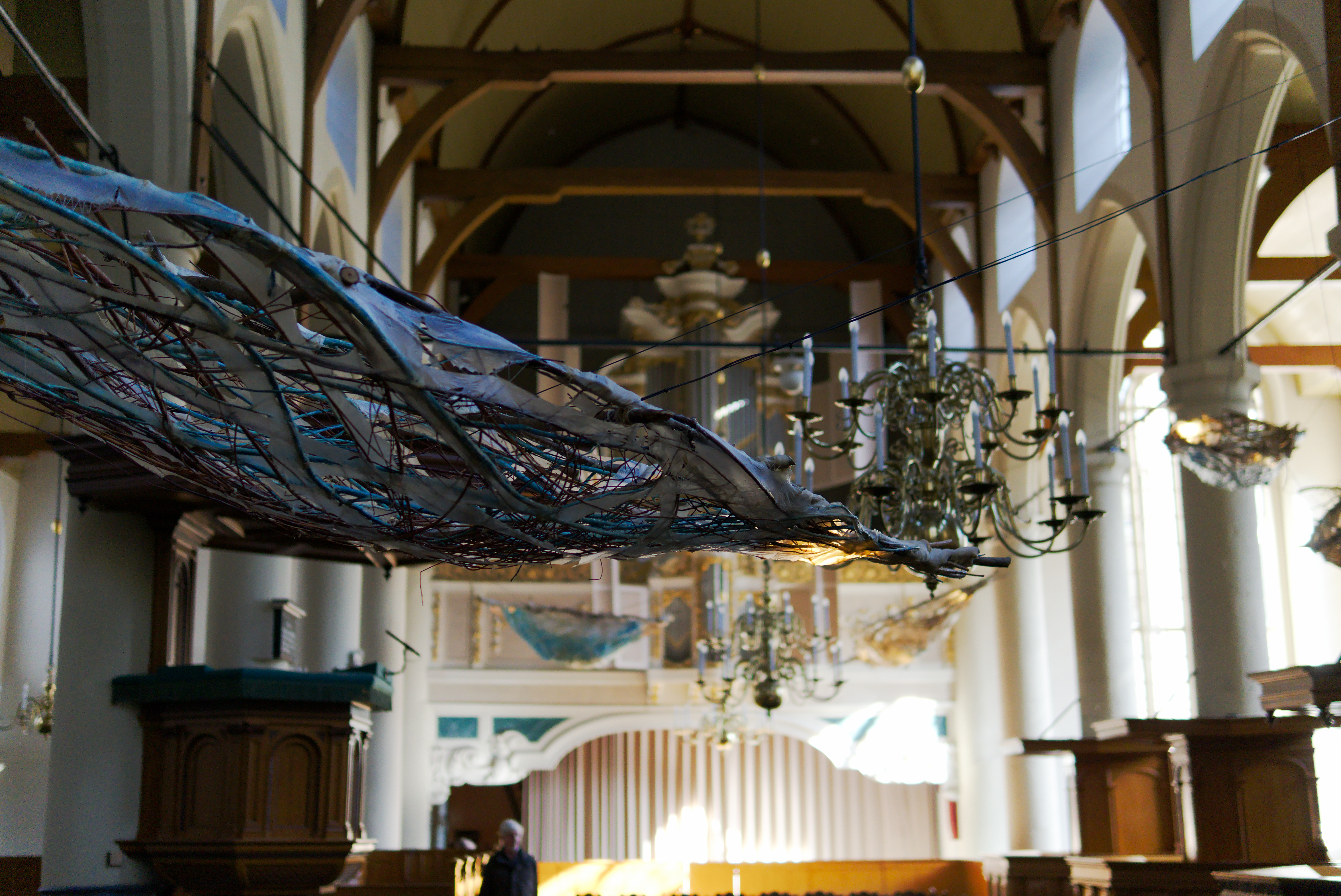
STATION 11.Erica Grimm’s Salt WaterSkin Boats, a collaboration with artist and arborist Tracie Stewart and soundscape specialist Sheinagh Anderson, is an installation of five sculptural coracles made of interwoven willow, dogwood, fig, and cedar branches; animal skin and gut; cheesecloth; and bathymetric ocean maps imprinted with scientific measurements of things like glacial melt, sea-level rise, and ocean acidification. These are suspended from the ceiling along the nave of the Waalse Kerk and are lit from inside, and they are accompanied by an ambient soundscape that viewers activate by scanning a QR code.
Erica L. Grimm (Canadian, 1959–), Salt Water Skin Boats, 2018. Willow, dogwood, fig, and cedar branches; cheesecloth; animal skin and gut; bathymetric ocean maps; layers of wax; earbuds; LED lights. Installation view at Waalse Kerk, Amsterdam, in March 2019, part of Art Stations of the Cross.
Small lightweight boats without rudder, anchor, or keel, coracles are unstable watercraft, easily carried by currents and wind. Back in the day, Celtic Christian pilgrims would set sail in them, not having any destination in mind but rather trusting that God would steer their little boats to wherever he saw fit. In a sense, we are all “skin boats” afloat on a vast ocean, not knowing where we’ll end up. But Grimm’s incorporation of numerical data that highlight the dangerous warming, acidifying, and expanding of the world’s oceans pushes this metaphor in a new direction; the work “proposes an analogy,” writes curator Marleen Hengelaar-Rookmaaker, “between our bodies and the vast ecology of the global ocean: between the life-sustaining, precariously balanced ocean chemistry and the chemistry of our own salt-water-filled bodies.” Continue reading “Walking the Via Dolorosa through Amsterdam (Part 3)”→
One of the joys of blogging at Art & Theology is being introduced to new artists by my readers. I was pleased to receive in the mail recently, as a gift from one such reader, a color booklet and a 2018 documentary on the art of Dom Gregory de Wit (1892–1978), a Dutch artist and Benedictine monk who between 1938 and 1955 lived in the United States painting murals for Catholic churches and monasteries. This was the first time I’ve encountered the artist, and I enjoyed getting to know him better through these materials.
All photos in this post are provided courtesy of Edward Begnaud or Stella Maris Films.
Gregory was born Jan Aloysius de Wit on June 9, 1892, in Hilversum, Netherlands. He entered the monastic life in 1913 at age twenty-one, joining Mont César Abbey in Leuven, Belgium, and there taking the name Gregory. (His interest in liturgy and ecumenism is what drew him to that particular abbey.) de Wit was passionate about art making since a young age, and his order encouraged him to further develop his talent as a painter. He therefore studied at the Brussels Academy of Art, the Munich Academy, and throughout Italy. In 1923 he exhibited at The Hague and ended up selling forty-five paintings in one month! He then went on to fulfill three sacred art commissions—one in Bavaria, two in Belgium—while continuing to live as a monk.
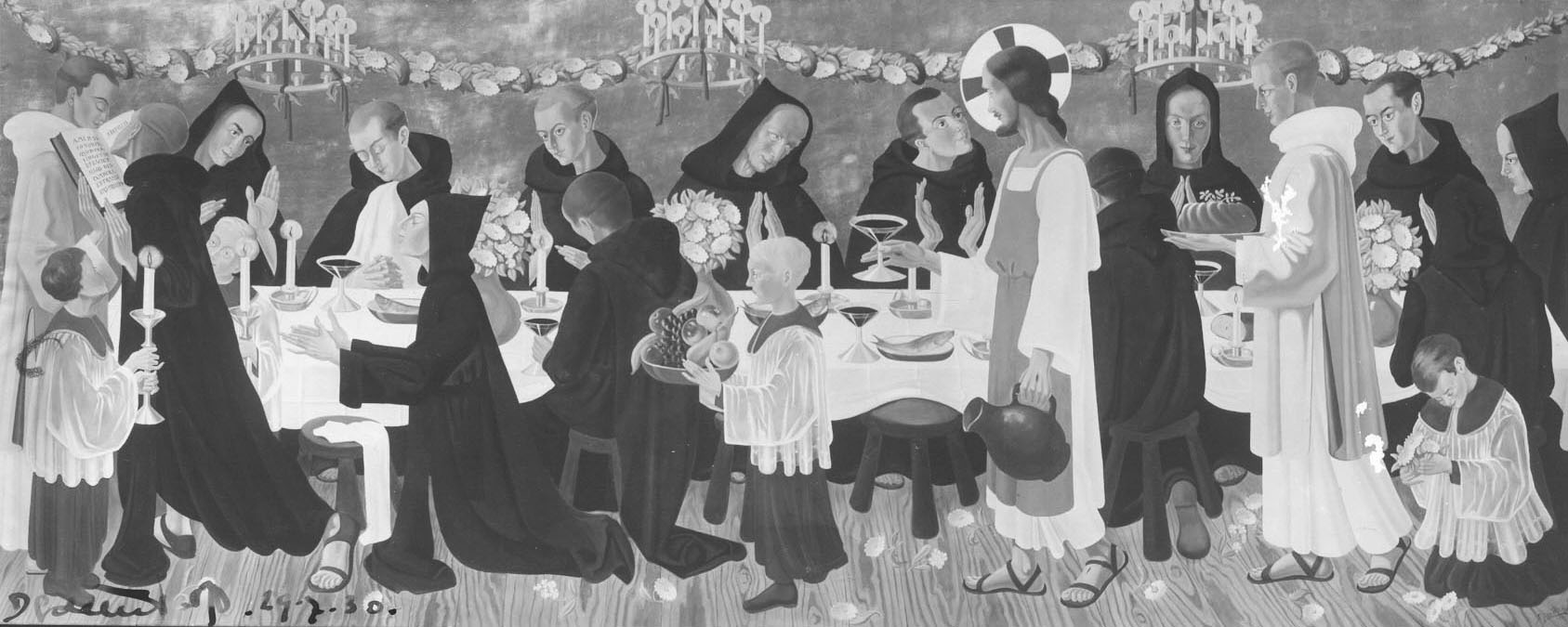
This mural, painted in 1930 and photographed here in black-and-white, shows Jesus serving wine at a monastic banquet. It’s one of nine murals Gregory de Wit painted in the refectory of St. Michael’s Abbey in Metten, Bavaria, Germany.
In 1938, Abbot Ignatius Esser of Saint Meinrad Archabbey in southern Indiana met de Wit in Europe and invited him to design and execute paintings for the abbey’s church and chapter room—which he gladly accepted.
Here he started to develop his own style, which would come to be marked by brilliant (sometimes garish) colors, bold outlines, distortion or disfiguration (e.g., disproportionate hands), and “overlapping” perspective.
In Christus, Jesus is borne upward by a red-winged chariot. In his right hand he holds a victory wreath, and in his left, an open book that declares, EGO SUM VITA (“I am the Life”). The three small Greek letters in the rays of his halo, a traditional device in Orthodox iconography, mean “I am the Living One,” a New Testament echo of God’s “I am who I am” in Exodus 3:14.
This figure of the risen Christ, painted by Gregory de Wit in the 1940s, is found high on the wall of the church of Saint Meinrad Archabbey, St. Meinrad, Indiana.
+++
Shortly after de Wit arrived in the US, World War II broke out, and even after he completed his work at Saint Meinrad, he couldn’t return to Belgium. Luckily, another stateside commission came his way, from the newly builtSacred Heart Catholic Church in Baton Rouge, Louisiana. The parish priest, Father Dominic Blasco, hired him to paint a series of murals, which resulted in de Wit’s most polarizing work: his Christ Pantocrator in the apse behind the altar. Many of the parishioners hated it (and I have to say, I’m not partial to it). A humorous anecdote in the documentary recalls Maria von Trapp, who had once visited the church, expressing her horror at the image to de Wit, not knowing he was its artist!
Not only did de Wit’s art garner dislike, but so did his temperamental personality and sometimes irreverent behavior. For example, while at Sacred Heart, he smoked while he painted, dropping cigarette butts onto the floor during services. Although he did have his supporters, he was eventually fired from Sacred Heart. The last painting he did for the church was of the Samaritan woman at the well—descried as “pornographic” by the sisters of the school because of the suggestive way her dress clings to her forwardly posed thigh.
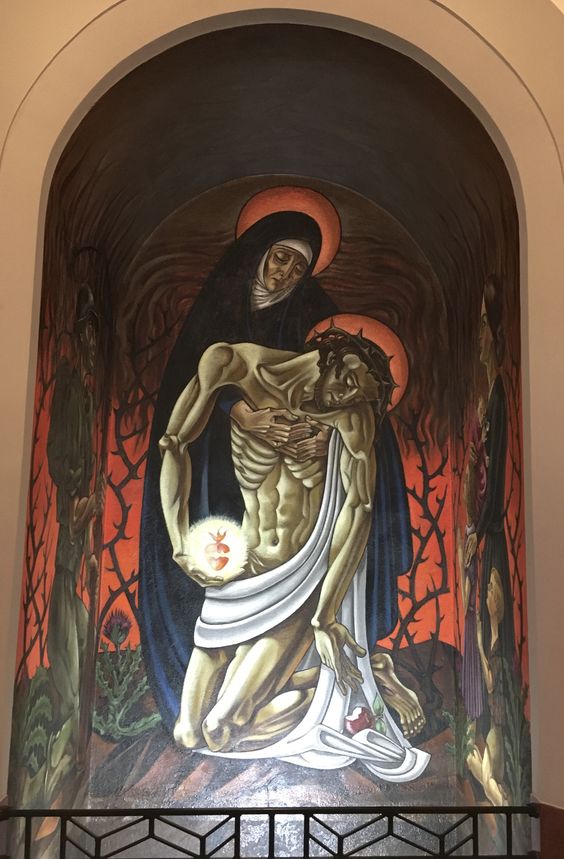
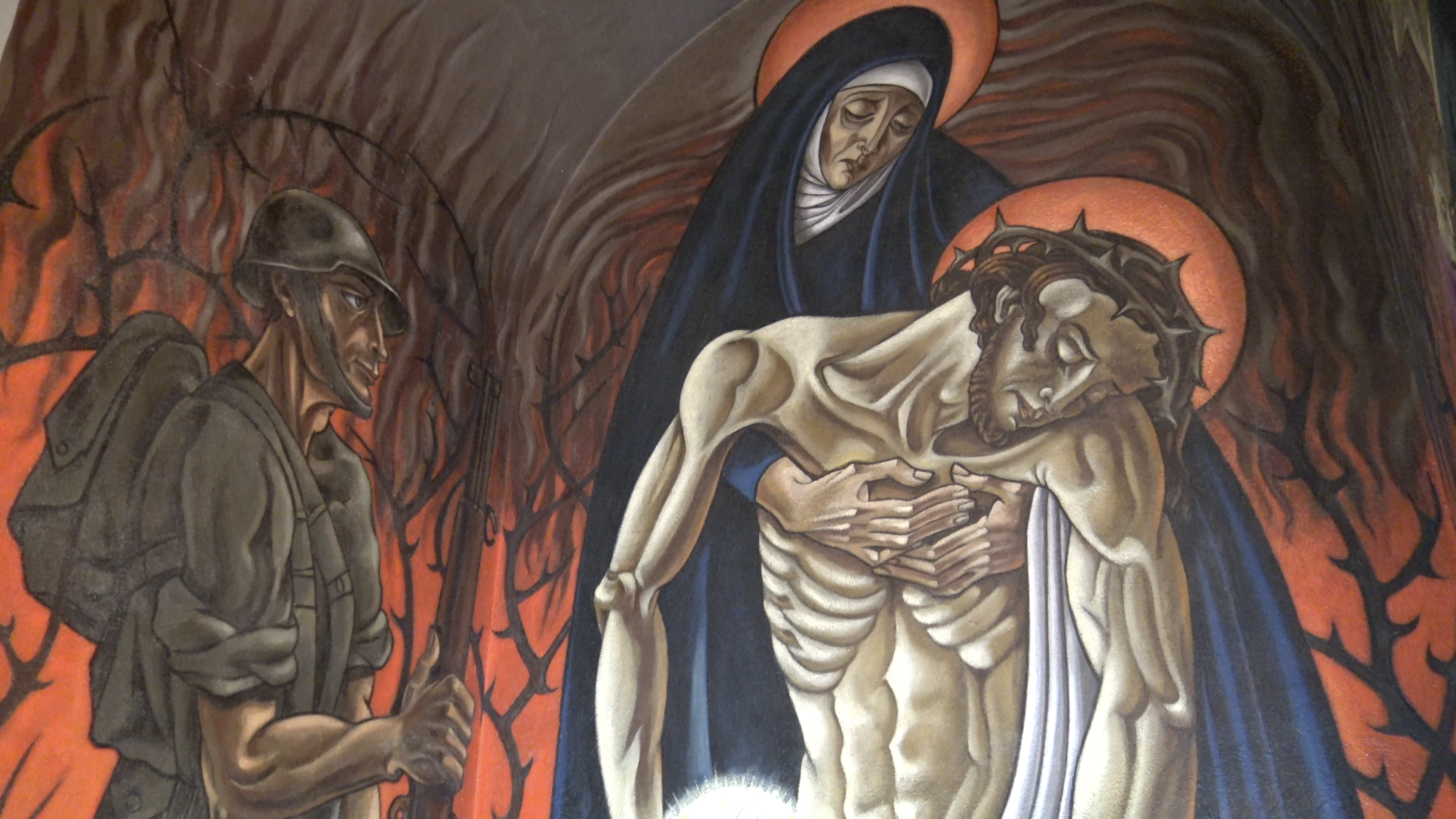
The painting at Sacred Heart that I’m most intrigued by is the Pietà in the narthex, which shows Mary holding her dead son. Genesis 3 is invoked by the thorns that not only crown Christ’s brow but that rise up all around him, symbolic of the curse. What’s more, a half-bitten apple rolls from his limp hand; he, like his forefather, Adam, has tasted death. And this he did willingly out of love, signified by the fiery, thorn-enwrapped heart of his that he holds in his right hand, whose glow illuminates the darkness.
Dom Gregory de Wit, OSB, Pietà, 1940–42. Narthex, Sacred Heart Catholic Church, Baton Rouge, Louisiana.
Because de Wit painted this image during the war, it is contextualized with a soldier on one side and the soldier’s wife and three children on the other, praying for his safe return. Why do they belong in this scene? Some wartime artists drew parallels between Christ and the soldiers’ sacrificial laying down of their lives (cf. John 15:13). I’m uneasy with this comparison for several reasons, not least of which is my Christian pacifism. But de Wit’s painting seems, rather, to use the soldier and his family as a representation of war and to suggest that Jesus, the Suffering Servant, is with us in our present suffering. He entered our world, after all, and died to redeem us from its evils—sin and death and all their extensions. The presence of Mary, Our Lady of Sorrows, must have been a comfort to the mothers at Sacred Heart whose sons were overseas fighting.
Moreover, even though its hieratic style may be off-putting to some, I also really like the crucifix de Wit created for Sacred Heart (but which is now at St. Paul the Apostle Catholic Church, also in Baton Rouge). The corpus is painted on solid mahogany, with real nails driven through the hands. Continue reading “The Art of Dom Gregory de Wit”→
Typically when scholars interpret African American art, they do so through the primary lens of racial identity, often glossing over overt Christian themes, expressions of religious identity. Beholding Christ and Christianity in African American Art(Penn State University Press, 2017), edited by James Romaine and Phoebe Wolfskill, seeks to redress that dearth by examining the Christian content, including theological significance, of works by fourteen African American artists who came to maturity between the Civil War and the civil rights era: Mary Edmonia Lewis, Henry Ossawa Tanner, Aaron Douglas, Malvin Gray Johnson, Archibald Motley Jr., William H. Johnson, James Richmond Barthé, Allan Rohan Crite, Sister Gertrude Morgan, William Edmondson, Horace Pippin, James VanDerZee, Romare Bearden, and Jacob Lawrence. Many of these artists were themselves devout Christians, working out of internalized religious convictions and not merely outward tradition or market expectations.
The essayists certainly take race into account as a factor in the works discussed, but not the only factor; political, socioeconomic, and biographical circumstances are also considered. Christianity, however, as the title suggests, is given pride of place in the selection and examination of the fifty-five images reproduced in the book.
One of the hallmarks of Beholding Christ is the diversity of styles, media, and denominational affiliations represented. As the book shows, African American art is no monolith, and neither is African American Christianity. While there is so-called primitive art and visionary art created by self-taught individuals with crayons, cardboard, or salvaged limestone, there is also neo-classical sculpture, as well as other academically informed works that tend toward impressionism or expressionism. Among the pages are rough-hewn stone sculptures, abstract watercolors, naturalistic oil paintings, and portrait photographs. While there are many depictions of Christ as black, there are also, per tradition, white Christs, and even a Middle Eastern one. What was most surprising to me was to see examples of art by African Americans from high-church traditions, like Catholicism and Anglicanism, who distinguish themselves from low-church Baptists, Pentecostals, and Holiness Christians. The editors are to the applauded for resisting the urge to perpetuate a narrow vision of “Negro art” in line with what the artists’ contemporary critics and viewers principally sought.
Another hallmark of the book is the rigorous formal evaluation and content analysis of specific artworks that make up the bulk of almost every essay, encouraging readers to look deeply. Biographical information about the artists is well integrated and does not overwhelm the focus on the works themselves. Given this image-forward approach, I must say, I’m disappointed that a handful of works, for which color photographs should be available, are reproduced in black and white—for example, Motley’s Tongues (Holy Rollers), Edward Hicks’s Peaceable Kingdom, and Lawrence’s Sermon II and Sermon VII. Luckily these can be found online, but seeing as the entire book is printed in full color with glossy pages, I wonder why color photographs of these were not obtained.
Lastly, I really appreciate the connections between artists made possible by the bringing together of these essays—some made explicitly by the authors, others implied. Douglas and Lawrence both dignified the art of black preaching by visualizing sermons. Crite and Johnson visualized the spirituals, but using very different approaches. Edmondson and Morgan were both motivated by a belief that they were divinely ordained to create by supernatural visions. Episcopal Crite and Catholic Motley intertwined class and religion in their works.
This book is essential reading for anyone in the fields of Christianity and the arts or African American studies. As one belonging to the former category, I see these artworks as part of not only art history but Christian history, and as worthy of being studied by Christians as any theological treatise, written scripture commentary, saint’s biography, or church trend. These artworks teach theology; they encapsulate hopes and fears; they comment on public issues; they expose sin; they lead us in celebration and in lament; they help us to re-member the works of Christ, and invite us into communion with him; they tell us who we are and from whence we’ve come; they cast a biblically grounded vision for the future.
What follows is a brief summary of each chapter.
In chapter 1, Kirsten Pai Buick traces the network of patronage that supported Catholic sculptor Mary Edmonia Lewis, as well as the multiple geographic moves she made to further her career: from Boston to Rome (1865), Rome to Paris (1893), and Paris to London (1901). Because many of Lewis’s religious works have been lost, little attention is given in this chapter to the art itself; the only art illustration is her conventional-looking Bust of Christ (1870), mentioned cursorily in the text.
In chapter 2, James Romaine demonstrates the shift in Henry Ossawa Tanner’s paintings from the visual clarity favored by nineteenth-century academic art to a mood of personalized spiritual mystery favored by the twentieth-century symbolists. He examines four paintings as representative of this move—The Resurrection of Lazarus(1896), Nicodemus (1899), The Two Disciples at the Tomb (ca. 1906), and The Disciples See Christ Walking on the Water (ca. 1907)—revealing how each explores the complex exchange between vision and belief.
Henry Ossawa Tanner (American, 1859–1937), Nicodemus, 1899. Oil on canvas, 85.5 × 100.3 cm (33.7 × 39.5 in.). Pennsylvania Academy of the Fine Arts, Philadelphia.
In chapter 3, Caroline Goeser examines the seven gouaches Aaron Douglas made in response to James Weldon Johnson’s God’s Trombones: Seven Negro Sermons in Verse. These images align biblical narrative with modern black experience to tell socially resonant stories. In its attention to the African Simon of Cyrene, for example, The Crucifixion (1927) promotes an “Ethiopianist” narrative, influenced by the late nineteenth-century biblical scholar Edward W. Blyden. Simon looms large as the most prominent figure, heaving Christ’s heavy cross over his shoulders, heroized by his vigorous stride and his active gaze toward God’s light above. Bearing similarities to that of the trudging African American migrant in Douglas’s On de No’thern Road (1926), this pose subtly associates the Great Migration north with the burdensome road to Calvary.
Aaron Douglas (American, 1899–1979), The Crucifixion, 1927. Oil on Masonite, 121.9 × 91.4 cm (48 × 36 in.) Private collection.
Up Golgotha’s rugged road
I see my Jesus go.
I see him sink beneath the load,
I see my drooping Jesus sink.
And then they laid hold on Simon,
Black Simon, yes, black Simon;
They put the cross on Simon,
And Simon bore the cross.
In chapter 4, Jacqueline Francis examines the dozen or so paintings Malvin Gray Johnson created between 1927 and 1934, the final years of his life, as visual interpretations of Negro spirituals. Modernist in style, these paintings, she says, united old and new and high and popular expressions, helping to revive and elevate this genre of black folk music that saw diminishing audiences during the Great Depression. Swing Low, Sweet Chariot (1928), a night scene painted in thick, dark hues and mounted in a gold lunette frame reminiscent of medieval icons, received the most critical attention in Johnson’s time, eliciting comparisons to Albert Pinkham Ryder. The artist said,
I have tried to show the escape of emotion which the plantation slaves felt after being held down all day by the grind of labor and the consciousness of being bound out. Set free from their tasks by the end of the day and the darkness, they have gone from their cabin to the river’s edge and are calling upon their God for the freedom for which they long. (qtd. 56)
Malvin Gray Johnson (American, 1896–1934), Swing Low, Sweet Chariot, 1928. Oil on canvas, 124.5 × 73.5 cm (49 × 29 in.). Studio Museum in Harlem, New York.









 The essayists certainly take race into account as a factor in the works discussed, but not the only factor; political, socioeconomic, and biographical circumstances are also considered. Christianity, however, as the title suggests, is given pride of place in the selection and examination of the fifty-five images reproduced in the book.


 Art & Theology