Roundup: Modern Bible illumination; hula; First Nations baptism design; father-daughter waltz; Tamayo and Parker

ESV Illuminated Bible spread

NEW BOOK: ESV Illuminated Bible (2017): In October Crossway released a new Bible illuminated by Seattle-based designer and lettering artist Dana Tanamachi. Printed in two-color (the illuminations are in gold ink), this volume contains one full-page illustration, custom icon, and illuminated drop cap for each book of the Bible, plus hundreds of hand-lettered Bible verses throughout the margins. There are no human figures in any of the illuminations; most consist of flora and fauna—olives, figs, pomegranates, peacocks, lions, lilies, deer, cedar, and so on—derived from the given book. Be sure to check out the book-opener illustration index, and the short video below, in which Tanamachi introduces herself, talks through her process, and explains some of her artistic choices:

“God loves beauty, so we wanted to honor him through this project with something that was beautiful,” says Josh Dennis, Crossway’s senior vice president of creative. “For this edition we really want people to engage with it, so there’s a lot of negative space and wide margins for people to write in it and to do their own Bible journaling.”

This publication comes six years after the release of Makoto Fujimura’s Four Holy Gospels, another illumination project. Fujimura’s is an oversize book with a $150 price point, containing original abstract paintings reproduced in full color alongside the first four books of the New Testament. By contrast, the ESV Illuminated Bible is more wieldy—it has a 6½ × 9 trim size—and less costly ($45), and it contains all sixty-six books. The aesthetic is also much different, as Tanamachi’s influences include art nouveau, the arts and crafts movement, and designers like William Morris and Koloman Moser. [HT: David Taylor]

+++

CHRISTIAN HULA: “‘O ‘Oe ‘Io” (You Are God): Though reduced to tourist entertainment in some places, Hawaiian hula dancing, in its traditional context, is a form of teaching and worship. Because of its associations with polytheism, early missionaries denounced it as sinful. Over the last half century or so, however, most missionaries have changed their stance toward this and other traditional forms of artistic expression—not only in Hawaii, but in whatever their host culture—seeing how such forms can offer more authentic ways for the people to connect to and worship the Christian God.

In the video below, Moani Sitch and ‘Anela Gueco perform a hula noho (“seated hula”) at the 2006 Urbana student missions conference sponsored by InterVarsity Christian Fellowship. It’s to the Christian hymn “‘O ‘Oe ‘Io” (You Are God), originally written in Maori by Luke Kaa Morgan but translated into Hawaiian by Moses Kaho‘okele Crabbe. The sacred name for Creator God—‘Io—is the same in both languages. The lyrics are below. [HT: Global Christian Worship]

‘O ‘oe ‘Io, e makuna lani (You are God, Heavenly Father)
‘O ‘oe ‘Io, ka waiola (You are God, the Living Water)
‘O ‘oe ‘Io, e kumu ola (You are God, the Source of Life)
Ka mea hana i na mea apau (The one who has made all things)
E ku‘u Haku (My Lord)
Ka mauna ki‘eki‘e (Who is the Highest Mountain)
‘O ‘oe ‘Io (You are God)

For a fantastic religious history of Hawaii, see this PDF booklet published by Aloha Ke Akua (“God Is Love”) Ministries. Among the many things I learned is that Hawaiians regard the arrival of Christian missionaries as the fulfillment of their elders’ prophecies that the one true God would one day return to the islands.

+++

FROM THE ARCHIVES: “Jesus as Chief: ‘Baptism Mural’ by Tony Hunt”: First Nations artist Tony Hunt Sr. died last month, just two months after his son Tony Hunt Jr., also a renowned carver. Read about Hunt Sr.’s inculturated serigraph of Christ’s baptism at my old blog, The Jesus Question—part of a seven-part series I did on Christian art of the Pacific Northwest Coast. Based on a carved and painted design he made for the Canadian Conference of Catholic Bishops, it shows John the Baptist as a Kwakwaka’wakw shaman in Native dress and with ceremonial rattle, installing Jesus as chief. The Father is manifest as Sun and the Spirit as Thunderbird.   Continue reading “Roundup: Modern Bible illumination; hula; First Nations baptism design; father-daughter waltz; Tamayo and Parker”

Roundup: Contemporary santos; singing grace with knives; Auden interprets Bruegel; “The Old Churchyard”; pyrotechnic ladder

“The Cosmopolitan and the Campesino: The Sacred Art of Luis Tapia” by Dana Gioia: I first learned about the pioneering Chicano artist Luis Tapia from the book Crafting Devotions: Tradition in Contemporary New Mexico Santos. His work was memorable, so when I saw it on the cover of the latest Dappled Things issue, I was eager to read inside. Dana Gioia’s essay introduces us to work that is “both strikingly original and deeply respectful of its origins” in the Hispano religious folk art tradition established in New Mexico in the seventeenth century. Pushing the art of polychrome wood sculpture to new levels of craftsmanship and social and political commentary, Tapia “has enlarged his tradition to make it capacious enough to contain his imagination and the complexities of contemporary Latino experience.”

The art world is more accustomed to disruption and transgression than to transformative renewal. (What is more normative in art nowadays than transgression?) It is easier to renounce or mock the past than to master and reshape it to new ends. Assimilating the past, however, allows new work to carry powerful formal and cultural resonance, such as Tapia’s adaptations of New Mexican Catholic folk subjects and symbolism into new secular and social contexts. Tapia does not approach the past with the distanced irony and intellectual condescension of artists such as John Currin or Jeff Koons. Tapia remains invested in the forms, themes, and techniques of the New Mexican Latino Catholic tradition.

(Related post: “Religious art highlights from New Mexico”)

Pieta by Luis Tapia
Luis Tapia (American, 1950–), Pietà, 1999. Carved and painted wood, 20¼ × 14½ × 9½ in. Collection of John Robertshaw. Photo: Dan Morse, courtesy The Owings Gallery, Santa Fe.

+++

Renaissance-era cutlery engraved with musical notations: The Victoria and Albert Museum in London has in its collection a rare “notation knife” from sixteenth-century Italy, whose blade contains on each side a line of music expressing gratitude for a meal. The inscription on one side reads, “The blessing of the table. May the three-in-one bless that which we are about to eat,” while the other reads, “The saying of grace. We give thanks to you God for your generosity.” The knife, which contains only a tenor voice part, belongs to a set. Art historian Flora Dennis, whose background is in musicology, tracked down the other three in the set and, with the help of the Royal College of Music, transcribed the voice parts into modern notation, then had the benediction and grace from the knives sung and recorded (listen below). Click on the link to hear curator Kirstin Kennedy discuss the knife’s possible uses, to view footage from the recording session, and to listen to two alternate recordings.

Notation Knife
Left and right views of an etched, engraved, and gilded steel knife with ivory, brass, and silver handle, by an unknown maker, Italy, 1500–50. Victoria & Albert Museum, London.

Benediction, Version 1

Grace, Version 1

+++

“‘About Suffering They Were Never Wrong’” by Kevin Antlitz: This essay about human indifference to others’ suffering centers on W. H. Auden’s poem “Musée des Beaux Arts,” which is itself a response to two paintings by Pieter Bruegel the Elder: The Census at Bethlehem and The Fall of Icarus. Insights from Mark Twain, Rabbi Abraham Joshua Heschel, Elie Wiesel, Nuremberg prosecutor Benjamin Ferencz, novelist Aleksandr Solzhenitsyn, and St. Theophan the Recluse add to the commentary, which is personalized by the author’s reflections on his visit to Yad Vashem, the World Holocaust Remembrance Center in Jerusalem. The indictment is sobering: we are all of us guilty of evil—the enabler just as much as the perpetrator.

The Census at Bethlehem by Pieter Bruegel
Nobody notices the need of the pregnant couple—the Holy Family—making their way into town. Pieter Bruegel the Elder (Dutch, 1525/30–1569), The Census at Bethlehem, 1566. Oil on panel, 116 × 164.5 cm. Royal Museums of Fine Arts of Belgium, Brussels.
Landscape with the Fall of Icarus by Pieter Bruegel
The plowman, shepherd, and angler continue with their work, indifferent to the upside-down, flailing legs in the sea beside them, and “the expensive delicate ship” at the crash site “had somewhere to get to and sailed calmly on.” 1560s copy of: Pieter Bruegel the Elder (Dutch, 1525/30–1569), Landscape with the Fall of Icarus, ca. 1558. Oil on canvas, 73.5 × 112 cm. Royal Museums of Fine Arts of Belgium, Brussels.

+++

Offa Rex records spiritual folk standard “The Old Churchyard”: Olivia Chaney has teamed up with the Decemberists under the name Offa Rex to record an album that pays homage to British folk music. Released this month, The Queen of Hearts features a beautiful rendition of “The Old Churchyard,” a song about the pain of death and the hope of resurrection. It invites you, first, to come pay respect to loved ones who have passed out of this world over the years, then entreats you not to feel sorrow for them, “for sweet is their sleep, though cold and hard their pillows may be.” The song acknowledges that words are insufficient to comfort those left behind but nonetheless offers the reassurance of peace and rest for the deceased, and a glorious rising on the last day. (Thanks to Paul Neeley for this find!)

Come, come with me out to the old churchyard,
I so well know those paths ’neath the soft green sward.
Friends slumber in there that we want to regard;
We will trace out their names in the old churchyard.

Mourn not for them, their trials are o’er,
And why weep for those who will weep no more?
For sweet is their sleep, though cold and hard
Their pillows may be in the old churchyard.

I know that it’s vain when our friends depart
To breathe kind words to a broken heart;
And I know that the joy of life is marred
When we follow lost friends to the old churchyard.

But were I at rest ’neath yonder tree,
Oh, why would you weep, my friends, for me?
I’m so weary, so wayworn, why would you retard
The peace I seek in the old churchyard?

Why weep for me, for I’m anxious to go
To that haven of rest where no tears ever flow;
And I fear not to enter that dark lonely tomb
Where our saviour has lain and conquered the gloom.

I rest in the hope that one bright day
Sunshine will burst to these prisons of clay,
And old Gabriel’s trumpet and voice of the Lord
Will wake up the dead in the old churchyard.

+++

Sky Ladder documentary (2016): This Netflix original directed by Kevin Macdonald (The Last King of Scotland) profiles the world-renowned contemporary artist Cai Guo-Qiang (pronounced Tsai gwo chi-ONG), who is best known for reinventing the possibilities of the firework, opening its purpose up beyond mere entertainment. Through interviews with the artist and his family, friends, and critics, the film tracks Cai’s rise from childhood in Mao’s China to global fame, addressing the cultural influences on his work, his desire to effect social change, and his struggles to maintain integrity and artistic freedom (his acceptance to design the fireworks display for the opening ceremony of the 2008 Beijing Olympics was controversial).

The documentary shares its title with Cai’s decades-long obsession and most ambitious work to date: a pyrotechnic ladder that rises up over a quarter mile into the sky, as successive explosions etch each new rung and rail segment into place. “I want to connect the earth to the universe,” Cai said. It was fascinating to be let in on his process for this, his working through all the technical details and other hurdles. Three previous attempts to realize Sky Ladder were canceled—in 1994, due to bad weather; in 2001, due to the 9/11 attacks; and in 2012, due to a revoked permit. It wasn’t until 2015 that the project finally succeeded, in a small Chinese fishing village before an audience of a few hundred. It lasted approximately two and a half minutes. Cai’s Sky Ladder reminds me of “Jacob’s ladder” from Genesis 28:10–19, burning bright, connecting two worlds.

Sky Ladder by Cai Guo-Qiang
Sky Ladder rising. Photo: Lin Yi & Wen-You Cai, courtesy Cai Studio.
Sky Ladder by Cai Guo-Qiang
Cai Guo-Qiang (Chinese, 1957–), Sky Ladder. Realized at Huiyu Island Harbour, Quanzhou, Fujian, June 15, 2015, at 4:49 a.m., approximately 2 minutes and 30 seconds. Photo: Lin Yi & Wen-You Cai, courtesy Cai Studio.

Art resources for Lent

As you may have noticed, I’ve had to ease up lately on my self-imposed one-post-a-week rule to accommodate other projects. For February and March, I’ve been teaching an adult Sunday school course at my church called “Art and the Church: Seeing the Sacred in Global Christian Art”; I have a really great group of people exploring the topic with me, and I’ve enjoyed seeing which images they respond to most. I’ve also been invited by three separate entities to produce content on their platforms this spring: by a missions organization, to curate an online gallery of Passion art; by a divinity school, to write a post for its blog; and by a Christian ministry at Brown University, to deliver a talk to undergraduates. Moreover, I just returned from a trip to California, where I attended a Biola University–sponsored art symposium called “Art in a Postsecular Age”; I got to meet Matthew Milliner and Jonathan Anderson and hear from a panel of other distinguished speakers.

So, while I had every intention of getting this list out last week to coincide with the start of Lent, slide preparations, permissions e-mails, and travels have claimed my focus. I regret that all this revving up has come during a season dedicated to slowing down. Please forgive the slackness, but I’ve decided to practice the “holy pause” for the next forty days (through Easter Sunday). To fast from my obsession with productivity. I will still honor my obligation to those who have commissioned me for specific tasks, but I will be lightening up on the frequency of blog posts. In lieu of Lent-related Art & Theology content, I lift up the following supports for your journey.

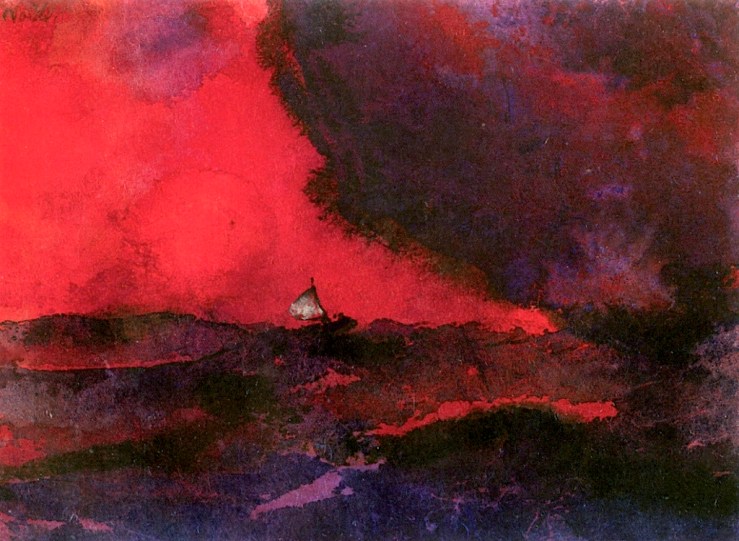
Online devotional with visual art and music: Each Lenten season since 2012, Kevin Greene, an associate pastor at West End Presbyterian Church in Richmond, Virginia, has published an online devotional that comprises for each day an art image, a short scripture reading, a prayer, and a music file. I absolutely love this model, with its spare style: because the entries are light on text, they invite silence, contemplation, seeing, listening. Greene’s image selection is stellar. He doesn’t go for the obvious choices but rather aims at something more atmospheric, more slant. Among the painted subjects, for example, you’ll find a stairway, a storm, a dancer, a reaper; day 1, Ash Wednesday, was a sailboat on troubled waters (pictured below). Fine-art viewing isn’t something that’s typically a part of Protestant devotional practice, so in response to questions he’s received, Greene has described how art operates on the imagination and the spirit. I’ve been greatly blessed moving through the first week of Lent with this companion, and I can’t wait to dive into the backlist entries later on. You can sign up via e-mail in the left sidebar, or simply bookmark the website and visit it each morning.

Dark Red Sea by Emil Nolde
Emil Nolde (German, 1867–1956), Dark Red Sea, ca. 1938. Watercolor. Nolde Museum, Seebüll, Schleswig-Holstein, Germany.

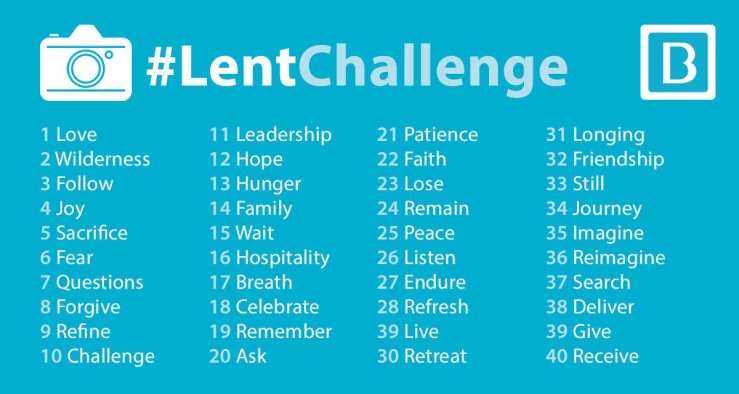
Lent Photo Challenge: The UK-based Bible Society invites people to take one photo per day throughout the season based on rotating themes (e.g., wilderness, hospitality, ask), then share them on social media using the hashtag #LentChallenge. Today is the sixth day of Lent (Sundays are excluded from the traditional forty-day count), and the assigned theme is “fear.”

#LentChallenge

Essays, short stories, poems, art: Founded in 1989, Image journal seeks “to demonstrate the continued vitality and diversity of contemporary art and literature that engage with the religious traditions of Western culture.” This Lent they’ve curated a selection of literary essays, short stories, poems, and art images from their back issues and their blog, Good Letters, that relate to the season, as well as to Easter. I especially enjoyed “Jeffrey Mongrain: An Iconography of Eloquence.” A few selections might be accessible only to subscribers (you can subscribe here; you won’t be disappointed!). Also available: the book God For Us: Rediscovering the Meaning of Lent and Easter, a full-color devotional with contributions by some of Image’s favorites. Lent is not about becoming lost in our brokenness, the description says, but about cleansing the palate so that we can taste life more fully.

Blood Pool by Jeffrey Mongrain
Jeffrey Mongrain (American, 1956–), Blood Pool, 2006. Plexiglas, 47 × 88 in. Saint Peter’s Catholic Church, Columbia, South Carolina.

“Lent Is Here to Throw Us Off Again: Finding healing in repetition, community, and art” by W. David O. Taylor: An excellent introduction to Lent, addressing unselfing, dying a good death, opening up vacant space, and praying with the eyes. This Christianity Today article is adapted from the foreword Taylor wrote for artist James B. Janknegt’s new book, Lenten Meditations, which features forty of Janknegt’s paintings on the parables of Jesus, along with written reflections. Artists like Janknegt, Taylor writes, “fix before us an image of a world broken by our own doing, but not abandoned by God. They question our habits of sight. They arrest our attention. See this image. See it for the first time, again. See what has become hidden and distorted. See the neglected things. See the small but good things. It is in this way that artists can rescue us from what the poet Samuel Taylor Coleridge calls the ‘film of familiarity’ and the ‘lethargy of custom.’”

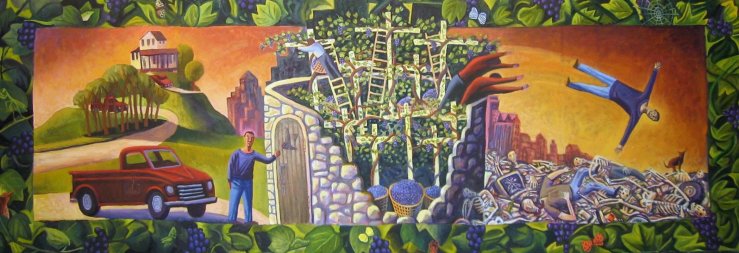
Lenten Meditations by James B. Janknegt

Parable of the Wicked Tenants by James B. Janknegt
James B. Janknegt (American, 1953–), The Wicked Tenants, 2008. Oil on canvas, 24 × 72 in.

Stations of the Cross in Washington, DC: This Lent, Dr. Aaron Rosen and the Rev. Dr. Catriona Laing of the Church of the Epiphany have organized a combination pilgrimage and art exhibition, featuring works located throughout Washington, DC, in places both sacred and secular. Mostly contemporary, some newly commissioned, the works include George Segal’s Depression Bread Line, the Vietnam Women’s Memorial by Glenna Goodacre, Barnett Newman’s Stations cycle at the National Gallery of Art, a video installation at First Congregational United Church of Christ by Leni Diner Dothan, and more. Participants can follow the stations by downloading the app “Alight: Art and the Sacred,” which offers maps and audio commentary (my friend Peggy Parker is a contributor!). (If you don’t have a smartphone, you can view the maps and listen to the commentary through a browser by following the primary link above.) Also check out the accompanying devotional guide.

Vietnam Women's Memorial by Glenna Goodacre
Glenna Goodacre (American, 1939–), Vietnam Women’s Memorial, 1993. Bronze. 5 Henry Bacon Drive, Washington, DC.

Lent by The Brilliance: This 2012 EP by The Brilliance, a duo comprising David Gungor and John Arndt, has seven tracks: “Dust We Are,” “Now and at the Hour of Our Death” (the rerelease on Brother removes the invocation to Mary), “Dayspring of Life,” “Does Your Heart Break?,” “Holy Communion,” “Violent Loving God,” and “Have You Forsaken Me?” Each one is a beautiful prayer, the words organized around a string quartet. Some take the shape of praise, others lament. God is supplicated for peace, mercy, light. The first track well captures the spirit of Lent: “Be still my soul and let it go, just let it go.” Click here to read a 2015 Hallels interview with The Brilliance, or here to listen to a podcast interview by David Santistevan.