This call-and-response song is from the December 31, 2015, morning session of the Urbana student missions conference in St. Louis, Missouri. It’s performed by the University of Hawaii’s Hui Poly student group, a ministry of InterVarsity Hawai‘i geared toward Pasifika Christians, along with some new conference friends. The song (and ministry) leader is Moanike’ala Nanod-Sitch, who establishes the rhythm on the djembe and issues the calls. She is the pastor of Ka ‘Ohana o ke Aloha church in Kaneohe and is of Native Hawaiian, Chinese, Japanese, and Ukrainian descent.
The first half of the song is in English (lyrics below), but starting at 3:51, the singers launch into seven different Polynesian or Native American languages: Yup’ik, ‘Ōlelo Hawai‘i (Hawaiian), Fijian, Tongan, Samoan, Hawaiian Pidgin, and Lakota. Subtitles are included in the video. There’s also dancing!
Holy Spirit, come (Holy Spirit, come) Won’t you rain down (Rain down) Rain down (Rain down)
Come like fiyah, come like flames Come like thundah, come like rain Won’t you rain down (Rain down) Rain down (Rain down)
Fill us up, fill our cup Fill us up, fill our cup Won’t you rain down (Rain down) Rain down (Rain down)
We want more, we want more We want more, we want more Won’t you rain down (Rain down) Rain down (Rain down)
Till we overflow Till we overflow Won’t you rain down (Rain down) Rain down (Rain down)
The Son of righteousness will rise With healing in his wings We will be free And dance before our king Let your kingdom come And let your will be done Here on earth as it is In heaven (In heaven) In heaven (In heaven)
We will walk in your love As we advance your kingdom Bringing your word To every nation Let your kingdom come And let your will be done Here on earth as it is In heaven (In heaven) In heaven (In heaven)
To view other video content from Urbana 15, including songs and sermons, see https://2100.intervarsity.org/resource-keyword/urbana-15. Urbana has been held triennially since 1946, and its worship always demonstrates a commitment to global multiculturalism.
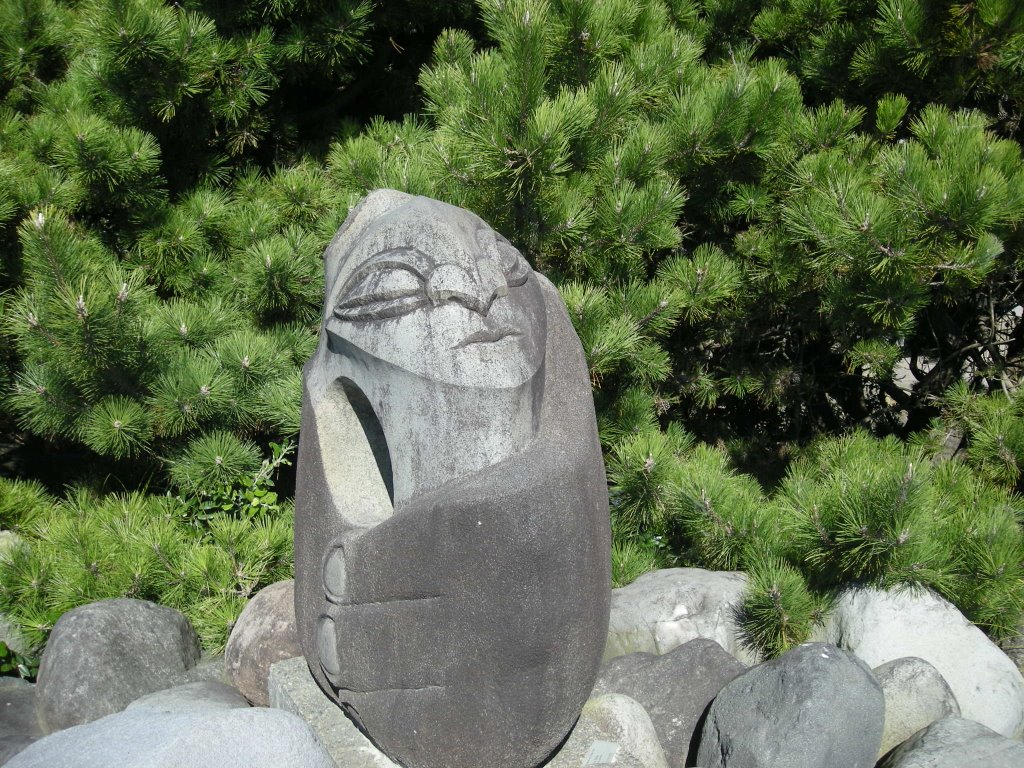
Filipe Tohi (Tongan, resident in New Zealand, 1959–), Fakaukau, 1996. Stone carving. Photo: Museum of New Zealand Te Papa Tongarewa, via Christ for All People, p. 87
I give them eternal life, and they will never perish, and no one will snatch them out of my hand. My Father, who has given them to me, is greater than all, and no one is able to snatch them out of the Father’s hand.
Fakaukau (“Thought”) is the title ascribed to this Tongan sculpture in the excellent book Christ for All People: Celebrating a World of Christian Art, published in 2001, which also places it in a private collection. However, photographs of a very similar—if not the same—sculpture by the same artist can be found online under the name Anchor Stone (see photos here and here), and it’s publicly accessible. Its shape is based on the anchor stone through which Tongan fishermen tie the rope of their boats. You can see the hand of God holding the fisher tenderly yet securely as the fisher rests in that grasp.
Anchor Stone by Filipe Tohi, located along the Coastal Walkway in New Plymouth, Taranaki, North Island, New Zealand. Photo courtesy of New Plymouth District Council.
Anchor Stone is located along the New Plymouth Coastal Walkway, an eight-mile path that forms an expansive sea-edge promenade stretching from Pioneer Park at Port Taranaki all the way to the eastern side of Bell Block Beach in the Taranaki region of North Island, New Zealand. More precisely, the sculpture sits at the eastern end of a bridge that crosses the Huatoki Stream, near the Wind Wand. The walkway features several other sculptures by Filipe Tohi, as well as artworks by other Pacific Islanders.
Filipe Tohi was born in Nuku’alofa, Tonga, in 1959 and moved to Taranaki, New Zealand, in 1979, where he trained as a carver with a Maori cooperative. His early sculptures were mainly in stone and wood, but more recently he has achieved recognition for large contemporary sculptures in aluminum and steel that are inspired by lalava, traditional Tongan coconut sennit lashing (used to build roofs and canoes). Tohi studied and learned this ancient art form during a return visit to his homeland in 1987 and has been responsible for revitalizing and popularizing it. See more of his work at http://www.lalava.net/index.php/ct-menu-item-17#6.
Christianity took root in Tonga in the first half of the nineteenth century when the country’s king, George Tupou I, converted and the people followed suit. It has been Tonga’s main religion ever since.
+++
I first encountered the hymn “O Love That Wilt Not Let Me Go” a few years ago through a Calvary Collective album—I was extremely moved by Madison Cunningham’s understated arrangement and vocal performance, which captures so well the weary tone of the old text and tune. Cunningham adds a four-line chorus: “You will not let me go, so I will trust in thee. You won’t let go, so I will rest. You won’t let go, so I will trust in thee. O I will rest in thee.” Here is the full original text:
O Love that wilt not let me go,
I rest my weary soul in thee;
I give thee back the life I owe,
that in thine ocean depths its flow
may richer, fuller be.
O Light that follow’st all my way,
I yield my flick’ring torch to thee;
my heart restores its borrowed ray,
that in thy sunshine’s blaze its day
may brighter, fairer be.
O Joy that seekest me through pain,
I cannot close my heart to thee;
I trace the rainbow through the rain,
and feel the promise is not vain
that morn shall tearless be.
O Cross that liftest up my head,
I dare not ask to fly from thee;
I lay in dust life’s glory dead,
and from the ground there blossoms red,
life that shall endless be.
Upon hearing this, I immediately set about looking for a piano score—come to find that the hymn is in the hymnal I grew up with! And yet I don’t recall my congregation ever singing it.
In my estimation, “O Love” is one of the most sublime hymns ever written. It taps deeply into that feeling of “I’m tired, burnt out, spent,” meeting us there with gentle hope and joy. The first verse opens with a reminder of the tenacious hold God has on us and with a soul-invitation into the “ocean depths” of God’s being. What a contrast the hymn builds between our weakness and God’s strength. We flicker; God blazes. We bow our heads in exhaustion and lie down to die; God lifts us up and brings us into his full-flowering life. I know some churches have revived “O Love” using new tunes, but those, I feel, don’t hold a candle to Albert Peace’s original. The hymn often crops up in funeral programs and works beautifully in that context, but its relevance is by no means restricted to those at the end of life or those observing a recent passing.
And here’s a great a cappella quartet arrangement by the Gaither Vocal Band:
Update, 10/19/20: Since I published this post, a video by 20schemes has been released, of Pete and Cara Bell from Hope Community Church Barlanark in Glasgow performing “O Love That Wilt Not Let Me Go” with the Peace tune I so admire. It’s a straightforward rendition with acoustic guitar, clear and beautiful singing, and lyrics onscreen, so if you’re looking to introduce the hymn to your church music team, this video would be a helpful start.
This post belongs to the weekly series Artful Devotion. If you can’t view the music player in your email or RSS reader, try opening the post in your browser.
To view all the Revised Common Lectionary scripture readings for the Fourth Sunday of Easter, cycle C, click here.
George Frederic Watts (British, 1817–1904), ‘For he had great possessions,’ 1894. Oil on canvas, 139.7 × 58.4 cm. Tate Britain, London.
And as he was setting out on his journey, a man ran up and knelt before him and asked him, “Good Teacher, what must I do to inherit eternal life?”
And Jesus said to him, “Why do you call me good? No one is good except God alone. You know the commandments: ‘Do not murder, Do not commit adultery, Do not steal, Do not bear false witness, Do not defraud, Honor your father and mother.’”
And he said to him, “Teacher, all these I have kept from my youth.”
And Jesus, looking at him, loved him, and said to him, “You lack one thing: go, sell all that you have and give to the poor, and you will have treasure in heaven; and come, follow me.”
Disheartened by the saying, he went away sorrowful, for he had great possessions.
—Mark 10:17–22 (cf. Matthew 19:16–30; Luke 18:18–30)
+++
SONG: “Iesū Me Ke Kanaka Waiwai” (Jesus and the Rich Young Man) | Words and music attributed to John Kamealoha Almeida, 1915 | Performed by Mark Yamanaka, with Sean Naleimaile, 2018
The origins of this song are debated, which is why it often circulates with the credit “Traditional,” but many sources attribute it to John K. Almeida (1897–1985), a famous singer, songwriter, and bandleader from Oahu, who said he wrote it in 1915. According to music archivist Harry B. Soria Jr., Almeida offered “Kanaka Waiwai” to the Mormon Church, of which he was a member, but his gesture was turned down when the piece was deemed too “hula sounding” and unsuitable for a worship service [liner notes, John Kameaaloha Almeida (HanaOla Records, 2003)].
Almeida first recorded it, along with secular mele (songs), in 1946, accompanied by Genoa Keawe’s Trio. It gained immense popularity in 1971, when the Sons of Hawaii recorded it with Moe Keale on vocals. Now it is one of Hawaii’s best-loved hymns and is widely performed not only in recording studios but in churches. I’ve combed through dozens of performances to find what I consider the best, which is Mark Yamanaka’s. You’ll notice he employs a characteristic Hawaiian vocal technique known as leo ki’eki’e (“high-pitched voice”), a yodel-like break between registers. The video above is from a HiSessions acoustic live session shot earlier this year, but you can also hear him singing the song on his 2013 album Lei Maile.
Ma ke alahele ʻo Iesû
I hālāwai aku ai
Me ke kanaka ʻōpio hanohano
Kaulana i ka waiwai
Pane mai e ka ʻōpio
ʻE kuʻu Haku maikaʻi
He aha hoʻi kaʻu e hana aku ai
I loaʻa e ke ola mau?
E hāʻawi, e hāʻawi lilo I kou mau waiwai Huli a hahai mai iaʻu I loaʻa e ke ola mau ia ʻoe
Minamina e ka ʻōpio
I kona mau waiwai
I ke kūʻai a hāʻawi lilo aku
I ka poʻe nele a hune
Huli aʻe ʻo Iesū lā
Pane aku i ka ʻōpio
ʻAʻole aʻe hiki ke kanaka waiwai
I ke aupuni o ka lani
A literal English translation, by Haunani Bernardino, is as follows:
Along the road, Jesus
Met
With a distinguished young man
Who was known for his wealth.
The young man said,
“My good lord,
What must I do
To gain eternal life?”
“Give, give away all Of your possessions, Then come and follow me In order to gain eternal life.”
The young man grieved
Over his wealth,
Unwilling to sell and give all
To the poor and destitute.
Jesus then turned
And answered the man,
“Rich man, you will not enter
The Kingdom of Heaven.” [source]
When the song is sung in English, however (even by native Hawaiians), a completely different set of lyrics is used, going something like this:
Let me walk through paradise with you, Lord
Take my hand and lead me there
All my earthly treasures I will gladly give
Teach me how to love and how to share
Greed and lust and vanity were mine, Lord
Till I found your love divine
Now on my knees I pray that I will find a way
Let me walk through paradise with you
Oh, my Lord, my Savior
Guide my poor feet along that lonely road
Faith and hope and love will light the way before me
And I’ll walk through paradise with you
Oh, my Lord, my Father
Take my hand and lead me to paradise
Oh, my Lord, let me follow in your footsteps
Let me walk through paradise with you
I’m not sure where these lyrics originated, nor why a closer approximation of the original has not been attempted. This English rewrite drastically changes the content of the song, shifting it from a retelling of a Gospel narrative that ends on a sad note to a personal prayer that, while touching on some of the themes of the rich man’s encounter with Jesus, is sweet and bright and indicates conversion. One could say it’s a revisionist account told in the rich man’s voice—if he had surrendered to Jesus’s call rather than resisted, unwilling to give up his material wealth. He is thus held up as a positive model in this version, and we are enjoined to respond with similar boldness of vow (“All my earthly treasures I will gladly give”) and fervency of petition (“Let me walk through paradise with you”).
In the following video, an unnamed woman with beautiful vocals performs this English version to a simple ukulele accompaniment:
This post belongs to the weekly series Artful Devotion. If you can’t view the music player in your email or RSS reader, try opening the post in your browser.
To view all the Revised Common Lectionary scripture readings for Proper 23, cycle B, click here.



 Art & Theology