Prayer-poems by George MacDonald

George MacDonald (1824–1905) was a Scottish preacher, poet, essayist, and writer of both realist and fantasy fiction. He was a great influence on J. R. R. Tolkien and C. S. Lewis, the latter of whom published, in 1946, a compilation of MacDonald’s theological writings excerpted from his sermons, novels, and other sources. “I know of hardly any other writer who seems to be closer, or more continually close, to the Spirit of Christ Himself,” Lewis wrote in the preface to George MacDonald: An Anthology.

MacDonald is best known for his fairy tales, such as The Princess and the Goblin (my entrée to the author as a child, via a 1991 animated film adaptation from Wales) and Phantastes. But more recently I have been appreciating his devotional poetry.

George MacDonald
George MacDonald, as photographed by his friend and fellow writer Lewis Carroll, 1863

While in his fifties, MacDonald published A Book of Strife in the Form of the Diary of an Old Soul (1880), a collection of 366 short, original, untitled devotional poems, one for each day of the year. (Read it for free online.) Addressed to God, these poems voice discouragement, weariness, restlessness, desire, doubt, and trust. MacDonald asks God for healing and refreshment; for a vulnerable, stripped-down soul, clothed anew in Christ; for salvation from his stubbornness and folly; for guidance through his dark night of the soul; for rightly ordered loves; for Christian growth. He searches for God, confesses his sinful tendencies, praises God for God’s love and faithfulness, and prays for words when words fail him.

Below are my favorite selections—some full poems, some just single lines or excerpts—from MacDonald’s Diary of an Old Soul, which is in the public domain. The headings are my own, to aid in navigating more easily to different topics, and the trifold dividers mark separate entries.

When the book was printed privately in 1880, all the left-hand pages were left blank to encourage thoughtful reader responses; “Let your white page be ground, my print be seed,” MacDonald wrote in the dedication. I’d encourage you, too, to grab a journal and record your own prayers and reflections prompted by any of these verses, or simply to copy out the lines that resonate. And songwriters and composers: I can see potential for musical settings here!

A New Song

Barb thou my words with light, make my song new.

Seeing with the Inner Eye

That thou art nowhere to be found, agree
Wise men, whose eyes are but for surfaces;
Men with eyes opened by the second birth,
To whom the seen, husk of the unseen is,
Descry thee soul of everything on earth.
Who know thy ends, thy means and motions see:
Eyes made for glory soon discover thee.

+++

Lord, in the land of things that swell and seem,
Help me to walk by the other light supreme,
Which shows thy facts behind man’s vaguely hinting dream.

God Transcends All Imagining

What the heart’s dear imagination dares,
Thou dost transcend in measureless majesty
All prayers in one—my God, be unto me
Thy own eternal self, absolutely.

+++

Oh, let me live in thy realities,
Nor substitute my notions for thy facts,
Notion with notion making leagues and pacts;
They are to truth but as dream-deeds to acts,
And questioned, make me doubt of everything.—
“O Lord, my God,” my heart gets up and cries,
“Come thy own self, and with thee my faith bring.”

Be My All

Be thou the well by which I lie and rest;
Be thou my tree of life, my garden ground;
Be thou my home, my fire, my chamber blest,
My book of wisdom, loved of all the best;
Oh, be my friend, each day still newer found,
As the eternal days and nights go round!
Nay, nay—thou art my God, in whom all loves are bound!

In Him and by Him All Things Consist

Thy fishes breathe but where thy waters roll;
Thy birds fly but within thy airy sea;
My soul breathes only in thy infinite soul;
I breathe, I think, I love, I live but thee.
Oh breathe, oh think,—O Love, live into me;
Unworthy is my life till all divine,
Till thou see in me only what is thine.

Practicing the Presence of God at Work

Two things at once, thou know’st I cannot think.
When busy with the work thou givest me,
I cannot consciously think then of thee.
. . . . . . . . . . . . . . . . . . . . . . . . . . . . . . . . . .

Therefore I make provision, ere I begin
To do the thing thou givest me to do,
Praying,—Lord, wake me oftener, lest I sin.
Amidst my work, open thine eyes on me,
That I may wake and laugh, and know and see,
Then with healed heart afresh catch up the clue,
And singing drop into my work anew.

“The life is more than meat, the body more than raiment”

Thy will be done. I yield up everything.
“The life is more than meat”—then more than health;
“The body more than raiment”—then than wealth;
The hairs I made not, thou art numbering.
Thou art my life—I the brook, thou the spring.
Because thine eyes are open, I can see;
Because thou art thyself, ’tis therefore I am me.

On Prayer

Sometimes, hard-trying, it seems I cannot pray—
For doubt, and pain, and anger, and all strife.
Yet some poor half-fledged prayer-bird from the nest
May fall, flit, fly, perch—crouch in the bowery breast
Of the large, nation-healing tree of life;—
Moveless there sit through all the burning day,
And on my heart at night a fresh leaf cooling lay.

+++

In my dead moments, master, stir the prayers.

+++

My prayer-bird was cold—would not away,
Although I set it on the edge of the nest.
Then I bethought me of the story old—
Love-fact or loving fable, thou know’st best—
How, when the children had made sparrows of clay,
Thou mad’st them birds, with wings to flutter and fold:
Take, Lord, my prayer in thy hand, and make it pray.

Prayers in Times of Spiritual Destitution

When I no more can stir my soul to move, 
And life is but the ashes of a fire;
When I can but remember that my heart
Once used to live and love, long and aspire,—
Oh, be thou then the first, the one thou art;
Be thou the calling, before all answering love,
And in me wake hope, fear, boundless desire.

+++

There is a misty twilight of the soul,
A sickly eclipse, low brooding o’er a man,
When the poor brain is as an empty bowl,
And the thought-spirit, weariful and wan,
Turning from that which yet it loves the best,
Sinks moveless, with life-poverty opprest:—
Watch then, O Lord, thy feebly glimmering coal.

A Prayer for Joy in All Circumstances

Do thou, my God, my spirit’s weather control;
And as I do not gloom though the day be dun,
Let me not gloom when earth-born vapours roll
Across the infinite zenith of my soul.
Should sudden brain-frost through the heart’s summer run,
Cold, weary, joyless, waste of air and sun,
Thou art my south, my summer-wind, my all, my one.

A Prayer for Victory over Temptation

Haste to me, Lord, when this fool-heart of mine
Begins to gnaw itself with selfish craving;
Or, like a foul thing scarcely worth the saving,
Swoln up with wrath, desireth vengeance fine.
Haste, Lord, to help, when reason favours wrong;
Haste when thy soul, the high-born thing divine,
Is torn by passion’s raving, maniac throng.

Fair freshness of the God-breathed spirit air,
Pass through my soul, and make it strong to love;
Wither with gracious cold what demons dare
Shoot from my hell into my world above;
Let them drop down, like leaves the sun doth sear,
And flutter far into the inane and bare,
Leaving my middle-earth calm, wise, and clear.

A Prayer for Endurance through Trials

Thou wouldst not have thy man crushed back to clay;
It must be, God, thou hast a strength to give
To him that fain would do what thou dost say;
Else how shall any soul repentant live,
Old griefs and new fears hurrying on dismay?
Let pain be what thou wilt, kind and degree,
Only in pain calm thou my heart with thee.

A Prayer for Sanctification

Lord, in my silver is much metal base,
Else should my being by this time have shown
Thee thy own self therein. Therefore do I
Wake in the furnace. I know thou sittest by,
Refining—look, keep looking in to try
Thy silver; master, look and see thy face,
Else here I lie for ever, blank as any stone.

But when in the dim silver thou dost look,
I do behold thy face, though blurred and faint.
Oh joy! no flaw in me thy grace will brook,
But still refine: slow shall the silver pass
From bright to brighter, till, sans spot or taint,
Love, well content, shall see no speck of brass,
And I his perfect face shall hold as in a glass.

A Prayer against Workaholism

Help me to yield my will, in labour even,
Nor toil on toil, greedy of doing, heap.

“My yoke is easy, and my burden is light”

I cannot see, my God, a reason why
From morn to night I go not gladsome, free;
For, if thou art what my soul thinketh thee,
There is no burden but should lightly lie,
No duty but a joy at heart must be:
Love’s perfect will can be nor sore nor small,
For God is light—in him no darkness is at all.

God Our Mother

. . . Weary and worn,
Why not to thee run straight, and be at rest?
Motherward, with toy new, or garment torn,
The child that late forsook her changeless breast,
Runs to home’s heart, the heaven that’s heavenliest . . .

Faith and Doubt

Doubt swells and surges, with swelling doubt behind!
My soul in storm is but a tattered sail,
Streaming its ribbons on the torrent gale;
In calm, ’tis but a limp and flapping thing:
Oh! swell it with thy breath; make it a wing,—
To sweep through thee the ocean, with thee the wind
Nor rest until in thee its haven it shall find.

+++

Ever above my coldness and my doubt
Rises up something, reaching forth a hand:
This thing I know, but cannot understand.
Is it the God in me that rises out
Beyond my self, trailing it up with him,
Towards the spirit-home, the freedom-land,
Beyond my conscious ken, my near horizon’s brim?

New Life

If thou hadst closed my life in seed and husk,
And cast me into soft, warm, damp, dark mould,
All unaware of light come through the dusk,
I yet should feel the split of each shelly fold,
Should feel the growing of my prisoned heart,
And dully dream of being slow unrolled,
And in some other vagueness taking part.

And little as the world I should foreknow
Up into which I was about to rise—
Its rains, its radiance, airs, and warmth, and skies,
How it would greet me, how its wind would blow—
As little, it may be, I do know the good
Which I for years half darkling have pursued—
The second birth for which my nature cries.

+++

“Wake, thou that sleepest; rise up from the dead,
And Christ will give thee light.” I do not know
What sleep is, what is death, or what is light;
But I am waked enough to feel a woe,
To rise and leave death. Stumbling through the night,
To my dim lattice, O calling Christ! I go,
And out into the dark look for thy star-crowned head.

+++

Lord, wake me up; rend swift my coffin-planks;
I pray thee, let me live—alive and free.

Rooted in Christ

Thou in my heart hast planted, gardener divine,
A scion of the tree of life: it grows;
But not in every wind or weather it blows;
The leaves fall sometimes from the baby tree,
And the life-power seems melting into pine;
Yet still the sap keeps struggling to the shine,
And the unseen root clings cramplike unto thee.

Dying to Self

Lord, I have fallen again—a human clod!
Selfish I was, and heedless to offend;
Stood on my rights. Thy own child would not send
Away his shreds of nothing for the whole God!
Wretched, to thee who savest, low I bend:
Give me the power to let my rag-rights go
In the great wind that from thy gulf doth blow.

+++

Lord of essential life, help me to die.
To will to die is one with highest life,
The mightiest act that to Will’s hand doth lie—
Born of God’s essence, and of man’s hard strife:
God, give me strength my evil self to kill,
And die into the heaven of thy pure will.—
Then shall this body’s death be very tolerable.

+++

With every morn my life afresh must break
The crust of self, gathered about me fresh;
That thy wind-spirit may rush in and shake
The darkness out of me, and rend the mesh
The spider-devils spin out of the flesh—
Eager to net the soul before it wake,
That it may slumberous lie, and listen to the snake.

Lost Sheep

Things go not wrong when sudden I fall prone,
But when I snatch my upheld hand from thine,
And, proud or careless, think to walk alone.
Then things go wrong, when I, poor, silly sheep,
To shelves and pits from the good pasture creep;
Not when the shepherd leaves the ninety and nine,
And to the mountains goes, after the foolish one.

“Forgive us our debts, as we forgive our debtors”

Keep me from wrath, let it seem ever so right:
My wrath will never work thy righteousness.
Up, up the hill, to the whiter than snow-shine,
Help me to climb, and dwell in pardon’s light.
I must be pure as thou, or ever less
Than thy design of me—therefore incline
My heart to take men’s wrongs as thou tak’st mine.

Spiritual Riches

Lord, in thy spirit’s hurricane, I pray,
Strip my soul naked—dress it then thy way.
Change for me all my rags to cloth of gold.
Who would not poverty for riches yield?
A hovel sell to buy a treasure-field?
Who would a mess of porridge careful hold
Against the universe’s birthright old?

The Prodigal God

Gloriously wasteful, O my Lord, art thou!
Sunset faints after sunset into the night,
Splendorously dying from thy window-sill—
For ever. Sad our poverty doth bow
Before the riches of thy making might:
Sweep from thy space thy systems at thy will—
In thee the sun sets every sunset still.

God’s Stability

Father of me, thou art my bliss secure.
Make of me, maker, whatsoe’er thou wilt.
Let fancy’s wings hang moulting, hope grow poor,
And doubt steam up from where a joy was spilt—
I lose no time to reason it plain and clear,
But fly to thee, my life’s perfection dear:—
Not what I think, but what thou art, makes sure.

God’s Universality

Where should the unknown treasures of the truth
Lie, but there whence the truth comes out the most—
In the Son of man, folded in love and ruth?
Fair shore we see, fair ocean; but behind
Lie infinite reaches bathing many a coast—
The human thought of the eternal mind,
Pulsed by a living tide, blown by a living wind.

Searching for Pleasure

Ah, me, my God! in thee lies every bliss
Whose shadow men go hunting wearily amiss.

+++

I see a little child whose eager hands
Search the thick stream that drains the crowded street
For possible things hid in its current slow.
Near by, behind him, a great palace stands,
Where kings might welcome nobles to their feet.
Soft sounds, sweet scents, fair sights there only go—
There the child’s father lives, but the child does not know.

Perfect Love

Thou dost demand our love, holy Lord Christ,
And batest nothing of thy modesty;—
Thou know’st no other way to bliss the highest
Than loving thee, the loving, perfectly.
Thou lovest perfectly—that is thy bliss:
We must love like thee, or our being miss—
So, to love perfectly, love perfect Love, love thee.

+++

Lord, with thy breath blow on my being’s fires,
Until, even to the soul with self-love wan,
I yield the primal love, that no return desires.

Surrender

O Christ, my life, possess me utterly.
Take me and make a little Christ of me.

+++

O Master, my desires to work, to know,
To be aware that I do live and grow—
All restless wish for anything not thee
I yield, and on thy altar offer me.
Let me no more from out thy presence go,
But keep me waiting watchful for thy will—
Even while I do it, waiting watchful still.

+++

My Lord, I have no clothes to come to thee;
My shoes are pierced and broken with the road;
I am torn and weathered, wounded with the goad,
And soiled with tugging at my weary load:
The more I need thee! A very prodigal
I stagger into thy presence, Lord of me:
One look, my Christ, and at thy feet I fall!

Freedom

So bound in selfishness am I, so chained,
I know it must be glorious to be free
But know not what, full-fraught, the word doth mean.
By loss on loss I have severely gained
Wisdom enough my slavery to see;
But liberty, pure, absolute, serene,
No freest-visioned slave has ever seen.

+++

So shall abundant entrance me be given
Into the truth, my life’s inheritance.
Lo! as the sun shoots straight from out his tomb,
God-floated, casting round a lordly glance
Into the corners of his endless room,
So, through the rent which thou, O Christ, hast riven,
I enter liberty’s divine expanse.

Receptivity to the Spirit

Faith opens all the windows to God’s wind.

Aging

O Life, why dost thou close me up in death?
O Health, why make me inhabit heaviness?—
I ask, yet know: the sum of this distress,
Pang-haunted body, sore-dismayed mind,
Is but the egg that rounds the winged faith;
When that its path into the air shall find,
My heart will follow, high above cold, rain, and wind.

+++

Thou, healthful Father, art the Ancient of Days,
And Jesus is the eternal youth of thee.
Our old age is the scorching of the bush
By life’s indwelling, incorruptible blaze.
O Life, burn at this feeble shell of me,
Till I the sore singed garment off shall push,
Flap out my Psyche wings, and to thee rush.

+++

My harvest withers. Health, my means to live—
All things seem rushing straight into the dark.
But the dark still is God. I would not give
The smallest silver-piece to turn the rush
Backward or sideways. Am I not a spark
Of him who is the light?—Fair hope doth flush
My east.—Divine success—Oh, hush and hark!

Death

God, thou from death dost lift me. As I rise,
Its Lethe from my garment drips and flows.
Ere long I shall be safe in upper air,
With thee, my life—with thee, my answered prayer,
Where thou art God in every wind that blows,
And self alone, and ever, softly dies,
There shall my being blossom, and I know it fair.

+++

I was like Peter when he began to sink.
To thee a new prayer therefore I have got—
That, when Death comes in earnest to my door,
Thou wouldst thyself go, when the latch doth clink,
And lead him to my room, up to my cot;
Then hold thy child’s hand, hold and leave him not,
Till Death has done with him for evermore.

The Diary of an Old Soul represents only a fraction of the poetry George MacDonald wrote. To explore more, see The Poetical Works of George MacDonald, vols. 1 and 2 (1893). Seeing as next year is the bicentenary of his birth, I expect to be hearing his name a lot more!

“Silence Like Cool Sand” by Pat Mora (poem)

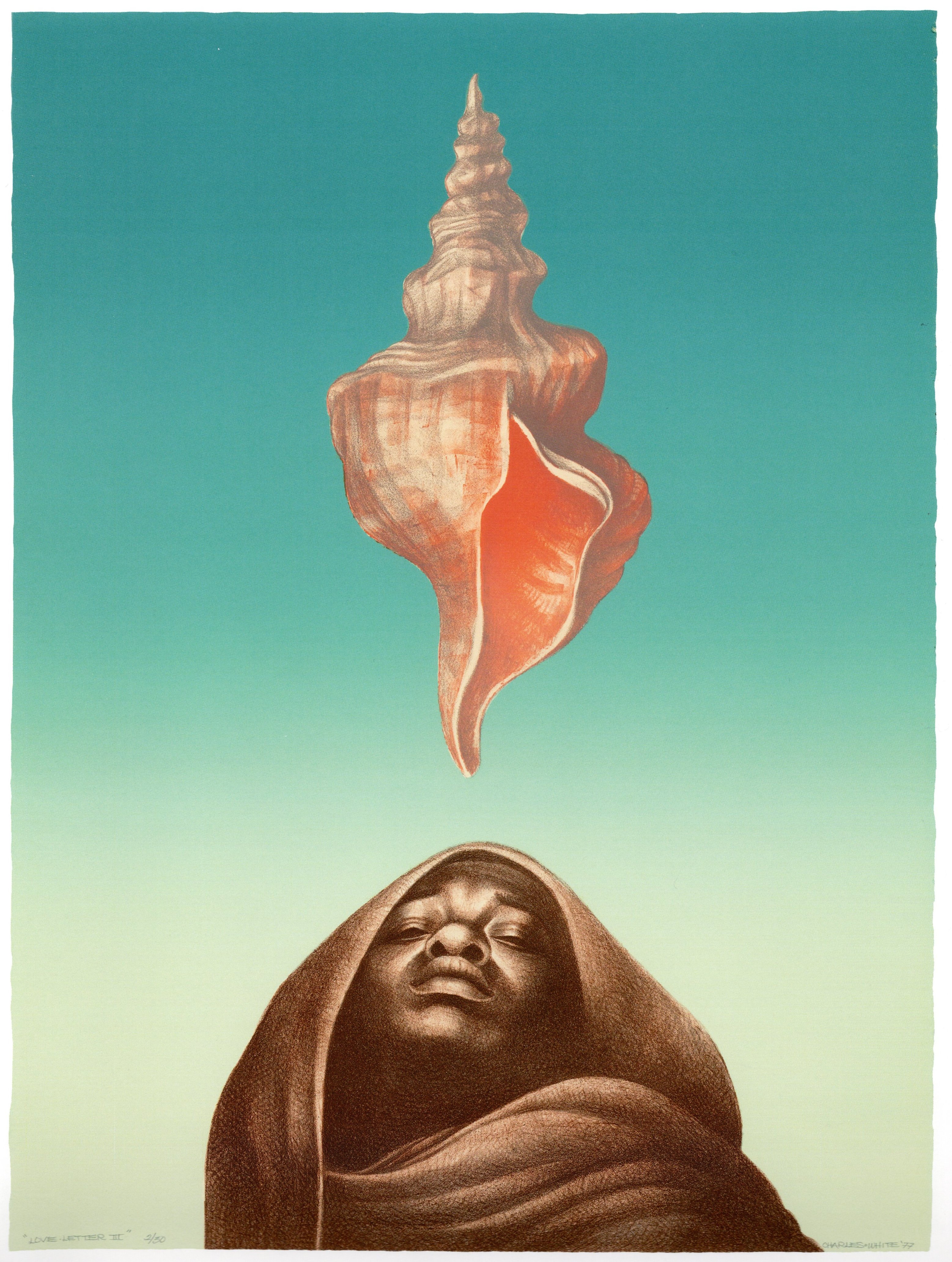
White, Charles_Love Letter III
Charles White (American, 1918–1979), Love Letter III, 1977. Color lithograph on cream wove paper, 30 1/16 × 22 5/8 in. (76.3 × 57.4 cm). Edition of 30. Art Institute of Chicago.

First lie in it.
Close your eyes.
Let it move through you.
Rock your shoulders back and forth.
Dig your heels in.
Slow your breath.

Curl forward and wash
your hands with it.
Pour it slowly on your legs.
Rub your heels deeper
into the damp.
Bury your toes.
Roll back, eyes shut.
Disappear into it.
Listen to the scratchings, then listen,
listen to the roar.

This poem originally appeared in Communion by Pat Mora (Houston: Arte Publico Press, 1991). Used by permission of the publisher.

Pat Mora (b. 1942) is an award-winning poet and author of books for adults, teens, and children. A former teacher and university administrator, in 1996 she founded Children’s Day, Book Day (El Día de los Niños, el Día de los Libros), a year-long initiative to cultivate “bookjoy” in kids nationwide, culminating on April 30. Recurring subjects in Mora’s writing include nature, family, folktales, and her Mexican American heritage. She lives in Santa Fe, New Mexico.

Roundup: “The Loving Look,” Keiskamma retrospective, and more

ONLINE EVENT: “Theodicy of Beauty” by Sarah Clarkson, March 6, 2:30 p.m. ET: “The question of suffering is one of the central, aching questions of faith. Too often, we meet suffering with an argument for God’s goodness, rather than an invitation to find and discover his goodness anew. Join me for an exploration of what it means to encounter and trust the beauty of God in our times of darkness, suffering, and pain. Drawing on my own story of mental illness and depression, I’ll explore what it means to engage with God’s goodness in a radically healing way, one that restores our capacity to imagine, hope, and create. We’ll use literature, art, and poetry to discern the ways that God arrives in our darkness to heal us, and also to restore us as agents of his loveliness in the midst of a broken world.”

This Crowdcast talk by Sarah Clarkson is based on her book This Beautiful Truth: How God’s Goodness Breaks into Our Darkness. Registration is $7 and includes a complimentary downloadable copy of “Encountering Beauty,” an arts-based reader’s guide to Clarkson’s book. I have appreciated her From the Vicarage: Books, Beauty, Theology newsletter and her wise, gentle reflections on spirituality, literature, and motherhood on Instagram @sarahwanders, so I’m looking forward to hearing from her on this topic!

+++

LECTURES (available on podcast platforms):

>> “The Loving Look” by Dr. Elissa Yukiko Weichbrodt: In this keynote address for the 2018 Beautiful Orthodoxy conference, art historian Elissa Yukiko Weichbrodt [previously], author of Redeeming Vision: A Christian Guide to Looking at and Learning from Art, discusses how contemporary art—which can sometimes be confounding or otherwise challenging—can drive us to confession, empathy, and love. Sharing her encounters with three contemporary artworks, she talks about art as a place where we can experience sanctification and common grace; how the Incarnation further vested our material world with significance; art as an invitation to embodied knowledge; art as part of how we order and understand our physical world; artworks as mirrors and shapers of culture; and how viewers, not just artists, are called to faithfulness.

Yamamoto, Lynne_Wrung
Lynne Yamamoto (American, 1961–), Wrung, 1992. Wringer, synthetic hair, nails, string, 42 × 13 × 5 in.

She cites Esther Lightcap Meek’s Loving to Know: Covenant Epistemology, in which Meek says that all acts of coming to know are integrative; they become part of us. Knowledge is an act of covenantal care, Meek says. We don’t know in order to love; we love in order to know. Weichbrodt says, “For me, contemporary art—particularly art made by artists grappling with histories and experiences that have remained largely unseen, unknown, and unloved by the dominant culture—has served as a catalyst for faithful knowing.”

Besides Wrung, the two other works she spotlights are Outline by Lorna Simpson and From Here I Saw What Happened and I Cried by Carrie Mae Weems.

>> “The Arts as a Means to Love” by Dr. Mary McCampbell: In this lecture given for English L’Abri, Mary McCampbell [previously], an associate professor of humanities at Lee University, discusses some of the ideas from her book Imagining Our Neighbors as Ourselves: How Art Shapes Empathy. I appreciate how her writing and teaching embraces the arts of film and television alongside literature, such that not only are works like The Power and the Glory by Graham Greene, “A Good Man Is Hard to Find” by Flannery O’Connor, and Beloved by Toni Morrison explored, but so are, for example, the comedy-drama Lars and the Real Girl and the drama series Better Call Saul. Discrediting the recent odd assertion from a prominent evangelical corner that empathy is a sin, McCampbell affirms that empathy is, on the contrary, an essential Christian virtue, and one that the narrative arts are adept at forming in us, exposing us to people and stories outside our realms of experience and helping us recognize the image of God in unlikely places.

+++

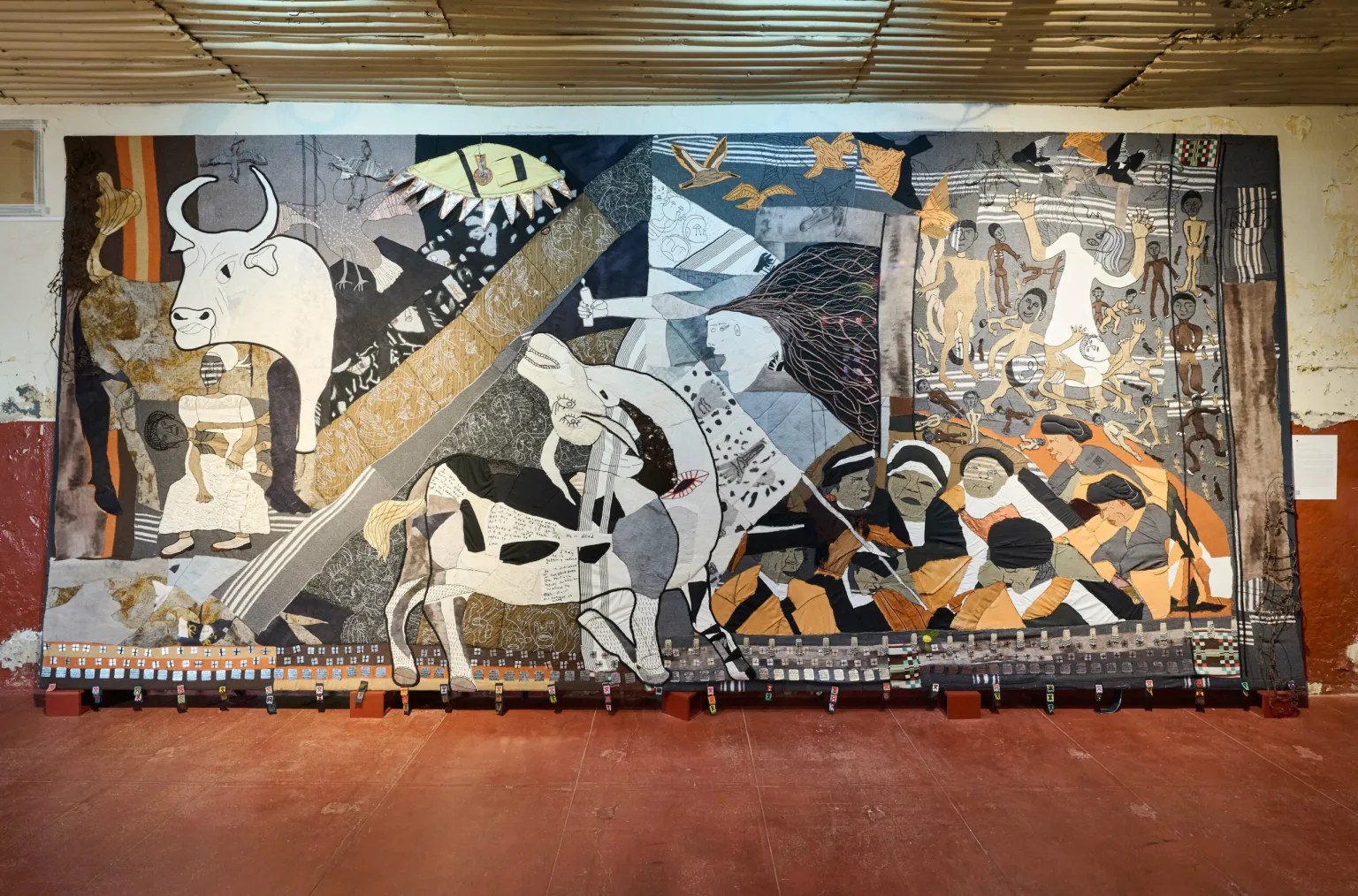
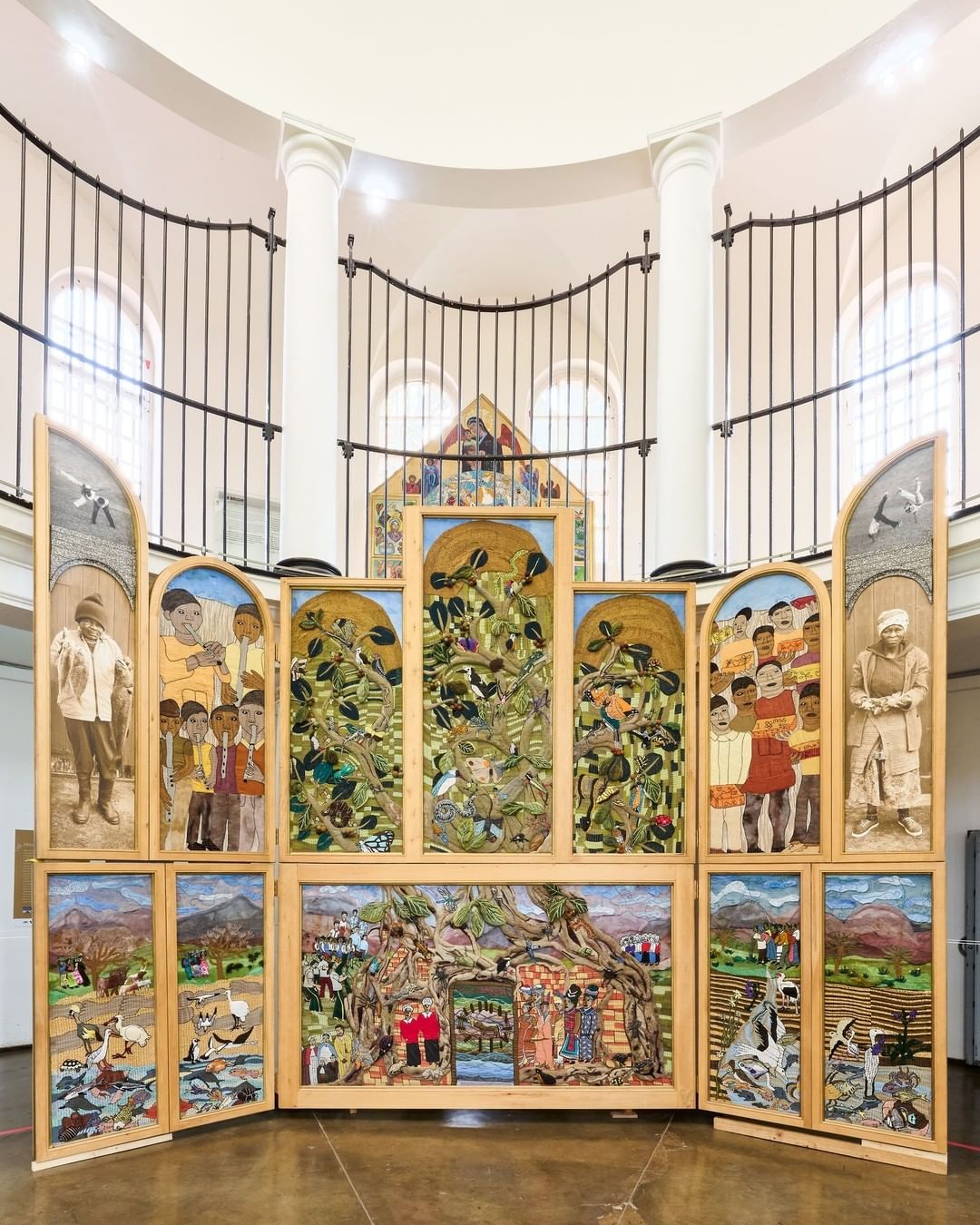
EXHIBITION REVIEW: “Mourning and Perseverance Stitched into South African Tapestries” by Alexandra M. Thomas: Through March 24 at Constitution Hill in Johannesburg, you can see Umaf’evuka, nje ngenyanga, dying and rising, as the moon does, a major retrospective of the work of the Keiskamma Art Project. Founded in 2000, the project archives the collective memory and oral histories of the rural Eastern Cape of South Africa through textile artworks, mainly by Xhosa women. Monumental and small-scale works tell stories of trauma, grief, hope, faith, resilience, and celebration. One of my favorite art research projects has been the one I did on the Isenheim-inspired Keiskamma Altarpiece in 2015, which resulted in the article “Sewing seeds of hope in South Africa”; this altarpiece is one of the many works on display. Let me call out just two others. The photos are from the current exhibition.

Keiskamma Guernica
Keiskamma Guernica, 2010. Mixed media, including appliqué, felt, embroidery, rusted wire, metal tags, beaded AIDS ribbons, used blankets, and old clothes, 3.5 × 7.8 m. Collection of Javett Art Centre at the University of Pretoria, Tshwane, South Africa. Photo: Anthea Pokroy / Keiskamma Trust.

Creation Altarpiece (Keiskamma)
Creation Altarpiece, 2007. Mixed media, including felt, embroidery, photographs, beadwork, wirework, and appliqué, 3.8 × 5.2 m (open). Collection of Unisa Art Gallery, Tshwane, South Africa.

Keiskamma Guernica, after Picasso’s famous antiwar painting, laments the limited access to HIV treatment in rural South Africa in the 2000s and the negligence of government hospitals, which resulted in many HIV/AIDS deaths. The piece repurposes the blankets and clothes of the deceased and serves as an expression of outrage as well as a form of commemoration. Creation Altarpiece, modeled loosely after the Ghent Altarpiece, exults in the region’s abundant wildlife and natural resources and in life-giving initiatives like Hamburg’s music education program, its capoeira group (a dance-like martial art), and the memory boxes made by orphaned children to remember their parents. The three top central panels depict a fig tree eating up an old hotel built by colonialists (a real-life scene observed in the nearby village of Bell!), and the bottom three show villagers of all kinds gathering around Christ, represented as a bull (whereas lambs were commonly sacrificed in ancient Israelite religion, traditional Xhosa religion calls for bull sacrifices).

View the beautiful exhibition catalog here.

+++

SONG: “Kyrie” by Ngwa Roland: Ngwa Roland is a composer and the director of De Angelis Capella [previously], a Catholic choir from Yaoundé, Cameroon. Here is his choral setting of the Kyrie eleison (Greek for “Lord, have mercy”), an important Christian prayer used in liturgies around the world.

+++

ARTICLES:

>> “To One Kneeling Down No Word Came” by Jonathan Chan, Yale Logos: Jonathan Chan is a Singapore-based poet and essayist who graduated with a master’s degree in East Asian Studies from Yale in 2022. In this personal essay he reflects on the poetry of R. S. Thomas, a twentieth-century Anglican priest from Wales, particularly as it relates to the toil of prayer—prayer as a discipline requiring persistence and solitude. Thomas’s poems often express a sense of alienation from God, which is not what we might expect from a pastor, but, as Chan remarks, “God’s absence cultivates a desire for God’s presence.”

>> “Stabat Mater: How a 13th Century Lament Resonates Today” by Josh Rodriguez, Forefront: Back in July 2020, composer Josh Rodriguez [previously here and here] published this article on four modern settings of one of the most celebrated Latin hymns of all time, the twenty-stanza Stabat Mater Dolorosa (lit. “The sorrowful mother was standing”), about Mary mourning the death of her son Jesus. Written in the Middle Ages, it continues to inspire composers today, and it remains “a powerful vehicle for ‘grieving with those who grieve,’” Rodriguez writes. He spotlights the settings by James Macmillan, Julia Perry, Hawar Tawfiq, and Paul Mealor, analyzing some of the musical elements of each and quoting the composers in regards to the piece’s meaning to them.

Roundup: “El Shaddai” (new song), everyday Black life in pictures, and more

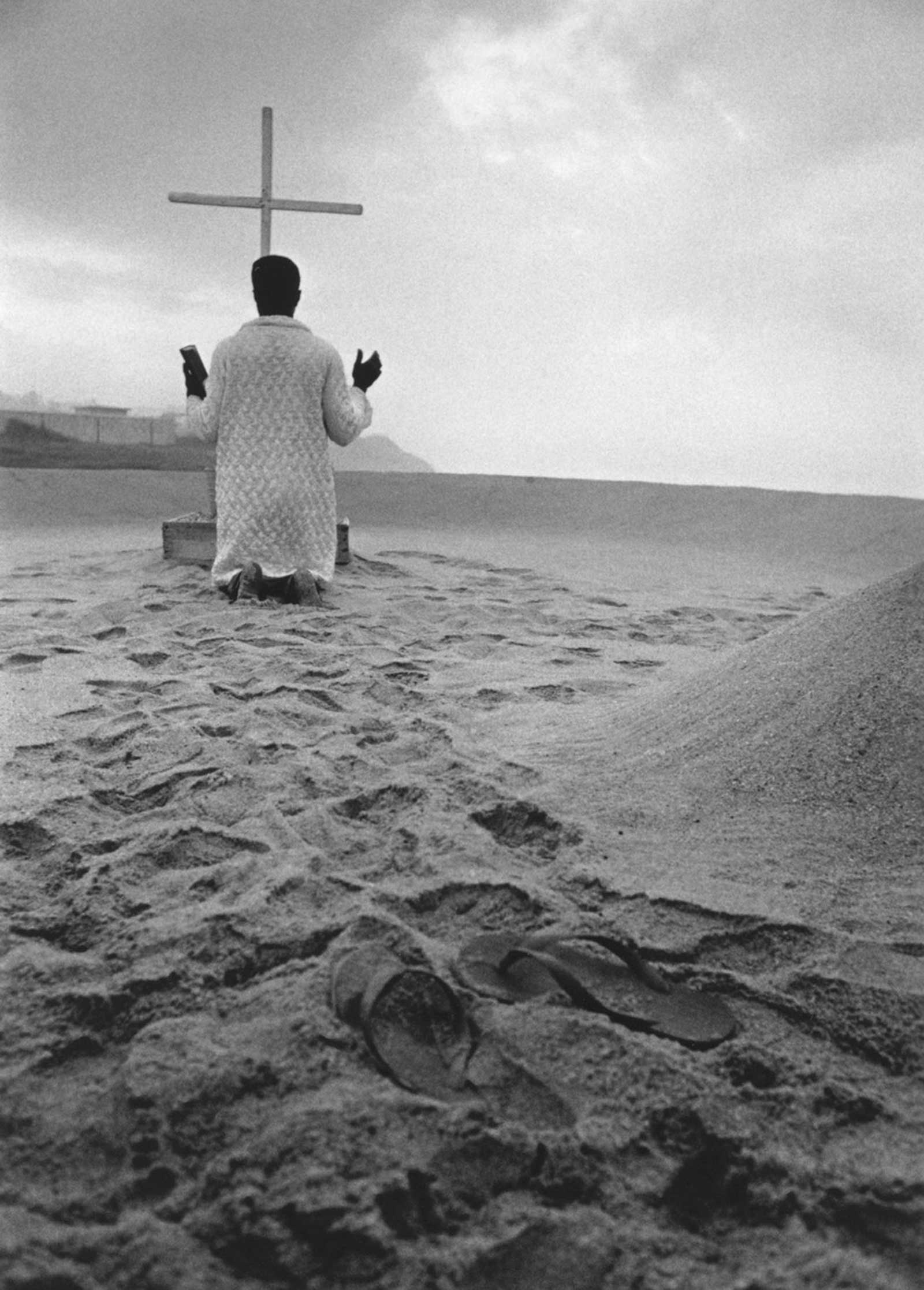
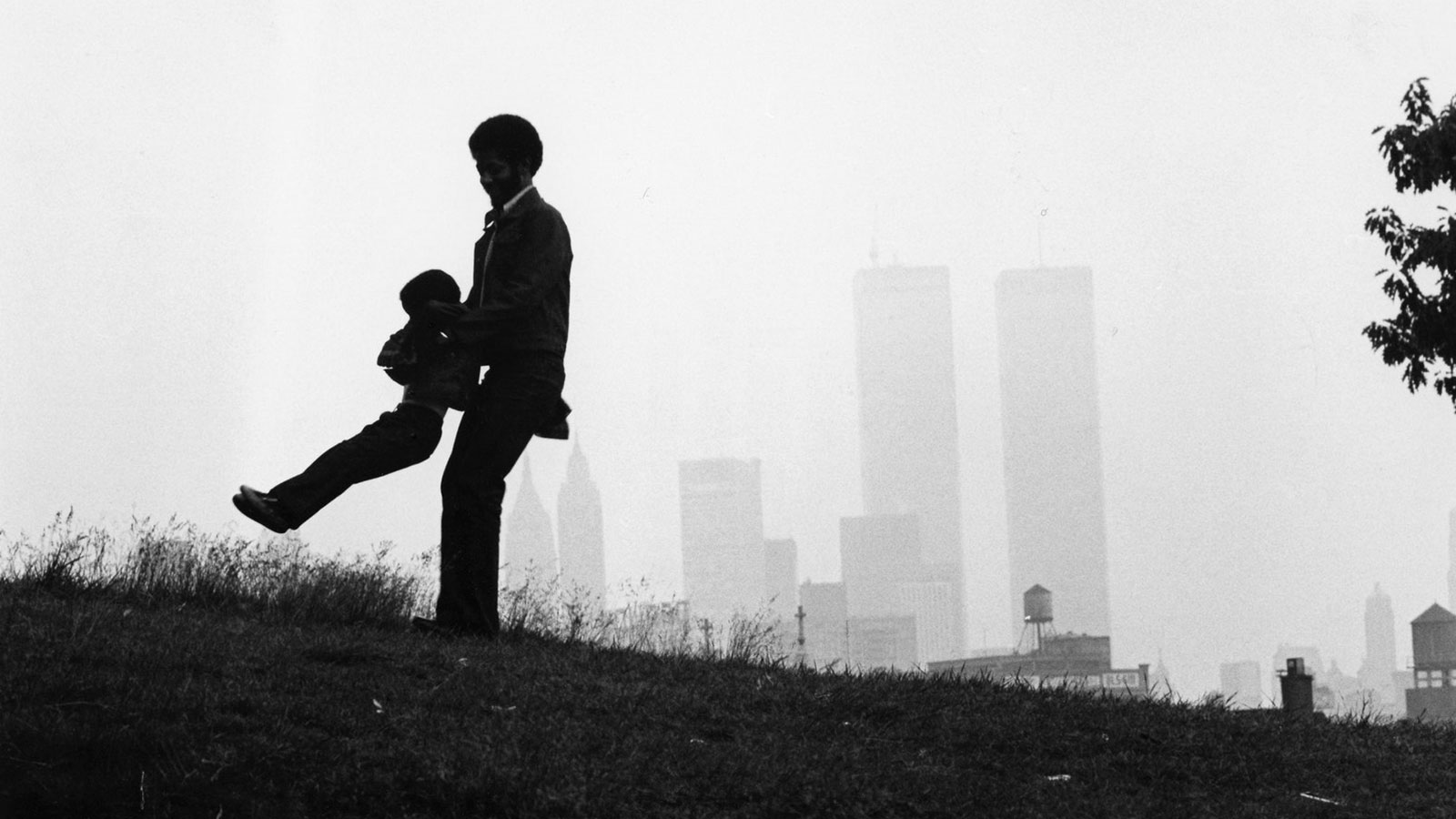
PHOTO COMPILATION: “Chester Higgins’s Life in Pictures”: Chester Higgins Jr. (b. 1946) is an American photographer whose work focuses on everyday Black life; “it is inside simple moments where I look for windows into larger meaning,” he says. He was a staff photographer for the New York Times for more than four decades, and his work is in the permanent collection of the Museum of Modern Art. This heavily illustrated New Yorker article is a good introduction to his oeuvre, in which religious belief and practice feature prominently. I found out about him through the photography compilation book Standing in the Need of Prayer: A Celebration of Black Prayer.

Higgins, Chester_Sunrise Prayer
Chester Higgins (American, 1946–), Sunrise Prayer on Osu Beach, Accra, Ghana, 1973

Higgins, Chester_Father Swinging Son, Brooklyn
Chester Higgins (American, 1946–), Father Swinging Son, Brooklyn, 1972

+++

SONGS:

>> “El Shaddai” by Victory: On January 27 singer-songwriter Victory Boyd, who goes professionally by the mononym Victory, released her latest single, “El Shaddai.” El Shaddai is an ancient Hebrew name for God whose original meaning is unclear but which is often translated into English as “God Almighty”—although “God of the Mountains,” “the Full-Breasted God” (referring to God’s nourishment of God’s children), or “the All-Sufficient One” have also been posited. Its first appearance in the Bible is in Genesis 17:1, where God tells Abram, “’I am El Shaddai; walk before me, and be blameless.”

Read the lyrics in the YouTube video description.

>> “Come Unto Me” by Take 6: A friend recently introduced me to the American a cappella gospel sextet Take 6. Formed in 1980 on the campus of Oakwood College in Huntsville, Alabama, and still active, they incorporate sophisticated jazz harmonies into the tradition of Black gospel “quartet” singing. They are featured on Spike Lee’s Do the Right Thing soundtrack and have won ten Grammys.

This 1988 performance for a Heritage USA TV spot features the group’s six original vocalists: Claude V. McKnight III, Mark Kibble, Mervyn Warren, David Thomas, Cedric Dent, and Alvin Chea.

>> “He’s Got the Whole World in His Hands” by Peter Collins: I love what Peter Collins does with this African American spiritual! This video was his submission to Tyler Perry’s #HesGotTheWholeWorldChallenge from 2020 (which I featured here). It didn’t make the final cut, but I’m so glad it’s out there.

+++

LITERARY EXCERPT from The Color Purple by Alice Walker: This short passage from Alice Walker’s 1982 Pulitzer Prize–winning novel is taken from a conversation between the protagonist, Celie, and her friend Shug, about pleasure, gratitude, and grace. Shug refers to God as “it” (“God ain’t a he or a she”), and her statement about the necessity of enjoying God’s good creation and being open to surprise provides the source of the title.

I’m embarrassed to say that although I saw and really liked the 1985 Steven Spielberg film adaptation of The Color Purple, I’ve never read the book! I plan to rectify that before December, when another film adaptation—of the 2005 stage musical based on Walker’s novel—is coming out, directed by Blitz Bazawule. It stars Fantasia, H.E.R., Colman Domingo (Euphoria), Taraji P. Henson (Hidden Figures), Danielle Brooks (Orange Is the New Black), Jon Batiste, and more.

+++

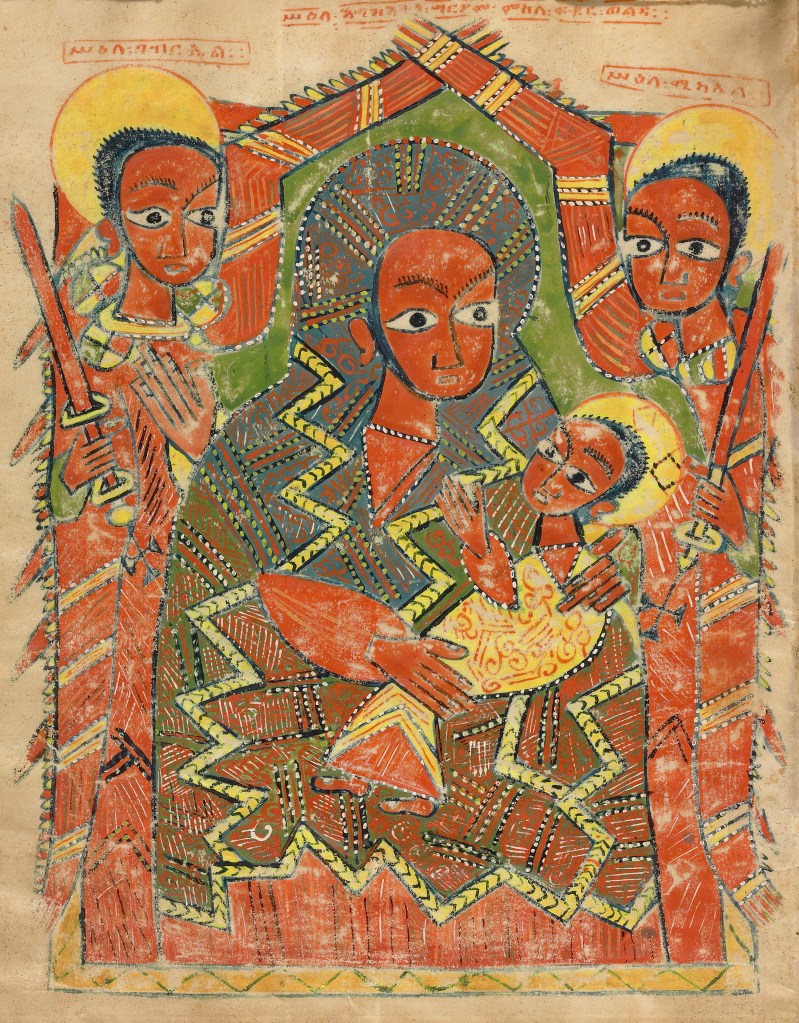
VIDEO: “Ethiopian Gospel Book”: In this six-minute instructional video, Dr. Beth Harris, executive director of Smarthistory, and Kelin Michael, a graduate curatorial intern of manuscripts at the Getty Museum, explore an early sixteenth-century Gospel book from Ethiopia. They discuss the book’s historical context and the formal qualities of its paintings, including the flatness of the figures and the colorful interlacing. They focus on a full-page illumination at the front of the Virgin and Child enthroned between two archangels, but they also touch on the book’s canon tables and its portrait of Saint John the Evangelist.

Virgin and Child (Ethiopian MS, Getty)
The Virgin and Child with the Archangels Michael and Gabriel, Ethiopia, ca. 1504–5. Tempera on parchment, 13 9/16 × 10 7/16 in. (34.5 × 26.5 cm). J. Paul Getty Museum, Los Angeles, Ms. 102, fol. 19v.

“A Prayer” by Claude McKay (poem)

Dougher, Patrick_Higher Power
Patrick Dougher, Higher Power, acrylic and mixed media on canvas, 28 × 22 in.

’Mid the discordant noises of the day I hear thee calling;
I stumble as I fare along Earth’s way; keep me from falling.

Mine eyes are open but they cannot see for gloom of night:
I can no more than lift my heart to thee for inward light.

The wild and fiery passion of my youth consumes my soul;
In agony I turn to thee for truth and self-control.

For Passion and all the pleasures it can give will die the death;
But this of me eternally must live, thy borrowed breath.

’Mid the discordant noises of the day I hear thee calling;
I stumble as I fare along Earth’s way; keep me from falling.

This poem was originally published in Harlem Shadows (Harcourt Brace, 1922) and is in the public domain.

Claude McKay (1889–1948) was a Jamaican American poet and fiction writer who was a key figure in the Harlem Renaissance, his work ranging from celebrations of Jamaican life and culture to protests of racial and economic inequities in the United States. Born in Sunny Ville, Jamaica, to well-to-do farmers of Malagasy (from Madagascar) and Ashanti descent, he was raised in the Baptist faith and with an appreciation for literature, philosophy, science, and theology. He came to the US in 1912 to attend Tuskegee Institute and was shocked by the racism he experienced in his newly adopted country. He moved to New York City in 1914 and became involved in social causes on behalf of Blacks and laborers. From 1923 to 1934 he traveled through Europe and North Africa, eventually returning to Harlem and becoming an American citizen in 1940. He started associating with Catholic social activists and studying Catholic social theory, and in October 1944 he converted to Catholicism. He died of heart failure at age fifty-seven.

Advent, Day 6: That Holy Thing

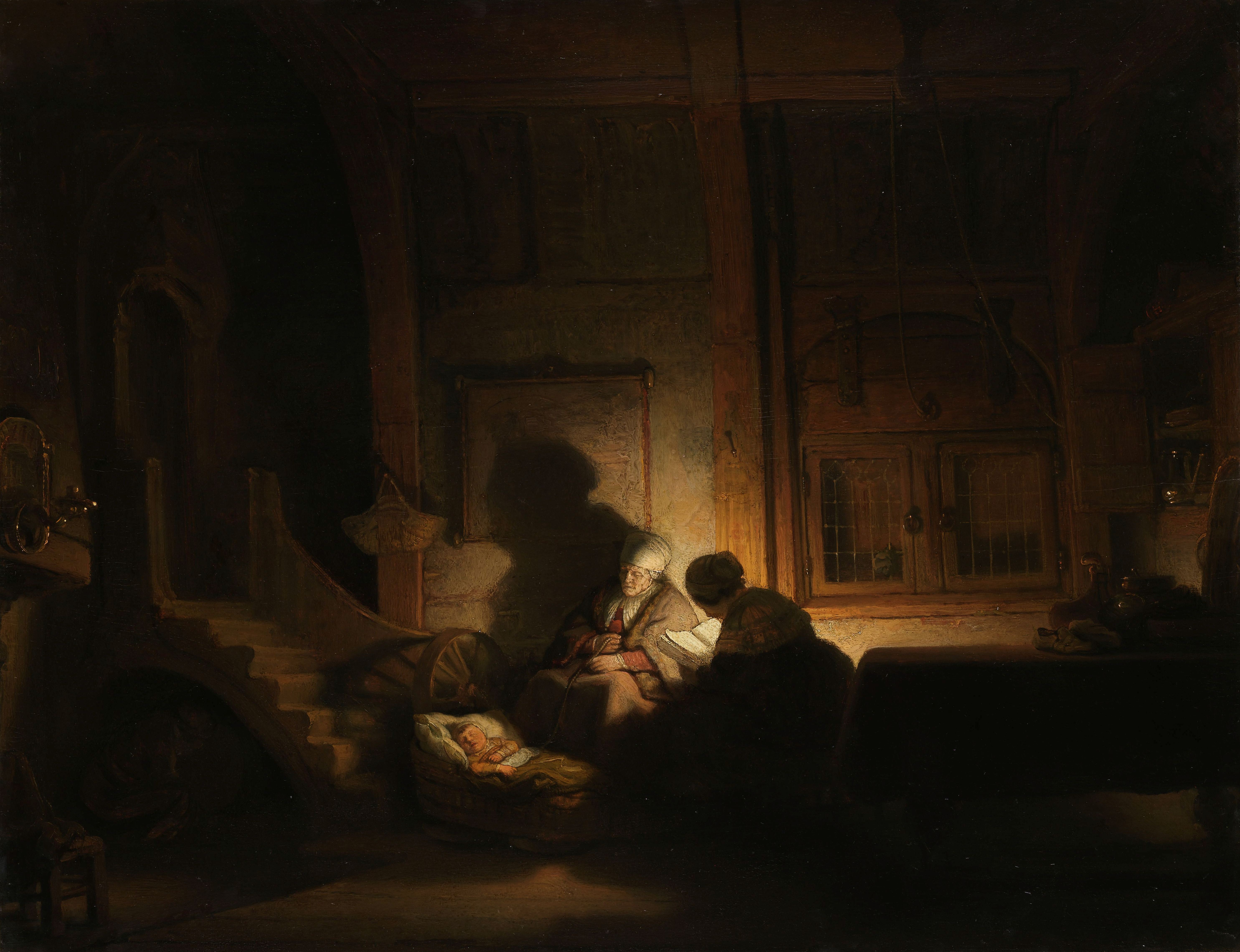
LOOK: Holy Family at Night (Rembrandt’s workshop)

Rembrandt (workshop)_Holy Family at Night
Workshop of Rembrandt van Rijn, Holy Family at Night, ca. 1642–48. Oil on panel, 66.5 × 78 cm. Rijksmuseum, Amsterdam.

During the Dutch Golden Age, the master artist Rembrandt van Rijn (1606–1669) ran a flourishing workshop in Amsterdam, overseeing the production of students’ paintings that continued the deep chiaroscuro and distinctive application of paint seen in his own work.

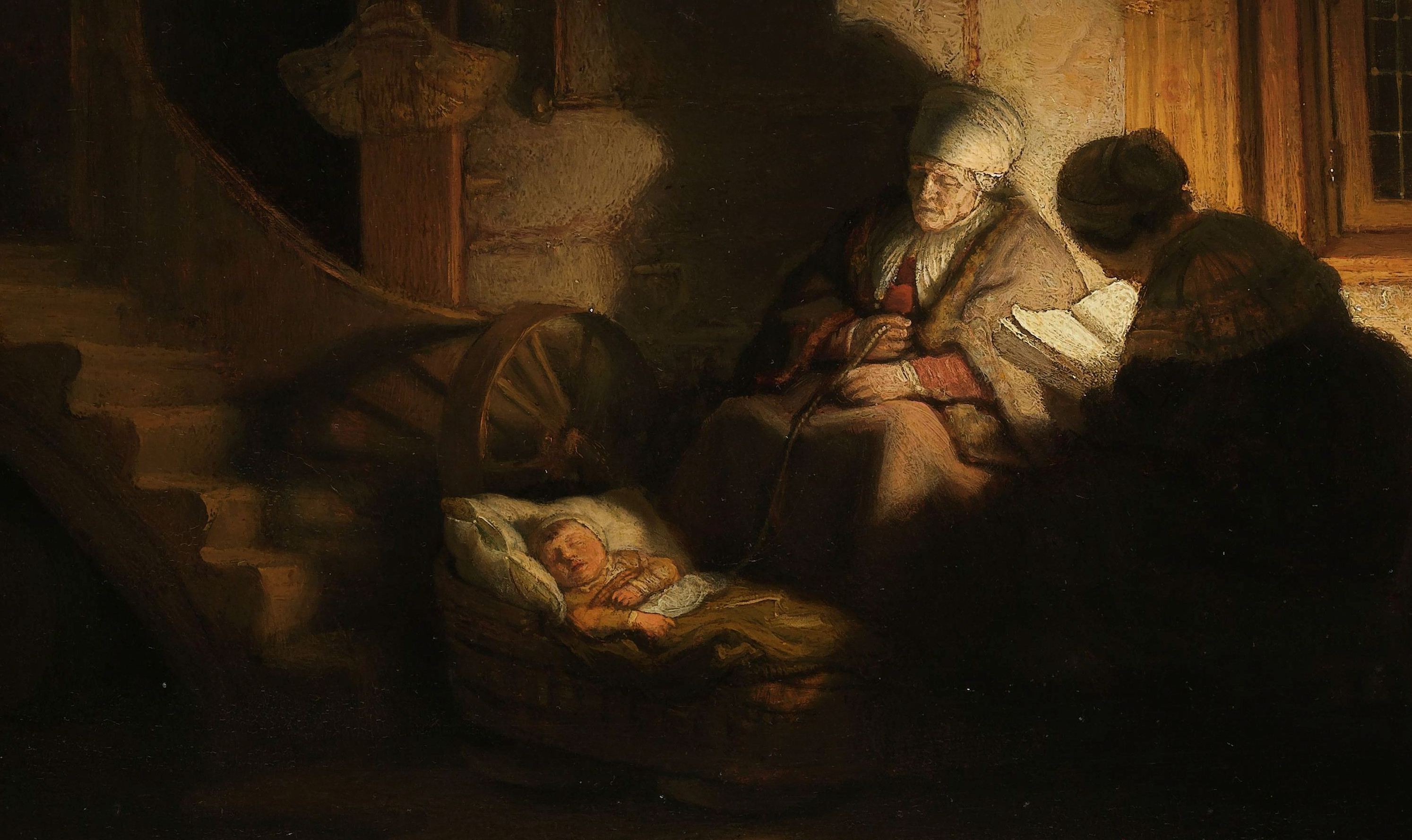
This painting from his workshop shows the Holy Family in a sparsely lit domestic interior at night. The Christ child lies asleep in a wicker cradle at the foot of a half staircase, his grandma Anne likewise nodding off as she rocks him gently with the cradle rope. Relieved by the quiet, Jesus’s mom, Mary, catches up on some reading, and Joseph taps liquid from a barrel on the left under the stairs (he’s very difficult to make out through the shadows).

This lived-in room is full of everyday objects from seventeenth-century Holland. Over the hearth on the left a copper candlestick holder is affixed to the wall. Behind Anne is a map, and beside her a spinning wheel, and a wicker basket hangs from the nail of a curved wooden beam. On the table to the right are a pair of old shoes, a flask attached to a leather belt, and a mortar and pestle, and a Jan Steen jug and other kitchenware are stored in the cupboard above. The shutters are drawn closed over the window. How utterly ordinary!

Although scholarly opinion since 1900 has identified the figures as biblical ones (the title is not the artist’s, as artists did not title their paintings at the time), for much of the painting’s history viewers interpreted it as simply a genre scene—that is, a scene showing regular people going about their daily lives. It lacks the “distinction, nobility, and loftiness” owed to biblical subject matter, it was believed, especially the Holy Family. There are no angels, no haloes. The only hint of sacredness is the pouring of light from a mysterious unknown source.

Rembrandt (workshop)_Holy Family at Night (detail)

But the ordinariness of the scene depicted is precisely what makes it so glorious. Jesus was born into a working-class family. For most of his life he labored as a carpenter, adopting Joseph’s trade. He wasn’t surrounded by lavish things. His upbringing looked much like that of all the other Jewish boys in Nazareth. That he was God incarnate would be revealed in time, to those who had eyes to see. But in the meantime, he cooed and pooed and cried and slept and fed and spit up like any other baby! And his mom was exhausted like any other mom, forced to sneak in some time for herself (including private devotional time, as she’s probably reading her Bible here) wherever she could, between childcare, chores, and other obligations.

That God chose to come to us as an ordinary human being born to an ordinary family (albeit conceived in an extraordinary way!) surprised everyone. The song that follows extends the surprise of the Incarnation into God’s other interventions in our lives, on a more personal scale. Just as he defied expectations in his first coming, so he often continues to surprise us in the ways he comes to us now—that is, not according to our own prescriptions, but down his “own secret stair,” when and where we’re least expecting it.

LISTEN: “That Holy Thing” | Words by George MacDonald, 1877 | Music by Katy Wehr, on In Others’ Words, 2008

They all were looking for a king,
To slay their foes, and lift them high:
Thou cam’st a little baby thing
That made a woman cry.

O Son of Man, to right my lot
Naught but thy presence can avail;
Yet on the road thy wheels are not,
Nor on the sea thy sail.

My how or when thou wilt not heed,
But come down thine own secret stair,
That thou mayst answer all my need,
Yea, every bygone prayer.

This song is a setting of a poem written by George MacDonald (1824–1905) in December 1877 and sent by letter to a handful of friends.* When it was first published in 1893 in the two-volume Poetical Works of George MacDonald, it was with this revised final stanza:

My fancied ways why shouldst thou heed?
Thou com’st down thine own secret stair;
Com’st down to answer all my need,
Yea, every bygone prayer!

The poem appears in the highly influential Oxford Book of English Verse (1900), compiled and edited by Arthur Quiller-Couch, but in its original form.

“That holy thing” is a translation of the Greek word hagios, which appears in Gabriel’s speech to Mary in Luke 1:35: “that holy thing which shall be born of thee shall be called the Son of God.” Educator Missy Andrews unpacks the poem:

In “That Holy Thing,” MacDonald meditates on man’s expectations and God’s will. In the first line of the poem, the poet remembers the first-century Jews who suffered under Roman occupation, waiting for the Messiah who would restore the throne of David to Israel. He acknowledges their plight and their expectation, contrasting it with what they in fact received. The baby Christ represented both a gracious answer to their need, and an immediate disappointment. He satisfied the deepest intentions of their prayer and Yahweh’s ancient prophecies, but frustrated their earthy expectations for geographic kingdoms and vindication. Not only that, but the baby King “made a woman cry.” This references not only the immediate suffering and travail of the Christ Child’s mother, Mary, but ultimately the suffering that would rend her heart when He himself was lifted high upon the cross in answer to their desperate prayer for triumph over their foes.

The poet notes that his own travails and petitions, his own desperate need of God’s intervening help, is denied in its immediacy as well. For, although the Son of Man’s own presence alone can help to “right the lot” of the poet, his coming is not visible by road or sea. In this way, MacDonald acknowledges that his own expectations, like those of his spiritual forebears, eclipse his ability to see the Lord’s coming in his own circumstances. He acknowledges the differences between God’s ways and man’s, in faith acknowledging that the Lord answers man in his own ways and times, keeping secret His approach, but stealthily accomplishing man’s every need, answering his every prayer through the mystery of incarnation. This incarnate Child, the Son of Man, replete with humanity and no stranger to suffering, suggests a remedy for all who wait and suffer.

Andrews is a founding director of CenterForLit, whose goal is “to bring readers face to face with the world’s best books so they can know themselves more fully as God’s creatures.” The center has a special emphasis on equipping parents to teach the classics to their kids.

The commentary above is excerpted, with Andrews’s permission, from the first post of twenty-five published in Advent 2015 for the CenterForLit’s “Literary Advent” blog series (which is excellent!). Andrews provides interpretations of poems by John Donne, Madeleine L’Engle, Gerard Manley Hopkins, T. S. Eliot, W. H. Auden, and more, combining literary analysis and theological reflection. You can enjoy Andrews’s series in print form with the book Wild Bells: A Literary Advent.

Kathryn Wehr, PhD, is a singer-songwriter whose most recent album, which leans folk rock in style, is And All the Marys: Women Encountering Christ in the Gospels (2018).

Besides being a musical artist, Wehr is also a scholar whose interests include theology and the arts, spiritual formation, and church history. Her specialization is the religious drama of Dorothy L. Sayers, and as such, she is the editor of the forthcoming book The Man Born to be King, Wade Annotated Edition (IVP Academic, 2023). In addition, she is the managing editor of Logos: A Journal of Catholic Thought and Culture at the Center for Catholic Studies at the University of St. Thomas in Saint Paul, Minnesota. 

* Thank you to the Special Collections & University Archives at Taylor University, through whose British Author Collections I discovered this earlier composition date for the poem, as well as an authoritative version of stanza 3 from MacDonald’s own hand. They provided me with a scan of one of MacDonald’s handwritten copies of “That Holy Thing” (Ref. ID 482), which contains the headnote “Written for my friends—Christmas, 1877.”

Advent, Day 4: Maranatha (multilingual)

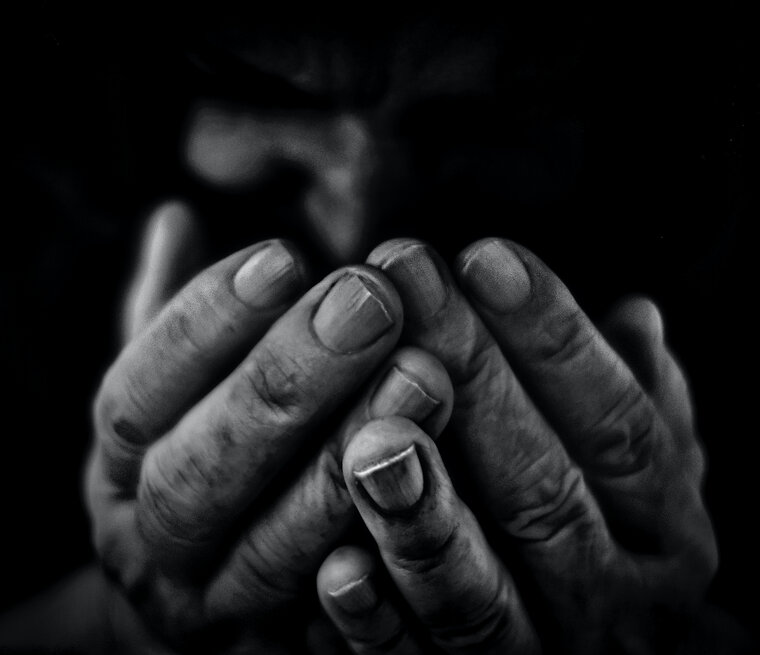
LOOK: God Heals by Anila Hussain

Hussain, Anila_God Heals
Anila Hussain, God Heals, metallic black and white print on Fujifilm paper with frame, 50 × 50 cm

A finalist for the 2021 Chaiya Art Awards, this black-and-white photograph shows a person at prayer, her hands cupped, anticipating in faith the receipt of what she’s asked for but open to whatever God gives. The woman pictured is photographer Anila Hussain’s eighty-something-year-old mother, who has suffered for years from chronic pain and prays multiple times a day for relief. Hussain is her primary caregiver.

With the woman’s face in the shadows and her rough, overlapping hands illuminated, closely cropped, and in the foreground, God Heals emphasizes a posture of humble and heartfelt entreaty.

LISTEN: “Ven, Señor Jesús, Maranathá” (Come, Lord Jesus, Come, O Lord), performed by Harpa Dei, 2020 [HT: Global Christian Worship]

Born in Germany and raised in Ecuador, siblings Nikolai, Lucía, Marie-Elisée, and Mirjana Gerstner form the sacred vocal quartet Harpa Dei. Here they sing a traditional chant invoking Christ’s return in ten languages, shifting voice parts and harmonies to beautiful effect. The lyrics are in the video and also below.

Māranā thā is Aramaic (the language of Jesus) for “Come, O Lord.” Christians have prayed this prayer since the apostolic era, looking toward the cosmic healing and restoration that Christ’s second coming will usher in.

SPANISH: ¡Ven, Señor Jesús, Maranathá!
ENGLISH: Come, Lord Jesus, Maranatha!
GERMAN: Komm, Herr Jesus, Maranatha!
FRENCH: Viens, Seigneur Jésus, Maranatha!
ITALIAN: Vieni, Signor Gesù, Maranatá!
CHINESE: 来吧,主耶稣 (Lai ba, zhu Ye su, Maranatha!)
HEBREW: !בּוֹא אָדוֹן יֵשׁוּעַ  מרנאתא (Bo Adon Jeshua, Maranatha!)
RUSSIAN: Гряди, Господи (Gryadi Gospodi, Maranatha!)
GREEK: ἔρχου, Κύριε (Erhu Kyrie, Maranatha!)
LATIN: Veni Domine, Maranatha!

Sheet music can be found here.

“Compassionate and Wise” (interfaith song in response to 9/11)

The song “Compassionate and Wise,” which appears on an album of the same name recorded by Father Cyprian Consiglio in 2006, represents a cross-pollination of Hinduism, Buddhism, and Christianity.

An earlier version, simply called “Dedication of Merit,” was first sung at a Buddhist-Christian conference at a Benedictine convent in Indiana the week after the September 11 terrorist attacks on the World Trade Center in New York City. The Rev. Dr. Heng Sure, an American Chan Buddhist monk, was asked to offer a dedication of merit (similar to what Christians would call an intercessory prayer, though it’s phrased more like a benediction). For this he and a colleague translated a passage from the Mettā Sutta, the Buddha’s discourse on developing and sustaining loving-kindness. Their translation reads:

May every living being,
Our minds as one and radiant with light,
Share the fruits of peace
With hearts of goodness, luminous and bright.

If people hear and see
How hands and hearts can find in giving, unity,
May their minds awake,
To Great Compassion, wisdom, and to joy.

May kindness find reward;
May all who sorrow leave their grief and pain;
May this boundless light
Break the darkness of their endless night.

Because our hearts are one,
This world of pain turns into paradise.
May all become compassionate and wise,
May all become compassionate and wise.

In reciting the dedication, Sure spontaneously matched it with a melody by Canadian singer-songwriter Loreena McKennitt, which she had written in 1994 for the song “Dark Night of the Soul,” a setting of verse by the sixteenth-century Spanish Catholic mystic Saint John of the Cross. Conference attendees, their hearts full of grief over the falling of the Twin Towers, joined in singing, lifting up their collective longing for light to break through the darkness.

A few years later at a different Buddhist-Christian gathering, Sure met Father Cyprian Consiglio, a Camaldolese Benedictine monk, author, and musician from California. He shared the song with him, struck by its similarity to some of the prayers Consiglio had offered that week.

With the blessing of Sure and McKennitt, Consiglio and his regular collaborator John Pennington, a percussionist, recorded a new arrangement of the song in 2006 under the title “Compassionate and Wise.” Here they are performing it with friends on June 28, 2018, at the “Arise, My Love” concert in Santa Cruz to raise money for New Camaldoli Hermitage in Big Sur, California, where Consiglio has been the prior since 2013:

(The song starts at 2:43, following Consiglio’s spoken introduction.)

Their version has slight lyrical alterations and opens with two Sanskrit chants that Consiglio learned from the monks and nuns at Saccidananda Ashram (nicknamed Shantivanam, “Forest of Peace”), a Camaldolese Benedictine monastery in Tannirpalli, South India. The first chant, which is from the Rig Veda but also appears in the Yajur Veda, is known as the Mahamrityunjaya Mantra (Great Mantra for Conquering Death). The second is a svasti pāṭhaḥ, an invocation for the welfare of all.

The following Sanskrit and its English translation were provided to me by Consiglio:

OM tryambakam yajâmahe
Sugandhim pushtivardhanam
Urvâr ukamiva bandhanât
Mrityor mukshiyam amritat

OM sarvesâm svastir bhavatu
Sarvesâm shantir bhavatu
Sarvesâm pûrnam bhavatu
Sarvesâm mangalam bhavatu
Sarve bhavtu sukhinâh
Sarve shântu nirâmayâh
Sarve bhadrâni pashyantu
Mâ kashchid dukha bhagbhavet
OM shânti shânti shânti

We worship the true God who is the Supreme Being
Who is fragrant and nourishes all beings
May he liberate us from death for the sake of immortality
Like a cucumber is severed from its bondage to the creeper

May all be happy
May all be free from disease
May all realize what is good
May none be in misery
May the nonvirtuous be virtuous
May the virtuous attain tranquility
May the tranquil be freed from the bonds of death
May the freed make others free
Peace, peace, peace

And here is the sung English that follows:

May every living being,
Our minds as one and radiant with light,
Share the fruits of peace,
Our hearts of goodness luminous and bright.

If people hear and see,
Our hands and hearts can find, in giving, unity.
May their minds awake
To Great Compassion, wisdom, and to joy.

May goodness find reward;
May all who sorrow leave their grief and pain;
May this boundless light
Dispel the darkness of their endless night.

Because our hearts are one,
This world of pain turns into paradise.
May all become compassionate and wise,
May all become compassionate and wise.

This song is full of interfaith exchanges. A melody written to set the text of a Carmelite Christian friar was adapted to fit a Buddhist dedication of merit and is introduced by a Benedictine Christian monk with a passage from the Hindu scriptures! For more information on the song’s history, see urbandharma.org.

Explaining the significance of a dedication of merit (and metta practice) to his Christian readers, Consiglio writes on the hermitage blog, “We can dedicate whatever closeness to God we have to the good of someone else.” I myself wouldn’t use the phrase “dedication of merit” or its derivatives to describe what I’m doing when I intercede to God for others, but I see what Consiglio means, and I think it’s this: “The prayer of the righteous is powerful and effective” (James 5:16). Through Christ, God hears our prayers, and it is our duty in prayer to think more widely than just our own needs or the needs of those in our immediate circles—though that can be a good starting point. As the apostle Paul says, “I urge that supplications, prayers, intercessions, and thanksgivings be made for everyone” (1 Tim. 2:1, emphasis mine).

What if our prayers extended to enfold all living beings? I was always taught to avoid genericisms in prayer, and while there is value in direct naming, there is also a beauty to those kinds of broad prayers often heard on the lips of children—for “the whole world,” for “peace everywhere.”

Perhaps you are uncomfortable by the lack of doctrinal specificity in “Compassionate and Wise,” or by what you might call “syncretism” (the mixing of belief systems). But as Consiglio says, there is nothing in the song that contradicts Christianity. The song arose out of an interreligious context, so it’s meant to invite the participation of people of various faith backgrounds.

“Because our hearts are one” refers to a unity of intention or desire. The singers may not be united in theological particulars, nor even around the deity they’re addressing, but they are one in their wish for universal well-being, for liberation from the bonds of death and a walking together in friendship across boundaries of difference.

Roundup: Frederick Buechner on the arts, contemporary art as spiritual discipline, and more

SPOTIFY PLAYLIST: September 2022 by Victoria Emily Jones: This month’s thirty-song lineup includes a tango, a Pentecostal praise song, a playful setting of the Heidelberg Catechism Q&A number one, an Americana lament for hard times, a Negro spiritual on sax, Christina Rossetti, guitar evangelist Mother McCollum with a unique Jesus metaphor (!), a 9/11-inspired interfaith prayer that I will write about in a separate post, and songs in Turkish (“Kutsal, Kutsal, Kutsal Allah” = Holy, Holy, Holy Lord God) and Sepedi (“Modimo re boka wena” = God, we praise you).

+++

LECTURE (AUDIO): “God’s Thumbprint” by Frederick Buechner: Ordained minister and Pulitzer Prize– and National Book Award–nominated author Frederick Buechner died August 15 at age ninety-six. He was a wonderful writer (of both fiction and spiritual nonfiction) and preacher, and I hear him quoted all the time. He once summed up the theme of all his work as “Listen to your life.”

In 1992 Buechner spoke for the biennial Festival of Faith and Writing at Calvin University in Grand Rapids, Michigan, about how “art and religion are twin expressions of the human spirit.” Discussing poetry, painting, and music, he shows how the arts help us to pay attention. Listen to the talk, “God’s Thumbprint,” on FFW’s Rewrite Radio podcast. It is an expansion of the “Art” entry Buechner wrote in his book Whistling in the Dark: An ABC Theologized (1988); read the full excerpt here.

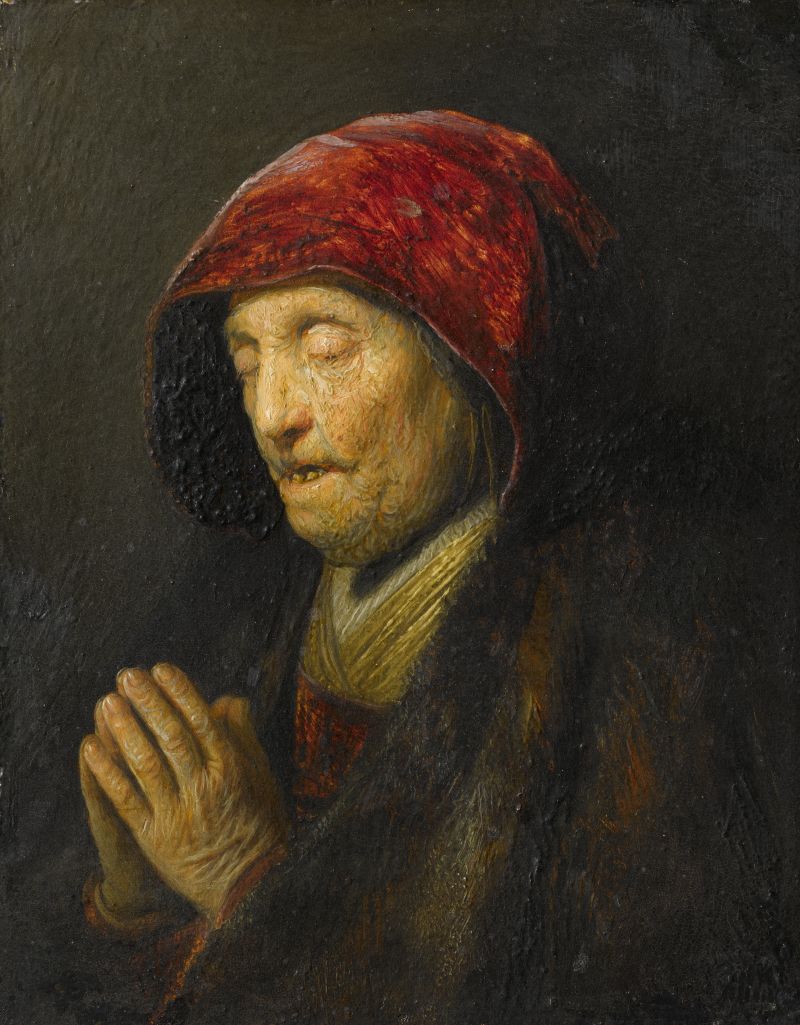
Rembrandt_Old Woman Praying
Rembrandt van Rijn (Dutch, 1606–1669), Old Woman Praying, 1629–30. Oil on gilded copper, 15.5 × 12.2 cm. Residenzgalerie Salzburg, Austria. This is one of the many careworn, lived-in elderly faces Rembrandt painted.

+++

LECTURE (VIDEO): “Difficult Beauty: Contemporary Art as Spiritual Discipline” by James K. A. Smith: In its content selection and development, the arts quarterly Image, says editor in chief James K. A. Smith, resists both nostalgia (old is better) and progressivism (new is better), charting a third way that he calls “archaic avant-garde.” The journal’s focus is on contemporary art, but contemporary art funded by tradition. Most of the writers and artists they feature see the tradition of religious art as a gift and a launchpad.

In this lunchtime Zoom talk from May 19, 2021, Smith considers why contemporary art so often feels alienating. He focuses on painting, giving a brief history of the onset of modernism in that medium, starting with the impact of photography, which pushed painters beyond the representation of objective reality. He shares compelling quotes by art critic Peter Schjeldahl and philosopher John Carvalho, about how we look and when thinking happens. Smith discusses the need for humility—to be comfortable with the not-knowing, to surrender our desire for mastery and control (i.e., demanding that paintings explain themselves).

What if the art that first alienates us is the art that might also stretch us? Or what if the literature that’s intimidating might also be the literature that has the possibility to kind of break us open in new ways, open us up to others, and even open us up to God? What if the difficulty of contemporary art is a virtue? And what if experiencing that difficulty is actually what we need? (12:42)

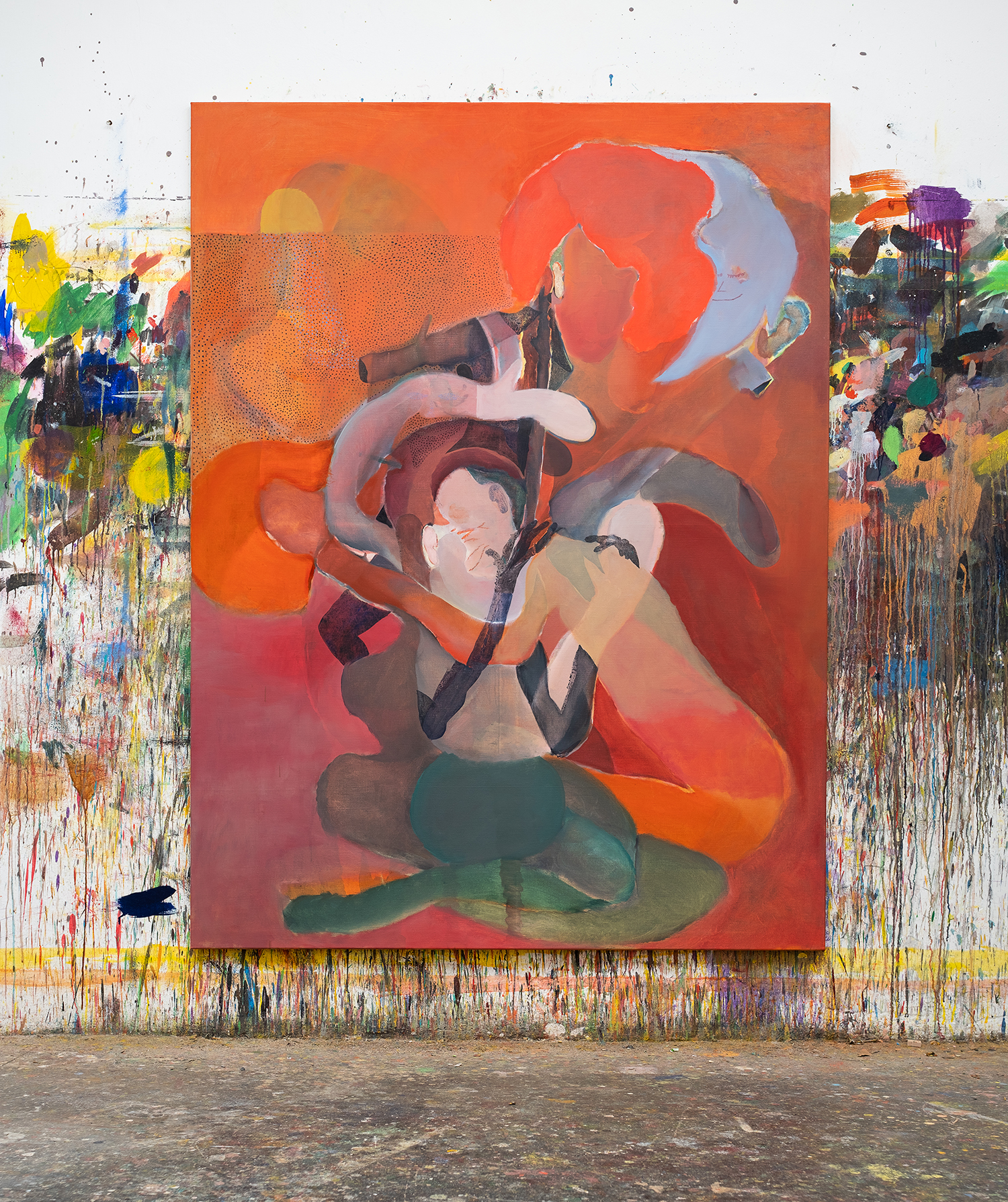
Daniel Domig (Canadian/Austrian, 1983–), Prayer Invites Chaos, 2019. Oil on mixed fibers, 75 × 59 in. [artist’s website]

The last twenty minutes consists of Q&A and addresses icons, art as propaganda, whether and how to engage art that comes out of a place of despair, and more.

I admit that I find much of contemporary art difficult, often unpleasantly so. A few readers have requested that I feature more abstract art, but I struggle to know how to talk about it. But I do want to learn. Image helps me do that.

+++

ESSAY: “Venice Undone” by Matthew J. Milliner: A core publication of Cardus, Comment magazine is committed to “the difficult work of being faithfully present in culture.” This summer they published an essay by art historian Matthew Milliner reflecting on the Anish Kapoor and Anselm Kiefer exhibitions at the 59th Venice Biennale, one of the art world’s largest and most significant recurring events.

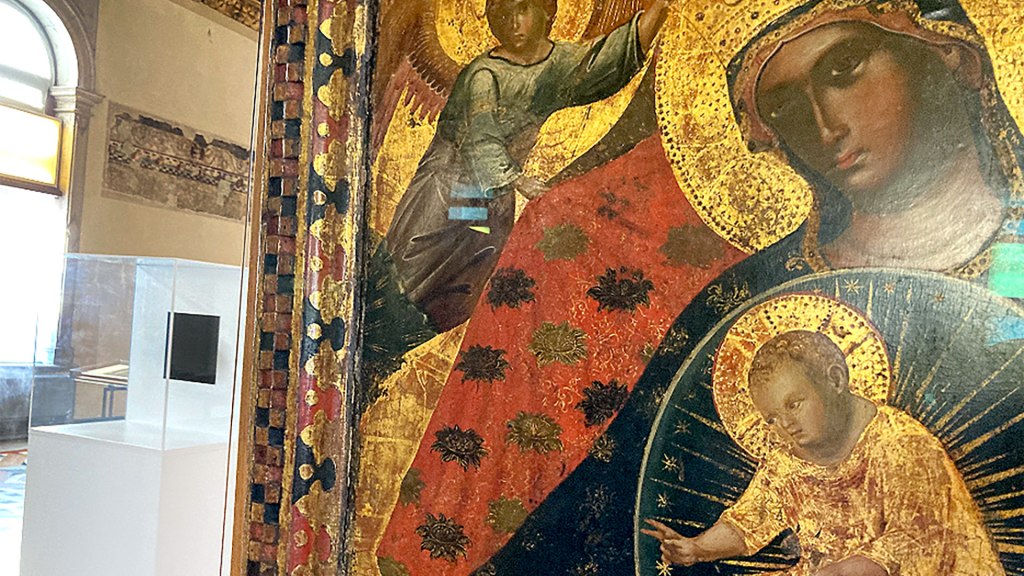
Milliner discusses one of Kapoor’s convex sculptures in Vantablack—a nanotech coating so dark that it absorbs 99.8 percent of visible light—which, in its staging at the Gallerie dell’Accademia, dialogues with three Marian icons and a ceiling painting of God the Father; Sky Mirror in the Accademia courtyard (see also Jonathan A. Anderson’s Instagram post on this piece); Shooting into the Corner; and The Healing of St. Thomas.

Photo by Matthew Milliner
At the 59th Venice Biennale, the Infant Christ from Paolo Veneziano’s Madonna and Child Enthroned (1320s) seems to bless one of Anish Kapoor’s “voids,” a black-painted work that appears flat when viewed head-on but whose convexity becomes apparent when viewed from the side. Photo: Matthew J. Milliner.

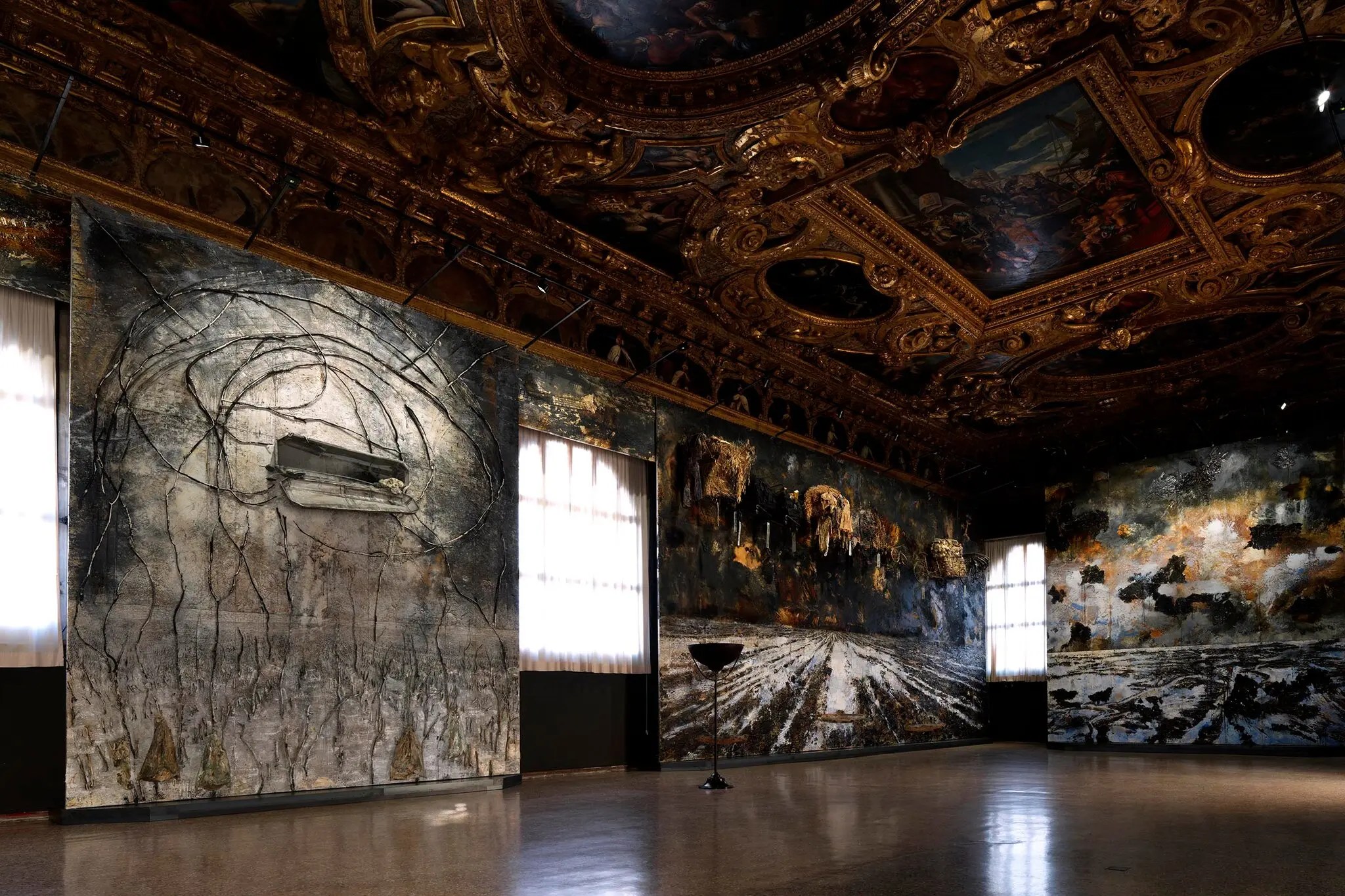
In part 2 of the essay, Milliner considers how the Kiefer show at the Doge’s Palace critiques Venice’s history of military conquest, replacing Titian’s The Conquest of Zara (1584) with an image of an empty tomb that evokes Jesus’s conquest over death. Apocalyptic themes have long been noted in Kiefer’s work; Milliner sees in particular traces of St. Paul and an interrogation of historic Venice’s bombastic displays of wealth and splendor, which are not lasting. And of course there’s the Jacob’s ladder motif. For a silent video tour of the exhibition, see here.

Kiefer, Anselm_Venice Biennale 2022
Anselm Kiefer (German, 1945–), These writings, when burned, will finally give some light, site-specific exhibition at the 59th Venice Biennale, 2022. Sala dello Scrutinio, Palazzo Ducale, Venice. Photo courtesy of the artist.

Prompted in part by their use of darkness, Kapoor and Kiefer have been read by some scholars through a lens of despair, but Milliner looks with eyes of hope and sees plenitude and light.

+++

SONG: “Jordan” by Jana Horn: One of Art & Theology’s subscribers sent this to me, and I’m not sure what to make of it, but I definitely find it intriguing, if a bit unsettling. A song from Jana Horn’s debut solo album, Optimism (2022), which Pitchfork calls “cryptic, bewildering, and daringly simple.” “Jordan” is full of veiled biblical allusions and touches on themes of pilgrimage, belief, destruction, incarnation, and burden bearing. I share it here in the spirit of Jamie Smith’s talk above, about not needing to nail down meaning in an artwork—even though I can’t help but ask, “Just who are the two dialogue partners?!” (God the Son and God the Father?)

Horn is a singer-songwriter from Austin, Texas, and a fiction-writing graduate student at the University of Virginia–Charlottesville.

Roundup: Prayers for a violent world, sad church songs, Climate Vigil Songs, and more

PRAYER COMPILATION: “Prayers for a Violent World” by W. David O. Taylor: “How exactly do we pray in the aftermath of violence? What words should we put on our lips? What can the whole people of God say ‘amen’ to and what might only one of us be able to say amen to in good conscience? These questions are, of course, far from easy to answer, but over the past couple of years I have attempted to give language to such matters and I have included here a number of those prayers, in the hope that they might prove useful, and perhaps comforting, to people who face the terrors and traumas of violent activities on a regular basis.” Included are prayers After a Mass Shooting, Against Bloodthirstiness, For Loving a Hurting Neighbor, For Enemies, For Bitter Lament, For Peace in a Time of War, For Those Who Weary of Doing Justice, and more.

Kubin, Alfred_War
Alfred Kubin (Austrian, 1877–1959), War, 1903

Here’s Taylor’s Prayer of Allegiance to the Prince of Peace:

O Lord, you who deserve all our loyalties, we pledge allegiance this day to the Lamb of God and to the upside-down Kingdom for which he stands, one holy nation under God, the Servant King and the Prince of Peace, with liberty and justice for all without remainder. We pray this in the name of the Holy Trinity. Amen.

+++

NEW ALBUMS:

>> Sorrow’s Got a Hold on Me by Paul Zach: On May 20, singer-songwriter Paul Zach wrote on his Instagram, “My new album of thirteen sad church songs is out today! Many of these songs were written right after one of my weekly EMDR therapy sessions, as I have been working through the sorrow, trauma, and grief of the past few years. I’m learning to bring all of myself to God in prayer and songwriting, which includes my sorrow and anger. I’ve always heard that God shows up in a unique way in times of grief but that has not been my experience. These songs are an invitation for the ‘man of sorrows’ to join me in my grief.”

Below is a demo of the first verse of my favorite song on the album, “We Bring You All Our Sorrows,” followed by the album link from Spotify. It includes a newly revised version of one of my favorite songs by Zach, “When Your Kingdom Comes” [previously].

Zach often writes collaboratively (including as part of the Porter’s Gate! see below), and the cowriters on some of the songs here are Kate Bluett, Latifah Alattas (Page CXVI), Nick Chambers, Orlando Palmer (IAMSON), Jessica Fox, Alex Johnson, and Philip Zach. There are also a few guest vocalists.

>> Climate Vigil Songs by the Porter’s Gate: The Porter’s Gate is a collective of fifty-plus songwriters, musicians, scholars, pastors, and music industry professionals from a variety of Christian worship traditions and cultural backgrounds, making music for churches. This sixth album of theirs, made in partnership with the #ClimateVigil movement, is themed around environmental justice and creation care. Below are videos for “Brother Son (Giving Glory!)” and “Jubilee.”

Besides “Brother Sun,” my favorite tracks are “Satisfied,” a prayer that we would stop seeking to build our wealth (a motive that drives a lot of environmental injustices) and instead be grateful for God’s provision; “The Kingdom Is Coming,” a marchlike call-and-response song that rallies us to pray, wait, and work for an end to creation’s groaning; and “Water to Wine,” which wonders at the miraculous process of planting and growing grapes for harvest. There’s also “All Creatures Lament,” a minor-key arrangement of “All Creatures of Our God and King” with new lyrics that enjoin the animals to mourn habitat loss, air pollution, and other results of humans’ power abuses and irresponsible stewardship.

To learn more about the album, listen to this great interview with Porter’s Gate cofounder and producer Isaac Wardell; it’s from the RESOUNDworship Songwriting Podcast, hosted by Joel Payne. Wardell discusses the vision for Climate Vigil Songs, and especially the difficulty, with thematic albums, of avoiding the pitfalls of being too heavy-handed with the messaging on the one hand, and on the other, being so vague that people don’t see the connection. There’s also a need for tonal balance, and for songs that fill different functions.

We wanted to write for this album at least three different kinds of songs. One kind is essentially songs of lament—songs lamenting the state of creation because of human sin and the brokenness of the world. Secondly, we wanted to write hopeful, you might even call them eschatological, songs—songs that are joyful, that are about this is the world that God has made, this is God’s creative work, this is how God calls us into his creative work. . . . And lastly, we wanted to write mobilization songs—songs that have some kind of an ethical component of calling people to action in some way. . . . We want to make sure the record is not too much of a downer, like all lament songs; we want to make sure that it’s not too much of a happy-clappy “Isn’t creation beautiful!”; and we also don’t want to let it just delve into being a 100 percent political action record. . . . We want to balance those things.

Wardell also talks about the group’s collaborative songwriting approach (including all the theological and editorial work that’s put in), Te Fiti’s stolen (and later, restored) heart in Disney’s Moana, personified nature in the Psalms, creation as an experiencer of the fall and redemption, the role of provocation in church, and biblical imagery he wishes they could have included on the album but had to leave out for length.

+++

POEM + CHORAL SETTING: “when god decided to invent” by E. E. Cummings: “Here’s a brief powerhouse of a poem from E. E. Cummings, two stanzas that draw a sharp distinction between God’s inventive, joyful creativity on the one hand, and our too-frequent turn toward violence on the other. As the mass shootings in Buffalo, Uvalde, and elsewhere continue to reverberate, Cummings’ poem helps us feel and think about what’s at stake – and what the way forward looks like.”

SALT Project reproduces the poem, provides brief commentary, and links to a musical setting by Joshua Shank—a composition for SATB, soprano saxophone, and finger cymbals that premiered in 2005. Shank says the arc of his piece is creation-destruction-recreation. “This final chord is the creator taking control of the creation again.”

+++

RADIO EPISODE: “Belief in Poetry: John Donne”: John Donne (1572–1631) is one of my favorite poets, and looking back on the blog, I can’t believe I’ve not yet featured any of his poems! (I’ll have to rectify that . . .) In this BBC Radio 4 segment from March 13, poet and theologian Pádraig Ó Tuama considers Donne’s complex faith life through his poetry. He speaks with Julie Sanders, professor of English literature and drama at Newcastle University; Mark Oakley, writer and dean of St. John’s College, Cambridge; and Michael Symmons Roberts, poet and professor of poetry at Manchester Metropolitan University. Sir Simon Russell Beale reads the four featured Donne poems: “Death, be not proud” and “Batter my heart, three-person’d God” from his Holy Sonnets series, “Hymn to God, My God, in My Sickness,” and “A Hymn to God the Father.”

Here are two of the quotes that stood out to me:

  • “It’s easy to think of John Donne’s life falling neatly into two parts: the worldly man, and the spiritual seeker; the lover of women, and the lover of God; Catholic, then Protestant; before Anne, and after Anne; love poet, and religious poet. But life is rarely that clear. And rather, it’s the tension between these dynamics of him that gives birth to so much of his work.”—Pádraig Ó Tuama
  • “There’s an assumption that a poet working in this territory is sure of their ground and knows what they’re writing about. I don’t think that’s ever true, because why would you write the poems, if that were true? You’d just bathe in your certainty! The whole act of sitting down to write a poem is not to dress up something you already know in a way that makes it an enticing package for other people to be convinced by—and if you attempted that, it’s going to fall like the deadest thing on the page. Making a poem is an exploratory process. You don’t know where it’s going to end when you start it.”—Michael Symmons Roberts