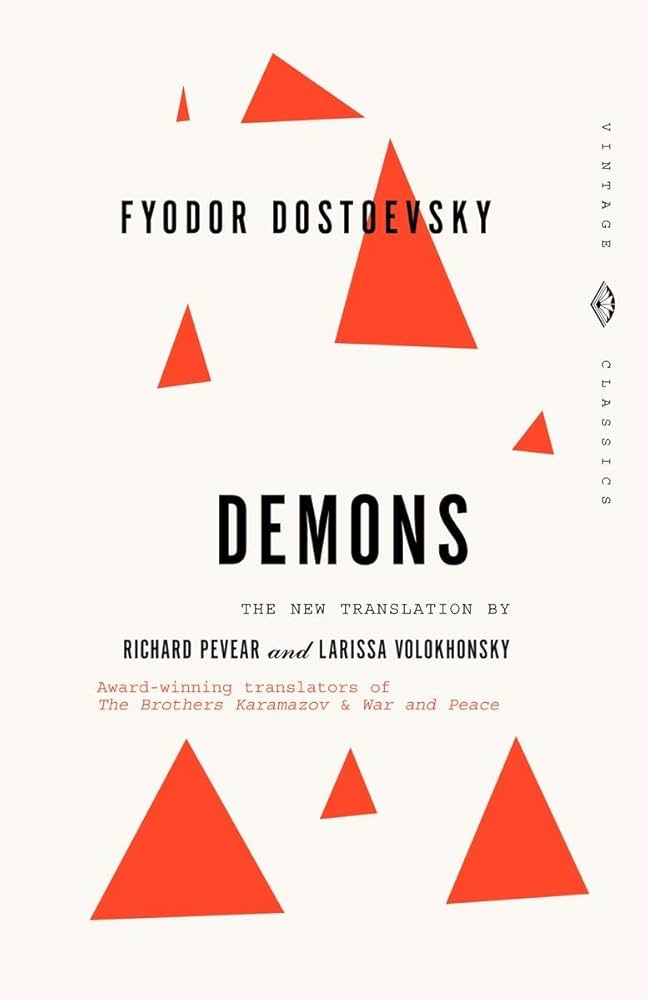
ONLINE COURSE: Studying the novel Demons by Fyodor Dostoevsky with Brian Zahnd, January 3–March 9, 2026: This ten-week online course led by Pastor Brian Zahnd (a Christian writer and preacher I admire) will explore Dostoevsky’s “darkest and most prophetic novel”: Demons (aka The Possessed or The Devils), a social and political satire, psychological drama, and large-scale tragedy inspired by the true story of a 1869 political murder in Russia. The course sounds intriguing to me, and I’m contemplating whether I can invest the time in a seven-hundred-page book—but I did buy a copy just in case! It’s the only one of the literary master’s four novels I haven’t read.
“Dostoevsky’s Demons changed me,” Zahnd writes on Substack. “From it I learned the danger of giving oneself to an ism instead of to Christ. Isms are idols and they often become demonic. Admittedly Demons is a difficult novel, but it’s also prophetic and timely. . . . As you read Demons, expect to be horrified, but also expect to laugh—you are meant to. During the course we will be horrified and warned, but we will also laugh and learn together.”
The live Q&As will take place the first ten Mondays of 2026 at 5 p.m. CT (6 p.m. ET).
+++
SEMINAR (VIDEO):“How to Watch a Movie (as a Christian)” with Chris Retts and Morgan Jefferson: On his FootnotesSubstack, historian Jemar Tisby recently hosted a teach-in with two team members from the Los Angeles Film Studies Center, a nonprofit educational program designed to give undergraduate students at Christian colleges and universities meaningful experience in the film industry during a semester “abroad” in Los Angeles. Chris Retts is the director of the center, and Morgan Jefferson is an instructor.
Before discussing how to watch a movie, they discuss why Christians should watch movies in the first place, beyond the obvious (enjoyment):
Because general revelation can happen anywhere, even at the movies (Rom. 1:20).
Because movies generate empathy, which is central to the greatest commandment (Matt. 22:37–40).
Because every movie has a theology, and media literacy makes it conscious and discernable (1 John 4:1).
They also discuss the four modes of meaning that filmmakers work with; cinematic language; and four steps for exegeting (“drawing out”) a film.
How does film relate to Dr. Tisby’s work at the intersection of faith, history, and justice? He has written for years about the dangers of white Christian nationalism. He says adherents of that ideology, or any, are not evaluating a list of propositions but are buying into a narrative; and “you can’t meet a narrative with logical reasoning,” he says. “You have to invite them into a counter-narrative—a more beautiful story.” Story is why he’s interested in film, as film is an engaging, and probably the most popular (in the US), storytelling medium. “Stories shape our sense of what’s true, what’s possible, and who belongs. That’s as true for political movements as it is for movies.”
DOCUMENTARY SHORT: The Quilters (2024), dir. Jenifer McShane: This thirty-minute documentary on Netflix follows a group of men in a maximum-security prison in Missouri who design and sew custom quilts for children in foster care using donated fabrics and old machines. They care deeply about the quality of their work—they’re proud of what they make—and are emotional about the recipients, some of whom send thank-you cards. The film is about creating beauty and meaning within strict confines, not letting destructive choices from your past stymie you from making constructive ones in the present.
+++
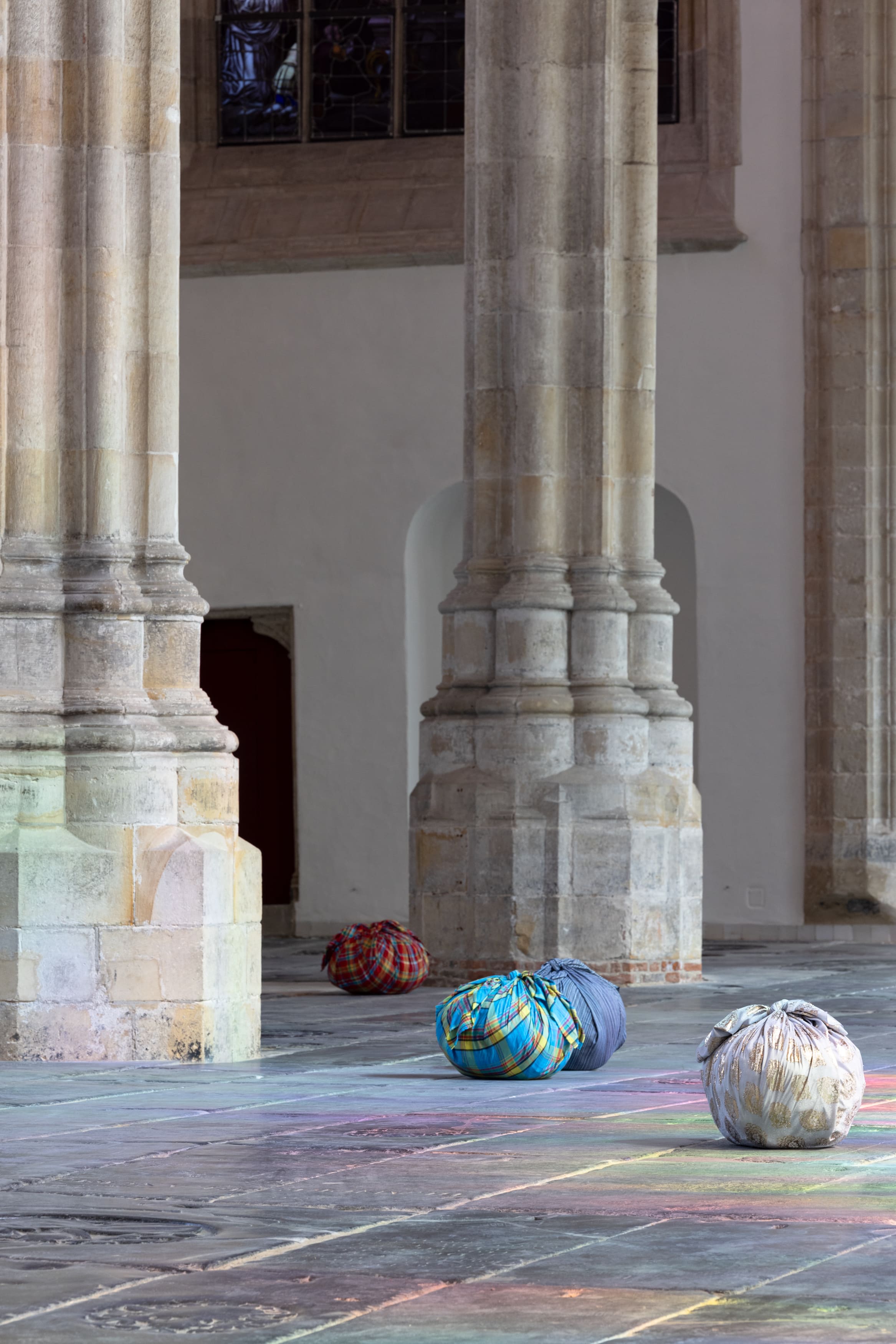
TEMPORARY INSTALLATION: To Breathe—Mokum by Kimsooja, Oude Kerk (Old Church), Amsterdam, May 23–November 9, 2025: Sorry I didn’t get this out while the installation was still up (it wrapped on Sunday), but please do explore the photographic documentation. Kimsooja’s To Breathe—Mokum explores themes of migration, belonging, and the transient nature of home; the Yiddish word in its subtitle means “safe haven.” “At the work’s heart are Kimsooja’s iconic bottari—colorful textile bundles inspired by traditional Korean wrapping cloths,” designboom writes. “Spread across the [medieval] stone floor of the church, these bundles are filled with clothing donated by members of Amsterdam’s diverse communities. Each piece of clothing represents the lives and stories of the people who contribute to the city’s rich multicultural fabric. These textile bundles serve as symbols of both personal and collective journeys, embodying the arrival and departure of individuals who have shaped the identity of the city” over its 750 years.
Kimsooja (Korean, 1957–), To Breathe—Mokum (partial view), 2025. Site-specific installation at Oude Kerk, Amsterdam. Photo: Natascha Libbert.
+++
POEMS:
>> “On the Staten Island Ferry” by A. E. Stallings, Plough, July 1, 2025: Liberty is an American ideal—but for many in this country, an illusory one. Riding in New York Harbor with a boatload of commuters and tourists, Stallings lets settle what a young girl, pointing to the Statue of Liberty, exclaims.
>> “The Pillar of Cloud and Fire”by Anna A. Friedrich, Monafolkspeak (Substack), October 29, 2025: The poet reflects on her confusion as a child about this manifestation of God from the Old Testament, which leads her to surprising insights.
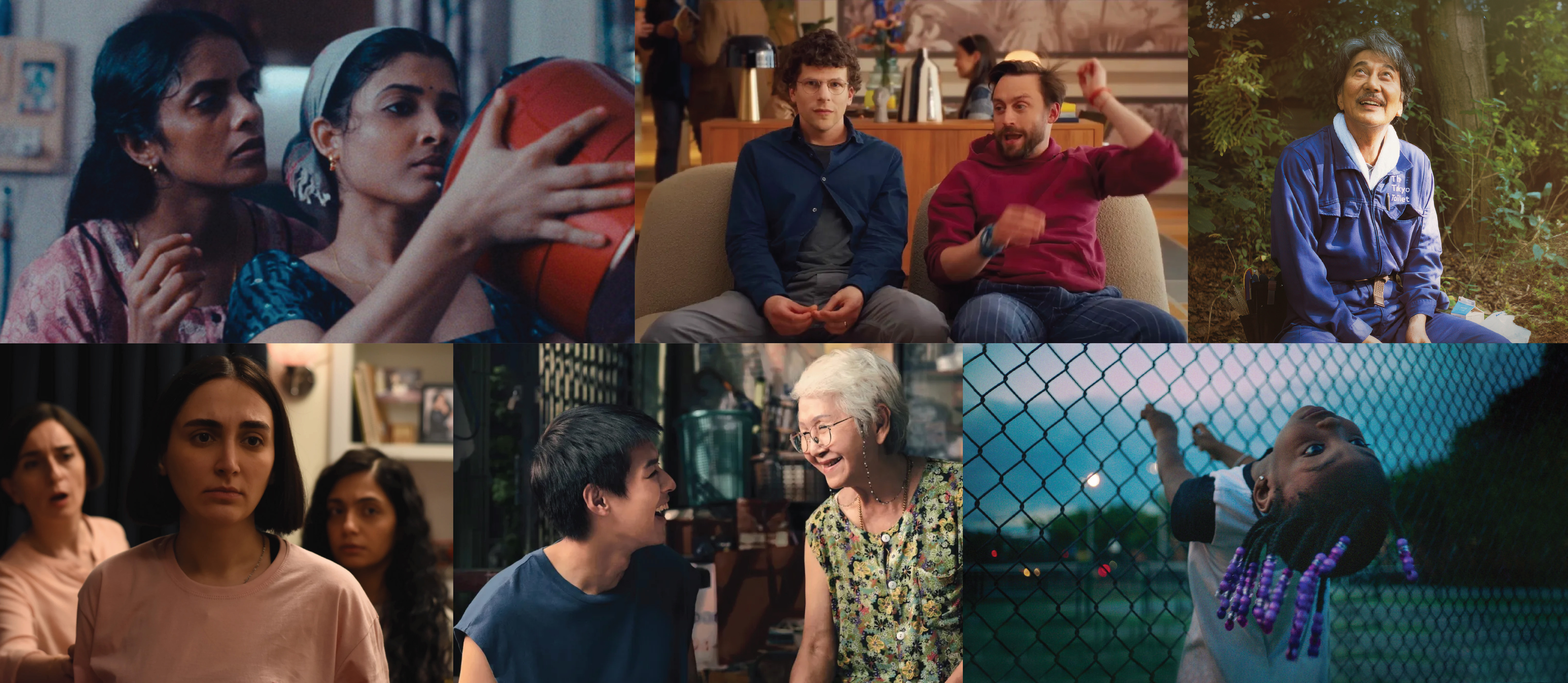
Of the 102 films I’ve seen that were released in the United States in 2024, these are my top ten. I’ll reveal my top eleven through twenty in a “part 2” post in the next few days.
Although I typically draw spiritual, theological, or liturgical connections with the art I feature on this website, here I do not do that. I’ve chosen these films not based on any kind of Christian messaging or interpretive possibilities but because they are beautifully made films that resonated with me. They address themes such as family, friendship, simplicity and awe, repressive governments, growing up, grief, mortality, addiction, trauma, joy, disability, identity.
One thing I love about cinema, as holds true with all the arts, is how it can connect us more fully to God, others, the world, and our own selves. So while I don’t think you need to watch movies with a purpose in mind, if you find yourself hesitant to invest the time, perhaps you might consider that connective capacity.
If the film is currently streaming for free with a subscription service, I’ve noted that at the bottom of the entry. Otherwise, check your local theaters or online rental platforms.
Cautionary note: Different viewers have different sensitivities. If there’s a particular type of content you want to avoid, I’d advise you to check out the “Parents’ Guide” section of the film’s IMDb webpage, to which I’ve linked each film title.
1. How to Make Millions Before Grandma Dies, dir. Pat Boonnitipat: From Thailand comes this tender story of a late teenage boy, M (Putthipong “Billkin” Assaratanakul), who quits his job as a video game streamer to become the live-in caretaker of his ailing amah (maternal grandmother) (Usha Seamkhum) in the hopes of inheriting her house when she dies. While initially motivated by self-interest, M develops genuine affection and gratitude for his grandma the more time he spends with her—getting up early with her each morning to make and sell congee at the street market, bringing her to the temple to pray, sitting with her during chemotherapy sessions (one of the most moving scenes is when he picks off the loose hairs she’s been shedding, one by one, from her sweater while she rests in her chemo chair). The balance of humor—conveyed especially through Amah’s feistiness—and sadness—loneliness, familial hurt and estrangement, terminal illness—is deftly handled and the emotional climax well earned.
2. Daughters, dir. Angela Patton and Natalie Rae. Pursuing the initiative of a group of young Black girls at Camp Diva Leadership Academy (now merged with Girls For A Change), Virginia-based community activist Angela Patton has helped organize a series of daddy-daughter dances in US prisons, a chance for K–12 girls to connect in person and make memories with their incarcerated fathers. This documentary captures one of those dances from 2019, following Aubrey, Santana, Raziah, and Ja’Ana over the course of eight years—before, during, and after the event. These girls and their fathers speak their sorrows, fears, insights, disappointments, and hopes, shedding light on the impact of parental incarceration and especially the rise, since 2014, of no-touch and even screen-only prison visits.
I appreciate that the film shows the complexity of the father-daughter bond, avoiding a simplistic portrait of that bond as either wholly resilient or frankly unmendable. The dance is not a triumph for all participants. While all at least have a desire to show up for each other, forgiveness and trust don’t always come easily. Nor does conversation, when you’ve been separated from someone for so long and barely know them.
Surely a contender for scene of the year is when the girls come down the hallway in their dresses, hand in hand and proud but nervous, to greet their fathers, who sit in a row of folding chairs in borrowed suits and ties. The men’s reactions are precious.
Streaming on Netflix.
3. Dìdi, dir. Sean Wang. Dìdi means “little brother” in Mandarin, and Chinese parents also use the term as an endearment for their younger sons. In this semiautobiographical dramedy from writer-director Sean Wang, it references the lead character Chris (Izaac Wang), a thirteen-year-old Taiwanese American boy growing up in Fremont, California. It’s 2008, the summer before high school, and all the awkwardness and anxieties of adolescent boyhood are upon him. He’s trying to fit in with a skater crowd and to figure out how to flirt with girls, and he’s navigating turbulent relationships with his mom (Joan Chen), who he feels is ashamed of him, and his sister (Shirley Chen), his only sibling, who’s getting ready to leave for college. Also living in the house is his nai nai (paternal grandmother) (Zhang Li Hua), played by Sean Wang’s actual grandma. The film is cringey in all the right ways, capturing that pubescent period we’ve all gone through of insecurity, immaturity, pressure, and desperation. Izaac Wang’s is one of my favorite performances of the year, especially for the vulnerability he lets us see in his character.
Streaming on Peacock.
4. Perfect Days, dir. Wim Wenders. This serene drama contains little plot, dialogue, or conflict and yet is absorbing to watch. It’s built around the daily routine of Hirayama (Kôji Yakusho), a custodial worker in Tokyo whose job is to clean public toilets. We watch him wake up, fold his bedding, water his plants, brush his teeth, put on his royal blue jumpsuit, and walk outside to greet a new day. He sanitizes toilet bowls, sweeps floors, and wipes mirrors, taking great pride and care in his work. He occasionally pauses to appreciate moments of beauty: children playing in the park, leaves glimmering in sunlight. He eats dinner at a restaurant where he’s friends with the proprietor. Then he reads at home by lamplight before falling asleep. His is a quiet life and a full one. His attentiveness and gratitude call us to the same.
Streaming on Hulu.
5. Sing Sing, dir. Greg Kwedar.Rehabilitation Through the Arts (RTA) is a program at New York’s Sing Sing Correctional Facility in which professional teaching artists lead year-round workshops inside the prison in theater, dance, music, creative writing, and visual arts. The drama Sing Sing spotlights the acting troupe as they put on a production of Breakin’ the Mummy’s Code, a time-traveling epic they helped come up with that involves an Egyptian prince, gladiators, pirates, cowboys, Robin Hood, and Hamlet. Starring Colman Domingo as the real-life John “Divine G” Whitfield (who was a founding member of RTA and who makes a cameo appearance), Clarence “Divine Eye” Maclin as himself, and an ensemble cast of other formerly incarcerated RTA participants, the film celebrates the transformative, therapeutic power of the arts, as the men find vulnerability, agency, creativity, confidence, connection, and release. It’s a real heart-warmer!
6.Nickel Boys, dir. RaMell Ross. Based on the Pulitzer Prize–winning novel by Colson Whitehead, this lyrical film is set in the Jim Crow era primarily at Nickel Academy, a state-run juvenile “reform school” (essentially a prison farm) in Florida, inspired by the real-life Dozier School for Boys that operated from 1900 to 2011, where hundreds of students were subjected to forced labor and physical and/or sexual abuse. The remains of several dozen boys have recently been unearthed from unmarked graves on the school grounds, many presumed to be victims of excessive punishment.
Nickel Boys centers on Elwood (Ethan Herisse), a high-achieving high schooler who gets sent to Nickel after hitching a ride in, unbeknown to him, a stolen car. There he becomes friends with Turner (Brandon Wilson). Despite the harrowing backdrop of their relationship, the boys share moments of leisure and joy, and for any violence that occurs, the director made the deliberate choice to portray it offscreen.
The film is shot almost entirely in double first-person POV, switching between the perspectives of Elwood and Turner. I had heard this beforehand and was skeptical that it would work for an entire movie, worried that it might come across as gimmicky, but on the contrary, it worked beautifully. I was mesmerized by the compositional poetics from the very beginning, by how the use of what the director calls “sentient perspective” allows us to get inside moments in a new way. (Shout-out to cinematographer Jomo Fray for, alongside director RaMell Ross, developing and executing such an evocative visual language; for an enthusiastic, in-depth conversation Fray has on his process, approach, and choices for the film, see here.) Before we meet Turner, a decade-plus earlier in the timeline, we see young Elwood’s face only in reflections—in the chrome plating of his grandma’s iron as he watches her do house chores, or through a window display of televisions that are broadcasting King’s “Our God Is Marching On” speech, before which Elwood stands transfixed. Then later we get to see him through Turner’s eyes. That characters look straight into the camera when they address the two mains creates an atypical intimacy and directness.
7. The Seed of the Sacred Fig, dir. Mohammad Rasoulof: Shot in secret and smuggled out of Iran, this thriller is about a family of four in Tehran who become increasingly divided as the Woman, Life, Freedom movement takes hold in 2022, demanding the end of compulsory hijab laws and other forms of oppression against women. Because the protest and crackdown scenes could not be re-created without attracting scrutiny, the director spliced in documentary footage that had been captured on various anonymous cellphones, some of which, I’ll warn, graphicly depicts police brutality and its aftermath.
In the film, the head of household, Iman (Missagh Zareh), works as an investigator in the country’s Islamic Revolutionary Court, signing death warrants against those who have violated sharia law, much to the chagrin of his daughters, Rezvan (Mahsa Rostami) and Sana (Setareh Maleki), who sympathize with the antigovernment protestors. Their mom, Najmeh (Soheila Golestani), tries to run interference between them and Iman and maintain normalcy, tradition, and respect in the home. But when Iman’s gun goes missing, chaos ensues; he becomes increasingly paranoid and unhinged.
Writer-director Mohammad Rasoulof has served jailtime before for his criticism of the Iranian government, and to avoid his latest eight-year prison sentence, he escaped the country illegally in 2024 and currently resides in self-exile in Berlin.
8. A Real Pain, dir. Jesse Eisenberg. After the recent death of their grandmother, a Holocaust survivor, two Jewish American cousins embark on a tour of Poland to visit her childhood home and connect with their heritage. David (Jesse Eisenberg) is straitlaced, shy, and anxious, whereas Benji (Kieran Culkin) is loud, uninhibited, fly-by-the-seat-of-his-pants, devil-may-care. This clash of personalities makes for a funny film, but we also come to see that behind Benji’s bluster there is, as the title gestures toward, “a real pain.” (The more frivolous meaning, of course, is that Benji is exasperating!) Both comedic and serious, the film succeeds in pulling off its dual tone while exploring relational dynamics and different ways of dealing with pain and trauma.
Streaming on Hulu.
9. All We Imagine as Light, dir. Payal Kapadia. Prabha (Kani Kusruti) and Anu (Divya Prabha) live together as apartment mates in multicultural Mumbai and work as hospital nurses. Prabha’s husband lives in Germany and rarely communicates with her, and Anu is dating a young Muslim man, against her Hindu parents’ wishes. When their friend Parvaty (Chhaya Kadam) becomes widowed, she is evicted from her shantytown, and they help her move back to her home village by the sea. The film is about sisterhood and longing—about these three women of different ages each pursuing a light-filled future in their own way.
10.Nowhere Special, dir. Uberto Pasolini. This warm, affectionate, tragic film set in Belfast was inspired by a newspaper headline: “Father dying of cancer spent his final months finding family for son.” When John (James Norton), a single dad who’s thirty-three, is diagnosed with brain cancer, he starts looking for a home for his four-year-old boy, Michael (Daniel Lamont). He partners with social workers to interview potential parents and tries to prepare Michael for what’s coming. A dead beetle in the park becomes an opportunity to teach him about death.
A premise like this could easily become over-the-top sentimental, but much to the film’s credit, and owing in part to the contained performances of the two leads, it does not. There’s both a sweetness and a sadness to it, as we watch father and son build ordinary memories before their imminent separation: they take naps together, wash their respective vehicles, enjoy ice cream cones in the park, watch dump trucks in action. As John becomes progressively weaker, Michael notices: he observes how his dad now needs to use two hands to pour a cup of OJ; he sees him wincing in pain when he thinks he’s not looking. Despite the heartbreaking scenario, the film is ultimately hopeful.
ART VIDEO: “Coventry Cathedral: A Journey Through Art” (HENI Talks), written and presented by James Fox: While my husband was presenting at a science conference at Oxford in 2013, I took a train to Coventry and spent the whole day at the city’s cathedral, wandering through its chapels and grounds, sitting in front of its various artworks as the light changed, praying, and even talking with a few locals, including one man who had lived in Coventry since before its bombing in World War II. That bombing destroyed the original St. Michael’s from the fourteenth century, but when the cathedral was rebuilt after the war, it provided the occasion for new commissions from modern architects and artists. Here’s a wonderful video introduction to the history, art, and design of Coventry Cathedral:
In it the art historian and BAFTA-nominated broadcaster Dr. James Fox explores some of the cathedral’s modernist masterpieces: St. Michael’s Victory over the Devil by Jacob Epstein; the West Screen by John Hutton; the Tablets of the Word by Ralph Beyer; the stained glass windows in the nave by Lawrence Lee, Keith New, and Geoffrey Clarke; the lectern eagle by Elisabeth Frink; the high-altar cross of nails by Geoffrey Clarke; the monumental tapestry Christ in Glory in the Tetramorph by Graham Sutherland (which I wrote about for ArtWay); Angel of Agony by Steven Sykes; the Crown of Thorns by Geoffrey Clarke; the Chapel of Unity floor mosaics by Einar Forseth; and the Baptistery Window by John Piper. The latter Fox calls the pinnacle of the entire complex, and I agree—it’s extraordinary. Explore more at www.coventrycathedral.org.uk.
Coventry Cathedral in the West Midlands, England. Photo: David Iliff (CC BY-SA 3.0).Detail of the large glass “west” screen at Coventry Cathedral, designed and hand-engraved by John Hutton, 1962. This view looks out over the ruins of the Old Cathedral. Photo: Victoria Emily Jones.
SONG: “See What a Morning (Resurrection Hymn)” by Stuart Townend and Keith Getty, sung by the Coventry Cathedral choirs and congregation: Although Coventry Cathedral attracts tourists, it’s also an active church, home to a regular worshipping community! Here’s a video of the beginning of the entrance rite on Easter Day 2012, a procession carried out to the 2003 hymn “See What a Morning.” I appreciate the versatility of Stuart Townend and the Gettys’ hymns, which tend to work equally well if led by a contemporary worship band or a traditional choir with piano/organ accompaniment. I’m used to hearing their hymns sung in low-church contexts (“low church” refers to Christian traditions, such as evangelicalism, that place less emphasis on ritual and sacrament, as opposed to “high church”), so it was a delight to see one used as part of the Anglican liturgy and in such a majestic space!
+++
ARTICLE: “La Scala concert features violins that inmates made from battered migrant boats” by Colleen Barry, AP News, February 13, 2024: “The violins, violas and cellos played by the Orchestra of the Sea in its debut performance at Milan’s famed Teatro alla Scala carry with them tales of desperation and redemption. The wood that was bent, chiseled and gouged to form the instruments was recovered from dilapidated smugglers’ boats that brought migrants to Italy’s shores; the luthiers who created them are inmates in Italy’s largest prison. The project, dubbed Metamorphosis, focuses on transforming what otherwise might be discarded into something of value to society: rotten wood into fine instruments, inmates into craftsmen, all under the principle of rehabilitation . . .” This is a beautiful story of repurposing, of new life—for weathered wood that carried families out of danger zones, and for men who have been convicted of crimes but who seek to engage their hands and hearts in creative projects.
February 9, 2024: A violin made from the wood of wrecked migrants’ boats lies in the instrument workshop at Opera maximum-security prison outside Milan. Photo: Antonio Calanni / Associated Press.Two members of the Orchestra of the Sea play cellos made by inmates from reclaimed wood at the orchestra’s debut performance in Milan on February 12, 2024. Photo: Antonio Calanni / Associated Press.
SPOTIFY PLAYLIST:November 2023 (Art & Theology): In this month’s playlist I nod, in part, to All Saints’ Day (November 1), Christ the King Sunday (November 26), and world events. It includes “Ad Ana” (How Long), a setting of Psalm 13 in its original Hebrew by Miqedem (a Tel Aviv–based band made up of Shai Sol [previously] and three other musical artists from a mix of Jewish and Christian backgrounds), and “Touba” (Blessed), a sung recitation of the Beatitudes in Arabic by the Sakhnini Brothers [previously], Arab Christians from Nazareth, with oud and keyboard accompaniment.
As American Thanksgiving is November 23, you may also want to check out my Thanksgiving Playlist, comprising songs of gratitude. Originally created in 2021, each year I add to and remix the list as I encounter new recordings. One of the newer additions is “He Has Made Me Glad” by Leona Von Brethorst, based on Psalm 100, as arranged and performed on organ by the amazing Cory Henry.
The Christian life consists of both praise and lament, both tears and laughter—which is why in any given worship service or Art & Theology playlist or blog post, as in the biblical psalter, you can find songs that express joy and others, heaviness. They don’t negate one another but rather give fuller expression to the breadth of religious experience.
+++
NEW ALBUM: Some Mississippi Sunday Morning by Parchman Prison Prayer: After a bureaucratic process that took over three years, music producer Ian Brennan was finally granted permission in February to record a Sunday worship service at the Mississippi State Penitentiary, aka Parchman Farm, a notorious prison with a rich musical history. The prison chaplains convened a unique service of inmate singers from various Christian denominations ranging in age from twenties to seventies, who were given turns at the mic and even collaborated on a few tracks. Brennan said he wanted to give the men a platform for their voices to be heard. All profits from the album benefit the Mississippi Department of Corrections Chaplain Services.
“You can hear the way Sunday services are particularly restorative for someone incarcerated – not simply because of the promise of redemption, but the solace of not being alone,” writes Sheldon Pearce for the Guardian. “Some Mississippi Sunday Morning feels like these men reaching out for the things such a barbaric system tries to deny them: compassion, intimacy, and mercy. The songs are not just purges of anxieties accrued on the inside or calls for the Lord’s embrace, but also pleas to be acknowledged as a person and not an ID number.”
(Thanks to Art & Theology reader Ted Olsen for alerting me to this! He compared the album to Angola Prison Spirituals, recorded in the 1950s.)
+++
PODCAST EPISODE: “Sarah Clarkson: The Gift of Beauty,”Life with God: A Renovaré Podcast, October 20, 2023:Sarah Clarkson, author of This Beautiful Truth: How God’s Goodness Breaks into Our Darkness, speaks with Renovaré community life director Nathan Foster about her struggle with OCD and, amid the great suffering wrought by that illness, how God’s goodness has been mediated to her by beauty—in nature, poetry, music, story, tea, ritual, and so on. Responding to the idea that beauty is a luxury for the affluent, she says, “Well, [it is] if beauty is about having a perfect house. But beauty is healing those who have been hurt in a war zone. It’s creating shelters where children can have refuge. It’s rebuilding what has been destroyed. . . . Beauty is a defiance of the forces of evil and disorder and destruction because it is [their] opposite: where evil tears down, beauty creates; where there is absence, beauty fills.”
+++
PRESS RELEASE: “Toledo Museum of Art Adds Armenian Gospel Manuscript with 46 Paintings to the Collection”: After centuries passing through private collections, in June the Pozzi Gospels, a sixteenth-century illuminated manuscript from Armenia, entered the collection of the Toledo Museum of Art, which will make it more accessible to the public. (I’m not sure when the book will go on display. And it doesn’t have an object page on the museum’s website yet.) The artist and scribe of this extraordinary, sumptuous manuscript was Hakob Jughayets’i. His forty-six full-page miniatures and marginal decorations combine Christian iconography with Byzantine, Islamic, and Buddhist design elements.
The Sam Fogg gallery, which exhibited the manuscript last year as part of The Medieval Body, created this short video about it, narrated by art historian Jack Hartnell:
Hakob Jughayets’i (Armenian, ca. 1550–1613), The Pozzi Gospels, 1586. Paper with blind-stamped brown leather binding, 403 folios with 46 full-page illuminations and numerous marginal miniatures, 7 3/4 × 5 3/4 in. (19.8 × 14.5 cm). This spread shows the Creation of Eve and the Temptation of Eve.
VIRTUAL MUSIC COLLECTION: Armenian Spiritual Music Special Vol. 1: NTS Radio in London has curated ninety minutes of traditional Armenian Christian music. (They’ve done the same for Byzantine chant, Welsh hymns, Hildegard von Bingen, and numerous other categories.) I wish the lyrics and translations were provided, but regardless of my understanding of the words, what beauty. [HT: ImageUpdate]
SERMONS by Rev. Nadia Bolz-Weber: Nadia Bolz-Weber [previously] is an ordained Lutheran pastor who founded the House for All Sinners and Saints in Denver and now guest-preaches around the city. Here are two of her sermons from the past year or so that I’ve come across and appreciate, just twelve minutes each.
>> “Sinking,” Montview Boulevard Presbyterian Church, Denver, August 13, 2023: Preaching on Matthew 14:22–33, Bolz-Weber critiques the idea that our ability to do great things relies on the quality of our faith instead of on the power of God: “I’ve often heard this walking-on-water story from Matthew preached as like The Little Disciple Who Almost Could. Like Peter could have kept walking on water if he just thought ‘I think I can, I think I can’ enough. The message being that with enough faith, you too can walk on water all the way to Jesus. Which, on the surface, sounds inspiring. But taken to its logical conclusion, it also means that if you are not God-like in your ability to overcome all your fears and failings as a human, if you are not God-like in your ability to defy the forces of nature, then the problem isn’t the limits of human potential, the problem is the limits of your faith, and you should probably muster up some more . . .” [Read the transcript]
>> “The Lord Is My Shepherd, (but) I Shall Not Want (a Shepherd, Thank You Very Much),” Saint John’s Cathedral, Denver, May 8, 2022: No matter how much we fancy ourselves “anti-shepherdarian,” wanting to make our own choices and go our own way, we are all shepherded by someone or something, says Bolz-Weber in this sermon on Psalm 23. Perhaps it’s by the “wellness” industry, or by the angriest voices on Twitter. And the thing is, “not one single shepherd-shaped wolf that I have followed has ever actually fulfilled my wants and desires,” she confesses; “they have only ever increased them. They have only ever led me to waters with a high salt content, only ever led me to waters that create thirst and never ever quench it. They leave me feeling insecure and insufficient.” She contrasts the shepherds of this world to the one true Good Shepherd. The preaching starts at 23:20. [Read the transcript]
+++
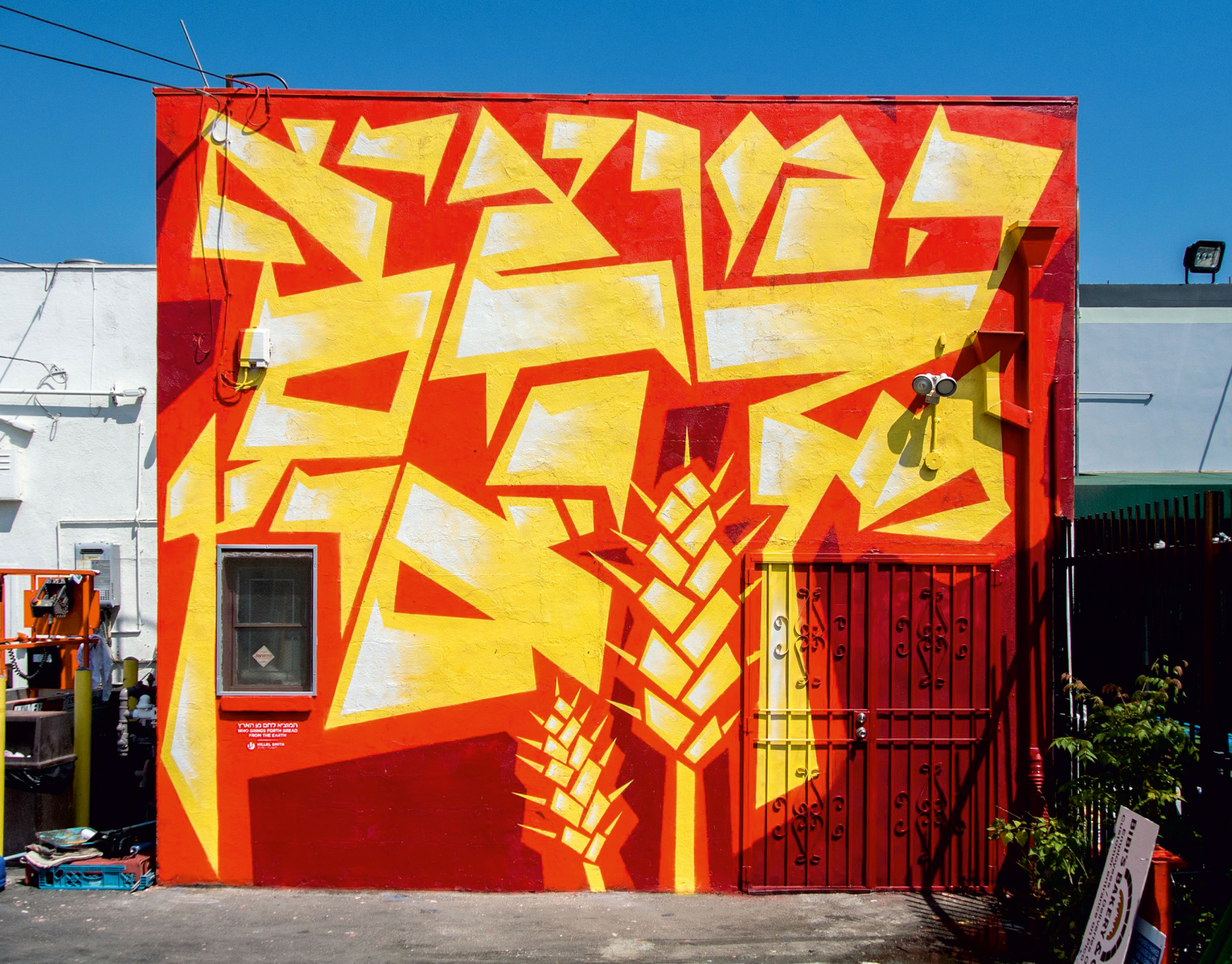
BOOK REVIEW: The Beauty of the Hebrew Letter: From Sacred Scrolls to Graffiti by Izzy Pludwinski, reviewed by Sarah Rose Sharp: In this new book from Brandeis University Press, certified Jewish scribe and calligrapher Izzy Pludwinski looks at the evolution of Hebrew calligraphy from sacred scrolls through modern art and graffiti. “Font enthusiasts, lovers of Judaica, and those passionate about the minutiae and range of the written form” will find much to appreciate here, writes Sarah Rose Sharp, whose review includes a handful of images from the book. For example, below is a mural painted by Hillel Smith on the alley-side exterior of a kosher bakery in the Pico-Robertson neighborhood of Los Angeles, which reads in bright yellow letters, “בָּרוּך אַתָּה אַדָנָי אֱלהֵינוּ מֶלֶך הָעוֹלָם הָמוֹציא לֶחם מן הַארץ” (Hamotzi lechem min ha-aretz) (Who brings forth bread from the earth), part of the traditional Hebrew blessing over bread before a meal: “Blessed are You, Lord our God, King of the Universe, Who brings forth bread from the earth.” [purchase on Amazon]
Hillel Smith (American, 1984–), Hamotzi Mural, Bibi’s Bakery and Café, Los Angeles, 2016. Photo courtesy of the artist.
+++
SONGS:
>> “Be Alright” by God’s Children: Having amassed over four million collective views, this video was posted August 1 by Shirika “ReRe” Flowers across multiple social media platforms, showing four of her six kids singing a gospel song she wrote for them, “Be Alright,” at her home in Memphis. It’s led by Demeriauna “Sugar Mama” Harper, with the other three parts sung by Thedrick “Preacher” Webb (in orange Crocs), Dedric “Chunky” Trice (seated at left), and Cornbread.
The family performs and records together under the name God’s Children, and this song can be heard on their 2018 album It’s So Amazing.
>> “Aakhaima Rakhchhu Mero Yeshu” (आँखैमा राख्छु मेरो येशू) (Keep My Eyes on Jesus): In this 2016 video, a group of teens from New Life Church in Nepal sing a popular Nepali Christian worship song. I haven’t been able to find who the songwriter is, but from a search on YouTube, I can see that it’s a very popular song to dance to in Nepal! There are dozens of videos, mainly of children or youth, dancing to it with hand motions and a bounce, often in church.
From what I can tell through Google Translate, the lyrics translate roughly to “I keep my eyes on Jesus. I keep him in my heart. He shadows me with his love.”
+++
POEMS:
>> “Mattina” (Morning) by Giuseppe Ungaretti: This week reading the book Poetry and Revelation: For a Phenomenology of Religious Poetryby Kevin Hart, I came across this beautiful four-word poem in Italian from 1917 that stopped me in my tracks: “M’illumino / d’immenso.” (Those euphonic m’s!) Hart didn’t translate it, and though I could recognize the two keywords (they’re English cognates), I wasn’t sure of the words connecting them or the verb tense. In googling the poem, I was sent to the blog Parallel Texts: Words Reflected, run by Canadian literary translator Matilda Colarossi, who lives in Florence. It’s fascinating to hear her describe the complicated process of translating these two spare lines. Click on the link to read her translation and to learn what considerations informed her.
Part of the poem’s brilliance is its openness to various readings. For me, it’s about being known warmly and intimately by an immensity I call God.
>> “What He Did in Solitary”by Amit Majmudar: A second book I read this week was the poetry collection What He Did in Solitary by Amit Majmudar, Ohio’s first poet laureate. The titular poem, the first in a suite of three that conclude the book, made me cry. You can read all three on the website of Shenandoah journal, where they were originally published in 2019.
Other favorites: “Altarpiece,” “Ode to a Jellyfish,” “Elegy with van Gogh’s Ear.”
VIDEO: “Waiting with Christ: An Artful Meditation for Holy Week”: A collaboration between Duke Initiatives in Theology and the Arts in Durham, North Carolina, and City Church in Cleveland, Ohio, this half-hour video from 2021 presents a small collection of scripture readings, poems, visual art, and music for Holy Week, interspersed with reflections by theologian Jeremy Begbie. The artistic selections are a spoken word performance by Paul Turner, Malcolm Guite’s sonnet “Jesus Meets His Mother,” the Adagio movement of Schubert’s String Quintet in C Major, the painting Riven Tree by Bruce Herman, and Bifrost Arts’ “Our Song in the Night,” performed by Salina Turner, Allison Negus, and Joel Negus [previously].
+++
ARTICLE: “6 Musical ‘Passions’ Beyond Bach” by Josh Rodriguez: Composer, professor, and Deus Ex Musica cofounder Josh Rodriguez is an excellent classical music curator and guide. In this article he introduces us to six modern large-scale musical works about Jesus’s final week: The Passion of Yeshua by Richard Danielpour, La Pasión Según San Marcos by Osvaldo Golijov, The Passion of the Christ Symphony by John Debney, Johannes-Passion by Sofia Gubaidulina, Simeron by Ivan Moody, and the St. John Passion by James MacMillan. He interweaves composer biography, musical analysis, and meaning in concise ways, with nods to music history. Stylistic influences for these diverse selections range from Byzantine chant to salsa! Audio/video excerpts are provided, such as the cued-up “¿Por qué?” from Golijov’s Pasión (see below), a movement centering on the woman who anointed Jesus’s feet with perfume (Mark 14:3–9).
+++
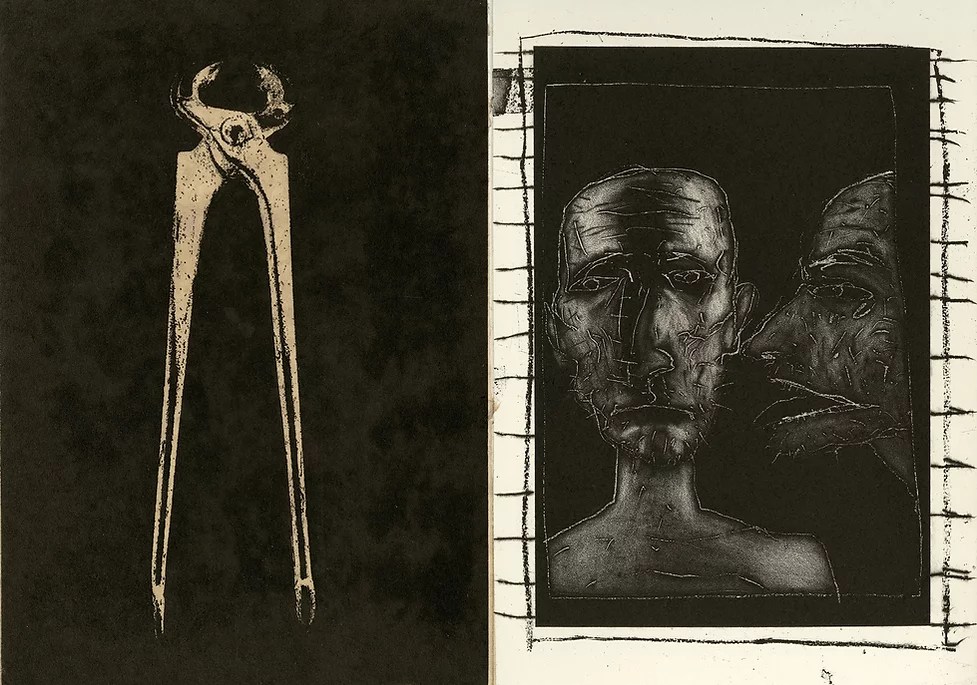
PRINT SERIES: The Passion and Its Objects (after Dürer) by Marcus Rees Roberts: “The Passion and Its Objects (after Dürer) is a series of etchings and monotypes by Marcus Rees Roberts. The images derive from fragments from Albrecht Dürer’s series of woodcuts The Small Passion (1511). Images of the Passion – and of the crucifixion in particular – are so embedded in Western consciousness that we forget that it is a depiction of betrayal, prejudice, and torture. In this version of the Passion by Dürer, one of several he made, small, everyday objects lie scattered within the images – a jug, pliers, a hammer, a coil of rope. Even five hundred years later, we recognise these objects as our own; we can identify with them. But in so doing, we enter the depicted space, and we become complicit in the cruelty. This is one reason why Dürer’s Small Passion is both so powerful and so uncomfortable.”
Marcus Rees Roberts (British, 1951–), The Passion and Its Objects (after Dürer) I, 2019. Diptych etching and aquatint with chine collé printed on Somerset Satin soft white 300gsm, each plate 29.5 × 21 cm (overall 29.5 × 42 cm). Edition of 15.
+++
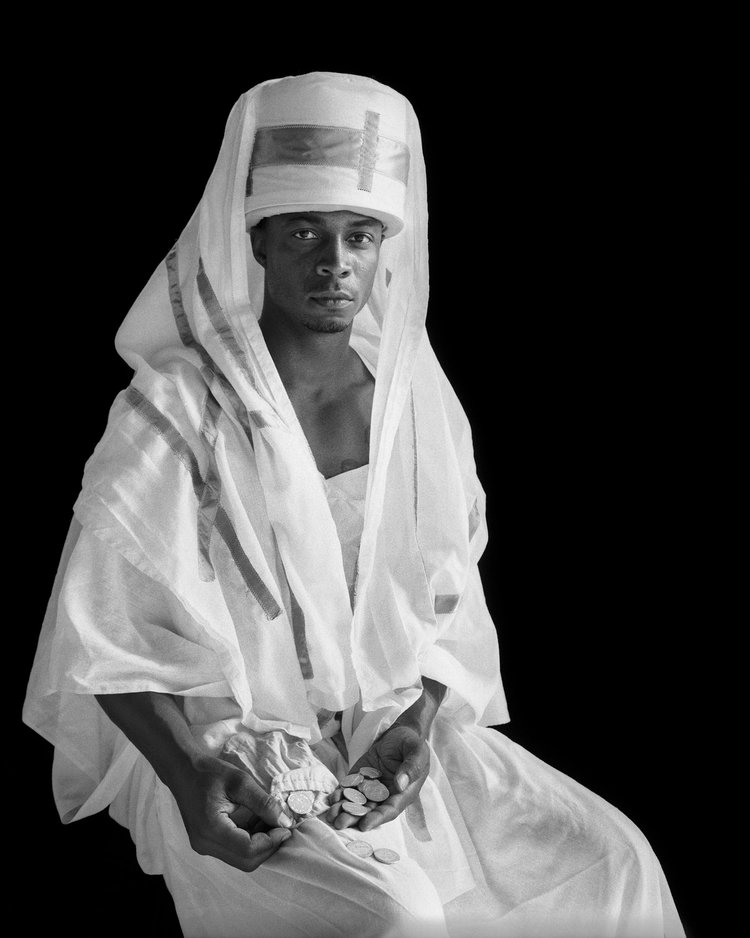
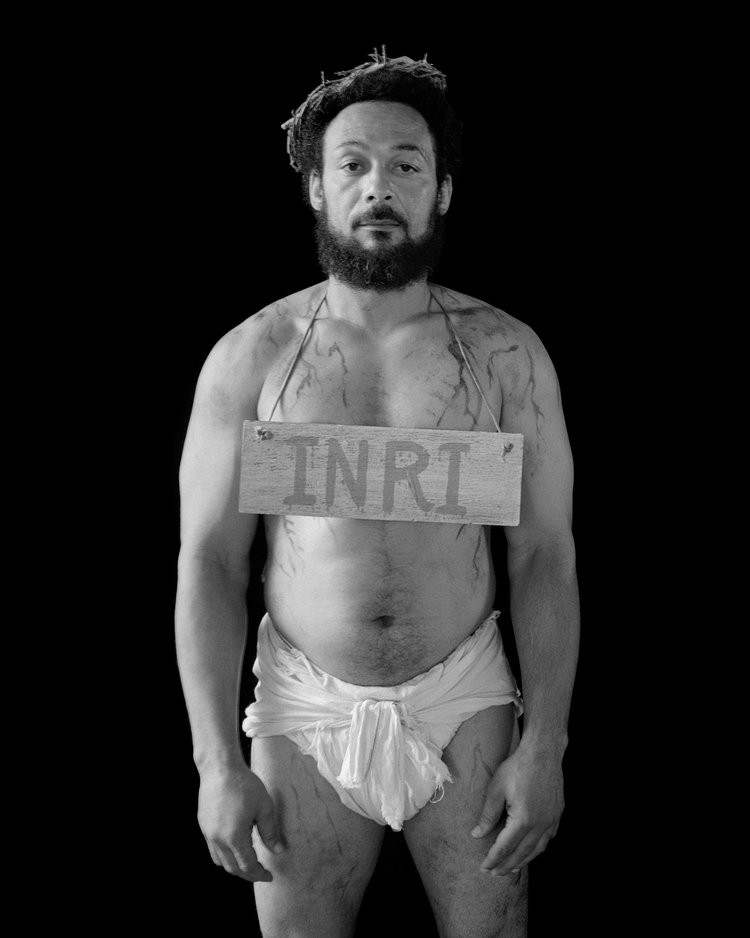
PHOTOGRAPHY SERIES: Passion Play by Deborah Luster: “There are more than 5,300 inmates at the Louisiana State Penitentiary at Angola. Nearly 4,000 of them are serving life without parole. In 2012 and 2013 the Angola Prison Drama Club staged a play unlike any other in the prison’s experience. The Life of Jesus Christ featured 70 inmates, men and women acting together for the first time—in costume, with a real camel, performing for the general public. For the untrained actors, this production held special meaning as they saw pieces of their own lives revealed in the characters they played.”
Layla “Roach” Roberts (Inquisitor), sentenced to LIFE, Angola Prison, Louisiana. Photograph by Deborah Luster, from the Passion Play series, 2013.Bobby Wallace (Jesus), Angola Prison, Louisiana. Photograph by Deborah Luster, from the Passion Play series, 2013.
+++
SONGS:
>>“May I Go with You” by January Lim: This Maundy Thursday song was written in 2020 in the voice of Jesus in Gethsemane, speaking to God the Father. In the first stanza, it seems to me that Jesus is asking to be taken up to heaven, like Elijah—just whisked away back to glory, and spared tomorrow’s cruelties and pain. But in the second stanza that same request seems to shift in meaning as Jesus expresses a desire to go with God’s plan and asks for the strength to follow through. The song was released on the EP Gathered Sighs (2021), put out by Evergreen Baptist Church of Los Angeles, where Lim serves as worship arts pastor. [HT: Global Christian Worship]
The German theologian and Nazi resister Dietrich Bonhoeffer wrote the poem “Von guten Mächten” (By Gracious Powers), his last theological work, in December 1944 while he was imprisoned in a basement cell at the Reich Security Main Office on Prinz-Albrecht-Strasse in Berlin. He sent it in a letter to his fiancée, Maria von Wedemeyer, with the note “als ein Weihnachtsgruß für Dich und die Eltern und Geschwister” (“as a Christmas greeting for you and the parents and siblings”). Two months later, the building was destroyed by an air raid, and Bonhoeffer was moved to Büchenwald and from there to other places. He was executed April 9, 1945, at Flossenbürg concentration camp, just two weeks before it was liberated by the Allies.
Letter from Dietrich Bonhoeffer to Maria von Wedemeyer, December 19, 1944. Collection of Houghton Library, Harvard University, MS Ger 161 (43).
The poem was published posthumously in The Cost of Discipleship under the title “New Year 1945.”
Von guten Mächten treu und still umgeben,
behütet und getröstet wunderbar,
so will ich diese Tage mit euch leben
und mit euch gehen in ein neues Jahr.

Noch will das alte unsre Herzen quälen,
noch drückt uns böser Tage schwere Last.
Ach Herr, gib unsern aufgeschreckten Seelen
das Heil, für das du uns geschaffen hast.

Und reichst du uns den schweren Kelch, den bittern
des Leids, gefüllt bis an den höchsten Rand,
so nehmen wir ihn dankbar ohne Zittern
aus deiner guten und geliebten Hand.

Doch willst du uns noch einmal Freude schenken
an dieser Welt und ihrer Sonne Glanz,
dann wolln wir des Vergangenen gedenken,
und dann gehört dir unser Leben ganz.

Laß warm und hell die Kerzen heute flammen,
die du in unsre Dunkelheit gebracht,
führ, wenn es sein kann, wieder uns zusammen.
Wir wissen es, dein Licht scheint in der Nacht.

Wenn sich die Stille nun tief um uns breitet,
so laß uns hören jenen vollen Klang
der Welt, die unsichtbar sich um uns weitet,
all deiner Kinder hohen Lobgesang.

Von guten Mächten wunderbar geborgen
erwarten wir getrost, was kommen mag.
Gott ist bei uns am Abend und am Morgen
und ganz gewiß an jedem neuen Tag.
With every power for good to stay and guide me,
comforted and inspired beyond all fear,
I’ll live these days with you in thought beside me,
and pass, with you, into the coming year.

The old year still torments our hearts, unhastening:
the long days of our sorrow still endure.
Father, grant to the soul thou hast been chastening
that thou hast promised—the healing and the cure.

Should it be ours to drain the cup of grieving
even to the dregs of pain, at thy command,
we will not falter, thankfully receiving
all that is given by thy loving hand.

But, should it be thy will once more to release us
to life’s enjoyment and its good sunshine,
that we’ve learned from sorrow shall increase us
and all our life be dedicate as thine.

Today, let candles shed their radiant greeting:
lo, on our darkness are they not thy light,
leading us haply to our longed-for meeting?
Thou canst illumine e’en our darkest night.

When now the silence deepens for our harkening,
grant we may hear thy children’s voices raise
from all the unseen world around us darkening,
their universal paean, in thy praise.

While all the powers of Good aid and attend us,
boldly we’ll face the future, be it what may.
At even, and at morn, God will befriend us,
and oh, most surely each new year’s day!

Trans. Geoffrey Winthrop Young
“In this hymn,” writes Joshua Miller for 1517, “Bonhoeffer leaves us a theological legacy that takes seriously the sorrows of life and the reign of death in a world still under the power of sin and the devil. But it’s a hymn that also confesses hope in a God who holds all things in his hands and demonstrates faithfulness to his promise to work all things together for his children’s ultimate good.”
The text has been set to music more than seventy times and appears in a number of hymnals. It is commonly sung by German congregations around New Year’s.
In 2020, the seventy-fifth anniversary of Bonhoeffer’s death, Berlin-based musical artist Sarah Kaiserreleased the song as a single, using the 1977 melody by Siegfried Fietz. COVID disrupted her plans to shoot a music video with her whole band, so she pivoted, singing a stripped-down, a cappella version with a minimal crew at the Kunstanstalt in Berlin-Köpenick, a former prison. (Bonhoeffer was not kept here, but the space is evocative of the other Berlin prison, no longer extant, where he was.) Filmed by Lukas Augustin, the video is hauntingly beautiful, with Kaiser’s bare vocals echoing through the dark, dank cell, testifying to God’s goodness amid the bleakest of circumstances.
Turn on the closed captioning (CC) on the YouTube video player for English subtitles.
By gracious powers so wonderfully sheltered, and confidently waiting, come what may, we know that God is with us night and morning, and never fails to greet us each new day.
Yet is this heart by its old foe tormented, still evil days bring burdens hard to bear; oh, give our frightened souls the sure salvation for which, O Lord, you taught us to prepare.
And when this cup you give is filled to brimming with bitter suffering, hard to understand, we take it thankfully and without trembling, out of so good and so beloved a hand.
Yet when again in this same world you give us the joy we had, the brightness of your sun, we shall remember all the days we lived through, and our whole life shall then be yours alone.
By gracious powers so faithfully protected, so quietly, so wonderfully near, I’ll live each day in hope, with you beside me, and go with you through every coming year.
HYMNS FOR LENT: A list of fifty-plus hymns for Lent, including free sheet music downloads, compiled by Dean B. McIntyre, director of music resources at the Center for Worship Resourcing at the United Methodist Church’s Discipleship Ministries in Nashville. Most of these hymns—either their tune, their words, or both—are contemporary, and I believe they were all either written or arranged by members of the UMC. I love that so many of them are minor-key! (There’s such a dearth of minor-key hymns in my evangelical tradition.) “The Desolate Messiah Dies” is a real standout for me—WOW. Here are the others that I really like. The first three would work particularly well for a Good Friday service:
“Behold the Savior of Mankind” – Words by Samuel Wesley, ca. 1709 | Music by Henry Purcell (“Dido’s Lament”), 1680s, arr. Dean B. McIntyre (alternate tune: Tennessee Harmony, 1818) [Note: The Purcell tune, originally written as an opera aria, makes a gorgeous pairing to this hymn text, but I feel that it’s better suited to a soloist; the Tennessee Harmony tune would be easier for a congregation to sing.]
“Holy God of Power and Might” –Words by Lawrence A. Wik, 2013 | Music by Thomas Hastings, 1830 [tune for “Rock of Ages”]
“Holy, Holy, Lord of Mercy” – Words by Lawrence A. Wik, 2013 | Music: French carol melody [tune for “Let All Mortal Flesh Keep Silence”]
“Sovereign Most Holy” – Words by Lawrence A. Wik, 2013 | Music by Johann Crüger, 1640 [tune for “Ah, Holy Jesus”]
“Hosanna (Save, Mighty Lord)” – Words by John Cennick, 1743, and Reginald Heber, 1811 | Music by J. A. and J. F. Wade, 1854 | Words and music adapted by Ryan D. Neaveill, 2005
+++
SONG: “You Can Never Hold Back Spring” by Tom Waits, covered by Lowana Wallace: I’ve had this song on repeat for the past several weeks—Lowana Wallace’s rendition is simply gorgeous. “This cover is a tribute to Canadians in March. Winter will end, you guys,” Wallace writes. “And maybe Tom didn’t mean for this song to point Christians to the beauty of Lent leading to Easter, but it did for me.”
Lowana Wallace is a singer-songwriter from Caronport, Saskatchewan. If you’ve listened to the Porter’s Gate Worship Project’s acclaimed album Work Songs, you will have encountered her work: she cowrote the song “Day by Day.” Check out more of her music videos, a mix of covers and originals, on her YouTube channel—they’re all great! To help her make more of these, consider becoming a Patreon supporter. You can also download four of the nine tracks from her Christmas jazz album, Hymns and Carols (2009), on NoiseTrade.
+++
POETRY: “5 Female Poets of Faith”: March is Women’s History Month, and Jody Lee Collins has compiled a list of five women poets you should know, whose Christian faith infuses their work: Abigail Carroll, Barbara Crooker, Jeanne Murray Walker, Laurie Klein, and Marjorie Maddox. I heartily second these recommendations! For each poet, Collins has selected a representative poem, giving you a taste of their style, and has provided links to the poets’ published volumes.
+++
2 FILMS + ART EXHIBITION: Incarceration is the theme of two HBO movies that premiered on television last month (following a positive reception at 2018’s Tribeca Film Festival) and the tie-in pop-up art exhibition, sponsored by HBO, that ran from February 20 to 25 at Studio 525 in Chelsea, Manhattan.
Written by Stephen Belber and directed by Madeleine Sackler, O.G. is an introspective drama that follows Louis (Jeffrey Wright), who, after spending twenty-four years in prison for murder, is about to be released. Groundbreakingly, it was filmed almost entirely inside an active prison—Pendleton Correctional Facility in Indiana—with a cast made up largely of inmates and correctional officers, who also consulted on the script. Read an interview with Wright, a professional actor best known for Westworld, and one with supporting actor Theothus Carter, who is serving a sixty-five-year sentence at Pendleton. When he was offered the role of Beecher, Carter said, “I was so happy, it was like being jolted alive back from the dead. I know I’ve never been dead before, but being dead has to feel like being in prison, because here it feels like you don’t matter anymore. This made me feel like I mattered again.”
It’s a Hard Truth, Ain’t It is a companion film to O.G. that is directed by Madeleine Sackler and thirteen incarcerated men at Pendleton, who reflect on their lives and the consequences of their crimes in front of and behind the camera. When Sackler received permission from the prison to lead a filmmaking workshop for inmates, she hadn’t intended to make a documentary, but she was so moved by the depth and intimacy of the conversations that were arising in that workshop, as participants shared their personal stories, and they all decided these stories and perspectives needed to be captured on film, crafted together, and shared more widely. An animator was brought on to bring the men’s memories to life.
Coinciding with the HBO premiere of these two films was a six-day exhibition in New York City called The OG Experience, curated by Jesse Krimes and Daveen Trentman. Like the Hard Truth film, this exhibition offered an insider narrative about the US prison system, as the art was all by formerly incarcerated individuals. The pieces on display included an installation of reclaimed cafeteria trays, a re-creation of a prison cell that invited viewers to sketch on the wall with a screwdriver, a video of the artist boxing with a projection of himself, a self-portrait in pastels over legal documents, and a mural of newsprint images transferred onto prison-issued bedsheets using hair gel (a method developed, and a work begun, by Krimes while in solitary confinement).
On seeing his work on display, Krimes said, “It was really emotional because so much of that experience and what our prison system is designed to do is pretty much destroy you. It’s designed to take away your identity, it’s designed to take away your humanity, and I think in creating that work and investing myself in something meaningful, and coming home and getting to see the final thing . . . it was something that made me feel like I came out of this situation intact, like I’m still a whole human being, and that this thing did not destroy me and it did not take away who I am at my core or change me in a way that it was designed to do.” Since his release from prison, Krimes cofounded the Right of Return Fellowship to directly support formerly incarcerated artists.
I particularly like the works by Russell Craig (also), a self-taught artist from Philadelphia. In his seven-piece set of unstretched canvases, E-Val, pairs of eyes peer out hauntingly from within Rorschach blots made of ox blood; “Craig, who was given Rorschach tests as part of his psychological evaluations during his time in the foster care system, wanted to represent the trauma felt in black communities,” the exhibition text says. Another work, a self-portrait he drew over his prison documents, “symbolizes the stigma of being a criminal,” Craig explained. “No matter how much you change your life around, you’re still viewed as a criminal.”





 Art & Theology