Playlist: The Lord Is My Shepherd (Psalm 23, etc.)

Tomorrow’s readings in the Revised Common Lectionary, for the fourth Sunday of Easter, include what’s probably the most famous passage in the Bible, Psalm 23:

The LORD is my shepherd; I shall not want.

He maketh me to lie down in green pastures: he leadeth me beside the still waters.

He restoreth my soul: he leadeth me in the paths of righteousness for his name’s sake.

Yea, though I walk through the valley of the shadow of death, I will fear no evil: for thou art with me; thy rod and thy staff, they comfort me.

Thou preparest a table before me in the presence of mine enemies: thou anointest my head with oil; my cup runneth over.

Surely goodness and mercy shall follow me all the days of my life: and I will dwell in the house of the Lord for ever.

In characterizing God as a shepherd, the psalmist expresses how God leads, protects, rescues, feeds, and cares for his own. The author of Psalm 95 uses the same metaphor when he writes, “For he is our God, and we are the people of his pasture, and the sheep of his hand” (v. 7)—as do Isaiah and Ezekiel. During his teaching ministry, Jesus described himself as “the good shepherd [who] lays down his life for the sheep,” and whose flock knows his voice and follows him (John 10:1–18).

There are hundreds of metrical paraphrases and musical settings of Psalm 23. I’ve compiled some three dozen of the best into a Spotify playlist, along with a handful of other songs that reference or adapt other biblical passages that speak of God as a shepherd. There are settings by Philippe Rogier, Franz Schubert, Antonin Dvořak, Noel Paul Stookey (of Peter, Paul and Mary), John Michael Talbot, Val Parker, David Gungor, Luke Morton, and others. Besides English, languages include Hebrew, Latin, Spanish, French, German, Czech, Arabic, Mandarin, Urdu, Swahili, and Sotho.

Rae, Ronald_Shepherd
Ronald Rae (Scottish, 1946–), Shepherd, 1988. Granite, 4 × 5 × 4 ft. Private collection, Peak District, Scotland.

The Psalm 23 settings that are most widely reproduced in modern English-language hymnals are:

  • “The Lord’s My Shepherd,” written by Francis Rous but extensively revised by committee and published by the General Assembly of the Church of Scotland in the Scottish Psalter (1650). This text is most commonly matched with the 1872 tune CRIMOND by Ms. Jessie Seymour Irvine of Scotland, but I really like it with the early American folk tune PISGAH, as recorded, for example, by the William Appling Singers. However, both melodies, I feel, are difficult to sing congregationally.
  • “My Shepherd Will Supply My Need” by Isaac Watts, from The Psalms of David Imitated in the Language of the New Testament (1719). This text is traditionally paired with the tune RESIGNATION, first published in the fifth edition of the shape-note hymnal The Beauties of Harmony (Pittsburgh, 1828), compiled by Freeman Lewis, but first appearing with the Watts text in The Valley Harmonist in 1836. My playlist features a performance by the female a cappella quartet Anonymous 4 (the music arranged by Johanna Maria Rose; see video embed below), as well as by folk singer Claire Holley, who recorded the hymn at the request of a friend who told her it was the song that helped her get sober for good. I also like the minor-key setting by Stephen Gordon.
  • “The Lord Is My Shepherd (No Want Shall I Know)” by James Montgomery (1822), with music by Thomas Koschat (1862). Here’s the Lower Lights:
  • “The King of Love My Shepherd Is” [previously] by Henry Williams Baker (1868). This hymn is most often sung to a traditional Irish tune known as ST. COLUMBA (my playlist features both a choral performance by the Choir of Kings School, Canterbury, and a folksy solo by Luke Spehar) and occasionally to MCKEE, also from Ireland, as recorded by Redeemer Knoxville.

At my church we use Wendell Kimbrough’s musical adaptation of the psalm, “His Love Is My Resting Place.” Do you sing Psalm 23 at your church, and if so, what version?

Probably my favorite choral setting is by Bobby McFerrin, “The 23rd Psalm,” performed below by his VOCAbuLarieS, featuring SLIXS & Friends, live in Gdansk, Poland, at the Solidarity of Arts Festival on August 17, 2013:

Some people are thrown off by McFerrin’s use of feminine pronouns for the Divine in this song. God has no literal sex because God does not possess a body, so our gendered binaries are inadequate—but scripture and church tradition refer to God using masculine pronouns. I’m not bothered by the “She” throughout, or even “Mother,” but the substitution of “Daughter” for “Son” in the Trinitarian doxology at the end is theologically confusing, since Jesus was a man. But I get what McFerrin is doing.

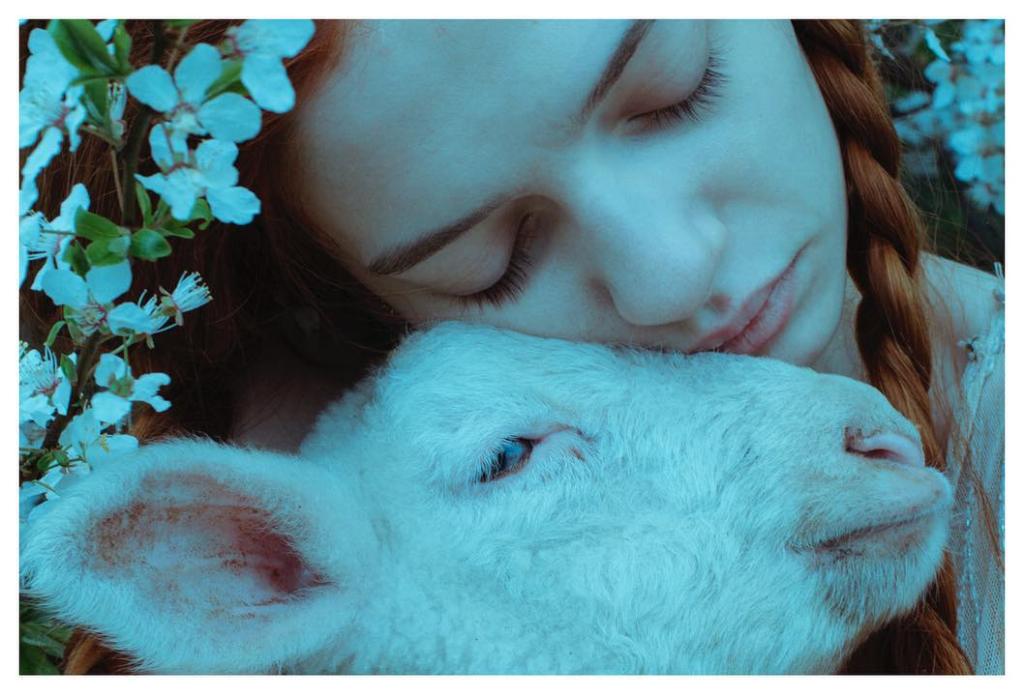
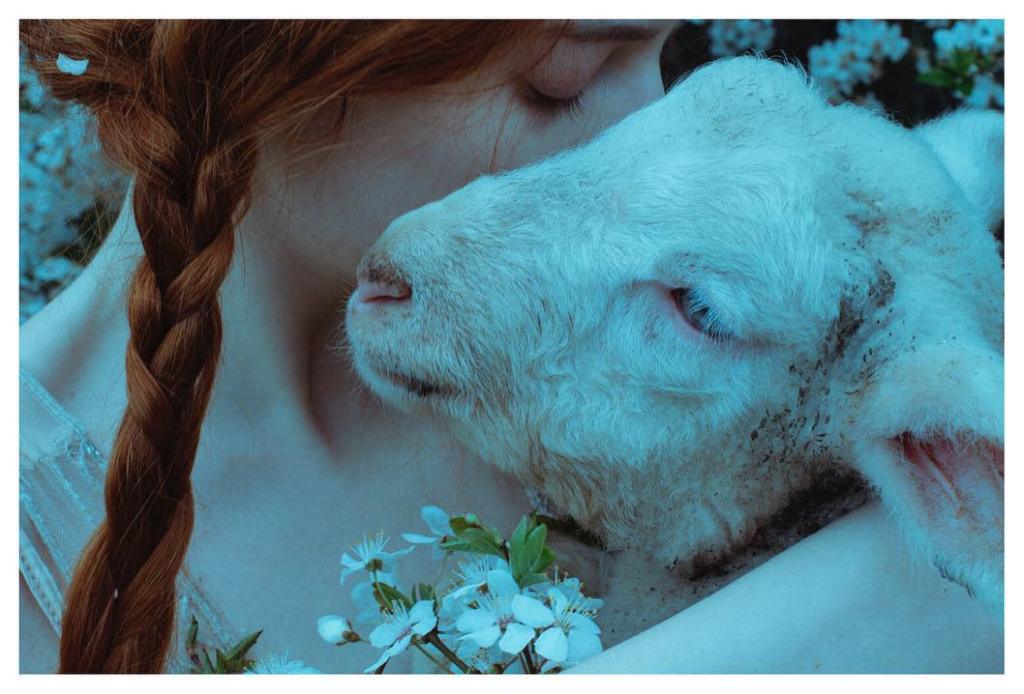
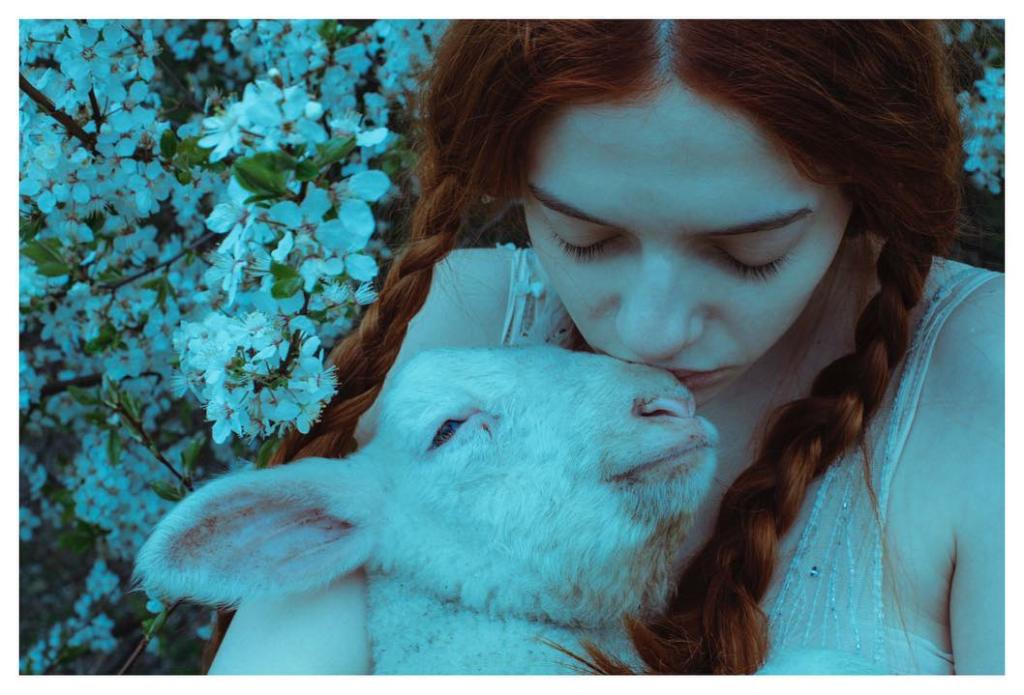
How does the change in gender impact your reception of the psalm text? We’re used to seeing religious imagery of a man with a sheep slung over his shoulders to embody the metaphor of God as shepherd—but what happens when you picture a shepherdess in the role? Note that it was not unusual in the ancient Near East for girls and women to tend their family herds (think of Rachel and Zipporah in the Old Testament, for example), and still today across the globe there are many female shepherds.

McFerrin dedicated his “23rd Psalm” to his mother.
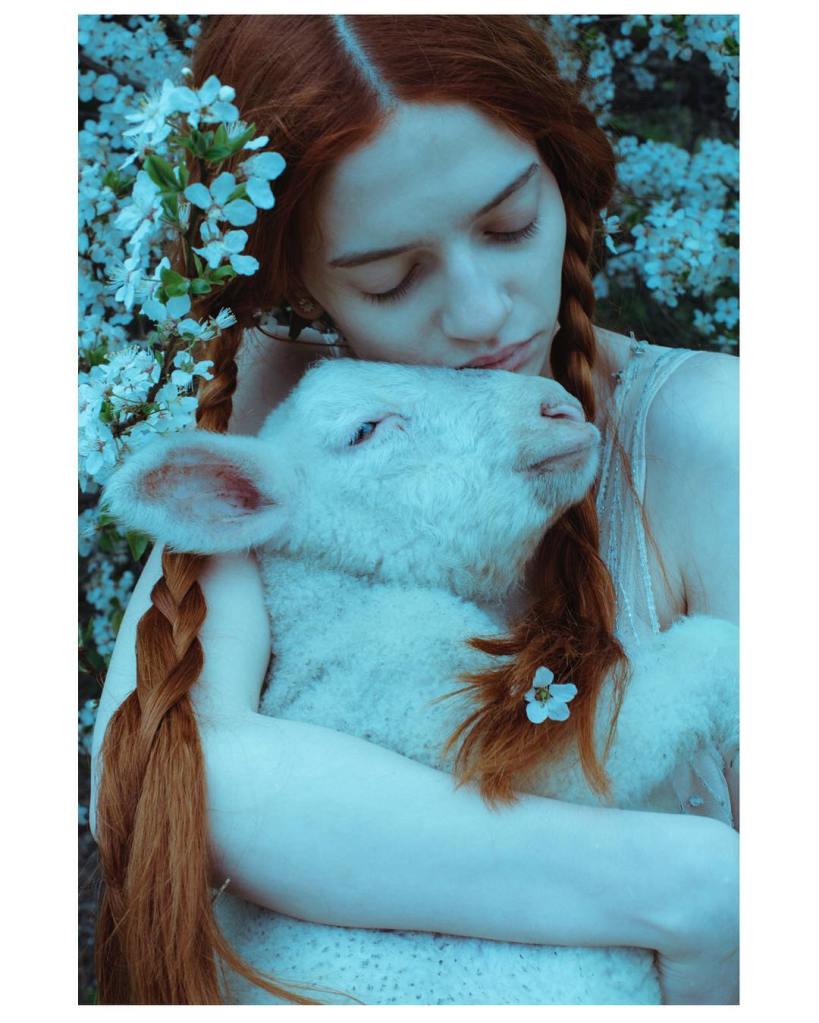
(The above artworks, sourced from Instagram, are from the 2019 series The Shepherd by Laura Makabresku, a fine-art photographer from Poland whose work is influenced by her Catholic faith and by fairy tales.)

Here is a selection of other songs from the playlist:

>> “Adonai Ro’i” is a setting of the original Hebrew of Psalm 23 by Jamie Hilsden of Misqedem, a band from Tel Aviv, Israel, that is heavily influenced by Middle Eastern and North African music styles, often utilizing microtonal scales, irregular time signatures, and regional instruments. The song is sung by Shai Sol. (Available on Bandcamp.)

>> “The Lord Is My Shepherd” by Paul Zach of the United States:

>> “El Señor es mi Pastor” by Omar Salas of the Dominican Republic, a salsa song:

>> “Ke Na Le Modisa” by the Soweto Gospel Choir, sung live at the Nelson Mandela Theatre in Johannesburg in 2008. The song is in Sotho, an official language in South Africa and Lesotho.

>> “The Shadow Can’t Have Me” by Arthur Alligood:

>> “Done Found My Lost Sheep,” an African American spiritual sung by Lucy Simpson [previously] for Smithsonian Folkways, based on Jesus’s parable of the lost sheep (Luke 15:1–7):
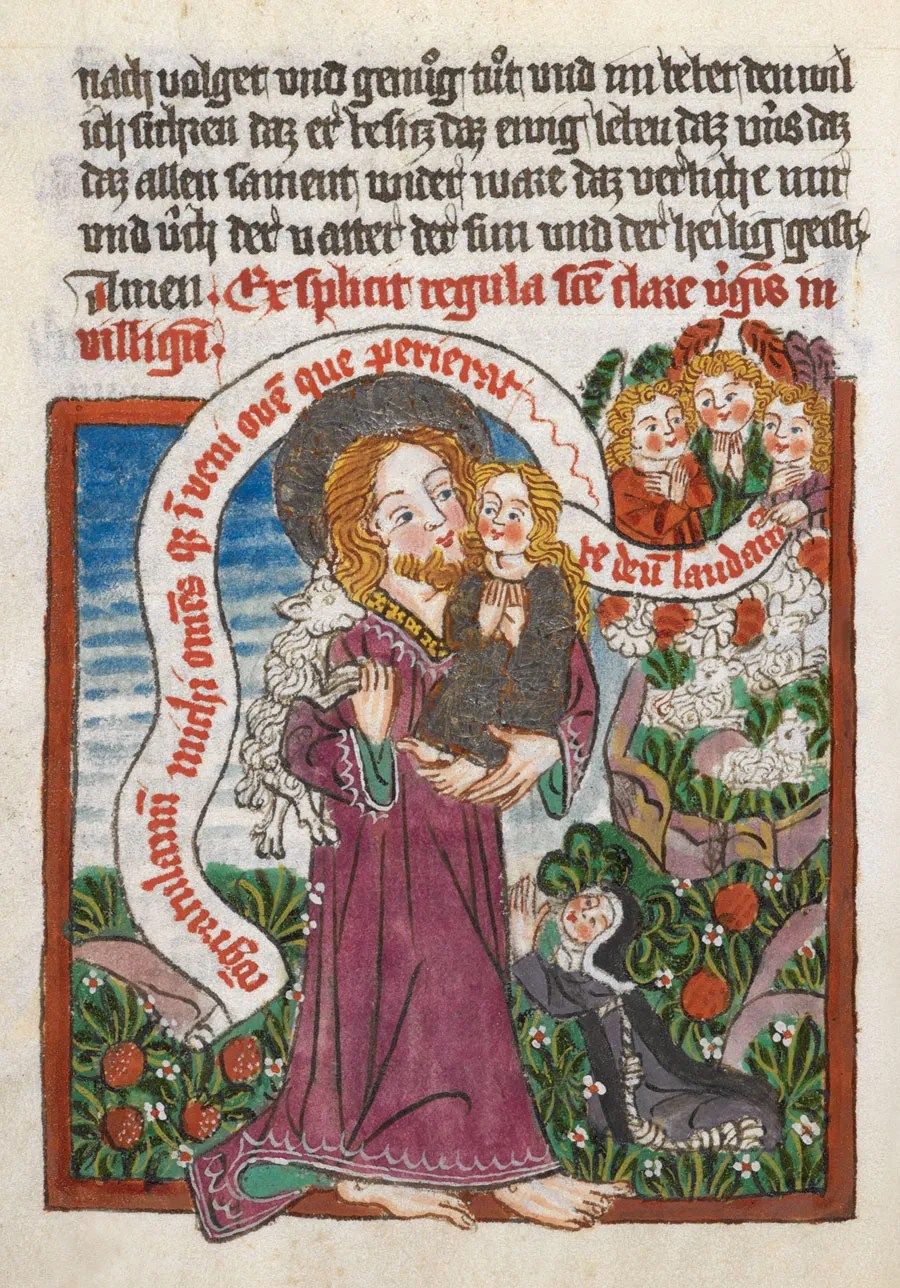

Lost sheep found (British Library)
Illustration by the nun Sibylla von Bondorf (German, ca. 1440–1525), from a copy of the Clarrissan Rule, Freiburg, ca. 1480. Opaque pigments on parchment, 15 × 10 cm. London, British Library, Add. MS 15686, fol. 30v. The banderole reads, “Rejoice with me, for I have found my sheep that was lost” (Luke 15:6). [HT]

Watanabe, Sadao_Good Shepherd
Sadao Watanabe (Japanese, 1913–1996), Good Shepherd, 1968. Katazome stencil print.

>> “Our Psalm 23” by Gabriella Velez, Kevin Dailey, Justin Gray, and JonCarlos Velez of Common Hymnal, featuring Sharon Irving:

Roundup: Sermons by Nadia Bolz-Weber, Jewish graffiti, four-word poem by Giuseppe Ungaretti, and more

SERMONS by Rev. Nadia Bolz-Weber: Nadia Bolz-Weber [previously] is an ordained Lutheran pastor who founded the House for All Sinners and Saints in Denver and now guest-preaches around the city. Here are two of her sermons from the past year or so that I’ve come across and appreciate, just twelve minutes each.

>> “Sinking,” Montview Boulevard Presbyterian Church, Denver, August 13, 2023: Preaching on Matthew 14:22–33, Bolz-Weber critiques the idea that our ability to do great things relies on the quality of our faith instead of on the power of God: “I’ve often heard this walking-on-water story from Matthew preached as like The Little Disciple Who Almost Could. Like Peter could have kept walking on water if he just thought ‘I think I can, I think I can’ enough. The message being that with enough faith, you too can walk on water all the way to Jesus. Which, on the surface, sounds inspiring. But taken to its logical conclusion, it also means that if you are not God-like in your ability to overcome all your fears and failings as a human, if you are not God-like in your ability to defy the forces of nature, then the problem isn’t the limits of human potential, the problem is the limits of your faith, and you should probably muster up some more . . .” [Read the transcript]

>> “The Lord Is My Shepherd, (but) I Shall Not Want (a Shepherd, Thank You Very Much),” Saint John’s Cathedral, Denver, May 8, 2022: No matter how much we fancy ourselves “anti-shepherdarian,” wanting to make our own choices and go our own way, we are all shepherded by someone or something, says Bolz-Weber in this sermon on Psalm 23. Perhaps it’s by the “wellness” industry, or by the angriest voices on Twitter. And the thing is, “not one single shepherd-shaped wolf that I have followed has ever actually fulfilled my wants and desires,” she confesses; “they have only ever increased them. They have only ever led me to waters with a high salt content, only ever led me to waters that create thirst and never ever quench it. They leave me feeling insecure and insufficient.” She contrasts the shepherds of this world to the one true Good Shepherd. The preaching starts at 23:20. [Read the transcript]

+++

BOOK REVIEW: The Beauty of the Hebrew Letter: From Sacred Scrolls to Graffiti by Izzy Pludwinski, reviewed by Sarah Rose Sharp: In this new book from Brandeis University Press, certified Jewish scribe and calligrapher Izzy Pludwinski looks at the evolution of Hebrew calligraphy from sacred scrolls through modern art and graffiti. “Font enthusiasts, lovers of Judaica, and those passionate about the minutiae and range of the written form” will find much to appreciate here, writes Sarah Rose Sharp, whose review includes a handful of images from the book. For example, below is a mural painted by Hillel Smith on the alley-side exterior of a kosher bakery in the Pico-Robertson neighborhood of Los Angeles, which reads in bright yellow letters, “בָּרוּך אַתָּה אַדָנָי אֱלהֵינוּ מֶלֶך הָעוֹלָם הָמוֹציא לֶחם מן הַארץ” (Hamotzi lechem min ha-aretz) (Who brings forth bread from the earth), part of the traditional Hebrew blessing over bread before a meal: “Blessed are You, Lord our God, King of the Universe, Who brings forth bread from the earth.” [purchase on Amazon]

Smith, Hillel_Hamotzi Mural
Hillel Smith (American, 1984–), Hamotzi Mural, Bibi’s Bakery and Café, Los Angeles, 2016. Photo courtesy of the artist.

+++

SONGS:

>> “Be Alright” by God’s Children: Having amassed over four million collective views, this video was posted August 1 by Shirika “ReRe” Flowers across multiple social media platforms, showing four of her six kids singing a gospel song she wrote for them, “Be Alright,” at her home in Memphis. It’s led by Demeriauna “Sugar Mama” Harper, with the other three parts sung by Thedrick “Preacher” Webb (in orange Crocs), Dedric “Chunky” Trice (seated at left), and Cornbread.

The family performs and records together under the name God’s Children, and this song can be heard on their 2018 album It’s So Amazing.

>> “Aakhaima Rakhchhu Mero Yeshu” (आँखैमा राख्छु मेरो येशू) (Keep My Eyes on Jesus): In this 2016 video, a group of teens from New Life Church in Nepal sing a popular Nepali Christian worship song. I haven’t been able to find who the songwriter is, but from a search on YouTube, I can see that it’s a very popular song to dance to in Nepal! There are dozens of videos, mainly of children or youth, dancing to it with hand motions and a bounce, often in church.

From what I can tell through Google Translate, the lyrics translate roughly to “I keep my eyes on Jesus. I keep him in my heart. He shadows me with his love.”

+++

POEMS:

>> “Mattina” (Morning) by Giuseppe Ungaretti: This week reading the book Poetry and Revelation: For a Phenomenology of Religious Poetry by Kevin Hart, I came across this beautiful four-word poem in Italian from 1917 that stopped me in my tracks: “M’illumino / d’immenso.” (Those euphonic m’s!) Hart didn’t translate it, and though I could recognize the two keywords (they’re English cognates), I wasn’t sure of the words connecting them or the verb tense. In googling the poem, I was sent to the blog Parallel Texts: Words Reflected, run by Canadian literary translator Matilda Colarossi, who lives in Florence. It’s fascinating to hear her describe the complicated process of translating these two spare lines. Click on the link to read her translation and to learn what considerations informed her.

Part of the poem’s brilliance is its openness to various readings. For me, it’s about being known warmly and intimately by an immensity I call God.

>> “What He Did in Solitary” by Amit Majmudar: A second book I read this week was the poetry collection What He Did in Solitary by Amit Majmudar, Ohio’s first poet laureate. The titular poem, the first in a suite of three that conclude the book, made me cry. You can read all three on the website of Shenandoah journal, where they were originally published in 2019.

Other favorites: “Altarpiece,” “Ode to a Jellyfish,” “Elegy with van Gogh’s Ear.”

Online highlights from the 2023 Calvin Symposium on Worship

On February 8–10, 2023, I had the pleasure of attending in person my first Calvin Symposium on Worship, an annual ecumenical gathering of Christian worship leaders from throughout North America (and some from overseas) organized by the Calvin Institute of Christian Worship at Calvin University and the Center for Excellence in Preaching at Calvin Theological Seminary in Grand Rapids, Michigan. The half-week is full of diverse worship services, lectures, breakout sessions, and opportunities to meet and mingle with folks who serve the church as pastors, liturgists, musicians, publishers, scholars, etc. It was an invigorating time!

The CICW is generous in providing recordings of much of its symposium content for free on their YouTube channel several months after the event, and they’ve just released a big batch. Below are some of my highlights that are shareable.  

Though music is not the exclusive focus of the symposium, it is a major component, and my ministry background is in that area, so I want to share with you some of the new songs I learned.

The worship service on February 9, titled “Rooted in Christ,” was excellent and worth watching in full (the sermon, on Colossians 2:6–15, was preached by Rev. Dr. Marshall E. Hatch, pastor of New Mount Pilgrim Missionary Baptist Church in Chicago), but here are three standout songs. The first two are led by the Calvin University Gospel Choir, directed by Nate Glasper Jr., and feature guest soloist Eric Lige.

“On Christ the Solid Rock,” adapt. and arr. Gerald Perry, 2022:

This song is a new gospel adaptation and arrangement by Gerald Perry of the classic Edward Mote–William Bradbury hymn “The Solid Rock.” It appears on the 2022 album Legacy by the James Family Singers (which is on Spotify), a West Michigan gospel group founded by Oscar and Erma James in 1981 and to which Perry belongs, along with more than two dozen members of his extended family.

“God Is Good” by Morris Chapman, 1992:

A call-and-response song written by Lige’s late mentor, Morris Chapman (1938–2020), a Grammy- and Dove Award–nominated composer and recording artist. The song appears on the 2010 compilation album Incredible Gospel, vol. 2.

“If God” by Casey Hobbs, John Webb Jr., and Natalie Sims, 2019:

This song of lament was sung by Samantha Caasi Tica, then a senior in Calvin’s speech-language pathology department, and Calvin alum Emma Gordon as the “Prayer of Intercession” portion of the service. The congregation (is that what you’d call the group of worshippers at a symposium?) was asked to come in on the chorus and the “Nothing but the Blood of Jesus” bridge. For the official live video of the song as performed by its writer, Casey J, see here.

And now from other worship services at the symposium:

“Los que sembraron con lágrimas” (Those Who with Tears Went Out Sowing) (Psalm 126) by Carlos Colón, 2019:

The Bifrost Arts setting of Psalm 126 by Isaac Wardell is one of my favorite congregational songs—it leans into the “weeping” aspect of the psalm. But this new setting by Carlos Colón leans into the psalm’s “joy” aspect, which gives it a different tone that works equally well, I think. It was led by Colón at the piano, with the help of Calvin University students and guest Wendell Kimbrough. (Watch full worship service.) It is #333 in the bilingual hymnal Santo, Santo, Santo: Cantos para el pueblo de Dios (Holy, Holy, Holy: Songs for the People of God).

“His Love Is My Resting Place (Psalm 23)” by Wendell Kimbrough, 2020:

There’s no standalone video for this song from the symposium, but I cued up the service video to where the song starts at 13:42; you can also listen to the solo recording released by songwriter Wendell Kimbrough in 2020. Director of music and songwriter at Church of the Incarnation in Dallas, Kimbrough is one of today’s foremost composers of biblical psalm settings for contemporary worship. Despite the dozens of settings that already exist of this most famous psalm, which begins “The Lord is my shepherd . . . ,” Kimbrough’s take is not a redundancy but rather a vibrant new and easily singable addition to this catalog of options. I brought it back with me to the local congregation I’m a member of, and the people took to it really well.

“Anta Atheemon” (You Are a Great God) by Ziad Samuel Srouji, 1990:

“Anta Atheemon” is sung by Christians throughout the Middle East and the Arabic-speaking world. It was written by Ziad Samuel Srouji, who was born in Haifa, Israel, and raised in Lebanon but then displaced by civil war to the United States. He is pastor of the Gate International Church in San Mateo, California.

“Soul, Adorn Yourself with Gladness / Vengo a ti, Jesús amado” (cued to 59:00):

What a wonderful song for the celebration of the Eucharist! “Bless the one whose grace unbounded this amazing banquet founded! The high and exalted and holy deigns to dwell with you most lowly. Be thankful! Soul, adorn yourself with gladness and rejoice!” I love the exuberant Puerto Rican melody.

The source of this hymn is the German communion chorale “Schmücke dich, O liebe seele” by Johann Franck (1618–1677). After being translated into Spanish by Albert Lehenbauer (1891–1955) for Lutherans in South America, the chorale traveled up to Puerto Rico, where it was reset to the tune CANTO AL BORINQUEN by Evy Lucío Cordova (b. 1934), now with an added refrain by Esther Eugenia Bertieaux (b. 1944). The English in the bilingual version here, published in Evangelical Lutheran Worship‎ #489, is a composite translation, borrowing from Catherine Winkworth (1827–1878) and others.

+++

The worship services, several a day, are only one component of the Calvin Symposium on Worship. There are also wonderful talks, panel discussions, and workshops—such as “Hardwired to Sing: Entrainment, Interactional Synchrony, and the Spirit-ed Magic of Corporate Song” by Dr. W. David O. Taylor. In this talk Taylor, a liturgical theologian teaching at Fuller Theological Seminary, expands on what I think is the most fascinating chapter of his latest book, A Body of Praise: Understanding the Role of Our Physical Bodies in Worship, which is “The Nature of the Body: Scientific Perspectives on the Body in Worship.”

“First, I wish to suggest that it is the Holy Spirit’s pleasure to work in and through our physical bodies, not just in our heads and hearts, in order to form us wholly into Christ’s body,” Taylor says. “And second, I would like to show how the sciences offer empirical insights into the metaphysical work of the Spirit to form our embodied communal singing.”

Citing Hebbian theory—namely, that “neurons that fire together wire together”—he says that singing together in corporate worship bonds us in ways that nothing else can, strengthening our kinship with one another through our bodies. “People who sing together experience a wiring together of their neural networks. They become tethered to one another in neurological and physiological ways, not just affective or relational ways.” He demonstrates this principle with the help of some audience volunteers.

The last twenty-five minutes of the video are Q&A. Unfortunately, the questioners aren’t miked, and not all the questions are repeated for the recording, so that part is a little hard to follow.

My favorite session that I attended was “The Practice of Lament,” a panel discussion with Drs. Wilson de Angelo Cunha, Cory B. Willson, and Danjuma Gibson, moderated by David Rylaarsdam—all Calvin faculty. “What are the different faces of lament? What is the goal of lament? How can pastoral leaders facilitate lament? What does lament reveal about the nature of God and what it means to be human?” It’s an excellent introduction to this important Christian discipline.

“Lament is a central part of our mission as God’s people, and I will say, we have largely failed,” says Willson. And later: “You cannot be a hopeful people or community if you don’t lament. And we need each other to hold out hope for us when we can’t find the strength to swing our feet from the bed to take another step toward a future.”

Asked to define lament, Gibson, a professor of pastoral care and a practicing psychotherapist, said, “Lamentation, or griefwork, is the process you engage in to come to terms with what has been lost, the rupture, the unattaching to what you have loved—that may be a way of life, that may be a person, that may be an image of how you thought things should have been—when there is a tragedy.”

Later in the discussion, in response to a question about how lament coheres with the apostle Paul’s call to rejoice always, Gibson clarifies: “Lamentation is not the opposite of joy. Lamentation is a particular manifestation of joy. And how I understand joy in my own work is this: joy is the inner assurance that you cultivate over time that you belong to God no matter what. . . . Lamentation is a declaration of that joy.”

Again, the questions from the audience are inaudible. But from memory, I can tell you that one was about divine impassibility (Greek apatheia), an attribute ascribed to God in classical theology that means that God does not feel pain or have emotions. This is an ascription that has always puzzled me and that I reject (it makes a virtue out of Stoicism), and indeed many Christian theologians have problems with it as well, because the picture of God that we have in both Testaments is of a God who is passionate, who grieves and gets angry and exults, and who is responsive to his people, empathetic.

Another question mentions the beating to death of Tyre Nichols by police officers in Memphis. Another asks how we know when we’re done lamenting a particular tragedy.

There’s so much that’s helpful and illuminating in this conversation; please give it a listen.

Another great panel discussion at the symposium was “Worship Music from Africa and the African Diaspora,” between Drs. James Abbington, Stephanie Boddie, Brandon A. Boyd, Pauline Muir, and Jean Kidula:

“What treasures and insights from the rich history of Christian worship music on the continent of Africa as well as from African diaspora communities in the United States and England should be more celebrated and cherished? What misunderstandings should be corrected? How can we learn from this rich history without misappropriating it? What signature examples of congregational song should we all learn more about and from? How can we all continue to learn more and explore more deeply connections across continents and Christian traditions?”

At 57:35, Abbington asks each panelist if they could teach the church one congregational song, one that’s important for the church to know, what would it be?

At the symposium, I also really enjoyed the lecture “More Than We Can Ask or Imagine: Music and the Uncontainability of Hope” by Dr. Jeremy Begbie, a theologian and pianist—but it is not and will not be available online. However, it draws on the themes of his new book from Baker Academic, Abundantly More: The Theological Promise of the Arts in a Reductionist World, which just released this week.


There were lots of other sessions offered as well—on creating a sense of belonging with youth in worship, intergenerational worship in global contexts, worshipping God with our public witness, sacred architecture and space design, cultural intelligence, singing the Psalms, wisdom from Indigenous Christians in Australia, how to shape a compelling sermon, lessons for leading congregational singing, refugia faith, and more. Several of these were recorded and are now hosted online in the Calvin Institute of Christian Worship Resource Library, which has content going back more than a decade (see also their YouTube channel @worshiprenewal).

Registration for next year’s Calvin Symposium on Worship has not yet opened, but the dates have been announced: February 7–9, 2024. The theme is Ezekiel. Find out more at https://worship.calvin.edu/symposium/index.html.

Love, My Shepherd (Artful Devotion)

Good Shepherd (sarcophagus fragment)
Sarcophagus Fragment with the Good Shepherd, Rome, early 4th century. Marble, 13 9/16 × 21 5/8 in. (34.5 × 55 cm). Walters Art Museum, Baltimore. Photo: Victoria Emily Jones.

God, my shepherd!
I don’t need a thing.
You have bedded me down in lush meadows,
you find me quiet pools to drink from.
True to your word,
you let me catch my breath
and send me in the right direction.

Even when the way goes through
Death Valley,
I’m not afraid
when you walk at my side.
Your trusty shepherd’s crook
makes me feel secure.

You serve me a six-course dinner
right in front of my enemies.
You revive my drooping head;
my cup brims with blessing.

Your beauty and love chase after me
every day of my life.
I’m back home in the house of God
for the rest of my life.

—Psalm 23 (MSG)

The King James Version’s translation of Psalm 23 from Hebrew into English is unsurpassable in terms of sheer poetic beauty, but since I’ve featured it here before and the words are so very familiar, I thought I’d shake things up a bit by giving Eugene Peterson’s contemporary translation.

The relief carving in this post is from a gallery of early Christian art at the Walters Art Museum in Baltimore, one of my favorite local hangouts. The museum label reads,

This fragment comes from a small Early Christian sarcophagus that was probably made for a child. At the right is a young shepherd, who carries a lamb over his shoulders as two sheep gaze up at him from below. The image of the Good Shepherd originated with the pagan Greek figure of Hermes (the gods’ messenger and ram-bearer) and was later transformed into Jesus as the Good Shepherd who watches over his flock.

[Related posts: “Sheep May Safely Graze (Artful Devotion)”; “The Lost Lamb (Artful Devotion)”]

+++

SONG: “The King of Love My Shepherd Is” | Words by Sir Henry Williams Baker, 1868 | Music: Traditional Irish tune (ST. COLUMBA) | Arranged by Paul Terracini and performed by the Ars Nova Vocal Group, on Hymns of Our Forefathers, 2000

The King of love my shepherd is,
whose goodness faileth never.
I nothing lack if I am his,
and he is mine forever.

Where streams of living water flow,
my ransomed soul he leadeth;
and where the verdant pastures grow,
with food celestial feedeth.

Perverse and foolish, oft I strayed,
but yet in love he sought me;
and on his shoulder gently laid,
and home, rejoicing, brought me.

In death’s dark vale I fear no ill,
with thee, dear Lord, beside me;
thy rod and staff my comfort still,
thy cross before to guide me.

Thou spreadst a table in my sight;
thy unction grace bestoweth;
and oh, what transport of delight
from thy pure chalice floweth!

And so through all the length of days,
thy goodness faileth never;
Good Shepherd, may I sing thy praise
within thy house forever.

I chose this intricate a cappella SATB arrangement as the feature track for today, but for a solo female vocalist on acoustic guitar, see Taylor Tripodi:

Though “The King of Love” is most associated with the traditional Irish tune ST. COLUMBA, it is sometimes sung to a handful of others. Below you can hear it with a different traditional Irish tune (MCKEE), arranged by Harry T. Burleigh in 1939. Performed by Tyler Anthony (of Cereus Bright) and the musicians of Redeemer Knoxville, this peppier version appears on the 2011 Cardiphonia album Songs for the Supper:

Contemporary retunes of the hymn include those by I Am They and Sarah Hart and Sarah Kroger. (Update, 6/26/20: The Gentle Wolves has just released one too.)

Good Shepherd (sarcophagus fragment)
Photo: Victoria Emily Jones


This post belongs to the weekly series Artful Devotion. If you can’t view the music player in your email or RSS reader, try opening the post in your browser.

To view all the Revised Common Lectionary scripture readings for the Fourth Sunday of Easter, cycle A, click here.

Roundup: Sketch notes from “Seeing the Story,” worship music for Spanish-speaking immigrant children, and more

Last weekend I was in Atlanta giving a talk on art and theology at North Decatur Presbyterian Church as part of the church’s “God’s Creative Story” program, enabled by a Vital Worship Grant from the Calvin Institute of Christian Worship. One of the attendees, Ross Boone (aka Raw Spoon), a local artist, took “sketch notes” of the talk, which I am so delighted by! I am posting them here with his permission. He does a lot of faith-inspired digital illustration, often in partnership with churches; you should definitely check him out.

"Seeing the Story" Sketch Notes by Raw Spoon

For “Seeing the Story: Visual Art for the Liturgical Year,” I used fifteen artworks, a mix of historical and contemporary, to chart a way through the church calendar, showing how art opens us up to the beauty of God’s story and helps us to see ourselves as participants in that story.

I really enjoyed getting to meet and worship with the folks at NDPC, and to continue the art conversation with them over the weekend. There was lots of engagement, which was really encouraging. Ellen Gadberry showed me some of the projects made by the liturgical art group she leads at the church. Many involved repurposed bulletins, which I love! One that’s currently in progress picks up on the lozenge shape present in the church’s architectural design, drawing on its symbolic use in Celtic art. Ellen also brought me to the High Museum of Art to see the new Romare Bearden exhibition and, at my request, the Clark Atlanta University Art Museum, where three new exhibitions, curated from the museum’s wonderful permanent collection, opened Sunday afternoon. (The museum was closed when we were there on Friday, as the art and signage were still being hung, but the curator graciously let us in for an unofficial preview!)

+++

CALL FOR RESEARCH PROPOSALS: Through its new Art Seeking Understanding initiative, the Templeton Religion Trust anticipates granting $12 million in funding over the next five years to research projects that connect art and spirituality. In particular: “Is there an empirically demonstrable connection between art and understanding? And if so, what distinctive cognitive value does engagement with the arts (production and/or consumption) generate? Under what conditions and in what ways does participation in artistic activities encourage or stimulate spiritual understanding, insight, or growth (meaning- or sense-making)?

“We’re bringing together writers, poets, painters, sculptors, musicians, dancers, filmmakers – artists of all kinds – as well as art historians and musicologists with philosophers, theologians, and scientists from a variety of sub-disciplines within the psychological, cognitive, and social sciences to conceive and design empirical and statistical studies of the cognitive significance of the arts with respect to spiritual realities and the discovery of new spiritual information.”

+++

POETRY BOOK CONTEST: Paraclete Press invites poets to submit a book-length (unpublished) manuscript for consideration of the inaugural Paraclete Poetry Prize, with a deadline of January 30, 2020. Two winners will be selected by a three-judge panel and announced April 1, 2020. Both prizes involve cash and book publication. Paraclete, the publishing arm of the Community of Jesus, publishes some of today’s best spiritual poets, including Scott Cairns, Paul Mariani, Jeanne Murray Walker, Luci Shaw, and Tania Runyan.

+++

ALBUM FOR IMMIGRANT CHILDREN: Somos Ovejas del Señor by Alabanzaré: Jared Weatherholtz is the director of a South City Church Hispanic ministry called Refugio, through which he teaches the Bible, develops worship resources, invests in relationship, and helps immigrants navigate life in St. Louis. He said US immigration policy has been taking a toll on the community he serves, especially its children, who fear going to school not only because of the bullying they encounter (“Go back to where you came from!”) but also because they could come home to no parents (detained by ICE).

As “a way to care for [the kids] and show them God’s goodness and promises to them through music,” Weatherholtz wrote the song “Somos Ovejas del Señor” (We Are the Sheep of the Lord), based on Psalm 23. The kids really took to it, and it became the seed for an entire album, recorded last year in Mexico City under the moniker Alabanzaré (“I Will Praise”). To learn more about the inspiration behind and making of the album, watch the half-hour documentary below. For English subtitles, click the “CC” button on the video player.

“I want immigrants and children of immigrants to hear and to know that they are important, that they have worth in this life, that they bear the image of God,” Weatherholtz said. “God is present, taking care of them.”

The album gives children a language of prayer and praise that they can sing amid their present circumstances. The opening track, “Espíritu Santo, Compañero Fiel,” celebrates the Holy Spirit as a faithful companion in good times and bad, accompanying us at school, when we play, and when we sleep. In “Como Niños,” Jesus invites boys and girls to “come closer,” tells them they’re small in size but big in faith—they’re wise and revolutionary. “Necesito Tu Ayuda, Oh Dios” is a prayer for protection, beginning “I need your help, oh God / Great sorrows I bring today / I feel sad and I don’t know what to do / Come to me soon, Protector.”

Somos ovejas del Senor

Stream or purchase Somos Ovejas del Señor on Bandcamp. Also available is an instrumental edition, released this summer.

+++

ARTICLE: “The Hidden Life of a Forgotten Sixteenth-Century Female Poet” by Jamie Quatro, New Yorker: Quatro writes about her distant relative Anne Vaughan Lock, a poet, translator, Calvinist religious figure, and, significantly, the first writer to publish a sonnet sequence in English. A gloss of Psalm 51, Lock’s “A Meditation of a Penitent Sinner” comprises twenty-six poems, published in 1560, thirty-one years before Philip Sidney’s “Astrophil and Stella” (long held to be the world’s first English sonnet sequence). “Lock’s cardinal place in the history of the sonnet cycle may not be news to scholars. But for me—a poetry-loving, feminist, conflicted Protestant English-Ph.D. dropout—it was an endorphin-surge of a discovery.” [HT: ImageUpdate]

+++

DANCE: Last month I posted a dance number from my favorite television dance show, So You Think You Can Dance, and now I’m going to post another one—from September 2’s episode. Choreographed by Talia Favia, “Amen” is danced by Ezra Sosa, Gino Cosculluela, and Bailey Muñoz to a song by Amber Run. It’s not a religious song, but it does use the language of prayer (and is performed with a choir), which the choreography and set design highlight. The speaker of the song is presumably talking to his recently deceased lover, trying to come to terms with his grief, to accept the painful loss. An anguished “Amen”—“Let it be”—repeats throughout. The dance routine expresses rage in the face of death and the struggle to submit to what is. It’s a phenomenal performance by these three young men.

When I post dance videos here, they tend to be emotionally volatile, but dance can be joyous and fun and sassy too, and SYTYCD has the full spectrum! Season 16 just wrapped, but if you want a taste, check out the final episode, which reprises a lot of my favorite routines of the season—sweet ones like “I’ll Be Seeing You,” “Slide,” and “The Girl from Ipanema”; comedic ones like “Mambo Italiano” and “Long Tall Sally”; and sexy ones like “You Can Leave Your Hat On,” “Tempo,” “Need You Tonight,” and “I Can’t Stand the Rain.”

Sheep May Safely Graze (Artful Devotion)

Landscape, Cornish, N.H. by John White Alexander
John White Alexander (American, 1856–1915), Landscape, Cornish, N.H., ca. 1890. Oil on canvas, 30 3/8 × 45 in. (77.2 × 114.2 cm). Smithsonian American Art Museum, Washington, DC.

The LORD is my shepherd; I shall not want.
He maketh me to lie down in green pastures:
he leadeth me beside the still waters.
He restoreth my soul . . .

Yea, though I walk through the valley of the shadow of death,
I will fear no evil:
for thou art with me;
thy rod and thy staff,
they comfort me.

—Psalm 23:1–3a, 4

+++

MUSIC: “Sheep May Safely Graze,” from BWV 208 | Composed by Johann Sebastian Bach (1713) | Performed by London Symphony Orchestra, on Night in Berlin (2001)

The aria “Schafe können sicher weiden” (Sheep May Safely Graze) comprises the ninth movement of Bach’s Was mir behagt, ist nur die muntre Jagd (The Lively Hunt Is All My Heart’s Desire)—known informally as the Hunting Cantata. Written for the thirty-first birthday of Duke Christian of Saxe-Weissenfels, the cantata was performed as a surprise at a banquet at the ducal hunting lodge, and it’s full of flattery. The text of “Sheep May Safely Graze,” written by Solomon Franck, praises Christian for his wise, protective leadership (in actuality, he was a lousy ruler):

Sheep may safely graze and pasture
In a watchful shepherd’s sight.

Those who rule, with wisdom guiding,
Bring to hearts a peace abiding,
Bless a land with joy made bright.

At 1:31 in the above recording, you can hear potential danger lurking nearby, but the attentive shepherd neutralizes the threat, keeping safe his flock.

Bach originally scored this piece for soprano with two recorders and continuo, but it has since been transcribed for orchestra and countless other combinations of instruments and is most popular without words. I enjoy playing Egon Petri’s transcription for solo piano, performed here by Alessio Bax:

Its pastoral mood, befitting Psalm 23, and its celebration of a good shepherd’s care have led it to be applied to the Good Shepherd and performed in church services. I’ve even come across some piano arrangements that interfuse it with “Savior, Like a Shepherd Lead Us” (for an intermediate arrangement of such by Cindy Berry, see Classical Hymns).

(Related post: “The evolution of ‘Jesu, Joy of Man’s Desiring'”)


This post belongs to the weekly series Artful Devotion. If you can’t view the music player in your email or RSS reader, try opening the post in your browser.

To view all the Revised Common Lectionary scripture readings for Proper 11, cycle B, click here.