Teach Us to Number Our Days (Artful Devotion)

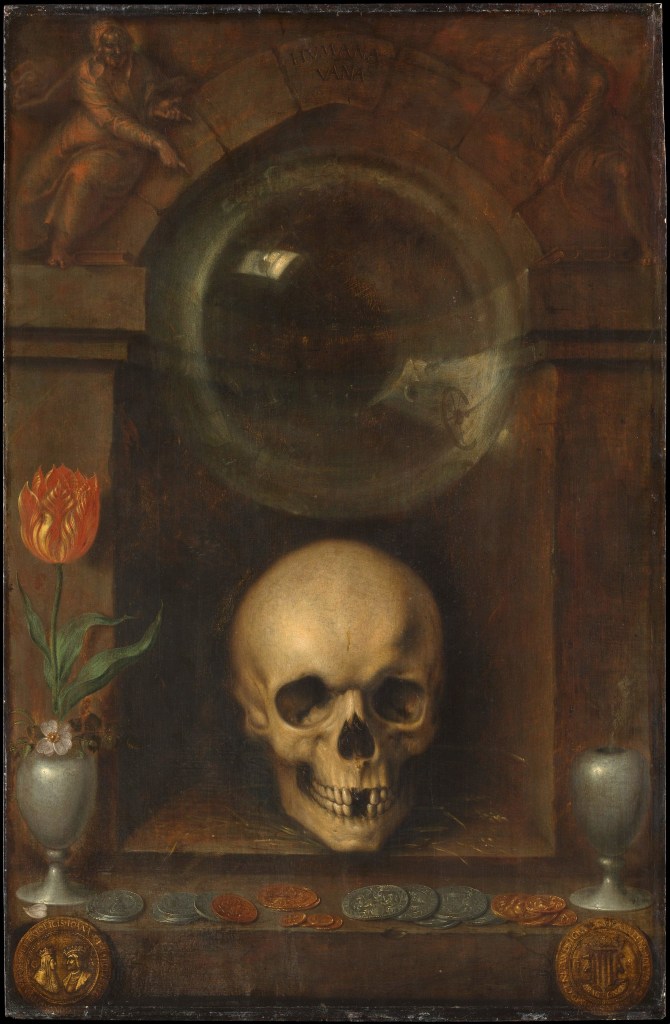
Jacques de Gheyn II (Netherlandish, 1565–1629), Vanitas Still Life, 1603. Oil on wood, 32 1/2 × 21 1/4 in. (82.6 × 54 cm). Metropolitan Museum of Art, New York.

Lord, you have been our dwelling place
in all generations.
Before the mountains were brought forth,
or ever you had formed the earth and the world,
from everlasting to everlasting you are God.

You return man to dust
and say, “Return, O children of man!”
For a thousand years in your sight
are but as yesterday when it is past,
or as a watch in the night.

You sweep them away as with a flood; they are like a dream,
like grass that is renewed in the morning:
in the morning it flourishes and is renewed;
in the evening it fades and withers.

. . .

The years of our life are seventy,
or even by reason of strength eighty;
yet their span is but toil and trouble;
they are soon gone, and we fly away.

. . .

So teach us to number our days
that we may get a heart of wisdom.

—Psalm 90:1–6, 10, 12

+++

MUSIC: Élégie in E-flat Minor, op. 3, no. 1, by Sergei Rachmaninoff, 1892 | Performed by Sheku Kanneh-Mason, with Isata Kanneh-Mason, 2017

I’ve mentioned these stellar sibling musicians on the blog before, when I shared Sheku’s arrangement of “In the Bleak Midwinter.” In fact, all seven Kanneh-Mason siblings, ranging in age from eleven to twenty-four, are musical—and of an exceptionally high standard! Their debut album as a family, Carnival, dropped November 6; it is a collaboration with Oscar-winning actor Olivia Colman and children’s author Michael Morpurgo.

Sheku Kanneh-Mason released Rachmaninoff’s Élégie, from Morceaux de fantaisie, as a single in 2017. He has two solo records: Elgar (2020) and Inspiration (2018).

Isata Kanneh-Mason has also recorded as a solo artist: see Romance: The Piano Music of Clara Schumann (2019).

+++

Vanitas (from the Latin vanus, “empty”) is a subgenre of still life painting, especially common in the Low Countries in the seventeenth century, that shows, through symbolism, the brevity of life and the transience of earthly pleasures.

Art historian Ingvar Bergström discusses Vanitas Still Life by Jacques de Gheyn II (Jacob de Gheyn) at length in the 1970 journal article “De Gheyn as a ‘Vanitas’ Painter.” The commentary that follows is derived from that.

In de Gheyn’s painting, a skull sits inside a stone niche on a bed of dry grass, a reminder that “all flesh is grass, and all the goodliness thereof is as the flower of the field: the grass withereth, the flower fadeth . . .” (Isaiah 40:6–7; cf. 1 Peter 1:24). Sitting on the left side of the ledge, the tulip and the wild rose with the fallen petal symbolize how man “cometh forth like a flower, and is cut down” (Job 14:2). The smoking urn on the other side references Psalm 102:3: “my days are consumed like smoke.” Between these two are a spill of Spanish coins and a Dutch military medal, and propped up against the ledge on each side is a gold ten-ducat coin showing, on the obverse, Joanna and Charles as sovereigns of Aragon. The message is that beauty, riches, and worldly power and honors all come to an end.

Lest this message somehow be missed, HUMANA VANA (“human vanity”) is carved into the top of the arch. The inscription is flanked by fictive sculptures of Heraclitus and Democritus, the weeping and laughing philosophers of Greek antiquity. Both figures point to a soap bubble (“Man is but a bubble” is a classical aphorism), which, if read in light of the traditional iconography of the two philosophers, doubles as a globe.

de Gheyn II, Jacques_Vanitas Still Life (bubble detail)

The bubble mirrors a number of disparate objects, which are difficult to make out. Bergström identifies a trophy group along the middle axis of the bubble: a crown in the center with various weapons converging upon it. At the top is an upturned moneybag with coins streaming out. Most discernible is the wheel of torture at the bottom right, and above that is a leper’s rattle, which lepers in some areas were required to shake to alert others to their proximity; these are symbols of human frailty. Also reflected “are a caduceus (probably signifying commerce) and a pair of bellows (signifying luxury?). Playing cards, backgammon with dice, and drinking vessels allude to vain pleasures and pastimes. The highlight of the sphere mirrors a burning heart, pierced by an arrow—an image of earthly love, of luxury” (153).

Though the painting doesn’t explicitly reference our lectionary reading from Psalm 90, it does complement the psalmist’s reflection on how short and precarious life is—it’s like a wilting flower, a burning candle, a fragile bubble. Here today, gone tomorrow. Which is why it’s so important to live wisely while we still can.

+++

To access another Artful Devotion for AProp28, on 1 Thessalonians 5:1–11, click here.


This post belongs to the weekly series Artful Devotion. If you can’t view the music player in your email or RSS reader, try opening the post in your browser.

To view all the Revised Common Lectionary scripture readings for Proper 28, cycle A, click here.

Roundup: Art and the Psalms, “We Americans,” the Walking Roots Band, and more

“Psalms in Dialogue: Psalms 22, 23, and 24,” presented by Duke University Chapel: This multidisciplinary video presentation brings together dancers, musicians, a theologian, a painter, and (other) members of the Duke community to draw out the meaning of, or respond to, these three sequential psalms through art, prayer, and conversation. The livestreamed event aired October 17 and will be available for viewing for a limited time. Several of the segments, which I’ve time-stamped below, are intercut with photos from the streets in 2020 (showing the impact of the pandemic and racial unrest), of artist Makoto Fujimura in his studio and of his three finished paintings, and of Ekklesia Contemporary Ballet dancers in training. I wish more university chapels and well-resourced churches would offer experiences like this! Thank you to my friend Peggy for telling me about it. Read more about Duke Chapel’s multiyear Psalms project here.

1:51: “How do we name the impossible mystery?,” a theological reflection by Morley Van Yperen

6:02: Organ: “Jésus accepte la souffrance,” from La Nativité du Seigneur [previously] by Olivier Messiaen, performed by Christopher Jacobson

10:58: Psalm 22 by Makoto Fujimura, 2020, oyster shell on Belgium canvas, 48 × 48 in.

11:09: Reading of Psalm 22:1–22 by Luke A. Powery, with balletic responses by Paiter van Yperen, Elijah Ryan, Heather Bachman, and Sasha Biagiarelli

15:40: Lament, ballet solo danced by Paiter van Yperen (music by Max Richter, choreo by Elisa Schroth)

18:10: Psalm 22:22–32 chant by Zebulon Highben

21:09: Conversation on the Psalms with Makoto Fujimura and Ellen F. Davis, moderated by Amanda Millay Hughes

29:32: Organ: “Christus, der uns selig macht,” BWV 620, by Johann Sebastian Bach, performed by Christopher Jacobson

32:00: Prayer by Nathan Liang

34:11: Recitation of Psalm 23 by Julia Hendrickson

35:22: 6IX, a tap dance by Andrew Nemr

37:10: “The 23rd Psalm,” text adaptation and music by Bobby McFerrin, performed by the Duke Chapel Staff Singers (*this was my favorite!)

40:42: Prayer by Jonathan Avendano

42:39: “The Lord Is My Shepherd,” music by Howard Goodall, performed by the Royal School of Church Music in America Choristers

46:13: Psalm 24 remix produced by Andrew Nemr

48:21: Prayer by Jordyn Blake

49:45: Recitation of Psalm 24 by Julia Hendrickson

51:32: Conversation continued

1:11:49: “He’s Got the Whole World in His Hands,” African American spiritual arranged by Mark A. Miller, performed by the Duke Chapel Choir

+++

POEMS: This week’s edition of ImageUpdate includes two poems that I really appreciated. The first, which was new to me, is “America” by Claude McKay, a key figure in the Harlem Renaissance. Originally published in The Liberator in 1921, it expresses the pain of living in a country where you’re hated for your race and yet remains optimistic, beginning, “Although she feeds me bread of bitterness, / And sinks into my throat her tiger’s tooth, / Stealing my breath of life, I will confess / I love this cultured hell . . .” The second poem is “Making Peace” by Denise Levertov, one of the best-known Christian poets of the twentieth century. “The poets must give us / imagination of peace, to oust the intense, familiar / imagination of disaster,” she writes. Poets can help us feel our way toward shalom—give us a vision of its permeating the world that inspires us to live out its rhythms, its metaphors, its structure, its grammar, our lives like poems.

+++

MUSIC VIDEO: “We Americans” by the Avett Brothers: I’m so moved by this song from the Avett Brothers’ 2019 album Closer Than Together—its grappling with the historical legacy of the US, its greatness and its guilt, with a mixture of heartache, empathy, and hope. It’s one of the healthiest expressions of patriotism I’ve ever come across in a song. We need to see America as the complex entity that she is, which means in part not ignoring her flaws but with love exposing them so that they can be remediated and we can move forward together more faithful to her celebrated ideals. “We Americans” is both confession and supplication, an “I’m sorry, God” and “God, help us to do better.” The final chorus:

I am a son of God and man
And I may never understand
The good and evil
But I dearly love this land
Because of and in spite of We the People
We are more than the sum of our parts
All these broken bones and broken hearts
God, will you keep us wherever we go?
Can you forgive us for where we’ve been?
We Americans

I was reminded of this song in the September 17 episode of the RTN Theology podcast, “You Shall Know the Truth and the Truth Shall Unsettle You.” Chris Breslin interviews Mark Charles, a Native American activist, public speaker, Christian leader, and independent candidate in this year’s US presidential election. He is the coauthor, with Soong-Chan Rah, of Unsettling Truths: The Ongoing, Dehumanizing Legacy of the Doctrine of Discovery. Charles enters at 12:40 with a discussion of the lack of common memory.

+++

SONGS:

>> “Whatever Comes Next” by Drew Miller: This song came out of “Hutchmoot: Homebound,” a virtual arts gathering organized by the Rabbit Room that took place earlier this month. In writing the song, Drew Miller [previously] was inspired in part by Shigé Clark’s new poem “Grateful” (see her perform the poem here).

>> “Bring Your Peace” by the Walking Roots Band: This song was written this year by Seth Thomas Crissman and Greg J. Yoder of the Walking Roots Band as part of a collection of fifteen songs for Shine, a children’s Sunday school curriculum published by MennoMedia and Brethren Press. It appears on Everybody Sing: Worship Songs for Children, released in June as a double album with Everybody Sing: Songs for the Seasons (which comprises ten original songs by The Many). The song asks God to bring his peace into our fears and into the storms we face, and to make us instruments of that peace to others.

>> “Rest Assured,” sung by the Walking Roots Band: TWRB learned this song from a bandmate’s parent (original authorship unknown) and recorded it a cappella in their separate locations at the start of quarantine in March. The chorus goes,

Rest assured, He’s not forgotten
Rest assured, He’ll take care of you
Look at the times He’s been there before
He’ll be there again, rest assured

>> “Let Justice Roll Like a River,” sung by Eric Lige: Bobby Gilles and Rebecca Elliott of Sojourn Music wrote this song in 2017, inspired by Amos 5. In this lyric video from July 5, it’s performed by Eric Lige and Paul Lee of Ethnos Community Church. The singing starts at 1:33. [HT: Global Christian Worship]

Roundup: Jesus as Dancer, The Daily Prayer Project, ethnoarts in Indonesia, and more

BLOG POST: “Jesus as Dancer: Jyoti Sahi’s ‘Lord of Creation’” by Victoria Emily Jones: I wrote a guest post for the Sojourn Arts blog about a gouache I own by Indian artist Jyoti Sahi, which shows Jesus leading the dance of new creation. On one side he pounds a drum, and on the other he emerges from a lotus. The painting brings together Jyoti’s interests in Christian and Hindu theologies and folk symbolism.

Sahi, Jyoti_Lord of Creation
Jyoti Sahi (Indian, 1944–), Lord of Creation, 1982. Gouache on paper, 14 3/4 × 20 in. Collection of Victoria Emily Jones.

Sojourn Arts is a ministry of Sojourn Church Midtown in Louisville, Kentucky, that seeks to support artists and build up the church through the arts. They have organized and/or hosted numerous exhibitions over the years and have commissioned temporary installations for their sanctuary, as well as coordinated community art projects. Visit www.sojourn-arts.com.

+++

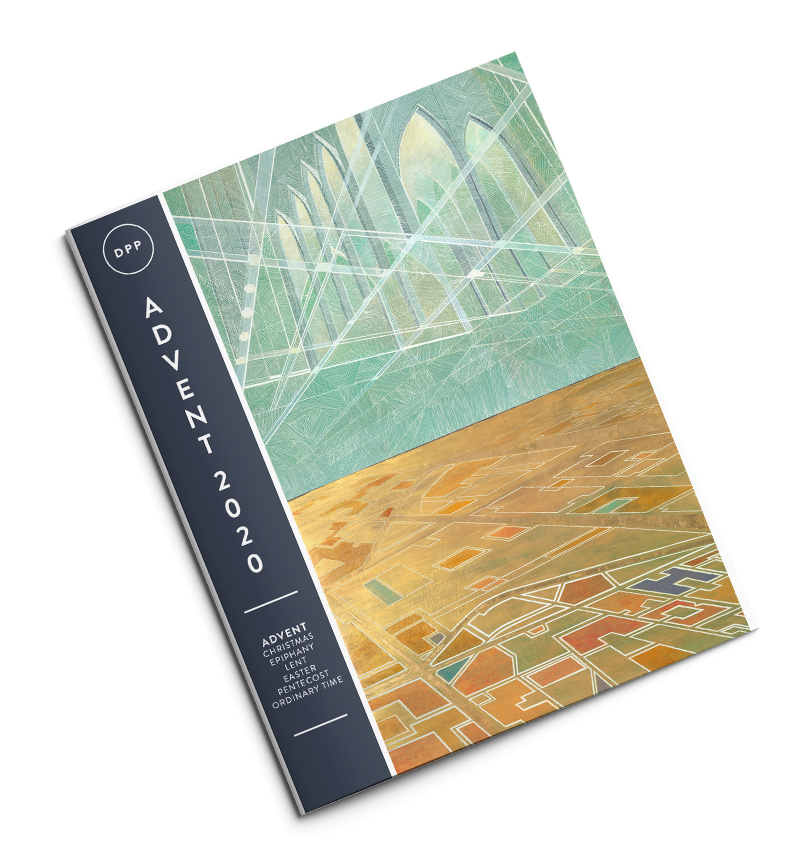
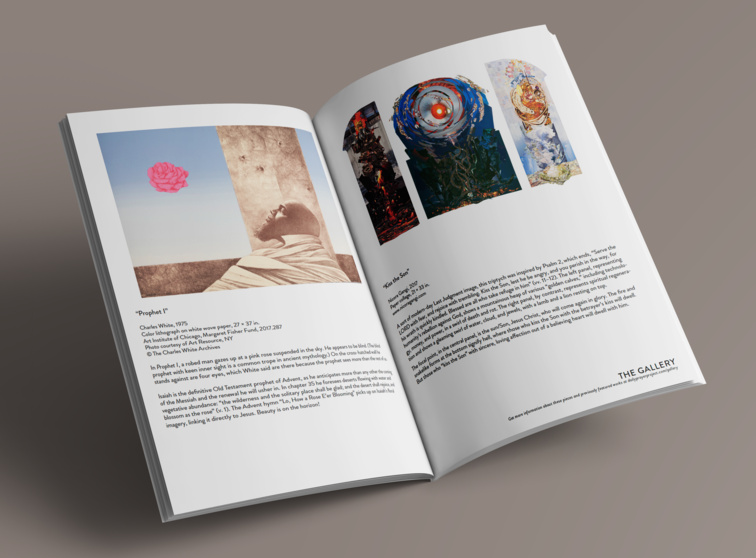
THE DAILY PRAYER PROJECT: This fall I joined the team at the Daily Prayer Project as curator of visual art. The Daily Prayer Project is a periodical that covers every season of the Christian year with robust, rooted, and cross-cultural liturgies for use in congregations, households, workplaces, small groups, or other gatherings. Released in seven editions per year, it features daily morning and evening prayer guides for the week, which include Psalm, Old Testament, and New Testament readings; short prayers sourced from around the globe and from different eras; specific prayer prompts; and songs (including lead sheets). In addition to the cover image, there is a mini-gallery of two art images inside, reproduced in full color, to serve as visual prompts for further contemplation and prayer. There is also a section called “The Practices,” with two page-long seasonal reflections by staff members or guest contributors.

The Advent 2020 issue of the DPP, covering November 29 through December 24, was released last week. It features prayers by African American civil rights leader Fannie Lou Hamer, the tenth-century English saint Ethelwold, and others; a Hebrew folk song, a Taizé chant, and an Argentine hymn by Federico J. Pagura; a striking cover image by Hilary Siber, which shows heaven coming down to earth; Charles White’s Prophet I, which resonates with passages from Isaiah; and an apocalyptic paper collage by Nicora Gangi.

The periodical is available as a physical booklet or as a PDF download. Visit the website for more information. If you are an artist and are interested in having your work considered for publication in a future prayerbook, email team@dailyprayerproject.com.

DPP Advent 2020 interior

+++

VIDEO: “Local Riches: Ethnoarts and Sumba”: A workshop for churches on the island of Sumba in Indonesia, led by Yayasan Suluh Insan Lestari in July 2019, reinforced that God is best honored, and the global body of Christ built up, when people worship God using their unique cultural and linguistic gifts, bringing their whole, authentic selves before him in praise. [HT: Global Christian Worship]

For centuries many Christian missionaries to other countries brought with them Western hymns and images, presenting them as definitive—as forms that alone are good and pleasing to God. (For example, a woman in the video mentions how she had previously thought that worship songs had to be based on Western scales and performed using certain instruments to be acceptable.) But in the last fifty or so years especially, at least from what I’ve noticed, many missionaries have recognized the falsity of this line of thinking and seek to undo negative conditioning by promoting the use of indigenous artistic expressions (sometimes called “ethnoarts”) in Christian worship, be it dance, drama, music, storytelling, carving, or what have you. I found it interesting that the interviewees seem to suggest that now it’s the forces of modernism that most threaten the survival of traditional cultures, whereas it used to be that the church was largely blamed (missionaries did undeniably play a large part, banning this and that, though in every era there were exceptions to the rule). Now the church is at the forefront of trying to preserve not only traditional languages but also traditional art forms.

“Everything we have was created by God, and we need to return to it with gratefulness because this is how God made us!” says Rev. Herlina of the Christian Church of Sumba. “With whatever we already have, we can be a blessing to our people.”

+++

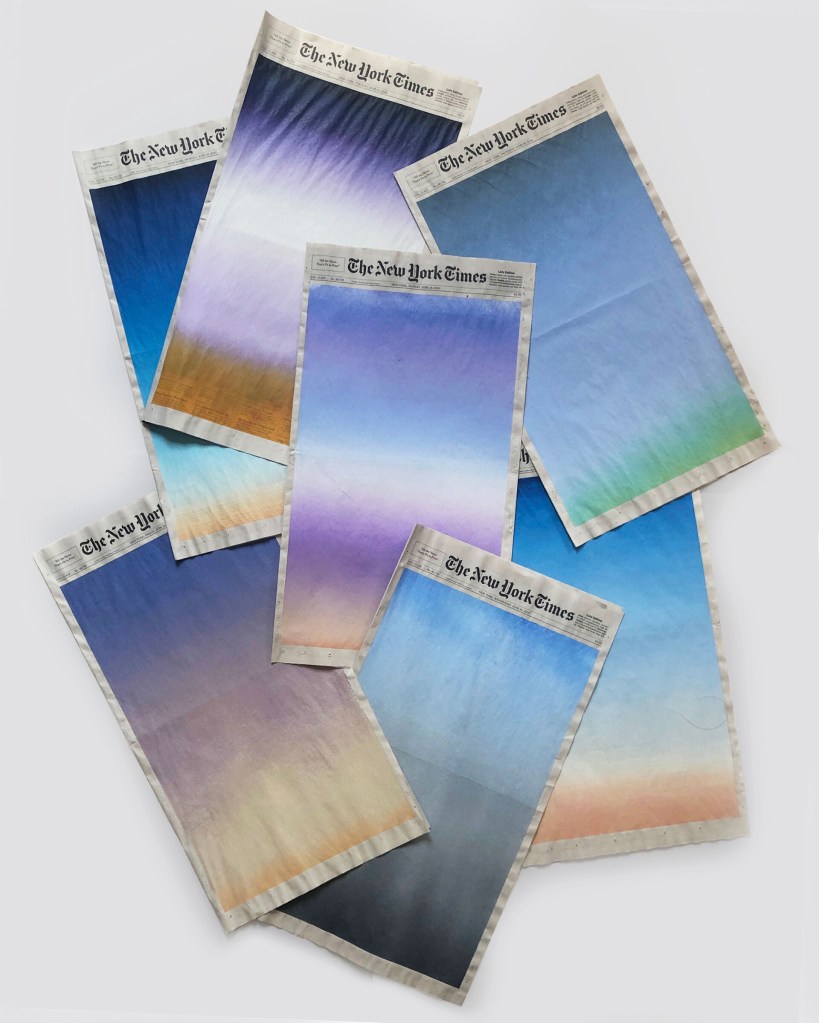
NEW ART SERIES: “Organic, Sunrise Gradients Mask Front Pages of the New York Times by Artist Sho Shibuya”: Since the lockdown started in March, Brooklyn-based artist and graphic designer Sho Shibuya has been painting color gradients in acrylic over the front pages of the New York Times, inspired by each morning’s sunrise. He calls the series “Sunrises from a Small Window.” I love how he’s able to express gratitude for a beautiful new day and to access calm amid dire news cycles. Shibuya is still reading those headlines and articles; he’s just putting them in a larger perspective. (As for myself, call me escapist, but I’ve found that actually blocking out the news—turning down the noise—for certain periods can be a helpful spiritual practice.)

Sho Shibuya, Sunrises from a Small Window, June 22–28, 2020. Acrylic on newsprint.

“I started . . . contrasting the anxiety of the news with the serenity of the sky, creating a record of my new normal,” Shibuya says. “Their front page has always been a time capsule of a day in history, so it made sense to use history as the canvas because the paintings are meant to capture a moment in time. . . . The spirit of the project is that maybe, even after the pandemic subsides, people can continue some of the generosity and peace we discovered in ourselves and that the sky reminds us of every day with a sunrise through a small window. If one thing the news has made clear, we need generosity and peace for all people now more than ever.”

+++

TWO FILMS: “Death on Netflix: I’m Thinking of Ending Things and Dick Johnson Is Dead by Mitch Wiley: I really liked both these cinematic reflections on mortality, but they’re completely different, as this short Gospel Coalition article bears out. Dick Johnson Is Dead is the more “Christian” of the two because of its hopeful perspective—the human subject of the film is a Seventh-Day Adventist, so death for him is not a final end. After her father was diagnosed with dementia, filmmaker Kirsten Johnson asked her dad if he’d be interested in a collaborative film project where, to help them both face the inevitable, she would stage his death in inventive and comical ways. Relishing the opportunity to spend more time with his busy daughter, he enthusiastically agreed.

The documentary shows them preparing and carrying out these stunts but also interacting in other contexts—birthday parties, trick-or-treating, looking through old photo albums, cleaning out Dick’s office, Dick’s being asked to give up driving, and so on. It made me laugh and cry—films that can do both tend to rate highly on my favorites list. There’s so much love and warmth and heartache and whimsy in it as father and daughter confront death together, talking very openly about it, which I found, strange as it may seem, refreshing. Oh, and the heaven sequences just may be the best I’ve ever seen.

For a more cynical take on death, here’s the trailer to I’m Thinking of Ending Things (Charlie Kaufman isn’t for everyone, but I’m still thinking about this movie after watching it a month ago, which means it made an impression!):

Seeing and Believing, a Christ and Pop Culture podcast, covered Ending Things and Dick Johnson in episodes 264 and 266, respectively, as have most other film podcasts and reviewers, with Dick Johnson being uniformly lauded as one of the best movies of the year.

+++

SONG: “Hodu” (Give Thanks), performed by the Platt Brothers: The Platt Brothers [previously] singing scripture to me? Yes, please. The text of this song is Psalm 118:1–4, and the music is by Debbie Friedman (1951–2011), a Jewish singer-songwriter whose songs are used widely in Reform and Conservative Jewish liturgies in North America. Friedman’s “Hodu” was originally released on her 1981 album And the Youth Shall See Visions. (Find sheet music here.)

In this video from earlier this month, Henry, Jonah, and Ben Platt sing “Hodu” to a guitar accompaniment by Al Seller.

Hodu l’Adonai kitov
Ki l’olam chasdo, ki l’oam chasdo
Yomar na, yomar na, Yisraeil
Ki l’olam chasdo, ki l’olam chasdo
Yomru na, yomru na veit Aharon
Ki l’olam chasdo, ki l’olam chasdo

Let all who revere G-d’s name now say
Ki l’olam chasdo
Give thanks to the Lord for G-d is good
Ki l’olam chasdo

The first time the Platt Brothers performed in public as a trio was this April, when they appeared in a virtual Yom Ha’atzmaut celebration at the request of the Jewish Federations of North America, singing “Ahavat Olam.” Ben and Jonah are musical theater performers: Ben originated the title role in Broadway’s Dear Evan Hansen and won a Tony for it, and Jonah is best known for playing Fiyero in Wicked on Broadway from 2015 to 2016. Henry is a senior at the University of Pennsylvania, where’s he’s a member of the a cappella group Counterparts.

Remember Me (Artful Devotion)

Picasso, Pablo_The Old Guitarist
Pablo Picasso (Spanish, 1881–1973), The Old Guitarist, 1904. Oil on panel, 48 3/8 × 32 1/2 in. (122.9 × 82.6 cm). Art Institute of Chicago.

Remember me, O LORD, with the favour that thou bearest unto thy people: O visit me with thy salvation.

—Psalm 106:4 (KJV)

+++

SONG: “Sing Your Song Over Me / Do Lord, Remember” by Tim Coons, on Potomac (2012)

In his Potomac album, Tim Coons combines American folk songs—mostly African American spirituals, blues, and gospel—with originals in the same track. Track 4 is based on “Do Lord,” Roud 11971. I actually learned this spiritual not in church but in Girl Scouts! Notable recordings include those by Mississippi John Hurt [previously] and Johnny Cash.

More recently Tim has been working on collaborations with his wife Betony, a visual artist, under the name Giants and Pilgrims [previously].

+++

The Art Institute of Chicago, which owns Picasso’s The Old Guitarist, writes,

Pablo Picasso made The Old Guitarist while working in Barcelona. In the paintings of his Blue Period (1901–04), the artist restricted himself to a cold, monochromatic blue palette, flattened forms, and emotional, psychological themes of human misery and alienation related to the work of such artists as Edvard Munch and Paul Gauguin. The elongated, angular figure of the blind musician also relates to Picasso’s interest in Spanish art and, in particular, the great 16th-century artist El Greco. The image reflects the twenty-two-year-old Picasso’s personal struggle and sympathy for the plight of the downtrodden; he knew what it was like to be poor, having been nearly penniless during all of 1902.


This post belongs to the weekly series Artful Devotion. If you can’t view the music player in your email or RSS reader, try opening the post in your browser.

To view all the Revised Common Lectionary scripture readings for Proper 23, cycle A, click here.

The Kiss of Justice and Peace (Artful Devotion)

La Hyre, Laurent de_The Kiss of Peace and Justice
Laurent de La Hyre (French, 1606–1656), The Kiss of Peace and Justice, 1654. Oil on canvas, 21 5/8 × 30 in. (54.9 × 76.2 cm). Cleveland Museum of Art, Ohio, USA.

Lord, thou hast been favourable unto thy land: thou hast brought back the captivity of Jacob.

Thou hast forgiven the iniquity of thy people, thou hast covered all their sin. Selah.

Thou hast taken away all thy wrath: thou hast turned thyself from the fierceness of thine anger.

Turn us, O God of our salvation, and cause thine anger toward us to cease.

Wilt thou be angry with us for ever? wilt thou draw out thine anger to all generations?

Wilt thou not revive us again: that thy people may rejoice in thee?

Shew us thy mercy, O LORD, and grant us thy salvation.

I will hear what God the LORD will speak: for he will speak peace unto his people, and to his saints: but let them not turn again to folly.

Surely his salvation is nigh them that fear him; that glory may dwell in our land.

Mercy and truth are met together; righteousness and peace have kissed each other.

Truth shall spring out of the earth; and righteousness shall look down from heaven.

Yea, the LORD shall give that which is good; and our land shall yield her increase.

Righteousness shall go before him; and shall set us in the way of his steps.

—Psalm 85 KJV

This psalm is a community lament, probably written during the period of Israel’s return from the Babylonian exile—to a ruined city, a fallen temple, and a mourning land. The people seek forgiveness for their covenant unfaithfulness and restoration, appealing to the benevolence God has shown them in the past. The closing section expresses confidence that salvation will come.

Verse 10 personifies four of God’s virtues: mercy (lovingkindness; Heb. hesed, Lat. misericordia), truth (Heb. emeth, Lat. veritas), justice (righteousness; Heb. tsedeq; Lat. iustitia), and peace (Heb. shalom, Lat. pax). Mercy and Truth meet together, and Justice and Peace embrace with a kiss. In medieval Christian writings these virtues came to be allegorized as the “four daughters of God,” a motif developed most famously by Hugh of St. Victor and Bernard of Clairvaux.

Many churches sing Psalm 85 at Advent or Christmastime, the birth of Jesus being a time when God’s salvation came near and “glory . . . dwell[ed] in our land.” All the virtues of God kissed each other in Christ, bringing heaven to earth. Others read the psalm as prophesying Jesus’s atoning death.

I love how Eugene Peterson translates this psalm in The Message, which suggests that these virtues of God are ones that humanity should emulate, and indeed what the gospel calls us to:

Our country is home base for Glory!
Love and Truth meet in the street,
Right Living and Whole Living embrace and kiss!
Truth sprouts green from the ground,
Right Living pours down from the skies!
Oh yes! GOD gives Goodness and Beauty;
our land responds with Bounty and Blessing.
Right Living strides out before him,
and clears a path for his passage. (vv. 9b–13)

Jesus lived rightly and bound up the brokenness he encountered, bringing wholeness. His ministry announced, verbally and in tangible ways, a kingdom to come, and we are to pave the way for that kingdom by embodying its values.

+++

SONG: “O God, Will You Restore Us” by Isaac Wardell | Performed by Bifrost Arts, feat. Yolonda Coles Jones, on Lamentations, 2016

O God, will you restore us,
And grant us your salvation? (×2)

I will hear what God proclaims.
The Lord our God proclaims peace.
Kindness and truth shall meet,
Justice and peace shall kiss.

O God, will you restore us,
And grant us your salvation?

“Here is the fast that I choose:
To loosen the bonds of the oppressed and break their chains.
Let righteousness and justice go out before you,
Then you will call out and I will hear.”

O God, will you restore us,
And grant us your salvation?

Near indeed is his salvation to those who call on him.
He will incline his ear and hear their prayers.
Truth shall spring out of the earth,
and justice will rain down from heaven.

O God, will you restore us,
And grant us your salvation?

The Lord will guide you on a righteous path,
His vindication will shine down forth as the dawn.
Your people will be called repairers of broken walls,
Making straight the path to proclaim his reign!

O God, will you restore us,
And grant us your salvation?

O God, will you restore us?
Please grant us your salvation.

Isaac Wardell’s “O God, Will You Restore Us” cleverly integrates Psalm 85 with Isaiah 58, which both center on themes of restoration, blessing, and social responsibility, even using similar word pictures. The refrain is based on the plea of Psalm 85:6–7, the heart of the psalm.

Opening with that plea, Wardell’s first verse then moves into Psalm 85:8, 10: God proclaims shalom. Verse 2 articulates what that looks like: the bonds of wickedness loosed, the oppressed set free. This verse is derived from God’s words in Isaiah 58:6, 8–9, in which God expresses the work he wants his people to be about—namely, justice. Only when his people practice true piety—emancipating captives, feeding the hungry, sheltering the homeless—will he answer their prayers.

The third verse is drawn from Psalm 85:9, 11, an image of abundance and refreshment. And finally, verse 4 seems to be based on Isaiah 58:8, 12 and Psalm 85:13 (cf. Isa. 40:3).

Unmetered and in a minor key, the song has the feel of a Gregorian chant.

+++

“The Allegory of Justice and Peace,” or “Justice and Peace Kissing,” was a popular subject in the seventeenth and eighteenth centuries in the art of the Italian and Flemish Baroque and the French Neoclassical, including works by Giovanni Battista Tiepolo, Corrado Giaquinto, Pompeo Batoni, Artemesia Gentileschi, Theodoor van Thulden, Maerten de Vos, Jacob de Backer—and the artist featured above, Laurent de La Hyre. Although the image comes from the Hebrew Bible, where it is rooted in God’s dealings with his people, artists often used it for secular purposes, to express political peace. Some such paintings were gifted to rulers as a form of flattery.

The iconography that developed draws on classical symbolism and mythology, with both virtues being personified as women. Justice’s attributes include a crown, a sword, scales, and a fasces; Peace’s, an olive branch, an inverted torch (which burns weapons and armor), ears of wheat and/or a cornucopia (because peace leads to plenty), and a caduceus (one myth suggests that Mercury saw two serpents entwined in mortal combat and separated them with his wand, bringing about peace between them).

The Hebrew word for “kiss” in Psalm 85 refers seldom to an erotic kiss, says Sigrid Eder, but rather to a form of greeting or goodbye exchanged by near relatives or to the final phase of a peacemaking ritual. In medieval Europe, where the visual motif of Justice and Peace Kissing was first introduced, kissing was even more widespread than in the ancient Jewish world; it was common for people of equal rank, both male and female, to exchange lip-to-lip kisses. (See a compilation of medieval “kiss paintings,” showing a variety of contexts, here.) But the Baroque taste for undraped figures means that quite a few artistic renditions of Justice and Peace can be read as sexualized, as when one of the women has a bared breast, for example.

In Laurent de La Hyre’s The Kiss of Peace and Justice, the action is set within a larger landscape. An olive-wreathed Peace embraces a blue-beribboned Justice beside a fountain inscribed with Iusticia et Pax // osculatae sunt, from the Latin Vulgate. The women are surrounded by ruins—upturned roadstones, crumbled walls and detached columns, a cracked garden urn. But this is an image of hope. A lion-faced spigot emits fresh, flowing water, which sheep flock to for refreshment, and trees part to reveal a vista. After the upheaval, healing and repair are underway. Justice and Peace have harmonized.

The Cleveland Museum of Art, which owns the painting, notes that its date coincides with the end of the Fronde, a period of civil war in France during which the parlement (law courts) and the nobility sought—unsuccessfully—to limit the power of the monarchy. So it’s likely the painting is an allusion to the climate of general reconciliation between parties.


This post belongs to the weekly series Artful Devotion. If you can’t view the music player in your email or RSS reader, try opening the post in your browser.

To view all the Revised Common Lectionary scripture readings for Proper 14, cycle A, click here.

Truly Grateful (Artful Devotion)

McIver, Beverly_Truly Grateful
Beverly McIver (American, 1962–), Truly Grateful, 2011. Oil on canvas, 30 × 30 in. (76.2 × 76.2 cm). North Carolina Museum of Art, Raleigh. Photo: Victoria Emily Jones.

I give thanks to you, O Lord my God, with my whole heart,
and I will glorify your name forever.
For great is your steadfast love toward me;
you have delivered my soul from the depths of Sheol.

. . . You, O Lord, are a God merciful and gracious,
slow to anger and abounding in steadfast love and faithfulness . . .

—Psalm 86:12–13, 15

+++

SONG: “Gospel Medley” by Beyoncé Knowles, Kirk Franklin, and Richard Smallwood | Performed by Destiny’s Child, on Survivor (2001)

The liner notes of Survivor credit Beyoncé [previously], Kirk Franklin, and Richard Smallwood as the writers of this song, but from what I can tell, the credit goes mainly to Beyoncé, who has woven together different gospel fragments and, it seems, written the first two-thirds of the song, which fan web pages say is an interpolation of Franklin’s “Now Behold the Lamb” and “So Good” (I myself can’t hear much of a resemblance). This is followed by a gospel rendition of the Anna B. Warner hymn “Jesus Loves Me” that is much like the one Michele Lamar Richards and Whitney Houston sing in the 1992 movie The Bodyguard. The medley concludes with the “Amen” section of Smallwood’s “Total Praise.”

+++

About the above painting by Beverly McIver, the North Carolina Museum of Art writes,

McIver is renowned for her expression-filled, emotive canvases that commemorate her life and the lives of those closest to her—in particular, her mother, who passed away in 2004, and her sister, who is mentally disabled. Such works reveal as much about the artist as they do about the subjects portrayed therein. As McIver has noted about her paintings, “All of my portraits are self-portraits,” says the artist. “I use the faces of others who reflect my most inner being.”

In Truly Grateful, the artist moves her focus away from her family and back towards herself, and the resulting self-portrait is one of quiet, contemplative acceptance. The artist represents herself at bust length, draped in a bright blue scarf, with her head bowed and eyes closed, perhaps in midst of prayer. McIver’s signature brushwork, patchy and lively, adds a marked contrast to an otherwise peaceful scene. She does not highlight any other figures or objects in this canvas, allowing the viewer to focus solely on the artist herself and her emotional state. The yellow-orange background surrounds her figure with a warm glow, reminiscent of the traditional gold-leaf ground seen in traditional European icons. As a result, the painting exudes a calming, almost spiritual atmosphere.

It is possible to examine McIver’s personal biography to determine the significance of the title, Truly Grateful. Over the past five years, McIver has grappled with the ongoing repercussions of her mother’s death. Her mother’s passing left Renee, McIver’s sister, without a caretaker to provide her with the assistance, comfort and protection required due to her disabilities. McIver, bolstered by a promise made to her mother years prior, became Renee’s primary guardian, taking on all related responsibilities and allowing her sister to move into her home. After years of struggle, Renee recently moved into her own apartment complex for the handicapped and disabled, freeing McIver to pursue her artistic career at a more fervent pace while being reassured of Renee’s continued care and contentment.


This post belongs to the weekly series Artful Devotion. If you can’t view the music player in your email or RSS reader, try opening the post in your browser.

To view all the Revised Common Lectionary scripture readings for Proper 11, cycle A, click here.

Girded with Joy (Artful Devotion)

Klee, Paul_Joyful Mountain Landscape
Paul Klee (Swiss, 1879–1940), Heitere Gebirgslandschaft (Joyful Mountain Landscape), 1929. Oil on board, 17 5/16 × 24 13/16 in. (43.9 × 63.1 cm). Yale University Art Gallery, New Haven, Connecticut.

By awesome deeds you answer us with righteousness,
O God of our salvation,
the hope of all the ends of the earth
and of the farthest seas;
the one who by his strength established the mountains,
being girded with might;
who stills the roaring of the seas,
the roaring of their waves,
the tumult of the peoples,
so that those who dwell at the ends of the earth are in awe at your signs.
You make the going out of the morning and the evening to shout for joy.

You visit the earth and water it;
you greatly enrich it;
the river of God is full of water;
you provide their grain,
for so you have prepared it.
You water its furrows abundantly,
settling its ridges,
softening it with showers,
and blessing its growth.
You crown the year with your bounty;
your wagon tracks overflow with abundance.
The pastures of the wilderness overflow,
the hills gird themselves with joy,
the meadows clothe themselves with flocks,
the valleys deck themselves with grain,
they shout and sing together for joy.

—Psalm 65:5–13

Psalm 65 is a such a magnificent praise song, and I especially love the expression in verse 12: “the hills gird themselves with joy” (ESV). Other translations have “the little hills rejoice on every side” (KJV), “the hillsides blossom with joy” (NLT), and “the hills [are set] to dancing” (MSG). The picture extends into the final verse, where, along with pastures, meadows, and valleys, the mountains “shout and sing” to their Creator. Last year when I saw Paul Klee’s Joyful Mountain Landscape at the Yale University Art Gallery, I instantly thought of this psalm—of how nature sings praises to God simply by being itself.

Human beings are called to join in creation’s joyful song.

[Related post: “Creation’s Praise” (Artful Devotion)]

+++

SONG: “I Sing the Mighty Power of God” | Words by Isaac Watts, 1715 | Music (tune: ELLACOMBE) from Gesangbuch der Herzogl, Württemberg, 1784

I sing the mighty power of God
that made the mountains rise,
that spread the flowing seas abroad
and built the lofty skies.
I sing the wisdom that ordained
the sun to rule the day;
the moon shines full at his command,
and all the stars obey.

I sing the goodness of the Lord
that filled the earth with food;
he formed the creatures with his word
and then pronounced them good.
Lord, how thy wonders are displayed,
where’er I turn my eye,
if I survey the ground I tread
or gaze upon the sky.

There’s not a plant or flower below
but makes thy glories known,
and clouds arise and tempests blow
by order from thy throne;
while all that borrows life from thee
is ever in thy care,
and everywhere that man can be,
thou, God, art present there.

For a fairly traditional rendition of this classic hymn, here’s a three-part a cappella arrangement performed by the Ball Brothers in 2012:

If you prefer a more modern sound, check out the version by Ben Thomas on the 2015 album Bring Forth. Thomas wrote a new melody for the song and recorded it under the title “I Sing the Goodness” (using the language of verse 2 instead of 1).

The whole Bring Forth album is great, which takes as its basis thirteen hymn lyrics dating from the fourth through twentieth centuries—“all seeking to find the Divine in the everyday elements of our existence,” Thomas says. Thomas adapted and retuned the hymns and released them in three movements that echo the cycle of time: Dawn, Day, and Dusk. To guide you through your listening, there is a meditation and prayer for each movement published on his website.

Other favorites of mine from the album are “Creator God, Creating Still,” “Tell Me the Old, Old Story,” “Lord of All Being,” “Peace, Troubled Soul,” and “Bring Forth.”


This post belongs to the weekly series Artful Devotion. If you can’t view the music player in your email or RSS reader, try opening the post in your browser.

To view all the Revised Common Lectionary scripture readings for Proper 10, cycle A, click here.

Sinking (Artful Devotion)

Graffam, Catherine_Head High, Tears Dry
Catherine Graffam (American, 1993–), Head High, Tears Dry, 2015. Oil on wood, 27.9 × 35.5 cm.

Save me, O God!
For the waters have come up to my neck.
I sink in deep mire,
where there is no foothold;
I have come into deep waters,
and the flood sweeps over me.
I am weary with my crying out;
my throat is parched.
My eyes grow dim
with waiting for my God.

. . .

My prayer is to you, O LORD.
At an acceptable time, O God,
in the abundance of your steadfast love answer me in your saving faithfulness.
Deliver me
from sinking in the mire;
let me be delivered from my enemies
and from the deep waters.
Let not the flood sweep over me,
or the deep swallow me up,
or the pit close its mouth over me.

Answer me, O LORD, for your steadfast love is good;
according to your abundant mercy, turn to me.
Hide not your face from your servant,
for I am in distress; make haste to answer me.

—Psalm 69:1–3, 13–17

[Related post: “From the Mire (Artful Devotion),” on Psalm 40]

+++

SONG: “Save Me, O God” by Marty Haugen, on Here Among Us: Songs for the Liturgical Year (2015)


This post belongs to the weekly series Artful Devotion. If you can’t view the music player in your email or RSS reader, try opening the post in your browser.

To view all the Revised Common Lectionary scripture readings for Proper 7, cycle A, click here.

Roundup: Anger, lament, and racial oppression

INTERVIEW: “Singing the Songs of Injustice” with David M. Bailey and W. David O. Taylor: David Bailey is the director of the reconciliation ministry Arrabon and founder of its music-making and liturgical resource arm, Urban Doxology, and David Taylor is an assistant professor of theology and culture at Fuller Theological Seminary. In this conversation the two men discuss how “biblical, angry, congregational worship can help transform our hearts and churches.” “God has given us the psalms to be an ‘anger school’ for us and I’ve discovered that when we skip class, we aren’t emotionally equipped to deal with difficult stuff we’re experiencing now,” Taylor says. “The extraordinary gift of the psalms is that they show us how to pray angry prayers without being overcome by our anger, how to hate without sinning (to borrow from Saint Paul’s language), or, as Eugene Peterson once put it, how to ‘cuss without cussing.’”

Bailey and Taylor talk about the constant simmer of race relations in America, faithful versus unfaithful expressions of anger, the language of “enemy” in the Psalms, the importance of lament in Sunday gatherings and the need for language that expresses the horizontal aspects of what it means to be a Christian, and leading without moderation during turbulent times.

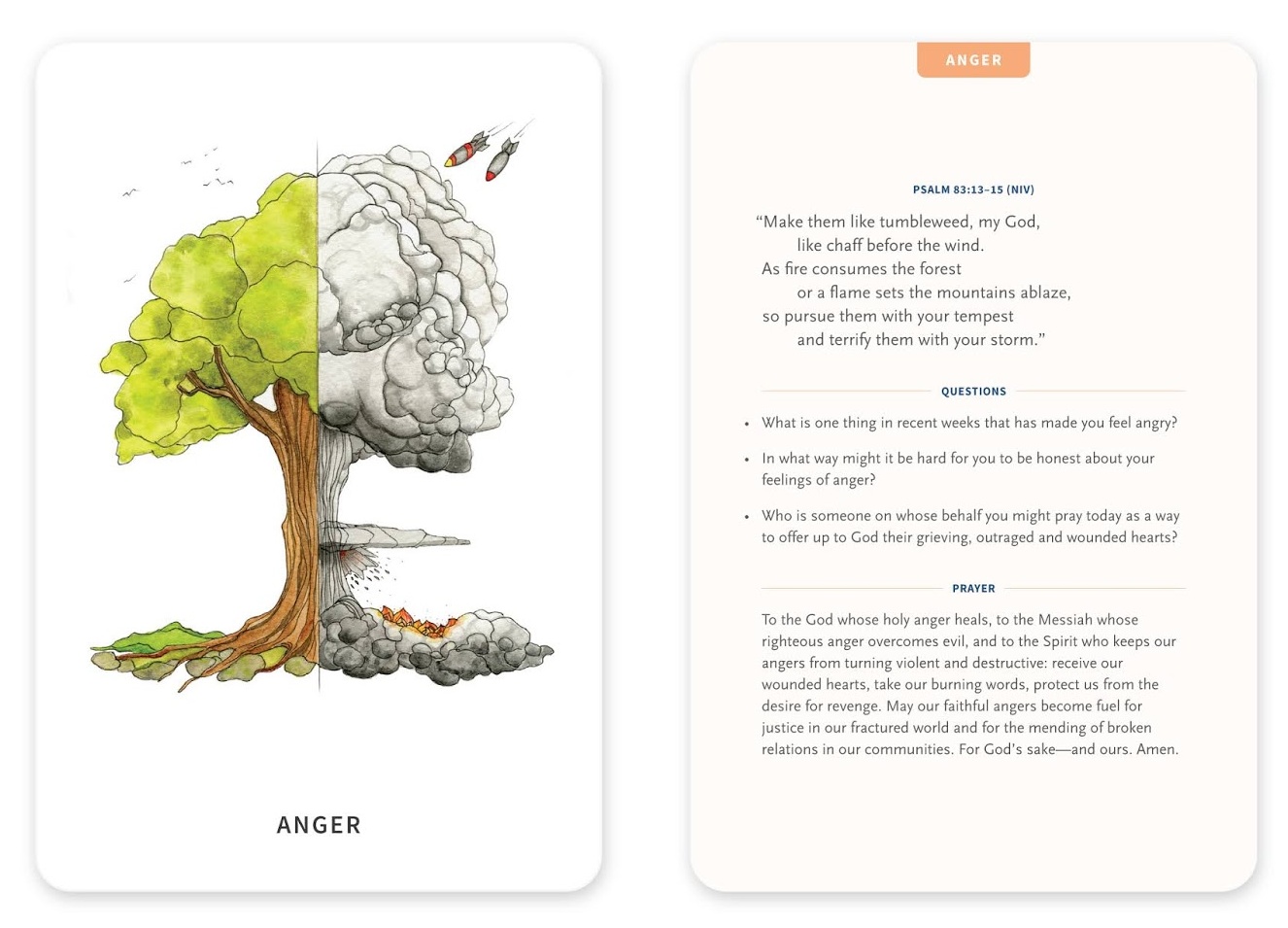
Anger prayer card
The Psalms of Anger: Prayer Card (illustration by Phaedra Taylor)

Taylor’s latest book, Open and Unafraid: The Psalms as a Guide to Life, contains a chapter on “The Psalms of Anger.” Read an excerpt here, or view this video talk. To coincide with the release in March, he and his wife Phaedra created a set of fifteen prayer cards. His prayer on the “Anger” card reads, “To the God whose holy anger heals, to the Messiah whose righteous anger overcomes evil, and to the Spirit who keeps our angers from turning violent and destructive: receive our wounded hearts, take our burning words, protect us from the desire for revenge. May our faithful angers become fuel for justice in our fractured world and for the mending of broken relations in our communities. For God’s sake—and ours. Amen.”

+++

LITURGIES

+++

LAMENT SONGS

The first two are new.

“I Just Wanna Live” by Johnnetta Bryant, performed by Keedron Bryant: Twelve-year-old gospel singer Keedron Bryant posted a video on Instagram last week of himself singing a song his mom wrote in response to the killing of George Floyd. “God gave me those lyrics” for Keedron, she said in a joint interview on Today. Keedron said he prayed the song, meditated with it, then hit record. It’s a heart-baring, heartbreaking lament, a plea for divine protection in a world that is especially dangerous for young black males.

“It Is Enough!” by R. DeAndre Johnson: R. DeAndre Johnson is the pastor of music and worship life at Christ Church Sugar Land outside Houston. He wrote the lyrics for “It Is Enough!” in July 2016 following the deaths of Alton Sterling and Philando Castile but hadn’t set them to music until now. The nine verses bear the refrain “Kyrie eleison” (Lord, have mercy!), or “Christe eleison” (Christ, have mercy!), a common cry of lament. “There are no words that can contain / The depth of sorrow, grief, and pain / That mothers, sons, and all exclaim: / Kyrie eleison!” Johnson sang the song for his church’s livestreamed service on May 31. A lead sheet is available on his Facebook page. [HT: Global Christian Worship]

“I Want Jesus to Walk with Me”: Sharon Irving is a singer-songwriter, spoken-word artist, and worship leader from Chicago who was also a semifinalist on season 10 of America’s Got Talent. In this video from 2015 she sings a spiritual that expresses deep sorrow—“When my strength is failing,” “When my heart is aching,” “When my life feels like a burden”—but also trust in the companionship of Christ, who walks with us through valleys of death. Having likely originated as an improvisation, the song has several lyrical variations and can be easily adapted to voice a range of feelings: “In my rage,” “In my frustration,” “In my exhaustion,” “In my confusion,” etc.

“O This Night Is Dark” by Tom Wuest: Last Sunday my congregation sang Isaac’s Wardell’s setting of Psalm 126 [previously], whose refrain is “Although we are weeping, Lord, help us keep sowing the seeds of your kingdom . . .” Seeds of love, truth, justice, hope. I just learned that Wardell’s song was inspired by Tom Wuest’s “O This Night Is Dark,” released in 2008 on Rain Down Heaven. In addition to Psalm 126, Wuest’s song also references 1 Corinthians 15, Isaiah 2, Amos 9, and Isaiah 65.


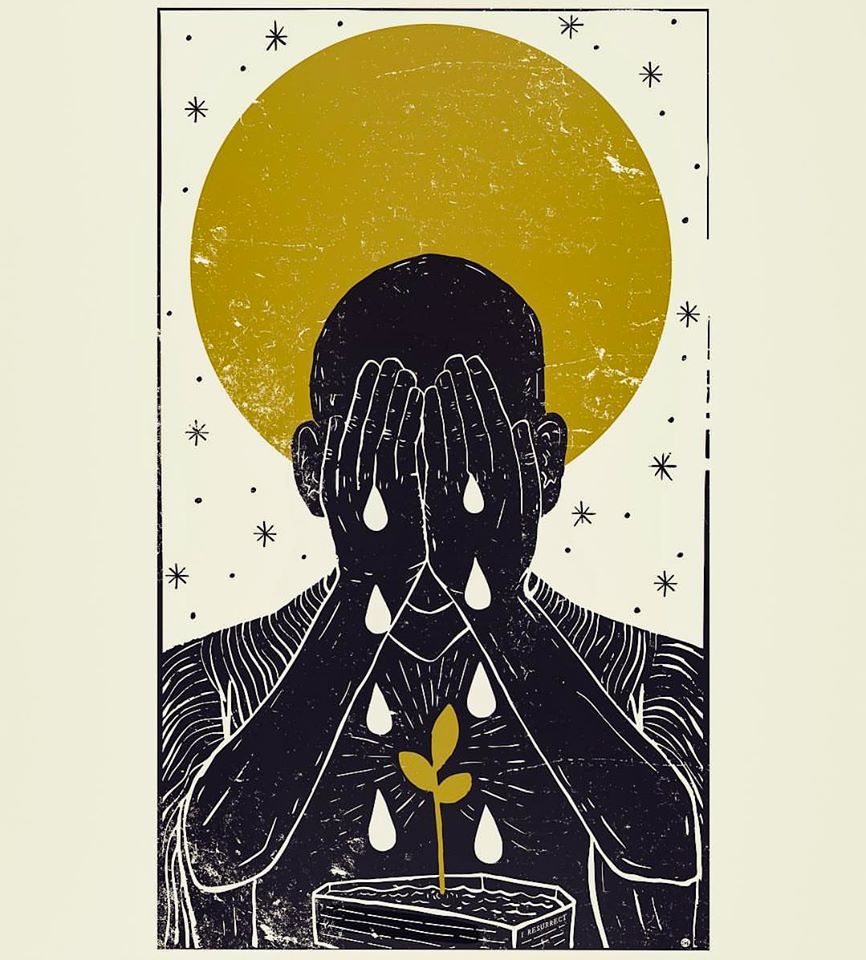
And this week as I was listening to the song, the following image by Scott Erickson showed up on my Instagram feed, with the caption “If one part suffers, all the parts suffer with it” (1 Cor. 12:26).

Erickson, Scott_Sorrowful Saint
Scott Erickson (American, 1977–), The Sorrowful Saint, 2016

Erickson painted the image in July 2016 in response to the fatal shootings of Sterling and Castile. It suggests that tears of grief can be generative, that new life can rise out of death. That’s not at all to say that death is good because it catalyzes a movement of change, but that our mourning the evils of racism and murder, our publicly crying out “Enough!,” is not fruitless, though it often seems so. Growth will come.

+++

VIDEO ART: Weight by André Daughtry:Weight is an attempt to visualize societal projections on the black male body,” writes André Daughtry, a Brooklyn-based interdisciplinary photography and media artist, writer, and performer. The piece is from 2014, and last year PBS’s AllArts station commissioned Daughtry to restage it in New York City as part of a larger video work. [HT: ImageUpdate]

Daughtry has a master’s degree in theology and the arts from Union Theological Seminary and serves as community minister of the arts at Judson Memorial Church, which has a long history of nurturing artists. “We believe that artists have the potential to serve as our modern-day prophets,” the church website reads. “They show us where we’ve been, who we are, and what we can become.”

+++

PODCAST EPISODE: “The SPU Conversation About Spike Lee Films,” North by Pacific Northwest: In this Seattle Pacific University conversation released April 11, 2019, two cinephiles, Jeffrey Overstreet and Josh Hornbeck, discuss some of the films of writer-director Spike Lee, “the boldest and brashest auteur in American film” (Guardian). The first several minutes, though, are spent decrying the then recent Oscar win of Green Book, which popular audiences loved but critics were generally sour on because it perpetuates the simplistic and ultimately false notion that to solve racism, white people just need to realize that “we’re all the same” and find a black friend.

Best known for Do the Right Thing (1989), Lee is one of several filmmakers they cite who deals with race in more complex ways, and while some people dismiss him as an “angry black man,” many celebrate him for forcing audiences to reckon with the problem of racism. “I think there should be rage inside of every conscious human being in the world, because there’s stuff that’s just not right,” he said in a 2000 interview. “Anger can be constructive.” Lee’s films are heavy-handed, in-your-face; they shout and unsettle. Heavy-handedness usually makes for bad art, but Overstreet and Hornbeck show how the approach works for Lee.

Spike Lee Films-01

Starting at 16:44, they focus on the satirical comedy-drama Bamboozled (2000), which joined the prestigious Criterion Collection just this March. (It’s also been the subject of much scholarly study across fields, one instance I’ve come across being an essay by art theorist W. J. T. Mitchell, titled “Living Color: Race, Stereotype, and Animation in Spike Lee’s Bamboozled,” in What Do Pictures Want? The Lives and Loves of Images.) “Under pressure to help revive his network’s low rating, television writer Pierre Delacroix (Damon Wayans) hits on an explosively offensive idea: bringing back blackface with The New Millennium Minstrel Show. The white network executives love it, and so do audiences, forcing Pierre and his collaborators to confront their public’s insatiable appetite for dehumanizing stereotypes.”

From 25:54 onward, Overstreet and Hornbeck discuss more generally their passion for cinema and the importance of revisiting films.

Here are some things they reference:

+++

People have been expressing frustration that The Help, a civil rights era drama that sidelines the perspectives of its black characters, is the number one most-streamed movie on Netflix right now. Film critic Alissa Wilkinson gives a list of fifteen movies to watch instead on racial injustice and being black in America. A mix of dramas and documentaries by such filmmakers as Barry Jenkins, Ava DuVernay, Spike Lee, and others, these are black-centered stories that help illuminate where we’re at right now. All are available for online streaming, and Wilkinson provides links to her reviews.

Love, My Shepherd (Artful Devotion)

Good Shepherd (sarcophagus fragment)
Sarcophagus Fragment with the Good Shepherd, Rome, early 4th century. Marble, 13 9/16 × 21 5/8 in. (34.5 × 55 cm). Walters Art Museum, Baltimore. Photo: Victoria Emily Jones.

God, my shepherd!
I don’t need a thing.
You have bedded me down in lush meadows,
you find me quiet pools to drink from.
True to your word,
you let me catch my breath
and send me in the right direction.

Even when the way goes through
Death Valley,
I’m not afraid
when you walk at my side.
Your trusty shepherd’s crook
makes me feel secure.

You serve me a six-course dinner
right in front of my enemies.
You revive my drooping head;
my cup brims with blessing.

Your beauty and love chase after me
every day of my life.
I’m back home in the house of God
for the rest of my life.

—Psalm 23 (MSG)

The King James Version’s translation of Psalm 23 from Hebrew into English is unsurpassable in terms of sheer poetic beauty, but since I’ve featured it here before and the words are so very familiar, I thought I’d shake things up a bit by giving Eugene Peterson’s contemporary translation.

The relief carving in this post is from a gallery of early Christian art at the Walters Art Museum in Baltimore, one of my favorite local hangouts. The museum label reads,

This fragment comes from a small Early Christian sarcophagus that was probably made for a child. At the right is a young shepherd, who carries a lamb over his shoulders as two sheep gaze up at him from below. The image of the Good Shepherd originated with the pagan Greek figure of Hermes (the gods’ messenger and ram-bearer) and was later transformed into Jesus as the Good Shepherd who watches over his flock.

[Related posts: “Sheep May Safely Graze (Artful Devotion)”; “The Lost Lamb (Artful Devotion)”]

+++

SONG: “The King of Love My Shepherd Is” | Words by Sir Henry Williams Baker, 1868 | Music: Traditional Irish tune (ST. COLUMBA) | Arranged by Paul Terracini and performed by the Ars Nova Vocal Group, on Hymns of Our Forefathers, 2000

The King of love my shepherd is,
whose goodness faileth never.
I nothing lack if I am his,
and he is mine forever.

Where streams of living water flow,
my ransomed soul he leadeth;
and where the verdant pastures grow,
with food celestial feedeth.

Perverse and foolish, oft I strayed,
but yet in love he sought me;
and on his shoulder gently laid,
and home, rejoicing, brought me.

In death’s dark vale I fear no ill,
with thee, dear Lord, beside me;
thy rod and staff my comfort still,
thy cross before to guide me.

Thou spreadst a table in my sight;
thy unction grace bestoweth;
and oh, what transport of delight
from thy pure chalice floweth!

And so through all the length of days,
thy goodness faileth never;
Good Shepherd, may I sing thy praise
within thy house forever.

I chose this intricate a cappella SATB arrangement as the feature track for today, but for a solo female vocalist on acoustic guitar, see Taylor Tripodi:

Though “The King of Love” is most associated with the traditional Irish tune ST. COLUMBA, it is sometimes sung to a handful of others. Below you can hear it with a different traditional Irish tune (MCKEE), arranged by Harry T. Burleigh in 1939. Performed by Tyler Anthony (of Cereus Bright) and the musicians of Redeemer Knoxville, this peppier version appears on the 2011 Cardiphonia album Songs for the Supper:

Contemporary retunes of the hymn include those by I Am They and Sarah Hart and Sarah Kroger. (Update, 6/26/20: The Gentle Wolves has just released one too.)

Good Shepherd (sarcophagus fragment)
Photo: Victoria Emily Jones


This post belongs to the weekly series Artful Devotion. If you can’t view the music player in your email or RSS reader, try opening the post in your browser.

To view all the Revised Common Lectionary scripture readings for the Fourth Sunday of Easter, cycle A, click here.