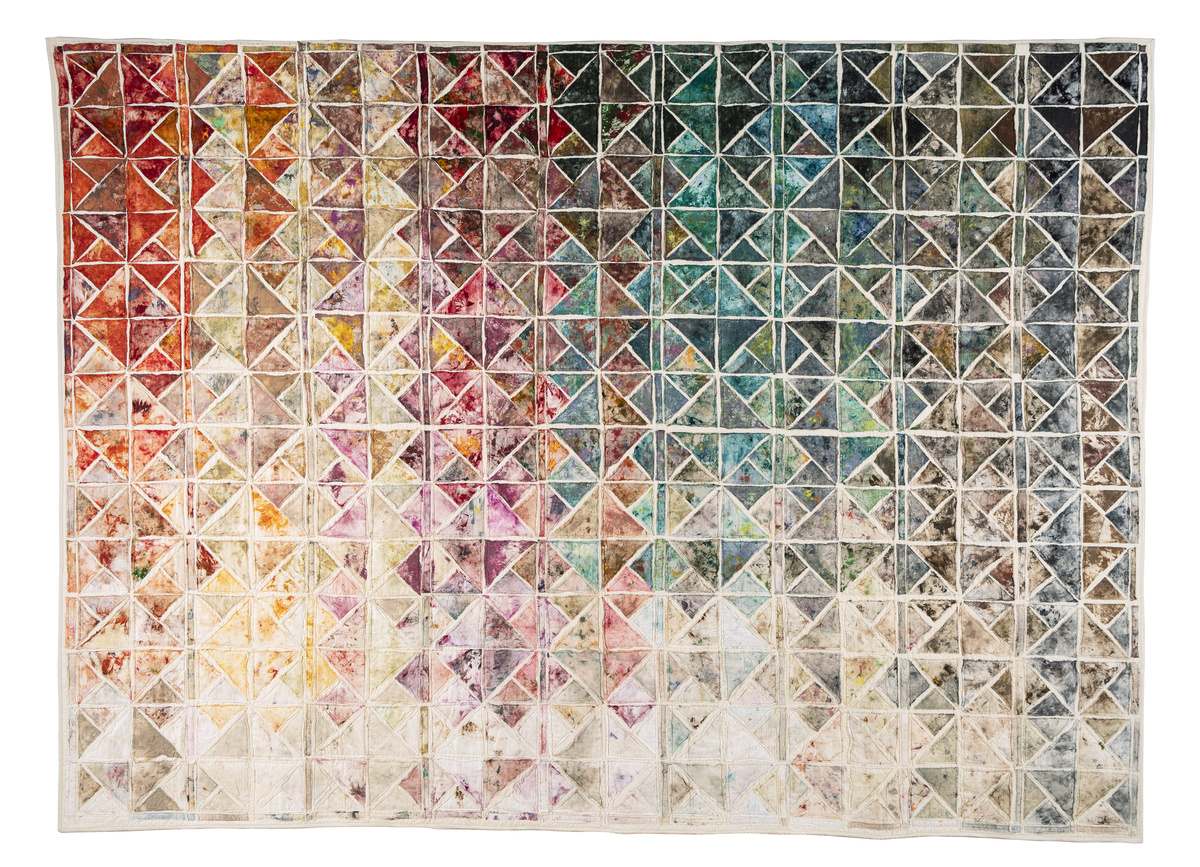
LOOK: the rain bows and the rainbows by Katy Mixon
Katy Mixon (American, 1984–), The rain bows and the rainbows (one day we will switch sides), 2018. Oil paint and used hand rags on muslin, 100 × 138 in.
I saw this quilt by Katy Mixon in December 2021 at the exhibition Break the Mold: New Takes on Traditional Art Making at the North Carolina Museum of Art. I was struck first by its prismatic color, and then by its title—which, the artist told me, comes from a dream she had after her close friend died. To bow, long o, is to bend into a curve; as a noun, a bow is a weapon used to propel an arrow, or a knotted ribbon typically worn by young girls. To bow, short o (as in “ow”), is to incline in respect or submission. The multiple meanings of this homograph open the title to different readings.
But the overall meaning points to the multihued arc that appears in the sky after a rainfall, as sunlight refracts through water vapor.
In the Judeo-Christian tradition, the rainbow is a sign of God’s covenant with Noah and has come to symbolize divine promise more generally, or hope—after the bleakness, beauty.
Mixon’s making process involves upcycling rags, which is itself a kind of redemptive act, saving used scraps and piecing them together into a new whole.
“Katy Mixon’s ‘quilts’ began as an outgrowth of her painting process,” the NCMA exhibition text read. “She routinely wipes her hands, palette knives, and other tools with baby wipes, which she then tosses into her studio’s garbage can. ‘One day [I] looked at the trash and realized it was full of all this hastily discarded color,’ she notes. She began saving the vibrant detritus with no specific purpose in mind, but after remembering her grandmother’s homemade quilts and discovering the famed African American quiltmakers of Gee’s Bend, Alabama, Mixon had a plan for her colorful scraps. ‘For me, the quilted works are alternate endings in the painting’s life cycle,’ Mixon says. ‘Painting as a practice, with the used rags as kaleidoscopic evidence.’”
Describing her technique, Mixon told me: “I compose the pieced tops and work with local longarm quilters to add the batting and backing. I finish each piece with hand stitching, often using crewel embroidery to define brush marks and tonal variations.”
LISTEN: “Joyful” | Words by Kate Bluett | Music by Paul Zach | Performed by Paul Zach with Taylor Leonhardt and Nick Dahlquist, on Christmas Hymns (2022)
The MP3 file of the song is embedded here with Paul Zach’s permission.
Come, O Lord, and make us joyful as you came to Mary’s womb; buried deep beneath our sorrows, where our hopes take root and bloom. Be the promise that sustains us through the seasons of the years, ’til at last we see your radiance when you shine beyond our tears.
Come, O Lord, and show your mercy as you came in Bethlehem; let us see the sunlight bursting through the shadows once again. Let us hear the song of glory where the silence held us fast. We will come to you rejoicing from the shackles of the past.
Come, O Lord, as living water; make our deserts green again, where the wellspring of our laughter will refresh us like the rain. After all the years of waiting for the promise long foretold, come at last, and let the day break in the morning of your joy!
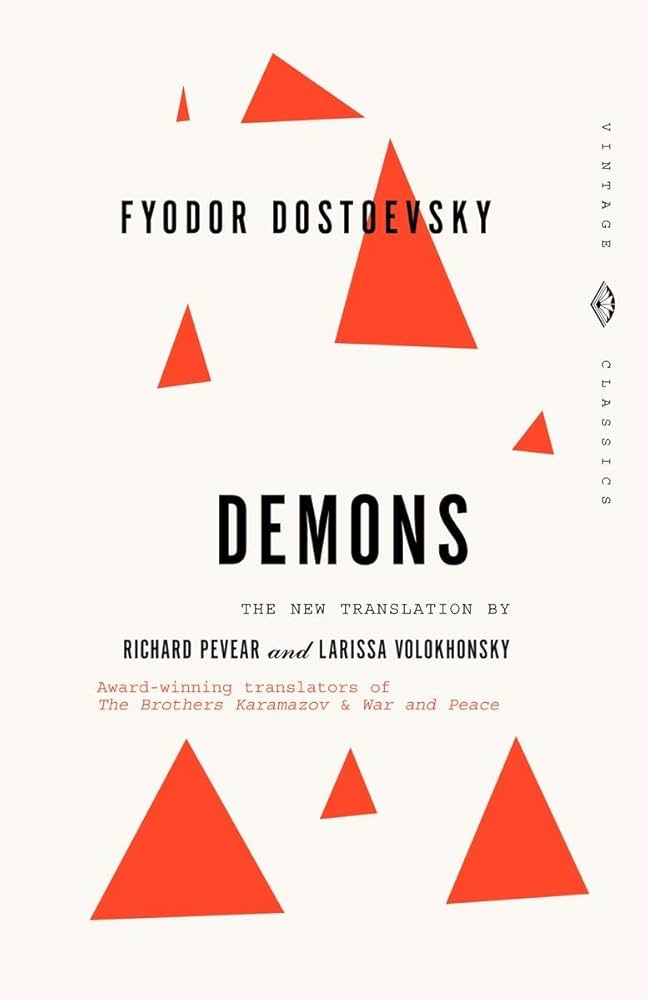
ONLINE COURSE: Studying the novel Demons by Fyodor Dostoevsky with Brian Zahnd, January 3–March 9, 2026: This ten-week online course led by Pastor Brian Zahnd (a Christian writer and preacher I admire) will explore Dostoevsky’s “darkest and most prophetic novel”: Demons (aka The Possessed or The Devils), a social and political satire, psychological drama, and large-scale tragedy inspired by the true story of a 1869 political murder in Russia. The course sounds intriguing to me, and I’m contemplating whether I can invest the time in a seven-hundred-page book—but I did buy a copy just in case! It’s the only one of the literary master’s four novels I haven’t read.
“Dostoevsky’s Demons changed me,” Zahnd writes on Substack. “From it I learned the danger of giving oneself to an ism instead of to Christ. Isms are idols and they often become demonic. Admittedly Demons is a difficult novel, but it’s also prophetic and timely. . . . As you read Demons, expect to be horrified, but also expect to laugh—you are meant to. During the course we will be horrified and warned, but we will also laugh and learn together.”
The live Q&As will take place the first ten Mondays of 2026 at 5 p.m. CT (6 p.m. ET).
+++
SEMINAR (VIDEO):“How to Watch a Movie (as a Christian)” with Chris Retts and Morgan Jefferson: On his FootnotesSubstack, historian Jemar Tisby recently hosted a teach-in with two team members from the Los Angeles Film Studies Center, a nonprofit educational program designed to give undergraduate students at Christian colleges and universities meaningful experience in the film industry during a semester “abroad” in Los Angeles. Chris Retts is the director of the center, and Morgan Jefferson is an instructor.
Before discussing how to watch a movie, they discuss why Christians should watch movies in the first place, beyond the obvious (enjoyment):
Because general revelation can happen anywhere, even at the movies (Rom. 1:20).
Because movies generate empathy, which is central to the greatest commandment (Matt. 22:37–40).
Because every movie has a theology, and media literacy makes it conscious and discernable (1 John 4:1).
They also discuss the four modes of meaning that filmmakers work with; cinematic language; and four steps for exegeting (“drawing out”) a film.
How does film relate to Dr. Tisby’s work at the intersection of faith, history, and justice? He has written for years about the dangers of white Christian nationalism. He says adherents of that ideology, or any, are not evaluating a list of propositions but are buying into a narrative; and “you can’t meet a narrative with logical reasoning,” he says. “You have to invite them into a counter-narrative—a more beautiful story.” Story is why he’s interested in film, as film is an engaging, and probably the most popular (in the US), storytelling medium. “Stories shape our sense of what’s true, what’s possible, and who belongs. That’s as true for political movements as it is for movies.”
DOCUMENTARY SHORT: The Quilters (2024), dir. Jenifer McShane: This thirty-minute documentary on Netflix follows a group of men in a maximum-security prison in Missouri who design and sew custom quilts for children in foster care using donated fabrics and old machines. They care deeply about the quality of their work—they’re proud of what they make—and are emotional about the recipients, some of whom send thank-you cards. The film is about creating beauty and meaning within strict confines, not letting destructive choices from your past stymie you from making constructive ones in the present.
+++
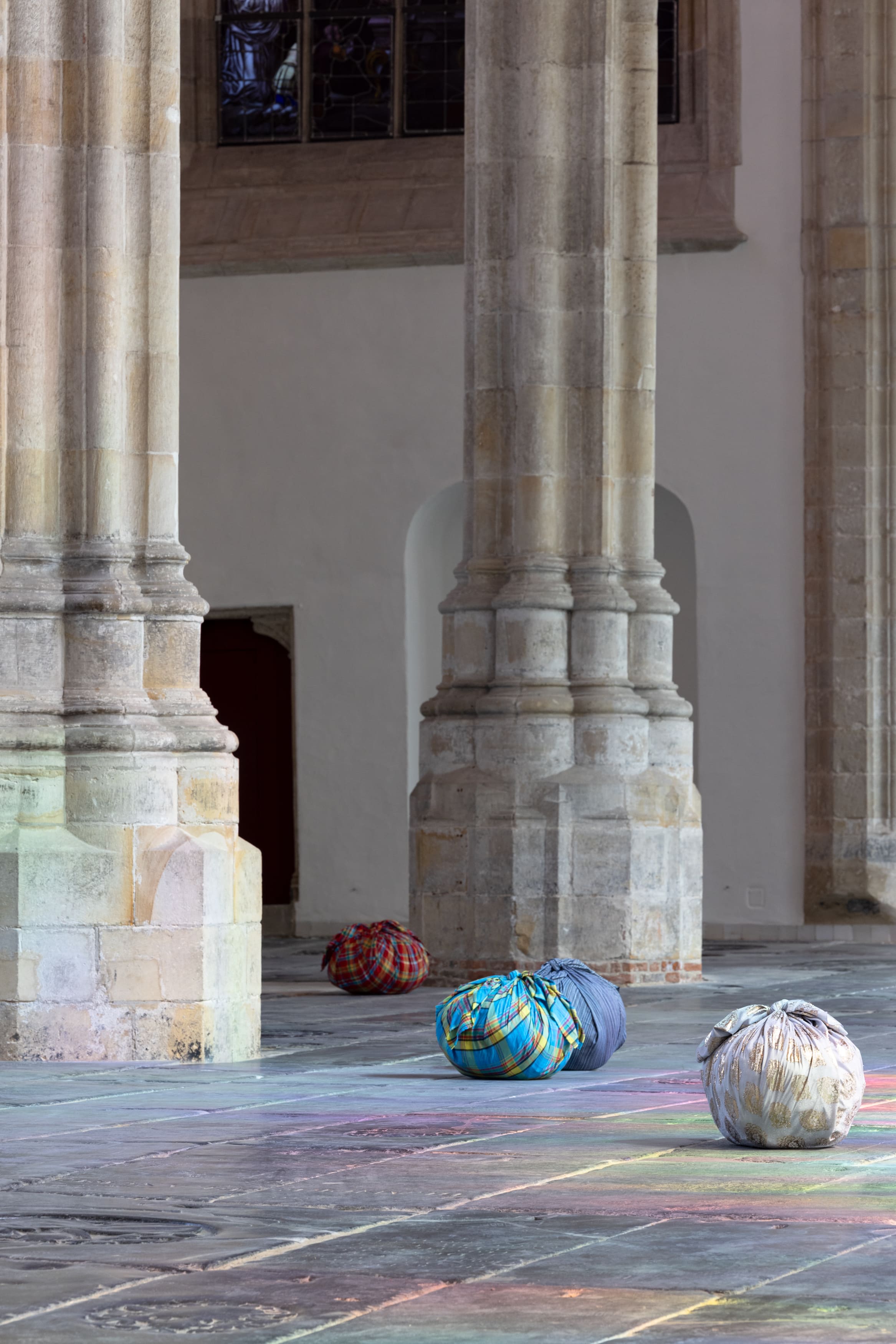
TEMPORARY INSTALLATION: To Breathe—Mokum by Kimsooja, Oude Kerk (Old Church), Amsterdam, May 23–November 9, 2025: Sorry I didn’t get this out while the installation was still up (it wrapped on Sunday), but please do explore the photographic documentation. Kimsooja’s To Breathe—Mokum explores themes of migration, belonging, and the transient nature of home; the Yiddish word in its subtitle means “safe haven.” “At the work’s heart are Kimsooja’s iconic bottari—colorful textile bundles inspired by traditional Korean wrapping cloths,” designboom writes. “Spread across the [medieval] stone floor of the church, these bundles are filled with clothing donated by members of Amsterdam’s diverse communities. Each piece of clothing represents the lives and stories of the people who contribute to the city’s rich multicultural fabric. These textile bundles serve as symbols of both personal and collective journeys, embodying the arrival and departure of individuals who have shaped the identity of the city” over its 750 years.
Kimsooja (Korean, 1957–), To Breathe—Mokum (partial view), 2025. Site-specific installation at Oude Kerk, Amsterdam. Photo: Natascha Libbert.
+++
POEMS:
>> “On the Staten Island Ferry” by A. E. Stallings, Plough, July 1, 2025: Liberty is an American ideal—but for many in this country, an illusory one. Riding in New York Harbor with a boatload of commuters and tourists, Stallings lets settle what a young girl, pointing to the Statue of Liberty, exclaims.
>> “The Pillar of Cloud and Fire”by Anna A. Friedrich, Monafolkspeak (Substack), October 29, 2025: The poet reflects on her confusion as a child about this manifestation of God from the Old Testament, which leads her to surprising insights.
Each month I put together a collection of thirty songs on Spotify—an assortment of psalms, hymns, and spiritual songs, old and new. Here’s the playlist for May:
+++
PRESS RELEASE: “Belmont University Launches Creative Arts Collective for Christian Life and Faith”: Supported by a $32 million grant from the Lilly Endowment, Belmont University in Nashville announced on March 26 the launch of a major new nationwide initiative: the Creative Arts Collective for Christian Life and Faith. “Positioned at the intersection of faith and artistry, the Creative Arts Collective is a vibrant community dedicated to exploring the divine through the lens of creativity. We believe in the transformative power of the arts to connect us with God’s profound narrative, uplifting spirits, and uniting hearts in a shared journey of discovery.”
The executive director is Rick Rekedal, who worked for twenty years at DreamWorks Animation on such projects as Shrek, Trolls, Prince of Egypt, Madagascar, Kung Fu Panda, and How to Train Your Dragon.
I’m looking forward to seeing what they do in the coming year!
+++
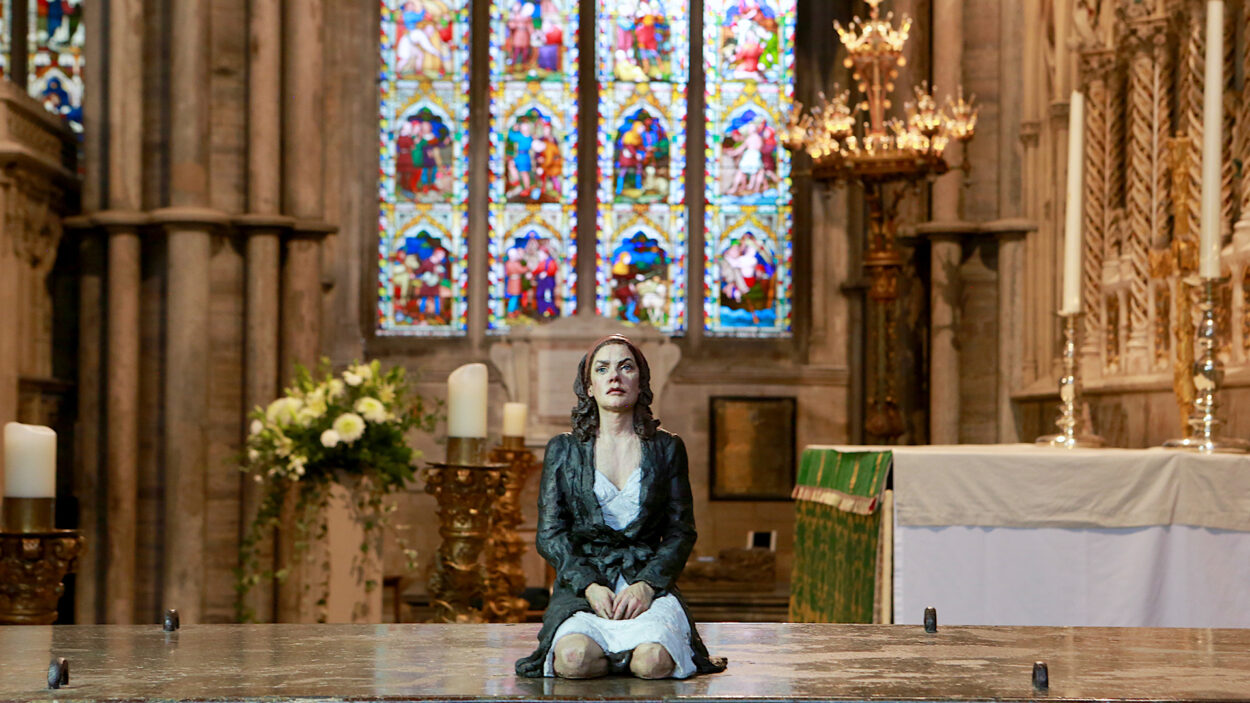
ART EXHIBITION: “Am I my brother’s keeper?” by Sean Henry, Ely Cathedral, England, April 26–September 1, 2024: Curated by Jacquiline Creswell [previously], this new exhibition places twenty-eight painted, contemporary figures from the oeuvre of British sculptor Sean Henry in various spaces in and outside the historic Ely Cathedral. The exhibition is titled after Cain’s indifferent response to God in Genesis 4, after he has just murdered his brother—a question that prompts us to consider our moral responsibility to care for and support one another.
Sean Henry (British, 1965–), T.P.O.L.R., 2005, bronze, and LM, 2014, bronze. From “Am I my brother’s keeper?,” an exhibition at Ely Cathedral, 2024. Photo courtesy of the cathedral.Sean Henry (British, 1965–), Hedda, 2018, ceramic. From “Am I my brother’s keeper?,” an exhibition at Ely Cathedral, 2024. Photo courtesy of the cathedral.
Henry “captures the human form with compassion, depicting the emotions, struggles, and joys that define us as human,” Creswell writes. “His figures also convey the vulnerability, strength and resilience that exist within each individual. They tell stories, evoke emotions and create connections with the viewer.” View more photos from the exhibition on Creswell’s Instagram page, and see also photos from the similar exhibition she curated for Salisbury Cathedral in 2011, Conflux: A Union of the Sacred and Anonymous.
+++
VIDEO INTERVIEW:“Faith Ringgold’s art of fearlessness and joy”: Faith Ringgold (1930–2024), the trailblazing artist best known for her story quilts documenting African American life, died this month at age ninety-three. This CBS Sunday Morning segment from 2021 is a good introduction to her and her work, which you can explore more of at www.faithringgold.com.
Faith Ringgold (American, 1930–2024), Church Picnic Story Quilt, 1988. Tie-dyed, printed fabrics and acrylic on cotton canvas, 74 1/2 × 75 1/2 in. High Museum of Art, Atlanta.Faith Ringgold (American, 1930–2024), The Flag Is Bleeding #2, from the American Collection series, 1997. Acrylic on canvas, painted and pieced border, 76 × 79 in. Pippy Houldsworth Gallery, London.
+++
HYMN FOR ASCENSION DAY (May 9):
“See the Conqueror mounts in triumph” is a ten-stanza hymn by Christopher Wordsworth, nephew of the great poet William Wordsworth, published in his collection The Holy Year in 1862. The Hymnology Archive provides the full lyrics, a revision history, a textual analysis, and sheet music for the tune Wordsworth preferred for it and the one Henry Smart wrote for it six years later. This is not a widely sung hymn, however. I’ve enjoyed hearing how contemporary songwriters have revitalized it through new tunes. Here are two examples:
>> Music by Jenny & Tyler, on Open Your Doors (2012): This married musical duo living in Nashville, Tennessee, uses a 6/8 time signature in their setting, and they’ve added a bridge.
>> Music by Wes Crawford, on Hymns for This World and the Next (2024): Wes Crawford, the worship pastor at Christ Church of Austin, released an album of thirteen retuned hymns this February, and “See the Conqueror” is one of them.
We need more Ascension hymns! Search this site’s “Ascension” tag to find a few more, as well as other Ascension Day content (sometimes mixed into roundups with other miscellany).
+++
ART COMPILATION: “Ascending Jesus—The Last Glimpse” by Aidan Kimmel: Fr. Aidan Kimmel has compiled eighteen medieval paintings depicting the Ascension of Christ, mostly from manuscripts. In several Jesus leaves behind footprints on the Mount of Olives. So delightful!
The Ascension, from a Bible moralisée made in Bruges, ca. 1455–60. The Hague, National Library of the Netherlands, KB, 76 E 7, fol. 219r. The foregrounded figures are Saint Peter and the Virgin Mary.
Jesus began his public teaching ministry by reading the following passage from an Isaiah scroll at his local synagogue:
The Spirit of the Lord is upon me, because he has anointed me to bring good news to the poor. He has sent me to proclaim release to the captives and recovery of sight to the blind, to let the oppressed go free, to proclaim the year of the Lord’s favor. (Luke 4:18–19)
Some theologians call this the Nazareth Manifesto. It’s Jesus’s inauguration speech, if you will, where he lays out his platform, his values, his mission.
The freedom that Jesus came to bring is not just spiritual, although it is at least that. It is also physical. He came to liberate us body and soul—from sin and its many ugly manifestations, both personal and systemic, that prevent us and others from thriving.
As we await Christ’s second advent, we can look forward to this promise: freedom is coming.
Jessie B. Telfair (American, 1913–1986), Freedom Quilt, Parrott, Georgia, United States, 1983. Cotton, with pencil, 74 × 68 in. American Folk Art Museum, New York.
When Jessie Telfair invoked the power of a single word repeated over and over in this quilt, she knew the word would reverberate through the history of the United States, back to the “peculiar institution” of slavery and the freedom that she was still struggling to attain in the 1960s at the beginning of the Civil Rights movement. The making of the quilt was incited by an incident she suffered in those years, when registering to vote was enough to cost this African American woman her job in a school kitchen. The bitterness of that experience still burned years later, and fellow quiltmakers urged her to express the pain through her art. Worked in the colors of the American flag, the quilt cries freedom. In a subtle metaphor, Telfair has set each repeated letter in its own block; all are visually related, but no two are alike.
LISTEN: “Freedom Is Coming” from South Africa, third quarter of 20th century | Performed by Kate Marks and friends on Circle of Song: Chants and Songs for Ritual and Celebration, 1999
Freedom is coming Freedom is coming Freedom is coming Oh yes, I know!
Jesus is coming Jesus is coming Jesus is coming Oh yes, I know!
This South African freedom song originated during the apartheid era (1948–1994). It’s one of the many songs collected by Swedish musician Anders Nyberg when he traveled with his choir Fjedur to South Africa in 1978 at the invitation of the South African Lutheran Church. Upon his return, “Freedom Is Coming” and other South African freedom songs and hymns were published in Sweden and soon after in the United States in the collection Freedom Is Coming: Songs of Protest and Praise from South Africa (Utryck, 1984), which is still in print. Fjedur’s performance of “Freedom Is Coming” at the Budapest Assembly of the Lutheran World Federation in 1984 was instrumental in disseminating the song around the world, and afterward it started appearing in more hymnals.
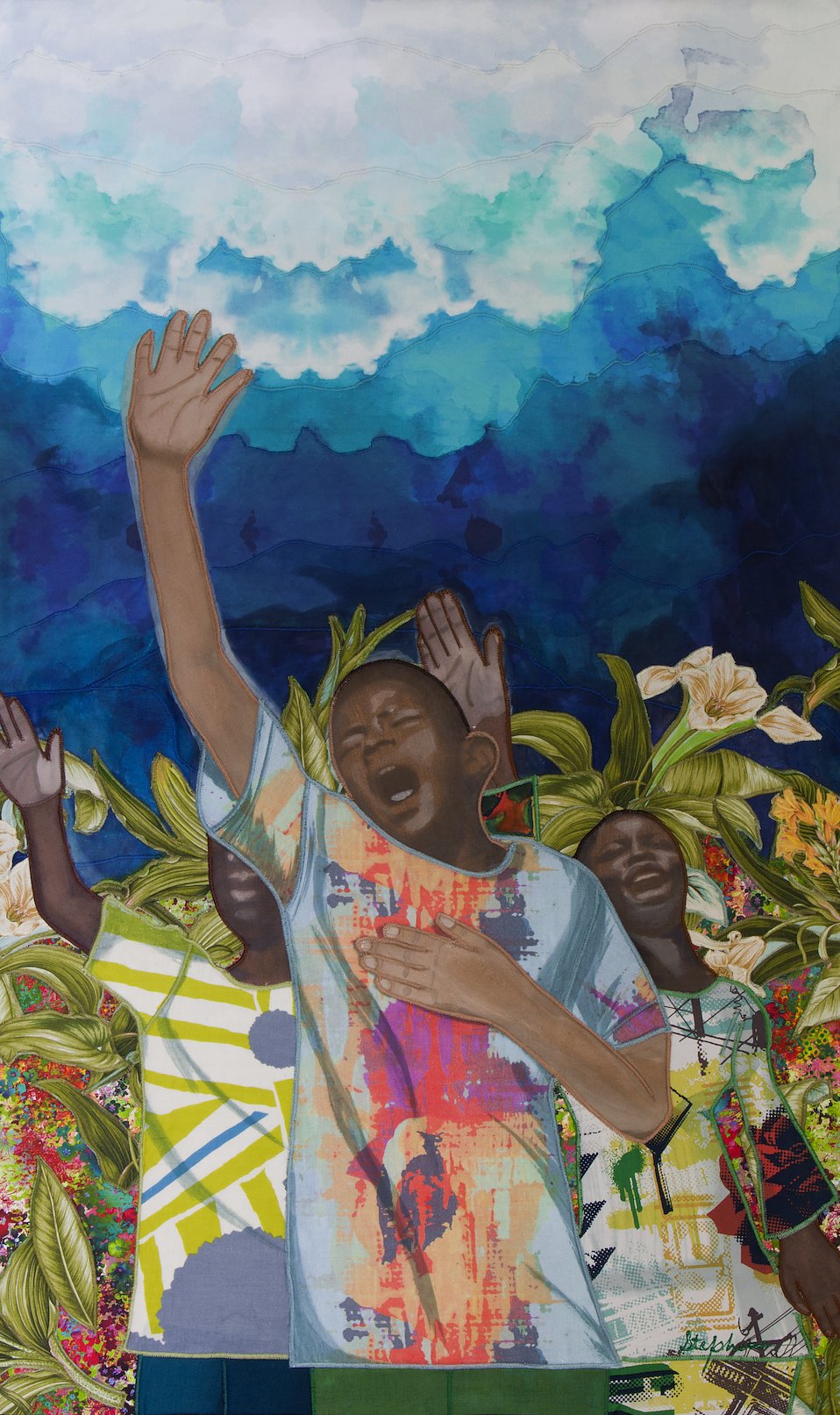
EXHIBITION: Otherwise/Revival, Bridge Projects, Los Angeles, April 9–June 26, 2021: Curated by Jasmine McNeal and Cara Megan Lewis, this group exhibition visualizes the impact of the historic Black church—specifically the Black Pentecostal movement—on contemporary artists. Included are several artists I’ve featured on the blog before—Lava Thomas [here], Kehinde Wiley [here], Clementine Hunter [here], Letitia and Sedrick Huckaby [here]—plus twenty-six others.
Phyllis Stephens (American, 1955–), High and Lifted Up, 2020. Cotton fabric, 57 × 33 in. Private collection. Courtesy of the artist and Richard Beavers Gallery, New York.Kenturah Davis (American, 1984–), Namesake I, 2014. Incense ink on rice paper, applied with rubber stamp letters, 39 × 36 in. Courtesy of the artist and the Petrucci Family Foundation, New Jersey.
I regret that I won’t be able to see the exhibition in person, but there’s a wealth of relevant content available on the gallery’s website, including photos, artist bios and statements, and commentaries. I haven’t fully delved in yet, but some of the artist names are new to me, and I look forward to jumping over to their websites to learn more. There’s also a series of free events that have been scheduled. The premiere of the virtual music performance yes! lord by Ashton T. Crawley and a symposium on the Azusa Street Revival have already passed (both are archived online for on-demand viewing), but here are some upcoming opportunities you can reserve a spot for:
May 1: “Jazz and the Gospel” with Daniel E. Walker, Ashon T. Crawley, Dario Robleto, Norman Teague, Lava Thomas, and Folayemi (Fo) Wilson
ARTICLE: “5 Films About the Beauty of Resurrection” by Brett McCracken: “Resurrection’ tropes are so familiar in certain genres that they can numb us to the jarring beauty and bracing surprise of resurrection. But other films capture the magic and shock of resurrection by situating it within more mundane realities and contexts. Here are five of my favorite examples of this kind—movies that capture resurrection in all of its miraculous, unsettling, hope-giving glory.” One of his selections is Happy as Lazzaro, which I saw last year and enjoyed:
+++
NEW ALBUMS:
>> Hymns I by Lovkn: Steven Lufkin is a singer-songwriter from Phoenix, Arizona, recording under the name Lovkn. His latest EP, a collection of eight acoustic hymn covers, was released April 2. (Also, he’s currently raising funds to record an album of original songs, to be released later this year: kickstarter.com/projects/lovkn/new-album-2021.)
>> Prayers for the Time of Trial by Joel Clarkson: Released April 7, this EP comprises five original SATB choral compositions by Joel Clarkson, which he recorded with his sister Joy Clarkson. My favorite is the first, “Lighten Our Darkness,” a setting of the Book of Common Prayer’s Collect for Aid Against Perils: “Lighten our darkness, we beseech thee, O Lord; and by thy great mercy defend us from all perils and dangers of this night; for the love of thy only Son, our Savior, Jesus Christ. Amen.”
The other four are “Sub Tuum Praesidium” (Beneath Thy Protection), a third-century hymn to the Virgin Mary as Theotokos; “Hail King,” a poem by Joel’s other sister, Sarah Clarkson, that marvels at how rocky cliffs and sea waves and herring gulls sing God’s praises in their own way; “Ubi Caritas,” an ancient hymn centered on the theme of Christian charity; and the simple benediction “May the peace of the Lord be with you now and always.”
ORTHODOX CHANT: Russian Kontakion of the Departed: At Prince Philip’s funeral service at St. George’s Chapel at Windsor Castle on April 17, a choir of four sang, among other pieces, the Russian Kontakion of the Departed, translated into English by William John Birkbeck and arranged by Sir Walter Parratt. “The Russian Kontakion of the Departed is an ancient Kiev chant with its origins in the Russian Orthodox liturgy. This moving chant expresses the sorrow of grief but reminds us of the Christian hope of everlasting life; in the face of sadness, we sing Hallelujahs.” [HT: Global Christian Worship]
Give rest, O Christ, to thy servant with thy saints: where sorrow and pain are no more; neither sighing but life everlasting. Thou only art immortal, the creator and maker of man: and we are mortal formed from the dust of the earth, and unto earth shall we return: for so thou didst ordain, when thou created me saying: Dust thou art und unto dust shalt thou return. All we go down to the dust; and weeping o’er the grave we make our song: Alleluia, alleluia, alleluia.
+++
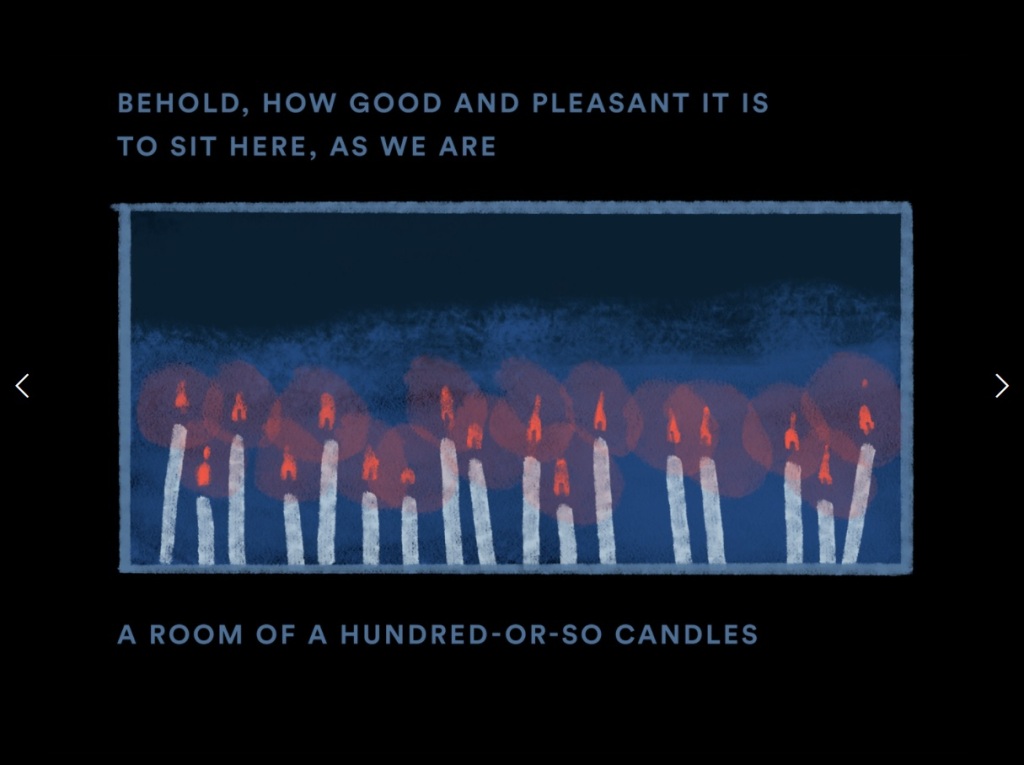
VISUAL LITURGY: “After Ezekiel” by Madeleine Jubilee Saito: Remember those flip books you probably encountered as a kid—the ones with a series of images that gradually change from one page to the next, giving the illusion of animation when viewed in quick succession? Well, this is a digital version of that. In 2019 cartoonist and illustrator Madeleine Jubilee Saito created an image sequence intended to be swiftly clicked through as part of the Easter Vigil at a church in Boston. It was inspired by the story of Ezekiel in the valley of dry bones (Ezek. 37). Very compelling!
This week I’ve been editing and captioning a backlog of photos from my camera, and I’ve come to a batch I took last August from Every Day: Selections from the Collection at the Baltimore Museum of Art, a reinstallation of the museum’s contemporary collection centered on the Black artistic imagination. I thought I’d share some of these photos here as a way to introduce you to some of today’s leading Black American artists.
+++
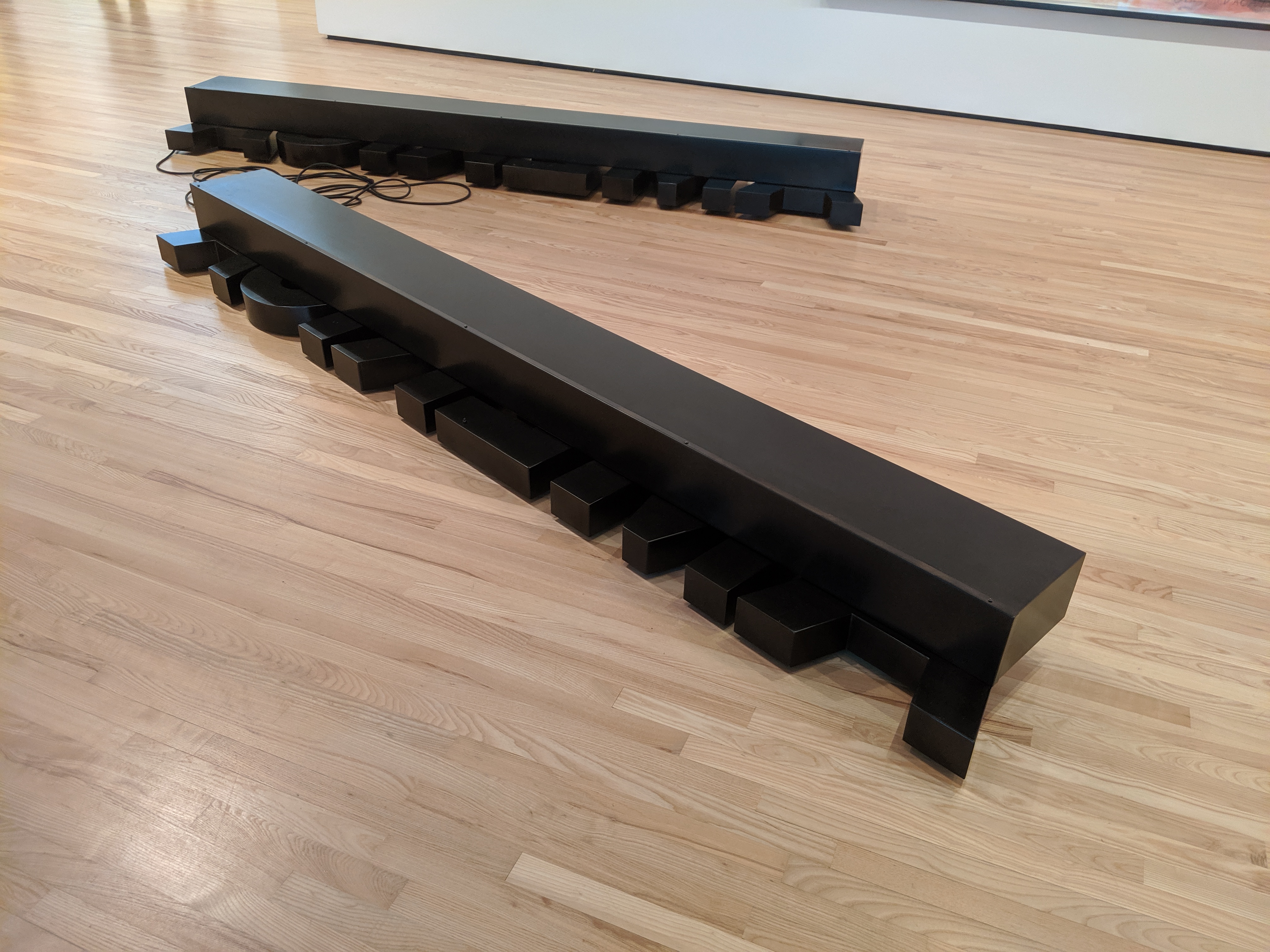
In the first gallery, an untitled neon sculpture by Glenn Ligon confronts the viewer, consisting of two black lightbox letter signs lying face-down on the floor, which each read, with some difficulty, “America.” They emit a flickering white light that pulsates at random. The piece is part of a series of variations on that word—a word, Ligon says, that means different things to different people.
Foreground: Glenn Ligon (American, 1960–), Untitled (America America), 2015. Neon and blackened steel, 22 × 125 × 10 in. each. Baltimore Museum of Art, Maryland. Photo: Victoria Emily Jones.
He said his “double America” motif was inspired by the opening lines of Charles Dickens’s A Tale of Two Cities: “It was the best of times, it was the worst of times, it was the age of wisdom, it was the age of foolishness . . . it was the spring of hope, it was the winter of despair . . .” The wall text continues: “Dickens used a series of opposing statements to capture a moment in European history [1775–92] in which wealth coexisted with poverty, war with leisure and comfort, and aspirational ideals with harsh realities. Ligon sees similar extremes at work in the twenty-first century: ‘There is this sense that America, for all its dark deeds, is still this shining light.’”
In the age of MAGA I’m reminded of a poem by Langston Hughes published in July 1936, “Let America Be America Again,” in which he laments that as a country, we’ve never been what we’ve aspired to be: a place of liberty and justice for all. He loves America and the ideals on which it was founded but is forced to reckon with its failures, pointing out the hypocrisy of a nation that proclaims in its founding document that “all men are created equal” while segregating, disenfranchising, and brutalizing African Americans. (And the poem goes on to cite inequalities experienced by other groups too.) It’s very much in the spirit of Frederick Douglass’s speech less than a century earlier, “What to the Slave Is the Fourth of July?”
Let America be America again.
Let it be the dream it used to be.
Let it be the pioneer on the plain
Seeking a home where he himself is free.
(America never was America to me.)
Let America be the dream the dreamers dreamed—
Let it be that great strong land of love
Where never kings connive nor tyrants scheme
That any man be crushed by one above.
(It never was America to me.)
O, let my land be a land where Liberty
Is crowned with no false patriotic wreath,
But opportunity is real, and life is free,
Equality is in the air we breathe.
(There’s never been equality for me,
Nor freedom in this “homeland of the free.”)
. . .
O, let America be America again—
The land that never has been yet—
And yet must be—the land where every man is free.
. . .
Hear Ligon discuss his art practice in the “A Closer Look” interview from the BMA, below, and zoom in on some of his artworks at Google Arts & Culture.
+++
Behind Ligon’s neon sculpture was a large gouache by Kara Walker titled Terrible Vacation. It was impossible to get a decent photo with the glare on the glass, so here is a professional photo of the painting, unframed, from Sikkema Jenkins & Co.
Kara Walker (American, 1969–), Terrible Vacation, 2014. Gouache on paper, 72 1/2 × 159 1/2 in. Baltimore Museum of Art, Maryland.
Best known for her room-size tableaux of cut-paper silhouettes addressing the history of race in America, here she pays homage to J. M. W. Turner’s 1840 Slave Ship, the Romantic painter’s abolitionist response to the Zong massacre of 1781, in which the captain of a British slave ship en route to Jamaica threw 133 sick enslaved people overboard to collect insurance on them as property “lost at sea.” Human and elemental violence converge in Turner’s painting, as a ship sails through a stormy ocean filled with flailing human limbs in chains.
Walker’s painting after Turner brings this mass murder to the attention of a new public, and though it references the past of England in particular, America, as a fellow player in the transatlantic slave trade, is implicated too.
+++
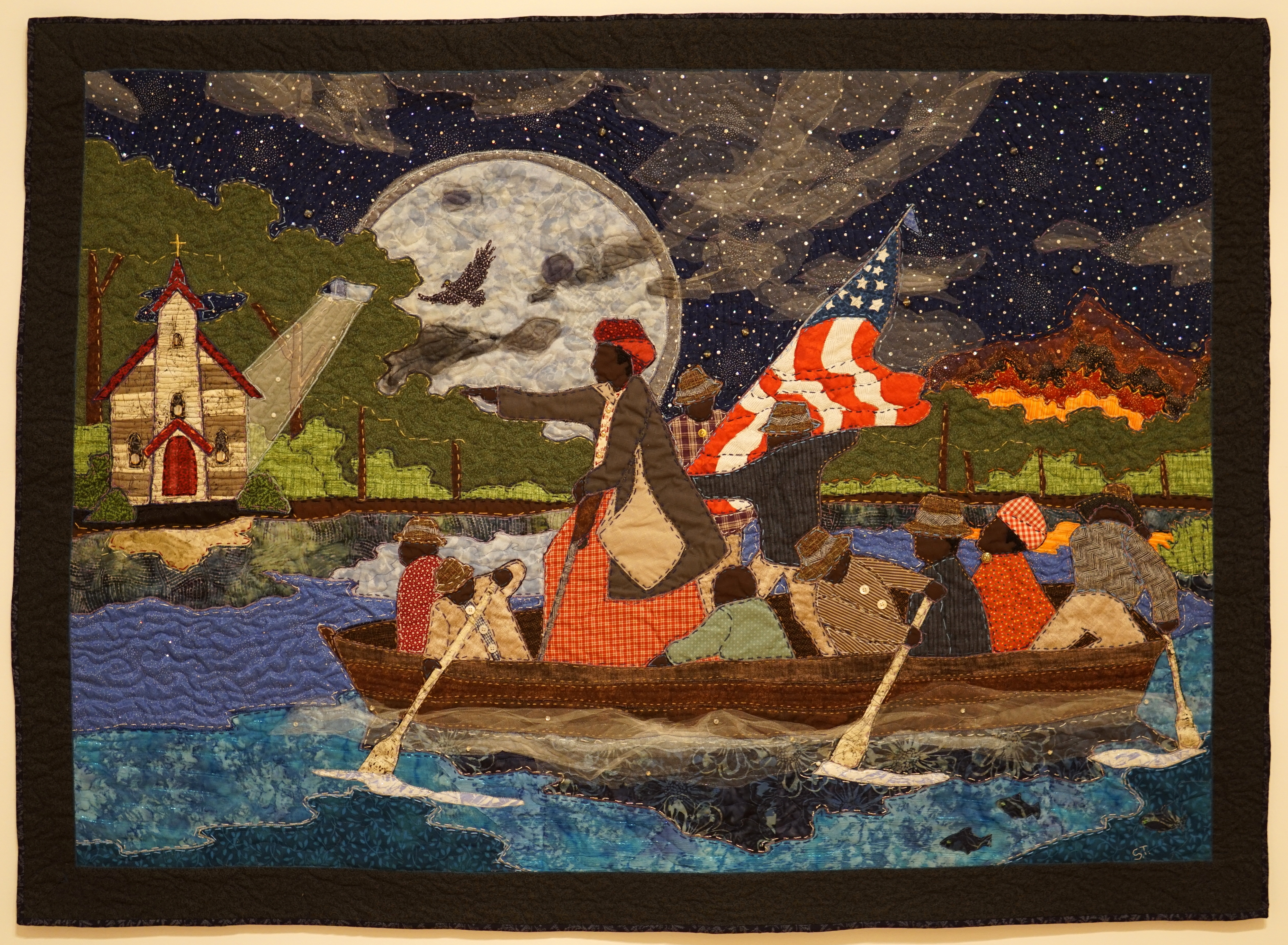
On the left wall was a story quilt by Baltimore artist Stephen Towns [previously], one is a series paying tribute to Harriet Tubman.
Stephen Towns (American, 1980–), We Shall Pass through the Combahee, 2019. Natural and synthetic fabric, nylon tulle, polyester and cotton thread, metallic thread, crystal glass beads, and resin and metal buttons. Baltimore Museum of Art, Maryland. Photo: Victoria Emily Jones.
Titled We Shall Pass through the Combahee, it records the historic military operation, led by Harriet Tubman, known as the Raid on Combahee Ferry, which succeeded in freeing seven hundred-plus slaves. During the Civil War, on June 1–2, 1863, Tubman guided two of Lincoln’s gunboats, peopled with Union Army soldiers, along the Combahee in South Carolina to strategic points near the shore where slaves awaited rescue, avoiding rebel torpedoes along the way.
Towns modeled the scene after Emanuel Leutze’s famous 1851 painting Washington Crossing the Delaware, set during the Revolutionary War, but he recasts Tubman as the American hero, bravely leading her people and her nation to victory. The church in the background likely represents the historic Tabernacle Baptist Church in Beaufort, where the escapees gathered after the raid, further up the river, before being relocated to St. Helena Island. It is illuminated as if by divine light because Tubman always said it was God who gave her direction in making certain critical moves during her many rescue operations—as Underground Railroad conductor and as military leader.
Towns describes the piece, and his complicated relationship to history and patriotism:
To learn about another body of Towns’s work, A Path Between Two Continents, see this video by York College Galleries:
+++
New York–based Afro-Dominican artist Firelei Báez examines through her art the historical narratives of the Afro-Caribbean diaspora, focusing on the politics and cultural ambiguities of place, writes ArtDaily. May 19, 2017, 6:05 p.m. (an idiom playing out its history) at the Baltimore Museum of Art commemorates New Orleans’s removal of its monument to Confederate general Robert E. Lee, erected in 1884, from “Lee Circle.” “It’s a gesture that reacts in time both forward and backwards, almost like a prayer, in solidarity with the people who had to suffer through that space and the resistance moving forward,” Báez said.
Firelei Báez (Dominican American, 1981–), May 19, 2017, 6:05 p.m. (an idiom playing out its history), 2018. Oil, oil stick, and graphite on canvas, 92 × 120 in. Baltimore Museum of Art, Maryland. Photo: Victoria Emily Jones.
Katie A. Pfohl, a curator at the New Orleans Museum of Art, writes about the series to which this piece belongs, which focuses on key chapters from New Orleans’s past:
In these new paintings, Báez overlays figures, symbolic imagery, and calligraphic gestures onto architectural surveys from the 1930s-era Historic American Buildings Survey, a project of the Works Progress Administration, of significant sites across New Orleans. Blurring the lines between past, present, and future, Báez paints new imagery upon these archival drawings, and in the process overwrites the often divisive history these older documents represent. Báez carries portraiture into a space where identity is rooted in history, but can likewise become untethered—and liberated—from it.
Another Báez piece in the BMA’s collection is Convex (recalibrating a blind spot), which consists of a diagram of the American Sugar Refinery in New Orleans overpainted with vibrant colors.
+++
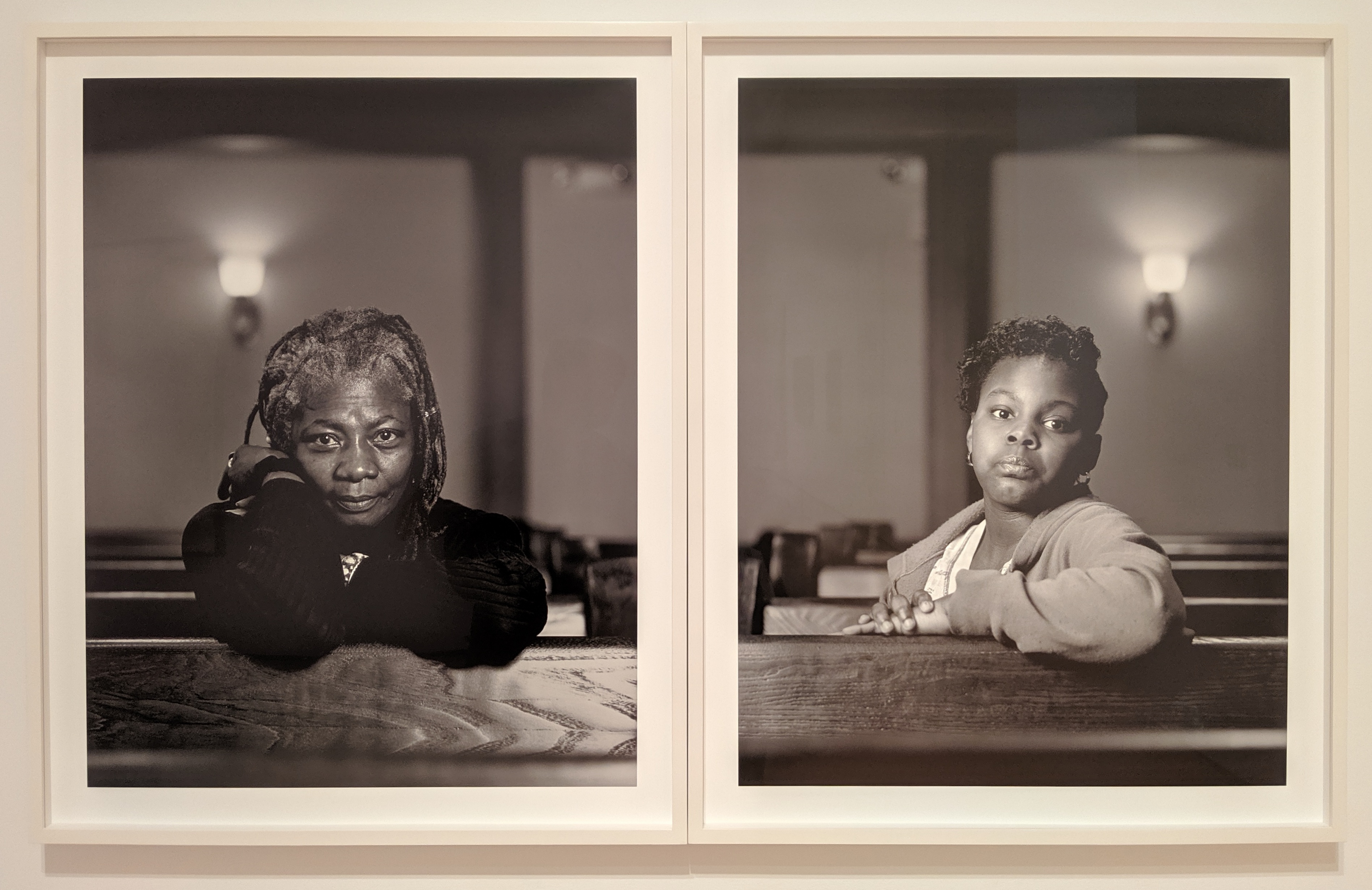
Dawoud Bey (American, 1953–), The Birmingham Project: Mathes Manafee and Cassandra Griffen, 2012. Inkjet prints, pigment-based, 40 × 32 in. each. Baltimore Museum of Art, Maryland. Photo: Victoria Emily Jones.
In the same gallery as the previous four pieces was a photograph diptych by Dawoud Bey, from his Birmingham Project series.
On September 15, 1963, four young black girls—Addie Mae Collins, Denise McNair, Carole Robertson, and Cynthia Wesley—were killed when white supremacists bombed the Sixteenth Street Baptist Church in Birmingham, Alabama. Fifty years later, Dawoud Bey worked with Birmingham residents to memorialize them, to pay “tribute to those who were in Birmingham at that difficult moment and those who have been born since.” He photographed adolescents the same ages as those who had died, and men and women in the fifties and sixties, the ages those young people would be had they lived.
+++
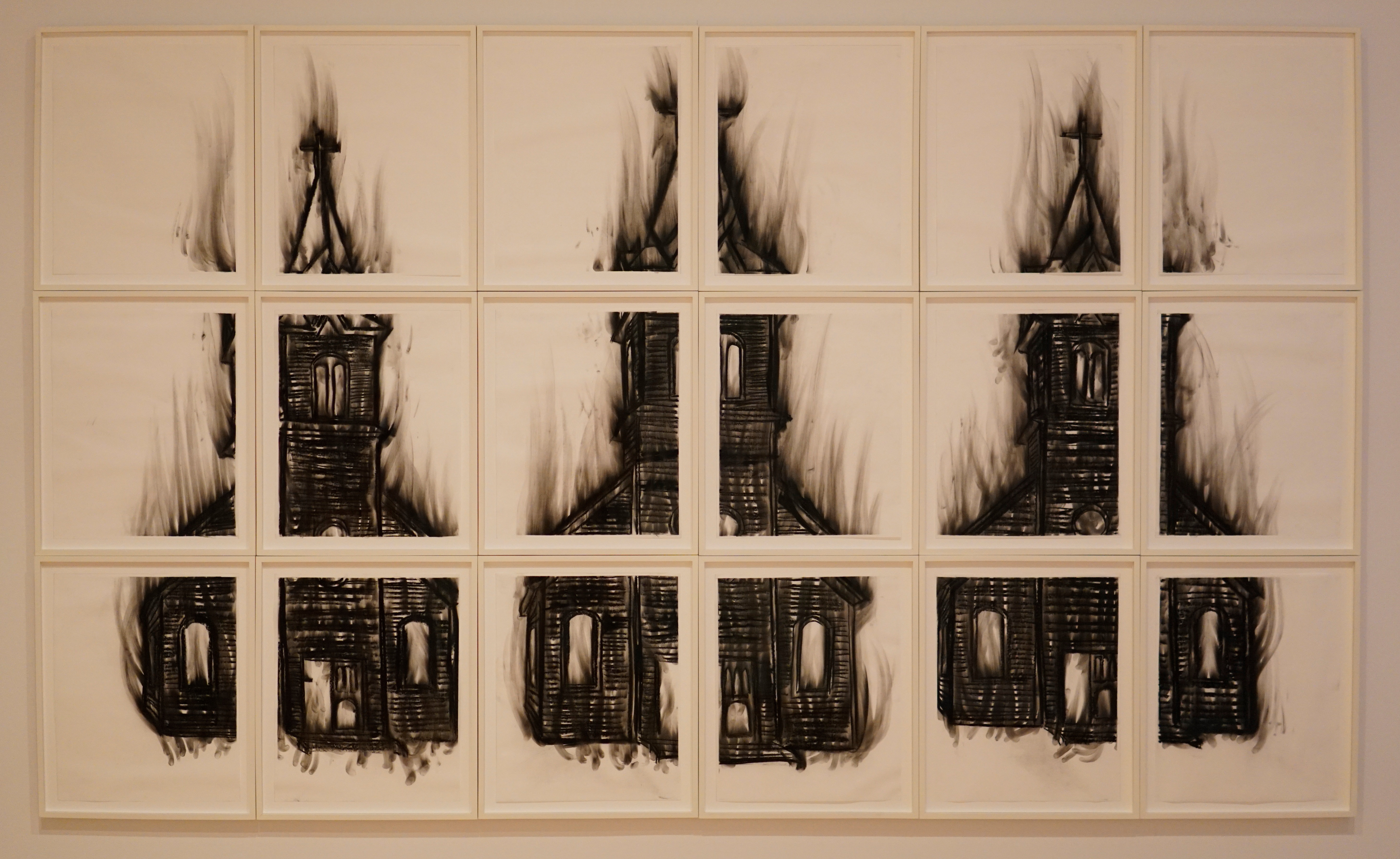
Gary Simmons (American, 1964–), Triple Burn, 2003. Charcoal with smudging on paper, 66 3/4 × 110 1/4 in. Baltimore Museum of Art, Maryland. Photo: Victoria Emily Jones.
Over and over again, white supremacists have sought to terrorize black communities by setting fire to black churches. The 1990s saw an increase in such terrorist acts and images circulated widely of burning churches, past and present. In this drawing, Gary Simmons blended his recollections of these images into a composite picture of a single church, repeated three times. He used his fingers to smudge trails of charcoal dust across the paper, creating ghostly impressions of flames of smoke. “I do this as a way of creating a feeling of something familiar but displaced,” the artist explains. “The image is intended to hang in one’s memory . . . the further one gets from an experience, the more it becomes abstracted.”
Ernest Shaw, a local artist and art educator, points out how the white frames around the paper create crosses, representing crossroads as well as Black spirituality:
+++
How long is a chain?
How long is a change?
How heavy is a chain?
How heavy is a change?
—Melvin Edwards, 1970
Melvin Edwards (American, 1937–), Scales of Injustice, 2017/2019. Barbed wire, chain, and steel. Baltimore Museum of Art, Maryland. Photo: Victoria Emily Jones.
In Scales of Injustice, a steel platform resembling one half of a weighted scale holds a tangle of barbed wire. It is suspended over a length of chain sprawled out on the floor, and the whole scene, sited in a corner, is separated from the viewer by a barbed-wire barrier. This conceptual sculpture by Melvin Edwards is an adaptation of a site-responsive work he exhibited at the Whitney Museum in 1970, Corner for Ana, the title a reference to his young daughter and to the notion of “timeout.”
The materials—steel chain, barbed wire—evoke brutality and oppression. Perhaps it’s change, in a larger sense, that hangs in the balance, precarious and unsure.
Edwards said this re-creation was in response to the death of Pateh Sabally, a twenty-two-year-old Gambian refugee who drowned in the Grand Canal of Venice on January 21, 2017, as onlookers taunted and filmed his struggles and offered no help.
+++
Lorna Simpson (American, 1960–), Easy to Remember (still), 2001. 16 mm film transferred to DVD (black and white, sound); 2:35 min. Baltimore Museum of Art, Maryland.
For this video, Lorna Simpson recorded fifteen professional singers separately humming along to jazz saxophonist John Coltrane’s haunting interpretation of Rogers and Hart’s “It’s Easy to Remember.” Simpson then combined the recordings to create a choir of voices. This layered tune becomes the soundtrack for a grid of moving images, each focused tightly on one singer’s lips. The individuality of each participant emerges in variations among the mouths, a part of the body integrally linked to expression and physicality. The video demonstrates that even within a collective experience, including one of songs and the emotions they conjure, independent voices persist and disrupt.
+++
David Hammons grew up in Springfield (Illinois), studied art in Los Angeles, and then settled in New York City in 1974, where he still lives. Traveling is one of his many “basketball drawings,” which he made by bouncing a Spalding around the streets of Harlem and onto a nine-foot-tall sheet of paper, creating atmospheric gray pebbling that resembles clouds in the sky or light and shadow on the ground.
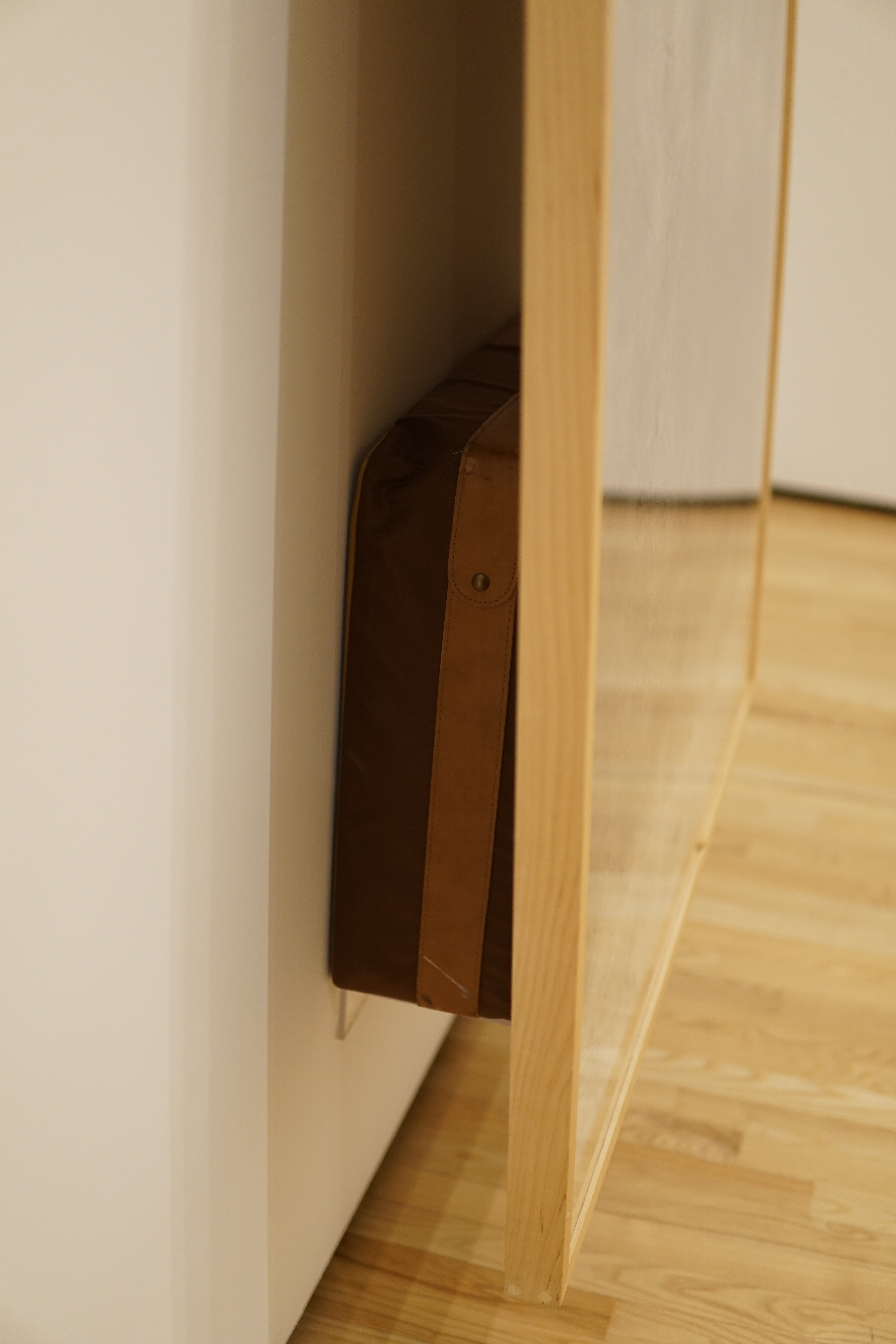
David Hammons (American, 1943–), Traveling, 2001–2. Harlem dirt on paper and suitcase, 109 5/16 × 41 3/4 × 9 1/2 in. Baltimore Museum of Art, Maryland. Photo: Victoria Emily Jones.
I love the love of place this piece promotes. “Harlem dirt” is listed as the primary material! Hammons is sanctifying the dust of his neighborhood (“the ephemeral stuff of black urban experience”) by bringing it into a high-art context, essentially saying, “My background, my experiences, are worthy.” Martin Herbert, writing for Frieze, discusses the multivalence of the title:
The title of this work, Traveling, evokes many things: the eponymous rule of basketball that says you can’t take the ball and run with it; Hammons’ own movement across the Atlantic and that of the grimy orange sphere across the room; the upward mobility of dirt-into-art, and its direct social analogue—the ‘coming up from the streets’ dream/boast of a million aspiring rappers and pro-court players in environments where, as hip-hopper Mos Def put it, ‘you can either get paid or get shot’.
The artwork juts out from the wall at a slight angle, and one discovers propped behind it a thin brown suitcase.
+++
Like Stephen Towns, Amy Sherald lives in Baltimore. She is known for her large-scale portrait paintings that use grisaille to portray skin tones as a way of “challenging the concept of color-as-race,” and was chosen to paint the official portrait of First Lady Michelle Obama.
Amy Sherald (American, 1973–), Planes, rockets, and the spaces in between, 2018. Oil on canvas, 100 × 67 in. Baltimore Museum of Art, Maryland. Photo: Victoria Emily Jones.
About Planes, rockets, and the spaces in between, Sherald writes,
I wanted the environment to be in what would be perceived as an American landscape. These two figures are witnesses of a very American moment in history. . . . One key thing to note in all of my paintings is that the figures in the work will never be passive participants. Eye contact plays an extraordinary and crucial role in human connection. The figure gazing off at the rocket as she holds her friend’s hand solidifies the moment, as the second figure looks back to meet the gaze of the viewer.
I’ve appreciated how conscientious the Baltimore Museum of Art has been, in the past two years especially, in expanding its collection to better reflect the city it’s in. In 2018 it deaccessioned redundancies in its contemporary holdings to enable the purchase of new works by female artists and artists of color. Such acquisitions “enhance our ability to tell the uniquely varied and layered narratives that exist across the history of art and into the present,” said BMA director Christopher Bedford in a press release.
I also appreciate the video interviews with artists that the museum has been producing, which I hope to see more of.
NEW SONG RELEASE: “Conversion” by Leon Bridges: A smoky, minor-key redemption ballad closes out Leon Bridges’s [previously] latest EP, Texas Sun, a collaboration with the three-piece psychedelic funk band Khruangbin. Bridges wrote the song in 2012 in response to his conversion to Christianity, he said, but this is the first time he’s recorded it. Halfway through, following a personal testimonial about being made alive by the Holy Spirit, the song breaks into a slow R&B rendition of Isaac Watts’s “At the Cross.” Lyrics here. See also the musical and lyrical analysis Aarik Danielsen wrote over at Think Christian.
+++
STATIONS OF THE CROSS:
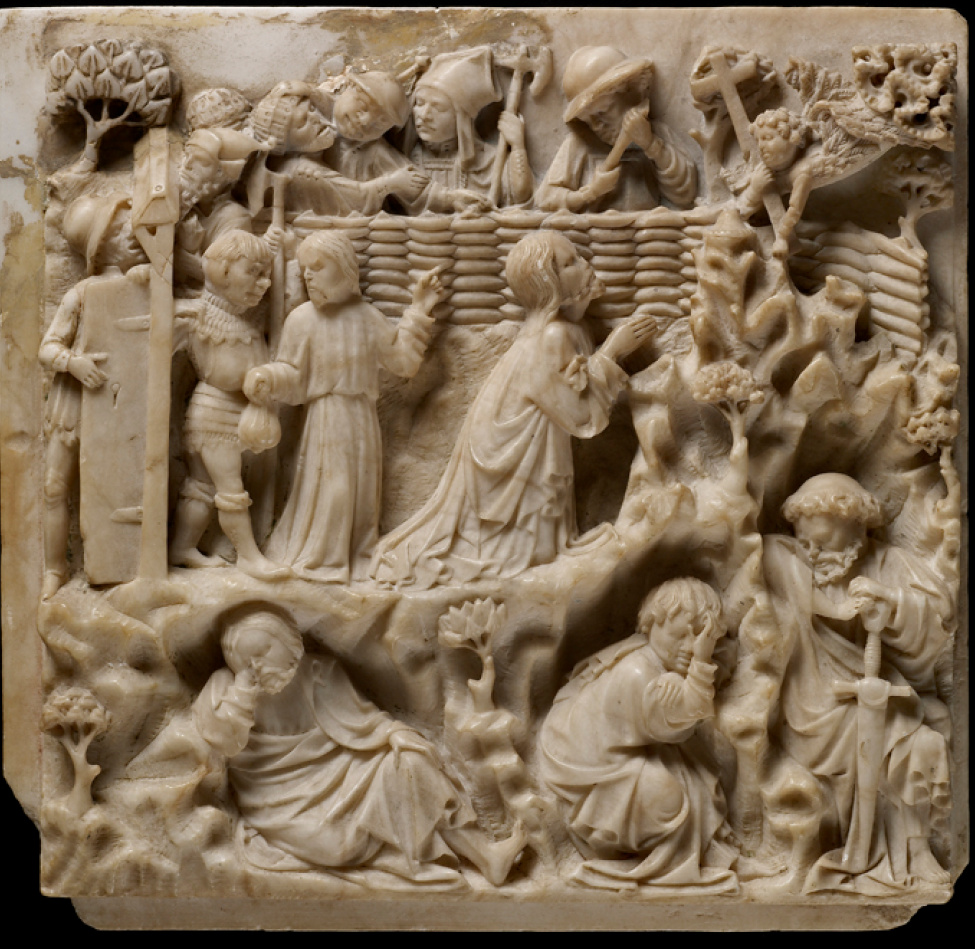
Contemporary Artists Interpret Stations of the Cross, St. Michael’s Episcopal Church, Arlington, Virginia, February 19–April 3, 2020: Thanks to one of my readers reaching out, I found out about this church-sponsored exhibition just south of where I live and was able to attend the opening reception, where many of the artists were present to talk about their work and answer questions. Unfortunately, the coronavirus has led to its early closure, but photos of the artworks, which are for sale, can be viewed online: see this write-up by curator Maureen Doallas. Below are the works representing station 8 (“Jesus meets the women of Jerusalem”) and station 14 (“Jesus is laid in the sepulcher”).
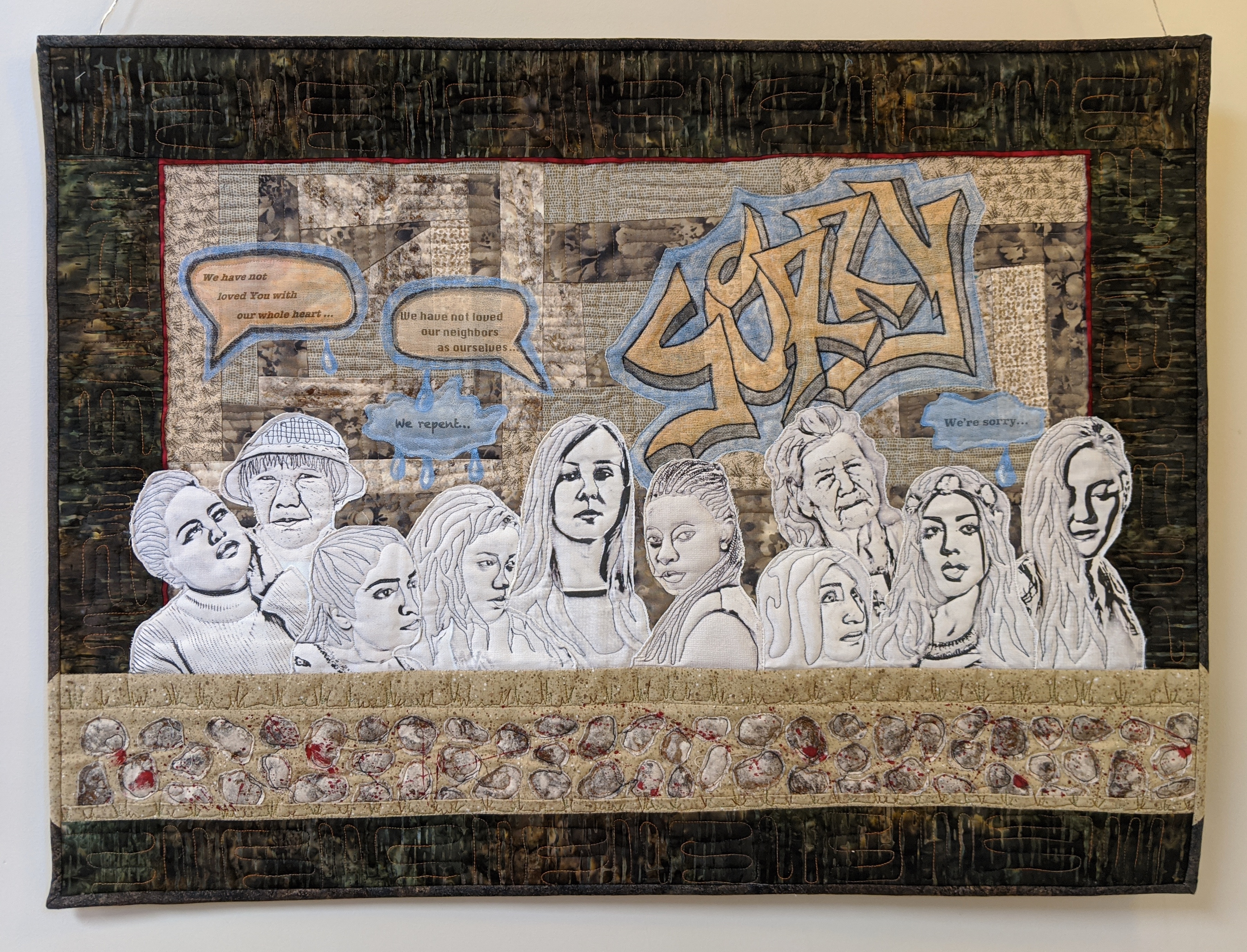
Terry Peckarsky, Still Weeping on the Via Dolorosa, 2020. Quilted commercial cotton fabrics, digitally altered photographs printed on fabric, tsukineko inks, and watercolor, 23 × 31 in. Photo: Victoria Emily Jones. Artist’s website: https://tpeckarsky.tumblr.com/
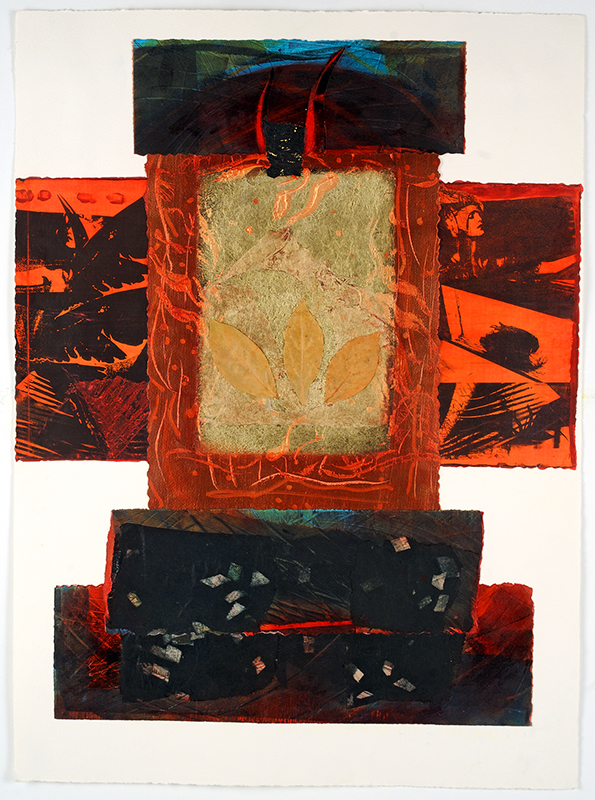
Carol Lukitsch, Sophia Icon. Mixed media collage on paper (with laurel leaves), 30 × 22 in. Photo courtesy of the artist. Artist’s website: http://carollukitsch.com/
Passion and Compassion Oxford: This self-guided tour through Oxford, released this February with a new website and supported by the “Alight: Art and the Sacred” app [previously] for Android and iOS, stops at fourteen artworks or artifacts in multiple locations across the city. Designed around the Scriptural Stations of the Cross as a pilgrimage of sorts, it comprises a mix of historical and contemporary pieces, including sculptures by Jacob Epstein and Antony Gormley, Old Master paintings by Anthony van Dyck and the studio of Andrea Mantegna, a medieval stained glass lily crucifix, Roger Wagner’s Elie Wiesel–inspired Menorah, a “celure” depicting the Pleiades in white gold, Thomas Cranmer’s prison band, and more. Each stop comes with audio commentary by a clergyperson, theologian, or artist. The tour starts at University Church Oxford, the institution that created this wonderful resource. (Note: Most of the sites on this tour are currently closed indefinitely due to the coronavirus.)
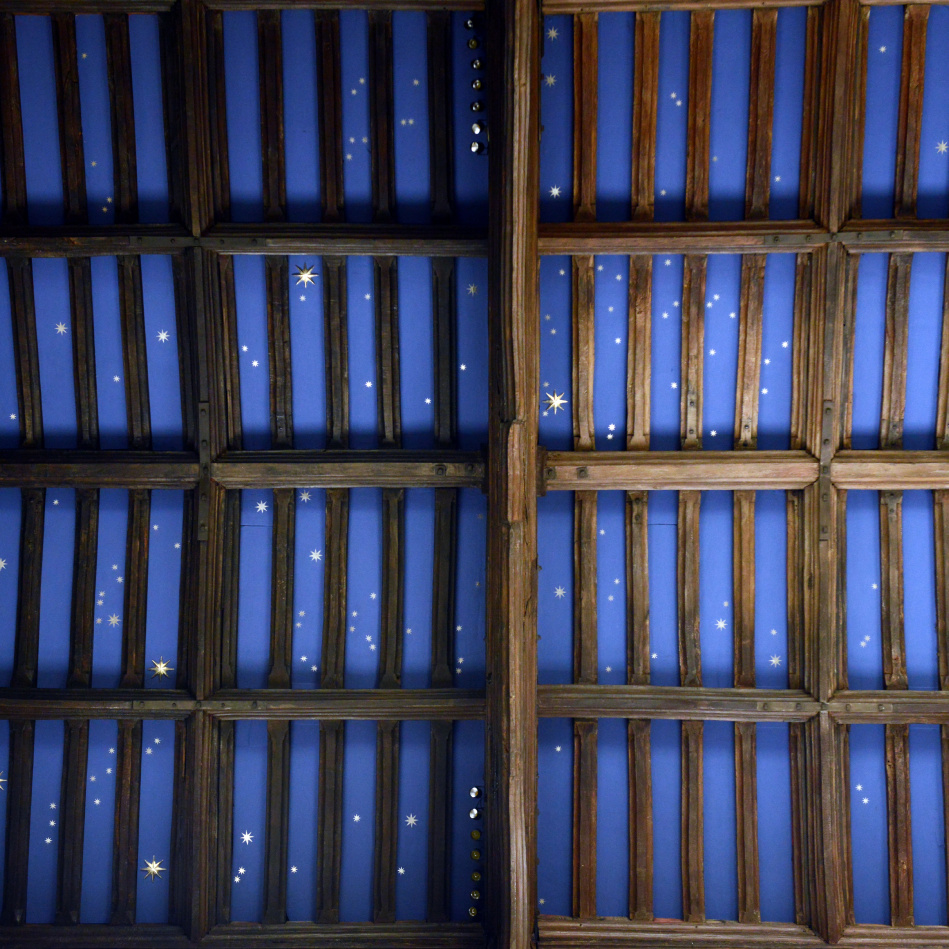
Oliver Caroe, Celure, 2012. University Church of St. Mary the Virgin, Oxford.
Alabaster relief by the Master of Rimini or workshop, southern Netherlands or northern France, ca. 1430–40. Ashmolean Museum of Art and Archaeology, Oxford.
+++
VIRTUAL TOUR: Single-shot walk-through of Russia’s Hermitage Museum: The State Hermitage Museum in St. Petersburg is the second-largest museum in the world (the Louvre is the largest), with over one million square feet of exhibition space extending across six historic buildings, including the Winter Palace, the former residence of the Russian tsars. Thanks to a five-and-a-half-hour advertisement by Apple showing off the iPhone 11’s battery life, people can move seamlessly through 45 of the museum’s 309 galleries from their own homes. Shot in one continuous take, the video includes close-ups of individual artworks as well as wide shots of the lavish interiors. It doesn’t cover the entire museum, but there is much western Christian art to see, starting at 1:04:41 with Hugo van der Goes’s Adoration of the Magi triptych. Among the most famous religious artworks in its collection, which you may know from Henri Nouwen’s book about it, is Rembrandt’s Return of the Prodigal Son (2:15:54). Here’s the trailer, followed by the full-length video:
It includes ballet sequences throughout and concludes with a live orchestral performance featuring Russian pianist and composer Kirill Richter.
The Hermitage Museum offers virtual tours of its entire collection, in an interactive format that uses panoramic photos, at https://www.hermitagemuseum.org/wps/portal/hermitage/panorama/. Unlike the Apple video, whose purpose is to showcase the capabilities of the new iPhone, the Hermitage-created tour inserts “info” buttons over each artwork so that you can click through to find out the artist, title, etc., if interested. But this format, in addition to requiring a brief load time for each step forward, lacks the grandiose scoring and camerawork of the new Apple video.
+++
POET FEATURE: Jeanne Murray Walker: A semirecent recent blog post by “online abbess” Christine Valters Paintner introduces the work of poet Jeanne Murray Walker, author of Helping the Morning (2014), Pilgrim, You Find the Path by Walking (2019), and eight other books. Reprinted in full are the poems “Staying Power,” about God’s pursuant nature (a modern-day “The Hound of Heaven,” if you will); “Attempt,” which opens with a quote by Traherne; and “Everywhere You Look You See Lilacs,” about being in the moment, taking cues from nature. There is also a video of Walker reading her poem “The Creation,” which muses on the beautiful quirkiness of giraffes, who “spring up like Wow . . . riff-raff of [God’s] imagination.”
+++
GOODLETTERS ESSAY: “What Does It Mean to Be a ‘Religious’ Poet?” by Brian Volck: The contemporary English theologian Nicholas Lash wrote that sadly, “the relation of human beings to the Holy One” has, by many and certainly in the popular imagination, been “reduced to knowledge of an object known as ‘God’ . . . [,] faith’s attentive presence to the entertaining of particular beliefs.” Such reductionism has led many artists to resist being labeled “religious”—“a designation that typically serves to qualify, marginalize, or dismiss creative work.”
But good poetry, Brian Volck says, “and the human sensibilities we’re taught to call religious needn’t be strangers.” There are many poets today who tread the “vast borderlands where religion, spirituality, faith, art, and mystery overlap,” and Volck briefly reviews four such collections from 2019: Anaphora by Scott Cairns, Pilgrim, You Find the Path by Walking by Jeanne Murray Walker, This Far by Kathleen O’Toole, and Long after Laudsby Jeanine Hathaway.











 Art & Theology