SPOTIFY PLAYLIST: February 2025 (Art & Theology): I put these monthly playlists on pause for December and January, since I’ve already published long, dedicated playlists for the seasons of Advent, Christmas, and Epiphany, but now I’m picking back up my usual smorgasbord routine. Enjoy two hours of songs handpicked by me!
+++
PODCAST EPISODE: “Nadia Bolz-Weber: From Fundamentalism to Stand-Up Comedy to Ordained Pastor,”No Small Endeavor, January 27, 2025: “Christian Fundamentalism is often looked down upon for its dualistic, black-and-white outlook, which is often used for policing behavior. But, Nadia Bolz-Weber explains, these are the same extreme tendencies that she found in secular activism after she left the church. Later in life, after working as a comedian and entering recovery, Nadia began to untangle the mindset that had taken her from one extreme to the other. Her long journey has since led her to becoming a Lutheran pastor and a three-time bestselling author. In this episode, she tells her story.”
In conversation with host Lee C. Camp, Bolz-Weber [previously] discusses some of the gifts and wounds from her Church of Christ upbringing; how comedy prepared her for preaching; the influence of AA’s Twelve-Step Program on her life, especially her necessary reckoning with her powerlessness (“it doesn’t mean you don’t have access to power; it’s just that it doesn’t all come from you”); moving through the grief of losing her nephew; and her Red States Revival tour, which since the date of recording has been actualized!
+++
SUBSTACK POST: “Why go to church, anyway” by Amy Peterson, Making All Things New, November 20, 2024: Amy Peterson is an Episcopal priest from Asheville, North Carolina, and the author of one of my favorite books from 2020, Where Goodness Still Grows: Reclaiming Virtue in an Age of Hypocrisy. In this Substack post from last November, she shares some responses from when she asked on Instagram, “Why did you stop going to church?” and, to a different set of respondents, “Why do you go to church?” Then she answers the second question for herself, giving fourteen reasons why she would still go to church even if it wasn’t her job. I (a regular churchgoer who has been hurt in the past by the church, though not to the degree that many others have been) find these reasons so compelling and encouraging.
+++
SONG: “Good Trouble”by Thomas Keesecker: This choral work was inspired by the catchphrase of the civil rights icon John Lewis (1940–2020), who repeatedly called on Americans to “get in good trouble”—to agitate for liberty and justice for all. For example, on June 27, 2018, he tweeted, “Do not get lost in a sea of despair. Be hopeful, be optimistic. Our struggle is not the struggle of a day, a week, a month, or a year, it is the struggle of a lifetime. Never, ever be afraid to make some noise and get in good trouble, necessary trouble.” Similarly, on December 4, 2019, at the opening of the Library of Congress exhibition Rosa Parks: In Her Own Words, Lewis said, “Rosa Parks inspired us to get in trouble. And I’ve been getting in trouble ever since. She inspired us to find a way, to get in the way, to get in what I call good trouble, necessary trouble.”
Lewis was a crucial leader of the civil rights movement, chairing the Student Nonviolent Coordinating Committee (SNCC) from 1963 to 1966, participating in sit-ins and Freedom Rides, co-organizing the 1963 March on Washington, and, on March 7, 1965, physically leading, with Hosea Williams, some six hundred peaceful marchers across the Edmund Pettus Bridge from Selma to Montgomery to protest the disenfranchisement of African Americans, an action that erupted into what’s known as Selma’s Bloody Sunday. When the marchers refused to disperse, Alabama state troopers attacked them with billy clubs and teargas, fracturing Lewis’s skull. He survived and continued his political activism and advocacy for another half century, serving in the US House of Representatives for Georgia’s Fifth Congressional District from 1987 until his death in 2020.
To learn more about John Lewis and his remarkable Christian witness, see the documentary John Lewis: Good Trouble, which is streaming for free on Kanopy (ask your local library if they subscribe). Here’s a trailer:
+++
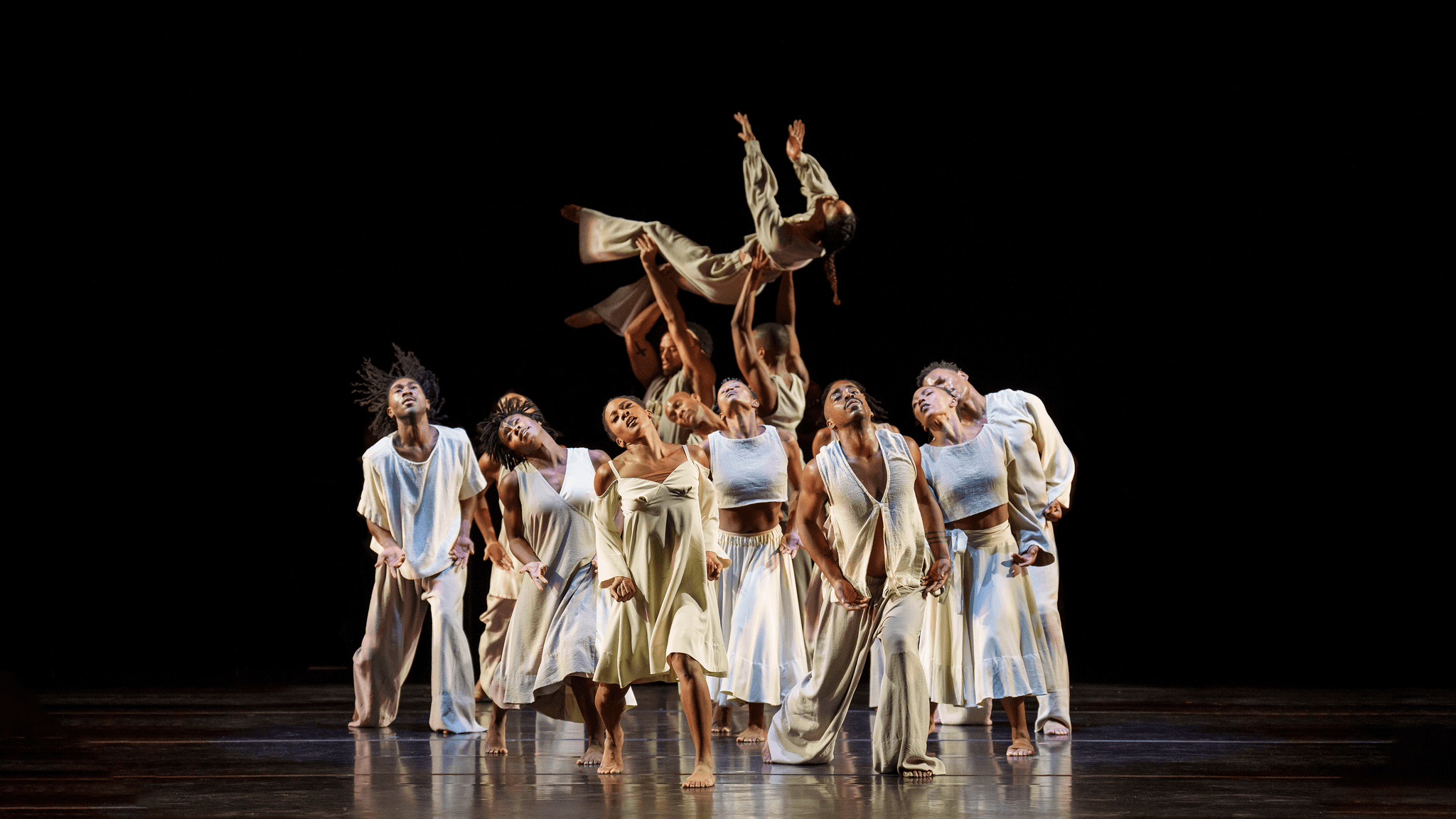
NEW ALBUM: Sacred Songs Suite by Du’Bois A’Keen: Last month I had the privilege of seeing Sacred Songs, a new dance work choreographed by Matthew Rushing and scored by Du’Bois A’Keen, performed by Alvin Ailey American Dance Theater. It was phenomenal! Both a visual and aural experience. The music was performed live with four vocalists (A’Keen sang lead) and a four-piece band, and throughout the evening, the verbal responses from the audience—“Mmmm” and “Amen” and “Yes, Lord!”—made me feel much more like I was in church than in a performing arts center.
Featuring original arrangements of nine spirituals, Sacred Songs “brings together and reimagines the sounds of jazz, West African drums, gospel, hip-hop, calypso, and more to call on the past, engage our present, and invite the listener into a magical, hopeful, and musical future.” A’Keen released the music, plus a few bonus tracks, on his album Sacred Songs Suite on January 18. “By the Waters” is one of the most memorable sections for me.
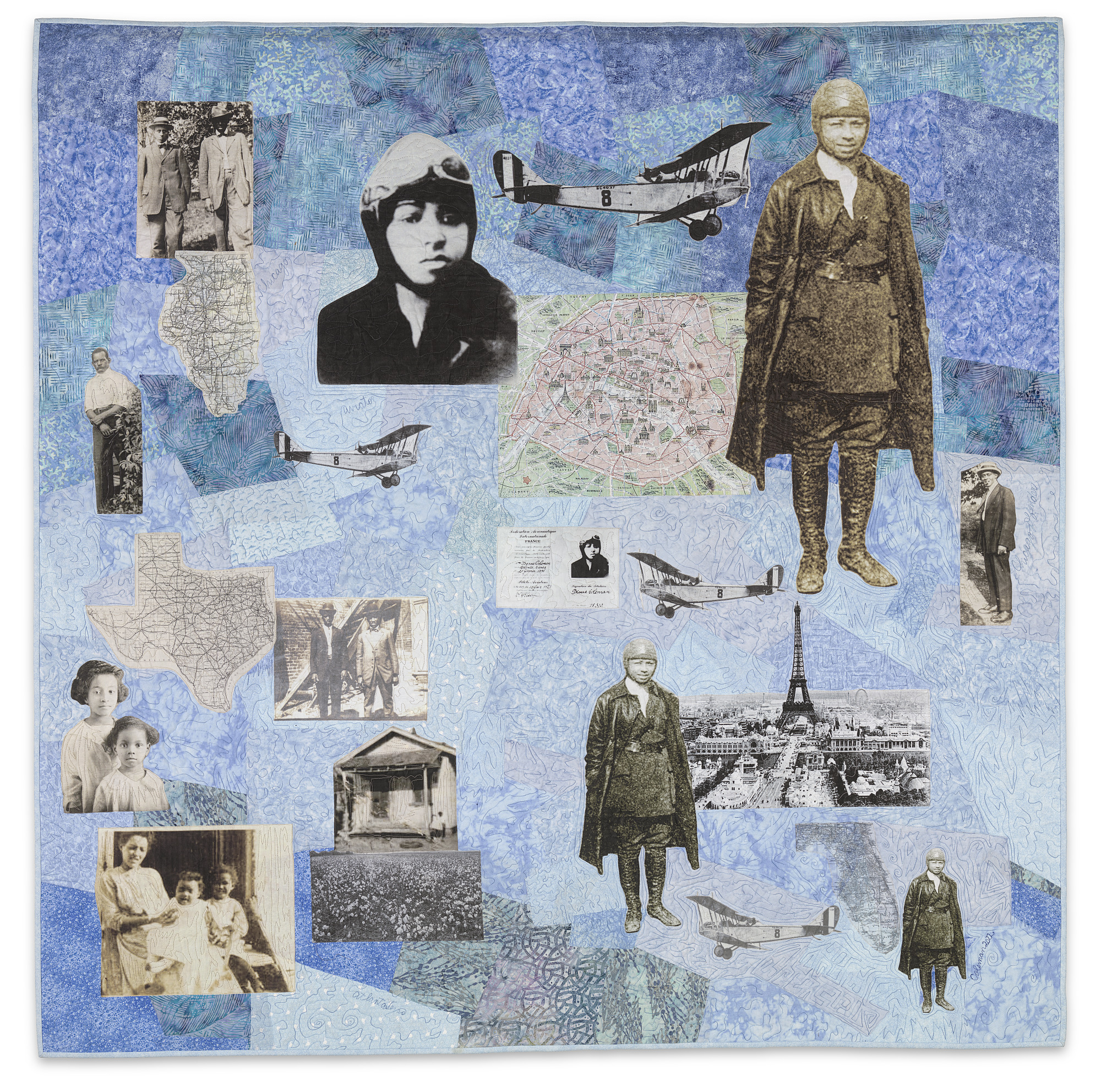
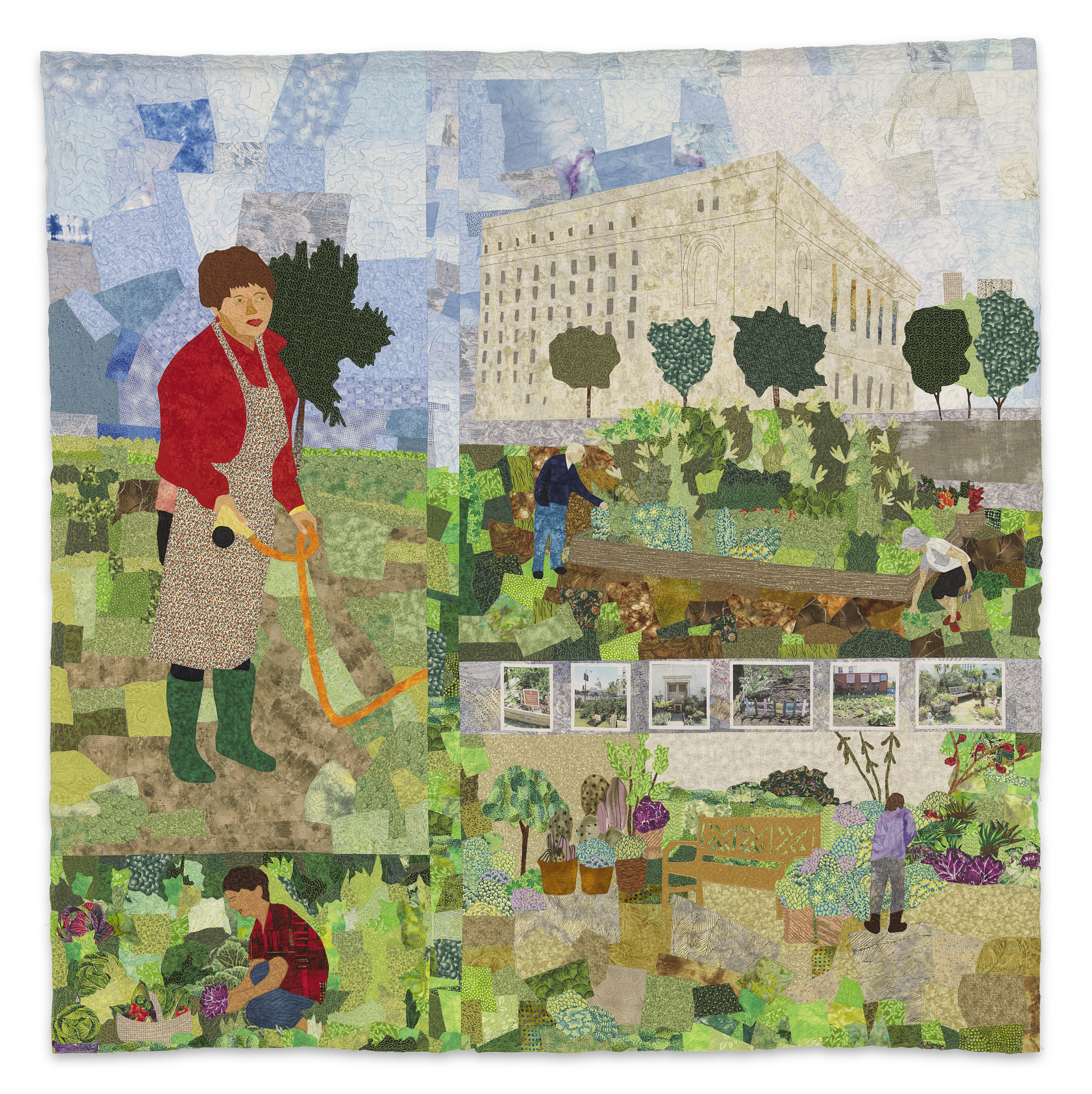
Marion Coleman (American, ?–2019), Her Heart Was in the Clouds, 2012. Cotton fabric, cotton thread, and cotton batt, 60 1/2 × 60 in. (153.7 × 152.4 cm). Smithsonian American Art Museum, Washington, DC.Marion Coleman (American, ?–2019), Tender Gardens, 2014. Cotton fabric and batt, 72 1/2 × 72 1/8 in. (184.2 × 183.2 cm). Smithsonian American Art Museum, Washington, DC.
LECTURE: “PRESENCE: Illuminating Black History, Faith, and Culture” by Steve A. Prince: Printmaker, sculptor, draftsman, and “art evangelist” Steve Prince is the director of engagement and distinguished artist in residence at the Muscarelle Museum of Art at the College of William & Mary in Williamsburg, Virginia—and a personal friend of mine! In this lunchtime presentation organized last fall by Upper House, a center for Christian gathering and learning in Madison, Wisconsin, he discusses his body of work, which is influenced by his New Orleans background and is full of symbols and of figures from African American history. Bessie Mitchell and the Trenton Six, Mamie Till, the Little Rock Nine, Henrietta Lacks, the Greensboro Four, Amadou Diallo, John Coltrane, Harriet Jacobs, and Sarah Collins Rudolph are just a few of the people he references. He discusses the role of the arts in lament, healing, renewal, and celebration, framing the whole talk in terms of the first and second lines of the New Orleans jazz funeral—metaphors, he says, of life on earth (“the dirge”) and life in the hereafter.
Steve Prince (American, 1968–), Bird in Hand: Second Line for Michigan, 2012. Graphite drawing, 9 × 20 ft.
+++
ABOUT HARRIET POWERS:
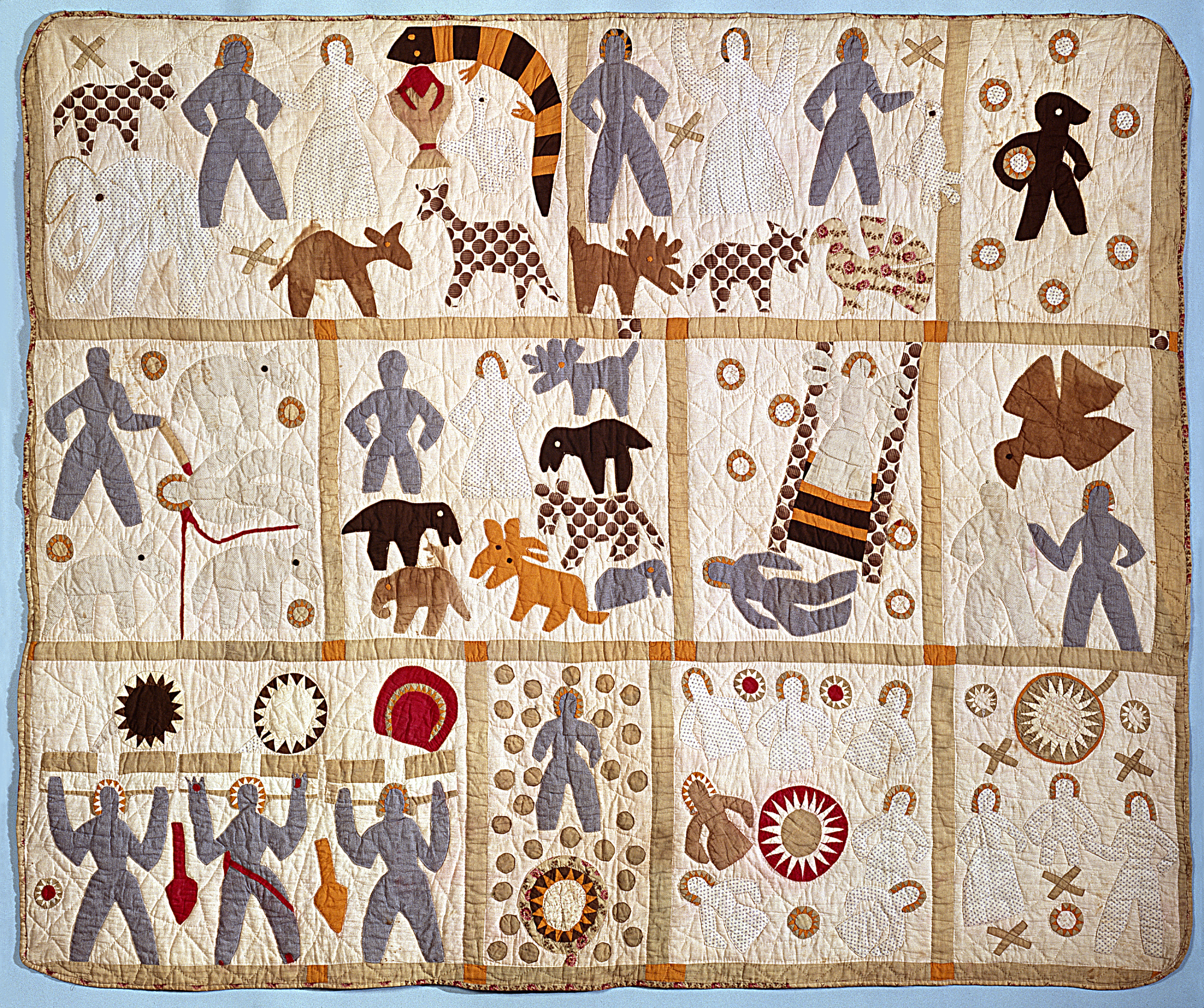
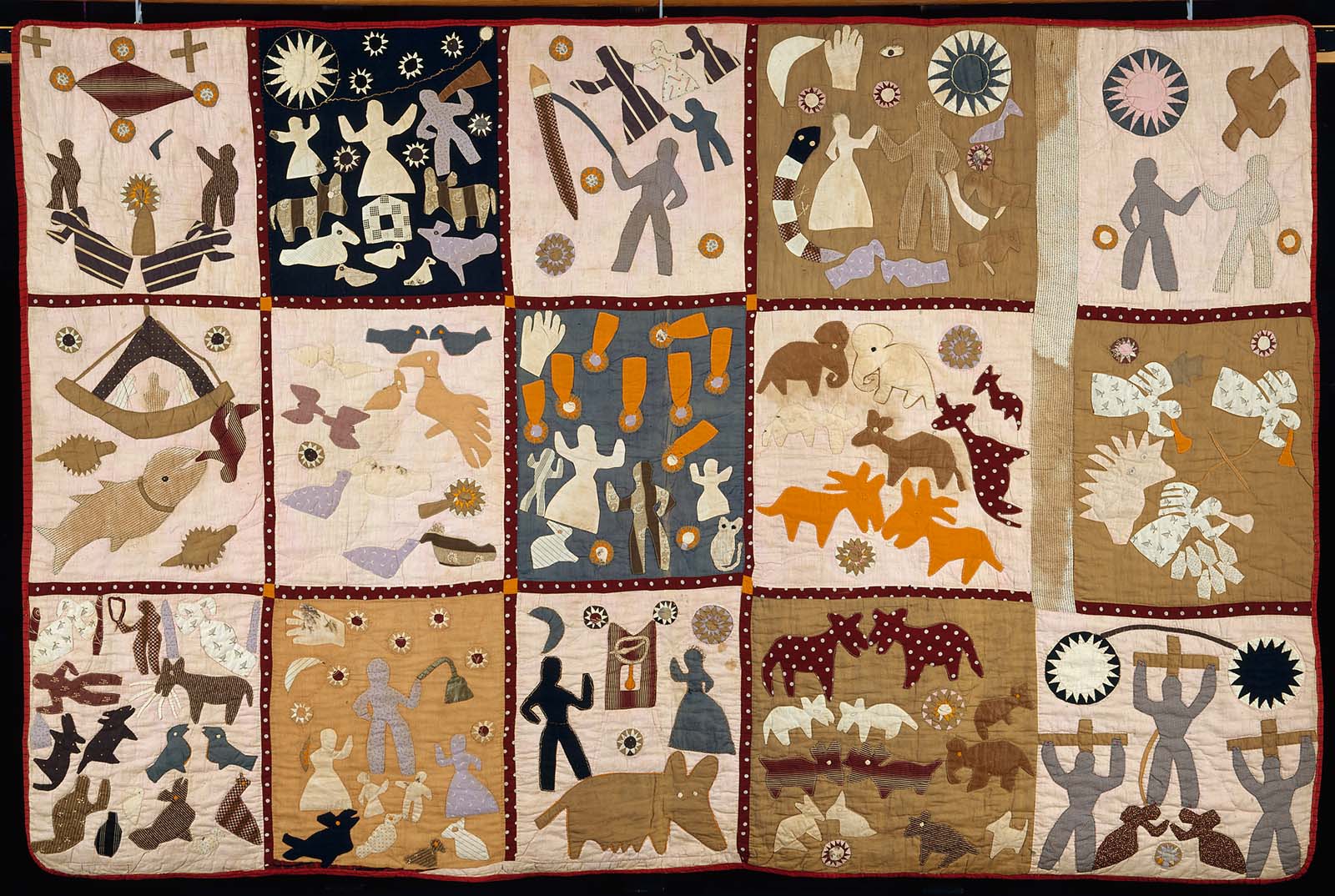
Harriet Powers (1837–1910) was an African American quilter from Georgia who used traditional appliqué techniques to record Bible stories, local legends, and astronomical events. Her two extant quilts, referred to as the Bible Quilt and the Pictorial Quilt, are considered among the finest examples of nineteenth-century Southern quilting. They really are extraordinary.
Harriet Powers (American, 1837–1910), Bible Quilt, ca. 1886. Cotton plain weave, pieced, appliqued, embroidered, and quilted, 75 × 89 in. (191 × 227 cm). National Museum of American History, Washington, DC.Harriet Powers (American, 1837–1910), Pictorial Quilt, 1895–98. Cotton plain weave, pieced, appliqued, embroidered, and quilted, 68 7/8 × 105 in. (175 × 266.7 cm). Museum of Fine Arts, Boston.
A breakdown of the individual squares on Powers’s quilts happens at 14:44–22:16, and conversation continues about Powers specifically until about the one-hour mark. Notably, when asked about the importance of the quilts, Hicks says, “They’re important because you have a woman who is testifying of her love for God 135 years after those quilts left her home. She continues to testify. When you think about all the people . . . I just think she’s a storyteller, but she’s a storyteller with a purpose, and I admire her for that.” The second hour is about story-quilting today—where a new generation of quilt-makers is taking the art form in the twenty-first century—and touches on functional use of quilts versus display.
>> “Blessed Assurance”: A Black gospel arrangement of a classic Fanny Crosby hymn, performed by the Portsmouth Gospel Choir from the University of Portsmouth in the UK.
>> “Parachute” by Arielle Howell and Moses Hooper: A song of surrender. Filmed in 2016, this was the first music video made under the aegis of Under the Belltower, a Biola University initiative (no longer active) that brought together student musicians, composers, and filmmakers to make art in community and showcase that work with an end product.
Here I’d like to share some of the art that was created at and/or on display at the conference. This is just a small snippet.
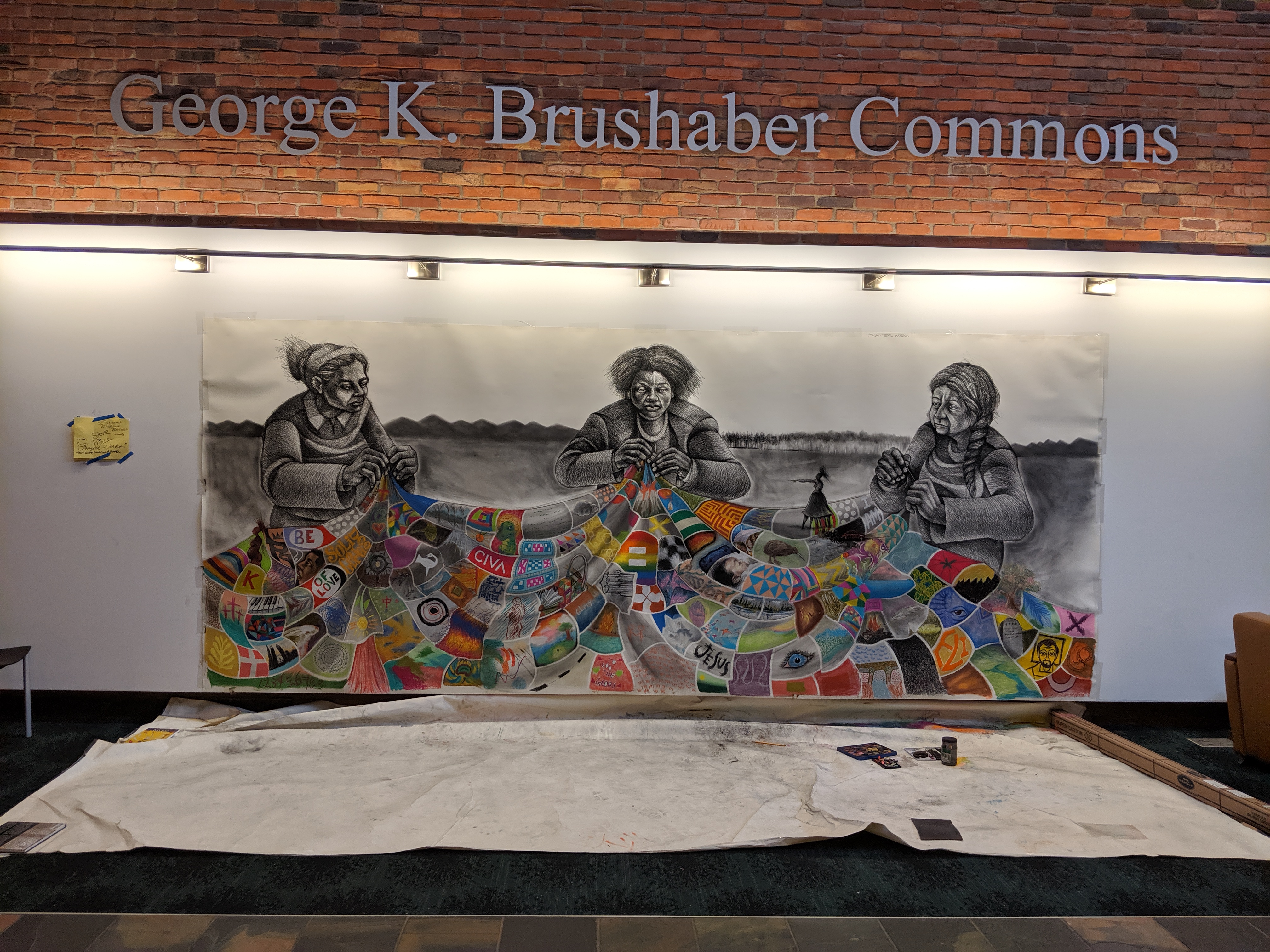
When I first crossed his path Thursday evening, printmaker and draftsman Steve Prince had unfurled a large sheet of paper across the wall of the George K. Brushaber Commons and was drawing in charcoal and graphite. A label taped up beside it gave the title: Prayer Works.
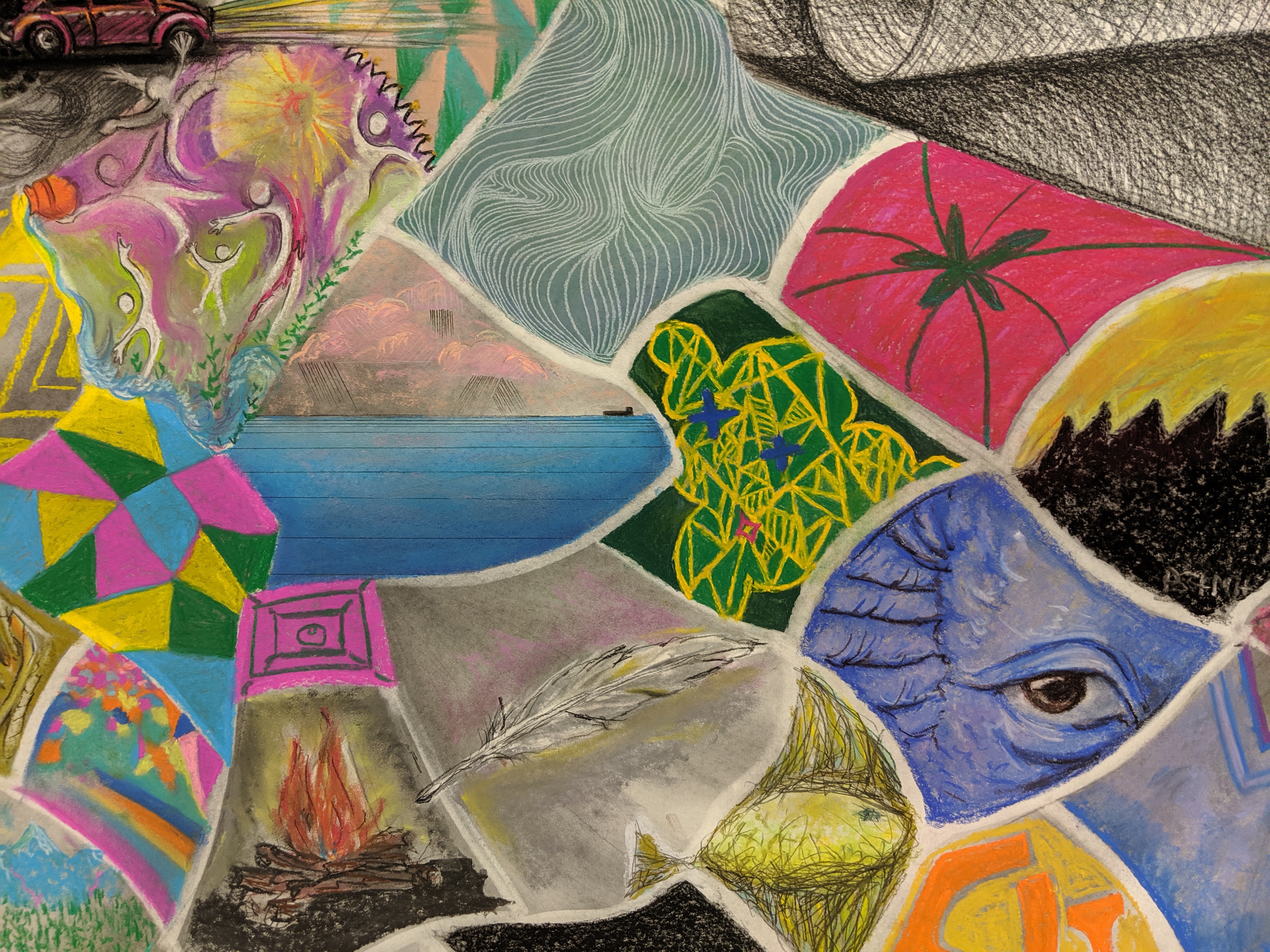
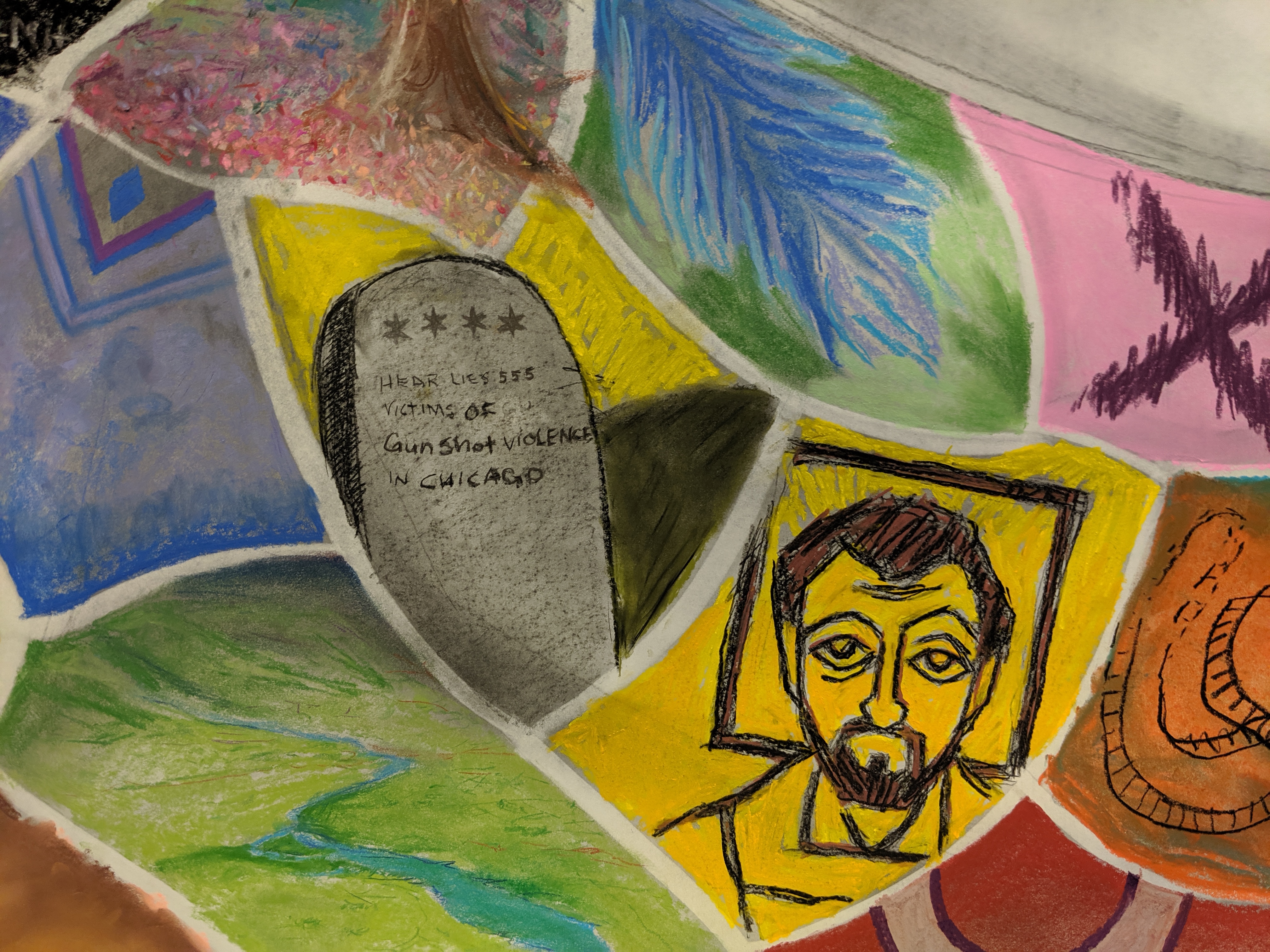
After Prince established the framework of three women quilting, he invited passersby to choose a quilt patch and fill it in with a pastel design of their own. (Though it was very much a low-pressure, “come one, come all” invitation, my self-consciousness, and my not being an artist, prevented me from making my mark. Something I need to get over . . .) It was fun to watch the work evolve over the weekend.
When I left on Sunday, this is what it looked like:
Steve A. Prince and friends, Prayer Works, 2019. A collaborative drawing completed at the 2019 CIVA conference at Bethel University, St. Paul, Minnesota.
Though he has an independent studio practice, Prince is especially passionate about facilitating community art projects—for example, Urban Stations of the Cross (2016), a collaboration between himself and participating members of Sojourn Community Church in Louisville, Kentucky, resulting in fourteen linocuts installed along the walls of the sanctuary. Or the Urban Garden project that capped off Prince’s residency at SUNY Geneseo this January and February. He’s also done a lot of work with grade schools and is great with working with people of all ages.
Prince had a work up for auction at the CIVA conference: a 2017 lithograph titled Salt of the Earth, based on a seminal moment in US civil rights history. On February 1, 1960, four African American college students sat down at a lunch counter at F. W. Woolworth’s in Greensboro, North Carolina. When they were refused service and told to leave, they remained in their seats—an act of nonviolent resistance that ignited a youth-led movement of sit-ins all across the South, challenging racial inequality.
Steve A. Prince (American, 1968–), Salt of the Earth, 2017. Lithograph, edition of 40, 27 × 37 in.
Blessed are the peacemakers, for they shall be called sons of God.
Blessed are those who are persecuted for righteousness’ sake, for theirs is the kingdom of heaven.
Blessed are you when others revile you and persecute you and utter all kinds of evil against you falsely on my account. Rejoice and be glad, for your reward is great in heaven, for so they persecuted the prophets who were before you.
You are the salt of the earth, but if salt has lost its taste, how shall its saltiness be restored? It is no longer good for anything except to be thrown out and trampled under people’s feet.
—Matthew 5:9–13
In Prince’s lithograph, protesters Ezell Blair Jr., David Richmond, Franklin McCain, and Joseph McNeil are portrayed as peaceful warriors, wearing badges that read “AOG”—Agent of God, as I once heard Prince explain. (This acronym is found in several of his works.) As they are reviled and persecuted, they remain steadfast and do not retaliate, representing the Christ who likewise was persecuted for righteousness’ sake.
Christ’s Spirit, symbolized by a dove, is resting on the counter. Around him are what look to be mini-tombstones, bearing inscriptions like “Love,” “Free,” “Truth.” These are all values associated with the Spirit (Rom 5:5 and 2 Tim 1:7; 2 Cor 3:17; Jn 15: 26) and also ones for which African American activists fought and died. You’ll notice that the cross-topped “tombstone” bears a chi (X) for Christ.
Social justice is a key theme in Prince’s oeuvre, including the large linocut of his that I bought at a CIVA auction several years ago.
+++
Another artwork at the CIVA conference that invited participation was Tim Lowly’s Without Moving (after Guy Chase). A multiyear project begun in 2009, it’s a portrait of the artist’s daughter Temma, who was born with severe disabilities, surrounded by a field of hundreds of thousands of tiny black dots. These dots, applied meticulously with a paintbrush by Lowly and other participants over the years, signify the contemplative presence of others surrounding Temma, enfolding her. One woman I talked to said her favorite part of the conference was having the honor to participate in this important work; she said it felt very intimate and connective, and like a form of prayer. Learn more and see more photos at the CIVA blog and the artist’s website. After the conference, Lowly declared the painting complete.
Tim Lowly (American, 1958–), Without Moving (after Guy Chase), 2009–19. Acrylic on panel, 75 × 120 in. [click here for a stunning detail shot!]Because I had a few hours to kill before my Sunday evening flight, I spent the afternoon at the Minneapolis Institute of Art—and discovered that the museum has a Lowly painting in its collection! Titled At 25, it, too, was collaborative. The gallery label reads, “At 25 is a collaborative work commemorating Tim Lowly’s daughter Temma’s 25th birthday. She has been the subject of his work since birth, and he has explored his relationship to her as father and caregiver as Temma was born with severe physical disabilities. Lowly considers Temma a creative collaborator in his work and invited friends to contribute to this icon to her life.” (Those friends include Makoto Fujimura, Tim Hawkinson, Bruce Herman, Catherine Prescott, and others.)
Tim Lowly (American, 1958–), At 25 (front), 2010. Acrylic, gold leaf, foil, gold pigment and glitter on wood, 29 1/2 × 23 1/2 × 2 1/4 in. (74.93 × 59.69 × 5.72 cm) (without base). Minneapolis Institute of Art, Minneapolis, Minnesota.
Lowly writes, “The piece is composed of 25 sections, each of which is painted by one or two artists from around the world. For the ‘portrait’ side of the image I provided the participants with a section of a photograph corresponding to the piece they were given. I also gave them black-and-white matte acrylic (the paint I usually use) and asked them to render the photograph as stylistically neutrally as possible. For an artist to set aside their ‘style’ is a significant gesture, and as such I am very grateful for how willingly and sincerely the participants took on this part of the project. For the back side of the work the directive was much more open: ‘make it gold.’ As anticipated, the result of the back was very eclectic and (friendship) quilt-like.”
I didn’t get a photo of the reverse side, but you can view it here.
+++
Above I mentioned an auction. There were many fine lots. I bid on Sandra Bowden’s Law and Gospel collograph but didn’t win.
Sandra Bowden (American, 1943–), Law and Gospel. Collograph mixed media, 18 × 27 in.
The artist’s description reads, “With one additional horizontal cut, the tablets of the Law become four quadrants, suggesting a cross. Jesus said he came to fulfill the Law. When we have finished an item on our list of things to be done, we put a line through it, marking it done. This is what I was thinking as I took the Law, marked it done, with a horizontal line, only to see a cross appear.” Bowden created the textured surfaces by layering gold leafing on the Hebrew text collagraph print, then adding colored iridescent Cray-Pas to the raised areas.
Wayne Roosa’s Tract also caught my eye—an eraser print that quotes Giotto’s Lamentation over the Dead Christ. It belongs to his “Ideas of Order” series of rubber stamp images, which, as he says, “use iconic elements from newspapers and art history, combined and recombined, to suggest symbolic/narrative meaning for our culture’s various structures of order. Here, the microphone, surrogate for figures in power, privilege, or influence, rises out of a trap door abyss, while three angels (from Giotto’s Arena Chapel) grieve over the state of ‘truth’ and discourse.”
Wayne Roosa, Tract, 2009. Eraser print, 11 × 8 1/2 in.
+++
While I was at Bethel, there was a CIVA-sponsored exhibition in the Olson Gallery, The Beautiful, which ran from April 23 to June 16. (This was in addition to a juried show and a walk-in show put together specially for the conference.)
Here are a few notable artworks from The Beautiful:
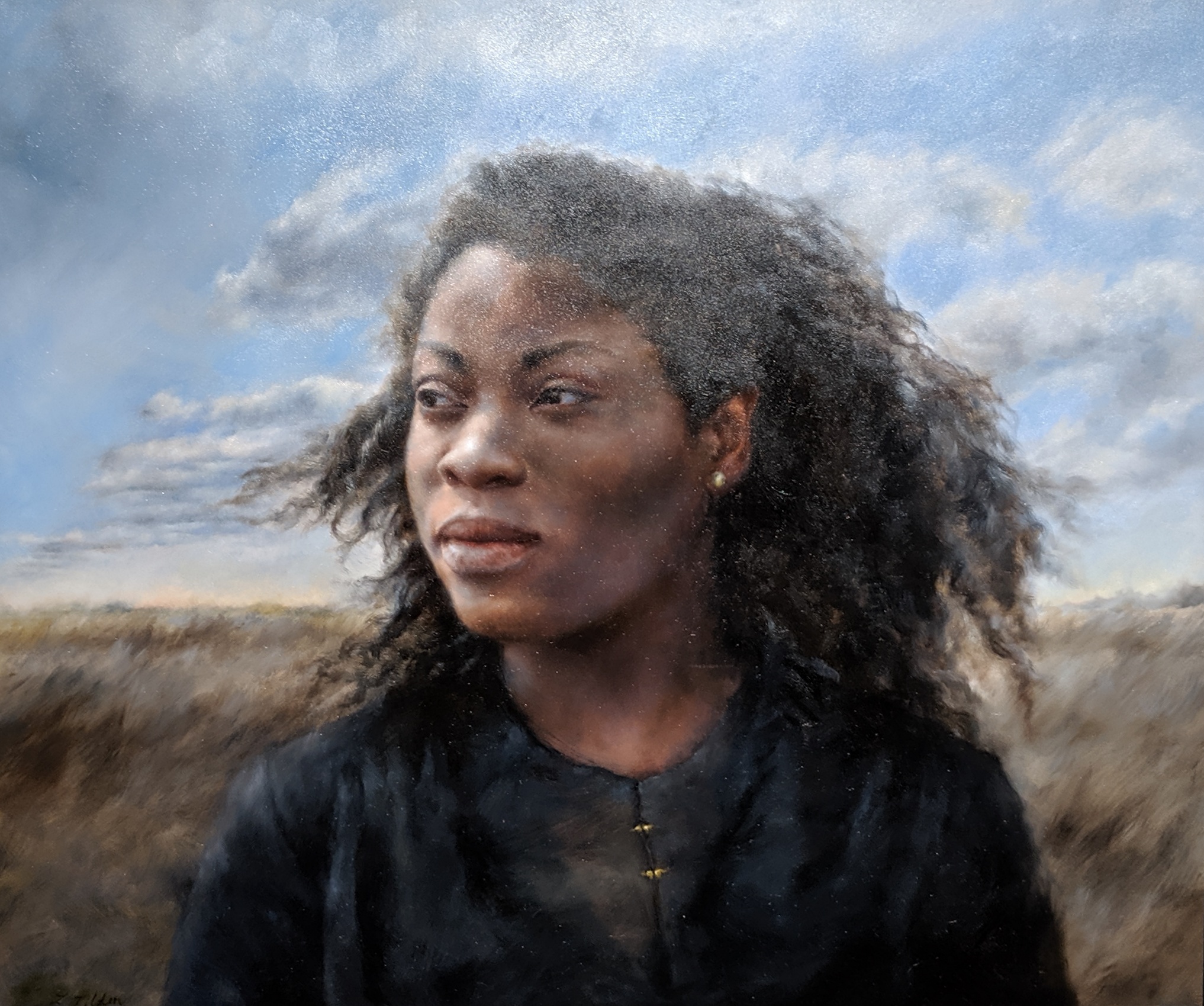
Lauren Tilden (American, 1981–), Wind on Her Face, 2017. Oil on panel, 18 × 24 in.
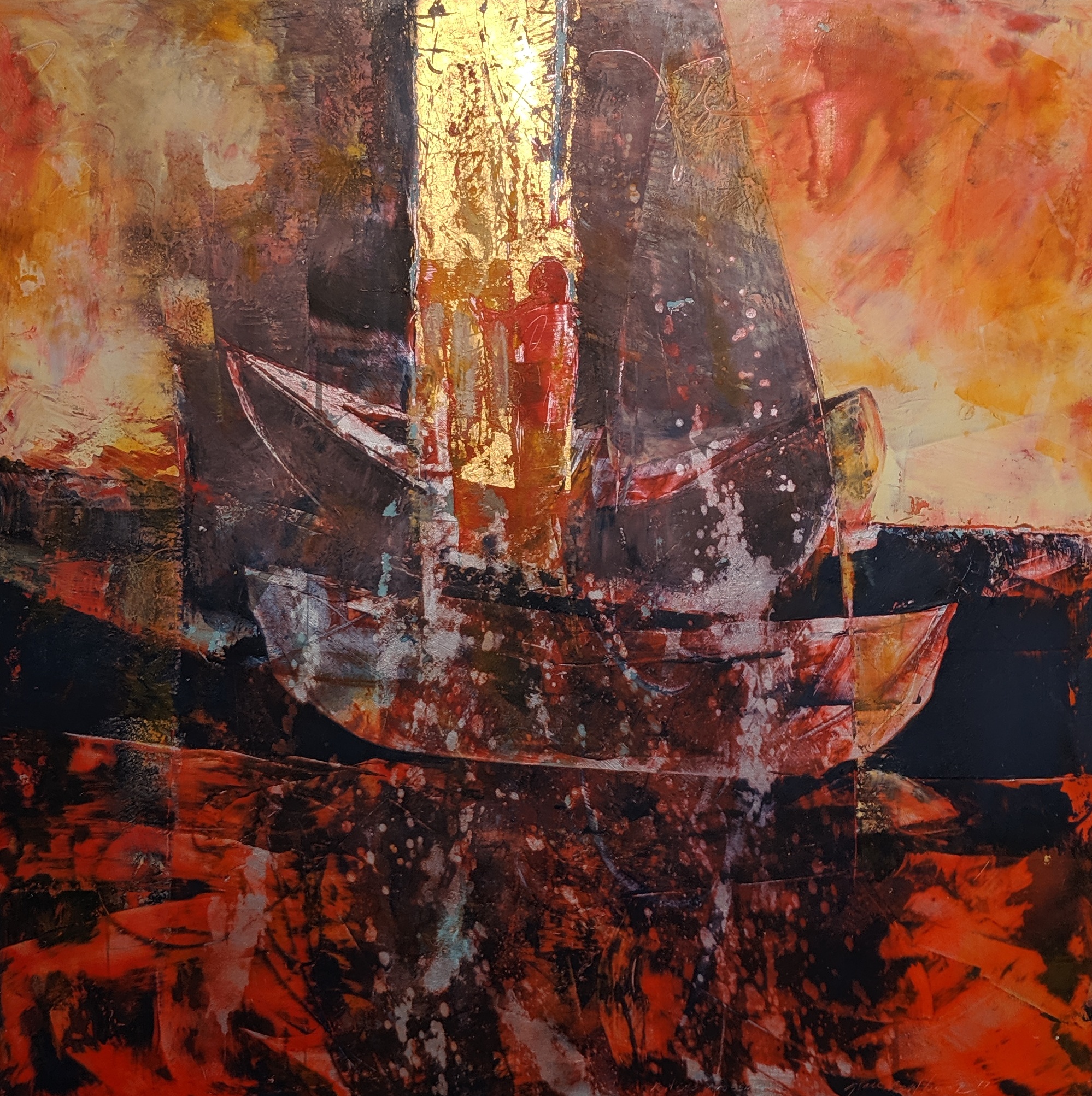
Grace Carol Bomer (American, 1948–), Red Sea Crossing, 2018. Oil, wax, and gold leaf on canvas, 30 × 30 in.
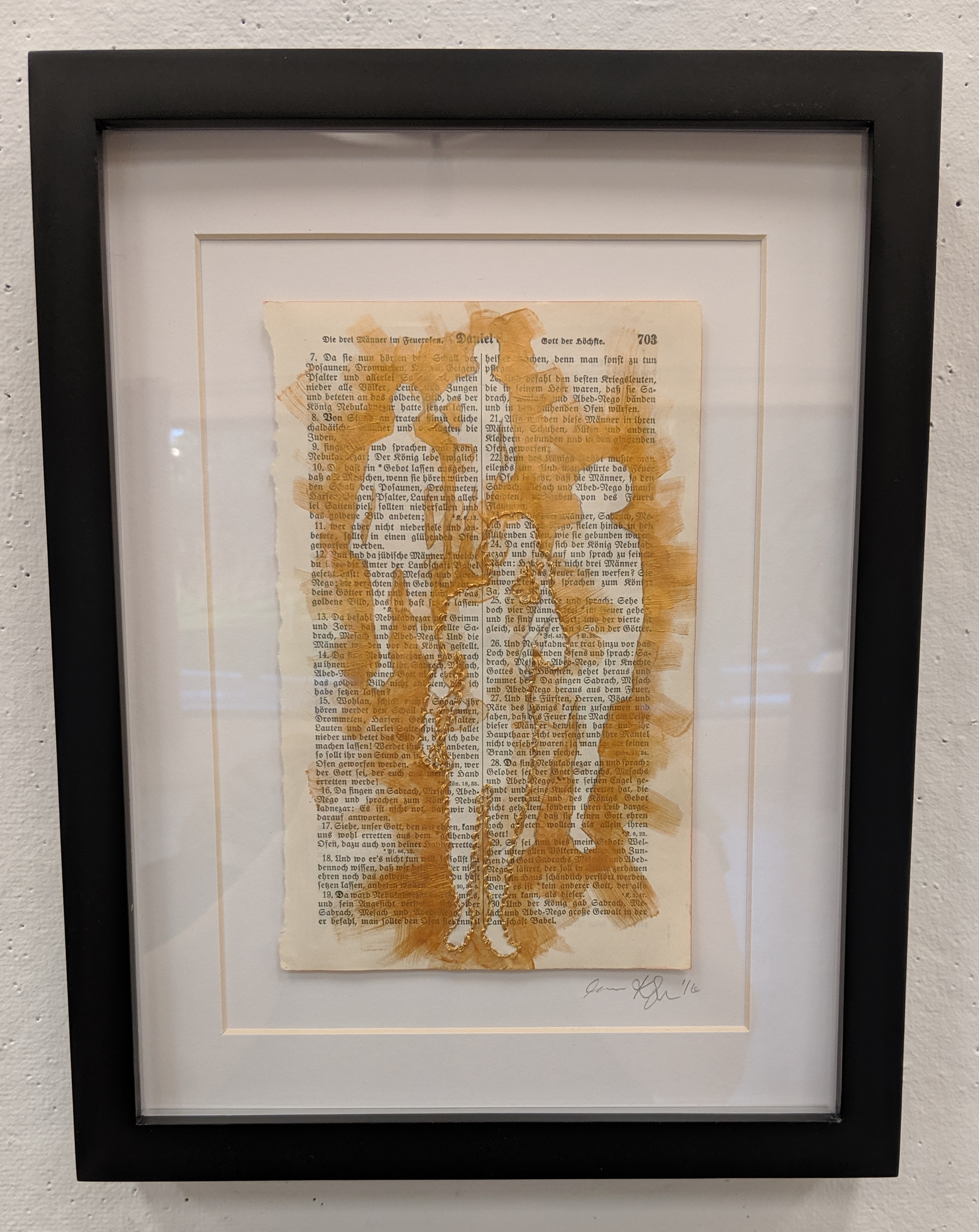
Jennie Kimbrough, Untitled 14 (Daniel 3:7–30), 2016. Acrylic and thread on paper, 8 × 5 in.
I learned about Jennie Kimbrough’s “And the Word Was God” series, in which she uses pages from a 1920s German Bible, purchased at a flea market, not only as inspiration but also as her substrate, painting and stitching atop them as a devotional response to the text. Untitled 14 (Daniel 3:7–30) shows the three youths in the fiery furnace, with a fourth figure mysteriously present among them.
Screen cap from artist Jennie Kimbrough’s website, showing a sampling of works from her “And the Word Was God” series
I also spent time at the video installation Belgium / Minnesota (for Henry) by Michelle Westmark Wingard. Shot over a four-hour period and then time-lapsed, it shows the movement of sunlight through a window and across the wall as the day progresses. The decal on the window is the horizon line she extracted from a photograph of a Belgian field, where her grandfather’s plane crashed during World War II; placed over the existing horizon line, it creates an interesting interplay. The artist said she intends the video as “a study of contrasts: light/dark, real/imagined, manicured landscape/wild natural landscape, static/ever-changing” and “a visual dialog about landscape, longing, and the passing of time.”
I love how this piece takes something as ordinary as sunlight and invites us to really notice it, to receive it as something more than a mere commonplace—as a wonder, or even a grace.
Artists are great at noticing beauty that others of us would simply pass by. The day I arrived at the conference, I was walking with my roommate to the dorms when suddenly she stopped in the road with wide eyes and open mouth. I assumed she was reacting to the herd of goats in the near distance, fenced off behind a small chapel—an unexpected and amusing feature of a college campus. (They were brought in last year, I later learned, to help manage an invasive plant species, buckthorn.) But it turns out she was responding to the way the sun’s rays were falling through a tree. “Isn’t this beautiful?” she kept saying, approaching for a closer look and pausing to take it in. She snapped multiple pictures from different angles so that she could paint it later. And here I was, only noticing the goats! Until this new artist friend of mine redirected my attention to something more subtle but equally as delightful.
+++
The Are We There Yet CIVA conference this summer was so rewarding, and these three blog posts, built as they are around works of art, don’t encapsulate the full experience. But they provide a taste of what you might expect to encounter were you to attend a biennial conference in the future.
I’d encourage you to listen to the fifteen-minute interviews conducted at the conference by Libby John of the podcast Art & Faith Conversations. She talks not only to artists but to an arts administrator and an art book publisher, all CIVA members:









 Art & Theology