Twelve Advent Stations by Mark Cazalet

Mark Cazalet (b. 1964) is a contemporary artist based in London whose work centers on color and balances empiricism and lyricism. He works across media—painting, drawing, printmaking, and (in collaboration with fabricators) stained glass, etched and engraved glass, printed enamel on glass, tapestries, and mosaics. A major part of his career has been fulfilling ecclesiastical commissions and making sacred art. But all of his work, regardless of subject matter, is shot through with a sacramental impulse.

Last year Cazalet made a series of twelve “Advent Stations” that move circuitously through the story of Jesus’s first coming, marked as it was by mystery, vulnerability, risk, and glory. These include modernized versions of scenes you’d find in traditional Infancy of Christ cycles, such as the Annunciation to Mary, the Annunciation to the Shepherds, the Dream of the Magi, and the Flight to Egypt, but also new ones, drawing us into the grand sweep—sometimes rushing, sometimes quiet—of gospel hope. “The overarching theme,” he told me, “is pregnancy, birth, nurturing, waiting, escape, migration, and finally, in the mistle thrush’s morning song, the greeting of the new day’s limitless potential.”

The artist’s choice of substrate is unique: He painted his stations in oil on domestic wooden objects, such as bread boards, meat and cheese boards, children’s lunch trays, washboards, chapati rolling boards, and a baker’s peel. By using these ordinary boards mainly from home kitchens, Cazalet further situates the biblical Advent story in the everyday. That many of the boards are used for preparing or serving bread underscores Jesus’s self-declaration as “the living bread that came down from heaven,” whose flesh Christians eat ritually as a means of interabiding (John 6).

Cazalet’s Advent Stations debuted last December at his home church, St Martin’s in Kensal Rise, London, where they were installed one per week from Advent through Candlemas. The project was a collaboration with fellow parishioners Richard Leaf, who wrote a poem for each station, and Pansy Cambell, who calligraphed the poems.

That exhibition spawned interest from Chelmsford Cathedral in Essex, where all the artworks and poems are on display from December 1, 2025, through February 2, 2026. The cathedral is already home to two commissioned works of Cazalet’s: the monumental multipanel painting The Tree of Life and an engraved and etched glass window depicting St. Cedd.

The word “station” in the title of Cazalet’s recent series refers to a stopping place along a route. In the Middle Ages, the Roman Catholic Church developed a devotional practice known as the Stations of the Cross, which breaks down the passion of Christ into fourteen distinct episodes fit for contemplation. The idea was that those who could not travel physically to Jerusalem for Lent to walk the Via Dolorosa (the processional route Jesus took to Golgotha) could at least walk the path in spirit, using a series of images as prompts to pause, pray, and reflect.

(Cazalet also made a set of twenty Stations of the Cross in 2024.)

Used by Christians in various denominations, this practice has been adapted for other seasons of the church year. While there are no official Advent Stations or Stations of the Nativity, Cazalet has come up with twelve.

All photos in this article are by the artist and are used with his permission.

Advent Station 1: The Breath of God

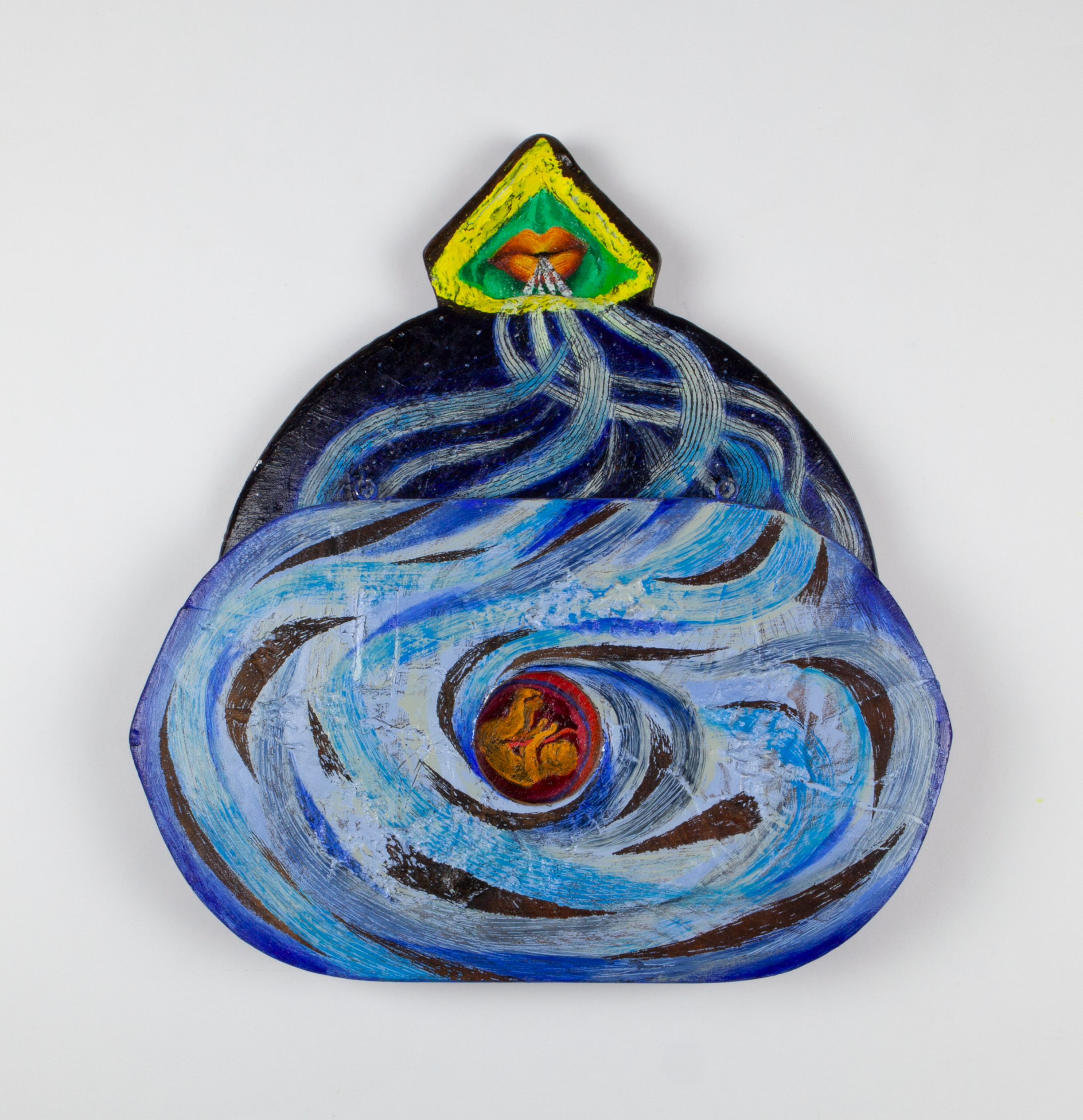
Advent Station 1. The Breath of God (closed)
Mark Cazalet, Advent Station 1: The Breath of God (closed), 2024

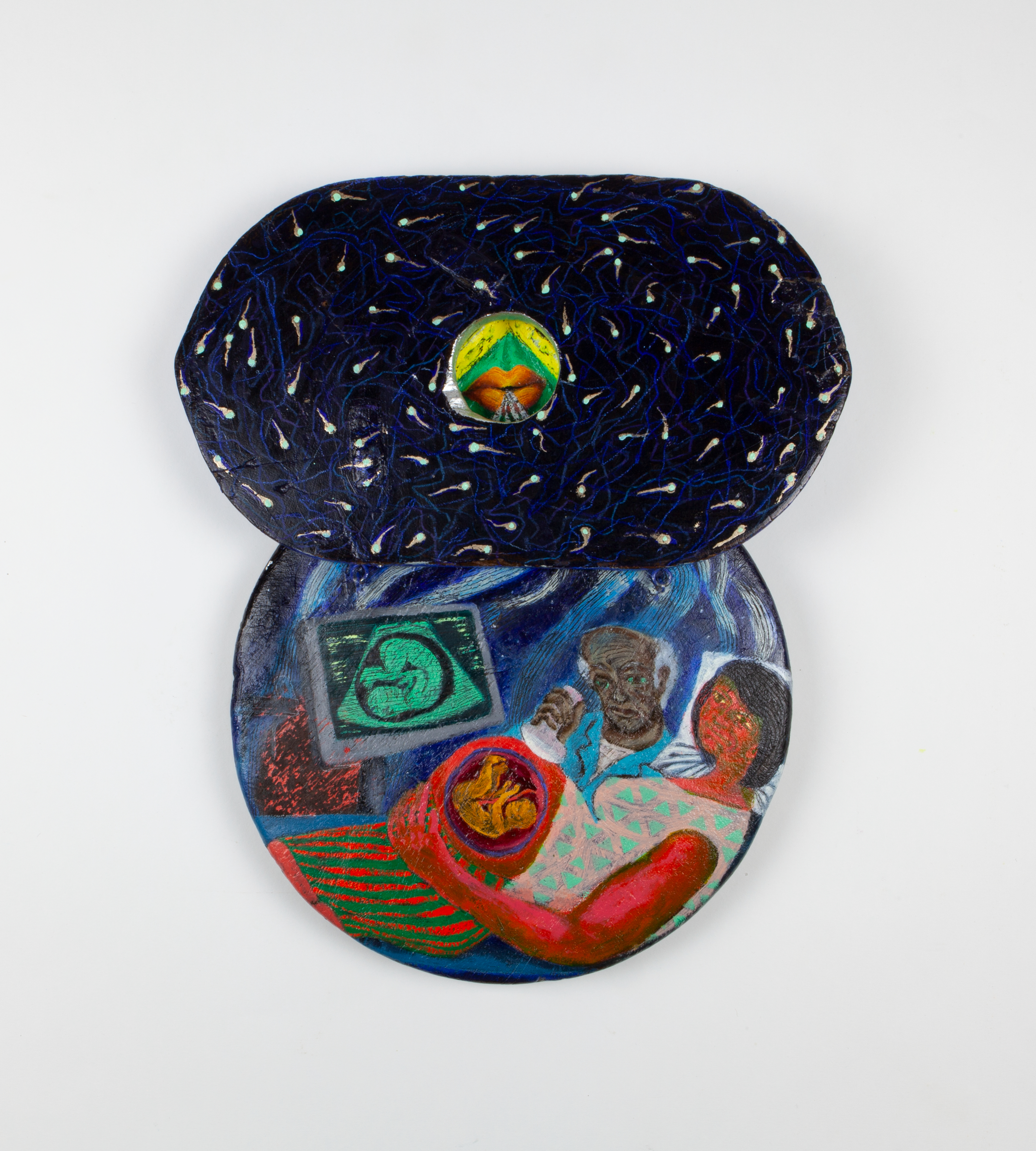
A mystical visualization of the Word becoming flesh, the first station has two configurations. In its closed form, it shows the mouth of God blowing through space, the divine breath coalescing around a woman’s uterus to form an embryo, the child who will be called Jesus. Wisps of blue swirl dynamically around this firstborn of new creation.

The triangular shape evokes the Trinity, as the Incarnation was an act involving Father (initiator), Son (enfleshed one), and Holy Spirit (overshadower / inseminating agent).

Advent Station 1. The Breath of God (open)
Mark Cazalet, Advent Station 1: The Breath of God (open), 2024

In the exhibition, an attached ribbon instructs viewers, “Lift me.” When you do, the bottom board flips up to reveal a pool of swimming sperm cells, as God created the male gamete needed to make a male child and supernaturally (nonsexually) deposited it into Mary, where it fertilized one of her eggs.

The virginal conception of Christ is a mystery beyond knowing; no amount of scientific head-scratching will bring us closer to understanding the mechanics, nor do we need to. But I like the reminder from this unusual artistic interpretation that all the necessary human genetic material was present—Mary supplying hers, and God supplying the rest. Jesus was not some kind of alien transplanted into a human womb, but rather was made up of all the human stuff we are, and grew by stages inside his mother over a period of nine months. And yet, while fully human, he’s also—marvel of marvels—fully God.

On the round board below, we see that the isolated uterus from the first view belongs to Mary, who lies in bed while Joseph serves as ultrasound technician, shining a light that discloses the still-developing Christ child on a video monitor.

Advent Station 2: John the Baptist on the Beach

Advent Station 2. John the Baptist on the Beach
Mark Cazalet, Advent Station 2: John the Baptist on the Beach, 2024

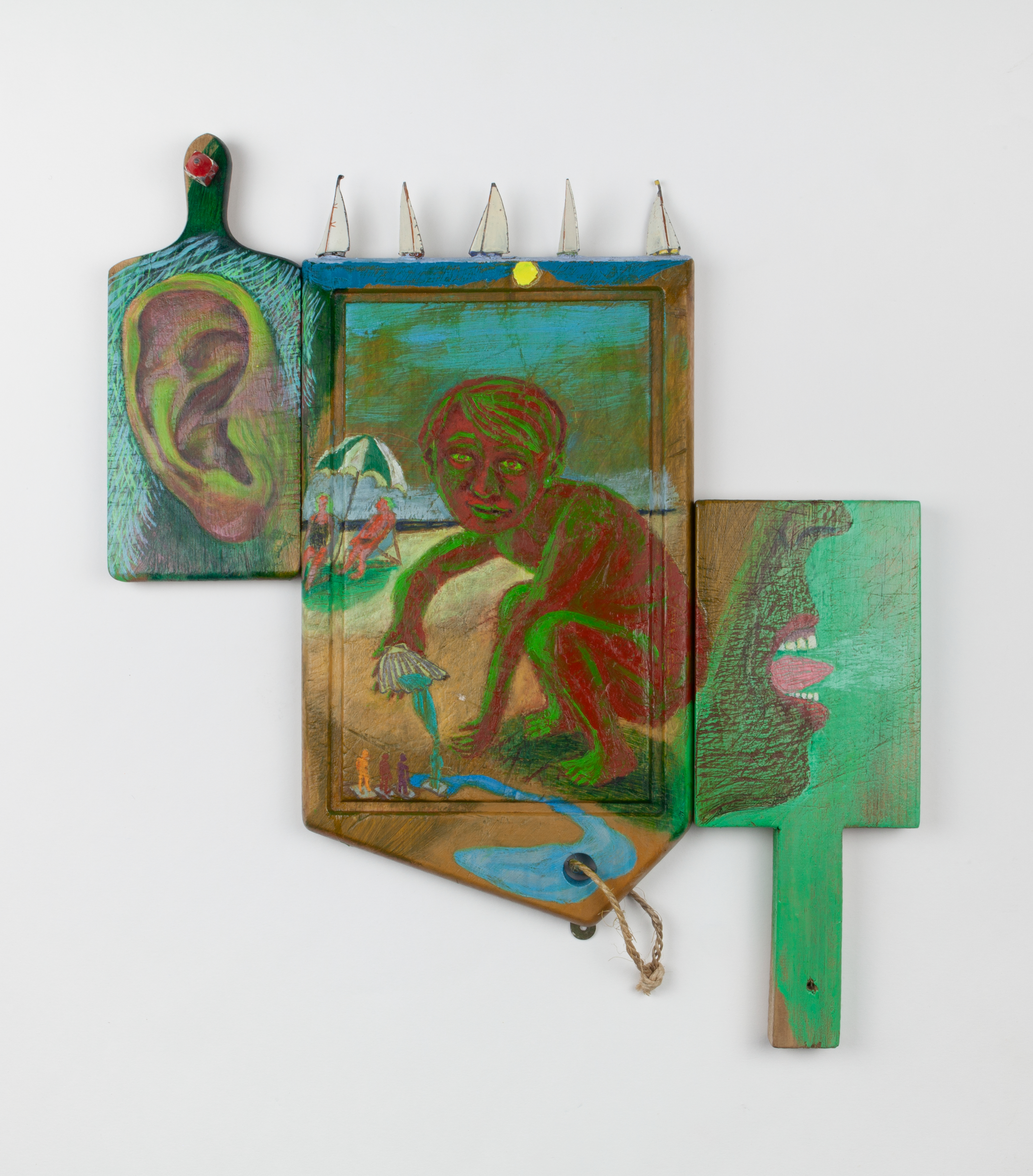
The breath/wind motif is subtly carried over into this second Advent station, with sailboats lining the top of the center board.

This scene shows a young John the Baptist playing on the beach, with his parents, Zechariah and Elizabeth, lounging in swimsuits under a nearby umbrella. John crouches in the sand, pouring water from a seashell (the implement he uses to baptize Jesus in many traditional paintings, most famously Piero della Francesca’s) onto toy figurines who have queued up for the affusion. The water cuts a mini river through the sand, alluding to the Jordan.

The two side panels, which show a close-up of an open ear and an open mouth, likely refer to, in his prophetic ministry as an adult, John’s hearing the word of God and proclaiming it. His is “the voice of one crying out in the wilderness: ‘Prepare the way of the Lord; make his paths straight’” (Mark 1:3). John is regarded as an Advent figure because, by preaching repentance from sin, he prepared the people for the coming of the Messiah.

Advent Station 3: The Annunciation

Advent Station 3. The Annunciation
Mark Cazalet, Advent Station 3: The Annunciation, 2024

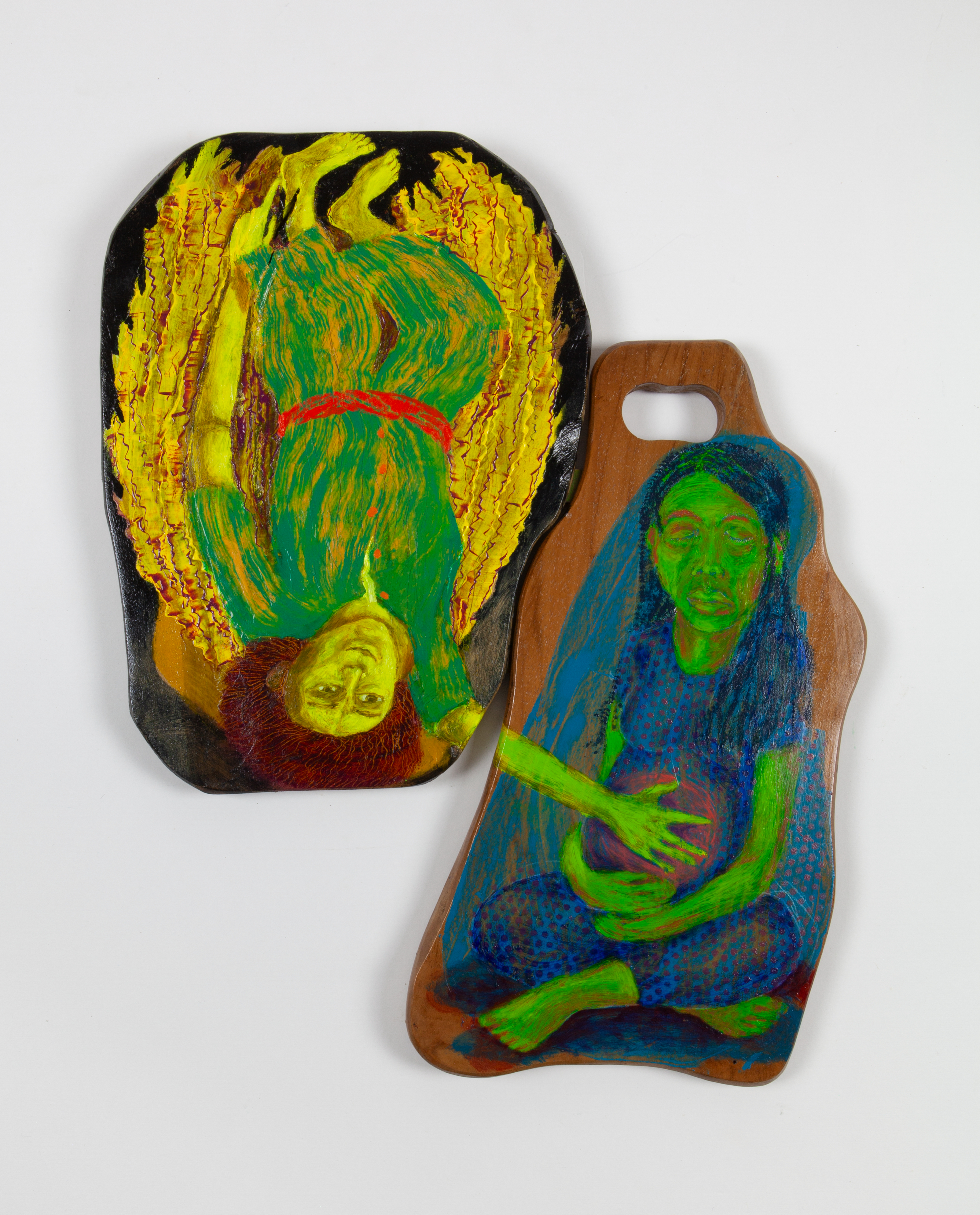
The Annunciation, portraying the angel Gabriel’s message to Mary that she has been chosen to bear God’s Son, is one of the most frequently depicted biblical scenes of all time. How could any artist possibly make it new?

Cazalet refreshes the encounter by showing Gabriel dipping down headfirst from the heavens, the unconventional orientation perhaps a playful allusion to the topsy-turvy nature of Christ’s kingdom. He reaches across the gap to touch the belly of Mary, a young Black woman in a polka-dot dress who is seated on the floor with her eyes closed, rapt in prayer. This consensual touch is what effects the Incarnation.

Mary wears blue and even exudes a blue aura, blue being her traditional color, associated with heaven (the sky realm) and hope. Gabriel’s skin has a golden sheen—the color of divinity, purity, holiness. The coming together of blue and yellow creates green, symbolizing life, growth, and renewal.

Advent Station 4: Bethlehem Motel

Advent Station 4. Bethlehem Motel
Mark Cazalet, Advent Station 4: Bethlehem Motel, 2024

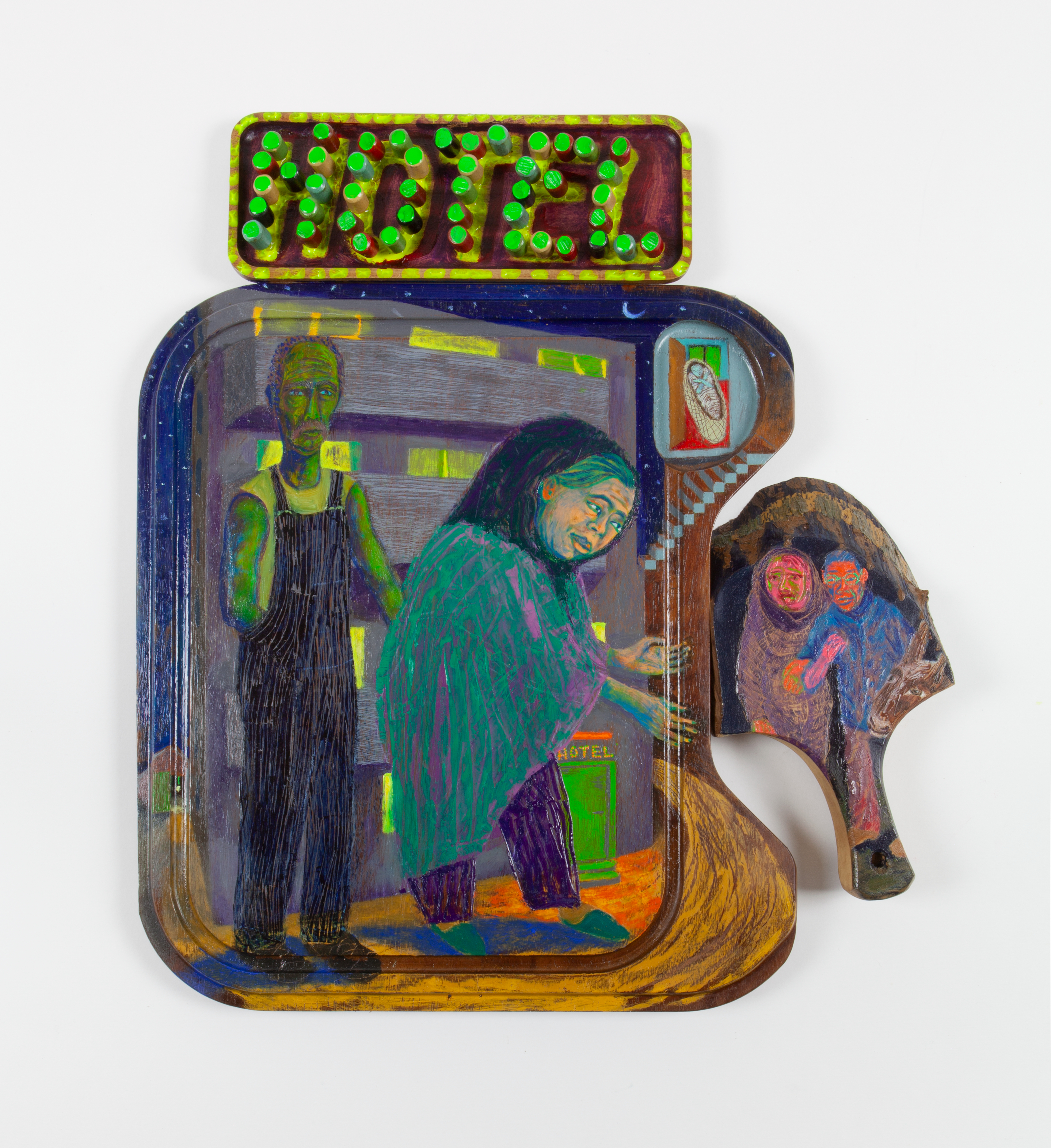
The innkeeper couple in Bethlehem are a cultural invention, biblical scholars tell us, spawned by a misleading English translation of Luke 2:7, which says “there was no room for them [Mary and Joseph] in the inn” (KJV). The Greek word translated “inn,” kataluma, more properly means “guest room”: Because the census had brought many out-of-towners to the area, the guest rooms of Joseph’s relatives were full, but they made space for the pregnant couple in the lower room of the house where animals were kept for the night.

Despite the lack of an innkeeper character in scripture, it has become a popular element in storytelling about the Nativity in art, song, and sermons, as it prompts us to consider whether we are making room for Christ in our busy, overcrowded lives. And not just Christ, but anyone in need—of shelter or other forms of care.

Cazalet shows Mary and Joseph approaching a motel door as the female owner, sympathetic, comes out to greet them. A niche above their heads, hovering like a thought bubble, shows what the couple desires: a place to give birth and to lay their son.

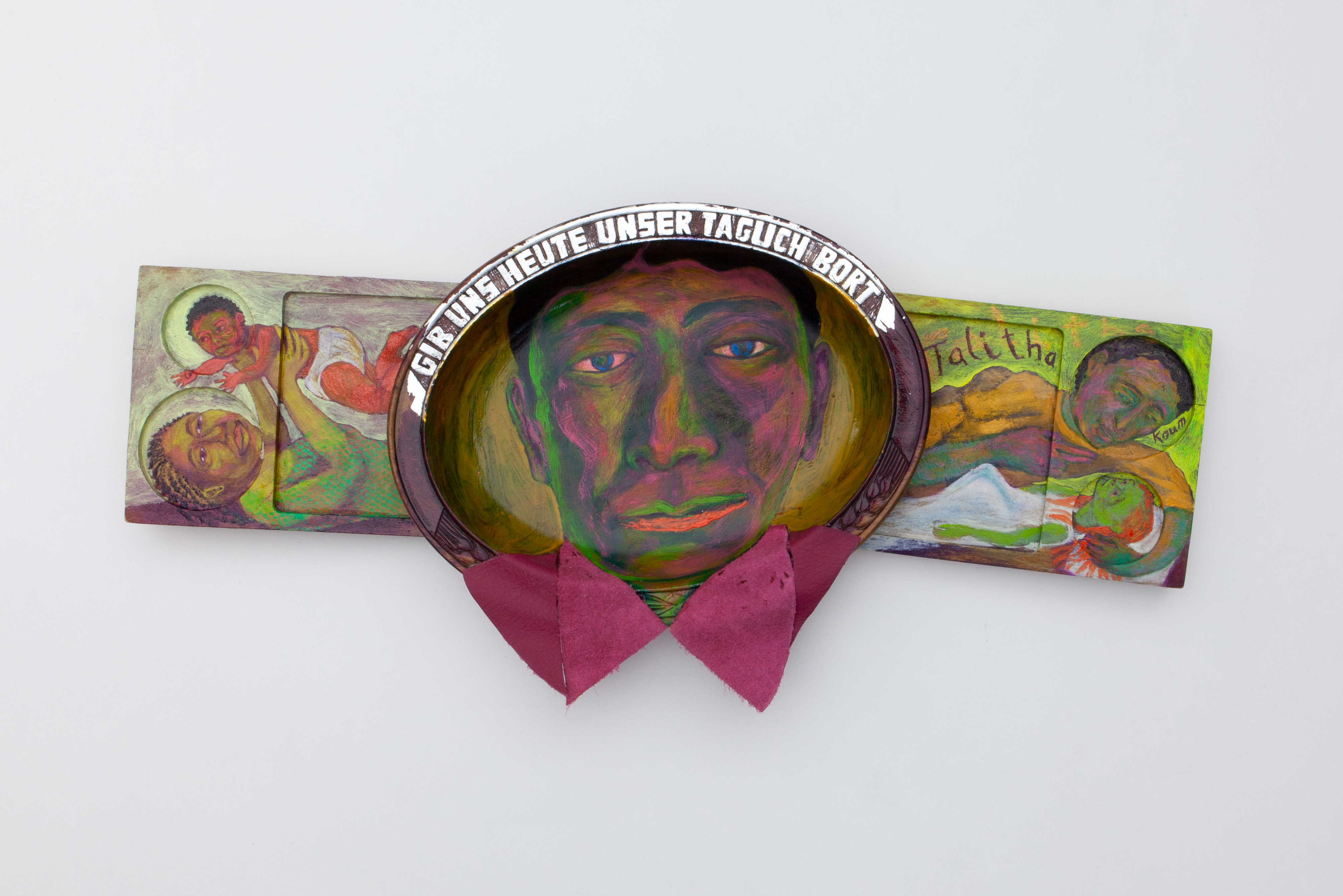
Advent Station 5: The Incarnation (A Blessing Conferred)

Advent Station 5. The Incarnation (A Blessing Conferred)
Mark Cazalet, Advent Station 5: The Incarnation (A Blessing Conferred), 2024

The fifth station features an unconventional combination of images. The left board shows Mary lying on her back, holding the wiggly infant Christ above her. She beams with maternal love.

On the right board, an adult Christ, similarly positioned, leans over the dead daughter of the synagogue leader Jairus. “Talitha koum,” Jesus gently instructs, cradling the girl’s head—Aramaic for “Little girl, get up” (Mark 5:41). With his words, she rises back to life.

The central image, a Head of Christ, is painted on a wooden bread plate from Germany—these plates were sometimes also used as church collection plates—whose rim reads, “Gib uns heute unser täglich brot” (Give us this day our daily bread). Carved sheaves of wheat poke out from under Jesus’s pink cloth collar.

“My intention is that Mary’s love for her son as she raised him taught him the care and compassion to want to help a child in extremis,” Cazalet told me. “The man is formed by the mother’s love, and our childhoods set the pattern of our response to others.”

Notice how, from behind the Christ head, the two adjoining boards emerge like wings, suggesting freedom.

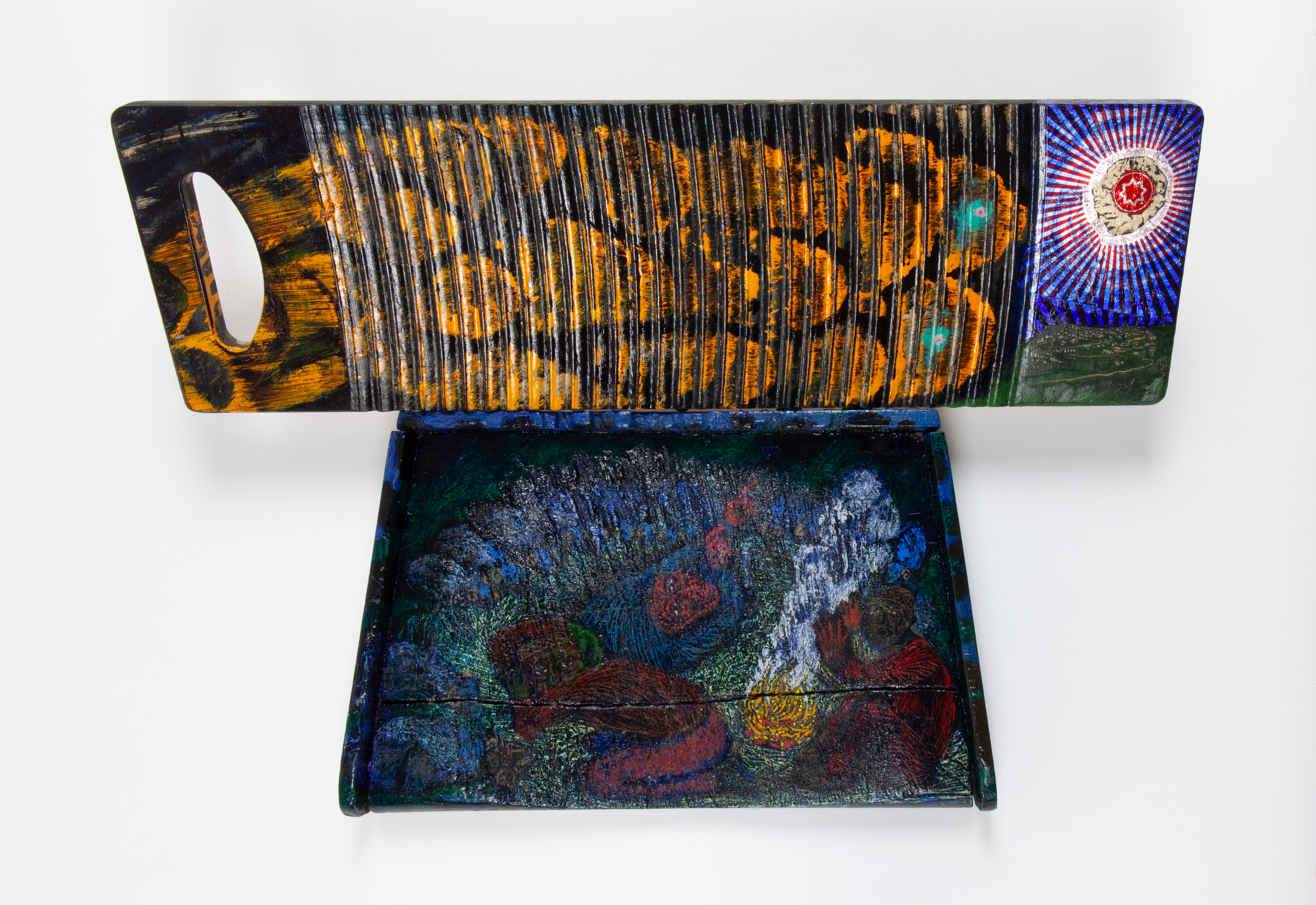
Advent Station 6: The Shepherds See the Star

Advent Station 6. The Shepherds See the Star
Mark Cazalet, Advent Station 6: The Shepherds See the Star, 2024

The sixth station portrays the glory of the Lord rippling across the night sky above three shepherds tending their flocks. Content and unassuming, they are gathered round a warm fire when suddenly, an angel appears to announce to them the birth of Christ. One of the shepherds cowers in fear while another gesticulates toward a brightly beaming star in the near distance—rendered with a Tunnock’s milk chocolate tea cake wrapper.

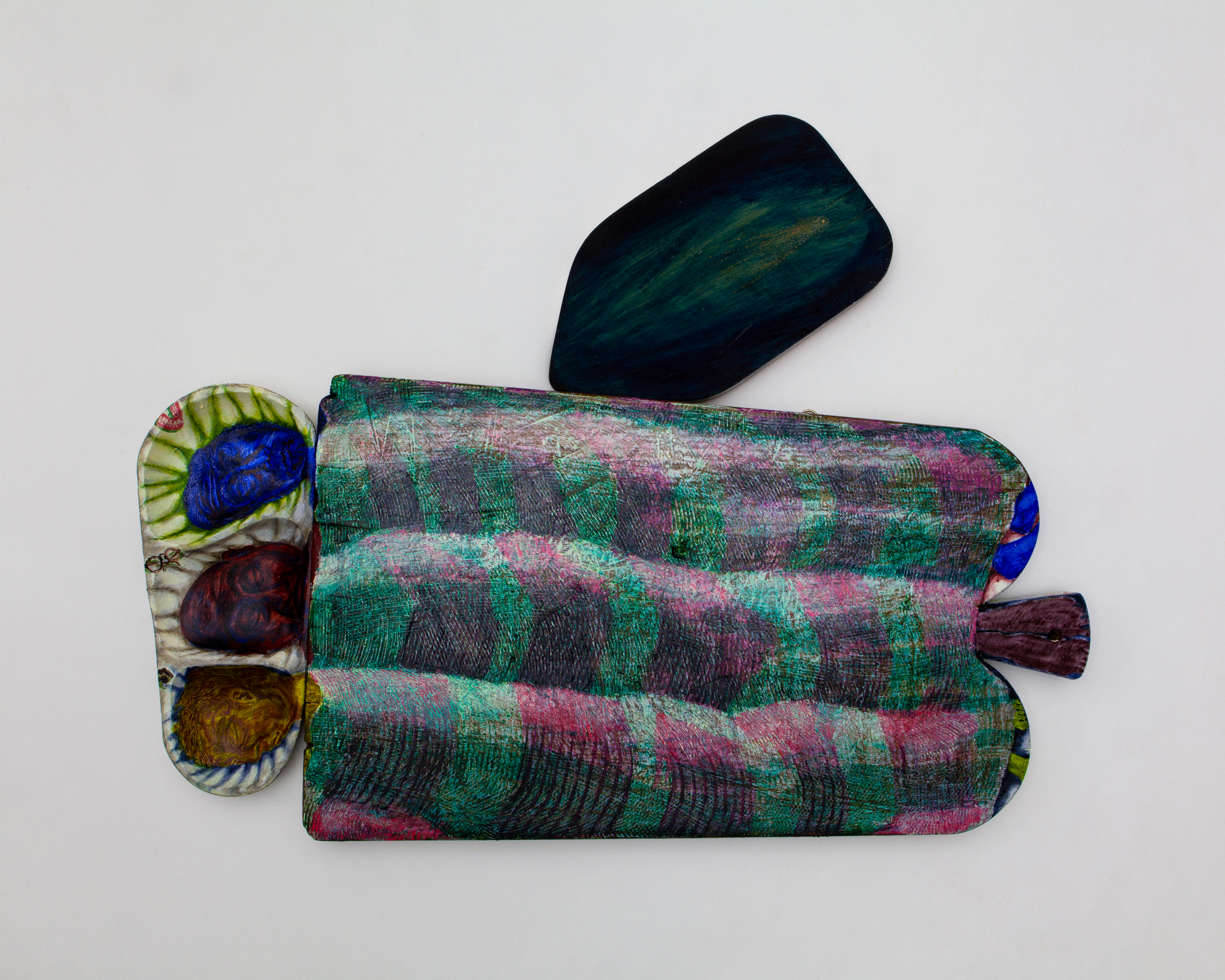
Advent Station 7: The Magi Dreaming

Advent Station 7. The Magi Dreaming
Mark Cazalet, Advent Station 7: The Magi Dreaming, 2024

Having followed a star to Jerusalem from their home back east, the magi enter the court of Herod to inquire where they can find the newborn king of the Jews whom the star heralds, to pay him homage. Herod hadn’t heard of such a king, but immediately he feels threatened—“king of the Jews” is his title—and, unbeknown to the visiting dignitaries, decides to crush this young rival. After consulting with Jewish scholars, he discerns Bethlehem as the birthplace. He divulges this information to the magi and asks them to report back once they’ve found the child so that he, too, can honor him. He hides his true motive under a lie.

The magi have a transformative encounter with Jesus in Bethlehem. Falling asleep after that momentous day, they receive a warning from God not to return to Herod. So they avoid him on their way back home.

As in medieval visual treatments of the Dream of the Magi, Cazalet has the magi sharing a bed. (There’s nothing salacious about it—it’s just a compositional practicality, to show the three men in one space, having the same dream at the same time.) Their toes peep out from under the covers. That surface, by the way, is flat—Cazalet skillfully creates the illusion of convexity through painting, suggesting bodies underneath.

Beside the magi’s heads are three small personal objects: earbuds, glasses, and dentures, which allude to the proverbial principle “See no evil, hear no evil, speak no evil.” “I was musing if this trinity of pilgrim searchers were perhaps aspects of the one true pilgrim, parts of a single whole disciple,” the artist told me.

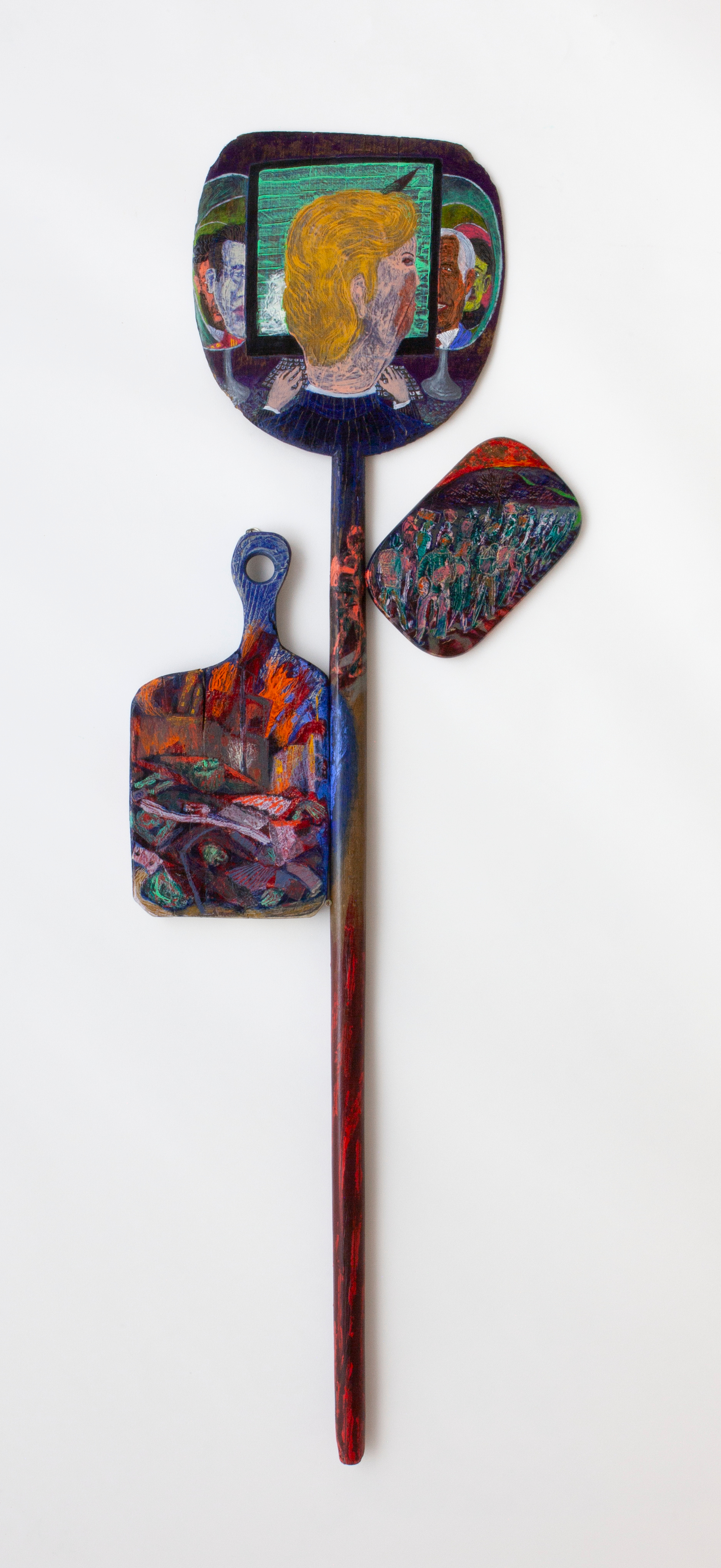
Advent Station 8: Herod Syndrome

Advent Station 8. Herod Syndrome
Mark Cazalet, Advent Station 8: Herod Syndrome, 2024

Thwarted by the magi, Herod fumes with rage. He will not be dethroned by this so-called messiah. So he orders his soldiers to kill all the boys in Bethlehem aged two and under, thinking that Jesus will be among them. In his self-obsession, he cares nothing for the good of the people; he cares only for the consolidation of his own power.

Station 8 is Cazalet’s modern take on the Massacre of the Innocents. At the helm of a computer keyboard is a presidential figure launching a missile on whomever he has deemed the enemy, while other likeminded autocrats—I believe that’s Saddam Hussein, Kim Jong Un, Vladimir Putin, and Adolf Hitler—look over his shoulder approvingly, their faces reflected endlessly in mirrors using a technique called mis en abyme (“put in the abyss”). This panel, the transferring surface of a baker’s peel, sits at a height to emphasize the pompousness of rulers like Herod, who see themselves as above others and above the law.

Such an attitude can have dire consequences. “Below we see the devastation of a civilian population, defenceless against the technological onslaught,” Cazalet describes, “and the perpetual streams of migrants fleeing who knows where to be vilified as more foreign mouths to feed.”

The power mania that gripped Herod, that led to his lashing out in violence, is still alive and well today in national and global politics.

Advent Station 9: The Flight to Egypt (Forced Migration)

Advent Station 9. The Flight to Egypt (Forced Migration)
Mark Cazalet, Advent Station 9: The Flight to Egypt (Forced Migration), 2024

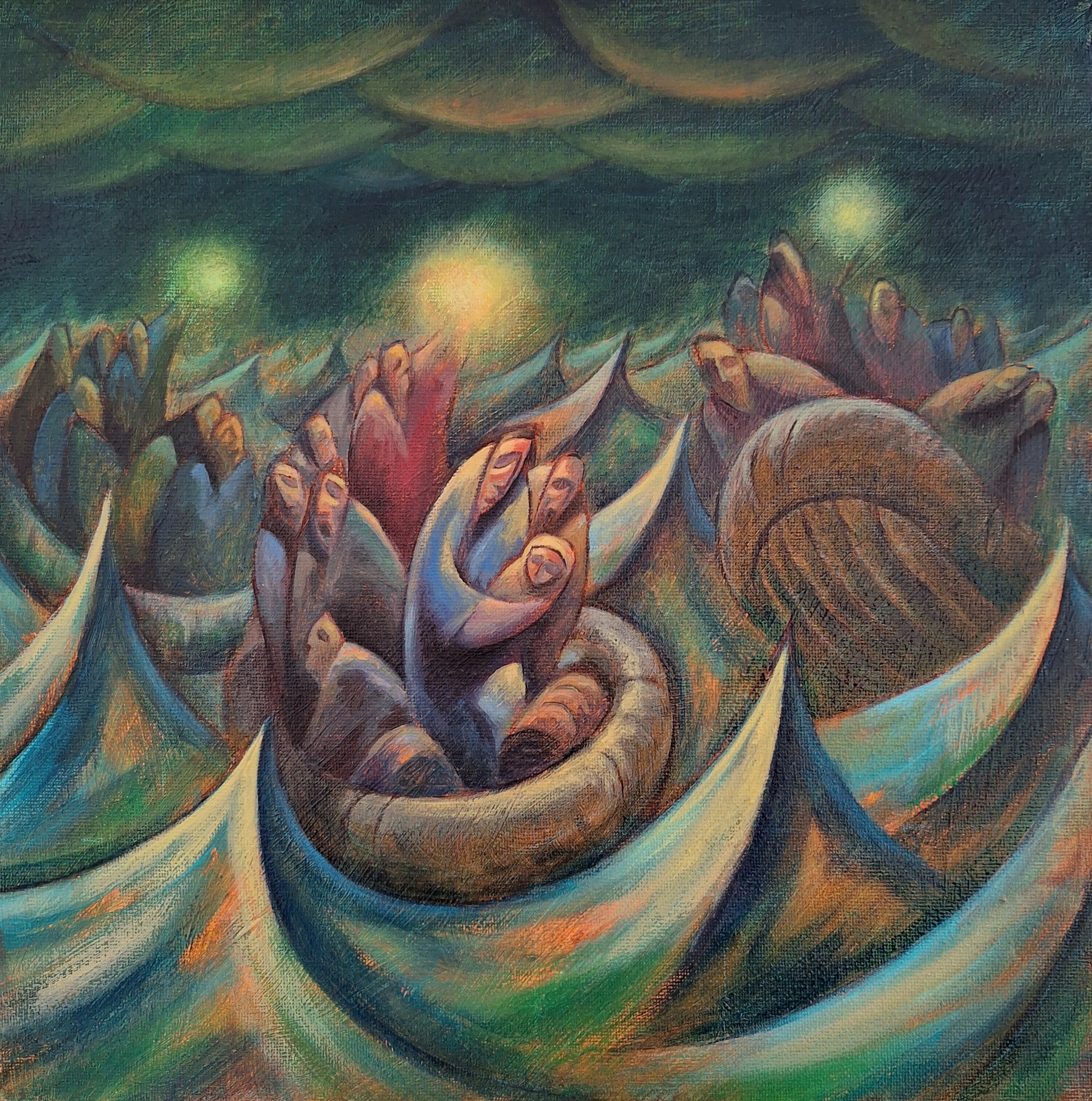
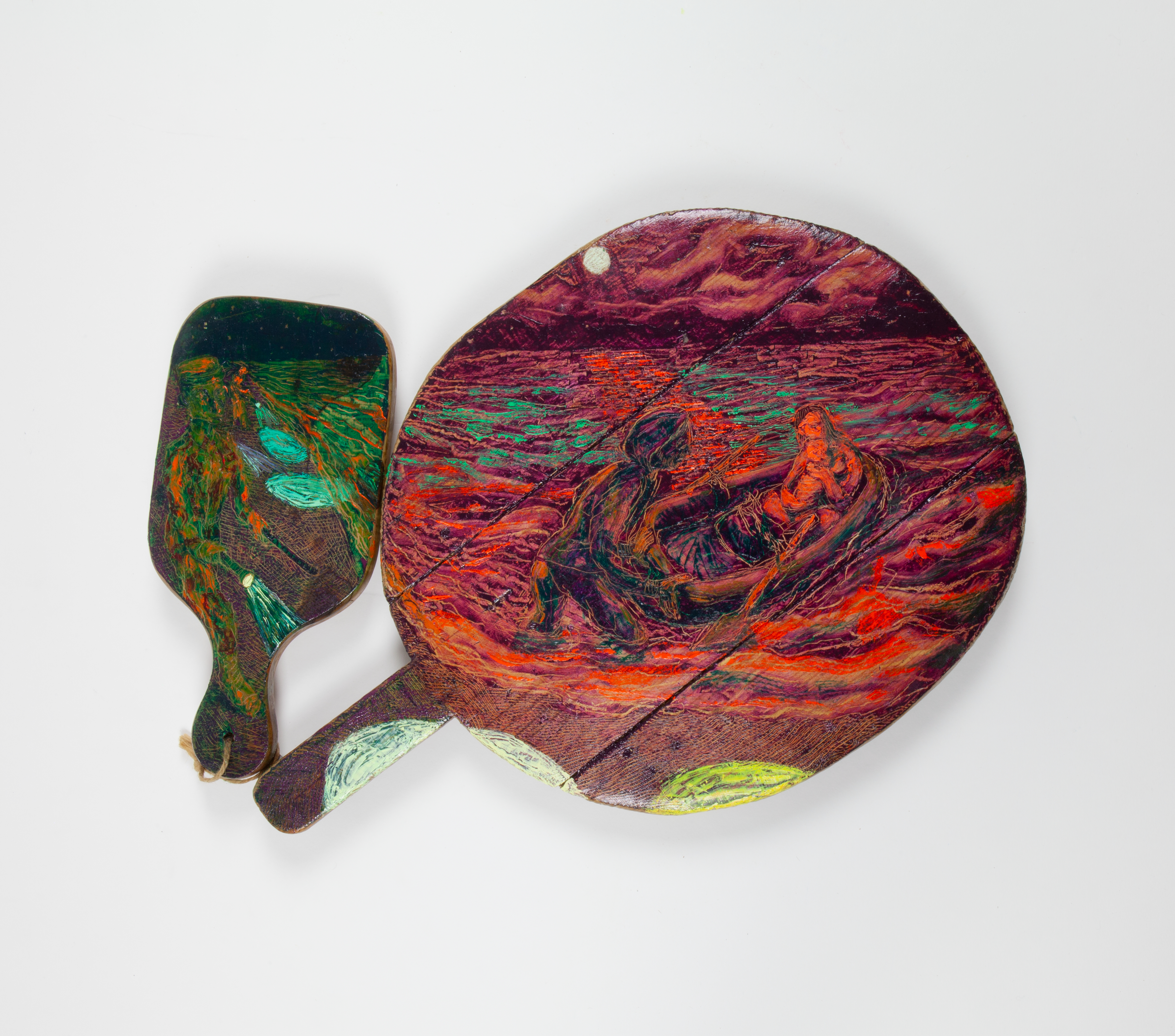
To protect their son from Herod’s murder decree, Mary and Joseph flee with him across the border to Egypt. Cazalet reimagines their flight through the lens of today’s refugee crisis. In station 9, the Holy Family boards an inflatable raft, braving choppy seawaters in search of asylum. They’re bathed in a menacing red.

On the adjoining panel, border patrol officers, with flashlights and batons, stand on the shore, seeking to bar the entry of strangers into their land.

Advent Station 10: The Exiles Return

Advent Station 10. The Exiles Return
Mark Cazalet, Advent Station 10: The Exiles Return, 2024

Egypt grants refuge to the Holy Family, and they settle there for an undisclosed period of time—until Joseph receives word from an angel that it’s safe to return to their homeland.

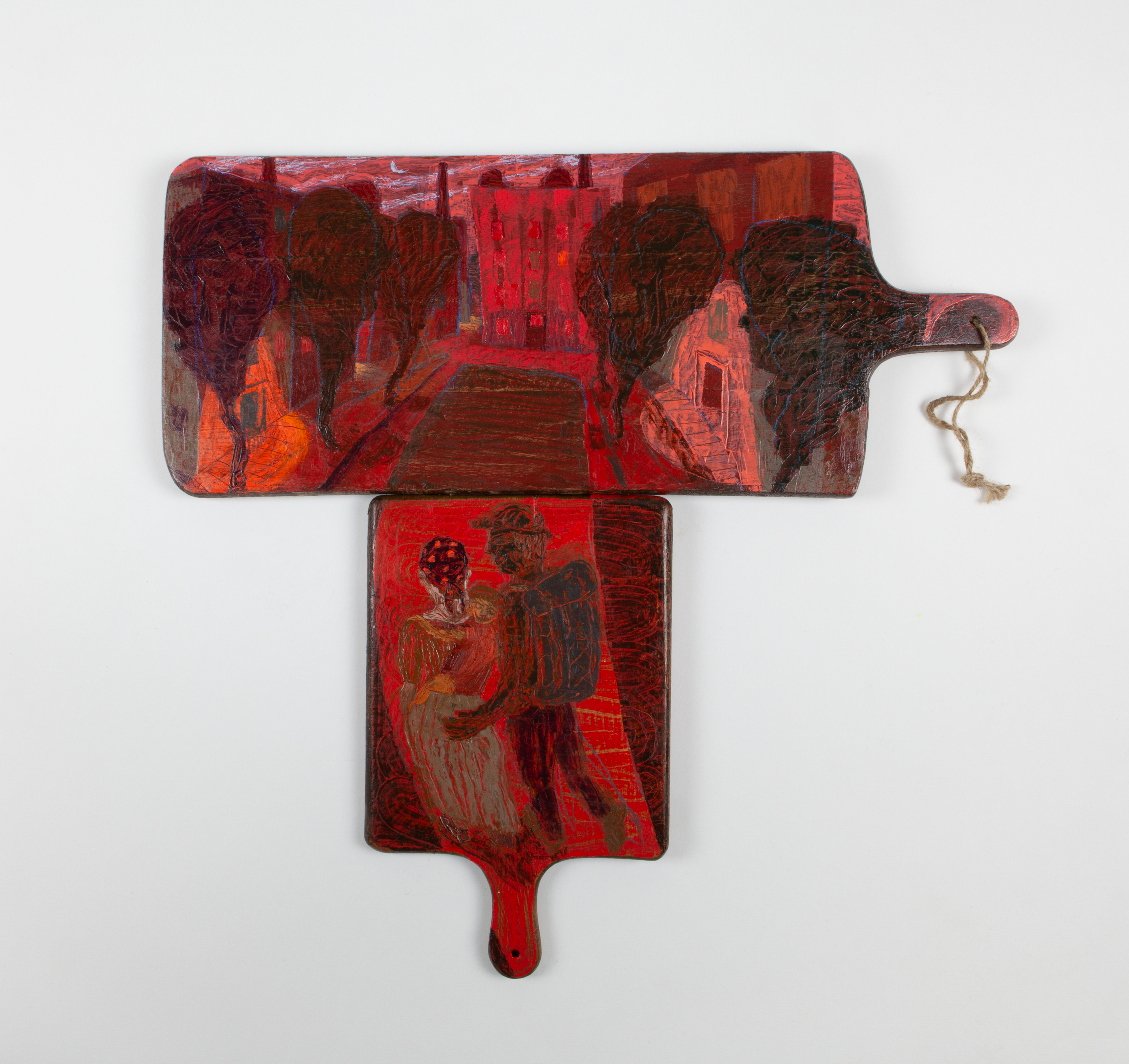
Station 10 shows the family arriving at sunset in their beloved Nazareth, all their belongings reduced to what could fit in a single backpack. As they approach a tree-lined boulevard, Jesus clings to his mother’s back, looking behind at where they’ve come from. He has not yet known this town but will come to love it. He will call it home until his ministry beckons him beyond it more than two decades later.

Advent Station 11: Faithful Waiting and Watching (Anna and Simeon)

Advent Station 11. Faithful Waiting and Watching (Anna and Simeon)
Mark Cazalet, Advent Station 11: Faithful Waiting and Watching (Anna and Simeon), 2024

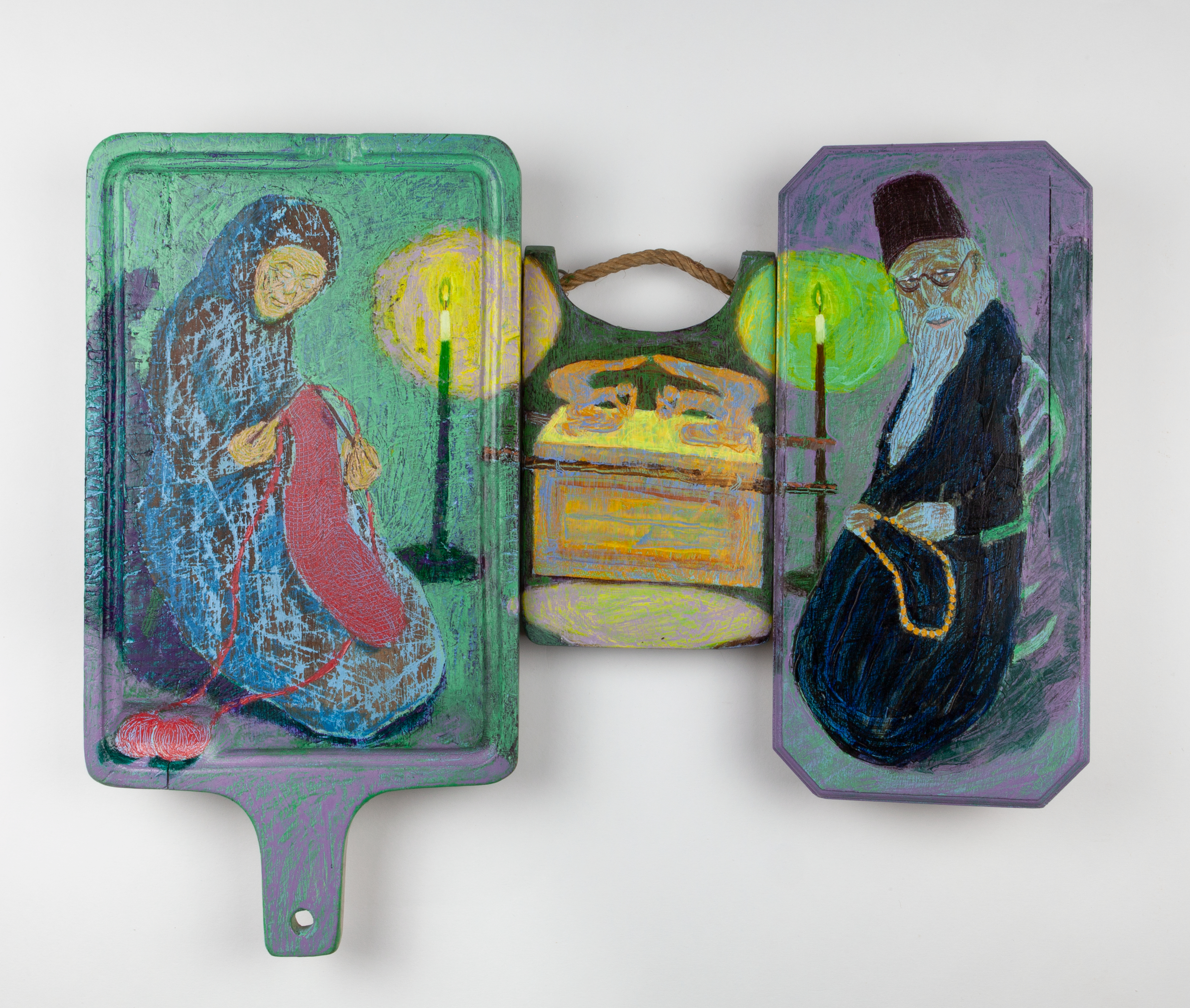
This is my favorite of all the stations. While the Presentation of Christ in the Temple is standard fare in Christian art—showing Mary handing Jesus to Simeon, a devout Jew interpreted by most artists as a priest, forty days after Jesus’s birth, with Joseph and the prophet Anna standing off to the side—Cazalet isolates the elderly Anna and Simeon, zeroing in on their faithful act of waiting for the Messiah.

Illuminated by candlelight, Anna knits a scarf, communing with God in the solitude, while Simeon fingers a string of prayer beads. Their eyes are weary and downcast, and yet they possess a steadfast hope that their Savior is on his way.

Linking their two spaces is the ark of the covenant, a sacred wooden storage chest plated in gold and topped by two hammered-gold cherubim. Containing the tablets of the law, Aaron’s rod, and a pot of manna, the ark was kept in the holy of holies, the innermost sanctum of the temple, where it signified God’s presence.

Waiting can often feel useless—like nothing’s happening or will ever happen. But Anna and Simeon continued to wait on the Lord, to count on his promise. And finally, before they died, they were granted the grace to see and to hold the One they had so fervently longed for: the Christ, Emmanuel, “God with us.”

Advent Station 12: The Mistle Thrush Greets the New Day

Advent Station 12. The Mistle Thrush Greets the New Day
Mark Cazalet, Advent Station 12: The Mistle Thrush Greets the New Day, 2024

The Advent path we’ve just walked has included an unplanned pregnancy, persecution, and displacement but also miracles, play, and surprise.

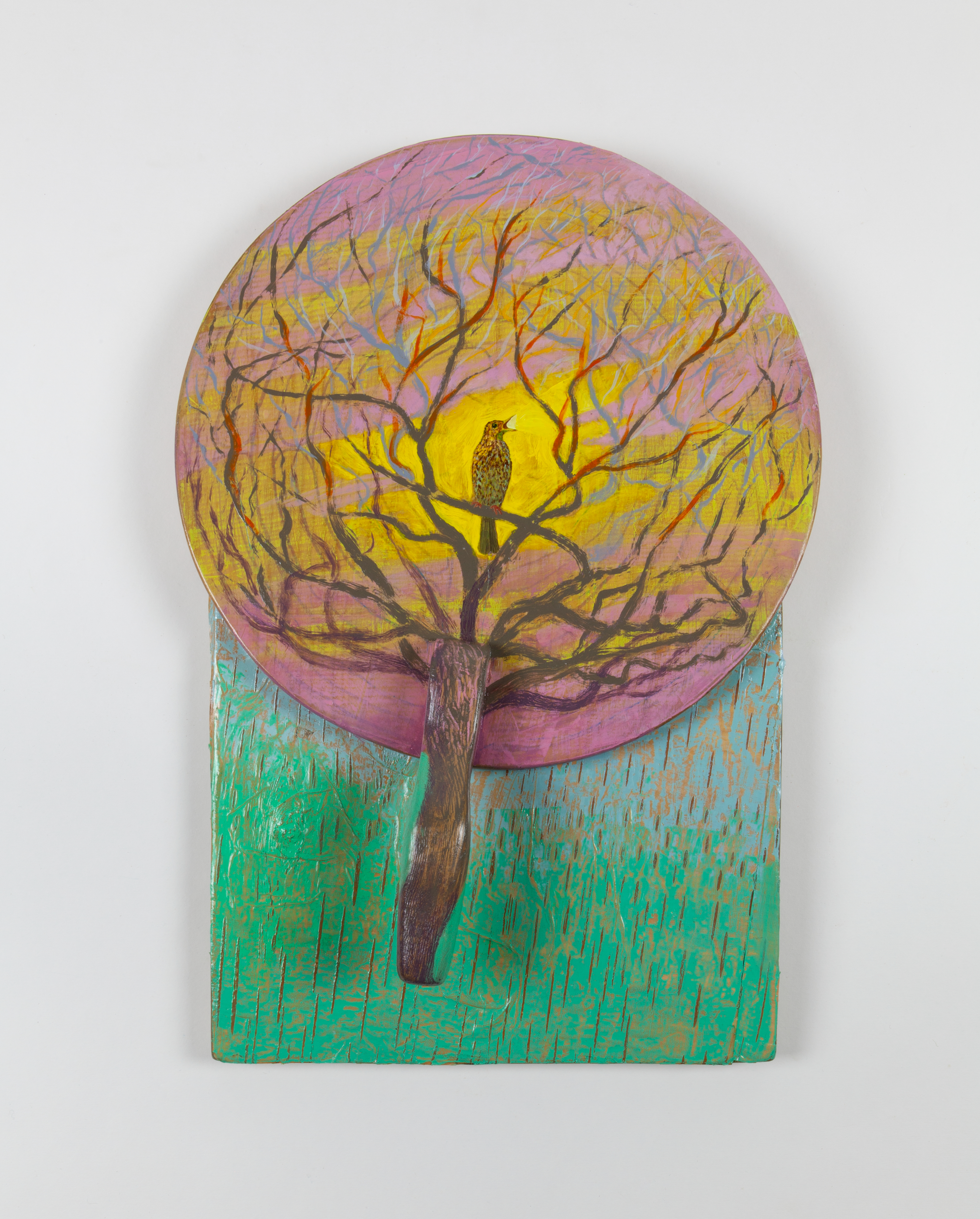
Cazalet’s Advent Stations end with a bird in a tree, singing its heart out as a pink and yellow dawn spreads across the sky. The twisted branches become streamers, blowing as if in celebration. (There’s that breath of God again!) Out of the bird’s beak shoots light.

The board that forms the grassy ground is incised with knife marks, perhaps suggesting woundedness—although maybe it’s a turning over of the soil to promote new growth.

The flame-like hues in and around the tree evoke the burning bush of Exodus 3, from which God spoke his name: I AM THAT I AM.

This Advent tree, bare yet lively, calls us to embrace each new day as a gift from the One who is and was and is to come, remembering how Christ came to show us who God is and to feel and heal our brokenness, and he will come again to make all things new.


The Advent Stations by Mark Cazalet, with accompanying poems by Richard Leaf rendered in calligraphy by Pansy Cambell, are on display at Chelmsford Cathedral in eastern England through February 2, 2026. They are available for sale, but until they’re purchased, Cazalet wants to show them in other churches and cathedrals. They’re tentatively scheduled for exhibition in Southwark Cathedral in London during Advent 2026.

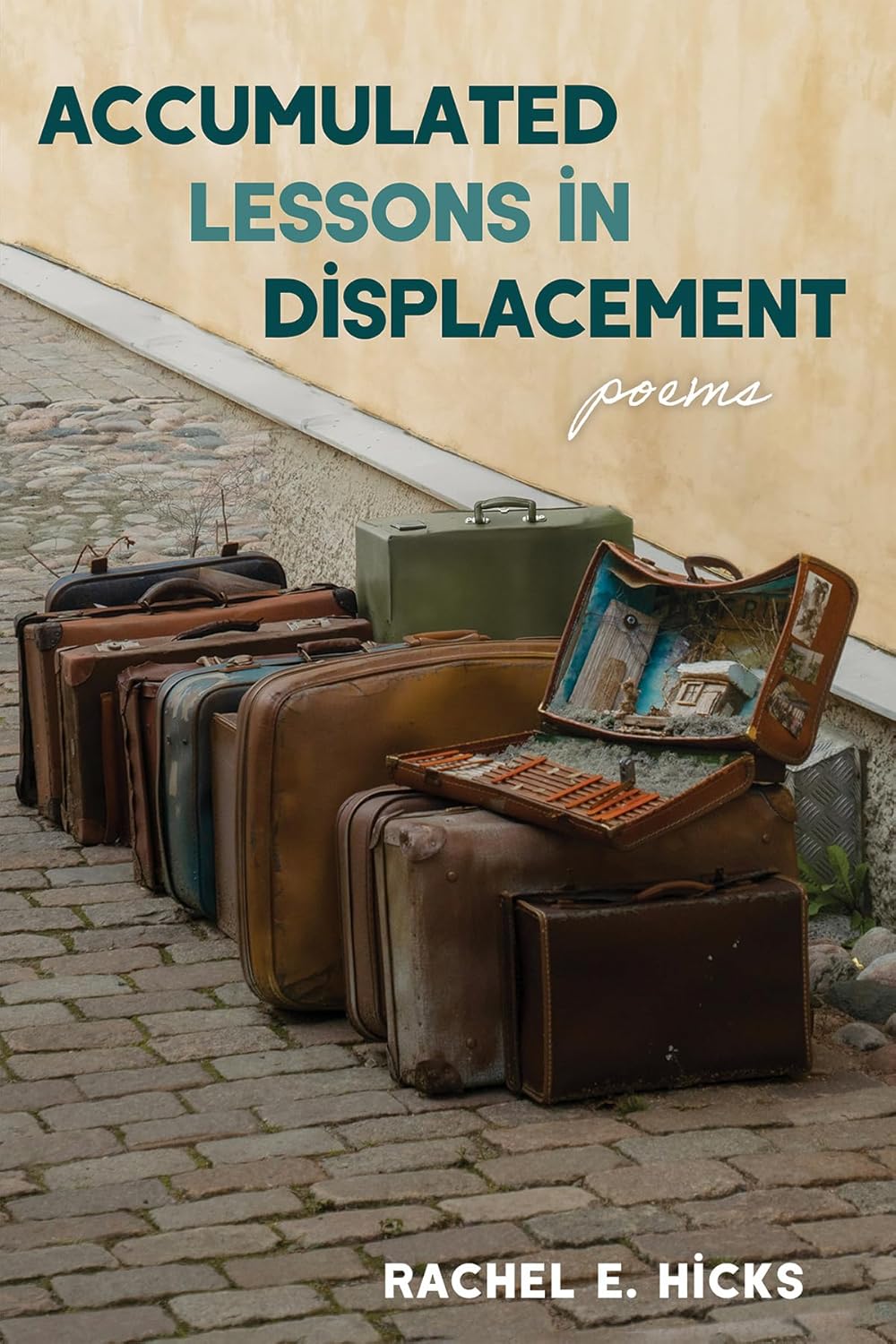
Book Review: Accumulated Lessons in Displacement: Poems by Rachel E. Hicks

. . . each day a misery and a marvel, each person also.

—Rachel E. Hicks, from “Accumulated Lessons in Displacement”

A white American born in the foothills of the Himalayas to international school educators, Rachel E. Hicks is a second-generation third-culture kid (TCK) whose writing reflects decades of living as a global nomad, exploring themes of memory, connection, suffering, exile (both physical and spiritual), hospitality, and hope. She grew up in six countries—India, Pakistan, the United States, Jordan, the Democratic Republic of the Congo, and Hong Kong—and spent seven years as an adult in Chengdu, China, where she worked for the relief and development organization Food for the Hungry.

In 2013, she, her husband, and their two kids repatriated to the US, settling in Baltimore, where they live today. Hicks has lived in Baltimore longer than in any other city. But even with this rootedness, “the soil of each place in which I’ve lived still clings,” she says.

Accumulated Lessons in Displacement

In her debut poetry collection, Accumulated Lessons in Displacement (Wipf & Stock / Resource Publications, 2025), Hicks grapples with the experience of being a “perpetual pilgrim”—on her way to a particular place but also attuned to the significance of each moment along the way. “Pilgrims learn to walk a life of paradox: even though their hearts are set on their final destination, they walk through each day alive to its possibilities, people and lessons,” she wrote in a 2014 blog post.

What is “home”? How can we bear to leave home, whether forced to do so by war, famine, or natural disaster, or we choose to for opportunity or ministry? What do we do with feelings of alienation when we find ourselves in a culture not our own or in which we don’t fit well? How do we live cross-culturally? How do we make a home where we’re at? What are our responsibilities to place? Who is our neighbor?

“I believe that many—all?—of us live our lives with some sense of exile,” Hicks writes on her blog. “We experience it and are aware of it to varying degrees, but it’s there. So many of our quests, our longings, our purpose-seeking, and the stories we create and tell are about trying to find our way home. Home being that place—literal or figurative—in which we feel wholeness and true belonging.”

Accumulated Lessons is divided into two parts: “Bright Sadness, Bitter Joy” and “A Deeper Knowing.” The term “bright sadness”—a translation of the Greek word charmolypê—comes from the Eastern Orthodox tradition, and it describes the paradoxical state of mourning over sin while rejoicing in God’s grace. It can also describe the paradox of living a life of joy amid suffering.

I was trying to learn the word for joy

that settles awkwardly in grief’s nest, an oversized bird.
I didn’t want to scare it away.

So says the speaker in the book’s title poem, “Accumulated Lessons in Displacement.” Unfolding over eight sections, this persona poem draws on Hicks’s own experience of abrupt displacement from Kinshasa as a teenager, as well as the experiences of Bosnian refugee friends, and Syrian refugees she had only read about in the news.

It opens with a reflection on “home” in all its ordinariness—the yellow coffee cup, the dusty houseplant, the sunlit window seat—and laments that “no footpath exists leading back to these things,” which, the reader is led to presume, have been destroyed by armed conflict, or its residents blocked from returning by threat of death.

The poem contains several arresting images, like the green threads of a sweater on barbed wire tracing a path across miles. A boy who collects bullet casings to make a necklace for his sister. Charred diary pages dancing around a blown-out living room, “ma[king] a strange poem in my heart.”

Hicks wrestles with the savage violence humans are capable of:

It makes no sense that a soldier can press a button

and somewhere a baby ignites into flame.
And he goes home and brushes his teeth.

What we do to each other, to other created souls.
Always I carry this burden like a child on my hip.

Another powerful poem in the collection is “Visit to Sarajevo,” where Hicks describes visiting the Bosnian-Herzegovinan capital with her friend Dragan, who was forced to flee it as a young married adult with a child in the 1990s after the city was besieged by Serbian forces. Hicks had met Dragan and his family in 2000 through her husband, Jim, who worked alongside him at a refugee resettlement agency in Phoenix, Arizona, and the families became close. Meeting up years later in Dragan’s hometown, Dragan leads Hicks through the once-familiar streets “in a haze of pride, nostalgia, nightmare,” giving her a tour of sites both historically significant and deeply personal.

Hicks’s passport country too has its national traumas, one of which was precipitated by 9/11, when in 2001, terrorists flew planes into the World Trade Center in New York City, killing almost three thousand people. In “Disaster Chaplaincy Training,” she describes a course she took, taught by a Ground Zero worker, to become further equipped for her work in China, which was focused on disaster preparedness and response. In the course, she learned how to “loiter with intent” in zones of disaster, “acclimat[ing] to [suffering’s] pungency.” Make sure, said the instructor, to “let them see you cupping a small ball / of hope—toss it up, catch it.”

Nationwide crisis struck the US again when on April 12, 2015, a young Black man from Baltimore, Freddie Gray, died of a spinal cord injury while in police custody, allegedly due to police brutality—though none of the six involved officers was ultimately held responsible. Gray’s death led to civil unrest in Baltimore (which Hicks had recently made her home) and throughout the country, as citizens demanded recognition, in word and practice, that “Black lives matter.”

Hicks wrote “The Morning After Freddie Gray’s Funeral” while Baltimore was on lockdown. Fumbling for words, she tries to explain to her children what’s going on as she, too, tries to educate herself more deeply about the history of racism in America and the longstanding grievances of the Black community she lives in. In the poem, she harvests mint from her garden to brew a gallon of black mint tea to share with her neighbor—

             as what? An offering, apology?

A way to say I’m trying—learning
about all that fuels these fires still
smoldering this hushed morning?

The staining of the clear water as the tea steeps becomes a metaphor.

Accumulated Lessons in Displacement addresses global suffering, more localized suffering, as well as personal and family suffering.

One example of the latter has to do with Hicks’s daughter’s diagnosis, following an ankle sprain, with complex regional pain syndrome (CRPS), Ehlers-Danlos syndrome (EDS), and postural orthostatic tachycardia syndrome (POTS), chronic conditions that cause extreme nerve pain. “Bright Sadness” describes a return car ride from a fruitless medical visit, her daughter crying and gasping in agony in the back seat, when offhandedly, Hicks insists, “Turn your cries into opera!” This unexpected and ridiculous suggestion defuses, if for just a moment, the intense situation, resulting in “joy-laughing” amid plaintive contralto tones all the way home.

“Post-Miracle (I)” celebrates her daughter’s miraculous healing, holds the strange, tentative, empty-handed feeling of a fervent prayer request graciously granted. But then comes “Post-Miracle (II),” written when, after two months of her daughter being pain-free, the CRPS returned. Hicks wrestles with gratitude for the brief reprieve and anger at God’s “undoing” the miracle. She wonders about some of the healings Jesus performed in the Gospels, and whether they stuck.

“Post-Miracle (II)” is one of the few poems in the collection with end rhyme, each quatrain following an abba pattern. Perhaps the choice to work with a rhyme scheme for this particular subject represents, consciously or subconsciously, her attempt to make things rhyme again, to harmonize the reality of chronic pain with a good and loving God, to impose structure on the chaos.

Several of Hicks’s poems engage with biblical stories: the Suffering of Job, the Parable of the Prodigal Son, the Massacre of the Innocents, Zacchaeus encountering Jesus, the Walk to Emmaus. She performs poetic midrash, imaginatively interpreting and expanding the texts to connect with them on a deeper level.

Besides the biblical authors, some of her literary conversation partners in this collection are Frederick Buechner, Henri Nouwen, Simone Weil, Czesław Miłosz, Dostoevsky, G. K. Chesterton, Gregory of Nyssa, Paul Kingsnorth, and Karen Blixen.

Although there’s a heaviness to much of the material, it’s not overwhelming, as small graces are woven throughout: complimentary walnuts from a fruit shop owner on a winter Sunday; laughter over language barriers; refreshment from a water hose; the scent of turmeric and cardamom at a Punjab store in Baltimore, reminders of the poet’s birthplace; “the comfort of the priest’s thick thumb / upon my forehead, the signature of / Jesus,” on Ash Wednesday; dandelions and buttercups brushing ankles; a cairn at West Clear Creek; the monks at Great Lavra, Greece, making room for the dispossessed; bundles of sheep ascending limestone slopes at dawn in the Cotswolds; the delightful word cusp; her son’s euphoria upon gliding down a mountain on skis; the slow labor of opening a pomegranate and obtaining its ruby-red seeds for her daughter to eat.

The book is shot through with joy—a joy that coexists with suffering and that is sustained through faith.

“These are poems to live by—to help you stay human, love people, find joy in sorrow, pay attention to the world around you, open yourself to God, welcome mystery, and understand our times at a deeper level,” Hicks wrote in an email announcing the launch of the book. “You’ll journey all around the world and find it—in spite of its sorrow—full of beauty and worth loving.”

One of my favorite poems is “Just Before,” a perfect reading for the upcoming Advent season. It spans four cities of the world—places where people work, play, pray, and rest; places of economic disparity, of spiritual longing as well as mundane concerns—in each imagining the moment just before Jesus returns. In the midst of our threshing corn or lighting a lamp or settling a legal dispute or herding sheep, Jesus will come with a beauty that blossoms all the way out to the horizon, calling all nomads home.

“Just Before” by Rachel E. Hicks

When Jesus comes again
in all his glory, somewhere in
the Sichuan mountains tires will crackle
over corn spread out on the road—
easy threshing—while a small child
urinates in the gutter, absorbed
in watching the car shoot by.

As the first rent opens
a fingernail tear in the hazy sky,
a woman in the foothills above Rishikesh
will lay down her firewood burden
and light the clay Diwali lamp
in the chilling dusk,
circling her cupped hands in blessing.

In the pause before the clamor
of heaven’s trumpets,
the jurors’ waiting room in Baltimore’s
civic court will throb with the quiet
turning of pages, a buzzing phone
in the hand of a tired man, berating
himself for forgetting to bring coffee.

Just before we are aware of him,
Jesus will pause to survey the view;
two shepherd boys amidst boulders
in the Wadi Rum hills south of Amman
wipe sleep from their eyes and stand amazed
at the blood-red poppies at their feet
stretching to the eastern horizon.


Purchase Accumulated Lessons in Displacement here. (Update, 11/14/25: Wipf & Stock is offering a 50% discount through November 30, 2025; use code CONFSHIP at checkout. Media mail shipping is free.)

“Just Before” is reproduced with permission from Wipf and Stock Publishers, www.wipfandstock.com.

Art at the United Nations Headquarters in New York

Chagall’s Peace Window is one of the most significant works in the United Nations’ art collection. On my quick visit to New York City last month, where the UN is headquartered, I was hoping to see it, but I emailed ahead of time and found out it’s not currently available for viewing due to construction behind it. (You can “see” it but not really, because it’s not lit, and there’s a tall plastic barrier in front.) I was disappointed, but I decided to visit the UN anyway, to see what other art I might find.

The United Nations was founded in 1945 for the purpose of preventing a third world war. Comprising 193 member states, the organization is committed to maintaining international peace and security, developing friendly relations among nations, and promoting social progress, better living standards, and human rights. Their motto is “Peace, dignity, and equality on a healthy planet.”

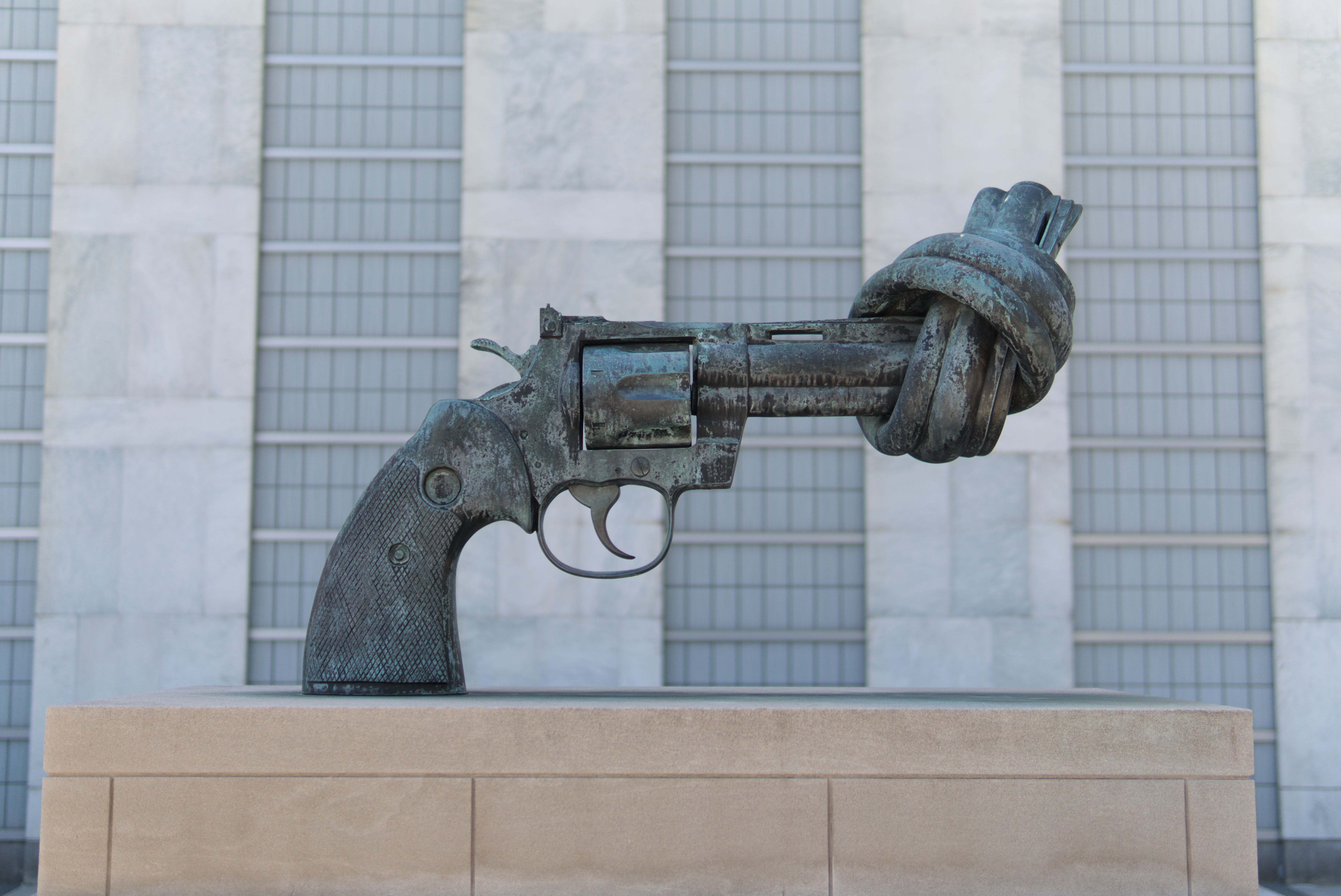
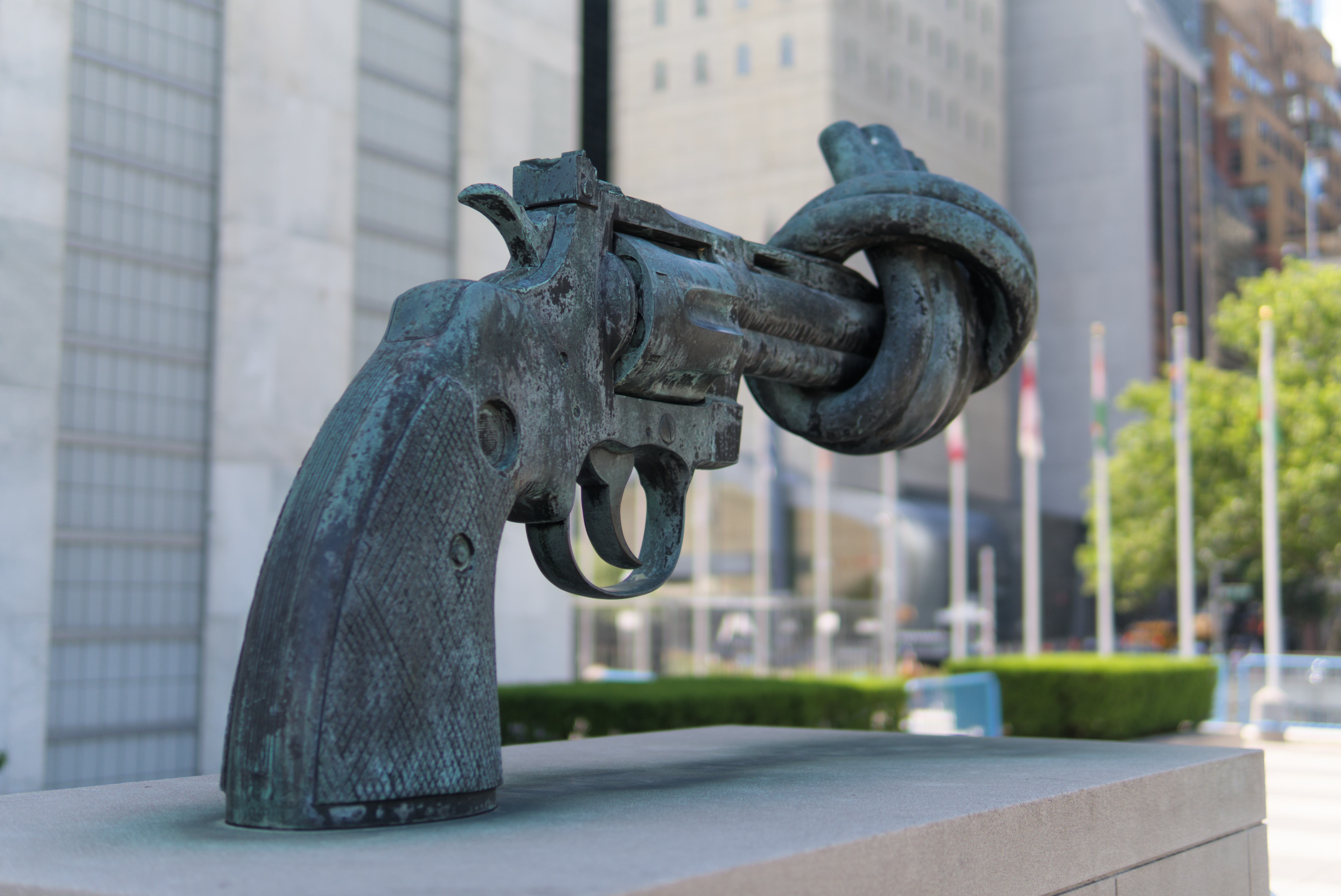
After presenting my ID, getting my photo taken, being stickered, and going through security, I was inside the campus and directed to the General Assembly Building. Outside the entrance to this building is the famous Non-Violence bronze, aka The Knotted Gun, by Carl Fredrik Reuterswärd of Sweden. The artist made the sculpture in 1980 after his friend John Lennon was murdered. He wanted to honor the singer-songwriter’s vision of a peaceful world.

Reuterswärd, Carl Fredrik_Non-Violence
Carl Fredrik Reuterswärd (Swedish, 1934–2016), Non-Violence, 1984. Bronze, 79 × 44 × 50 in. United Nations Headquarters (outside the General Assembly building), New York. Gift from Luxembourg. Photo: Victoria Emily Jones. [object record]

Reuterswärd, Carl Fredrik_Non-Violence

The original cast was first placed at the Strawberry Fields memorial in New York City’s Central Park, across the street from the Dakota apartment building where Lennon and his wife, Yoko Ono, lived, and where he was shot. But Reuterswärd worried it would be stolen there. In 1988, the Government of Luxembourg bought the sculpture and donated it to the United Nations, who installed it inside the gate of their New York headquarters.

Non-Violence is an oversize replica of a Colt Python .357 Magnum revolver with the barrel tied in a knot and the muzzle pointing upward, rendering the weapon useless. In his statement from 1988, Reuterswärd said, “Humor is the finest instrument we have to bring people together. While making my peace-symbol, I thought of the importance of introducing a touch of humor, just to make my ‘weapon’ symbolically ridiculous and completely out of order.”

Reuterswärd ultimately made over thirty additional casts of Non-Violence, which are publicly installed in cities such as Beijing, Beirut, Cape Town, Lausanne, and Mexico City.

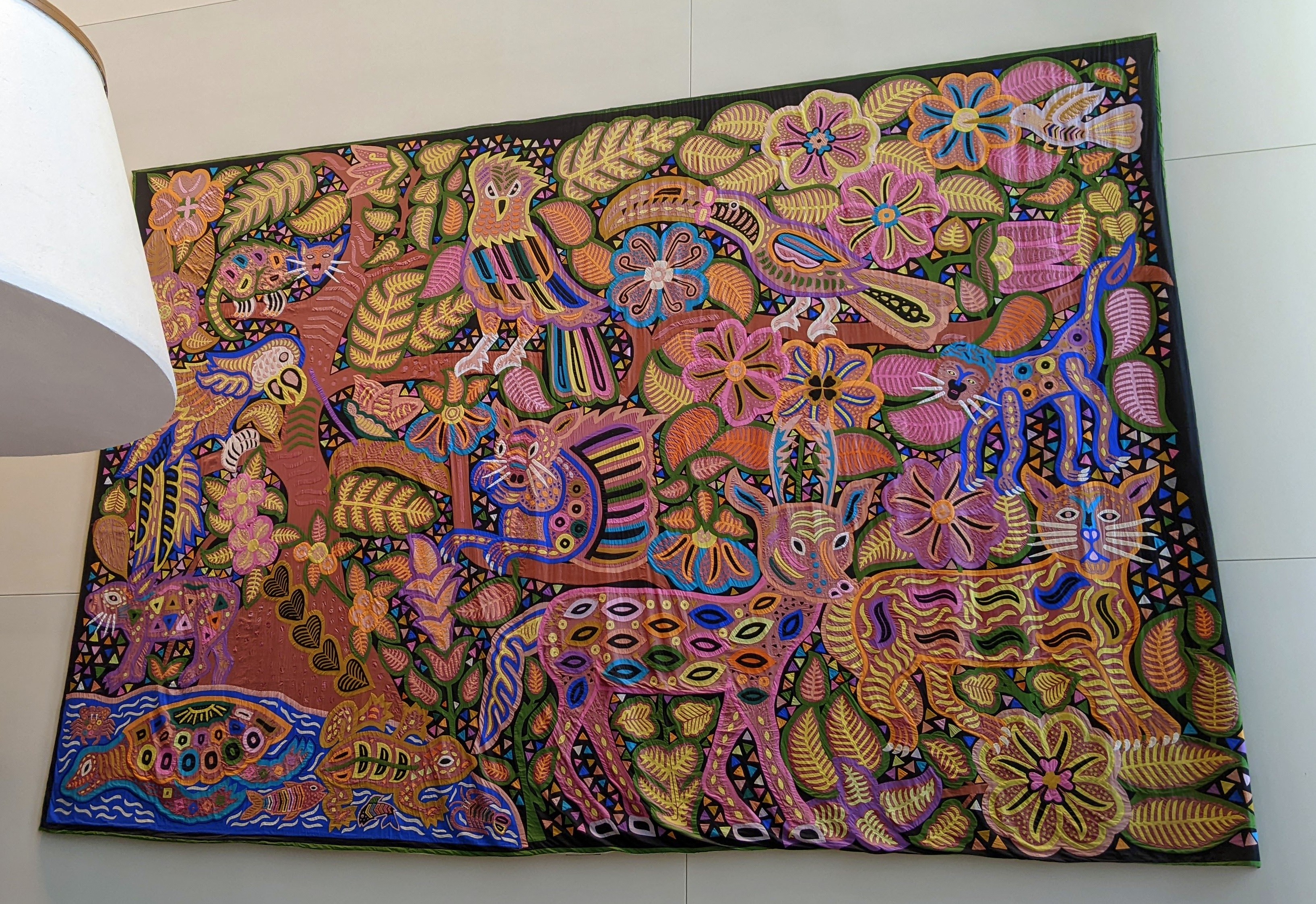
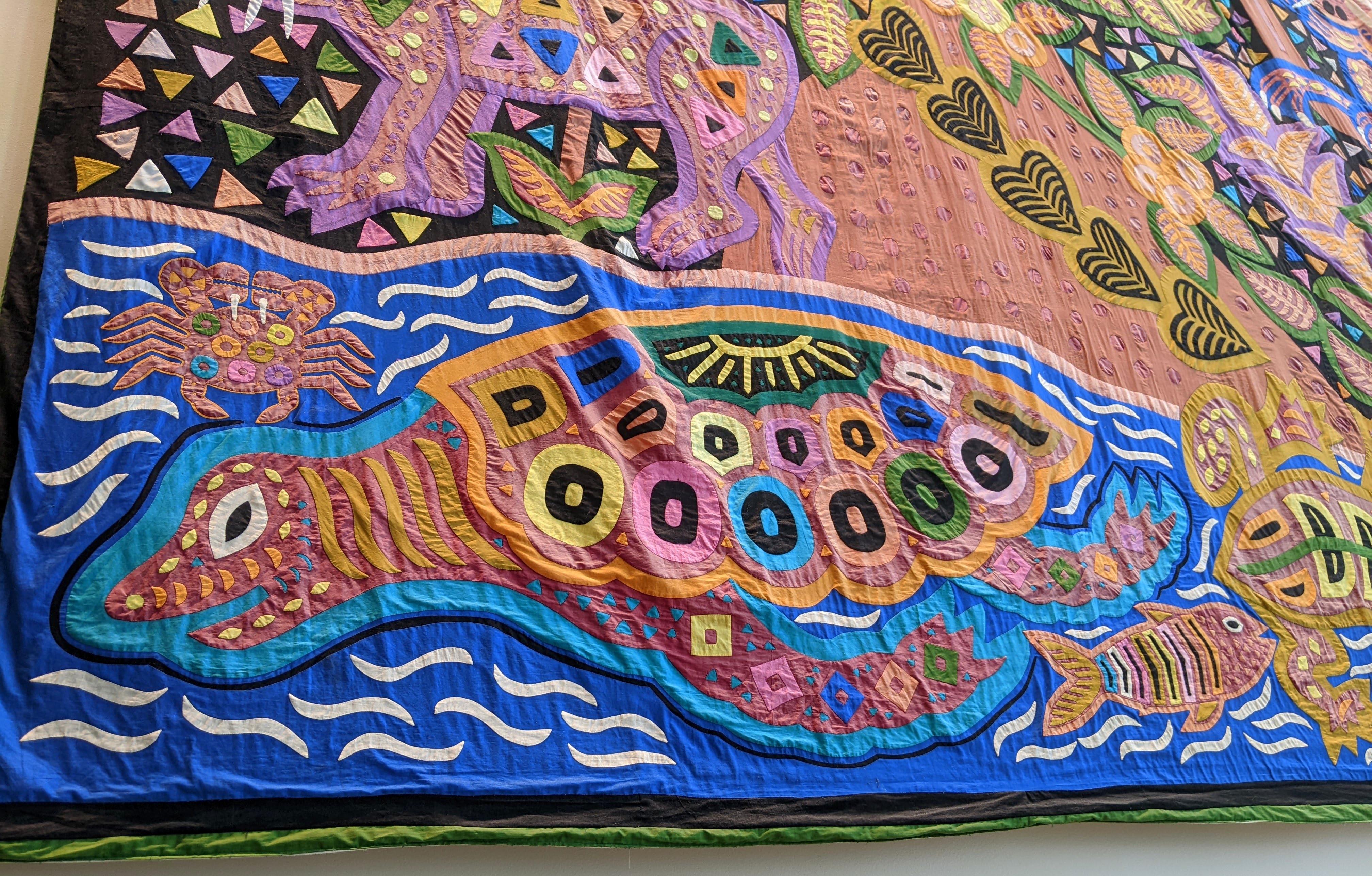
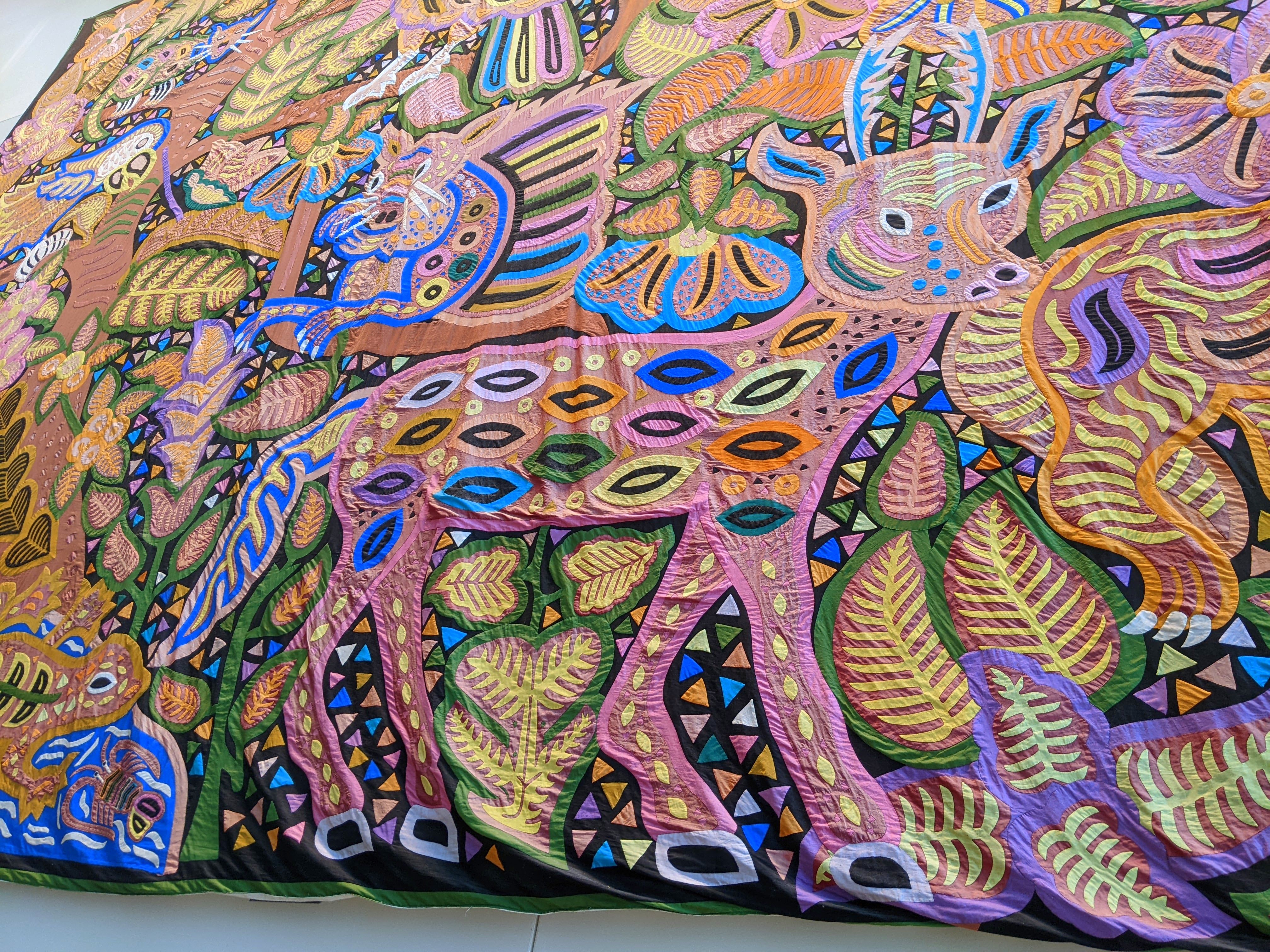
After spending some time with this iconic work, I entered the General Assembly lobby. What first caught my eye, on the right wall, was a monumental Mola Tapestry from Panama, made by unidentified Kuna women. (To learn about the art form, see my previous blog post from Lent 2022.)

Mola Tapestry
Mola Tapestry by the Kuna people, 1993. Reverse appliqué tapestry, 190 × 284 in. General Assembly Building, United Nations Headquarters, New York. Gift from Panama. Photo: Victoria Emily Jones. [object record]

Molas are made using a reverse appliqué technique, in which several layers of multicolored cloth are sewn together and then parts of each layer are cut out to form the design. These textile panels are traditionally made on a smaller scale and sewn onto women’s blouses, but as outside interest in them grew, local artisans started making some to be displayed as wall hangings.
This one shows a colorful array of indigenous flora and fauna, including a toucan, owl, hummingbird, monkey, turtle, frog, squirrel, rabbit, deer, and wildcat.

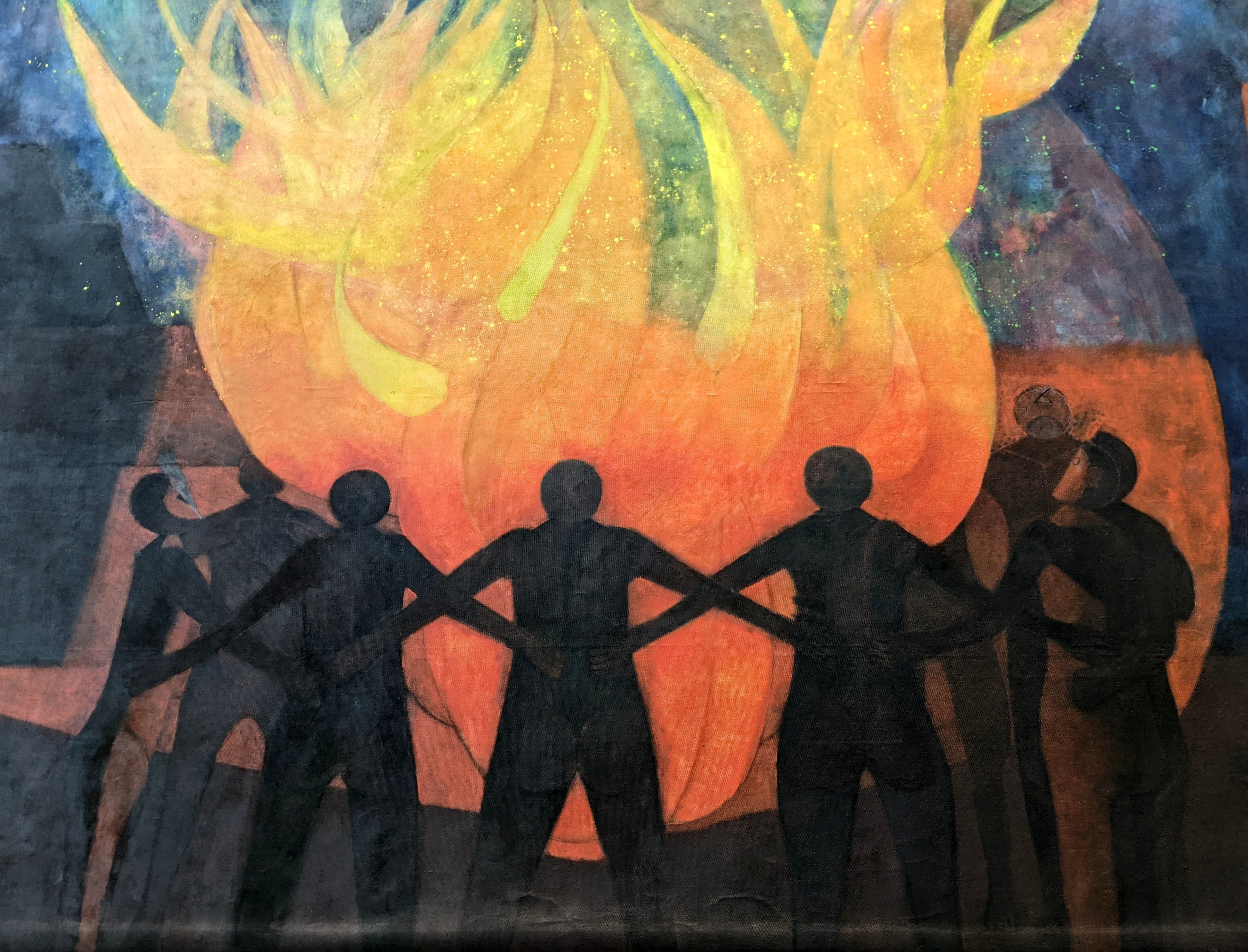
On the opposite wall is a nearly thirty-foot-long painting titled La Fraternidad (Brotherhood) by Mexican artist Rufino Tamayo [previously], which shows a group of people gathered around a fire with interlaced arms. The fire may represent enlightenment, knowledge and power, or the Divine Presence.

Rufino Tamayo (Mexican, 1899–1991), La Fraternidad (Brotherhood), 1968. Oil on canvas, 160 × 358 in. General Assembly Building, United Nations Headquarters, New York. Gift from Mexico, 1971. Photo: Victoria Emily Jones. [object record]

Tamayo, Rufino_La Fraternidad

At the left is an ancient Aztec or Mayan pyramid, whereas the structure at the right is modern. Tamayo said this shows the span of time, from the ancient era into the present and future.

From 2009 to 2014 the painting was on display at the Mexican state legislature, after which it was restored and returned to the UN.

Situated in front is a replica of an ancient Greek sculpture depicting Poseidon of Artemision, god of the sea, in an active stance. His right hand would have originally wielded a trident, representing his power. At first I thought it an odd choice for the UN to display an apparently militant figure, as Poseidon used his trident as a weapon to fight Trojans, Titans, and others, and indeed here he seems poised to deliver a death blow. But after some rudimentary research, I found that Poseidon also created life-giving springs with the strike of his trident (think Moses striking the rock with his staff), and used it to calm turbulent waters. These ameliorating acts align with the UN’s mission and make the Poseidon sculpture a fitting addition to their collection.  

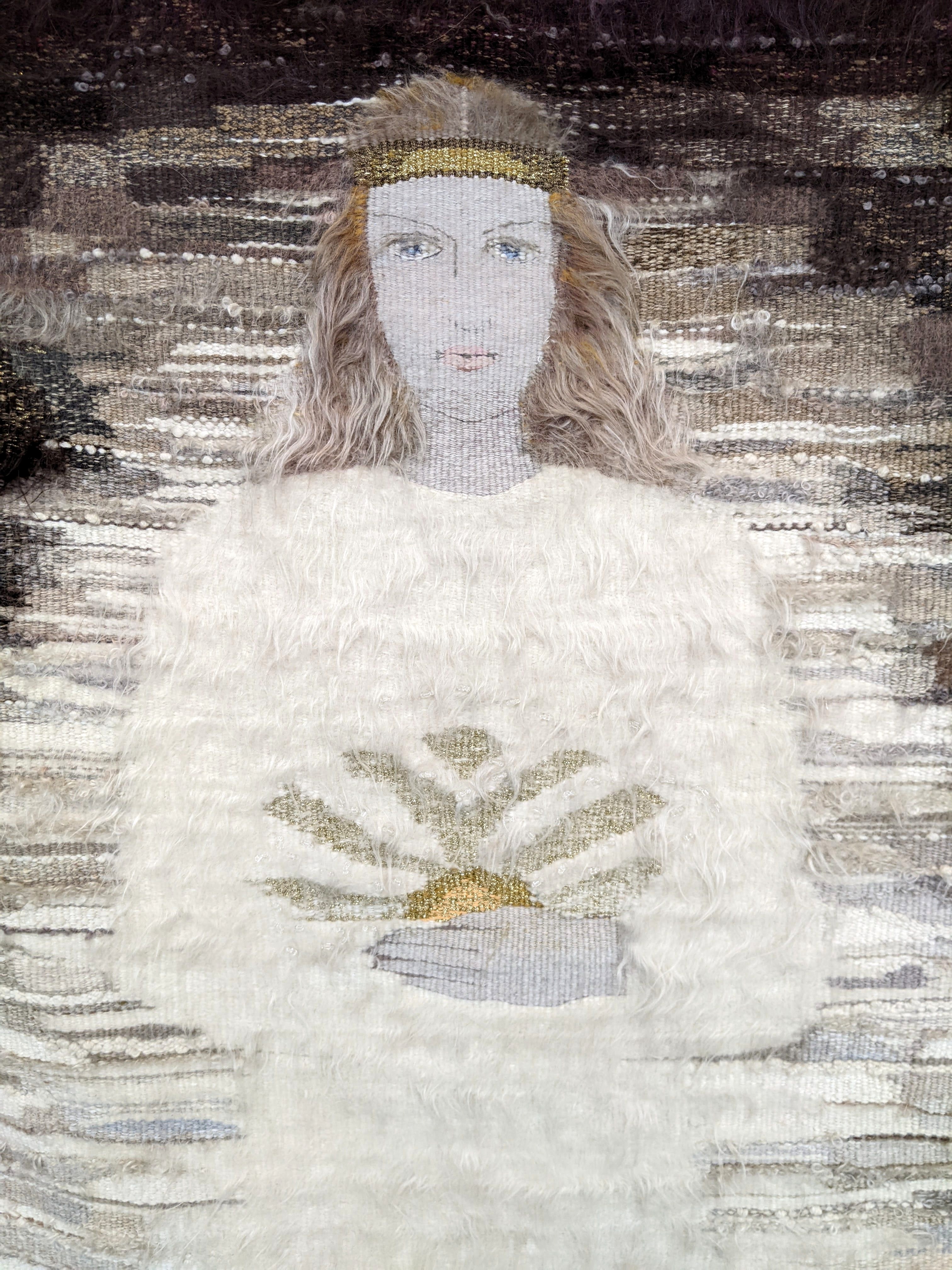
Also in the lobby is a wool tapestry from Latvia. Titled Hope, it’s by the well-known Latvian textile artist Edīte Pauls-Vīgnere.

Pauls-Vīgnere, Edīte_Hope
Edīte Pauls-Vīgnere (Latvian, 1939–), Hope, 1994. Tapestry, 126 × 114 in. General Assembly Building, United Nations Headquarters, New York. Gift from Latvia. Photo: Victoria Emily Jones. [object record]

Pauls-Vīgnere, Edīte__Hope (detail)

The female figure in the foreground is, I’m assuming, a personification of hope, dressed in a white gown and golden headband and holding the sun. She stands in front of the Freedom Monument in Riga, which shows Lady Liberty holding three gilded stars, symbolizing the three constitutional districts of Latvia.


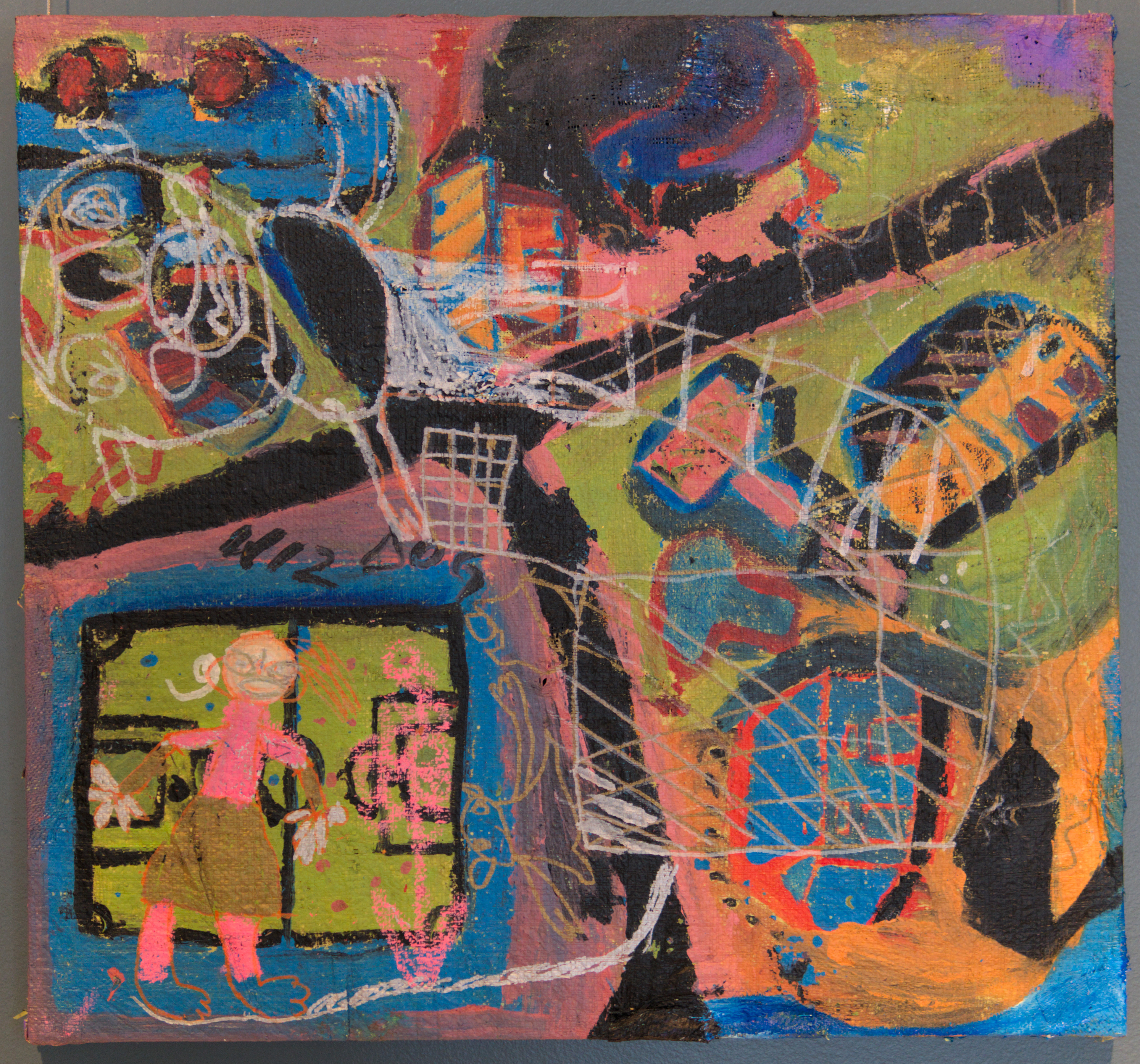
Deeper inside the lobby was a temporary exhibition, Interwoven: Refugee Murals Across Borders, organized jointly by UNHCR (the UN Refugee Agency) and Artolution. It opened on June 20, World Refugee Day, and will continue through July 19. The exhibition presents paintings by refugees and host communities in refugee camps, conflict zones, and crisis-affected communities across the world. These were created through a collaborative process in which the work circulated to different locations, with artists contributing additions at each stop. The end results show interwoven narratives of the diverse peoples forced to flee their homes. Themes include joy, lament, labor, empowerment, identity, and home.

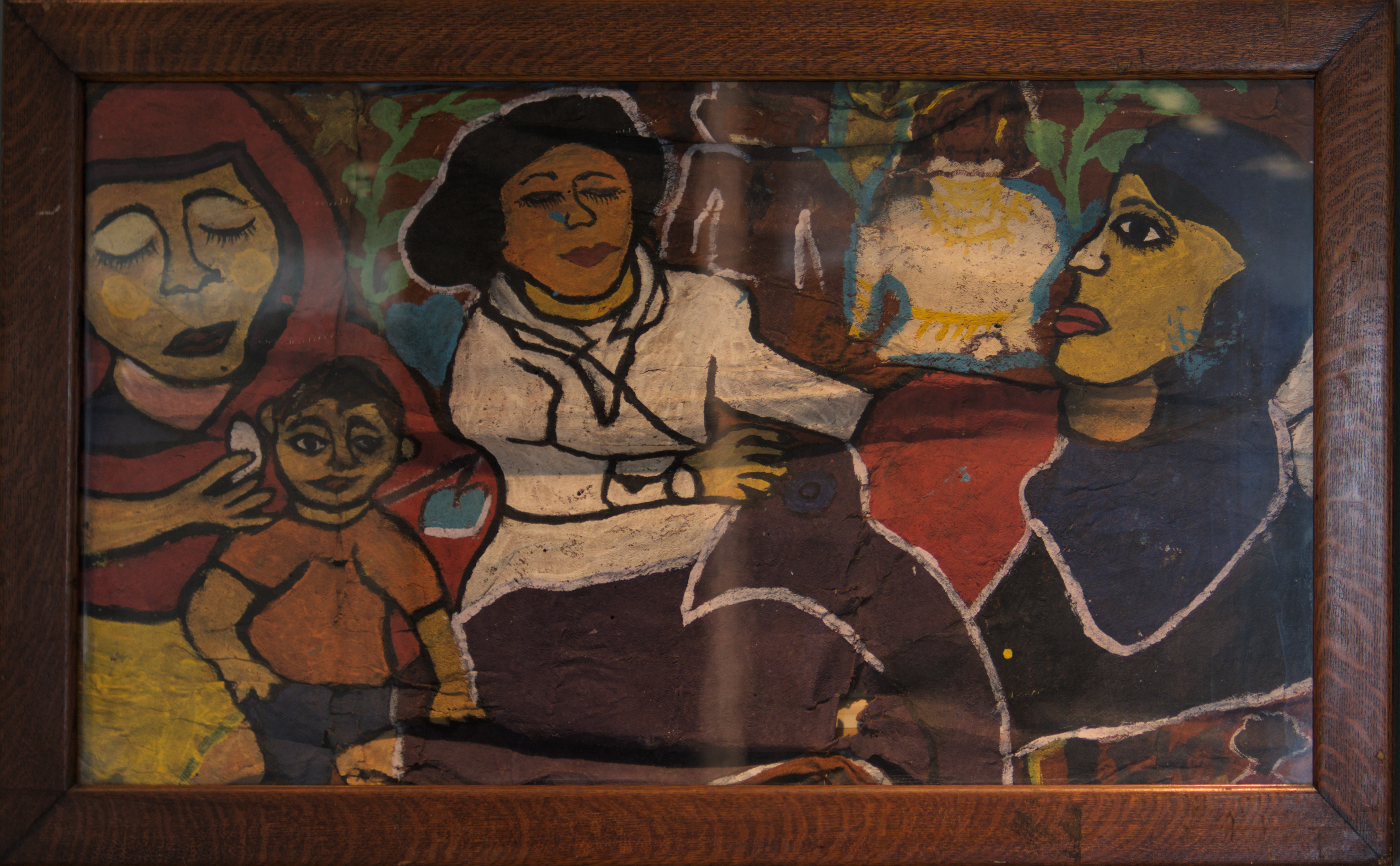
Made by about a dozen refugee girls and women from four countries, Fabric of Women’s Resilience began in Uganda with a small group of South Sudanese, who prepared the traditional bark cloth from the bark of a mutuba tree. This substrate then traveled to Bangladesh, where Rohingya women painted a pregnant woman lying on a bed while a female doctor presses a stethoscope to her belly, and on the left, a mother bathing her child. The artists said they wanted to encourage mothers to seek access to prenatal healthcare and to practice good hygiene with their babies.

Fabric of Women's Resilience
Fabric of Women’s Resilience, a collaborative painting by approx. twelve Rohingya, Syrian, Afghan, and South Sudanese refugee women, 2018. Acrylic on bark cloth, 24 × 60 in. Photo: Victoria Emily Jones.

In Greece, the bark cloth traveled to Samos refugee camp, where one young Afghan woman, with the help of others, painted one of her traumatic childhood experiences: being married off at age twelve to an older man. This scene at the top is a bit crumpled in the frame, so it’s difficult to see, but the child bride is crying, and the man has a white beard.

The painting also went to Azraq refugee camp in Jordan, where Syrian women added a woman carrying a baby on her back while reading a book to show that women can be mothers and pursue an education. (This scene was at the extreme right but must have come off; view the full original painting on the exhibition webpage, fourth image down.) It ended its journey with a return to Uganda, where the South Sudanese women filled in the remaining spaces with plants, fish, and fruits.

Other artworks include The Creature of Home and Play in the Midst of Chaos, painted on food distribution bags and as a collaboration between South Sudanese and Rohingya refugees, both children and adults.

The Creature of Home, which traveled to BidiBidi Refugee Settlement in Uganda and Balukhali Refugee Camp in Bangladesh, depicts chickens, a soccer field, memories of home, and tools needed to take care of the land.

The Creature of Home
The Creature of Home, a collaborative painting by South Sudanese refugees at BidiBidi Refugee Settlement, Uganda, and Rohingya refugees at Balukhali Refugee Camp, Bangladesh. Photo: Victoria Emily Jones.

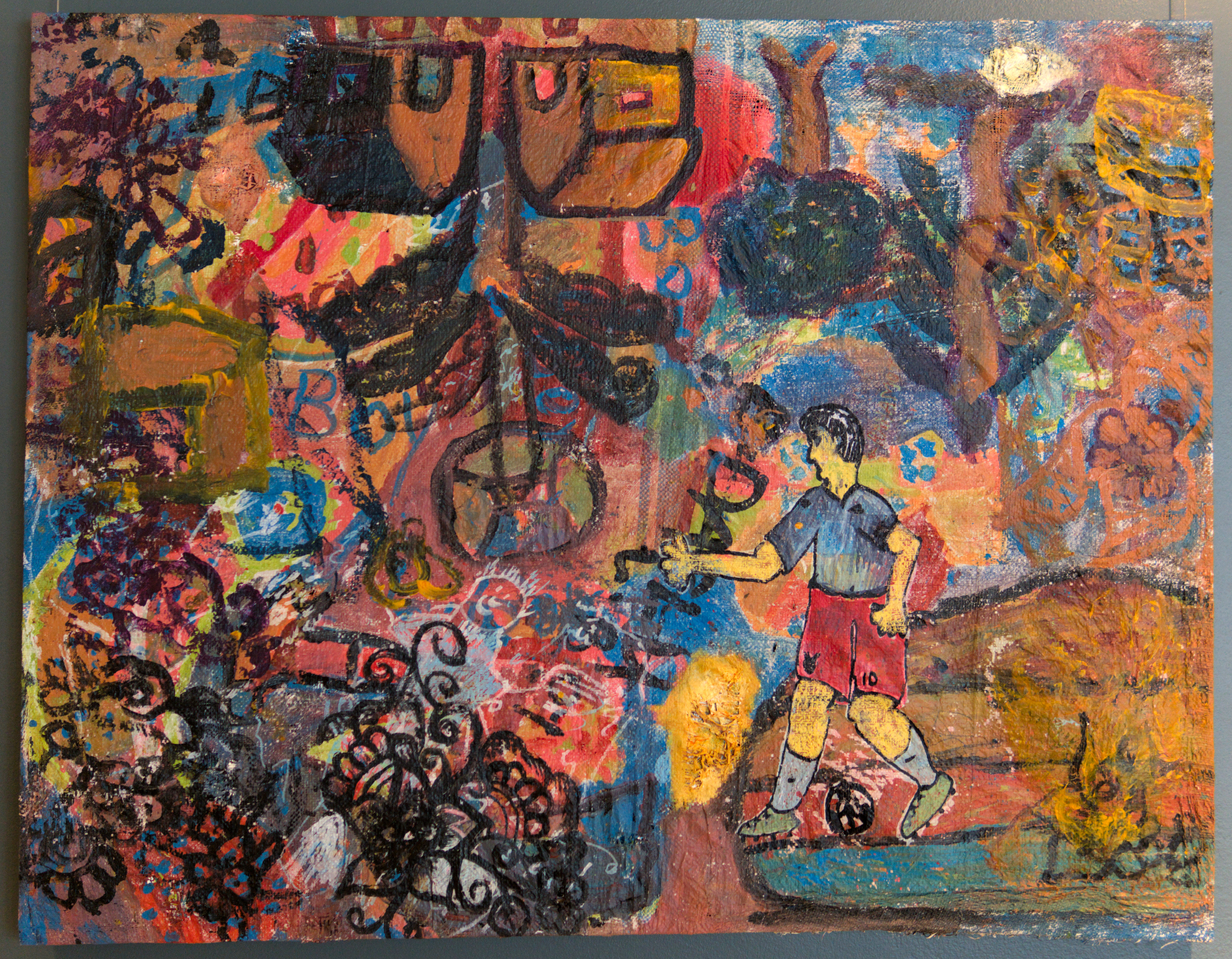
Play in the Midst of Chaos, which traveled to BidiBidi Refugee Settlement in Uganda and Bhasan Char Island in Bangladesh, captures a sense of joy with its vivid colors and depiction of sports. It also highlights the importance of planting trees and taking climate action.

Play in the Midst of Chaos
Play in the Midst of Chaos, a collaborative painting by South Sudanese refugees at BidiBidi Refugee Settlement, Uganda, and Rohingya refugees at Bhasan Char Island, Bangladesh. Photo: Victoria Emily Jones.

Seeing the Interwoven exhibition sent me down an internet rabbit trail of learning more about the co-organizer, Artolution, and the work they’re doing, which then impelled me to learn more about the refugee communities in which they’re active. Follow them on Instagram, Facebook, or Twitter. I also commend to you the Founder Spirit podcast interview with Artolution cofounder and public artist, educator, and humanitarian Max Frieder.


All the above artworks can be seen for free without an appointment. (However, note that the temporary exhibitions change throughout the year.) But to access the sculptures in the garden, which is kept locked, your only option is to pay $26 for the guided, forty-five-minute Garden Tour.

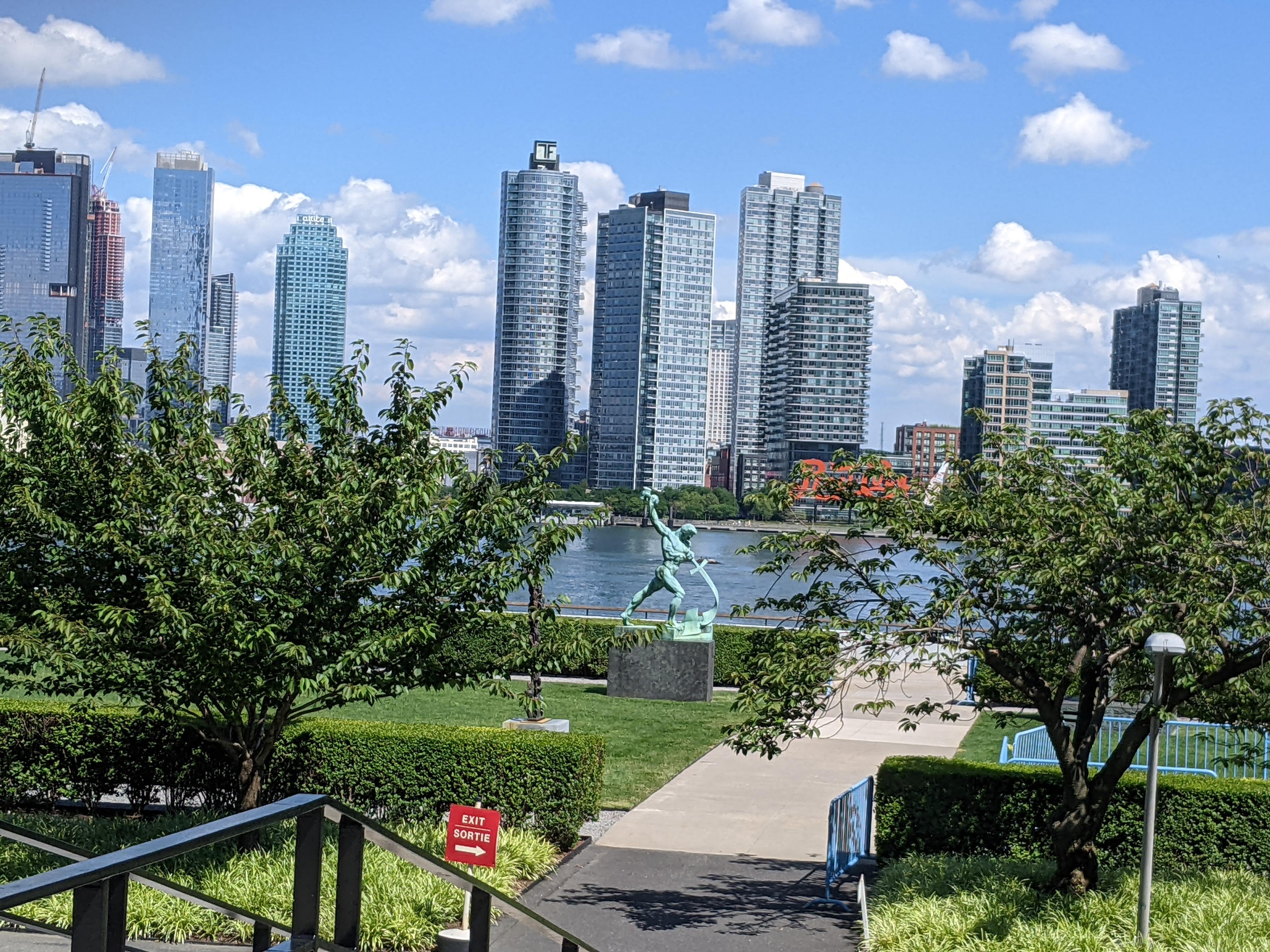
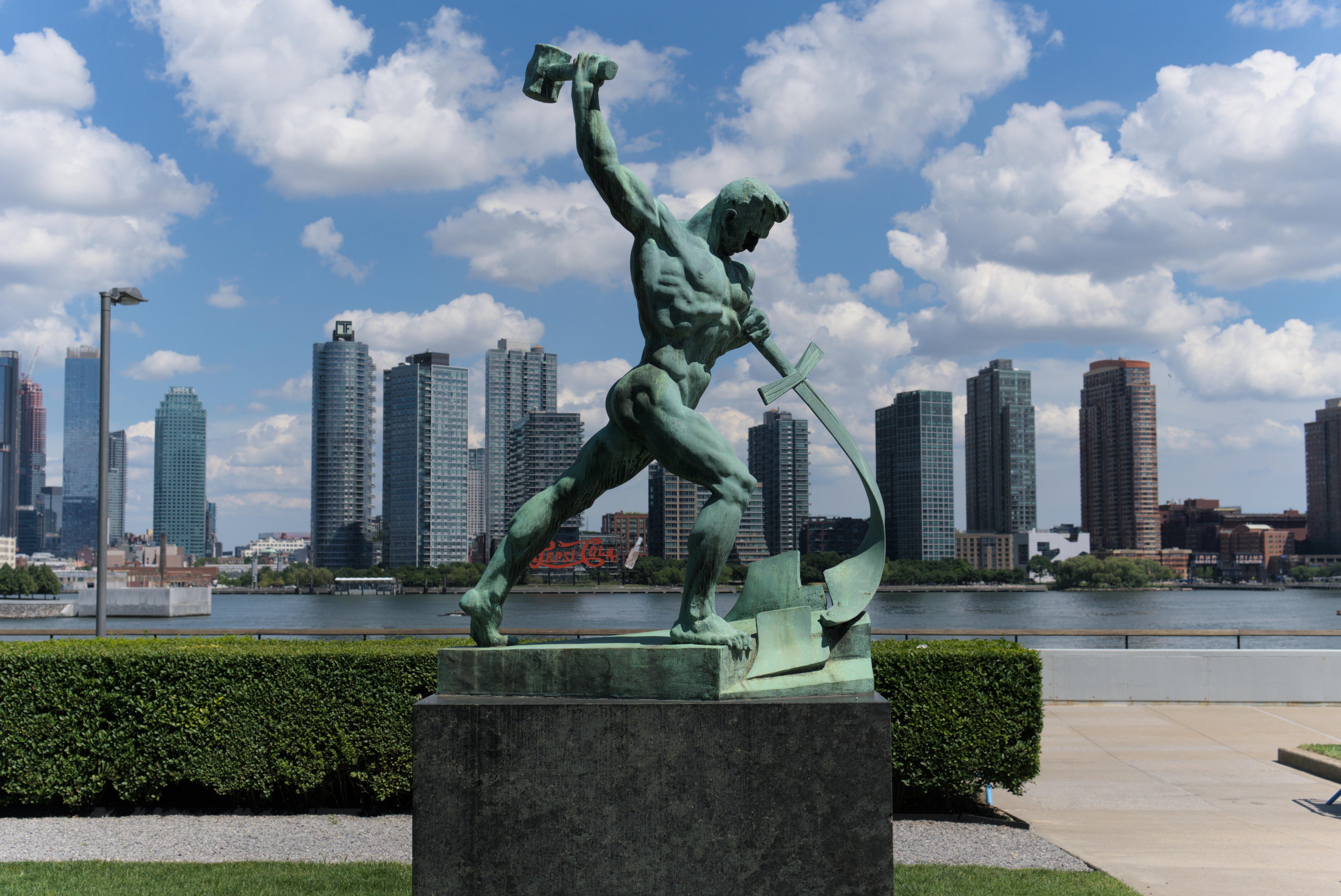
I had seen photos of the biblically inspired Let Us Beat Swords into Ploughshares and wanted to see it in person, so I paid up. It’s vaguely visible from the vantage of the free-access plaza outside the main entrance of the General Assembly Building.

Swords into Plowshares

But let’s move in closer.

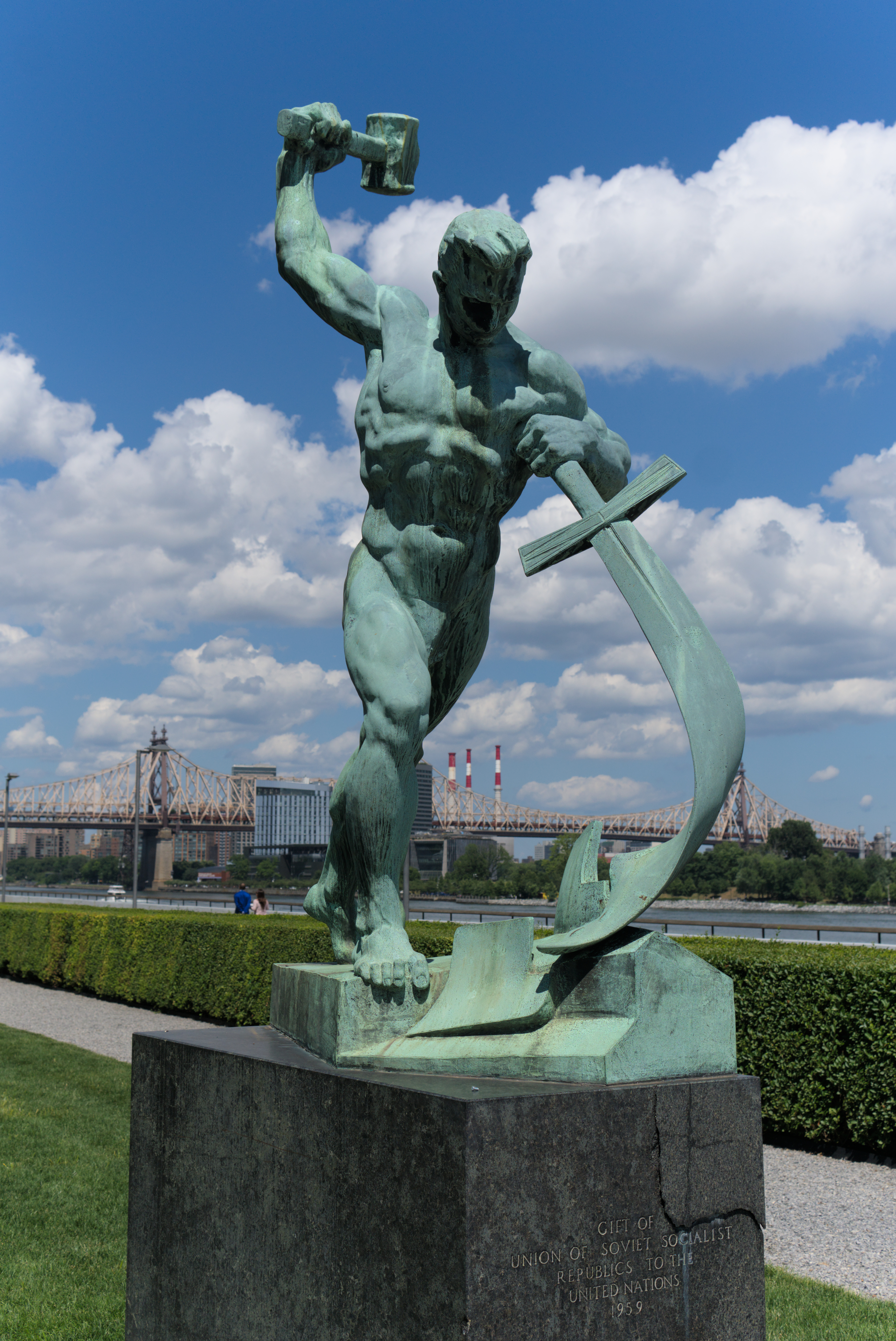
Vuchetich, Yevgeny_Let Us Beat Swords into Ploughshares
Yevgeny Vuchetich (Russian, 1908–1974), Let Us Beat Swords into Ploughshares, 1959. Cast bronze and granite pedestal, figure 111 × 76 × 35 in., pedestal 44 × 75 × 34 in. North Lawn, United Nations Headquarters, New York. Gift from the USSR. Photo: Victoria Emily Jones. [object record]

Swords into Plowshares

Gifted to the United Nations by the USSR in 1959, the bronze sculpture is by the Soviet artist Yevgeny (sometimes spelled “Evgeniy”) Vuchetich, who was of Russian, French, and Serbian heritage and lived most of his life in Russia. It shows a muscular man (modeled by Olympic wrestler Boris Gurevich) hammering a sword into a plow blade, used to cut furrows for planting crops. Representing the transformation of tools of death into tools of life, the imagery is taken from Isaiah 2:4 in the Hebrew Bible, in which the prophet proclaims that “in days to come,” people of all nations “shall beat their swords into plowshares and their spears into pruning hooks; nation shall not lift up sword against nation; neither shall they learn war any more.” The vision is that in the kingdom of God, instead of the land being littered with human blood and corpses, it will be cultivated and bring forth good food.

This scripture text is the basis of the African American spiritual “Down by the Riverside” [previously], whose refrain declares, “I ain’t gonna study war no more!” One of the commonly used verses is “I’m gonna beat my sword into a plow.” Here’s Michael Wright’s version:

And, from 1959, the Golden Gate Quartet’s, arranged by Orlandus Wilson:

Reflecting the song lyrics, Vuchetich’s sculpture is itself planted “down by the riverside”—the East River.

(Related posts: “A Blessing for Those Who Hate and Hurt”; “The Christmas Truce of 1914”; Benjamin Rush’s “Plan of a Peace-Office for the United States”)

Vuchetich was one of the major figures of Soviet government–backed monumental sculpture, making his name from depictions of military heroes. So I find it a little odd that he was commissioned to make this peace sculpture that subverts the very militarism his other sculptures celebrate. One of his most famous pieces is The Motherland Calls; located at the top of Mamayev Kurgan hill overlooking the city formerly known as Stalingrad, it shows a female personification of Russia lifting high a sword in one hand and calling the Soviet people to battle with the other.

Look, many artists will take what work they can get, regardless of whether a commission matches their own ideology. I don’t claim to know what Vuchetich’s personal views were about war, violence, and empire.

Regardless of its disjunction with the artist’s larger oeuvre—and the uncomfortable fact that the donor’s successor state and caretaker of the sculpture, the Russian Federation, is persisting in an illegal and immoral war against its neighbor Ukraine—I really appreciate the theological imagination that Let Us Beat Swords into Ploughshares embodies, entreating us to apply our strength to constructive, not destructive, acts.

Nearby in the garden, not pictured in this article, is a literalization of the “swords into plowshares” principle. A recent gift from the Government of Colombia, Kusikawsay (Quechua for “peaceful and happy life”) is made of steel armaments melted and cast into the shape of a canoe, sailing upward. A donor representative said the sculpture for them symbolizes the end of an over-fifty-year armed conflict in their country. The idea is that the grotesque paraphernalia of war is metamorphosed into a benign watercraft that, in how it’s positioned, symbolizes humanity’s traveling into a lofty future.

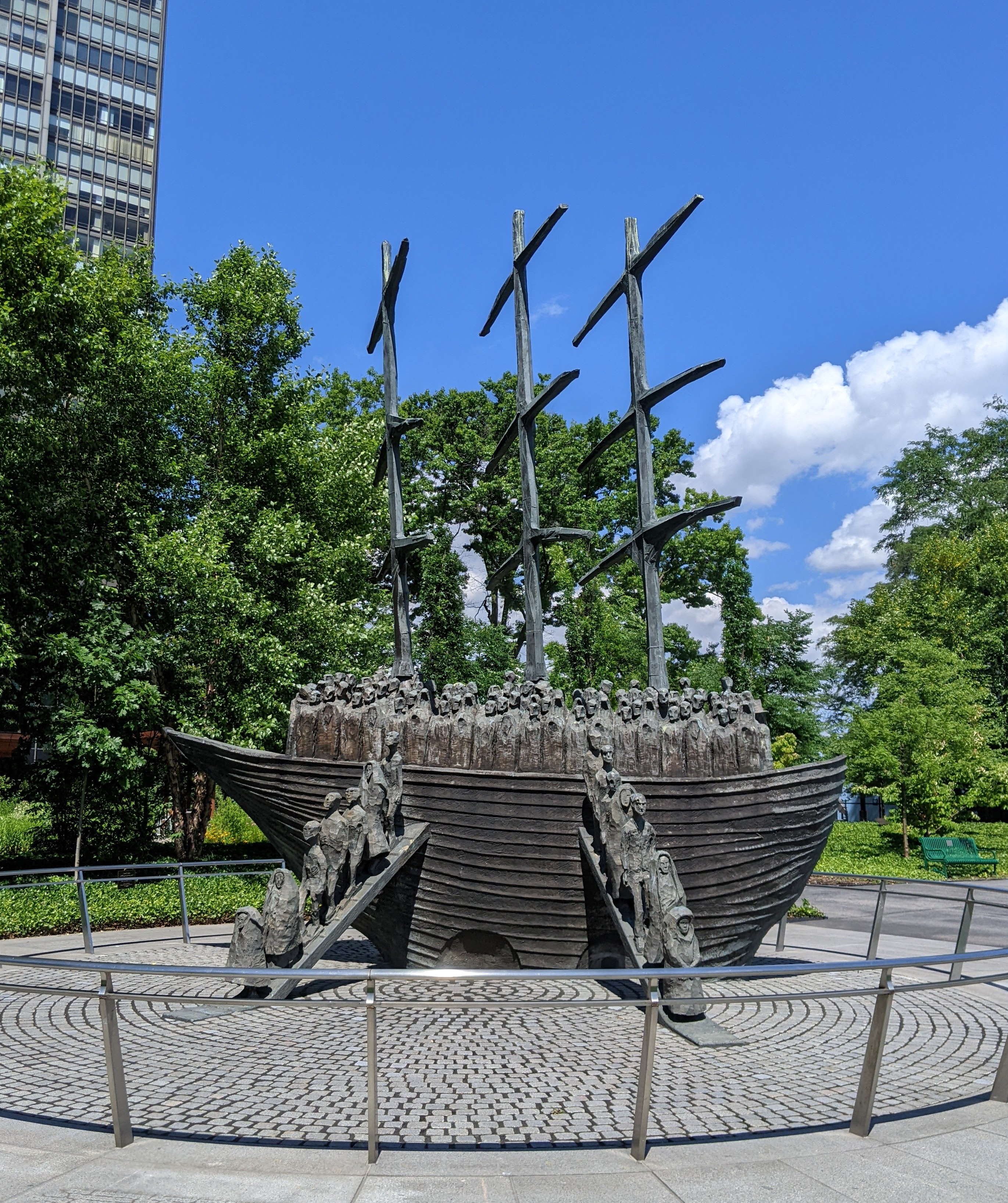
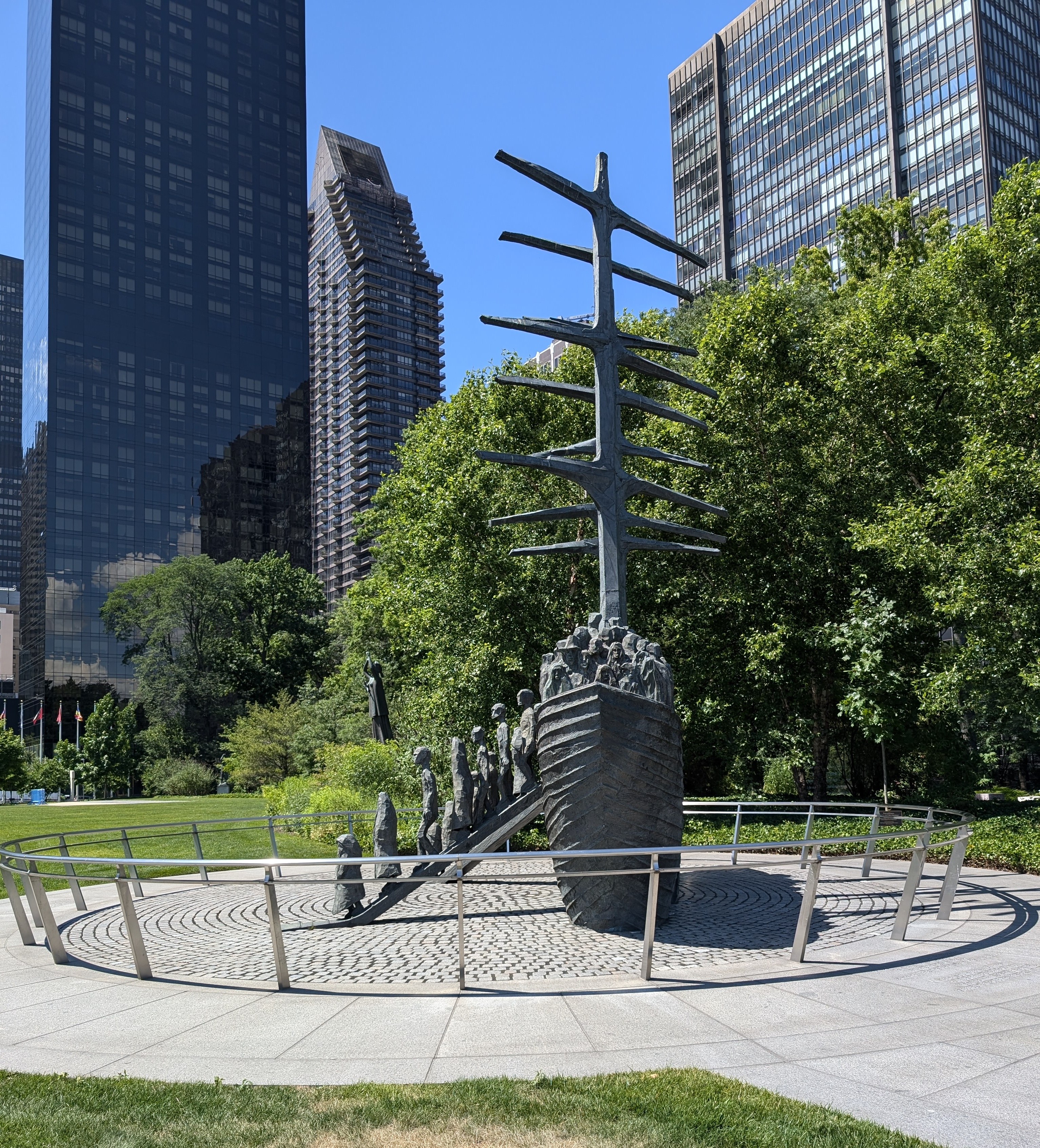
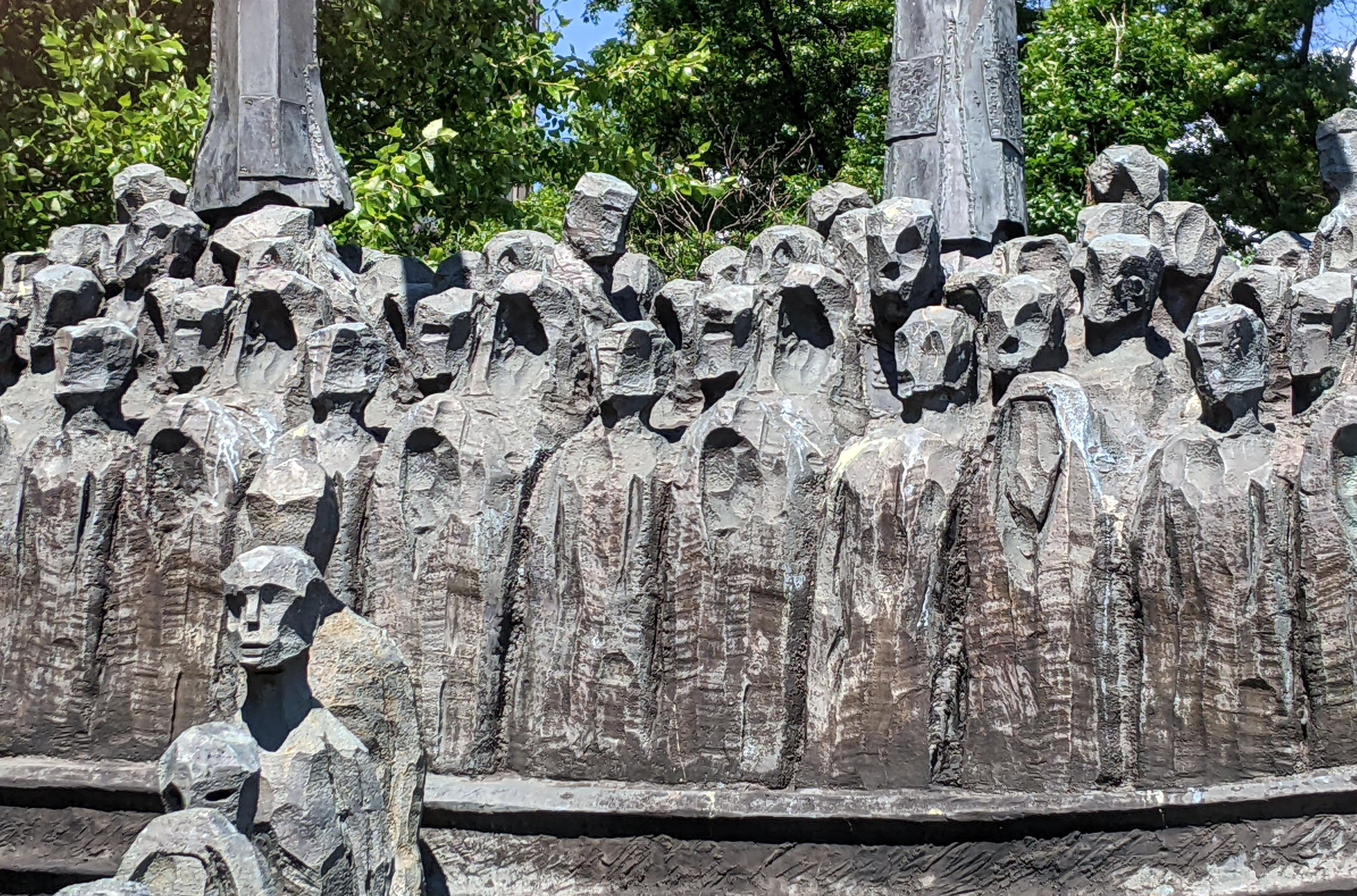
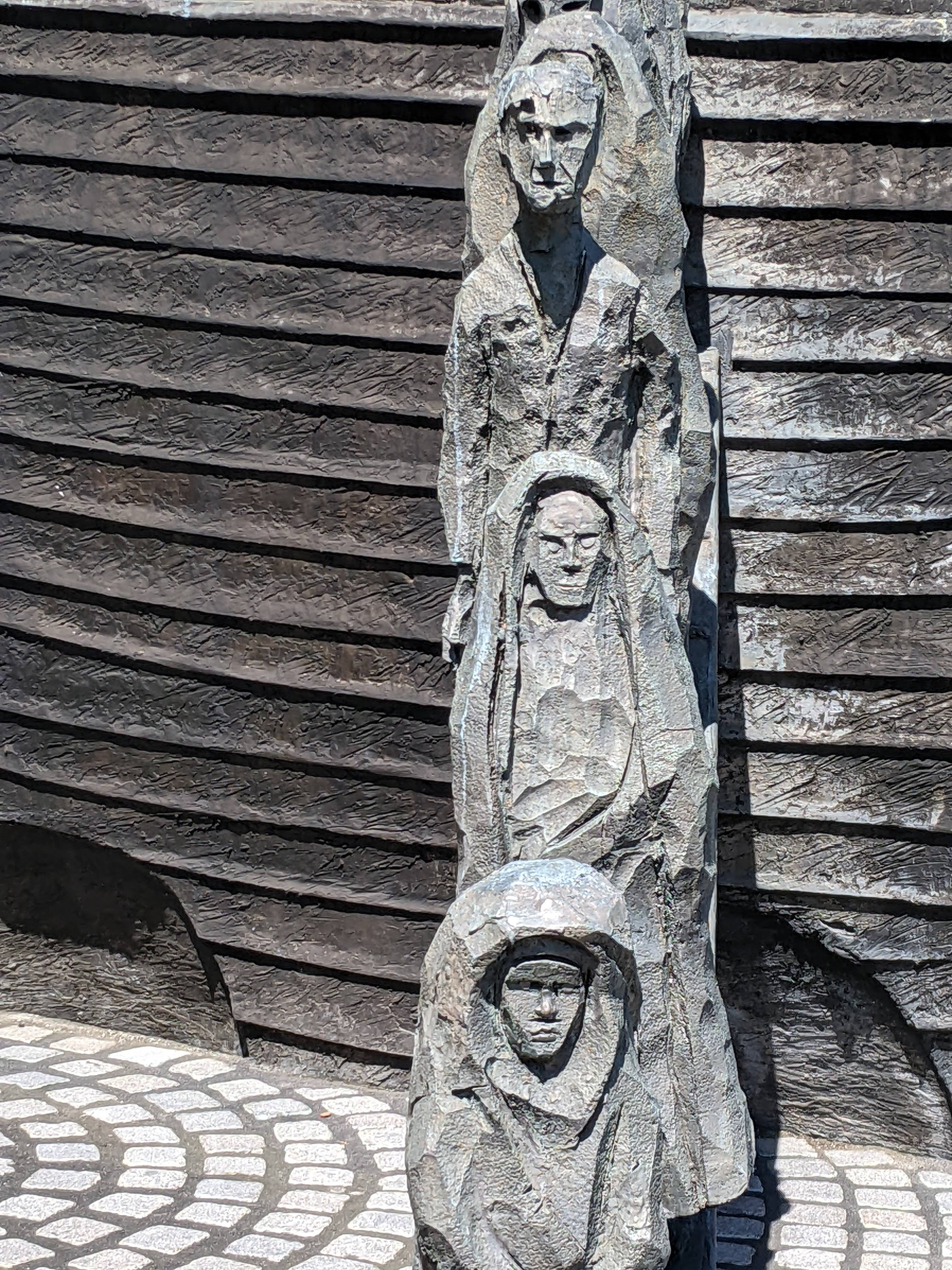
Another boat on the UNHQ’s North Lawn is Arrival by the Irish sculptor John Behan, which shows Irish immigrants disembarking into a new world. The sculpture was intended as a thank-you to the many nations that have received the Irish over the years, including Great Britain, the United States, Canada, Australia, Argentina, Chile, Mexico, New Zealand, and Brazil.

Behan, John_Arrival
John Behan (Irish, 1938–), Arrival, 2000. Bronze, stainless steel on granite pavers, 26 × 23 ft. North Lawn, United Nations Headquarters, New York. Gift from Ireland. Photo: Victoria Emily Jones. [object record]

Behan, John_Arrival

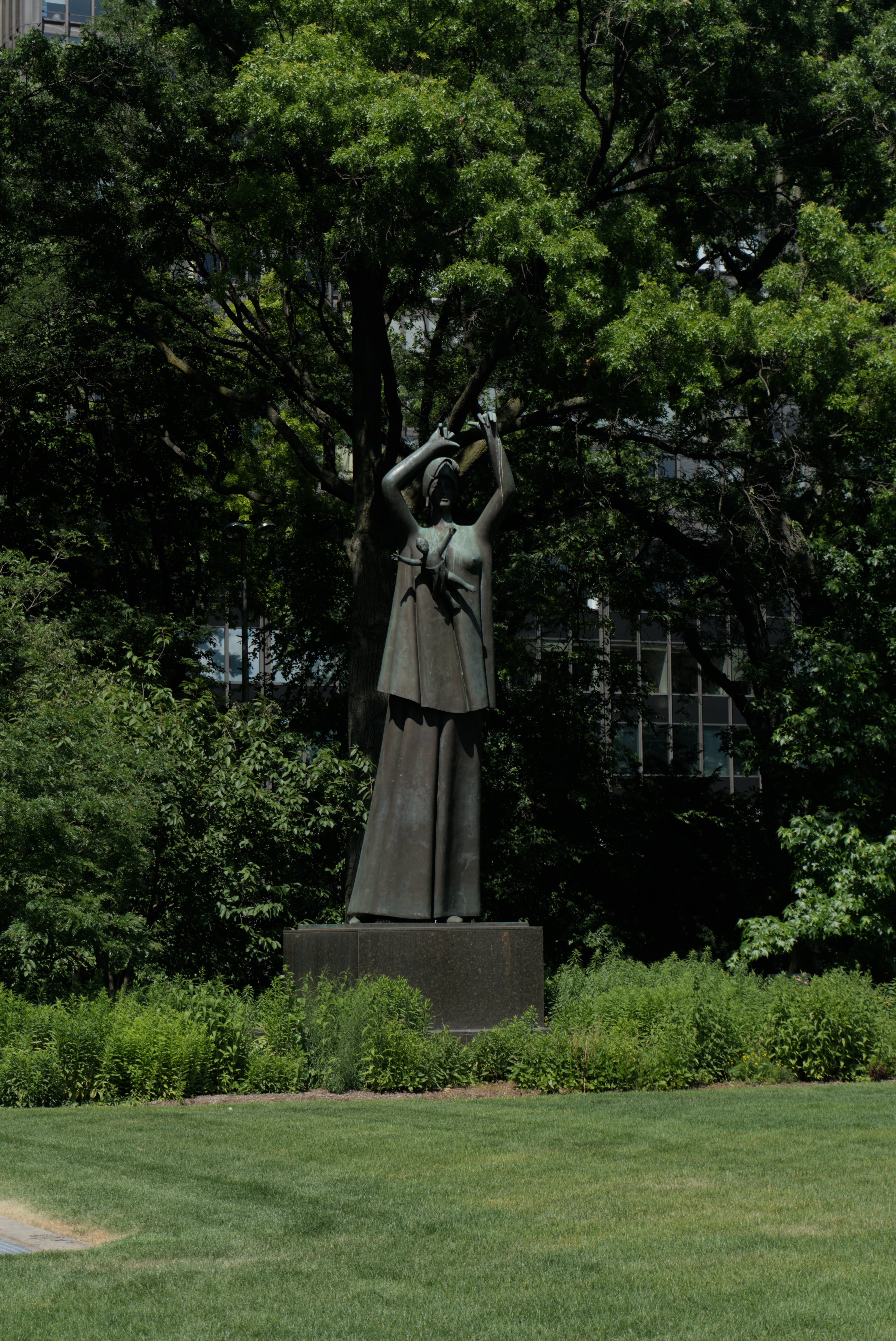
This piece wasn’t covered by the Garden Tour, nor was the colossal Mother and Child by the Italian artist Giacomo Manzù, which I spotted across the lawn and hurriedly snapped a distant photo of while scurrying to keep up with the group.

Manzù, Giacomo_Mother and Child
Giacomo Manzù (Italian, 1908–1991), Mother and Child, 1989. Bronze, 254 × 66 × 52 in. North Lawn, United Nations Headquarters, New York. Gift from Italy. Photo: Victoria Emily Jones. [object record]

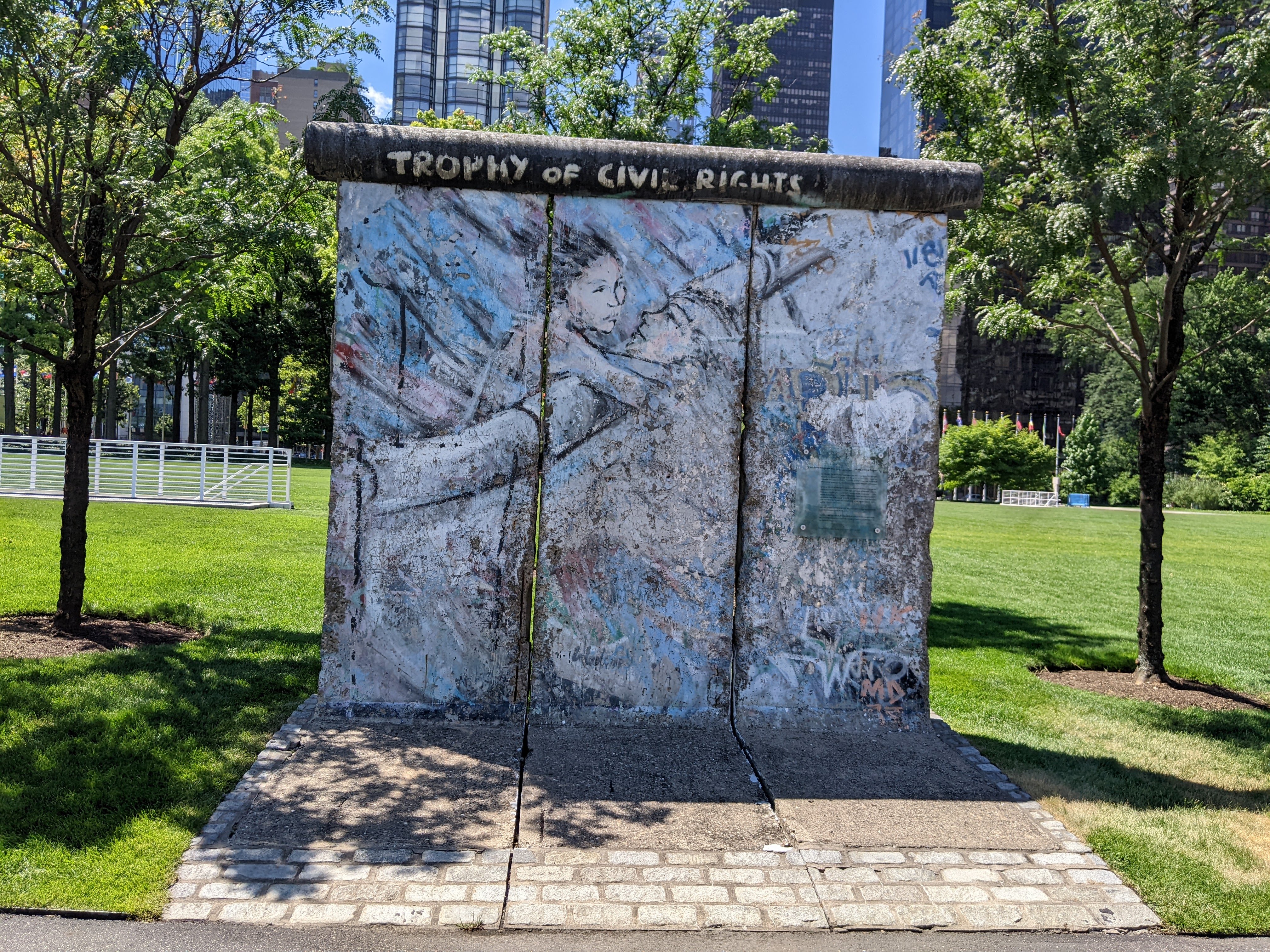
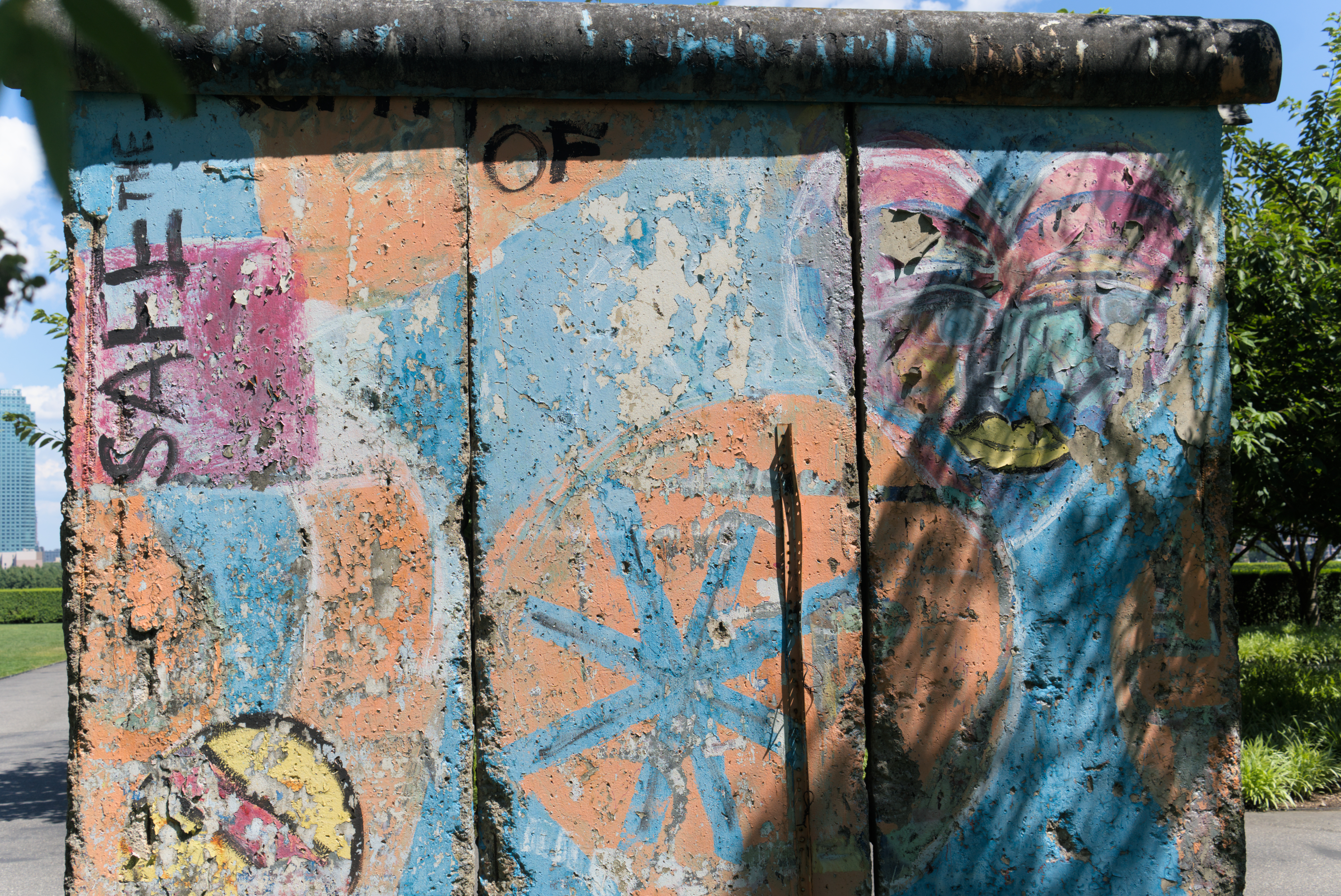
One of the pieces our guide did stop for and spend a good amount of time on was a fragment of the Berlin Wall gifted by Germany in 2002, after the wall came down in 1989. The ninety-six-mile-long barrier was erected in 1961 to divide the country into East (Communist) and West (Federal Republic), but a peaceful revolution in East Germany resulted in its fall and the country’s reunification as a federal republic, marking the end of the Cold War in Europe.

Alavi, Kani_Trophy of Civil Rights
Kani Alavi (Iranian German, 1955–), Trophy of Civil Rights (Berlin Wall Fragment), ca. 1998. Precast reinforced concrete wall sections with paint, overall 84 × 114 in. North Lawn, United Nations Headquarters, New York. Gift from Germany. Photo: Victoria Emily Jones. [object record]

The front of this three-slab wall fragment (that is, the side visible from the paved path) bears a mural by Kani Alavi, an Iranian artist who moved to West Berlin in 1980, living in an apartment overlooking the formidable “Checkpoint Charlie.” Throughout the 1980s, artists painted images on the west side of the wall as a form of political commentary and resistance. The east side, however, was unpainted during the Cold War because it was so heavily guarded; attempted art interventionists probably would have been shot.

After the border opened on November 9, 1989, and demolition of the wall began, Alavi was a key organizer of what’s known as the East Side Gallery, inviting artists from Germany and around the world to paint murals on the east side of the wall, across a segment that would be deliberately left standing as a memorial. “Alavi helped transform the most visible symbol of the Iron Curtain into an enduring monument to the power of freedom,” Ryan Prior wrote for CNN. This open-air gallery is one of Berlin’s most visited attractions, featuring the work of at least 118 artists from twenty-one countries.

Berlin Wall (detail)

Alavi painted Trophy of Civil Rights (I’m not sure whether that inscription was his or just a remnant from another artist, but it’s become the mural’s de facto title) on a section of remaining wall sometime around 1998. “It is a representation of two people hugging over the wall, a dramatic situation of people trying to get close to each other,” he told NPR through a translator. “It shows how the people were separated. It shows how a culture was divided by a wall. That’s what happened, and that’s what I showed.”

The other side of the wall is painted with miscellaneous graffiti by anonymous artists.

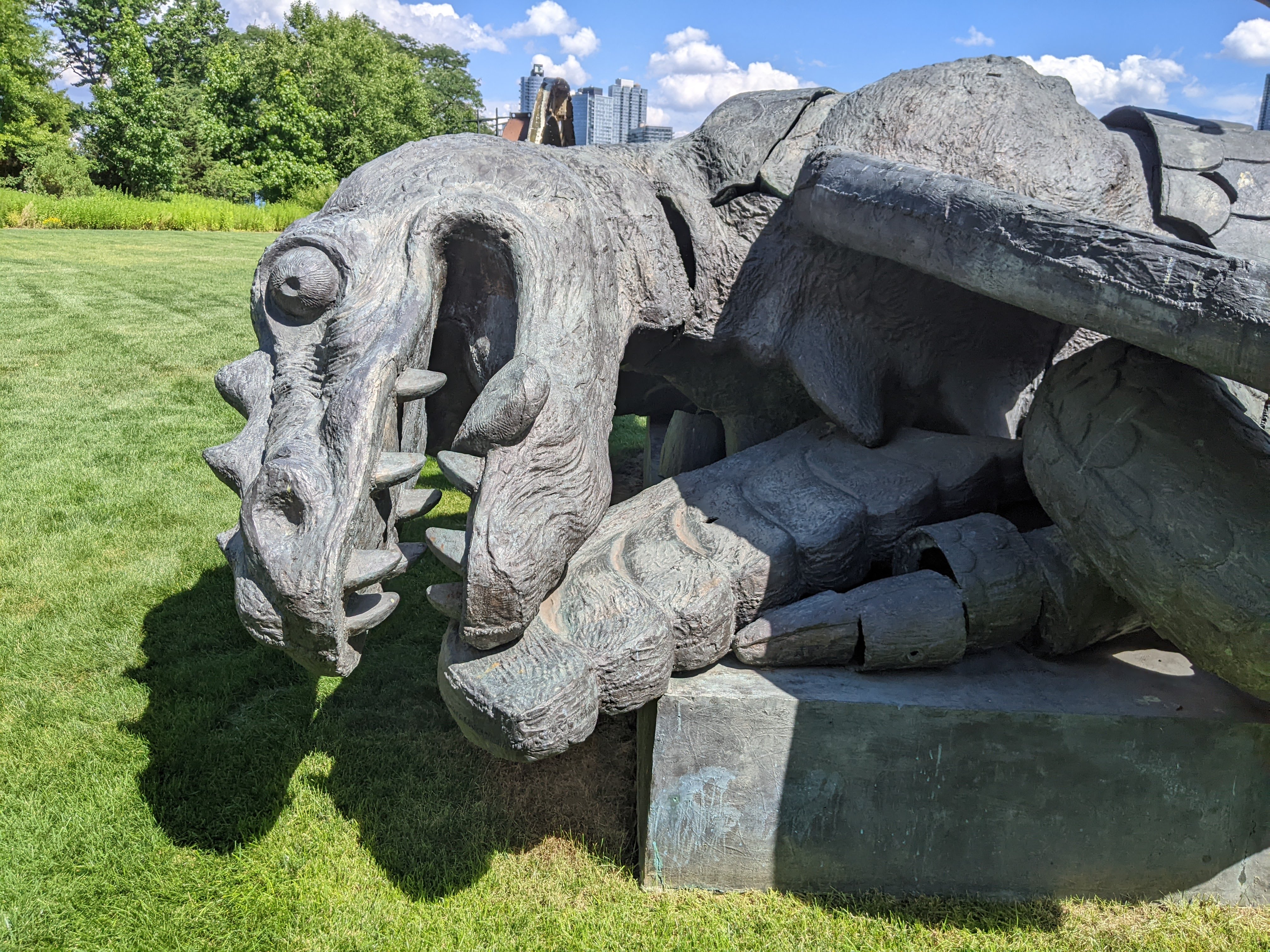
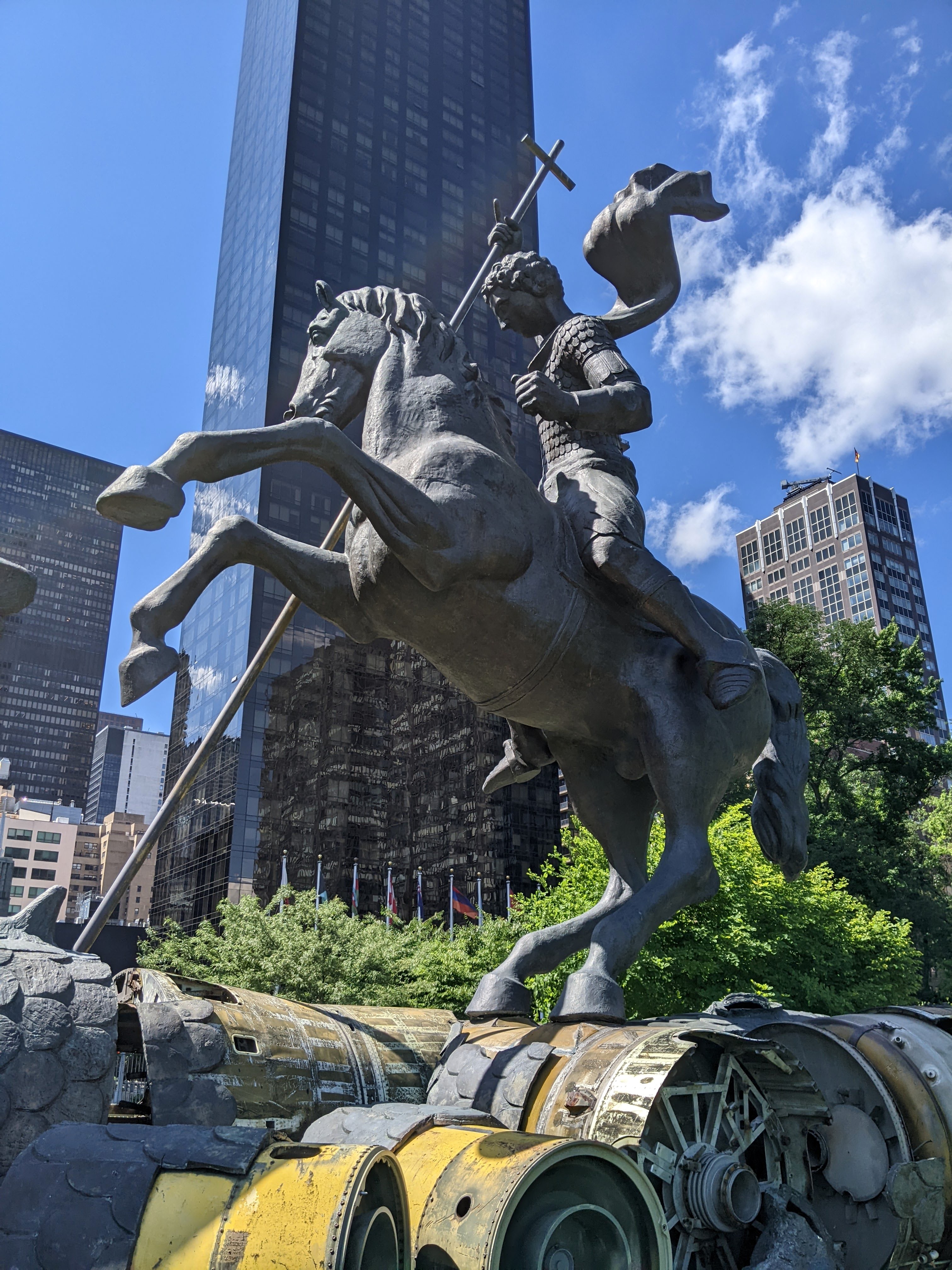
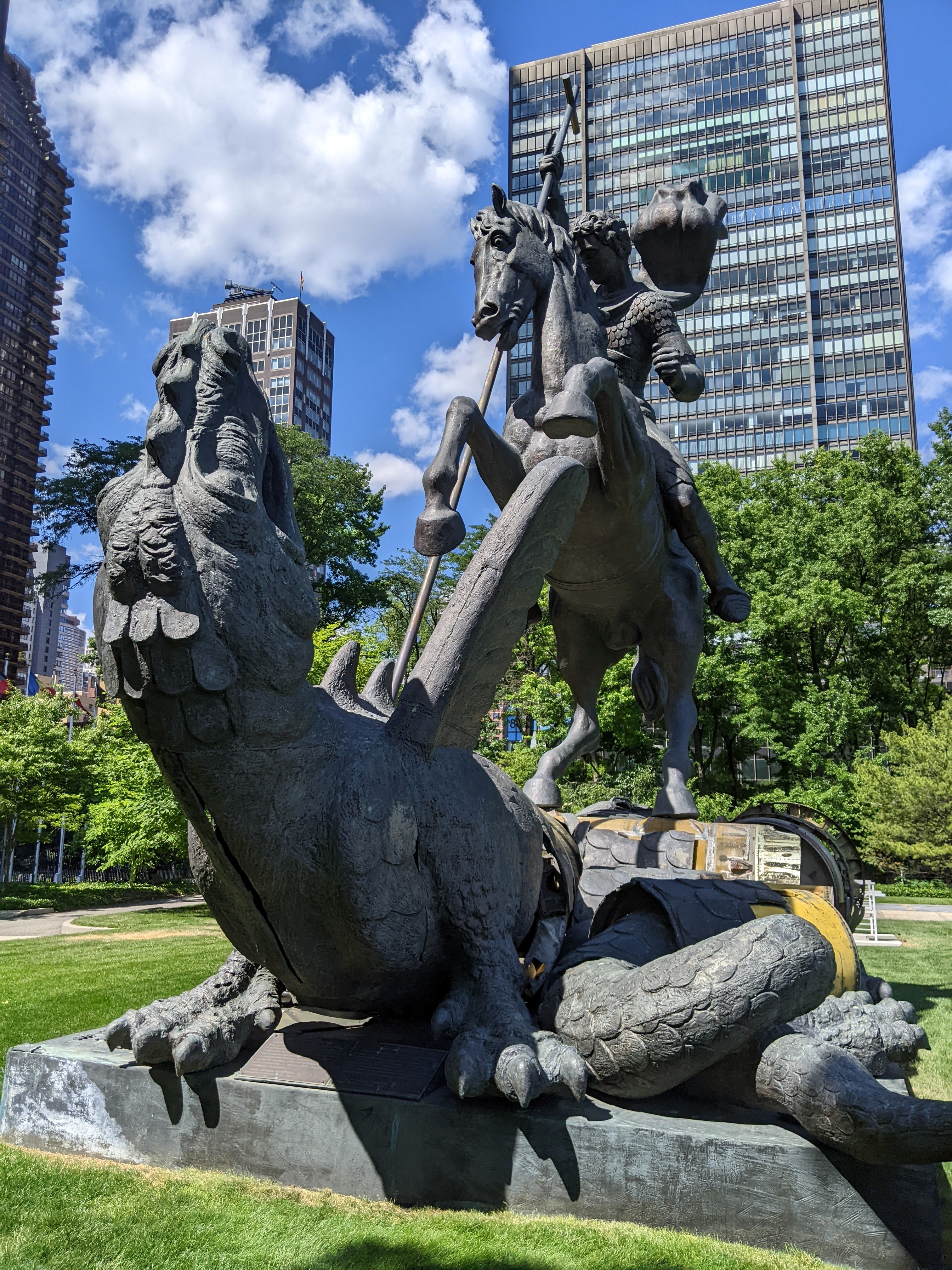
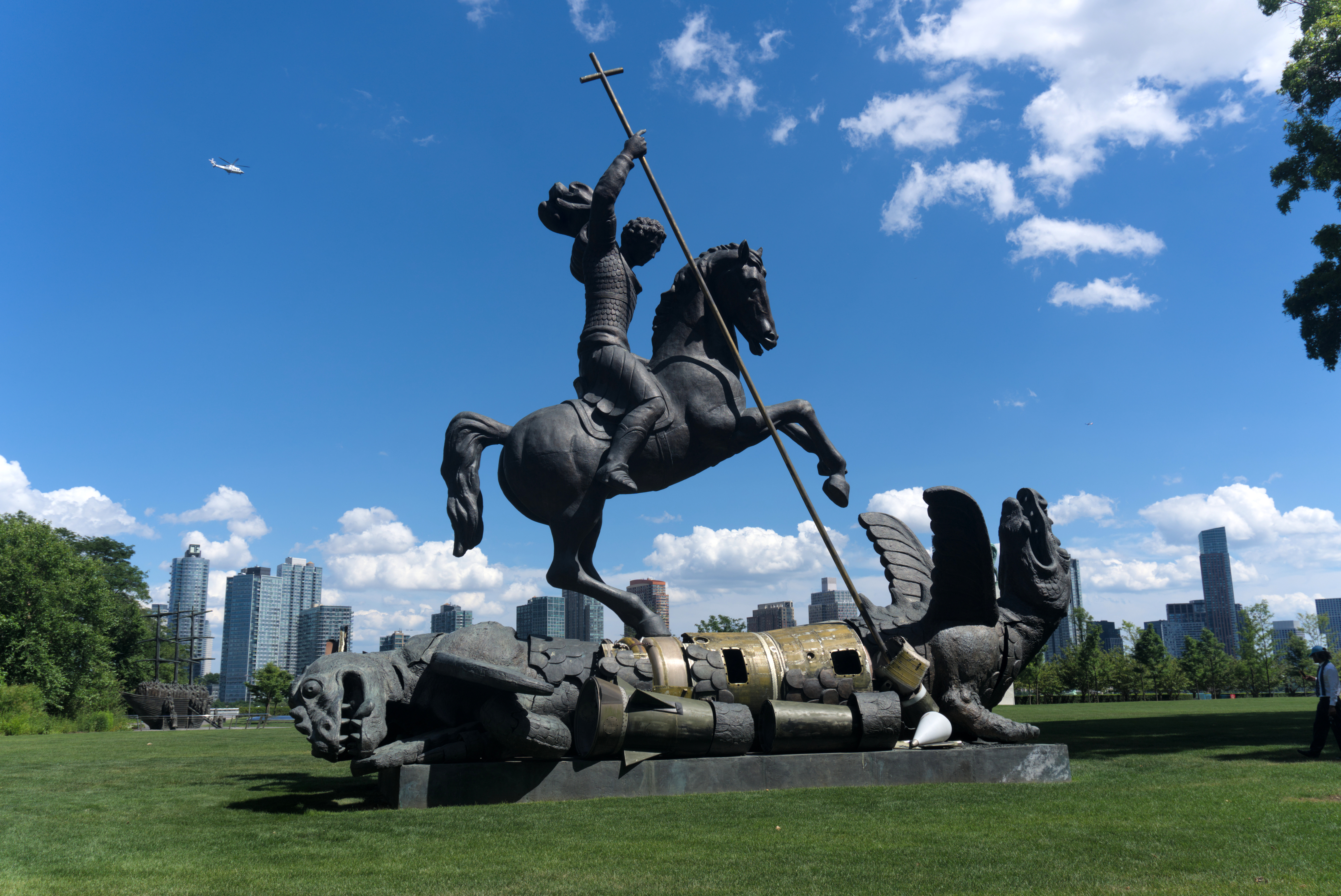
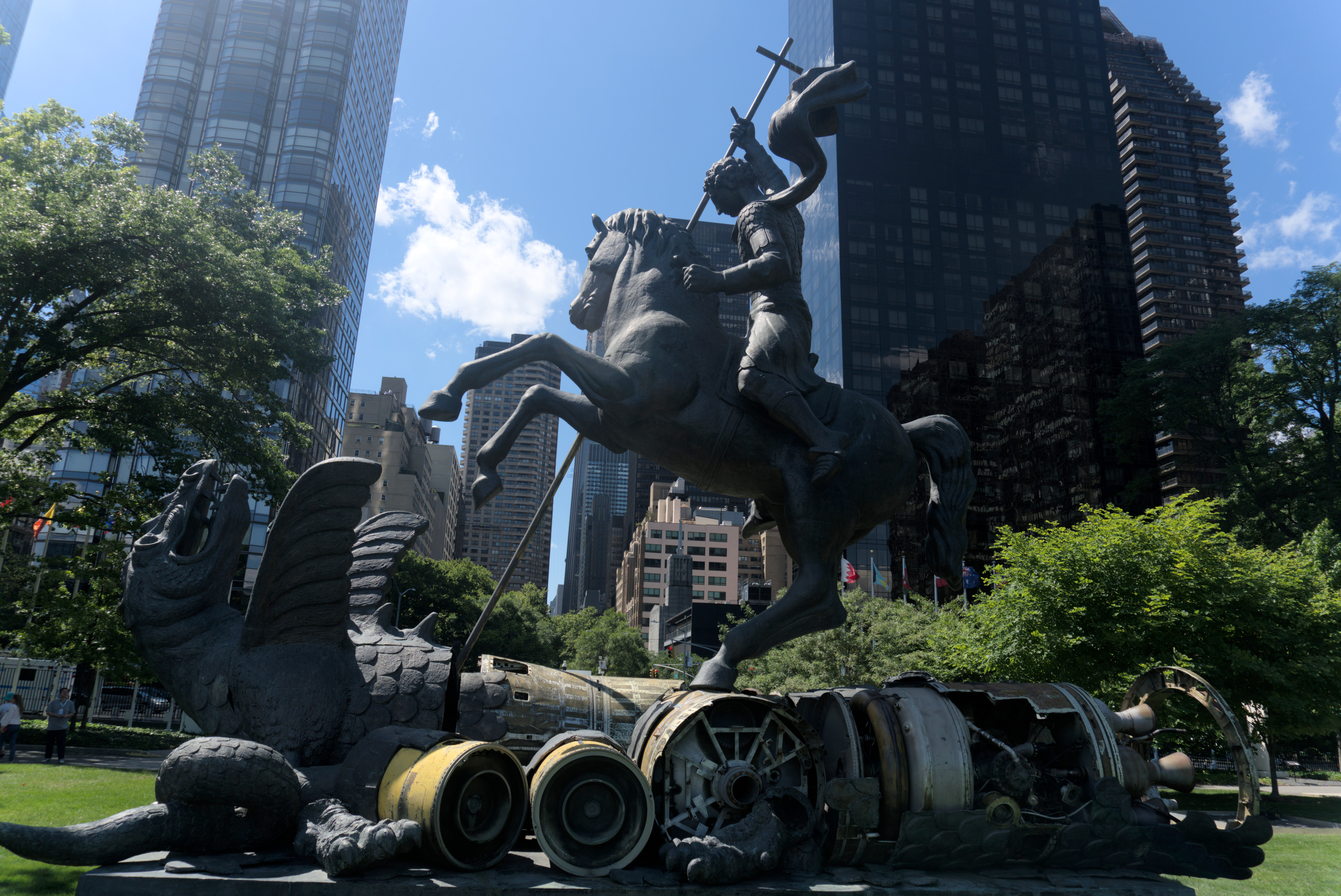
The largest sculpture on the North Lawn, standing at thirty-one feet tall and weighing forty tons, is Good Defeats Evil by the Georgian Russian sculptor Zurab Tsereteli. It depicts the Early Christian martyr-saint George, who was tortured and executed in 303 under the Diocletian persecution. Legends about him started developing in the sixth century and by the thirteenth century were widely circulated and embellished to include a tale of him slaying a dragon to save a Libyan princess whom the terrorized villagers had planned to sacrifice to it for appeasement.

Tsereteli, Zurab_Good Defeats Evil
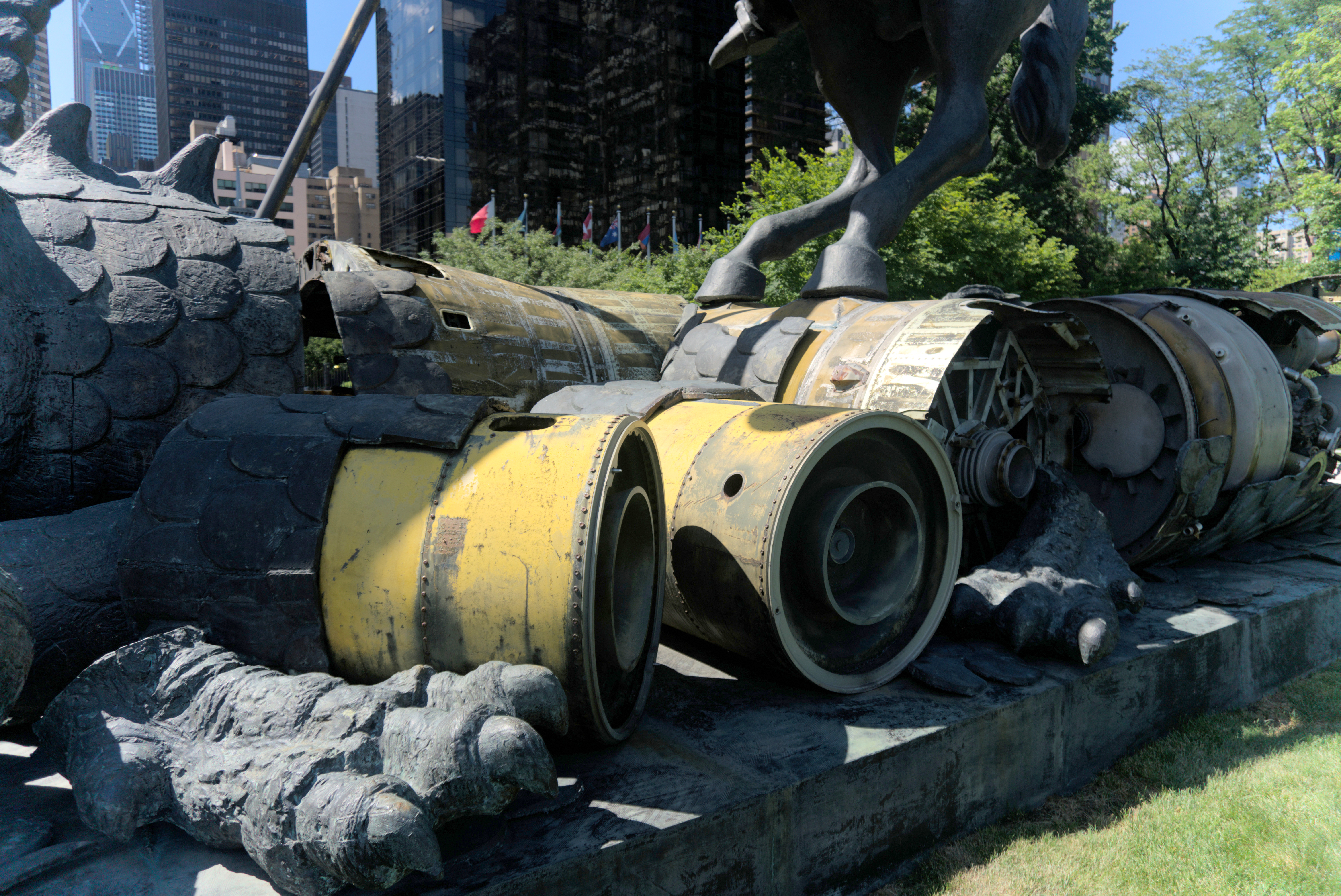
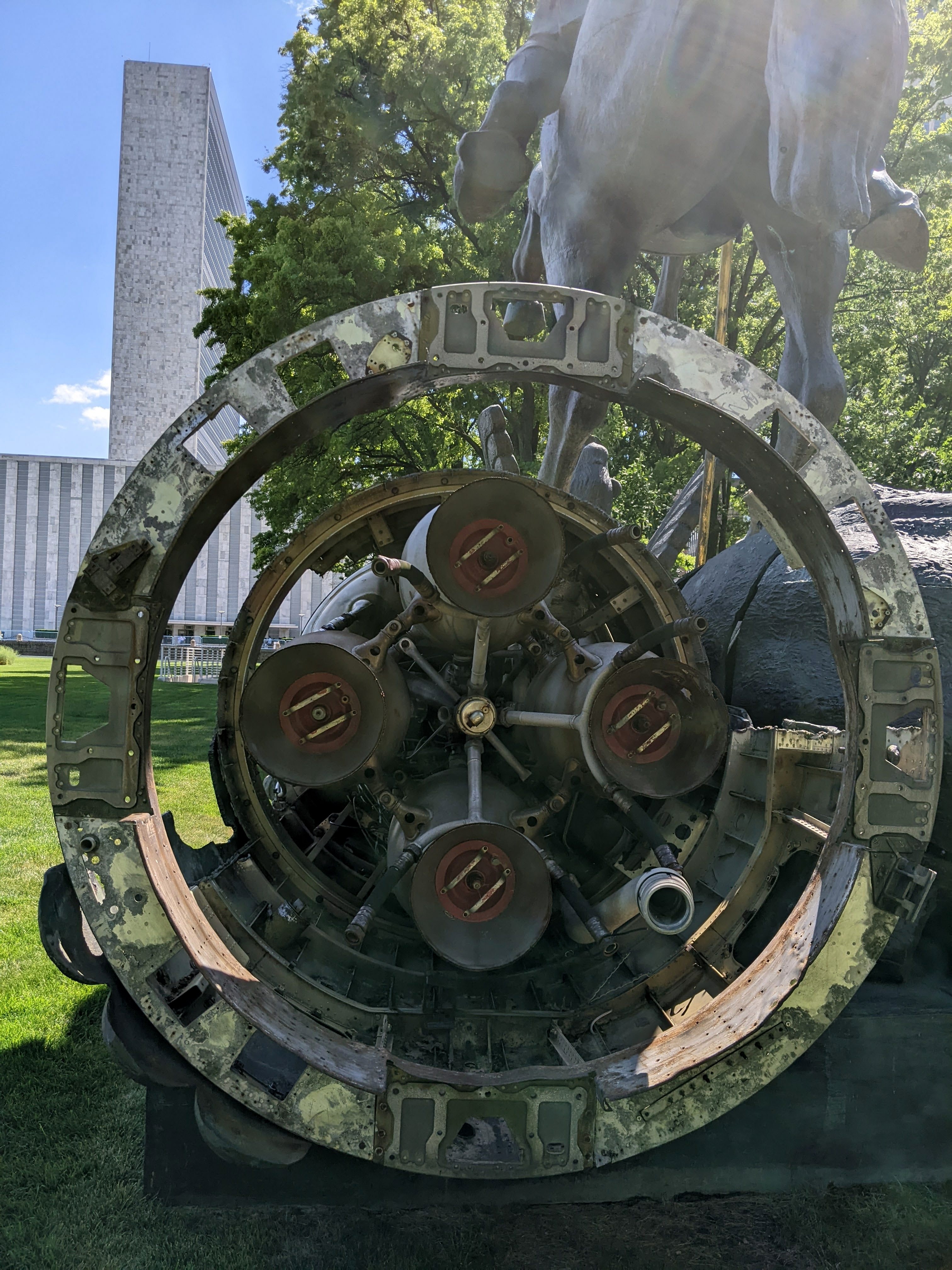
Zurab Tsereteli (Georgian Russian, 1934–), Good Defeats Evil, 1990. Cast bronze figure with dragon formed from sections of two destroyed nuclear missiles, 31 × 18 × 10 ft. North Lawn, United Nations Headquarters, New York. Gift from the USSR. Photo: Victoria Emily Jones. [object record]

Tsereteli, Zurab_Good Defeats Evil (back)
Tsereteli, Zurab_Good Defeats Evil (detail)

(Side note: Saint George is not to be confused with Saint Michael the Archangel from the book of Revelation, who in Christian iconography is usually shown on foot [but occasionally on horseback], also slaying a dragon. The easiest way to tell the two saints apart is that Michael has wings, whereas George does not.)

The most intriguing aspect of this sculpture is that the two-headed dragon is made up of sections of two destroyed nuclear missiles, making the piece a symbol of disarmament. According to the UN website, here

the dragon is not the mythological beast of early Christian tradition, but rather represents the vanquishing of nuclear war through the historic treaty between the Soviet Union and the United States [the Treaty on the Elimination of Intermediate-Range and Short-Range Nuclear Missiles, signed in 1987]. Created as a monument to peace, the sculpture is composed of parts of actual United States and Soviet missiles. Accordingly, the dragon is shown lying amid actual fragments of these weapons, the broken pieces of Soviet SS-20 and U.S. Pershing missiles.

Tsereteli, Zurab_Good Defeats Evil (detail)

The dragon’s two heads thus represent the world’s two largest nuclear arsenals during the Cold War: those of the Soviet Union and the United States.

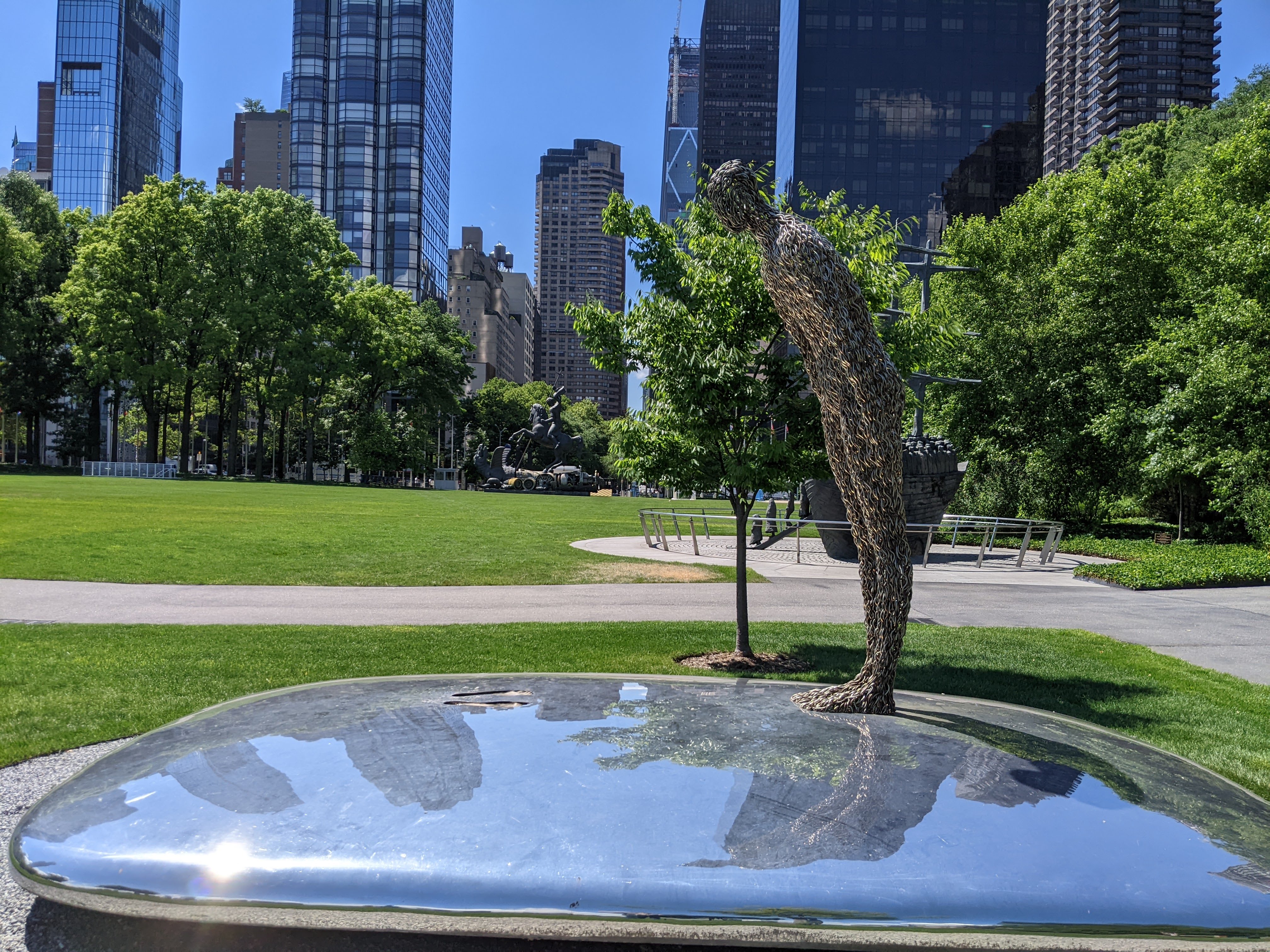
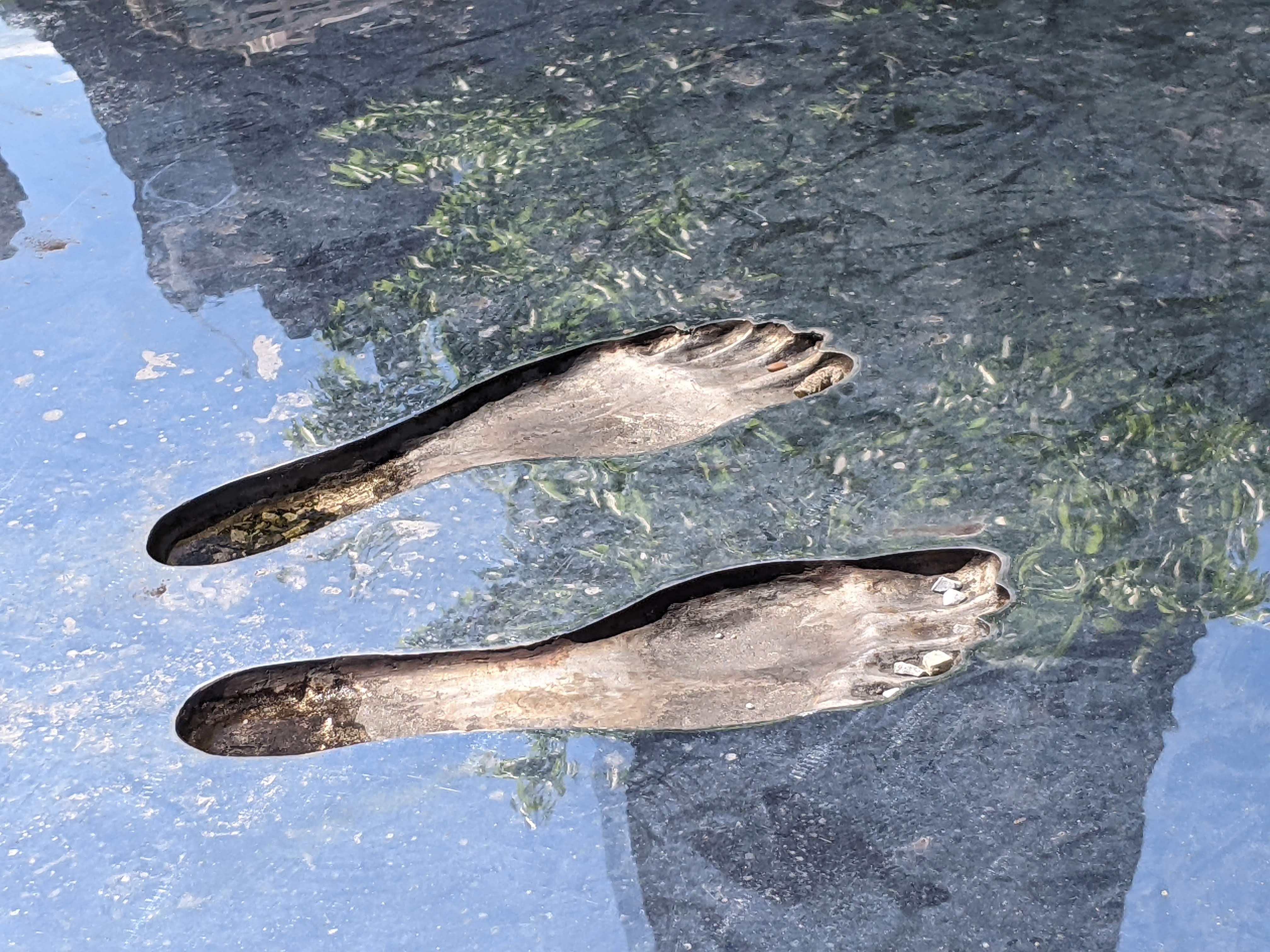
The last sculpture I’ll mention is Consciousness by the Mongolian artist Ochirbold Ayurzana. It consists of a rounded, high-luster steel alloy floor plate on which stands a human figure, made of twisted metal strings, examining the footprints they’ve left on the planet. What mark will we make, for good or ill? The sculpture is dedicated to the historic adoption of two global developmental milestone documents: the UN 2030 Agenda for Sustainable Development and the Paris Agreement on Climate Change.

Ayurzana, Ochirbold_Consciousness
Ochirbold Ayurzana (Mongolian, 1976–), Consciousness, 2017. Steel, metal on pedestal, 110 × 196 × 125 in. North Lawn, United Nations Headquarters, New York. Gift from Mongolia. Photo: Victoria Emily Jones. [object record]


This is just a selection of the many artworks on view at the United Nations Headquarters in Manhattan. To view a full catalog, click here.

Garden Tours are offered every Wednesday at 2 p.m. from May through August, and Art Tours are offered every other Thursday at 1:15 p.m. year-round—or either one upon request. I’m grateful for their having accommodated me and my husband while we were in town!

I really wish the UN would allow visitors to move through the garden at their own speed, though, as the tour was so fast-paced that I hardly had time to take in a sculpture before we were made to move on to the next one. Approximately one to three minutes was apportioned for each work, which is hardly enough time to sit with the weight and history of some of these pieces. And I didn’t have time to change camera lenses for different types of shots. Because you have to be accompanied by a staff person, you are not allowed to linger behind when the group advances. Some leeway was given to me, but overall I felt rushed. Perhaps the pacing was anomalous because it was such a hot day—in the nineties—and the few shaded areas were prioritized.

Despite the swiftness, I really enjoyed the tour and experiencing and learning about the variety of sculptures and other art pieces from a variety of UN member countries, which celebrate peace, joy, and global unity and project a hopeful future.

Roundup: Coventry Cathedral HENI Talk, dilapidated migrant boats transformed into musical instruments, and more

SONGS:

>> “Empty Grave” by Zach Williams: Some southern rock!

>> “Overcome with Light” by Bowerbirds, performed by Daniel Seavey and Liz Vice:

>> “Look Who I Found” by Harry Connick Jr., performed by the Good Shepherd Collective, feat. Charles Jones: This song cover premiered at Good Shepherd New York’s online Easter service last month. The original is from Harry Connick Jr.’s 2021 album Alone with My Faith, a mix of new songs he wrote (like this one) and classic hymns.

+++

ART VIDEO: “Coventry Cathedral: A Journey Through Art” (HENI Talks), written and presented by James Fox: While my husband was presenting at a science conference at Oxford in 2013, I took a train to Coventry and spent the whole day at the city’s cathedral, wandering through its chapels and grounds, sitting in front of its various artworks as the light changed, praying, and even talking with a few locals, including one man who had lived in Coventry since before its bombing in World War II. That bombing destroyed the original St. Michael’s from the fourteenth century, but when the cathedral was rebuilt after the war, it provided the occasion for new commissions from modern architects and artists. Here’s a wonderful video introduction to the history, art, and design of Coventry Cathedral:

In it the art historian and BAFTA-nominated broadcaster Dr. James Fox explores some of the cathedral’s modernist masterpieces: St. Michael’s Victory over the Devil by Jacob Epstein; the West Screen by John Hutton; the Tablets of the Word by Ralph Beyer; the stained glass windows in the nave by Lawrence Lee, Keith New, and Geoffrey Clarke; the lectern eagle by Elisabeth Frink; the high-altar cross of nails by Geoffrey Clarke; the monumental tapestry Christ in Glory in the Tetramorph by Graham Sutherland (which I wrote about for ArtWay); Angel of Agony by Steven Sykes; the Crown of Thorns by Geoffrey Clarke; the Chapel of Unity floor mosaics by Einar Forseth; and the Baptistery Window by John Piper. The latter Fox calls the pinnacle of the entire complex, and I agree—it’s extraordinary. Explore more at www.coventrycathedral.org.uk.

Coventry Cathedral interior
Coventry Cathedral in the West Midlands, England. Photo: David Iliff (CC BY-SA 3.0).

West Screen by John Hutton
Detail of the large glass “west” screen at Coventry Cathedral, designed and hand-engraved by John Hutton, 1962. This view looks out over the ruins of the Old Cathedral. Photo: Victoria Emily Jones.

For more HENI Talks, see heni.com/talks. See also a feature I ran about this video series back in 2021.

+++

SONG: “See What a Morning (Resurrection Hymn)” by Stuart Townend and Keith Getty, sung by the Coventry Cathedral choirs and congregation: Although Coventry Cathedral attracts tourists, it’s also an active church, home to a regular worshipping community! Here’s a video of the beginning of the entrance rite on Easter Day 2012, a procession carried out to the 2003 hymn “See What a Morning.” I appreciate the versatility of Stuart Townend and the Gettys’ hymns, which tend to work equally well if led by a contemporary worship band or a traditional choir with piano/organ accompaniment. I’m used to hearing their hymns sung in low-church contexts (“low church” refers to Christian traditions, such as evangelicalism, that place less emphasis on ritual and sacrament, as opposed to “high church”), so it was a delight to see one used as part of the Anglican liturgy and in such a majestic space!

+++

ARTICLE: “La Scala concert features violins that inmates made from battered migrant boats” by Colleen Barry, AP News, February 13, 2024: “The violins, violas and cellos played by the Orchestra of the Sea in its debut performance at Milan’s famed Teatro alla Scala carry with them tales of desperation and redemption. The wood that was bent, chiseled and gouged to form the instruments was recovered from dilapidated smugglers’ boats that brought migrants to Italy’s shores; the luthiers who created them are inmates in Italy’s largest prison. The project, dubbed Metamorphosis, focuses on transforming what otherwise might be discarded into something of value to society: rotten wood into fine instruments, inmates into craftsmen, all under the principle of rehabilitation . . .” This is a beautiful story of repurposing, of new life—for weathered wood that carried families out of danger zones, and for men who have been convicted of crimes but who seek to engage their hands and hearts in creative projects.

Reclaimed violin
February 9, 2024: A violin made from the wood of wrecked migrants’ boats lies in the instrument workshop at Opera maximum-security prison outside Milan. Photo: Antonio Calanni / Associated Press.

Reclaimed cellos
Two members of the Orchestra of the Sea play cellos made by inmates from reclaimed wood at the orchestra’s debut performance in Milan on February 12, 2024. Photo: Antonio Calanni / Associated Press.

Favorite Films of 2021, Part 1

I know, I know. My top 20 list of films from 2021 is very late. Several that I wanted to see before compiling the list didn’t come to a theater near me until after the Oscar nominees were announced . . . But better late than never, right?

I’m breaking up the list into two separate posts.

I am counting films as from 2021 if they were released in the US in that year. If the film is available for free through a streaming service to subscribers, I will mention that at the end of the description; most of the others can be rented online for a fee, or you might also try checking your local library for a DVD.

Note: Several of these films are rated R, and for a variety of reasons. If you want to avoid specific types of mature content, I suggest you consult the Parents’ Guide on the IMDB page of whatever movie you’re considering watching.

If you’d like to see my top 20 films of 2020, click here.

Belfast film still
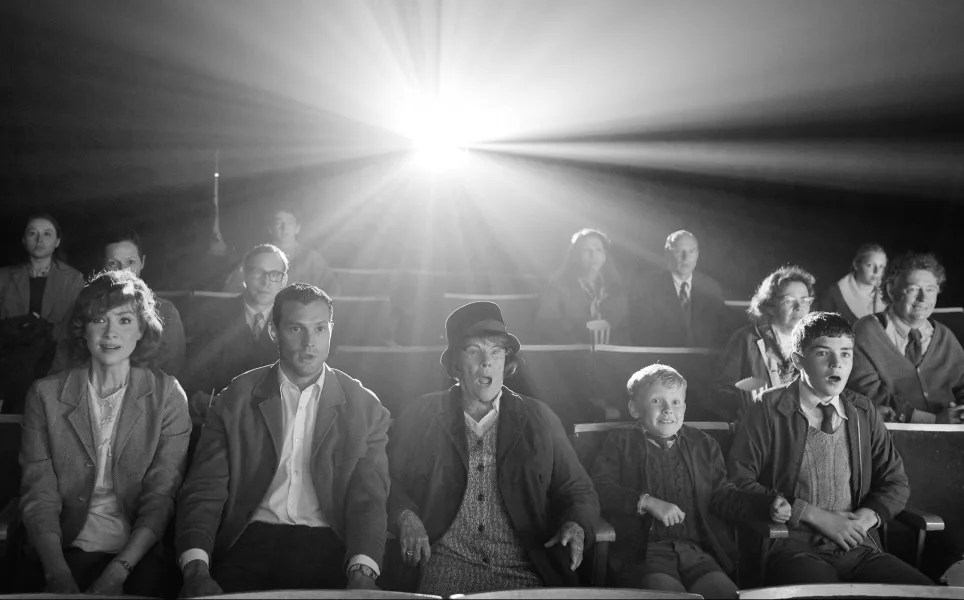
The joy of cinema is one of the themes in Kenneth Branagh’s semiautobiographical film Belfast, as all three generations of Buddy’s family enjoy going to the movies together. In this still, they react to the flying car riding off the cliff in Chitty Chitty Bang Bang.

1. Belfast, dir. Kenneth Branagh. Drawn from writer-director Kenneth Branagh’s own childhood, Belfast takes place in 1969–70 in a working-class neighborhood in the Northern Ireland capital, at the beginning of the thirty-year period of political violence known as the Troubles. This conflict was between (mostly Catholic) nationalists seeking independence from Britain, and (mostly Protestant) loyalists who saw themselves as British and thus sought to preserve Northern Ireland’s union with Britain. The focus of the film, however, is on family, not politics, as all the events of the year are filtered through the perspective of nine-year-old Buddy (Jude Hill). He sees his dad, for example, who refuses to participate in the riots, as a hero in the vein of his favorite western film characters.

Belfast is poignant and nostalgic and not at all the worse for being so. The “Everlasting Love” scene near the end is euphoric—and well earned!—and made me cry. In the wake of a death and amid financial debt, impending displacement from what has been their family’s hometown for generations, and other marital strains, Pa (Jamie Dornan) sings a pop song to Ma (Caitriona Balfe) from a lounge stage and pulls her into a dance, creating a moment of pure celebration, love, and defiant survival. The film’s highlight for me is how it holds together life’s joys and struggles, sorrows and laughter. Branagh, who moved with his parents and brother from Belfast to Reading, England, at age nine to escape the violence, dedicated the film to “those who stayed, those who left, and those who were lost” in Belfast.

2. The Power of the Dog, dir. Jane Campion. An adaptation of a Thomas Savage novel, this film subverts the traditional image of the western cowboy, exploring male virility, vulnerability, and agency. What is required to protect those you love? Is it muscles and bluster and a “gloves off” sort of grit, or a courage rooted someplace else?

Set in Montana in 1925, the film centers on the macho-posturing Phil Burbank (Benedict Cumberbatch), who runs a cattle ranch with his brother George (Jesse Plemons). When George marries the widowed Rose (Kirsten Dunst), she and her impressionable teenage son Peter (Kodi Smit-McPhee) settle at the Burbank estate. Phil is set off by Peter’s “sissiness”—his willowy frame, his slight lisp, his delight in crafting paper flowers for his mother—and he reacts with incessant bullying. He is cruel, mocking, and emotionally abusive not only to Peter but also to Rose, whom he resents for layered reasons.

The ending makes us see one of the characters in a completely different light and therefore prompts us to reread some of the emotional dynamics we have witnessed. The title comes from Psalm 22:20: “Deliver my soul from the sword; my darling from the power of the dog” (KJV).

Streaming on Netflix.

3. The Lost Daughter, dir. Maggie Gyllenhaal. Ambivalence toward motherhood is rarely explored onscreen. We see mother characters overwhelmed and exhausted, even stifled, but the sacrifices they make in those roles are almost always portrayed as ultimately worth it for the profound love and joy they experience as a result of being a mom. Because we’re conditioned, culturally and religiously, to view children as an unmitigated blessing, to express any kind of regret about having children is taboo (we’re only allowed to regret not having children). Women are expected to relish their role as mothers and to find their deepest fulfillment in that role, and if they don’t, they’re branded as “bad” or selfish.

I can already hear the alarm bells going off with my readers right now. “Children are a gift from God! How dare we be anything less than grateful for them! Women are designed to bear and nurture life! What could possibly be more fulfilling than living out that design?” One of the great things about films is that they often help us to enter into other experiences and perspectives, to access the feelings of another and, through that, our own. That doesn’t mean we forsake our beliefs and convictions, but we open ourselves up to a story that could challenge our sometimes overly simplistic thinking. One doesn’t have to reject the Bible to acknowledge that motherhood is messy and that for many women it requires them to confront (or else bury) darker pulls and emotions. Contrary to what we’re often told, motherliness does not come naturally to all women! There’s much more I could say about this, but let’s get to The Lost Daughter:

First-time writer-director Maggie Gyllenhaal, who herself has two daughters, wanted to make a film that explores all the complicated, unresolved emotions surrounding motherhood, which can include terror, anxiety, doubt, annoyance, and despair. An adaptation of Elena Ferrante’s novel of the same title, it follows Leda (Olivia Colman), a middle-age literature professor on holiday in Greece. One day on the beach she encounters a young mother named Nina (Dakota Johnson), who triggers Leda’s memories of her own two daughters, now in their twenties. We see flashbacks to Leda’s life as a struggling twenty-something mom (played by Jessie Buckley). She loves her children but feels plundered by them. And so she does something “aberrant,” as Gyllenhaal put it in an interview, which we find out about halfway through the film.

The film neither punishes nor condones its protagonist’s behavior. To what degree Leda feels guilt, regret, or satisfaction, and about what specifically, is largely left to the viewer to interpret, as she’s a hard one to read. (Colman gives us a very interior performance, which I think is to her and the film’s credit.) She is obviously troubled by past decisions, as her dizzy spells and thievery would suggest. There is also quite a bit of open-ended symbolism at play throughout.

Streaming on Netflix.

4. Drive My Car, dir. Ryûsuke Hamaguchi. The forty-minute prologue of this three-hour film establishes the relationship between theater actor-director Yusuke Kafuku (Hidetoshi Nishijima) and his screenwriter wife, Oto (Reika Kirishima). Within this pocket of time, Oto dies of a cerebral hemorrhage—after Yusuke finds out about her having an affair but before he confronts her about it. Roll opening credits.

Based loosely on a short story by Haruki Murakami, Drive My Car is about grief, intimacy, betrayal, forgiveness, self-knowledge, and communication across barriers. Two years after his wife’s death, Yusuke participates in a residency in Hiroshima, where he has been invited to direct a multilingual stage production of Chekhov’s Uncle Vanya, about a forty-seven-year-old man who is so world-weary that he wants to die. Yusuke’s concept is for the actors to act in their native language—Mandarin, Japanese, Korean, Korean Sign Language—feeding off their dialogue partner’s tones, speech rhythms, body language, and facial expressions, while subtitles are projected on a screen for the play’s audience.

Yusuke’s emotional healing comes through his work on this play (“Chekhov is terrifying because his lines drag the real out of you,” he says) and through the friendship he develops with his assigned driver, Misaki Watari (Toko Miura), a young woman who also carries a private grief. The two help each other come to terms with loss and regret and learn how to live again.

Streaming on HBO Max.

5. Flee, dir. Jonas Poher Rasmussen. This animated documentary chronicles the refugee experience of Amin Nawabi (not his real name), who fled from Afghanistan to Russia with his family in 1992 when he was eleven to escape the Mujahedeen attacks that became more frequent in Kabul after the Soviet withdrawal. He sought asylum in Europe for the next few years as an unaccompanied minor and eventually settled in Denmark, where he attended high school in Copenhagen and became friends with classmate Jonas Poher Rasmussen, now a filmmaker. More than twenty years later, he is telling his story for the first time, and it is Rasmussen he has entrusted it to.

The use of animation, a rare but not unheard-of choice for a documentary, has several advantages. It enables the subject to remain anonymous for his own safety. It allows for the re-creation of scenes from Amin’s childhood that were not, and could not have been, captured on film. And it enhances the expressiveness, tone, and meaning of certain scenes. The animation is supplemented, sparingly, with archival newsreel footage that gives historical veracity to some of Amin’s memories. And an important link to “the real” is forged by the use of Amin’s own voice in the animated interview sessions, conducted over several years, and sometimes in voiceover in the flashbacks. (His younger self is voiced by actors who capture him at two different ages—nine to eleven, and fifteen to eighteen.)

Throughout the film, Amin works to integrate his past and present and to make a home (“someplace safe, somewhere you know you can stay, and you don’t have to move on”) with his fiancé, Kasper, whom he has not yet spoken his traumas to.

Streaming on Hulu.

6. CODA, dir. Sian Heder. Sure, this film follows a predictable narrative arc and hits all the notes you would expect. But it’s so good! Seventeen-year-old Ruby (Emilia Jones) is the only hearing member of her family (CODA = child of deaf adults). Before school each day she works on the family’s fishing boat with her dad (Troy Kotsur) and older brother (Daniel Durant), while her mom (Marlee Matlin) runs the business side of things. But she finds herself increasingly drawn toward singing as a career path, and she starts to consider applying to Berklee College of Music in Boston.

The conflict is a familiar one: follow the plans your parents have laid out for you, or chase your own dreams, your own calling. Ruby needs to find her identity apart from being her family’s interpreter. But how can she honor the talents she’s been gifted with and her family obligations? Ruby’s parents slowly learn to accept and support her ambitions, even though they revolve around an auditory art form that is not accessible to them, and even though it means she’ll have to leave home. A turning point comes when they see her sing a duet at a school concert. In what is the most moving scene in the film, they experience the performance through watching the reactions of others in the audience.

Streaming on Apple TV+.

7. The Killing of Two Lovers, dir. Robert Machoian. A stylish arthouse drama set in rural Utah, this film follows David (Clayne Crawford), who’s desperately trying to keep his family of six together during a separation from his wife, Niki (Sepideh Moafi). He refuses to accept that the marriage is over. Shot in a 4:3 aspect ratio and with lots of long takes, the film is raw, potent, unflinching. And I love where it ends up.

Streaming on Hulu.

8. The Truffle Hunters, dir. Michael Dweck and Gregory Kershaw. This documentary made me smile more than any other film I saw last year. It’s so tender, and so gorgeously shot. And it’s got to be my favorite dog movie!

Truffle hunters are typically a secretive bunch, but the filmmakers got access to several of these elderly men from northern Italy who forage the forests with their trusty dogs, seeking out the edible fungus, a gourmet delicacy, to sell at high-priced auctions or on the black market. There are no interviews, no voiceovers—just a quietly observant camera. Despite the high prices truffles fetch, the hunters live simple lives in their Piedmont villages. And each has his own personality.

There’s a heavy focus on the relationship between the men and their dogs. They share meals with them, take baths with them, sing “Happy Birthday” to them, bring them to church. Aurelio, who is single and has no children, looks for someone to take care of his dog Birba when he dies; his chatter with Birba, and his expressions of love (like baking her a cake for her birthday), is the most endearing part of the film. It was also precious to see Titina, Carlo’s dog, being blessed by a priest—to use her gift of scent to serve others, to bring joy, as her finds will end up being used to make delicious dishes.
9. The Father, dir. Florian Zeller. Because of the COVID-19 extended eligibility period for Oscar submissions last year, this film was technically part of the 2021 Academy Awards, even though it was released in February 2021. Anthony Hopkins, who won Best Actor for this role, plays Anthony, an elderly man with dementia. As he loses his grip on the things and people around him, he becomes easily agitated and resists the care of his daughter Anne (Olivia Colman).
Zeller said he wanted the audience to feel as though, like Anthony, they’re “groping their way through a labyrinth,” so he wove a complex narrative that mixes reality with Anthony’s memories. We are made to feel his confusion, terror, frustration, and disorientation, in part by the use of multiple actors to portray a single character, such that we’re also not sure who’s who and what’s going on. Kudos to editor Yorgos Lamprinos and production designer Peter Francis for their work, as both those skills are key in pulling off this kind of storytelling.

The film is heartbreaking—the biggest downer on my list, for sure, especially with its climactic scene where Anthony breaks down and cries for his mommy. But by inviting us into Anthony’s suffering, The Father develops our empathy for those whose brains stop functioning properly in old age, for whom the world no longer makes any sense—an incredibly fearful thing.

10. C’mon C’mon, dir. Mike Mills. Johnny (Joaquin Phoenix) is a radio journalist who travels the US asking kids big questions about life. When his sister (Gaby Hoffmann) is forced to deal with a mental health crisis her ex-husband is experiencing, Johnny becomes the caretaker of her son (Woody Norman) for an extended period. The uncle-nephew bonding that follows constitutes the core of the film. Unlike The Lost Daughter, C’mon C’mon paints a bright and affirmative portrait of parenthood. It acknowledges the challenges of raising children while also celebrating the many small, beautiful moments of connection that are possible between adult and child.

Read part 2.

New book: Parallel Universes of Children by Uğur Gallenkuş

Warning: This post contains distressing photographs, including one of an emaciated child and one of a wounded (but bandaged) infant.

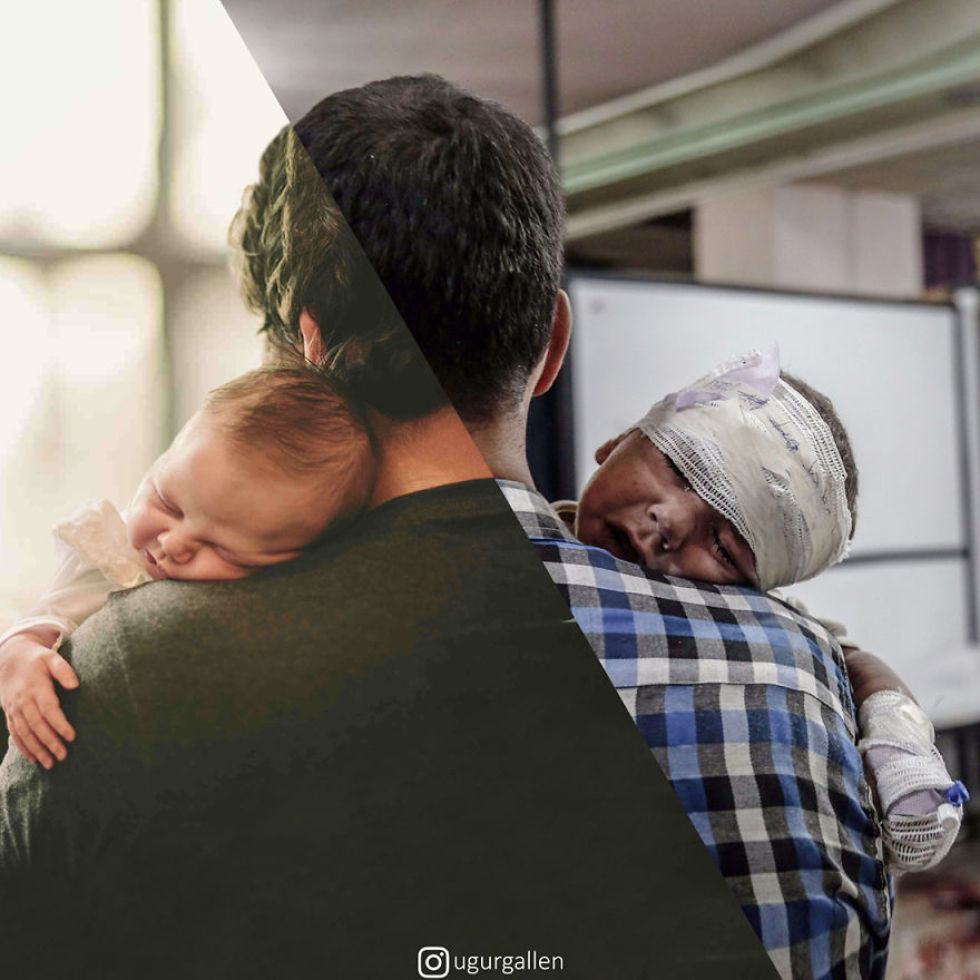
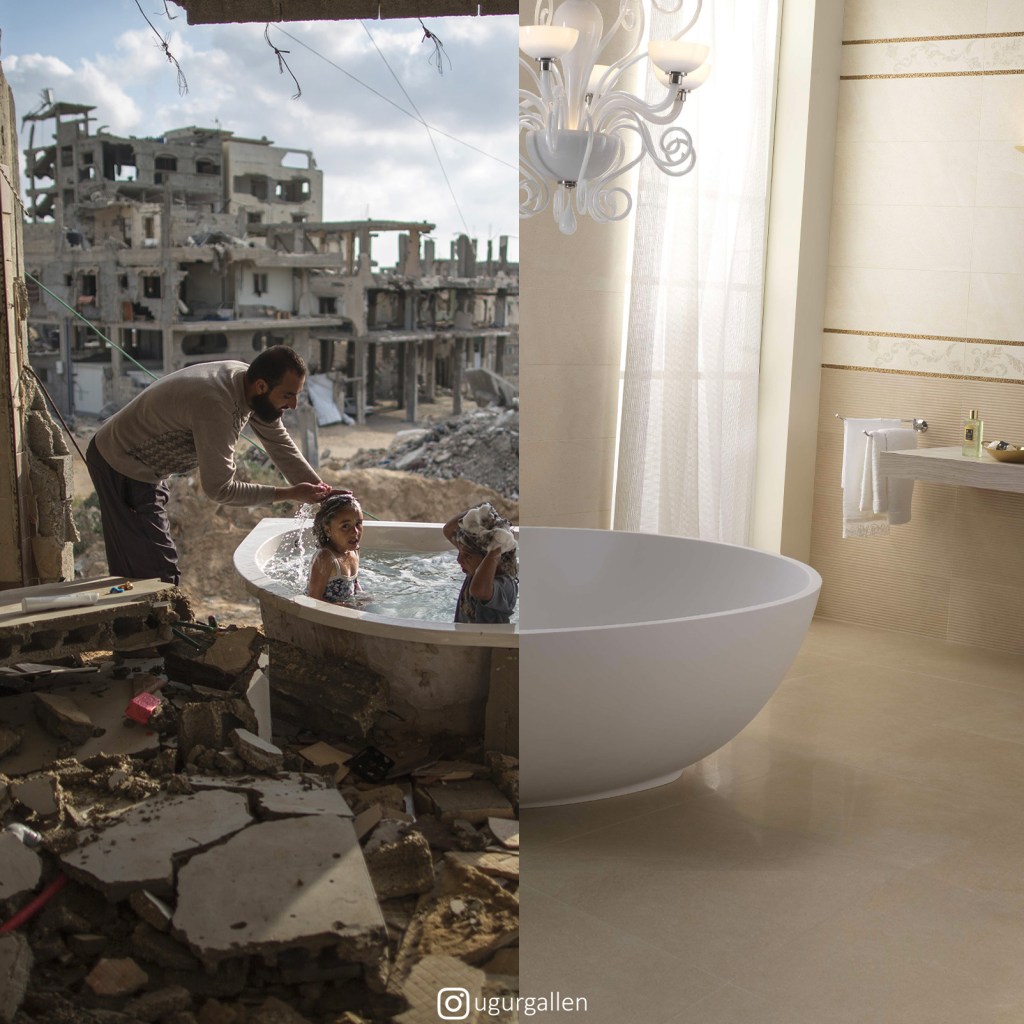
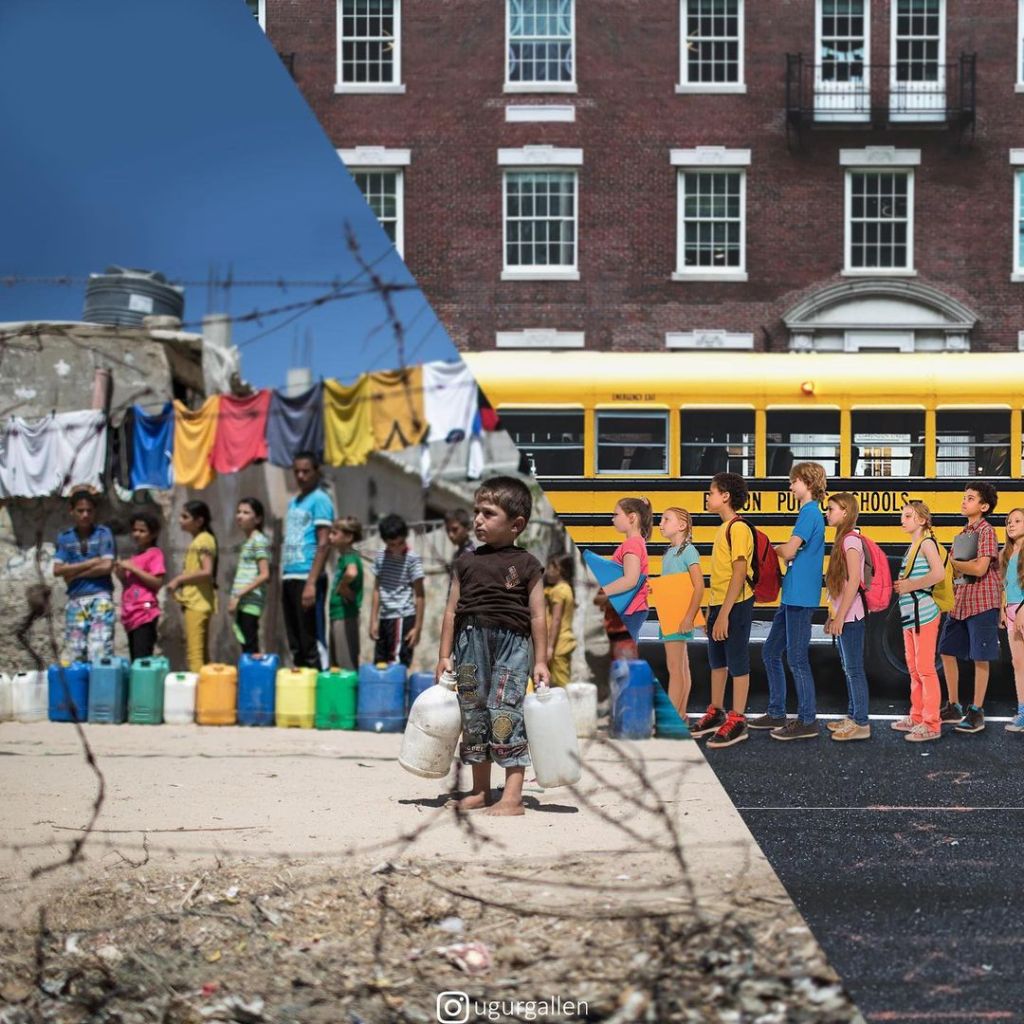
Uğur Gallenkuş (Turkish, 1990–) is an Istanbul-based artist whose digital photomontages address the widening global divide between the privileged and the oppressed. By combining photojournalistic images and stock photos with similar compositional elements, he juxtaposes the relative safety, stability, comfort, and flourishing experienced by middle- and upper-class Westerners with the violence, terror, trauma, and hardship experienced by victims of poverty, war, and displacement. Because Gallenkuş lives in the Middle East, he focuses on that geographic region.

Releasing November 20 in honor of World Children’s Day, Parallel Universes of Children brings together fifty of Gallenkuş’s sobering mash-ups, integrating facts of children’s lived realities around the world. It is $60 plus shipping, available only through the artist’s website. (For US buyers, there’s stock warehoused in New Jersey, so you won’t be paying to ship it from Turkey.)

“I aim to create awareness and inspire action to remember and to ask ourselves every day what we have done to safeguard children’s rights, both near home and across the globe,” Gallenkuş says. He wants not only to alert the well-off to the suffering they often shield themselves from, shaking them out of their complacency, but also to remind those in underdeveloped countries that they deserve better government and education, the right to thrive.

I’ve linked each image to its source on Instagram, where you can find out more information about it—when and where the photograph was taken and by whom (Gallenkuş does not take the photos himself), context, stats, etc. Some of the links will take you to a revised (updated) form of the image; in those instances, the originals I found at Juxtapoze.

Ugur Gallenkus mash-up

The stark contrast between the two component photos of each montage is jolting, intentionally so. Reflecting socioeconomic and political disparities, they tell drastically different stories about childhood. My existence must look like a fairy tale to those who have grown up in war zones or refugee camps.

One of Gallenkuş’s montages shows a lavish bathroom with a chandelier, pristine tiles, and freshly pressed towels next to the remnants of a bathroom whose walls were blown out by an Israeli airstrike, where a father bathes his daughter and niece.

Ugur Gallenkus mash-up

Another one shows a line of American schoolchildren waiting to board a bus, which transforms into a line of Palestinian children waiting to fill jerrycans and bottles with drinking water from public taps at the Deir al-Balah refugee camp in central Gaza Strip. (Many fall sick from the water, whose source is polluted with human waste.)

Ugur Gallenkus mash-up

Consider, too, the differences in play. A child at an IDP camp plays with a toy grenade launcher, while his counterpart plays doctor. A Syrian boy has fun balancing on the barrel of a tank in a pile of wreckage, while opposite him, in a green park, a boy rides a harmless seesaw. The imaginations of children are shaped by what surrounds them, whether that be violence or possibility.

Continue reading “New book: Parallel Universes of Children by Uğur Gallenkuş”

Roundup: On crossing borders

In a recent conversation, poet and novelist Joy Kogawa said, “We need to see each other’s eyes, and see each other through each other’s eyes.” Art, from all disciplines, can help us do that. Art can awaken our social conscience and breed empathy and understanding. It can serve as a vehicle for lament, a practice of voicing suffering before God. It can also widen our imaginations—that is, in part, our ability to think up creative solutions to problems both big and small. Here are just a few recent justice-oriented art projects that inspire me.

+++

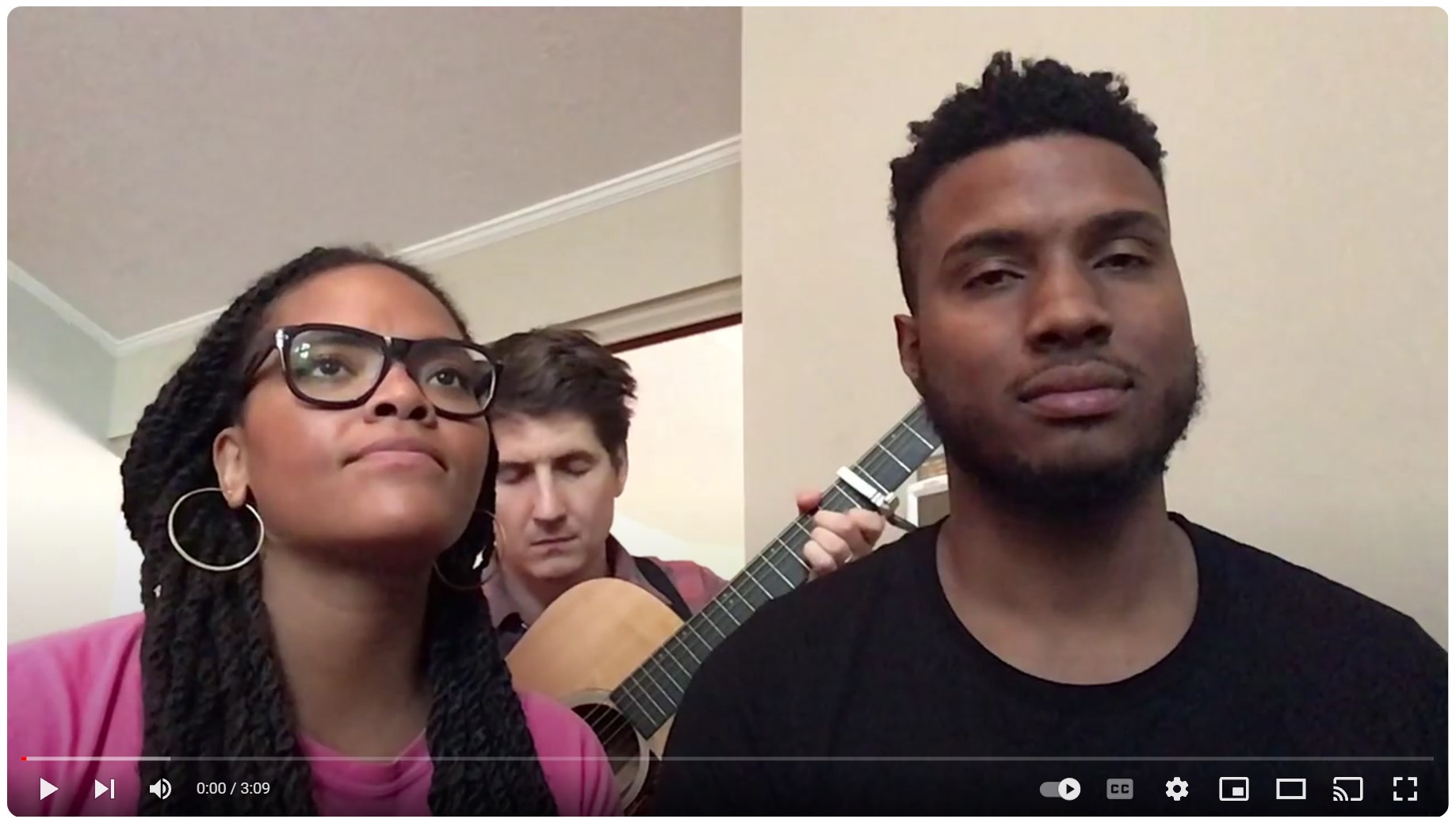
CLASSIC SONG REVISED: Earlier this month Liz Vice, Paul Zach, and Orlando Palmer took Woody Guthrie’s folk classic “This Land Is Your Land” and, gathering at Trinity Church in Charlottesville, Virginia, revised the lyrics and tone to project lament over some of America’s more troubling legacies. The lyrical turn happens in the fourth line: where we would expect “To the New York islands,” we get “To the Texas border,” turning our mind from the country’s beauty to its broken systems that prevent us from sharing abundance with our southern neighbors fleeing violence. The song continues to plot a path through various places of historical and present-day suffering in the US, the three stanzas compactly addressing immigration; slavery, the “New Jim Crow,” and police brutality against black people; and the forcible expulsion of Native Americans from their ancestral territories, as well as massacres and other forms of colonialist violence.

This Land Is Your Land

This land is your land
This land is my land
From California
To the Texas border
Through the Juarez mountains
With the migrant caravans
This land was made for you and me

This land is your land
This land is my land
From the piers of Charleston
To the fields of cotton
From the crowded prisons
To the streets of Ferguson
This land was made for you and me

This land is your land
This land is my land
From the Jamestown landing
To Lakota Badlands
From the Trail of Tears to
The reservations
This land was made for you and me

Most people don’t know it, but Guthrie actually wrote “This Land Is Your Land” as a protest against the vast income inequalities in the US. Two of its original verses, the radical ones, were nixed when it came time to record (it was the McCarthy era, after all); these referenced breadlines and tall walls with “No Trespassing” signs. In its original form, the song celebrated America as a place of natural abundance—forests and streams and wheat fields under “endless skyways”—while lamenting the scarcity that many Americans experience. The refrain, therefore, was more loaded. Learn more about the song’s history at https://www.npr.org/2000/07/03/1076186/this-land-is-your-land.

+++

Seesaws at the border
An interactive art installation by Rael San Fratello on July 27, 2019, fostered cross-border interactions between residents of Sunland Park, New Mexico, and Colonia Anapra, Mexico.

SEESAWS AT THE BORDER: On July 27, Oakland-based creative duo Ronald Rael and Virginia San Fratello installed three bright pink teeter-totters through the slats of a section of the US-Mexico border wall that separates the neighboring communities of Sunland Park, New Mexico and Colonia Anapra, Mexico. Citizens on both sides were invited to ride this playground essential with a cross-border partner—a whimsical way to engage the other. As the creators said, it enabled people to literally feel the weight of humanity on the other side, using the wall as a fulcrum. The installation lasted forty minutes before it was dismantled (without incident).

I love this idea of play as protest—teeter-tottering as an act of creative defiance. What was enacted July 27 at the wall was a theater of the absurd, something that Rael, an architect, is especially drawn to in his practice. He actually conceived of Teeter-Totter Wall ten years ago, publishing a conceptual drawing in the book Borderwall as Architecture (University of California Press, 2009), along with other outlandish design possibilities for turning the wall into something that brings together rather than divides—these include its use as a massive xylophone played with weapons of mass percussion, a bookshelf feature inside a binational library, and more. Through these humorous proposals, Rael “reimagin[es] design as both an undermining and reparative measure,” as Dr. Marilyn Gates put it.

In his 2018 TED Talk, Rael discusses how the wall, meant to separate, has actually served to unite people in some instances. He mentions, for example, games of Wall y Ball, a variation on volleyball that was established at the wall in 1979, and binational yoga classes. I’ve heard of the Eucharist being celebrated jointly through the slats, and picnics hosted—such as the one organized in Tecate by the French artist JR on October 8, 2017: families passed plates of food between the bars, and musicians on both sides played the same songs.

JR_Picnic at the Border
A picnic at the US-Mexico border on October 8, 2017, organized by the elusive street artist JR

This picnic was the capstone of a month-long installation by JR featuring a monumental photograph of a Mexican toddler named Kikito, peering over the border wall into California from Tecate. (The photograph was held up with scaffolding.)

Kikito by JR
In early September 2017, street artist JR created a massive art installation on the Mexican side of the US border wall in Tecate showing a child, Kikito, peering over.

Shared play, shared food, shared music, shared sacrament—these are such breathtakingly beautiful countermeasures to separatism. The world needs more imaginative acts like these.

+++

POEM: Timothy E.G. Bartel has just published a new poem, “Status Check,” over at Curator. It’s only five lines, seven questions. A must-read. It’s not about immigration policy per se (it’s open-ended), but it took me back to another poem by Bartel that I featured back in 2017 as part of a blog post entitled “One sonnet vs. shouted prose: Lady Liberty, Emma Lazarus, and Trump.” Bartel has since published a freely downloadable chapbook (a compilation of Sapphic stanzas he wrote this year during National Poetry Month) and a traditionally published collection with Kelsay Books, Aflame but Unconsumed, which I just ordered and am excited about.

+++

VIRTUAL REALITY INSTALLATION: This was in DC last year and I missed it! A VR experience directed by the multi-Academy-Award-winning Alejandro G. Iñárritu, known for the films Birdman, The Revenant, Biutiful, and Babel, and shot by (also multiple-award-winning) cinematographer Emmanuel Lubezki. “Carne y Arena is a six-and-a-half-minute solo experience that employs state-of-the-art technology to create a multi-narrative space with human characters. . . . Based on true accounts from Central American and Mexican refugees, [it] blurs and binds together the superficial lines between subject and bystander, allowing individuals to walk in a vast space and live a fragment of a refugee’s personal journey.”

“It’s a way of understanding, which is another way to love somebody,” Iñárritu said in a video interview recorded against the backdrop of Jacob Lawrence’s Migration series.

+++

In terms of lectures, I highly recommend the three-part series “A Light unto Our Feet: How Does the Bible Orient Us Toward Immigration?” by Dr. M. Daniel Carroll R. (Rodas), delivered November 1–3, 2018, for the Diocese of Christ Our Hope. Dr. Carroll is the author of Christians at the Border: Immigration, the Church, and the Bible (Brazos Press, 2014).

Rise Up (Artful Devotion)

Worn Out by Iyah Sabbah
Iyad Sabbah (Palestinian, 1973–), Worn Out, 2014. Fiberglass sculptures covered in clay.

God has taken his place in the divine council;
in the midst of the gods he holds judgment:
“How long will you judge unjustly
and show partiality to the wicked? Selah
Give justice to the weak and the fatherless;
maintain the right of the afflicted and the destitute.
Rescue the weak and the needy;
deliver them from the hand of the wicked.” . . .

Arise, O God, judge the earth;
for you shall inherit all the nations!

—Psalm 82:1–4, 8

Verses 2–4 of Psalm 82 are God speaking to his court, whereas the final verse is the psalmist Asaph speaking to God in prayer. The identity of “the gods” (elohim) in this psalm is much debated among scholars, with some thinking it refers to human rulers and others thinking it an assembly of spiritual beings to whom God delegates authority. Either way, God is upset that these judges have been neglecting justice in failing to uphold the cause of orphans, the elderly, the sick, the poor, and other marginalized groups.

Further reading:

+++

SONG: “Rise Up” | Words and music by Isaac Wardell, with the verse melody based on a melody by Evan Mazunik | Performed by Lauren Goans, on Lamentations by Bifrost Arts (2016)

For the lonely and forgotten,
for the weary and distressed;
for the refugee and orphan,
and for all who are oppressed;
for the stranger who is pleading
while insulted and despised:
Will You rise? Will You rise?

Rise up! Rise up!
The earth will fear the Lord
when You avenge the poor.
May Your kingdom come . . .
O rise up!

Hear how Rachel, she is weeping.
How she will not be consoled.
And the children in our keeping,
are their bodies bought and sold?
And the watchman, he is sleeping.
Do You see them with Your eyes?
Will You rise? Will You rise?

Rise up! Rise up!
The earth will fear the Lord
when You avenge the poor.
May Your kingdom come . . .
O rise up!

As Your will is done in heaven,
Let it now be done below.
Let Your daily bread be given,
Let Your kingdom come and grow.
Lead us not into temptation,
But deliver us, we cry.
Will You rise? Will You rise?

Rise up! Rise up!
The earth will fear the Lord
when You avenge the poor
and bare Your holy arm
to keep them safe from harm.
May Your kingdom come . . .
O rise up!

+++

Several times throughout scripture, God’s people call on him to “Rise up!” (or, as some translations have it, “Arise!”) against oppression, against evildoers. In other words: Move; take action.

Arise, LORD, in your anger;
rise up against the rage of my enemies.
Awake, my God; decree justice. (Ps. 7:6)

Rise up, LORD, confront them, bring them down;
with your sword rescue me from the wicked. (Ps. 17:13)

Awake, Lord! Why do you sleep?
Rouse yourself! Do not reject us forever.
Why do you hide your face
and forget our misery and oppression?

We are brought down to the dust;
our bodies cling to the ground.
Rise up and help us;
rescue us because of your unfailing love. (Ps. 44:23–26)

Do not let the oppressed retreat in disgrace;
may the poor and needy praise your name.
Rise up, O God, and defend your cause . . . (Ps. 74:21–22a)

The whole biblical story is about God rising up again and again in defense of the weak. On more than one occasion the prophet Isaiah uses the language of “rise up” to express God’s activism:

The LORD longs to be gracious to you;
therefore he will rise up to show you compassion.
For the Lord is a God of justice.
Blessed are all who wait for him! (Isa. 30:18)

+++

Worn Out by Iyad Sabbah

Worn Out by Iyad Sabbah

In October 2014, Palestinian artist Iyad Sabbah installed the seven-piece clay sculpture group Worn Out on the beach of Shuja’iyya, a Gaza neighborhood that was decimated that summer by Israeli military forces. Commemorating the victims of the Gaza war, it depicts a family fleeing the rubble of what used to be home. The figures are all flecked with red pigment, signifying blood, and have an eroded appearance. They stagger on through the detritus left by three days of shelling, in desperate need of deliverance.

As I view photos of this installation set amid the ravages of war, by a man who is himself from Gaza, I feel helpless to redress the wrongs suffered. And so I lean on this ancient prayer of beseeching, echoed so beautifully in the above song by Isaac Wardell: Rise up, God. Do not turn away from our misery. In your love, rescue us. For those displaced by war, forced to become strangers in a strange land: rise up. For those who have lost loved ones, homes, limbs, livelihoods to violence: rise up. Put a stop to the unjust whose policies and actions deal in death rather than life.


This post belongs to the weekly series Artful Devotion. If you can’t view the music player in your email or RSS reader, try opening the post in your browser.

To view all the Revised Common Lectionary scripture readings for Proper 10, cycle C, click here.

Walking the Via Dolorosa through Amsterdam (Part 2)

This is part two of my commentary on Art Stations of the Cross: Troubled Waters, a multisite exhibition in Amsterdam running from March 6 to April 22. (Read part one.) Unless otherwise noted, all photos are by Eric James Jones/ArtandTheology.org.

STATION 4. Ocean Eden by Lynn Aldrich is a whimsical coral reef assemblage made out of everyday household cleaning supplies—sponges, scrubbers, scouring pads, mop heads, brushes, plastic gloves, and plungers, a rich biodiversity. Sea urchins, sea anemones, starfish, and snails are among the animals evoked.

Ocean Eden by Lynn Aldrich
Lynn Aldrich (American, 1944–), Ocean Eden, 2008. Sponges, scrubbers, scouring pads, mop heads, brushes, rubber gloves, plungers, and wood, 234 × 168 × 61 cm.

Playful though it is, this bricolage of commercial products, arranged to represent an underwater ecosystem, creates a crass juxtaposition of natural and unnatural that makes the piece tragicomic. The subtext is ecological concern—in particular, for the endangerment of coral reefs. Let’s clean up our oceans, the work seems to say. The assignment of Ocean Eden to station 4, “Jesus meets his mother,” reinforces the traditional conception of nature as mother. Here we meet Mother Nature, who grieves our mistreatment of her.

Ocean Eden by Lynn Aldrich (detail)

Ocean Eden by Lynn Aldrich (detail)

Station 4 is sited at the Keizersgrachtkerk, a church built under the leadership of Abraham Kuyper just two years after the 1886 schism of the Dutch Reformed Church. (Kuyper led the conservative offshoot, the Doleantie.) Aldrich’s assemblage is visible from the street through the main glass entrance doors and so can be viewed even when the church is locked. Luckily, a staff member was there to let us in after hours through a side entrance, so we could see the work closer up. It’s located in a small lobby that dips between stairwells on either side.

+++

STATION 5. Next on the route is the Amsterdam Museum, whose building complex served from 1580 to 1960 as Burgerweeshuis, the city orphanage. Before that it was a monastery. To mark this change of function, a large entrance gate was built in 1581 off the Kalverstraat, which, as Marleen pointed out to me, features a relief sculpture of a group of orphans gathered around the Holy Spirit, entreating passersby for help:

Wy groeien vast in tal en last. Ons tweede vaders klagen
Ay ga niet voort door dese poort, of help een luttel dragen.

We grow steadily in number and burden. Our second fathers ask with heavy hearts:
“Do not go forth through this gate without helping us a little in our care.”

Orphanage relief sculpture
Relief sculpture by Joost Jansz Bilhamer (Dutch, 1541–1590), above the entrance to the courtyard of the former City Orphanage of Amsterdam. Address: Sint Luciensteeg 27. The inscription is by the Dutch poet Joost van den Vondel. The paint colors, which are not original, seem to me a bit gaudy; to view the sculpture in its pre-restoration state, click here.

Their “second fathers” are, of course, their new caretakers, who run the orphanage. These children are asking for someone to help them carry their burden (poverty, hunger, sickness, lack of education, lack of prospects for the future, feelings of abandonment, longing for love, etc.), which the fathers are helping to shoulder but who can do only so much with their limited power. This sixteenth-century sculpture and inscription resonate with the fifth station of the cross, “Simon of Cyrene helps Jesus carry his cross.”

But this is only supplementary to the main artwork we’ve come to see: Out of History by Iris Kensmil, located in the Schuttersgalerij (Civic Guards Gallery). Part of the Amsterdam Museum, this gallery is a covered passageway that visitors can enter for free, featuring portraits of Dutch citizens through the centuries. (Admission to the rest of the museum is €15.)

Out of History by Iris Kensmil
Iris Kensmil (Dutch, 1970–), Out of History, 2013. Triptych, oil on canvas, 105 × 465 cm.

An artist of Surinamese descent committed to highlighting black contributions to Dutch history, Iris Kensmil was commissioned by the Amsterdam Museum in 2013 to create a new work to commemorate the 150th anniversary of the abolition of slavery in the Netherlands. (The Netherlands was a major player in the transatlantic slave trade from the sixteenth through nineteenth centuries.) She chose to depict three strong black figures from eighteenth-century Surinam (a former Dutch colony in the Guianas) who rose above colonial oppression to secure a position and a future for themselves.

The left panel of this triptych shows Elisabeth Samson (1715–1777), who, through her business acumen, became one of the richest women in Surinam. After this socioeconomic rise, she then successfully petitioned the Dutch government to be allowed to marry a white man, and became the first black woman in Surinam to do so; this consolidated her power. But despite overcoming huge obstacles, Elisabeth’s legacy is somewhat controversial because she amassed and maintained her wealth the same way the rest of the Dutch of Surinam did at that time—through slavery. (She owned a coffee plantation and some forty slaves.) Hear Cynthia McLeod’s super-entertaining TedX talk about Elisabeth Samson, which is just fifteen minutes long. (I could listen to this woman teach me history all day long!)

Out of History by Iris Kensmil
Elisabeth Samson

The central panel of Out of History shows Wilhelmina Kelderman (1734–1836), about whom less is known. What we do know is that she was an enslaved woman from Surinam who purchased her own freedom and that of her son. I think that’s a moneybag she’s holding.  Continue reading “Walking the Via Dolorosa through Amsterdam (Part 2)”

Walking the Via Dolorosa through Amsterdam (Part 1)

Last month I undertook a contemporary art pilgrimage through Amsterdam, curated by Marleen Hengelaar-Rookmaaker and Anikó Ouweneel-Tóth under the aegis of Art Stations of the Cross, a project founded in 2016 by Dr. Aaron Rosen and the Rev. Dr. Catriona Laing. (Previous city-specific editions have been in London; Washington, DC; and New York.)

Inspired by the traditional Stations of the Cross, the pilgrimage comprises fifteen stops at thirteen locations across the city, where participants are invited to spend time before a specially chosen contemporary artwork that addresses some form of human or environmental suffering. The route starts at the Basilica of Saint Nicholas (Amsterdam’s patron saint) just across from the train station and weaves through, among other places, a park, the old Jewish quarter, a former orphanage, a church-cum–rock concert hall, a hidden house church where persecuted Catholics used to worship, and the red-light district, ending inside the Oude Kerk (Old Church), the city’s oldest extant building, located right in the heart. Not only the art but also the sites themselves were selected with intention, each one a part of the journey down this via dolorosa, “way of sorrows.”

This was my first time to Amsterdam, and it was such a good way to see the city, learn about the city, and pray for the city—all through the agent of art, which functions in this experience as a series of visual laments. When I encounter suffering or read about it in the news, I am often at a loss for how to bring it before God in prayer. I feel its heaviness but lack the words to express that feeling or to intercede in any concrete way. That’s why I’m so appreciative of artists, whose work so often becomes, for me, a nonverbal prayer addressed to my Maker, as I behold and internalize what the artist has first beheld and internalized and has then shared with me through whatever their medium. This is a gift that artists offer the church: vision, long and deep, that’s sensitive to the glories but also the woes of the world and that invites others in, through the skillful crafting of materials, to see right along with them. That act of seeing—of noticing, of giving attention to—can itself be prayer.

Troubled Waters

Amsterdam was founded as a fishing village at the end of the twelfth century with the building of a dam on the Amstel River. (The name Amstelledamme later evolved into Amsterdam.) Its sixty-plus miles of interconnected canals have earned it the nickname “Venice of the North” and make it the most watery city in the world. These navigable waterways led to Amsterdam becoming, in the seventeenth century, the foremost maritime and economic power in the world, and the wealth that came through international trade also enabled the arts and sciences to flourish throughout the country; that’s why the seventeenth century is known as the Dutch Golden Age. (Think Rembrandt and Vermeer.)

Amsterdam canal

The exhibition’s subtitle, Troubled Waters, alludes to the fraught nature of Amsterdam’s identity as a historic port city into which both goods and people travel. The pioneering Dutch East India Company, an amalgamation of trading companies that is now defunct, is important in global business history as the forerunner of modern corporations, but it also cannot be separated from its involvement in the slave trade. Although slavery was formally abolished in the Netherlands in 1863, it continues in Amsterdam’s sex industry, in which a percentage of workers are victims of human trafficking; girls and women sometimes arrive in shipping containers, enslaved by pimps and even further by ignorant customers.

Other residents of Amsterdam arrive as refugees, and for many of them, water is a formidable danger that must be traversed on the way to safety.

“Troubled waters” also references the acidification, pollution, and rising temperatures of the world’s oceans, which endanger the many marine species that live there. So even the water itself bears wounds.

Although the overall tone of the pilgrimage is one of sorrow, pockets of hope are dispersed throughout, as in the empowered Surinamese painted by Iris Kensmil (station 5), Paul van Dongen’s Rising drawing that counterbalances his Judgment (station 7), Janpeter Muilwijk’s afterlife vision of his dead daughter victoriously bounding over the earth (station 9), the soothing “streams of mercy, never ceasing” that provide an auditory accompaniment to Anjet van Linge’s chiseled “Kyrie eleison” (station 12), and, of course, the inclusion of a resurrection station (station 15).

(Related posts: “Stations of the Cross at the Smithsonian American Art Museum”“Remembering Charleston”)

Though modeled loosely after a medieval devotional practice, Art Stations of the Cross: Troubled Waters is thoroughly modern, incorporating audio and video components, 3-D technologies, and the distinctively contemporary genre of installation art. Figurative art is still present and in some cases interacts with the traditional religious images in its environs, but it often does so transgressively—for example, the photorealistic Madonna and Child wrapped in emergency blankets in station 1 and the decapitated corpus of Christ in station 13.

For more information about Art Stations, which runs through April 22, visit http://www.artstations.org/. There you can find a map, opening times, descriptions, tie-in events, and information on where you can purchase a catalog (available in Dutch or English). Most stops along the route host a stack of brochures that condense this info and that contain a stamp card on the back, where you can mark off the stations you’ve visited. All the exhibition sites are freely accessible. (Oude Kerk waives its admission fee if you present your Art Stations brochure at the entrance desk.)

Below and in two subsequent posts, I will share some of my photos and impressions of each station. Unless otherwise specified, all photos are by my husband, Eric James Jones, and are the property of ArtandTheology.org. Feel free to use them noncommercially, with credit to the artists and a link back to this webpage.

+++

Madonna del Mare Nostrum by Hansa
Hansa (Hans Versteeg) (Dutch, 1941–), Madonna del Mare Nostrum, 2017. Oil on canvas, 125 × 125 cm. Photo courtesy of the artist.

STATION 1. The route starts at the neo-Baroque Church of St. Nicholas, which temporarily houses one of my favorite and arguably the most confrontational of all the works on the tour: Hans Versteeg’s Madonna del Mare Nostrum: Of, Mantel der Liefde (Our Lady of the Mediterranean Sea: Or, Cloak of Love). A young dark-skinned mother holds her toddler son, both of them wrapped in a thermal blanket like the ones given to refugees to prevent hypothermia. Replacing Mary’s traditional ultramarine robe with a “robe” of metallized polyethylene terephthalate, whose gold surface glints in the sun, emphasizes how she and her boy are clothed not only in holiness but also in need. Because of how the artist chose to frame the composition, we don’t know if the figures are standing in a boat that’s still at sea or on the shore. Regardless, their strongly frontal positioning and their direct stares seem to ask the viewer, “Will you receive us?”  Continue reading “Walking the Via Dolorosa through Amsterdam (Part 1)”