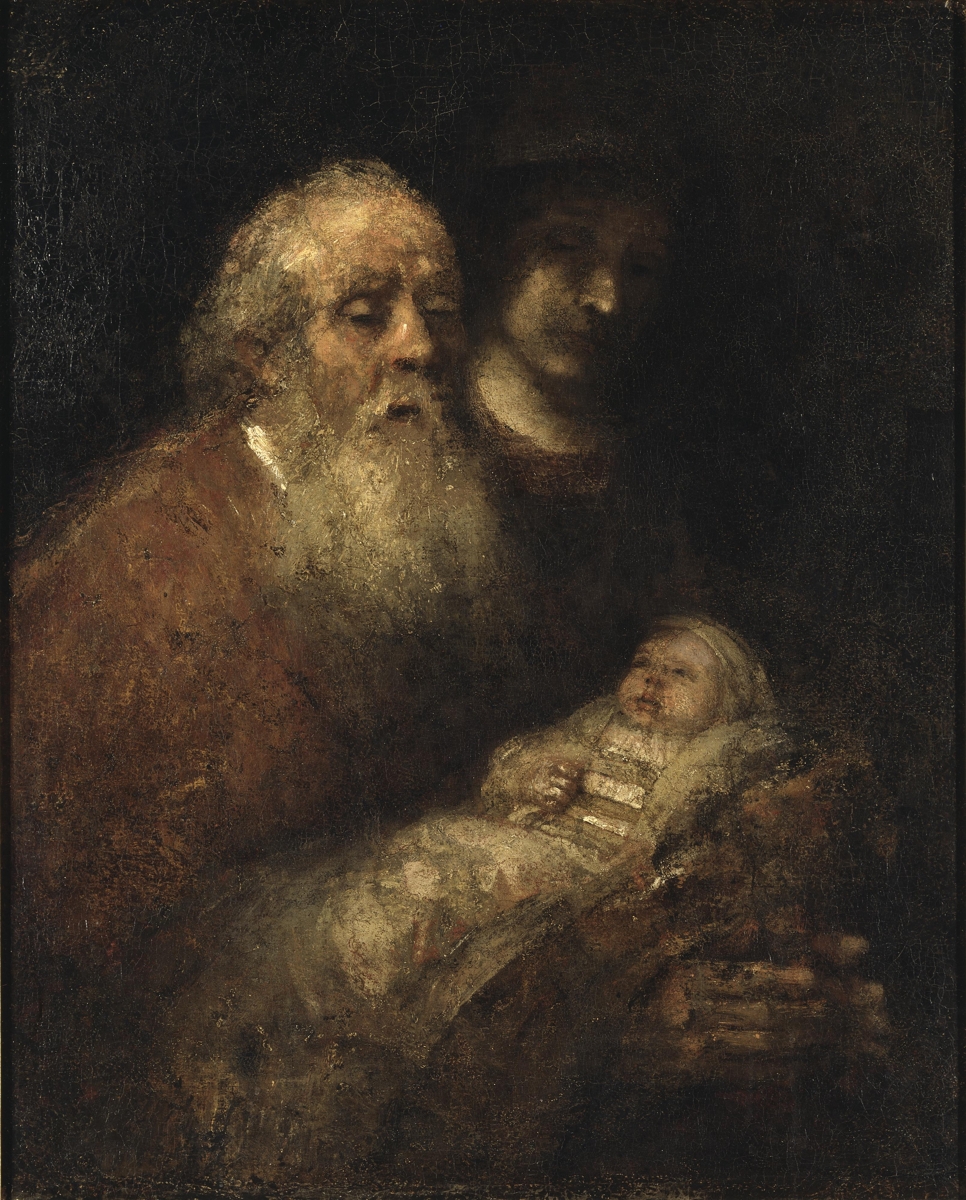
Rembrandt Harmensz. van Rijn (Dutch, 1606–1669), Simeon in the Temple, 1669. Oil on canvas, 98.5 × 79.5 cm. Nationalmuseum Stockholm, Sweden. Photo: Erik Cornelius.
after Simeon in the Temple, Rembrandt, 1669
Fingers stretch as if supplicating hands are interrupted— the answer placed in his waiting arms.
Light glistens on his temple— the mind consoled by consolation’s burden.
Death takes the prophet; takes the artist before his painting is complete; takes the one already bearing sin’s stripes.
Mary’s response to this announcement [of Jesus’s forthcoming birth]—her Magnificat—is even more overtly revolutionary. Her song in Luke’s Gospel is not a lullaby; it is a manifesto. She declares that the mighty will be cast down from their thrones, the lowly lifted, the hungry filled with good things, and the rich sent away empty. This is the language of redistribution, the language of a world reordered by justice rather than domination. It is no surprise that tyrants have feared this text; throughout modern history, the Magnificat has been prohibited and/or discouraged in public worship in places like Guatemala, Argentina, and India because oppressed communities used it as a rallying cry for liberation. Mary’s theology is insurgent.
What I love about Hannah and Mary is they step into God’s eternal streams of justice and of righteousness and of what it means to live as a faithful follower of Yahweh. They step into this expansive world of what God is going to do and has promised to do in the world, instead of the smaller space of their own need—which again, is OK and understandable. But they take us to places where, if we’re honest, most of our prayers don’t regularly go.
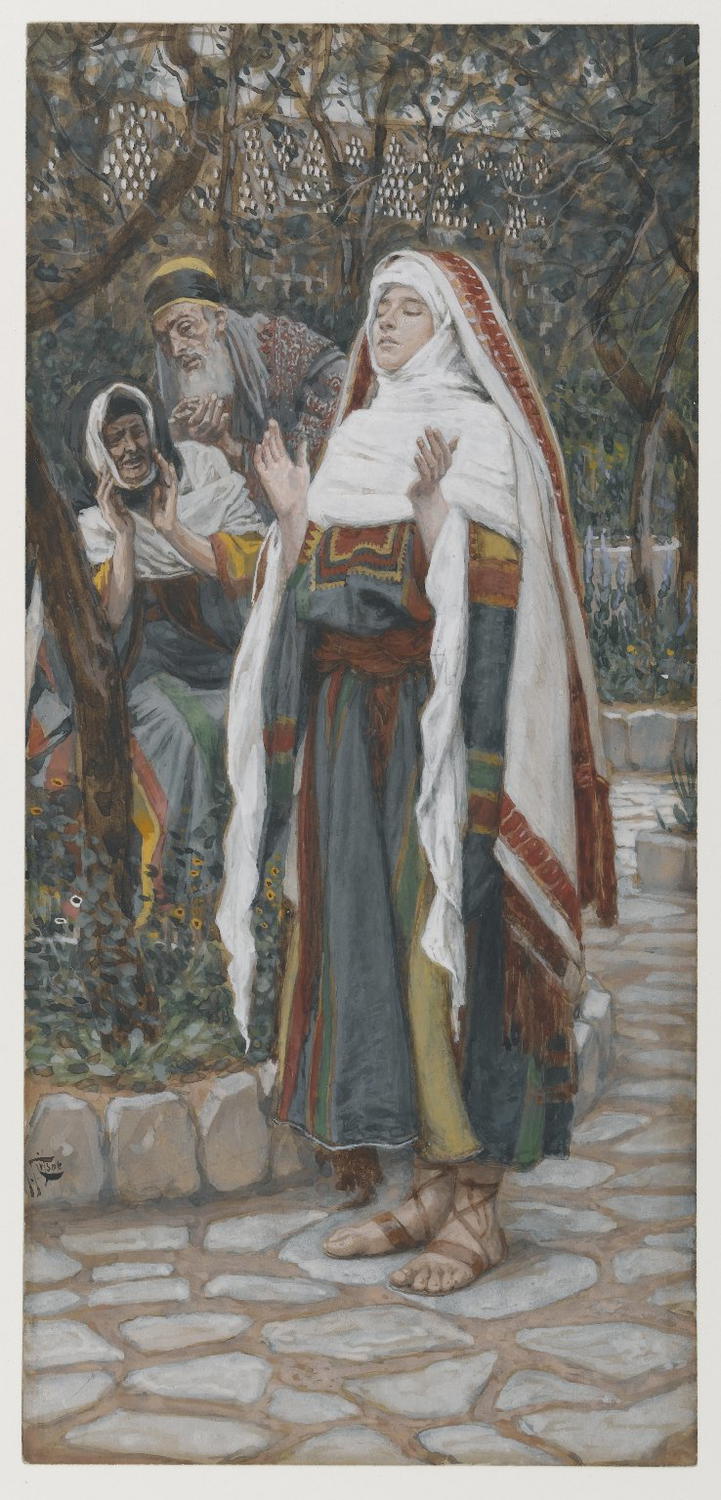
VIDEO DEVOTION:“Beholding the Magnificat with Mary Gardner”: In this “Space for God” video devotion from Coracle, Rev. Mary Amendolia Gardner, an Anglican priest with a bachelor’s degree in art history and a master’s in Christian spirituality, guides us in lectio divina (sacred reading) with Luke 1:46–55 and visio divina (sacred seeing) with James Tissot’s Magnificat.
James Tissot (French, 1836–1902), The Magnificat, 1886–94. Opaque watercolor over graphite on gray wove paper, 9 15/16 × 4 5/8 in. (25.2 × 11.7 cm). Brooklyn Museum, New York.
I typically don’t care for Tissot’s biblical watercolors, because of their illustrative quality—they remind me of pictures from the Sunday school curriculum I followed as a child. But I do like this one, which shows Mary in a position of wisdom and authority, absorbed in prayer, preparing to preach and prophesy. Elizabeth and Zechariah stand in attentive awe on the sidelines, their eyes directed toward the divine child she carries in her body while they await her words. The priest’s tongue had been tied, but Mary’s has been loosed. The Cuban American theologian Kat Armas, in the post quoted above, calls Mary “the first theologian of the Gospel,” as she boldly proclaims the messianic deliverance God has set in motion.
+++
SONGS:
>> “For Ages Women Hoped and Prayed” by Jane Parker Huber: “We join the song that Mary sings, an earthly, heavenly theme.” Performed at Wheaton Bible Church in Illinois.
>> “Mary, Did You Know”with alternative lyrics by Jennifer Henry: The original lyrics of this Gaither Vocal Band song were written by Mark Lowry in 1985, and they were set to music by Buddy Greene in 1991; the song became a popular hit. However, some Christians take issue with the rhetorical device that implies Mary did not know her son was God, that he would deliver Israel, and that he would reign forever, when that’s precisely what Gabriel told her from the beginning and what she alludes to in her Magnificat. (Defenders say these questions are most likely voiced by people in Mary’s life who didn’t know all that God had conveyed to her; or that it’s legitimate to wonder whether Mary knew the specifics that would unfold, and to suppose that even if she knew theoretically who Jesus was, she may have struggled to grasp the full scope and significance of his messiahship.)
In 2017, the Canadian theologian and activist Jennifer Henry rewrote the lyrics to center on the Magnificat and its mobilizing influence on justice movements across the globe. That song is sung here by Eric Lige, who is accompanied by Vahagn Stepanyan on piano.
>> “Magnificat” by Simon de Voil, feat. Alexa Sunshine Rose: This adaptation of the Magnificat is by Simon de Voil, a sacred musician, “interspiritual minister,” and retreat leader originally from Scotland now living in Vermont. The imagery in the video is not what I would have expected: It’s footage of bears in the woods. Perhaps it alludes to how all of creation will be redeemed in “the world that is to come”? The bears here, though, seem at peace, so maybe it’s a picture of blessedness, or of creation’s praise alongside Mary’s.
+++
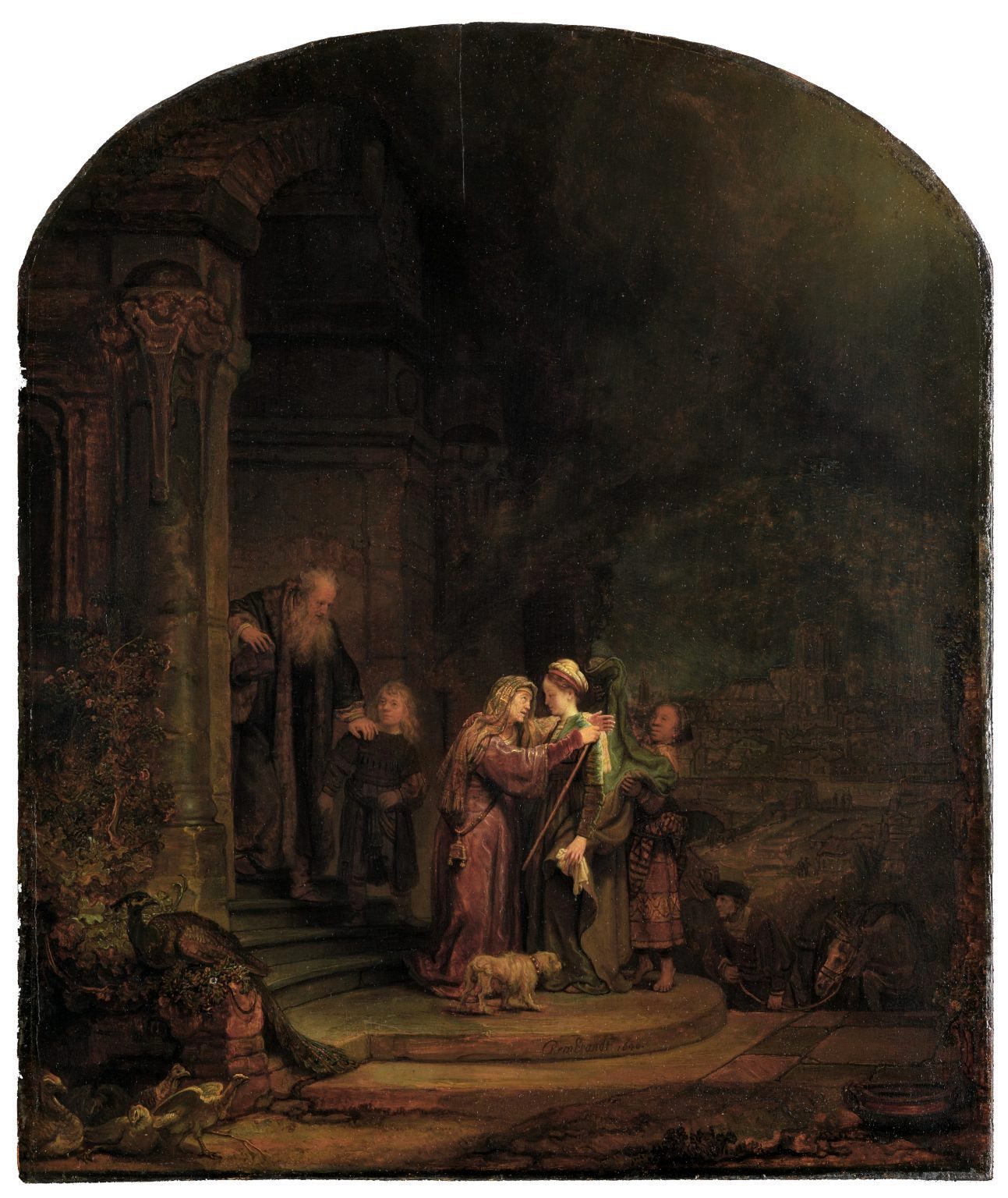
SERMON:“Liberated to See by the God Who Sees” by Wes Vander Lugt, Trinity Forest Church, Concord, North Carolina, December 7, 2025: I’m always pleased when preachers, as part of their biblical exegesis, skillfully integrate art into their sermons—not as mere illustration or decoration but as itself interpreting scripture and/or doing theological work. In the sermon he gave for the Second Sunday of Advent this year, Rev. Dr. Wes Vander Lugt [previously], an ordained Presbyterian minister and director of the Leighton Ford Initiative in Theology, the Arts, and Gospel Witness at Gordon-Conwell Theological Seminary, preached on Luke 1:5–25, 39–45, about how God sees us and liberates us to see him and others. He discusses Rembrandt’s Visitation painting, especially the artist’s use of light and shadow—Mary and Elizabeth step out of the shadows, out of a place of feeling unseen, into the light of God’s grace, says Vander Lugt, where they are known and knowing.
Rembrandt Harmensz van Rijn (Dutch, 1606–1669), The Visitation, 1640. Oil on cedar panel, 22 1/4 × 18 7/8 in. (56.5 × 47.9 cm). Detroit Institute of Arts, Michigan. [object record]
He also touches on, very briefly, James B. Janknegt’s 2008 Visitation, which shows how John the Baptist has been liberated to see Jesus, even as the two are still in utero. See 17:49–20:05.
+++
FROM THE ARCHIVE: The Magnificat is a topic I’ve covered on the blog several times over the past ten years. Here are some examples:
Van Engen answers questions from poet Shane McCrae and from the audience, addressing how to read a volume of poetry, how poetry produces an experience, the role of understanding and not understanding when it comes to poems, why Christians in particular should read poetry, hymns as poetry, how Adam’s naming creation in Genesis 2 relates to the task of the poet, his favorite poets, and the qualities of a good poem.
Two especially great questions from attendees were:
How do you imagine poetry nourishing discipleship and/or corporate worship, if used by a church leader?
What, if anything, would you like to see more of from Christian poets writing today?
Regarding the first, he says,
I often think that ministers in particular—and especially the heavier the preaching tradition, the more true this is—need creative literature—poetry, novels, and other things—to enliven what it is they’re doing from the pulpit. Not just to understand human life in all of its flourishing and misery, but to connect to people in different kinds of ways than pure principle and message can do.
He mentions the recurring summer seminar for pastors co-led by Dr. Cornelius “Neal” Plantinga, “Imaginative Reading for Creative Preaching,” to help participants explore the possibilities and homiletical impact of engaging in an ongoing program of reading novels, poetry, short fiction, children’s lit, and nonfiction outside the category of Christianity—not just to mine for sermon illustrations but also to develop a “middle wisdom” (“insights into life that are more profound than commonplaces, but less so than great proverbs”) and to deepen their perception of people.
+++
PODCAST EPISODE: “Opening Your Bible? Turn on Your Imagination” with Russ Ramsey and Sandra McCracken, The Gospel Coalition Podcast, May 8, 2020: This is a recording of a breakout session—“Reading Scripture with an Engaged Imagination”—from the Gospel Coalition’s 2019 National Conference in Indianapolis. Pastor Russ Ramsey (author of Rembrandt Is in the Wind: Learning to Love Art through the Eyes of Faith) and singer-songwriter Sandra McCracken (“We Will Feast in the House of Zion,” “Thy Mercy, My God”) discuss the role the imagination plays in reading scripture and understanding and conveying its truth.
Scripture calls for reading with a fully engaged imagination, Ramsey says, because that’s how literature works and that’s how people work. “How are you supposed to understand Scripture if you’re not trying to empathize or get into a situation and walk around inside of it?” he asks. They discuss wonder, mystery, and paradox—the unresolved dissonance and complexity present in many Bible stories—and the need to take a Bible story on its own terms instead of always trying to extract a moral or “life application” from it.
Though they don’t use the term, they’re basically advocating for Ignatian contemplation, aka the Ignatian method of Bible reading and prayer, in which you put yourself into the story and try to experience it with all your senses. Ramsey demonstrates with the story of Mary and the nard. “In those hours as Jesus is being arrested and tried and flogged and crucified, he smells opulent. And I think we’re supposed to get that, you know. We’re supposed to . . . especially a first-century reader is going to say, ‘He left a lingering scent as he went down the Via Dolorosa, and it was the scent of royalty. And it was the scent of extravagance.’”
Some of the names that come up along the way are Robert Alter, Ellen Davis, Eugene Peterson, and Frederick Buechner.
+++
IMMERSIVE ART EXPERIENCE:Rembrandt’s Christ in the Storm on the Sea of Galilee at Frameless in London: I’ve been seeing these kinds of exhibitions advertised more and more—ones that use animation and projection-mapping technology and dozens of loudspeakers strategically placed around the room to create a wall-to-wall, multisensory experience built around one or more masterpiece paintings. Some people say it’s gimmicky or overstimulating, but though I’ve never been to one, I generally think they look like fun! They’re not meant to be a substitute for seeing the actual artwork in person.
In the case of Rembrandt van Rijn’s Christ in the Storm on the Sea of Galilee, though, that’s not possible, as the painting was stolen from the Isabella Stewart Gardner Museum in Boston in 1990 and has not been recovered. In collaboration with their long-term partner Cinesite, Frameless recently developed an immersive art experience based on the painting—the Dutch master’s only seascape—in which visitors can get a sense of the terror and exasperation Jesus’s disciples must have felt that night they were caught at sea in a torrential wind- and rainstorm while Jesus lay calmly asleep in the boat’s stern (see Matt. 8:23–27; Mark 4:36–41; Luke 8:22–25). Here’s a making-of featurette for that experience, which garnered a nomination for a prestigious Visual Effects Society award earlier this year:
Frameless is permanently housed in the Marble Arch Place in London’s West End cultural district. Christ in the Storm is one of forty-two works of art they riff on across four galleries.
+++
POEMS:
Here are two poems published this month that each explores a different episode from the story of Jacob’s family in the book of Genesis—one of his wife Rachel stealing her father’s household gods as they flee to Canaan, and one of Jacob’s sons avenging the rape of their sister, Dinah. Both are examples of how poems can stimulate renewed engagement with scripture, as these were stories I had forgotten some of the details of, and the poems did not make sense until I revisited the relevant Bible passages. Poems can help us walk around inside the biblical narratives, both familiar and unfamiliar ones, and see things from the perspectives of different characters, especially ones who are not given a voice in scripture, such as a Shechemite woman taken captive by Jacob’s sons.
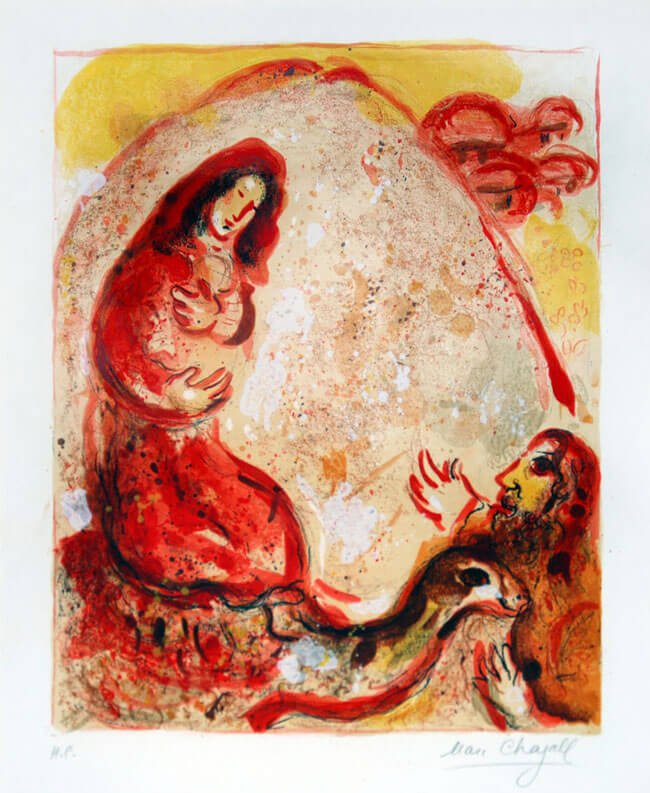
>>“Rachel, Cunning”by Patricia L. Hamilton, Reformed Journal: Read the poem first, then Genesis 29–31, then my commentary.
Voiced by Jacob’s second wife, Rachel, in this poem Rachel vents her jealousy over Jacob having first married her sister, Leah, who bore him six sons to her one at this point. This marriage was due to the trickery of her father, Laban, who also tried to cheat Jacob out of fair shepherding wages—so Rachel resents her father. As she prepares to secretly leave Paddan-aram for Canaan with Jacob, Leah, and their children, she steals her father’s teraphim (small images or cult objects used as domestic deities or oracles by ancient Semitic peoples).
In the biblical narrative, Rachel’s motive for stealing the idols is not given. Was she seeking to prevent Laban from consulting them to find out which way she and her family went? Was possession of the gods in some way connected to property inheritance, as some scholars have attested? Was she stealing a blessing from her ancestors? Did she take them for their monetary value? Or leaving her homeland, did she simply wish to take with her a little piece of home, for nostalgia’s sake?
I think the most likely reason is she still believed in these gods’ power—her allegiance to the God of Jacob had not yet been firmly established—and so she stole them for protection. That’s what Hamilton imagines in her poem: that Rachel sees them as “talismans against the spite of brothers,” averting the evil Jacob’s older twin brother, Esau, wished him for his having stolen their father’s blessing that belonged to him. (According to Genesis 27:41–45, before Jacob left for Paddan-aram, Esau had vowed to kill him.)
Marc Chagall (Belarusian French, 1887–1985), Rachel dérobe les idoles de son père (Rachel Hides Her Father’s Household Gods), from The Bible series, 1960. Original color lithograph on Arches wove paper, image size 14 × 10 1/2 in. (35.6 × 26.7 cm).
Caught between two tricksters—her husband and her father—Rachel herself becomes a trickster. When Laban catches up with their traveling party and searches among their possessions for the stolen gods, Rachel, who’s sitting on them, lies and says she cannot get up because she’s menstruating (Gen. 31:34–35). She deceives her deceitful father to keep her deceitful husband and her son Joseph safe from Esau’s rage, as she believes the gods will act in the interests of whoever possesses them. The poem explores the ever-thickening web of deceptions woven in Jacob’s and Rachel’s families and also reminds us that Rachel, remembered now as a great Jewish matriarch, was not raised in the then-still-developing Israelite religion, nor was her turn to Yahweh necessarily immediate upon her marriage to Jacob. I hear in the poem a lament for fraternal and sororal rivalries, and a subtle sad awareness of the vulnerabilities and pressures of women in patriarchal cultures, who are bought and sold in marriage, valued primarily for their childbearing capacities, and typically forced to rely on men for survival, often suffering the consequences of men’s mistakes. (In the poem at least, Rachel’s feeling of insecurity comes from Esau’s threat of vengeance.)
Based on a lithograph by Marc Chagall, this ekphrastic poem is one of twenty-four from the unpublished chapbook Voiced by Patricia Hamilton, all inspired by biblical artworks by Chagall. Hamilton is currently looking for a publisher to take on the collection.
>>“For the Circumcision of a Small City” by Emma De Lisle, Image: The deception continues in Genesis 34; like father, like sons. This poem is based on the episode of the massacre of the men at Shechem by Jacob’s sons Simeon and Levi to avenge the rape of their sister, Dinah. Shechem, meaning “shoulder,” was the name of both the city in Canaan where the rape took place and the Hivite prince’s son who committed the rape. Jacob and his family were sojourning there, having even bought land. After sexually assaulting Dinah, Shechem wanted to make her his wife. Dinah’s brothers were disgusted by this request, but they pretended they would entertain bride-price discussions on the condition that all the males in the city be circumcised. Shechem’s father agreed, and his position as ruler meant the people obeyed. A few days after the mass circumcision, while the men were still sore, Simeon and Levi attacked with swords, killing all the males in the city. Their brothers then joined them in capturing the men’s wives and children and plundering their wealth.
Emma De Lisle’s poem is written from the perspective of a woman of Shechem, taken captive in the slaughter. The women of the city scorned the lengths Shechem was willing to go to for the homely Dinah, barely old enough to have her period. “Jacob’s silence for you” alludes to Genesis 34:5, which says that when he found out about his daughter’s rape, “Jacob held his peace” until his sons returned from the fields. If he felt grief or outrage, it’s not apparent in the scripture text. His initial response was to say and do nothing, and then to defer to his sons, who exact an outsize punishment for the crime that Jacob admits after the fact disappointed him because when word spreads, it will negatively impact the hospitality of other Canaanite cities toward them.
Stanzas 4 and 5 refer to two of Jacob’s previous deceptions: donning goatskins on his hands and neck to impersonate his hairy brother, Esau, before their blind father, so as to steal the blessing of the firstborn (Gen. 27), and altering the breeding pattern of Laban’s flocks to increase the number of spotted sheep and goats (how this is accomplished is vague and has posed difficulties for interpreters) and so enrich himself, as the spotted animals were his agreed-upon wage (Gen. 30:25–43). The implication of this mention is, I think, that men will take what they feel is owed to them, whether by guile or force.
Sometimes women participate in this violence. The poetic speaker wonders whether Dinah will force her or the other captive women to bear children for her (future husband’s) family line, just as her mother, Leah, had used her slave, Zilpah, when her own womb had closed.
“The city bled one way // or another, before your brothers took interest,” the speaker says. Sexual violence was not new to them. The last sentence suggests that Dinah was not the only female victim of the lustful Shechem’s assault—the women of the city paid a price too, seeing their husbands, fathers, brothers, and sons murdered in retaliation and themselves taken prisoner.
+++
ORATORIO: The Book of Romans by Emily Hiemstra (2019): Consisting of musical settings of select passages from the apostle Paul’s letter to the Romans, this piece for SATB soloists, choir, and string orchestra was commissioned by Grace Centre for the Arts, a ministry of Grace Toronto Church, where it premiered October 22, 2019. (Hooray for churches that commission new art!) Read a statement from the composer on the Deus Ex Musica blog. The performers are Meghan Jamieson (soprano), Rebecca Cuddy (alto), Asitha Tennekoon (tenor), Graham Robinson (baritone), Lyssa Pelton (violin), Amy Spurr (violin), Emily Hiemstra (viola), and Lydia Munchinsky (cello).
Here is the video time stamp for each of the eight movements:
0:18: i. Who Has Known the Mind of the Lord? (Rom. 11:33–36)
3:56: ii. His Eternal Power and Divine Nature (Rom. 1:20)
In February I shared a few of the Vespers services offered at this year’s Calvin Symposium on Worship at Calvin University in Grand Rapids, Michigan, which I was privileged to attend. Here are two of the full-fledged services that give you a sense of what the larger corporate gatherings are like. (The theme was Ezekiel.) I love the cross-cultural sharing that goes on, learning new songs alongside others, getting refreshed by prayer and formed by liturgy, sitting under the teaching of wise ministers of God from various backgrounds, and taking Communion with friends new and old.
>> “God’s Glory Departs from Israel,” February 8, 2024 (with bilingual Korean-English music and liturgy): This worship service was led in Korean and English by the Woodlawn Christian Reformed Church Choir, directed by Chan Gyu Jang; the Living Water Church Worship Team, directed by Yohan Lee; and members of the Calvin University and Calvin Theological Seminary Korean communities. Rev. Dr. Anne Zaki from Evangelical Presbyterian Seminary in Cairo, Egypt, preached on Ezekiel 10–11.
This is an example of bilingual worship done really well! (I’ve seen it done poorly: with lack of communication of intention, one-sided involvement in the design or execution, inadequate pronunciation coaching for non-native speakers at the mic, unclear instructions that create confusion as to who is supposed to say or sing what, unintelligibility, etc.) I’m so grateful for all the creativity and thoughtfulness that went into creating this service—with a special shout-out to the bulletin designers and livestream technicians.
The bulletin provides this note on bilingual worship:
Two languages are intertwined together in this bilingual service. At times, words are spoken in one language, and their translation—unspoken—is provided on the righthand column; at times, the leaders demonstrate to the congregation how to sing or speak the words through transliteration; and at other times, the leaders and congregation converse in both languages, providing meaning to each other, so that no word sung or spoken is left unintelligible. We seek understanding and order in the sharing of our gifts.
In our pursuit, however, we practice patience and hospitality. In this service, we are called not only to speak and sing, but also to listen, to take turns. By listening, we create a room—a shelter—for travelers and strangers in this land, since language and music have power to transport one’s soul homeward. By taking turns, we practice the pace and posture of dialogue, even monolingual dialogue.
Beautiful! Here are three songs I’ll call out for special attention:
9:14: “Joo-yeo, Come, O Lord” by Sunlac Noh: This song, which is particularly well suited for Advent, originated in the Anglican Church of Korea and was translated into English last year by Martin Tel (see podcast interview below). The version we sang at the symposium preserves two of the Korean titles for Jesus.
23:36: “우리에게향하신” (Woo-ri-e-ge Hyang-ha-shin) (Never-Ending Is God’s Love) by Jin-ho Kim, based on Psalm 117:2: Sung entirely in Korean, this was used as a refrain during the Assurance of Pardon and the Prayers of the People. A simple, repeated line, either sung or spoken, is a good way to involve non-native speakers of a given language.
1:14:37: “주님다시오실때까지 / Rise, My Soul, Till Jesus Comes Again” by Hyeong-won Koh: The closing song is a charge to continue in the way of Jesus, all the way Home. The vocalists on stage sang the song themselves in its original Korean the first time through, and then we all joined in in English for the second time.
All the song credits are provided in full in the YouTube video description.
I want to especially draw your attention to 23:31, where Floyd premieres an extraordinary new song of hers, “God Breathed.” It opens and closes with a flute, and in between are her powerful jazz vocals, singing an original poetic text based on Ezekiel 37, accompanied by James Weidman on piano. (Update: Here’s a standalone video of the song.)
+++
PODCAST EPISODE: “Fighting Back Against the Storms of Life with Martin Tel,”Psalms for the Spirit: Host Kiran Young Wimberly interviews Martin Tel, director of music at Princeton Theological Seminary and senior editor of Psalms for All Seasons: A Complete Psalter for Worship (2012), about the Psalms—the importance of psalm singing in his Dutch Reformed upbringing; the Psalms as a form of resistance and protest; the Psalms as a means of praying our own prayers and those of others; our need to overhear some psalms as being prayed against us (that is, have you considered that you might be someone else’s oppressor?); and ideas for framing a psalm with a refrain, such as these:
Combine the Charles Albert Tindley gospel song “The Storm Is Passing Over” with Psalm 57 (“In the shadow of your wings I will take refuge, until the destroying storms pass by . . .”). Sing into the storm.
Choose a Gospel passage of someone in deep lament (e.g., the ten lepers in Luke 17:11–19), surround it with Psalm 88, and have the congregation sing “Kum Ba Yah” (Gullah for “Come by Here”) in minor mode as a refrain (“Someone’s crying, Lord . . .”). A choir can hum the spiritual while the reader(s) read the scriptures.
Intersperse the verses of Psalm 14 (“Fools say in their heart, ‘There is no God.’ . . . They have all gone astray . . .”) with the refrain “Prone to wander, Lord, I feel it . . .” to help the congregation members see their own foolishness instead of assuming it’s someone else who’s the fool.
+++
ARTICLE: “The Mysteries of Liturgical Sincerity” by John Witvliet, Worship (reprinted Pray Tell), May 2018: Some Protestants accuse the more liturgically inclined Christians, like me, of not valuing sincerity in worship because we value prewritten prayers and other set forms. But just because something is scripted or done habitually does not make it “rote” or “empty.”
“Among my mostly Protestant students, no theme is more contested, misunderstood, or cherished” than sincerity, writes John D. Witvliet, director of the Calvin Institute of Christian Worship and professor of worship, theology, and congregational and ministry studies at Calvin University and Calvin Theological Seminary. In this article he explores several different definitions of sincerity, which vary widely across cultures, centuries, philosophical frameworks, and Christian traditions, and then offers six “corrective lenses” to common astigmatisms in the free-church Protestant way of viewing the world: outside-in sincerity, vicarious sincerity, trait sincerity, symbiotic sincerity, sincerity as gift, and aspirational sincerity.
This article is SO GOOD. I have been greatly influenced over the years by Dr. Witvliet’s teachings on liturgical formation, and I strongly encourage you all to read this piece.
+++
EKPHRASTIC POEMS:
An ekphrastic poem is a poem written in response to a work of visual art. Here are two examples I like from the past two years:
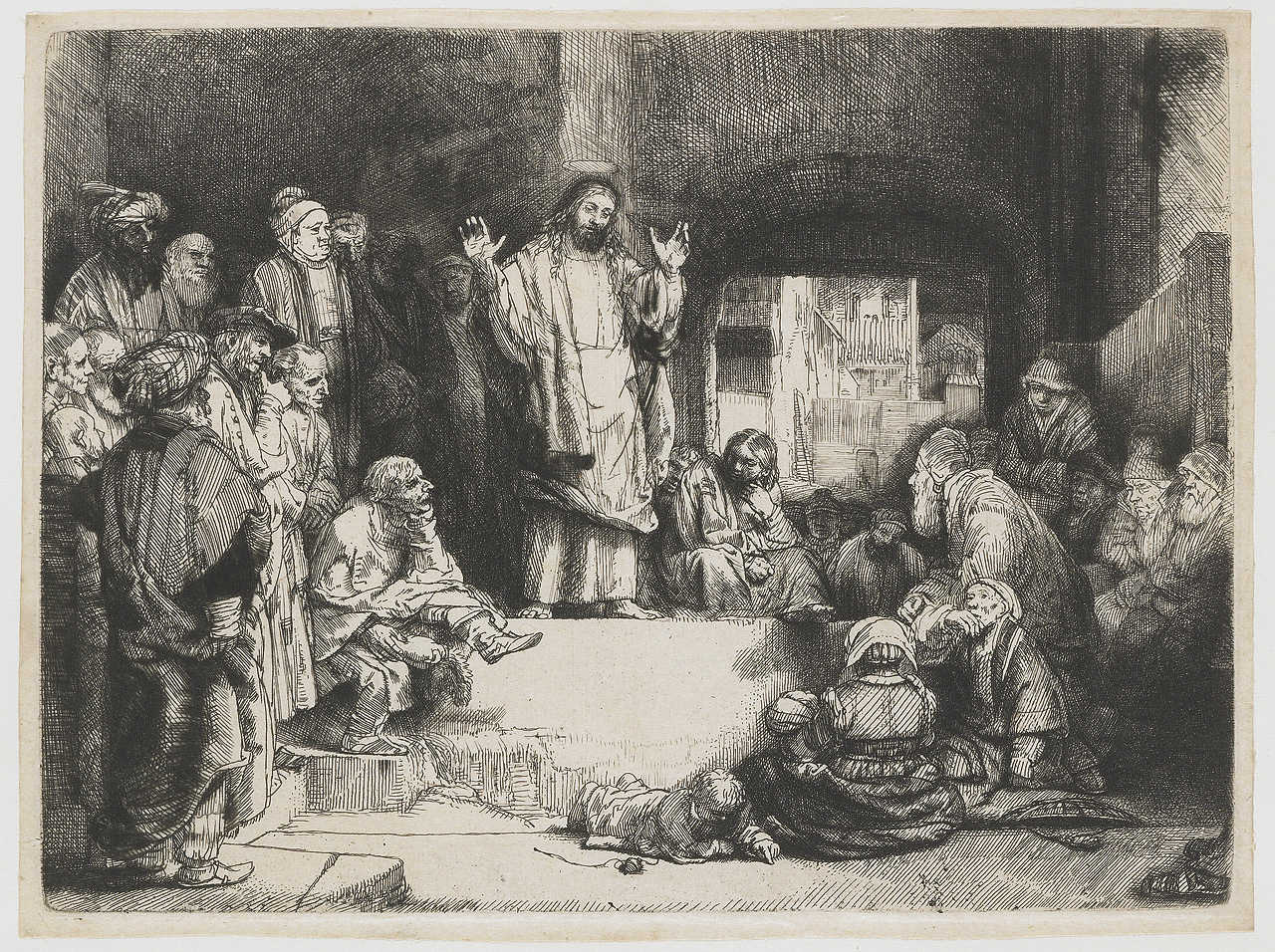
>> “Christ Preaching”by Keene Carter, Image: “I forgive the absent boy,” begins this poem based on a Rembrandt etching, directing our attention to the young child in the foreground who has turned away, disinterested, from Jesus’s sermon, drawing on the ground instead. Jesus gives grace to those in the crowd with averted gazes or who are distracted, simply continuing to preach on on the virtue of empathy—of seeing yourself in others—and on true life.
Rembrandt van Rijn (Dutch, 1606–1669), Christ Preaching (La Petite Tombe), ca. 1652. Etching, engraving, and drypoint on paper, 6 1/4 x 8 5/16 in. (15.9 × 21.1 cm). National Gallery of Art, Washington, DC.
>> “L’Angélus”by Seth Wieck, Grand Little Things:The Angelus is a traditional Christian prayer whose name comes from its opening words in Latin, “Angelus Domini” (The angel of the Lord). For centuries it was prayed by the faithful three times a day—at 6 a.m., noon, and 6 p.m.—the times announced by the ringing of bells from church towers. In the nineteenth century Millet famously painted two peasant farmers at dusk pausing from their labor in the fields to bow their heads and pray the Angelus. Seth Wieck interprets the painting through poetry, homing in on the part of the prayer that says, “Let it be done to me according to thy word,” expressing an attitude of surrender to God’s will. Wieck imagines the hard life of the man and woman shown pulling up potatoes from the earth—the same earth in which, shortly hence, they’ll bury a child, lost to sickness. The poem becomes a meditation on death, harvest, and acceptance.
Jean-Franҫois Millet (French, 1814–1875), The Angelus, 1857–59. Oil on canvas, 55.5 × 66 cm. Musée d’Orsay, Paris.
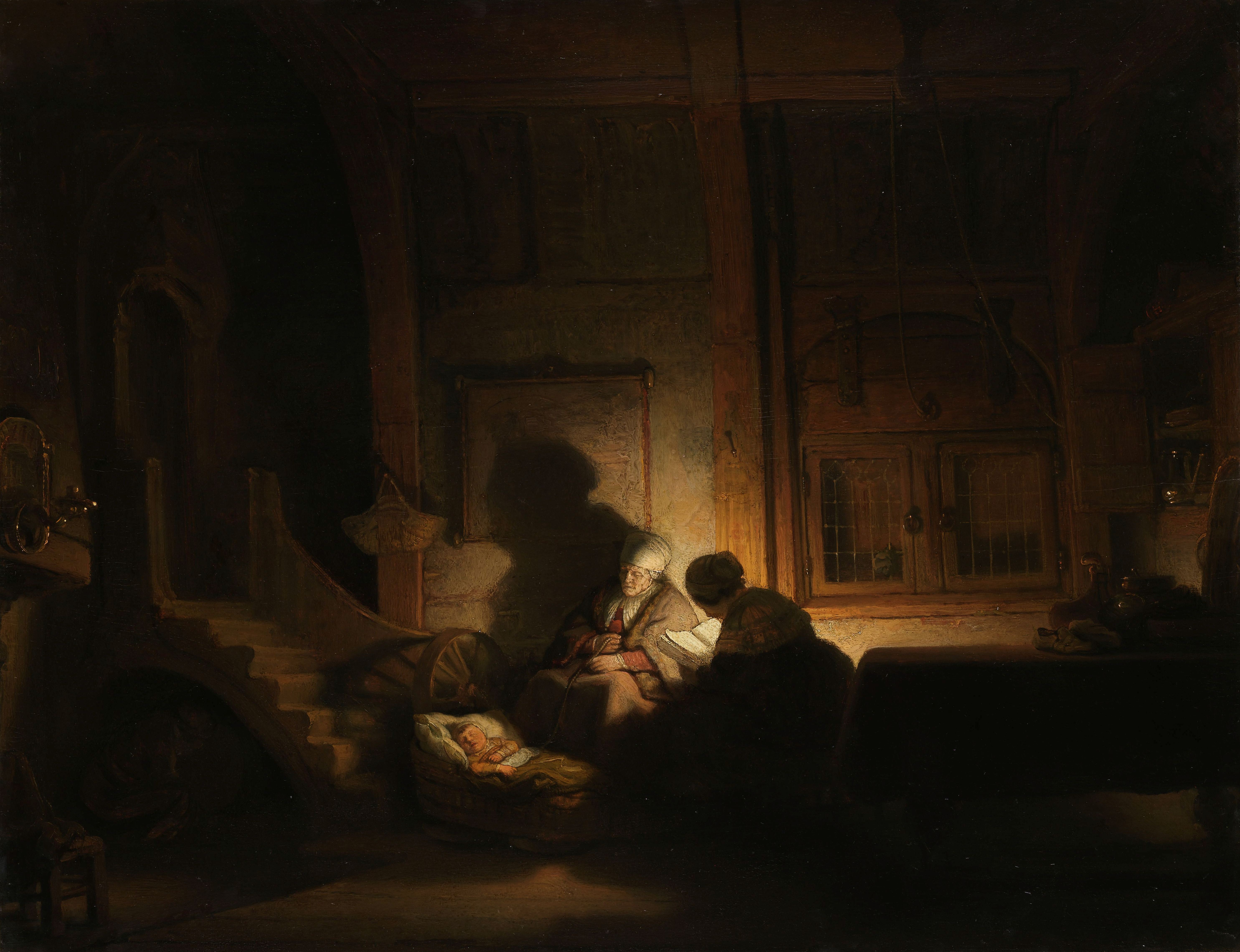
Workshop of Rembrandt van Rijn, Holy Family at Night, ca. 1642–48. Oil on panel, 66.5 × 78 cm. Rijksmuseum, Amsterdam.
During the Dutch Golden Age, the master artist Rembrandt van Rijn (1606–1669) ran a flourishing workshop in Amsterdam, overseeing the production of students’ paintings that continued the deep chiaroscuro and distinctive application of paint seen in his own work.
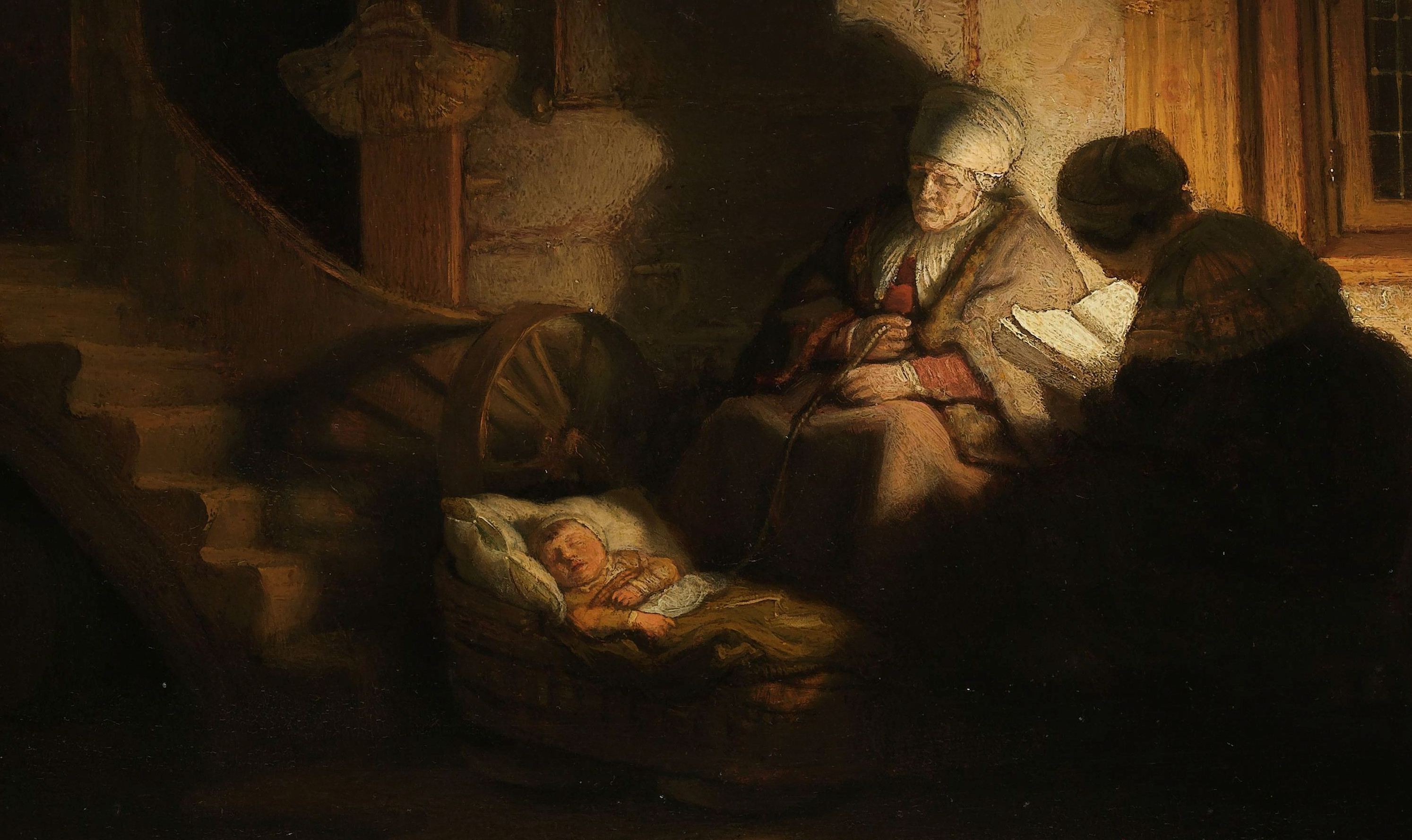
This painting from his workshop shows the Holy Family in a sparsely lit domestic interior at night. The Christ child lies asleep in a wicker cradle at the foot of a half staircase, his grandma Anne likewise nodding off as she rocks him gently with the cradle rope. Relieved by the quiet, Jesus’s mom, Mary, catches up on some reading, and Joseph taps liquid from a barrel on the left under the stairs (he’s very difficult to make out through the shadows).
This lived-in room is full of everyday objects from seventeenth-century Holland. Over the hearth on the left a copper candlestick holder is affixed to the wall. Behind Anne is a map, and beside her a spinning wheel, and a wicker basket hangs from the nail of a curved wooden beam. On the table to the right are a pair of old shoes, a flask attached to a leather belt, and a mortar and pestle, and a Jan Steen jug and other kitchenware are stored in the cupboard above. The shutters are drawn closed over the window. How utterly ordinary!
Although scholarly opinion since 1900 has identified the figures as biblical ones (the title is not the artist’s, as artists did not title their paintings at the time), for much of the painting’s history viewers interpreted it as simply a genre scene—that is, a scene showing regular people going about their daily lives. It lacks the “distinction, nobility, and loftiness” owed to biblical subject matter, it was believed, especially the Holy Family. There are no angels, no haloes. The only hint of sacredness is the pouring of light from a mysterious unknown source.
But the ordinariness of the scene depicted is precisely what makes it so glorious. Jesus was born into a working-class family. For most of his life he labored as a carpenter, adopting Joseph’s trade. He wasn’t surrounded by lavish things. His upbringing looked much like that of all the other Jewish boys in Nazareth. That he was God incarnate would be revealed in time, to those who had eyes to see. But in the meantime, he cooed and pooed and cried and slept and fed and spit up like any other baby! And his mom was exhausted like any other mom, forced to sneak in some time for herself (including private devotional time, as she’s probably reading her Bible here) wherever she could, between childcare, chores, and other obligations.
That God chose to come to us as an ordinary human being born to an ordinary family (albeit conceived in an extraordinary way!) surprised everyone. The song that follows extends the surprise of the Incarnation into God’s other interventions in our lives, on a more personal scale. Just as he defied expectations in his first coming, so he often continues to surprise us in the ways he comes to us now—that is, not according to our own prescriptions, but down his “own secret stair,” when and where we’re least expecting it.
LISTEN: “That Holy Thing” | Words by George MacDonald, 1877 | Music by Katy Wehr, on In Others’ Words, 2008
They all were looking for a king, To slay their foes, and lift them high: Thou cam’st a little baby thing That made a woman cry.
O Son of Man, to right my lot Naught but thy presence can avail; Yet on the road thy wheels are not, Nor on the sea thy sail.
My how or when thou wilt not heed, But come down thine own secret stair, That thou mayst answer all my need, Yea, every bygone prayer.
This song is a setting of a poem written by George MacDonald (1824–1905) in December 1877 and sent by letter to a handful of friends.* When it was first published in 1893 in the two-volume Poetical Works of George MacDonald, it was with this revised final stanza:
My fancied ways why shouldst thou heed? Thou com’st down thine own secret stair; Com’st down to answer all my need, Yea, every bygone prayer!
The poem appears in the highly influential Oxford Book of English Verse (1900), compiled and edited by Arthur Quiller-Couch, but in its original form.
“That holy thing” is a translation of the Greek word hagios, which appears in Gabriel’s speech to Mary in Luke 1:35: “that holy thing which shall be born of thee shall be called the Son of God.” Educator Missy Andrews unpacks the poem:
In “That Holy Thing,” MacDonald meditates on man’s expectations and God’s will. In the first line of the poem, the poet remembers the first-century Jews who suffered under Roman occupation, waiting for the Messiah who would restore the throne of David to Israel. He acknowledges their plight and their expectation, contrasting it with what they in fact received. The baby Christ represented both a gracious answer to their need, and an immediate disappointment. He satisfied the deepest intentions of their prayer and Yahweh’s ancient prophecies, but frustrated their earthy expectations for geographic kingdoms and vindication. Not only that, but the baby King “made a woman cry.” This references not only the immediate suffering and travail of the Christ Child’s mother, Mary, but ultimately the suffering that would rend her heart when He himself was lifted high upon the cross in answer to their desperate prayer for triumph over their foes.
The poet notes that his own travails and petitions, his own desperate need of God’s intervening help, is denied in its immediacy as well. For, although the Son of Man’s own presence alone can help to “right the lot” of the poet, his coming is not visible by road or sea. In this way, MacDonald acknowledges that his own expectations, like those of his spiritual forebears, eclipse his ability to see the Lord’s coming in his own circumstances. He acknowledges the differences between God’s ways and man’s, in faith acknowledging that the Lord answers man in his own ways and times, keeping secret His approach, but stealthily accomplishing man’s every need, answering his every prayer through the mystery of incarnation. This incarnate Child, the Son of Man, replete with humanity and no stranger to suffering, suggests a remedy for all who wait and suffer.
Andrews is a founding director of CenterForLit, whose goal is “to bring readers face to face with the world’s best books so they can know themselves more fully as God’s creatures.” The center has a special emphasis on equipping parents to teach the classics to their kids.
The commentary above is excerpted, with Andrews’s permission, from the first post of twenty-five published in Advent 2015 for the CenterForLit’s “Literary Advent” blog series (which is excellent!). Andrews provides interpretations of poems by John Donne, Madeleine L’Engle, Gerard Manley Hopkins, T. S. Eliot, W. H. Auden, and more, combining literary analysis and theological reflection. You can enjoy Andrews’s series in print form with the book Wild Bells: A Literary Advent.
Kathryn Wehr, PhD, is a singer-songwriter whose most recent album, which leans folk rock in style, is And All the Marys: Women Encountering Christ in the Gospels (2018).
Besides being a musical artist, Wehr is also a scholar whose interests include theology and the arts, spiritual formation, and church history. Her specialization is the religious drama of Dorothy L. Sayers, and as such, she is the editor of the forthcoming book The Man Born to be King, Wade Annotated Edition(IVP Academic, 2023). In addition, she is the managing editor of Logos: A Journal of Catholic Thought and Culture at the Center for Catholic Studies at the University of St. Thomas in Saint Paul, Minnesota.
* Thank you to the Special Collections & University Archives at Taylor University, through whose British Author Collections I discovered this earlier composition date for the poem, as well as an authoritative version of stanza 3 from MacDonald’s own hand. They provided me with a scan of one of MacDonald’s handwritten copies of “That Holy Thing” (Ref. ID 482), which contains the headnote “Written for my friends—Christmas, 1877.”
SPOTIFY PLAYLIST: September 2022 by Victoria Emily Jones: This month’s thirty-song lineup includes a tango, a Pentecostal praise song, a playful setting of the Heidelberg Catechism Q&A number one, an Americana lament for hard times, a Negro spiritual on sax, Christina Rossetti, guitar evangelist Mother McCollum with a unique Jesus metaphor (!), a 9/11-inspired interfaith prayer that I will write about in a separate post, and songs in Turkish (“Kutsal, Kutsal, Kutsal Allah” = Holy, Holy, Holy Lord God) and Sepedi (“Modimo re boka wena” = God, we praise you).
+++
LECTURE (AUDIO): “God’s Thumbprint” by Frederick Buechner: Ordained minister and Pulitzer Prize– and National Book Award–nominated author Frederick Buechner died August 15 at age ninety-six. He was a wonderful writer (of both fiction and spiritual nonfiction) and preacher, and I hear him quoted all the time. He once summed up the theme of all his work as “Listen to your life.”
In 1992 Buechner spoke for the biennial Festival of Faith and Writing at Calvin University in Grand Rapids, Michigan, about how “art and religion are twin expressions of the human spirit.” Discussing poetry, painting, and music, he shows how the arts help us to pay attention. Listen to the talk, “God’s Thumbprint,” on FFW’s Rewrite Radio podcast. It is an expansion of the “Art” entry Buechner wrote in his book Whistling in the Dark: An ABC Theologized (1988); read the full excerpt here.
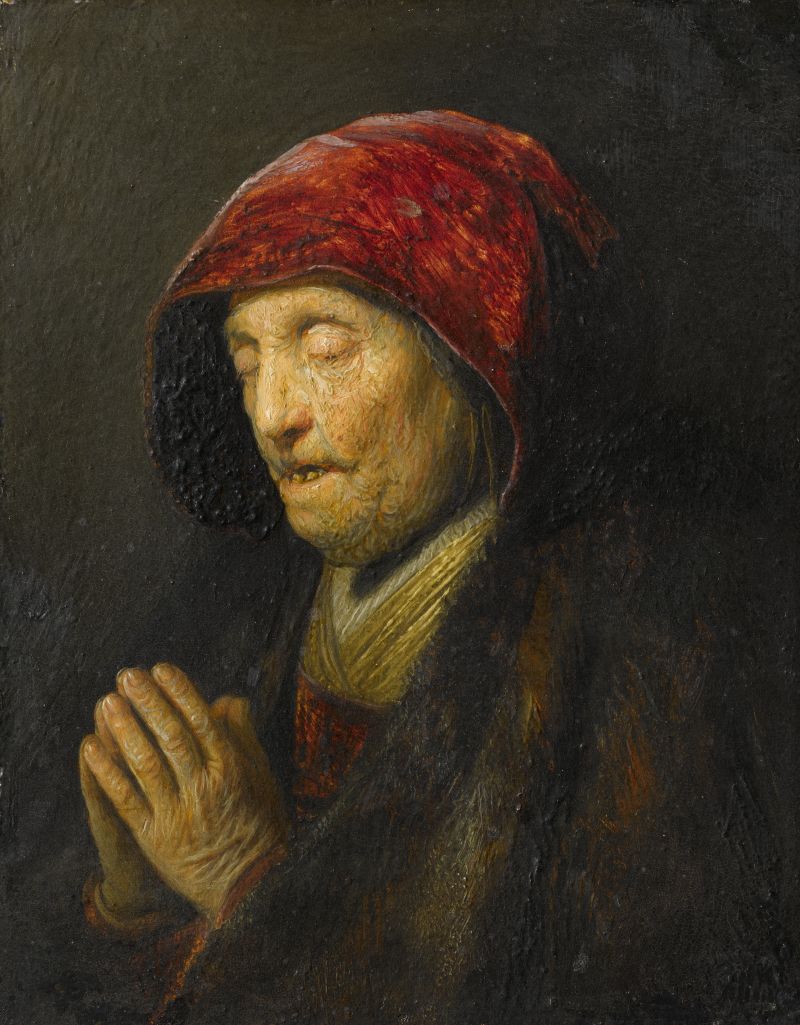
Rembrandt van Rijn (Dutch, 1606–1669), Old Woman Praying, 1629–30. Oil on gilded copper, 15.5 × 12.2 cm. Residenzgalerie Salzburg, Austria. This is one of the many careworn, lived-in elderly faces Rembrandt painted.
+++
LECTURE (VIDEO): “Difficult Beauty: Contemporary Art as Spiritual Discipline” by James K. A. Smith: In its content selection and development, the arts quarterly Image, says editor in chief James K. A. Smith, resists both nostalgia (old is better) and progressivism (new is better), charting a third way that he calls “archaic avant-garde.” The journal’s focus is on contemporary art, but contemporary art funded by tradition. Most of the writers and artists they feature see the tradition of religious art as a gift and a launchpad.
In this lunchtime Zoom talk from May 19, 2021, Smith considers why contemporary art so often feels alienating. He focuses on painting, giving a brief history of the onset of modernism in that medium, starting with the impact of photography, which pushed painters beyond the representation of objective reality. He shares compelling quotes by art critic Peter Schjeldahl and philosopher John Carvalho, about how we look and when thinking happens. Smith discusses the need for humility—to be comfortable with the not-knowing, to surrender our desire for mastery and control (i.e., demanding that paintings explain themselves).
What if the art that first alienates us is the art that might also stretch us? Or what if the literature that’s intimidating might also be the literature that has the possibility to kind of break us open in new ways, open us up to others, and even open us up to God? What if the difficulty of contemporary art is a virtue? And what if experiencing that difficulty is actually what we need? (12:42)
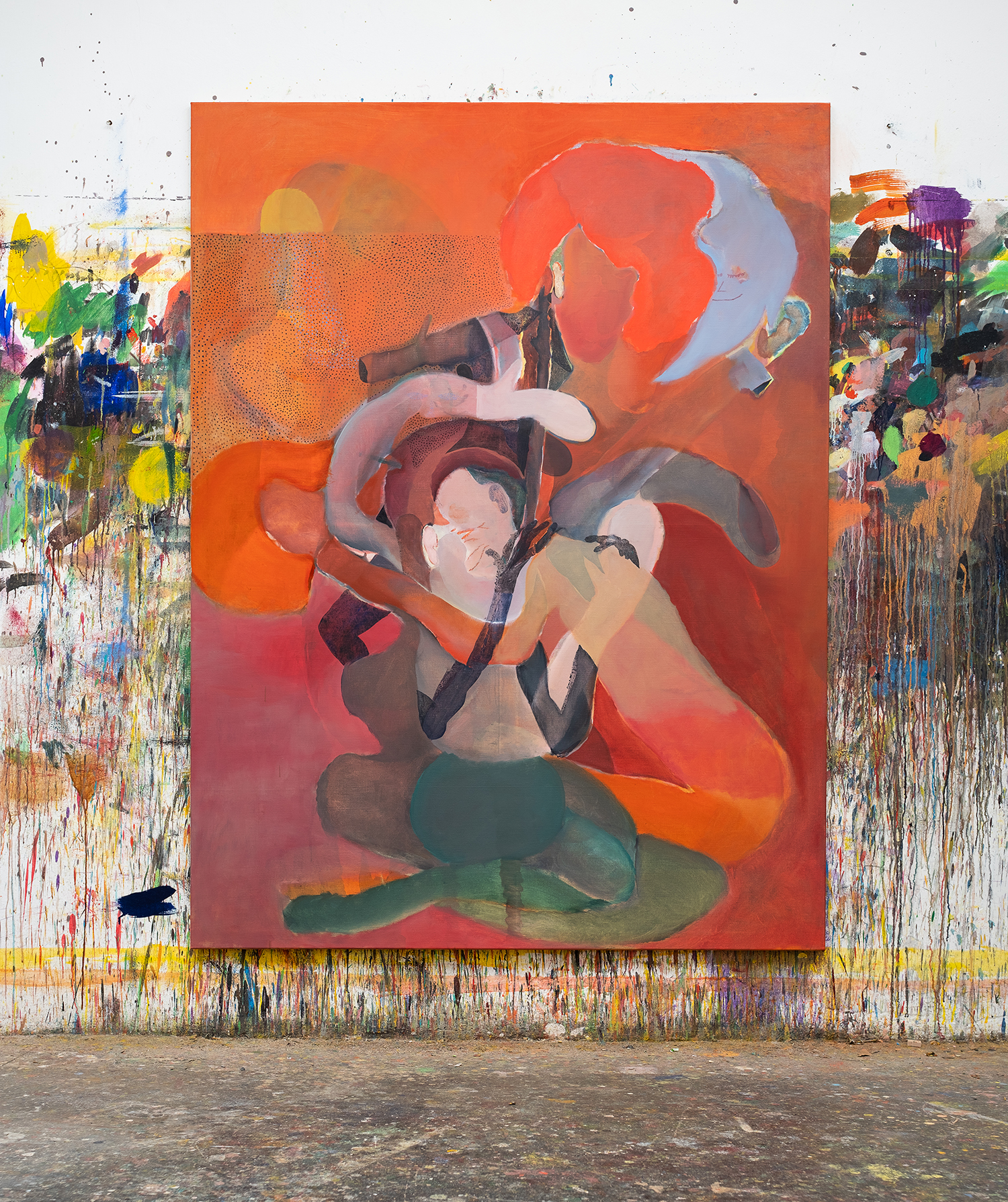
Daniel Domig (Canadian/Austrian, 1983–), Prayer Invites Chaos, 2019. Oil on mixed fibers, 75 × 59 in. [artist’s website]
The last twenty minutes consists of Q&A and addresses icons, art as propaganda, whether and how to engage art that comes out of a place of despair, and more.
I admit that I find much of contemporary art difficult, often unpleasantly so. A few readers have requested that I feature more abstract art, but I struggle to know how to talk about it. But I do want to learn. Image helps me do that.
+++
ESSAY: “Venice Undone” by Matthew J. Milliner: A core publication of Cardus, Comment magazine is committed to “the difficult work of being faithfully present in culture.” This summer they published an essay by art historian Matthew Milliner reflecting on the Anish Kapoor and Anselm Kiefer exhibitions at the 59th Venice Biennale, one of the art world’s largest and most significant recurring events.
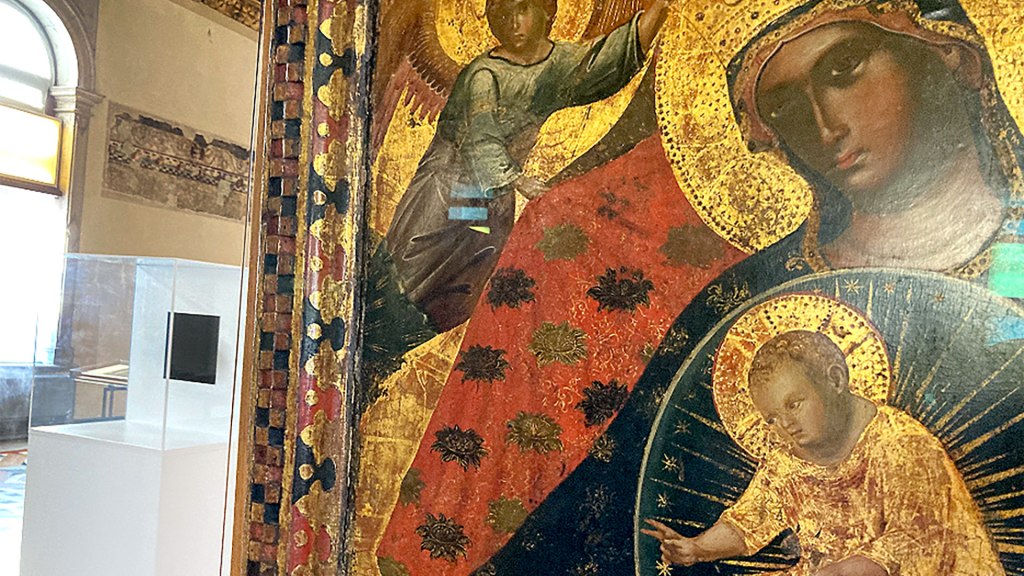
At the 59th Venice Biennale, the Infant Christ from Paolo Veneziano’s Madonna and Child Enthroned (1320s) seems to bless one of Anish Kapoor’s “voids,” a black-painted work that appears flat when viewed head-on but whose convexity becomes apparent when viewed from the side. Photo: Matthew J. Milliner.
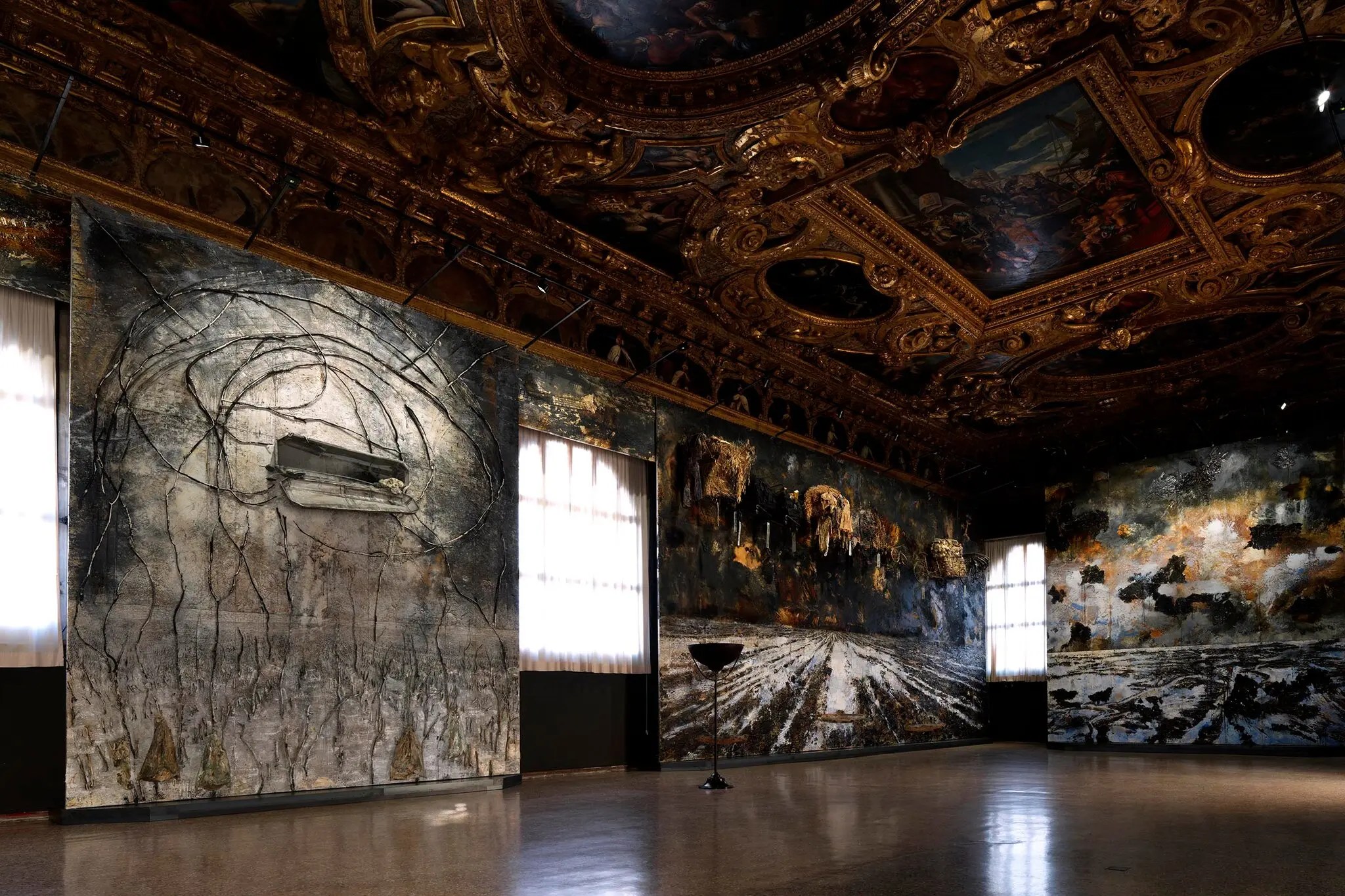
In part 2 of the essay, Milliner considers how the Kiefer show at the Doge’s Palace critiques Venice’s history of military conquest, replacing Titian’s The Conquest of Zara (1584) with an image of an empty tomb that evokes Jesus’s conquest over death. Apocalyptic themes have long been noted in Kiefer’s work; Milliner sees in particular traces of St. Paul and an interrogation of historic Venice’s bombastic displays of wealth and splendor, which are not lasting. And of course there’s the Jacob’s ladder motif. For a silent video tour of the exhibition, see here.
Anselm Kiefer (German, 1945–), These writings, when burned, will finally give some light, site-specific exhibition at the 59th Venice Biennale, 2022. Sala dello Scrutinio, Palazzo Ducale, Venice. Photo courtesy of the artist.
Prompted in part by their use of darkness, Kapoor and Kiefer have been read by some scholars through a lens of despair, but Milliner looks with eyes of hope and sees plenitude and light.
+++
SONG: “Jordan” by Jana Horn: One of Art & Theology’s subscribers sent this to me, and I’m not sure what to make of it, but I definitely find it intriguing, if a bit unsettling. A song from Jana Horn’s debut solo album, Optimism (2022), which Pitchfork calls “cryptic, bewildering, and daringly simple.” “Jordan” is full of veiled biblical allusions and touches on themes of pilgrimage, belief, destruction, incarnation, and burden bearing. I share it here in the spirit of Jamie Smith’s talk above, about not needing to nail down meaning in an artwork—even though I can’t help but ask, “Just who are the two dialogue partners?!” (God the Son and God the Father?)
Horn is a singer-songwriter from Austin, Texas, and a fiction-writing graduate student at the University of Virginia–Charlottesville.
Launched in April 2018, HENI Talks is a growing catalogue of short films on art, narrated by experts. The project was prompted by the 2016 announcement by the AQA exam board in England that they would be dropping art history A-levels, meaning that the subject would no longer be taught in high schools. Although the course was saved at the last minute, it rang alarm bells for the international art services business HENI, who decided they wanted to help bring art history more fully into the digital age, to make it accessible to a wider public. They assembled a dedicated team of producers, researchers, editors, and camera operators and shot twenty-five videos on location on a range of art history topics, interviewing leading artists, curators, and academics. For these efforts HENI Talks won Apollo Magazine’s 2018 Digital Innovation Award.
I first encountered them through their video “Van Gogh’s Olive Trees” and was super-impressed by the high production values. That close-up photography! Makes a huge difference in experiencing art online.
Since then they have been steadily adding new videos, which average about ten minutes each. These include breakdowns of movements/styles, like abstract expressionism, brutalism, and land art, as well as videos focused on single artists or artworks or even themes, such as “The Bed in Art: From Titian to Emin.”
The emphasis is on modern and contemporary art—Marcel Duchamp, Henry Moore, Francis Bacon, Jean-Michel Basquiat, Gerhard Richter, Maurizio Cattelan, Paula Rego, Louise Bourgeois, Glenn Ligon, and so on. And art in British collections. I, of course, am particularly drawn to the videos that feature biblical or liturgical art. My favorites are below.
“Pisa Pulpit: ‘Judge by the correct law!’,” presented by Jules Lubbock: This video examines the seven-hundred-year-old marble relief sculptures of the life of Christ carved by Italian Gothic artist Giovanni Pisano into the pulpit of Pisa Cathedral. (The piece Lubbock looks at is actually a plaster cast of the pulpit, at the Victoria and Albert Museum.)
“Emotional Enigma in the Sculpture of Michelangelo,” presented by Alison Cole: “Michelangelo’s most well-known works exist on a colossal scale, from his formidable statue of David to the High Renaissance frescoes of the Sistine Chapel. Yet, his art could also be tender and lyrical, dwelling upon the inherent tensions of the human condition. Art Historian Alison Cole examines one such example, the Taddei Tondo (c.1504-1505) – the only marble sculpture by Michelangelo in a British collection. Cole provides a rich insight into the artist’s life, influences and unique approach to sculpture.” The tondo portrays the Virgin and Child with Saint John the Baptist.
“Ely Cathedral’s Lady Chapel: Devotion and Destruction,” presented by Paul Binski: “Ely Cathedral’s Lady Chapel was one of the most splendid artistic and architectural achievements of medieval England. The Catholic chapel’s lavishly painted sculpture and stained glass, devoted to the Virgin Mary, moved pilgrims to a religious frenzy. But when Protestants began to call for a ‘purer’ vision of the Christian faith in the 16th and 17th centuries, this same quality triggered repulsion. During the hundred years of the English Reformation, the chapel was scraped, scrubbed and smashed of its extravagance.
“Art historian Paul Binski believes it is possible to recover the Lady Chapel’s former opulence in the imagination. His talk gives an insight into the psychology behind Ely’s splendour, and the idea that art can be so powerful as to provoke violence – something we still see in headlines today.”
“Art & Soul at St Paul’s Cathedral,” presented by Sandy Nairne: “How does art ‘wake up the soul’? There is perhaps no better place to explore this theme than St Paul’s Cathedral in the City of London. Art historian Sandy Nairne walks through the architecture of Sir Christopher Wren’s masterpiece, pointing out how artists have responded to the sanctity of this historic space. He describes how early commissions by the Cathedral aimed to sustain belief in Christian worshippers, and how modern and contemporary artists including Henry Moore, Bill Viola and Mark Wallinger, have tried to express spirituality in a more secular age.”
+++
There’s also a HENI Talk written and narrated by the art critic Julian Spalding, called “Faith and Doubt in Art” and released in May 2019, but I feel it doesn’t do justice to its title, and it advances an overly simplistic narrative that is misleading in places and confusing in others. I know it’s difficult to bring nuance to such a vast topic in just twelve minutes, and that under such constraints, generalizations are inevitable. The video is mainly about representational art versus abstract art, and in particular the effect of modernity on Western art. Spalding posits that the age of scientific discovery that we call “the Enlightenment” was actually a time of spiritual darkening, where people ceased believing that the world was beautiful or had meaning, and this in turn produced an art of doubt and worry—“a nightmare vision of the world” exemplified by Goya and culminating in Munch’s The Scream (“the very end of the Christian tradition,” Spalding says).
The Enlightenment did, of course, cause faith crises for many, and this shaken worldview was reflected in the work of some artists. But I want to note that doubt is not incompatible with Christian faith, nor is an awareness of the world’s horrors or a dedication to science. In fact, many Enlightenment scientists were devout Christians who were impelled further in their research by their very belief in God and that the universe is ordered and contains mysteries to be discovered. And artists, even within the Christian tradition, have always been attuned to the darker aspects of life and had fears and anxieties surrounding sickness, violence, and sex, for example, which in medieval Europe could be expressed through portrayals of particular biblical narratives and saints’ lives. Some of the most gruesome artistic imaginings of hell were inspired by real-life tortures that were taking place at the time. Distorted forms and the grotesque are not unique to modern art, and their use was and is not a sure indicator of a nihilistic attitude or a rejection of a good creator-God.
So while Spalding’s account of art history as relates to the Christian faith is widely accepted, it’s important to remember that things weren’t quite so linear or across-the-board. And art can be “dark,” hold tensions, or pose questions and still be faithful to Christianity.
Puzzlingly, Spalding uses Rembrandt as an early example of religious doubt, noting that the tonality of his works got darker and darker, as if that signified a dissolving faith. Spalding reads into Rembrandt’s late self-portraits, in which he portrays himself in a nonidealized manner, a questioning whether God really created him, imperfect as he is. I, on the other hand, see in these portraits a man owning his own brokenness and frailties, bringing them into the light.
Spalding also makes a few inaccurate statements in the video, like that all Islamic art is abstract (what about the magnificent traditions of Persian [Iranian], Ottoman [Turkish], and Mughal [Indian] miniature painting?) and that Piero della Francesca’s Baptism of Christ represents “a man turning into a god” (no, Christians believe Jesus has always been both fully man and fully God; his anointing in the Jordan signified the start of his earthly ministry).
He ends by stating that in the modern period, as more and more people rejected the idea of a Creator, representation ceased to have meaning and Western art became abstract, much like that in the rest of the world. He compares, for example, an abstract expressionist painting with Islamic architecture, noting how they both express transcendence and mystery (he doesn’t have time to discuss their foundational differences, however). I would argue that while abstraction is a perfectly valid approach, representation in its own way can also express mystery. Take, for example, icons.
I would also add that there’s a huge difference between believing that life has no meaning and believing that that meaning cannot be represented. I think Spalding would agree—the video just doesn’t make that clear.
Spalding makes a very important point when he says that in Hinduism, Buddhism, Confucianism, etc., the “source of spirituality” (Truth) is invisible, and similarly, Judaism and Islam say you can’t visualize God, whereas Christianity says that the source and object of our faith, Jesus Christ, God the Son, did make himself visible and is therefore representable, and that belief very much influenced the trajectory of Western art.
My biggest concern with Spalding’s talk is that it doesn’t come full circle to acknowledge the “return of religion” in contemporary art—as Jonathan Anderson (see here), among other art historians and critics, have shown—nor does it address the comeback that representational art has been making in recent years, and in fact among Black artists by and large, it never really went away.
Rembrandt van Rijn (Dutch, 1606–1669), Simeon in the Temple, 1669. Oil on canvas, 98.5 × 79.5 cm. Nationalmuseum, Stockholm, Sweden.
Candlemas, celebrated every year on February 2, commemorates the presentation of Jesus at the temple forty days after his birth, according to Jewish custom (Luke 2:22–40). While there, the Holy Family encountered Simeon, an elderly man, “righteous and devout,” who was “waiting for the consolation of Israel.” Though weak and tired with age, he was told by the Holy Spirit that he would not die before laying eyes on the messiah of his people, and he banked on that promise. When the Spirit led him to the temple that day, he beheld the baby Jesus and knew instantly that this was the One he had been waiting for—and not only him, but the whole world. He took the child in his arms and sang this canticle, known in church tradition as the “Nunc dimittis” (“Now you dismiss . . .”):
Lord, now you are letting your servant depart in peace,
according to your word;
for my eyes have seen your salvation
that you have prepared in the presence of all peoples,
a light for revelation to the Gentiles,
and for glory to your people Israel. (vv. 28–32)
+++
SONG: “Until My Dying Day Has Come” by Carl-Eric Tangen, from Incarnation Hymns (2008)
+++
Probably Rembrandt’s last painting, Simeon in the Temple was found unfinished on an easel in his studio when he died. It depicts this enlightening moment from Luke 2, in which Simeon recognizes the Christ and exults—quietly, gratefully—in his salvation. The woman in the shadows, thought to be a later addition by another’s hand, is probably the prophetess Anna, though some suppose her to be Mary.
This post belongs to the weekly series Artful Devotion. If you can’t view the music player in your email or RSS reader, try opening the post in your browser.
To view all the Revised Common Lectionary scripture readings for the feast of the Presentation of the Lord, cycle B, click here.
Last summer when participating in a two-week Calvin College seminar, I was providentially assigned to room with Margaret (Peggy) Adams Parker, a sculptor and printmaker who lives, as it so happens, just an hour south of me! Peggy’s enthusiasm—for God, for life, for art—is infectious. She possesses such deep joy, and yet she feels so deeply the hurts of the world. She is attentive, as all good artists must be. “I feel called as an artist to bear witness to the world I see around me and also to the ways I understand that world,” Peggy wrote in an ArtWay feature. “This yields not only images of beauty and tenderness, but also images of suffering and terror.” She regards her art as a means of prayer.
By way of further introduction, here is an essay Peggy wrote ten years ago for the book Heaven, ed. Roger Ferlo (New York: Seabury Books, 2007), pp. 158–66. It is reproduced by kind permission of the publisher.
“Where Sorrow and Pain Are No More”
by Margaret Adams Parker
To be honest, I’ve never thought much about heaven, at least in any systematic fashion. I was interested enough to pick up, at some point, The Great Divorce, C. S. Lewis’s allegory of heaven and hell. And I’ve been known to joke about my expectations that heaven had better have a comprehensively stocked art studio, as well as a fabulous bookstore.
But in looking back though many years of making art and also teaching about art at a Christian seminary, I’ve unearthed a great deal about heaven, although not in the expected places. I haven’t glimpsed heaven among the many imagined depictions, ranging from medieval woodcuts to the visual speculations of twentieth-century outsider artists. I’m simply not drawn to “visionary” images. These are not the kinds of images I make. Instead, my image of heaven is distinctly negative (theologians would call it apophatic). I have no vision of what heaven is like. But I have seen, and I have also made, pictures of what heaven is not.
I am a concrete thinker, and so my art is earthbound, far from visionary. I’ve always understood the incarnational nature of Christianity as a charge to take seriously life in this world. What’s more, my two great artistic mentors—Rembrandt and Käthe Kollwitz—were rarely given to visions. Rather, their work was grounded in the physical, spiritual, and social realities of life. Such symbols as they used (most notably Kollwitz’s use of the skeleton to represent death) served to underscore their understanding of human existence as it is. They recorded moments as small as a child learning to walk and as momentous as war or revolution. Even when picturing the incarnation, that most heavenly of earthly events, both artists showed the miracle taking place in a tangible human setting.
Consider some of these two artists’ characteristic images. Rembrandt’s drawings testify powerfully to his all-encompassing interest in the life around him. He depicted everyone he saw—beggars and merchants, rabbis and serving girls—with the same probing yet sympathetic scrutiny. His drawings of his wife Saskia constitute a particularly poignant record: we watch as she endures four pregnancies, suffers the deaths of three infants, and finally dies at thirty, a short nine years after their betrothal. We glimpse her first in a silverpoint drawing (1633), made the week of their engagement. In this love poem in line, Rembrandt shows us a winsome young woman, resting her cheek lightly against her hand, dangling in her other hand one of the flowers that also adorn her straw hat. In a pen and ink drawing made four years later (1637), Saskia lies in bed, supporting her head heavily on her hand, staring out with a weary and resigned expression. And in the image that Rembrandt sketched on a tiny etching plate the year Saskia died (1642), she has become an old woman, worn, gaunt, and desperately ill.
Rembrandt van Rijn (Dutch, 1606–1669), Portrait of Saskia as a Bride, 1633. Silverpoint on parchment, 18.5 × 10.7 cm (7 3/10 × 4 1/5 in.). Staatliche Museen Preussischer Kulturbesitz, Kupferstichkabinett, Berlin. Inscription (trans.): “This was portrayed after my wife when she was 21 years old, the third day after we were married. June 8, 1633.”
Rembrandt van Rijn (Dutch, 1606–1669), Saskia in Bed, ca. 1637. Pen and brown ink, 8.4 × 10.4 cm (8 3/10 × 10 1/10). British Museum, London.
Rembrandt van Rijn (Dutch, 1606–1669), Sick Woman with a Large White Headdress (Saskia), ca. 1642. Etching with touches of drypoint, 6 × 5.1 cm (2 3/8 × 2 in.).
Käthe Kollwitz’s imagery is more politically engaged. The daughter of a trained lawyer who chose to work as a builder rather than practice within the Prussian legal system, she spent her life depicting the plight of the poor and protesting the ravages of war. In her first great print series, A Weavers’ Rebellion (1897–98), she chronicled the causes, progression, and bloody aftermath of the 1844 revolt of Silesian home weavers against their employers. The series begins with Poverty (1894), where a family of weavers gathers around the deathbed of an infant, and concludes with The End (1897), where the bodies of slain revolutionaries are being laid out on the floor of a weaver’s cabin. In both of these dimly lit interiors, the looms and other apparatus of the weavers’ trade stand as ominous reminders of the weavers’ plight. Continue reading “ESSAY: “Where Sorrow and Pain Are No More” by Margaret Adams Parker”→
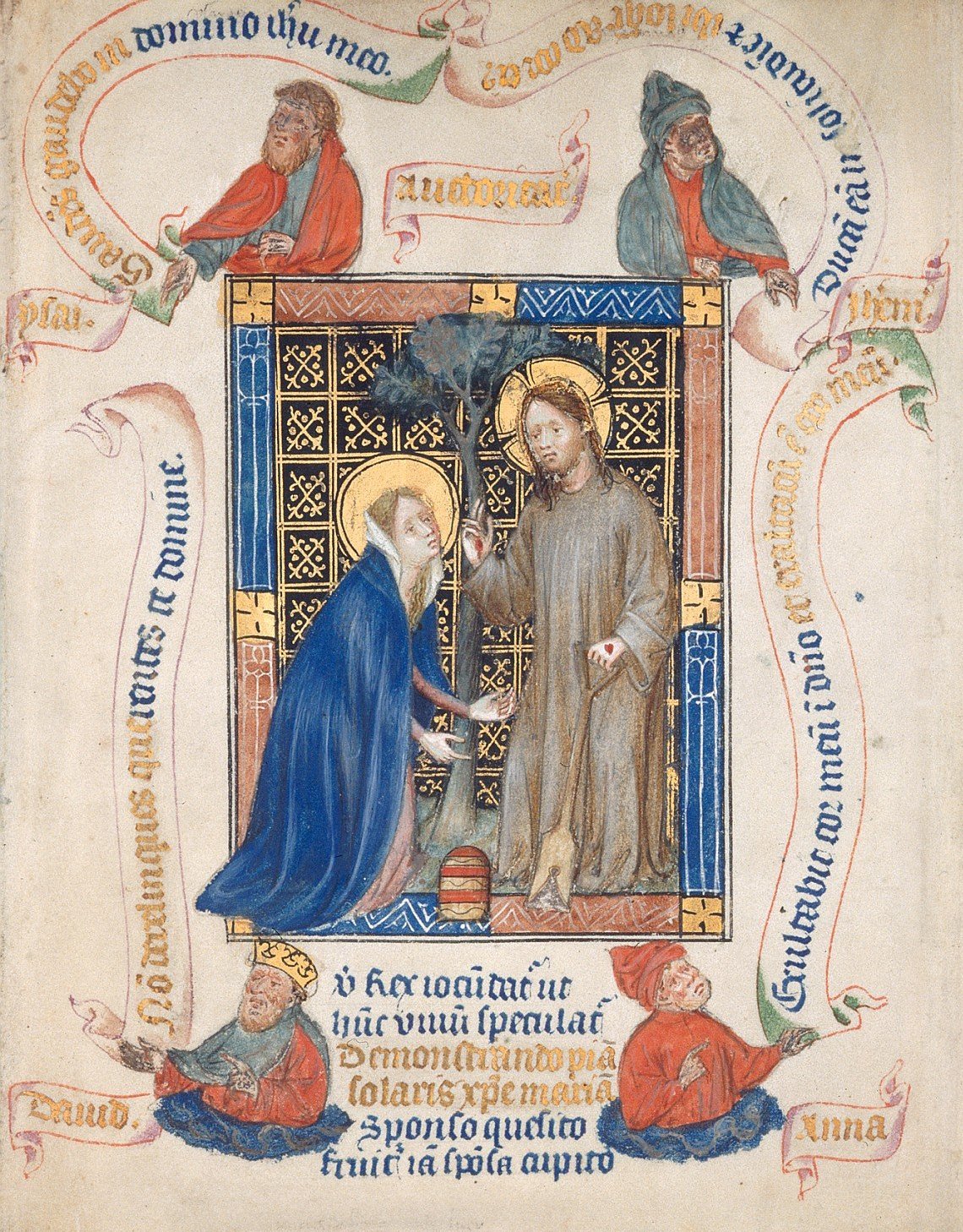
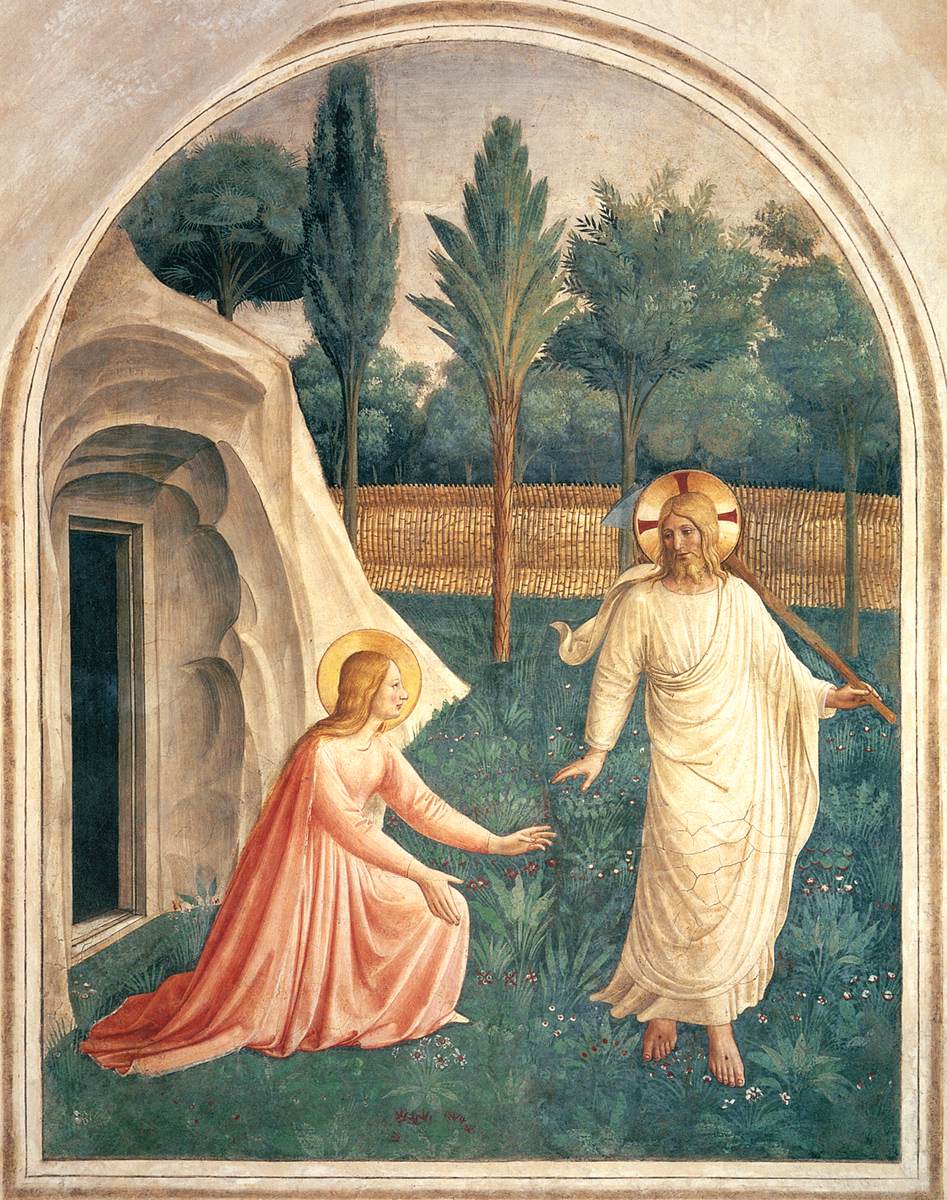
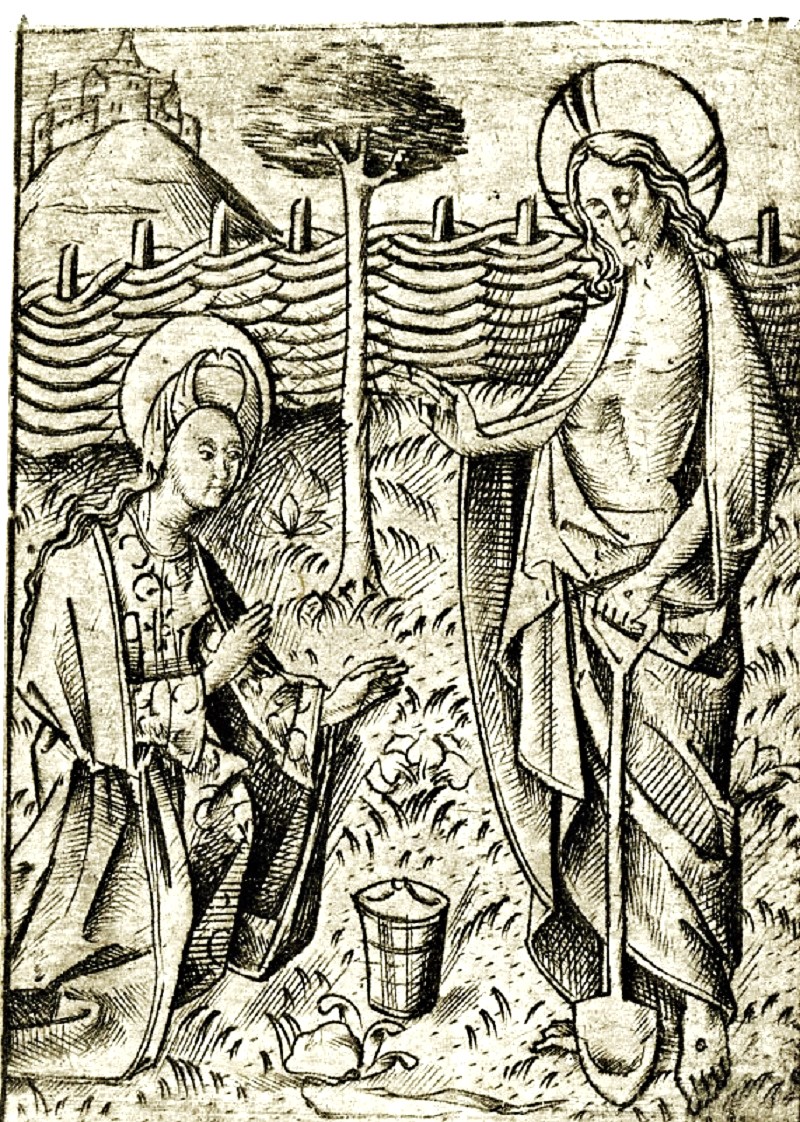
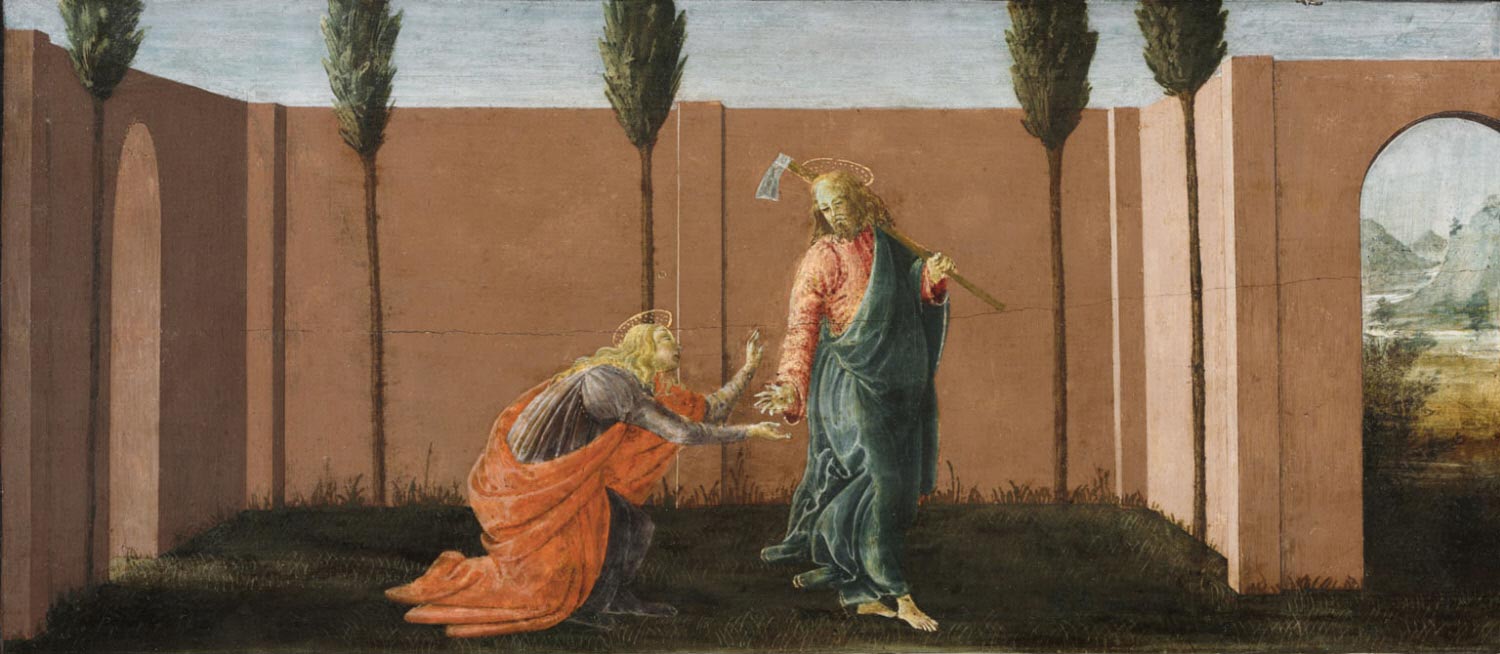
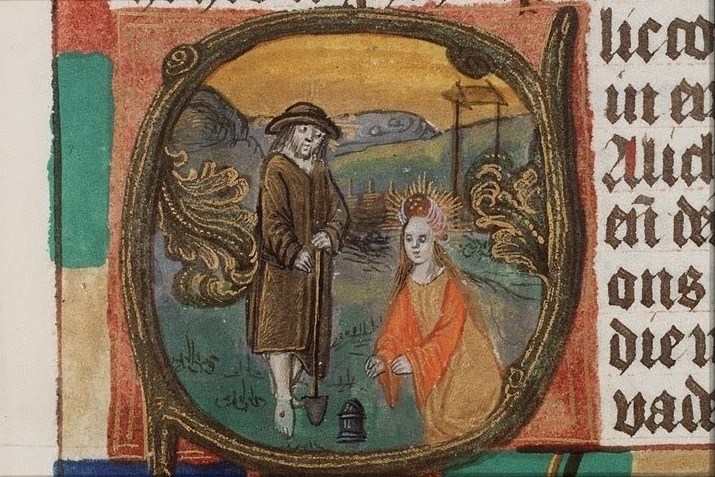
In his Gospel John records that on the Sunday morning following Jesus’s crucifixion, Mary Magdalene went to the tomb and, finding it empty, started to weep, for she thought someone had taken the body. In her worry and frustration, she “turned around and saw Jesus standing, but she did not know that it was Jesus . . . supposing him to be the gardener” (John 20:14–15). It isn’t until he says her name that she recognizes him.
Artists—mainly from the fifteenth and sixteenth centuries—have latched onto this detail of mistaken identity, representing Jesus carrying gardening tools, like a shovel or a hoe, and sometimes sporting a floppy gardener’s hat. A few artists, such as Lavinia Fontana, Rembrandt, and the illuminators of the book of hours and passional shown below, have even shown Jesus in full-out gardener’s getup. (In her commentary on John, Dr. Jo-Ann A. Brant mentions that the fact that Jesus left his burial clothes in the tomb, coupled with Mary’s confusion, might provoke the “fanciful speculation” that Jesus actually borrowed the gardener’s clothes. Nevertheless, a different understanding is more likely behind the artistic representations; read on.)
Attributed to Jacopo di Cione (Italian, 1365–1398/1400), Noli me tangere, ca. 1368–70. Pinnacle panel from a Florentine altarpiece, now in the collection of the National Gallery, London.
Jesus Appears to Mary Magdalene, from a Biblia Pauperum (typological picture book), ca. 1405, Netherlands. British Library, London.
Fra Angelico (Italian, ca. 1395–1455), Noli me tangere, 1440–42. Fresco from the convent of San Marco, Florence, Italy. [commentary by Georges Didi-Huberman]
Israhel van Meckenem (German, ca. 1445–1503), Noli me tangere, 1460–1500. Engraving. British Museum, London.
Sandro Botticelli (Italian, 1445–1510), Noli me tangere, ca. 1484–91. Predella panel from an altarpiece from the convent of Sant’Elisabetta delle Convertite, Florence, Italy, in the collection of the Philadelphia Museum of Art.
Master of the Dark Eyes, “Christ Appears to St. Mary Magdalene as a Gardener,” from The Hours of the Eternal Wisdom: Lauds (KB, 76 G 9), fol. 88r, ca. 1490. Koninklijke Bibliotheek (National Library of the Netherlands), The Hague.
“Christ Appears to Mary Magdalene as a Gardener” (detail), ca. 1503–1504, England. Fol. 134v, Vaux Passional (Peniarth 482D), National Library of Wales.

#/media/File:JEAN-FRAN%C3%87OIS_MILLET_-_El_%C3%81ngelus_(Museo_de_Orsay,_1857-1859._%C3%93leo_sobre_lienzo,_55.5_x_66_cm).jpg)


_(f._134v).jpg)
 Art & Theology