

“‘The Sun to Rule by Day’” by Gerhard Tersteegen (poem)

Le Pho_Composition
Lê Phổ (Vietnamese, 1907–2001), Composition, 1969. Oil on canvas, 23 3/4 × 29 in. (60.3 × 73.7 cm).

Phil. 2:13

Thou sayest, “Fit me, fashion me for Thee.”
Stretch forth thine empty hands, and be thou still;
O restless soul, thou dost but hinder Me
By valiant purpose and by steadfast will.

Behold the summer flowers beneath the sun:
In stillness his great glory they behold;
And sweetly thus his mighty work is done,
And resting in his gladness they unfold.

So are the sweetness and the joy divine
Thine, O beloved, and the work is Mine.

Translated from the German by Frances Bevan, 1894

In this poem God speaks to his beloved, urging her to cease her anxious striving to please him and to simply be present, soft, and open—to receive his love and its attendant sweetness and joy. The epigraph cites the apostle Paul’s encouragement to the church at Philippi that “it is God which worketh in you both to will and to do of his good pleasure,” but the title is taken from Psalm 136:8: “O give thanks unto the LORD . . . to him that made . . . the sun to rule by day: for his mercy endureth for ever.”

The second stanza is also a biblical allusion, pointing to Matthew 6:27–29, in which Jesus asks rhetorically, “Which of you by taking thought can add one cubit unto his stature? And why take ye thought for raiment? Consider the lilies of the field, how they grow; they toil not, neither do they spin: and yet I say unto you, that even Solomon in all his glory was not arrayed like one of these.”

As we rest in God, he shines his face on us and gladly grows us, beauties all.

(Related post: “The Avowal” by Denise Levertov)


Gerhard Tersteegen (1697–1769) was a German Pietist preacher, writer, humanitarian, and hymnist. Self-taught in religious studies, as a young man he gave up a successful career as a merchant to live a simple life of personal devotion and public ministry. Known as “the physician of the poor and forsaken,” he opened his home in Mülhern—it became known as Pilgrim’s Hut—to all manner of needy folks, leading prayer services and dispensing food, medicine, and spiritual counsel. He also traveled the region preaching the gospel. His writings include the hymn collection Das geistliche Blumengärtlein (The Spiritual Flower Garden) (1729), a volume of Gebete (prayers) and another of Briefe (letters), and translations of the French mystics and Julian of Norwich. He is sometimes classified as a mystic himself because of his emphasis on intimacy with God.
Advent, Day 22

He shall feed his flock like a shepherd: he shall gather the lambs with his arm, and carry them in his bosom, and shall gently lead those that are with young.

—Isaiah 40:11 (KJV) (cf. Micah 5:2–5a, today’s lectionary reading)

“Come unto me, all ye that labour and are heavy laden, and I will give you rest. Take my yoke upon you, and learn of me; for I am meek and lowly in heart: and ye shall find rest unto your souls. For my yoke is easy, and my burden is light.”

—Matthew 11:28–30 (KJV)

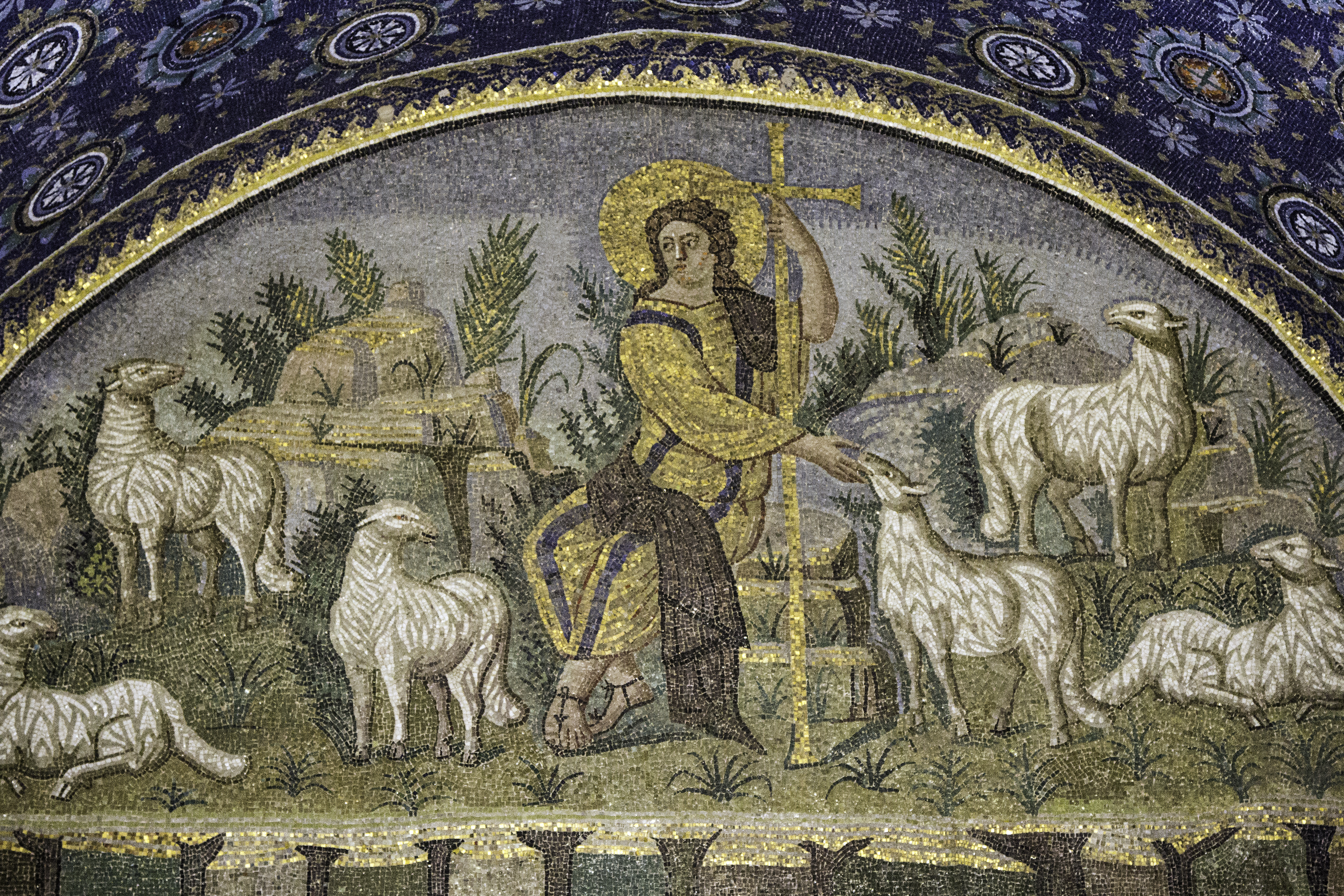
LOOK: Good Shepherd mosaic, Ravenna

Good Shepherd (Ravenna)
Christ the Good Shepherd, 5th century. Mosaic from the tomb of Galla Placidia, Ravenna, Italy. Photo: Fr. Lawrence Lew, OP.

[Related post: “Love, My Shepherd” (Artful Devotion)]

LISTEN: “He Shall Feed His Flock” | Text: Isaiah 40:11; Matthew 11:28–30 (KJV) | Music by Georg Frederic Handel, 1742 | Arranged and sung by Tara Ward on Adventus by Church of the Beloved, 2010

He shall feed his flock
Like a shepherd
And he shall gather
The lambs with his arm
With his arm

He shall feed his flock
Like a shepherd
And he shall gather
The lambs with his arm
With his arm

And carry them in his bosom
And gently lead those
That are with young
And gently lead those
That are with young

Come unto him
All ye that labor
Come unto him
Ye that are heavy laden
And he will give you rest

Come unto him
All ye that labor
Come unto him
Ye that are heavy laden
And he will give you rest

Take his yoke upon you
And learn of him
For he is meek
And lowly of heart
And ye shall find rest
Unto your souls

Take his yoke upon you
And learn of him
For he is meek
And lowly of heart
And ye shall find rest
Unto your souls

Born out of a group of friends’ reading of Life of the Beloved by Henri Nouwen, the Church of the Beloved in Edmonds, Washington, was active from 2006 to 2019. It had a vibrant music ministry, led by Tara Ward, that put out four albums, including Adventus. One of the tracks on Adventus is Ward’s slow, ambient, synth-driven arrangement of “He Shall Feed His Flock,” an air from Handel’s Messiah. Charles Jennens, the librettist (lyricist) of the oratorio, combined passages from Isaiah and Matthew to evoke a sense of the deep soul-rest and care that Christ proffers. Church of the Beloved’s rendition so beautifully captures the weariness we often feel, whether we’re on a spiritual path or not, and is a gentle reminder that Christ is always calling us back into his bosom.