The risen Christ bounds victoriously over the abyss—using his cross like a pole vault!—in this scratched painting by the Congolese artist André Kamba Luesa (1944–1995). The flaming pit of hell has been conquered, cleared. And crossing over from death to life, Christ brings us with him. That’s why the men, women, and children lift high their hands in celebration. His victory is ours!
The Gospel of Matthew describes the Crucifixion-Resurrection event as causing a geological quaking; “the earth shook and the rocks were split” (Matt. 27:51; cf. 28:2). Kamba Luesa portrays this frightening phenomenon in his Resurrection. And yet he also uses warm reds, oranges, and yellows to convey the radiant joy of resurrection. The sky is awash in a soft glow. The Son rises with the sun, its orb a halo behind his head.
As is common in Christian art, the artist connects the Resurrection to his own cultural context. His Jesus is African and wears traditional printed cloth, just like those who praise him from the sides. As much as Jesus’s rising was a historical happening that took place some two thousand years ago outside Jerusalem, it is also an ongoing reality whose implications continue to reverberate as the life of God is made manifest in believers all over the globe.
I originally wrote this art commentary for the Daily Prayer Project’s Easter 2023 prayer periodical.
Mfurahini, haleluya, mkombozi amefufuka. Amefufuka, haleluya, msifuni sasa yu hai.
Refrain: Tumwimbie sote kwa furaha. yesu ametoka kaburini. Kashinda kifo, haleluya; haleluya, Yesu yu hai.
. . .
[I can’t find the Swahili lyrics to verses 2–5]
This Easter text was written in Swahili by Rev. Bernard Kyamanywa (born 1938), a Tanzanian Lutheran pastor, while a student at Lutheran Theological College Makumira (now Tumaini University Makumira). He set it to a tune from the Haya people of northwestern Tanzania, an ethnic group he belongs to.
The English version of the song, “Christ Has Arisen, Alleluia,” is relatively popular throughout the world. Here’s a video of Christ the King Choir in Molyko Buea, Cameroon, singing the song in English:
Christ has arisen, alleluia! Rejoice and praise him, alleluia, For our Redeemer burst from the tomb, Even from death, dispelling its gloom.
Refrain: Let us sing praise to him with endless joy; Death’s fearful sting he has come to destroy, Our sins forgiving, alleluia. Christ has arisen, alleluia!
For three long days the grave did its worst Until its strength by God was dispersed. He who gives life did death undergo; And in its conquest his might did show. [Refrain]
The angel said to them, “Do not fear! You look for Jesus who is not here. See for yourselves the tomb is all bare; Only the grave cloths are lying there.” [Refrain]
“Go spread the news: He’s not in the grave; He has arisen this world to save. Jesus’ redeeming labors are done; Even the battle with sin is won.” [Refrain]
Christ has arisen; he sets us free; Alleluia, to him praises be. Jesus is living! Let us all sing; He reigns triumphant, heavenly King. [Refrain]
Trans. Howard S. Olson, 1977 (admin. Augsburg Fortress)
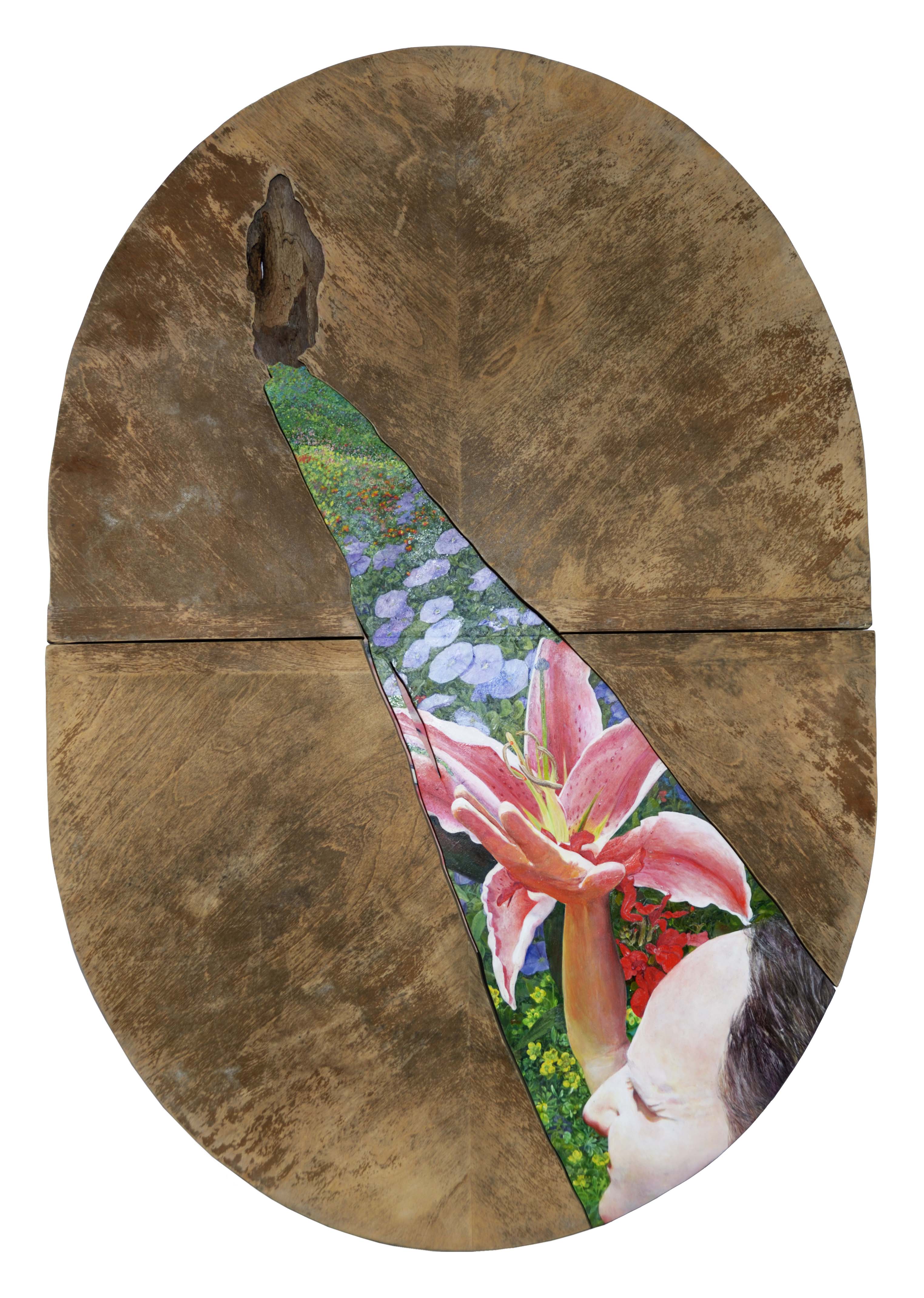
LOOK: (She thought he was)The Gardener by Helen Sherriff
Helen Sherriff (Australian, 1951–), (She thought he was) The Gardener, 2013. Acrylic and oil on found medium-density fiberboard tabletop with parquetry veneer and bark insert, 15 × 10.7 cm.
This painting by Helen Sherriff, which won the Needham Religious Art Prize in 2013, shows Christ appearing to the forlorn Mary Magdalene after his resurrection. Sheriff cut the figure of Christ out of the MDF substrate and “inserted a piece of thick tree bark which had a scar in an appropriate place suggesting a wound,” she writes at ArtWay.eu.
The colorful flowering cast forth from his form is such a unique way to visually interpret the significance of this moment of encounter. “Normally there would be a shadow stretching forward,” Sherriff says, “but this darkness is light.”
Sherriff also notes how the shape of the Stargazer lily is echoed by Mary’s hand held up to shield her face from the brightness.
LISTEN: “J’entre dans mon jardin” (I Come to My Garden) by the Choeur des Moines de l’abbaye de Keur Moussa au Sénégal, on L’heure vient (2007)
This instrumental piece, an air for kora (traditional calabash harp-lute) and recorder, is part of the Liturgy of the Resurrection at Keur Moussa Abbey in Senegal. Its title is taken from Song of Songs 5:1:
I come to my garden, my sister, my bride; I gather my myrrh with my spice; I eat my honeycomb with my honey; I drink my wine with my milk.
Eat, friends, drink, and be drunk with love.
The liner notes for this track on the CD sleeve, which are all in French, say, “Christ, in the Christian tradition, is the Bridegroom. He comes, resurrected on Easter morning, to meet Mary Magdalene, seated at the entrance to the tomb. The kora and the flute convey the joy of this Easter reunion with freshness and brightness.”
Early on the first day of the week, while it was still dark, Mary Magdalene came to the tomb and saw that the stone had been removed from the tomb. . . . [She] stood weeping. . . .
As she wept, she bent over to look into the tomb, and she saw two angels in white sitting where the body of Jesus had been lying, one at the head and the other at the feet. They said to her, “Woman, why are you weeping?”
She said to them, “They have taken away my Lord, and I do not know where they have laid him.” When she had said this, she turned around and saw Jesus standing there, but she did not know that it was Jesus.
Jesus said to her, “Woman, why are you weeping? Whom are you looking for?”
Supposing him to be the gardener, she said to him, “Sir, if you have carried him away, tell me where you have laid him, and I will take him away.”
Jesus said to her, “Mary!”
She turned and said to him in Hebrew, “Rabbouni!” (which means Teacher).
Jesus said to her, “. . . Go to my brothers and say to them, ‘I am ascending to my Father and your Father, to my God and your God.’”
Mary Magdalene went and announced to the disciples, “I have seen the Lord,” and she told them that he had said these things to her.
—John 20:1, 11–18
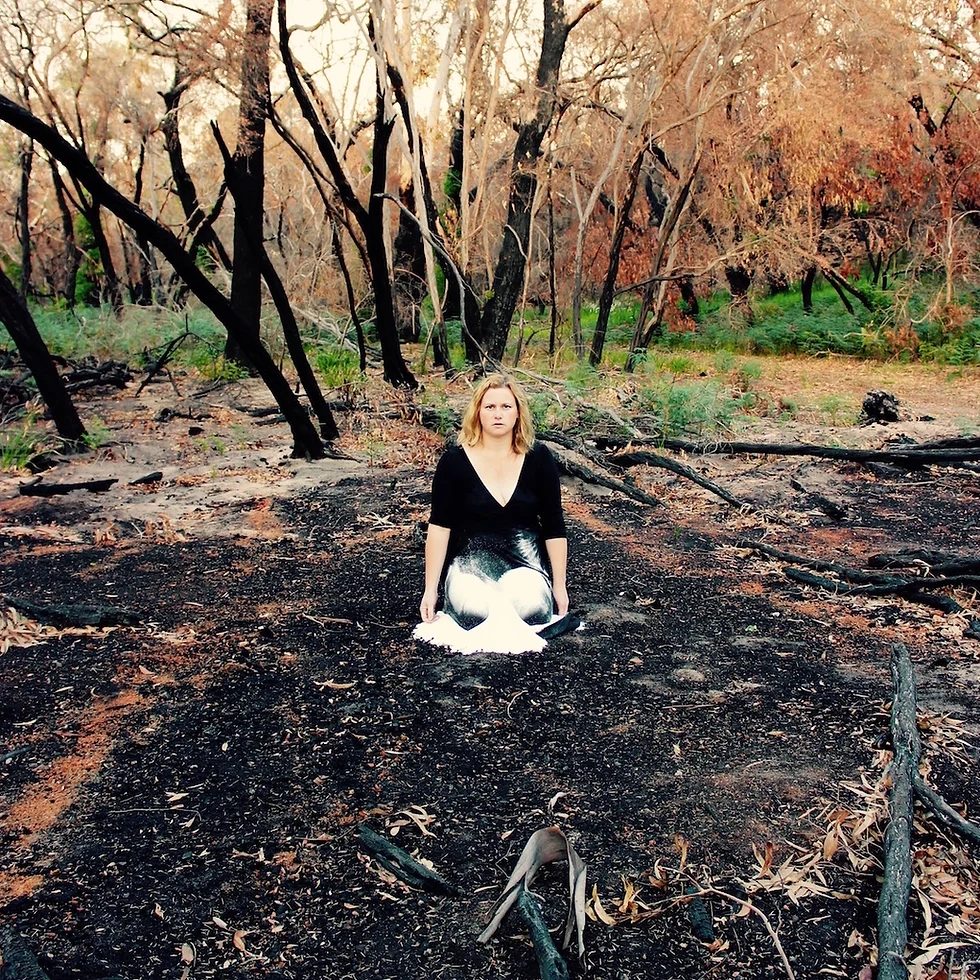
LOOK: ‘Woman, Why Are You Weeping?’ by Rebekah Pryor
Rebekah Pryor, ‘Woman, Why Are You Weeping?’, 2016. Pigment on archival cotton rag, 60 × 59 cm.
Dr. Rebekah Pryor [previously] is a visual artist, curator, scholar, and member of Australian Collaborators in Feminist Theologies. In this photograph of hers, she poses as Mary Magdalene in the garden of the resurrection at the moment when the risen Christ appears to her. Having wept copious tears, represented by the mounds of salt in front of her, Mary kneels in the soil as she converses with this man whom she at first supposes to be the gardener. Pryor writes that “dawn light and the horizon of regrowth suggest the possibility of ‘a new heaven and a new earth’ in which death, dying, mourning and crying will be no more (Revelation 21:1-5).”
LISTEN: “Still Thy Sorrow, Magdalena!” | Original Latin words (title: “Pone luctum Magdalena”) attributed to Adam of St. Victor, 12th century; English translation by Edward A. Washburn, 1868 | Music by Jon Green, 2023 | Performed on Resurrect, vol. 2, a Cardiphonia Music compilation
Still thy sorrow, Magdalena! Wipe the teardrops from thine eyes; Not at Simon’s board thou kneelest, Pouring thy repentant sighs. All with thy glad heart rejoices; All things sing, with happy voices, Hallelujah! Hallelujah! Hallelujah!
Laugh with rapture, Magdalena! Be thy drooping forehead bright: Banished now is every anguish, Breaks anew thy morning light. Christ from death the world hath freed; He is risen, is risen indeed: Hallelujah! Hallelujah! Hallelujah!
Joy! exult, O Magdalena! For he hath burst the rocky prison. Ended are the days of darkness: Conqueror hath he arisen. Mourn no more the Christ departed; Run to welcome him, glad-hearted: Hallelujah! Hallelujah! Hallelujah!
Lift thine eyes, O Magdalena! See! thy living Master stands; See his face, as ever, smiling; See those wounds upon his hands, On his feet, his sacred side— Gems that deck the Glorified: Hallelujah! Hallelujah! Hallelujah! Live, now live, O Magdalena!
This medieval Easter hymn was retuned by Jon Green, a Texan living in Edinburgh, Scotland, as part of a Cardiphonia project spearheaded by Bruce Benedict to bring new life to some of the old texts found in Resurgit: A Collection of Hymns and Songs of the Resurrection (Boston, 1879). The lyrics follow a longstanding tradition in the church of conflating the identities of two Marys in the Gospels (Mary of Magdala and Mary of Bethany) and that of the “sinful woman” in Luke 7; all three women become Mary Magdalene, characterized as a penitent who scandalously anoints Christ’s feet with expensive perfume and her own tears during a supper at the house of Simon the Pharisee.
None of the Gospels indicates that this anointer was Mary Magdalene. (Matthew, Mark, and Luke do not name her at all, and John identifies her as the sister of Lazarus and Martha.) But popular tradition ascribes to Mary Magdalene this role—hence the references in the first stanza of the hymn.
What we do know, though, is that Mary Magdalene came early Sunday morning to Jesus’s tomb with the intention of anointing his body, only to find the tomb empty. John 20 is, I think, one of the most glorious chapters in all of scripture. John’s is the only Gospel that recounts Mary’s intimate encounter with the postresurrection Jesus. He tells us that she is distraught over the absence of Jesus’s body, which she presumes someone moved to some unknown location. She had wanted to say her proper goodbyes—he had been taken so suddenly—and, as a gesture of honor, to finish the job of treating his corpse with myrrh and aloes that had been hastily performed by Joseph and Nicodemus on Friday. Now unable to do either, she weeps.
It’s then that Jesus comes to her, alive and in the flesh, revealing himself as her Lord and as conqueror of the grave. He bids her to weep no more.
The gladness of this moment is palpable in the hymn text by Adam of St. Victor. “Laugh with rapture, Magdalena! . . . Joy! exult . . . ! . . . Live, now live.” We are called to do the same.
>> “He Is Lord (In Every People),” adapt. Gregory Kay: In this video from 2021, members of Spring Garden Church in Toronto take turns singing the popular twentieth-century worship song (of unknown authorship) “He Is Lord” in their native languages: English, Portuguese, Arabic, Korean, and Chinese. Greg Kay, one of the church’s copastors, added a fun refrain that highlights the global character of Christianity and the lordship of Christ over all creation, which everyone joins in on. Love this idea! [HT: Liturgy Fellowship]
>> Easter Medley performed by Infinity Song, feat. Victory Boyd:Infinity Song is a sibling band from New York City that was led for years by Victory Boyd, who is now focusing on her solo music career; its current members, represented in this video from 2021, are Abraham, Angel, Israel, and Thalia “Momo” Boyd. (Victory is singing lead.) The group combines the songs “In the Name of Jesus” by David Billingsley, “Jesus Is Alive” by Ron Kenoly [previously], and “Redeemer” by Nicole C. Mullen into an Easter medley at Fount Church in New York.
>> “Yessu Jee Utheya” (یسوع جی اُٹھیا) (Jesus Is Risen), performed by Tehmina Tariq:Tehmina Tariq is a prolific gospel singer from Islamabad, Pakistan. Here she performs a song in Urdu by Nadir Shamir Khan (words) and Michael Daniel (music). Press the “CC” button on the YouTube video player to follow along with the lyrics. For a more recent Easter song that Tariq recorded, see “Zinda Huwa Hai Masih” (The Messiah Is Risen). [HT: Global Christian Worship]
+++
MEDIEVAL MYSTERY PLAY: The Harrowing of Hell from the York cycle, produced by the YMPST (York Mystery Plays Supporters Trust): From the mid-fourteenth to mid-sixteenth century in England, during the feast of Corpus Christi in early summer, villagers used to enact stories from the Bible on moveable stages called pageant wagons, which would wheel through town making various stops for performance. Playing the roles of sacred personages were not professional actors but members of the trade guilds. Such plays were banned in Tudor times but since the mid-twentieth century have enjoyed a revival.
One of the few complete surviving English mystery play cycles, consisting of forty-eight individual verse dramas of about twenty minutes each, is the York Mystery Plays, named after the historic town where they originated. One of the plays, assigned to the town saddlers, is The Harrowing of Hell. The following video is a 2018 performance sponsored by the York Mystery Plays Supporters Trust, also available on DVD. You can follow along with the script at TEAMS Middle English Texts, though note that the players do adapt it lightly. Learn more at https://ympst.co.uk/.
A soul writhes in Hades, awaiting rescue by Christ, in the 2018 YMPST wagon play performance of The Harrowing of Hell
For a preview of the language, here’s Adam’s speech toward the end, after Christ binds Satan and casts him into a fiery pit (I love the alliterative phrase “mickle is thy might”!):
A, Jesu Lorde, mekill is thi myght That mekis thiselffe in this manere Us for to helpe as thou has hight Whanne both forfette, I and my feere. Here have we levyd withouten light Foure thousand and six hundreth yere; Now se I be this solempne sight Howe thy mercy hath made us clene.
Modern English translation:
Ah, Lord Jesus, mickle [great] is thy might That makest thyself in this manner To help us as thou hast said When both of us offended thee, I and my companion [Eve]. Here have we lived without light For four thousand six hundred years; Now see I by this solemn sight How thy mercy hath made us clean.
The YMPST performance incorporates modern elements in the music and costuming, including an electric guitar–driven rendition of the American gospel song “Ain’t No Grave” at the opening and closing.
+++
ART COMMENTARIES:
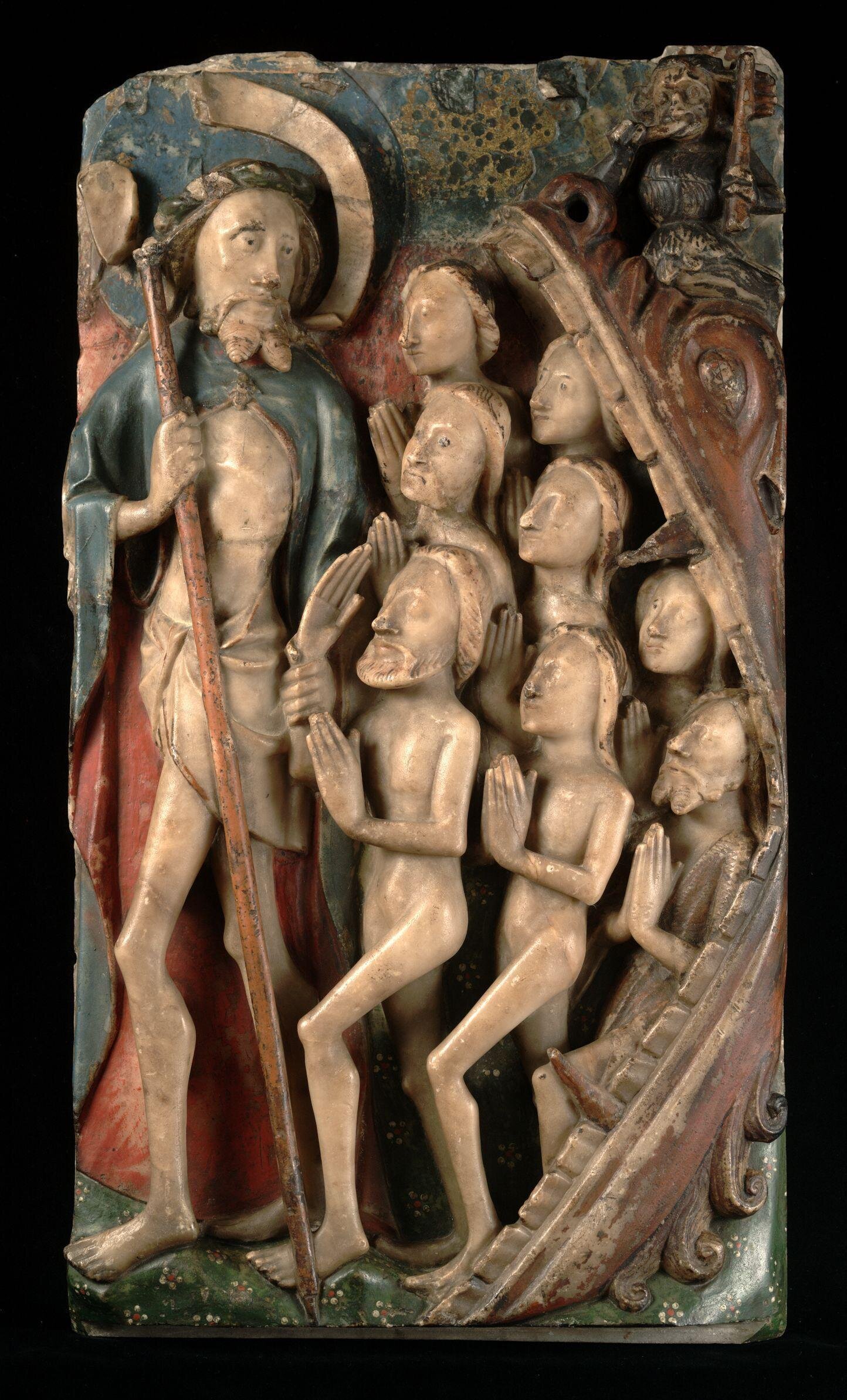
Below are discussions of two medieval English artworks of the Harrowing of Hell, one of my favorite religious subjects. In modern-day parlance, the word “hell” (an English translation of the Greek “Tartarus” or “Hades” or the Hebrew “Sheol”) typically connotes a place of eternal torment where the damned go, but in Christian theology it was long used more broadly to refer to the compartmentalized netherworld where both righteous and unrighteous souls go after death to await the general resurrection that will take place at Christ’s return.
>> “The Harrowing of Hell” (Smarthistory video): Drs. Nancy Ross and Paul Binski discuss a fifteenth-century alabaster that’s in the collection of the Victoria and Albert Museum in London. What sticks out to me—the commentators mention it only briefly—is that Christ stands on a green, flowery lawn! The artist is probably alluding to the springtime, the new life, that Jesus’s resurrection ushered in: the redeemed exit the hellmouth, barefoot like their Lord, onto this lush grass. This detail reminds me a bit of Fra Angelico’s Noli me tangere fresco at San Marco in Florence.
The Harrowing of Hell, England, 15th century. Carved, painted, and gilt alabaster, 58 × 32 cm. Victoria and Albert Museum, London.
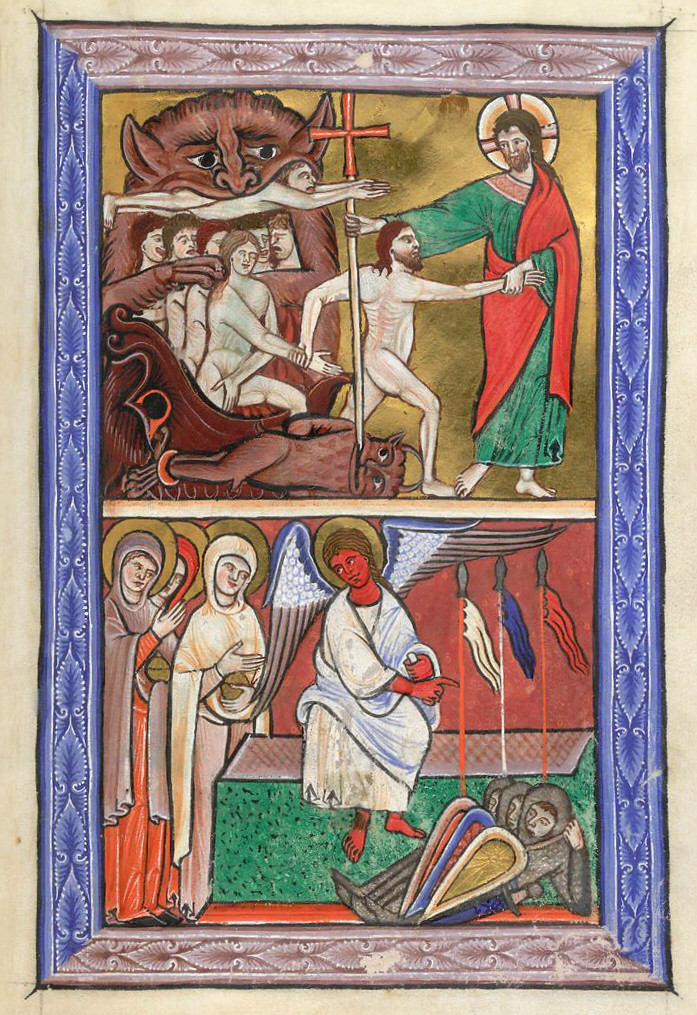
>> “Under the Earth” by Joanna Collicutt: The Visual Commentary on Scripture is a free online resource that provides material for teaching, preaching, researching, and reflecting on the Bible, art, and theology. For one of her three VCS-commissioned “visual commentaries” on Philippians 2:1–11, Rev. Dr. Joanna Collicut has selected an illumination of the Harrowing of Hell from a thirteenth-century psalter. The Christ Hymn that forms the meat of this passage celebrates Jesus’s descent and ascent, and in verse 10 it says that at his name, every knee will bow in heaven, on earth, and “under the earth.” This phrase had never stood out to me until now.
The Harrowing of Hell and The Holy Women at the Tomb, from an English psalter (BL Arundel 157, fol. 110), ca. 1220–40. Ink, tempera, and gold leaf on vellum, 29.5 × 20 cm. British Library, London.
Kateryna Shadrina (Ukrainian, 1995–), Harrowing of Hell, 2021. Acrylic on gessoed wood, 40 × 30 cm.
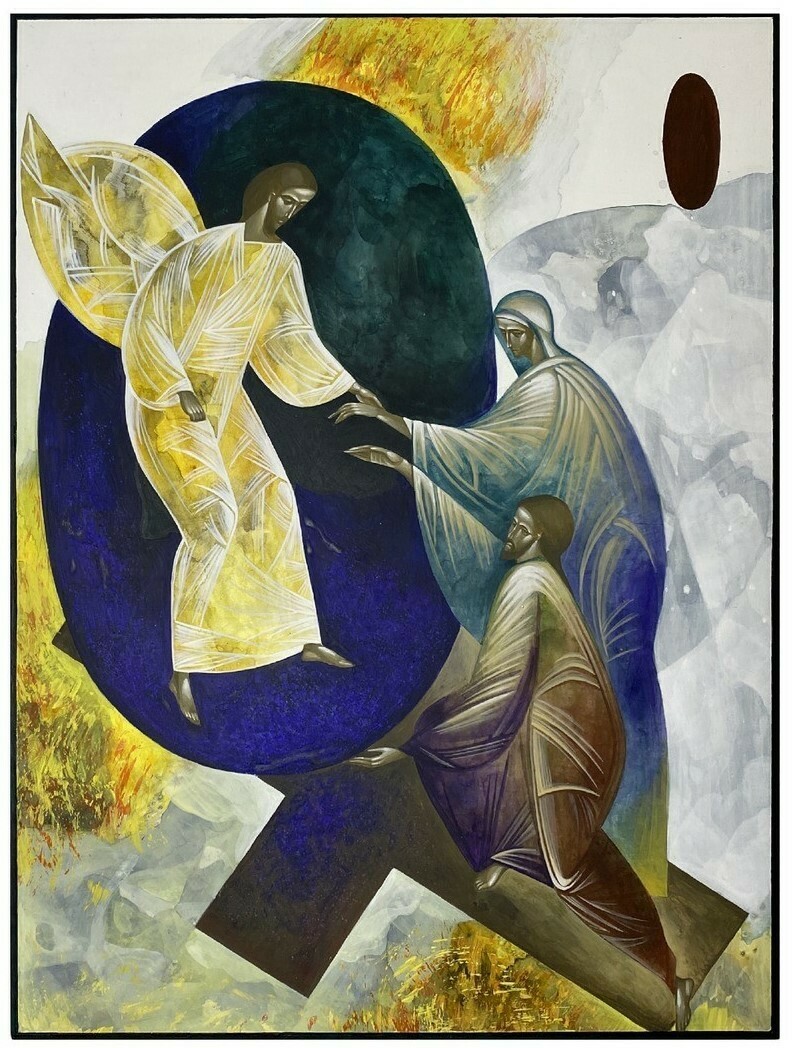
This contemporary icon of the Resurrection shows Christ standing atop the gates of hell—which have fallen into the shape of a cross—redeeming Adam and Eve while flames whip all around. In the sudden rush of rescue, his cloak billows behind him. His mandorla—that is, the radiant oval that frames him—is traditionally gold, but here the artist has chosen a deep royal blue, symbolic of heaven, and jade green for healing, renewal, and prosperity. The black oval in the upper right may signify the mouth of the empty tomb, or the portal through which Christ will return with the newly liberated to the realms above.
LISTEN: “Welcome, Happy Morning!” | Original Latin words by Venantius Fortunatus, 6th century; English translation by John Ellerton, 19th century | Music: NOEL NOUVELET (traditional French tune), 15th century | Performed by the Green Carpet Players (musicians of Redeemer Church of Knoxville), feat. Tyler Anthony, on Rise, O Buried Lord, 2011
“Welcome, happy morning!” age to age shall say: hell today is vanquished, heav’n is won today. Lo! the dead is living, God forevermore! Him, their true Creator, all his works adore.
“Welcome, happy morning!” age to age shall say: hell today is vanquished, heav’n is won today.
Maker and Redeemer, life and health of all, thou, from heav’n beholding human nature’s fall, of the Father’s Godhead true and only Son, manhood to deliver, manhood didst put on.
Thou, of life the author, death didst undergo, tread the path of darkness, saving strength to show. Come then, True and Faithful, now fulfill thy word; ’tis thine own third morning: rise, O buried Lord!
Loose the souls long prisoned, bound with Satan’s chain; thine that now are fallen raise to life again; show thy face in brightness, bid the nations see; bring again our daylight; day returns with thee.
I like how this hymn—whose origins are in the sixth century!—integrates the Incarnation into the story of Easter, enfolding together Jesus’s birth, life, death, and resurrection as well as his second coming.
To deliver humanity from the thrall of sin and death, the second person of the Trinity put on human flesh. He lived faithfully and died a sacrificial death. And then this God-Man came back to life! Now all the created world praises his name. The hymn ends with a prayer to see resurrection life in our world and for Christ’s return. “True and Faithful” in the third stanza are epithets of Jesus, the white-horse rider, in Revelation 19:11.
The musicians of Redeemer Church of Knoxville have paired the early medieval text with the fifteenth-century French carol tune NOEL NOUVELET, which is more commonly used with “Sing We Now of Christmas” and “Now the Green Blade Riseth” but works equally well here. The group brings a raucous energy and sings at a quickened tempo, using xylophones, mandolins, and trumpets in their celebration of the Risen Christ.
During the Easter Octave (the first eight days of the fifty-day season of Easter), I will continue publishing short daily posts in this art-and-song format.
Joaquín Vaquero Turcios (Spanish, 1933–2010), Alba de Resurrección (Dawn of Resurrection), 1956. Oil on canvas, 120 × 180 cm. Museo Reina Sofia, Madrid, Spain.
The garden in the deep night
after God’s rapt silence
has no breath. No echo even
in the vacant tomb which no one
yet has visited, no one seen,
and yet everywhere his breathing,
the turn begins, the blanket
of sunrise in mist stretches
to swaddle the earth,
gouged and waiting.
Jill Peláez Baumgaertner (born 1948) is the multi-award-winning author of six poetry collections and an academic book on Flannery O’Connor as well as the editor of the anthologies Taking Root in the Heart: Poems from the Christian Century (Paraclete, 2023) and Imago Dei: Poems from Christianity and Literature (Abilene Christian University Press, 2012). A Fulbright fellowship to Spain and a nomination for the Pushcart Prize are among her honors. Professor emerita of English and former dean of humanities and theological studies at Wheaton College, she lives in Chicago with her husband, Martin, where she serves as poetry editor of the Christian Century. Hear her discuss her work on a recent Faith and Imagination podcast episode on poetry and the Divine Presence.
O set me as a seal upon thy heart O set me as a seal upon thine arm For love is strong, strong as death, my love And jealousy is cruel as the grave
Its flashes are the living flame of a blazing fire That cannot be drowned out in a flood All earthly gold in exchange for love Would be utterly contemptible and scorned
Come, my love Let me hear your voice My companions and I wait in the garden Make haste, my love, and shine out like the rising sun Like a stag appearing on the mountain
After the crucifixion of Jesus, a small group of his female followers purchased spices and prepared them to bring to the tomb to anoint his body on Sunday morning. (Sabbath restrictions prevented them from doing work on Saturday.) This was an act of love and reverence that served the practical function of counteracting the smell of decomposition.
The singer-songwriter Katy Wehr [previously] imagines the women consoling each other by singing excerpts from the Song of Songs as they crushed the myrrh, mixed it with oil, and bottled it up for transport—maybe also as they headed over to the gravesite. Wehr has set to music four of the verses from the book’s final chapter, a setting she says she hopes conveys a tone that is both mournful and hopeful.
The Song of Songs, or Song of Solomon, is an ancient collection of Hebrew love poems that Christians have long read as allegorical of the love between Christ and his bride, the church.
Wehr’s selections comment on the nature of love: it is permanent, strong, passionate, inextinguishable, and priceless. The female speaker in the poem seeks to stamp herself on her lover’s heart like a seal, claiming him as hers. She professes love’s power, which is as severe and enduring as death. In the context of this passage, the word “jealousy” appears to be used in the positive sense to mean zeal or passion—a resolute devotion.
She goes on to describe love as fiery and intense.
It seems her lover has gone out for the day, or gone on a trip, and she calls him back home. She can’t wait to hear his voice again. She waits outside for him in the garden, wishing for him to come bounding back into her arms.
“Make haste, my love, and shine out like the rising sun.” One can imagine the myrrh-bearing women of the Gospels hoping beyond hope that their beloved Jesus would arise, would speak their names once more, would prove that love is indeed stronger than death.
All photos in this post, except for the last one (of the processional icon), are my own.
(Note: WordPress seems to have disabled the feature that allows you to expand an image upon clicking, but if you’re reading on a computer, you can right-click an image and open it in a new tab to view it in full resolution; if you’re reading on a phone, you can pinch to zoom.)
Located in the Horn of Africa and with access to the Red Sea, Nile River, Mediterranean Sea, and Indian Ocean, Ethiopia stands at the nexus of historical travel, trade, and pilgrimage routes that brought it into contact with surrounding cultures and influenced its artistic development. Coptic Egypt, Nubia, South Arabia, Byzantium, Armenia, Italy, India, and the greater African continent were among those influencers. But Ethiopia not only absorbed influences; it transmitted them too.
A major art exhibition is centering Ethiopia’s artistic traditions in a global context. For Ethiopia at the Crossroads at the Walters Art Museum in Baltimore (running through March 3), curator Christine Sciacca has brought together more than 220 objects from the Walters’ own extraordinary Ethiopian art collection and private and institutional lenders both domestic and international. Icons, wall paintings, processional crosses and hand crosses, illuminated Gospel books and psalters, sensuls (chain manuscripts), healing scrolls, and more are on display throughout the galleries, whose walls have been painted bright green, yellow, and red—the colors of the Ethiopian flag. To round off the exhibition, guest curator Tsedaye Makonnen, an Ethiopian American multidisciplinary artist, was tasked with curating a few works from contemporary artists of the Ethiopian diaspora.
The majority of objects are Christian, made for liturgical or private devotional use. Ethiopia is one of the world’s oldest Christian nations: in the early fourth century, persuaded by a missionary from Syria, King Ezana of Aksum embraced Christianity, and it has been the dominant religion of Ethiopia ever since. But the exhibition does also include some Islamic and Jewish objects.
One of the first works you’ll encounter is a mural that would have originally been mounted on the outer wall of an Ethiopian Orthodox church sanctuary (mäqdäs), portraying the Nativity, the Presentation of Christ in the Temple, and the Adoration of the Magi.
Nativity, Presentation of Christ in the Temple, and Adoration of the Magi, Ethiopia, 18th century. Glue tempera on overlapping canvas pieces mounted to a new stretched canvas, 49 3/16 × 66 15/16 in. (124.9 × 170 cm). Walters Art Museum, Baltimore. [object record]
Remarkably, at the Nativity, there is a feast taking place, and Jesus is feeding his mother with what looks like a Communion wafer! As the theologian Lester Ruth has said, “The sound from most baby beds is a cry to be fed. But the cry from the manger is an offer to feed on his body born into this world.”
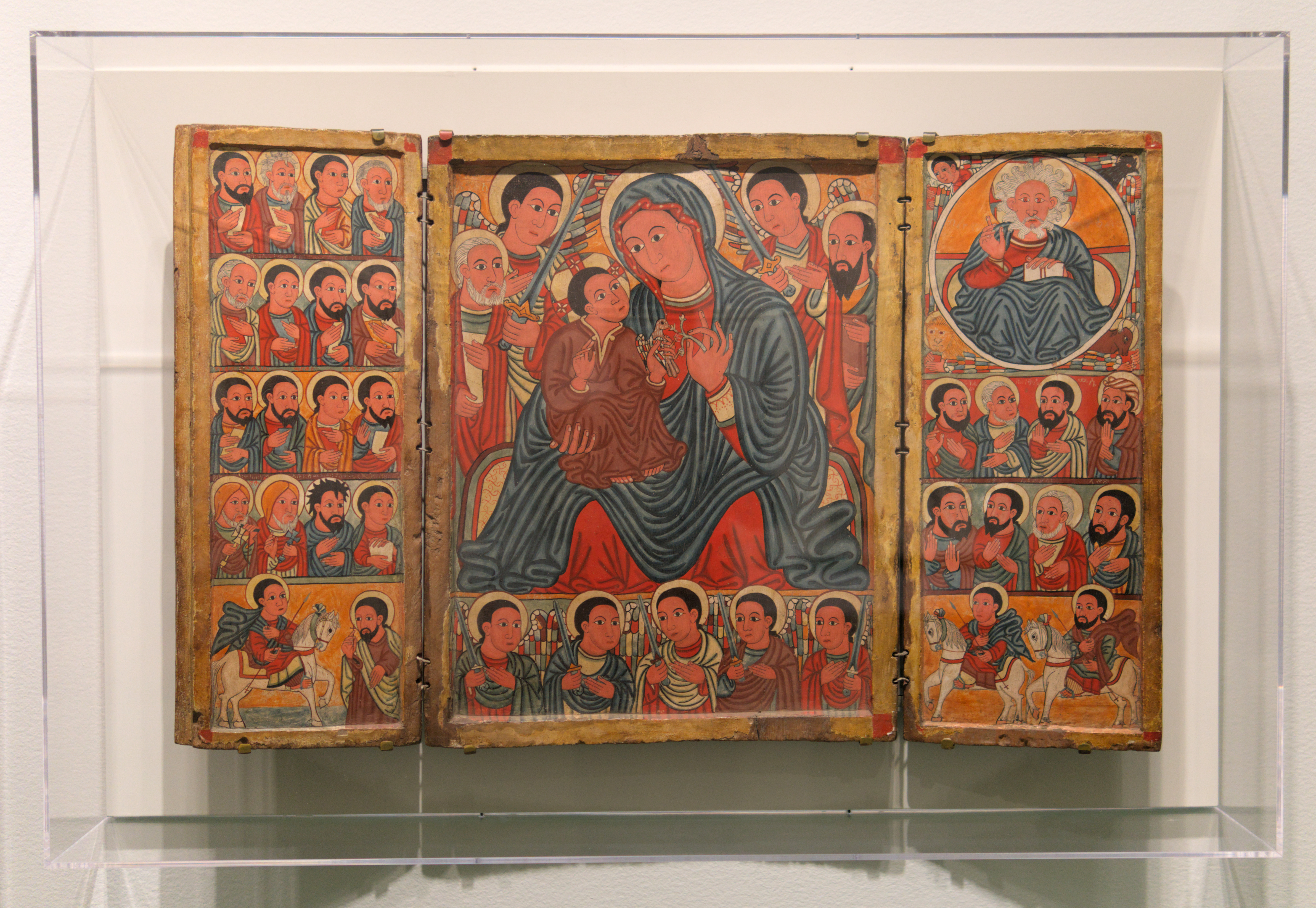
One of history’s most famous Ethiopian painters is Fre Seyon, who worked at the court of Emperor Zara Yaqob (r. 1434–1468) and was of the first generation of Ethiopian artists who painted icons on wood panels. He was also a monk. He likely introduced one of the characteristic features of Ethiopian icons of the Virgin and Child: the archangels Michael and Gabriel flanking them with drawn swords, acting as a kind of honor guard.
Fre Seyon (Ethiopian, active 1445–1480), Triptych Icon with the Virgin Mary and Christ Child Flanked by Archangels and Saints (center), Twelve Apostles and Saints (left), and Prophets and Saints (right), mid- to late 15th century. Tempera on gesso-primed wood. Institute of Ethiopian Studies, Addis Ababa University, acc. no. IESMus4186.
My two favorite details of this triptych by Fre Seyon are (on the right wing) the image of the Ancient of Days surrounded by the tetramorph, his wild gray locks being blown about, and in the center, the bird that Christ holds, its feet grasping at a three-branched twig. On a literal level, the bird is a plaything for the boy that charmingly emphasizes his humanity (in the late Middle Ages, at least in Europe—I’m not sure about in Ethiopia—it was common for young children to keep tame birds as pets). On another level, the bird may be symbolic. In traditional Western art, Jesus sometimes holds a goldfinch, a bird with distinctive red markings that’s fond of eating thistle seeds and gathering thistle down and thus came to be read as a prefiguration of Christ’s thorny, blood-spilt passion. I’m not sure whether Fre Seyon intended a symbolic significance for this bird.
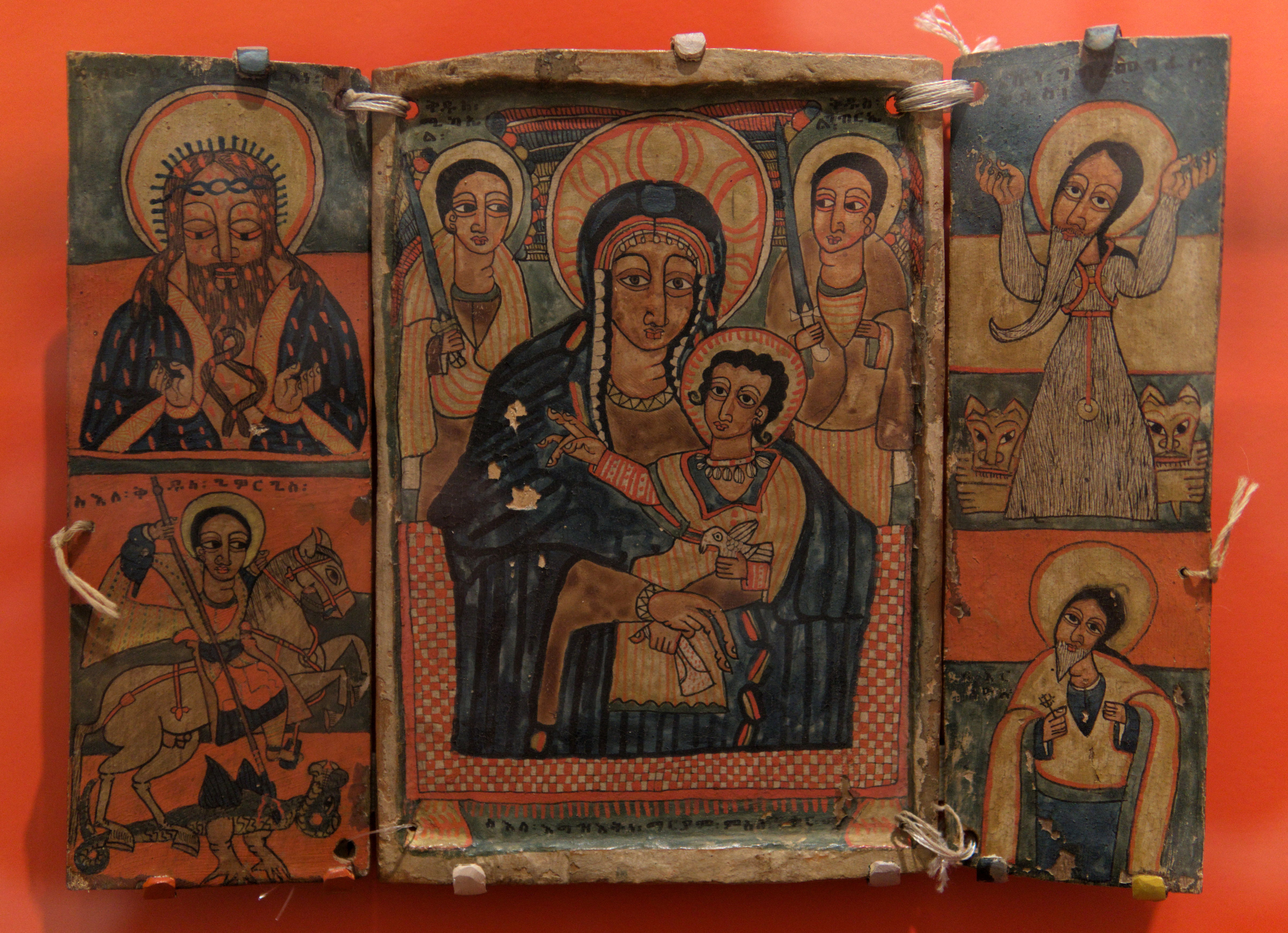
Here’s another triptych from the exhibition, this one from a century and a half later:
Triptych Icon with the Virgin Mary and Christ Child Flanked by Archangels, Scenes from the Life of Christ, Saint George, and Saints Honorius, Täklä Haymanot, and Ewostatewos, Ethiopia (Tigray), early 17th century. Glue tempera on panel, 16 3/4 × 22 5/16 in. (42.5 × 56.7 cm). Walters Art Museum, Baltimore. [object record]
The composition of the Virgin and Child is based on prints of a painted icon from Santa Maria Maggiore in Rome brought to Ethiopia by Portuguese Jesuit missionaries—but it innovates. As the wall text notes, “Mary’s cloak stretch[es] out in either direction to embrace the scene of Christ Teaching the Apostles below. Umbrella-like, Mary appears as both the protector and personification of the church.”
On the right wing, angels hold up chalices to collect the blood that flows from Jesus’s wounds on the cross, while below that, Joseph of Arimathea and Nicodemus carry Jesus’s wrapped corpse to the tomb. On the left wing is one of my favorite traditional religious scenes: the Harrowing of Hell, or Christ’s Descent into Limbo, in which, on Holy Saturday, Jesus enters the realm of his dead to take back those whom Death has held captive, first of which are our foreparents Adam and Eve. Below that scene is an image of the dragon-slaying Saint George, a late third-century figure from the Levant or Cappadocia who is the patron saint of Ethiopia.
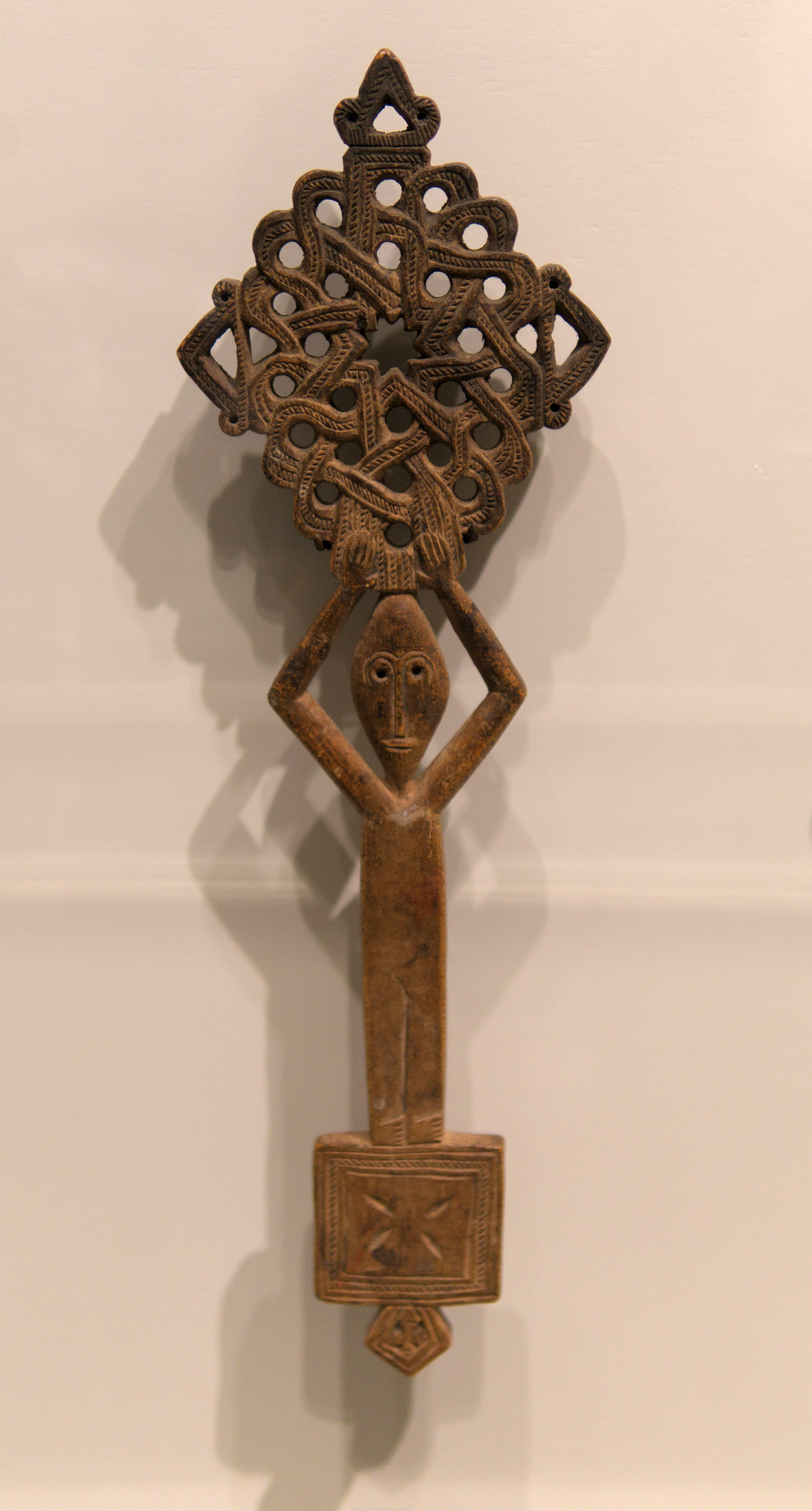
At the bottom center is a scene of Christ teaching the twelve apostles, plus two Ethiopian saints. They all hold hand crosses, like those carried by Ethiopian priests and monks.
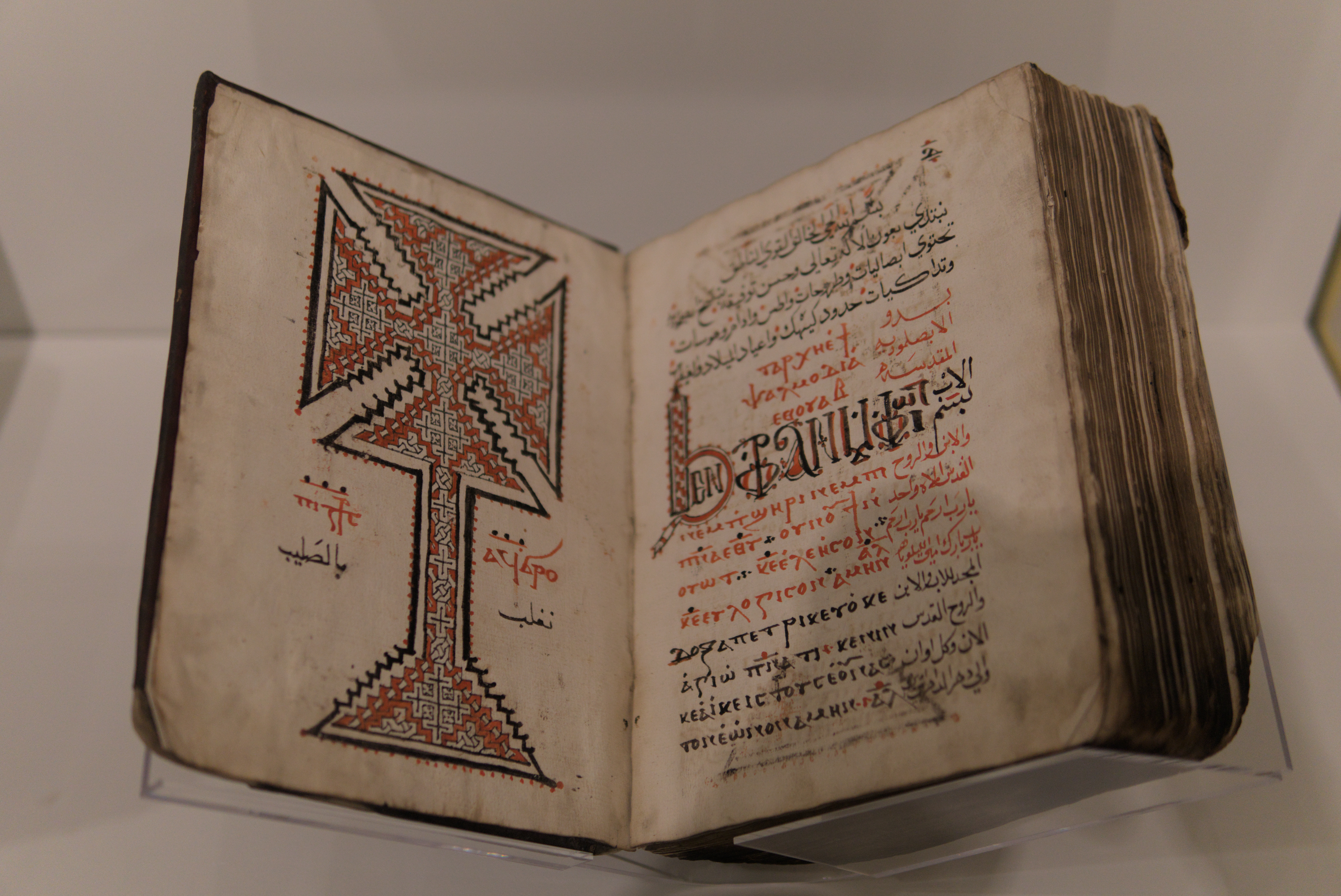
Hand Cross with Figure, Ethiopia, probably 18th–19th century. Wood, 13 3/8 × 4 3/16 × 9/16 in. (34 x 10.7 × 1.4 cm). Walters Art Museum, Baltimore. [object record]Coptic-Arabic Book of Prayer, Egypt, 18th century. Tempera and ink on parchment, 11 3/4 × 9 in. (29.8 × 22.8 cm). Melikian Collection. [object record]
One of the hallmarks of the exhibition is its multisensory nature: attendees are immersed not only in the sights of Ethiopia but also in the sounds and smells. Scratch-and-sniff cards invite people to take a whiff of frankincense, which would have filled the censer on display. Or to smell berbere, a hot spice blend that would have been stored in the woven baskets nearby.
This olfactory element was produced by the Institute for Digital Archaeology, which, as part of its efforts to record and preserve ephemeral culture, has launched an ambitious program to preserve the heritage of smells. “The aim is to provide the technical means for documenting the aromas of today for the benefit of future generations – and to find new methods and opportunities for experiencing the odors of the past.”
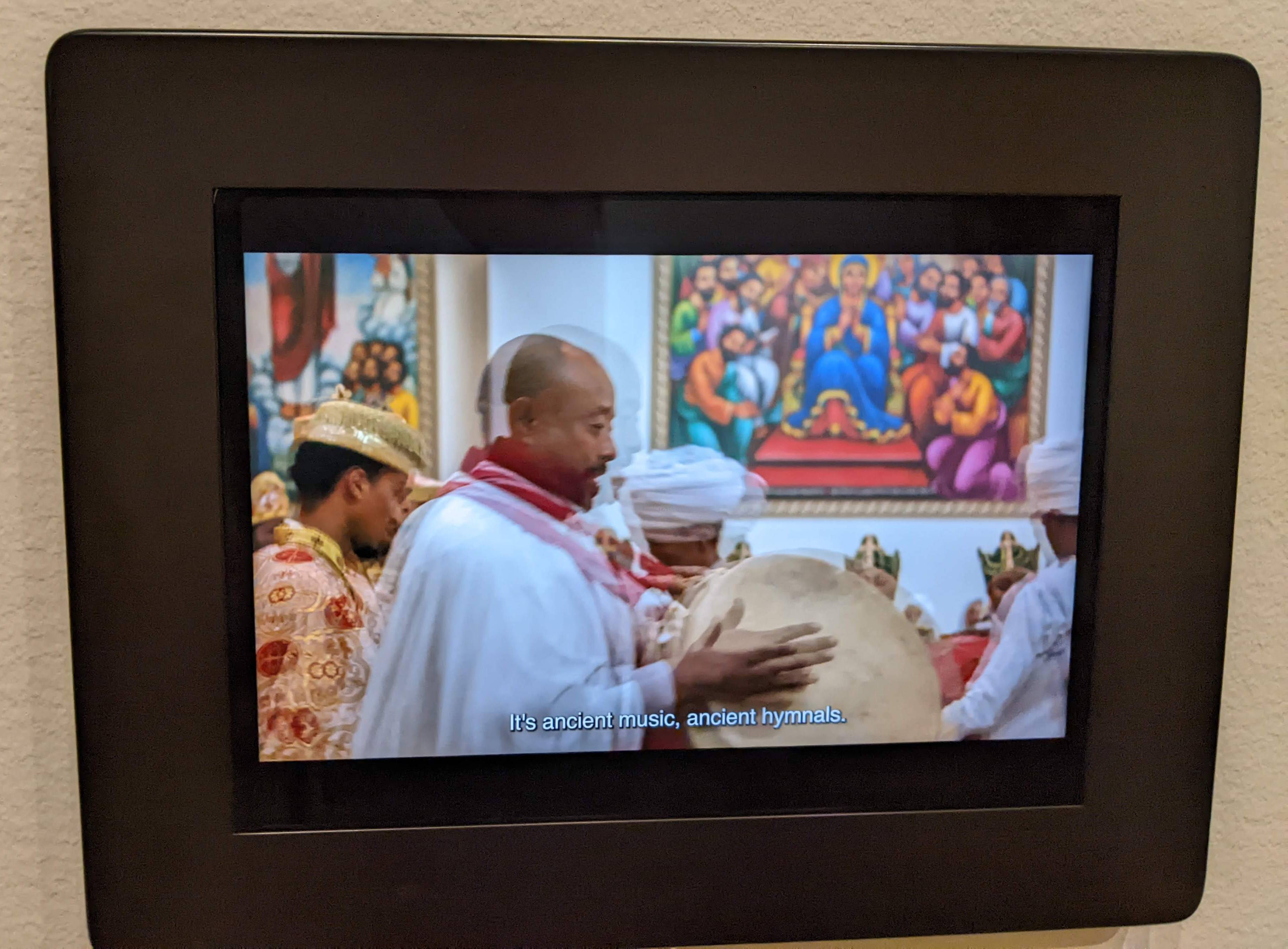
Also in the exhibition there are screens where you can watch videos of Ethiopian Orthodox worship, including music and liturgies, where you will see some of the objects in use. You can also listen to interviews with members of the local Ethiopian diaspora community. (The Washington metropolitan area has the largest Ethiopian population outside Ethiopia.)
Further contextualizing the objects and enhancing the sense of place, pasted onto the wall is a blow-up photograph of a Christian holy-day celebration wending through the streets. This serves as a backdrop to two physical artifacts present in the room: a qämis (dress) and a debab (umbrella).
The inscriptions on many of the Ethiopian icons and manuscript illuminations, which identify the figures and scenes, are in Ge‘ez (aka classical Ethiopic), an ancient South Semitic language that originated over two thousand years ago in what is now northern Ethiopia and Eritrea. It’s no longer spoken in daily life, but it is still used as the language of the Ethiopian Orthodox Church and taught to boys in Sunday school. I really wish I could read it, as it would be a great help in interpreting the Ethiopian images I come across in my studies!
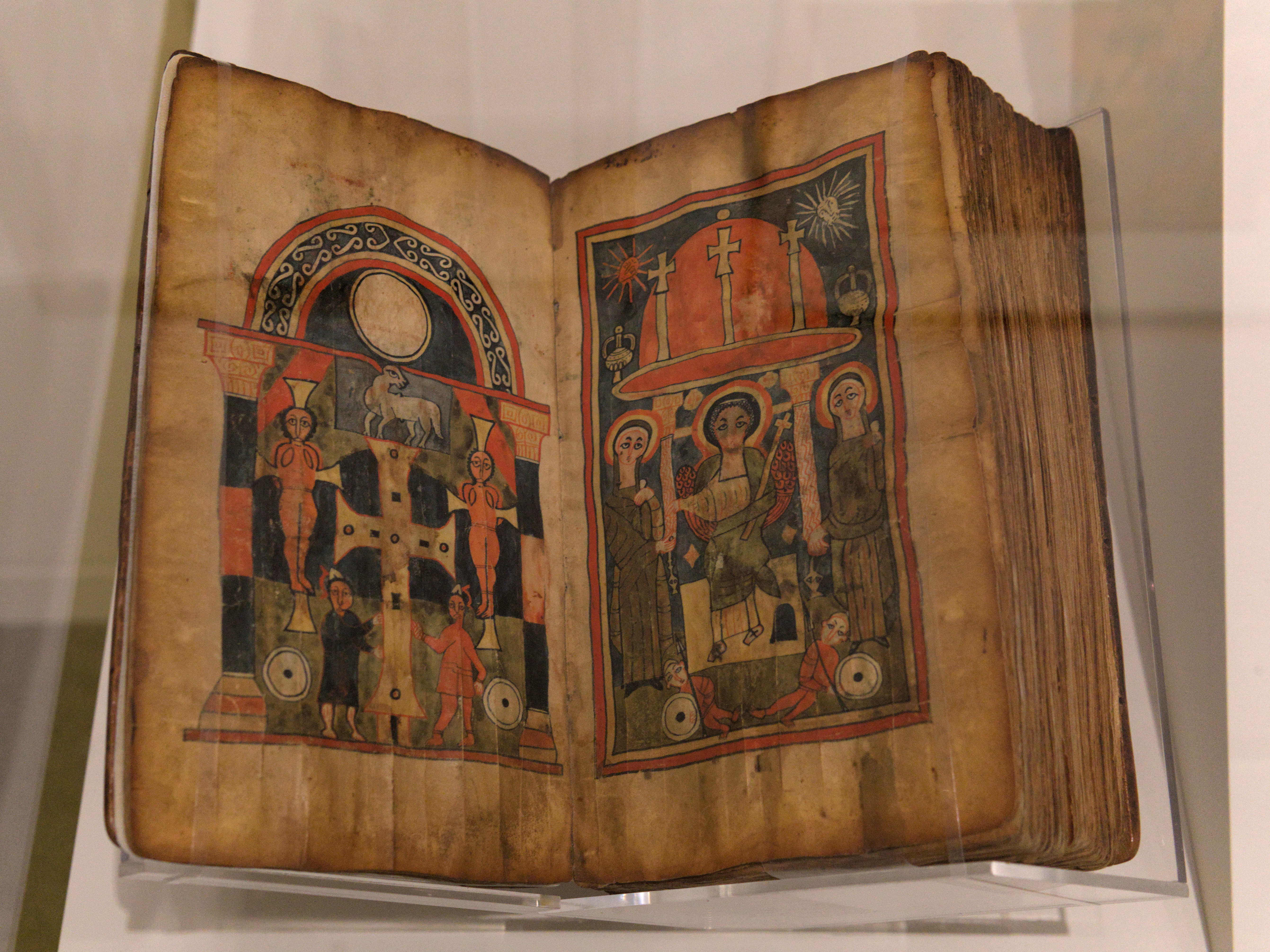
Contrary to what some may assume, Ethiopians in the medieval era were not an isolated people. They traveled—to Rome, to Jerusalem, and so forth. Evidence of Holy Land pilgrimage is suggested by an early fourteenth-century Gospel book that includes the domed Church of the Holy Sepulcher as the backdrop for Christ’s resurrection:
Gospel Book with the Crucifixion and Christ’s Resurrection, Ethiopia (Tigray), early 14th century. Ink and paint on parchment, 10 1/2 × 6 11/16 in. (26.7 × 17 cm). Walters Art Museum, Baltimore, W.8.36, fols. 6v–7r. [object record]
This is an extraordinary book, one of the oldest surviving Ethiopian manuscripts and the oldest in North America. Ethiopian artists weren’t yet depicting Jesus on the cross, so to represent the Crucifixion, this artist has painted a living lamb surmounting a bejeweled cross, with the two thieves crucified on either side.
Also from the fourteenth century, a manuscript opened to a page spread of Christ’s Entry into Jerusalem:
Christ’s Entry into Jerusalem, folios added from an earlier Gospel book to a Ta’ammera Maryam manuscript, Ethiopia, 14th century. Tempera and ink on parchment. Private collection.
I like how the scene extends across both pages, creating a sense of forward progression, and the two onlookers above the city gate.
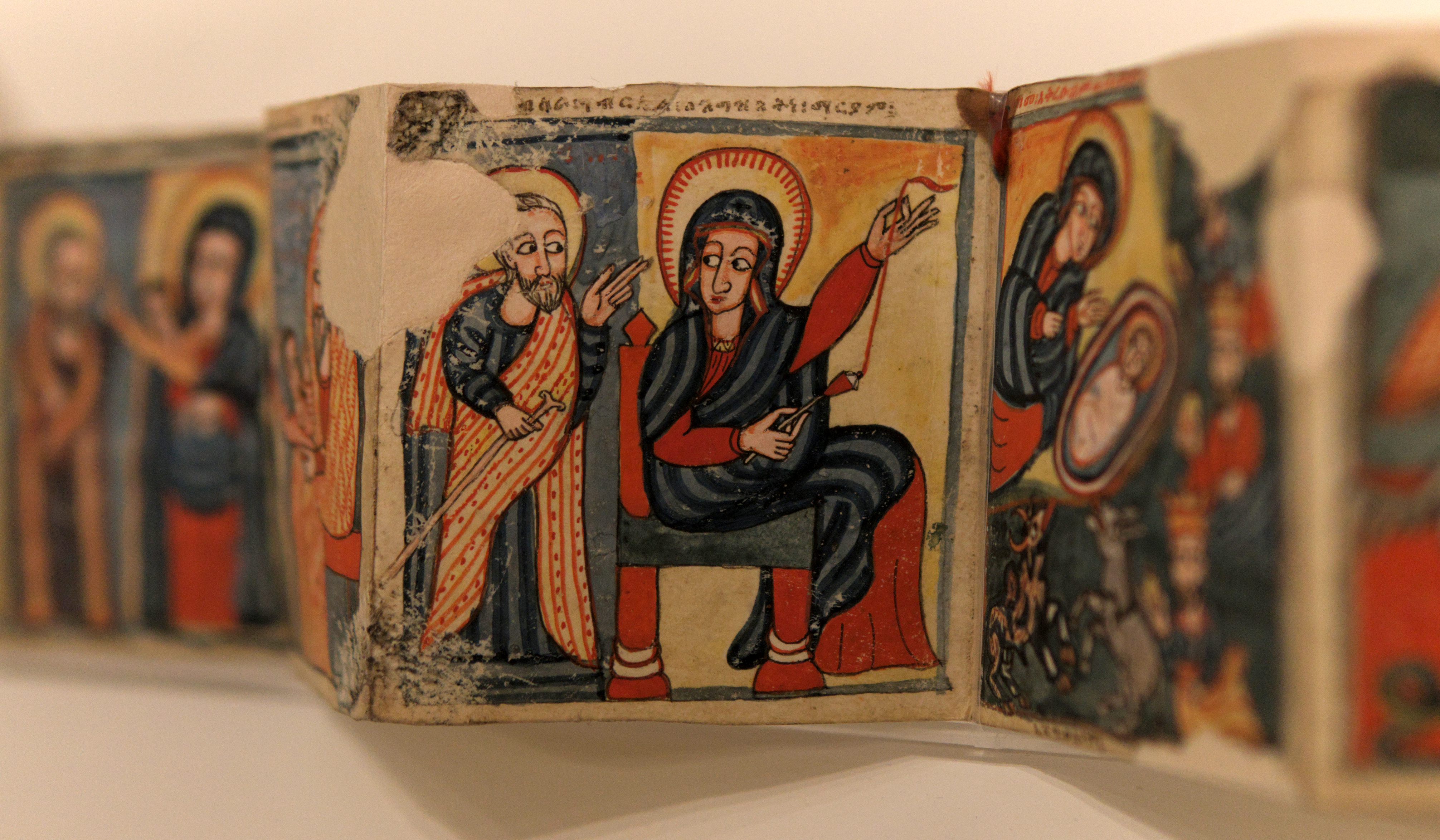
One of my favorite objects from the exhibition is a sensul from Gondar depicting ten scenes from the life of Mary. A sensul is an Ethiopian chain manuscript, in this case pocket-size, created out of a single folded strip of parchment attached to heavy hide boards at each end, which creates a small book when folded shut. Here’s a detail showing the Annunciation:
Annunciation, from a Gondarine sensul (chained manuscript), Ethiopia (Gondar), late 17th century. Ink and paint on parchment, each panel 3 5/8 × 3 1/8 in. (9.2 × 9 cm). Walters Art Museum, Baltimore. [object record] [GIF]
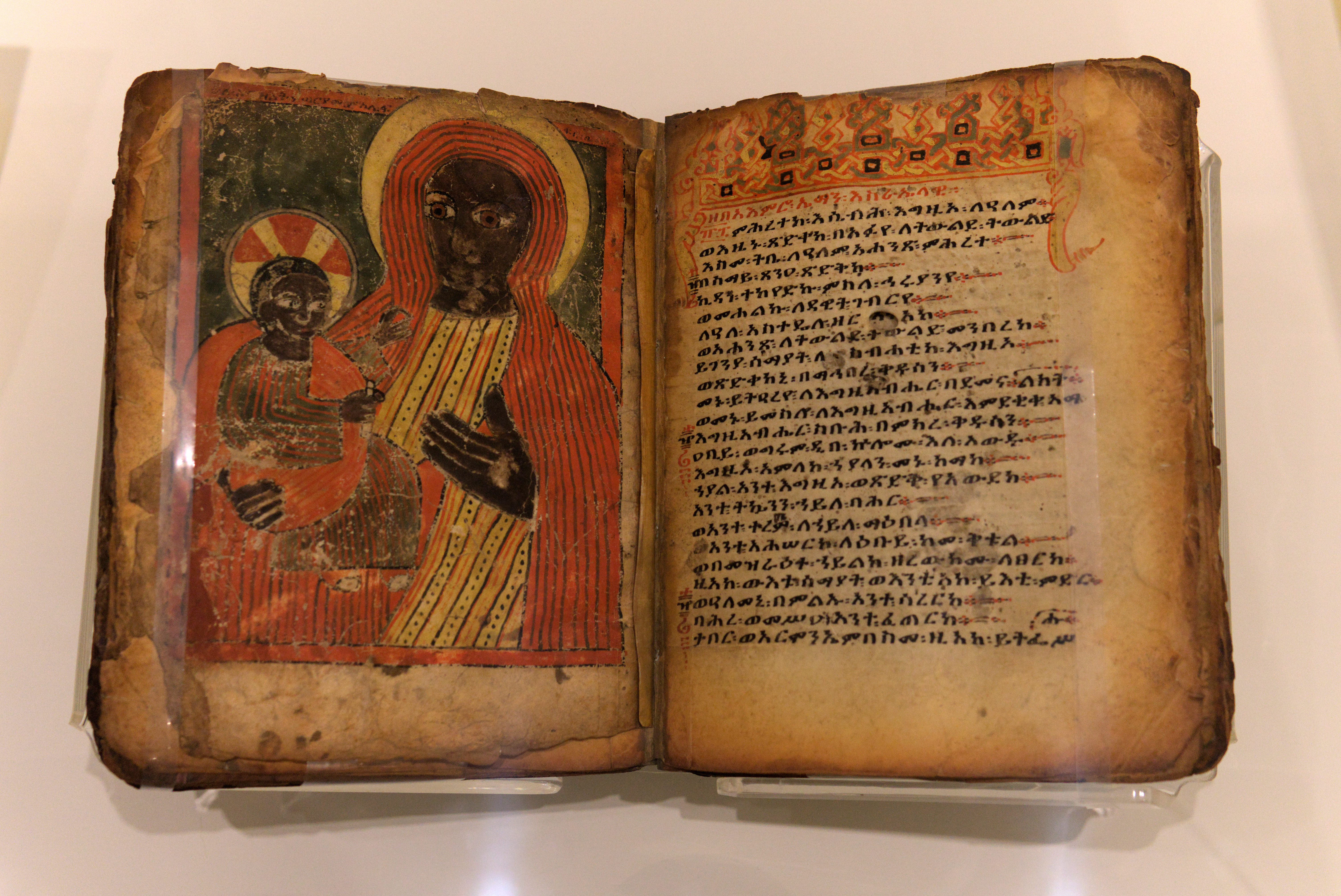
It’s a common misconception that Ethiopians have always depicted biblical figures as dark-skinned to reflect the local population. Such treatment didn’t become normative until the eighteenth century, although some earlier artists did choose black complexions for holy persons:
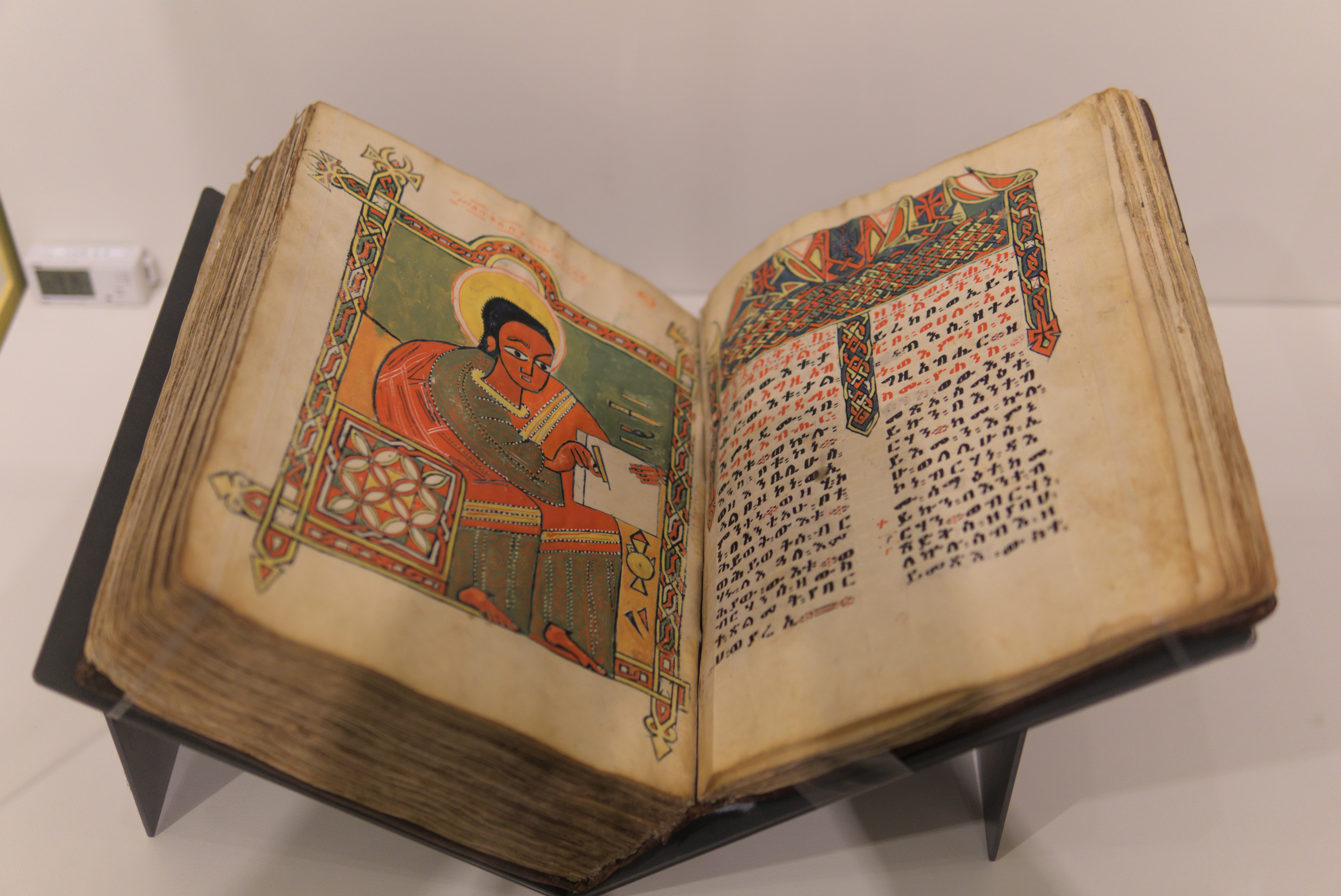
Virgin and Child, from a Psalter with the Wəddase Maryam (Praise of Mary) and Mähalǝyä Näbiyyat (Canticles of the Prophets), Ethiopia, 15th century. Ink and pigments on parchment with wooden boards, open: 8 7/8 × 6 11/16 × 3 15/16 in. (22.5 × 17 × 10 cm). Toledo Museum of Art, Ohio. [object record]The Opening of the Gospel of John, from a Gospel book, Ethiopia, ca. 1504–5. Tempera on parchment, 13 9/16 × 10 7/16 in. (34.5 × 26.5 cm). J. Paul Getty Museum, Los Angeles, Ms. 102, fols. 215v–216r. [object record]Triptych Icon with the Virgin Mary and Christ Child Flanked by Archangels (center), the Kwer‘atä re’esu (Man of Sorrows) and Saint George (left), and Saint Gäbrä Mänfäs Qeddus and Abba Arsanyos (right), Ethiopia (Gondar), late 17th–early 18th century. Tempera on gesso-primed wood. Institute of Ethiopian Studies, Addis Ababa University, acc. no. IESMus3492.
In the triptych shown above, not only is the infant Jesus depicted as Black, but he also wears a necklace made of cowrie shells, which are traditionally given to Ethiopian children for protection!
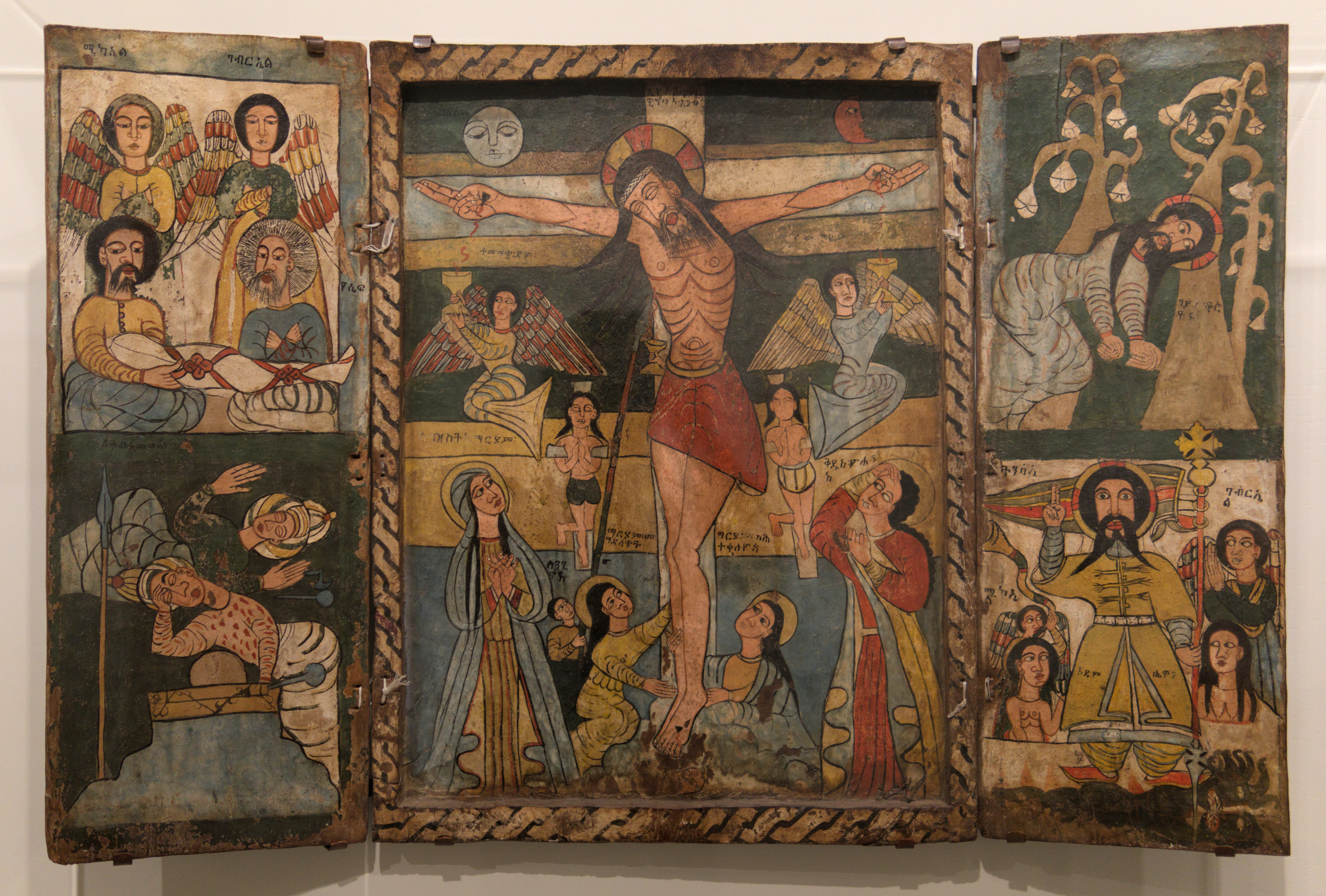
My favorite artwork from the exhibition is probably this triptych:
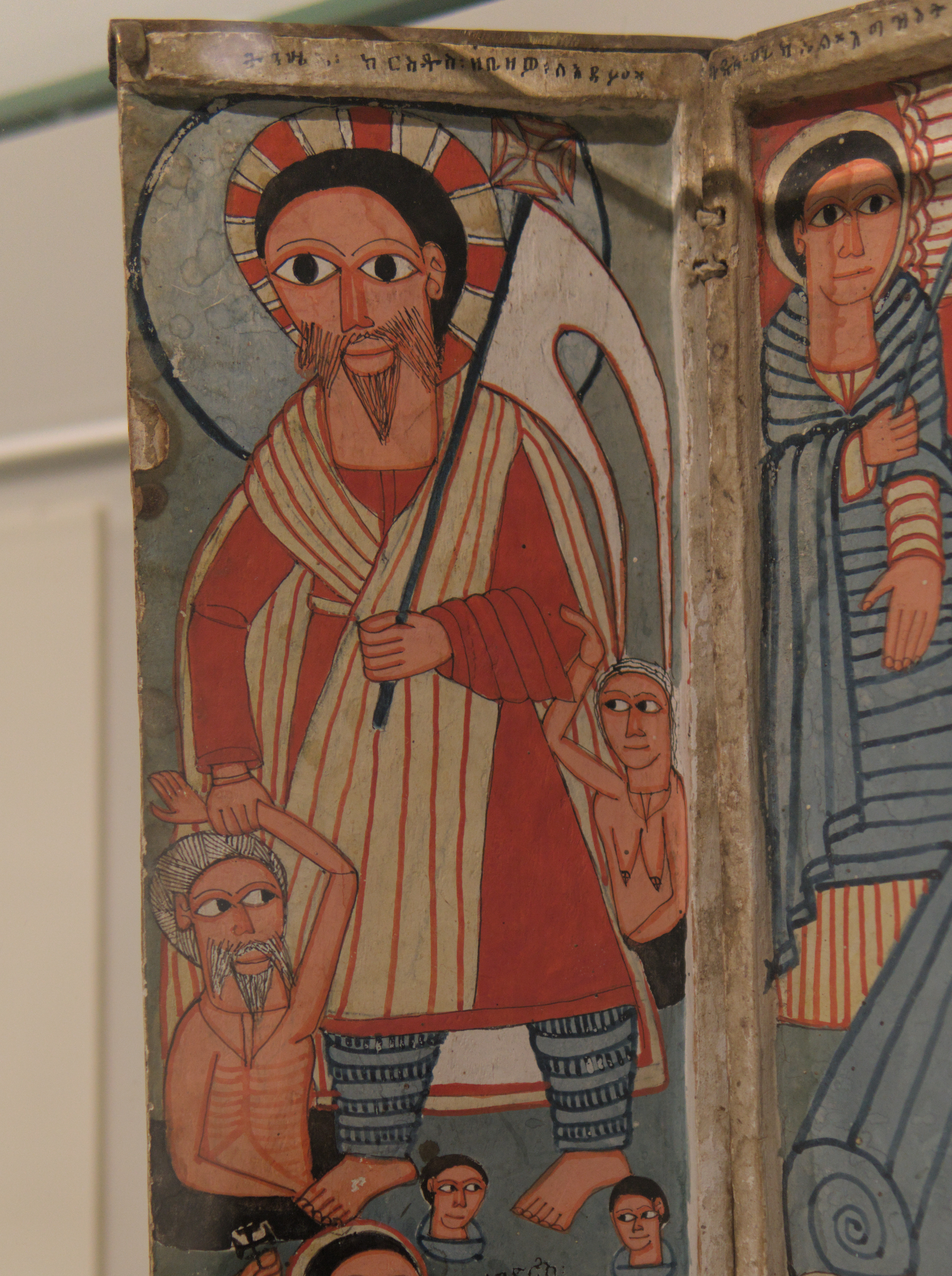
Triptych Icon with the Crucifixion (center), Entombment and Guards at the Tomb (left), and Temptation in the Wilderness and the Resurrection of Christ (right), Ethiopia, late 16th century. Tempera on gesso-primed wood. Institute of Ethiopian Studies, Addis Ababa University, acc. no. IESMus4126.
Its central panel depicts the Crucifixion, Christ’s head bowed in death and his fingers gesturing blessing, even as his palms are nailed. At the top, the sun and the moon mourn his passing. As we saw before, angels catch the blood that drips from his body (notice the cute little hand sticking out from behind his torso!). At the base, the two larger-scale figures are the Virgin Mary and St. John, while next to Mary on a smaller scale is Longinus, the centurion who pierces Christ’s side with a spear.
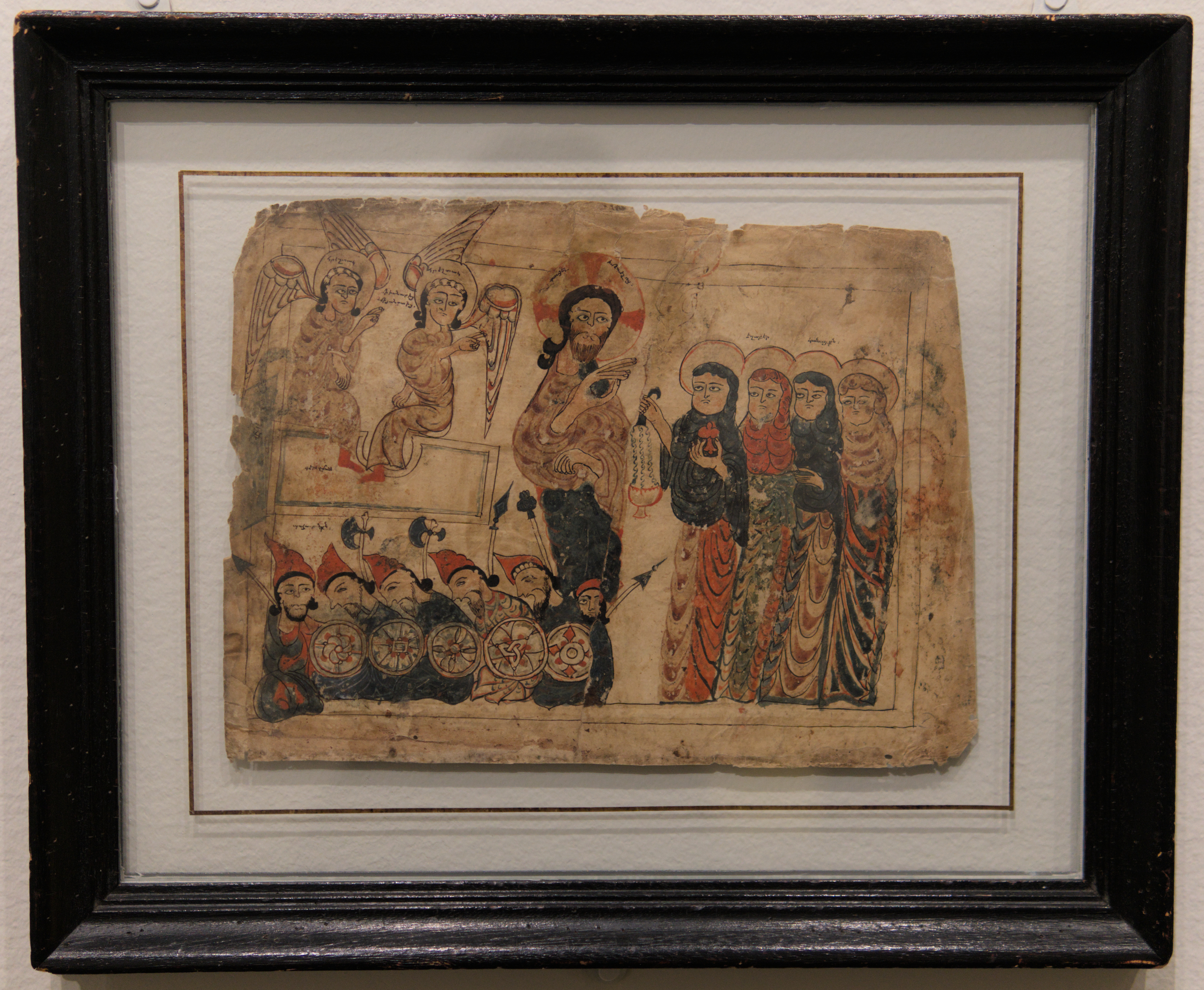
The left wing shows the Entombment of Christ, with two guards, wearing pointed turbans, sleeping at their post. The right wing shows a scene that the label identifies as “Temptation in the Wilderness” (presumably a translation of the inscription on the tree) but that looks to me more like an Agony in the Garden. Below that is the Resurrection, with Christ holding a victory banner, standing atop Hades. An angel blows a shofar and the dead rise up out of their graves, following Christ, the firstfruits of the resurrection (1 Cor. 15:20–22). Christ wears a short-sleeved, knee-length jacket with frog closures, and bunched sleeves and trousers, both of which reflect clothing from regions east of Africa.
The wall text notes the fine, wavy lines used to render the figures’ draperies, perhaps influenced by Armenian artists from the Lake Van region.
Yovsian of Vaspurakan (Armenian), Leaf from a Gospel book with the Resurrection of Christ and Visit of the Women to the Tomb of Christ, ca. 1350. Tempera on cotton paper. Private collection.
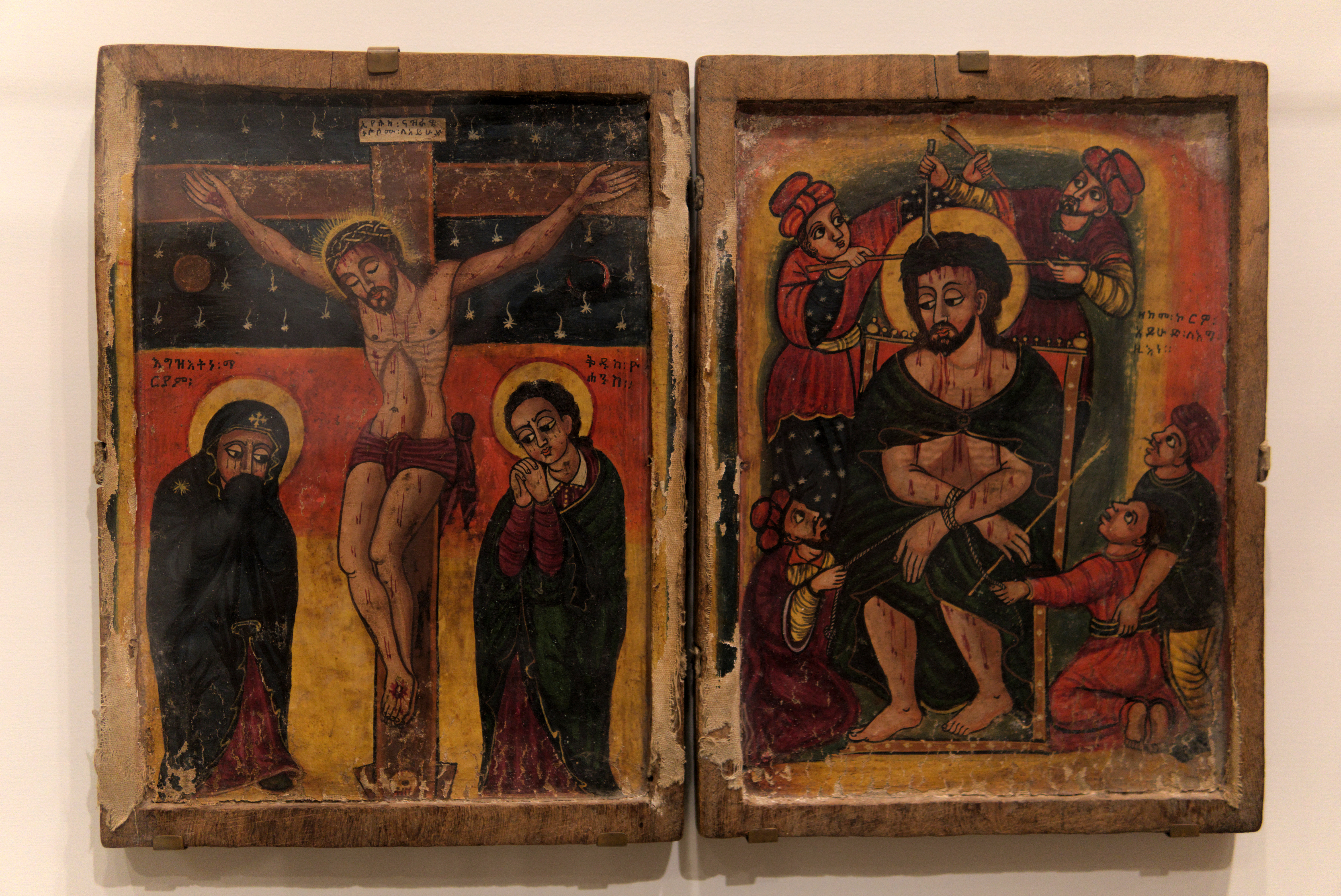
Here’s another Crucifixion, this one painted in what’s called the Second Gondarine style, characterized by smoothly modeled figures, often with darker skin tones, and wide horizontal bands of red, yellow, and green filling the background:
Diptych Icon with the Crucifixion (left) and the Mocking of Christ (right), Ethiopia, late 17th–early 18th century. Wood, polychrome, 13 1/2 × 9 7/8 in. (34.3 × 25.1 cm). Virginia Museum of Fine Arts, Richmond. [object record]
The squiggles behind Christ at the top left may simply be a decorative motif, but to me they look like falling stars, an apocalyptic sign, and as if the sky is weeping.
The right panel of the diptych shows Christ being cruelly fitted with a crown of thorns.
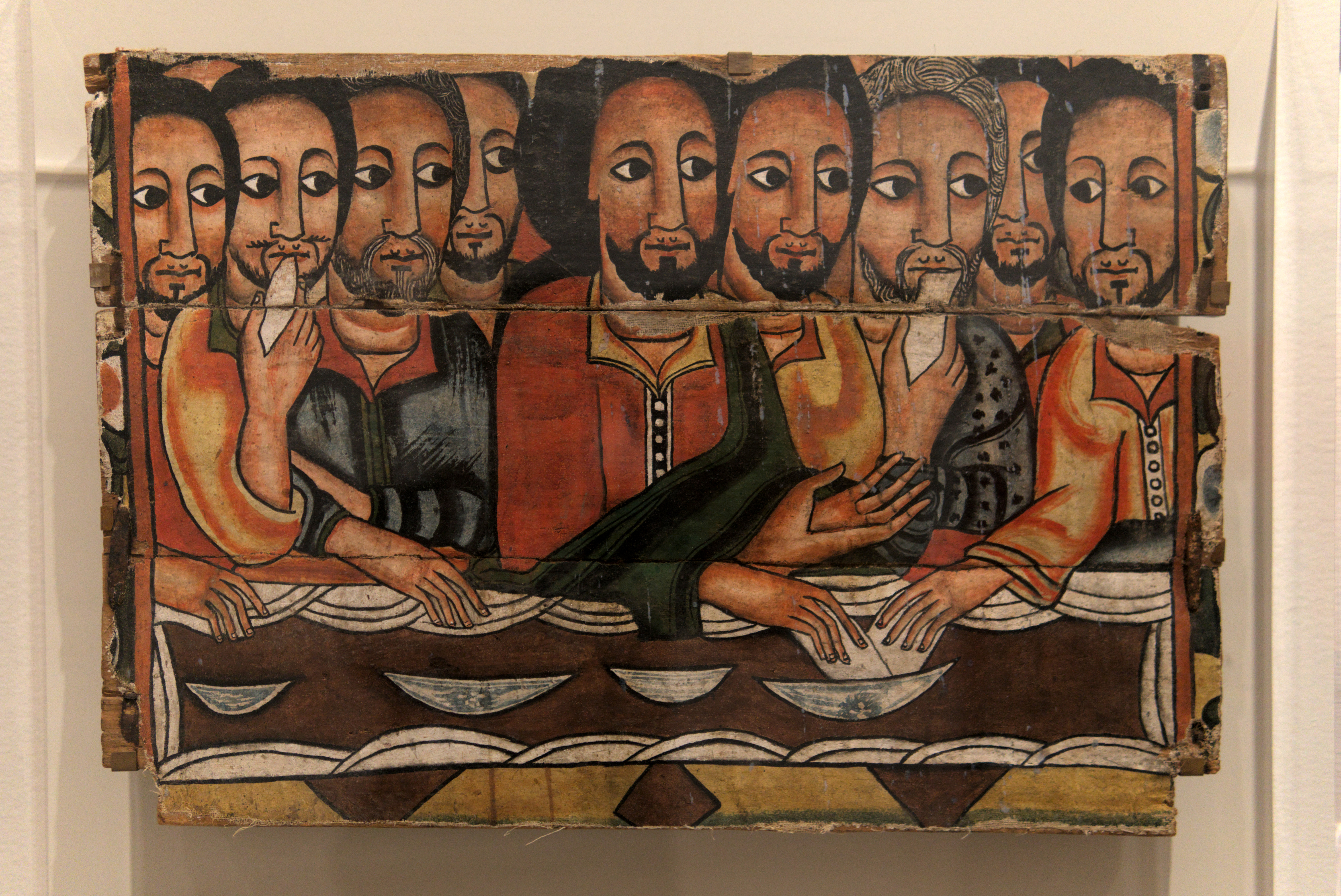
Two other passion images I want to share are a Last Supper wall painting and an Entombment from a disbound album.
Last Supper, Ethiopia, 18th century. Tempera on linen, mounted on panel, 16 3/4 × 24 in. (42.6 × 61 cm). Virginia Museum of Fine Arts, Richmond. [object record]Album Leaf with the Entombment of Christ, Ethiopia (Sawa?), late 17th century. Pigments on vellum. Minneapolis Institute of Art, 2009.39.3y. [object record]
In the Last Supper, Jesus and Judas both dip their bread (injera!) into the same bowl and exchange a knowing glance.
In the Entombment, Jesus, wrapped in white linen, is lowered into the ground, mourned by several of his women followers. The portrayal of his mother Mary’s weeping, her hands covering her eyes and her face stained with tears, is particularly poignant. This leaf is from a set of forty-four, now matted separately but originally arranged in series and likely painted on several long sheets of parchment that were sewn together and folded accordion-style to form a sensul.
One of the most extraordinary objects on display is a rare folding processional icon that adopts the form of a fan, from the late fifteenth century:
Folding Processional Icon in the Shape of a Fan, Ethiopia, late 15th century (Stephanite). Ink and paint on parchment, thread, extended: 24 1/4 × 154 1/8 × 4 3/4 in. (61.6 × 391.4 × 12 cm). Walters Art Museum, Baltimore. Photo courtesy of the museum. [object record]
Thirty-eight identically sized figures span the surface of this elongated parchment: the early Christian martyrs Julitta (Juliet) and Cyricus, St. George, St. John the Baptist, the archangel Michael, the Virgin Mary, the archangel Raphael, St. Paul, the Ethiopian artist-priest Afnin, and unidentified Old Testament patriarchs and prophets. There would have been a wooden handle attached to either end that, when pulled together, created a double handle for a giant wheel to be displayed during liturgical processions and church services (see here). As the museum website notes, “The Virgin Mary, whose hands are raised in a gesture of prayer, is then at the top of the wheel. By depicting Mary in the company of saints and angels, the icon powerfully evokes the celestial community of the church.”
This is just a sampling of all the wonderful art objects that are a part of the Ethiopia at the Crossroadsexhibition. I’ll share more photos on Instagram (@art_and_theology) in the coming weeks.
I strongly encourage you to go see this! I think it would be enjoyable for children as well, especially Christian children, who will be able to identify many of the painted stories. For Christians, it’s an opportunity to connect with our artistic heritage and with African church history. If you can’t catch the exhibition at the Walters in Baltimore before it closes March 3, it will be traveling to the Peabody Essex Museum in Salem, Massachusetts (April 13–July 7, 2024), and the Toledo Museum of Art in Ohio (August 17–November 10, 2024).
The Easter season is a time of hope. There still is fear, there still is a painful awareness of sinfulness, but there also is light breaking through. Something new is happening, something that goes beyond the changing moods of our life. We can be joyful or sad, optimistic or pessimistic, tranquil or angry, but the solid stream of God’s presence moves deeper than the small waves of our minds and hearts. Easter brings the awareness that God is present even when his presence is not directly noticed. Easter brings the good news that, although things seem to get worse in the world, the Evil One has already been overcome. Easter allows us to affirm that although God seems very distant and although we remain preoccupied with many little things, our Lord walks with us on the road and keeps explaining the Scriptures to us. Thus there are many rays of hope casting their light on our way through life.
—Henri Nouwen, A Cry for Mercy: Prayers from the Genesee (1981) [HT]
+++
TRAVELING EXHIBITION: Arte de Lágrimas: Refugee Artwork Project: Started in August 2014 by the Rev. Dr. Gregory Cuéllar and Nohemi Cuéllar, Arte de Lágrimas (Art of Tears) is a traveling art exhibit and archive that aims to create greater public awareness of the lived migratory journeys of asylum-seeking children and youth from Central America. The Cuéllars and other volunteers have visited respite centers in Texas border towns like McAllen, Brownsville, and Eagle Pass, distributing art supplies to migrant children who are waiting for buses to take them to their longer-term destination. They want to give these children the option to express themselves or process their journeys through an artistic outlet. Some of the children have chosen to donate their artworks to the volunteers, and it is these that constitute the Arte de Lágrimas collection, which is currently on display at Fuller Theological Seminary in Pasadena, California.
This Thursday, April 27, Fuller is holding a gallery reception at Travis Auditorium (180 N. Oakland Ave., Pasadena) from 6 to 9 p.m., which will include a presentation by Gregory Cuéllar as well as a panel discussion; RSVP here. Cuéllar, who teaches Old Testament at Austin Presbyterian Theological Seminary, is the author of Resacralizing the Other at the US-Mexico Border: A Borderland Hermeneutic (Routledge, 2020) and Voices of Marginality: Exile and Return in Second Isaiah 40–55 and the Mexican Immigrant Experience (Peter Lang, 2008).
If you can’t make it to the exhibition at Fuller, you can at least tour the Virtual Showroom that the Cuéllars developed, which hangs the images in a digital space that gives users the impression of being in a physical gallery.
+++
ARTICLE: “‘He Is Not Here’: A Choral Easter Season” by Mark Meynell: This Rabbit Room blog post is part of 5&1, a weekly series from 2021 in which British chaplain Mark Meynell shares five short pieces of classical music and one long piece, drawing attention to some of their musical elements. For Easter he selected a setting of Psalm 118:24 by Renaissance composer William Byrd; “O dulce lignum” (O Sweet Wood) from Ēriks Ešenvalds’s Passion and Resurrection (below); “Christus Vincit” by Sir James MacMillan; an anthem for Ascension Day by Gerald Finzi; an Easter hymn from an Italian opera by Pietro Mascagni (also below); and the fifth movement of Mahler’s famous Resurrection Symphony. I appreciate that he provides lyrics and translations!
+++
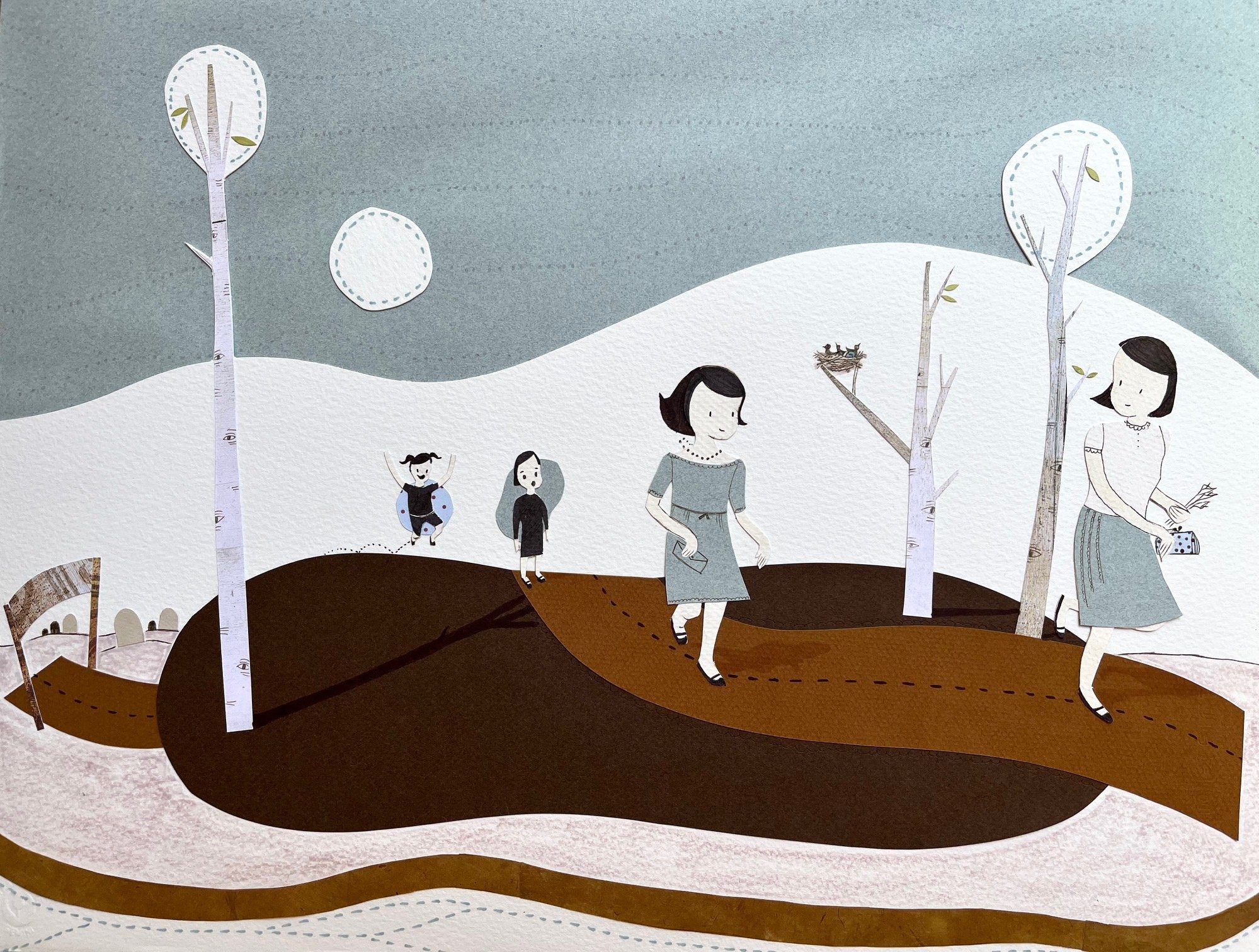
BLOG POST: “The Good Fridays of Our Eastertide Lives” by W. David O. Taylor, feat. Sam Wedelich: W. David O. Taylor, a theology professor at Fuller Theological Seminary, shares a visual interpretation of Matthew 28:8 by Sam Wedelich, at the time a member of Hope Chapel in Austin, where Taylor served as arts pastor. Wedelich’s collage shows how both fear and joy gripped the hearts of the two Marys on Easter morning, reflecting the complexities of our own often muddled-up feelings. Whether we’re skipping to the tune of “Hallelujah” this Easter or standing still, immobilized—or experiencing, like the Marys, some strange mixture of stances—the Risen Lord meets us, Taylor writes.
Sam Wedelich, With Fear and Great Joy, 2005. Collage.
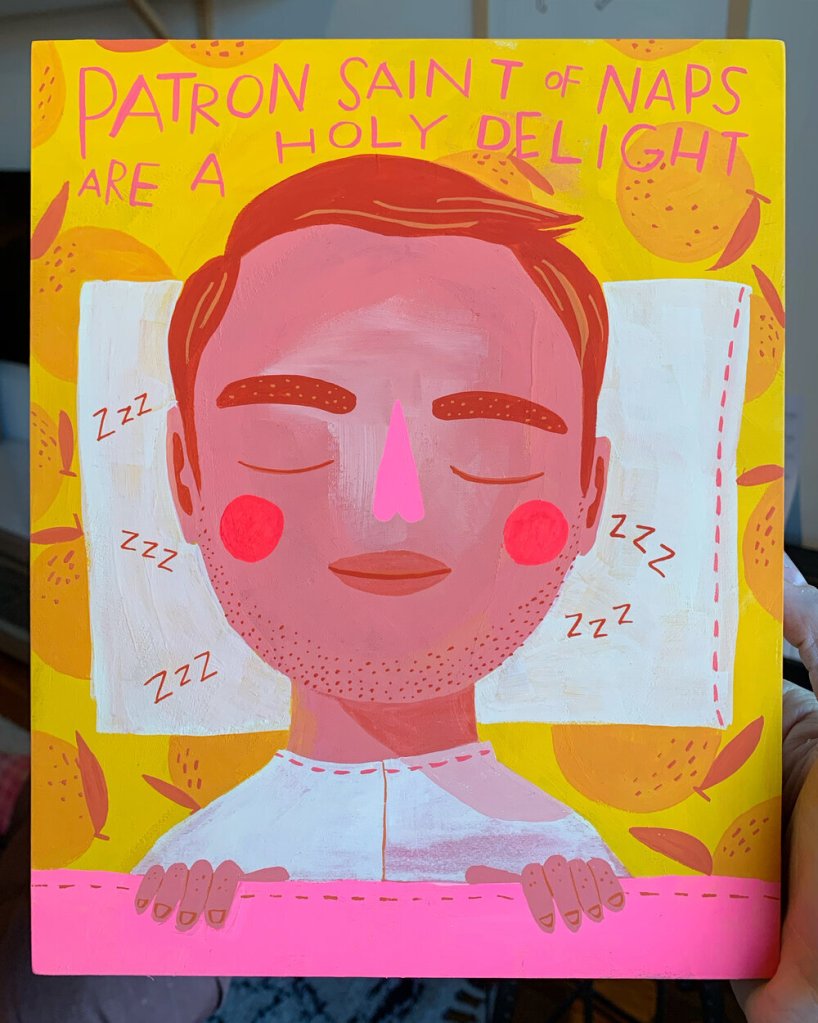
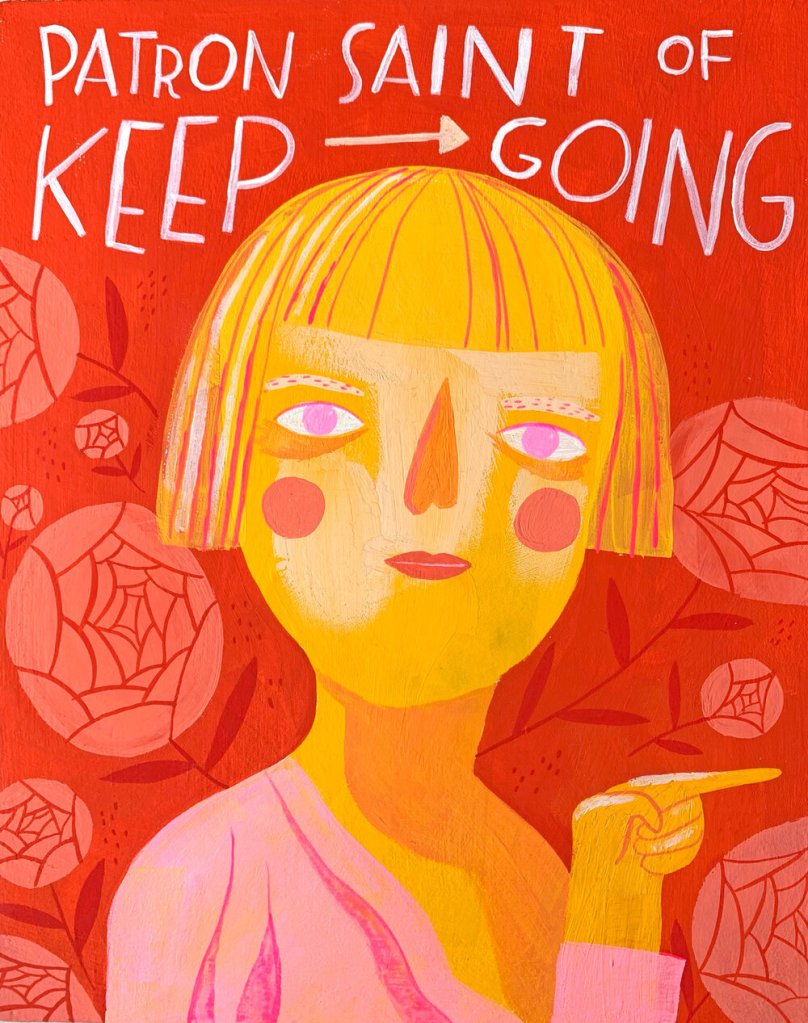
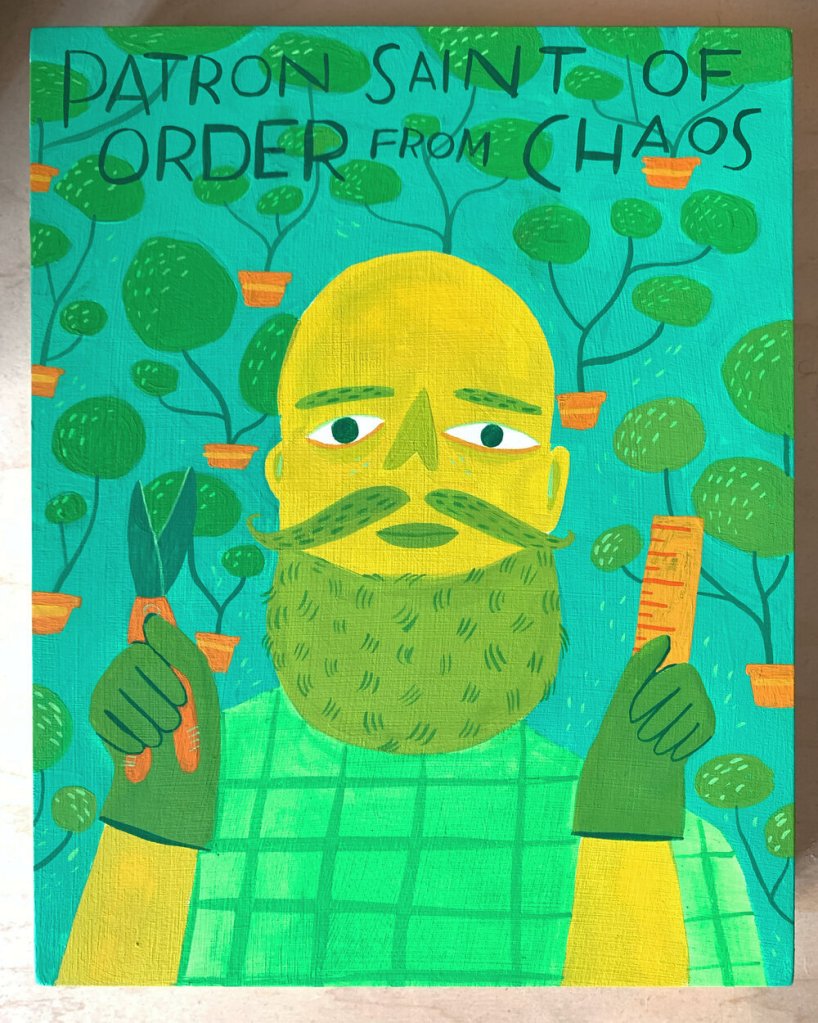
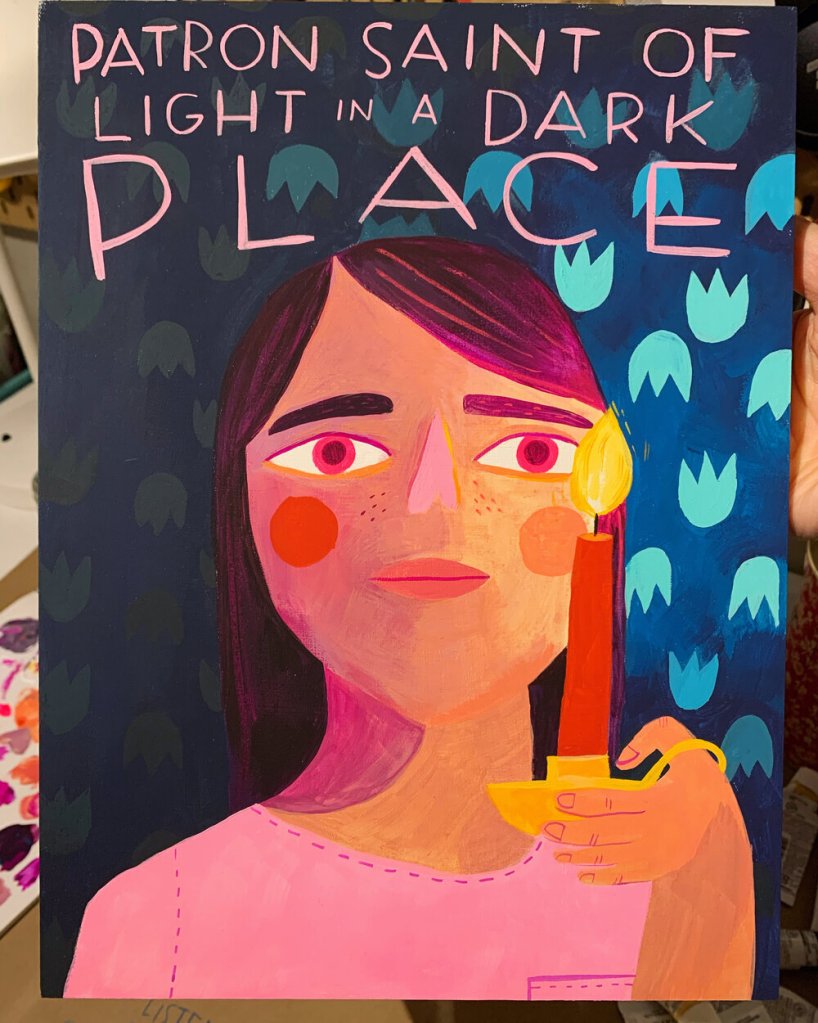
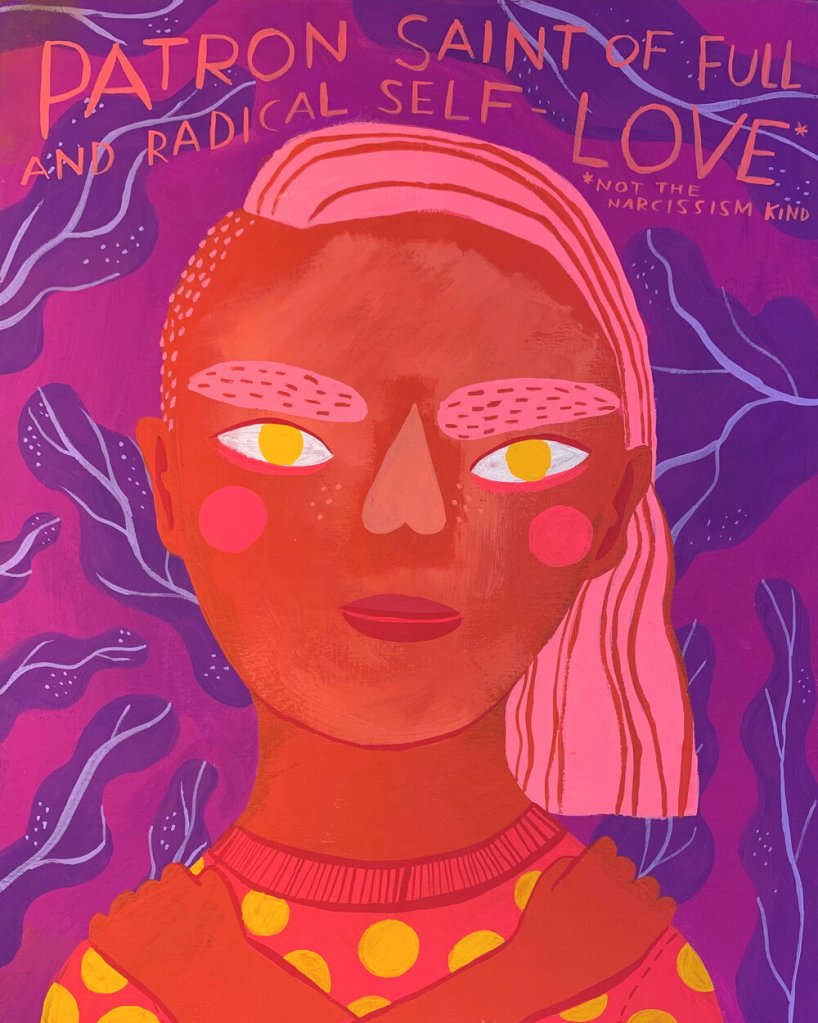
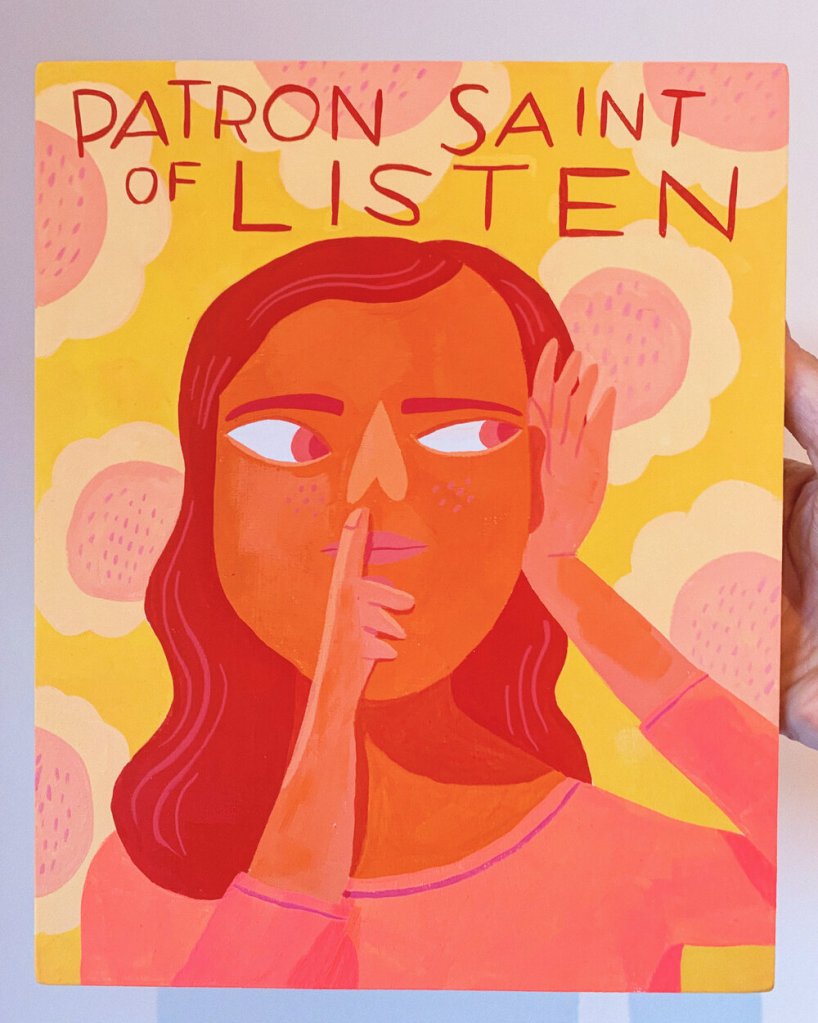
This is an early piece by Wedelich, which she made when she was a college student. She has since become well established as an illustrator. Follow her on Instagram @samwedelich. I especially like the series of “patron saint” paintings she did in 2020. Two of them are available for sale as prints from her online shop: Patron Saint of Keep Going and Patron Saint of Listen.
SONG: “To Thessalonica” by John Davis: Dedicated to his father, who passed away last month, Nashville-based rock singer-songwriter John Davis’s new album, My Hope Is Found in a God Who Can Raise Up the Dead, includes an original musical adaptation of 1 Thessalonians 4:14–18: “This we declare to you by word from the Lord: We who are alive, who are left until the coming of the Lord, will not precede those who sleep in death. The Lord will descend with a cry of command; the voice of an archangel too. And with the sound of the trumpet of God, the dead in Christ will rise up first. The dead in Christ will rise up first. I know, I know, I know we’re gonna meet in the air. Yeah! The shout of command and the voice of the angel, the trumpet of God will declare. Yeah! I believe, I believe in, I believe, I believe in . . . My hope is found in a God who can raise up the dead, yeah! . . . My hope is found in a God who has raised up the dead. . . .” [HT: Crowdfunding Christian Music]
Jyoti Sahi (Indian, 1944–), Triptych of Salvation, 2021. Acrylic, oil, and ocher on canvas, 24 × 48 in. All photos courtesy of the artist.
Death trampled our Lord underfoot, but he in his turn treated death as a highroad for his own feet. He submitted to it, enduring it willingly, because by this means he would be able to destroy death in spite of itself. Death had its own way when our Lord went out from Jerusalem carrying his cross, but when by a loud cry from that cross he summoned the dead from the underworld, death was powerless to prevent it.
Death slew him by means of the body which he had assumed, but that same body proved to be the weapon with which he conquered death. In slaying our Lord, death itself was slain. It was able to kill natural human life, but was itself killed by the life that is above the nature of mortals.
Death could not devour our Lord unless he possessed a body, neither could hell swallow him up unless he bore our flesh; and so he came in search of a chariot in which to ride to the underworld. This chariot was the body which he received from the Virgin; in it he invaded death’s fortress, broke open its strong room, and scattered all its treasure.
At length he came upon Eve, the mother of all the living. She was that vineyard whose enclosure her own hands had enabled death to violate, so that she could taste its fruit; thus the mother of all the living became the source of death for every living creature. But in her stead Mary grew up, a new vine in place of the old. Christ, the new life, dwelt within her. When death, with its customary impudence, came foraging for her mortal fruit, it encountered its own destruction in the hidden life that fruit contained. All unsuspecting, it swallowed him up, and in doing so released life itself and set free a multitude.
He who was also the carpenter’s glorious son set up his cross above death’s all-consuming jaws, and led the human race into the dwelling place of life. Since a tree had brought about the downfall of humankind, it was upon a tree that humankind crossed over to the realm of life. Bitter was the branch that had once been grafted upon that ancient tree, but sweet the young shoot that has now been grafted in, the shoot in which we are meant to recognize the Lord whom no creature can resist.
We give glory to you, Lord, who raised up your cross to span the jaws of death like a bridge by which souls might pass from the region of the dead to the land of the living. . . .
We give glory to you who put on the body of a single mortal and made it the source of life for every other mortal.
You are incontestably alive! Your murderers sowed your living body in the earth as farmers sow grain, but it sprang up and yielded an abundant harvest of people raised from the dead.
Come then, my brothers and sisters, let us offer our Lord the great and all-embracing sacrifice of our love, pouring out our treasury of hymns and prayers before him who offered his cross in sacrifice to God for the enrichment of all.
—Ephrem the Syrian, sections 3–4 and 9 of the Eastertide sermon “On Our Lord,” trans. the International Commission on English in the Liturgy in TheLiturgy of the Hours, vol. 2 (New York: Catholic Book Publishing Co., 1976), 735–36
Ephrem the Syrian (ca. 306–373) was a prominent Christian theologian, hymnist, and teacher who is venerated as a saint and a doctor of the church. Born in Nisibis (in modern-day Turkey), he served as a deacon and later lived in Edessa, a center of Greek and Syriac theological and philosophical thought in Upper Mesopotamia. He spoke and wrote in Syriac, a dialect of Aramaic, and is the most significant of all the Syriac Christian fathers.
The three-paneled painting at the top of this post is by my friend Jyoti Sahi, one of the most theologically exploratory artists working today. I saw this triptych at an earlier stage of development when I visited his home in Silvepura Village, India, in 2019 and am so pleased by how it turned out. “It represents Christ ascending the cross (left), harrowing the underworld as the drummer (center), and rising like the sprout from the seed that is Mary, from whose womb he sprang forth (right),” Jyoti told me.
The central panel is based on iconography of the Anastasis, in which Jesus descends into Hades following his crucifixion to liberate those who have died. In such icons, Adam and Eve, who represent all of humanity, are “drawn up from the earth,” as Jyoti puts it. Jyoti portrays this rescue as a dance, with Jesus beating out the rhythms of redemption, as well as a time of planting and harvest (he wields a plow and a scythe). Jesus’s death tilled the soil, making conditions right for the dead to be raised to new life.
Jyoti has long been interested in the symbolism of the ladder and the seed, and both symbols are employed here. The ladder is an instrument of both descent and ascent, and the seed, as Christ himself taught, must “die”—be buried in the ground—before it yields life. In the right panel of the Triptych of Salvation, Jesus, having gone down into the earth, bursts forth from his casing, emerging as the tree of life, whose roots are watered by the river of life, which flows across all three panels. This tree is the cross transformed.
His arms raised again as they were on the cross but no longer pinned down, Jesus leads the dance of resurrection, and Adam and Eve and the others who have been delivered join in. They are the fruitful crop of Christ the Gardener.













 Art & Theology