Christ is risen! He is risen indeed! Happy Easter, friends.
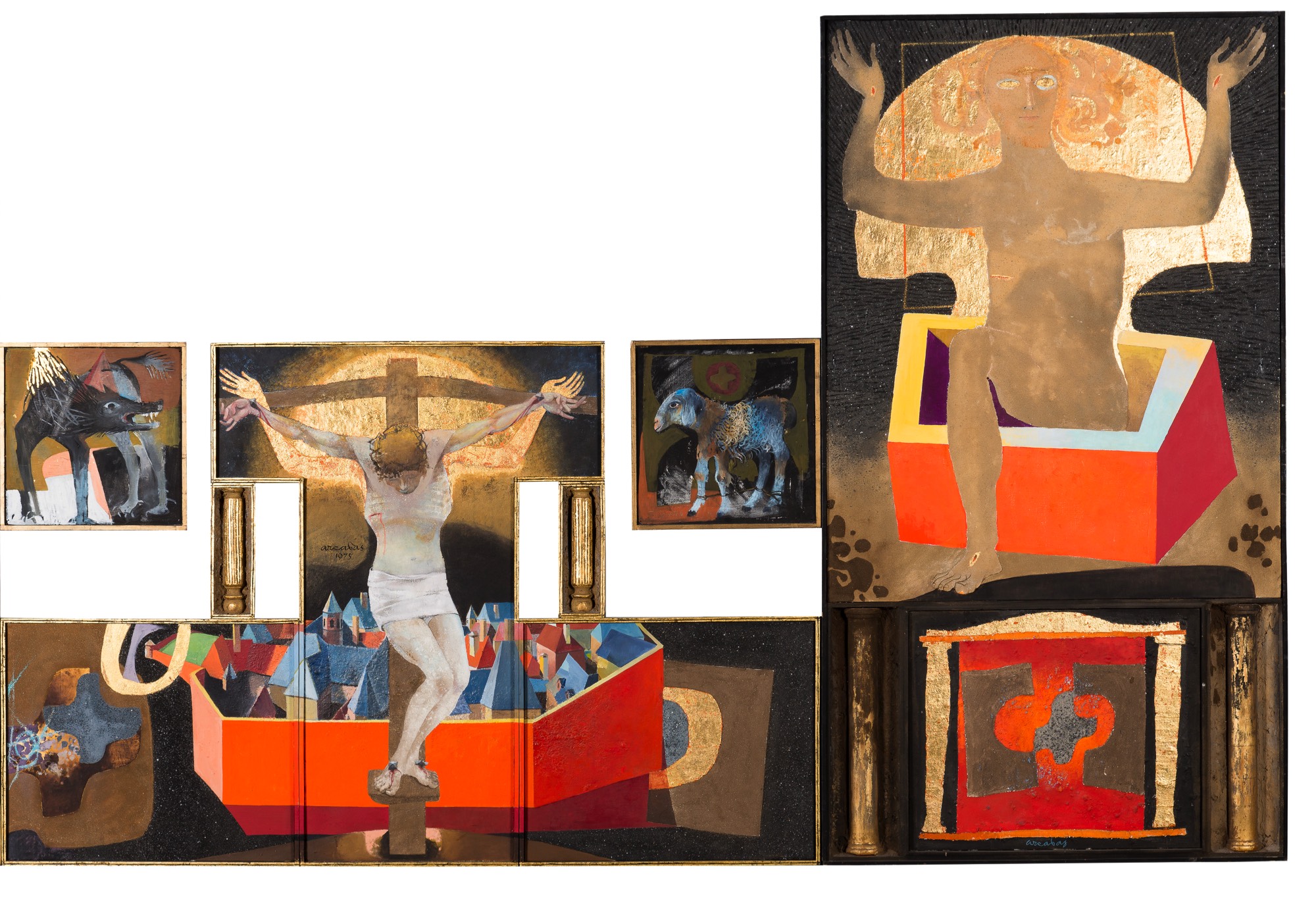
LOOK: Crucifixion sur la ville and Résurrection by Arcabas
Arcabas (French, 1926–2018), Crucifixion sur la ville (Crucifixion over the City) and Résurrection, from the Petite suite en noir et or (Little Suite in Black and Gold), 1975. Oil on canvas.
There is very little written in English about the sacred French artist Jean-Marie Pirot (1926–2018), known as Arcabas [previously]—which is a shame, because his work is fantastic. I’d love to see it in person someday. Much of it is concentrated at L’église de Saint-Hugues-de-Chartreuse, near where he lived from 1950 until his death. One published source of information about the artist is Dr. David Lyle Jeffrey’s wonderful book In the Beauty of Holiness: Art and the Bible in Western Culture (Eerdmans, 2017); he devotes the book’s final section, pages 349–63, to Arcabas, reproducing in full color seven of his paintings and translating material from French interviews. Jeffrey cites Kirsten Appleyard’s honors thesis at Baylor University from 2009, which he supervised, as the most complete study of the artist’s work available in English, which I believe is still the case.
Unfortunately, the website arcabas.com, from which I gathered photos of many of Arcabas’s works some ten years ago, is now defunct. That’s where today’s featured image was sourced from. The panels are from a larger polyptych, which you can view in this photo of its temporary exhibition at L’église Saint Ignace in Paris. I’m not sure where it resides now.
The left panels portray Jesus being crucified outside the city walls. But the cityscape is not of first-century Jerusalem; it’s a modern French village. As have many artists before him, Arcabas collapses the distance between Jesus’s life and times and his own by transposing Jesus’s death to a familiar setting.
On the right is a lamb whose legs are bound in preparation for sacrifice—an emblem of Christ, who was led “like a lamb . . . to the slaughter” (Isa. 53:7). Opposite the lamb is a snarling wolf, a reference to Psalm 22:16–18:
For dogs are all around me; a company of evildoers encircles me; they bound my hands and feet. I can count all my bones. They stare and gloat over me; they divide my clothes among themselves, and for my clothing they cast lots.
The Crucified One bows his head. His hands, nailed by the wrists to the cross, are contorted in pain. His ribcage protrudes from his emaciated torso. But as he gives up the spirit, it spills out, a silhouette of his form, in gold, dissolving into a sun/halo behind his head. His golden arms are strong, vigorous, alluding to the Resurrection and capturing something of the paradox of the cross, a site of both shame and glory.
In the right panel, which is on a larger scale than the others, granting it preeminence, Christ emerges victorious from a multicolored sarcophagus. He rises bodily, but his form is transfigured, shiny, especially his eyes. Stepping out of the box that cannot contain him, he lifts his hands to reveal the wounds of crucifixion, signs of our redemption. The lustrous swirls about his head could be his wild, windswept hair, or else some kind of electric or mystic force.
This is one of several Resurrection images Arcabas painted during his lifetime. Another one, you can hear the artist discuss (in French) in the following 2005 interview, cued up at 20:26:
This whole KTO TV segment, nearly an hour long, is worth watching if you’re a French speaker! I am not, but a generous follower of my blog, knowing my enthusiasm for Arcabas, translated significant portions of it for me into English.
Since Arcabas’s death, a new online hub has sprung up to showcase his work: https://arcabas.net/. While it doesn’t host as many image files as its .com predecessor, this archive provides helpful location and copyright information, and I believe it’s in a state of expansion.
LISTEN: “The Resurrection” by Richard Smallwood (based on Rachmaninoff’s “Vocalise”), 1982
And he died For our sin and our shame Jesus died For our sins He hung high On a hill called Calvary To save a wretch undone Like you and me
I can’t forget how he died for me He suffered so much on Calvary I can’t forget how they pierced his side And he bowed his head and died
But he rose Conquered death, hell, and grave And he rose With all power Jesus rose Now he lives forevermore Through Christ we now are saved eternally
Richard Smallwood (1948–2025) was a legendary gospel composer, pianist, and singer, known for blending classical music with traditional gospel. For “The Resurrection,” which debuted on the album The Richard Smallwood Singers (1982), he adopted the main theme of Rachmaninoff’s wordless song “Vocalise” as the basis. Meditating on Christ’s crucifixion and then resurrection, Smallwood’s song evolves in tone from elegiac to triumphant.
This is the first post in a daily series for the first eight days of Easter, each one of which will pair a visual artwork with a piece of music to encourage celebration of the risen Christ.
Other than the second one, captioned with a copyright notice, all photos in this article are my own.
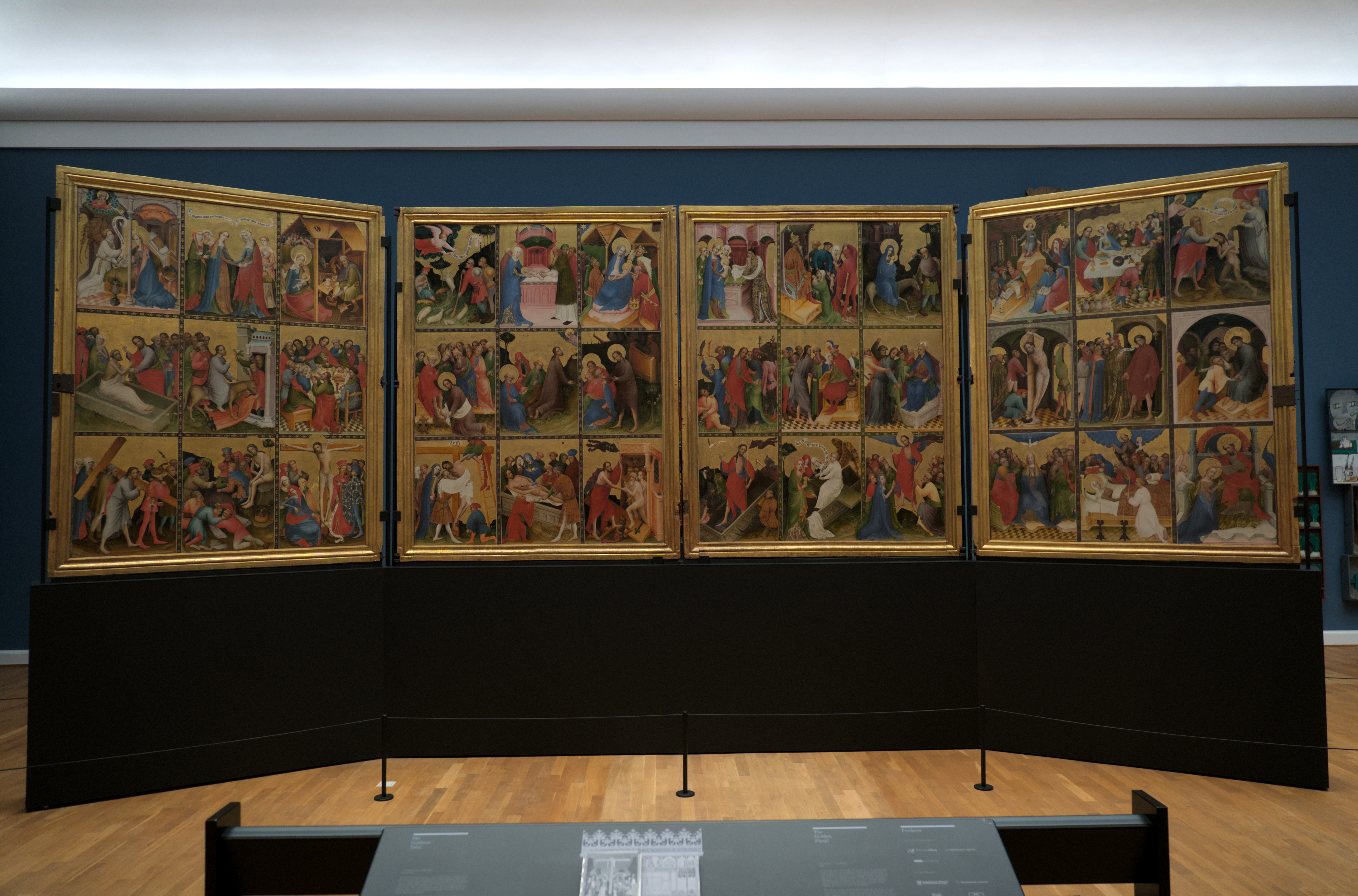
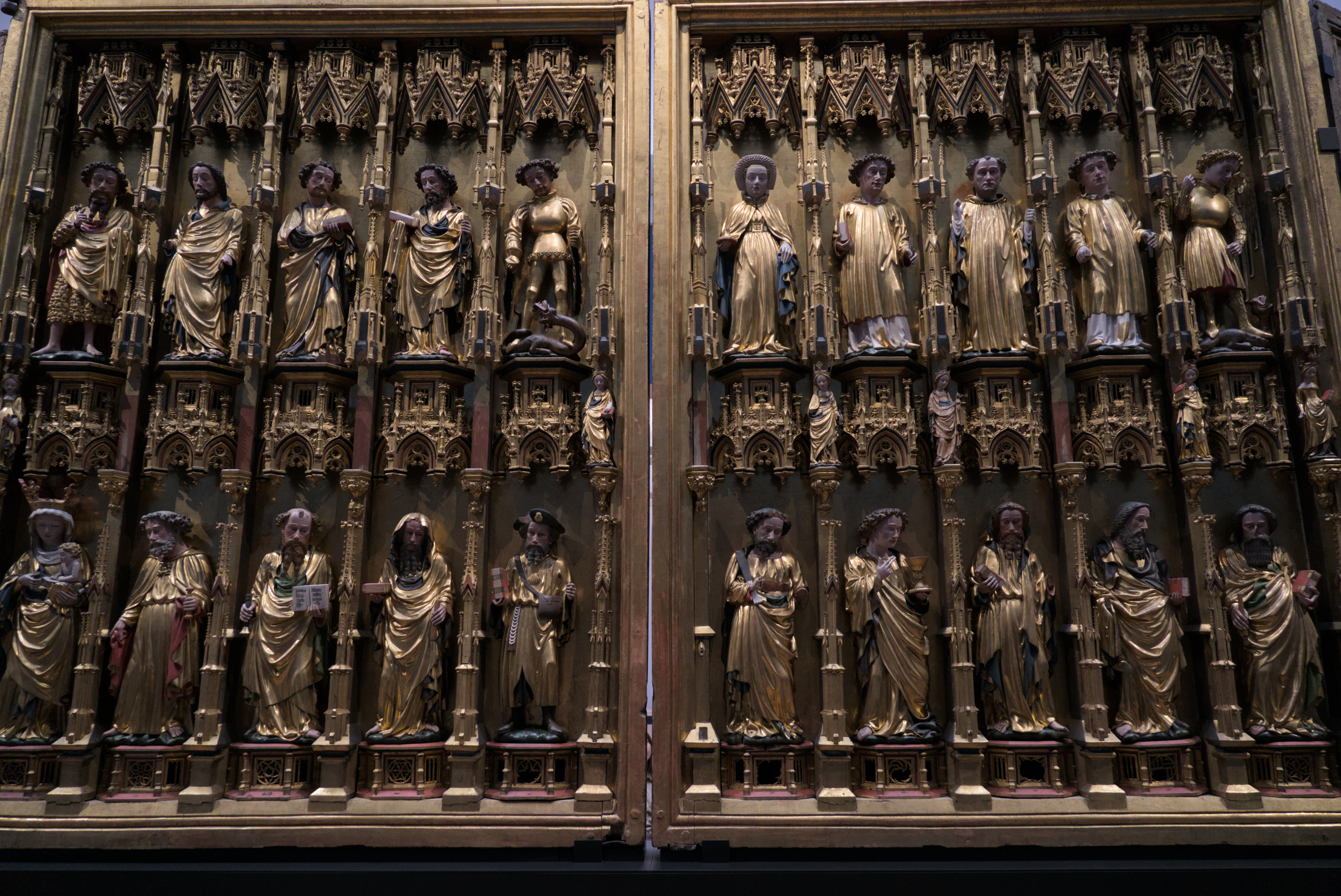
When visiting the Landesmuseum (State Museum) in Hanover, Germany, last fall, I was struck by a monumental medieval altarpiece depicting thirty-six scenes from the life of Christ. Scholars refer to it as the Goldene Tafel (Golden Panel) after the now-lost large gold repoussé plaque, originally designed (most likely) as an antependium in the twelfth century, that was once at the center of its inner display, depicting Christ seated in a mandorla flanked by the twelve apostles.
The “Goldene Tafel” (Golden Panel), made for the church of St. Michael’s monastery in Lüneburg, Germany, ca. 1420–30. Tempera and gold leaf on oak, each panel 231 × 184 cm (overall 231 × 736 cm). Landesmuseum Hannover, Germany, WM XXIII, 27. Photo: Victoria Emily Jones.
One of the most important northern German works in the International Gothic style, the altarpiece was created in the 1420s for the high altar of the newly built Benedictine monastery of St. Michael in Lüneburg. It was the work of carpenters, sculptors, and two painters, one from the circle of the Westphalian artist Conrad von Soest, and the other probably based in Cologne or even Lüneburg.
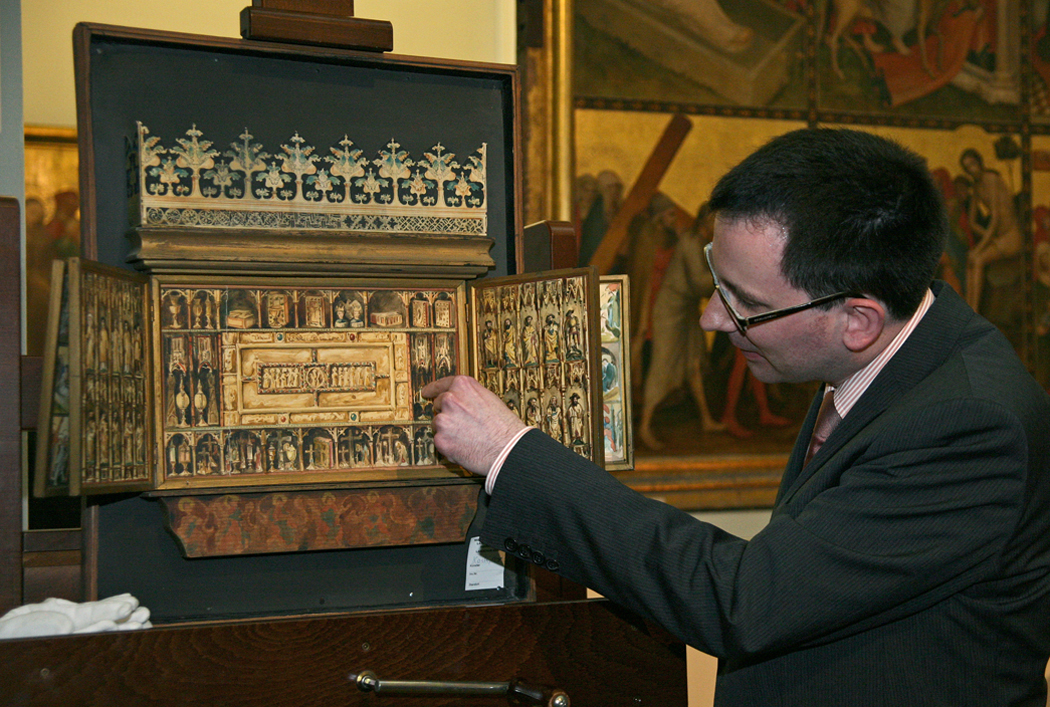
The Golden Panel altarpiece, in its original design, had two pairs of hinged wings that could be opened or closed over a fixed central shrine, offering three possible configurations. The shrine, irrecoverably robbed in 1644 and 1698, housed the monastery’s treasury, especially its reliquaries, displayed in a cabinet of twenty-two richly decorated rectangular compartments surrounding the eponymous, aforementioned “golden panel.” This main body of the altarpiece (called the corpus) was dismantled in 1792–94 and its remaining objects melted or sold. The predella (base) has also been lost.
However, the wings, replete with panel paintings and figural sculptures, have survived to the present day and, having been restored in 2016–19, are proudly displayed at the Landesmuseum Hannover for visitors to enjoy. When you enter the gallery, you are greeted with the full cycle of thirty-six painted scenes (nine per panel) from the life of Christ, read from left to right in long rows. Then you can walk behind to see the panels’ other sides, which would not have been simultaneously on view to the monks of St. Michael’s with the altarpiece’s original construction.
The scale model in the following photograph gives you a good sense of the three distinct viewing states that were originally possible.
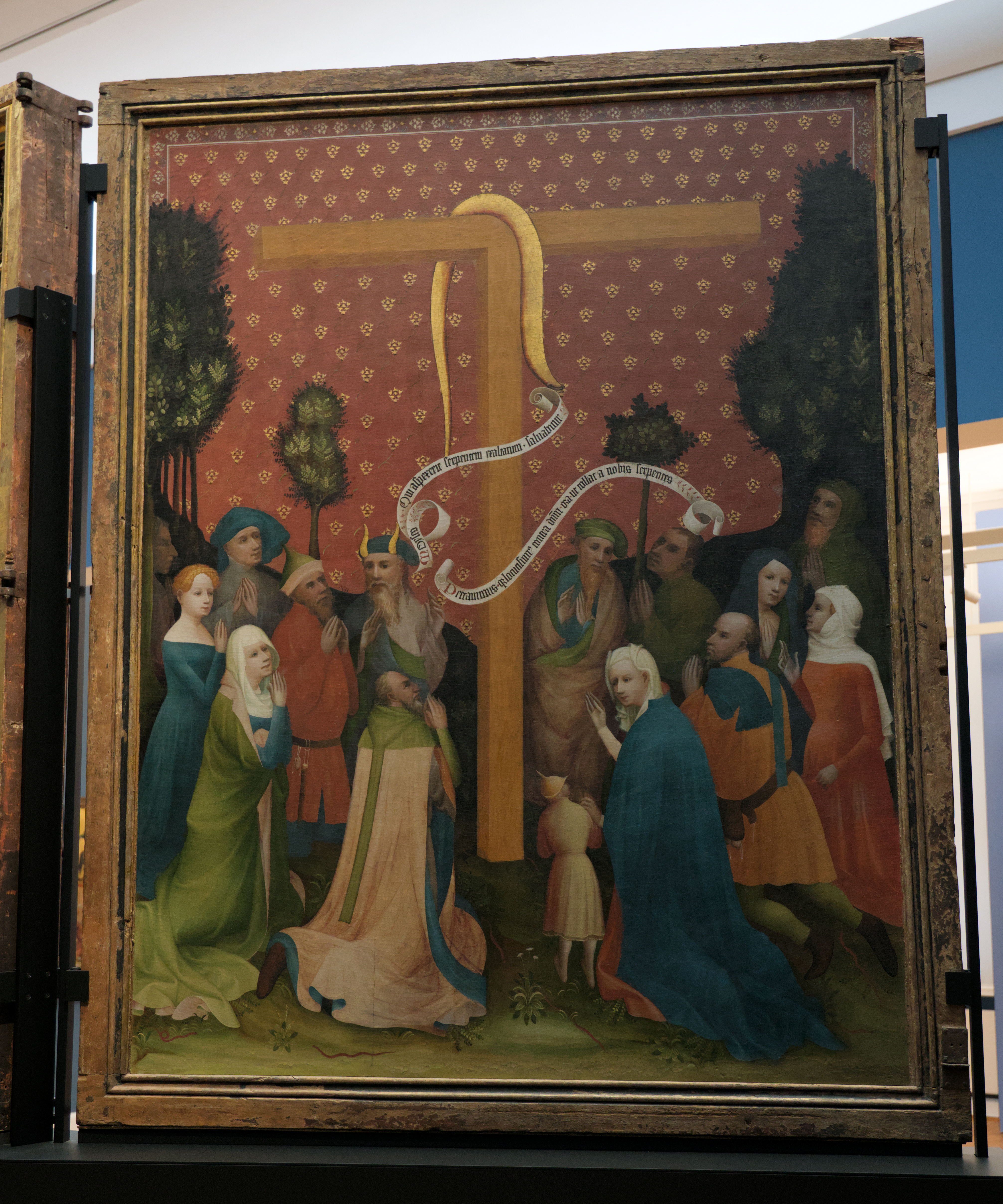
View 1, the closed view, juxtaposes a scriptural type and antitype: the brazen serpent in the wilderness, raised on a pole for the life of the people, and the crucifixion of Christ.
Numbers 21:4–9 tells of how, wandering the desert after God delivered them from slavery in Egypt, the Israelites complained about how life was better before. As punishment for their ingratitude, God sent poisonous serpents into their camp, and fatalities ensued. The people realized their sin and repented, asking Moses to intercede with God for relief. God told Moses to craft a bronze serpent and lift it high on a pole, and to instruct the people that if they are bitten, to look on the sculpture and they will be spared.
In John 3:14–15, Jesus interpreted this story as foreshadowing his being raised on a cross to bring healing: “And just as Moses lifted up the serpent in the wilderness,” he told Nicodemus, “so must the Son of Man be lifted up, that whoever believes in him may have eternal life.”
The anonymous artist shows the gleaming snake on a tau cross that mirrors the one Jesus hangs on in the opposite panel. The lower banderole reads, from the Vulgate, “Peccavimus quia locuti sumus contra Dominum et te ora ut tollat a nobis serpentes” (We have sinned, because we have spoken against the Lord and thee: pray that he may take away these serpents). I can’t make out the text on the upper banderole, other than aspexerit, “shall look,” but presumably it communicates God’s antidote to the snake bites.
And when Moses came down from Mount Sinai, he held the two tables of the testimony, and he knew not that his face was horned from the conversation of the Lord. And Aaron and the children of Israel seeing the face of Moses horned, were afraid to come near. (Douay–Rheims)
Almost all English translations say instead that Moses’s face “shone” or “became radiant,” interpreting qaran as horned with rays of light. This artist splits the difference and shows, growing out from under Moses’s hat, two bony protrusions that are luminous!
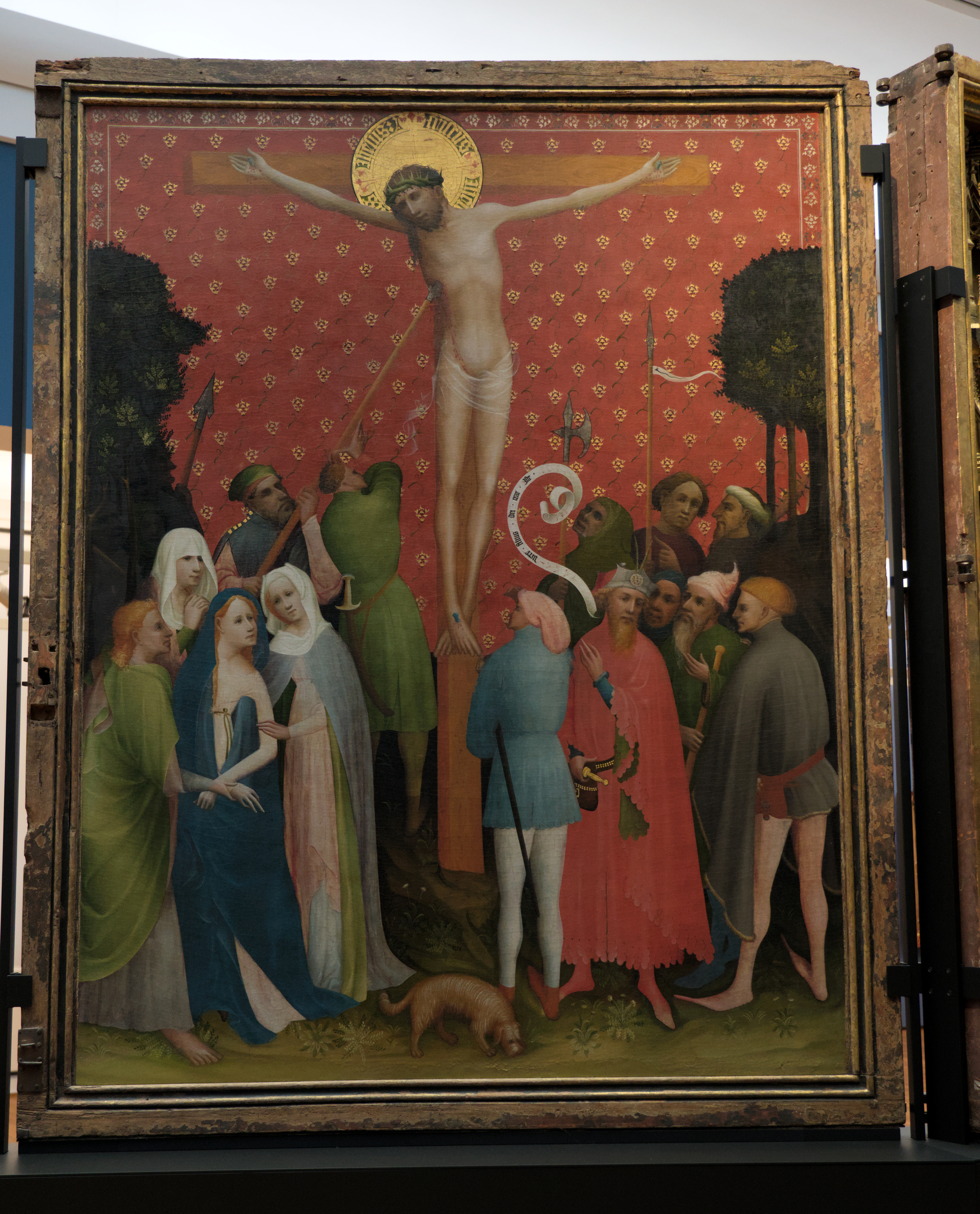
The Crucifixion scene shows a Roman spearman piercing Jesus’s side to confirm his death, while Jesus’s mother, two other Marys, and the apostle John mourn under his right hand. A centurion in the crowd exclaims, “Vere Filius Dei erat iste” (Truly this man was the Son of God).
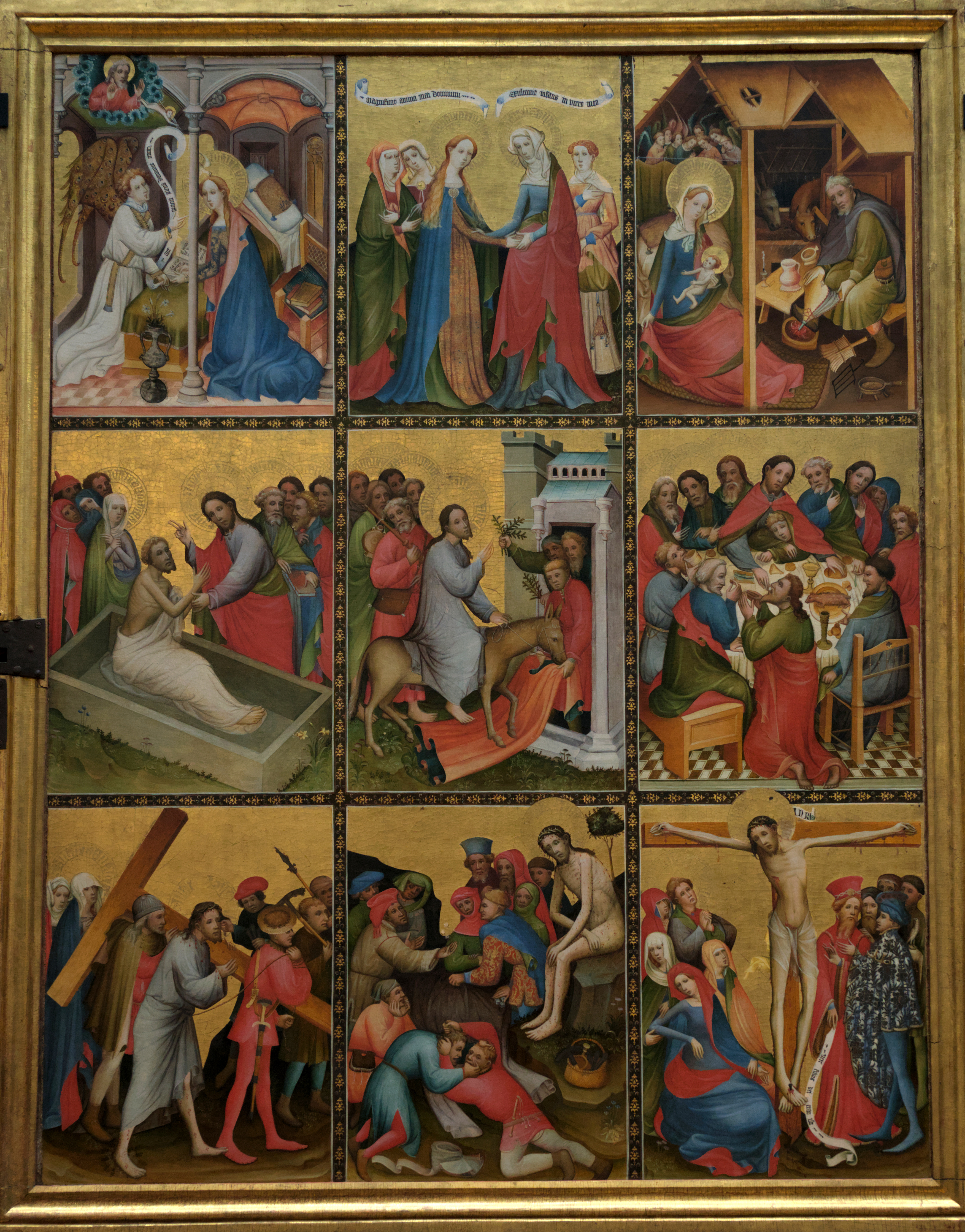
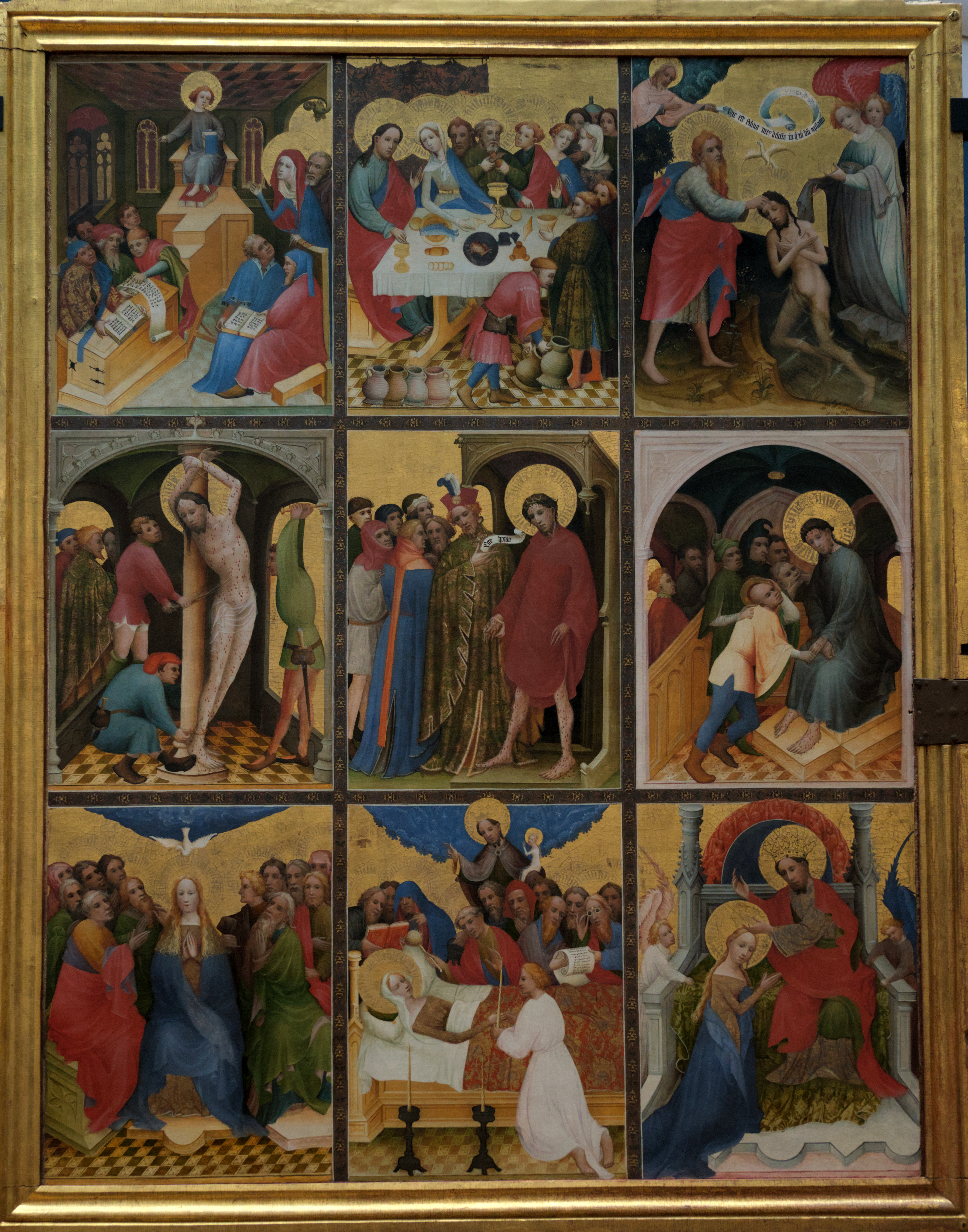
When these two outer panels were opened in their day, they would reveal view 2 of the altarpiece (pictured at top of article), or the first open view, displaying scenes from Jesus’s infancy, passion, and resurrection across four panels.
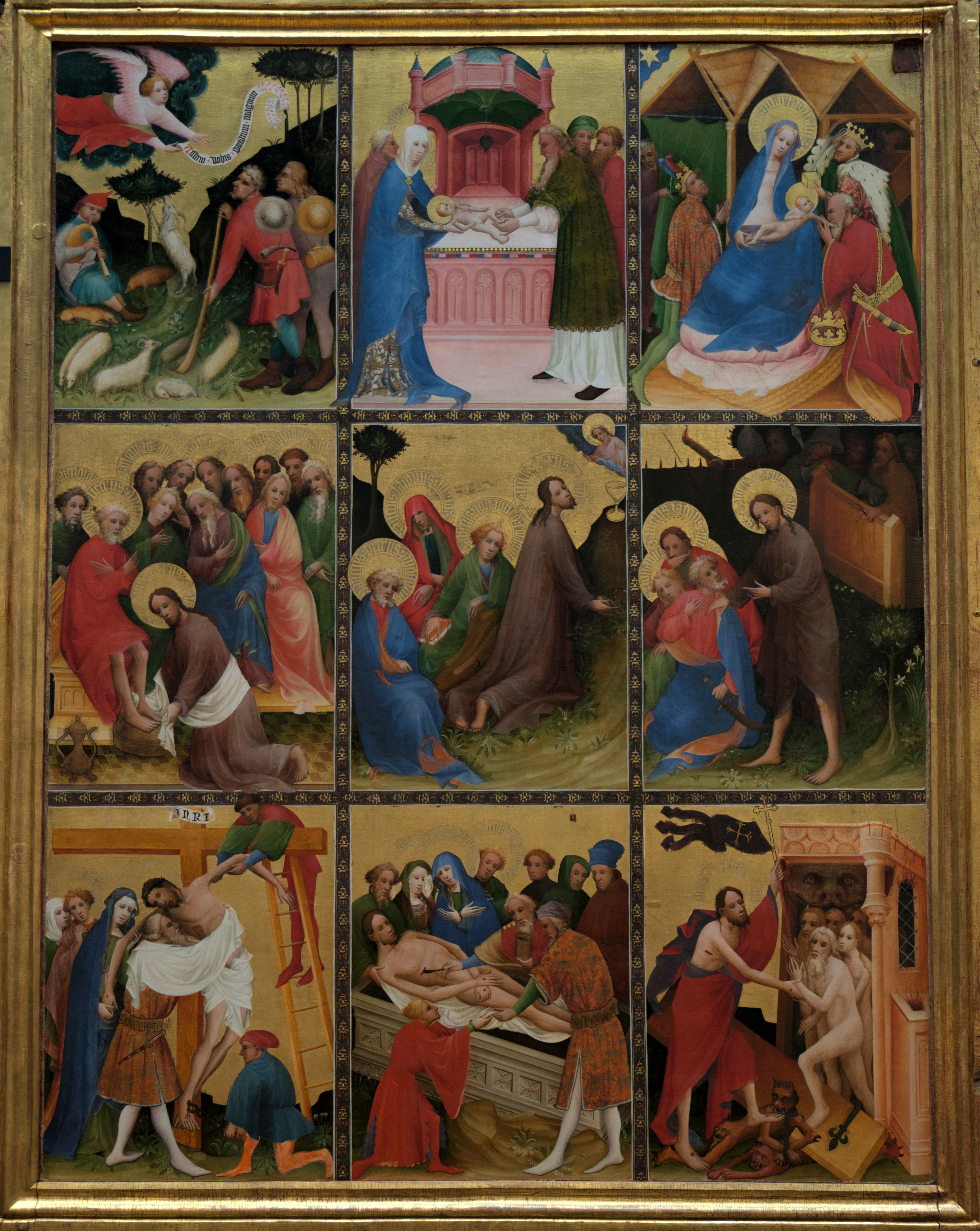
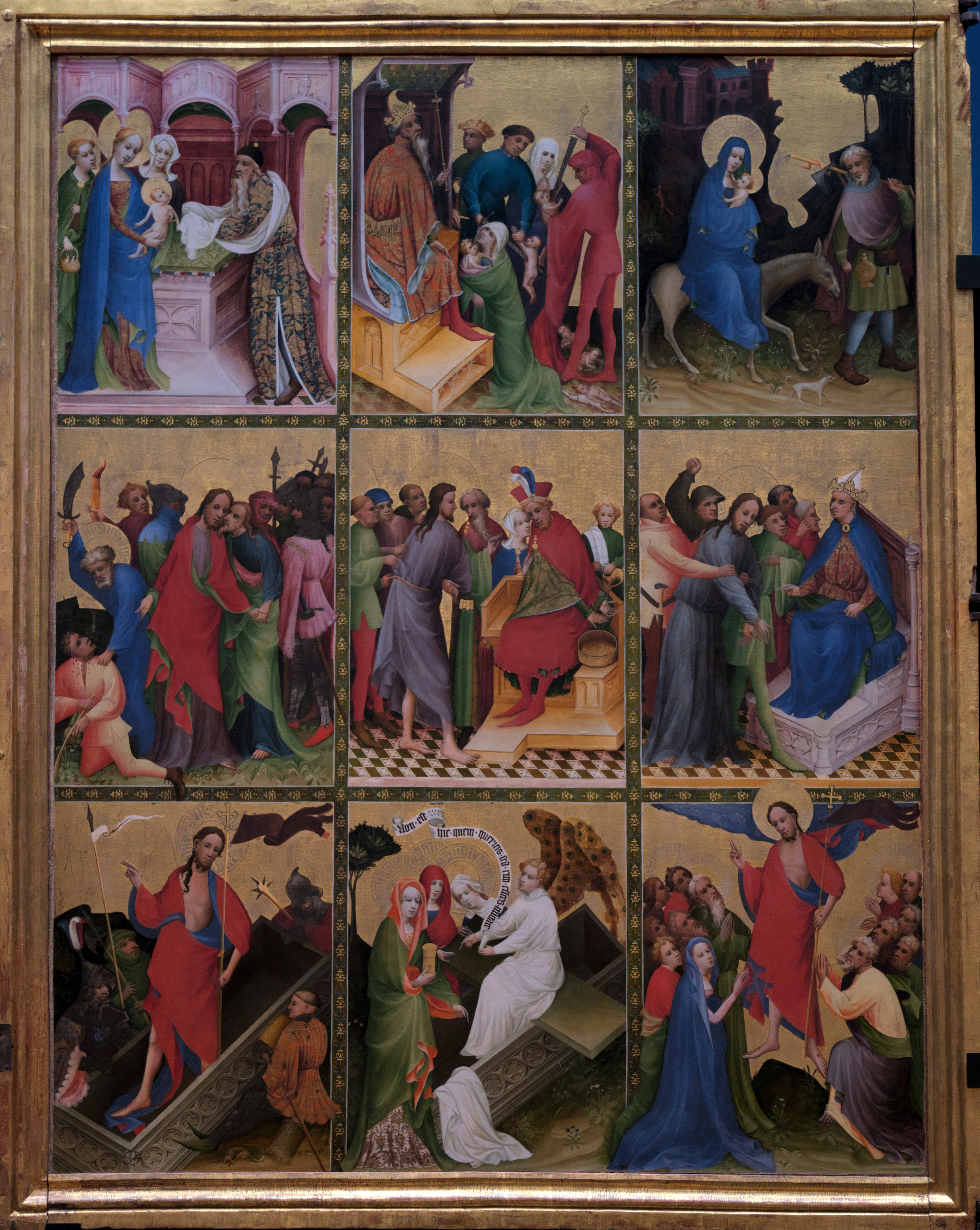
The Annunciation; The Visitation; The Nativity; The Raising of Lazarus; Christ’s Entry into Jerusalem; The Last Supper; Christ Carrying His Cross; Christ in Distress; The CrucifixionThe Annunciation to the Shepherds; The Circumcision of Christ; The Adoration of the Magi; Christ Washing His Disciples’ Feet; The Agony in the Garden (2); The Deposition; The Entombment; The Harrowing of HellThe Presentation in the Temple; The Massacre of the Innocents; The Flight to Egypt; The Arrest of Christ; Christ before Pilate; Christ before Herod; The Resurrection; The Holy Women at the Tomb; The AscensionChrist among the Doctors in the Temple; The Wedding at Cana; The Baptism of Christ; The Flagellation of Christ; Ecce Homo; The Mocking of Christ; The Descent of the Holy Spirit; The Death of the Virgin; The Coronation of the Virgin
I’ll share a few of my favorite scenes.
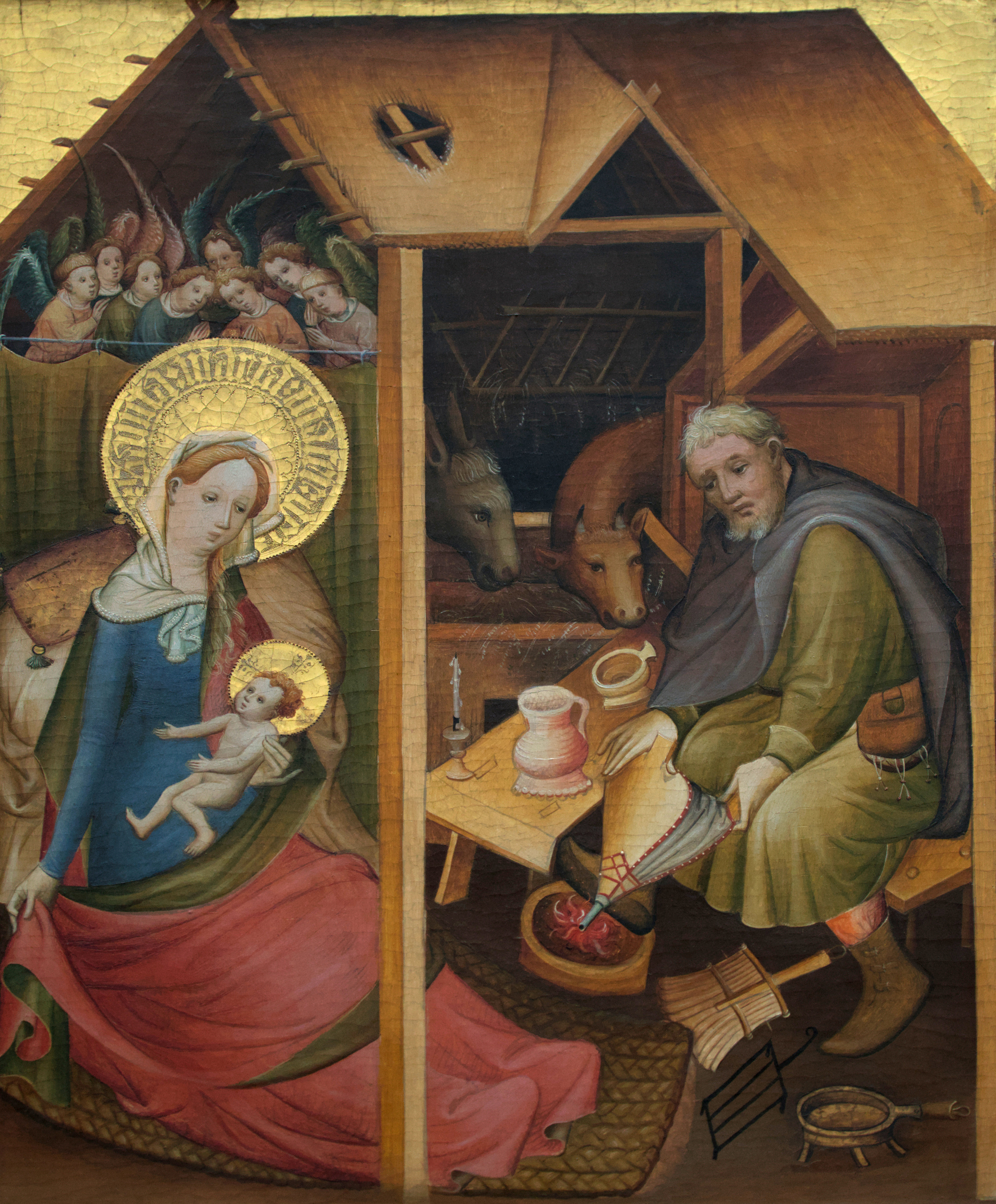
The Nativity features what I call the industrious Joseph motif [previously], as rather than sitting off to the side with his head in his hands, as he’s commonly shown, Jesus’s dad is hard at work trying to make his family comfortable. He pumps a bellows to supply air to the small fire he has going, either to warm his wife and child or, as he does in a handful of other medieval German Nativities, to cook a simple meal. Mary reclines with the infant Christ on a woven straw mattress while angels peek in from over a curtain to adore him.
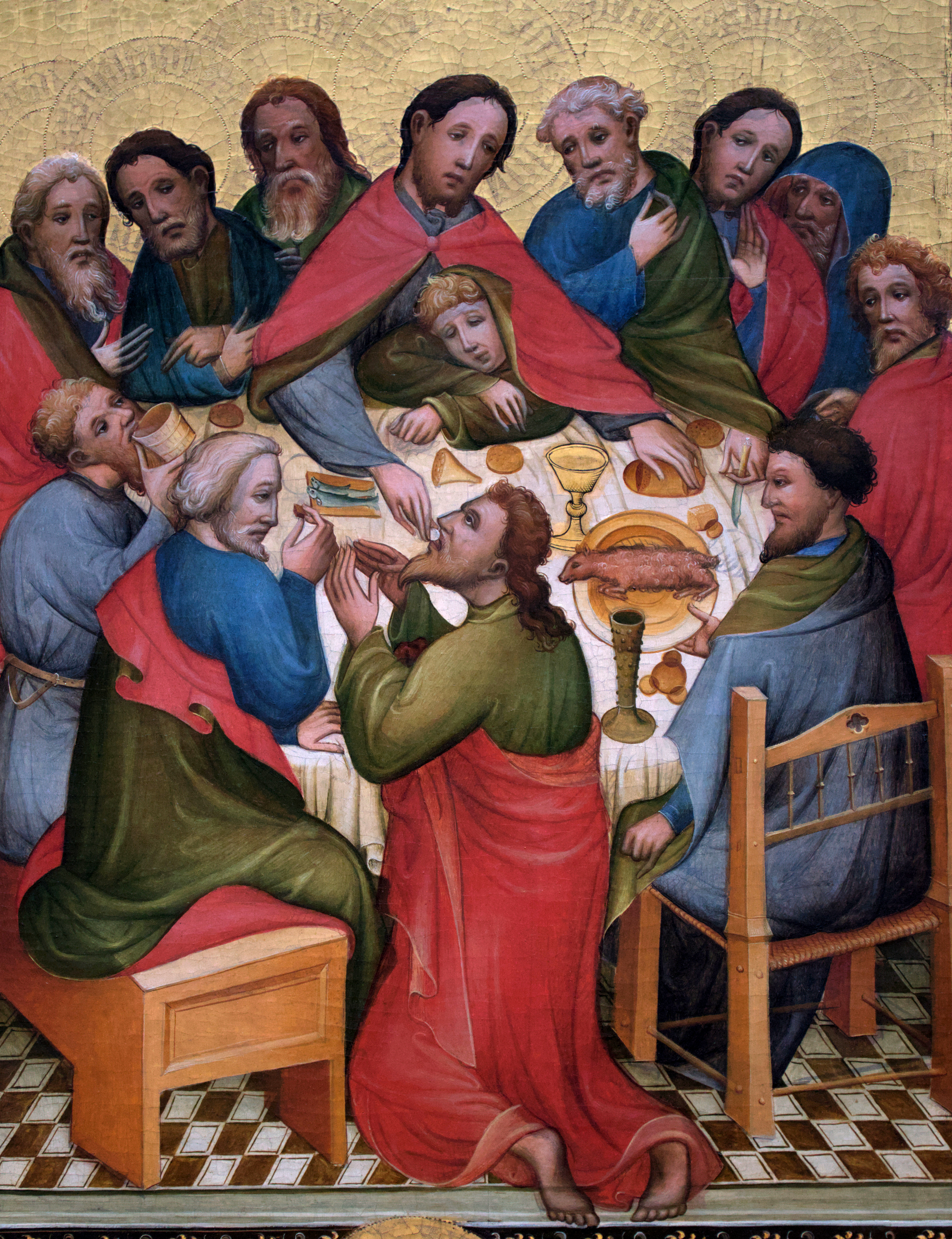
The Last Supper I found especially charming because of how the apostle John shelters under Jesus’s cloak, relaxed, secure. The image of John resting on Jesus’s breast rose to popularity in fourteenth-century Germany, a commemoration of the two’s bosom friendship and a call to, like John, abide in Christ. It’s based on the description in John 13:23, which says that at Jesus’s last meal, at Passover time, “one of his disciples—the one whom Jesus loved—was reclining close to his heart.” This verse alludes to the typical eating posture assumed at ancient Greco-Roman banquets, at which men reclined with their heads near a low table and their feet pointing away from it. But in Christian interpretation it has come to signify, more than simply a seating arrangement, the proximity of John to the heart of Christ.
In the Golden Panel’s Last Supper, Jesus enfolds John much like a mother hen would her chick (cf. Matt. 23:37; Luke 13:34), his garment like a wing. Even in this moment before his greatest trial, when most would be inclined to turn inward, Jesus shows concern for those he loves—he covers, protects. And nourishes. He stretches his hand across the table, laid with dishes of lamb and fish, to feed Judas a morsel of bread that resembles a eucharistic wafer. He sups with the man he knows will betray him. He does not turn him away.
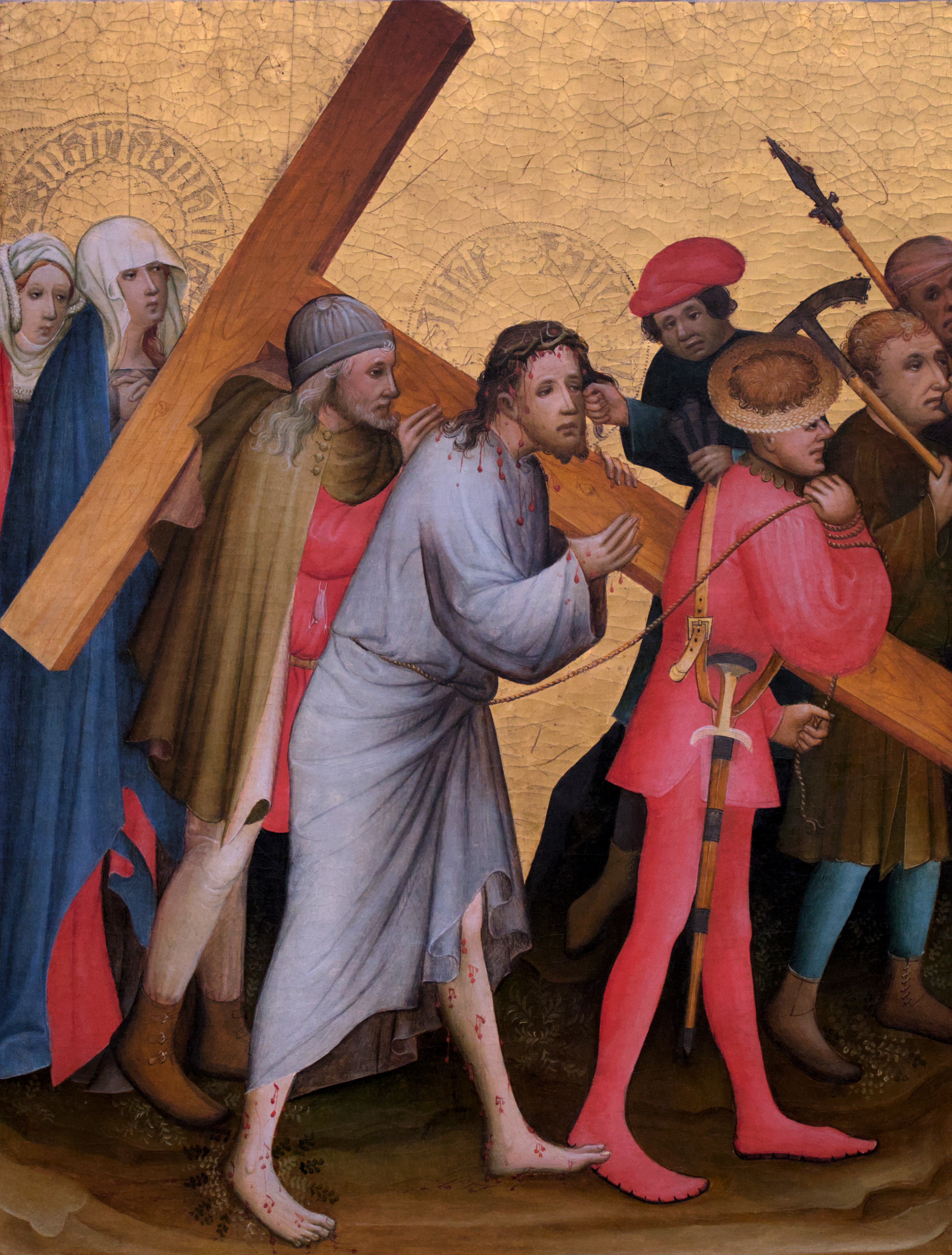
Further along in the narrative, the scene of Christ carrying his cross with the help of Simon of Cyrene stands out to me because of the man pulling Jesus’s hair as he walks. The cruel mocking and assault continue outside the courthouse and en route to Golgotha.
Called Christus im Elend (Christ in Distress) or Christus in der Rast (Christ at Rest), the subject depicted in the bottom center of the far left panel first started appearing in northern Germany in the second half of the fourteenth century. It shows Jesus sitting pensively, usually on a stone, waiting for his cross to be raised.
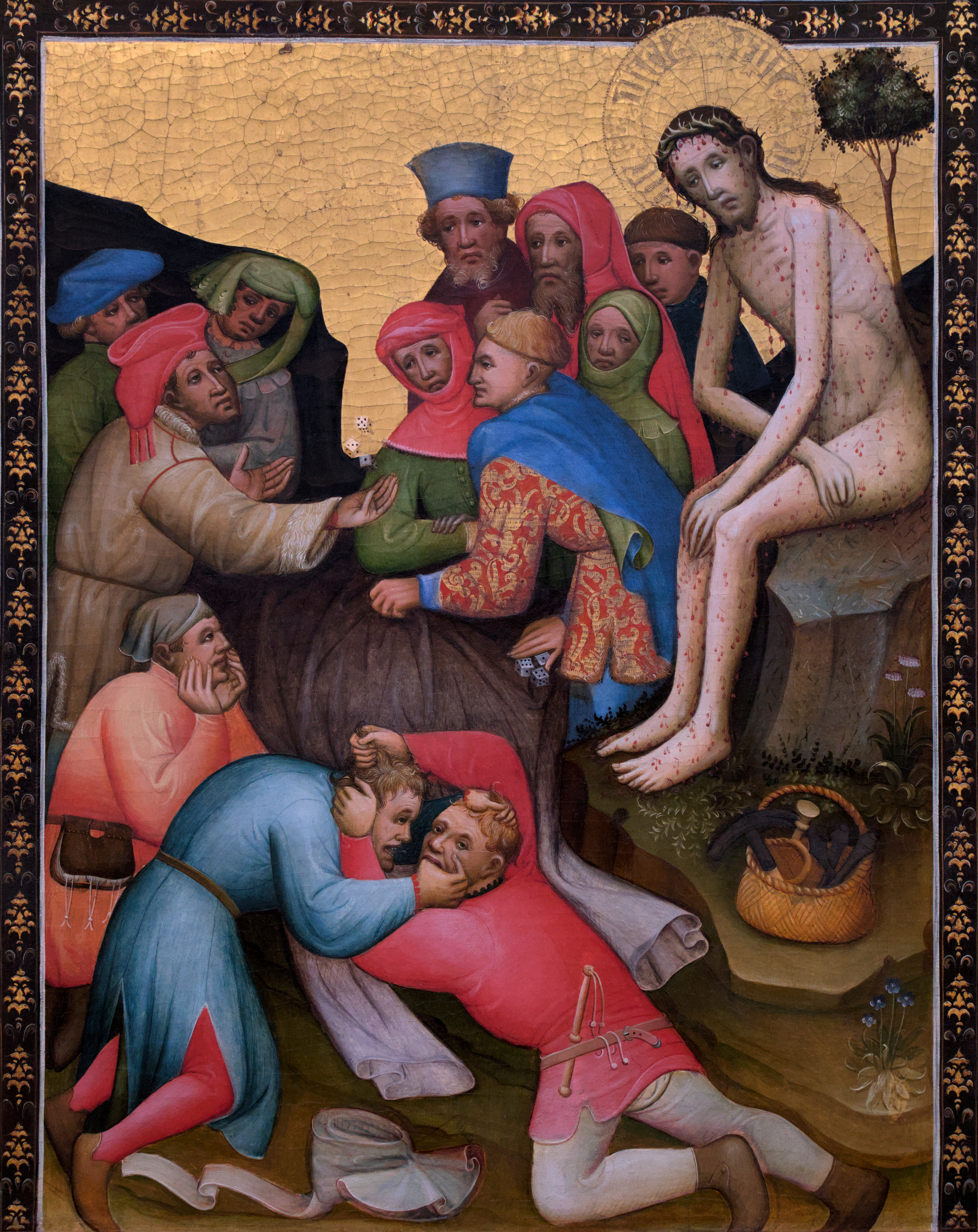
In the Golden Panel, Jesus, naked, bleeds all over while the soldiers roll dice and fight over who will get to keep his seamless tunic. The two men in the foreground, one with a flagrum tucked in his belt, tumble and tear at each other, pulling and biting, exemplifying the human penchant for violence that will culminate in the killing of God’s Son. (The basket of hammer and nails that has been procured for the task sits temporarily off to the side.) Combative and puerile, this is the humanity Christ has come to save.
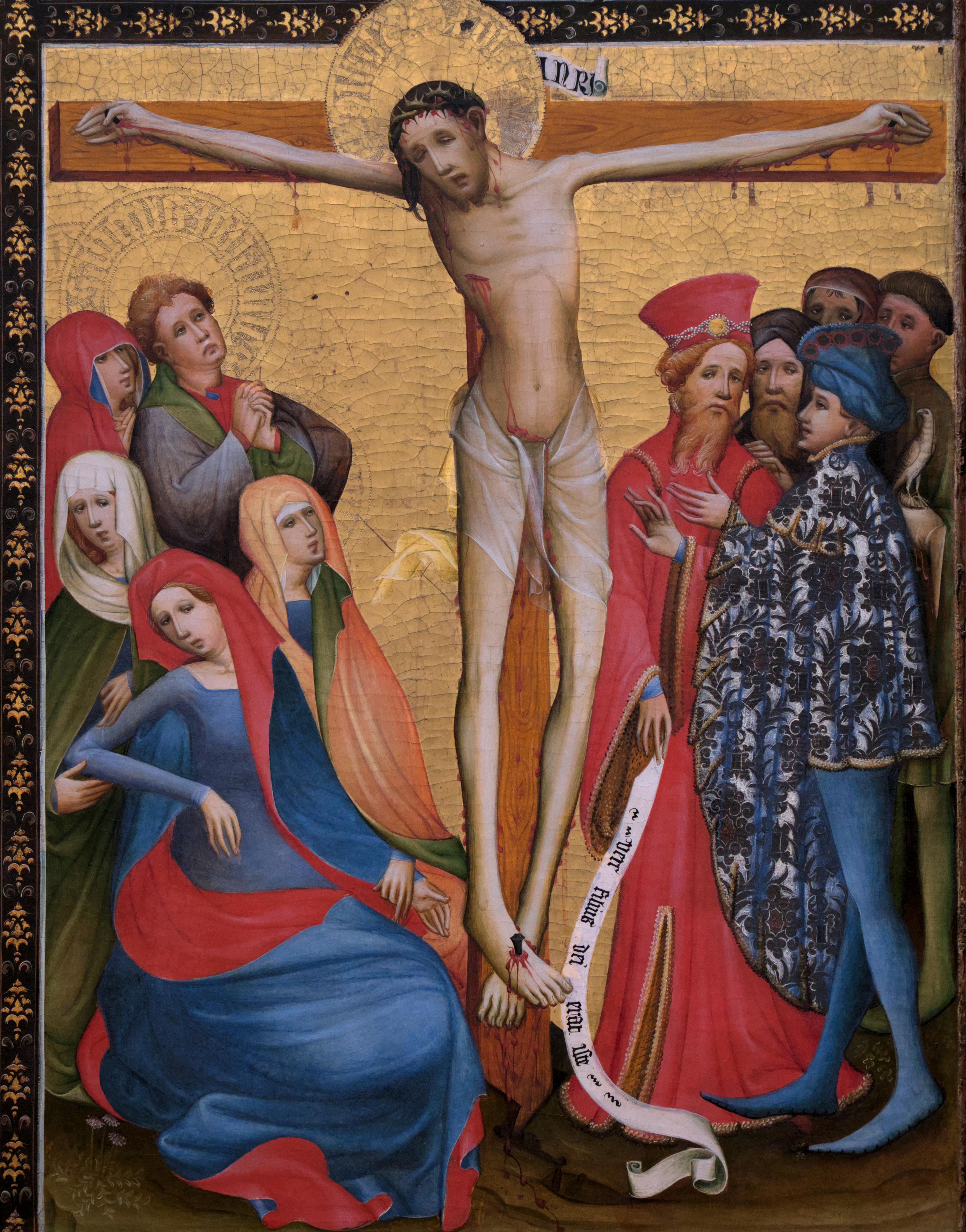
The interior Crucifixion painting is fairly standard, but oh, isn’t it lovely? One notable feature is how Christ’s blood flows from his side, his final wound, down to his groin, where he received, at eight days old, his first wound, the cutting off of his foreskin in a ritual circumcision. Scholars such as Leo Steinberg have remarked how this diversion of the blood’s natural path (which would be to the right thigh) was an intentional device some painters used to connect these two sheddings of blood, and thus the incarnation and the atonement.
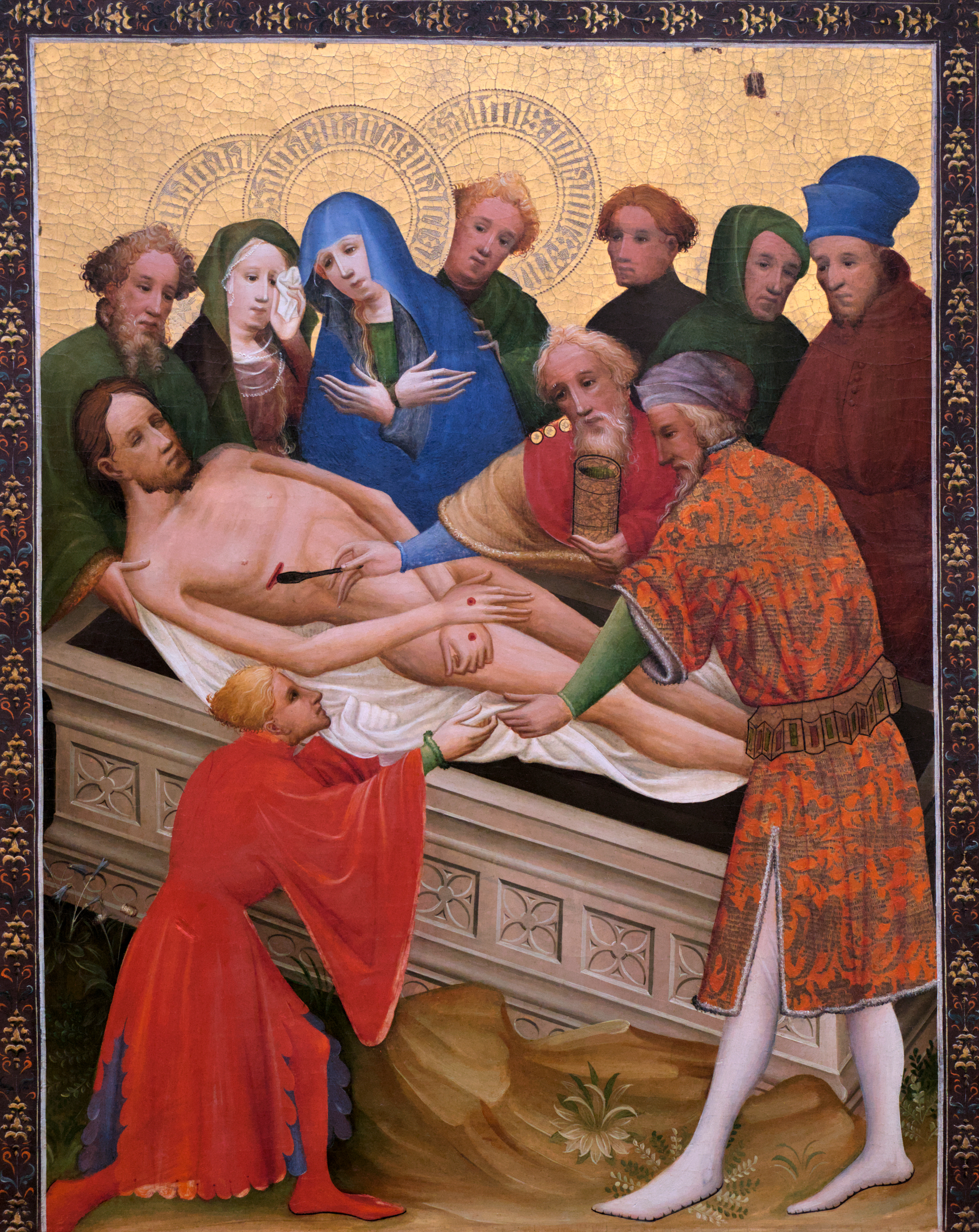
Moving two pictures down the line, the Entombment scene caught my eye because of the tender care shown to the dead Christ before he’s laid to rest. Nicodemus anoints Christ’s wounds with myrrh and aloes, applying them with a spatula, while Joseph of Arimathea, who has donated his tomb, prepares to enshroud the body.
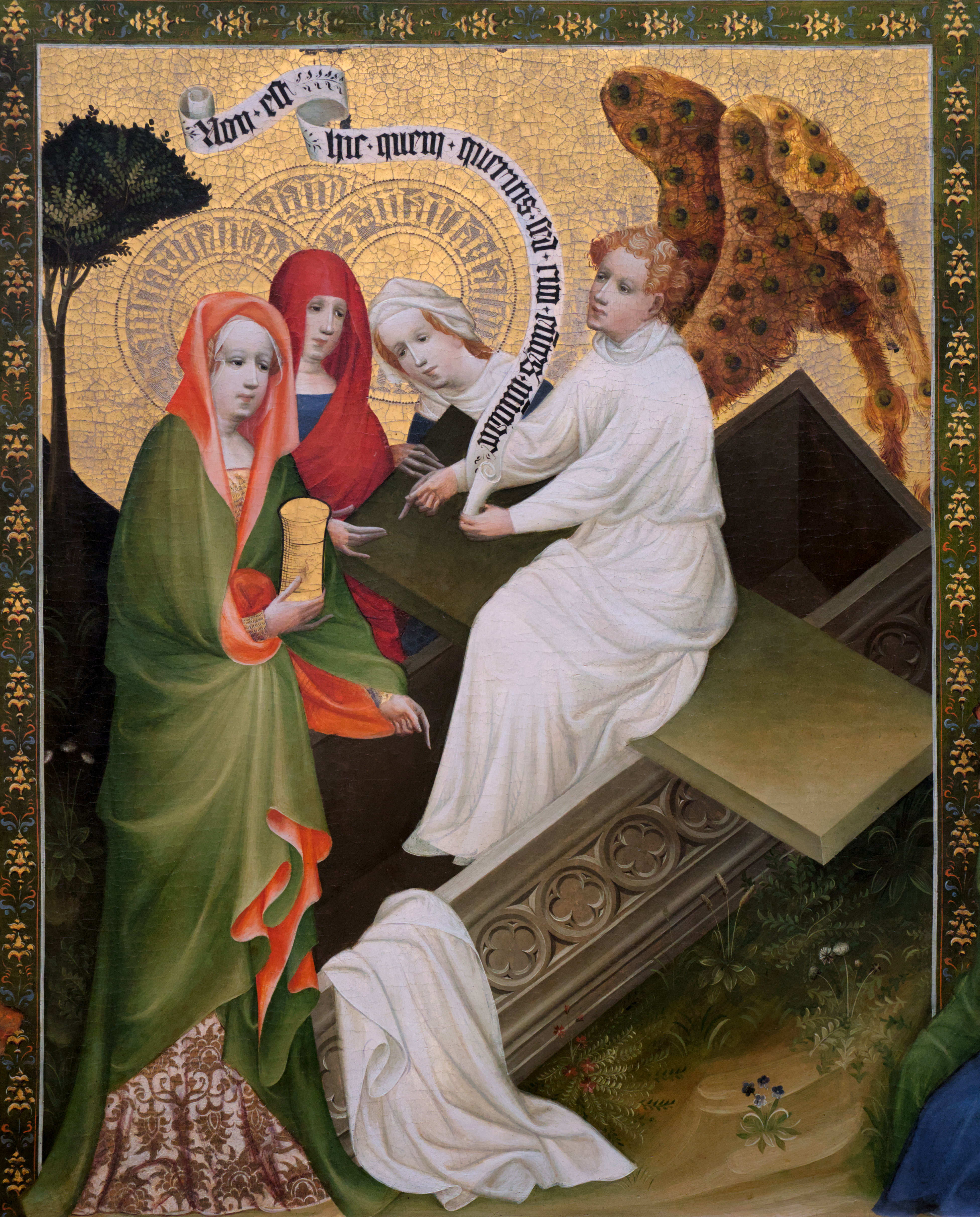
In a quintessential Easter scene, three faithful women come to the burial site after the Sabbath to complete the anointing ritual, only to find a finely feathered angel perched atop the skewed lid of Christ’s now-empty sarcophagus. Mary Magdalene, holding a golden jar, points into the vacant space as if to ask, “Where’s my Lord?” To which the angel responds that he is risen!
View 3 (Partial): Sculptures of the Saints
View 3 of the Golden Panel altarpiece—the fully open view, saved for important feast days—cannot be replicated because the shrine that formed the corpus is lost. But flanking the shrine would have been two wings that have survived largely intact, displaying polychrome wood sculptures of twenty (mostly male) saints and, in the intermediate row, smaller statuettes of six female saints (the other six are missing).
The identities of the main figures are listed below. The ones I couldn’t confirm but for which I proffer my best guess are followed by a question mark.
Top left: John the Baptist, Thomas(?), Matthew, Simon(?), George
Top right: Mary Magdalene, Lawrence (deacon), Benedict, Cyriacus (deacon), Michael
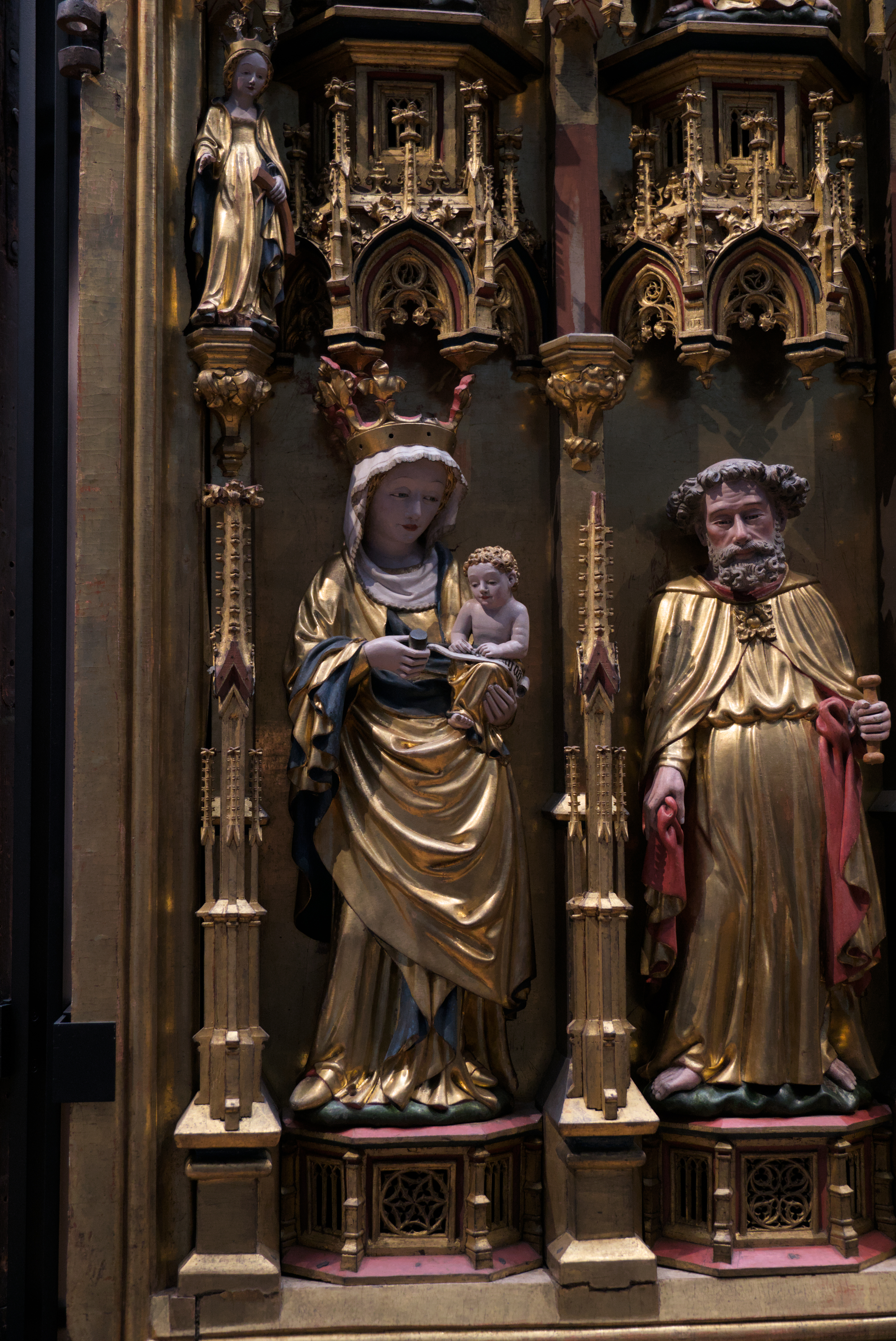
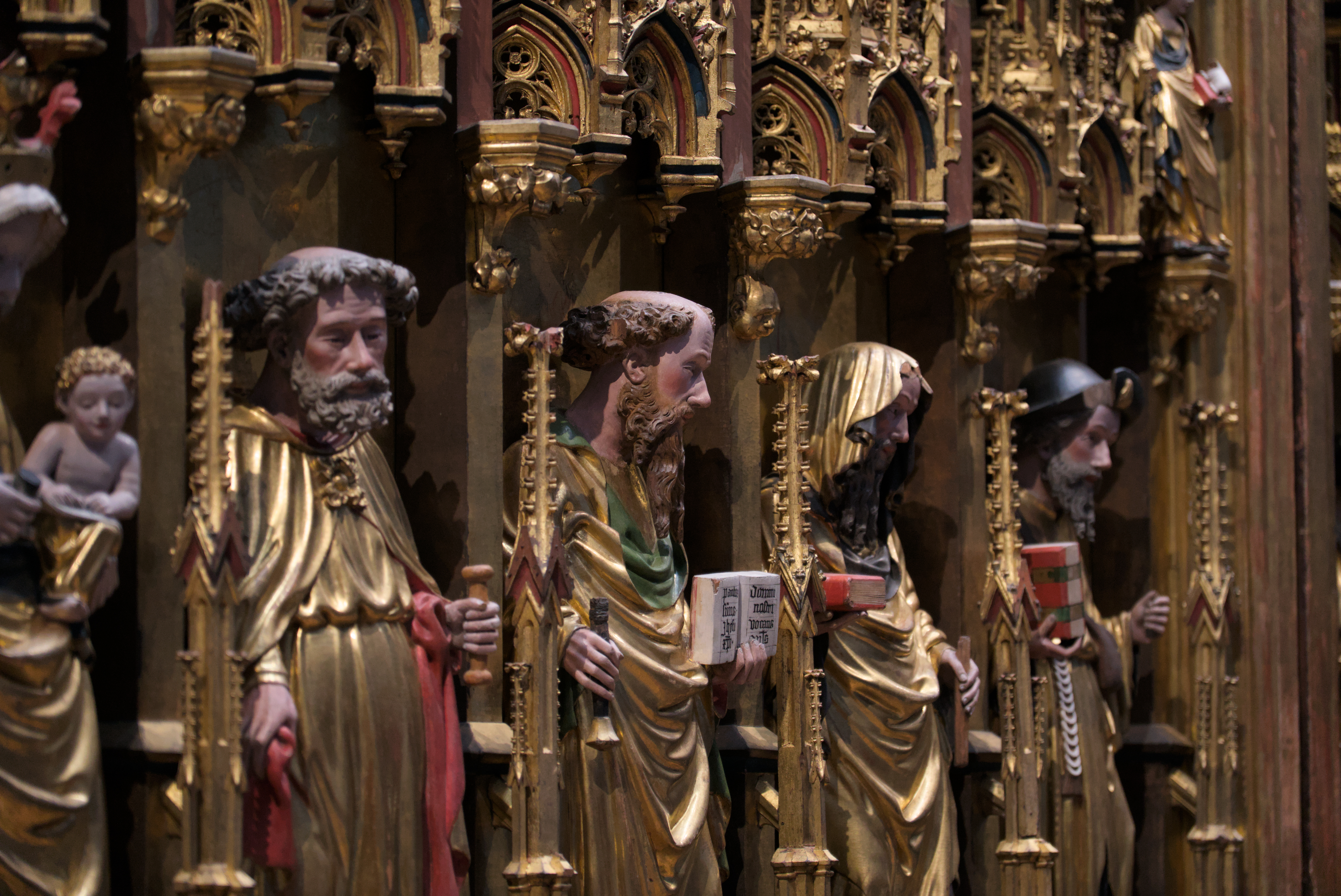
Bottom left: Madonna and Child, Peter, Paul, James the Lesser(?), James the Greater
Bottom right: Bartholomew, John the Evangelist, Jude (Thaddeus)(?), Andrew, Philip
In the sculpture of the Madonna and Child, Mary holds an inkwell that Jesus dips his pen into as he writes on a scroll. How delightful! It’s a rare iconography but one that’s shared by the Tintenfassmadonna in Hildesheim Cathedral, sculpted around the same time.
The figure to the right of Mary is Peter. He holds a handle with a dowel hole on the underside; originally, a set of keys was attached to it and hung down.
The diminutive figure above Mary is Catherine of Alexandria, identifiable by the fragmented wheel she holds, a symbol of her martyrdom.
To learn more about the Golden Panel, see the book Die Goldene Tafel aus Lüneburg, edited by Antje-Fee Köllermann and Christine Unsinn (Michael Imhof, 2021), from the Niederdeutschen Beiträge zur Kunstgeschichte (Low German Contributions to Art History) series. Only three of its twenty-five chapters are in English; the rest is in German. It’s highly technical, the product of an interdisciplinary research project carried out from 2012 to 2016. There’s not much in it about the actual content of the images. But it provides ample color illustrations, which I always appreciate, as well as stylistic comparisons, historical inventories, and more.
PODCAST: Poetry for All, hosted by Joanne Diaz and Abram Van Engen:Poetry for All “is for those who already love poetry and for those who know very little about it. In this podcast, we read a poem, discuss it, see what makes it tick, learn how it works, grow from it, and then read it one more time.” I’ve consistently enjoyed this podcast since its launch in 2020, having learned about it through cohost Abram Van Engen [previously], an academic who often writes and speaks about poetry for general Christian audiences. Here are some of my favorite episodes of the ninety-seven that have been released to date:
Three haiku by Kobayashi Issa, translated from the Japanese by Robert Hass: The first: “The snow is melting / and the village is flooded / with children.” Learn the characteristics of what Joanne Diaz calls “the perfect poetic form.”
“spring song” by Lucille Clifton: One of my favorite poems by one of my favorite poets. “This joyful poem caps a sequence of sixteen poems called ‘some jesus,’ which walks through biblical characters (beginning with Adam and Eve) and ends on four poems for Holy Week and Easter. [Clifton] wrote other poems on the Bible as well, including ‘john’ and ‘my dream about the second coming,’ which reimagine a way into biblical characters to make their stories fresh.”
“Elegy for My Mother’s Mind” by Laura Van Prooyen: This episode is unique in that it has the poet herself on to read and discuss the poem, which in this case navigates the complexities of memory, loss, and familial relationships.
“View but This Tulip” by Hester Pulter: Ashamedly, I had never heard of this seventeenth-century female poet before listening to this episode, so I’m grateful to guest Wendy Wall, cocreator of the award-winning Pulter Project website, for introducing me to her! “In this episode we discuss [Pulter’s] work with emblems, her scientific chemistry experiment with flowers, and her wonderment (both worried and confident, doubtful and awestruck) about the resurrection of the body and its reunification with the soul after death.”
“From Blossoms” by Li-Young Lee: A much-anthologized poem ostensibly about eating summer peaches, but more deeply, it’s about joy. “One of the things that draws me to this poem,” says Van Engen, “is that joy is actually very hard to write about . . . without it sounding naive or sentimental or withdrawn or unaware.”
“Primary Care” by Rafael Campo: Dr. Rafael Campo is both a poet and a practicing physician. Here he uses blank verse to explore the experience of illness and suffering.
+++
POEMS:
>> “For V. the Bag Lady, Great in the Kingdom of Heaven,” “Damascus Road,” “The Sower,” and “Crosses” by Paul J. Pastor: The Rabbit Room received permission to reproduce four poems from Paul J. Pastor’s [previously] new poetry collection, The Locust Years, which “explores a world of mystery and sorrow, desolation and love. Rooted in the Pacific Northwest, these poems offer readers an invitation to walk along a path pebbled with profound joy and deep loss.” I’ll be sharing another on the blog next week, courtesy of Wiseblood Books.
>>“Undone”by Michael Stalcup: The rise of blogging in the aughts and its descendant, Substacking, in the last few years has meant that poets and other writers can share their work directly with their reading publics and give them insight into their creative process if they wish. On his Substack, the Thai American poet Michael Stalcup [previously] recently shared one of his new poems that’s based on the story of the woman caught in adultery in John 8:1–11. He explains how the poem’s form, a blend of the Petrarchan sonnet and the chiasmus, contributes to its meaning.
Nalini Jayasuriya (Sri Lankan, 1927–2014), Go, Sin No More, 2004. Mixed media on cloth, 23 × 19 in. Published in The Christian Story: Five Asian Artists Today, ed. Patricia C. Pongracz, Volker Küster, and John W. Cook (Museum of Biblical Art, 2007), p. 119.
Blessed be the paps which Thou hast sucked. —Luke 11:27
Suppose he had been Tabled at thy Teats, Thy hunger feels not what he eats: He’ll have his Teat ere long (a bloody one). The Mother then must suck the Son.
Scholar Kimberly Johnson [previously] unpacks these four lines about the body of Christ, who as an infant drank milk from his mother’s breast, and whose sacrificial death opened up his own breast whence flows the blood that nourishes us all. Johnson teases out the overlap of physical and spiritual in the poem, highlighting the maternal sharing of one’s own substance that links both couplets. At the eucharistic table, we are bidden to come and eat; or, in the stark metaphorical language of Crashaw, come and suck Christ’s bloody teat.
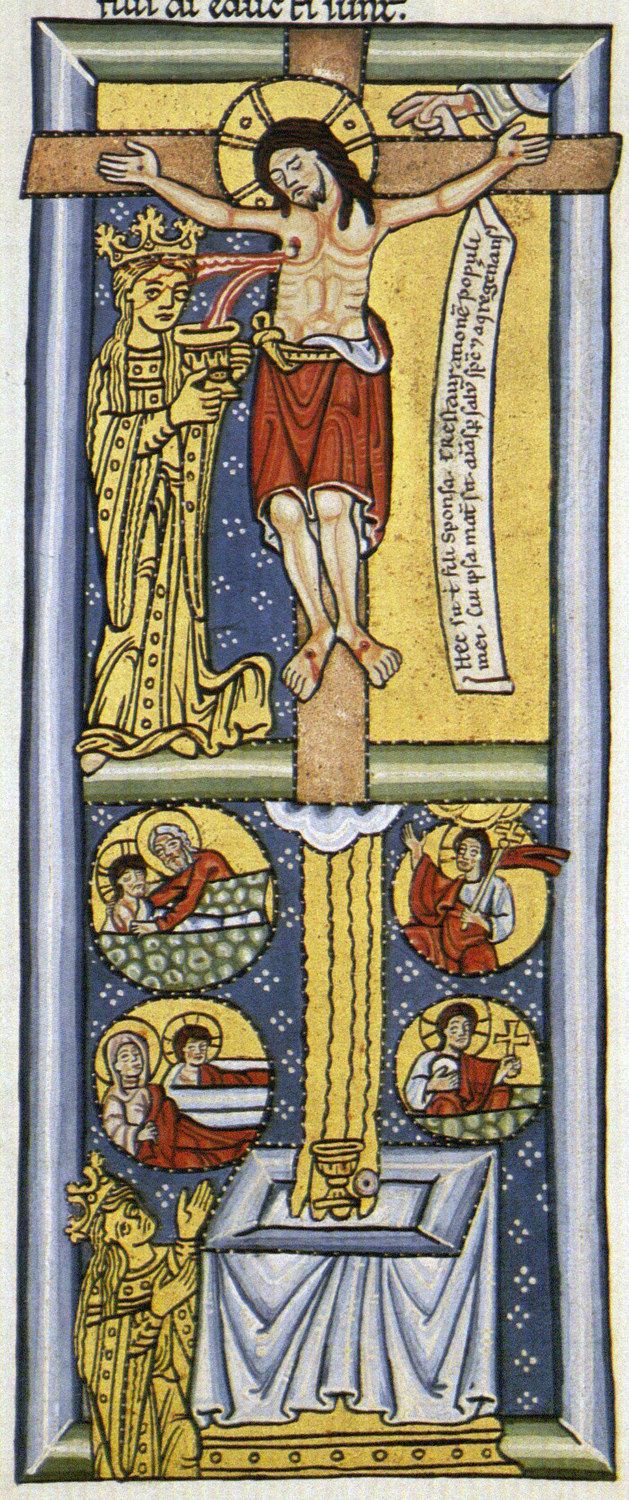
I plan to write an essay sometime about Christ as a nursing mother, as I’ve seen the image pop up in medieval writings and some visual art, including from Kongo and Ethiopia. In the meantime, here’s an illumination of the sixth vision in book 2 of Hildegard of Bingen’s Scivias (short for Scito vias Domini, “Know the Ways of the Lord”), painted under the supervision of Hildy herself. It shows the crucified Christ feeding Ecclesia (his bride, the church) with blood from his breast.
(Facsimile of) “Christ’s Sacrifice and the Church” from Scivias II.6, illuminated at the Rupertsberg, near Bingen, ca. 1165. The original manuscript from Hildegard’s lifetime was lost in the Dresden bombing in 1945, but a faithful copy was made in 1927–33, which is the source of the color reproductions now available.
+++
ESSAY: “Only One Heart: The Poetry of Franz Wright as Emblem of God’s Grace” by Bonnie Rubrecht, Curator: “Are You / just a word? // Are we beheld, or am I all alone?” These three lines typify the poetry of Franz Wright (1953–2015), the Pulitzer Prize–winning author of Walking to Martha’s Vineyard, God’s Silence, and other collections. “Wright’s work is often described as confessional, colored by irony and humor. His irreverence, juxtaposed with honesty and humility, make his poetic voice unique in addressing God. Writers and poets often traffic in spiritual themes, but few modern poets echo the prophetic Old Testament tradition of crying out, approaching God with the concision and raw emotion that Wright does. He excels in voicing the concerns and ruminations of the human experience of suffering, while simultaneously shifting towards his own embodiment of grace.”
This month I traveled to parts of Germany and Belgium to experience some of the art of those countries, with a focus on medieval religious art. In Brussels, besides exploring the famous Oldmasters Museum (part of the Royal Museums of Fine Arts of Belgium), I visited the lesser-known Art and History Museum, whose collection includes not just western European art from prehistoric times through the nineteenth century, but also art from Asia (China, Korea, India, Pakistan, Afghanistan, Sri Lanka, Tibet, Nepal, Turkey, Iran, Cambodia, Thailand, Burma), Oceania, the pre-Columbian Americas, and ancient Egypt, Greece, and Rome.
I spent the most time with the medieval European art on the ground floor—wooden statuettes, ivory and alabaster carvings, stained glass, paintings, metalworks, and tapestries. With the Google Translate app open, I hovered my phone over the Dutch and French descriptive labels to read them in English.
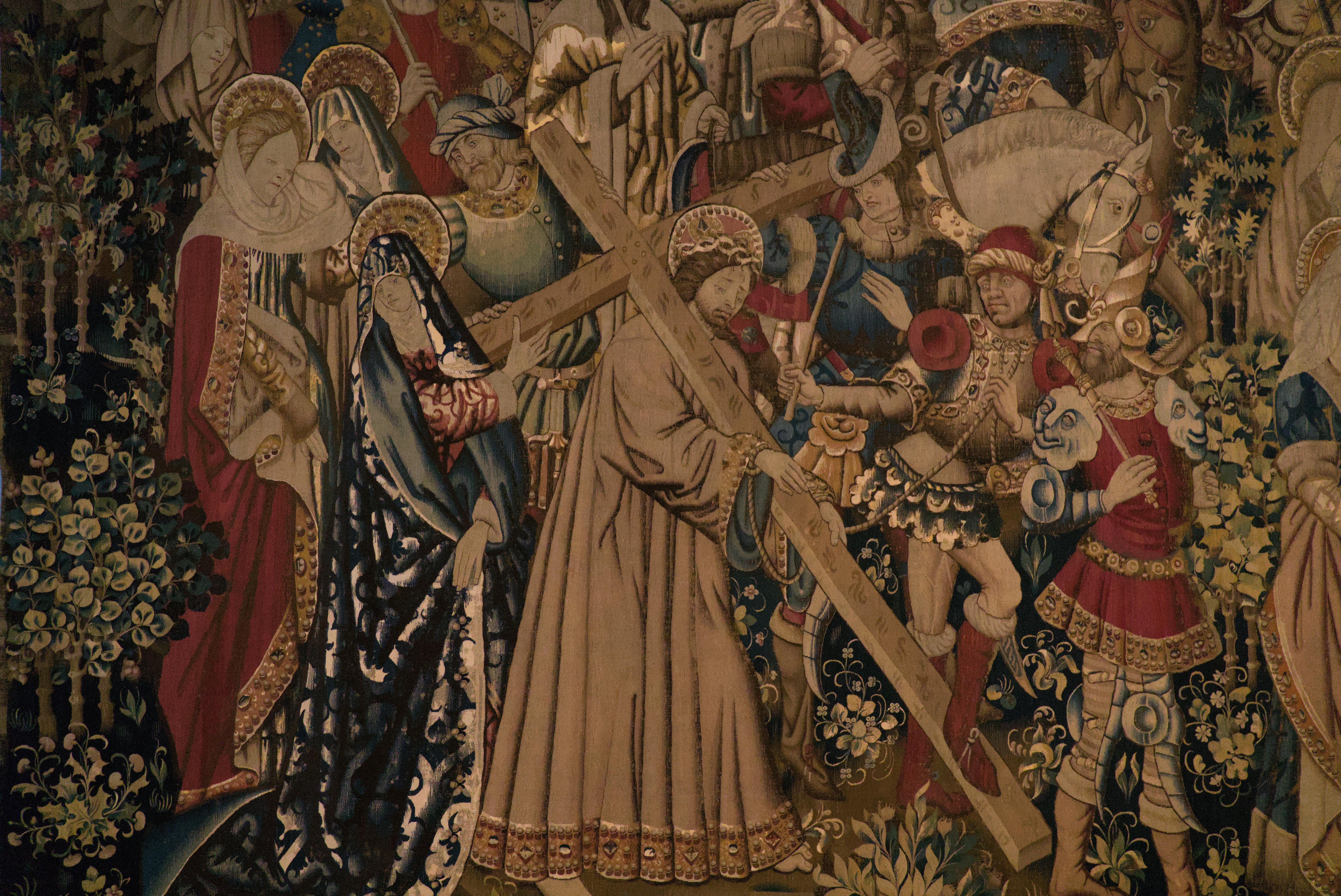
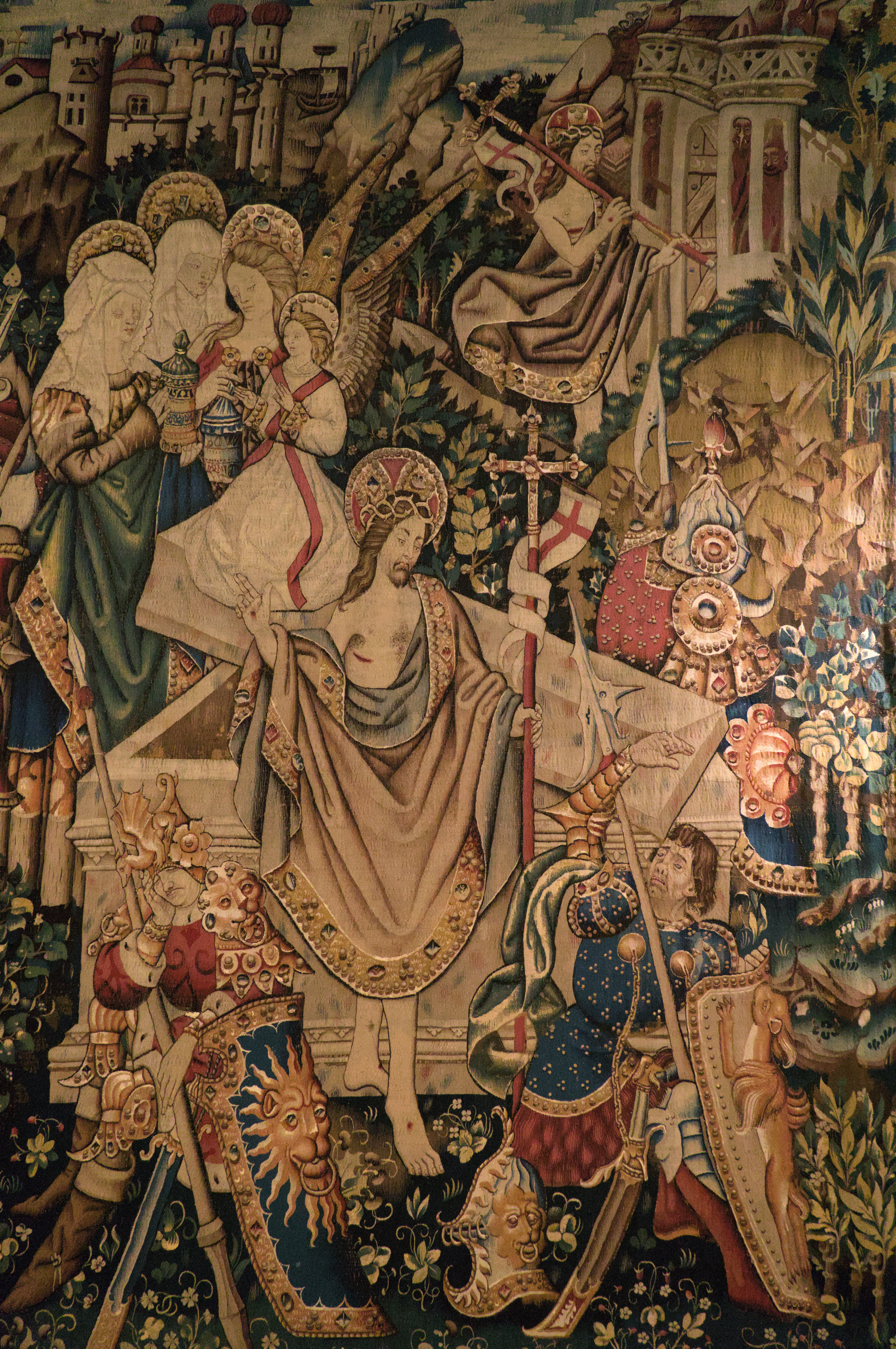
My favorite tapestry I saw, from fifteenth-century Tournai, portrays three scenes from the passion of Christ: Christ Carrying the Cross, the Crucifixion, and the Resurrection. The museum gallery it’s displayed in also houses a large medieval loom, which is what’s protruding at the bottom right corner of the following photo.
Scenes from the Passion, Tournai, ca. 1445–55. Tapestry of wool and silk, 424 × 911 cm. Art and History Museum, Brussels, Belgium, Inv. 3644. All photos by Victoria Emily Jones.
Tapestries made in the Flemish city of Tournai were among the most sought after in the fifteenth century. These large-scale wall hangings were bought by royalty, nobles, and high-ranking clergy to decorate their palaces. This one, nearly thirty feet long, is the second of a two-part hanging whose first part (portraying Christ’s Entry into Jerusalem, the Last Supper, and the Arrest of Christ) is in the collection of the Vatican.
Below are some detail shots.
First, Christ carries his cross. A soldier pulls him forward by a rope tied to his wrists, while tauntingly standing on the vertical wood beam and hitting him with a baton. On a less serious note, those are some spiffy face-shaped shoulder scales on the right.
Christ crucified:
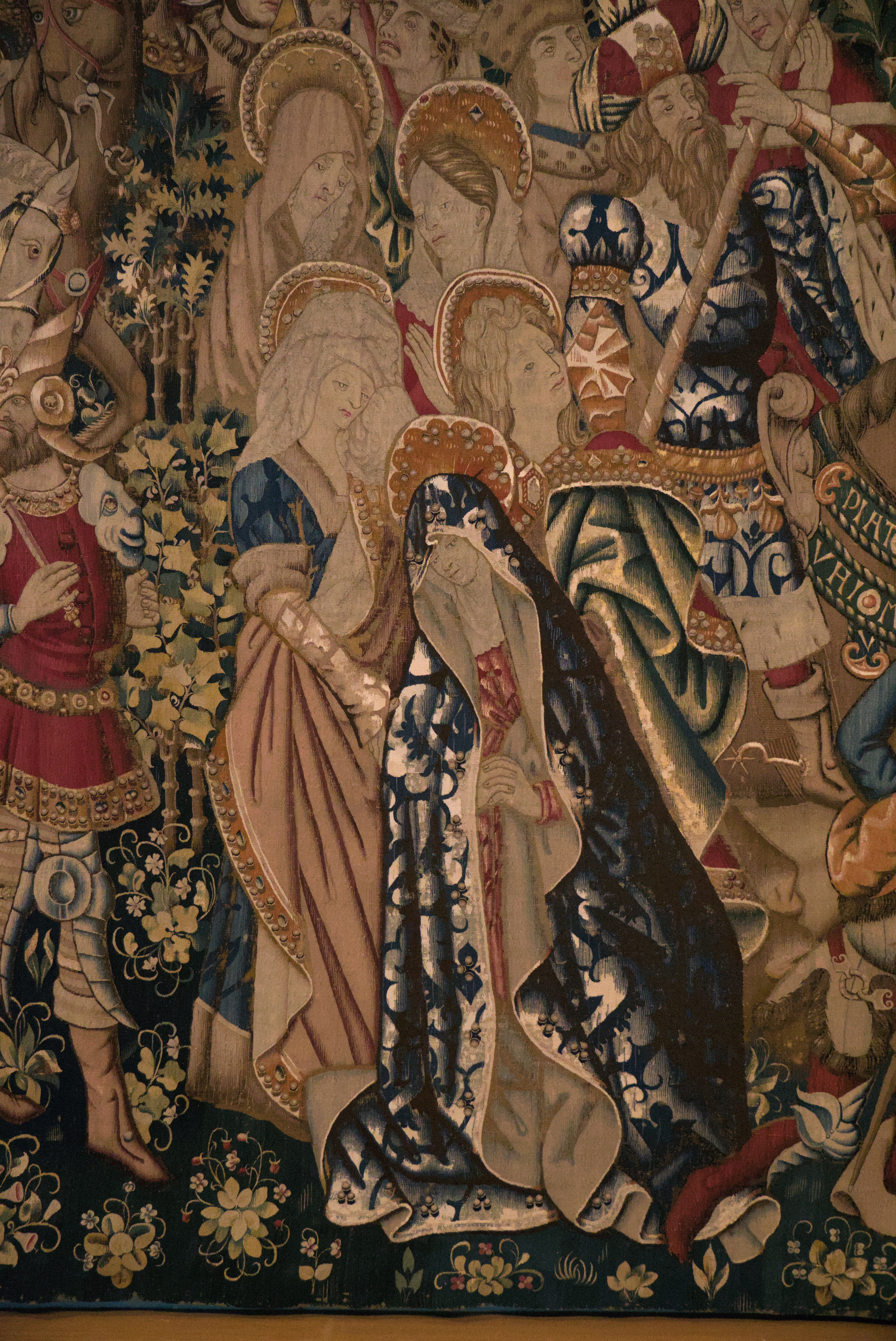
A group of four women mourn—the Virgin Mary up front in the blue mantle, backed by three other Marys—alongside a curly-haired apostle John in green.
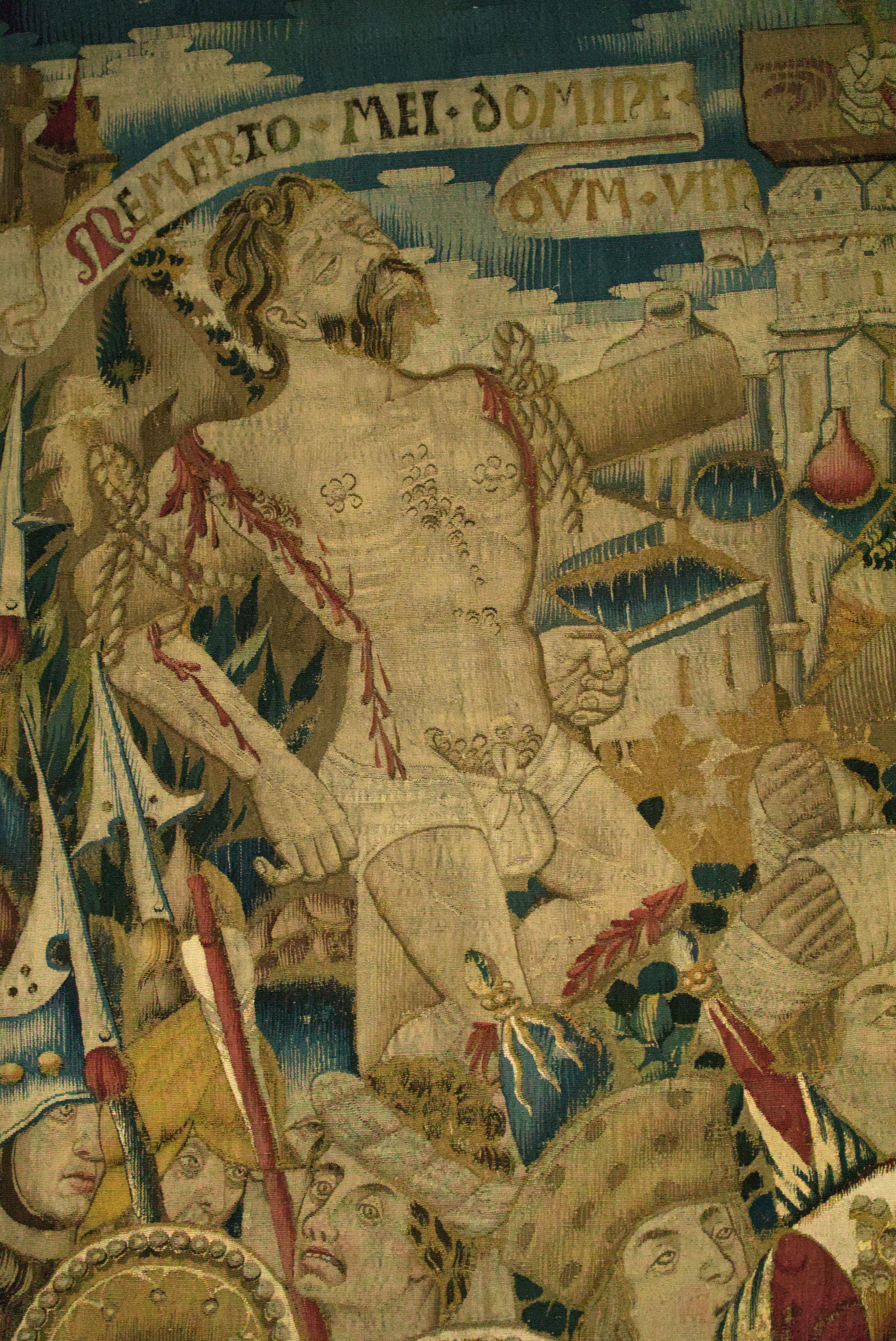
On Christ’s right (the viewer’s left), the penitent thief, with his last breaths, says, Memento mei, Domine, dum ven[eris in regnum tuum] (Remember me, Lord, when you come into your kingdom) (Luke 23:42).
The pointing man below the cross to Christ’s left, our right, is the Roman centurion (officer in command of one hundred soldiers) who, when Jesus died, proclaimed, Vere filius Dei erat iste (Truly this man was the Son of God!) (Matt. 27:54; Mark 15:39; cf. Luke 23:47).
On the other side of the cross, a Roman spearman, to whom tradition gives the name Longinus, points to his eyes. That’s because according to a medieval legend, Longinus was blind, but when he pierced Jesus’s side to verify his death, some of the blood from the open wound fell into Longinus’s eyes and restored his sight, after which he confessed allegiance to Christ.
Despite these three stories—two biblical, one apocryphal—of Christian conversion at the cross, Christ’s death did not move all the hearts of those present. At the base of the cross, two men fight with knives over Christ’s garment, their greed and aggression a foil to Christ’s selflessness and gentleness, and an example of the sin he came to redeem us from.
And again, pacifist though I am, I can’t help but remark on the fine-looking armor in the crowd:
The right-most third of the tapestry portrays vignettes of the Resurrection.
At the bottom, Christ emerges triumphant from his tomb, holding a banner in one hand and bestowing blessing with the other.
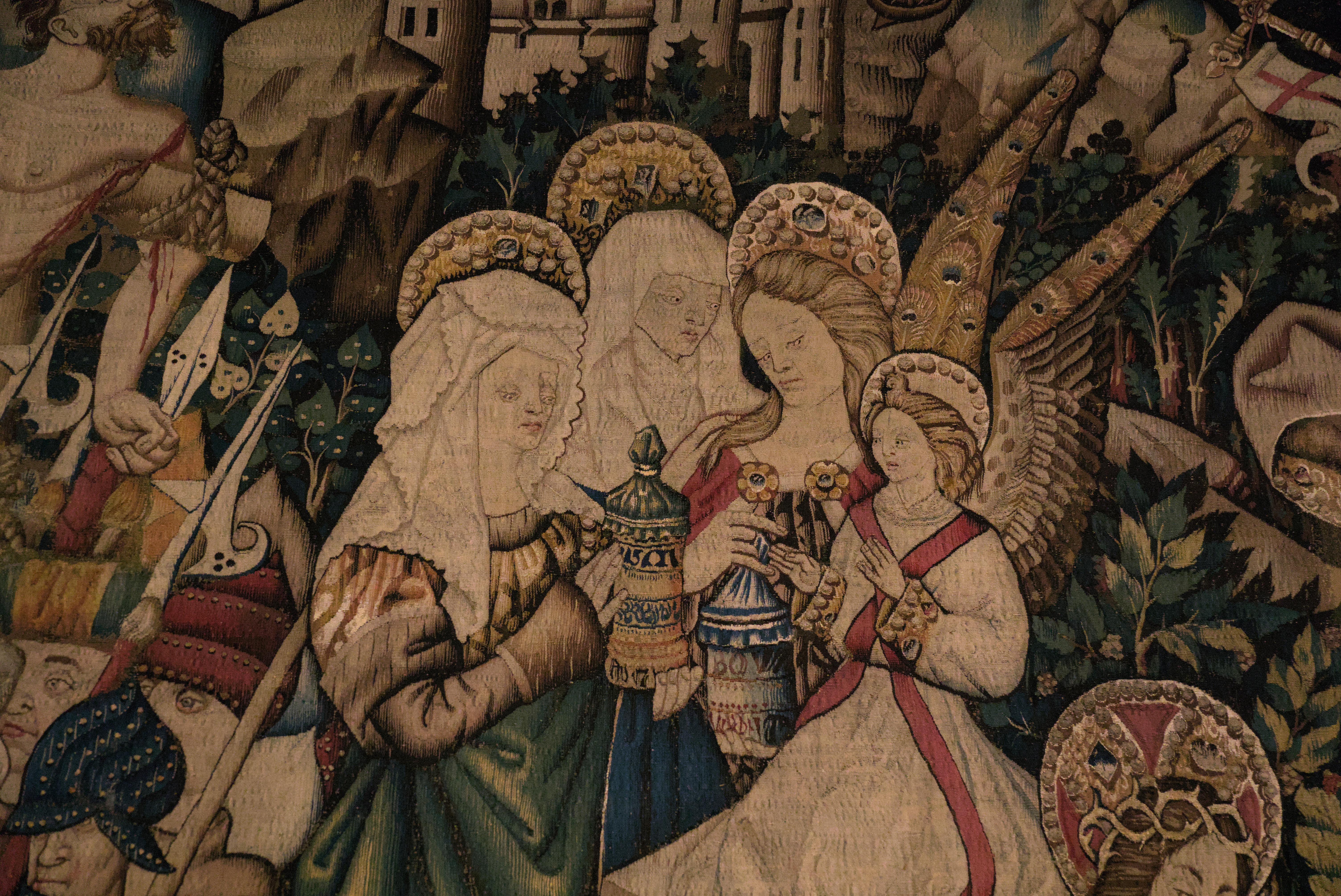
In the middle ground, the three Marys arrive at the empty tomb, ointments in hand, where they meet an angel who informs them that Christ has risen from the dead. Mary Magdalene is the one with her hair uncovered.
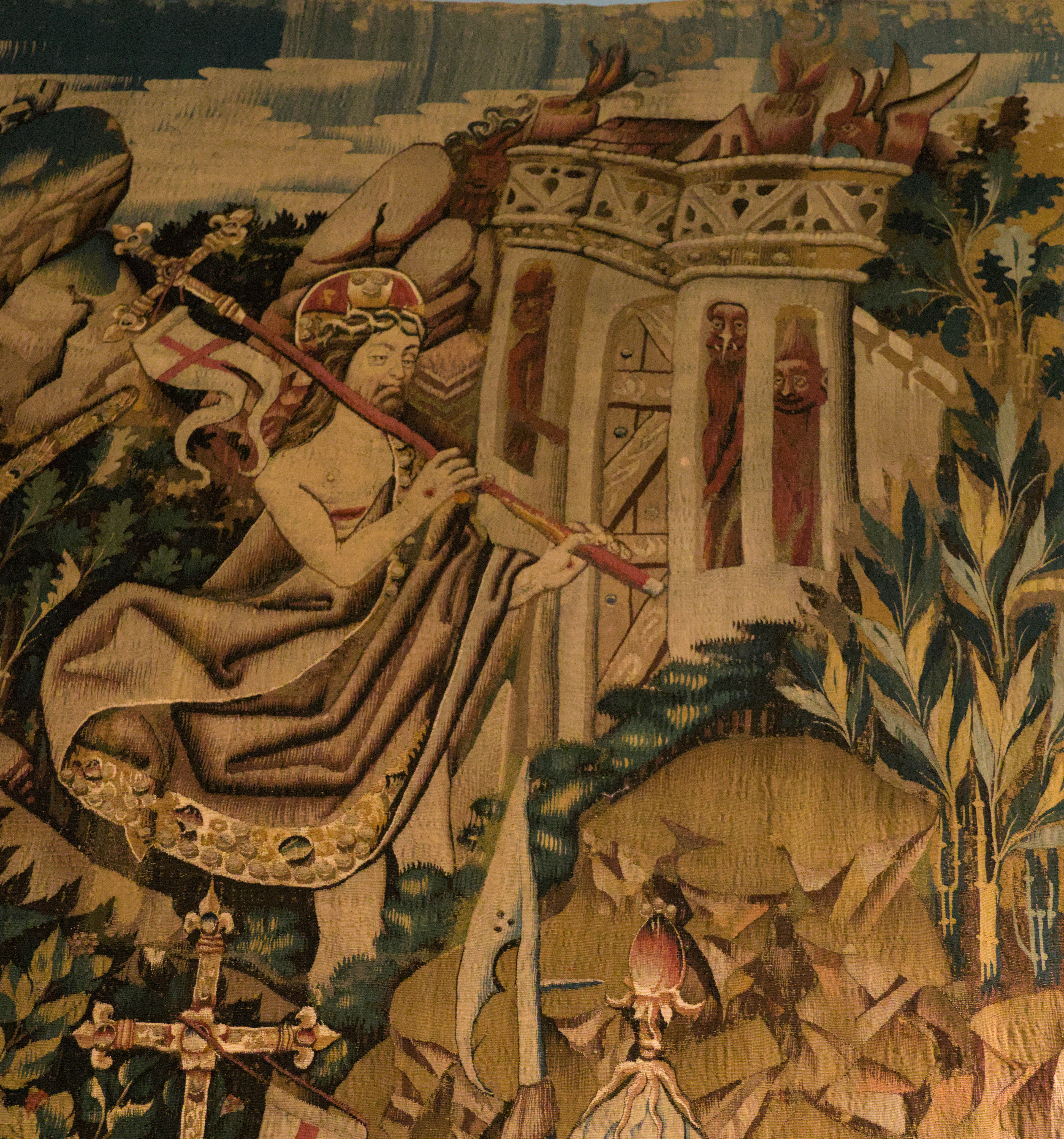
The risen Christ appears again at the top right, harrowing hell, a realm that is represented as a turreted fortress from whose windows fiery red demons glower and smirk. Christ has come to break down the doors and release the Old Testament saints being held captive—that is, those who died trusting in Yahweh and who were awaiting Christ’s redemption in the netherworld.
Let’s zoom in closer, shall we?
This is just one of the many artistic treasures, woven and otherwise, at Brussels’ Art and History Museum. I highly recommend a visit! I easily spent several hours there.
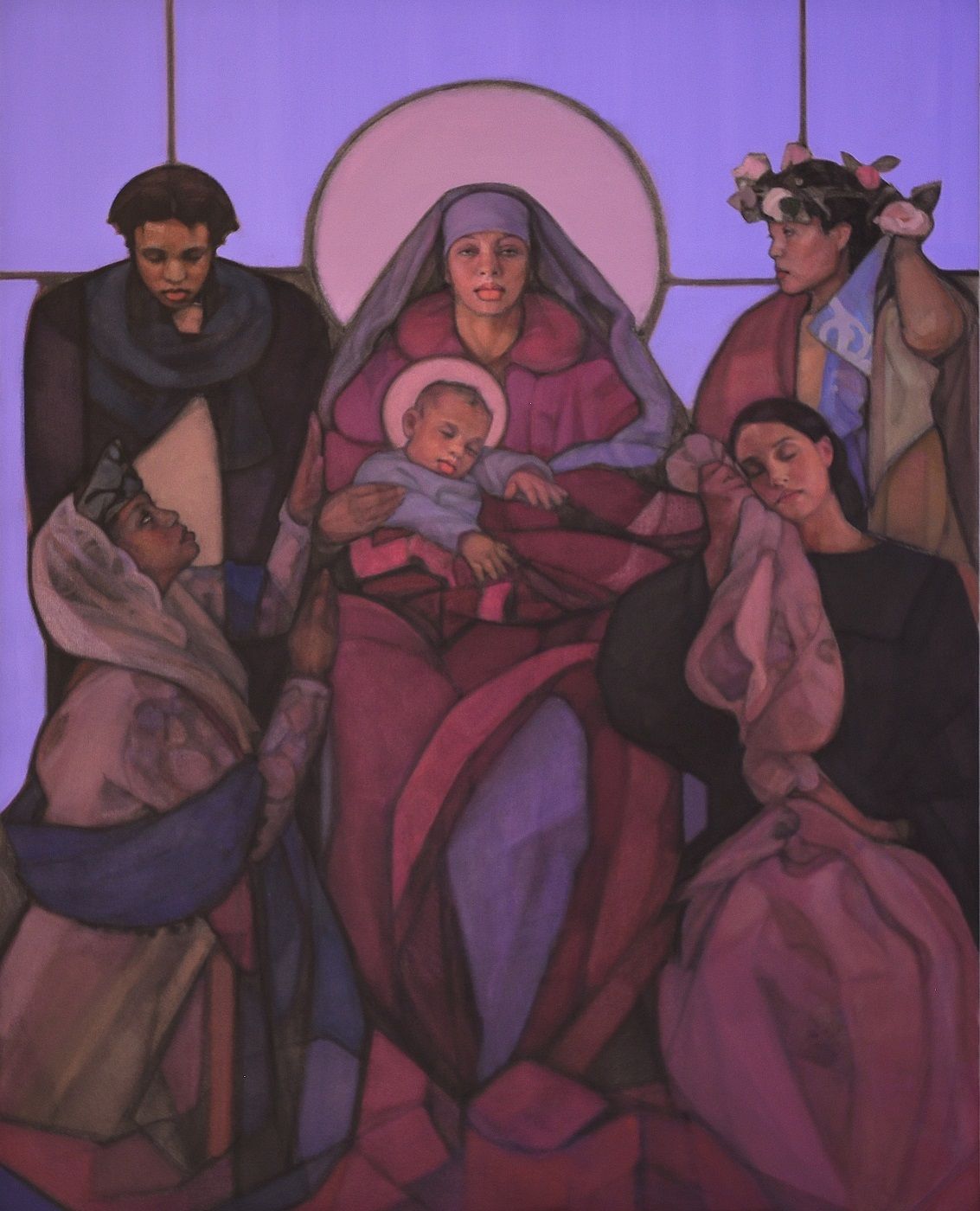
Janet McKenzie, The Divine Journey: Companions of Love and Hope, 2017. Oil on canvas, 48 × 36 in. Memorial Church, Harvard University, Cambridge, Massachusetts.Khrystyna Kvyk (Ukrainian, 1994–), The Descent into Hell, 2023. Acrylic on gessoed wood, 40 × 40 cm. Private collection.
+++
FREE ZOOM CONVERSATION: Social music with Dan Zanes, July 16, 2025, 8 p.m. ET: I met the Baltimore-based folk musicians Dan and Claudia Zanes [previously] two years ago at a local family concert they put on. Joyous, bighearted, faith-filled, community-focused, committed to social justice—I love who they are and what they’re about and all the rich music they share.
In a social mediapost on June 11, Dan posed the question, “Is there anyone out there who wants to become a music maker and help uplift their community?” Followed by a generous offer: “I can teach you how to play guitar and sing songs (and write songs if you want). No cost, this is a different approach. It will be through a series of Zoom lessons (unless you live down the street). Whether you’re a beginner or someone who’s been dabbling and wants to take it out of the house, I can get you to a confident place so you can play for and with people.” The caveat? You just have to promise to put in the practice and to share your music freely in your community! And to teach someone else what you’ve learned.
“There are so many ways to make positive social change,” Dan says, “and creating music in our communities is certainly one of them.” I believe he has already selected a set of students to take on, but having received so many messages of interest, he has also decided to host a Zoom conversation on social music this coming Wednesday evening. On July 9, he wrote on socialmedia:
Social music in chaotic times, people! Let’s talk about it. I’ve been hearing from many folks who want to be more useful in their communities and see music as the way.
Yes! Music can be healing, galvanizing, uplifting, energizing, and calming. Imagine if every community had many more music makers to play for the young folks, the elders, to lead singalongs and dance parties, to offer songs during times of loss and celebration. Of course it’s happening now, and still I believe there’s so much more that is possible.
If you’re interested in joining the meeting, send Dan an Instagram message @danzanes or a Facebook message @danandclaudiazanes and he’ll send you the link.
To give you a sense of Dan and Claudia’s vibes, here’s one of their original songs, which they debuted on their YouTube channel in 2020:
+++
ONLINE RETREAT: “Read for Your Life: Creating a Story-Formed Home” with Sarah Clarkson, August 5, 2025: Join author Sarah Clarkson [previously] for a daylong online retreat exploring children’s literature, childhood reading, and the development of imagination. “My goal,” she writes, “is to provide a vision for the beauty of the reading life, some good research, and a generous stack of practical booklists to help you begin to outfit and build a home library for the children in your life.” The cost is $35. The event begins at 9:30 a.m. UK time, but all live sessions will be recorded and offered on-demand afterward to registrants.
+++
PODCAST EPISODE: “The Green Man,”Gone Medieval, June 23, 2025: In this episode, Dr. Eleanor Janega talks with Imogen Corrigan, author of The Green Man: Myth and Reality (Amberley, 2025), about the enigmatic “green man” figure, or foliate head, which can be found in almost every pre-Reformation English cathedral and in many churches, decorating arches, corbels, roof bosses, choir stalls, and chancel screens. Corrigan claims that “the image has to be one of the most misunderstood, misinterpreted and misrepresented in the history of church carvings,” having nothing to do with pagan fertility rites. She suggests, rather, that the Green Man gestures toward the resurrection of, and resurrection in, Christ—to spiritual rebirth and eternal life.
Misericord from King’s Lynn Minster, England, ca. 1370s, depicting a Green Man disgorging oak leaves. Photo: Lucy Miller. (Click on image for great compilation!)
The two medievalists speak on location at St Mary’s at Minster-in-Thanet and St Nicholas-at-Wade in Kent. The conversation really starts to pick up at 19:47.
+++
This past month has seen the death of two rock ’n’ roll legends whose music, which played regularly on Oldies 100.7 WTRG, formed part of the soundtrack of my 1990s childhood: Brian Wilson (of the Beach Boys) and Sly Stone (of Sly and the Family Stone).
Much has been written about both trailblazers. I just want to mention two things:
1. Love and Mercy, the 2014 film directed by Bill Pohlad about Brian Wilson (played by Paul Dano and John Cusack), is excellent. Elliot Roberts makes the case that it’s the best music biopic ever made, and I’m inclined to agree; New York Times film critic Alissa Wilkinson also cites it as her favorite, at least within the rock genre. The story alternates between Wilson’s production of the Pet Sounds album in the mid-sixties and his psychological treatment under his abusive therapist and conservator Eugene Landy in the late 1980s, which coincided with his meeting Melinda Ledbetter, who would become his wife. The title is taken from one of Wilson’s solo songs from 1988. Here’s the film trailer:
2. Active from 1966 to 1983, Sly and the Family Stone was one of the very few multiracial, mixed-gender bands of the time, modeling integration when the notion was still fairly new in America. Perhaps you’ve heard their most famous hit, “Everyday People,” a call for unity across lines of difference (“There is a blue one who can’t accept the green one / For living with a fat one, tryna be a skinny one . . .”). Sly Stone was the front man—singer, songwriter, multi-instrumentalist, and producer. As is common among so many African American musicians, he got his musical start in church; from infancy, he was immersed in gospel music as a member of the Church of God in Christ, and his musical talent was nurtured there. I learned that in the fifties, he and three of his four siblings even formed a gospel group called the Stewart Four, locally releasing a single in August 1956. Here’s the B-side, “Walking in Jesus’ Name,” with a thirteen-year-old Sly singing lead:
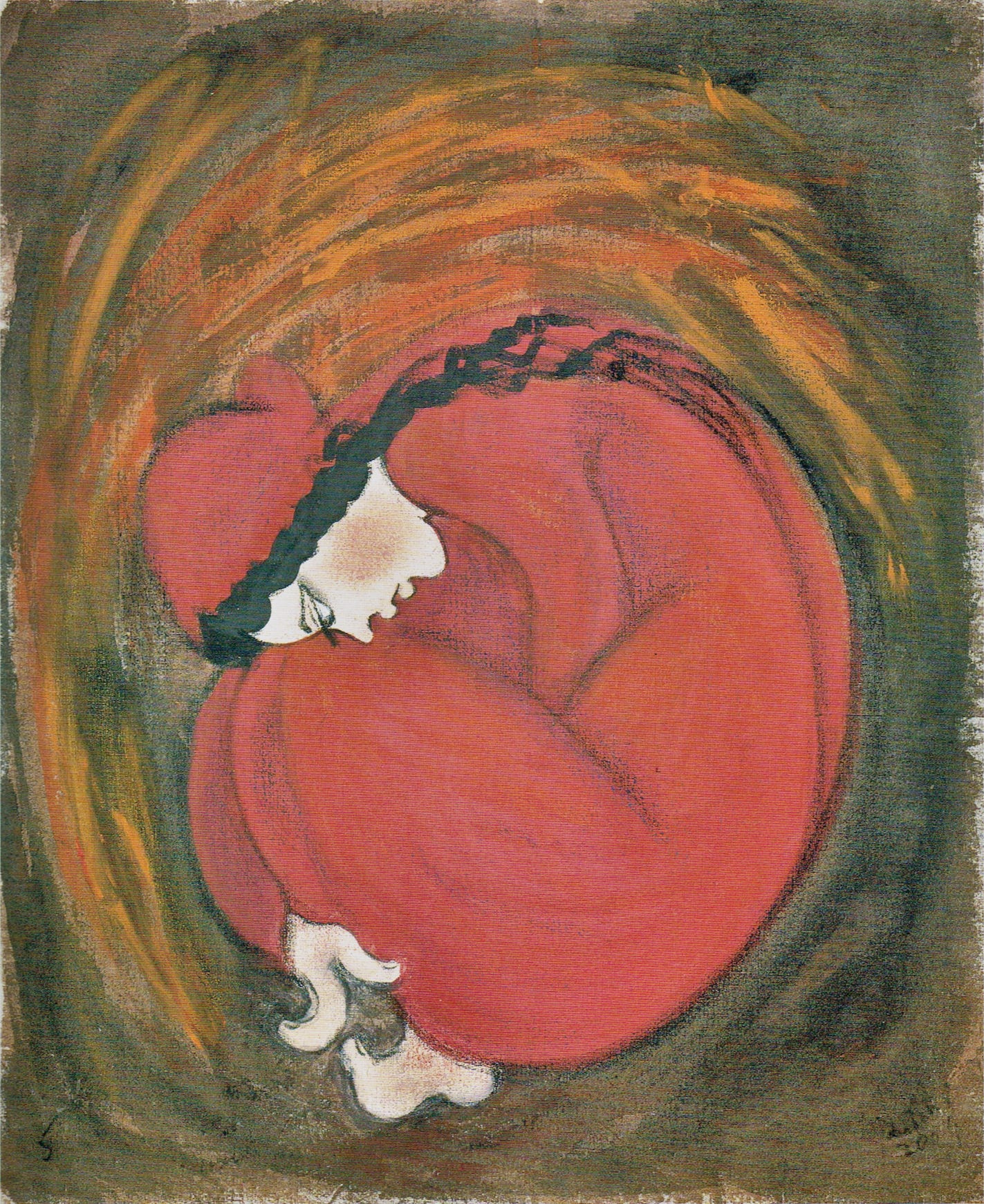
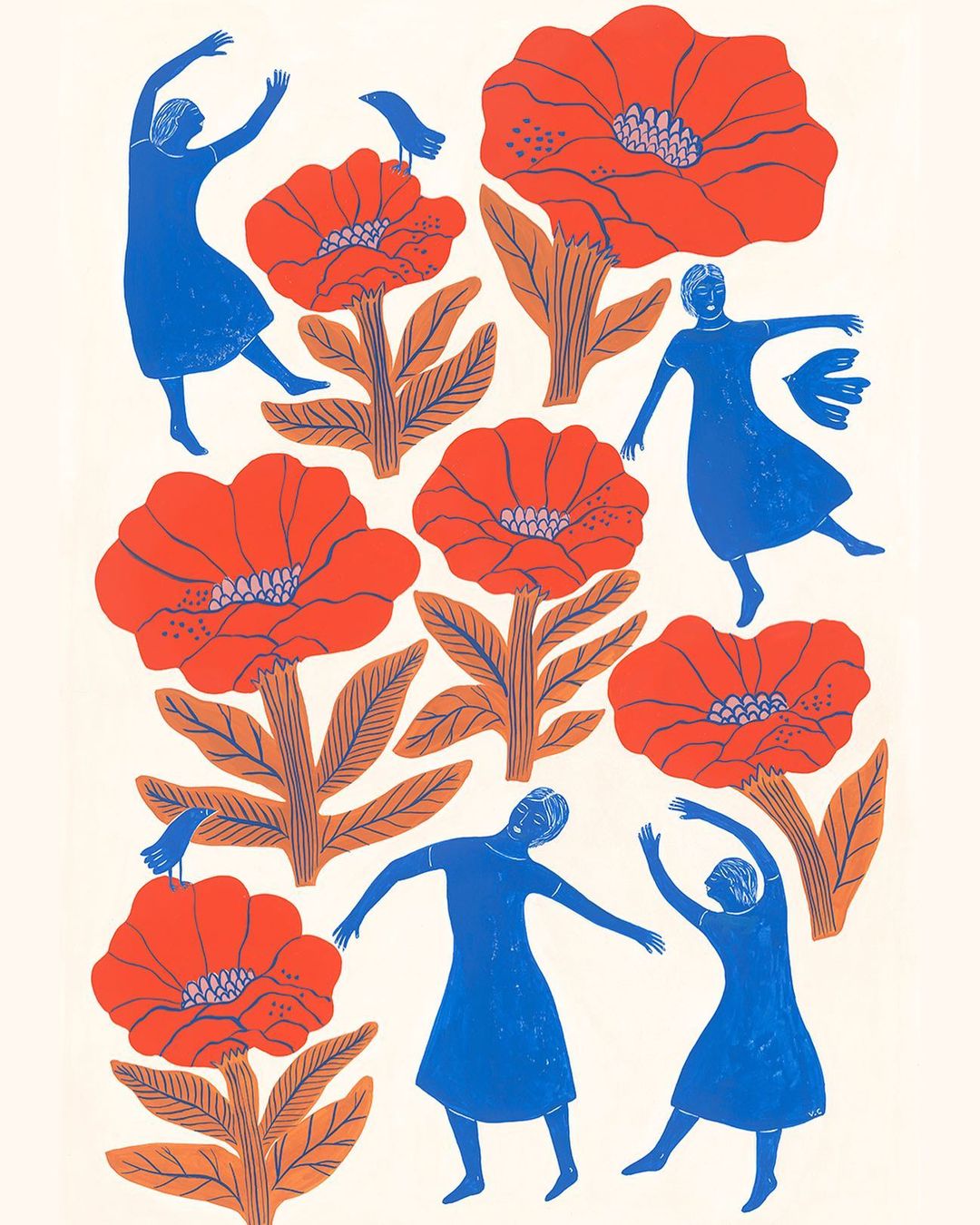
Virginie Cognet, Danse, 2023. Gouache on satin-finish watercolor paper, 70 × 50 cm.
Last night did Christ the Sun rise from the dark,
     The mystic harvest of the fields of God,
And now the little wandering tribes of bees
     Are brawling in the scarlet flowers abroad.
The winds are soft with birdsong; all night long
     Darkling the nightingale her descant told,
And now inside church doors the happy folk
     The Alleluia chant a hundredfold.
O Father of thy folk, be thine by right
The Easter joy, the threshold of the light.
This English translation of Sedulius Scottus’s “Carmen paschale” originally appeared in Mediaeval Latin Lyricsby Helen Waddell (Henry Holt, 1929) and is in the public domain.
Sedulius Scottus (fl. 840–860) was an early medieval Irish monk, poet, teacher, and biblical commentator. (He is not to be confused with the fifth-century poet Caelius Sedulius, who also wrote a [much longer] Carmen paschale, consisting of five books.) Driven out of his monastery by Viking invaders, Sedulius settled in the city of Liège under the protection of Bishop Hartgar. While living in exile on the Continent, he established himself as a leading literary figure of the Carolingian Renaissance. One of his most important works is De Rectoribus Christianis (On Christian Rulers), an instructional treatise on governing and a noteworthy contribution to Christian ethics. Sedulius was at least trilingual, proficient in Irish, Greek, and Latin. Eighty-three of his poems survive, composed in a variety of classical meters and ranging from mock heroic epics and philosophical puzzles to hymns of praise and drinking songs.
Helen Waddell (1889–1965) was a medieval literature scholar, historical novelist, playwright, and translator (from medieval French and Latin to English) who was awarded the Benson Medal of the Royal Society of Literature. She was born in Tokyo to an Irish Presbyterian missionary family, spending the first eleven years of her life in Japan. She was later educated in Belfast, Oxford, and Paris and became part of a circle of friends in London that included W. B. Yeats, Virginia Woolf, and Siegfried Sassoon. In addition to writing, she worked as a literary adviser and reader for the esteemed publisher Constable. She is the subject of an award-winning biography by Dame Felicitas Corrigan, published in 1986.
Addendum, 1/19/26: The hymn-writer Dan Damon has composed a beautiful, singable setting of this text, available from Hope Publishing Company. He told me he was inspired by reading this post.
HYMN TEXT: “Lights” by Kate Bluett: Kate Bluett [previously] is a Catholic poet and lyricist from North Texas who frequently participates in cross-denominational music collaborations. Her work has been published by Oregon Catholic Press and GIA Publications and recorded by the Porter’s Gate and Paul Zach, among others. I enjoy following her at https://katebluett.home.blog/, where she regularly shares new metrical verses she has written, tied to the liturgical calendar. Last Eastertide she published a text called “Lights,” which muses on candle flames, stars, and other light sources as reflections of the light of the risen Christ.
+++
AUDIO DRAMA: Anastasis: The Harrowing of Hades by Creative Orthodox:Creative Orthodox is the moniker of Michael Elgamal, a Coptic Orthodox artist and storyteller born in Egypt and living in Canada. Last May he released an audio drama, adapted from a graphic novel, about Christ’s epic descent into the underworld to reclaim the Old Testament righteous. This theatrical medium, which relies on voice acting, sound effects, and music to tell a story, was a very popular form of entertainment in the 1920s–40s before the advent of television but is much rarer today—which is a shame, because I find it really engaging! See the YouTube description for a full list of credits (script, score, actors, etc.).
Dionysius (Russian, ca. 1440–ca. 1508), Christ’s Descent into Hades, from Ferapontov Monastery, ca. 1495–1504. Tempera on wood, 31.2 × 10.5 cm. State Russian Museum, Saint Petersburg.
+++
SONGS:
>> “Christ Is Risen” (لمسيح قام) by Ribale Wehbé:Ribale Wehbé is a Lebanese singer specializing in Byzantine chant. Here she sings a traditional Easter chant in Arabic, arranged by Joseph Yazbeck.
>> “Hallelujah, Hosanna” (हाल्लेलुयाह होशन्ना) by One Tribe: Originally written in Tamil by pastors Dudley Thangaiah and Paul Thangaiah, “Hallelujah, Hosanna” is sung here in Hindi by the Indian Christian worship collective One Tribe. Turn on “CC” for closed captioning, and view the full credits in the YouTube video description. [HT: Global Christian Worship]
>> “He Did Rise” by Monroe Crossing: A bluegrass song about the women’s discovery of the empty tomb on Easter morning, written by Mark Anderson and performed here by his band, Monroe Crossing, at a music festival in Lexington, Kentucky, in 2009. Anderson is on the double bass. [HT: Global Christian Worship]
+++
SPOTIFY PLAYLIST: May 2025 (Art & Theology): An assortment of psalms, hymns, and spiritual songs, old and new. For my Easter-specific playlist from 2022 (with a smattering of new additions since, including a large batch from Cardiphonia at the bottom), see here.
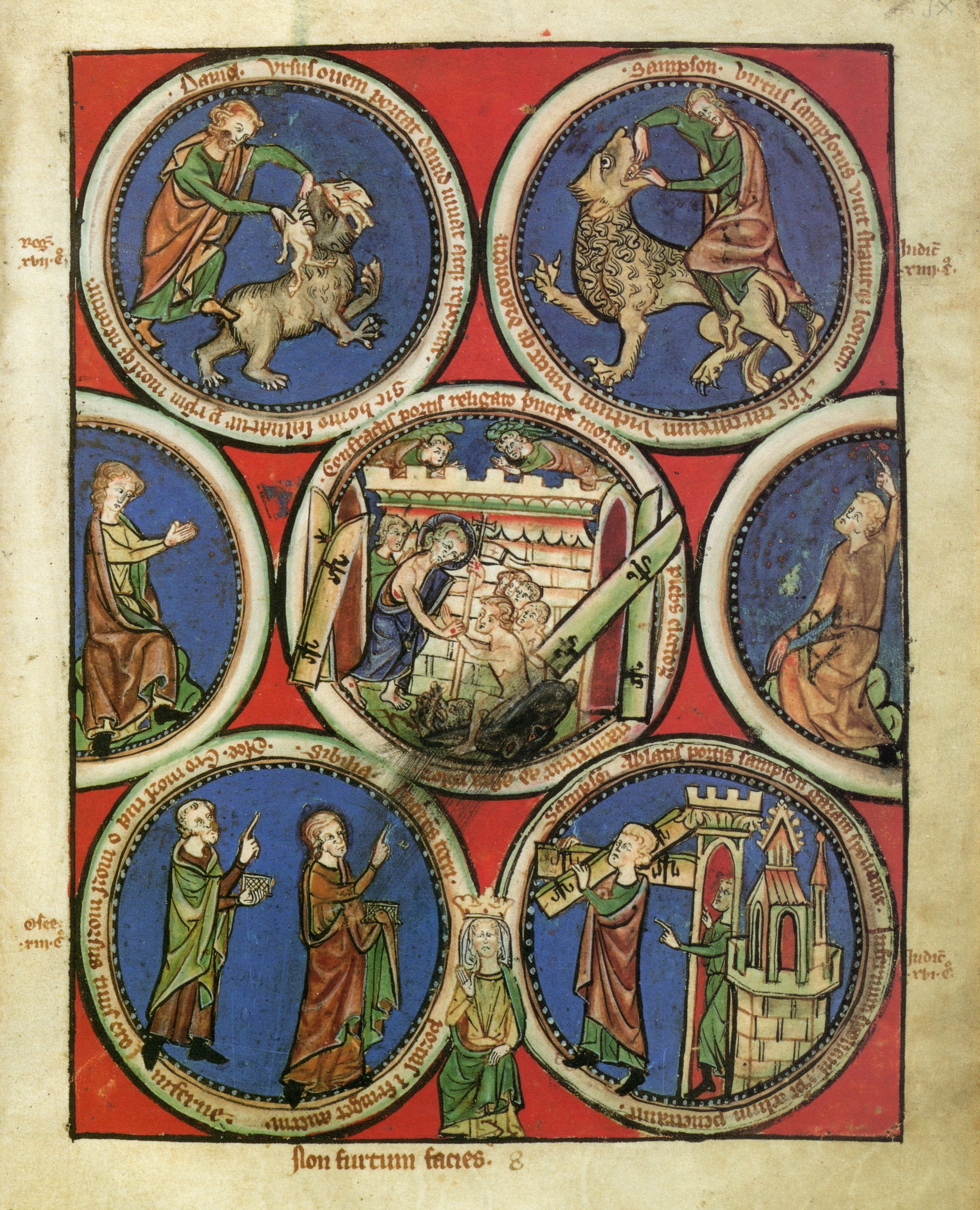
The medieval manuscript known as the Eton Roundels is a brief typological picture sequence produced in the English Midlands (possibly Worcester) in the mid-thirteenth century. Typology is a mode of Christian biblical interpretation in which certain Old Testament figures, events, or objects are seen as foreshadowing New Testament figures or events, especially Christ. Art historian Avril Henry says the Eton Roundels came into being at about the same time as the Biblia pauperum, a tradition of picture Bibles forming the largest and best-known compendium of typological imagery and verses.
The Eton manuscript consists of twelve pages of pictures, each with a large roundel at the center picturing a New Testament event (the “antitype”) and four surrounding smaller roundels depicting the Old Testament (and occasionally classical) “types” and prophets. Each page also includes a half-roundel on the left and right inhabited by anonymous figures who probably simply represent onlookers. A crowned female Virtue is seated at the bottom of each page, under whom is written a biblical commandment whose relevance to the pictures is sometimes difficult to discern. These pages are bound together with an Apocalypse, but it’s unknown whether the two works were conceived together from the start; it’s only certain that they were combined by the late seventeenth century.
The maker, scriptorium or city of origin, original recipient (and whether religious or lay), and purpose of the Eton Roundels are also unknown. Presumably the manuscript’s function was meditational.
The artist didn’t invent any of the typological correspondences illustrated in the roundels; they were all already common currency.
Below are the two Resurrection-themed pages, with a breakdown of the illustrations, including translations of the Latin inscriptions. The translations are by Avril Henry and are from his book The Eton Roundels: Eton College, MS 177 (‘Figurae bibliorum’)—A colour facsimile with transcription, translation and commentary (Scolar Press, 1990). This book is an excellent resource for learning more about the manuscript and is the only place I’m aware of where you can view all twelve pages.
Thank you to Sally Jennings, Collections Administrator at Eton College Library, and Dr. Carlotta Barranu, Library Curator of Rare Books and Manuscripts at the time of my research, who provided me with photographs and translations prior to my gaining access to Henry’s book.
Folio VIII (5v)
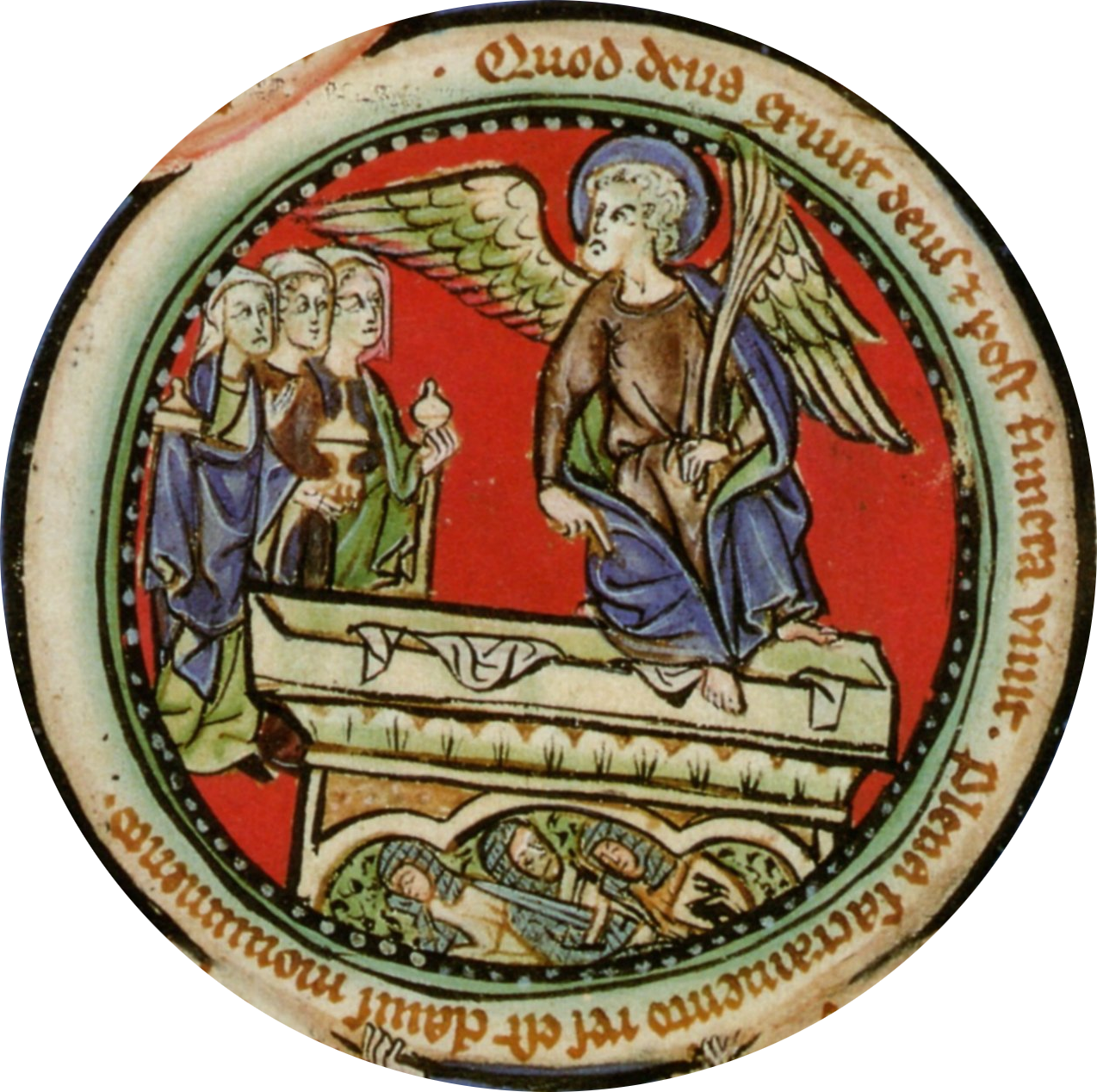
“Three Women at the Tomb,” etc., from the Eton Roundels manuscript, English Midlands, 1260–70. Eton College Library, MS 177, fol. VIII. Reproduced by permission of the Provost and Fellows of Eton College.
↑ Center:Three Women at the Tomb (Mark 16:1–8)
“Because God came forth and God lives after burial, the event filled with mystery is the key to the tomb.”
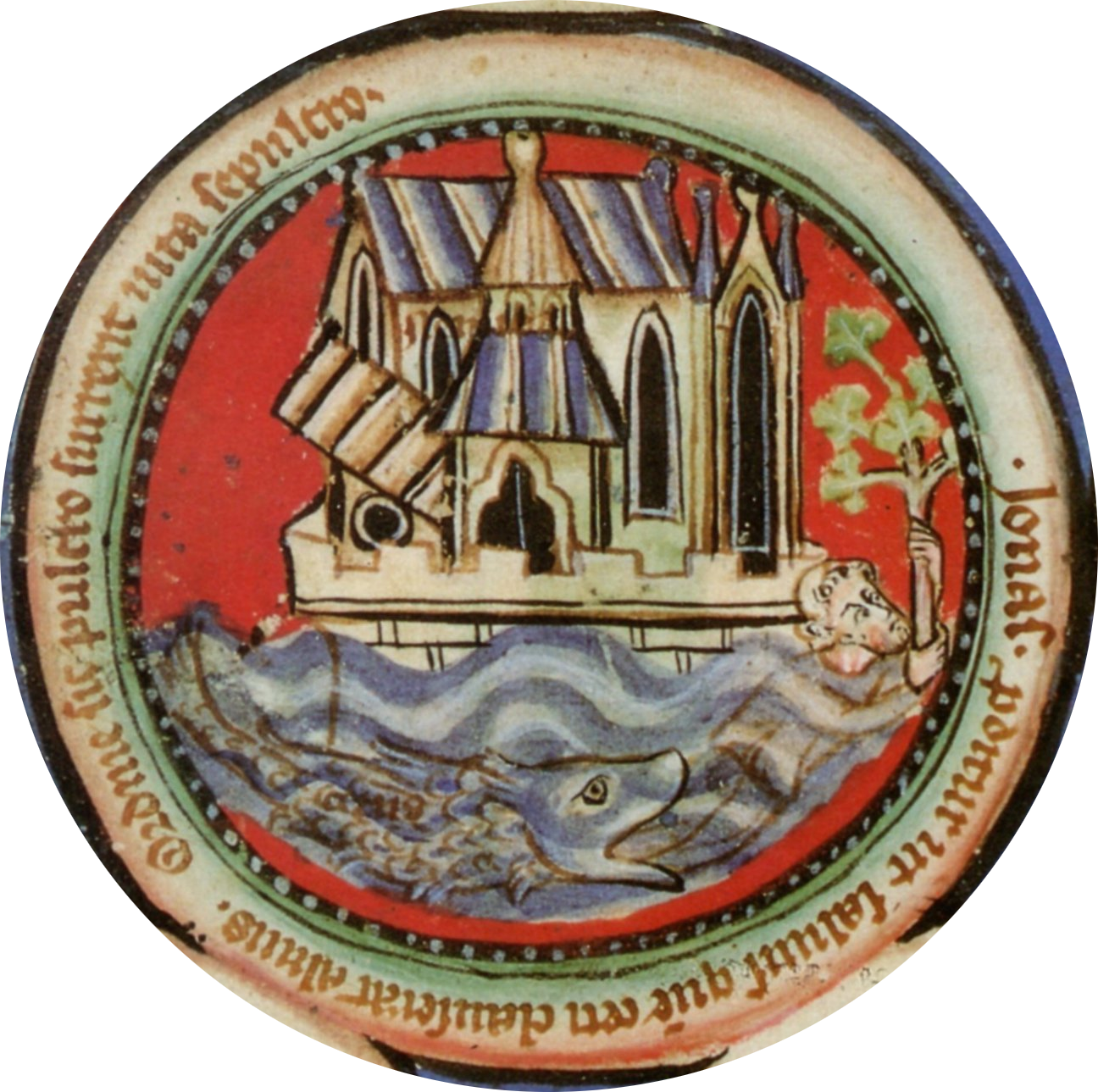
↑ Top left:Jonah Leaves the Fish (Jonah 2:11; cf. Matt. 12:38–41)
“Jonas. Just as he whom the belly of the sea-creature had enclosed is brought forth unharmed, at a glorious command life rose up from the tomb.”
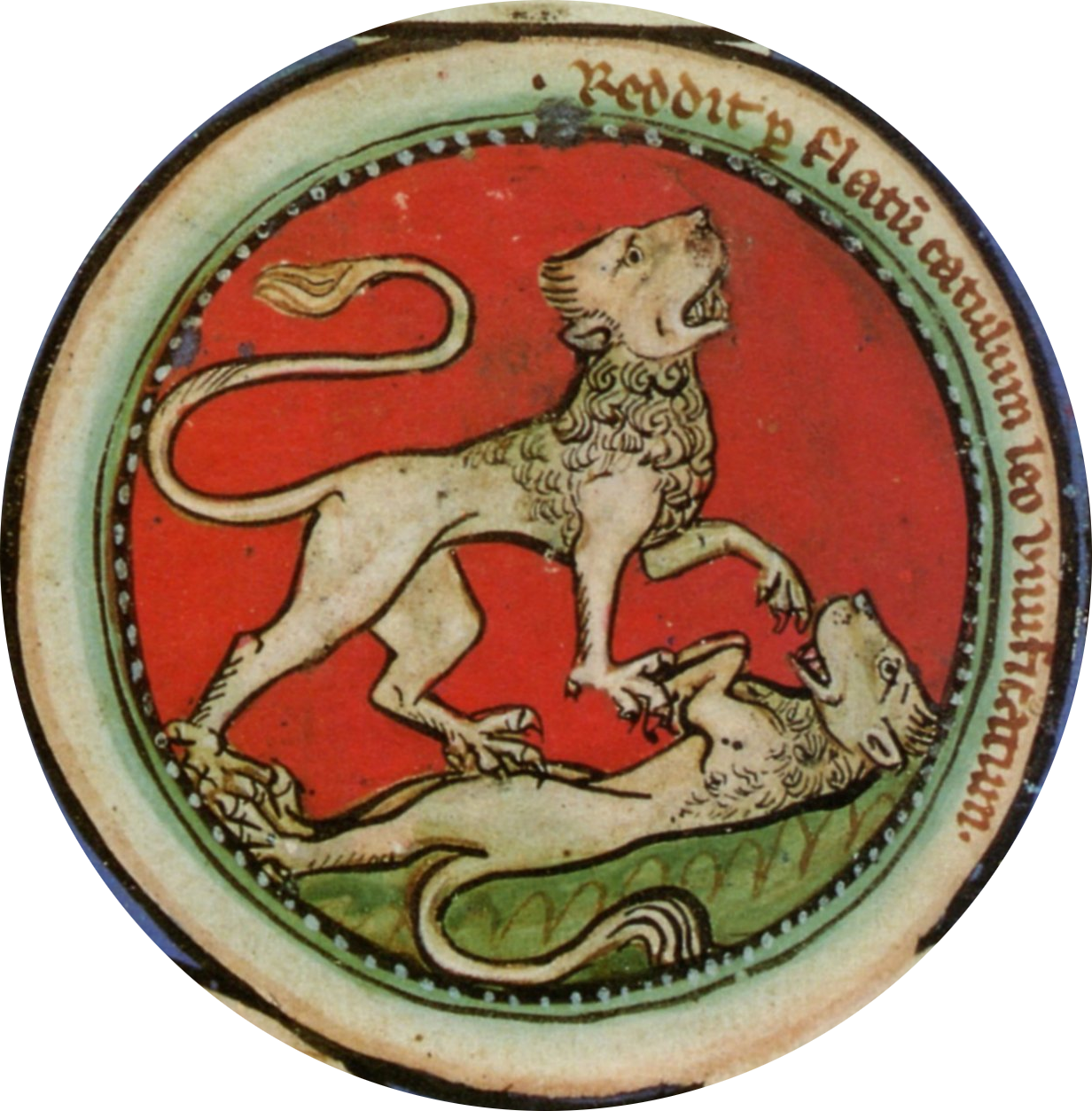
↑ Top right:A Lion Revivifies Its Young
“By [its] breath the lion brings its cub back to life.”
This statement refers to a piece of lore found in the third-century Physiologus and its descendants, the medieval bestiaries, according to which lion cubs are born dead but are brought back to life three days later by their father’s breath. This (fictitious) leonine behavior was seen to reflect the Father raising the Son from the tomb on Easter morning.
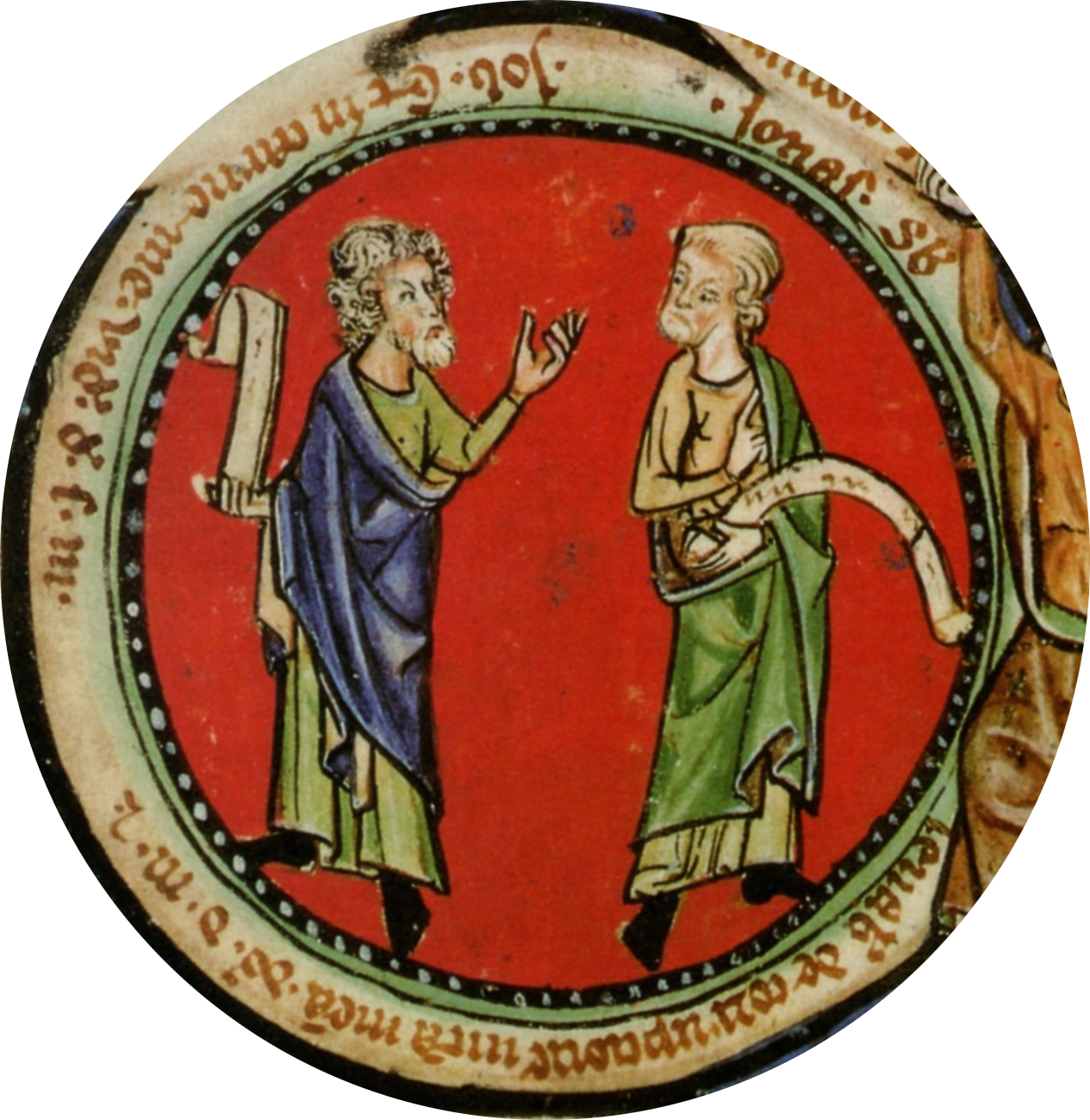
↑ Bottom left:Job and Jonah (Job 19:26; Jonah 2:7)
“Job: And in my flesh I shall see God my [savior]. Jonah: Thou shalt lift up my life from corruption, O Lord my God.”
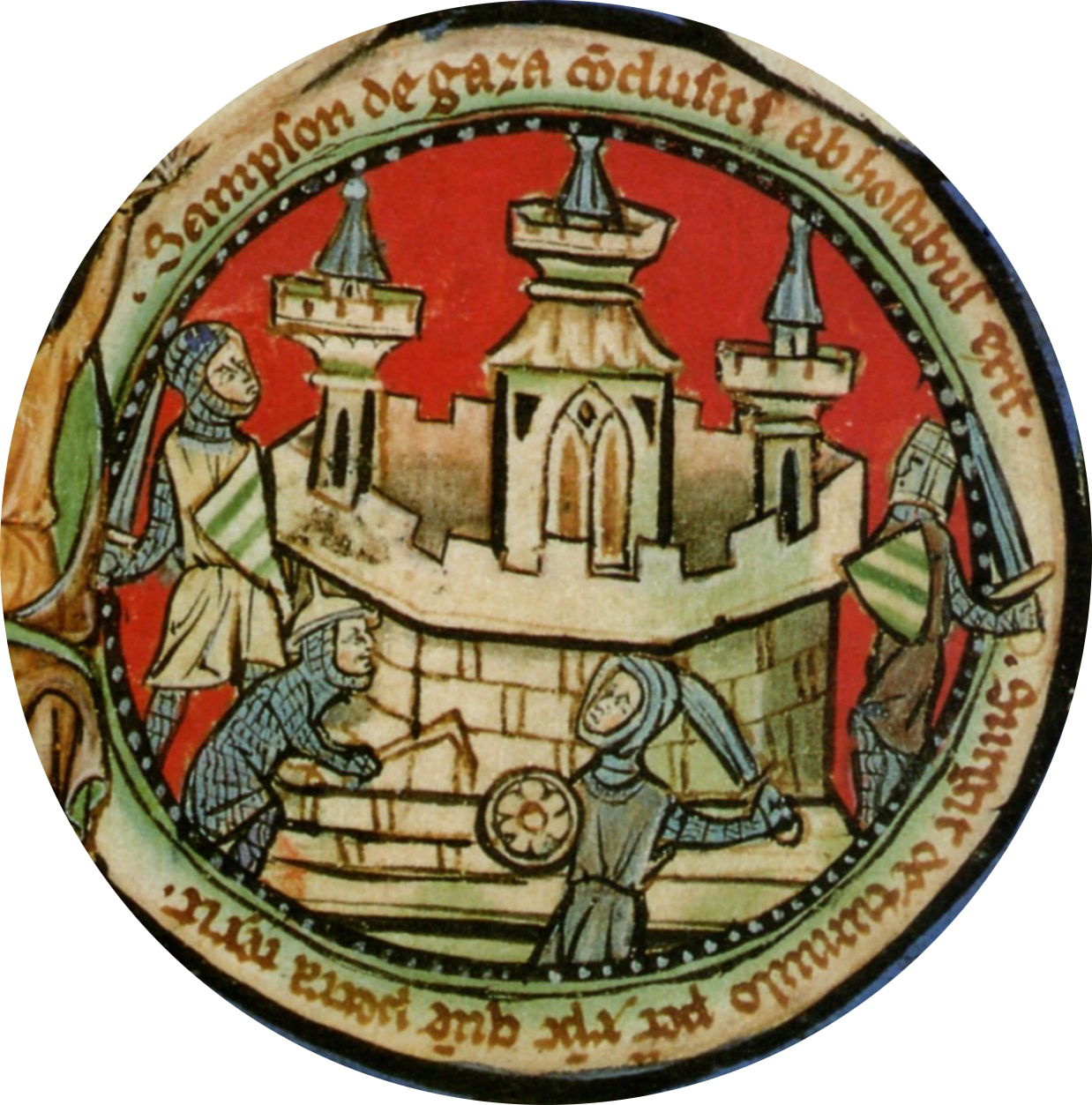
↑ Bottom right:Samson’s Escape from Gaza (Judg. 16:1–3)
“The imprisoned Samson escaped from Gaza and his enemies. Christ the stone, whom the stone covered, rose from the tomb.”
This roundel portrays Philistine soldiers of Gaza encircling the city gate to kill Samson the Israelite. But Samson escapes their watch unharmed, in a dramatic episode depicted on the following page (see below). The scene here is rarely depicted, whereas what follows in the narrative—Samson carrying the gates of Gaza—was a popular type of the Resurrection. Notice how the soldiers parallel the sleeping ones in the central scene, both groups bested by God’s power.
Folio IX (6r)
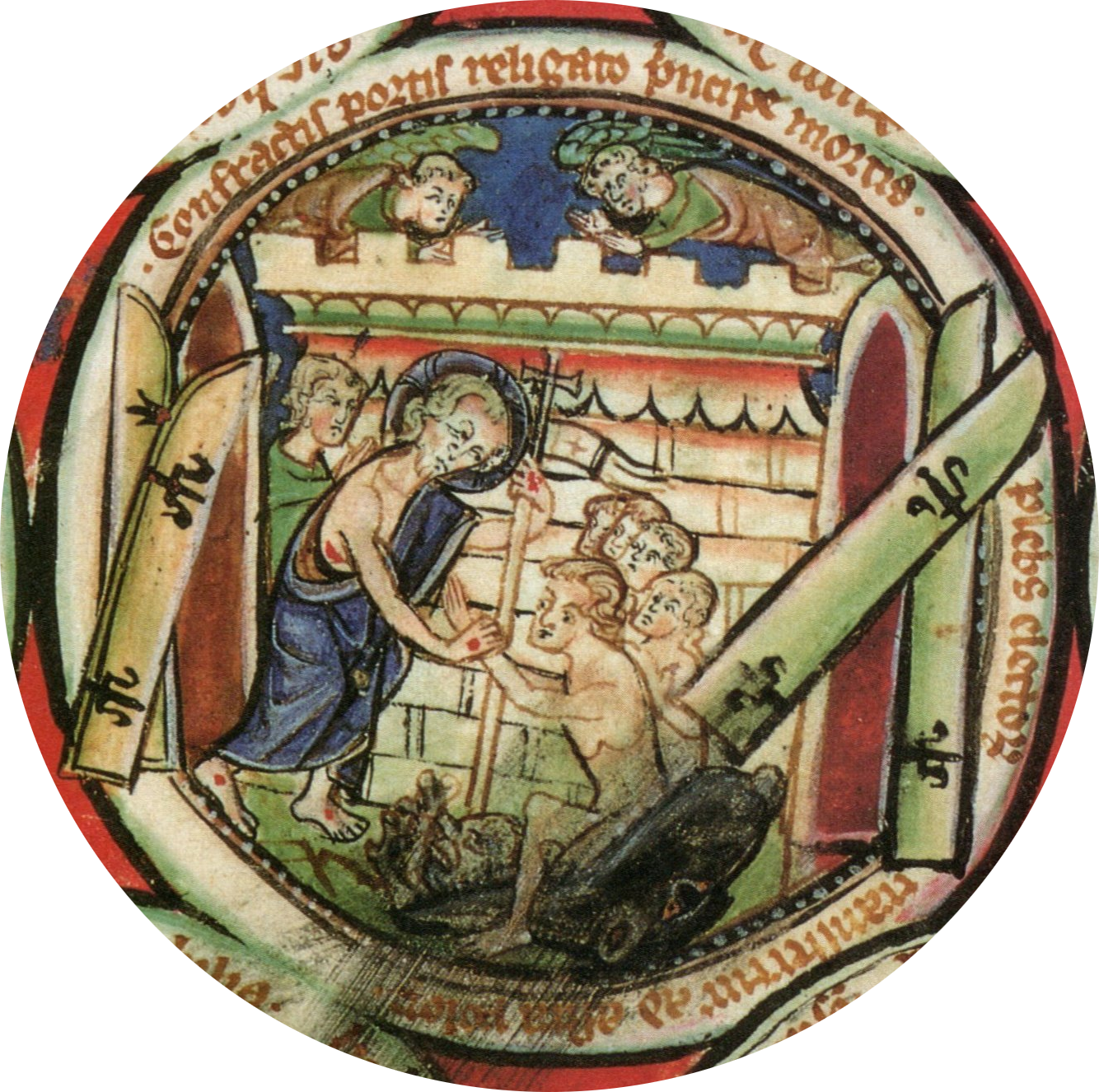
“Christ Opens Limbo,” etc., from the Eton Roundels manuscript, English Midlands, 1260–70. Eton College Library, MS 177, fol. IX. Reproduced by permission of the Provost and Fellows of Eton College.
“The gates having been broken and the prince of death bound, the body of the elect is carried to the stars in the heavens.”
Christ’s Descent into Limbo, or the Harrowing of Hell, is an episode inferred from a few enigmatic biblical verses and elaborated in the apocryphal Gospel of Nicodemus. In the Eastern Orthodox Church, it is the primary icon of the Resurrection: Christ breaking down the gates of hell to rescue his predeceased beloveds from death and Satan. Medieval artists in the West were also fond of picturing the Harrowing, often portraying the entrance to hell as a monstrous maw (called a “hellmouth”).
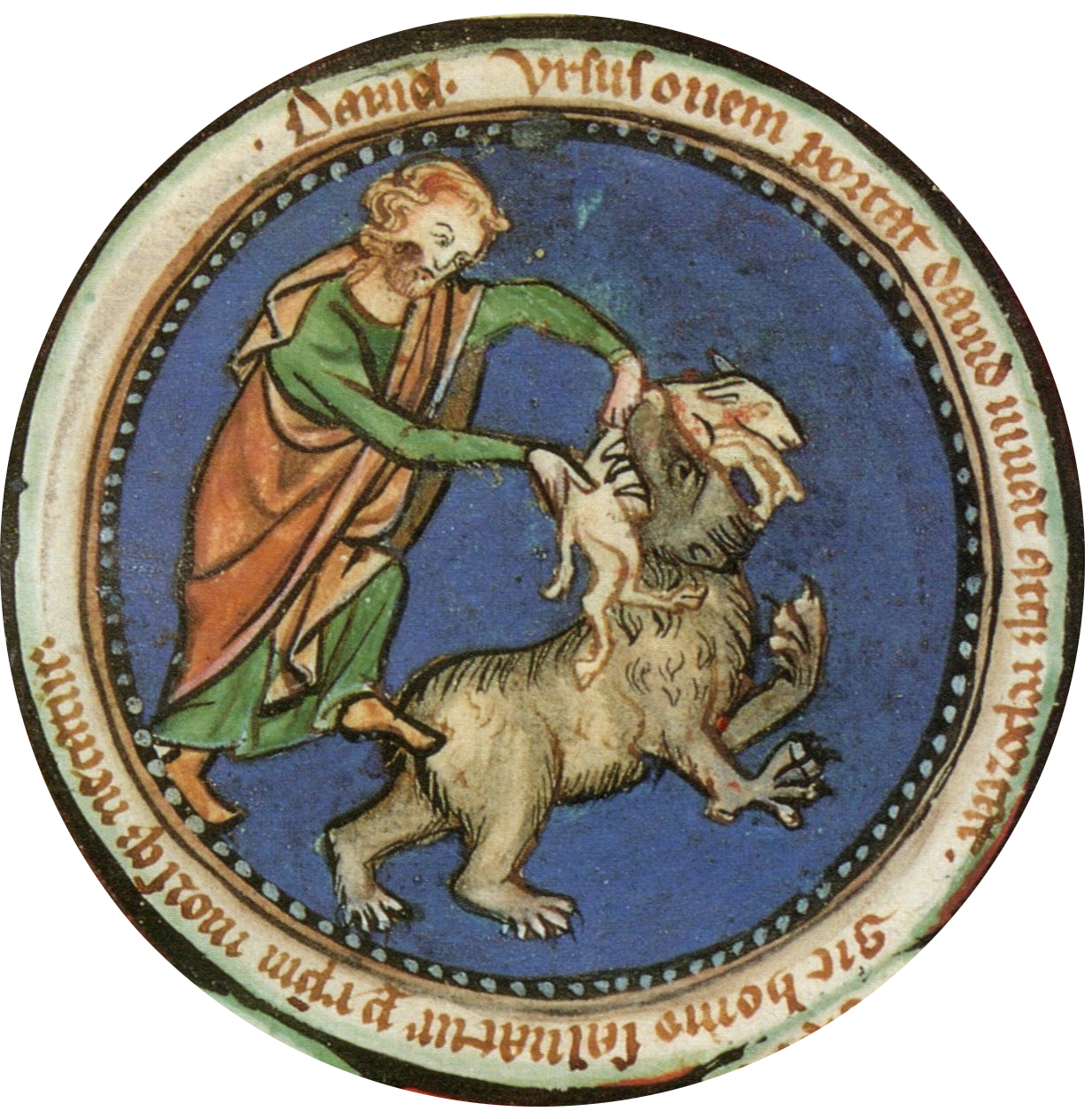
↑ Top left:David Saves the Lamb from the Bear (1 Sam. 17:34–37)
“David. The bear is carrying off a sheep. David assists [the sheep], and takes it back. In the same way, man is saved by Christ and death is slain.”
David, who was a shepherd before he was anointed king of Israel, figures Christ in how he fiercely protected the lambs in his care, intervening to save them whenever they were snatched away by a lion or bear; he’d pry open the beast’s jaws, free the lamb, and then strike the beast dead, he relays to Saul. In a similar manner, Christ pried open the jaws of hell to save his precious sheep.
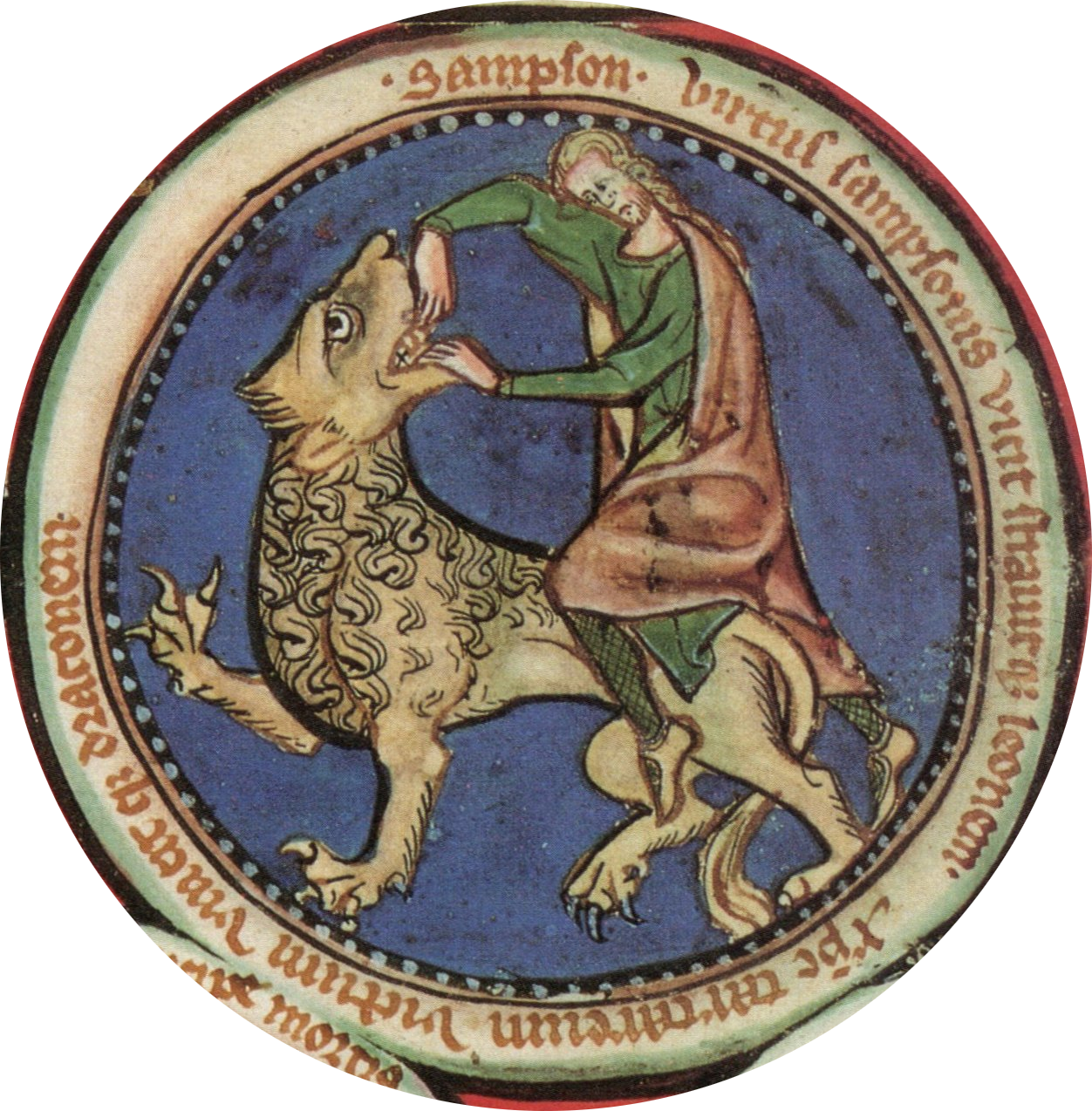
↑ Top right:Samson Kills the Lion (Judg. 14:5–8)
“Samson. The strength of Samson conquered the lion and tore [it] to pieces, and Christ conquers defeated hell together with the dragon.”
When Samson went down to the vineyards of Timnah to seek a wife, he encountered a fearsome lion, and “the spirit of the LORD rushed on him, and he tore the lion apart barehanded” (Judg. 14:6). This was Samson’s first display of divine empowerment.
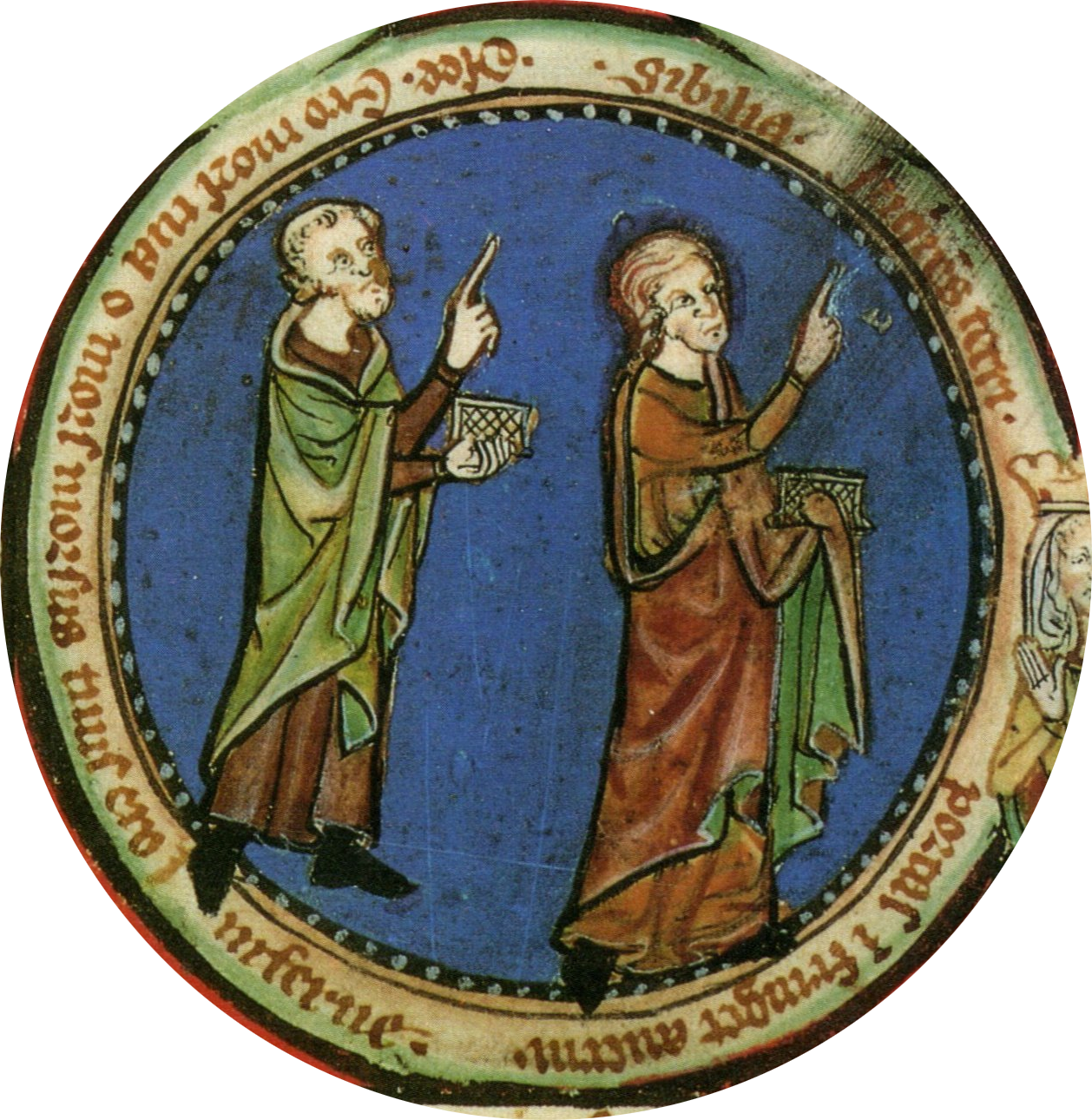
↑ Bottom left:Hosea and the Erythraean Sibyl (Hosea 13:14; Augustine, PL XLI 579)
“Hosea: O death, I will be your death; O hell, I will be your torment. Sibyl: The seeker will break the gates of the hideous underworld.”
The Sybilline Oracles is a collection of ancient Greek prophecies ascribed to the pagan sibyls (but many of which were actually written by Jews and Christians). Several of the church fathers cited them in defense of Christianity. The Erythraean Sibyl, for example, is said to have foretold the coming of Christ through an acrostic whose initial letters spell out “Ιησόύς Χριστός Θεου Ύίος Σωτηρ Σταύρος” (Jesus Christ, God’s Son, Savior, Cross). (See Eusebius’s Oration of Constantine, chap. 18.) She appears in the floor mosaic at Siena Cathedral, the stained glass at Beauvais Cathedral, Michelangelo’s Sistine Chapel, the Van Eycks’ Ghent Altarpiece, and a number of other medieval and Renaissance Christian artworks.
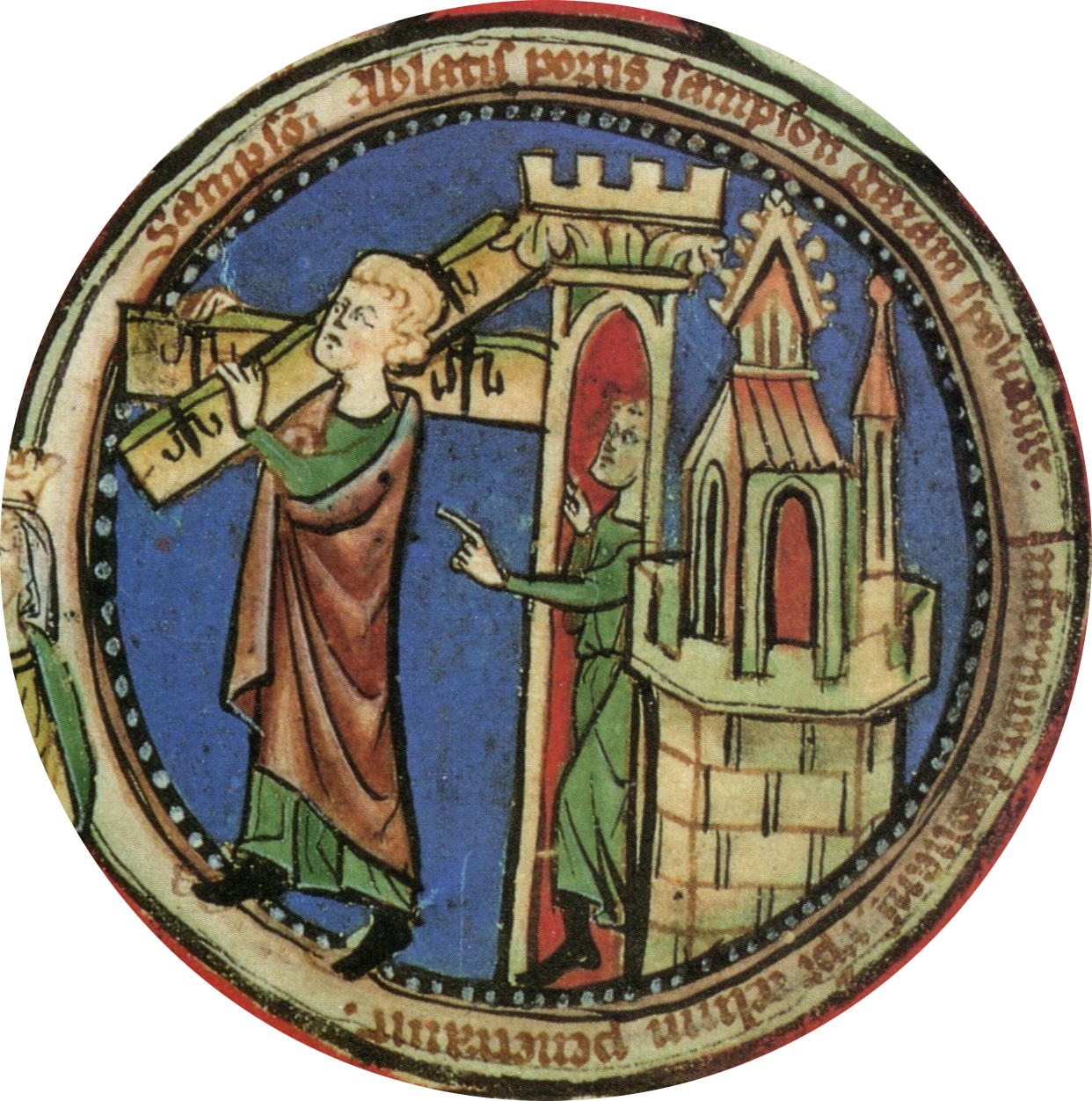
↑ Bottom right:Samson and the Gates of Gaza (Judg. 16:1–3)
“By carrying off the gates, Samson robbed Gaza. Robbing hell, Christ entered heaven.”
To break free of the Gazites, Samson tore the doors of the city gates off their hinges and carried them away, a demonstration of triumph. This feat prefigured Christ’s breaking out of his tomb. It can also be read, as on this Eton folio, as a prefigurement of Christ’s storming the gates of hell to release those held captive by the devil.
VIDEO: “The Lord is Risen! Proclaimed by people from 29 countries”: This video was put out in 2020 by ICF Rotterdam, an intercultural church in the Netherlands whose congregation consists of members from over forty nations! They asked a handful of them to recite the Paschal greeting in their native tongue, so represented here are Indonesian, Chinese, Zulu, Igbo, Urdu, Nepali, Kurdish, Romanian, and more. [HT: Global Christian Worship]
Wycliffe Bibliafordítók (Wycliffe Bible Translators) in Hungary produced a similar video last year:
+++
SERMON: “Let Beauty Awake” by N. T. Wright: One of the things I love about the Anglican cleric N. T. Wright’s preaching and teaching is the importance he places on beauty. (I actually met Wright once—and it was at an arts conference.) In this sermon, which he preached at Durham Cathedral on Easter Sunday 2009, he takes as his text what I’ve heard him say is his favorite chapter in the Bible, John 20, and discusses how in Jesus’s rising, the glory of God was let loose in all the world.
“Easter carries with it a strange and powerful beauty,” he says. “I hope that, by exploring the biblical roots of why this is so, I may have surprised some of you at least into asking, afresh, What can we do to celebrate, more consciously and deliberately, the reawakening of beauty which comes with the light of Easter Day? How can we take this forward, as an explicit project, so that a world so full of ugliness and functionality, and in consequence so full of unbelief or false belief, can once again be wooed into belief and love?”
He opens the sermon by quoting a stanza from a poem by Robert Louis Stevenson, and near the close, he reprises it in his own words, which were developed into a song by Steve Bell:
Let Beauty awake in the morn from the cool of the grave, Beauty awake from death; Let Beauty awake, For Jesus’ sake, In the hour when the angels their silence break And the garden is bright with His Breath.
+++
RECIPE: “Tsoureki: The Symbolic Greek Easter Bread”: On her blog The Liturgical Home (and on Instagram), Ashley Tumlin Wallace shares a recipe for tsoureki, a brioche-like sweet bread made by many Greek Christians on Easter. It is soft and fluffy, flavored with citrus, and decorated with red-dyed eggs!
SPOKEN WORD + SONG: “Because He Lives” by Sharon Irving: Singer-songwriter, worship leader, and spoken word artist Sharon Irving [previously] recorded this video for City First Church Spring Creek’s virtual worship service for Easter 2020. It begins with an original spoken word piece, and then is followed by her singing the Gaither classic “Because He Lives.”
+++
SONG: “Sbab Dia Hidup” (Because He Lives) by Prison Akustik: The song “Because He Lives,” written in 1971 by Bill and Gloria Gaither, has made its way all around the world and has been translated into many languages. Here is the group Prison Akustik [previously] singing it in Indonesian.
+++
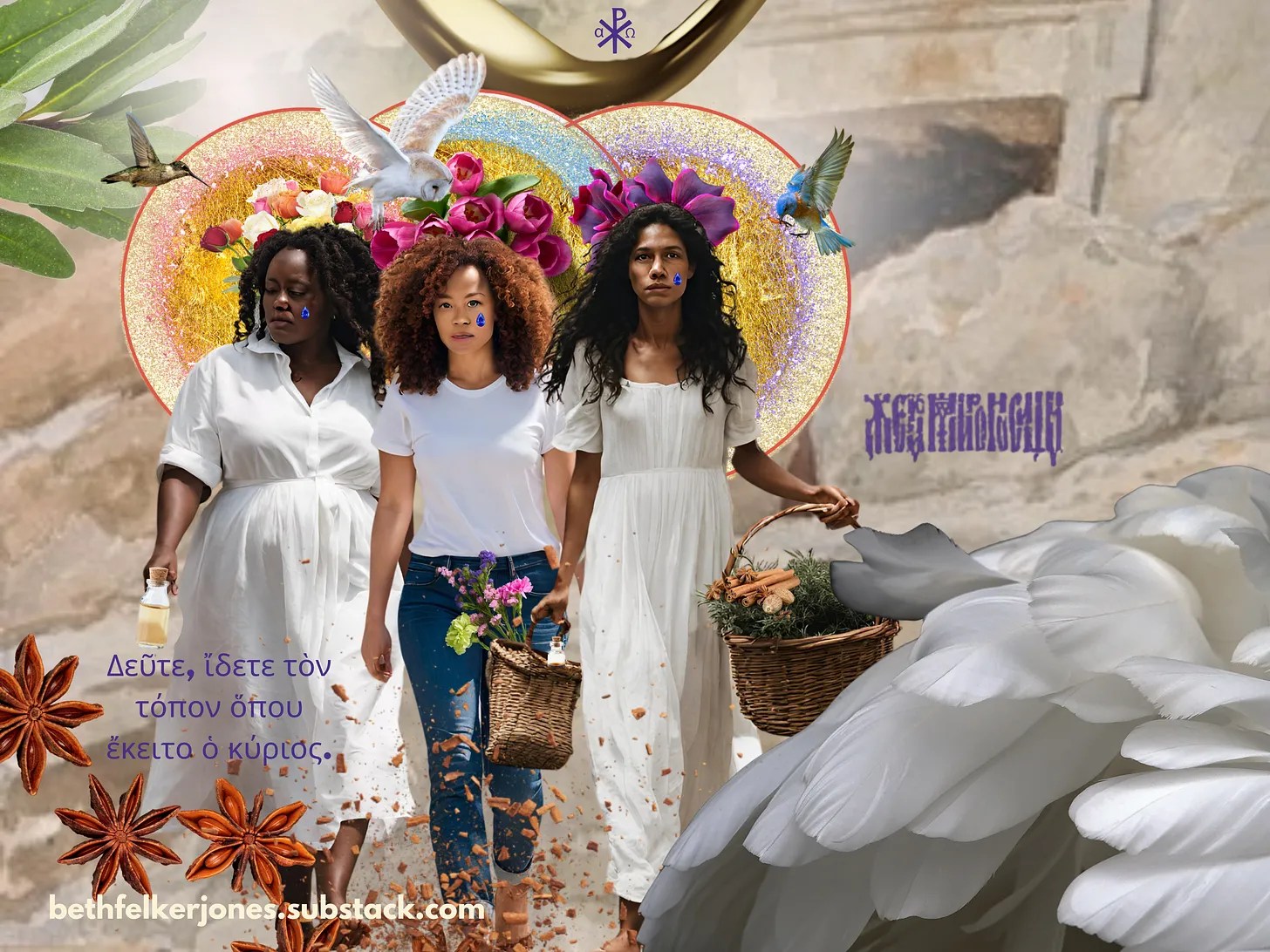
SUBSTACK POST: “Myrrhbearers & Magi” by Beth Felker Jones: In her Church Blogmatics post from last week, theologian Beth Felker Jones [previously] shares three new digital collages she made: one of the three myrrh-bearing women who discovered Jesus’s empty tomb, one of the three magi who brought gifts to the newborn Christ, and one that combines both groups of devoted witnesses. She provides descriptions of each and two original prayers, including the one below.
Digital collage (with AI-generated elements) by Beth Felker Jones, 2025
Holy Father, who accompanied your daughters on their way to the tomb, and in the power of your Spirit, turned their sorrow into joy, bring us too into the joy of those who found the tomb empty, and incorporate us, with them, into your resurrection life. With our sisters at the tomb that day, help us to say, “I have seen the Lord!” Amen.
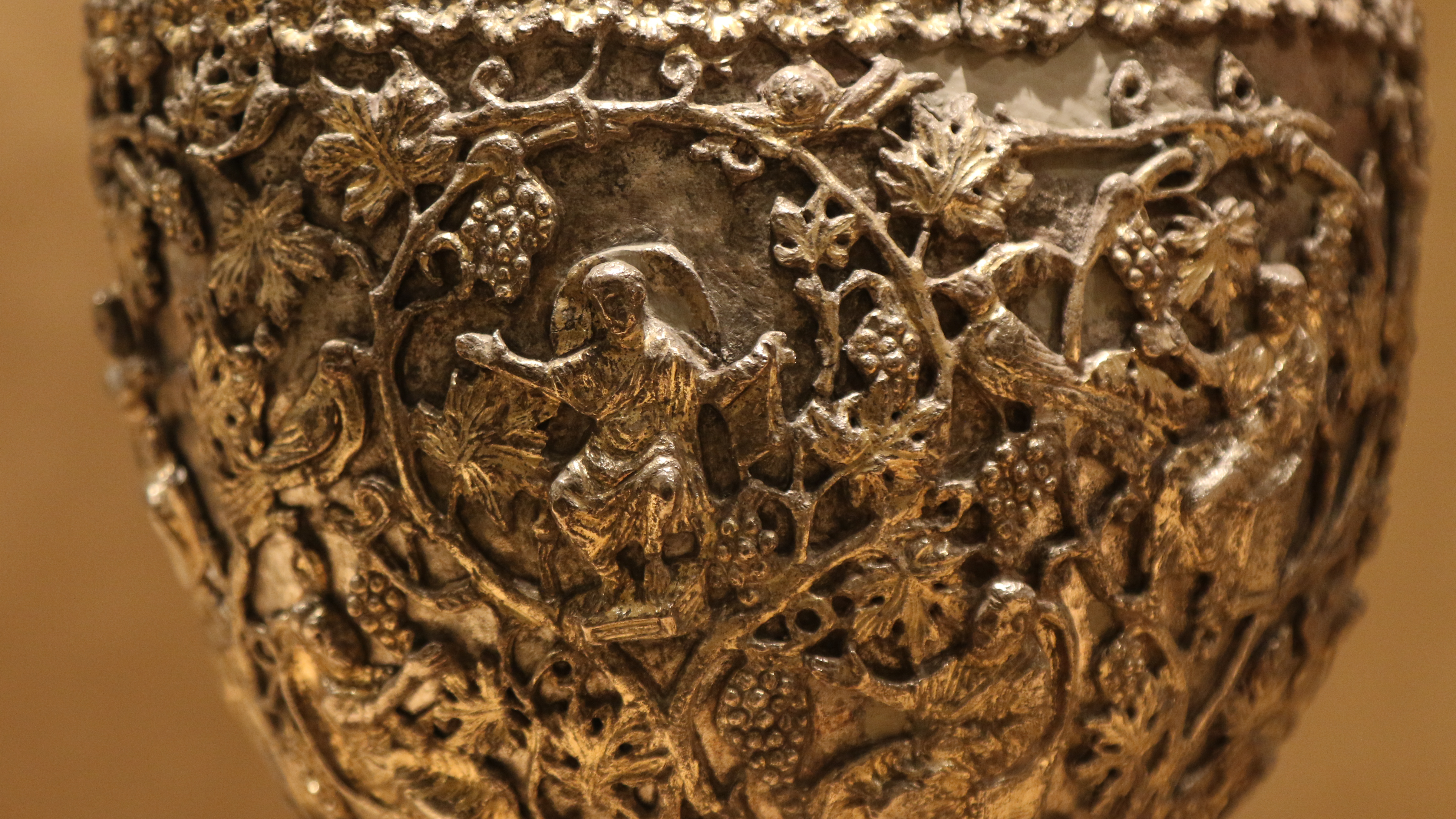
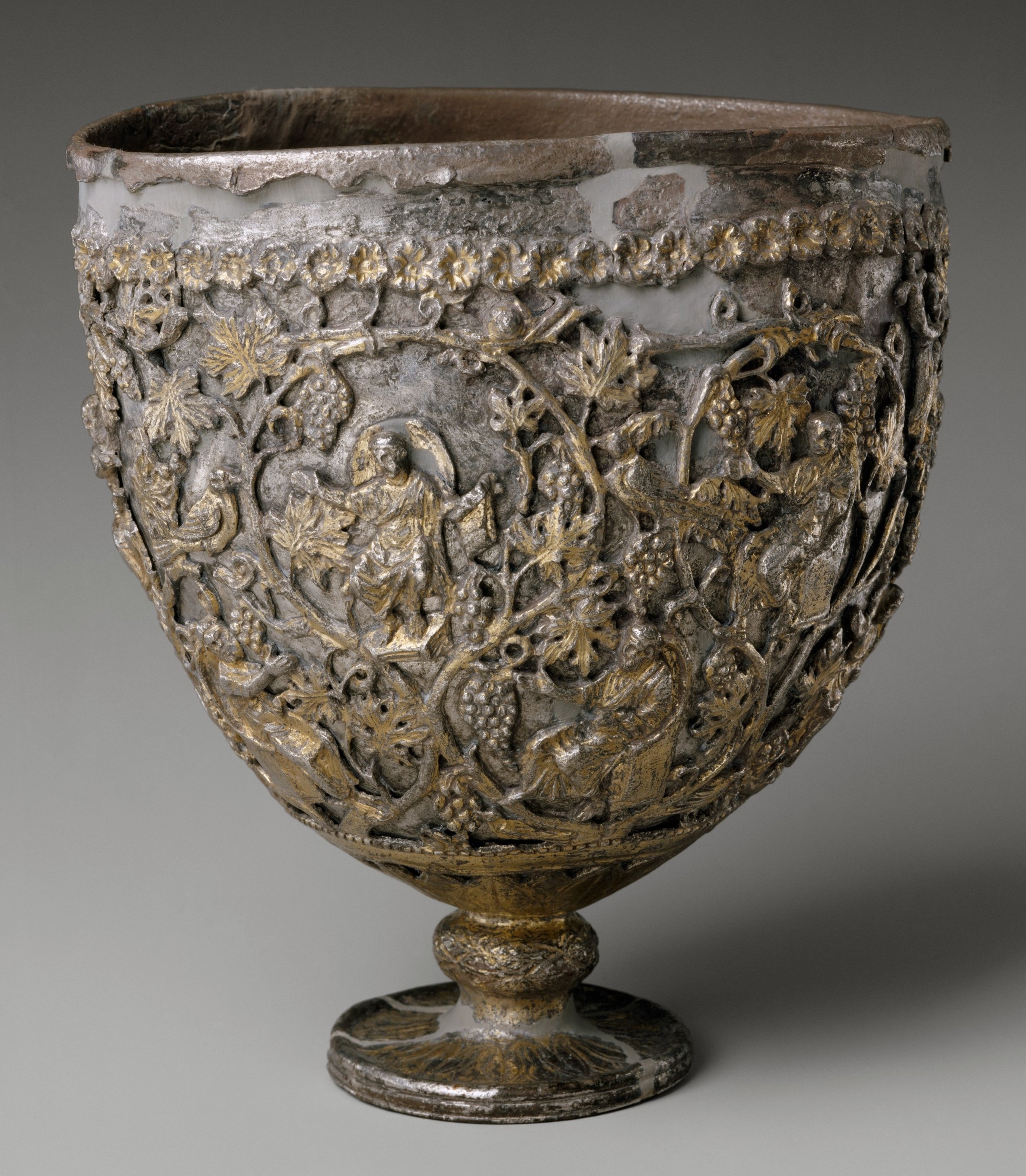
The Antioch “Chalice,” Byzantine (Syria), 500–550. Silver, silver-gilt, overall 7 11/16 × 7 1/16 × 6 in. (19.6 × 18 × 15.2 cm). Metropolitan Museum of Art, New York. Photo: Fr. Lawrence Lew, OP.
This Byzantine liturgical object was discovered in 1908 in Antioch on the Orontes (in modern-day Turkey, near the Syrian border) and is thought to be from the first half of the sixth century. Originally it was identified as a chalice, used in the celebration of the Eucharist, but more recent scholarship suggests that it was probably a standing oil lamp that was used in church.
The elaborate silver shell that encloses the plain silver bowl is covered in emblems of the renewal of life—vines, fruit, doves, a butterfly, a rabbit. There are also snails and a grasshopper! If indeed the object is a lamp, its flame would have reinforced Jesus’s self-identification as the light of the world.
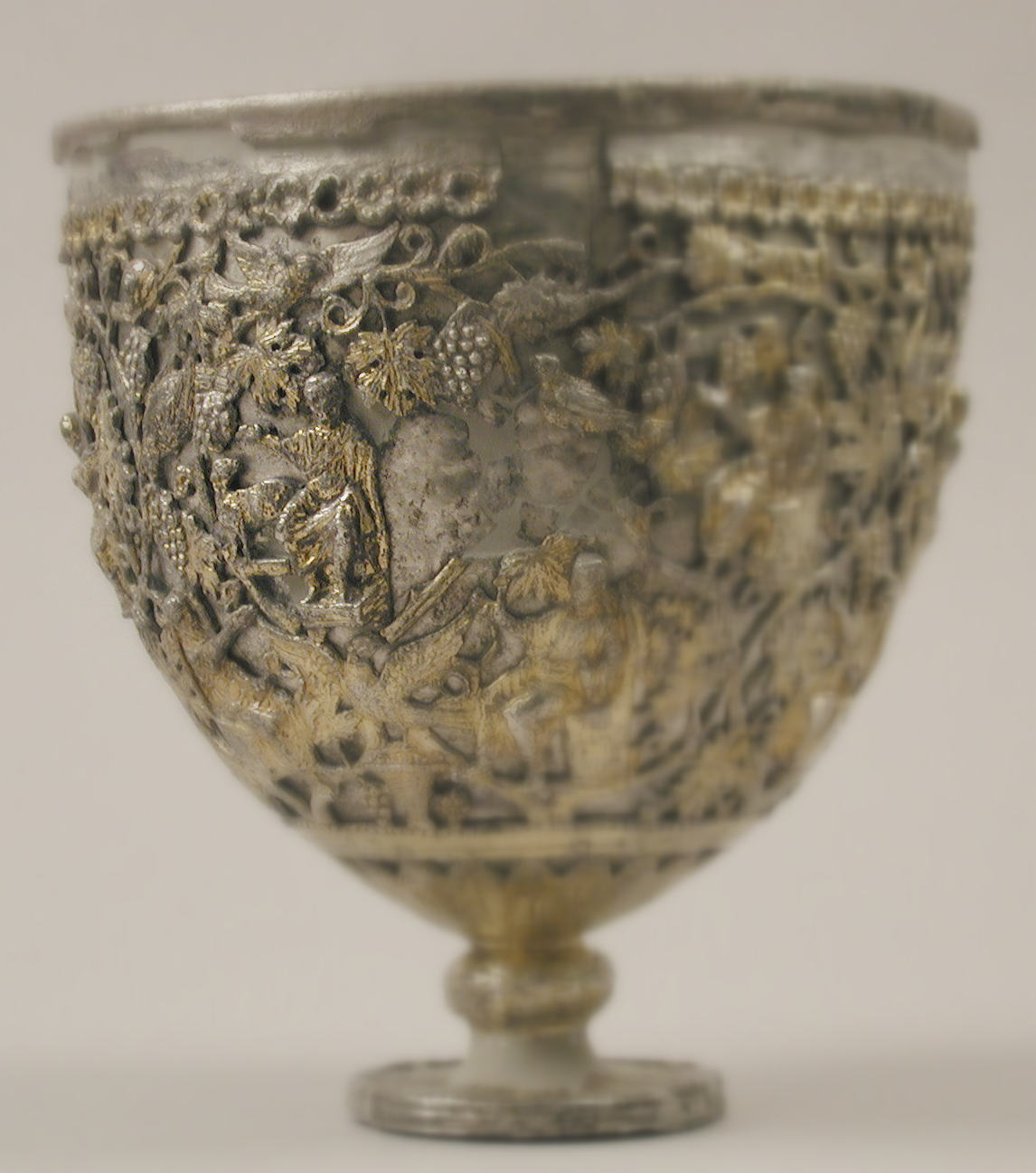
Twelve seated human figures circle the bowl, two of which likely represent Christ, as each is surrounded by five figures in attitudes of directed reverence. One Christ figure (see the first photo below) is shown with a scroll draped over his left arm, representing his teaching. The other Christ, on the opposite side, is depicted as the resurrected Lord and giver of life; a lamb stands under his right arm, and beneath him, an eagle with outspread wings perches on a fruit basket.
View 1, what I’ll call the frontView 2, what I’ll call the back. Photo edited by me to focus on the (second) Christ figure and the lamb. Click on image for original.
The subordinate figures, all holding scrolls, may be apostles, or they may be philosophers of the classical age who, like the Hebrew prophets, had foretold the coming of Christ.
LISTEN: Christ lag in Todesbanden (Christ Lay in the Bonds of Death) (BWV 4) by J. S. Bach, 1707 | Words by Martin Luther, 1524 | Performed by Ensemble Orlando Fribourg at the Church of St. Michael’s College, Fribourg, Switzerland, 2016
Bach wrote this Easter cantata—one of his earliest works—at age twenty-two as part of his application for the post of organist at Divi Blasii church in Mühlhausen, Germany. (He got the job!) Its text and melody are taken from the hymn of the same name by Martin Luther, which was itself derived from the eleventh-century plainsong “Victimae paschali laudes.”
The twenty-two-minute cantata is divided into an opening instrumental movement, called a sinfonia, and seven vocal movements corresponding to the stanzas of Luther’s hymn. These are arranged symmetrically—chorus–duet–solo–chorus–solo–duet–chorus—with the focus on the high drama of the central fourth movement, which describes the battle between Life and Death.
Sinfonia
1. Choral Christ lag in Todesbanden, für unsre Sünd gegeben, der ist wieder erstanden und hat uns bracht das Leben. Des wir sollen fröhlich sein, Gott loben und dankbar sein und singen Halleluja. Halleluja.
2. Duett (SA) Den Tod niemand zwingen kunnt bei allen Menschenkindern; das macht alles unsre Sünd, kein Unschuld war zu finden. Davon kam der Tod so bald und nahm über uns Gewalt, hielt uns in seim Reich gefangen. Halleluja.
3. Aria (T) Jesus Christus, Gottes Sohn, an unser Statt ist kommen und hat die Sünde abgetan, damit dem Tod genommen all sein Recht und sein Gewalt; da bleibt nichts denn Tods Gestalt, den Stachel hat er verloren. Halleluja.
4. Choral Es war ein wunderlich Krieg, da Tod und Leben ’rungen; das Leben, behielt den Sieg, es hat den Tod verschlungen. Die Schrift hat verkündet das, wie ein Tod den andern fraß, ein Spott aus dem Tod ist worden. Halleluja.
5. Duett(ST) Hier ist das rechte Osterlamm, davon wir sollen leben, das ist an des Kreuzes Stamm in heißer Lieb gegeben. Des Blut zeichnet unsere Tür, das hält der Glaub dem Tode für, der Würger kann uns nicht rühren. Halleluja.
6. Aria (B) So feiern wir das hoh Fest mit Herzensfreud und Wonne, das uns der Herre scheinen lässt. Er ist selber die Sonne, der durch seiner Gnaden Glanz erleucht unsre Herzen ganz; der Sünden Nacht ist vergangen. Halleluja.
7. Choral Wir essen und leben wohl, zum süßen Brot geladen; der alte Sau’rteig nicht soll sein bei dem Wort der Gnaden. Christus will die Kost uns sein und speisen die Seel allein; der Glaub will keins andern leben. Halleluja.
Sinfonia
1. Chorale Christ Jesus lay in death’s strong bands for our offenses given; but now at God’s right hand he stands and brings us life from heaven. Therefore let us joyful be and sing to God right thankfully loud songs of alleluia! Alleluia!
2. Duet(SA) No son of man could conquer death, such ruin sin had wrought us. No innocence was found on earth, and therefore death had brought us into bondage from of old and ever grew more strong and bold and held us as its captive. Alleluia!
3. Aria (T) Christ Jesus, God’s own Son, came down, his people to deliver; destroying sin, he took the crown from death’s pale brow forever. Stripped of pow’r, no more it reigns; an empty form alone remains; its sting is lost forever. Alleluia!
4. Chorale It was a strange and dreadful strife when life and death contended. The victory remained with life, the reign of death was ended. Holy Scripture plainly saith that death is swallowed up by death; disgraced, it lies defeated. Alleluia!
5. Duet (ST) Here the true Paschal Lamb we see, whom God so freely gave us; he died on the accursed tree— so strong his love—to save us. See, his blood now marks our door; faith points to it; death passes o’er, and Satan cannot harm us. Alleluia!
6. Aria (B) So let us keep the festival to which the Lord invites us; Christ is himself the joy of all, the sun that warms and lights us. Now his grace to us imparts eternal sunshine to our hearts; the night of sin is ended. Alleluia!
7. Chorale Then let us feast this Easter day on Christ, the bread of heaven; the Word of grace has purged away the old and evil leaven. Christ alone our souls will feed; he is our meat and drink indeed; faith lives upon no other! Alleluia!