Moveable Garden, a community art project organized by Sojourn Arts, 2021. Mixed media on panel.
Sojourn Arts is a ministry of Sojourn Midtown in Louisville, Kentucky. As one way for their community to engage the springtime theme of Easter, on Easter Sunday 2021, Tim Robertson led a riso printing project in the church’s art gallery between services, open to all. Participants selected and arranged live flowers on the glass copier of a risograph (a type of digital printing machine that uses a process similar to screen printing to create vibrant, textured prints), printed their designs onto colorful paper, cut them out, and collaboratively collaged them into a floral arrangement on a wood panel—a “moveable garden”! View more photos here.
LISTEN: “Christ Is Your Spring”|Words by Edward A. Washburn, 1863 | Music by Andy Bast, 2024 | Performed by Bellwether Arts, feat. Emily Hanrahan, 2024
Christ has arisen, And Death is no more! Lo! the white-robed ones Sit by the door. Dawn, golden morning, Scatter the night. Haste, you disciples glad, First with the light!
Break forth in singing, O the world newborn! Sing the great Eastertide, Christ’s holy morn. Sing him, young sunbeams Dancing in mirth; Sing, all you winds of God Coursing the earth!
Sing him, you laughing flow’rs Fresh from the sod; Sing him, wild, leaping streams, Praising your God! Break from your winter, Sad heart, and sing! Bud with your blossoms fair; Christ is your spring.
Sing alleluia!
Christ is your spring.
What a beautiful hymn text! Andy Bast found it in Jane Eliza (Coolidge) Chapman’sEaster Hymnscompilation, published in Boston in 1876. In the introduction to the hymnal, Chapman’s uncle J. I. T. (James Ivers Trecothick) Coolidge, an Episcopalian minister, delights in how
[Easter’s] sun shines with fuller radiance each year upon the world, whose night of darkness it broke on the Resurrection Morning. The anthems which greet its rising are caught and repeated by increasing millions of grateful hearts of every tongue, kindred, and people, until the wide earth is filled with their sounding praise. How sacred a privilege to have part in this mighty and triumphant symphony, how sad to be out of harmony with its sublime strains!
Written by Rev. Dr. Edward A. Washburn (and given a new tune by Bast), “Christ Is Your Spring” apostrophizes the whole newborn world, enjoining it to praise God. Sunbeams, winds, flowers, streams, the human heart—all are encompassed in God’s project of renewal and invited to sing each in their own way.
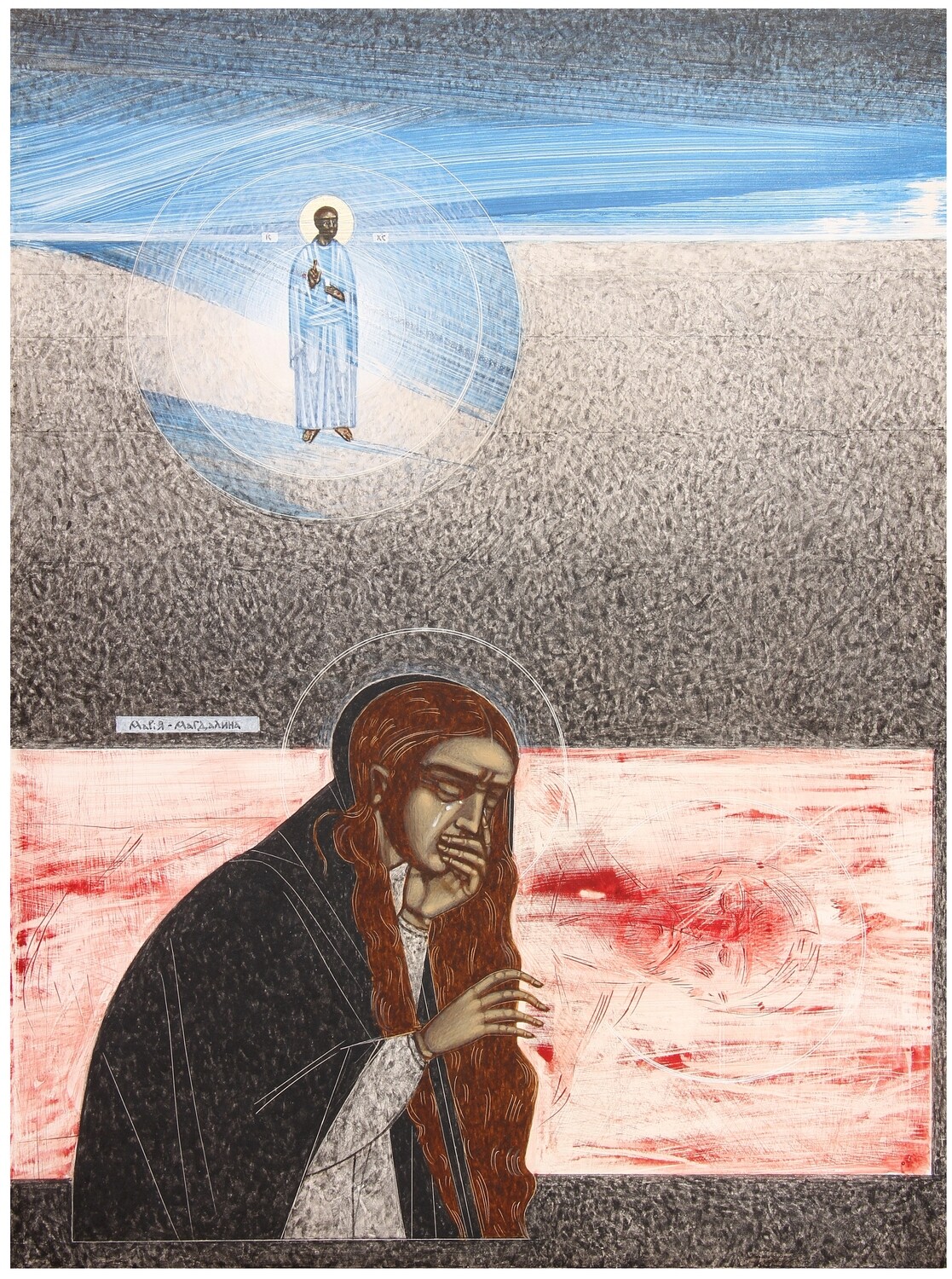
LOOK: Mary Magdalene Stood Crying by Kateryna Kuziv
Kateryna Kuziv (Ukrainian, 1993–), Mary Magdalene Stood Crying, 2021. Egg tempera and gilding on gessoed wood, 40 × 30 cm.
LISTEN: “Weeping Mary” | Traditional American, 19th century | Arranged by Dan Damon and performed by the Dan Damon Quartet, feat. Sheilani Alix, on Beautiful Darkness, 2022
Is there anybody here like Mary a-weeping? Call to my Jesus and he’ll draw nigh. Is there anybody here like Mary a-weeping? Call to my Jesus and he’ll draw nigh.
Refrain: Glory, glory Glory, glory Glory be to my God on high Glory, glory Glory, glory Glory be to my God on high
Is there anybody here like Peter a-sinking? . . .
Is there anybody here like jailers a-trembling? . . .
This early American spiritual was transmitted orally before first being recorded in The Social Harp (Philadelphia, 1855), a shape-note hymnal compiled by John Gordon McCurry (1821–1886). McCurry was a farmer, tailor, and singing teacher who lived most of his life in Hart County in northeastern Georgia. The Social Harp credits the music for “Weeping Mary” to him and gives it the year 1852, but I think that indicates not composition but notation and harmonization; in other words, McCurry is the arranger.
In the description of their 1973 facsimile reprinting of The Social Harp, the University of Georgia Press writes, “In the time between the [American] Revolution and the Civil War, the singing of folk spirituals was as common among rural whites as among blacks. This was the music of the Methodist camp meeting and the Baptist revival, and white spirituals in fact are known chiefly because homebred composers sometimes wrote them down, gave them harmonic settings, and published them in songbooks.”
I regard “Weeping Mary” as an Easter song, since the primary verse refers to Mary Magdalene standing outside the empty tomb weeping because she doesn’t know what happened to the body of her Lord (John 20). Then a man she supposes to be the gardener engages her in conversation—and turns out to be the one she’s been seeking, only he’s alive!
The jailer in the third verse refers to the Philippian jailer from Acts 16, tasked with guarding the prisoners Paul and Silas, who were falsely charged with disturbing the peace. One night an earthquake strikes, releasing the chains from the walls and breaking open the cell doors. The jailer raises his sword to kill himself to avoid the shame of having let his wards escape. But Paul alerts him that they’re still there, after which the jailer “fell down trembling” and asked the two what he must do to be saved. “Believe in the Lord Jesus,” they reply. After which he and his whole household convert to the new faith.
“Call to my Jesus and he’ll draw nigh,” the song promises.
Another “Weeping Mary” verse not in The Social Harp but that I’ve heard added in some renditions is “Is there anybody here like Thomas a-doubting?”
More subdued than the typical Easter fare, “Weeping Mary” testifies to the nearness of God in our sorrows, fears, doubts, and weaknesses. It embraces those who are anxious, grieving, or struggling, offering a gentle word.
I first learned this song from a recording by the American folk musician Sam Amidon, which I also really like:
In Brattleboro, Vermont, where he grew up in the 1980s and ’90s, he told NPR, shape-note singing was a social tradition, something that happened once a month, with singers moving to different people’s houses, including his own. His parents are the well-known folk musicians Peter and Mary Alice Amidon.
In his rendition he uses the grammatically incorrect but historically faithful verb that appears in original songbook, “Are there anybody . . .”
For a more vigorous jazz arrangement, which includes scat singing and a trumpet solo, see June April’s 2007 album What Am I?. She uses just the first verse.
And here’s a traditional performance in four-part a cappella by the Dordt College Concert Choir, directed by Benjamin Kornelis:
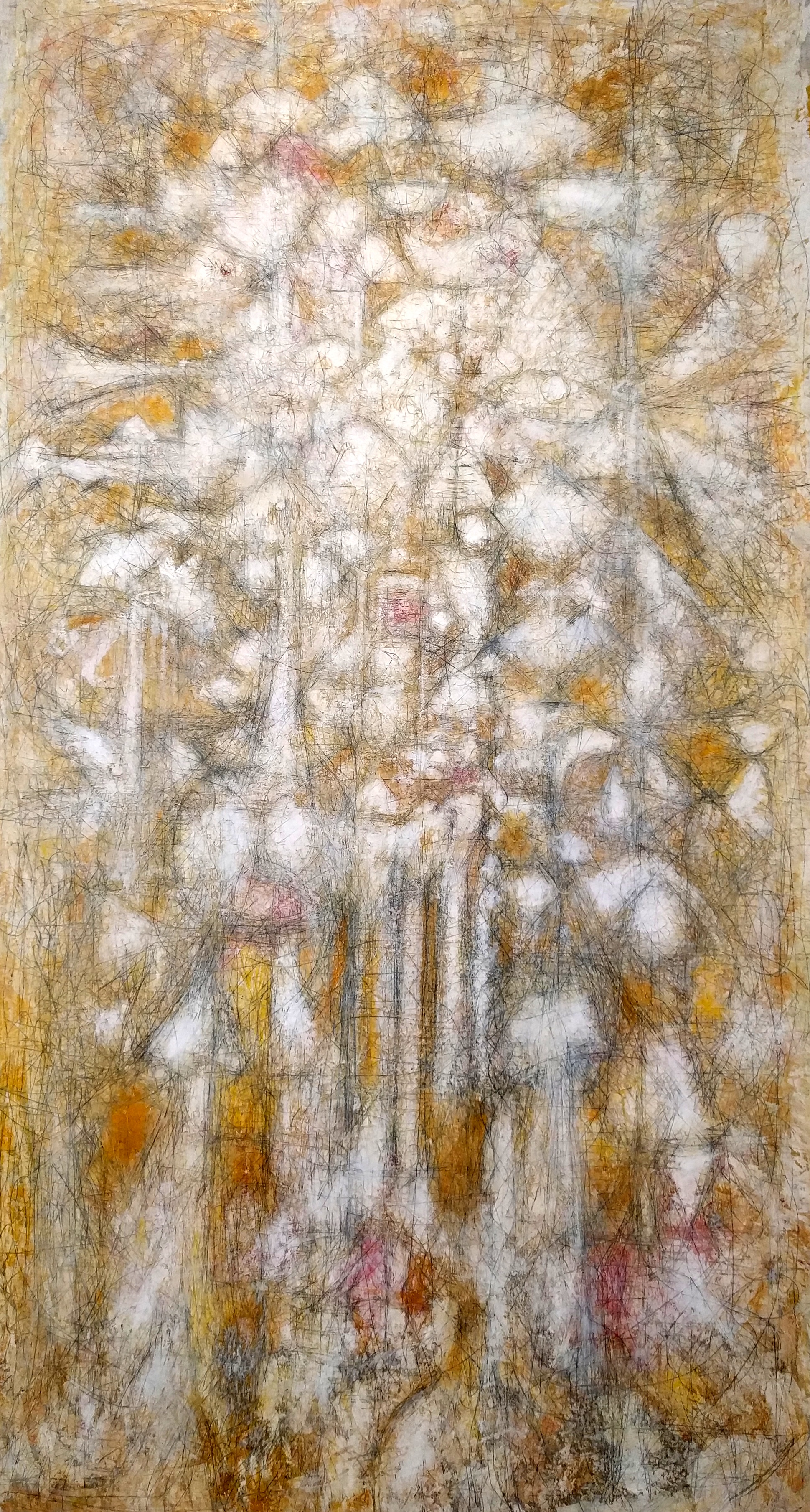
Richard Pousette-Dart (American, 1916–1992), Golden Dawn, 1952. Oil and graphite on linen, 93 1/2 × 51 1/2 in. (237.5 × 130.8 cm). North Carolina Museum of Art, Raleigh. Photo: Victoria Emily Jones. [object record]
This abstract expressionist painting by Richard Pousette-Dart shows an explosion of light, and human bones, as I read it, reassembling—death being translated into life. I’m reminded of Ezekiel’s vision in the valley, of scattered skeletal remains coming back together, growing flesh, standing up, and receiving breath—a foretaste (one, of the descent of God’s Spirit at Pentecost, but also) of the coming resurrection of all the dead, the firstfruits of which was Christ.
LISTEN: The Protecting Veil: “Christ Is Risen!” by John Tavener, 1988 | Performed by the Ulster Orchestra, feat. Maria Kliegel, on John Tavener: The Protecting Veil; In Alium, 1999; re-released on The Essential John Tavener, 2014
This is section 6 of 8 from John Tavener’s The Protecting Veil, a work for cello and strings commissioned by the BBC for its 1989 Promenade season. It’s a Marian work, its title referencing the name of an Eastern Orthodox feast that commemorates the Mother of God’s miraculous appearance over Constantinople in the early tenth century to protect the Christians living there from a foreign invasion.
The “Christ Is Risen!” section is shimmering and exultant, evoking Jesus’s bursting out of the tomb. But about halfway through, the tempo slows and the mood softens, perhaps suggesting, after his triumphant victory over death, a quieter, tearful moment of reuniting with his mom.
The Protecting Veil, Tavener said, “is an attempt to make a lyrical ikon in sound, rather than in wood, and using the music of the cellist to paint rather than a brush.”
The painting featured above is no religious icon, but I see the gospel in it.
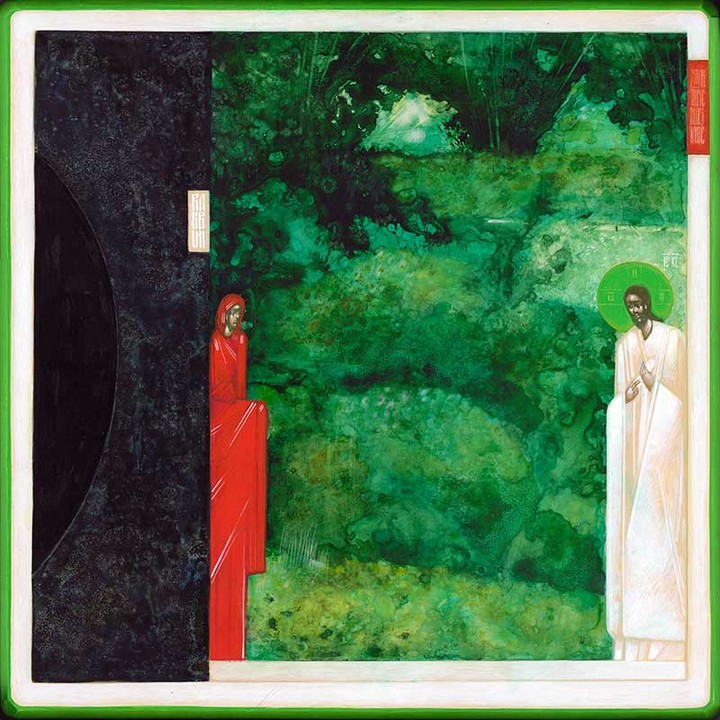
Greta Leśko (Polish, 1979–), Rabbuni!, 2021. Tempera on board, 29 × 30 cm. [purchase giclée print]
“At the place where Jesus was crucified, there was a garden, and in the garden a new tomb, in which no one had been laid.” —John 19:41

From garden to garden, God’s body moved.
Born to breath beneath Eden’s tree,
He named Himself Adam, Herself Eve,
a twice-crowned exiled King and Queen.
Gethsemane came a dark surprise—
(Who knew where the garden gate might lead?)—
the wind in the olives, the moon’s slow rise,
the tell-tale blood on bony knees.
That gray Friday we carried Christ home
to one last garden, while evening birds
sang a song of pity His stopped ears heard
until He rose and hove away the stone.
Our good dead God, while the dawn birds keened,
bloomed anew in the garden’s sudden green.
Angela Alaimo O’Donnell is a writer, poet, and professor at Fordham University in New York City, where she teaches English and creative writing and serves as associate director of the Curran Center for American Catholic Studies. She is the author of eleven books of poems and four books of prose, three of which are about Flannery O’Connor, and her essays—about the poetic craft, the nexus between faith and art, and literature in the context of the Catholic intellectual tradition—appear in numerous publications, including the magazines America and Commonweal.
This is the first of eight daily art-and-song posts, one for each day of the Easter Octave.
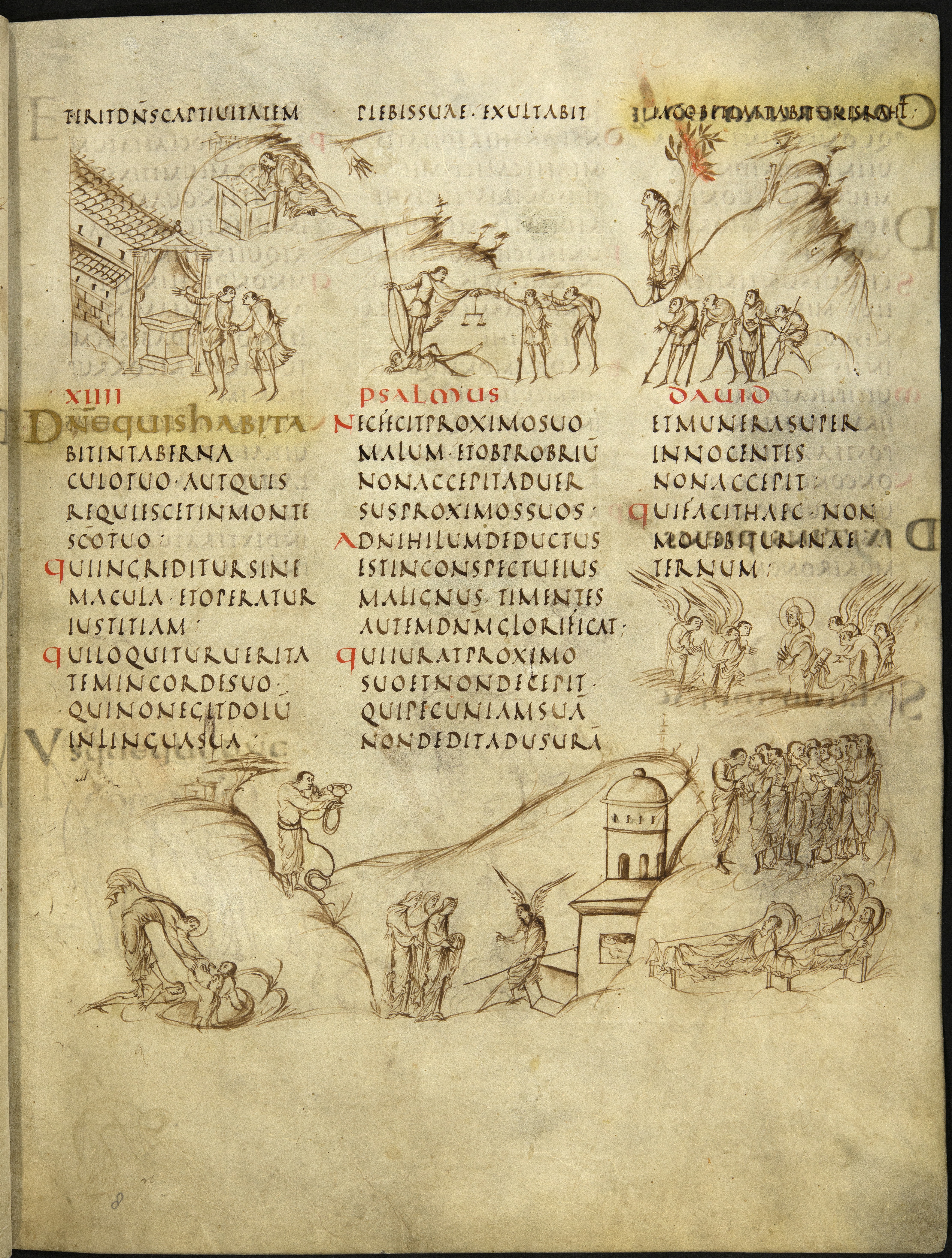
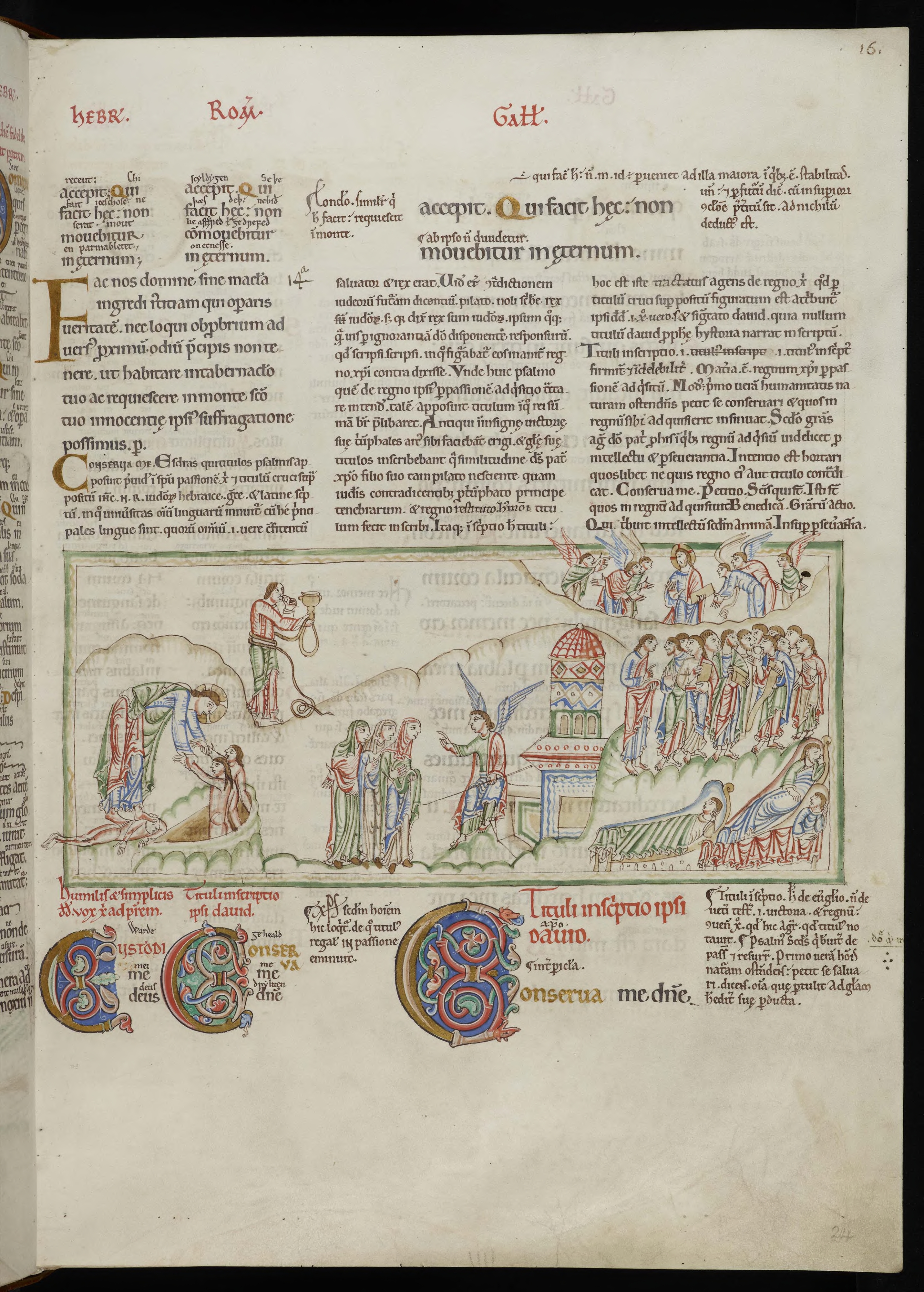
LOOK: Folio 8r (detail) from the Harley Psalter
Detail from the Harley Psalter, Canterbury, first half of 11th century. London, British Library, Harley MS 603, fol. 8r.
Produced at Christ Church in Canterbury, England, in the eleventh century, the Harley Psalter is celebrated for its lively and delicate multicolored line drawings executed in green, blue, pale sepia, and red inks, which illustrate individual lines from the Psalms, sometimes interpreting them in light of the New Testament. The manuscript is closely based on the ninth-century Utrecht Psalter from France, with a very similar arrangement and many near-identical images.
Folio 8r illustrates Psalm 16 (Psalm 15 in the Vulgate), even though the text of that psalm appears on the following page. I’ll focus on the three drawings at the bottom left (pictured above).
On the far left, the risen Christ pulls Adam and Eve up out of the pit of hell, trampling Hades (death personified as a crumpled man). To the right, three women go to visit Jesus’s tomb early on Easter morning, only to find it empty, save for the abandoned graveclothes—which we can see through an opening in the lower story.
These two vignettes illustrate Psalm 16:10: “For thou wilt not leave my soul in hell; neither wilt thou suffer thine Holy One to see corruption” (KJV). In the New Testament, both Peter (Acts 2:24–28) and Paul (Acts 13:35) apply this verse to Jesus’s resurrection.
The Hebrew word translated into English as “hell” is Sheol, the realm of the dead. In the Apostles’ Creed, the church proclaims that Jesus “was crucified, died, and was buried; he descended into hell [or ‘to the dead,’ as some translations render it]. On the third day he rose again . . .” As have and will most all humans, Jesus went down into the grave—but God did not leave him there. Nor will he leave his holy ones in that shadowy netherworld of deceased souls. Paul writes that Jesus is the first fruits of the harvest of eternal life (1 Cor. 15:20), his resurrection a foretaste and guarantee of the resurrection of all believers. That’s why the church developed the image of the Harrowing of Hell, or Anastasis, showing Christ triumphantly retrieving our ancestors in the faith from the Pit.
Matthew records that at the moment of Jesus’s death, the earth quaked, opening tombs, “and many bodies of the saints who had fallen asleep were raised. After his resurrection they came out of the tombs and entered the holy city and appeared to many” (Matt. 27:52–53). What a strange phenomenon! That’s the harrowing.
The figure who appears in the Harley Psalter between the Harrowing of Hell and the Holy Women at the Tomb is the psalmist himself. He stands on a hillside holding a cup in his right hand and touching his lips with his left, harking to Psalm 16:4–5: “Their [idolaters’] drink offerings of blood I will not pour out or take their names upon my lips. The LORD is my chosen portion and my cup . . .”
If you want to explore the manuscript’s predecessor, the Utrecht Psalter, the Universiteitsbibliotheek Utrecht (its owning institution) provides a full, annotated digital scan, in which every vignette is linked to the psalm verse it illustrates and accompanied by a description. It’s a wonderful resource! Here’s folio 8r, for example.
Psalm 15(16) from the Utrecht Psalter, Reims, France (Hautvilliers Abbey), ca. 820-30. Utrecht, Universiteitsbibliotheek, MS 32, fol. 8r.
See also the Eadwine Psalter, another copy of the Utrecht Psalter, only slightly later than Harley. Folio 24r corresponds with folio 8r in Utrecht and Harley.
Psalm 15(16) from the Eadwine Psalter, Canterbury, ca. 1150. Cambridge, Trinity College, R.17.1, fol. 24r.
LISTEN:“Rise Up (Lauds)” by Dylan McKeeman, on Good Morning, Happy Easter, vol. 3, by the Morning and Night Collective, 2014
Rise up this morning Jesus is risen! Rise up this morning and praise Rise up this morning Jesus is risen! Rise up this morning and praise
He is risen indeed He is risen for me He is risen this blessed day He is risen indeed He has set us all free He’s risen this blessed day
Dylan McKeeman wrote this song while serving as the director of music and arts at Reynolda EPC in Winston-Salem, North Carolina. He is currently the director of modern worship and production at First Presbyterian Church, also in Winston-Salem.
The subtitle “Lauds” (Latin for “praises”) refers to an early-morning canonical hour designated for prayer, corresponding with dawn.
The song opens with the low, bowed tones of an upright bass, and then a violin, banjo, and guitar enter, all improvising around an F2 chord. Vocalist Jess Silk provides an ethereal hum underneath, which, together with the instruments, evokes a mist lifting. After about the first minute, the song modulates up a whole step to G and a bright banjo tune kicks in along with the summons: “Rise up this morning, Jesus is risen!”
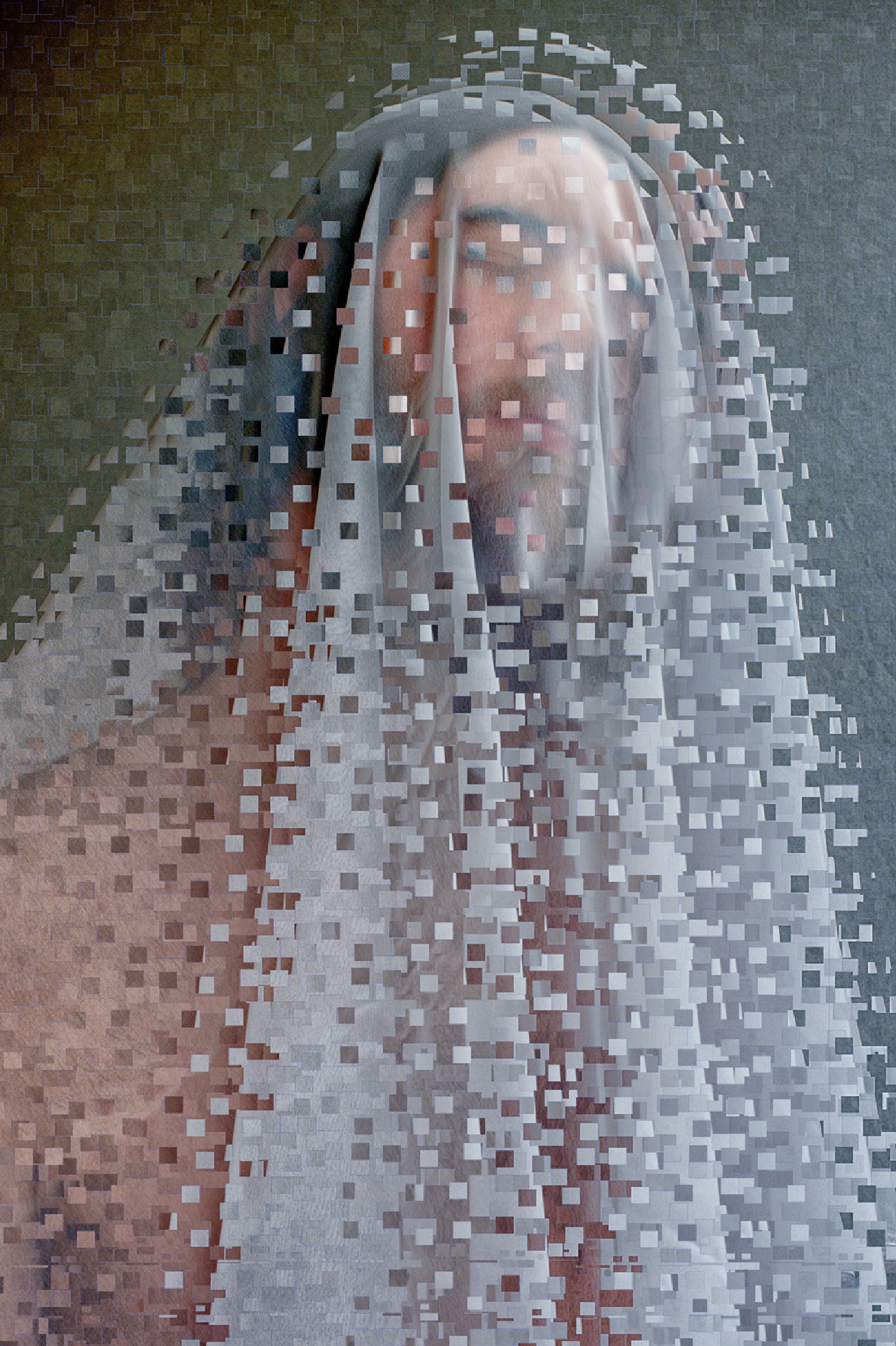
Brett Canét-Gibson (Australian, 1965–), Anastasis, 2016. Photographic digital print, 90 × 60 cm.
Anastasis is the Greek word for “resurrection.” This image by the Australian photographer Brett Canét-Gibson shows the dead Christ covered in a translucent burial shroud, which appears pixelated, out of joint. Some kind of mysterious transformation is afoot. It’s as if Jesus is in the process of waking up, reconstituting, his form coming back into focus as death comes undone. The shimmying squares create a sense of motion and effervescence.
LISTEN: “The Communion Verse of Holy Saturday” | Traditional Orthodox liturgical hymn (in Tone 4), arr. Boris Ledkovsky, mid-20th century | Performed by the Holy Trinity Monastery and Seminary Choir of the Russian Orthodox Church Outside Russia, Jordanville, New York, on Let Us Sing of John, the Hierarch of Christ, 2011
This verse is sung at the end of the Vespers with Divine Liturgy service of the Orthodox Church on the morning of Great and Holy Saturday. Here is the Slavonic text, followed by a phonetic rendering and the English translation:
Воста яко спя Господь: и воскресе спасаяй нас. Аллилуиа.
Vosta yako spya Gospod, i voskrese spasayai nas. Aleluija.
The Lord awoke as one out of sleep, and he is risen to save us. Alleluia.
Even though Holy Saturday commemorates Jesus’s repose in the tomb, this hymn for the occasion anticipates his resurrection. The first half is taken from Psalm 78:65a: “Then the LORD awaked as one out of sleep.”
As we wait in the darkness of what looks like defeat, victorious new life is stirring, about to emerge.
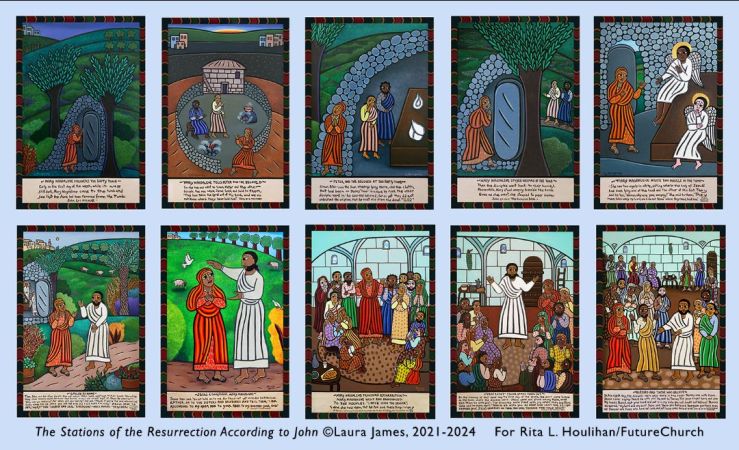
VIRTUAL ARTIST’S TALK: “The Stations of the Resurrection according to John” with Laura James, July 30, 2024, 7:00–8:15 p.m. ET: Next Tuesday, Bronx-based artist Laura James will discuss her latest painting series, The Stations of the Resurrection according to John, in a live online conversation with patron Rita L. Houlihan. Register at the link above.
The series began in 2021 with four paintings—Called by Name, Jesus Commissions Mary Magdalene, Mary Magdalene Proclaims Resurrection, and Pentecost: Jesus Sends Them Out, collectively the Mary Magdalene and the Risen Jesus series (which you can purchase as a set of cards)—and then expanded to include the full resurrection narrative from John 20. View details of all ten paintings for the first time, and hear from the artist about the artistic choices she made.
The daughter of immigrants from Antigua in the Caribbean, Laura James is especially celebrated for her vibrant paintings that depict biblical figures, including Jesus, as dark-skinned, influenced in part by the long tradition of Ethiopian Christian art. Rita Houlihan, who commissioned the Stations of the Resurrection series from James, is a founding member of FutureChurch’s Catholic Women Preach and Reclaim Magdalene projects and a longtime advocate for the restoration of historical memory regarding early Christian women leaders, especially Mary Magdalene.
VIRTUAL BOOK LAUNCH: Refractions, 15th anniversary edition, by Makoto Fujimura, August 6, 2024, 3:00 p.m. ET: Artist, speaker, writer, and IAMCultureCare founder Makoto Fujimura is one of the most prominent voices in the “art and faith” conversation in the US. On Tuesday, August 6, he’s hosting a Zoom event to celebrate the release of the fifteenth anniversary edition of his essay collection Refractions: A Journey of Faith, Art, and Culture, which is updated and expanded. He will read new selections from the book and host a time of Q&A and sharing. Register for the event at the above link, and you will receive a 30% discount on copies of the book preordered before the end of July.
+++
ART TRAIL: Vessel, miscellaneous locations along the Welsh-English border, August 8*–October 31, 2024: An exciting new art trail has been curated by Jacquiline Creswell [previously] for the group Art and Christianity. From the press release: “Vessel is a curated art trail in remote rural churches near the Black Mountains between Usk and Hay-on-Wye [in the border country between South Wales and England]. Seven artworks by seven [contemporary] artists will be shown in seven churches, six of which are maintained by the Friends of Friendless Churches who keep them open all year round. The theme of ‘vessel’ references bodies, boats, secretions and receptacles; each of the artworks will be sited in a particular relationship to the church and its material culture.”
*Lou Baker’s installation at Dore Abbey opens August 21.
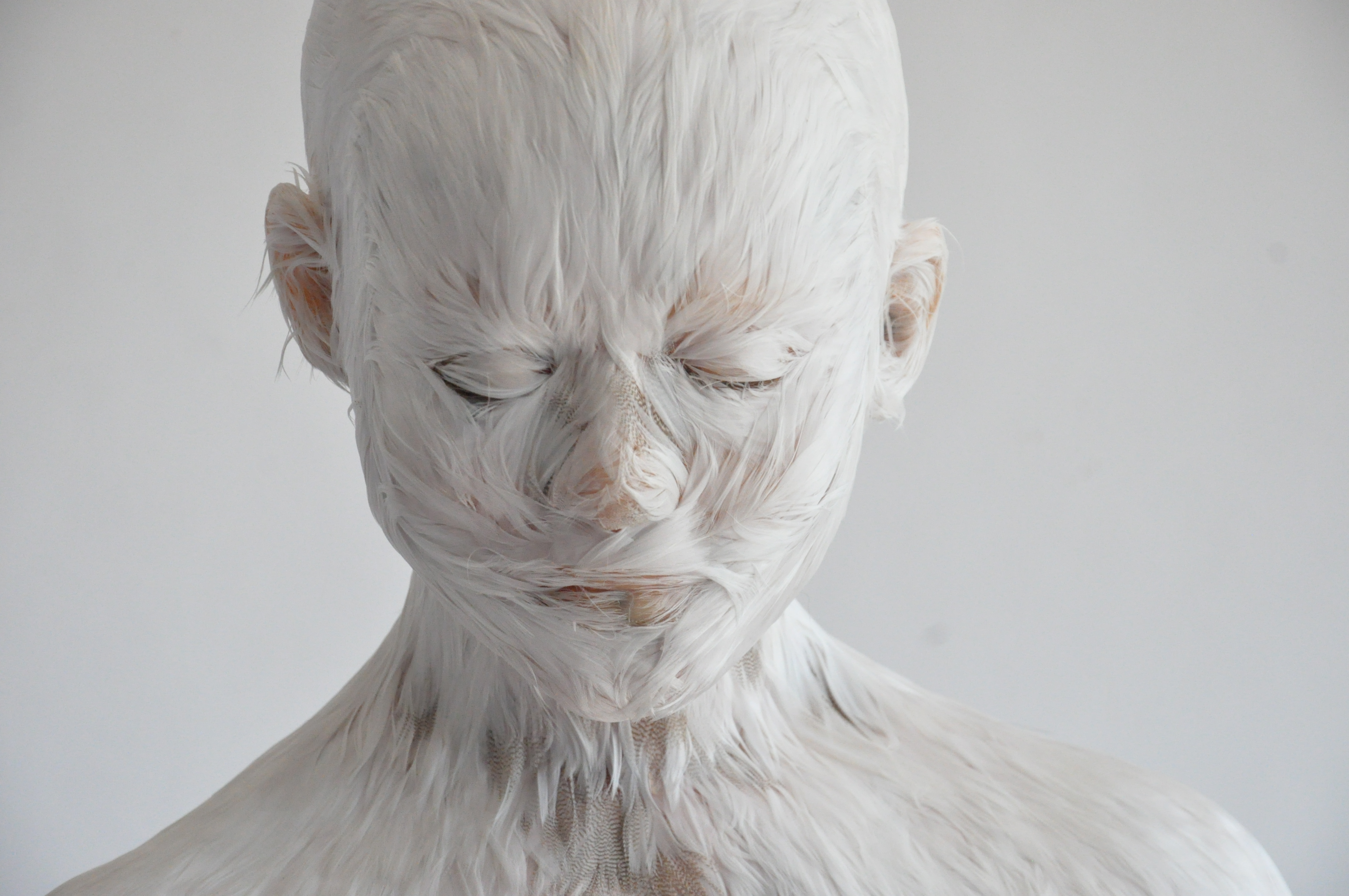
Lucy Glendinning (British, 1964–), White Hart (detail), 2018. Wax, Jesmonite, timber, duck feathers, 175 × 73 × 58 cm. Photo courtesy of Art and Christianity. [artist’s website]
Here is the list of venues, artists, and artworks:
St Michael and All Angels’, Gwernesney, Monmouthshire, Wales: Grace Vessel by Jane Sheppard
St Cadoc, Llangattock Vibon Avel, Monmouthshire, Wales: Wiela by Barbara Beyer
St Mary the Virgin, Llanfair Kilgeddin, Monmouthshire, Wales: Centre by Steinunn Thorarinsdottir
St Jerome, Llangwm Uchaf, Monmouthshire, Wales: White Hart by Lucy Glendinning
St David, Llangeview, Monmouthshire, Wales: Compendium by Andrew Bick
Dore Abbey, Herefordshire, England: Life/Blood by Lou Baker
Castle Chapel, Urishay, Herefordshire, England: Simmer Down I by Robert George
Art + Christianity is offering a weekend retreat September 13–15, based in Abergavenny, that will include a guided minibus tour (led by the curator) to all seven sites, a lecture by Fr. Jarel Robinson-Brown titled “Living Stones: Buildings, Bodies and Spirit,” a presentation and panel discussion on curating and organizing art in rural churches and chapels, and a performance by Holly Slingsby, Felled, Yet Unfurling, that draws on the iconography of the Tree of Jesse. (St Mary’s Priory in Abergavenny houses an extraordinary fifteenth-century oak carving of the Old Testament figure of Jesse that once formed the base of an elaborate sculpture depicting Jesus’s ancestry; to contextualize this artwork, in 2016 a Jesse Tree Window designed by Helen Whittaker was installed in the church’s Lewis Chapel.) Ticket pricing starts at £35 and does not include accommodations.
“As religious affiliation declines, can art provide fresh ways of exploring the questions posed by theology?” Borysewicz asks. “Might art—its creation as well as reception—lead to the discovery of new spiritual information? What do faith traditions lose when they overemphasize the written word and neglect the role of images?
“Historically, faith traditions have focused on both the written word and images as sources of knowledge and meaning. Some would claim that words have taken undue precedence as theologies have developed, while images seem to have been left behind. Has this shift in focus left us wanting?”
Alfonse Borysewicz (American, 1957–), Pomegranate, 2010–11. Oil and wax on linen, 70 × 50 in. The artist said, “When I see a pomegranate at the market, I see it as a visible sign of the resurrection of Christ; or a hive, the community of Christ.”
+++
SONGS:
>> “Kasih Tuhan” (God’s Love) by Abraham Boas Yarona, performed by Prison Akustik: This video shows, from what I can gather, a group of men incarcerated at Lapas Abepura (Abepura Prison) in Papua, Indonesia, playing and singing an Indonesian Christian song together. It’s one of many lagu rohani (spiritual songs) uploaded to the Prison Akustik YouTube channel (the group is also active on Instagram and TikTok).
>> “Del amor divino, ¿quién me apartará?” (Who Can Separate Me from the Love of God?) by Enrique Turrall and José Daniel Verstraeten, performed by Coro del Seminario Internacional Teológico Bautista: Based on Romans 8:31–39, the lyrics of “Del amor divino” are by Enrique Turrall (1867–1953) of Spain, and the music is by José Daniel Verstraeten (b. 1935). The song was performed in 2018 by a vocal and instrumental ensemble from Seminario Internacional Teológico Bautista (International Baptist Theological Seminary) in Buenos Aires [previously], under the direction of Constanza Bongarrá.The instrumentalists are Jimena Garabaya (guitar), Marcelo Villanueva (charango), and Samy Mielgo (bombo). [HT: Daily Prayer Project]
>> “Caritas abundat in omnia” (Love Aboundeth in All Things) with “O virtus Sapientie” (O Virtue of Wisdom) by Hildegard of Bingen, sung by St. Stanislav Girls’ Choir of the Diocesan Classical Gymnasium, feat. Julija Skobe: Combining two Latin antiphons by the medieval German polymath Hildegard of Bingen [previously], who wrote both the words and music, this song is performed a cappella inside St. Joseph’s Church in Ljubljana, Slovenia, by a student choir with some forty singers between the ages of sixteen and nineteen, directed by Helena Fojkar Zupančič. Mesmerizing! Turn on closed captioning for English subtitles, or see here and here.
Soichi Watanabe (Japanese, 1949–), To God Be the Glory, 2009. Acrylic on canvas, 52 × 39 in. Collection of the Overseas Ministries Study Center at Princeton Theological Seminary.
This is the paschal feast,
the Lord’s passing from death to life:
so cries the Spirit.
No type or telling, this, no shadow.
Pasch of the Lord it is, and truly.

You have protected us, Jesus,
from endless disaster.
You spread your hands like a mother
and, motherlike, gave cover with your wings.
Your blood, God’s blood, you poured over the earth,
giving life, because you loved us.

The heavens may have your spirit, paradise your soul,
but oh, may the earth have your blood!

This feast of the Spirit
leads the mystic dance through the year.
New is this feast and all-embracing;
all creation assembles at it.

Joy to all creatures, honor, feasting, delight!
Dark death is destroyed
and life is restored everywhere.
The gates of heaven are open.
God has shown himself human,
humanity has gone up to God.
The gates of hell are shattered,
the bars of Adam’s prison broken.
The people of the world below have risen from the dead,
bringing good news:
what was promised is fulfilled.
From the earth has come singing and dancing.

This is God’s passing!
Heaven’s God, showing no stinginess,
has joined us together with God in the Spirit.
The great marriage hall is full of guests,
all dressed for the wedding,
no guest rejected for want of a wedding garment.
The paschal light is the bright new lamplight,
light that shines from the virgins’ lamps.
The light in the soul will never go out.
The fire of grace burns in us all,
spirit, divine, in our bodies and in our souls,
fed with the oil of Christ.

. . . . . . . . . . . . . . . . . . . . .

Join, then, all of you, join in this great rejoicing.
You who’ve been working the vineyard from the early hour
and you who came later,
come now and collect your wages.
Rich and poor, sing and dance together.
You who are hard on yourselves, you who are easy,
honor this day.
You who have fasted and you who have not,
make merry today.

The meal is ready: come and enjoy it.
The calf is a fat one: you will not go away hungry.
There’s kindness for all to partake of and kindness to spare.

Away with pleading of poverty:
the kingdom belongs to us all.
Away with bewailing of failings:
forgiveness has come from the grave.
Away with your fears of dying:
the death of our Savior has freed us from fear.
Death played the master: he has mastered death.
The world below had scarcely known him in the flesh
when he rose and left it plunged in bitter mourning.

Isaiah knew it would be so. [Isa. 14:9]
The world of shadows mourned, he cried, when it met you,
mourned at its being brought low, wept at its being deluded.
The shadows seized a body and found it was God;
they reached for earth and what they held was heaven;
they took what they could see: it was what no one sees.
Where is death’s goad? Where is the shadows’ victory?

Christ is risen: the world below [hell] is in ruins.
Christ is risen: the spirits of evil are fallen.
Christ is risen: the angels of God are rejoicing.
Christ is risen: the tombs are void of their dead.
Christ has indeed arisen from the dead,
the first of the sleepers.

Glory and power are his for ever and ever. Amen.
This text is a composite of excerpts from two Easter sermons spuriously attributed to John Chrysostom (ca. 347–407) and drawing inspiration from Hippolytus of Rome (ca. 170–ca. 235), which I adapted from Walter Mitchell’s English translation from the original Greek that appears in Adalbert Hamman, OFM, ed., Early Christian Prayers (Chicago: Regnery Gateway, 1961), 31–35. The source texts can be found in the Patrologia Graeca59:741–46 and 59:721–24. They probably date to the fourth century.
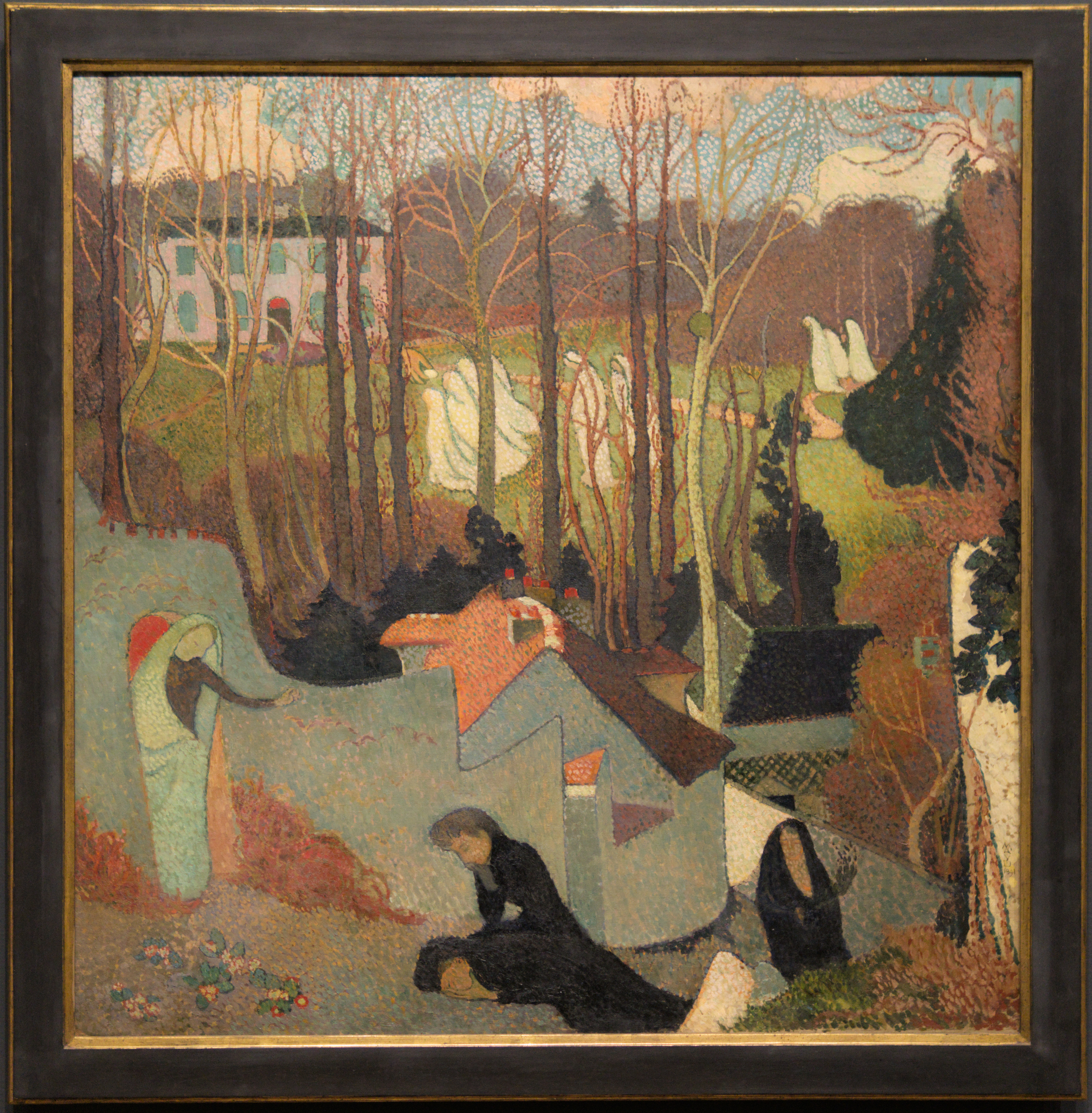
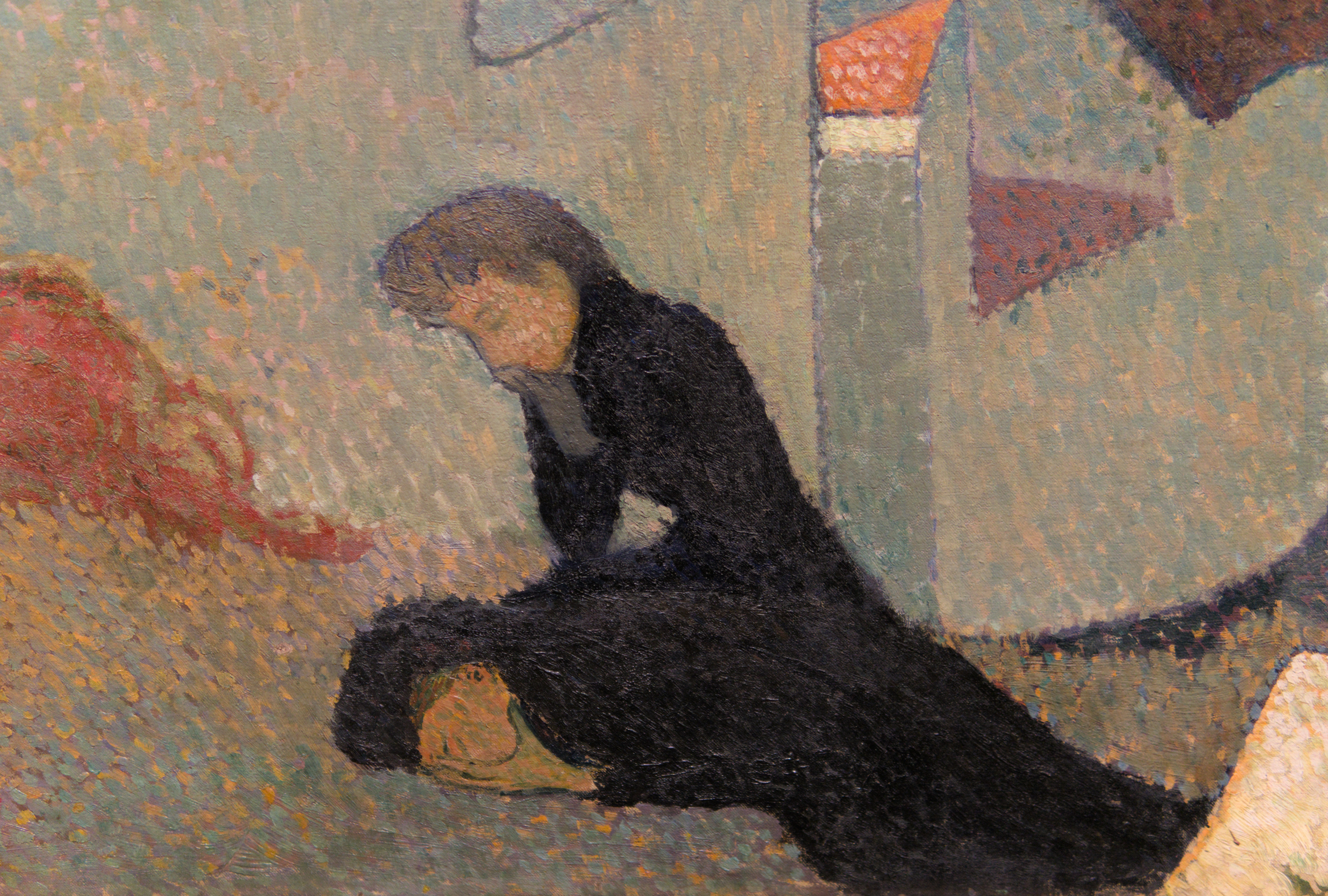
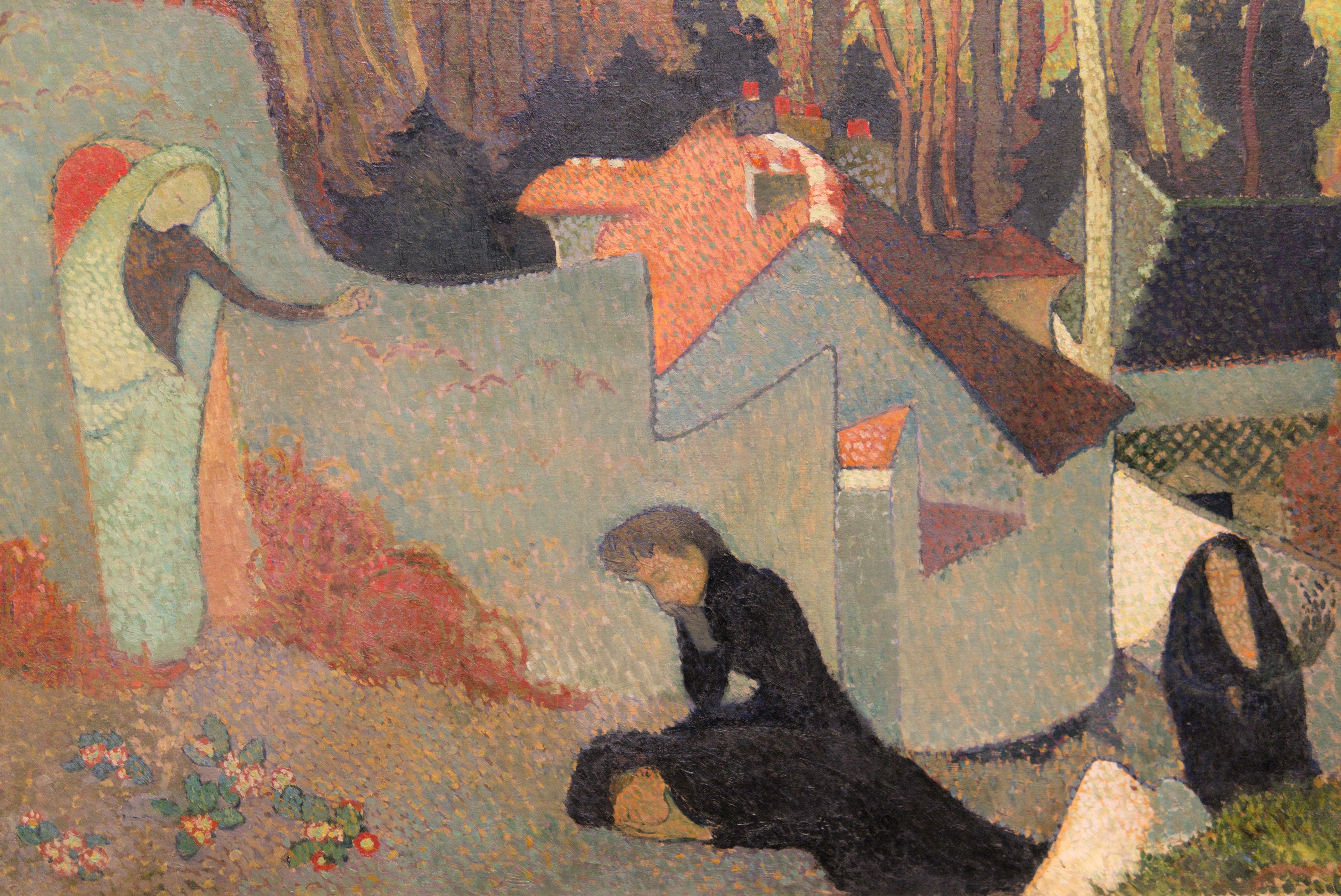
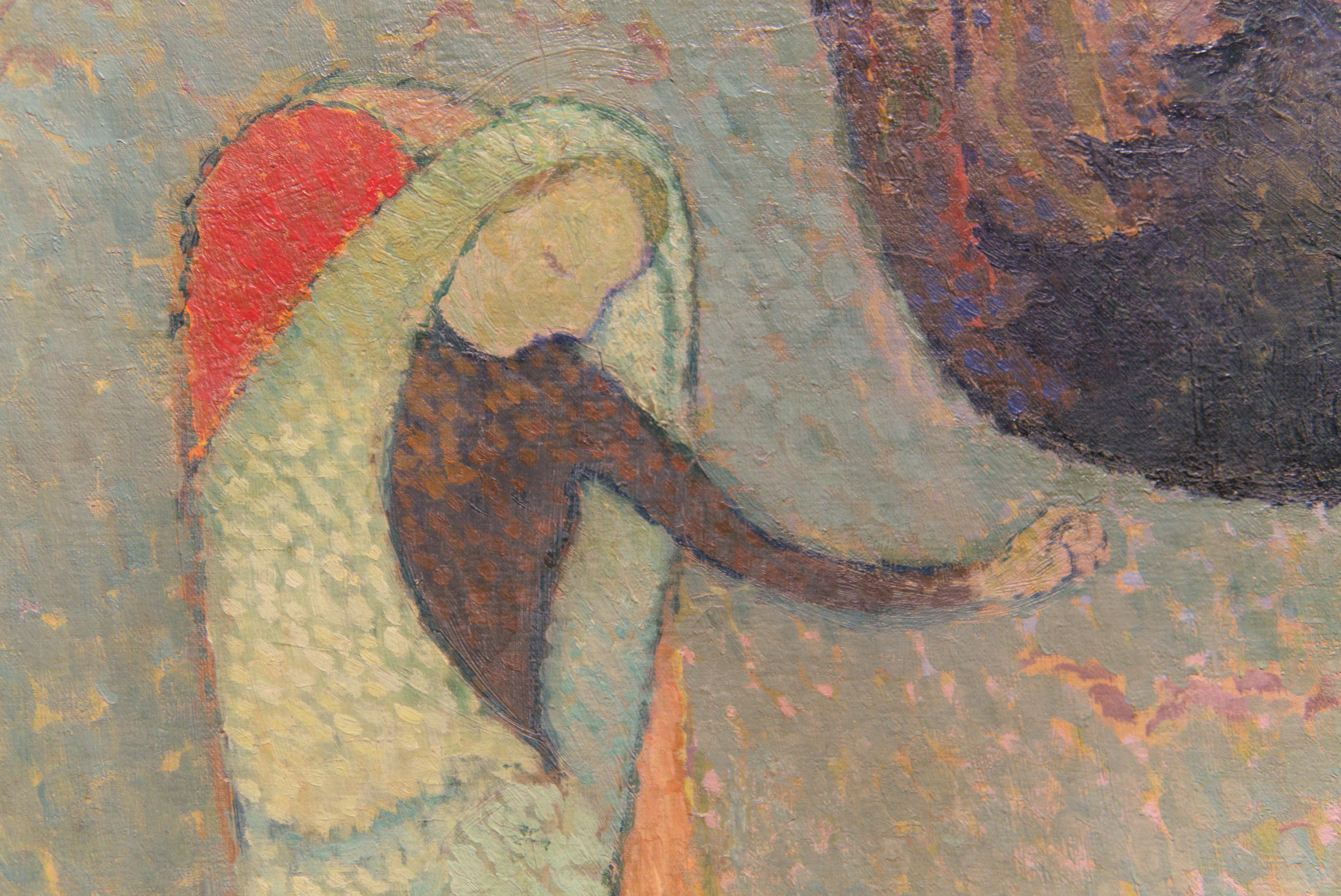
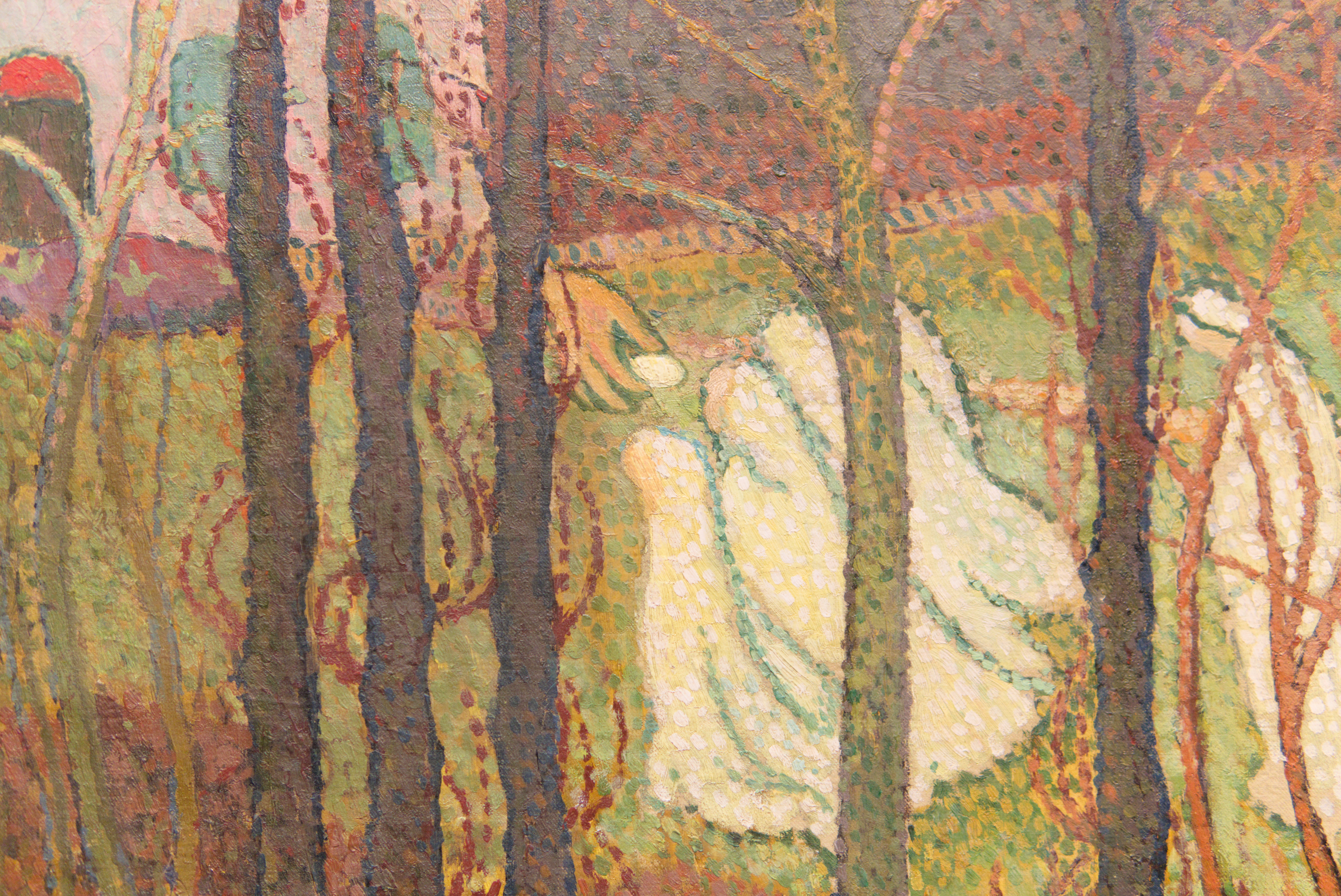
Last year when I was at the Art Institute of Chicago, I was transfixed by the pointillist painting Easter Mystery by the French artist Maurice Denis.
Maurice Denis (French, 1870–1943), Easter Mystery (Mystère de Pâcques), 1891. Oil on canvas, 41 × 40 1/8 in. (104 × 102 cm). Art Institute of Chicago. Photo: Victoria Emily Jones. [object record]
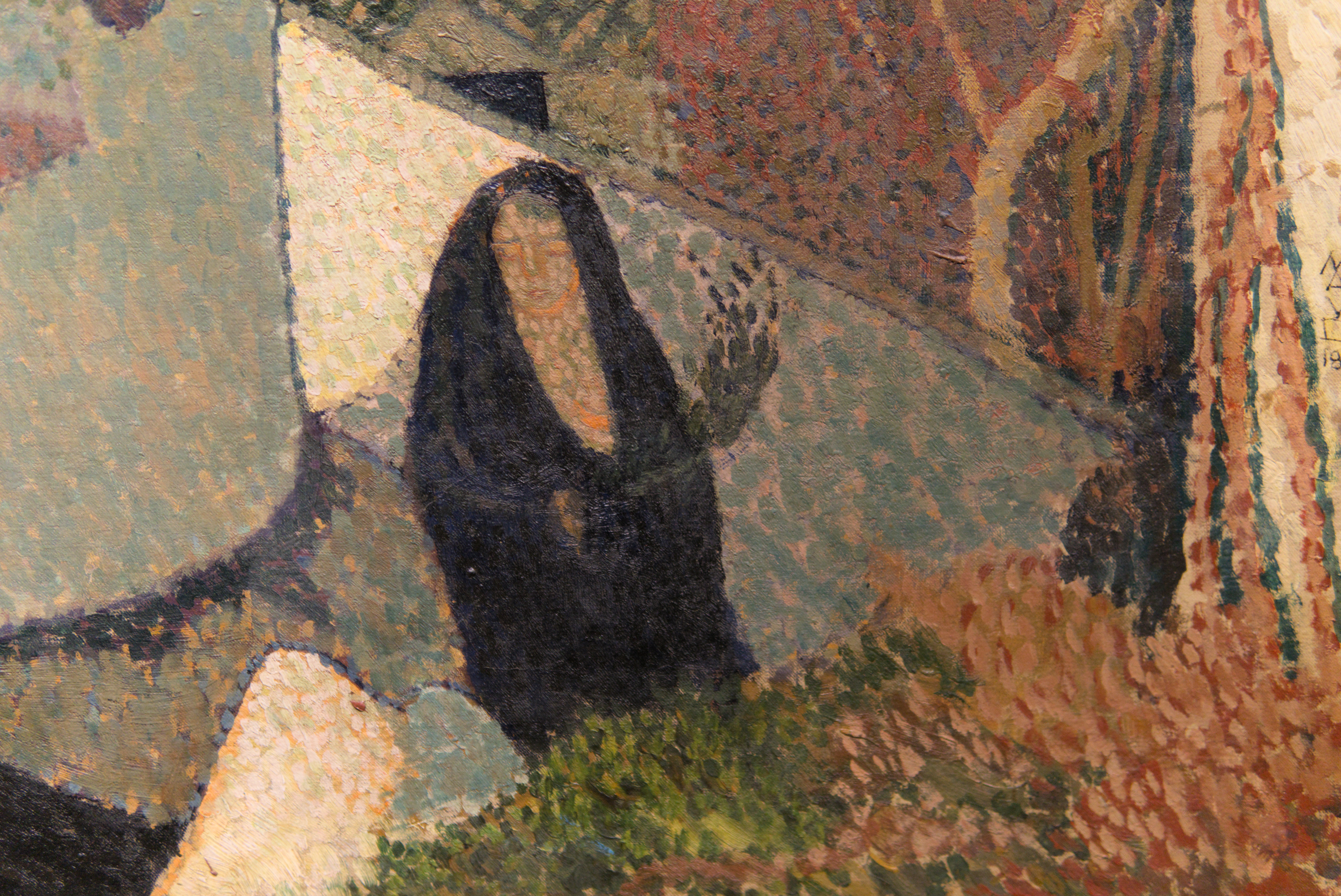
It shows three women dressed in mourning clothes arriving at Christ’s tomb (one ascending the hill, one kneeling, and one prostrate), only to find an angel at its entrance, announcing that Christ has risen. In the midground, visible through a veil of trees, the hand of God bends down to feed a group of white-clad women the body of Christ, a consecrated wafer that gives them eternal life.
Jesus’s teaching in John 6:48–58 is instructive here:
“I am the bread of life. Your ancestors ate the manna in the wilderness, and they died. This is the bread that comes down from heaven, so that one may eat of it and not die. I am the living bread that came down from heaven. Whoever eats of this bread will live forever, and the bread that I will give for the life of the world is my flesh.”
The Jews then disputed among themselves, saying, “How can this man give us his flesh to eat?”
So Jesus said to them, “Very truly, I tell you, unless you eat the flesh of the Son of Man and drink his blood, you have no life in you. Those who eat my flesh and drink my blood have eternal life, and I will raise them up on the last day, for my flesh is true food, and my blood is true drink. Those who eat my flesh and drink my blood abide in me and I in them. Just as the living Father sent me and I live because of the Father, so whoever eats me will live because of me. This is the bread that came down from heaven, not like that which the ancestors ate, and they died. But the one who eats this bread will live forever.”
The Art Institute audio guide (#841) provides the following commentary on the painting:
Maurice Denis belonged to a group of young French artists who called themselves the Nabis after the Hebrew word for prophets. The Nabis were interested in imbuing their subject matter with a sense of mystery and otherness. For Denis, a devout Catholic, an ordinary landscape could be loaded with manifestations of the divine. Denis sets this scene in the village of Saint-Germain-en-Laye, west of Paris, where he lived. The large house in the background would later become his home. In the foreground, an angel emerges from a cave, as if to announce Christ rising, to the mourning Virgin Mary and Mary Magdalene. Behind them are white-clad figures who hasten toward an astonishing sight, the hand of God himself, appearing miraculously from the trees to offer the Eucharist.
Denis strived for simple, flattened forms that sometimes verge on abstraction. He believed this process reflected spiritual purification, and he looked to the work of early Italian Renaissance art, and especially to the work of the painter monk Fra Angelico for inspiration. But he and the other Nabis were also deeply influenced by avant-garde French art. Here, Denis explores the effects of the pointillist technique of building up the picture surface with tiny dots of paint.
A 1994 exhibition catalog for Maurice Denis, 1870–1943 at the Musée des beaux-arts in Lyon expands on the artist’s technique in Easter Mystery. “By treating the surface with a kind of pointillist technique,” it reads, “he accentuates the gentleness of the curves, increases the light everywhere as in a mosaic, and endows the whole composition with an effect of airy lightness. . . . A spring landscape seems to be scattered with regularly spaced dabs of green paint, which work like a prism, breaking the light up into coloured particles. Denis used this method widely in order [in the words of Jean-Paul Bouillon] ‘to embody the truths of love and faith in perceptible form – making a surface quiver.’”
The quivering surface contributes to the mystical quality of the painting, in which mortality is taken up into immortality. By our partaking of the Eucharist, Christ assimilates us into his risen, living body, over which death has no dominion.
This painting is in the public domain, and you are free to use my photos if you wish. To view them in full resolution, right-click and open in a new tab (if viewing on a computer) or pinch to zoom (if viewing on a phone).
Woman gathering flowers, first century CE. Detached fresco, 38 × 32 cm, from the Villa Arianna in Stabiae, Campania, Italy, now in the Collection of the Museo Archeologico Nazionale di Napoli, Naples, Italy. The woman may be Primavera (a personification of spring) or Flora (the Roman goddess of flowers, fertility, and abundance), or simply a generic maiden at leisure.
Spring bursts today,
For Christ is risen and all the earth’s at play.

Flash forth, thou Sun,
The rain is over and gone, its work is done.

Winter is past,
Sweet Spring is come at last, is come at last.

Bud, Fig and Vine,
Bud, Olive, fat with fruit and oil and wine.

Break forth this morn
In roses, thou but yesterday a Thorn.

Uplift thy head,
O pure white Lily through the Winter dead.

Beside your dams
Leap and rejoice, you merry-making Lambs.

All Herds and Flocks
Rejoice, all Beasts of thickets and of rocks.

Sing, Creatures, sing,
Angels and Men and Birds and everything.

All notes of Doves
Fill all our world: this is the time of loves.
This poem was originally published in A Pageant, and Other Poems(London, 1881) and is in the public domain.
One of the most celebrated poets of the Victorian era, Christina Georgina Rossetti (1830–1894) was an English writer of Romantic, devotional, and children’s poems. She was the youngest of four siblings, among them the Pre-Raphaelite artist Dante Gabriel Rossetti, several of whose paintings she sat for, famously modeling for the Virgin Mary. A devout Anglican whose verse gives vivid expression to the life of faith and to spiritual longing, she is recognized as a saint by the Church of England and the Episcopal Church, who celebrate April 27 as her feast day.



_-_Napoli_MAN_8834.jpg)

