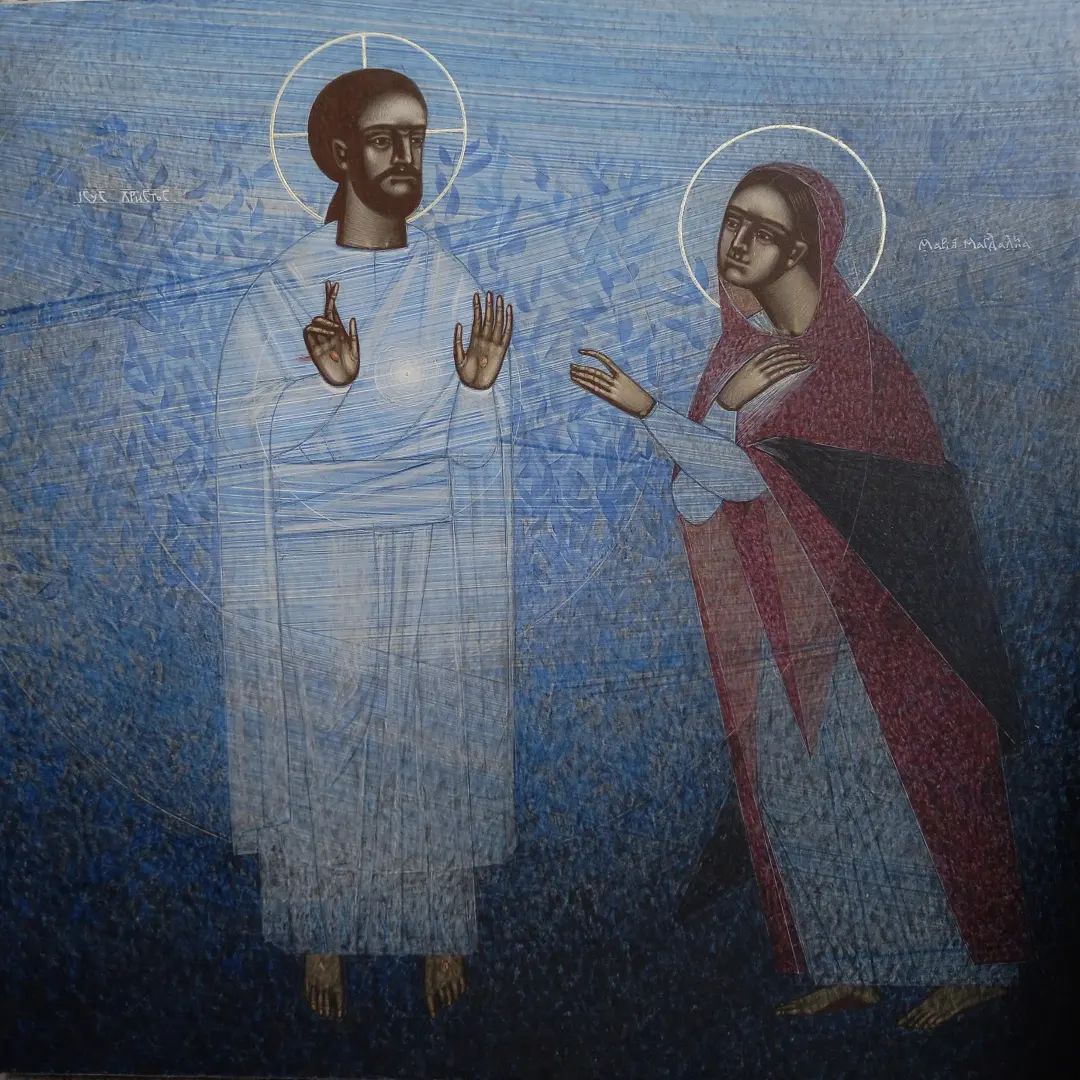
Kateryna Kuziv (Ukrainian, 1993–), Mary!, 2022. Egg tempera and gilding on gessoed wood, 40 × 40 cm.
In the end of the Sabbath, as it began to dawn towards the first day of the week, came Mary Magdalene.

The tomb, the tomb, that
Was her core and care, her one sore.
The light had hardly scarleted the dark
Or the first bird sung when Mary came in sight
With eager feet. Grief, like last night’s frost,
Whitened her face and tightened all her tears.
It was there, then, there at the blinding turn
Of the bare future that she met her past.
She only heard his Angel tell her how
The holding stone broke open and gave birth
To her dear Lord, and how his shadow ran
To meet him like a dog.
And as the sun
Burns through the simmering muslins of the mist,
Slowly his darkened voice, that seemed like doubt,
Morninged into noon; the summering bees
Mounted and boiled over in the bell-flowers.
‘Come out of your jail, Mary,’ he said, ‘the doors are open
And joy has its ear cocked for your coming.
Earth now is no place to mope in. So throw away
Your doubt, cast every clout of care,
Hang all your hallelujahs out
This airy day.’
This is the last of fourteen untitled, epigraphed poems from “Resurrection: An Easter Sequence” by W. R. Rodgers, originally published in Europa and the Bull and Other Poems (Farrar, Straus and Young, 1952) and compiled posthumously in Collected Poems (Oxford University Press, 1971) and later Poems, ed. Michael Longley (The Gallery Press, 1993). Used with permission of The Gallery Press.
William Robert “Bertie” Rodgers (1909–1969) was an Irish poet, essayist, radio broadcaster and scriptwriter, lecturer, and (for eleven years) a pastor. Born, raised, and educated in Belfast, he studied literature as an undergraduate and then entered theological college, becoming ordained as a Presbyterian minister in 1935 and taking a post at Loughgall parish in County Armagh. He began writing poetry three years later, after a friend lent him books by contemporary poets, of whom Auden made the biggest impact. In 1946 he left pastoral ministry to work for the BBC in London and later to freelance, creating radio portraits of Irish writers using a pioneering sound mosaic technique that is now a staple of radio documentaries. He joined a community of writer friends that included Dylan Thomas and Louis MacNeice. During his lifetime he published two books of original verse, with themes including the landscape of Northern Ireland, war, myth, erotic love, and the life of Christ.
Again your Spirit sweeps, a wind over the deep; a new creation now arrives to rouse us from our sleep.
The breath of heaven brings the long-awaited spring into the fields and seas and skies and every barren thing.
Refrain: Creation blooms anew in fresh and joyful hue. In Christ’s arising all things rise to draw their breath from you.
Awaken by the sound of forging swords into plows. Come fill the Garden with your light, and we will till the ground.
The earth is being cleared for heaven to come near. From every depth an eager sigh is all that we can hear. [Refrain]
Nick Chambers [previously] is the worship pastor at Church of the Incarnation in Atlanta and a singer-songwriter whose debut album, Great Cloud, released last year. “Creation Blooms Anew” is not part of that LP, but he shared it on YouTube in 2020. It was inspired by a hymn of Adam of St. Victor, a major Latin-language poet from twelfth-century France:
Earth blooms afresh in joyous dyes; In Christ’s arising all things rise; A solemn joy o’er nature lies; Alleluia!
Now peace the sea, the sky doth fill; Heav’n’s breath wakes fair each vale and hill; Spring pours through barren hearts and chill; Alleluia!
Life wins from death the glorious prey; The cherub’s sword is turned away, And Eden’s paths are free today; Alleluia!
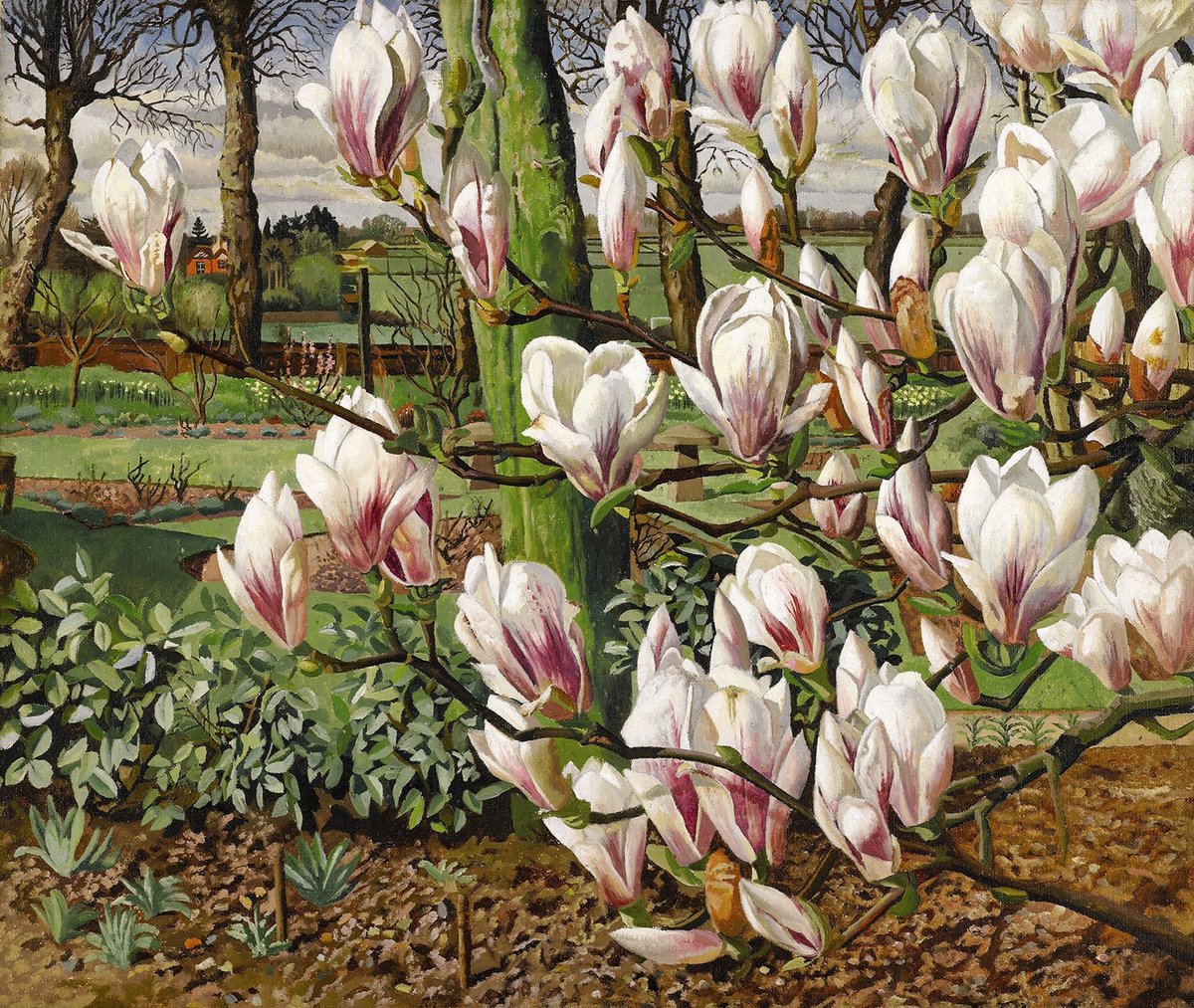
Memories of his family’s first Easter in Atlanta in 2017 also influenced the song. “More than anything I remember the magnolia flowers,” Chambers said, “bright white and big as our baby’s head. The branches bent with the weight of them, swinging like bells welcoming us into a new home, a new season of life.”
Chambers reflects further on the image of flowering:
Norman Wirzba, in one of his many reflections on gardening, writes, “It is significant that the material context for creation and for redemption should be a garden, for it is precisely through gardening that we most experience ourselves as created beings, as beings tied to a magnificent creation and to God. . . . [The writer of Genesis 2] is clear that we become authentic and truly fulfill our vocation as we learn to care for the garden which is creation itself.” He continues, “Gardens have long been a place of spiritual nourishment, because it is here that we can sense the vivifying and gracious power of the creator at work in the creation. Without much help from us, and sometimes in spite of our worst efforts, we can plainly see that we are in the presence of a life- and death-wielding power that overcomes and envelops us all” (The Paradise of God, 117).
In the beginning, God creates humanity to till the ground in a garden. Christ suffers anguish and grief in a garden, then to be resurrected in a garden and even mistaken for its caretaker. The story comes to its endless ending in a garden—steady streams in the shade of trees thick with healing leaves. We live from this past into this future, ourselves like flowers nourished by soil and bending toward the sun. Here and now, Easter invites us into this vision, into the wild surprises of spring to be both gardeners and the garden itself.
BANJO DUET: “Foggy Morning Breaking” by Alison Brown and Steve Martin: Did you know the actor Steve Martin also has a music career? He’s been playing the banjo since he was a teenager, and he writes, records, and tours, both solo and as part of bluegrass bands. He’s even won three Grammys for his banjo music!
Fellow banjoist Alison Brown invited him to contribute to one of the tunes on her forthcoming album, On Banjo, which releases May 5. It’s called “Foggy Morning Breaking.” She wrote and plays the A section; he wrote and plays the B. The piece was released last month as a single, along with this music video.
>> April 22: “The Ekstasis Café: An Evening of Poetry, Music, Testimony, and Gallery,” Goldberry Books, Concord, North Carolina: Ekstasis is a beautiful quarterly magazine “exhibit[ing] arts and letters that reflect the depths of Christian life.” Next Saturday they are hosting their first-ever public gathering! Their hope with it is to foster meaningful connections, conversation, deep aesthetic encounters, and inspiration.
Stephen Procopio, Ascension, 2020. A full-color version of an illustration for Come See a Man (an illustrated Gospel of John) by Fish Coin Press.
From April 9 to May 28, the gallery at Sojourn Church Midtown in Louisville is exhibiting a selection of art from Fish Coin projects (open Sundays from 9 a.m. to 12:30 p.m., or by appointment); here are a few exhibition views. And two Friday evenings from today, Fish Coin Press creative director Jared Boggess and development lead Stephen Procopio, who are illustrators themselves, will be visiting the gallery to discuss “visual theology” and its role in the local church. There will be a Q&A and a sneak preview of upcoming publications.
+++
POEM: “Psalm” by Dorianne Laux: This poem sings the glories of “the hidden and small,” of the plants and creatures beneath our feet. Read more of Laux’s poems at https://www.doriannelaux.net/poems.
+++
LECTURE: “Resurrection and the Renewal of Creation” by N. T. Wright: In this 2018 lecture sponsored by Lanier Theological Library and Baylor University’s Truett Seminary, ancient historian and New Testament scholar N. T. Wright discusses the meaning of Jesus’s resurrection, a topic he explores thoroughly in the influential academic tome The Resurrection of the Son of God and its more accessible corollary, Surprised by Hope: Rethinking Heaven, the Resurrection, and the Mission of the Church. “Easter is the start of something; it isn’t the ending,” he says. With the resurrection of Christ, the new creation has been launched and put to work in the world. It’s not about securing our souls a place in some nonspatiotemporal heaven when we die but about heaven colonizing earth here and now. We humans, he says, are meant to stand at the place where heaven and earth interlock. We who have received life are to be ourselves life-bringers, to participate in God’s massive renewal project. We are resurrection people!
Wright addresses common Christian misconceptions about death, judgment, and the fate of this world, seeking to root out the corrupting influence of Platonism and other pagan Greek philosophies on Christian eschatology. (For example, the new creation won’t be a creatio ex nihilo, creation out of nothing; it will be a creatio ex vetere, a creation out of the old. The implications of that are huge.) He also affirms the absolute importance of belief in Jesus’s bodily resurrection—his rising is no mere metaphor!—and calls on Christians to recover a centralizing hope in the general resurrection (what he calls “life after life after death”; fully embodied life in the new heavens and the new earth that comes after the not-yet-fully-realized life experienced in the interim between one’s death and the future cosmic coming of Christ) rather than regarding what happens immediately after one’s death as the ultimate beatitude.
Wright always makes me excited about what God’s doing and excited to be a disciple of Jesus. What more could a preacher ask for?
The final half hour of the video is Q&A.
+++
DIGITAL COMIC: 30 Days of Comics (2022) by Madeleine Jubilee Saito:Madeleine Jubilee Saito [previously] is a Seattle-based cartoonist who is interested, as she says on her website, in “friendship, formal experimentation, medieval sacred comics, the built environment, solidarity, climate justice, the psalms, the material world, and the sacred.” Last year she was one of five artists in the inaugural cohort of On Being Project’s Artist Residency; during that time she created “For living, in climate crisis.” Her work is poetic, spiritual, and earthy, and I love it.
Comic by Madeleine Jubilee Saito, 2022, the ninth of thirty from “30 Days of Comics.”
In November 2022 Saito made a one-page, four-panel comic (almost) every day for the duration of the month. The series is resurrection-themed and, she told me, inspired by one of my blog posts: the one about Fra Angelico’s Noli me tangere at San Marco, a painting in which Christ the Gardener sows his stigmata across the lawn, as art historian Georges Didi-Huberman so beautifully interprets in his monograph on the artist. Click on the image and scroll down (then, at the bottom, click “←older”) to view all twenty-seven comics from the series. Each can stand alone, but they also have a cumulative effect. It’s stunning! You can follow Saito on Instagram @madeleine_jubilee_saito.
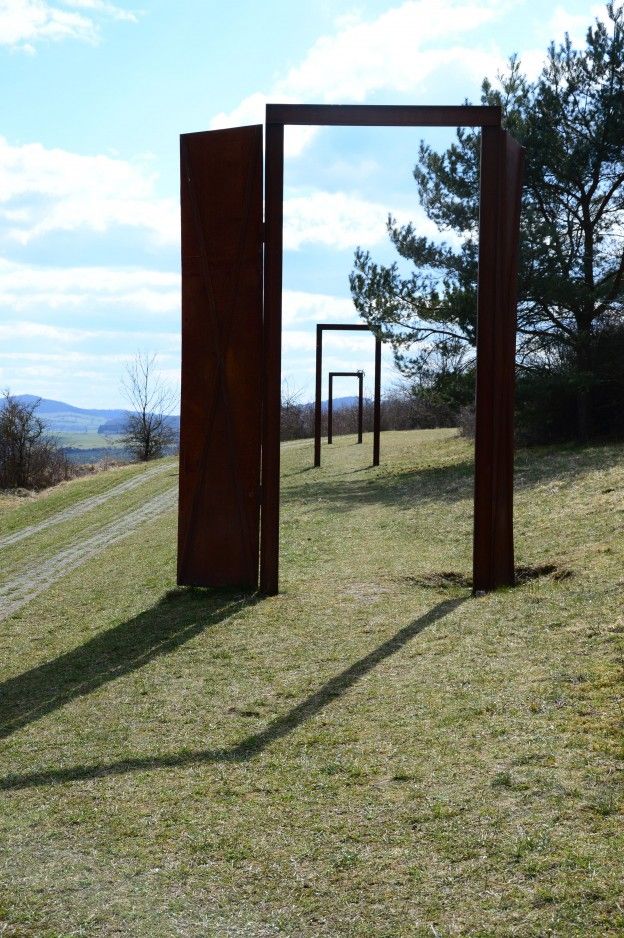
Ulrich Barnickel (German, 1955–), Hoffnung (Hope), fourteenth station from the cycle Weg der Hoffnung (Path of Hope), 2009–10. Iron sculpture, Geisa, Germany.
This is the last of fourteen monumental sculptures situated along the former inner German border that separated Soviet-occupied East Germany and Allied-occupied West Germany from 1952 to 1990. Stretching from Hesse to Thuringia, this highly militarized frontier consisted of high metal fences, barbed wire, alarms, watchtowers, and minefields, a literal iron curtain that divided families, friends, and neighbors.
In 2009, the Point Alpha Foundation, founded to preserve the historic site as a memorial, commissioned German metal sculptor Ulrich Barnickel to create an artwork as part of the memorial. He decided to draw on the traditional fourteen Stations of the Cross, connecting the suffering of Jesus to that of the people on the inner German border under Communism. Collectively titled Path of Hope, his fourteen iron sculptures cover 1,400 meters of ground (scaling down the 1,400 kilometers of the former border). All but the last are figurative, representing Jesus falling, meeting his mother, being nailed to the cross, and so on. They contain artifacts from or references to German Cold War era history, such as a vintage steel helmet hanging on Pilate’s chair, or the grenade and the trench that Jesus stumbles over.
The final station, titled Hope, is a threefold open doorway. After all the heaviness of the previous thirteen stations, we get this breather. Here’s what the doors say to me: Invitation. Possibility. The fourteenth station of the cross is traditionally where Christ is buried in his tomb. But instead of a dead body on a slab or a sealed-up cave, Barnickel gives us an open frame, a door ajar, a view of sky. It alludes to resurrection. Jesus walked through death and came out the other side. And so can we.
While the Path of Hope is a vehicle for remembering, lamenting, and healing from the collective traumas of war and political violence and oppression, it can also speak to personal losses, to any individual’s journey of grief. It’s an invitation to acknowledge the pain we carry but also to see beyond it to the Better Day that is coming, as well as to embrace the life before us here and now. The doors ask us to unburden ourselves of whatever weight is crushing us and to be renewed. (Notice the crown of thorns, an emblem of suffering, left hanging on the corner of the final threshold.) To follow the Man of Sorrows, who walks beside us in our own sorrow, from death into life.
For those accompanying a loved one to the door of death, or who have had a loved one suddenly snatched through, may Barnickel’s Hope meet you in your grieving, filling you with soft consolations of a Love stronger than death, a Love who, once buried, became on the third day the firstfruits of the resurrection harvest.
Waking up to tragic dawn Not comprehending what is going on Alleluia, Christ is risen once again
And it frames a hollow place Lost dreams and accolades Alleluia, Christ is risen once again
Alleluia, Christ is risen Though the walls of castles fall Alleluia, he is risen for us all
From these sights the shadows light In an overwhelming night Alleluia, Christ is risen once again
Hopes fly from us every day Fear reigns far and so does hate Alleluia, Christ is risen once again
Alleluia, Christ is risen Though the gates of all this war Alleluia, Christ is risen evermore
Alleluia, God is able To complete the life you led Alleluia, Christ is risen from the dead
Alleluia, he is risen once again
From the sorrow you have fled You have joy around your head Alleluia, Christ is risen once again
And as from earthly trials you fly You leave sadness when you die Alleluia, Christ is risen once again
Alleluia, Christ is risen And the life you’re living now Alleluia, all’s forgiven somehow
Alleluia, there is beauty When I think of you, joy I feel Alleluia, in my sadness, faith is real
Alleluia, Christ is risen once again Alleluia for you, my friend
Tara Ward [previously] wrote this song during the 2007 Easter season when two tragedies struck within a week of each other. On April 16, a mass shooter opened fire at Virginia Tech, killing thirty-two people, and on April 21, Ward’s friend Liz Duncan was fatally struck by a car while jogging. In the second half of the song, Ward addresses Duncan in the second person, rejoicing through tears that she has entered a state of joy and rest and will one day be raised, body and soul.
Ward returned to the song for Easter 2020 following the death that March of another friend and the initial outbreak of COVID-19. “I was trying to think of what I would sing if I was still working at a church, looking for honest songs to sing on Easter, and this one came up,” she writes on the YouTube video description.
The Nashville community, and America at large, is still reeling from the March 27 shooting at Covenant School that left seven dead, the 131st mass shooting in the US this year. I can only imagine the absolute devastation and rage a parent would feel upon learning that the child they dropped off at school that morning would not be coming home because they were gunned down with an assault rifle.
As I listen to this song, I think, too, of Leslie Bustard, a writer and book publisher, a luminary in the art and faith sphere, who, less than two months after hosting an amazing Square Halo conference on the theme of “ordinary saints,” is now in hospice with late-stage cancer.
Sometimes all the exuberance of Easter can seem disjunctive with the bleak state of the world or our own present circumstances. Christ is risen, but death is still a reality, and it’s still painful. Quiet and aching, this song gives space to grief while also confessing this central Christian doctrine: that Jesus rose from the dead, giving life to all who will receive it. Of course, that doesn’t mean Christians are exempt from experiencing physical death—we will all one day go to the grave—nor from the grief that follows in the wake of a loved one’s passing.
But what Ward’s song helps us do is sing “alleluia” in our sadness, because Christ’s resurrection life is at work in those who have passed on in him, and it’s at work in those of us who walk through the valley of death’s shadow here on earth. The “once again” language—“Christ is risen once again”—indicates that Jesus’s historical rising has ongoing implications, its efficacy extending to every new place of death.
Anastasis (Harrowing of Hell), ca. 1207. Fresco, St. Nicholas Church, Kintsvisi Monastery, Shida Kartli region, Georgia.
In this (partially damaged) icon of the Resurrection from the main church at Kintsvisi Monastery in the country of Georgia, Christ stands over the pit of hell, atop its broken gates. He has come to take back his own from this place of death. He heaves Adam up first, and Eve next. On the right stand Kings Solomon and David and John the Forerunner (aka John the Baptist). The deliverance they’ve been awaiting has come.
Fresh from the tomb, Christ holds aloft his cross as a victory staff. As is common in Orthodox icons, it has three horizontal beams: a short one on top, representing the titulus that read, “King of the Jews”; the main one, onto which Jesus’s hands were nailed; and a footrest at the bottom.
LISTEN: “Kriste aghdga” (Christ Is Risen), the Paschal troparion in a traditional Georgian setting from the Svaneti region | Performed by the Sheehan Family, 2020
The troparion [short hymn] for Pascha is this brief and punchy one, written by St. John of Damascus (d. 749):
Christ is risen from the dead, trampling down death by death, and upon those in the tombs bestowing life.
We sing it many, many times—surely hundreds of times—before Pascha concludes on the day of Pentecost. It is always sung a capella, without accompaniment (apart from the vigorous ringing of bells, in some congregations). It is set to many, many different melodies. Each ethnicity has a half-dozen favorite melodies, so the options are very broad. . . .
But when Orthodox of other nations hear it sung in a Georgian tone, they stop and listen.
Georgian church music is unique. It is always sung in three parts, honoring the Trinity; but what’s striking is the sound of it, unlike anything we have in the West. Someone who is trained in Georgian chant might be able to explain it, but I can’t.
“Kriste aghdga” (Christ is Risen) is an important Easter hymn in the Georgian Orthodox tradition. It is sung when the priest knocks on the doors of the church, symbolizing entrance to the tomb of Christ, just before entering the sanctuary space to commence the all-night liturgy service [on the Saturday before Easter].
Then it is repeated in groups of three throughout the All-Night vigil service (4-7 hours). It is also sung in every service after Easter until Pentecost.
The chant survives in many musical variants, as chanters in each village and region perfected their individual style.
The most popular variant, the one you heard above, is from Svaneti, a highland region in northwest Georgia. The style is influenced by Svan folk music. This variant begins with a solo sung by the middle voice. You can purchase the vocal score here, as sung by the Sheehan family, or see the free transcription that Graham provides.
Here’s the Orthodox Virtual Quarantine Choir, directed by Steve Jacobs, singing the chant in English, interspersed with a Paschal reading taken from Psalm 68:1–3 (“Let God rise up . . .”) and Psalm 118:24 (“This is the day . . .”):
In his article, Graham lists seven characteristics of traditional Georgian chant, among which are its three-part voicing, its close harmonies (“The dissonances are integral to the desired sound. The tension-release in the music is symbolic of our prayers and supplications to God.”), and an ending in unison. He posts videos of several other regional musical variants of the troparion in Georgian.
This song, as performed by the Capitol Hill Chorale, is on the Art & Theology Eastertide Playlist.
. . . the sun of righteousness shall rise, with healing in its wings . . .
—Malachi 4:2
The people who walked in darkness have seen a great light; those who lived in a land of deep darkness— on them light has shined.
—Isaiah 9:2
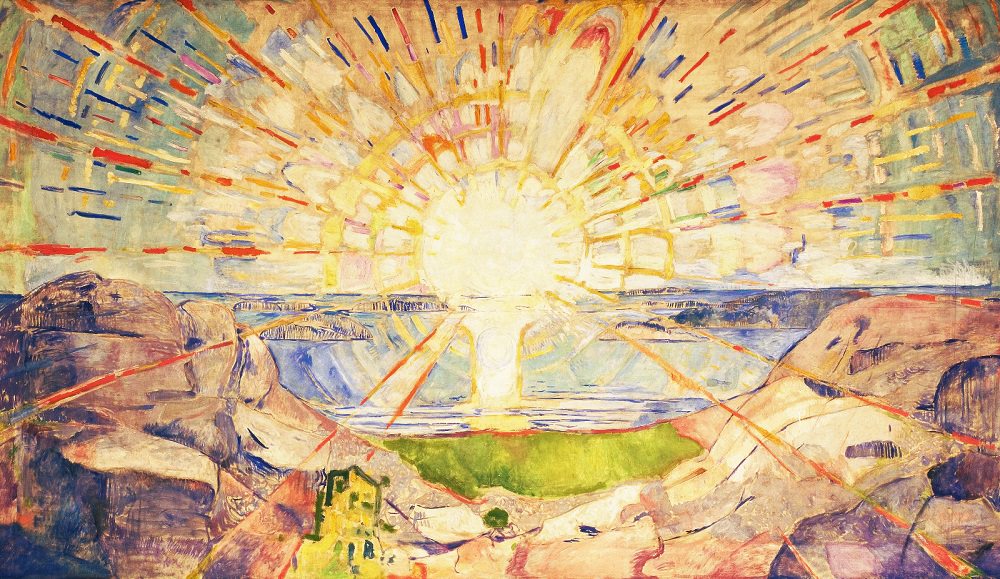
LOOK: The Sun by Edvard Munch
Edvard Munch (Norwegian, 1863–1944), The Sun, 1911. Oil on canvas, 455 × 780 cm (14.9 × 25.5 ft.). The Aula, University of Oslo, Norway.
Over twenty-five feet across, Edvard Munch’s The Sun is the centerpiece of an eleven-piece cycle of oil paintings on the theme of enlightenment commissioned for, and still located in, the Aula (assembly hall) at the University of Oslo. It shows a blazing sunrise over the coastline of Kragerø in Norway, its multicolored rays extending to adjacent canvases, which portray men and women reaching up toward the light.
Though he didn’t have an explicitly Christological meaning in mind, Munch did see the sun as the source of all life, as he wrote about in his notebooks, and in his work it is often read as a symbol of the eternal.
LISTEN:“Again the Lord” | Words by Anna L. Barbauld, 1772 | Music by Ben Thomas, 2015 | Performed by Ben Thomas on Bring Forth, 2015
Again the Lord of light and life Awakes the kindling ray Unseals the eyelids of the morn And pours increasing day
O what a night was that which wrapped The sleeping world in gloom O what a Sun which rose this day Triumphant from the tomb
This day be grateful homage paid And loud hosannas sung Let gladness dwell in every heart And praise on every tongue
Ten thousand different lips shall join To hail this welcome morn Which scatters blessing from its wings To nations yet unborn
Henry Ossawa Tanner (American, 1859–1937), The Three Marys, 1910. Oil on canvas, 42 × 50 in. Fisk University Art Galleries, Nashville, Tennessee.
Based on Mark 16:1–4, this painting shows Mary Magdalene (leading the way), Mary the mother of James, and Salome approaching the tomb of their rabbi, Jesus, the Sunday after his crucifixion. They came bearing spices to anoint his body. They expected it to be a mournful day.
Imagine their response when they found the stone rolled away and the tomb empty! That’s the moment the artist Henry Ossawa Tanner shows us here. Not the Resurrection itself, but the emotional reaction to it, or rather to the evidence of it.
What do you read on the faces of these women? Surprise? Confusion? Fear? Curiosity? Caution? Wonder? Love? Some mix thereof?
They are illumined by the light of an angel who is out of frame and who will speak the news to them presently. Mary Magdalene lifts her hand to her face in a gesture of self-reassurance, while her companion raises her tensed arms at the elbow in a defensive posture, as I read it. Compelled but still somewhat guarded, they progress toward the mystery.
Born and raised the son of a minister in the AME Church in Pennsylvania, Henry Ossawa Tanner (1859–1937) was an African American expat to Paris whose biblical paintings, inspired in part by his two trips to the Holy Land, garnered him international acclaim. In Beholding Christ and Christianity in African American Art, art historian James Romaine identifies Tanner as “the most artistically gifted and theologically astute American painter of biblical subjects.” A master of conveying nuanced mystery, “Tanner paints personal experiences rather than public spectacles,” Romaine writes, communicating more through suggestion than depiction and urging the viewer to undergo, like the figures in his paintings, their own experience of spiritual sight.
LISTEN: “Dum transisset Sabbatum” (When the Sabbath was past) | Text: Mark 16:1–2 | Music by John Taverner, 1520s | Performed by Alamire, 2010
Dum transisset Sabbatum, Maria Magdalene et Maria Jacobi et Salome emerunt aromata ut venientes ungerent Jesum. Alleluia.
Et valde mane una sabbatorum veniunt ad monumentum orto iam sole.
Gloria Patri et Filio et Spiritui Sancto.
English translation:
And when the sabbath was past, Mary Magdalene, and Mary the mother of James, and Salome, had bought sweet spices, that they might come and anoint him. Alleluia.
And very early in the morning the first day of the week, they came unto the sepulcher at the rising of the sun.
Glory be to the Father, and to the Son, and to the Holy Ghost.
The third responsory at Matins on Easter Sunday, this text has been set to music by many composers. The motet by English Renaissance composer John Taverner is the most famous. The video above is just an excerpt. The full piece lasts about eight minutes and alternates between plainchant and polyphony.
The high point of the church year, Easter is a fifty-day festal season, beginning today, that celebrates the Resurrection of Christ with concentrated vigor! The first eight days of Easter are called the Easter Octave. During this octave I will be publishing daily art-and-song posts, as I did for Holy Week, in the hopes that these works of beauty will help you to bask, wonder, and rejoice in the world-changing truth that Christ is risen.
LOOK: Alleluia by Helen Siegl
Helen Siegl (Austrian/American, 1924–2009), Alleluia, 1975. Color woodcut, 20.5 × 12 cm.
Jesus flipped the script on death! On the bottom of this woodcut, Jesus hangs dead on a tree. The sun and moon have gone black. In the center of the composition, a large crown of thorns encircles instruments of the passion: the titulus, the rooster, the three nails, the spear, the sponge-tipped reed, the scourge, the bread and the wine. But Jesus emerges victorious from the whole ordeal. The serpentine creature that bares its teeth could be read as the serpent from Genesis, whom God prophesied would have his head crushed by the offspring of Eve (Gen. 3:15), or as the sea monster from the book of Jonah as an allegory of the tomb in which Jesus spent three days before emerging anew (Matt. 12:38–41). Sun, stars, planets—the cosmos rejoices. Its Savior has risen.
LISTEN:“Praise the Savior, Now and Ever” | Original Latin words by Venantius Fortunatus, 569 CE; adapted into Swedish by Johan Olaf Wallin, 1819; translated into English by Augustus Nelson, 1925 | Music: American shape-note tune (HOLY MANNA), attributed to William Moore, 1829 | Performed by the musicians of Redeemer Presbyterian Church, Indianapolis, 2007
Praise the Savior, now and ever; Praise him, all beneath the skies! Prostrate lying, suff’ring, dying On the cross, a sacrifice. Vict’ry gaining, life obtaining, Now in glory he doth rise.
Man’s work faileth, Christ’s availeth; He is all our righteousness. He, our Savior, has forever Set us free from dire distress. Through his merit we inherit Light and peace and happiness.
Sin’s bond severed, we’re delivered; Christ has bruised the serpent’s head. Death no longer is the stronger, Hell itself is captive led. Christ has risen from death’s prison; O’er the tomb he light has shed.
For his favor, praise forever Unto God the Father sing; Praise the Savior, praise him ever, Son of God, our Lord and King. Praise the Spirit; through Christ’s merit He doth us salvation bring!
This song has its roots in one of the oldest Easter hymns, “Pange, lingua, gloriosi proelium certaminis” (Sing, My Tongue, the Glorious Battle)—from the sixth century. It’s been copiously translated and adapted over the years. This version comes from Redeemer Indy, a Presbyterian church in Indianapolis. While working as a worship director there in the 2000s, Bruce Benedict found the English text in the Trinity Hymnal and paired it with the shape-note tune HOLY MANNA to give it an “Easter jamboree vibe,” arranging it for bluegrass instruments.
The Psalter Hymnal Handbook notes, “The text sets forth the gospel of Easter: Christ who died has risen in victory (st. 1), has set us free from sin (st. 2), and has conquered death and hell itself (st. 3); to that confession we respond with our praise—a doxology to the Trinity (st. 4).”
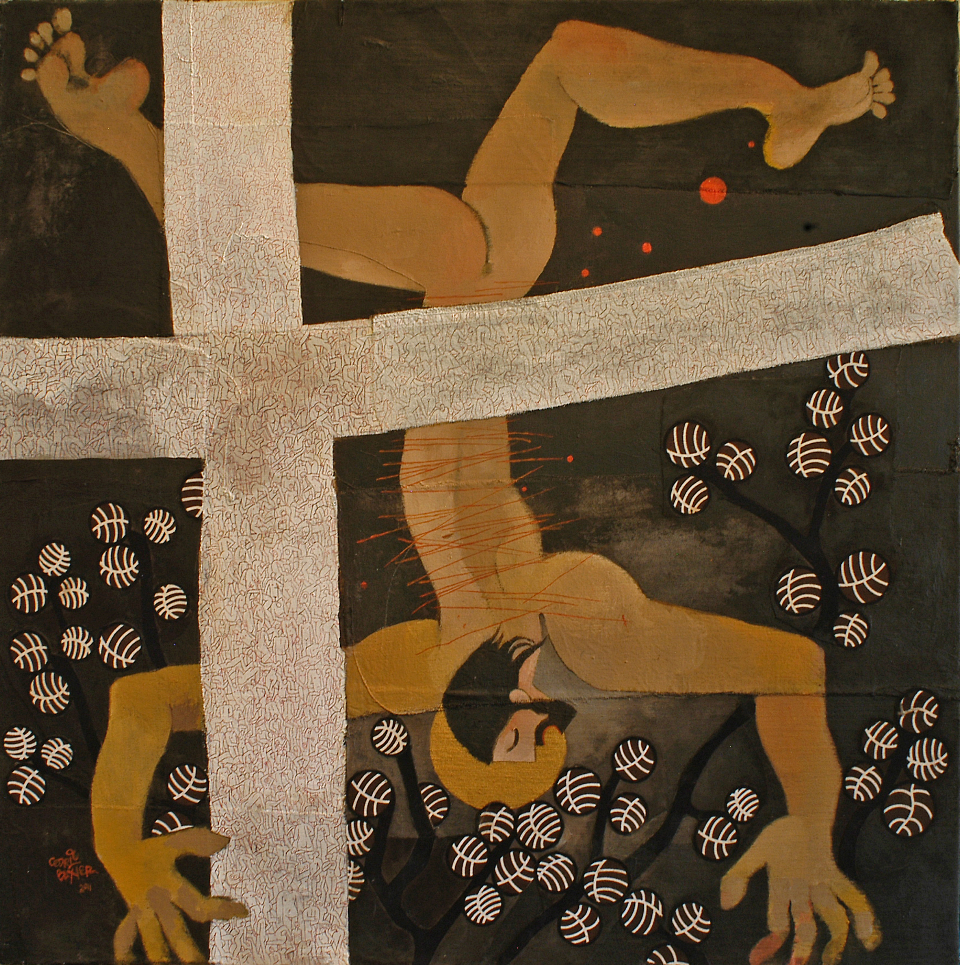
Cedric Baxter (Australian, 1930–), Jesus Striped and Stripped, 2011. Acrylic, collage, and pen on canvas, 91 × 91 cm. Collection of the Uniting Church in Australia. [learn more]
Christ came juggling from the tomb,
flipping and bouncing death’s stone pages,
tossing those narrow letters high
against the roots of dawn spread in cloud.
This Jesus, clown, came dancing
in the dust of Judea, each slapping step
a new blossom spiked with joy.

Hey! Listen—that chuckle in the dark,
that clean blast of laughter behind—
Christ comes juggling our tombs,
tossing them high and higher yet,
until they hit the sun and break open
and we fall out, dancing and juggling
our griefs like sizzling balls of light.
This poem is from Christographia by Eugene Warren (St. Louis, MO: The Cauldron Press, 1977), a chapbook of thirty-two numbered poems that “attempt to express personal views of, & perspectives on, Christ.”The book’s title comes from a series of sermons by the Puritan poet and preacher Edward Taylor.
Gene Warren Doty (1941–2015) was an American poet in the Anabaptist tradition who taught in the English department of Missouri S&T for forty-two years. Throughout his career he explored a variety of non-Western poetic forms, including haiku, renga, tanka, sijo, and ghazals. He is the author of seven books of poetry: Christographia, Rumors of Light, Geometries of Light, Fishing at Easter, Similitudes, Nose to Nose, and Zero: Thirty Ghazals. Until 1988 his books and poems were signed “Eugene Warren,” Warren being the surname of his adoptive father, George, who raised him; but from 1988 onward he used the surname of his biological father, Floyd Doty.
This early sixteenth-century poem by William Dunbar of Scotland—who served as poet in the court of King James IV and was also an ordained Catholic priest—is an imaginative retelling of the extrabiblical episode known as the Harrowing of Hell, wherein Christ descends to the realm of the dead on the eve of his resurrection to free the souls being held captive there by Satan.
The original poem, in Middle Scots, is reproduced below, followed by my translation into modern English, with the assistance of the Dictionary of the Scots Language. I’ve provided hyperlinks to Scots words that don’t have an obvious English correlative. The Latin refrain translates to “The Lord is risen from the grave.”
Done is a battell on the dragon blak, Our campioun Chryst confountet hes his force; The yettis of hell ar brokin with a crak, The signe triumphall rasit is of the croce, The divillis trymmillis with hiddous voce, The saulis ar borrowit and to the blis can go, Chryst with his blud our ransonis dois indoce: Surrexit dominus de sepulchro.
Dungin is the deidly dragon Lucifer, The crewall serpent with the mortall stang, The auld kene tegir with his teith on char Quhilk in a wait hes lyne for us so lang, Thinking to grip us in his clowis strang: The mercifull lord wald nocht that it wer so, He maid him for to felye of that fang: Surrexit dominus de sepulchro.
He for our saik that sufferit to be slane And lyk a lamb in sacrifice wes dicht, Is lyk a lyone rissin up agane, And as a gyane raxit him on hicht: Sprungin is Aurora radius and bricht, On loft is gone the glorius Appollo, The blisfull day depairtit fro the nycht: Surrexit dominus de sepulchro.
The grit victour agane is rissin on hicht That for our querrell to the deth wes woundit; The sone that wox all paill now schynis bricht, And, dirknes clerit, our fayth is now refoundit: The knell of mercy fra the hevin is soundit, The Cristin ar deliverit of thair wo, The Jowis and thair errour ar confoundit: Surrexit dominus de sepulchro.
The fo is chasit, the battell is done ceis, The presone brokin, the jevellouris fleit and flemit, The weir is gon, confermit is the peis, The fetteris lowsit and the dungeoun temit, The ransoun maid, the presoneris redemit, The feild is win, ourcummin is the fo, Dispulit of the tresur that he yemit: Surrexit dominus de sepulchro.
ENGLISH TRANSLATION:
Done is a battle on the dragon black, Our champion Christ has confounded his force; The gates of hell are broken with a crack, The sign triumphal raisèd is the cross, The devils tremble with hideous voice, The souls are redeemed and to the bliss can go, Christ with his blood our ransom does endorse: Surrexit dominus de sepulchro.
Beaten is the deadly dragon Lucifer, The cruel serpent with the mortal sting, The old sharp tiger with his teeth bared, Who in wait has lain for us so long, Thinking to grip us in his claws strong: The merciful Lord would not that it were so, He made him for to fail of that prize: Surrexit dominus de sepulchro.
He who for our sake allowed himself to be slain, And like a lamb in sacrifice was offered, Is like a lion risen up again, And like a giant raised himself on high: Risen is Aurora radiant and bright, Aloft is gone the glorious Apollo, The blissful day departed from the night: Surrexit dominus de sepulchro.
The great victor again is risen on high Who on our behalf to the death was wounded; The Son that waxed all pale now shimmers bright, And, darkness cleared, our faith is now refounded. The knell of mercy from the heav’n is sounded, The Christians are delivered from their woe, The Jews and their error are confounded: Surrexit dominus de sepulchro.
The foe is chased, the battle is done, The prison broken, the jailers fled and banished, The war is gone, confirmèd is the peace, The fetters loosed and the dungeon emptied, The ransom made, the prisoners redeemed, The field is won, overcome is the foe, Despoiled of the treasure that he held: Surrexit dominus de sepulchro.
“Done Is a Battle” consists of five stanzas with a rhyme scheme of ababbcbc, dedeecec, and so on. (I wasn’t able to perfectly preserve this scheme in the translation.)
As was common in medieval European literature on the Resurrection, the poem portrays Christ as a heroic warrior who storms the gates of hell, freeing the souls imprisoned there by the Enemy—described here variously as a dragon, a serpent, and a tiger, who guards his stolen possession with ferocity. Carrying a cross as his battle standard and covered with his own blood, Jesus goes down into the beast’s lair to reclaim what is rightfully his.
The opening line is considered one of the finest of any poem: “Done is a battle on the dragon black.” Part of its power comes from the use of a literary device known as anastrophe—the inversion of the usual order of words in a sentence (usually subject-verb or adjective-noun). Dunbar uses it twice: “Done is a battle” instead of “A battle is done,” emphasizing finality rather than the conflict itself, and “dragon black” instead of “black dragon,” which gives more prominence to the creature than its color. “A battle is done on the black dragon” just doesn’t have the same ring. Anastrophe is used all throughout the poem (e.g., “sign triumphal,” “claws strong,” “confirmed is the peace”).
Cosmic and dramatic, the poem highlights the Christus Victor aspect of the atonement—that is, how Christ’s death and resurrection were a triumph over the powers of evil. Integrated into this model is the idea of ransom, redemption, emancipation.
While the Harrowing of Hell refers specifically to the salvation of those saints who died before Christ and were awaiting redemption in Sheol (aka Limbo, or Hades), it is representative of the act that Christ performs for all those who are in him—releasing us from Satan’s hold, bringing us out of the grave, letting us share eternally in the fruits of his victory in heaven. In the Eastern Orthodox Church, the central icon of Easter shows the risen Christ standing atop the broken-down doors of hell, pulling Adam and Eve and the other Old Testament faithful up from its pit. It’s called the Anastasis, Greek for “resurrection,” and we on this side of sacred history are meant to see Christ’s saving of our foreparents as a promise extended to us who live in our own kind of darkness.
Jesus conquered death by going through it. Stanza 3 describes the glory with which he rose from such a state. He died a sacrificial lamb, meek and lowly, but rose up like a lion—vigorous, strong. From the darkness of night, he rose like day—like Aurora, goddess of the dawn, or Apollo, god of the sun.
In the fourth stanza Dunbar uses a play on words that was particularly beloved in Middle English and Scots religious lyrics (and which still works in modern English): sun/Son. The sun/Son went dark at the Crucifixion (Luke 23:45) but reemerged brighter than ever on Easter morning, the dawn of a new day. Mercy sounds like bells from on high, and the world enters its liberation.
I don’t want to ignore the problematic nature of the penultimate line of this stanza: “The Jews and their error are confounded.” Their error was failing to see who Christ truly was and, because of that, calling for his execution. Attributing Jesus’s death to, broad brush, “the Jews” led to centuries of anti-Semitic persecution and violence in Europe. While the religious establishment of Jesus’s day certainly did play a driving role in his death, it’s important to remember that the Roman authorities were also key players; it was a collusion between synagogue and state. Both perceived Jesus as a threat, for different reasons. (And of course there’s a sense in which we all bear culpability, regardless of religious affiliation or time period, because it was for humanity’s sin that Christ went to the cross.) But casting blame is fruitless. Jesus died willingly. When I read old texts that charge all Jews across time and place with the crime of deicide, I can’t help but protest that it was also “the Jews” who stood by Jesus in the end—his mother Mary, Mary Magdalene, Nicodemus and Joseph of Arimathea (members of the Sanhedrin!), John the Evangelist, and others—and who were among his closest followers. Not to mention that most of those whom Jesus “harrowed” from hell were Jewish! Across generations they trusted the promise given to them.
I alert you to this line so that if you use the poem in a worship context, you might consider a revision there (or at least a clarification), as the shorthand can cause confusion and breed prejudice. Though it doesn’t exactly honor Dunbar’s intent, I might suggest the following: “The people are delivered from their woe, / Resisters all most truly are confounded.”
Despite the undesirable generalization in line 31, I still believe “Done Is a Battle” is a poem worthy of our attention and engagement. It’s an exciting and culturally contextualized celebration of Christ the Dragon-Slayer, who “descended into hell,” as the Apostles’ Creed puts it, to save his people.
Try reading the Scots aloud! That way you can get a better sense of the musicality. I was surprised by how much of the language I was able to comprehend. Curious of its history, I discovered that most people claim, controversially, that Scots is not actually a separate language, but rather a dialect of English.






 Art & Theology