Roundup: Jonah disgorged, Watching TV Religiously, “My Mother’s Body,” and more

VISUAL MEDITATIONS (ARTWAY.EU)

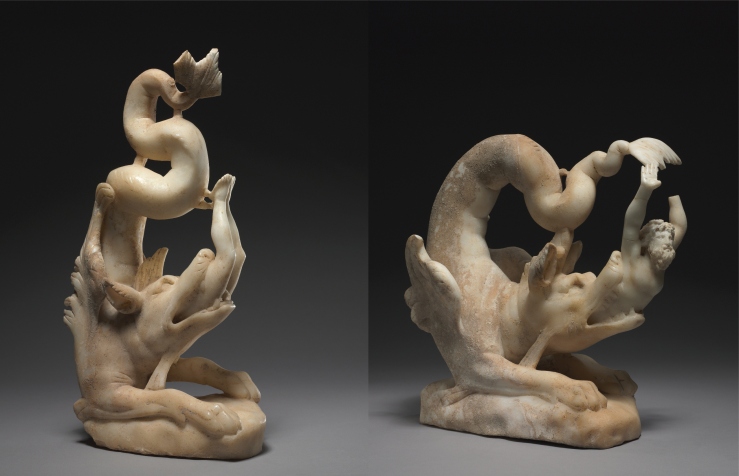
Jonah Swallowed and Jonah Cast Up, commentary by Victoria Emily Jones: My latest visual meditation for ArtWay was published Sunday—it’s on two third-century Jonah sculptures from Asia Minor that likely decorated a family fountain. Early Christians read the story allegorically (at least on one level), as pointing forward to the death and resurrection of Christ. The “great fish” is portrayed as a ketos, a sea-monster of Greek myth.

Jonah Marbles
“Jonah Swallowed” and “Jonah Cast Up,” made in Asia Minor, probably Phrygia, 280–90 CE. Marble, 50.4 × 15.5 × 26.9 cm (left) and 41.5 × 36 × 18.5 cm (right). Cleveland Museum of Art, Ohio.

Run by Marleen Hengelaar-Rookmaaker, the faith-based website ArtWay has been publishing a new visual meditation every Sunday for years, as well as a lot of other content from a variety of contributors. To subscribe to the weekly email, click here. Here are just a few VMs published in the past year that I particularly enjoyed:

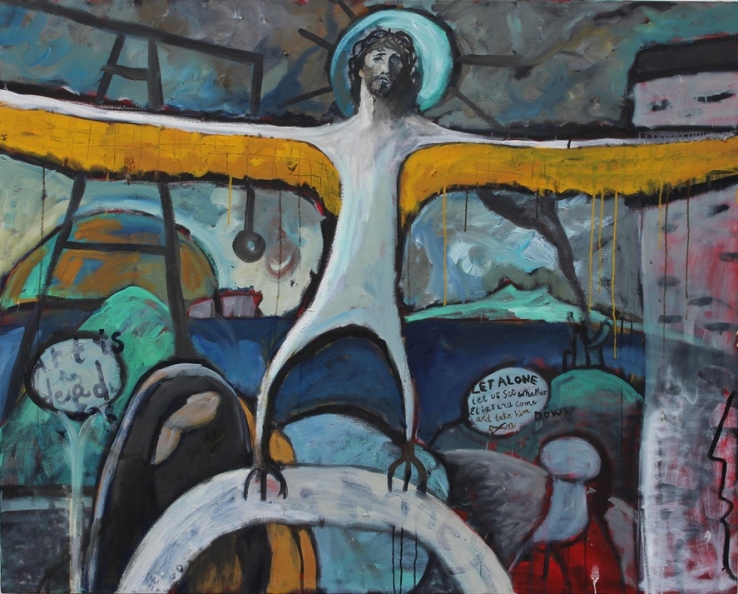
Manu-Kahu by Brett a’Court, commentary by Rod Pattenden: Pattenden begins, “This striking image of an airborne Christ is from New Zealand painter Brett a’Court. It is part of his investigations into a way of bringing together the spiritual insights of the indigenous culture of the Maori people and that of Christianity brought to New Zealand by British settlers. In cultural terms it is a hybrid image. This is something that occurs when two cultures are in a process of mutual re-assessment. That sort of conversation is full of conflict and critique but also allows for the potential for new forms to arise that express the best of both traditions. A Christ figure flying in the sky like a kite, is such a form. It is a new thing, a potential heresy or aberration, but one full of potential for new insight and spiritual refreshment.”

Manu-Kahu by Brett a'Court
Brett a’Court (New Zealand, 1968–), Manu-Kahu, 2007. Oil on canvas.

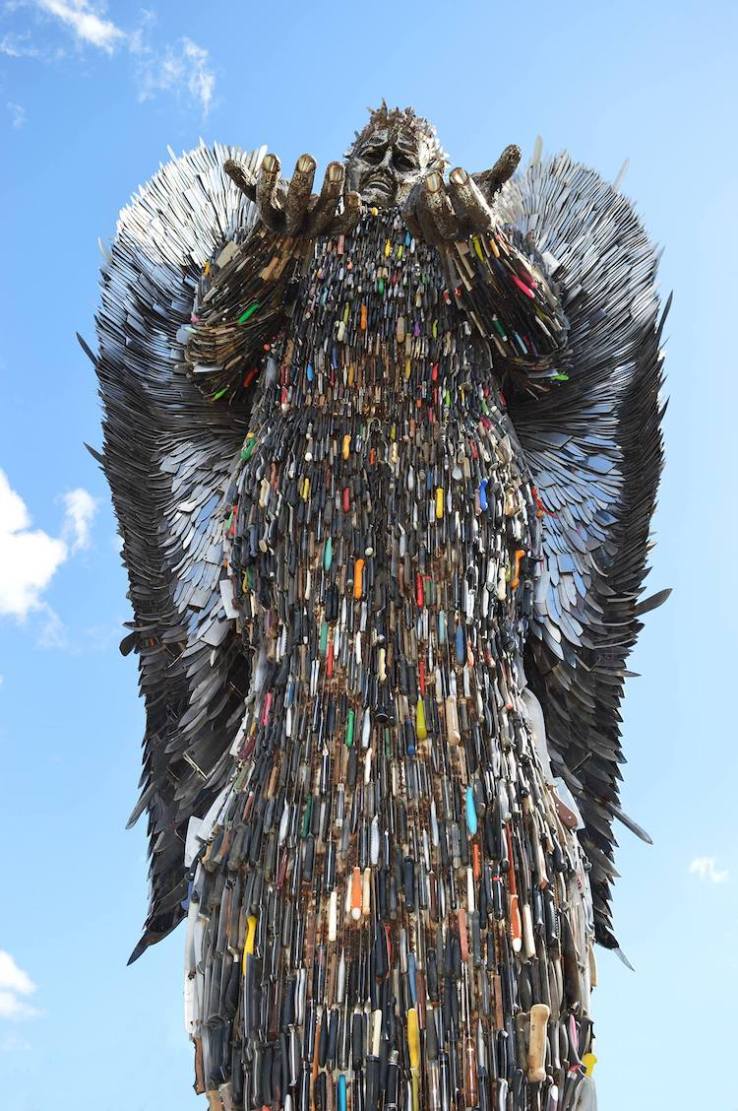
Knife Angel by Alfie Bradley, commentary by Rachel Wilkerson: This twenty-seven-foot-tall sculpture, welded from 100,000 knives collected in confiscations and amnesties around the UK, confronts the issue of knife violence. The artist cleaned and dulled the blade of each knife he received and engraved personal messages on all the wings’ “feathers,” messages sent by families affected by knife violence.

Bradley, Alfie_Knife Angel
Alfie Bradley (British, 1990–), Knife Angel, 2018. Mixed media sculpture, incl. 100,000 knives.

Cathedra by Barnett Newman, commentary by Grady van den Bosch: I saw this painting in Amsterdam last spring and was surprised by how it compelled me. (I don’t typically gravitate to abstract art.) After spending some time up close—I supposed this was a Newman, and Newman says his paintings need to be experienced up close—I looked at the label and saw that it has a religiously inflected title: Cathedra. The word is Latin for “seat,” and in Christianity it refers specifically to the bishop’s chair inside a church (churches that had a cathedra were called cathedrals). But Newman was of Jewish descent, and van den Bosch writes that Cathedra is meant to represent the throne of God. “And above the firmament that was over their heads was the likeness of a throne, as the appearance of a sapphire stone . . .” (Ezek. 1:26).

Newman, Barnett_Cathedra
Barnett Newman (American, 1905–1970), Cathedra, 1951. Oil and acrylic on canvas, 243 × 543 cm. Stedelijk Museum, Amsterdam, Netherlands. Photo: Victoria Emily Jones.

As someone who loves historical Christian art, including its many Christ Pantocrators, I must nevertheless admit that there is something so right about modern artists’ often apophatic approach to evoking the Divine. While I do believe God imaged Godself in the person of Jesus Christ and is therefore representable, I understand the argument some make that abstraction is a better visual language for spiritual subject matter or encounter. I accept both/and. Whether God is shown as a rich, blue expanse that invites and envelops, or a heroic nude emerging from the jaws of death, or a Man of Sorrows head with a harrier hawk’s body, I think we can learn a little something from the diversity of representations, which are not mutually exclusive. Not all representations need be embraced, but nor do unfamiliar, difficult, or even shocking ones need be automatically dismissed.

Click on the link for more on how to read Newman’s color field paintings, including his signature “zips.”

+++

FREE ONLINE COURSE: Watching TV Religiously: Through at least July 1, Fuller Theological Seminary is offering all its online Fuller Formation courses for free! I just finished taking Watching TV Religiously, taught by Kutter Callaway [previously], author of the book of the same title, and really enjoyed it. It’s a series of six self-paced lessons, which includes short video lectures by the professor, audio conversations with TV writer Dean Batali (Buffy the Vampire Slayer; That ’70s Show), TV watching assignments, reflection questions, and more.

The course aims to help Christians develop critical tools for watching television and a vocabulary that is as rich and thoughtful as the medium itself, so that we can engage it constructively. (It need not be mindless entertainment!) Callaway explores television as a technology, a narrative art form, a commodity, and a portal for our ritual lives. He’s interested in how stories are told in this episodic, audiovisual format, and what that means for the Story we tell. The course is not about what Christians should watch, but how Christians should watch, leaving ample room for individual viewers to set their own boundaries, ethical and otherwise. (Callaway acknowledges that TV can form as well as de-form us.) He discusses empathy building and access to other perspectives, knowing your sensibilities, how being offended can be useful, watching in community, seeing God in all places, being aware of how your desires and imagination are being shaped, Christians in Hollywood (and Christian characters on TV), and the culture shaping TV and TV shaping culture, among other things.

The course is fairly broad in its approach; it does not analyze particular shows or episodes, though some specific examples are mentioned in conversations, and students are encouraged to form discussion groups with friends or family members and apply what they’re learning to shows of their choice. I really appreciated the assigned PBS docuseries America in Primetime (somewhat outdated because made in 2011 but very good nonetheless), whose four episodes explore character types throughout the history of TV, from the fifties to today: “The Independent Woman,” “Man of the House,” “The Misfit,” and “The Crusader.” From taking this course I realized how many acclaimed TV shows I’ve never seen. I’ve got a lot of homework to do!

Other arts courses offered by Fuller Formation are

+++

POEM: “My Mother’s Body” by Marie Howe, read with commentary by Pádraig Ó Tuama: As Mother’s Day is Sunday, I thought I’d share this wonderful, sad-sweet, mother-themed episode of the new Poetry Unbound podcast from On Being Studios. Pádraig Ó Tuama introduces Marie Howe’s “My Mother’s Body,” in which a middle-age woman, caring for her dying mother, thinks back to the time when her mother was just a twenty-four-year-old girl giving birth to her. The speaker in the poem is Howe.

She imagines being in her mother’s womb, experiencing the rhythm of her mother’s heartbeat. (What an exercise, to imagine yourself as your mother’s baby!) Now decades later, her mother is dying—that heart is failing, and the kidneys too. The uterus has been removed. Toggling between the two time frames, the poem is both a celebration of the strength of women’s bodies and a lament for its vulnerabilities, especially in old age. Howe marvels at how her mother’s body was capable of such a wonder as giving and sustaining life, and now to see that once-vibrant form breaking down grieves her. In some sense their roles have switched as daughter mothers mother, combing her hair, changing her soiled bedsheets.

The poem opens with “Bless my mother’s body” and ends with “Bless this body she made . . .” In the progression of pronouns in the last two lines—my, her, our—is a recognition of how our mothers always remain a physical part of us. They are in our cells. “My Mother’s Body” is a thank-you and a letting go.

The poem is from Howe’s collection The Kingdom of the Ordinary—which I highly recommend.

+++

ARTICLE: “5 Contemporary Poets Christians Should Read” by Mischa Willett: There is so much good crop still being pulled from the fertile fields of theologically inflected verse,” writes poet Mischa Willett—so don’t stop short, content merely with Donne and Hopkins! This is an excellent short list of contemporary poets of faith, with summaries of key themes and recommendations for which volume(s) to start with. Willet was recently on The Ride Home with John and Kathy to discuss this topic, and he wrote a follow-up post on his blog.

+++

MUSIC VIDEO: “I Am a Poor Wayfaring Stranger”: One of the most poignant scenes in last year’s 1917 is when, after a harrowing journey across No Man’s Land, Lance Corporal William Schofield—exhausted, disoriented—reaches a wood and encounters a fellow British soldier singing the spiritual “Wayfaring Stranger” [previously] to a battalion that sits at somber attention, for they’re about to go into battle. This official music video from Sony splices together clips from the movie with studio footage of the actor and singer Jos Slovick.

God Raised Him Up (Artful Devotion)

Haugen Sorensen, Arne_Resurrection
Resurrection by Arne Haugen Sørensen (Danish, 1932–)

Peter, standing with the eleven, lifted up his voice and addressed them:

“. . . Men of Israel, hear these words: Jesus of Nazareth, a man attested to you by God with mighty works and wonders and signs that God did through him in your midst, as you yourselves know—this Jesus, delivered up according to the definite plan and foreknowledge of God, you crucified and killed by the hands of lawless men. God raised him up, loosing the pangs of death, because it was not possible for him to be held by it. For David says concerning him,

“‘I saw the LORD always before me,
for he is at my right hand that I may not be shaken;
therefore my heart was glad, and my tongue rejoiced;
my flesh also will dwell in hope.
For you will not abandon my soul to Hades,
or let your Holy One see corruption.
You have made known to me the paths of life;
you will make me full of gladness with your presence.’

“Brothers, I may say to you with confidence about the patriarch David that he both died and was buried, and his tomb is with us to this day. Being therefore a prophet, and knowing that God had sworn with an oath to him that he would set one of his descendants on his throne, he foresaw and spoke about the resurrection of the Christ, that he was not abandoned to Hades, nor did his flesh see corruption. This Jesus God raised up, and of that we all are witnesses . . .”

—Acts 2:22–32

+++

SONG: “Easter” by Bruce Cockburn, on Crowing Ignites (2019)

+++

The tender hands of God lifting Christ out of the grave is one of Arne Haugen Sørensen’s favorite motifs—he’s painted it dozens of times, often as altarpieces for Danish churches.

Haugen Sorensen, Arne_Resurrection (Ringkobing)
Arne Haugen Sørensen (Danish, 1932–), Resurrection, 1996. Acrylic on canvas, 268 × 190 cm. Ringkøbing Church, Ringkøbing, Denmark.
Haugen Sorensen, Arne_Resurrection (Skelager)
Arne Haugen Sørensen (Danish, 1932–), Resurrection, 1997. Acrylic on canvas, 195 × 130 cm. Skelager Church, Aarhus, Denmark.
Haugen Sorensen, Arne_Resurrection (Bramming)
Arne Haugen Sørensen (Danish, 1932–), Resurrection (triptych), 2003. Acrylic on canvas. Sankt Ansgar Kirke, Bramming, Denmark.
Haugen Sorensen, Arne_Resurrection (Lillerod)
Arne Haugen Sørensen (Danish, 1932–), Resurrection, 2011, installed 2015. Acrylic on canvas, 162 × 130 cm. Lillerød Kirke, Lillerød, Denmark. Photo: Benny Grey Schuster.
Haugen Sorensen, Arne_Crucifixion and Resurrection (Fonnesbaek)
Arne Haugen Sørensen (Danish, 1932–), Crucifixion and Resurrection, 1996, installed 2002, Fonnesbæk Kirke, Ikast, Denmark. Photo: Benny Grey Schuster.

To view more of Haugen Sørensen’s work, visit www.arnehaugensorensen.com, and take this video tour of the Arne Haugen Sørensen Museum in Videbæk:


This post belongs to the weekly series Artful Devotion. If you can’t view the music player in your email or RSS reader, try opening the post in your browser.

To view all the Revised Common Lectionary scripture readings for the Second Sunday of Easter, cycle A, click here.

“The Recompense” by John Banister Tabb

Wesley, Frank_Mary at the Tomb
Frank Wesley (Indian, 1923–2002), Mary at the Tomb, ca. 1991. Watercolor, 25 × 20 cm. Published in “Frank Wesley: Exploring Faith with a Brush” (Auckland: Pace, 1993).

She brake the box, and all the house was filled
With waftures from the fragrant store thereof,
While at His feet a costlier rose distilled
The bruisèd balm of penitential love.

And lo, as if in recompense of her,
Bewildered in the lingering shades of night,
He breaks anon the sealèd sepulcher,
And fills the world with rapture and with light.

“The Recompense” by John Banister Tabb was originally published in Poems by John Banister Tabb (Boston: Copeland and Day, 1894) and is now in the public domain.

This short poem—just two quatrains with an abab cdcd rhyme scheme—draws on Luke 7:36–50. In this Gospel episode, Jesus is dining at the house of Simon the Pharisee when an unnamed “sinful woman” enters with an alabaster jar of precious ointment, which she pours lavishly onto Jesus’s feet in an act of love and gratitude, and in recognition of his messianic identity. So humbled is she by Jesus’s forgiveness of her sin that she is in tears. (Note: Tradition says this woman was Mary Magdalene—based in part on a conflation with the similar account in John 12:1–8, which names the woman Mary.)

Of even more value to Christ than the essential oils, Tabb suggests, is the woman’s “penitential love,” a balm before his wounds. Her beautiful, bruised soul, like a rose, releases such an aroma, though the Pharisees can’t smell it, and they try to shame her. Not long hence Jesus returns her tenderhearted gesture, opening another stone container (his tomb) and spilling forth life and light and bliss, priceless treasures, onto his beloved world. He meets Mary in her bewilderment on that first Easter morning, lavishing on her all his resurrection riches.

Easter Sunday (Artful Devotion)

Saric, Nikola_Resurrection
Nikola Sarić (Serbian, 1985–), The Resurrection of Jesus, 2017. Acrylic on canvas, 90 × 90 cm.

Now after the Sabbath, toward the dawn of the first day of the week, Mary Magdalene and the other Mary went to see the tomb. And behold, there was a great earthquake, for an angel of the Lord descended from heaven and came and rolled back the stone and sat on it. His appearance was like lightning, and his clothing white as snow. And for fear of him the guards trembled and became like dead men. But the angel said to the women, “Do not be afraid, for I know that you seek Jesus who was crucified. He is not here, for he has risen, as he said. Come, see the place where he lay.”

—Matthew 28:1–6

Now on the first day of the week Mary Magdalene came to the tomb early, while it was still dark, and saw that the stone had been taken away from the tomb. So she ran and went to Simon Peter and the other disciple, the one whom Jesus loved, and said to them, “They have taken the Lord out of the tomb, and we do not know where they have laid him.” So Peter went out with the other disciple, and they were going toward the tomb. Both of them were running together, but the other disciple outran Peter and reached the tomb first. And stooping to look in, he saw the linen cloths lying there, but he did not go in. Then Simon Peter came, following him, and went into the tomb. He saw the linen cloths lying there, and the face cloth, which had been on Jesus’ head, not lying with the linen cloths but folded up in a place by itself. Then the other disciple, who had reached the tomb first, also went in, and he saw and believed . . .

—John 20:1–8

And we are witnesses of all that he did both in the country of the Jews and in Jerusalem. They put him to death by hanging him on a tree, but God raised him on the third day and made him to appear, not to all the people but to us who had been chosen by God as witnesses, who ate and drank with him after he rose from the dead.

—Acts 10:39–41

+++

SONG: “Hallelujah, Our Lord Is Risen” by the Easter Brothers | Performed by Jeff and Sheri Easter, 1992

+++

To view more paintings by Nikola Sarić, including ones from his “Cycle of Life” series, visit www.nikolasaric.de.

Music and art from previous Easter Sundays at Art & Theology include


This post belongs to the weekly series Artful Devotion. If you can’t view the music player in your email or RSS reader, try opening the post in your browser.

To view all the Revised Common Lectionary scripture readings for Easter Sunday, cycle A, click here.

Wake Up, Rise (Artful Devotion)

Spencer, Stanley_The Resurrection (Waking Up) (detail)
Stanley Spencer (British, 1891–1959), The Resurrection: Waking Up (triptych, detail), 1945. Oil on canvas, center panel 30 × 20 in. (76.2 × 50.8 cm), side panels 20 × 30 in. (50.8 × 76.2 cm). Private collection. Photo © Christie’s Images. Source: SACRED NOISE e-catalog (London, 2018).

“Awake, O sleeper,
and arise from the dead,
and Christ will shine on you.”

—Ephesians 5:14

+++

SONG: “Wake Up, Oh Sleeper” by David Nasser, Jonathan Shelton, Mac Powell, and Shane Barnard

Live performance from 2009 by Third Day:

Studio recording by Jason Crabb, Jonathan Shelton, and Bear Rinehart, on Glory Revealed II (2009):


This post belongs to the weekly series Artful Devotion. If you can’t view the music player in your email or RSS reader, try opening the post in your browser.

To view all the Revised Common Lectionary scripture readings for the Fourth Sunday of Lent, cycle A, click here.

The Strife Is Over (Artful Devotion)

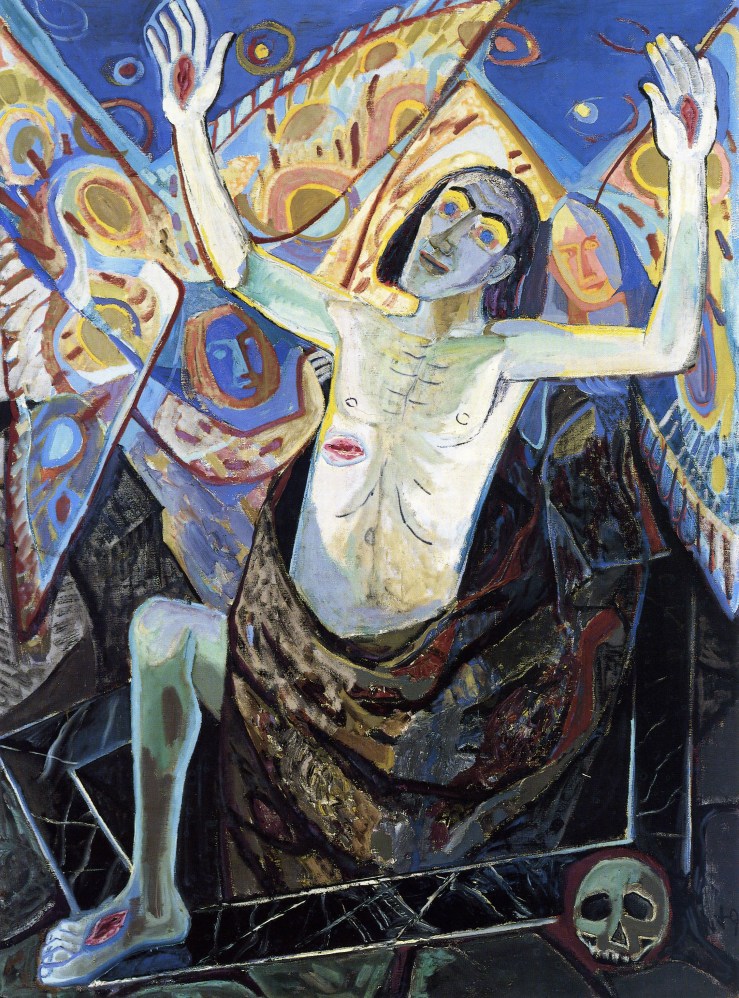
Resurrection by Otto Dix
Otto Dix (German, 1891–1969), The Resurrection, 1949. Oil on canvas, 213 × 163.5 cm. Kunstmuseum Stuttgart, Germany.

He . . . has risen.

—Luke 24:6a

The Lord is my strength and my song;
he has become my salvation.
Glad songs of salvation
are in the tents of the righteous:
“The right hand of the Lord does valiantly,
the right hand of the Lord exalts,
the right hand of the Lord does valiantly!”

I shall not die, but I shall live,
and recount the deeds of the Lord.

—Psalm 118:14–17

+++

SONG: “The Strife Is O’er” | Words: Anonymous Latin poem (first compiled 1695), translated by Francis Pott, 1861 | Music: Rev. Vito Aiuto, on Precious Remedies Against Satan’s Devices by the Welcome Wagon (2012)

The strife is o’er, the battle done;
The victory of life is won;
The song of triumph has begun:
Alleluia! Alleluia!

The pow’rs of death have done their worst;
But Christ their legions hath dispersed;
Let shouts of holy joy outburst:
Alleluia! Alleluia!

The three sad days are quickly sped;
He rises glorious from the dead;
All glory to our risen Head:
Alleluia! Alleluia!

He closed the yawning gates of hell;
The bars from heav’n’s high portals fell;
Let songs of praise his triumph tell:
Alleluia! Alleluia!

Lord, by the stripes which wounded thee,
From death’s dread sting your servants free,
That we may live, and sing to thee:
Alleluia! Alleluia!

(I’ve noticed several slight variations in the English lyric translation attributed to Francis Pott. This is the version used by the Welcome Wagon.)


This post belongs to the weekly series Artful Devotion. If you can’t view the music player in your email or RSS reader, try opening the post in your browser.

To view all the Revised Common Lectionary scripture readings for Easter Sunday, cycle C, click here.

He Went On Ahead (Artful Devotion)

Jesus Entering Jerusalem by Nathan Simpson
Nathan Simpson (Australian, 1973–), Jesus Entering Jerusalem, 1999. Oil on canvas.

And when he had said these things, he went on ahead, going up to Jerusalem . . .

—Luke 19:28

+++

SONG: “My Lord” by Hiram Ring, on Home (2013)


This Sunday marks the start of Passion Week, with Jesus riding into Jerusalem on a donkey, where he is greeted by palm branches and Hosannas. By Thursday, though, these shouts of praise will devolve into “Is it I?,” “I do not know him,” and “Crucify him!”

In a series of simple verses, Hiram Ring’s blues-inflected song “My Lord” moves from Jesus’s triumphal entry to his agony in the garden (where he drinks heavily the bitter draft of suffering) to his crucifixion. The final two verses shift then to his resurrection and his exaltation in heaven.

+++

Agony in the Garden by Nathan Simpson
Nathan Simpson (Australian, 1973–), Agony in the Garden, 1999. Oil on canvas.
Resurrection by Nathan Simpson
Nathan Simpson (Australian, 1973–), Large Resurrection, 1999. Oil on canvas.

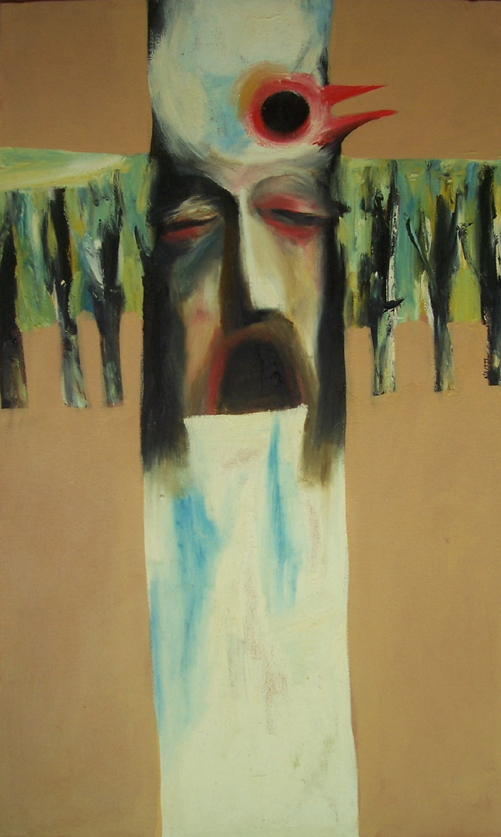
I’m compelled by the Gospel narrative paintings of contemporary Australian artist Nathan Simpson. These are a few I saved from his website a while ago before it went under construction. In Simpson’s Agony in the Garden, Christ’s anguish is palpable. The image combines the Gethsemane narrative with all the suffering that lies ahead, culminating in death. A row of olive trees forms the horizontal beam of a cross, while a rooster (alluding to Peter’s betrayal) forms the vertical; Christ’s head, with swollen eyes and gaping mouth (“My God, my God . . .”), is the point of intersection.

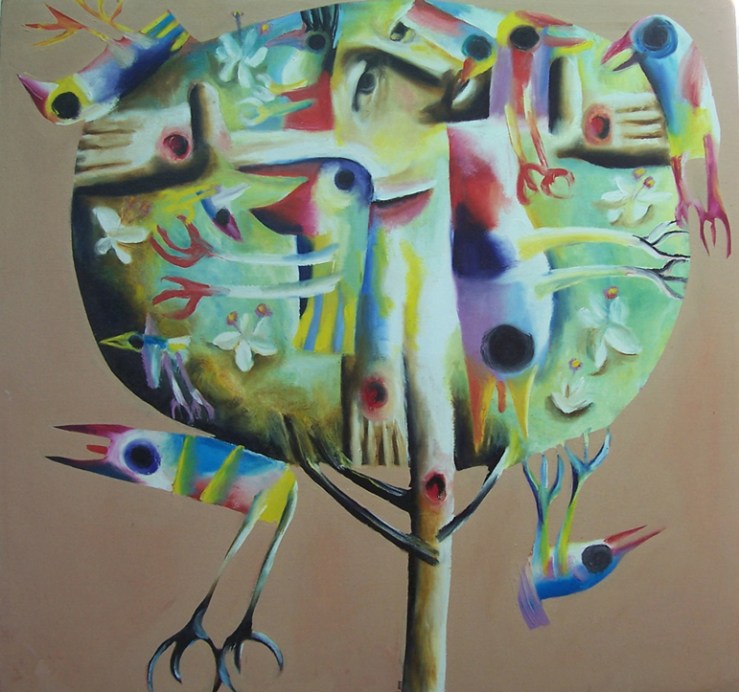
Simpson’s Resurrection painting, by contrast, shows a Christ who’s victorious over death, his face serene. The artist plays with the popular “tree of life” motif, fusing Christ’s body into this flowering, bird-filled plant. An arborescent Christ! See how the nail wound in his left foot is also the tree’s hollow.

+++

In their latest blog post, SALT Project suggests a simple at-home Holy Week ritual for families that I really like: a Tenebrae Wreath (tenebrae means “shadows”).

Imagine . . . a sort of Advent Wreath in reverse: four candles in a circle with a Paschal candle in the middle, extinguished one by one. Sunday night: beginning with only the Paschal candle lit, read Luke’s story of Palm Sunday, and then light all four candles in joy, hope, and thanksgiving. Thursday night: read Luke’s story of the Last Supper, and extinguish one candle; then read Luke’s story of Gethsemane, and extinguish a second. Friday night: read Luke’s story of Peter’s denials and desertion, and extinguish a third candle; then read Luke’s story of Jesus’ suffering, and extinguish the fourth; and then finally, read Luke’s story of Jesus’ death, and extinguish the Paschal candle. Saturday, the wreath remains unlit and bare, perhaps shrouded with cloth. And Sunday morning, the shroud is gone and all candles are lit, with a few more candles added—along with some flowers and Easter sweets! Read Luke’s story of the empty tomb, and sing your favorite Easter hymn (or two).


This post belongs to the weekly series Artful Devotion. If you can’t view the music player in your email or RSS reader, try opening the post in your browser.

To view all the Revised Common Lectionary scripture readings for Palm Sunday and the Liturgy of the Passion, cycle C, click here and here.

Roundup: Raban Maur, comic books, and more

SEMINAR: “The Language of Grace? The Action of God’s Love in Poetry and Art”: On February 6 at 6 p.m., as part of the Catholicism and the Arts York initiative, St. Wilfrid’s Church in Duncombe Place, York, will be hosting back-to-back talks: “Grace and the Poetics of David Jones” by Dr. Elizabeth Powell and “Full of Grace? The Desire of Art for God” by Katherine Hinzman.

+++

ALBUM FUNDRAISER: Love Secrets by John Mark Pantana: I really enjoyed Pantana’s 2017 debut album, Mighty Grace, so I jumped at the opportunity to support his next project on Indiegogo: Love Secrets. His voice is so soothing! So are his original lyrics, all about God’s love and grace. Visit him at https://www.johnmarkpantana.com/, and listen to one of the songs from his upcoming album, “Abba,” below. Fundraising campaign ends February 9.

+++

EXHIBITIONS

I love the curatorial approach of these two current exhibitions, which bring art from the Middle Ages or Renaissance into conversation with contemporary art. Rather than doing this to prove a disjunction sparked by modernity, the curators stress continuity between the artists of yesterday and today.

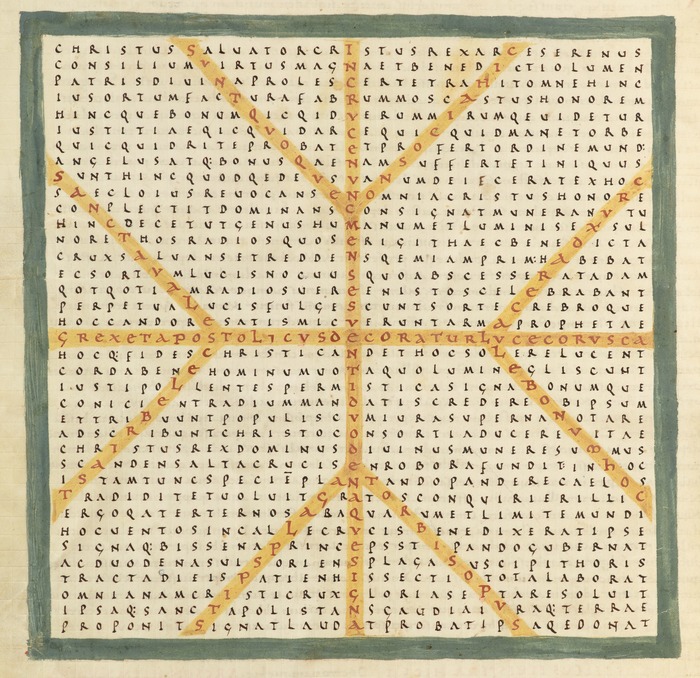
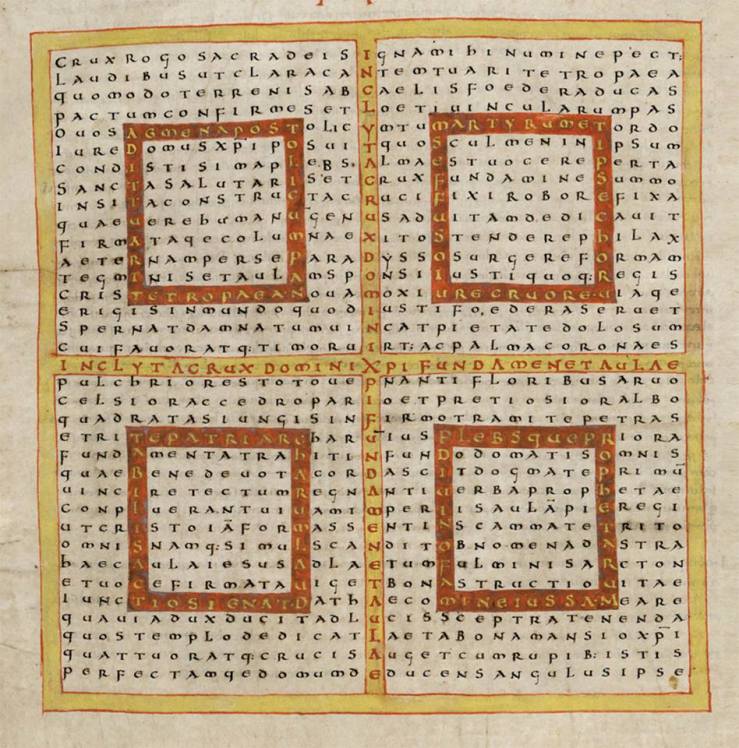
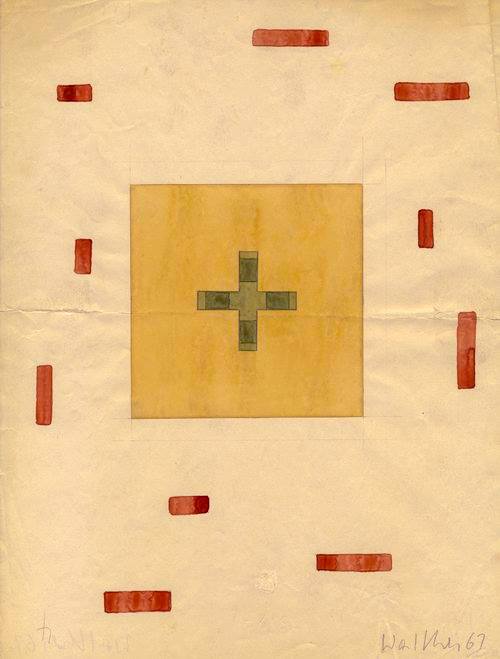
“Make It New: Conversations with Medieval Art,” Bibliothèque nationale de France (National Library of France), Paris, November 5, 2018–February 10, 2019: Curated by Dutch artist Jan Dibbets, “Make It New” explores the relationship between works of contemporary art and the medieval art of Raban Maur (Hrabanus Maurus), a ninth-century monk from Fulda, Germany, and a major figure of the Carolingian renaissance. The centerpiece of the exhibition is Raban Maur’s De laudibus sanctae crucis (In Praise of the Holy Cross), a Latin manuscript comprising twenty-eight highly sophisticated poems whose letters are arranged in simple grids over colorful, geometric cross patterns. At the BnF, these compositions are placed in dialogue with thirty-plus works by some of today’s minimalist, conceptual, and land artists, including Sol LeWitt, Carl Andre, François Morellet, Niele Toroni, and Franz E. Walther, stressing similarities in form, color, proportion, and perspective. [press release (English)] [compilation of Maur images]

The original figure poem cycle was produced around 810 at the scriptorium in Fulda, and Raban Maur had a hand in making at least five other copies during his lifetime (of which France’s National Library owns two: Lat. 2423 and Lat. 2422); seventy-four additional copies from the Middle Ages are extant. The Burgerbibliothek Bern in Switzerland has digitized its early eleventh-century copy (Cod. 9), and it’s really fascinating! Full-resolution downloads are enabled. According to the Benedictine abbot Odilo of Cluny, “no work more precious to see, more pleasing to read, sweeter to remember, or more laborious to write can or could ever be found.” I don’t know Latin, but visually, I can really appreciate these fine pages. I was hoping to find more information about the work but could really only find a single French lecture given back in 2007 by Denis Hüe, a professor of medieval and Renaissance language and literature at the Université Rennes 2 Haute-Bretagne.

In Praise of the Holy Cross by Raban Maur
Figure poem by Raban Maur, Fulda, Germany, ca. 822–847. BnF Lat. 2422, fol. 10v.
In Praise of the Holy Cross by Raban Maur
Figure poem by Raban Maur, Fulda, Germany.
Untitled by Sol LeWitt
Sol LeWitt (American, 1928–2007), Untitled, 1970. Ink on paper. © Adagp, Paris.
Work Drawing by Franz Erhard Walther
Franz Erhard Walther (German, 1939–), Werkzeichnungen (Work Drawing), 1967. Watercolor, ink, and pencil on paper. © Adagp, Paris.

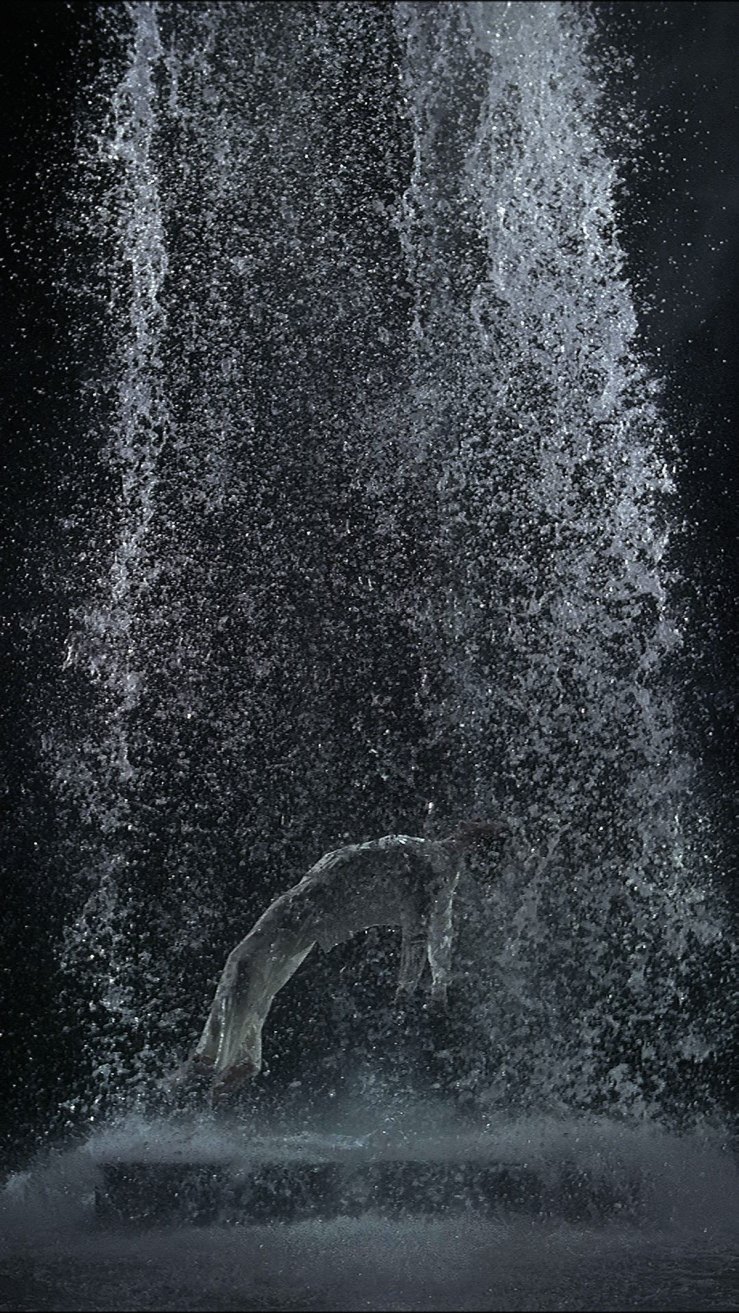
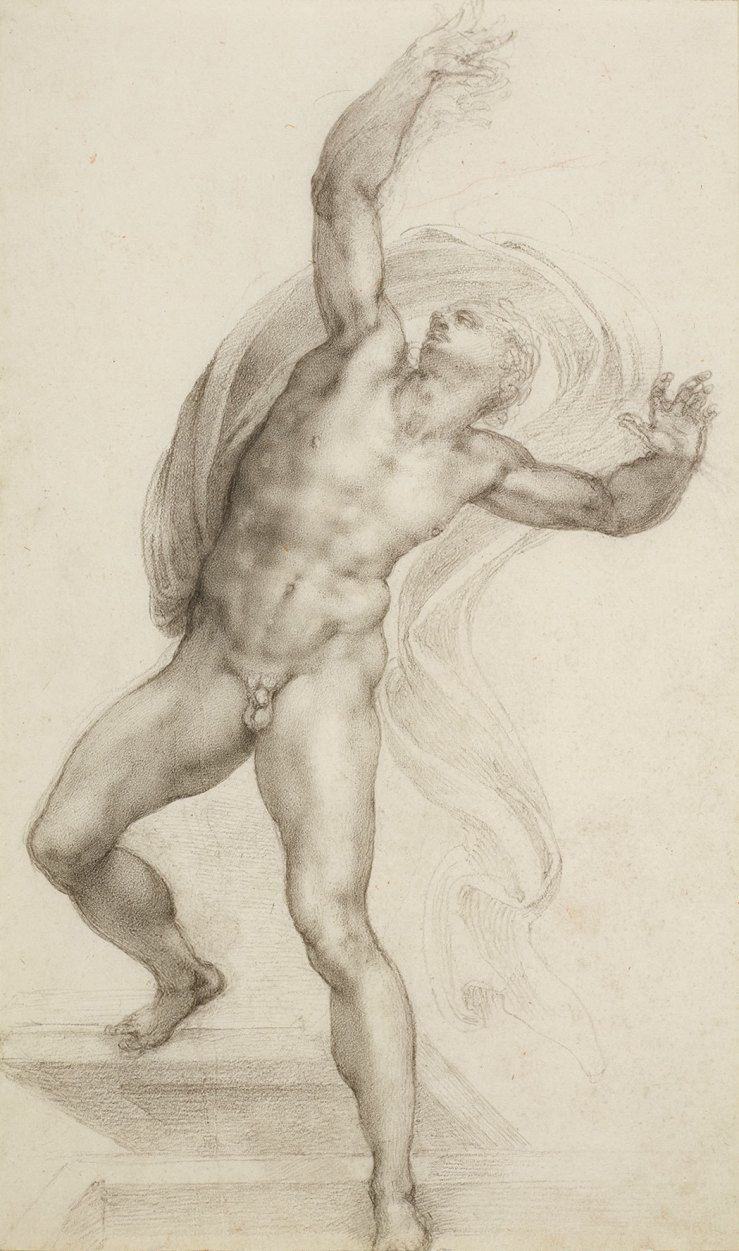
“Bill Viola / Michelangelo: Life, Death, Rebirth,” Royal Academy of Arts, London, January 26–March 31, 2019: When pioneering video artist Bill Viola saw a collection of Michelangelo’s exquisite drawings at Windsor Castle in 2006, he was astonished by the Renaissance master’s expressive use of the body to convey emotional and spiritual states. Here the two artists are exhibited side by side, showing their common grappling with life’s fundamental questions, albeit in vastly different mediums. “Both artists harness the symbolic power of sacred art, and both show us physical extremes and moments of transcendence.” Among the twelve major installations from Viola, spanning his career, is Tristan’s Ascension (The Sound of a Mountain Under a Waterfall), a sixteen-foot-high projection depicting the ascent of the soul after death.

For February 16, the Royal Academy has organized a full day of events keyed to the exhibition, including poetry readings, a documentary screening, and a panel discussion with cultural historian Marina Warner, theologian Ben Quash, and artist Mariko Mori, titled “Art as fulfilment: the use of religion and spirituality in contemporary art.” Questions for the day include: Does art connect us? Can art be transformative or transcendental? Can art influence society—that is, change opinions or human behavior? Other offerings in addition to this program are a curator’s introduction on February 1, a short course on figure drawing, and a talk on the limitations and opportunities of digital art. Plus, the London Art Salon is hosting a talk on the exhibition by art historian Marie-Anne Mancio.

Tristan's Ascension by Bill Viola
Bill Viola (American, 1951–), Tristan’s Ascension (The Sound of a Mountain Under a Waterfall), 2005. Video/sound installation. Performer: John Hay. Photo: Kira Perov. Courtesy Bill Viola Studio.
The Risen Christ by Michelangelo
Michelangelo Buonarroti (Italian, 1475–1564), The Risen Christ,” ca. 1532–33. Black chalk on paper, 37.2 × 22.1 cm. Royal Collection Trust, UK.

+++

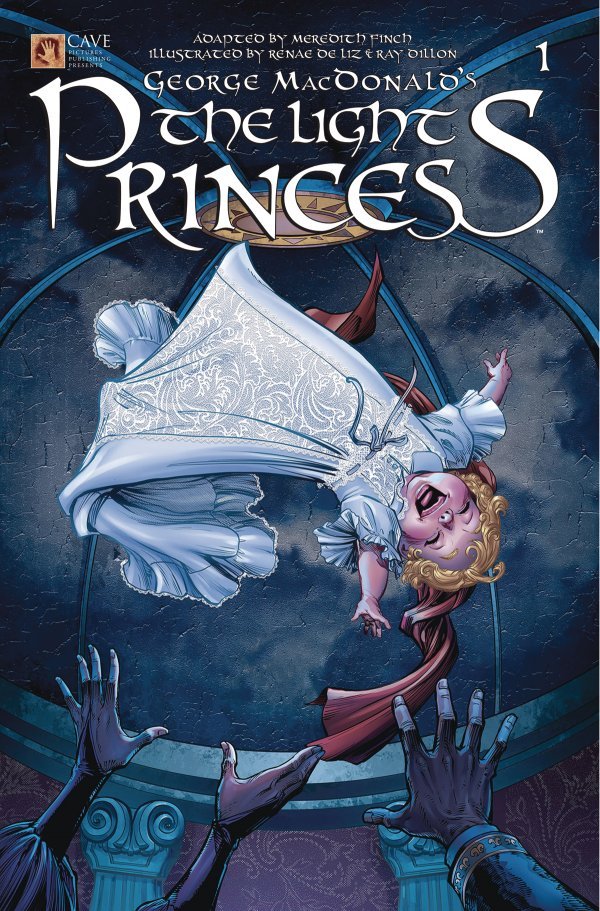
NEW COMIC BOOK PUBLISHER: Cave Pictures Publishing, founded in fall 2018 by Mark Rodgers, is committed to the telling of “modern myths” that “speak to the soul” through comic books in the genres of action-adventure, sci-fi, historical fiction, and fantasy. Pitched for the spiritually inclined, the stories they publish “seek to make sense of our world . . . draw us toward the source of goodness . . . uncover what we worship.” Says Rodgers in a Hollywood Reporter interview: “Just as cave paintings were humanity’s initial attempt to process through the tough ultimate questions of human existence, we look at our stories as ‘sherpas of the soul,’ to contribute to the individual and collective human journey towards meaning and a greater reality,” the One True Myth. Read more about the company’s influences and aspirations in this Convivium essay. See also the interview in Sojourners.

The Light Princess (Cave Pictures Publishing)

One of their five inaugural series is The Light Princess, an adaptation of one of George MacDonald’s best-loved fairy tales, about a princess who is cursed with weightlessness and is only brought down to earth by a true, sacrificial love. MacDonald was a Scottish author, poet (e.g., here, here, and here), and Christian minister who deeply influenced C. S. Lewis and J R. R. Tolkien. Speaking of Tolkien, I’m really digging this quote of his on Cave Pictures’ website, which affirms the value of story: “Legends and myths are largely made of ‘truth,’ and indeed present aspects of it that can only be received in this mode. . . . Long ago certain truths and modes of this kind were discovered and must always reappear.”

Roundup: Anglo-Saxon Ascension poem; underwater dance; Andy Squyres album; contemporary icons; Catholicism meets high fashion

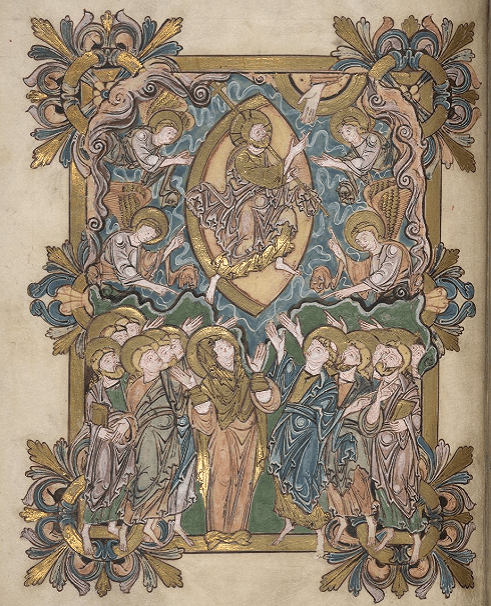
ANGLO-SAXON ASCENSION POEM: Excerpts from “Christ II” by Cynewulf, probably ninth century, translated from Old English by Eleanor Parker: Dr. Eleanor Parker lectures on medieval literature at Oxford University and runs the excellent blog A Clerk at Oxford, where she often shares her translations of Anglo-Saxon poetry, with commentary. The poem she shares here reflects on Christ’s ascension—the disciples’ grief, the angels’ joy. To me the most remarkable section is the one that, indirectly referencing a sermon of Gregory the Great, describes Christ “leaping” up to heaven, taking an active bound toward his homeland, a movement read in light of Song of Solomon 2:8: “Behold, he comes, leaping over the mountains, bounding over the hills.” This leap is one of six he took: from heaven (1) into Mary’s womb, (2) into a manger, (3) onto the cross, (4) into the tomb, (5) into hell, and finally, (6) back into heaven. “Prince’s play”! Parker pairs the poem with an exquisite, near-contemporary manuscript illumination, also from England; there’s also a lot of resonance between the poem and the Ascension image I published Tuesday by Bagong Kussudiardja, which shows a more balletic ascent.

Ascension (10th c)
The Ascension, from the Benedictional of St. Æthelwold (BL Additional MS. 49598), f. 64v, England, 963–984 CE. British Library, London.

+++

UNDERWATER DANCE: “AMA,” a short film by Julie Gautier: This wonderfully expressive silent film shows French free diver and underwater artist Julie Gautier dancing in a single breath for several minutes inside the world’s deepest swimming pool, Y-40 Deep Joy in Montegrotto Terme, Padua, Italy, to a minimalist piano piece. The final shot shows Gautier slowly rising to the water’s surface while releasing a giant air bubble, her pose evocative of the crucified Christ (and her upward movement an Ascension of sorts!). Titled “Ama” (Japanese for “sea woman,” the name given to Japan’s pearl divers), the film is “dedicated to all the women of the world,” Gautier says. The choreography is by Ophélie Longuet.

Gautier and her husband, Guillaume Néry, a free-diving champion, own the underwater filmmaking company Les Films Engloutis. Their most well-known project has been a music video featuring Beyoncé, codirected by Gautier and starring Néry.

+++

KICKSTARTER CAMPAIGN: Help Andy Squyres finance his next album: Andy Squyres is a super-talented singer-songwriter whose lyrics don’t stay in the shallows but, rather, dive into the depths of the faith experience. They are also supremely hope-filled. Below is a video of Squyres performing “Labor in Vain” at a house concert; the song is from his last album, Cherry Blossoms, which I reviewed here. Click on the boldface link above to hear Squyres discuss his new album project and to donate toward it.

+++

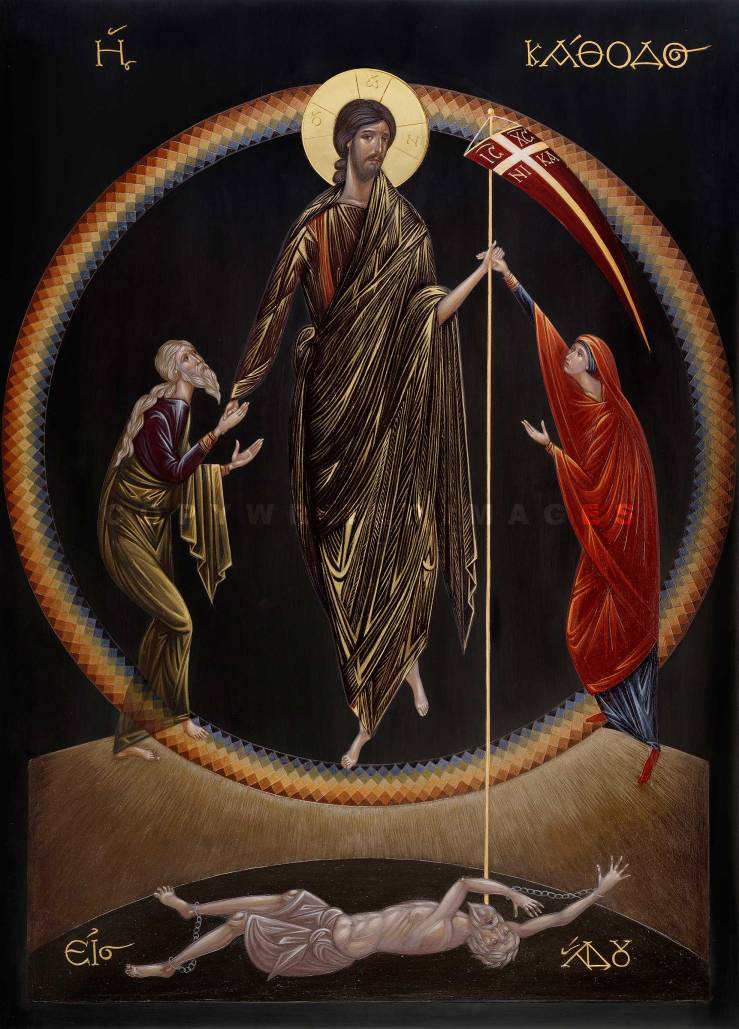
ICON PAINTING COMPETITION: The Interparliamentary Assembly of Orthodoxy (IAO) is hosting an international icon painting competition on the subject of Christ’s Resurrection. “Our purpose is to explore and bring to the foreground the numerous stylistic trends in existence today, enabling the visualization of a creative dialogue with tradition and, at the same time, the personal artistic expressions of artists who reframe tradition without, however, digressing from the doctrinal framework of Christian icon painting set by the 7th Ecumenical Council.” The submission window is closed—there are sixty-three great entries!—and now it’s time to cast your vote. Five winners will be selected to receive cash prizes, the topmost being €3,000, and other honors. Popular votes will be taken into account by the twelve jury members, among whom are esteemed iconographers George Kordis from Greece and Todor Mitrovic from Serbia.

Resurrection by Dimosthenis Avramidis
Dimosthenis Avramidis (Greek, 1965–), Christ’s Descent into Hades, 2017. Egg tempera on wood, 91.5 × 61.5 cm.

+++

ESSAY: “On the Border of East and West: Searching for Icons in Lviv” by John A. Kohan: The latest issue of Image journal features a wonderful essay on the Lviv school of iconography (represented in entries #4, #10, and #20 of the above contest), a movement by young Ukrainian Greek Catholic artists to contemporize the Byzantine visual tradition. Written by John A. Kohan, an avid religious art collector and former Time bureau chief in Moscow (1988–1996), it discusses the political history of the city; the role of Metropolitan Andrey Sheptytsky (r. 1901–1944) in preserving and supporting art for future generations; the opening of the Iconart gallery in 2010 to nurture and promote the new style; the broad training these icon makers receive at the Lviv National Academy of Arts; and the uneven reception by others in the denomination (especially official church bodies), who tend to prefer their sacred art in the Radruzh School style or as contemporary Catholic kitsch. Kohan writes from his firsthand experiences meeting the artists and visiting their studios, churches, and exhibition spaces. The essay is available to subscribers only; click here to subscribe.

Crucifixion by Natalya Rusetska
Natalya Rusetska (Ukrainian, 1984–), Crucifixion, 2017. Egg tempera on gessoed wood, 11 3/4 × 8 1/4 in.
Pilate Condemns Jesus to Death by Ivanka Demchuk
Ivanka Demchuk (Ukrainian, 1990–), Christ before Pilate, 2017. Mixed media on gessoed wood, 19 3/4 × 15 3/4 in.

I’m enthralled by the contemporary icons being produced in Lviv—I saw a bunch from Kohan’s collection last summer, and I featured some in a Baptism of Christ roundup earlier this year. The best way to keep abreast of the output from the Lviv school is to follow Iconart on Facebook, and for an even wider breadth of innovative eastern European icons, follow Międzynarodowe Warsztaty Ikonopisów w Nowicy (International Iconography Workshop in Nowica, Poland).

+++

MET GALA + EXHIBITION: “Heavenly Bodies: Fashion and the Catholic Imagination,” May 10–October 8, 2018, Metropolitan Museum of Art, New York City: The largest exhibition ever mounted by the Met’s Costume Institute, “Heavenly Bodies” features both religious vestments from the Vatican and runway fashions by famous designers inspired by Catholicism. A Fashionista reviewer who attended a preview reports on the integrated displays:

A reliquary arm of Saint Valentine is displayed alongside a breastplate and crown of thorns from Alexander McQueen’s Givenchy days; sacred music serves as the auditory backdrop for a Rodarte collection that features a dress inspired by Bernini’s famous sculpture Ecstasy of Saint Teresa. Rows of mannequins wearing Dolce & Gabbana, Moschino and Raf Simons show the ways that the silhouettes of the cassock and nun’s habit have been explored on the runway time and again. There are even vestments by the likes of Yves Saint Laurent and Riccardo Tisci that were expressly designed to dress statues of the Virgin Mary in chapels in Italy and France.

Each year since 1948, the opening of the Costume Institute’s spring exhibition has been celebrated with a huge fundraising gala attended by celebrities who dress to the theme; this year’s took place May 7. There were lots of crosses and haloes, but also some more particularized outfits. Ariana Grande’s gown was inspired by Michelangelo’s Last Judgment; Gigi Hadid’s, by stained glass. Selena Gomez carried a Coach handbag embroidered with Proverbs 31:30b: “A woman who fears the Lord is a woman who shall be praised.” The most brazenly dressed was Rihanna, who wore a gem-encrusted bishop’s miter (not a papal tiara, as has been commonly reported). Another standout headpiece was Sarah Jessica Parker’s, which featured a Neapolitan Nativity scene set inside a mini baldachin. (The making of elaborate presepi, or Christmas crèches, is a longstanding tradition in Naples, reaching its height during the eighteenth century.)

Rihanna as pope
The white Margiela minidress, cape, and headpiece Rihanna wore to Monday’s Met gala were inspired by Catholic pontifical vestments. Photo: John Shearer/Getty.
Sarah Jessica Parker
Sarah Jessica Parker wore a regal gold, long-trained Dolce & Gabbana gown, but the pièce de résistance of her ensemble was the Nativity headpiece.

Lana Del Rey went as Our Lady of Sorrows, wearing an immaculate-heart chest plate pierced through with seven daggers; it was comical to hear religiously illiterate reporters trying to interpret the symbolism, saying things like the daggers are a “reminder to repent your sins or suffer damnation!” (Wrong. The swords symbolize the Virgin’s seven sorrows, beginning with Simeon’s prophecy.)

Sowing the stigmata: A reading of Fra Angelico’s Noli me tangere by Georges Didi-Huberman

During Easter 2016 I published an article on Jesus as the gardener of our souls, featuring a roundup of Noli me tangere (“Touch me not”) paintings that portray the risen Christ as a literal gardener, including a fresco by Fra Angelico from the convent of San Marco in Florence.

Noli me tangere by Fra Angelico
Fra Angelico (Italian, ca. 1395–1455), Noli me tangere, 1440–42. Fresco from the convent of San Marco, Florence, Italy.

I spent the spring semester of my junior year of college living in Florence and, while there, fell in love with Renaissance art, and in particular the paintings of Fra Angelico (ca. 1395–1455). Born Guido di Pietro, he took vows as a Dominican friar and, together with his assistants, painted two corridors and the forty-four cells in the newly built San Marco, where he lived. The convent is now a state museum and is one of my favorite sites in the city.

In 1990 art historian Georges Didi-Huberman published a monograph on Fra Angelico, spending considerable time on his Noli me tangere, especially its red flowers, which he reads as a figural displacement of Christ’s stigmata (nail wounds). (More on this below.) In the painting, he writes, Christ’s blood “soaks the earth and makes a new humanity grow there, a humanity in the imitation of Christ, a humanity redeemed from sin” (161). He notes how the floral imagery is echoed in the Annunciation in the hallway outside the cell, serving to visually connect these two stages of redemption: Christ’s “flowering,” or conception, in the womb of Mary and his flowering forth from the womb of the earth on Easter.

(Related: “Rosing from the Dead” by Paul J. Willis)

The figure of the Christ-flower was already a common one in the medieval West. For example, the great thirteenth-century theologian Albertus Magnus writes,

The Christ-flower [flos Christus] blossomed in the Nativity, as we read in Isaiah 11:1: “There shall come forth a rod out of the stem of Jesse.” It withered in the Passion, when there was no longer aspect or beauty. . . . It blossomed again at the Resurrection according to human nature, in the very place where it had withered. Thus it is said: “And my flesh blossomed anew” (Psalm 27:7). [De laudibus 12.4.2]

Fra Angelico furthered the development of this metaphor in visual form, picturing Christ’s blood (according to Didi-Huberman) as a fertilizing material, the agent of regeneration.

The following excerpt is taken from Fra Angelico: Dissemblance and Figuration* by Georges Didi-Huberman, translated from the French by Jane Marie Todd (Chicago: University of Chicago Press, 1995), pages 19–22. I find some of the semiotics discourse to be abstruse, but I’ve highlighted a few standout ideas in boldface—ideas that have helped me to see Fra Angelico’s Noli me tangere (and the Resurrection!) with new eyes.

Noli me tangere (detail) by Fra Angelico

Angelico sprinkled little spots, deposited little splotches all over this “field” [of green]: more or less regular blotches, made of Saint John White [bianco di San Giovanni]—that is, the very material that constitutes the intonaco of the pigment—and, on top of that, red. It is a bright color, a terra rossa, and it forms a slight relief from the wall; the rhythmic effect, the pattern effect, is only that much stronger.

But what about this “field” in the economy of representation? And in particular, what exactly do these little spots of red pigment spread across the surface like stars represent? To what category of signs do they belong? A response suggests itself at first glance, a response relating to the obviousness of the storia and, consequently, to the overall mimetic, “realist” nature of the fresco: these little red blotches without a doubt represent flowers in the meadow. In [Charles Sanders] Peirce’s semiotic typology, these little red blotches would therefore be icons of flowers in a meadow. Peirce noted quite rightly, concerning this concept of the icon, the extent to which we have a tendency when contemplating a painting to forget the distinction between the present sign (in this case, the red blotches) and the absent reality (the flowers). We therefore need to go a bit further in our contemplation of the little blotches themselves.

We notice at this point that the colored patterns are absolutely not painted like flowers. They do not describe anything, do not suggest any distinguishing features: in these flowers, there are no calyxes, no corollas, no pistils, no stamens. They are colored blotches, no more and no less. And it would be completely absurd to invoke at this point some incompetence on Fra Angelico’s part in representing a flower with its pistil and stamens: he carried out the task perfectly well elsewhere, and moreover, he proved himself competent in the face of much greater mimetic difficulties. It would be just as pointless to imagine the painter “not having the time,” or the coat of paint drying too quickly. If Angelico had wanted to paint a flower like a flower, he would have done so; he would have applied himself. But that is precisely the point: he did not decide to do so. He was satisfied with laying on little circular “heaps” of terra rossa. Why? The response is not in absentia, in a meadow or a text, for example; it is in praesentia, on the fresco itself. For if we persist in wondering what the red blotches are painted like, we can give as our response only what we see: in all rigor, these red blotches are painted like—that is, exactly in the same manner as—Christ’s stigmata.

These red blotches are even painted the way Fra Angelico painted stigmata in general, Christ’s or Saint Francis’s, everywhere in San Marco: they are small circular inflections of the brush that deposits its thick pigment of terra rossa. And the evidence of such a relation is accentuated, specified, virtually demonstrated by the constellation effect Angelico actually bestowed on his little blotches: these flowers scattered across a green ground follow a trajectory that ends with a repetition of the same pictorial sign on Christ’s hand and foot.

Noli me tangere details sketch
Detail sketches of Fra Angelico’s Noli me tangere, showing Christ’s dispersal of his stigmata. Source: Fra Angelico: Dissemblance and Figuration, p. 20

Confronted with what amounts to a real displacement of the iconic sign, I can no longer affirm anything that has the minimal stability required for the notion of a motif: speaking in absolute terms, I can no longer say “it is” or “it is not” in a decisive way. There is a displacement of the iconic value and hence an equivocal representation. For example, I can very well affirm that Christ’s stigmata are, according to Fra Angelico, the flowers of his body. And I will have no difficulty, by the way, in finding a Thomist text to support an affirmation of this kind: for instance, the article in his Summa theologica that Aquinas devotes to the question of whether Christ’s risen body had or did not have scars. To the objector who maintained that stigmata are wounds, and hence a “corruption” and a “defect,” Aquinas responds yes, but those wounds, on Christ, possess a “special beauty” (specialis decor) which is Beauty itself, the (bleeding, of course) Beauty of the Virtue of Humility [Summa theologica 3a.54.4].

But I could just as easily affirm, confronted with Angelico’s fresco, that Christ is here represented in the emblematic act of “sowing” his stigmata in the garden of the earthly world, just before going to rejoin the right hand of his Father in heaven. The idea finds support, by the way, if we pay attention to the fact that, seven times in the fresco and especially next to the stigmata stricto sensu, the red “flowers” appear in groups of five, the symbolically very pregnant number of Christ’s wounds.

In short, in considering these little red blotches in terms of the how of their presence in the fresco, we are led to equivocate on the question of what they represent mimetically. The iconic character of these red signs moves to the background, submits to a logical aporia, while their nature as indexes, as blotches, as pure physical, colored traces, takes center stage. And their way of signifying—between the flower and the stigmata, creating the notion of a relation above all—no longer has anything to do with the way the story delivers its very recognizable meaning.

Finally, as if to definitively convince his meditative fellow friar that he was not merely recounting a too well-known anecdote from the Gospels, Fra Angelico placed a third type of sign at the level of the gaze, something that does not look like anything recognizable in a meadow or even in the story of the Noli me tangere: it is a symbol, three little bleeding crosses, placed between Mary Magdalene and the risen Christ. Here is something that does not “resemble” anything in the order of meadow reality, but nonetheless possesses an obvious memorative function, pointing toward a meditation on Christ’s Passion and the Trinity.

It is particularly important to note that Angelico’s fresco signifies a great deal beyond the conventional iconographical attributes of its story. The example of the little patterns of red in itself raises the possibility of a painter’s using pictorial signs that constitute, strictly speaking, signa translata, a term I will translate as “transit signs,” signs or operators of conversion. And these signs of conversion are not simply metaphors, because their material existence sets up a labile movement between signs of very different semiotic status—icons, indexes, and symbols. That is why such pictorial signs immediately prohibit any univocal relation of attribution—a word to be understood in its two senses, logical and iconological. Such signs have the value of displacement, movement, and association rather than definition, identification, or predication.

But that does not mean they have a lesser value. On the contrary: if there is a type of thinking characteristic of images, it is associative—translata—thinking, a thinking that structures itself by shifting. To represent flowers in a field, Fra Angelico chose to produce only stigmata, simple marks, red colored traces; but these traces, arranged in series, in some sense bridge the gap between two completely heterogeneous (but theologically articulable) orders of thought: a field in springtime on the one hand, and Christ’s body “decorated” with wounds, his stigmata, on the other. That is what, in all rigor, is called a practice of figurability. The image, incapable of—or rather oblivious to—strict logical thinking, draws from this obliviousness all its signifying force. It is only a matter of seeing in Angelico’s fresco how a single material element—that famous terra rossa color—can function on the whole surface of the work as the privileged operator of displacements and structurers of meaning: this red speaks to us of sin in Mary Magdalene’s robe, but it is also, across from her, the very place of Christ’s suffering, the stigmata; it returns to Mary Magdalene in the converted form of compassion; it is disseminated as spring flowers, as an emblem of the Passion, but also of the Resurrection; it continually shifts between the flesh of man—since it is in general a stroke of that same red that outlines bodies in Angelico’s frescoes—and the glory of Christ’s risen flesh, the incarnate of his lips, the red cross of his halo. . . .


* This is an Amazon affiliate link, meaning that Art & Theology will earn a small commission on any purchase that originates here.